
Negative Consciousness
MattalystThe original article - about students protesting the lack of trigger warnings in law school - is totally worth reading.
After publishing an article on law students objecting to parts of the curriculum that might upset them or trigger memories of traumatic events, I heard from a lot of attorneys. A large majority felt that the difficult business of facing fraught subjects head on was a valuable part of law school and that aspiring lawyers need to toughen up. A smaller number of respondents argued that law schools should accommodate those who feel traumatized by certain subjects in the curriculum. What follows are excerpts of thoughtful reader emails from both perspectives.
* * *
One lawyer described what it's like to defend child molesters after having been molested:
I am a male public defender in a large American city. I am also a former victim of sexual assault. When I was 7 or 8, a young adult in his late teens who lived in the neighborhood forced me to perform oral sex on him on several occasions and also penetrated me anally with his fingers. My job is now to defend people who are accused of committing, and often did in fact commit, heinous crimes—including sexual assault and child molestation. I now work on cases with facts very similar to the facts of my own experience of male/male child sex assault, and cross examine alleged victims whose stories are very similar to my own.
I strongly believe that the work I do is important and that every defendant deserves a zealous and committed defense. That said, it still takes a lot of emotional armor and control for me to be as zealous as I need to be in child molestation cases. In fact, however difficult it might have been to engage with sex assault in law school, actual practice is much harder. While in law school I may have had to talk and think about these issues, my career (and the ethical obligations that come with it) now require me to sit next to actual child molesters and call their victims liars on a fairly regular basis. I do not think I would have been well served by a law school experience that tried to protect me from stories about molestation and assault because I do not think that a more "sensitive" law school experience would have helped prepare me for what I do now.
As you wrote in your article, real legal practice is ugly. I have trouble imagining a situation in which a classroom is a more emotionally "dangerous" place to engage with that ugliness than a courtroom. As lawyers, we owe our clients a duty zealous advocacy once we actually get to that courtroom. To meet that duty, we have to make sure we're able to meet whatever issues arise with emotional equanimity, or at least control. If we can't do that, we put our clients interests—be it money, child custody, liberty, or whatever else—at risk, and that is unfair. Clients hire lawyers (or in my case, get assigned their lawyer) because they want their lawyer to protect them, to be stronger than they are, to defend them in ways they feel that they can't defend themselves. I doubt that many clients would want their protector to be someone who felt emotionally unable to handle a classroom discussion about any subject.
I would hate for my childhood experience of sexual victimization to have precluded me from being a criminal defense attorney, and I'm glad that difficult classroom discussions in law school helped prepare me for much, much more difficult courtroom discussions. I also have trouble imagining that I'd feel comfortable with an advocate who felt unable to handle discussion about certain issues. I think law schools should continue to include material on rape, race and other potentially distressing topics in their courses.
* * *
A family law attorney wrote about the difficulties of practicing family law:
The Monday after I graduated from law school, at the ripe old age of 23, I started work at legal aid in my first job as an attorney. By day, I worked in the areas of social security, family, and education discrimination law; by night I studied for the bar exam. After passing the bar in October, my family law cases were mine alone. One-hundred percent of the family law cases we took involved domestic violence and child abuse. One of my very first cases involved horrific domestic and child abuse. As I achieved success in the courtroom, the very violent opposing party found my home phone number and address and began to leave me threatening messages.
I would wake up in the middle of the night worrying that I didn't have what it took to succeed. The stakes could not have been higher. Failure would mean children living with someone who would hurt, or could even kill, them. And I knew all too well what that meant. The reason I had been drawn to this work was because my own experiences in childhood. Every day, every family law case was a trigger.
It was a challenge, but I didn't give up doing this work. I'm still a family law attorney 12 years later. I found a way to (mostly) not take it home with me. The reason I stuck with it is that I know that I bring a perspective to this work that might otherwise be lacking. I understand my clients and the opposing parties in a way that someone without my life experiences could not. My understanding is not academic.
Law schools more than a decade ago did not shield their students. As it was, law school could not prepare me for all that I would face in my career. How much worse off might I have been, how much less prepared, if I would have had three less years to delve into tough topics? Law is a difficult field. Attorneys have incredibly high rates of substance abuse and mental illness. It is not a career for the faint of heart. But if you have the strength for it, you really can help people.
My client from that first difficult case tracked me down a few years ago. We had won at trial, and the opposing party's parenting time was limited and supervised. Still, she worried whether her children would ever be okay after what they had been through. I shared a bit of my story because I wanted to give her hope that things could be okay, that her children could be okay. That day a few years ago, she was calling to ask for my advice on scholarships. Her oldest child was preparing to go to college. She told me that she and all of her children were safe and doing well. Calls like that are worth facing your fears and your trauma for, and law school is the training ground for doing just that.
* * *
A professor at a midwestern law school urged teaching students "resilience":
Lawyers need to deal with loss and hard topics, and the good news is that there are concrete skills that can be taught. Students should receive the message in law school that "emotional triggering" will be part of their careers and they can deal with it without burning out, especially if they learn resiliency skills and foster work environments that acknowledge the complexity of lawyering.
* * *
A recent law school graduate now working as a public-interest lawyer wrote that working with traumatized clients put classroom discussions of hard topics in perspective:
One client described to me how she had been the victim of sexual violence as a homeless person ... she only became homeless after fleeing an abusive, armed spouse. A professor or casebook relating that sort of story might well have triggered discomfort among students—legitimately so, especially for other survivors of assault. But I was the only one in the room with this client ... She began to cry. I had to figure out how to redirect the conversation and salvage the meeting. The enormity of the fact that this person in front of me had actually endured and survived such atrocities displaced the discomfort I otherwise might have felt ... I later began participating in a human rights clinic. Early on in that clinic, my team had to cancel a planned project when a key figure in the movement we were helping was assassinated in a foreign country—specifically for his involvement in that very movement. Later, while doing work for a different client, my clinical team had to review unpublished, secretly taken photographs of massacre victims. One of my teammates was quite shaken, and all of us were genuinely affected.
Law students are a privileged bunch on the whole, but work of this sort really drives home what a luxury it is to be able to discuss ideas or areas of law in a classroom that is, in essence, a safe space. I don't think I'd have been inclined to complain about sensitive topics arising in class anyway, but after encountering so many people who are clearly much less fortunate than I am, complaints about matters of sensitivity often (thought not always) feel excessively self-pitying. I certainly don't object to properly calibrated trigger warnings, and I would not presume to understand the situation of (for example) a sexual assault survivor learning about the law of sexual assault. But recent reports suggest the trend, at least in some places, is getting out of hand.
* * *
A law professor who has taught abroad wrote that in his experience American students are unique:
>I just wanted to offer a comparative perspective as an American who has taught law full-time in the U.S. and in three other countries (New Zealand, Australia, and now the U.K.). I think the kind of oversensitivity you discuss is particularly, if not uniquely, American. I have never had a non-American law student complain about a choice of topic in a course, and I have taught rape and sexual assault in all four countries. Perhaps because of my American training, I always begin the sexual offense section of my criminal law course by discussing the local statistics on sexual assault and offering to give my notes to any student who doesn’t feel comfortable attending class. No one has ever taken me up on my offer; on the contrary, I’ve had probably a dozen students over the years tell me in my office that they had been sexually assaulted and really appreciated both learning about the law in that area and my awareness that it might be difficult for some students to do so. I say that not to pat myself on the back, but to indicate that it simply would not occur to a non-American law student that they should get to decide what a course covers.
And that’s true even though, in general, non-American law students are generally much less dedicated than American law students—they do not prepare as well, they don’t participate as much, and their attendance is much spottier.
* * *
A law student at Stanford who experienced a sexual assault in her past writes:
The entire class could have had nearly the same experience as the victim in Commonwealth v. Berkowitz without pressing charges or even considering themselves a rape victim, but that does not diminish the experience or the effects it had on the individual.
My professor preferred to write one long fact pattern on our final. My fear was that it would mirror experiences I've personally had. A date-rape fact pattern would have made it difficult for me to organize my thoughts and outline efficiently because instead of just working through the fact pattern, I would also have been working through anger and personal experiences. As you mentioned, a professor may want to test students' abilities to write objectively when having strong feelings about the topic; but with rape, professors are selecting a topic where one group in particular will be tested on their ability to write objectively while having strong feelings, and one group will not, and the group that will be tested will be disproportionately women. There are other ways a professor can test students' abilities to write objectively, such as the death penalty or three-strikes laws.I want to make it clear that I'm not advocating for removing rape from the syllabus. As uncomfortable as the rape unit was, it is a necessary part of the class. I'm not even advocating it not to be tested on—the only thing I think is problematic is, in a test with one long fact pattern, having the entire pattern be about rape, because this would disproportionately hurt one group of the class. There are other ways to test students' understanding of rape law and ability to write objectively under emotional pressure ... I would have the same reaction to a professor who gave an exam with a fact pattern describing torture or child abuse in intimate detail. It is simply something that no one wants to read, that the vast majority will not have to deal with after graduation, and that tests a skill that could be tested in thousands of different ways. Some methods that are less triggering: very short hypotheticals (which would minimize the effects of having one long rape-based fact pattern), multiple choice, or providing students two fact patterns to choose from.
It is our choices that show us whom we really are, and a professor choosing to put a rape hypothetical on a test shows me exactly who he—it is almost always a "he"—is. The costs to student performance and to the curve far outweigh any benefit having a long fact pattern based on rape (or torture, or child abuse).
* * *
A Berkeley law student writes:
Minority and female students already face emotionally charged and sometimes downright antagonistic situations in the classroom all the time. They don't need to be "taught" how to think well in emotional situations on some 1L exam. Believe me: If you make it to a competitive law school and you're not a wealthy white male, you're already a pro at holding back emotions and thinking analytically ...
I completely agree that difficult topics should never be off the table. Ever. But because I agree that black students are just as capable of rational thought in emotional contexts as anyone else, I'm left wondering what it was about the particular context of the UCLA professor's classroom that prompted complaints. It seems just as likely, for instance, that complaints are becoming more frequent in recent years because of growing diversity on law school campuses rather than as the result of a general rise in student sensitivity. A critical mass of historically non-traditional law students might create an environment in which they feel more comfortable coming forward with complaints.
... Emotion tends to get maligned in the study of law, but at the end of the day, practicing attorneys work in the service of their clients who are people with emotions. Emotional intelligence—sensitivity even—can be hugely advantageous in the practice of law, because it allows the attorney to see a more complete picture of the case and all its angles. Considering that the law in the U.S. was originally created by and for wealthy white men, it's not surprising that anyone who doesn't fit that description is often deemed emotional when entering this profession.
* * *
A recent law school graduate writes:
While sexual assault was covered in my first year curriculum, both the professor and some students were deeply uncomfortable with the endeavor. I think one important piece of the debate is the critical role that the law itself plays in how society understands and punishes sexual violence. To study the history of the law of sexual assault is to study evolving norms about what the crime of "rape" is on a philosophical level. There are hard questions in play at every turn--should we divide sexual assault into different categories? Should a "forcible" rape be a different crime than merely non-consensual sex? Are some types of penetration different than others? These are questions that are answered (rightly or wrongly) in divergent sexual assault statutes across states, and thinking about them requires facing head-on a spectrum of human behaviors and trying to evaluate whether they should be differently in the eyes of the law. People like to complain that universities or police departments fail to give due process to the victim or the accused—but it is the lawyers who must decide what that due process can and does look like.
Although I cannot speak from the perspective of a victim, I do think my own understanding of some of the dynamics of sexual assault was sharpened by addressing the matter in the classroom. Studying the history of sexual assault as defined by law offers a crash-course in the abuses and victim-blaming that were (and to some extent, still are) the norm for centuries. There's a reason the Federal Rules of Evidence need a special section protecting victims in sexual assault cases—and the story behind those (and other) legal reforms is a compelling one. Whether or not these rules go far enough, there is value in forcing students (and especially those who may someday be a judge, or a defense attorney, or a district attorney) to understand that sexual violence is a different breed of crime than the other crimes of the 1L curriculum—different rules, different challenges, and still carrying the prejudices and misconceptions of centuries of common law jurisprudence.
Having lawyers debate these issues and continue to reform the law in a way that protects victims, punishes offenders, and balances the rights of the accused is paramount in society's larger mission to understand and address the problem of sexual assault. I hope professors, law students, and lawyers do not run from that burden—even as we do our best to respect victims whose stories and injuries are too-often shrugged off.
* * *
An attorney at a big firm writes:
Practicing law is incredibly unforgiving, especially private practice. There are no mulligans for having a bad day or hurt feelings. When my cousin committed suicide back in 2011, I had to take time off for her funeral. After I told the partners with whom I worked, two of them gave me assignments to complete "while I'm out of town" and several complained to our Director of Associates about how the funeral talk was TMI. She later called to tell me to, in the future, just notify people when I'll be gone. They're not interested in my personal life ... In practice I have interviewed clients about nightmarish sexual assaults and rape, traveled to maximum security prisons, and poured over documents detailing every form of bad behavior that money can buy. I've been screamed at by partners, worked through almost every major holiday, and threatened by clients, attorneys, and judges alike and it's all part of the job.
The law is about power, full stop. Clients depend on us, sometimes at the most vulnerable moments in their lives. The idea that the field should or even could be censored in favor of someone's sensibilities is offensive to everyone out there who needs a lawyer that won't cringe from his or her story. Back in 2007 (I believe) a student at UConn Law School objected when her white collar criminal law professor showed footage used at the Enron hearings. The clips were from the infamous birthday party and included strippers, a breast-shaped cake, and other forms of adolescent jackassery.
What, I wondered at the time, did she think awaited in practice? Would the court censor offensive evidence for her? Would partners carve out work she found distasteful? Should everyone just ignore the offensive bits? Or did she simply think it better that students go into those situations deliberately unprepared?
Part of the problem, I think, is that law school has increasingly become disconnected from it's original purpose of teaching students how to practice law. Instead students learn how to be academicians from professors who themselves have rarely, if ever, actually practiced. Indeed, many firms have begun to discount (sometimes heavily) the work of first year associates as clients have revolted against paying for people who don't know what they're doing.
In this environment I think it becomes much easier for students to demand, and professors to grant, accommodations based on their feelings. Academia is an important field, but it's also relatively consequence free. A professor who finds one subject distasteful can simply research another. When that attitude creeps into a criminal law class it becomes easy to rationalize skipping rape in favor of felony murder because they seem fungible. This isn't the case when a client depends on you. Anyone who thinks that that responsibility is to be taken selfishly or lightly should have to personally deliver the news after losing a case. Do that and then try to argue that it's okay to skip the rough stuff.
* * *
A law professor recounts how he prepared to teach criminal law for the first time:
The most difficult question I contended with in preparing for the course was whether or not to teach sexual assault. I conferred with faculty at my law school and others. These colleagues initially persuaded me, for two reasons, to bypass the subject: 1) It is the one major topic in criminal law (compared to homicide) in which a victim may be in the classroom—in teaching criminal law I may bring up unpleasant and painful memories for that student, and 2) Homicide has the core elements of criminal law (e.g., actus reus, mens rea, defenses, excuses) and the students, with knowledge of homicide, can apply those elements to other substantive criminal offenses, including sexual assault.
Despite these arguments, which were made by respected and seasoned professors, I decided to teach sexual assault. This is because sexual assault, while sensitive, exists in our society, particularly in the context of colleges and universities. I want my students to be equipped to understand the legal framework within which general social and political conversations about sexual assault take place, and to be able to analyze the particulars of a specific sexual assault case. In other words, I would not feel as though I have done my job as a professor of criminal law if I allowed the students to leave an entire semester without being able to be effective participants in a national dialogue about sexual assault in our society, and without being able to dissect an actual sexual assault case. Moreover, I am unconvinced by the argument that homicide is sufficiently applicable to sexual assault because there are unique aspects to the latter criminal offense, such as the meaning of consent and evidentiary rules, such as rape shield laws. With respect to actually teaching it, when the class session starts, I have students re-read the following paragraph from my syllabus:
"PLEASE NOTE: A classroom environment in which all feel comfortable to share their views is predicated on mutual respect and collegiality. Breaches of civility are highly disfavored and will result in deductions in students’ class participation grades. Laptop use unrelated to class may be construed as a breach of the duties of professionalism owed to others in the classroom."
I lecture more than usual, and only call on those students whom I think, based on their previous class participation, would stay well within the bounds of this policy.
* * *
A Harvard law student writes:
Certain groups (emphatically not my demographic of upper middle-class white men) are historically and systematically disadvantaged in law school (and of course in society more broadly as well). There was a famous study on this (I believe, though am not certain, that Susan Estrich writes about it) at Penn a while back where they see that men and women entering as 1Ls have the same undergrad GPA/LSAT/other factors, but for whatever reason when they graduate the men do, on aggregate, astronomically better than the women. I've seen anecdotal evidence of this at HLS too—the vast majority (I think someone mentioned the number 90 percent to me) of those who graduate magna are men. While I'm not aware of formal studies on this as it relates to race/religion/political persuasion/anything else, I'd be pretty surprised to find that similar/related issues are playing out there as well (particularly with regard to race).
I think this is relevant for two reasons. First, it means that when professors like the guy at UCLA who wrote the Ferguson question do things like that, they are actively disadvantaging a group that is already disadvantaged. When this affects their grades, it impedes these students' rise in a legal world that is embarrassingly prestige driven. I would argue that this is bad on its face, and perhaps outweighs whatever benefit they might gain from learning how to deal with the emotions they are feeling in an artificial, three-hour, time-pressured exam situation.
Secondly, and more importantly, note the key group that is missing from your list of people who might be offended: us. White men. And I would hazard a guess that even among those who do have some "triggers," those that are most systematically disadvantaged are subject to more of them because they have had to overcome more things, and have been less sheltered from injury/fear/etc. I certainly don't know this second part to be true. But to me it stood out like a sore thumb that there was no mention of something that would uniquely disadvantage white men—and how, if that is the case, it grants us yet another systematic advantage. This is especially clear when put in the context of the two most prominent issues around triggers/sensitivity on law school campuses these days: sexual assault (this is not to suggest that men don't suffer from sexual assault, just that the relative distribution of victims skews heavily female) and police violence.
* * *
A student at NYU law writes:
In my experience, I have found that student objections over triggers and insensitivity are nearly always reasonable, and speak less to individual feelings than to a clear-headed objection to professors' offensive and unreasonable behavior. I think what's most important, though, is that students are objecting less to isolated events or issues than to deep-seated biases in the law, and in legal education, and these 'trigger' moments are symptoms of a well-known problem. That law school attracts so many critical-thinking students, but chafes when those students [offer] a critical eye toward the structures of legal education and [is] suspect to anyone who advocates for free speech and intellectual inquiry.
In my experience, the typical scenario is not about an individual 'trigger' such as the UCLA exam question, but about a legal culture in which these moments are only symptoms of a larger problem. And focusing on students complaining puts the onus on students to justify their objections ...
In a well-run startup, all employees are encouraged and expected to question and critique assumptions from the moment they arrive. This is seen as a valued end in itself, as part of 'disruption' and 'innovation' culture, as well as the best way to ensure that the best ideas guide the company. I find it striking that law school actually discourages the same thing ... there is a balance between preparing students to deal with the world as it is, particularly the legal profession with its often uncomfortable realities, and cultivating an educational environment where students can critique and question the assumptions of the law itself.
* * *
A California lawyer writes:
As an attorney who briefly did criminal defense work, I was exposed to truly heinous situations, including gruesome, premeditated homicides. I don't think protecting me from sensitive exam or classroom subjects would have helped prepare me for facing those real-world horrible situations. I wouldn't have been very much good to my boss if, for the gang cases, I wasn't able to evaluate the documents and make legal recommendations. To be useful, to defend the clients competently, required facing the horrors of very dark corners of the world ...
If you insulate a law student from a given subject, you undermine his ability to be competent practicing law with respect to that subject. You produce lawyers who say, "Sorry, I don't work gang cases, because I was traumatized by a gang once," or, "I can't take this rape case because I was raped and it's too sensitive a subject for me." That approach to the practice of law is understandable, and of course all attorneys do not work in at least some areas of law ... But just as there could be potential negative consequences from exposing a sensitive student to some subjects, so too could there be negative consequences from not doing so. I think it's critical for everyone, including and especially students themselves, to keep that in mind when they ask for exemptions from subjects that, for whatever reason, they don't like.
* * *
It's tough to lose, this lawyer says:
As a litigator, we are faced with losing. All the time. No matter how just we believe our cause to be, at the end of a trial, there is a winner and a loser, and often, it has nothing to do with how great of a lawyer you are. Sometimes, the fact-finder (judge or jury) simply can't be convinced that your side is the more righteous (or just right at all), no matter how invested you are in that point.
I get the sense that these law students are ill-prepared to deal with the fact that they may lose, and that they may have to deal with loss. Self-assessment and critical thought may be lost on them because remembering the loss may be too traumatic. Here's an article where a student wanted an exam postponed, and then when the professor responded with "no," the student was traumatized. I feel as if this is the response of a two-year-old. We don't get want we want. Sometimes, we lose, and you have to dust yourself off, figure out what went wrong, and be back at work the next morning because another client needs you.
I sincerely hope that this is isolated, and not common amongst "today's generation." Keep in mind, I am a Millennial, having only been in practice for less then a decade, so when I say "today's generation," I hope not to come off as some old codger.
* * *
And a lawyer who walked a tough road shares her story:
I survived law school while being involved in an emotionally and physically abusive relationship. No matter what was in my way, my mission was to finish school. There is no doubt I would have liked to walk out in class during many discussions or not have to discuss certain topics, but I went to law school to become an attorney. Rape is an uncomfortable topic. It is a national conversation, and if we cannot as future lawyers discuss it, who the hell is going to shape the criminal justice system for the better? If you cannot understand it in criminal law, how can you understand it in evidence law?
I ended up a judicial law clerk in the family division, often dealing with domestic violence issues and angry litigants demanding "justice" immediately. I've lived in fear of clients or their spouses attacking me in parking lots of my offices or the courthouse. My first case as an attorney, the client's wife showed up throwing papers at me—she worked for the police, using her job as a way to escape any crimes she committed, which were aplenty. I interned in a domestic violence unit while I was experiencing domestic violence. There was never any shortage of, how can this be my life? But the favors I expected in return from my law school—not much. I have my own story with my own law school, but it is irrelevant in the big picture. There is the internal separation of yourself that is necessary immediately upon practice. You can feel an ounce of emotion for people, but the work you do requires as much of your intellectual being. Your heart is great, but this whining has no purpose. It is self-serving. I'm so offended as a former student. They are doing these kids no favors in life. These law schools, Columbia, UCLA—great law schools are spoiling these kids rotten for no reason in practice. The partners at law firms are not going to want to hear excuses.
This article was originally published at http://www.theatlantic.com/education/archive/2015/01/are-todays-law-students-tough-enough/384376/

MattalystAn inspiration.
Ever seen a grown man with a tambourine shoved up his ass?
WELL I’M FUCKING ABOUT TO MAKE THAT HAPPEN.



I never get tired of reposting this. Every quote you see above are actual texts from the Bible itself. These are just a few examples of the gruesome stuff your pastor never tells you about.
:strip_icc(1)/https%3A%2F%2Fs3.amazonaws.com%2Fpolicymic-images%2Fun3tnmfcouh3rfge9iqedzedujxpng7isnozbgb6zpjdgoqkbyean2e7npvfrqdh.jpg)
My girlfriend and I are Mothmeister. We create Wounderland – a weird and wonderful universe. We portray anonymous, ugly masked creatures as a reaction against the dominant exhibitionism of the selfie culture and beauty standards marketed by the mass media.
We are passionate taxidermy collectors. That’s why our lonesome characters are, most of the time, accompanied by mounted animals. We reincarnate these dead critters into fairy tale figures by dressing them up like the Victorian taxidermist Walter Potter did. Our surreal inspiration comes from our own imagination, dreams and nightmares.






















MattalystSesame sriracha, indeed. Not that "blackberry lavender" sounds like a bad doughnut, either.
MattalystToo good to be true. Probably.
LAS VEGAS—In a one-on-one discussion with Consumer Electronics Association (CEA) President Gary Shapiro, Federal Communications Commission (FCC) Chairman Tom Wheeler implied that Title II of the Communications Act will be the basis for new net neutrality rules governing the broadband industry. Title II lets the FCC regulate telecommunications providers as common carriers, and President Obama urged the commission to use Title II to impose net neutrality rules that ban blocking, throttling, and paid prioritization.
ISPs have strongly resisted being subject to Title II, fearing that it could lead to rate regulation and other onerous provisions that apply to the traditional telephone network, which is also regulated under Title II.
In thinking about how to regulate broadband, Wheeler told Shapiro on Wednesday that the FCC considered two sides. ”First you want to make sure that innovators have access to open Internet. The other [side] is that you have to create an environment to provide sufficient incentives to ISPs who want to invest and build out.”
Read 14 remaining paragraphs | Comments
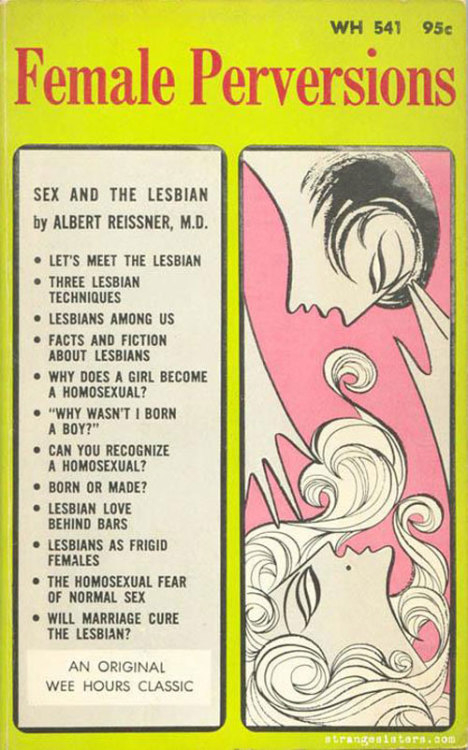
Female Perversions: Sex and the Lesbian by Christian author Dr. Albert Reissner in 1965 (Found @aflashbak; For a related video, click here http://christiannightmares.tumblr.com/post/21153777834/rosie-odonnell-quotes-the-bible-to-a-street)
MattalystHere's to lapses in Youtube's censorship!


She would not cower in fear of the Muslim menace. She would not hide out in her aerie high above Manhattan with only her houseboy Manuel and a crate of Dewar’s for company. No sir, not Sister Peggy Noonan of Our Lady of the Xanax Brain Cloud! The dirty savages might have attacked a newspaper office and cut down beloved members of France’s press, but they could not kill the spirit of free nations! Turn it into a raft of terrified, paranoid, jingoistic chest-beating sociopaths bent on revenge, maybe. But never kill it!
So she headed for her office at the Wall Street Journal, Manuel and crate of Dewar’s in tow, to show the Muslims she was fearless. “I’m not afraid of you!” she screamed at the turban-clad terrorist manning the newsstand on 3rd and 68th.
“Meesus Peggy, that is Adar from Mumbai. He is Hindu,” the patient but slightly strained voice of the Dewar’s-laden Manuel said from behind her.
“I’m not afraid of you!” she shouted at the brown-skinned menace shoveling snow away from the front door of the bodega at 65th.
“That is a Mexican,” Manuel explained. “You have seen many of them before.”
“I’m not afraid of you!” she hollered into the dark face that had been trailing her since she left home.
“I am Manuel. I work for you.”
This was confusing. She hoped the office was close. She had thoughts to order.
Maybe it would be instructive to look at how we in the West handle what is rude and unpleasant and offensive.
The problem is that the savages do not understand how civilized people do things in the West. She would explain it to them, as if she were an intrepid explorer from a Rudyard Kipling story.
In the late 1980s, Andres Serrano produced “Piss Christ,” a photograph of a small crucifix submerged in the artist’s urine. That didn’t go over well with a lot of Christians. They wrote op-eds, protested peacefully, and criticized the National Endowment for the Arts for subsidizing the work with tax money. The arguments were vigorous. But the protests were peaceful, and no one even dreamed of harming the artist.
Had Andres Serrano or any of the gallery officials who showed his work received death threats? Who knew! Those had been crazy times. If only there was some way she could quickly look up that information to see how even how her fellow Catholics in France reacted to “Piss Christ.” Ah well, she was sure the same fact-checker who worked on all her columns would catch that one if she was mistaken.
Or maybe the artists were just talentless hacks producing the only thing they were good at: publicity.
This was her column, not Twitter, but she saw no reason why she could not use that famous literary device known as a “subtweet.” She was sure a certain snarky political blog would get the message.
A singular feature of extremist Islamists is that they are not at all interested in persuasion. They don’t care about winning you over, only about making you submit. They want to menace and threaten. They want to frighten. They enjoy posing with the severed head.
Americans never do that sort of thing. And if they do, it is just fraternity hijinks. The West cannot be blamed if a young man sees pictures from, say, Abu Ghraib during the Iraq War and becomes a radicalized jihadi who goes on to kill 12 people in a newspaper office in Paris years later. That is just crazy talk.
It is the West’s job not to be overcome by fear, not to give an inch.
Steady is the word.
Yep, steady as an old newspaper columnist who hadn’t gulped down any Dewar’s for at least 10 minutes. That’s how the West reacts to attacks by radical Islamic fundamentalists.
Peggy smiled, puffed up by words she could easily imagine Churchill reciting to Parliament even as Luftwaffe bombs rained down all around them and the populace of London cowered in the tubes below. If only she had been his speechwriter! The war would have been over before Dunkirk.
This was turning out to be her greatest column yet.
[WSJ]
MattalystTo-do.
When a celebrated director helms the first-ever adaptation of a book by a notoriously cerebral author, the natural impulse is to overanalyze. This is the blessing and the curse facing Inherent Vice, the rare stoner comedy that will receive more critical attention than it should. The movie’s based on the 2009 novel by Thomas Pynchon, the notoriously camera-shy author considered a paradigmatic postmodernist. It’s directed by Paul Thomas Anderson, the rare Hollywood creative who can produce enigmatic films of epic lengths within the studio system, the last of which, The Master, showed his unaccommodating art at its peak. Considering all this, the stakes were always going to be too high for this film.
But at its most basic level, Inherent Vice, in book and film forms, isn't asking for probing inquiry: It's about a pothead bumbling around L.A. There’s a quest, of sorts, resembling the concept of a '40s noir: In 1970, private investigator Larry “Doc” Sportello (Joaquin Phoenix) is visited by his tall, tanned California ex-flame Shasta Fay (Katherine Waterston, a femme fatale in an orange high-necked minidress). She's now dating a real estate mogul named Michael Wolfmann, but there's trouble in paradise: Wolfmann’s wife and her boyfriend want Fay’s help in committing Wolfmann to a mental institution to make off with his money. Before long, Fay’s disappeared, Doc’s set up for the murder of the tycoon’s bodyguard, and he starts looking into Wolfmann, aimlessly because he’s stoned.
If the investigation sounds like an odyssey, it comes together by coincidence. A Black Panther asks Doc to locate Wolfmann's bodyguard (who happens to be involved in the Aryan Brotherhood). A heroin-addict-turned-drug-counselor's request that he determine if her late husband is actually dead turns up intelligence interest at the federal level, and an old acquaintance of Wolfmann's, Jade (Hong Chau, supremely funny). The new characters and odd coincidences point him to a larger conspiracy involving a mysterious entity known as the Golden Fang, which could alternately be a luxury schooner, an Indo-Chinese drug ring, or a syndicate of dentists.
It's taken 50 years for a work by Thomas Pynchon to come to the big screen because his narratives are impossible to follow, by design perhaps. Pynchon's novels contain dozens of characters, wordy, indirect language, loose ends, and perhaps most obviously difficult for studios with a deadline, incredible attention to detail. (Pynchon’s Inherent Vice made reference to an encyclopedia of California ’70s miscellany including: chocolate-covered bananas, pooka-shell necklaces, liquid eyeliner, shag-carpeted walls, whorehouse menus, and ’fros.)
This is—unfortunately for the success of the movie as a mystery but really great for its value as comedy—a very faithful adaptation. The movie’s at its best when it’s visually riffing on the sudden appearances of dissonant characters and things in Pynchon’s prose. These motifs show up in the movie version like bad pennies, conjuring the sense of paranoia Doc’s feeling as he goes down the rabbit hole of finding Shasta surrounded in a haze of smoke. It's hard not to go down with him. When a client who's supposed to be in hiding shows up protesting a Nixon speech on television, is that a sign? An indication of a larger conspiracy at play? Who’s in charge here? Even for the viewer who hasn't lived through the ’70s and experienced Nixon in office, the era’s anxiety over the higher powers are expertly induced.
And it’s really, really tempting to spend the movie trying to make sense of it all. There are a lot of good analyses already, and I’m partial to the overarching opinion so far that this movie, like so many others by Anderson, depicts the end of an era: Here the shift is from ’60s counterculture to ’70s popular culture, in others the end of the porn auteur, the death of his father (see Marc Maron’s recent WTF podcast for more details), and the turn of the century.
But Inherent Vice could just as equally be “about” the history of California, fear of authority, the rise of capitalism, postmodernism, The Movies, and/or an insurance policy (“inherent vice” refers to a clause in policies that excludes coverage when a loss is caused by a quality in the property itself). At one point during the film I wrote in my notebook, GOLDEN FANG = AMERICA. It seemed plausible at the time. In the cold light of day it looked more like a conclusion come to whilst on strong substances.
Which is the point, of course. Inherent Vice inherently rewards only half-serious analysis: Anything more is just as much a trap as is assuming Pynchon was being serious about the postage-stamp conspiracy in The Crying of Lot 49. Anderson's latest is defiantly unresonant, a movie about the decline of marijuana culture a year after it became legal in some states. It's funny and light in the box-office season when most everything else is serious and has gravity. (How refreshing to have a psychedelic druggie mystery in the mix.) Semiotics nerds, who so love Pynchon, might call the effort a fitting moment when a familiar signifier (Paul Thomas Anderson) doesn't necessarily line up with an agreed-upon signified (deep masterpiece) and creates a feeling of postmodern unease. I call it Anderson finally enjoying the clout he’s reaped.
The actors are having a good time, too. Joaquin Phoenix pulls off the blazed look of alarm masterfully, even if he mumbles his lines on occasion (Pynchon enunciates). As Lt. Det. “Bigfoot” Bjornsen, Brolin’s even better: His LAPD officer and wannabe-TV actor is given the best scene in the entire film, just as iconic as “I drink your milkshake!” from There Will Be Blood. Cat (Brolin) and mouse (Phoenix) run into a host of Hollywood character-actor champions along the way, from the great Jena Malone to Owen Wilson to Michael Kenneth Williams. They eat a lot of pizza, smoke a lot of pot, shoot some dope. They make reference to the Red Scare, the Black List, and James Wong Howe. If the adaptation’s a little too faithful to sustain a cinematically tight story, there’s still a lot to admire in the sheer, uninhibited folly of the whole thing, the gall to get groovy while the Oscar-watchers are on high alert.
This article was originally published at http://www.theatlantic.com/entertainment/archive/2015/01/inherent-vice-dont-overanalyze-it/384368/

MattalystJust skip to the study:
http://www.plosone.org/article/info%3Adoi%2F10.1371%2Fjournal.pone.0115255
:strip_icc(1)/https%3A%2F%2Fs3.amazonaws.com%2Fpolicymic-images%2Flzrhyxqx2jj0gfyfgzxm5axkk7ubiyfrlvvtr8uasdona6hws5rmovu3ztlykolt.jpg)

Other than ingesting alcohol and narcotics in sufficient doses to induce a state of analgesia, for most of its history, people in the West got through surgery with the aid of little more than forcible restraint and grit.


Vindication is yours! If you've been demanding that your friends put down the selfie stick and stop posting every goddamn photo of themselves online because it's probably a sign of severe mental illness, you've finally got some research to back all of that up. It appears that people who post lots of selfies score higher on measures of narcissism (bad) and psychopathy (more bad).

MattalystPutting this on Youtube forever is pretty much the cruelest thing you can do to these kids' future selves.

Here’s a pretty amusing video of befuddled kids learning about sex for the very first time on camera. One kid was already hipped to the birds and the bees to his father’s shock (his older brother told him), but others were convinced babies came from the butt...
 From
From 


