Shared posts

08 Jan 18:19

Why the Republican Congress’s First Act Was to Declare War on Math

by Jonathan Chait

The first substantive act of the new, all-Republican Congress was a telling one: House and Senate leaders, now in partisan accord and able to impose an undiluted partisan imprint upon the institution, struck a blow in their decades-long struggle on behalf of low taxes for the rich and against the ... More »


08 Jan 02:35

the-goddamazon: fragileblackgirl: circuitfry: functional...


the-goddamazon:

fragileblackgirl:

circuitfry:

functional jet-propulsion swimming robot legs

aqua-cyborg

*deep inhale* 🙊😺

I’m just thinking about the leaps and bounds this could mean for disabled folks.

07 Jan 22:47

BirthMachine by HR Giger

by take-me-far-away-from-here


BirthMachine by HR Giger


07 Jan 22:20

You've Heard Of The Selfie Stick, Now Meet The Belfie Stick

by Taylor Lorenz
Mattalyst

The official media accessory of /r/gonewild

Belfie Stick

2014 was the year the selfie stick firmly took hold in American culture. But 2015 could be the year of the Belfie Stick. 

If you’re unfamiliar, a belfie is essentially a selfie taken of your rear end from behind.

Coined by Kim Kardashian, the belfie pose is favored among celebrities like Rihanna, Miley Cyrus, Heidi Klum, Nicki Minaj, Cara Delevingne, and Jen Selter.

A belfie is not easy to take, however. It is inherently a very advanced level of selfie.

Unless you’re taking the photo through a mirror, you need to hold, focus, and frame a photo over your shoulder, all without being able to see the shot.

The Belfie Stick streamlines this process.

Unlike a normal selfie stick, the Belfie Stick is bendable and ideal for taking photos from behind. The titanium steel stick can be bent and angled according to your preference and it’s easy to take a causal looking belfie that, to the viewer, looks like a casual glance over your shoulder.

The Belfie Stick was created by the selfie experts at ON.com, a photo-based social networking site.

"Our users are our biggest indicator of selfie trends being that it’s the type of photo they post most often,” says ON.com’s CTO Kevin Deegan. “We’ve noticed a huge spike in users taking butt selfies in recent months so the natural next step was for us to develop a device to assist our users in taking one.”

 on


Before creating the product, On.com polled over 10,000 selfie experts. They found that many users wanted to highlight their assets from behind, but had difficulty maneuvering this type of shot with a traditional selfie stick. They created the product to meet this demand. 

The Belfie Stick is available for preorder here for $79.99. 

Join the conversation about this story »


07 Jan 22:18

The Daniel Plan In Action

Mattalyst

I guess it was inevitable :/

Learn more about The Daniel Plan In Action. For more information and to order, visit http://danielplaninaction.com
07 Jan 20:14

Exoplanet Travels

07 Jan 20:04

A New Drug in the Age of Antibiotic Resistance

by Cari Romm
Mattalyst

Pushing that boulder just a few inches back up towards the top of the hill.

Two alarming figures from a report released last month by the U.K. government: By 2050, antibiotic resistance will cost the world a projected 10 million lives and $8 trillion each year.

The report is one more in a growing collection of dire pronouncements about the current state of antibiotics: This past summer, Thomas Frieden, the director of the Centers for Disease Control and Prevention, warned that antibiotic resistance could be “the next pandemic.” In March 2013, England’s chief medical officer urged lawmakers to add antibiotic resistance to the government’s list of civil emergencies, a registry of contingency plans for situations like terrorist attacks and major floods. And last April, the World Health Organization issued its own report, declaring that “a post-antibiotic era—in which common infections and minor injuries can kill—far from being an apocalyptic fantasy, is instead a very real possibility for the 21st century.”

In the U.S. alone, antibiotic-resistant bacteria infect more than two million people each year, killing around 23,000 of them. Meanwhile, scientists are struggling with a losing race against the clock, as bacteria evolve to evade our drugs faster than we can make new ones. But researchers at Northeastern University say they’ve discovered a new antibiotic that may buy us some time. In a paper published today in the journal Nature, they describe teixobactin, a compound they say hasn’t encountered any resistance from the bacteria it attacks.

According to the researchers, teixobactin’s strength lies primarily in its means of attack: “Antibiotics usually hit one defined target, some important protein in the cell,” says Kim Lewis, the lead researcher for the project and a biology professor at Northeastern University. Teixobactin, by contrast, “hits two different targets,” both polymers that build the bacterial cell wall.

“Normally, the way resistance is acquired, there’s a mutation in the [bacterium’s] DNA. A gene changes, so the protein target changes and no longer binds to the antibiotic,” he explains. “These polymers are not coded by genes. They’re made by enzymes, and there’s nothing to mutate. So in a way, they’re immutable targets.”

Once the compound is further developed into a drug, the researchers say, it can be used treat superbugs currently immune to most available treatments, including methicillin-resistant Staphylococcus aureus (MRSA), a type of staph infection common in healthcare settings, and drug-resistant tuberculosis.

Many antibiotics currently in use come from species found in soil—but while the earth was once fertile ground for new compounds, “overmining of this limited resource by the 1960s brought an end to the initial era of antibiotic discovery,” according to the Nature paper, as only around 1 percent of soil organisms can be cultivated in a lab. “So we decided to see if we could tap into uncultured bacteria, the remaining 99 percent,” Lewis says. After developing a method to grow and test soil bacteria in their natural environment, the research team discovered a new species of bacteria, Eleftheria terrae, that produces teixobactin.

The discovery comes at an otherwise frustratingly stagnant time for antibiotic development. Sold for relatively cheap and taken for only a short time, antibiotics are less lucrative than the drugs used to treat chronic diseases. As a result, companies have increasingly focused their attention elsewhere; in 2011, Pfizer, one of only a handful of large pharmaceutical firms working on antibiotic development, shuttered its antibiotic research lab in Connecticut. “The decline in antibacterial drug research and development in the private sector, at a time when serious antibiotic resistant infections are on the rise, is a tremendous public health problem,” Janet Woodcock, the director of the Center for Drug Evaluation and Research, testified before an Food and Drug Administration committee in September.

Teixobactin may encounter bacterial resistance further down the road, Lewis admits, though he predicts it would be at a slower pace than most antibiotics. While widespread resistance to new drugs typically takes anywhere from weeks to years, Lewis anticipates that resistance to teixobacitn may take decades to develop, citing vancomycin, a drug often used to treat MRSA infections, and considered a drug of last resort—one typically saved unless there are no other options. Developed in England in the 1960s, vancomycin, which also targets a bacterial cell-wall polymer rather than a protein, only began to encounter resistance in the 1990s. “So that gives us an idea of how long it will take for resistance to develop to teixobactin,” he says. “It should take more than 30 years.”

But while the lack of resistance may not be permanent, teixobactin’s discovery may inject new energy into a field where need remains far ahead of progress. “The low-hanging fruit has been picked,” infectious-disease researcher Brad Spellberg told the WHO in 2011. “But the concept that we’ve exhausted the pantry is ridiculous.”

This article was originally published at http://www.theatlantic.com/health/archive/2015/01/a-new-drug-in-the-age-of-antibiotic-resistance/384291/


07 Jan 19:09

Charlie Hebdo and the Right to Commit Blasphemy

by Jonathan Chait
Mattalyst

Yes, exactly. I'm not interested in any arguments about how the victim was asking for it, going out dressed like that.


Just over three years ago, the office of Charlie Hebdo, the French satirical magazine whose staff was horrifically murdered, was firebombed. Time’s Paris bureau chief, Bruce Crumley, responded to the attack at the time with an outpouring of anger and contempt — mostly aimed at the target of the attack. ... More »


07 Jan 18:48

Thync, a Wearable That Zaps Your Brain To Calm You Down or Amp You Up

by Soulskill
Mattalyst

Hmm. I'm dubious, but, possible....

blottsie sends this first-hand report on how it felt to use a wearable device called Thync, which sends small amounts of electricity into your brain for the purpose of either calming you down or making you feel energized. While the unit I used isn't the finalized physical version, the best way to describe it is as a two-part device, one of which is fasted to the front of the right side of your temple, and one behind your right ear. It's not a helmet, which is what I absolutely assumed it would be. It's relatively discreet sort of dual patch system ... It didn't... hurt. Hurt isn't the right way to describe it. It felt like a tightness; it felt like the patch was trying to crawl across my skin. But — if you can believe this — in a good way. And while Thync was attached to the right side of my head, occasionally I felt 'tingles' pulling and hitting my brain on the left side and in the middle. I was feeling progressively awake and aware. Granted, I had patches stuck to my head sending gentle vibrations to my brain, so that might have been part of my sudden alertness. But still, after 20 minutes of Thync I just felt... better.

Share on Google+

Read more of this story at Slashdot.


07 Jan 18:42

f e e l i n g s


f e e l i n g s

07 Jan 18:28

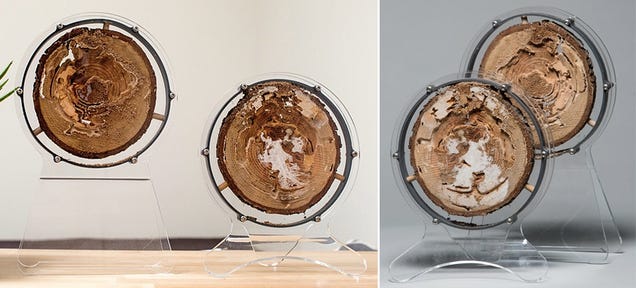
Ants Are So Passé, You Need a Termite Farm On Your Desk

by Andrew Liszewski

Ants Are So Passé, You Need a Termite Farm On Your Desk

Is there any better way to relax than being reminded of your species' dominance on this planet while watching a bunch of bugs trapped in a clear plastic enclosure? Not likely. But ant farms are so yesterday, what you need is your own personal termite farm, and that's exactly what the Termitat delivers—complete with a slice of Douglas Fir to keep them fed for up to two years.

Read more...


07 Jan 17:06

flexpuke: fucbad: truedoommurderhead: anarchacannibalism: can...


flexpuke:

fucbad:

truedoommurderhead:

anarchacannibalism:

canonicalmomentum:

nostalgebraist:

ghostdunk:

from the ARNELL GROUP’s “BREATHTAKING” Pepsi logo redesign document from 2009

"Pepsi Geometries: Perimeter Oscillations"

accurate depiction of face after reading this

capitalism is utterly baffling

this is the purest Accelerationist document i’ve ever read. please, please read the brand guidelines. the picture attached does not even begin to describe the depths of horror this thing reaches into. this document about a soft drink contains a 5000 year timeline and a discussion on sacred geometry. these are the end times.

enter the pepsi orb

Sometimes I forget how much I hate capitalism.

what the fuck this is so absurd

07 Jan 16:32

Photo


06 Jan 22:25

AT&T has 10 businesses paying for data cap exemptions, and wants more

by Jon Brodkin
Mattalyst

An economic slippery slope. Each additional business that pays for a cap exemption reduces the cost to AT&T's reputation of keeping caps small (because fewer customers will notice what their cap is). To simplify, then, each cap exemption customer can be said to reduce the consumer data cap a year from now by some fixed amount of data. And the lower AT&T's data cap is, the more incentive OTHER businesses have to pay for a cap exemption.

So it's a self-sustaining business model, in that the more they sell, the easier it is to sell. Oh, and of course consumers get fucked as we slide down the slope, too: fewer and fewer minutes of interaction are possible each month with non-profits, startups, and other content providers who aren't yet trying to monetize them.

A year after AT&T started charging businesses to deliver data without counting against customers' mobile data caps, the wireless carrier has 10 companies signed up and is hunting for more.

Those 10 businesses represent a larger number of companies and services, because some have created their own platforms based on AT&T's "Sponsored Data" that can be used by third parties. AT&T CMO David Christopher said in an interview with FierceWireless that the company is "very bullish" on Sponsored Data and thinks it will spur new business models for companies delivering data to AT&T customers.

"What we said last year, and what we've continued to say, is Sponsored Data is a really unique, interesting capability that is going to take time for it to evolve into various business models," Christopher said, according to FierceWireless' article yesterday. "We are seeing interest from a variety of developers and content owners in Sponsored Data."

Read 6 remaining paragraphs | Comments

06 Jan 21:50

50 shades of Gronk: Of course there's Patriots erotica

by adamg
Mattalyst

"Q: Tell me about the story’s climax, where Rob Gronkowski spikes a football into the heroine’s butt. Was that always the plan, or did that plot point sort of evolve naturally?

A: It’s hard to remember exactly how it evolved. I think I just started writing it and let it go where it wanted to."

06 Jan 19:55

Photo


06 Jan 18:15

Taming Christian Rage

by Emma Green

It's a semiannual tradition in America: the culture-war debates. Is there a culture war in America, ask pundits and professors and journalists, or isn't there? And if there is one, is it over yet?

As with any tidy narrative, the culture war can be somewhat shape-shifting, invoked in ways that diverge from how the sociologist James David Hunter first wrote about it in 1991. But the gist is this: In debates over social issues like abortion, homosexuality, and birth control, American culture and politics is divided into two camps: the orthodox—or traditionalists, or conservatives—versus progressives. Often, these issues are discussed in terms of religious values and religious freedom. Accurately or not, "the culture wars" are often referred to in terms of religious America vs. secular America—and, sometimes, the Christian right vs. everyone else.

As Pat Buchanan said in his speech at the 1992 Republican National Convention, "There is a religious war going on in our country for the soul of America. It is a cultural war, as critical to the kind of nation we will one day be as was the Cold War itself." But today's culture war, if there even is one, doesn't seem to be about winning America's soul—it's about people's right to live their lives according to their beliefs.

The past year saw a renaissance in culture-war thinkpiece writing, with the fight being declared over and not over and over again in many turns. That's because many of 2014's big news stories touched on culture-war standards, like gay marriage, public prayer, and birth control. This year's list of Big Issues could have easily been from the 1980s—the heyday of the Moral Majority—instead of 2014.

But the fascinating thing is that these issues of culture-war vintage have played out in distinctly un-culture-war-y ways. Unlike the alleged culture wars of yore, these legal battles aren't about shaping culture and laws in favor of one side or another—they're about individual conscience.

Gay marriage, for example, has been a long-simmering, divisive political issue. Same-sex marriage is now legal in 35 states, and in nearly a dozen others, court decisions for or against same-sex marriage are pending. In November, the Sixth Circuit Court of Appeals upheld same-sex-marriage bans in Kentucky, Michigan, Ohio, and Tennessee, which will likely lead to a Supreme Court review of the issue.

Arguably, the many court decisions that overturned same-sex-marriage bans last year were enabled by shifts in public opinion, which has steadily moved in favor of gay-marriage legalization over the last decade. Yet, as I pointed out in March, a slim majority of Americans still think gay sex is morally wrong. What can be made of this apparent contradiction?

The answer doesn't fit neatly within a typical culture-war framework. Unlike Buchanan's 1992 battle cry, many of today's debates over social issues imply a respect for people's private lives. In a March poll of public opinion on gay marriage, 53 percent of respondents said they support gay marriage, while only 43 percent said they morally approve of gay sex. The gap in these numbers—presumably, the 10 percent of respondents who are fine with gay marriage but not fine with gay sex—suggests an interesting posture doesn't quite square with the two-camp logic of the culture war: People can support a law without agreeing with what that law allows.

There's a version of this dynamic at work in another yet-to-be-resolved controversy related to gay marriage: A number of people who bake cakes, cut flowers, and provide other services at weddings have refused to work at same-sex ceremonies and celebrations. It seems likely that many of these people do not support gay marriage at all, but that's actually somewhat irrelevant. This issue is specifically about people's private lives: Should people be required to do work in service of something they disagree with?

This is similar to the central question of last summer's debates over the Supreme Court's decision in Hobby Lobby v. Burwell, which prohibited the federal government from requiring closely held private businesses to provide birth-control coverage in their employee insurance plans. Proponents of birth-control access were outraged at the decision. But as John J. Dilulio Jr., the first director of the White House Office of Faith-Based and Community Initiatives, wrote at Brookings, "love it or loathe it, the Hobby Lobby decision is limited in scope." Although the case touched on many culture-war themes, including female sexuality and access to contraception, it was really a decision about whether companies can be required by the government to pay for birth control if the owners have a moral objection to it—not whether taking birth control is, itself, right or wrong.

Of course, it's not the Supreme Court's job to decide what is and is not moral—to a certain extent, rulings are always an act of balancing one group's rights against another, not adjudicating who is or is not morally correct. Besides, the idea of the culture war extends beyond court decisions and government policies. The least tangible, and perhaps most influential, front in the culture war is the public sphere: the talking heads who bemoan the war on Christmas, the liberal pundits who rage against conservative bigotry, the religious figures who rally their flocks to defend traditional values. As Hunter pointed out in a 2006 panel discussion on this topic, if there is a culture war in America, it's not really fought among the American people at large. It's waged and sustained by elites.

But even the standard cast of culture-war characters seems to be losing its influence—or its interest in sustaining a one-note, cliched stream of outrage. The Southern Baptist Convention, for example, has historically been a strong force in stoking culture-war rage. In 2013, Richard Land, who served as president of the organization's Ethics and Religious Liberty Commission for 25 years, was forced to retire after making controversial remarks about the Trayvon Martin case. In his resignation letter, he specifically paid homage to the culture wars. "I believe the 'culture war' is a titanic spiritual struggle for our nation's soul and as a minister of Christ's Gospel, I have no right to retire from that struggle," he wrote.

Yet over the past year and half, his successor Russell Moore has subtly and meaningfully shifted the Baptists' rhetoric. In an interview about the Southern Baptist Convention's stance on sexuality in May, he stood firmly against gay marriage—yet, he said, "You don’t ridicule people into the kingdom." And instead of turning the shooting deaths of Michael Brown and Eric Garner into political weapons like his predecessor, he issued a statement saying that "it’s high time we start listening to our African American brothers and sisters in this country when they tell us they are experiencing a problem."

There were other examples of the public-information culture war receding in 2014, especially among conservatives. As Molly Ball wrote recently in The Atlantic, Erick Erickson, one of America's most powerful and outspoken conservatives, has condemned the political right's "constant state of hair-on-fire, yelling anger." Bill O'Reilly even gave up the war on Christmas schtick this year, sort of.

The outrage machine is still alive and well—it pays to rage, especially about ideological differences. But America's most fascinating pluralistic challenges seem to be aligned along a different axis these days: How should the way I want to live my life affect your life, and vice versa? These are battles over private lives, not public communities, which might be a sign of Americans' growing tolerance of others' beliefs—or a retreat from intellectual diversity, a crystallization of the social and economic boundaries between those who see the world differently. The latter seems more likely: From the firing of Brendan Eich to the protests against eating at Chick-fil-A to the cake-baking controversies in Arizona and Colorado and Oregon, some Americans seem to want to go about their private work and lives without exposure to opposing world views.

Then again, it's nothing new to question the culture-war framework. When Hunter's book on the topic was published in 1991, The New York Times ran not one, but two, reviews, with both coming to a conclusion along these lines: "The American people's reaction to cultural conflicts is much more complex, nuanced, ambiguous and ambivalent than any two-category typology might suggest."

This article was originally published at http://www.theatlantic.com/politics/archive/2015/01/taming-christian-culture-war-rage/383908/


06 Jan 16:41

The Department of Awesome Natural Wonders would like to remind...


The Department of Awesome Natural Wonders would like to remind you that mushrooms are strange, fascinating and sometimes exquisitely beautiful things. Bored Panda assembled a fantastic collection of some of the most stunning fungi photos we’ve ever seen.

These photos were taken by Bernhard Pfister, Patricia Woods, Martin Pfister, Steve Axford (previously featured here), Eric Balcon, Maneesh, Wojciech Grzanka, and H Richard Ellis respectively.

Head over to Bored Panda for even more.

06 Jan 16:40

Mommy, why is there a home server in the house?

The most viral images on the internet, curated in real time by a dedicated community through commenting, voting and sharing.

That file type is not supported!

Supported formats: JPEG, GIF, PNG, APNG, TIFF, BMP, PDF, XCF

06 Jan 14:32

unexplained-events: Lucifer (Morningstar) A wax sculpture...

by hellabeautiful
Mattalyst

In a church, no less.


unexplained-events:

Lucifer (Morningstar)

A wax sculpture depicting the devil snared in a set of power lines built by Paul Fryer. The sculpture is illuminated by the church’s stained glass windows.

It can be seen at The Holy Trinity Church in Marylebone, Westminster.

06 Jan 14:31

Photo


06 Jan 06:12

A Trip to the S&M Dentist

by Olivia Richardson

[body_image width='1200' height='1800' path='images/content-images/2014/12/23/' crop='images/content-images-crops/2014/12/23/' filename='dentist-fashion-shoot-294-body-image-1419354957.jpg' id='13930']

William Wilde dress, Libidex gloves, Fabulously Fetish heels, Yael Salomon bracelet and ring

PHOTOGRAPHY: OLIVIA RICHARDSON
STYLING: ALICE BURNFIELD

Hair: Satomi Suzuki
Set designer and props: Marisha Green
Make-up: Nicola Moores-Brittin at Untitled Artists LDN
Photographer's assistant: Alice Bullough
Models: Paloma at Profile and Abby at Anti-Agency

[body_image width='1200' height='1680' path='images/content-images/2014/12/23/' crop='images/content-images-crops/2014/12/23/' filename='dentist-fashion-shoot-294-body-image-1419355027.jpg' id='13931']

William Wilde bra, Manuela Dack skirt, Angels lab coat, So High Soho hat

[body_image width='1200' height='1680' path='images/content-images/2014/12/23/' crop='images/content-images-crops/2014/12/23/' filename='dentist-fashion-shoot-294-body-image-1419355086.jpg' id='13932']

William Wilde dress, Libidex gloves, Yael Salomon bracelet

[body_image width='1200' height='857' path='images/content-images/2014/12/23/' crop='images/content-images-crops/2014/12/23/' filename='dentist-fashion-shoot-294-body-image-1419355141.jpg' id='13933']

William Wilde bra, Manuela Dack skirt, So High Soho hat; William Wilde bow; Lucilla Gray white bodysuit

[body_image width='1200' height='1759' path='images/content-images/2014/12/23/' crop='images/content-images-crops/2014/12/23/' filename='dentist-fashion-shoot-294-body-image-1419355257.jpg' id='13936']

William Wilde bow

[body_image width='1200' height='1680' path='images/content-images/2014/12/23/' crop='images/content-images-crops/2014/12/23/' filename='dentist-fashion-shoot-294-body-image-1419355304.jpg' id='13938']

William Wilde top

[body_image width='1200' height='1800' path='images/content-images/2014/12/23/' crop='images/content-images-crops/2014/12/23/' filename='dentist-fashion-shoot-294-body-image-1419355333.jpg' id='13940']

William Wilde top and knickers, Honour latex stockings, Fabulously Fetish heels

06 Jan 05:35

This Is the Video CNN Will Play During the Apocalypse

by tom.leo.mckay@gmail.com (Tom McKay)

Whether it's a plague, alien enslavement, planet-killing asteroids or the sun finally saying screw it and exploding, CNN has long made clear their intention to broadcast through the apocalypse.

For years, there have been rumors of an alleged tape the network would play during the end of days, but now Jalopnik's Michael Ballaban has turned up proof of CNN's plan to be the last news network standing. Labeled "TURNER DOOMSDAY VIDEO," it has a blunt description reading "HFR [hold for release] till end of the world confirmed":

Source: YouTubeNestled deep in CNN's archive, a low-resolution video of a military band playing "Nearer, My God, to Thee" remains ready for broadcast. Read More
05 Jan 23:36

Scarlett Johansson to star in live-action "Ghost in the Shell" movie

by Xeni Jardin
Mattalyst

Can this even be real? God, I hope so.

This should be interesting. Read the rest
05 Jan 21:46

“Electrosensitives” flock to Wi-Fi quiet zone as teens set up rogue hotspots

by Jon Brodkin

Cellular and Wi-Fi networks have spread throughout the country to support our growing reliance on smartphones and other portable Internet-connected devices. But in Green Bank, West Virginia, radio transmissions are heavily restricted to protect the National Radio Astronomy Observatory's Robert C. Byrd Green Bank Telescope, “the world's largest fully steerable radio telescope.” The telescope picks up radio waves from space that are weak and thus difficult to detect.

The Federal Communications Commission established the National Radio Quiet Zone in 1958 to protect the observatory’s sensitive radio telescopes from interference, and state law restricts transmissions within a radius of 10 miles of any radio astronomy facility. (The Quiet Zone also protects “radio receiving facilities for the United States Navy in Sugar Grove, WV.”)

The restrictions are annoying to some residents who would like a greater ability to use wireless devices. But for nearly a decade, those limits have ensured that Green Bank has been attracting “electrosensitive” residents, who have ailments they believe are caused by electromagnetic fields. The January issue of Washingtonian magazine has a detailed update on these new residents and on how the radio restrictions affect those who have no objections to wireless technology. The story, titled “The town without Wi-Fi,” also notes that the telescope facility could be shut down due to lack of funding by 2017, potentially leading to the elimination of the wireless restrictions.

Read 9 remaining paragraphs | Comments

05 Jan 18:50

Why the NYPD Turned Its Back on the City

by Ta-Nehisi Coates
Mattalyst

More about their needs than ours, I think; if cops thought like essayists, they wouldn't have chosen the academy on career day. But he's on to something.

On Sunday, a relatively large group of New York police officers, sworn to protect and serve the public, turned their back on the public's elected executive, Mayor Bill de Blasio:

The show of disrespect came outside the funeral home where Officer Wenjian Liu was remembered as an incarnation of the American dream: a man who had immigrated at age 12 and devoted himself to helping others in his adopted country. The gesture, among officers watching the mayor's speech on a screen, added to tensions between the mayor and rank-and-file police even as he sought to quiet them.

This particular protest came after Commissioner William Bratton asked them not to stage a repeat of Officer Rafael Ramos's funeral. This request included the telling caveat, "I issue no mandates, and I make no threats of discipline, but I remind you that when you don the uniform of this department, you are bound by the tradition, honor and decency that go with it."

It's not clear that Bratton could (or should) do much of anything to stop his officers from protesting. But whatever Bratton's sense of honor and decency, it clearly isn't shared by the officers working under him, and it's unlikely that his appeal swayed anyone.

Those who are demoralized by these protests would do well to read James Fallows's cover story on the American military this month. The same cloak of puffed grandeur and bombast that surrounds our army can be detected in our police. Jim is describing a society that has taken its hands off the wheel. Give us safety now (real or imagined), goes the agreement, and we won't ask about what comes later. Until some critical mass of Americans decides that police cannot, all at once, wield the lethal power of gods and the meager responsibilities of mortals, change is unlikely.

And it always was. If the public appetite for police reform can be soured by the mad acts of a man living on the edge of society, then the appetite was probably never really there to begin with. And the police, or at least their representatives, know this. In this piece, by Wesley Lowery, there are several amazing moments where police complain about things Barack Obama and Eric Holder have not actually said. There simply is no level of critique they would find tolerable. Why take criticism when you don't actually have to? Better to remind the public that you are the only thing standing between them and the barbarians at the gate:

“We might be reaching a tipping point with the mind-set of officers, who are beginning to wonder if the risks they take to keep communities safe are even worth it anymore,” Milwaukee County Sheriff David Clarke said. “In New York and other places, we’re seeing a natural recoil from law enforcement officers who don’t feel like certain people who need to have their backs have their backs.”

Here's Radley Balko quantifying those "risks" police officers face:

Policing has been getting safer for 20 years. In terms of raw number of deaths, 2013 was the safest year for cops since World War II. If we look at the rate of deaths, 2013 was the safest year for police in well over a century .... You’re more likely to be murdered simply by living in about half of the largest cities in America than you are while working as a police officer.

Nearly half of those deaths are from automobile accidents. Balko is somewhat frustrated that despite the empirical facts around policing, nothing seems to penetrate the narrative of police living under constant threat. Why? Is it that most people are just basically ignorant of the information? Is it that most people just believe, uncritically, what police officers tell them?

Or is there something more? Forgive me. I have not yet fully worked this all out. But Aleksandr Solzhenitsyn describes the prisoners headed to the Soviet Gulag as waves flowing underground. These waves "provided sewage disposal for the life flowering on the surface." I understand this to mean that the gulag was not just mindless evil—was not just incomprehensible insanity—but served some sort of productive and knowable purpose.

Could it be that believing our police to be constantly under fire is not mysterious—that it serves some productive function, that society actually derives something from its peace officers engaged in forever war? And can we say that the function of the war here at home is not simply a response to violent crime (which has plunged) but to some other need? And knowing that identity is not simply defined by what we are, but what we are not, can it be that our police help give us identity, by branding one class of people as miscreants, outsiders, and thugs, and thus establishing some other class as upstanding, as citizens, as Americans? Does the feeling of being besieged serve some actual purpose?

I am not sure this is all correct. But if the direction is right, then it becomes possible to understand the NYPD's protest (and the toothless admonitions of the commissioner) not as mindless petulance, but as something systemic, as a natural outgrowth of our needs.

This article was originally published at http://www.theatlantic.com/politics/archive/2015/01/why-the-nypd-turned-its-back-on-the-city/384196/


05 Jan 16:20

Robocop, Circa 1924: "The Radio Automata Have No Equal"

by Nick Gillespie

"Such a machine would seem to be exceedingly valuable to disperse mobs, or for war puroposes and even for industrial purposes.... For fighting mobs use is made of tear gas which is stored in a  tank under pressure and which alone will quickly disperse a mob if necessary. The arms are provided with rotating discs which carry lead balls on flexible leads. These act as police clubs in action...Bullets do not affect them and if equipped with a twenty to forty H.P. engine, they will be well nigh irresistible."—Science and Invention, May 1924

As for turning their backs on elected leaders at funerals for slain officers? Well, that depends on who's operating the "automata," doesn't it?

Via the Twitter feed of Hell Is Empty.

05 Jan 05:35

mmmmyup.


mmmmyup.

04 Jan 16:33

Photo


04 Jan 02:23

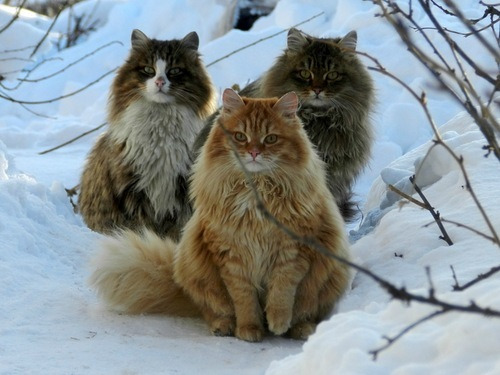
The Norwegian Forest cat (Norsk skogkatt or Norsk skaukatt) is...


The Norwegian Forest cat (Norsk skogkatt or Norsk skaukatt) is a breed of domestic cat native to Northern Europe. This natural breed is adapted to a very cold climate, with a top coat of glossy, long, water-shedding hairs, and a woolly undercoat for insulation. Norse legends refer to the skogkatt as a “mountain-dwelling fairy cat with an ability to climb sheer rock faces that other cats could not manage. (x)