
Shared posts
29 Dec 15:14
Mannequin Spies - Will Dummy Shoppers Revolt?
by Kevin Murray
An Italian firm selling mannequins that secretly monitor the age, race and gender of customers using facial recognition software has come under fire from privacy groups. The information logged by the dummies is then used to implement more effective marketing strategies by stores in the US and Europe.
And the manufacturer now plans to add audio recording to the dummies' capabilities, listening in on customers' discussions about their clients' products.
The mannequins, known as "EyeSee" are manufactured by Italian company Almax and retail for £3,200 each.
Privacy campaigners agree, describing the technology as "creepy" and "totally disproportionate."
Emma Carr, deputy director of campaign group Big Brother Watch, told the Daily Mail newspaper: "The use of covert surveillance technology by shops, in order to provide a personalised service, seems totally disproportionate.
"The fact that the cameras are hidden suggests that shops are fully aware that many customers would object to this kind of monitoring.
"Keeping cameras hidden in a mannequin is nothing short of creepy." (more)
AsSeen on Predicted on TV in 1960!
(YouTube)

And the manufacturer now plans to add audio recording to the dummies' capabilities, listening in on customers' discussions about their clients' products.
 |
| Click to enlarge |
Privacy campaigners agree, describing the technology as "creepy" and "totally disproportionate."
Emma Carr, deputy director of campaign group Big Brother Watch, told the Daily Mail newspaper: "The use of covert surveillance technology by shops, in order to provide a personalised service, seems totally disproportionate.
"The fact that the cameras are hidden suggests that shops are fully aware that many customers would object to this kind of monitoring.
"Keeping cameras hidden in a mannequin is nothing short of creepy." (more)
As
(YouTube)
Massa and -1 others like this
26 Dec 12:15

Are mass shootings really random events? A look at the US numbers.
by aatish
Update (8 January 2013): After I wrote this article, I heard that Mother Jones put their data of US mass shootings online. Going through this data, I realized that I made a number of errors in transcribing the data from their website. I have corrected the numbers and graphs in the plots below. These changes actually make the data fit more poorly to a Poisson distribution, weakening my original claim. I apologize for my sloppiness in this regard.
In the wake of the tragic massacre at Sandy Hook Elementary School, there’s been a lot of discussion about whether mass shootings in the United States are on the rise. Some sources argue that mass shootings are on the rise, while others argue that the rate has stayed more-or-less constant.
Steven Pinker, author of The Better Angels of Our Nature: Why Violence Has Declined was recently interviewed by CNN. When asked whether incidents such as the Sandy Hook massacre represent a real rise in mass shootings, he responded:
It’s not clear whether we’re seeing a real uptick, or just a cluster of events that are more or less distributed at random. You’ve got to remember – random events will occur in clusters just by sheer chance. So we don’t really know whether the fact that there are many of them in the year 2012 represents a trend or just a very unlucky year.
In this article, I’d like to use data available online to address this question.
I recently wrote a post about randomness and rare events. The main lesson from that article is that randomness isn’t the same thing as uniformity. For example, if on average, sharks attack swimmers 3 times a year, then just by chance, you will expect to see years in which no swimmers are attacked, and years in which 7 swimmers are attacked. To our eyes, streaks like this don’t seem random. But, as I argue in my previous post, we are typically not good judges of randomness. In particular, we vastly underestimate the likelihood of such streaks. And so the question is, how can you test whether a set of events is random?
Here’s how. There is a formula that tells you how many times you expect to see streaks arise from a random process. It’s called the Poisson distribution, and it assumes that your events are rare, have a fixed average rate, and are independent (i.e. that events are just as likely to occur at any time). You can then compare the number of predicted streaks to the real number of streaks in your data, and mathematically test whether a set of events is random or not.
To summarize: if the incidences of mass shootings in the US match a Poisson distribution, then this argues that the streaks (years with unusually high number of shootings) are expected due to chance. If the data doesn’t fit a Poisson distribution, then this suggests that it violates one of the assumptions – either mass shootings are not independent events, or the rate is falling, or it’s on the rise.
The data. I downloaded data for mass shootings in the United States occurring from 1982 to 2012, from this comprehensive Mother Jones article on mass shootings. I used their numbers because they compiled information from multiple credible sources, and they clearly outlined the criteria they used to classify a crime as a mass shooting. (Update: this link has the data in easily accessible formats)
Their data shows a total of 62 mass shootings in 31 years – an average of 2 mass shootings per year. However, 2012 was the most violent year on record, clocking in 7 mass shootings. Is this an outlier, or would you expect to see streaks this large, simply due to chance?
To get at this question, I counted years in which there were 0 mass shootings, 1 mass shooting, 2 mass shootings, and so on..
| Number of Mass Shootings in a Year | Number of Years |
|---|---|
| 0 | 3 |
| 1 | 13 |
| 2 | 5 |
| 3 | 5 |
| 4 | 3 |
| 5 | 1 |
| 6 | 0 |
| 7 | 1 |
Out of 31 years of data, we find one year with 7 mass shootings, and four three years with no mass shootings. Are these values consistent with an average of 2 mass shootings a year?
To find out, we can compare these counts to a Poisson distribution with an average value of 2.

In the graph above, the blue bars represent the observed instances of 0,1,2,3.. mass shootings in a year. For example, the long blue bar tells us that there were 10 years with one mass shooting per year. The red dotted curve is the Poisson distribution – these are the outcomes that one expects from a random process with an average value of 2 per year. To my eye, the red curve sort of fits the data, but not quite.
| Number of mass shootings in a year | Observed number of years | Expected number of years (Poisson) |
|---|---|---|
| 0 | 3 | 4.2 |
| 1 | 13 | 8.39 |
| 2 | 5 | 8.39 |
| 3 | 5 | 5.59 |
| 4 | 3 | 2.8 |
| 5 | 1 | 1.12 |
| 6 | 0 | 0.37 |
| 7 | 1 | 0.11 |
But instead of trusting my eye, we can use statistics to compare these two curves. I used a chi-squared test to test whether the two distribution were significantly different, and found a p-value of 0.18 0.09. What does this mean? It suggests that there is no isn’t strong evidence of clustering beyond what you would expect from a random process. In other words, the occurrences of mass shootings from 1982-2012 are consistent not inconsistent with the assumption that shootings are independent events, occurring at an average rate of 2 per year. However, a p-value of 0.18 0.09 is not particularly high, and if we see a few more years another year as extreme as 2012, it’s likely that this will rule out the hypothesis that mass shootings are random events.
What do I conclude from this? If mass shootings are really occurring at random, then this suggests that they are extreme, hard-to-predict events, and are perhaps not the most relevant measure of the overall harm caused by gun violence. (Update: That last claim is my deduction and not a conclusion of the above analysis – In response to some of the comments at hackernews, I wanted to clarify this point.) I agree with Steven Pinker’s take, and with this analysis by Chris Uggen, who says:
a narrow focus on stopping mass shootings is less likely to produce beneficial changes than a broader-based effort to reduce homicide and other violence. We can and should take steps to prevent mass shootings, of course, but these rare and terrible crimes are like rare and terrible diseases — and a strategy to address them is best considered within the context of more common and deadlier threats to population health.
We are compelled to pay attention to extreme events. In the words of Steven Pinker, “we estimate risk with vivid examples that we recall“. But as much as we should try to prevent these horrific extreme events from taking place, we should not use them as the sole basis for making inferences that determine policy. The outliers are a tragic part of the overall story, but we also need to pay attention to the rest of the distribution.
Massa and -1 others like this
24 Dec 21:00



What does randomness look like?
by aatish
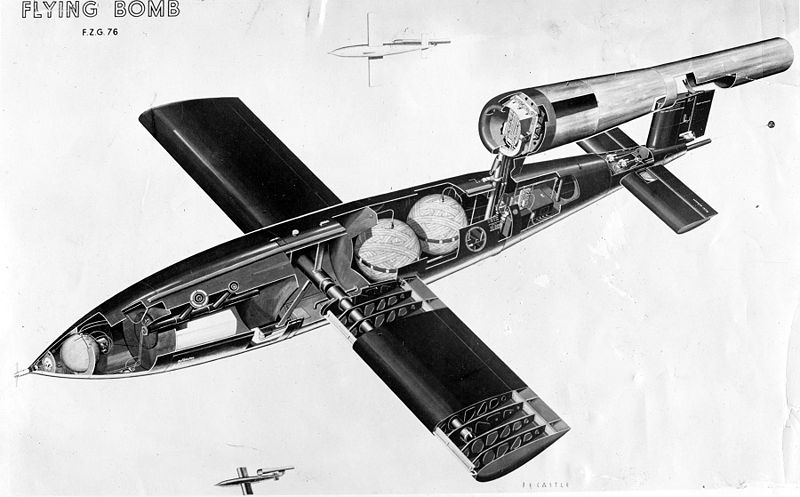
On 13 June 1944, a week after the allied invasion of Normandy, a loud buzzing sound rattled through the skies of battle-worn London. The source of the sound was a newly developed German instrument of war, the V-1 flying bomb. A precursor to the cruise missile, the V-1 was a self-propelled flying bomb, guided using gyroscopes, and powered by a simple pulse jet engine that gulped air and ignited fuel 50 times a second. This high frequency pulsing gave the bomb its characteristic sound, earning them the nickname buzzbombs.
From June to October 1944, the Germans launched 9,521 buzzbombs from the coasts of France and the Netherlands, of which 2,419 reached their targets in London. The British worried about the accuracy of these aerial drones. Were they falling haphazardly over the city, or were they hitting their intended targets? Had the Germans really worked out how to make an accurately targeting self-guided bomb?
Fortunately, they were scrupulous in maintaining a bomb census, that tracked the place and time of nearly every bomb that was dropped on London during World War II. With this data, they could statistically ask whether the bombs were falling randomly over London, or whether they were targeted. This was a math question with very real consequences.
Imagine, for a moment, that you are working for the British intelligence, and you’re tasked with solving this problem. Someone hands you a piece of paper with a cloud of points on it, and your job is to figure out if the pattern is random.
Let’s make this more concrete. Here are two patterns, from Steven Pinker’s book, The Better Angels of our Nature. One of the patterns is randomly generated. The other imitates a pattern from nature. Can you tell which is which?
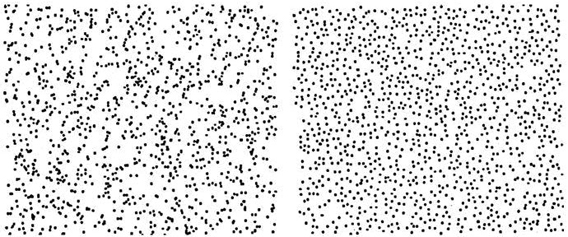
Thought about it?
Here is Pinker’s explanation.
The one on the left, with the clumps, strands, voids, and filaments (and perhaps, depending on your obsessions, animals, nudes, or Virgin Marys) is the array that was plotted at random, like stars. The one on the right, which seems to be haphazard, is the array whose positions were nudged apart, like glowworms
That’s right, glowworms. The points on the right records the positions of glowworms on the ceiling of the Waitomo cave in New Zealand. These glowworms aren’t sitting around at random, they’re competing for food, and nudging themselves away from each other. They have a vested interest against clumping together.
Update: Try this out for yourself. After reading this article, praptak and roryokane over at hacker news wrote a script that will generate random and uniform distributions in your browser, nicely illustrating the point.
Try to uniformly sprinkle sand on a surface, and it might look like the pattern on the right. You’re instinctively avoiding places where you’ve already dropped sand. Random processes have no such prejudices, the grains of sand simply fall where they may, clumps and all. It’s more like sprinkling sand with your eyes closed. They key difference is that randomness is not the same thing as uniformity. True randomness can have clusters, like the constellations that we draw into the night sky.
Here’s another example. Imagine a professor asks her students to flip a coin 100 times. One student diligently did the work, and wrote down their results. The other student is a bit of a slacker, and decided to make up fake coin tosses instead of doing the experiment. Can you identify which student is the slacker?
Student 1:
THHHTHTTTTHTTHTTTHHTHTTHT
HHHTHTHHTHTTHHTTTTHTTTHTH
TTHHTTTTTTTTHTHHHHHTHTHTH
THTHTHHHHHTHHTTTTTHTTHHTH
Student 2:
HTTHTTHTHHTTHTHTHTTHHTHTT
HTTHHHTTHTTHTHTHTHHTTHTTH
THTHTHTHHHTTHTHTHTHHTHTTT
HTHHTHTHTHTHHTTHTHTHTTHHT
Take a moment to reason this through.
The first student’s data has clusters – long runs of up to eight tails in a row. This might look surprising, but it’s actually what you’d expect from random coin tosses (I should know – I did a hundred coin tosses to get that data!) The second student’s data in suspiciously lacking in clusters. In fact, in a hundred coin tosses, they didn’t get a single run of four or more heads or tails in a row. This has about a 0.1% chance of ever happening, suggesting that the student fudged the data (and indeed I did).
Image by Scott Adams.
Trying to work out whether a pattern of numbers is random may seem like an arcane mathematical game, but this couldn’t be further from the truth. The study of random fluctuations has its roots in nineteenth century French criminal statistics. As France was rapidly urbanizing, population densities in cities began to shoot up, and crime and poverty became pressing social problems.
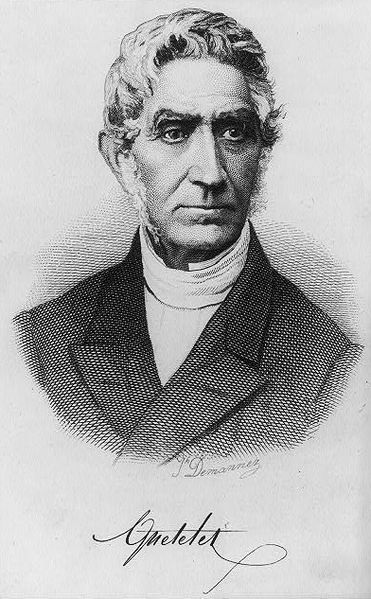
In 1825, France began to collect statistics on criminal trials. What followed was perhaps the first instance of statistical analysis used to study a social problem. Adolphe Quetelet was a Belgian mathematician, and one of the early pioneers of the social sciences. His controversial goal was to apply probability ideas used in astronomy to understand the laws that govern human beings.
In the words of Michael Maltz,
In finding the same regularity in crime statistics that was found in astronomical observations, he argued that, just as there was a true location of a star (despite the variance in the location measurements), there was a true level of criminality: he posited the construct of l’homme moyen (the “average man”) and, moreover, l’homme moyen moral. Quetelet asserted that the average man had a statistically constant “penchant for crime,” one that would permit the “social physicist” to calculate a trajectory over time that “would reveal simple laws of motion and permit prediction of the future” (Gigerenzer et al, 1989).
Quetelet noticed that the conviction rate of criminals was slowly falling over time, and deduced that there must be a downward trend in the “penchant for crime” in French citizens. There were some problems with the data he used, but the essential flaw in his method was uncovered by the brilliant French polymath and scientist Siméon-Denis Poisson.
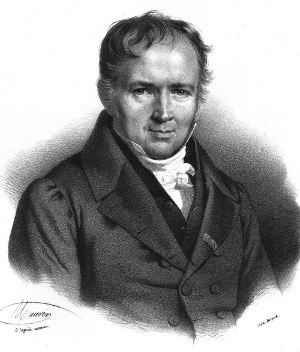
Poisson’s idea was both ingenious and remarkably modern. In today’s language, he argued that Quetelet was missing a model of his data. He didn’t account for how jurors actually came to their decisions. According to Poisson, jurors were fallible. The data that we observe is the rate of convictions, but what we want to know is the probability that a defendant is guilty. These two quantities aren’t the same, but they can be related. The upshot is that when you take this process into account, there is a certain amount of variation inherent in conviction rates, and this is what one sees in the French crime data.
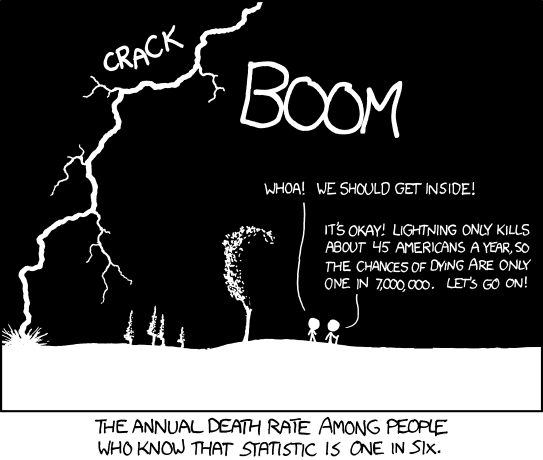
In 1837, Poisson published this result in “Research on the Probability of Judgments in Criminal and Civil Matters“. In that work, he introduced a formula that we now call the Poisson distribution. It tells you the odds that a large number of infrequent events result in a specific outcome (such as the majority of French jurors coming to the wrong decision). For example, let’s say that on average, 45 people are struck by lightning in a year. Feed this in to Poisson’s formula, along with the population size, and it will spit out the odds that, say, 10 people will be struck by lightning in a year, or 50, or a 100. The assumption is that lightning strikes are independent, rare events that are just as likely to occur at any time. In other words, Poisson’s formula can tell you the odds of seeing unusual events, simply due to chance.
By Randall Munroe
One of the first applications of Mr. Poisson’s formula came from an unlikely place. Leap sixty years ahead, over the Franco-Prussian war, and land in 1898 Prussia. Ladislaus Bortkiewicz, a Russian statistician of Polish descent, was trying to understand why, in some years, an unusually large number of soldiers in the Prussian army were dying due to horse-kicks. In a single army corp, there were sometimes 4 such deaths in a single year. Was this just coincidence?
A single incidence of death by horse kick is rare (and assumedly independent, unless the horses have a hidden agenda). Bortkiewicz realized that he could use Poisson’s formula to work out how many deaths you expect to see. Here is the prediction, next to the real data.
| Number of Deaths by Horse Kick in a year | Predicted Instances (Poisson) | Observed Instances |
|---|---|---|
| 0 | 108.67 | 109 |
| 1 | 66.29 | 65 |
| 2 | 20.22 | 22 |
| 3 | 4.11 | 3 |
| 4 | 0.63 | 1 |
| 5 | 0.08 | 0 |
| 6 | 0.01 | 0 |
See how well they line up? The sporadic clusters of horse-related deaths are just what you would expect if horse-kicking was a purely random process. Randomness comes with clusters.
By Ryan North
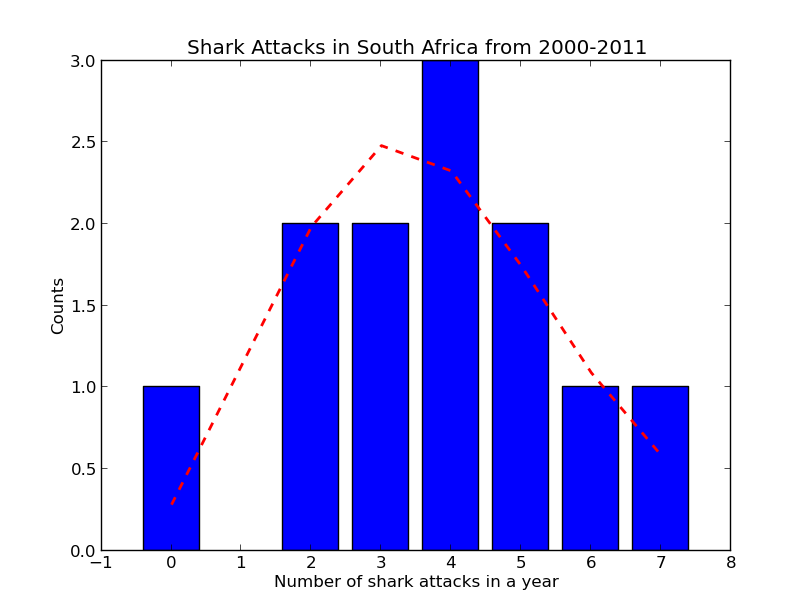
I decided to try this out for myself. I looked for publicly available datasets for deaths due to rare events, and came across the International Shark Attack File, that tabulates worldwide incidents of sharks attacking people. Here’s the data of shark attacks in South Africa.
| Year | Number of Shark Attacks in South Africa |
|---|---|
| 2000 | 4 |
| 2001 | 3 |
| 2002 | 3 |
| 2003 | 2 |
| 2004 | 5 |
| 2005 | 4 |
| 2006 | 4 |
| 2007 | 2 |
| 2008 | 0 |
| 2009 | 6 |
| 2010 | 7 |
| 2011 | 5 |
The numbers are fairly low, with an average of 3.75. But compare 2008 and 2009. One year has zero shark attacks, and the next has 6. And then in 2010, there are 7. You can already imagine the headlines crying out, “Attack of the sharks!“. But is there really a shark rebellion, or would you expect to see these clusters of shark attacks due to chance? To find out, I compared the data to Mr. Poisson’s prediction.
“Anyone else see the shark fin?” Nice catch, by @Gareth_Elms
In blue are the observed counts of years with a 0,1,2,3.. shark attacks. For example, the long blue bar represents the 3 years in which there were 4 shark attacks (2000, 2005 and 2006). The red dotted line is the Poisson distribution, and it represents the outcomes that you would expect if the shark attacks were a purely random process. It fits the data well – I found no evidence of clustering beyond what is expected by a Poisson process (p=0.87). I’m afraid this rules out the great South African shark uprising of 2010. The lesson, again, is that randomness isn’t uniform.
Which brings us back to the buzzbombs. Here’s a visualization of the number of bombs dropped over different parts, reconstructed by Charles Franklin using the original maps in the British Archives in Kew.
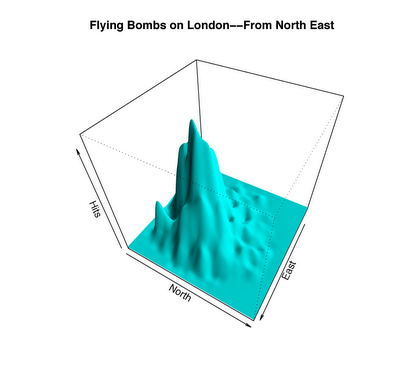
Note: A clarification. The plot above shows the distribution of bombs that were dropped over London. The question I’m asking is, if you zoom in to the part of the city most heavily under attack (essentially the mountain that you see in the figure above), are the bombs being guided more precisely, to hit specific targets?
It’s far from a uniform distribution, but does it show evidence of precise targeting? At this point, you can probably guess how to answer this question. In a report titled An Application of the Poisson Distribution, a British statistician named R. D. Clarke wrote,
During the flying-bomb attack on London, frequent assertions were made that the points of impact of the bombs tended to be grouped in clusters. It was accordingly decided to apply a statistical test to discover whether any support could be found for this allegation.
Clarke took a 12 km x 12 km heavily bombed region of South London, and sliced it up in to a grid. In all, he divided it into 576 squares, each about the size of 25 city blocks. Next, he counted the number of squares with 0 bombs dropped, 1 bomb dropped, 2 bombs dropped, and so on.
In all, 537 bombs fell over these 576 squares. That’s a little under one bomb falling per square, on average. He plugged this number into Poisson’s formula, to work out how much clustering you would expect to see by chance. Here’s the relevant table from his paper:
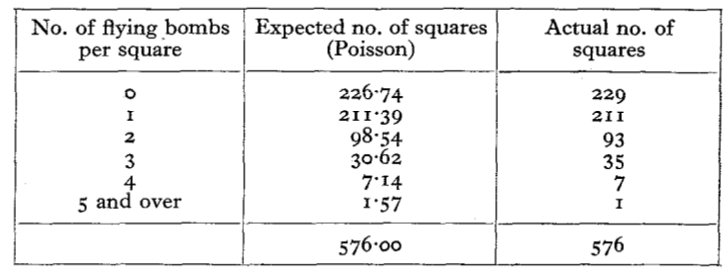
Compare the two columns, and you can see how incredibly close the prediction comes to reality. There are 7 squares that were hit by 4 bombs each - but this is what you would expect by chance. Within a large area of London, the bombs weren’t being targeted. They rained down at random in a devastating, city-wide game of Russian roulette.
The Poisson distribution has a habit of creeping up in all sorts of places, some inconsequential, and others life-altering. The number of mutations in your DNA as your cells age. The number of cars ahead of you at a traffic light, or patients in line before you at the emergency room. The number of typos in each of my blog posts. The number of patients with leukemia in a given town. The numbers of births and deaths, marriages and divorces, or suicides and homicides in a given year. The number of fleas on your dog.
From mundane moments to matters of life and death, these Victorian scientists have taught us that randomness plays a larger role in our lives than we care to admit. Sadly, this fact offers little consolation when the cards in life fall against your favor.
“So much of life, it seems to me, is determined by pure randomness.” - Sidney Poitier
References
Shark attacks and the Poisson approximation. A nice introduction to using Poisson’s formula, with applications including the birthday paradox, one of my favorite examples of how randomness is counter-intuitive.
From Poisson to the Present: Applying Operations Research to Problems of Crime and Justice. A good read about the birth of operations research as applied to crime.
Applications of the Poisson probability distribution. Includes a list of many applications of the Poisson distribution.
Steven Pinker’s book The Better Angels of our Nature has many great examples of how our intuition about randomness is generally wrong.
Want to know more about the accuracy of the flying bombs? The story is surprisingly rich, involving counterintelligence and espionage. Here’s a teaser.
21 Dec 15:59


Sex, Drugs, Theft and Destruction: What Really Goes On Inside An Apple Retail Store, And Why You Should Be Afraid
by Dan Lyons
MassaDoido isso.
Gizmodo has published an amazing story about shenanigans inside Apple stores. Somehow Gizmodo got current and former Apple store employees to dish about the naughty stuff that goes on. The list includes breaking stuff just for fun, stealing, sexual harassment, plain old consensual sex (sometimes inside the store), fraud and drugs.
But the grossest, creepiest thing:
Geniuses looking through people's hard drives for nasty personal photos, collecting them and sometimes even posting them on the Internet.
Women, Beware
Reporter Sam Biddle writes: "If a woman walked in, her stuff would get digged through, shared and laughed at. Team bonding. Your iPhone camera roll isn't safe."
Quote from one tipster: "I used to be an Apple store Expert and the most common practice by Geniuses was going through young girls computers and emailing their private photos to themselves so they could have them for personal use."
Another Apple employee tells a tale of a girl who brought in a computer with a broken display. They took it out back to fix it, went through her photos, found naked pictures she'd taken of herself, and "added that to the collection."
Biddle sums up:
"There are - and always will be - miscreants in every job... But when emails arrived in droves repeating the same naughty phenomena, you have to wonder why a company whose rep is as sterling as Apple's seems to have such a pattern of internal havoc."
One tipster who claimed to be a former Apple employee who had opened retail stores in North America and Asia wrote: "The corruption within Apple goes straight to the top... Apple is fracturing from the inside out."
It's an amazing, scary, must-read story with lots of screen grabs, emails, documents and photos. See the full story here.
Image courtesy of Reuters.
13 Dec 16:51

How Your Brain Corrupts Your Shopping Choices
by Thorin Klosowski
MassaExcelente.
 Ever come home from a day of shopping and wondered why on earth you purchased certain items? As it turns out, our brains corrupt our shopping choices to the point that we barely know what we're doing. Here's what's happening and what you can do about it.
We've talked about the stupid things you do when shopping before, but those are just part of the problem. The other big issue? You have cognitive biases that sabotage your decisions, cause you to waste money, and buy things you ay not even really want. Let's dig into a few of the worst ways your brain corrupts your choices when when you're shopping.
Confirmation Bias Causes You to Waste Money on Things You Don't Need
 Confirmation bias is one of the worst biases we have. You believe your opinion is based on years of objective analysis, right? In reality, your opinion is nothing more than the a collection of information you choose to pay attention to. Confirmation bias is when you only believe information that conforms to your prior belief and you discount everything else. It's the reason hard-lined Republicans watch Fox News and hard-lined Democrats watch MSNBC. Confirmation bias colors your decisions in everything ranging from politics to science, but it's just as impactful on your shopping choices. As financial blog The Simple Dollar points out, confirmation bias is used by advertisers all the time to affect your decisions:
Let's say you've seen repeated advertisements and product placements that convince you that a particular product is really cool. You go into a store, see it on a well-designed display, and find yourself really wanting this item you don't need. You sigh, decide that you can probably afford it, and head to the checkout aisle.
It's not just gadgets that trick your confirmation bias, it's pretty much everything. Take the common cold as an example. As we've talked about before, most "alternative" treatments for a cold, like Vitimin C and zinc, aren't as well proven as basic home remedies. People still believe they work so strongly because they've been told as much for most of their lives. You end up wasting money on something with no proven benefit because you're unwilling to believe evidence to the contrary.
With shopping especially, confirmation bias also causes you to narrow your research to positive results that conform to your previous opinion. The main way to counter this is to keep an open mind, research through a variety of sources, and if the data tells you you're wrong, accept it and find another product.
The Decoy Effect Confuses You Into Thinking You're Getting a Deal
 The decoy effect is one of the toughest biases to see because it's essentially a marketing trick. Basically, it's when we change our preference for a product when an expensive product is right next to it. In his book Predictably Irrational: The Hidden Forces That Shape Our Decisions, author Dan Ariely shares this example:
When Williams-Sonoma first introduced a home "bread bakery" machine (for $275), most consumers were not interested...Flustered by the poor sales, the manufacturer of the bread machine brought in a marketing research firm, which suggested a fix: introduce an additional model of the bread maker, one that was not only larger but priced 50 percent higher than the initial machine...Sales began to rise, though it was not the large bread maker that was being sold...people didn't have to make their decision in a vacuum. They could say: "Well, I don't know much about bread makers, but I do know that if I were to buy one, I'd rather have the smaller one for less money."
Here's another way to put it using this years supposed hottest gift: the tablet. You might have no interest in a tablet at all, but when you have the iPad priced at $499 and the smaller Kindle Fire at $159 right next to each other, you're going to buy the cheaper, smaller one. You might even say to yourself, "Well, I don't know much about tablets, but I do know that if I were to buy one, I'd rather have the smaller one for less money."
In most cases, a little bit of research on a product can counteract the decoy effect. It's also important to ask yourself if you're purchasing something you actually want, or if you're just buying it because you think you should. Photo by Intel Free Press.
Hyperbolic Discounting Makes You Buy Items Right Now Because You Can't Wait
 Hyperbolic Discounting is a biases that we've probably all fallen for, knowing full well we were falling for it. Essentially, hyperbolic discounting is when you prefer an option that arrives sooner rather than later.
So, lets say you're standing in a store and you see that a piece of software you want is 25% off. You know for a fact you can order it from Amazon for 50% off, but you don't want to wait. You want the software right now, so you buy it from the store at the higher price instead of Amazon.
Fortunately, this is one of the biases you can really fight against. If you start comparing prices before you're actually in a store (although these mobile apps can help you in the store as well), you have a better chance of putting everything on the same delivery timeline. Two day shipping from Amazon to save 50% sounds pretty good when you're sitting at your computer and thinking about the commute to the store. If you know the variation on prices beforehand, you're more likely to not worry about getting it immediately. Photo by Roger Price.
Restraint Bias Makes You Believe You Actually Have Control Over Impulse Purchases
 Restraint bias is when you overestimate your ability to control impulsive behavior. You believe you can control your impulses all the time when in fact you're pretty horrible at it. On its own restraint bias is just an annoying quirk of your brain, but when it's coupled with shopping (or any addiction) it means you're more likely to buy things on a whim than you think you are.
As science writer Ed Yong points out, the more control you think have over your impulses, the more likely it is you'll lose control.
So, let's say you walk into an Apple store, because you want to "just check out" a new iPad. You believe that you have the restraint to not actually buy one, but when you get there and start playing with it you convince yourself to buy it on an impulse. You tell yourself you'll do it "just this once." Later that day, you head to the grocery store and in the checkout lane you start flipping through People Magazine. You decide to buy it "just this once" because you never succumb to your impulses. And so on, and so on.
The easiest way to fight against restraint bias is to simply not put yourself in situations where you're challenging your self-control. While you can boost your self-control with practice, it's best to not believe you're in control in the first place and stay away from those situations. Photo by Gord Webster.
Anchoring Makes You Believe the Worth of All Items Based on the First
 Anchoring is a bias where you rely on the first piece of information you see to set the standard for all the information that follows. For example, if you see that Apple sells their iPad for $499 then you believe that's a fair price for all tablets. In fact, we usually have no idea what a product is worth, and the first company that throws out a number sets the standard for everything else.
Unfortunately, that's not all. That anchor works across different products as well. The Atlantic shares one story about how a store can adjust your anchor:
You walk into a high-end store, let's say it's Hermès, and you see a $7,000 bag. "Haha, that's so stupid!" you tell your friend. "Seven grand for a bag!" Then you spot an awesome watch for $367. Compared to a Timex, that's wildly over-expensive. But compared to the $7,000 price tag you just put to memory, it's a steal. In this way, stores can massage or "anchor" your expectations for spending.
Anchoring works in pretty much any type of shopping experience, from the housing market to groceries stores where everything is always "discounted" from an manufacturer's suggested price. The worst part? Anchoring is really hard to avoid even when you know you're doing it. Like most of these biases, the best thing you can do is acknowledge it exists and challenge your thought process as often as possible. Photo by Jason Meredith.
Choice-Supportive Bias Causes You to Make Stupid Decisions Based on Nostalgia
 Choice-supportive bias is when you only remember the positive attributes of a choice you made in the past. It's part of the explanation behind brand loyalty, and whether you realize it or not, it colors every future decision you make in a bad way.
So, let's say you've worn Converse since childhood, and you continue to purchase them despite the fact they don't seem to last as long as they used to. Your nostalgia for that original purchase, combined with how your memory is blinded by choice-supportive bias causes you to keep buying those same shoes even though you're consistently disappointed with them because you only remember the positive qualities.
The only real way to fight this is to get yourself out of the rut of purchasing the same products, try out different brands, and research other options. Photo by Jacob Bøtter.
The most interesting thing about our biases is the fact they all work together to sabotage our basic thinking and decision-making skills. The worst part is that collectively, we all believe we don't have these biases to begin with. In this case, it's best to simply recognize you have these biases, and keep them in mind when you're out shopping.
Title images by CLIPAREA (Shutterstock) and Mushakesa (Shutterstock).
Albener Pessoa, Massa and -1 others like this

13 Dec 00:16
For New Lamps, An Unlikely Energy Source: Gravity
by Colin Lecher
Massalegal...
As long as you reset a weight every 30 minutes, you can have a continuous, battery-free light source.
GravityLight: lighting for the developing countries from T4 on Vimeo.
Kerosene lamps used in off-grid, rural areas are a major problem. They're bad for people's health and the environment's. One startup's solution is to tap another, greener resource, something we all have in abundance: gravity.
The invention, GravityLight, does exactly what the name suggests: It keeps a light going through the power of gravity. As an attached weight falls, it pulls a cord through the center of the light, powering a dynamo. That dynamo converts the energy from the falling weight into power for the light. (It's the same idea as a hand-cranked device, just more vertical.) The weight can be set in a few seconds, and as it slowly reaches Earth, enough energy is generated to keep a light working for 30 minutes. As long as it's set every 30 minutes, it makes for a green, battery-free, continuous stream of light. Other, similar devices like battery chargers could be used through the same process, too.
The inventors say the gadgets can be sold now for less than $10, which would make a return on investment for owners three months after dumping kerosene lighting. And speaking of investments, the group has already shattered the goal for its Indiegogo campaign, meaning we'll hopefully see these in action soon.
Narcélio, Albener Pessoa and one other like this
11 Dec 13:14







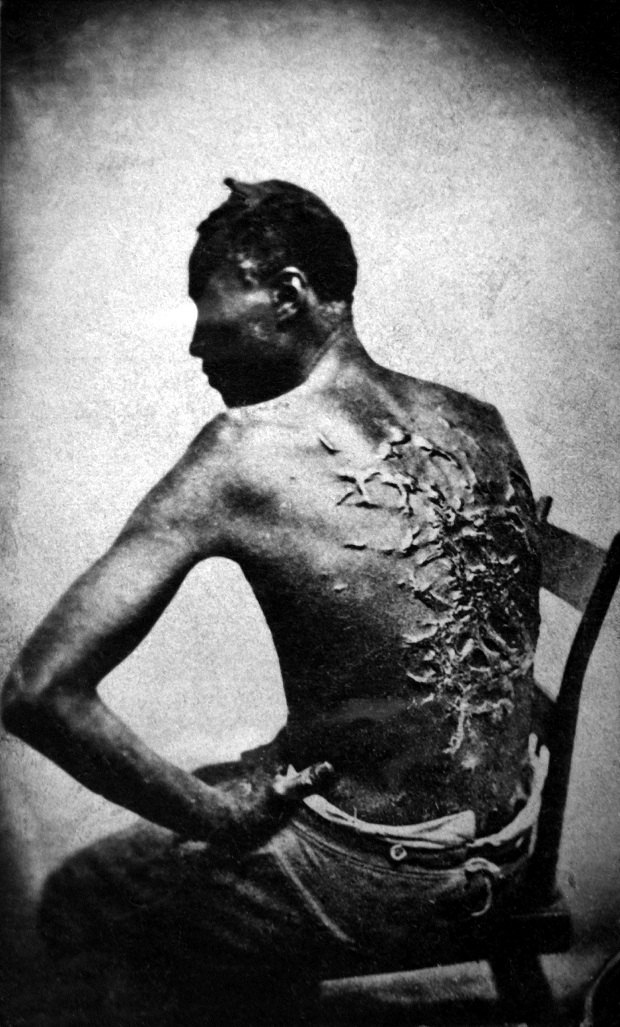


Senzalas & campos de concentração
by Alex Castro
MassaLongo mesmo. Mas muito interessante.
O Brasil se considera uma nação boa e pacífica. Mas é só porque esqueceu ter sido a maior economia escravocrata de todos os tempos.
Muitas vezes, o sono tranquilo não é consciência limpa: é falta de memória.
“O melhor bife batido da cidade está na Lanchonete Doi-Codi!”
Senzalas eram lugares de morte, tortura, exploração. Por que associar seu restaurante a ISSO?
No coração do centro histórico de Paraty, cidade colonial construída com o sangue e o suor de muitos escravos, em pleno mês da consciência negra, acabou de ser inaugurado um novo restaurante:
Senzala Churrascaria Rodízio.
Não deveria me chocar mas ainda me choco. Afinal, o que não falta, em todo Brasil, são estabelecimentos chamados Senzala.
Na Alemanha, pelo menos, não existe nenhum Restaurante Auschwitz.
Eles teriam vergonha.
As maravilhas do tráfico humano
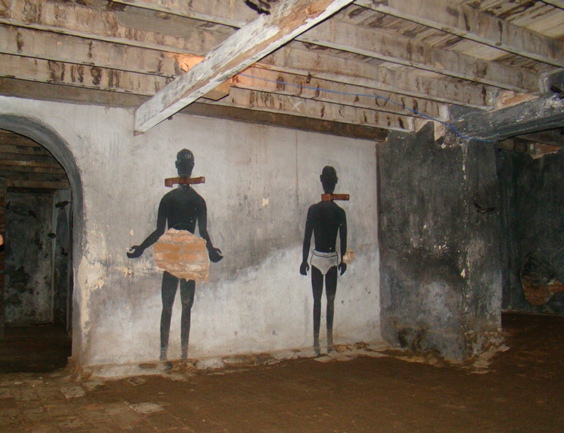
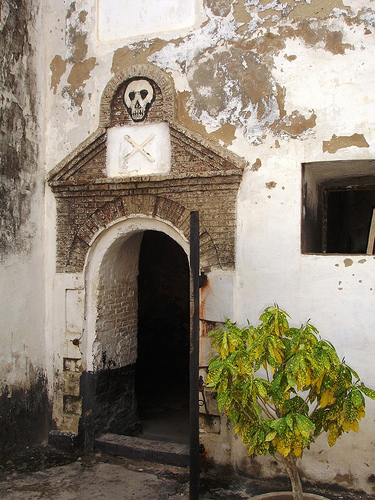
Nesse cela, eram colocados para morrer de fome os escravos problemáticos. Elmina, uma maravilha da arquitetura colonial portuguesa!
Em 2009, Portugal promoveu um concurso para escolher as “7 Maravilhas de origem portuguesa do mundo“.
Dentre os vinte e sete indicados, muitos eram locais fortemente identificados com a escravidão, com a compra e com a venda, com a morte e com a tortura, com o desterro e com o desenraizamento de milhões de pessoas. Pessoas como eu e como você. Pessoas cujo sofrimento não deveria ser esquecido:
Por exemplo, o forte Elmina foi construído em 1482 para fazer ali o comércio de escravos, hoje abriga um museu onde os visitantes são convidados a visitar as celas onde os Africanos ficavam confinados antes de serem enviados para as Américas. No sítio da votação, encontra-se uma longa descrição do forte e nem sequer uma linha, uma palavra mencionando o tráfico de africanos escravizados. …
É como se Auschwitz participasse em uma eleição das sete maravilhas alemãs no mundo.
(Leia mais ou confira a lista dos vencedores.)
A feliz união das raças da maior democracia racial do mundo!!
Todos são iguais… mas um tem maior expectativa de vida que os outros. Adivinha qual?
Ninguém realmente deveria ficar surpreso. No mundo lusófono, o apagamento da memória da escravidão sempre foi a regra.
A grande maioria dos brasileiros aprende na escola que nosso lindo país foi construído por brancos, negros e índios, todos felizes, de mãos dadas e cantando kumbayá. Como se a colonização do Brasil tivesse sidoe um comercial da Benetton.
Para manter a mentira primordial no cerne do nosso mito de origem, a escravidão nunca é mostrada em seu verdadeiro horror:
Sim, alguns de nossos avós escravizaram nossos outros avós, mas, no fim das contas, eram todos bons amigos, os escravos eram muito bem tratados e, olha só, pelo menos nunca tivemos as leis racistas dos EUA! No Brasil, país bondoso e generoso, até a escravidão era a melhor do mundo!
(Aliás, não faz sentido falar em “escravidão melhor” mas, somente nos Estados Unidos, a população escrava tinha crescimento vegetativo, ou seja, aumentava e se reproduzia. No resto da Américas, a mortalidade era tão alta que, mesmo com os nascimentos, era preciso sempre importar novos escravos. O Brasil foi o maior importador de escravos de todos os tempos porque aqui, nessa terra tão bondosa e tão pacífica, era onde eles mais rapidamente morriam. Esse artigo clássico de Herbert S. Klein explora essas contradições.)
Somos tão legais hoje que nem parece que éramos tão escrotos ano retrasado!
Sim, vamos parar de falar de racismo! Afinal, essa tática tem dado tão certo no último século… (pra nós, brancos, claro!)
Um trecho do Hino à Proclamação da República, escrito em 1890:
Nós nem cremos que escravos outrora
Tenha havido em tão nobre País…
Hoje o rubro lampejo da aurora
Acha irmãos, não tiranos hostis.
Somos todos iguais! Ao futuro
Saberemos, unidos, levar
Nosso augusto estandarte que, puro,
Brilha, ovante, da Pátria no altar!
Somente um ano e meio depois de abolida, a escravidão já começava a ser sistematicamente lavada da memória nacional.
Escravidão e Holocausto, ensinados lado a lado
“Eu, Barack Obama, o 44º presidente eleito dos Estados Unidos, peço desculpas pela escravidão.”
Para muitos brasileiros, o bicho-papão racial são os Estados Unidos. Não podemos implementar cotas, pois senão “nos tornaríamos um Estados Unidos”; “temos muitos defeitos mas pelo menos não somos os Estados Unidos”, etc etc.
Pois eu morei lá e morei aqui, e estudei a fundo a história da escravidão nos dois países. Somos ambos profundamente racistas, mas o Brasil é pior por um motivo:
A cultura do deixa-disso. Por pensarmos que o não-falar sobre o racismo e a escravidão vai resolver por si só o problema.
Enquanto isso, o presidente norte-americano, em visita a Gana, um dos principais portos exportadores de escravos, afirmou que a escravidão, como o Holocausto, é daquelas coisas que não pode ser esquecida.
Para Obama, a visita aos calabouços de escravos remeteu à sua viagem ao campo de concentração Buchenwald: ambos nos fazem lembrar da capacidade humana para cometer o Mal.
E completou afirmando:
A escravidão e o Holocausto deveriam ser ensinados nas escolas de modo a conectar a crueldade passada aos eventos atuais.
Homens que não entendem porque tanto alarde pelo câncer de útero
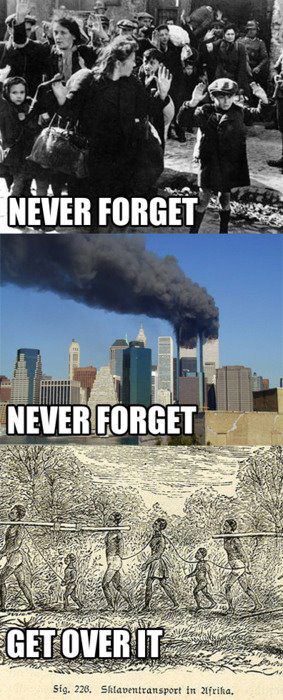
“Nunca esqueça! Nunca esqueça! Sai dessa, pô!”
Desconfie sempre de quem fala “sai dessa” quando o “essa” é algo que ele nunca experimentou.
Afinal, do ponto de vista de quem está bem acomodado e seco no convés do barco, não há motivo pra se debater tanto lá embaixo no mar só porque tem água entrando nos seus pulmões… SAI DESSA!
“Por que esses cadeirantes preguiçosos não deixam de se fazer de vítima e sobem as escadas como todo mundo, hein?”
A meritocracia do Brasil, em uma charge.
Pior ainda são aquelas pessoas (muitas negras) que são contra as cotas (e similares) argumentando que “nunca precisaram delas”.
E eu faço uma cara pensativa e respondo:
Concordo, claro, como não? E tem mais, também sou contra esse negócio de diálise em hospitais públicos e rampas para cadeirantes nos prédios.
Oras, se passei a vida inteira sem precisar de nenhuma dessas coisas, é porque não são tão importantes assim, certo?
Afinal, dado que eu sou o centro do universo e a medida de todas as coisas, as pessoas só deveriam receber o que eu recebi e as únicas necessidades válidas são as que eu também tenho!
(Sobre isso, leia meu texto O assunto não é você.)
Somos os melhores em esquecer nossos crimes
Durante sete anos, morei em Nova Orleans, principal porto escravista norte-americano. Assim como o Rio de Janeiro, uma bela cidade, sexy e musical, turística e carismática, construída nas costas de escravos desesperados e agonizantes.
Um dia, enquanto passeava com meu cachorro pelo bairro universitário, uma soccer mom enfiava cuidadosamente seus quatro filhinhos, todos brancos e roliços, em seu jipão utilitário de luxo, também branco e roliço. Era uma senhora baixinha e gorducha, bochechas rosadas e orelhas de abano, carregando mochilas e merendeiras, parecendo dotada daquela infinita paciência que só uma mãe de quatro meninos pode ter. E, em seu para-choque traseiro, discretamente, estava o adesivo:
The South Will Rise Again (“O Sul se Erguerá Novamente”)
Como não se sentir ameaçado? Não conheço o contexto dessas palavras. Por tudo que sei, é um inocente desejo de revitalizar a economia local. Mas, ainda assim, nenhuma racionalização poderia apagar o meu calafrio ao ler aquela frase; nenhuma explicação lógica faria aquele adesivo soar menos sinistro. De certo modo, era como se o ressurgimento do Sul fosse indistinguível e indissociável do reescravizamento de toda uma raça.
E pensei: o Brasil foi tão ou mais escravista do que o Sul dos Estados Unidos, e resistiu por muito mais tempo até libertar seus escravos. Ainda mais doloroso pra mim, dos nove únicos deputados que tiveram a cara-de-pau e a temeridade de votar contra a Lei Áurea em pleno maio de 1888, já na véspera do século XX e na contra-mão de todos os ventos filosóficos do XIX, oito eram do Rio de Janeiro. Legítimos representantes eleitos do meu estado.
Entretanto, não ficamos nem o Rio e nem o Brasil maculados por essa nódoa. Um adesivo “O Brasil Crescerá” despertaria calafrios? Claro que não. Nem o Paraguai tem medo do Brasil. E concluí, aliviado: ainda bem que pelo menos o bom nome do meu país e do meu estado não estão ligados à escravidão.
Um segundo depois, bateu o estranhamento: mas… por que não?
A falta de calafrios não corresponde à falta de crimes. O Sul dos EUA teve, no Norte, um vizinho incômodo que manteve viva a memória de seus crimes. Já em nosso caso, simplesmente varremos nossos crimes para debaixo do tapete.
Não somos mais virtuosos: somos melhores em esconder o corpo.
(Ao contrário do que muita gente pensa, a Abolição não foi um “presente da monarquia”, mas uma lei disputada voto a voto no Parlamento, somente sancionada pelo Poder Executivo, naquele momento representado pela Princesa Isabel. Mais detalhes nesse meu rascunho de uma História da Abolição.)
“Shoah”, um documentário impossível
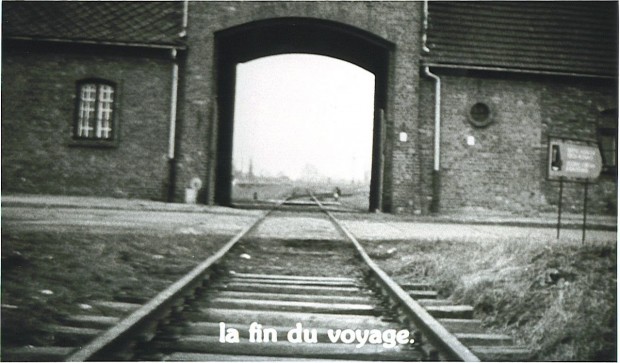
“Shoah”, o fim da viagem.
Shoah é uma palavra íidiche que significa “calamidade”. Para muitas pessoas, é um termo preferível à Holocausto – que, afinal, significa “oferenda aos deuses”.
“Shoah” também dá título a uma das grandes obras de arte, de qualquer arte, do século vinte, realizado pelo boy-toy de Simone Bouvoir, Claude Lanzmann.
São nove horas de filme, sem nenhuma imagem de arquivo: são somente depoimentos, e depoimentos, e depoimentos. Lanzmann entrevista três tipos de pessoa: sobreviventes, algozes (oficiais de campos de concentração) e testemunhas (poloneses que moravam perto dos campos).
Com os sobreviventes, Lanzmann é implacável. Ele praticamente os obriga a falar:
“Não foi uma crueldade fazê-las reviver, através da fala, tudo o que sofreram, no caso dos judeus. Era absolutamente necessário. Não acho que tenha sido sádico, mas fraternal. Durante as entrevistas, eu toco suas mãos, seus ombros, seus braços. Uma forma de dizer ‘eu estou com você’. Não faço interrogatórios para que alguém se diga culpado. Eles sofrem. Mas eu também sofro. Eu não os torturei. Eles se sentiram liberados. Eu não estava falando com uma pessoa qualquer, mas com um grupo muito especial de sobreviventes – e não há mais do que um punhado deles no mundo”.
Abaixo, talvez a cena mais emocionante no filme. O barbeiro não consegue falar, mas Lanzmann pressiona (em inglês):
Link YouTube | “Shoah”, e a impossibilidade de lembrar
“Shoah” é um filme de insuportáveis silêncios: das nove horas de filme, cinco horas e meia são de puro silêncio. Diz Lanzmann:
“Não é uma reconstituição, não é uma ficção, não é um documentário. O filme é uma ressurreição, uma reencarnação, tem uma arquitetura, uma construção em torno de uma obsessão pessoal. Eu fazia sempre as mesmas perguntas, geralmente referentes à primeira vez. E não tinha nenhuma intenção de acusar, denunciar, culpar. Nada disso, isso não me interessava.
Houve uma decisão consciente de fazer um filme sobre o presente, e não sobre o passado:
“O pior dos crimes, ao mesmo tempo de ordem moral e artística, quando se quer consagrar uma obra ao Holocausto, é considerá-lo como passado. Meu filme é uma anti-lenda, um contra-mito, vale dizer, uma investigação sobre o presente do Holocausto ou, ao menos, sobre um passado cujas cicatrizes estão ainda tão fresca e vivamente inscritas nos lugares e nas consciências que ele se dá a ver numa alucinante intemporalidade. … Os homens e as mulheres que falam diante da câmera dão sempre a impressão de não estarem contando lembranças, mas de as viverem mesmo, com força e clareza, no presente. … Enquanto fazia o filme, a distância entre o presente e o passado foi totalmente abolida. Em Treblinka só havia pedras, filmei as pedras como um louco, por todos os lados. Quando o espectador vê as pedras de Treblinka, ele vê os judeus sendo mortos. Da mesma maneira que quando o trem chega a Treblinka o espectador vê a tabuleta com o nome do campo exatamente como os judeus que iam para morte deviam ver. É um ato de cinema muito violento. Por isso o filme é fundamentalmente uma invenção, não uma lembrança. … O filme é sobretudo uma ressurreição, as pessoas entrevistadas revivem aquele tempo de tal maneira que, quando falam, até alternam os tempos dos verbos – presente e passado. … No filme, quando as pessoas falam, confundem presente e passado. Na mesma fala, dizem: eu estava lá e pouco depois: eu estou lá.”
Mais do que tudo, é um filme sobre a impossibilidade de recordar, de conceber, de articular o Mal:
Comecei precisamente com a impossibilidade de recontar essa história. Situei essa impossibilidade bem no início do meu trabalho. Quando comecei o filme, tive que lidar, por um lado, com o desaparecimento dos vestígios: não havia coisa alguma, absolutamente nada, e eu tinha que fazer um filme a partir desse nada. E por outro lado tive que lidar com a impossibilidade, até mesmo dos próprios sobreviventes, de contar essa história; a impossibilidade de falar, a dificuldade que pode ser vista ao longo do filme de trazer luz e a impossibilidade de nomear: seu caráter inominável.
Para celebrar os 30 anos de sua estréia, “Shoah” está sendo lançado em DVD pelo Instituto Moreira Salles. Recomendo nos mais enfáticos termos.
Mas não assista sozinho. É muito duro.
(Sobre “Shoah”, leia também: A dificuldade de falar de “Shoah” e It’s a beautiful thing.)
O Holocausto foi terrível mas não foi único
Estudo raça e racismo há muitos anos. Um dos meus livros preferidos sobre o tema é The Racial Contract, de Charles W. Mills.
Segundo Mills, o racismo seria um sistema político e uma estrutura de poder baseados em um Contrato Social (na verdade, um Contrato Racial) no qual os membros da raça dominante formariam um acordo tácito de, ao mesmo tempo em que garantem para si a maior parte das riquezas/oportunidades/etc da sociedade, também consentem em não ver o próprio sistema, criando assim a “alucinação consensual” de um mundo sem raças, meritocrático e igualitário, que passa a mediar sua interpretação da realidade.
Raça, para eles, sera invisível porque o mundo seria estruturado em função deles; eles seriam a norma em oposição a qual seriam medidas as pessoas de outras raças (“esses outros tem raça, não eu!”). Assim como o peixe não vê a água, os membros da raça dominante não veriam o racismo.
Mills também embarca em uma comparação perigosa, mas praticamente inevitável, entre o racismo e o Holocausto.
Visto de fora pelos não-europeus, que sabem na pele que a civilização européia se baseia em praticar barbarismo fora da Eueropa, o Holocausto não representaria “uma anomalia transcendental no desenvolvimento do Ocidente”, mas, pelo contrário, sua unicidade estaria apenas no aplicação do Contrato Racial contra europeus.
Ao colocar o Holocausto no contínuo cultural de outras políticas exterminatórias colonialistas européias, Mills não deseja negar o seu horror, mas somente sua singularidade histórica.
Tudo o que o nazismo tinha de operacional já vinha sendo aplicado, legitimado, tolerado, negado e esquecido pelos europeus há muitos séculos: a maior transgressão de Hitler seria aplicar contra europeus métodos que antes eram aplicados exclusivamente contra árabes, negros e índios.
A própria percepção do Holocausto, de um horror tão fora de escala e colocado num plano moral muito diferente de todos os outros massacres de não-europeus por toda a história, seria evidência da força ideológica do Contrato Racial.
Além disso, ao narrar o racismo como uma invenção aberrante de figuras como Gobineau e Goebbels, o Holocausto presta à intelligentsia européia do pós-guerra um importante serviço: sanitizou seu passado racial.
Link YouTube | “Nação do Medo”, legendado, completo, um filmaço de ficção científica.
Por fim, Mills cita o romance de ficção científica “A Nação do Medo” (Fatherland), que mostra um futuro alternativo onde os nazistas ganharam a guerra e nunca existiu a memória do Holocausto.
Na verdade, aponta Mills, nós JÁ vivemos nesse mundo não-alternativo: a única diferença é que os vencedores foram outros, mas eles também apagaram a memória dos massacres que cometeram, esvaziando sua importância e subtraindo seu ultraje.
Daí o esquecimento dos horrores da escravidão.
(O livro de Mills é realmente brilhante: leia minha resenha completa.)
O Epcot da escravidão nos Estados Unidos
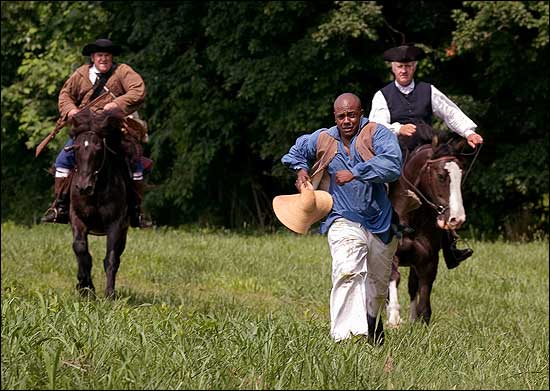
Em Williamsburg, escravo é perseguido.
Mas se devemos lembrar sempre a escravidão… como?
Nos Estados Unidos, a cidade de Williamsburg oferece uma janela ao passado. Em troca do passe diário de US$36, o visitante passa o dia em uma “autêntica” vila colonial, onde tudo é como antigamente (menos os banheiros!), todos estão vestidos à caráter, em roupas de época, falando em vocabulário antigo, essas coisas. É um dos destinos turísticos e educacionais mais famosos do país.
Entretanto, sempre foi criticado por apresentar uma versão muito fácil, sanitizada e maniqueísta da história. Mais do que tudo, cadê os escravos? Afinal, na época da colônia, os Estados Unidos tinham escravidão e metade da população de Williamburg era negra.
Hoje em dia, o parque faz um esforço consciente (e polêmico, claro) para retratar a escravidão: além de incluir mais atores negros, criou-se também um “passeio” chamado Enslaving Virginia (“Escravizando a Virgínia”) especificamente sobre os horrores da escravidão.
Deve ser horrível mesmo: vários atores negros já se recusaram a interpretar os escravos (por considerar muito humilhante), as crianças choram tanto que foram criadas sessões explicativas posteriores para enfatizar que era tudo faz-de-conta e já aconteceu de visitantes interromperem o passeio para “salvar os escravos”.
Melhor assim. Preferível ser repelido por um simulacro do horror que nos gerou do que fingir que ele nunca existiu.
Encenação da escravidão à brasileira
O guia do engenho, vestido de escravo, se oferece para ser chicoteado pelos turistas.
E no Brasil?
Vassouras, no estado do Rio de Janeiro, já foi uma das cidades mais ricas do país, no centro da região que produzia a mais importante riqueza nacional: café. Hoje, é uma cidadezinha de vinte mil habitantes, que vive dos turistas que atrai com seus palacetes e fazendas coloniais – algumas com polêmicas encenações históricas.
Na fazenda São João da Prosperidade, há cinco gerações com a mesma família, a proprietária recebe os turistas vestida de sinhá e suas empregadas, de escravas:
Da janela, aponta a senzala: “Tenho 300 escravos” orgulha-se, voz impostada e dedo em riste. De repente, entra correndo pela varanda uma negrinha com remendos de algodão e cabelos presos em tranças. A menina, de apenas seis anos, se agarra à barra da saia da sinhá, põe o dedo polegar na boca e fixa os olhos nos visitantes. Basta um gesto da sinhazinha para que a pequena escrava abaixe a cabeça e saia da sala. “Não vê que estou com visitas?” – esbraveja a senhora. A menina vai brincar no alambique. Pouco depois, uma mucama adentra o salão, sob ordens de servir café aos convidados. (fonte)
Em uma fazenda próxima, Cachoeira Grande, que eu visitei agora em novembro, são só os empregados que estão vestidos à caráter: os proprietários se vestem e falam como se estivessem no século vinte.
Mais para o norte, na Zona da Mata de Pernambuco, o engenho Uruaé também encena a escravidão:
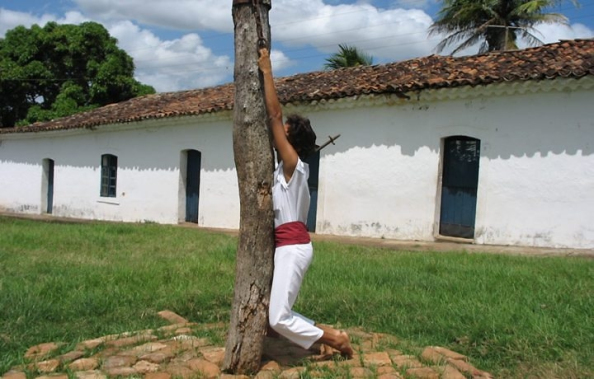
Vestido como “escravo da casa”, o jovem guia mostra o “quarto da sinhazinha” e explica a genealogia da família proprietária do engenho através dos retratos na parede. Na senzala, que chegou a ter 300 escravos de uma vez, ele coloca uma peça de ferro no pescoço e anuncia, sorridente: “Quem era moreno como eu era aqui”. O mais constrangedor vem depois, do lado de fora: o guia se amarra no tronco e pede que um voluntário simule açoitá-lo. Foi difícil arranjar alguém disposto a interpretar o papel. (fonte)
O engenho Uruaé também está na mesma família há sete gerações. Durante a visita, a proprietária afirma:
“A gente tem mais é que se orgulhar dos nossos que vieram antes. Nós ainda não fizemos nada.”
Fui só eu que achei esse “ainda” um pouco sinistro? O que essa senhora ainda está planejando fazer, meu Deus? Re-escravizar todo mundo?
Mas isso é implicância minha. A raiz filosófica do problema é outra:
Como retratar os horrores do passado?
Qual é a medida certa do horror?
As encenações históricas da escravidão nas fazendas coloniais parecem não agradar ninguém.
Por um lado, argumenta-se que elas não são horríveis o suficiente. Que encenam somente os aspectos mais, digamos, reprodutíveis da escravidão, aqueles por definição mais doces e inofensivos. Que perpetuam a ideia de que a escravidão era somente uma forma de trabalho entre tantas outras.
Afinal, se a escravidão é algo que uma doméstica contemporânea pode reproduzir, se a escravidão se resumia a se vestir de branco e trazer café pra uma mulher que você chama de “sinhá”, bem, então não era tão ruim assim, né? (Ou talvez ser empregada doméstica é que é horrível demais, mas não entremos nisso.)
Por outro lado, argumenta-se que são horríveis demais. Que mesmo doces e meigas, ainda mais quando encenadas pelos descendentes das vítimas, são sempre humilhantes:
Outros, no entanto, não sabem como reagir diante da interação realista dos ‘escravos’, que circulam vestidos em pobre algodão e, não raro, se curvam para obedecer às ordens da sinhazinha. “Será que esta criança tem idéia do que está fazendo? Ela ainda não tem idade para entender e pode ficar com a idéia de que deve se comportar como escrava, de que isso é normal” – indigna-se uma visitante paulistana, depois de recusar um copo d’água servido pela ‘mucama’.
Já o historiador Milton Teixeira, que trabalha como guia de turismo nas fazendas do café, defende a prática:
Não é degradante representar um escravo. Se o turista se sente incomodado, muito bem. O passado de escravidão tem de incomodar bastante, e não deve ser esquecido. … Ora, representações são feitas em toda parte do mundo. Na Europa, tem famílias pré-históricas; nos Estados Unidos, há simulação das batalhas da Guerra de Secessão, e, aqui no Brasil, é natural que haja uma encenação com escravos. Muito pior seria querer mostrar que não houve escravidão. (fonte)
Não deixa de ser simbólico que muitas dessas fazendas ainda estejam nas mãos das mesmas famílias. Ontem, lucraram nos ombros de seus escravos plantando cana ou café. Hoje, a mesma família continua lucrando nos ombos dos descendentes dos escravos, agora reduzidos a guias de turismo que reproduzem para turistas curiosos o horror da vida de seus avós.
Como escreveu o historiador e jornalista Fabiano Maisonnave, para a Folha:
De forma explícita ou não, as visitas aos engenhos transformam esses verdadeiros campos de concentração numa bufonaria, diluindo um dos piores crimes da humanidade, principal responsável pela imenso fosso social brasileiro, em um exemplo acabado do “racismo cordial”. A escravidão é exaltada, a casa-grande, absolvida, e a cana-de-açúcar, revalorizada como “energia renovável”, se torna bênção econômica do passado e do presente.
Mas como reproduzir de forma correta e didática o verdadeiro horror da escravidão? Como mostrar os corpos jovens mas enfraquecidos e fragilizados pelo criminoso excesso de trabalho? Como mostrar as marcas da tortura? Como mostrar as frequentes mutilações causadas pelo machete durante o corte da cana ou pelas engrenagens dos engenhos durante a moagem? Como mostrar as feridas emocionais de famílias desfeitas e de vidas sem esperança? Como mostrar os escravos revoltosos que davam e tiravam vidas para não voltarem ao cativeiro?
Será possível mesmo começar a quantificar esse horror? Quem dirá reproduzi-lo?
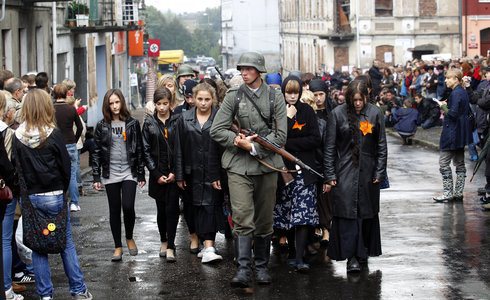
Existem encenações históricas em Auchwitz? O que o mundo pensaria de ver sorridentes atores descendentes de arianos brincando de depositar chorosos descendentes de judeus dentro dos fornos? Mas é só mentirinha, gente! É educacional!
Holocausto reencenado na Polônia. Grande idéia. Só que não.
(Na verdade, como o instinto humano da burrice é inesgotável, já houve tentativas de encenar o holocausto, como essa aqui na Polônia. Muitas vezes, dá merda e acaba em processo, como dessa vez no Texas.)
Escravidão: essa pica é nossa!
A escravidão africana nas Américas foi talvez a maior tragédia da Era Moderna.
Estima-se que cerca de 11 milhões de pessoas tenham sido transportadas à força da África para a América.
(Outras estimativas mais agressivas calculam que cerca de 40 a 75 milhões de vidas africanas tenham sido perdidas por causa do tráfico, entre mortos em guerras para obter escravos, em emboscadas para capturar escravos, ou em marchas forçadas para os portos exportadores de escravos no litoral.)
Dentre as muitas nações responsáveis por esse lucrativo e criminoso tráfico, os maiores culpados são os portugueses.
(Principais transportadores de escravos para as Américas: Portugal, 4,6 milhões; Reino Unido, 2,6 milhões; Espanha, 1,6 milhão.)
Dentre as muitas nações que receberam esses escravos e que construíram sua riqueza nas costas deles, o maior culpado é o Brasil.
(Principais destinos de escravos nas Américas: Brasil, 4 milhões; América Hispânica, 2,5 milhões; Índias Ocidentais Britânicas, 2 milhões.)

Reparem no tamanho da seta que nos cabe.
Dentre os muitos portos brasileiros que receberam essa massa humana desgraçada, o principal foi o Rio de Janeiro. (Dos nove deputados que votaram contra a Lei Áurea, vamos lembrar, oito eram da província do Rio.)
Além disso, quem inventou esse lucrativo e terrível modelo de negócios foram os próprios portugueses – não por acaso, os primeiros homens brancos a explorar sistematicamente a África. Em 1441, Antão Gonçalves teve a dúbia honra de se tornar o primeiro europeu a comprar e trazer para casa escravos africanos.
Depois disso, a história se desenrolou rapidamente, comprovando o tino comercial dos portugueses: já em 1452, arrancaram do Papa uma bula autorizando-os formalmente à escravizar os infiéis; em meados de 1470, estavam comerciando escravos no golfo do Benim e no delta do rio Níger; e, finalmente, em 1482, construíram a Fortaleza de São Jorge da Mina, em Gana, que em 2009 seria indicada candidata a “maravilha de origem portuguesa do mundo”.
(Por si só, a escravidão é mais antiga que andar pra frente. Todos os povos de todos os continentes de todas as épocas já tiveram algum tipo de escravidão, mas quase sempre cerimonial e economicamente insignificante. A escravidão africana nas Américas é um novo tipo de fenômeno humano porque, pela primeira vez, temos nações economicamente dependentes de milhões de escravos que compõem muitas vezes a maior parte de suas populações.)
Por fim, muitos e muitos séculos depois, no outro extremo dessa triste história, a última nação das Américas a abolir essa escravidão africana inventada pelos portugueses, a nação que mais teimosamente se agarrou aos seus escravos até o último minuto possível, foi justamente a nação gerada do ventre português: o Brasil. Nós.
De um modo bem real e doloroso, é difícil evitar a conclusão que esse enorme crime contra a humanidade é, em grande parte, uma responsabilidade lusófona e, dentro disso, brasileira. (E, mais especificamente ainda, e não que os outros estados sejam inocentes, carioca e fluminense.)
Passei seis meses na Alemanha durante a década de noventa. Mesmo cinquenta anos depois da Segunda Guerra, mesmo entre meus amigos adolescentes cujos pais nem eram nascidos durante a guerra, basta uma menção a nazismo, Holocausto ou Auschwitz para fazê-los abaixar a cabeça em silêncio, envergonhados, culpados, tristes.
Nós, brasileiros, se tivéssemos vergonha na cara, se tivéssemos um pouco mais de memória, faríamos a mesma coisa ao ouvir menções a senzala, navio-negreiro, escravidão.
Essa pica é nossa.
Cais do Valongo, o elevador de serviço do século XIX
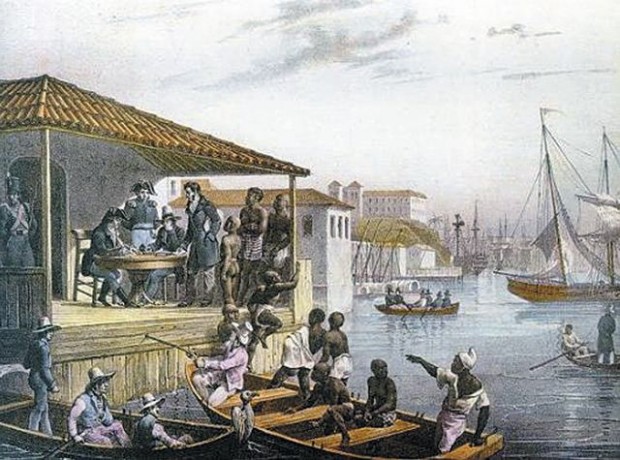
Desembarque de escravos no Cais do Valongo, pintado por Rugendas em 1835.
No Rio de Janeiro, o principal porto de desembarque de escravos foi o Cais do Valongo. Estima-se que, entre 1758 e 1843, tenham chegado por ele quase um milhão de pessoas. (897.748, segundo o The Transatlantic Slave Trade Database.)
Provando que não foi de repente que nos tornamos o povo que faz subir pelo elevador de serviço a doméstica que faz o nosso serviço sujo, em 1770 o desembarque de escravos é proibido no porto principal da cidade (onde hoje fica a Praça XV e o Paço Imperial) e transferido exclusivamente para o distante Valongo.
Afinal, quando se está chegando de um grand tour pela Europa, a última coisa que se quer ver é um escravo nu agonizando no cais perto de você! Pelo amor de Deus!
Por fim, em 1843, cada vez mais envergonhado com a escravidão que lhe pagava as contas, o Império desativa e aterra o Cais do Valongo, construindo por cima dele o elegante Cais da Imperatriz.
E fim de história. Assim esqueceu-se o Valongo. Afinal, nós nem cremos que escravos outrora tenha havido em tão nobre país!
Uma escavação arqueológica em pleno centro do Rio de Janeiro.
Fast-forward para o presente. Em meio a um frenesi de obras para preparar o Rio de Janeiro para a Copa e para os Jogos Olímpicos, a prefeitura acabou de descobrir e desencavar o Cais do Valongo em pleno centro da cidade.
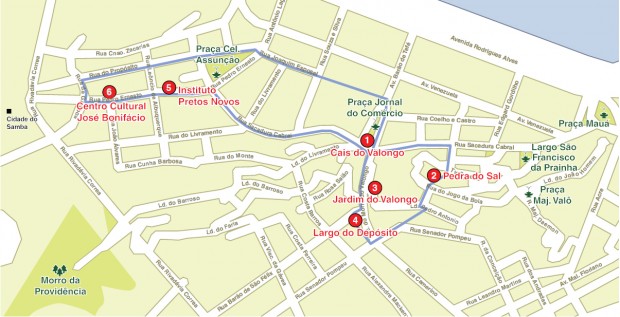
Agora reformado e reembalado para turistas (“são nossas ruínas romanas!“, disse o empolgado prefeito), o Cais do Valongo foi inserido no recém-criado Circuito Histórico e Arqueológico da Celebração da Herança Africana, ao lado de outras atrações como a Pedra do Sal, o Cemitério dos Pretos Novos (onde eram enterradas as vítimas da travessia atlântica) e os Jardins Suspensos do Valongo, esses últimos uma das coisas mais lindas e surpreendentes que já vi nessa cidade. (Veja o mapinha abaixo.)
O recém-criado Circuito Histórico e Arqueológico da Celebração da Herança Africana, no Rio de Janeiro.
Mas que não seja só um espaço para turista tirar fotos.
O que falta ao Brasil e ao Rio de Janeiro, e o que esse circuito histórico pode começar a timidamente fornecer, é uma verdadeira compreensão dos horrores que engendramos, um pálido retrato do terror que aconteceu (e ainda acontece) debaixo dos nossos olhos, nesse nosso chão, na nossa senzala, no nosso quartinho de empregadas.
O texto que você está lendo só existe porque calhei de visitar o Cais do Valongo no dia seguinte de assistir “Shoah”.
O Cais do Valongo, hoje, aberto à visitação pública.
É possível quantificar o horror?
O Holocausto perpetrado pelos alemães matou cerca de seis milhões de judeus, um terço de todos os judeus no mundo. Além de incontáveis milhões de outras pessoas.
Não é minha intenção negar nem suavizar esse horror.
Mas não foi nem de longe o único horror perpetrado por europeus em sua longa história de horrores.
É impossível visitar lugares de tortura e morte como Auschwitz, Treblinka, Sobibor sem uma atitude de respeito e reflexão, sem pensar na memória das centenas de milhares de pessoas que sofreram ali.
Mas por que nós, brasileiros, não temos a mesma atitude ao visitar uma senzala, o Pelourinho (onde os escravos eram castigados publicamente) ou o Cais do Valongo?
Auschwitz matou 1,1 milhão de pessoas, Treblinka, 900 mil, Sobibor, 200 mil.
Enquanto isso, o Brasil recebeu 4 milhões de escravos, sendo que um milhão só pelo Cais do Valongo, logo ali, no centro do Rio.
Quem consegue compreender a enormidade desses números? Quem consegue quantificar tamanho sofrimento?
O passado é presente
Por isso, ali de pé diante do Cais do Valongo, um dia depois de assistir “Shoah”, eu tentei esquecer os números e somente imaginar como teria sido a experiência individual, una, indivisível, de pisar em terra firme ali, naquelas pedras, naquele chão.
Imagino que fui arrancado de minha família e de tudo que conheci; que atravessei o oceano cercado de pessoas agonizantes em um navio infecto; que não pude trazer uma roupa, um livro, nenhum objeto pessoal; que não sabia se jamais veria minha terra; que estava condenado a um castigo literalmente e potencialmente infinito, pois a escravidão não seria apenas minha, mas sim herdada por todos os meus descendentes até o fim dos tempos.
Imagino que o Rio de Janeiro, para mim, escravo recém-chegado, era um lugar desconhecido e cheio de horrores. Era o porto onde meus companheiros mais fracos vinham morrer. Era o chão onde começava a escravidão do meu corpo. Era minha primeira experiência nesse novo mundo onde seria cativo e explorado.
Imagino então que hoje o Rio de Janeiro continua sendo um lugar de horror para os meus descendentes, que são ao mesmo tempo a maior parte das vítimas de assassinato e também a maior parte da população carcerária, e ainda têm que ouvir que racismo não existe no Brasil.
Tudo isso aconteceu ontem, e continua acontecendo hoje. O passado, como uma pedra jogada no lago, cria ondas concêntricas na água e repercute no presente. O passado é o presente.
As cotas raciais são necessárias hoje não para corrigir as injustiças históricas do passado, mas para corrigir as injustiças cotidianas de hoje. As cotas raciais são necessárias porque hoje a Polícia Militar não invade do mesmo jeito a cobertura do descendente do escravista e o barraco do descendente do escravo.
O que fica claro é que não dá pra pensar nesses fenômenos como se pertencessem a universos tão diferentes assim. Não faz sentido chorar assistindo A Lista de Schindler e depois ir espairecer tomando o milkshake do Senzala.
A escravidão deixa marcas. Na pele. Na história. Em nós.
Para ler mais
- O melhores textos sobre racismo de Alex Castro.
- O peso da história: a escravidão e as cotas, onde explico minha posição sobre as cotas.
- Racismo e normalidade, aqui no PapodeHomem.
Gostou do texto? Fez diferença na sua vida? Pois estão compre um dos meus livros ou faça uma doação.
Artigos Relacionados
- Nirvana e Paul McCartney em 12.12.12: esse dia foi foda
- Consumismo aleatório: a forma mais criativa de gastar dinheiro com besteira
- Bela notícia: o Green Day voltou a não se levar a sério
- Seu amigo é gay: como lidar
- 8 animes fodões pra macho!
Fernando and -1 others like this
07 Dec 17:59
Analysis of How Bitcoin Is Actually Used
by schneier
"Quantitative Analysis of the Full Bitcoin Transaction Graph," by Dorit Ron and Adi Shamir:
Abstract. The Bitcoin scheme is a rare example of a large scale global payment system in which all the transactions are publicly accessible (but in an anonymous way). We downloaded the full history of this scheme, and analyzed many statistical properties of its associated transaction graph. In this paper we answer for the rst time a variety of interesting questions about the typical behavior of account owners, how they acquire and how they spend their Bitcoins, the balance of Bitcoins they keep in their accounts, and how they move Bitcoins between their various accounts in order to better protect their privacy. In addition, we isolated all the large transactions in the system, and discovered that almost all of them are closely related to a single large transaction that took place in November 2010, even though the associated users apparently tried to hide this fact with many strange looking long chains and fork-merge structures in the transaction graph.
The paper has been submitted to the 2013 Financial Cryptography conference.
Narcélio and -1 others like this
07 Dec 02:46

Quem viveu a Era de Ouro das videolocadoras brasileiras deve lembrar bem do nome Wilson Rodrigues. Através da sua empresa, a WR-Filmes Ltda., este mineiro de Belo Horizonte radicado em São Paulo distribuiu um montão de tralhas hoje dificílimas de encontrar mesmo lá fora, como a ficção científica pós-apocalíptica "1999 - O Sobrevivente do Fim do Mundo", de Michael Shackleton, o drama de guerra "Mergulhando Para o Inferno", de Shûe Matsubayashi, e o anime "Terror em Love City", de Kôichi Mashimo.
Mas Wilson Rodrigues também dirigiu e produziu seus próprios filmes. Começou com pornochanchadas ("A Dama do Sexo", "Meu Primeiro Amante"), mudou para o sexo explícito quando o pornô estava dando dinheiro ("Masculino... Até Certo Ponto", em 1986), e tentou limpar o currículo especializando-se em produções voltadas ao público infantil. "É a primeira vez que se tem a chance de produzir um vídeo especialmente dedicado ao público infantil, que tem poucos títulos brasileiros à sua disposição", declarou Wilson em reportagem da época.

O resultado da iniciativa foram duas produções baratas baseadas em contos de fadas, produzidas originalmente para o mercado de vídeo, mas também exibidas em alguns cinemas: "No Mundo da Carochinha Volume 1 - Chapeuzinho Vermelho" e "No Mundo da Carochinha Volume 2 - Joãozinho e Maria", ambas de 1986. José Mojica Marins, o Zé do Caixão, trabalhou na supervisão de "Chapeuzinho Vermelho", e Rubens Francisco Lucchetti, roteirista de vários filmes de Mojica e de Ivan Cardoso, ficou responsável pelas adaptações (acima, os pôsteres das duas produções).
Surpreendentemente, os dois filmes deram um bom retorno financeiro, e Wilson resolveu investir a grana que lucrou com eles numa produção melhorzinha, em sociedade com Rodri J. Rodriguez. Só que sonhou um pouquinho alto demais, achou que era Steven Spielberg e torrou todo o dinheiro num filme brasileiro com pretensões hollywoodianas (só pretensões). Em resumo, foi assim que nasceu O GATO DE BOTAS EXTRATERRESTRE, terceira obra da série "No Mundo da Carochinha", mas lançada diretamente em VHS sem esta alcunha, como se fosse uma produção independente.

Rubens Lucchetti novamente ficou a cargo da adaptação, dessa vez da fábula "O Gato de Botas" (Le Chat Botté, no original), do francês Charles Perrault (1628–1703). Esta história popular foi publicada originalmente no volume conhecido como "Histórias da Mamãe Gansa" (Les Contes de ma Mère l'Oye), em 1697. Anos depois, no século 19, os Irmãos Grimm escreveriam sua própria versão de "O Gato de Botas", mas sem nenhuma mudança marcante na trama já conhecida.
Na versão original dos contos de fadas, "O Gato de Botas" narra a história dos três filhos do finado proprietário de um moinho. O mais velho herda o moinho, o irmão do meio herda os cavalos, e o mais jovem fica com o inofensivo gatinho que pertencia ao pai. Só que não é um felino normal: o "Gato de Botas" do título anda em duas patas, fala e se comporta como gente (sem que ninguém estranhe o fato), e, entristecido com a pobreza do seu novo dono, arma um complicado esquema para que ele se case com a bela princesa do reino.


Pelos próximos dias, o Gato de Botas caça coelhos e gansos e os entrega ao rei como se fossem presentes do "Marquês de Carabás", de quem seria súdito. Repete isso tantas vezes que o rei e a rainha ficam encantados com a generosidade do nobre que sequer existe. Aí o gato malandro coloca seu dono no golpe durante um passeio de carruagem do rei, fazendo o rapaz identificar-se como o tão comentado marquês e fingindo que foi assaltado.
E a mentira vai ficando cada vez mais complexa: para que o rei acredite que seu humilde dono é mesmo um nobre, o Gato de Botas sai em disparada pelo reino inventando mentiras, convencendo fazendeiros a dizerem ao rei que suas terras pertencem ao fictício "Marquês de Carabás", e até matando um malvado Ogro que vive na região para apoderar-se do seu castelo, que passa a ser o castelo do marquês de mentirinha. No final, o rapaz pobretão que se fingia de nobre ganha a mão da princesa em casamento e vira príncipe de verdade, enquanto o mentiroso Gato de Botas diverte-se com sua nova vida entre a realeza.


Para a adaptação brasileira, Wilson Rodrigues contratou um elenco repleto de nomes famosos e/ou conhecidos, quase todos oriundos do elenco da Rede Globo na época. O fazendeiro e falso Marquês de Carabás, por exemplo, é interpretado por um jovem Maurício Mattar, então astro das novelas da Globo graças ao João Ligeiro de "Roque Santeiro".
Sua princesa é a ninfetinha Flávia Monteiro, que alguns anos antes, em 1987, tinha provocado polêmica por interpretar uma espécie de Lolita em "A Menina do Lado", protagonizando cenas ousadas com Reginaldo Farias. Na época do filme, ela integrava o elenco da novela das oito "Vale Tudo".


Já o papel do Gato de Botas, que já havia sido interpretado pelo oscarizado Christopher Walken numa adaptação mequetrefe da Cannon Films (e depois seria dublado por Antonio Banderas na série "Shrek"), ficou com Heitor Gaiotti, figurinha carimbada dos filmes de ação baratos de Tony Vieira (como "Tortura Cruel" e "O Último Cão de Guerra").
Ironicamente, Gaiotti era conhecido pelo apelido de "Gato", e talvez por isso tenha sido convidado a interpretar o personagem. (Alguns podem achar engraçado e "politicamente incorreto" um ator de pornochanchada interpretando um clássico personagem infantil, mas é bom não esquecer que o eterno Papaco Fernando Benini hoje está no elenco da novela "Carrossel"!)

O GATO DE BOTAS EXTRATERRESTRE começa com a então garota-propaganda do Leite de Aveia Davene, Tônia Carrero, no papel de uma simpática vovó contando uma história para a netinha dormir. Ela pega o livro do "Gato de Botas", e então começa a encenação da história, seguindo fielmente o original de Perrault (embora os créditos iniciais informem que o roteiro de Lucchetti baseou-se na versão dos Irmãos Grimm).
Além dos nomes já citados, Felipe Levy (célebre figurante do programa Os Trapalhões e ator em tralhas como "A Rota do Brilho") interpreta o rei, e a atriz gaúcha Carmem Silva a sua rainha. Tony Tornado aparece como um dos guardas do palácio, Joffre Soares é o feiticeiro malvado Mago Mau (substituindo o Ogro da história original), e há pequenas participações de Zezé Motta e José Mojica Marins como vítimas do feiticeiro malvado. Mojica aparece vestido como Zé do Caixão, mas identifica-se como "Príncipe Renini", um jovem enfeitiçado para ficar com a aparência do Zé do Caixão, na única tirada divertida da adaptação.


O produtor Wilson (que faz uma ponta lendo o testamento dos três irmãos no início do filme) não poupou esforços para dar o ar de "superprodução hollywoodiana" que tanto sonhava ao seu filme. Além de filmar parte das cenas em Monte Verde (MG) e na cidade gaúcha de Gramado - onde também foram aproveitadas as miniaturas de castelos do parque temático Mini Mundo para as externas do reino do conto de fadas -, Wilson encomendou a máscara do Gato de Botas ao Burman Studio, em Hollywood.
Você não leu errado: "o" Burman Studio, aquele mesmo responsável pelos licantropos de "A Marca da Pantera" e "O Garoto do Futuro", pelo Sloth de "Os Goonies", e indicado ao Oscar de Melhor Maquiagem pelas assombrações da comédia "Os Fantasmas Contra-Atacam" (1988). A máscara do gato realmente é bem expressiva, e deve ter comido a maior parte do orçamento, mas sozinha não salva o filme. (Para não ser injusto, a caracterização de Joffre Soares como feiticeiro malvado também é muito boa.)

E se a produção segue fielmente o original de Perrault/Irmãos Grimm (descontando, é claro, a introdução com a vovó e sua netinha, e o bruxo no lugar do ogro), por que diabos o título é O GATO DE BOTAS EXTRATERRESTRE?
Aí é que está o problema: para tentar dar uma ar mais "moderno" à fábula, já que as crianças do final dos anos 80 foram educadas mais por Spielberg e George Lucas do que pelos velhos contos de fadas, Lucchetti resolveu dar uma origem alienígena ao Gato de Botas, o que talvez explique o fato de o gato andar, falar e comportar-se como ser humano - embora no filme, como na fábula original, ninguém nunca estranhe esse comportamento.


O problema é que o produtor Wilson deve ter ficado sem dinheiro na hora de filmar as cenas que explicam essa origem alienígena. Portanto, não espere por cenas com o Gato de Botas em seu planeta cheio de outros Gatos de Botas inteligentes e malandros, recebendo a missão de ir à Terra ajudar o pobre fazendeiro. O máximo de "extraterrestre", para justificar o título absurdo do filme, são takes totalmente gratuitos de uma nave espacial em formato fálico no espaço (sua construção é creditada a "Alex Miller"), enxertados sem muito critério no meio da narrativa.
E a conclusão também traz um toque mínimo de ficção científica, quando revela-se que o tal "Gato de Botas Extraterrestre" na verdade é um robô! O personagem fica paralisado enquanto caminha pelo campo, como se as pilhas tivessem acabado, e foi isso mesmo que aconteceu! Então a tal nave em formato fálico aproxima-se da órbita da Terra, um alienígena vestido de preto estilo Darth Vader sai dela e troca as baterias do Gato de Botas, que volta a andar todo serelepe. The end!


Em resumo, a natureza "extraterrestre" do Gato de Botas não acrescenta absolutamente nada de novo à fábula, e a trilha sonora roubada de "Blade Runner - O Caçador de Andróides", repetida ad nauseam ao longo do filme, também falha em dar qualquer tom de ficção científica ao produto final. Lá pelas tantas, também entram trechos da 9ª Sinfonia de Beethoven, talvez porque os realizadores tenham ficado com vergonha da repetição da música de "Blade Runner".
Misteriosamente, os créditos iniciais indicam Jorge Mello como autor da trilha sonora do filme, mas não consegui perceber nenhuma música original além das chupadas de "Blade Runner" e de Beethoven. De qualquer jeito, faz-se a menção.

Se os toques de ficção científica não acrescentam nada de novo, Lucchetti tampouco parece interessado em mexer no texto original, adaptado praticamente na íntegra. Não há espaço para que os poucos personagens novos, como o príncipe enfeitiçado para ter a cara do Zé do Caixão, ou mesmo o bruxo malvado, possam fazer algo para justificar suas existências.
O guarda do rei interpretado por Tony Tornado em certos momentos parece suspeitar da idoneidade do Gato de Botas, mas nem a este personagem é dado qualquer espaço para crescer e mostrar serviço. Por isso, na maior parte de O GATO DE BOTAS EXTRATERRESTRE só vemos Heitor Gaiotti correndo para cá e para lá com suas mentiras e Maurício Mattar andando de carruagem com Flávia Monteiro e Carmen Silva, ele com cara de bunda, elas com cara de paisagem - quem sabe pensando "Por que diabos fui me meter nessa furada?".


Particularmente, acho bem triste o fato do roteiro de Lucchetti preferir manter a ambientação do conto original num "reino de conto de fadas", com os poucos e dispensáveis toques de ficção científica, ao invés de "abrasileirar" a trama, fazendo, quem sabe, uma adaptação contemporânea do Gato de Botas aqui no Brasil, e não num reino mágico de conto de fadas.
Afinal, se a fábula de Perrault pode ser interpretada como um elogio à esperteza, por outro lado também incentiva e glorifica a mentira: o que o Gato de Botas faz não deixa de ser o popular "conto do vigário", enrolando o rei e a rainha para que entreguem a mão da sua filha a um fazendeiro pobretão que se finge de nobre.

Portanto, sendo o Gato de Botas um personagem tão "171", parece ter nascido para estrelar uma adaptação feita no Brasil, o notório país dos malandros que querem levar vantagem às custas dos outros. Numa adaptação contemporânea da fábula, o felino poderia ter se transformado num personagem estilo Zé Carioca, e sem princesas e castelos.
Mas Wilson Rodrigues e Rubens Lucchetti preferiram uma adaptação mais tradicional, e os ridículos elementos de ficção científica parecem ter sido inseridos no fim das filmagens. Ao mesmo é a essa conclusão que se chega na pesquisa por reportagens antigas sobre a produção, que ainda era chamada apenas de "O Gato de Botas". Não duvido que a sub-trama com a origem extraterrestre do personagem tenha sido acrescentada depois para tornar o filme mais atrativo à molecada, o que também justificaria as poucas cenas com esse tema.

No conjunto, O GATO DE BOTAS EXTRATERRESTRE é um desastre. Não há história para mais do que um curta-metragem de meia hora, e curiosamente os episódios anteriores de "No Mundo da Carochinha" ficavam nessa metragem, entre 40 e 50 minutos. Mas este aqui preferiram transformar em longa, com intermináveis 85 minutos! Não há a menor noção de ritmo e nem um mínimo de edição (cada take dura uma eternidade).
Como não havia história para contar (a própria fábula em que se inspira é bem curtinha), a solução foi enrolar com inúmeras e intermináveis cenas de cavaleiros galopando, com loooooooooongas cenas dos personagens caminhando de ponto A para ponto B, ou ainda a festa de casamento da princesa com o "Marquês de Carabás" no final, filmada como se fosse um autêntico vídeo de festa de casamento da vida real - ou seja, com cenas longas e arrastadas de pessoas comendo, dançando e se divertindo.


O excesso de astros e estrelas, efeitos hollywoodianos e pompa de O GATO DE BOTAS EXTRATERRESTRE cobrou seu preço, e o diretor/produtor Wilson Rodrigues teria ido à bancarrota. Pelo menos foi o que explicou o roteirista Lucchetti em entrevista de 2000: "Wilson investiu todo o seu dinheiro numa superprodução, que, apesar de não ficar devendo nada às fitas hollywoodianas, levou a WR-Filmes à falência".
O filme sequer chegou aos cinemas, como os dois volumes anteriores da série "No Mundo da Carochinha", saindo direto em vídeo. E se a data oficial da produção é 1990, aparenta ter sido filmado pelo menos dois anos antes (provavelmente ficou emperrado pelos problemas financeiros e de distribuição).

O curioso é que os créditos iniciais do filme estão em inglês (o título inclusive ficou "The Extra-Terrestrial Cat in Boots"!!!), porque a ideia de Wilson e cia. era lançá-lo nos cinemas disputando espaço e público de igual para igual com os blockbusters de Hollywood. "Nosso Gato de Botas vai enfrentar Spielberg", dizia a manchete "só um pouquinho" exagerada de um jornal da época da produção.
Só que o inglês do cara que fez os títulos não era tão bom assim, e deixou passar algumas pérolas. O montador Walter Wanny, por exemplo, virou o responsável pela "ediction" (!!!), palavra que nem existe na língua inglesa (o correto seria "montage", ou "film editing by"); o co-produtor Rodri J. Rodriguez virou "The Rodri Group" (!!!); e os agradecimentos nos créditos finais são identificados pela cartola "Thankfulness" (!!!).

Wilson Rodrigues ainda insistiu e tentou fazer um quarto "No Mundo da Carochinha" em 1994, novamente com roteiro de Rubens Lucchetti, e dessa vez com apresentação de Mojica. Algumas cenas chegaram a ser filmadas, mas a produção foi cancelada pelas dificuldades financeiras do produtor, e porque o próprio cinema brasileiro vivia tempos muito difíceis pré-Retomada.
Ignorado na época de seu lançamento, O GATO DE BOTAS EXTRATERRESTRE logo ganhou uma sobrevida entre os admiradores de filmes trash. Afinal, não é todo dia que você Maurício Mattar como príncipe assessorado por Heitor Gaiotti com uma máscara de gato, e Tony Tornado e Zé do Caixão fazendo parte do mesmo elenco!

E eu não consegui descobrir se o filme chegou a ser lançado no exterior, mas, por mais inacreditável que isso soe, existem reproduções do pôster original do filme para vender em sites como Amazon e Moviegoods! Não consigo imaginar quem em sã consciência seria maluco o suficiente para adornar seu quarto ou sala de estar com um pôster de O GATO DE BOTAS EXTRATERRESTRE...
Mas, a julgar pela quantidade de gente talentosa/famosa que se envolveu nessa canoa furada, e à quantidade de linhas que o demente aqui escreveu sobre o filme, o que mais tem nesse mundão é gente maluca...
PS: Um dos assistentes de direção foi Custódio Gomes, que já havia lidado com "extraterrestres" antes, mas num filme com teor bem menos infantil: o pornô "Aguenta Tesão - O ETesão"!
Trailer de O GATO DE BOTAS EXTRATERRESTRE
*******************************************************
O Gato de Botas Extraterrestre (1990, Brasil)
Direção: Wilson Rodrigues
Elenco: Maurício Mattar, Heitor Gaiotti, Flávia Monteiro,
Felipe Levy, Carmen Silva, Tony Tornado, Joffre Soares,
José Mojica Marins e Zezé Motta.
O GATO DE BOTAS EXTRATERRESTRE (1990)
by Felipe M. Guerra
MassaIsso parece interessante!
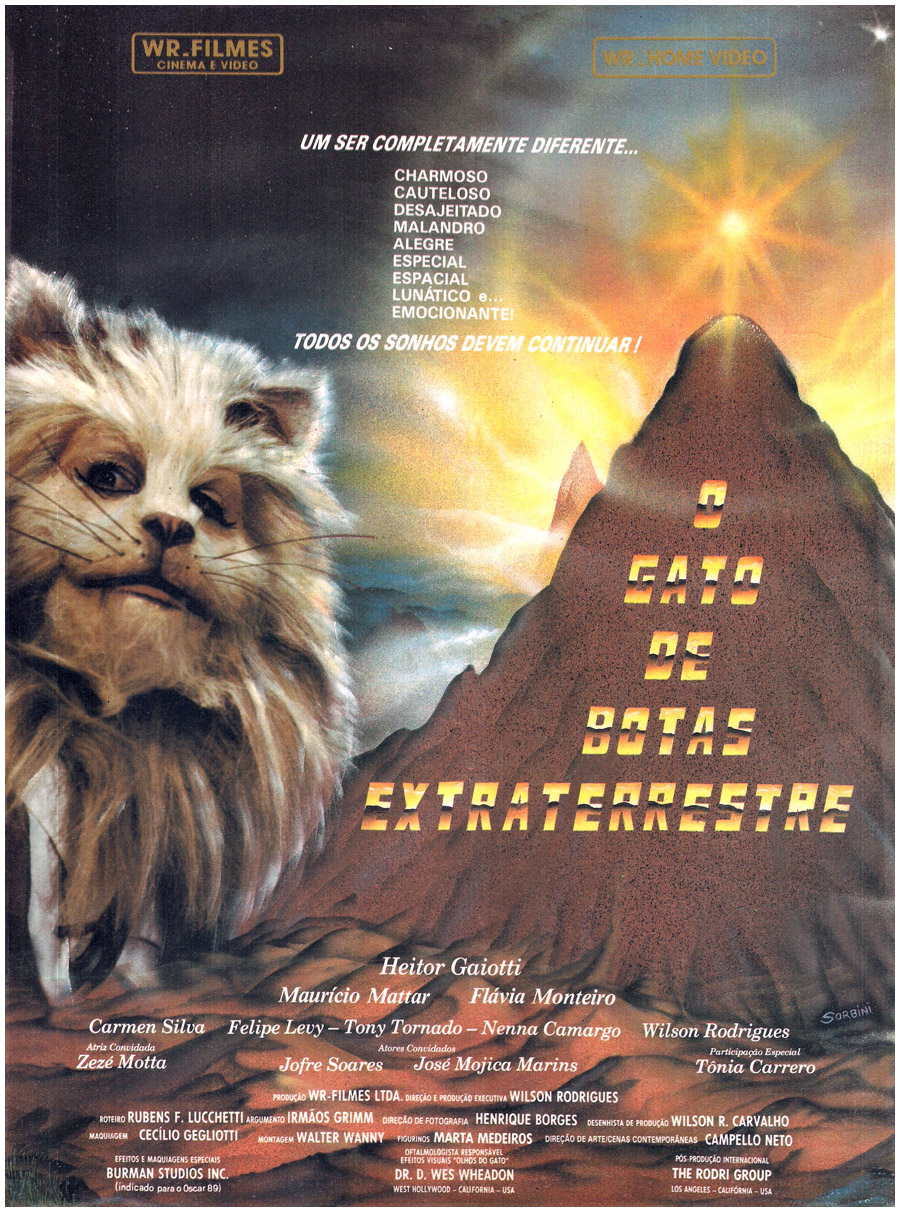
Quem viveu a Era de Ouro das videolocadoras brasileiras deve lembrar bem do nome Wilson Rodrigues. Através da sua empresa, a WR-Filmes Ltda., este mineiro de Belo Horizonte radicado em São Paulo distribuiu um montão de tralhas hoje dificílimas de encontrar mesmo lá fora, como a ficção científica pós-apocalíptica "1999 - O Sobrevivente do Fim do Mundo", de Michael Shackleton, o drama de guerra "Mergulhando Para o Inferno", de Shûe Matsubayashi, e o anime "Terror em Love City", de Kôichi Mashimo.
Mas Wilson Rodrigues também dirigiu e produziu seus próprios filmes. Começou com pornochanchadas ("A Dama do Sexo", "Meu Primeiro Amante"), mudou para o sexo explícito quando o pornô estava dando dinheiro ("Masculino... Até Certo Ponto", em 1986), e tentou limpar o currículo especializando-se em produções voltadas ao público infantil. "É a primeira vez que se tem a chance de produzir um vídeo especialmente dedicado ao público infantil, que tem poucos títulos brasileiros à sua disposição", declarou Wilson em reportagem da época.

O resultado da iniciativa foram duas produções baratas baseadas em contos de fadas, produzidas originalmente para o mercado de vídeo, mas também exibidas em alguns cinemas: "No Mundo da Carochinha Volume 1 - Chapeuzinho Vermelho" e "No Mundo da Carochinha Volume 2 - Joãozinho e Maria", ambas de 1986. José Mojica Marins, o Zé do Caixão, trabalhou na supervisão de "Chapeuzinho Vermelho", e Rubens Francisco Lucchetti, roteirista de vários filmes de Mojica e de Ivan Cardoso, ficou responsável pelas adaptações (acima, os pôsteres das duas produções).
Surpreendentemente, os dois filmes deram um bom retorno financeiro, e Wilson resolveu investir a grana que lucrou com eles numa produção melhorzinha, em sociedade com Rodri J. Rodriguez. Só que sonhou um pouquinho alto demais, achou que era Steven Spielberg e torrou todo o dinheiro num filme brasileiro com pretensões hollywoodianas (só pretensões). Em resumo, foi assim que nasceu O GATO DE BOTAS EXTRATERRESTRE, terceira obra da série "No Mundo da Carochinha", mas lançada diretamente em VHS sem esta alcunha, como se fosse uma produção independente.

Rubens Lucchetti novamente ficou a cargo da adaptação, dessa vez da fábula "O Gato de Botas" (Le Chat Botté, no original), do francês Charles Perrault (1628–1703). Esta história popular foi publicada originalmente no volume conhecido como "Histórias da Mamãe Gansa" (Les Contes de ma Mère l'Oye), em 1697. Anos depois, no século 19, os Irmãos Grimm escreveriam sua própria versão de "O Gato de Botas", mas sem nenhuma mudança marcante na trama já conhecida.
Na versão original dos contos de fadas, "O Gato de Botas" narra a história dos três filhos do finado proprietário de um moinho. O mais velho herda o moinho, o irmão do meio herda os cavalos, e o mais jovem fica com o inofensivo gatinho que pertencia ao pai. Só que não é um felino normal: o "Gato de Botas" do título anda em duas patas, fala e se comporta como gente (sem que ninguém estranhe o fato), e, entristecido com a pobreza do seu novo dono, arma um complicado esquema para que ele se case com a bela princesa do reino.


Pelos próximos dias, o Gato de Botas caça coelhos e gansos e os entrega ao rei como se fossem presentes do "Marquês de Carabás", de quem seria súdito. Repete isso tantas vezes que o rei e a rainha ficam encantados com a generosidade do nobre que sequer existe. Aí o gato malandro coloca seu dono no golpe durante um passeio de carruagem do rei, fazendo o rapaz identificar-se como o tão comentado marquês e fingindo que foi assaltado.
E a mentira vai ficando cada vez mais complexa: para que o rei acredite que seu humilde dono é mesmo um nobre, o Gato de Botas sai em disparada pelo reino inventando mentiras, convencendo fazendeiros a dizerem ao rei que suas terras pertencem ao fictício "Marquês de Carabás", e até matando um malvado Ogro que vive na região para apoderar-se do seu castelo, que passa a ser o castelo do marquês de mentirinha. No final, o rapaz pobretão que se fingia de nobre ganha a mão da princesa em casamento e vira príncipe de verdade, enquanto o mentiroso Gato de Botas diverte-se com sua nova vida entre a realeza.


Para a adaptação brasileira, Wilson Rodrigues contratou um elenco repleto de nomes famosos e/ou conhecidos, quase todos oriundos do elenco da Rede Globo na época. O fazendeiro e falso Marquês de Carabás, por exemplo, é interpretado por um jovem Maurício Mattar, então astro das novelas da Globo graças ao João Ligeiro de "Roque Santeiro".
Sua princesa é a ninfetinha Flávia Monteiro, que alguns anos antes, em 1987, tinha provocado polêmica por interpretar uma espécie de Lolita em "A Menina do Lado", protagonizando cenas ousadas com Reginaldo Farias. Na época do filme, ela integrava o elenco da novela das oito "Vale Tudo".


Já o papel do Gato de Botas, que já havia sido interpretado pelo oscarizado Christopher Walken numa adaptação mequetrefe da Cannon Films (e depois seria dublado por Antonio Banderas na série "Shrek"), ficou com Heitor Gaiotti, figurinha carimbada dos filmes de ação baratos de Tony Vieira (como "Tortura Cruel" e "O Último Cão de Guerra").
Ironicamente, Gaiotti era conhecido pelo apelido de "Gato", e talvez por isso tenha sido convidado a interpretar o personagem. (Alguns podem achar engraçado e "politicamente incorreto" um ator de pornochanchada interpretando um clássico personagem infantil, mas é bom não esquecer que o eterno Papaco Fernando Benini hoje está no elenco da novela "Carrossel"!)

O GATO DE BOTAS EXTRATERRESTRE começa com a então garota-propaganda do Leite de Aveia Davene, Tônia Carrero, no papel de uma simpática vovó contando uma história para a netinha dormir. Ela pega o livro do "Gato de Botas", e então começa a encenação da história, seguindo fielmente o original de Perrault (embora os créditos iniciais informem que o roteiro de Lucchetti baseou-se na versão dos Irmãos Grimm).
Além dos nomes já citados, Felipe Levy (célebre figurante do programa Os Trapalhões e ator em tralhas como "A Rota do Brilho") interpreta o rei, e a atriz gaúcha Carmem Silva a sua rainha. Tony Tornado aparece como um dos guardas do palácio, Joffre Soares é o feiticeiro malvado Mago Mau (substituindo o Ogro da história original), e há pequenas participações de Zezé Motta e José Mojica Marins como vítimas do feiticeiro malvado. Mojica aparece vestido como Zé do Caixão, mas identifica-se como "Príncipe Renini", um jovem enfeitiçado para ficar com a aparência do Zé do Caixão, na única tirada divertida da adaptação.


O produtor Wilson (que faz uma ponta lendo o testamento dos três irmãos no início do filme) não poupou esforços para dar o ar de "superprodução hollywoodiana" que tanto sonhava ao seu filme. Além de filmar parte das cenas em Monte Verde (MG) e na cidade gaúcha de Gramado - onde também foram aproveitadas as miniaturas de castelos do parque temático Mini Mundo para as externas do reino do conto de fadas -, Wilson encomendou a máscara do Gato de Botas ao Burman Studio, em Hollywood.
Você não leu errado: "o" Burman Studio, aquele mesmo responsável pelos licantropos de "A Marca da Pantera" e "O Garoto do Futuro", pelo Sloth de "Os Goonies", e indicado ao Oscar de Melhor Maquiagem pelas assombrações da comédia "Os Fantasmas Contra-Atacam" (1988). A máscara do gato realmente é bem expressiva, e deve ter comido a maior parte do orçamento, mas sozinha não salva o filme. (Para não ser injusto, a caracterização de Joffre Soares como feiticeiro malvado também é muito boa.)

E se a produção segue fielmente o original de Perrault/Irmãos Grimm (descontando, é claro, a introdução com a vovó e sua netinha, e o bruxo no lugar do ogro), por que diabos o título é O GATO DE BOTAS EXTRATERRESTRE?
Aí é que está o problema: para tentar dar uma ar mais "moderno" à fábula, já que as crianças do final dos anos 80 foram educadas mais por Spielberg e George Lucas do que pelos velhos contos de fadas, Lucchetti resolveu dar uma origem alienígena ao Gato de Botas, o que talvez explique o fato de o gato andar, falar e comportar-se como ser humano - embora no filme, como na fábula original, ninguém nunca estranhe esse comportamento.


O problema é que o produtor Wilson deve ter ficado sem dinheiro na hora de filmar as cenas que explicam essa origem alienígena. Portanto, não espere por cenas com o Gato de Botas em seu planeta cheio de outros Gatos de Botas inteligentes e malandros, recebendo a missão de ir à Terra ajudar o pobre fazendeiro. O máximo de "extraterrestre", para justificar o título absurdo do filme, são takes totalmente gratuitos de uma nave espacial em formato fálico no espaço (sua construção é creditada a "Alex Miller"), enxertados sem muito critério no meio da narrativa.
E a conclusão também traz um toque mínimo de ficção científica, quando revela-se que o tal "Gato de Botas Extraterrestre" na verdade é um robô! O personagem fica paralisado enquanto caminha pelo campo, como se as pilhas tivessem acabado, e foi isso mesmo que aconteceu! Então a tal nave em formato fálico aproxima-se da órbita da Terra, um alienígena vestido de preto estilo Darth Vader sai dela e troca as baterias do Gato de Botas, que volta a andar todo serelepe. The end!


Em resumo, a natureza "extraterrestre" do Gato de Botas não acrescenta absolutamente nada de novo à fábula, e a trilha sonora roubada de "Blade Runner - O Caçador de Andróides", repetida ad nauseam ao longo do filme, também falha em dar qualquer tom de ficção científica ao produto final. Lá pelas tantas, também entram trechos da 9ª Sinfonia de Beethoven, talvez porque os realizadores tenham ficado com vergonha da repetição da música de "Blade Runner".
Misteriosamente, os créditos iniciais indicam Jorge Mello como autor da trilha sonora do filme, mas não consegui perceber nenhuma música original além das chupadas de "Blade Runner" e de Beethoven. De qualquer jeito, faz-se a menção.

Se os toques de ficção científica não acrescentam nada de novo, Lucchetti tampouco parece interessado em mexer no texto original, adaptado praticamente na íntegra. Não há espaço para que os poucos personagens novos, como o príncipe enfeitiçado para ter a cara do Zé do Caixão, ou mesmo o bruxo malvado, possam fazer algo para justificar suas existências.
O guarda do rei interpretado por Tony Tornado em certos momentos parece suspeitar da idoneidade do Gato de Botas, mas nem a este personagem é dado qualquer espaço para crescer e mostrar serviço. Por isso, na maior parte de O GATO DE BOTAS EXTRATERRESTRE só vemos Heitor Gaiotti correndo para cá e para lá com suas mentiras e Maurício Mattar andando de carruagem com Flávia Monteiro e Carmen Silva, ele com cara de bunda, elas com cara de paisagem - quem sabe pensando "Por que diabos fui me meter nessa furada?".


Particularmente, acho bem triste o fato do roteiro de Lucchetti preferir manter a ambientação do conto original num "reino de conto de fadas", com os poucos e dispensáveis toques de ficção científica, ao invés de "abrasileirar" a trama, fazendo, quem sabe, uma adaptação contemporânea do Gato de Botas aqui no Brasil, e não num reino mágico de conto de fadas.
Afinal, se a fábula de Perrault pode ser interpretada como um elogio à esperteza, por outro lado também incentiva e glorifica a mentira: o que o Gato de Botas faz não deixa de ser o popular "conto do vigário", enrolando o rei e a rainha para que entreguem a mão da sua filha a um fazendeiro pobretão que se finge de nobre.

Portanto, sendo o Gato de Botas um personagem tão "171", parece ter nascido para estrelar uma adaptação feita no Brasil, o notório país dos malandros que querem levar vantagem às custas dos outros. Numa adaptação contemporânea da fábula, o felino poderia ter se transformado num personagem estilo Zé Carioca, e sem princesas e castelos.
Mas Wilson Rodrigues e Rubens Lucchetti preferiram uma adaptação mais tradicional, e os ridículos elementos de ficção científica parecem ter sido inseridos no fim das filmagens. Ao mesmo é a essa conclusão que se chega na pesquisa por reportagens antigas sobre a produção, que ainda era chamada apenas de "O Gato de Botas". Não duvido que a sub-trama com a origem extraterrestre do personagem tenha sido acrescentada depois para tornar o filme mais atrativo à molecada, o que também justificaria as poucas cenas com esse tema.

No conjunto, O GATO DE BOTAS EXTRATERRESTRE é um desastre. Não há história para mais do que um curta-metragem de meia hora, e curiosamente os episódios anteriores de "No Mundo da Carochinha" ficavam nessa metragem, entre 40 e 50 minutos. Mas este aqui preferiram transformar em longa, com intermináveis 85 minutos! Não há a menor noção de ritmo e nem um mínimo de edição (cada take dura uma eternidade).
Como não havia história para contar (a própria fábula em que se inspira é bem curtinha), a solução foi enrolar com inúmeras e intermináveis cenas de cavaleiros galopando, com loooooooooongas cenas dos personagens caminhando de ponto A para ponto B, ou ainda a festa de casamento da princesa com o "Marquês de Carabás" no final, filmada como se fosse um autêntico vídeo de festa de casamento da vida real - ou seja, com cenas longas e arrastadas de pessoas comendo, dançando e se divertindo.


O excesso de astros e estrelas, efeitos hollywoodianos e pompa de O GATO DE BOTAS EXTRATERRESTRE cobrou seu preço, e o diretor/produtor Wilson Rodrigues teria ido à bancarrota. Pelo menos foi o que explicou o roteirista Lucchetti em entrevista de 2000: "Wilson investiu todo o seu dinheiro numa superprodução, que, apesar de não ficar devendo nada às fitas hollywoodianas, levou a WR-Filmes à falência".
O filme sequer chegou aos cinemas, como os dois volumes anteriores da série "No Mundo da Carochinha", saindo direto em vídeo. E se a data oficial da produção é 1990, aparenta ter sido filmado pelo menos dois anos antes (provavelmente ficou emperrado pelos problemas financeiros e de distribuição).

O curioso é que os créditos iniciais do filme estão em inglês (o título inclusive ficou "The Extra-Terrestrial Cat in Boots"!!!), porque a ideia de Wilson e cia. era lançá-lo nos cinemas disputando espaço e público de igual para igual com os blockbusters de Hollywood. "Nosso Gato de Botas vai enfrentar Spielberg", dizia a manchete "só um pouquinho" exagerada de um jornal da época da produção.
Só que o inglês do cara que fez os títulos não era tão bom assim, e deixou passar algumas pérolas. O montador Walter Wanny, por exemplo, virou o responsável pela "ediction" (!!!), palavra que nem existe na língua inglesa (o correto seria "montage", ou "film editing by"); o co-produtor Rodri J. Rodriguez virou "The Rodri Group" (!!!); e os agradecimentos nos créditos finais são identificados pela cartola "Thankfulness" (!!!).

Wilson Rodrigues ainda insistiu e tentou fazer um quarto "No Mundo da Carochinha" em 1994, novamente com roteiro de Rubens Lucchetti, e dessa vez com apresentação de Mojica. Algumas cenas chegaram a ser filmadas, mas a produção foi cancelada pelas dificuldades financeiras do produtor, e porque o próprio cinema brasileiro vivia tempos muito difíceis pré-Retomada.
Ignorado na época de seu lançamento, O GATO DE BOTAS EXTRATERRESTRE logo ganhou uma sobrevida entre os admiradores de filmes trash. Afinal, não é todo dia que você Maurício Mattar como príncipe assessorado por Heitor Gaiotti com uma máscara de gato, e Tony Tornado e Zé do Caixão fazendo parte do mesmo elenco!

E eu não consegui descobrir se o filme chegou a ser lançado no exterior, mas, por mais inacreditável que isso soe, existem reproduções do pôster original do filme para vender em sites como Amazon e Moviegoods! Não consigo imaginar quem em sã consciência seria maluco o suficiente para adornar seu quarto ou sala de estar com um pôster de O GATO DE BOTAS EXTRATERRESTRE...
Mas, a julgar pela quantidade de gente talentosa/famosa que se envolveu nessa canoa furada, e à quantidade de linhas que o demente aqui escreveu sobre o filme, o que mais tem nesse mundão é gente maluca...
PS: Um dos assistentes de direção foi Custódio Gomes, que já havia lidado com "extraterrestres" antes, mas num filme com teor bem menos infantil: o pornô "Aguenta Tesão - O ETesão"!
Trailer de O GATO DE BOTAS EXTRATERRESTRE
*******************************************************
O Gato de Botas Extraterrestre (1990, Brasil)
Direção: Wilson Rodrigues
Elenco: Maurício Mattar, Heitor Gaiotti, Flávia Monteiro,
Felipe Levy, Carmen Silva, Tony Tornado, Joffre Soares,
José Mojica Marins e Zezé Motta.
Massa and -1 others like this
05 Dec 19:50
Novidades de HTML5 na DevFest Brasil
by Renato Mangini
MassaÓ o mangini aí...
Na semana passada eu tive a oportunidade de fazer uma apresentação sobre HTML5 na DevFest Brasil, onde mostrei algumas das novidades de HTML5 em 2012 que eu considero mais relevantes para web apps.
Na apresentação (veja aqui, ou leia o código-fonte), eu mencionei os seguintes itens:
Veja o código da apresentação e os demos linkados nos slides para aprender como usar cada uma dessas novidades.
Infelizmente o tempo era pouco e tive que me limitar a 8 items. Como aqui, por outro lado, tempo e espaço são bastante flexíveis ;-) vou reativar o blog falando de algumas das novidades que eu gostaria de ter demonstrado no DevFest mas não tive tempo. Começando, nos próximos dias, com nada menos que Object.observe() !
 |
| Por algum motivo inexplicável, as pessoas riem de mim... |
 |
| … ah, já sei, deve ser a minha camisa :-) |
Na apresentação (veja aqui, ou leia o código-fonte), eu mencionei os seguintes itens:
- CSS adequado a Web Apps
- CSS dinâmico
- JavaScript multithread
- Acessando um Filesystem
- Downloads sem servidor
- Acesso ao hardware
- <audio> "sexy"
- Stream Multimidia
Veja o código da apresentação e os demos linkados nos slides para aprender como usar cada uma dessas novidades.
Infelizmente o tempo era pouco e tive que me limitar a 8 items. Como aqui, por outro lado, tempo e espaço são bastante flexíveis ;-) vou reativar o blog falando de algumas das novidades que eu gostaria de ter demonstrado no DevFest mas não tive tempo. Começando, nos próximos dias, com nada menos que Object.observe() !
Massa likes this
27 Nov 11:01


Phoning An Aircraft Engine In Mid-Flight? No Problem
by Mark Hachman
Emirates Airlines can have up to 90 aircraft in flight at any given time. So what happens if something goes wrong on one of them? If everything works the way it's supposed to, airline personnel may know about it even before the pilots do, via terminals and a massive video display that’s slightly smaller than the screen in a movie theater.
Emirates controls the in-flight safety of its aircraft from inside its operations center, close by the main terminals at the Dubai airport, within the United Arab Emirates. The company opened the facility to reporters last week, as part of a sponsored tour of its latest aircraft, the Airbus A380-800, as well as its Microsoft-powered crew-management application, known as KIS.
(Disclosure: Emirates flew this reporter to Dubai, United Arab Emirates, to cover the airline's technology as well as the Middle-Eastern launch of Windows 8. It also paid for a hotel room and meals, some of which it split with Microsoft.).

Inside Emirates' Dubai facility, employees have access to a small collection of shops and restaurants, open 24/7, Nearby are the corporate offices, whose lobby is studded with jerseys from teams like London’s Arsenal, which the company sponsors. Security is tight, naturally, with each member of the airline's staff carrying an RF badge with varying levels of access.
By fleet size, Emirates doesn’t rank in the top ten of the world’s airlines, at least according to Wikipedia; its 188 aircraft put it at about half of the 362 aircraft operated by Air Canada, the ninth-largest airline. But by another metric, passenger-kilometers, Emirates ranked fourth in 2011, with 153.2 million. The airline’s hub is in Dubai, and relatively few aircraft fly long distances each day, reaching San Francisco, Tokyo, Buenos Aires, and other far-flung destinations.

The first priority of any airline is safety. But with Emirates striving for top marks in customer satisfaction, minimizing delays is nearly as important. A repair that grounds an aircraft for just 30 minutes may mean the difference between a passenger making or missing a connecting flight, making the center’s operations even more critical.
(Airlines that make up more than 1% of U.S. “deplanements” are required to report on-time flight information to the federal government; because of its relatively few, long-haul flights touching down in the States, Emirates doesn’t fall under this category. A list of its overall complaints by passengers to the Department of Transportation is included in the document, however; simply search for “Emirates.”)
Flight Monitoring - Plus A Big-Screen TV
One might imagine that a network operations center might be constructed with glass and steel, perhaps with network cables strewn about. Instead, the facility’s workstations are embedded in the type of old wood (or at least paneling) that one might find in a reading room, with busts of old composers surveying the room. The workers used traditional mice and monitors, overseeing sophisticated management applications, including AirMAN, for managing Airbus aircraft, and Airplane Health Management, for Boeing airplanes. I saw Windows 7 and Windows XP both being used, decorated with the traditional post-its and tech detritus (“double facepalm” images, for example) taped alongside the monitors.
The room is dominated on either end by sweeping views: to the north, two-story picture windows look out over a pair of Emirates terminals, where aircraft taxi in, park, and then debark. On the other side of the center is a massive video display, slightly smaller than a movie screen. The display shows the local air traffic around Dubai’s airport, followed by a larger, worldwide view of location of each Emirates aircraft on duty. On the day we visited, most of the aircraft clustered around Dubai, either recently departed or waiting to leave. But other flights were en route from Tokyo and other destinations.

On the left, however, Emirates had tucked a video window, tuned that day to CNN. Why? Because maintenance crews and other teams need real-time information. “A perfect example would be Hurricane Sandy,” an Emirates spokeswoman explained. “We would have been touch with the [New York] Port Authority, monitoring the impact from that... whoever has the latest update, we can stay on top of that.”
About 100 employees man the operations center, working 12-hour shifts, 6:00 to 6:00. “We have all the stakeholders... ensuring that the aircraft sticks to the departure that is on the schedule,” said the manager of maintenance control from Emirates’ engineering department. (Emirates allowed the manager to speak with reporters, but did not allow him to be quoted by name.)
“So we have the controlling vice president, who oversees all the aspects of departures and things like that, the maintenance control center, preventative maintenance, health monitoring, scheduling to make sure that the aircraft is not unduly delayed, then hardware, flight dispatch, crew scheduling and Dubai hub control,” the manager said.

If there’s a problem, everyone’s in the room: “It makes it easy to call out, ‘Cabin crew scheduling!’” when that comes ups, said the Emirates spokeswoman.
Maintenance Owns The Planes
Each morning, the manager of maintenance control reviews the last 24 hours, reviewing any delays, discussing service issues and planning the day ahead. Representatives from Airbus and Boeing attend, as well as staff from engine makers Rolls-Royce and other component manufacturers. Even aviation systems manufacturers like Honeywell have offices in the building, the manager said.
According to Emirates, the company owns 188 aircraft in all, with an additional 212 on order. Some 27 of its existing planes are the Airbus A380-800 superjumbos Emirates uses on its New York (JFK) route, while another 80 are the Boeing 777-300 that Emirates uses to service San Francisco.
As each plane takes off, supervision of the plane moves to the maintenance staff. Over the United Arab Emirates, crews can communicate with the ground via radio. Farther out, satellite phones or text messages are used, via a global communications partner that Emirates declined to name.
Whatever the medium, the maintenance staff is on the lookout for are error messages, specifically automated failure messages that can indicate trouble. Emirates can also “ping” newer aircraft, such as the 777, for real-time updates that allow engineers to communicate directly with the aircraft. If there is a failure warning, those messages flash on to the screens of the Emirates engineers, who then can alert the crew, if necessary. There’s even a simulation showing the actual cockpit of aircraft like the A380, with each instrument in its proper place.

At that point, maintenance must make a series of decisions: does the aircraft need to be repaired? Does it need spare parts? Are those spare parts available, or do they need to be shipped in from London, for example? If repairs do need to be made, Emirates can ensure that the necessary manuals and documentation are electronically transmitted, so that the repair crews have the information before the plane reaches the ground. In critical situations, Emirates even has what it calls a “tiger team” of engineers, ready to deploy to any spot on the globe.
Emirates can also decide to allow the aircraft to fly even with “deficiencies” - a scenario where performance is degraded in a non-critical area. “That means that this aircraft will not be compromised on safety because of this situation,” the maintenance manager said.
I was pretty impressed by Emirates’ ICE system, a sort of “Netflix in the sky” that offers 10,000 movies and TV shows to its passengers while in the air (check ReadWrite on Wednesday for more on that). But the maintenance manager made it clear where its priorities lay: “The most important point of having this technology is to fly passengers in a safe manner at any given point in time,” he said.

Massa likes this
25 Nov 18:38
(A post presenting some interesting, but still only half-baked, physics ideas....)
The issue of unifying quantum mechanics and general relativity is perenially bouncing around in the back of my mind. I don't spend that much time thinking about it, because I decided years ago to focus most of my intellectual energy on AI and understanding the mind, but I can't help now and then revisiting the good old physics problem, and doing occasional relevant background reading....
Of course there are loads of approaches to unified physics out there these days, some of them extremely sophisticated. Yet I can't help hoping for a conceptually simpler unification. Here's what I'm thinking today....
Complex-Probability Random Walks and the Emergence of Continuous General-Relativistic Spacetime from Quantum Dynamics
by Benjamin Goertzel
(A post presenting some interesting, but still only half-baked, physics ideas....)
The issue of unifying quantum mechanics and general relativity is perenially bouncing around in the back of my mind. I don't spend that much time thinking about it, because I decided years ago to focus most of my intellectual energy on AI and understanding the mind, but I can't help now and then revisiting the good old physics problem, and doing occasional relevant background reading....
Of course there are loads of approaches to unified physics out there these days, some of them extremely sophisticated. Yet I can't help hoping for a conceptually simpler unification. Here's what I'm thinking today....
I've been enjoying Frank Blume's 2006 paper A Nontemporal Probabilistic Approach to Specialand General Relativity.... It consists of fairly elementary calculations done in pursuit of a philosophical point. Blume wanted to show that the continuous spacetime assumed in special and general relativity, can be approximated arbitrarily well by discrete random walks. The subtle point is that these discrete random walks hop around randomly (according to a certain specified probability distribution) not only in space, but also in time. So Blume's picture has particles hopping back and forth in time, which in his view is in accordance with Julian Barbour's perspective that "physical reality is essentially nontemporal and is best thought of as an ordered sequence of discrete static images" (see Barbour's book The End of Time).
I don't feel confident I know how physical reality is "best thought of" ... but I do agree with Barbour and Blume that the view of time as flowing forward from past to future is badly flawed. This sense of unidirectional time-flow is part of human psychology, and perhaps part of the dissipative nature of the human mind/body as a macroscopic, thermodynamic system ... but it's not fundamental in the way that people sometimes naively assume. It's not there in microphysics, either -- at the quantum level the flowing of time from past to future is an alien concept. If you think this sounds like nonsense, read Barbour's book!
But the philosophy of time is somewhat peripheral to the point I want to make here. What I've been thinking about is the possibility of replacing Blume's random walk, which is defined in terms of ordinary real-number probabilities, with an analogous random walk defined in terms of complex-number probabilities.
Saul Youssef, in a series of interesting papers (click here and scroll down to Youssef's name) has shown that if one replaces ordinary real-number probabilities with complex-number probabilities, and adds a few other commonsensical assumptions, then the equations of quantum theory basically pop out.
This direction of research seems natural once one notes that, according to the basic math of probability theory, there are four options for creating probabilities that obey all the standard probability rules: real-number, complex-number, quaternionic and octonionic probabilities. Classical physics uses the standard real-number option. Quantum physics uses the complex-number option.
Ordinary quantum logic uses real-number probabilities, but uses an unusual logic (lattice meet and join on the lattice of subspaces of a complex Hilbert space), which lacks some of the normal rules of Boolean logic, such as distributivity. Youssef's exotic probability approach retains ordinary Boolean logic rules, but moves to complex number probabilities.
What I began wondering is: What if you replace Blume's conventional random walk with a random walk in which each movement of a particle is quantified by a certain complex-number probability?
Then a particle may move in various spatiotemporal directions, and there is the possibility for constructive or destructive interference between the different directions.
And it seems that, in the case where the interference between the different directions cancels out, one would get the same behavior as a real-probability random walk.
So based on back-of-the-envelope calculations I did the other day, it looks like one can probably get General Relativity to emerge as a statistical approximation to the large-scale behavior of complex-number-probability (quantum) random walks, under conditions of minimal interference.
How far does a perspective like this go, in terms of explaining the particulars of unified physics? I don't know, and don't seem to have the time to do the rigorous calculations to find out, right now. But it seems an interesting direction.... If you're a physicist interested in helping work out the details, drop me a line! ...
20 Nov 22:42
Senado aprova criação de 171 cargos comissionados no governo
MassaPiada pronta...
O Senado aprovou hoje a criação de 171 cargos comissionados e funções gratificadas no Ministério da Integração Nacional, Dnit (Departamento Nacional de Infraestrutura e Transportes), Sudam, Sudene e Sudeco - Superintendências de Desenvolvimento da Amazônia, Nordeste e Centro-Oeste. O governo encaminhou o pedido para a criação dos cargos em 2008, no governo do ex-presidente Lula, com a previsão de impacto anual no Orçamento de R$ 7 milhões.
O Congresso levou mais de quatro anos para aprovar a criação dos cargos. O projeto foi encaminhado ao Legislativo antes da "faxina" promovida pela presidente Dilma Rousseff no órgão. O texto segue para sanção da presidente.
Em setembro de 2011, sete novos diretores foram indicados pela presidente depois de denúncias de corrupção no Ministério dos Transportes e órgãos ligados à pasta. As denúncias também resultaram no afastamento do então ministro Alfredo Nascimento (PR), responsável por encaminhar ao Congresso o pedido de criação dos cargos.
Leia mais (20/11/2012 - 19h31)
Massa likes this
19 Nov 22:44
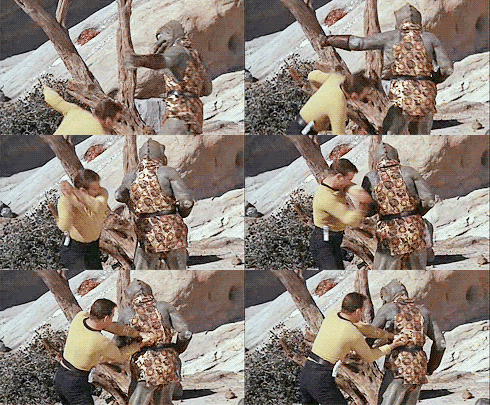
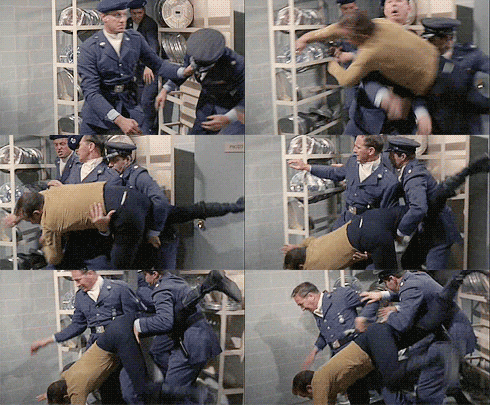
Star Trek me ensinou tudo que eu sei sobre artes marciais
MassaHe,
Star Trek me ensinou tudo que eu sei sobre artes marciais
Tadeu and -1 others like this
19 Nov 18:30


Heroes of Science Action Figures
MassaEu quero isso!! Feynman vem com a van e umas gatinhas de minivestido ??
Submitted by: Unknown (via Datazoid)
Tagged: datazoid , action figures , deviant art , toys , heroes of science Share on Facebook
16 Nov 01:19


How to Develop Sherlock Holmes-Like Powers of Observation and Deduction
by Thorin Klosowski
Massa...
 If there's one spy skill we all envy, it's the Sherlock Holmes-like ability to quickly read a situation and come up with a theory that explains it (like the toothpaste stain that reveals your co-worker overslept, or the nervous twitch that shows your friend drank too much). Luckily, anyone can hone these same skills, and it isn't that hard. Here's how to do it.
Observing people and situations is an incredibly valuable tool. It gives you the ability to notice subtle cues during conversations, job interviews, presentations, and anywhere else so you can react to situations more tactfully. These are the trademark tools of Sherlock Holmes, as well as modern day detectives you see on TV shows like Psych, Monk, or The Mentalist. To figure out how to train your brain for Sherlock Holmes-esque intuition, I spoke with journalist and psychologist Maria Konnikova, author of the upcoming book Mastermind: How to Think Like Sherlock Holmes. The two core values of Holmes' skills are simple: observation and deduction.
Increase Your Powers of Observation
 Most of us don't pay attention to the world around us. What makes a detective good is the ability to notice small details. Konnikova suggests this is all about building the habit of being mindful of your surroundings:
It's not a superhuman ability. It's important to note when talking about Holmes that he has spent a lifetime cultivating the habits of mindfulness. So it's not like he was just born with this ability to be in touch with the world. What we choose to notice or not notice is a way of framing it in our own mind. We have a lot of bad habits in our mind, and we have to retrain ourselves to really notice the world. Everything we do rewires the brain, but we can rewire it in a way that mindfulness eventually becomes less of an effort.
Our worst habit is that we simply don't pay attention. We're always trying to get things done quickly, and because of that, we lose the childlike wonder of focusing in on the smaller details and asking "why is that there?" So, like any habit, increasing your powers of observation means first identifying your bad habit (you prioritize getting things done fast and miss the smaller details), and cultivating new habits (slowing down and paying attention). The first step is to just stop and pay attention every once and awhile, but here are a few things you can do to train your brain along the way. Photo by Olivier Bacquet.
Give Yourself Monthly or Daily Challenges That Force You to Slow Down
 One of the classic tricks for forming a new habit is to gradually work yourself into it every day. Since we're looking at observation as a habit, let's start by observing one new thing every day.
You can do anything you want here, provided it causes you to slow down and observe the world from another angle. Personally, I try to take one interesting picture a day (like the 365 Project). For me, that means stopping and actually paying attention to the countless amounts of weird things I usually don't notice when I'm moving around my city. Other ideas could include trying new foods weekly and writing about them, noticing the color of a co-worker's shirt every day, or even just looking at a new piece of art closely once a day.
The idea is to gradually teach yourself to notice small details in your environment and daily life. As you do so, you'll become more likely to notice everything that's out of place. Photo by Stacie.
Take Field Notes to Focus Your Attentions
 If you're really struggling to pay attention and personal challenges aren't working, scientists teach us another trick: start taking field notes throughout the day. Time explains:
First, scientists train their attention, learning to focus on relevant features and disregard those that are less salient. One of the best ways to do this is through the old-fashioned practice of taking field notes: writing descriptions and drawing pictures of what you see.
When you get yourself in the mindset of taking field notes, you start paying attention to the tiny details. You can do this anywhere. If you're at work, dedicate 10 minutes to observing one person's behavior. Pay attention to how often they take a sip of water, when their eyes stray from their computer screen, or if they're constantly checking their email. The more you do this on paper, the better you'll get at doing it on the fly. Photo by Incase.
Briefly Meditate Daily
 Meditation is sometimes equated with a religious experience or seen as silly, but it's a good skill for anyone to learn that can help increase your focus. It's also not as rigorous as you might think. As Konnikova notes, a few minutes a day is all you really need:
There's this whole area of mindfulness training that teaches you to pay attention to yourself and what's going through your head more. It's not about going on a meditation retreat, but just taking a couple minutes at your desk. I think that's important to keep in mind—meditation doesn't mean you have to run off and become a monk, it's just a way to refocus your mind.
As we've talked about before, meditation is all about teaching yourself focus. When you can focus on yourself, you'll likely become a better observer of the world as well. Photo by John.
Power Up Your Deduction Skills with Critical Thinking
Once you start paying close attention to the world, you can start turning those observations into theories or ideas. Deduction is about thinking through a situation logically, and then applying critical thinking to what you're seeing. Essentially, critical thinking is analyzing what you observe closely, and deduction is coming up with a conclusion based on those facts.
Analyze What You See or Read, and Ask Questions
 You're not going to find a complete guidebook out there for critical thinking, but the first step is to recapture your childlike awe of the world and start asking as many questions as possible. Konnikova suggests you start asking yourself questions:
It's important to teach yourself to think critically about something. So, when you store new information or learn anything new, you don't just by rote put it in your brain, you learn to critically analyze everything. You ask yourself, "Why is this important?" "How does this connect with things I already know?" or "Why do I want to remember it?" When you're doing that you're training your brain to make connections between things and you're building a network of knowledge.
This is a bit of extra work, but boosting your reading comprehension isn't that hard, and when you get in the habit of doing it you'll walk away with a stronger memory of what you read. When you're asking a lot of questions, you're thinking critically, and that improves your skills at deduction in general. We've talked before about using Michel de Montaigne's idea of writing notes in books, and that's an excellent step to take here as well. Once you write down your opinion, and the questions you have after reading, it'll solidify those ideas in your head longer. Photo by francois.
Form Connections Between What You See and What You Know
 Of course, all the increased perception and critical thinking isn't going to do you any good unless you can start making connections between the knowledge you have and what you see. Konnikova describes this as maximizing your mental real estate:
It's not necessarily that Holmes remembers more, but that he can see connections that people usually miss. People think Holmes is this paragon of logic, but that logic is innately imaginative at its core. He doesn't think linearly, he engages his entire network of possible connections.
Essentially, Holmes remembers so much because he encodes knowledge by seeing its uses right away. It's similar to how the memory palace works, but instead of leveraging the memory on a space, it connects it to previous knowledge like a mind map. Traditionally, mind maps are used as brainstorming tools, but they're a great way to take notes as well. I used mind maps for notes throughout college to connect ideas between classes together, and it helped solidify those memories in my head far better than when I simply wrote down what the professor was saying.
So, how does all this work together? The more connections you make, and the more often you think critically, the better you're going to get at making deductions:
It has to do a lot with the way that information is stored in Holmes' brain. It's kind of a circular argument—learning to think critically about something will also innately teach you remember something better. In doing that you're not only enhancing your ability to make deductions but you're also increasing your knowledge base.
With a little practice and critical thinking, you'll eventually be able to start making those trademark leaps in logic Holmes is known for.
Increase Your Knowledge Base
 One of the big takeaways from Sherlock Holmes—or any detective out there—is that it's rarely worth it to condense your knowledge into a specialty. Being more of a renaissance type with both your learning and your skill set will make your skills of deduction much stronger. Konnikova sums it up like so:
You should be broad in your knowledge. Holmes says that you should have a clean "brain attic," but he's also a walking encyclopedia of knowledge. He reads incredibly broadly—he reads about art, music—things that you would think have no bearing on his detective work. I think that's an important lesson that we can take. It's bad to overspecialize, and we should try to remain as curious about all the different types of things you want to learn.
Being a student of everything isn't an easy task, but whether you're looking to read people better, or just increase your general knowledge base, we've got you covered. Here are a few places to start from our own archives:
- Broaden Your Knowledge of General Studies with Lifehacker University
- Top 10 Ways to Make Yourself Look (and Be) Smarter
- Top 10 Tips and Tricks to Train, Exercise, and Better Your Brain
- How to Train Your Brain and Boost Your Memory like a USA Memory Champion
- I Learned to Speak Four Languages in a Few Years: Here's How
- Broaden Your Horizons by Randomizing Your Reading Material
- How to Detect When Someone's Lying and Get Them to Tell the Truth
- How to Determine if a Controversial Statement is Scientifically True
- How to Spot Truth in the Sea of Lies, Rumors, and Myths on the Internet
- How Science Can Teach You to Easily Spot a Liar
It takes a lot of practice and the formation of true habits to emulate the way Sherlock Holmes and other detectives view the world, but it's not that difficult to do yourself. Once you train your brain to stop and pay attention to the tiny details, the rest of the process falls into place. Before you know it you're able to analyze any situation—whether it's a friend's hangover or a stranger's affair—in no time. Photo by Nick Webb.
Maria Konnikova is a journalist, psychologist, and author of the upcoming book, Mastermind: How to Think Like Sherlock Holmes. You can find more of her writing on her web site.
This post is part of Spy Week, a series at Lifehacker where we look at ways to improvise solutions to every day problems Bond-style. Want more? Check out our spy week tag page.
Photo by Penywise (pond5).
16 Nov 01:18

Learn How to Break Down a Door (Without Hurting Yourself)
by Whitson Gordon
Massa...
 Perhaps you're saving a child from a burning building, or perhaps you're breaking into the stronghold of an enemy spy—but one way or another, you have to break down a door. Weblog The Art of Manliness shows us how to do it effectively and safely.
You've probably seen people do it in the movies, but Art of Manliness notes that there are a few things you'll want to make sure of before you go kicking down every door in your path:
Check to see which way the door opens by checking the hinges. If the door opens towards you, kicking it down is going to be next to impossible. Kicking a door down is best employed on a door that swings away from you.
Kick to the side of where the lock is mounted (near the keyhole). This is typically the weakest part of the door.
The above illustration explains most of the things you need to know, but for a more detailed description of the process, hit the link below.
How To Break Down A Door: An Illustrated Guide
This post is part of Spy Week, a series at Lifehacker where we look at ways to improvise solutions to every day problems Bond-style. Want more? Check out our spy week tag page.
Massa likes this
14 Nov 16:46


Red Riding Hood and the Big Bad Bolzano-Weierstrass Theorem
by Maiu
MassaHa!
Do you want to hear a different kind of bedtime story? This one won’t leave you disappointed.

Source: people.math.sfu.ca
11 Nov 21:19
"Gay marriage legalized on the same day as marijuana makes perfect biblical sense. Leviticus 20:13:..."
MassaSulu++++
“Gay marriage legalized on the same day as marijuana makes perfect biblical sense. Leviticus 20:13: ‘A man who lays with another man should be stoned.’ Our interpretation has just been wrong for all these years.”
- George Takei (via knowhomo)
- George Takei (via knowhomo)
09 Nov 18:12
Fofura do dia
by Família Petiscos
MassaPolítica é política, mas esse trem me deu uma lagriminha aqui.
Esta quarta-feira, 7/11, já entrou para a história como o dia em que Barack Obama foi reeleito presidente dos Estados Unidos. Mas aqui na redação outra notícia sobre ele chamou nossa atenção: a carta que a menina Sophia, de dez anos, adotada por um casal de homossexuais, enviou à Casa Branca. Nela, a garotinha agradece Obama por apoiar o fato de dois homens se amarem, viverem juntos e formarem uma família, e ainda pede conselhos ao presidente sobre como deve responder às provocações dos colegas na escola.
E sabe o melhor? Ele respondeu. Disse que se sentia honrado em ser presidente de um país em que vivem pessoas cheias de amor e respeito e sugeriu que ela aconselhasse os colegas a tratarem os outros da mesma maneira com a qual gostariam de ser tratados.


08 Nov 18:38
Micromorts
by schneier
Massaliked it.
Here's a great concept: a micromort:
Shopping for coffee you would not ask for 0.00025 tons (unless you were naturally irritating), you would ask for 250 grams. In the same way, talking about a 1/125,000 or 0.000008 risk of death associated with a hang-gliding flight is rather awkward. With that in mind. Howard coined the term "microprobability" (μp) to refer to an event with a chance of 1 in 1 million and a 1 in 1 million chance of death he calls a "micromort" (μmt). We can now describe the risk of hang-gliding as 8 micromorts and you would have to drive around 3,000km in a car before accumulating a risk of 8 mt, which helps compare these two remote risks.
There's a related term, microlife, for things that reduce your lifespan. A microlife is 30 minutes off your life expectancy. So smoking two cigarettes has a cost of one microlife.
Massa and -1 others like this
08 Nov 01:40

Grab Eight DRM-free Ebooks for a Pay-What-You-Want Price
by Whitson Gordon
MassaOlha aí, galera...
 Cheap ebook service StoryBundle is at it again, selling eight ebooks from independent authors (this time focusing on horror and dark fantasy) for a pay-what-you-want price, just like usual. Pay $9 and you'll get two extra books—a great way to find new authors for super cheap. The bundle ends in two days, so hurry up and grab them while you can. [StoryBundle]
Albener Pessoa, Massa likes this
07 Nov 14:11
Colorado e Washington legalizam uso recreativo da maconha nos EUA
Colorado e Washington são os primeiros Estados americanos a legalizar o uso recreativo da maconha, após referendos votados nesta terça-feira (6) junto com a eleição presidencial que reelegeu o democrata Barack Obama.
Os dois Estados são os primeiros dos EUA a autorizarem o uso da maconha para fins recreativos --a legalização para fins recreativos foi rejeitada na Califórnia em referendo em 2010. A campanha pró-maconha angariou US$ 6 milhões em Washington, segundo registros financeiros da campanha. No Colorado, as doações chegaram a quase US$ 2 milhões.
Segundo autoridades do Colorado, com mais de 50% das urnas apuradas, 52,7% dos votos foram a favor da medida.
Leia mais (07/11/2012 - 03h05)
Massa likes this
05 Nov 03:07


Hands On: The Mosaic Photobook
by Jon Mitchell
The touchscreen will not replace the book. Until some possible future when the two technologies are indistinguishable from each other, the tangible, sensuous, unpowered nature of the book will never give way to cold, glowing glass. Mosaic proved that once again when it was revealed in October, and now it's live and available to all iPhone owners.
Mosaic is an iPhone app that lets you print dreamlike photo albums on demand. You choose up to 20 photos from your phone’s camera roll, arrange them in a virtual photobook in the Mosaic app, tap ‘Place Order,’ and the real book arrives on your doorstep in days.
The tactile experience of the product begins on the phone. You can endlessly remix the photos that appear in the iconic cover frame by tapping the shuffle button.
Then you drag your photos into the right order, and you can turn every page of the book with your finger onscreen to make sure it looks right.

When you’re ready, you tap ‘Place Order,’ and if you haven’t yet entered your information, you quickly do so.
After a couple days, your book arrives in bare, beautiful packaging that would make Apple blush.

Every detail, down to the ribbon that frees the book from its box, has been tuned to hit the right visual and tactile notes.

When I expressed surprise at how the physical book surpassed my expectations, Caleb Elston, head of the Mosaic team, humbly said, “We’ve sweated the details.”

A Mosaic book costs $20. At first, that price seemed too high to overcome the inertia of people saying “Meh, I’ll just look at my pictures on my computer.” But I didn’t realize until I saw it that the book that would arrive on my porch in days would be something I’d want to keep around forever.

My Mosaic book is exquisite. My roommate and I took drugstore disposable film cameras to Burning Man this year and got the prints on CDs. I chose 20 of my favorite of these ethereal, grainy shots for my Mosaic, and I can’t believe how beautifully they turned out.
I can see ordering these as heartfelt gifts. I can see a whole section of my bookshelf for them. They look like totems from the film Inception, personal tokens for remembering dreams.
Mosaic for iPhone is the first release from the team that brought us the mobile chat room, Yobongo, after its acquisition by Mixbook. The team was tasked with bringing photo album printing from the desktop to mobile, just as it did with the chat room before. Mosaic isnt the first solution for turning digital photos into books, but it may be the first with such a realistic book-building experience on the mobile device. And, wow, did they pull it off.
Massa likes this