 This is a visual comparison of fantasy dragon sizes as compiled by The Daily Dot. As you can see, George R.R. Martin's dragons take the cake. Still, I would have liked to see Falcor, Trogdor and Puff the Magic Dragon on the chart. Man, if I was friends with Puff I would have never stopped coming to visit. Seriously, who gets tired of hanging out with a dragon? Jackie Paper: you're a f***ing idiot.
Thanks to MerpMerp, whose name is fun to say out loud but your roommate may eventually yell at you to stop.
This is a visual comparison of fantasy dragon sizes as compiled by The Daily Dot. As you can see, George R.R. Martin's dragons take the cake. Still, I would have liked to see Falcor, Trogdor and Puff the Magic Dragon on the chart. Man, if I was friends with Puff I would have never stopped coming to visit. Seriously, who gets tired of hanging out with a dragon? Jackie Paper: you're a f***ing idiot.
Thanks to MerpMerp, whose name is fun to say out loud but your roommate may eventually yell at you to stop.Shared posts
03 May 02:51
This is a visual comparison of fantasy dragon sizes as compiled by The Daily Dot. As you can see, George R.R. Martin's dragons take the cake. Still, I would have liked to see Falcor, Trogdor and Puff the Magic Dragon on the chart. Man, if I was friends with Puff I would have never stopped coming to visit. Seriously, who gets tired of hanging out with a dragon? Jackie Paper: you're a f***ing idiot.
Thanks to MerpMerp, whose name is fun to say out loud but your roommate may eventually yell at you to stop.
A Visual Comparison Of Fantasy Dragon Sizes
This is a visual comparison of fantasy dragon sizes as compiled by The Daily Dot. As you can see, George R.R. Martin's dragons take the cake. Still, I would have liked to see Falcor, Trogdor and Puff the Magic Dragon on the chart. Man, if I was friends with Puff I would have never stopped coming to visit. Seriously, who gets tired of hanging out with a dragon? Jackie Paper: you're a f***ing idiot.
Thanks to MerpMerp, whose name is fun to say out loud but your roommate may eventually yell at you to stop.
19 Apr 03:59


A Better Battery
by James Fallows
Why do batteries matter? Look at all your electronic devices: from laptops to smartphones to Kindles or iPads, even your watch. Those electronics are getting better at reducing the amount of energy they need, but as they do, you get greedy and want their capability to increase. The battery, and how much energy you can store in a given volume and weight, is the defining factor in this whole field.
Then there are electric cars. If we can make batteries with double the energy density of today’s and drive the price below $200 a kilowatt-hour (versus $300 to $800 today, depending on type and weight), we could have a car with a 300-mile range, even with the air conditioner or heater turned up, that sells for $25,000 to $30,000. The Department of Energy’s goal is to get batteries to $150 a kilowatt-hour by 2020.
Finally, there are the utility-scale batteries, which are very important for renewable energy. Wind and solar power are going to keep increasing. Wind is already the second-cheapest form of new energy, after shale gas, and it will become the cheapest within a decade. Right now utility companies get about 4 percent of their power from renewable sources other than hydro—and that 4 percent is roughly all from wind. You want to see a day when renewables are 50, 60, 70 percent. Utility companies will need batteries to stabilize the flow of renewable energy into the grid, plus a better electrical control system to do the switching. People may have these batteries at their houses instead of generators.
All of this would be a huge market. But the effects are more profound. There are mountainous places even in the U.S., like western Alaska, that will never be connected to the electric grid. There aren’t enough people, and the distances are too great. There are many parts of South Asia like this, too.
But they will have solar and wind power—which, in 10 or 15 years, are going to be as cheap as any other form of energy, or cheaper. Once you have storage systems, you can put a little solar installation on your roof or a plot of land, and now you have your electric supply! It will be like cellphones’ leapfrogging the land-line era. It will transform the prosperity of the world.
There is a slow march toward improving today’s systems, by 5 or 10 percent a year. Meanwhile, many innovative companies, scientists, and engineers are exploring novel approaches. Many of them may not work. But there is a reasonable chance that a couple may work—and really work, to double or triple energy density and lower cost. If you are a battery company and your cost per unit of storage doesn’t drop by a factor of two in the next five years, you are going to be out of business.
— Steven Chu, as told to James Fallows
The Cutting Edge of Battery Technology
At Stanford, Chu and Cui are experimenting with new battery technologies. Here, they discuss three materials on the verge of transforming battery storage.
Silicon Electrodes, through which current flows, are the working heart of a battery. In most batteries, lithium ions carry electrons from the anode to the cathode in order to create an electric current. According to Cui, silicon can store 10 times more lithium than can carbon, which is used in existing technology. “But silicon has an expansion problem,” Cui says. “It gets physically larger as it absorbs ions, and it can break.” Cui’s research group has been addressing this problem via nanotechnology, using very thin, resilient strands of silicon “wire” that can swell and absorb ions without breaking.
Lithium metal Cui calls this metal the “holy grail” for anodes. In the past, researchers have had trouble with dendrite formation, whereby fingers of material grow off lithium-metal anodes, creating short circuits and safety concerns. But Cui is optimistic that, thanks to “lots of great minds coming together,” these problems will be “solvable in the next few years.”
Metal-air In what Chu calls a “whole other class of batteries,” oxygen acts as a cathode, interacting with a metal anode to create electricity. In Chu’s estimate, these batteries have “the very highest energy density, maybe eight times higher than current lithium-ion batteries.” They’re primarily used in hearing aids but are not yet rechargeable—a deficit that, according to Chu, researchers may be close to fixing.
13 Apr 23:04
Crimean Tom and Other War Cats
by Miss Cellania

Have you ever heard the legend of Crimean Tom? It’s a true story, but this cat has achieved legendary status after a 150 years. In 1855, during the Crimean War, British and French forces captured the Crimean (then Russian) port of Sevastopol, which had been under siege for a year. The city was starving, and so were the invading troops. There was no food to be found. But wait -there’s a tom cat!
The cat was so healthy despite the carnage around him that the Brits grew curious. One day, they followed Tom among the ruins. The tabby ducked under some rubble … and didn’t immediately come back.
The soldiers cleared away the debris and discovered a hidden cache of food the Russians had squirreled away at the beginning of the siege. Tom had survived the battle by returning again and again to the same supplies.
The cat saved everyone from starvation. When the time came to return to Britain, a soldier named William Gair took Tom with him. The cat died a year later.
You can still see Crimean Tom, as he was stuffed and is on display at London’s National Army Museum. Read the full story, and those of several other wartime cats, at Medium. -via Nag on the Lake
(Unrelated image credit: Flickr user Jeff Gitchel)
06 Apr 03:03
Hybrid Desk & Storage Rise Up to Meet Suspended Staircase
by Urbanist
[ By WebUrbanist in Design & Fixtures & Interiors. ]





[ By WebUrbanist in Design & Fixtures & Interiors. ]
[ WebUrbanist | Archives | Galleries | Privacy | TOS ]


Playing tricks on the eye, this split-style stairway merges a desk and storage below with a framework of steps hanging down from above, all with a daunting-looking gap left in the middle.


Dutch designer Mieke Meijer hand-crafted this hybrid interior system for the home of Just Haasnoot in The Hague, inspired in part by the black and white photography of Bernd and Hilla Becher.


The frame-based structure was made to save space and maintain a sense of openness. The unfolding angular geometries add elements of visual interest to a toned-down space while accommodating various storage surfaces, nooks and crannies.


The use of alternating steps allows for a steep incline to be safely traversed, though some might still question the absence of a hand rail (which would be mandated by building code in most locations).


This approach seems particularly well-suited to places with less-used upstairs spaces – as the photographs show, it would be easy to let certain steps simply become shelves most of the time, then be cleared off when guests come to stay in the spare attic bedroom.
Want More? Click for Great Related Content on WebUrbanist:
Living Staircase: Spiral Stairs Wrapped in Organic Greenery
Boldly curved and cantilevered into midair, these plant-wrapped stairs are designed to provide more than just a means of moving from one floor to another. ... Click Here to Read More »»
Drop-Leaf Desk: Small Side Table Converts into Work Surface
Designed as carefully as it is hand-crafted, this Tablet Desk has a deceptively streamlined look that hides a series of modular features and space-saving ... Click Here to Read More »»
Storage Tubs for Bathrooms with Precious Little Space
No room in your bathroom for those essential items? These clever bathtub storage solutions give you more space in a most unexpected place. Click Here to Read More »»
[ By WebUrbanist in Design & Fixtures & Interiors. ]
[ WebUrbanist | Archives | Galleries | Privacy | TOS ]
27 Mar 22:53
What do the bullies for Christ hope to gain?
by Fred Clark
The bullies had to prove that they could control World Vision, because controlling World Vision helps them pretend that they can control the Bible.
It’s just like why the same bullies are compelled to control women. Controlling women is another way of pretending that they can control the Bible.
And as long as the bullies can pretend that they can control the Bible, they can pretend that they control God.
That’s what they really want to do and sometimes almost actually convince themselves that they can do: Control God.
After all, somebody has to get God under control. It’s just like the biblical prophet said — God gets out of control:
God changed his mind about the calamity that he had said he would bring upon them; and he did not do it.
But this was very displeasing to Jonah, and he became angry. He prayed to the Lord and said, “O Lord! Is not this what I said while I was still in my own country? That is why I fled to Tarshish at the beginning; for I knew that you are a gracious God and merciful, slow to anger, and abounding in steadfast love, and ready to relent from punishing. And now, O Lord, please take my life from me, for it is better for me to die than to live.”
Jonah totally called it. He was looking forward to some righteous smiting and wrathful calamity, but he just knew that God was going to ruin everything. He knew that God was gracious and merciful, slow to anger, and abounding in steadfast love.
 Completely unreliable, in other words. Completely out of control.
And Jonah, just like his disciples, the bullies for Christ, was sure that unless he could get God under control then life just wasn’t worth living.
So the bullies for Christ pretend to control the Bible and thereby pretend to control God. On behalf of God, they say, LGBT people are banished. And anyone who fails to condemn LGBT people or who fails to shun them is also banished.
But here’s the thing — we’ve all been banished into Ninevah. Jonah and his fellow bullies imagine it must be awful in there, inside that wicked unclean city full of wicked unclean people. And so they stand outside, baking in the desert sun, smugly convinced that they’ve managed to punish all the out-of-control people that an out-of-control God refused to smite.
What they don’t realize — what they’ll probably never realize — is that banishment into Ninevah is no punishment. Ninevah is a party. Ninevah is the party — the party to end all parties, the banquet at the world’s end, the marriage supper of the Lamb. It’s out of control.
Malady579 likes this
25 Mar 03:11
Abandoned Underground: 10 Long-Lost Subterranean Cities
by Steph
[ By Steph in Travel & Urban Exploration. ]
Next Page - Click Below to Read More:


[ By Steph in Travel & Urban Exploration. ]
[ WebUrbanist | Archives | Galleries | Privacy | TOS ]


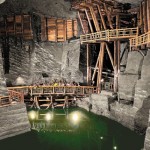
Subterranean spaces now silent, dank and cobwebbed once bustled with activity – often of the illicit variety – housing secret speakeasies, opium dens, bootlegging operations and hubs for human trafficking. Others were literally entire cities unto themselves, complete with roller skating rinks. Some are still a mystery, decades after their discovery. These 10 once-thriving underground complexes were abandoned for many years and nearly forgotten as the cities above them evolved.
Ancient Underground Tunnels of Germany


Nobody has any clue why a network of claustrophobic stone tunnels emerge into the kitchens of farmhouses, the aisles of churches and the center of cemeteries in a small town near Munich. The German state of Bavaria is packed with at least 700 such tunnel systems but perhaps none are so mysterious as the Erdstall, which was discovered when a grazing dairy cow suddenly fell into the earth, revealing an opening. The tunnels are uncomfortably cramped, leading to local legends that they were constructed by elves. Archaeologists have ruled out their use as storage space or livestock housing and have found very few artifacts inside, deepening the mystery. It’s believed that only about 10% of the total tunnel system has been explored.
Burlington Bunker, England


A secret rail line leads from London’s royal palaces directly to a nuclear blast-proof bunker with sixty miles of roadways and its own underground lake, about 100 feet below the small town of Corsham. Built in the ’50s to house 4,000 central Government employees during a nuclear strike, the Burlington Bunker is truly a city unto itself with kitchens, laundry facilities, its own pub and a communications hub from which the Prime Minister would have addressed the nation in the event of an attack. Capable of withstanding bombs, radiation and poison gas, it was designed to keep its inhabitants safe and healthy for a three-month stretch. But nobody outside those with the right level of clearance even knew this facility existed until 2004, when it was decommissioned. The walls are covered in murals, the kitchen equipment still seemingly ready to churn out food for hundreds at any moment, the beds dressed in white sheets and red pillows. Read more and see hundreds of photos at BBC.
Shanghai Tunnels: Portland, Oregon

Unconscious men and women who had been drugged with opiates, knocked out or otherwise incapacitated were once carried through the dank tunnels leading from Portland, Oregon’s hotel and business basements out to the Willamette River at a rate of up to ten per day. The ‘Shanghai Tunnels‘ were initially built to keep ship equipment out of the rain and transport supplies to the city, but between 1850 and 1941, they were the shadowy setting for a booming slave trade. Portland became known as the “Forbidden City of the West” thanks to the ‘Shanghaiing’ trade, in which men were captured and sold to ship captains as slaves. But of course, women weren’t safe from the dangers, either: they were often kidnapped, sold and sent off to faraway cities to be held as sex slaves.
Most of these subterranean spaces have since been filled in as Portland has grown over the decades, and as far as anyone knows, there aren’t any that still lead to the waterfront. But the Cascade Geographic Society conducts tours of the parts that are still accessible, and is currently digging out new tunnels.
The Speakeasy Tunnels of Moose Jaw, Canada

On the surface, the town of Moose Jaw doesn’t seem much different from many other historic small towns in Saskatchewan, Canada. But just beneath the pavement is a labyrinth of tunnels constructed during the late 19th century that ultimately became known as ‘Al Capone’s Hangout.’ They were originally built so building staff could move from one building to the next to keep the furnaces going in the frigid winters, but Chinese migrants escaping persecution during the Yellow Peril eventually moved into them and started their own little subterranean society. Sleeping three to a bed, they worked long hard hours for little money and soothed themselves with opium. Then, once prohibition hit, the town became a hub for rum-running, gambling and prostitution. The Al Capone reference comes from a legend that the mobster had interests in the bootlegging operations, but no written or photographic proof exists that he ever visited.
Today, the tunnels are open for tours year-round, though the living inhabitants have long since been replaced with animatronics, and the barrels of contraband booze with empty containers.
Next Page - Click Below to Read More:
Abandoned Underground 10 Long Lost Subterranean Cities
Want More? Click for Great Related Content on WebUrbanist:
Buried Cities: 7 (More!) Underground Wonders of the World
Humans burrow into the Earth out of anything from necessity to superstition, driven by coincidence or coerced by circumstance. Click Here to Read More »»
Down Towns: 6 Unbelievable Spaces Gone Underground
The above-ground world is far from being the whole story. There's another world beneath our feet - one that many of us never see - like these 6 amazing spaces. Click Here to Read More »»
Subterranean Scare: 7 Underground Wonders of the World
What motivates humankind to burrow deep into the Earth? Wind your way through these crypts, catacombs, labyrinths and tunnels to learn more, if you dare! Click Here to Read More »»
[ By Steph in Travel & Urban Exploration. ]
[ WebUrbanist | Archives | Galleries | Privacy | TOS ]
23 Mar 02:46
 Hey guys I am having some personal health problems, so bear with me.
This is the Doctor Who TARDIS LEGO set currently up for voting on the LEGO Cuuso website. Of all the sets I've seen on the site recently, I feel like this one might actually stand a chance. Whovians are pretty fanatical. The only question is whether the BBC, which owns the rights to Doctor Who and is based in England, will be able to reach a licensing agreement with LEGO, which is based in Denmark. England and Denmark are long time rivals. They actually hate each other. "Who told you that?" My roommate, he said it would make me sound smart. Is it working? What if I put on these glasses?
Keep going for some closeups.
Hey guys I am having some personal health problems, so bear with me.
This is the Doctor Who TARDIS LEGO set currently up for voting on the LEGO Cuuso website. Of all the sets I've seen on the site recently, I feel like this one might actually stand a chance. Whovians are pretty fanatical. The only question is whether the BBC, which owns the rights to Doctor Who and is based in England, will be able to reach a licensing agreement with LEGO, which is based in Denmark. England and Denmark are long time rivals. They actually hate each other. "Who told you that?" My roommate, he said it would make me sound smart. Is it working? What if I put on these glasses?
Keep going for some closeups.
Doctor Who TARDIS LEGO Set Up For Voting
Hey guys I am having some personal health problems, so bear with me.
This is the Doctor Who TARDIS LEGO set currently up for voting on the LEGO Cuuso website. Of all the sets I've seen on the site recently, I feel like this one might actually stand a chance. Whovians are pretty fanatical. The only question is whether the BBC, which owns the rights to Doctor Who and is based in England, will be able to reach a licensing agreement with LEGO, which is based in Denmark. England and Denmark are long time rivals. They actually hate each other. "Who told you that?" My roommate, he said it would make me sound smart. Is it working? What if I put on these glasses?
Keep going for some closeups.
13 Mar 23:23


National Weather Service forecast: You are basically screwed
by Maggie Koerth-Baker

This was included as part of the official forecast last night for the Baltimore, Maryland/Washington DC area. Hope you all are surviving the apocalypse. (via Wired)
    
|
13 Mar 13:27


English mispronunciations that became common usage
by Cory Doctorow

Here's a great history of English mispronunciations that became the received pronunciations. The piece makes the important point that English has no canon, no unequivocal right way or wrong way of speaking -- a point that is often lost in Internet linguistic pedantry and literacy privilege.
I'm as guilty as anyone of thinking that my English is the best English, but the next time I wince at "nukular," I'll remind myself that "bird" started out as "brid" and "wasp" started out as "waps," but were mispronounced into common usage.
Adder, apron and umpire all used to start with an "n". Constructions like "A nadder" or "Mine napron" were so common the first letter was assumed to be part of the preceding word. Linguists call this kind of thing reanalysis or rebracketing.
Wasp used to be waps; bird used to be brid and horse used to be hros. Remember this when the next time you hear someone complaining about aks for ask or nucular for nuclear, or even perscription. It's called metathesis, and it's a very common, perfectly natural process.
8 pronunciation errors that made the English language what it is today [David Shariatmadari/Guardian]
(via Hacker News)
(Image: Double bitted felling axe, Wikimedia Commons/Luigizanasi CC-BY-SA)
|
|
Randy Laue, Luke.stirling and 3 others like this
12 Mar 18:24


A math teacher explains so-called "new math"
by Maggie Koerth-Baker

You've probably seen this image making the rounds on social media. It shows a method of doing basic subtraction that's intended to appear wildly nonsensical and much harder to follow than the "Old Fashion" [sic] way of just putting the 12 under the 32 and coming up with an answer. This method of teaching is often attributed to Common Core, a set of educational standards recently rolled out in the US.
But, explains math teacher and skeptic blogger Hemant Mehta, this image actually makes a lot more sense than it may seem to on first glance. In fact, for one thing, this method of teaching math isn't really new (our producer Jason Weisberger remembers learning it in high school). It's also not much different from the math you learned back when you were learning how to count change. It's meant to help kids be able to do math in their heads, without borrowing or scratch-paper notations or counting on fingers. What's more, he says, it has absolutely nothing to do with Common Core, which doesn't specify how subjects have to be taught.
I admit it’s totally confusing but here’s what it’s saying:
If you want to subtract 12 from 32, there’s a better way to think about it. Forget the algorithm. Instead, count up from 12 to an “easier” number like 15. (You’ve gone up 3.) Then, go up to 20. (You’ve gone up another 5.) Then jump to 30. (Another 10). Then, finally, to 32. (Another 2.)
I know. That’s still ridiculous. Well, consider this: Suppose you buy coffee and it costs $4.30 but all you have is a $20 bill. How much change should the barista give you back? (Assume for a second the register is broken.)
You sure as hell aren’t going to get out a sheet of paper ...
|
|
12 Mar 18:23


Lux, an angry cat, traps family, including dog, in bedroom
by Rob Beschizza

"He's charging at us," she screamed into the handset. "He's at our door, the bedroom door!"
"One moment, okay?" the dispatcher's voice echoed in the darkness, the liminal zone between cell towers, between life and death.
"Raaaaaarrrrrrrr!" said the cat, angrily. He remembered the child's kick, the sting of betrayal, and would not soon forget it. "Raaaaaarrrrrrrr!"
Aggravated cat is subdued by Portland police after terrorizing family [The Oregonian via Gawker]
|
|
12 Mar 18:22


Randall "XKCD" Munroe is doing a What If? book!
by Cory Doctorow
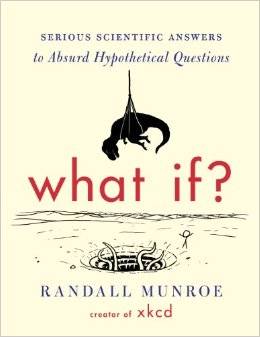 XKCD creator Randall Munroe has announced that Houghton Mifflin will collect his amazing What If? science columns into a book called What If?: Serious Scientific Answers to Absurd Hypothetical Questions, to be published in September 2014. It will include in-depth answers to questions that he hasn't yet answered online, as well as expanded and updated versions of his previous columns.
What If? is one of my Internet must-reads, and I look forward to each new installment, and always read it with delight.
See, for example: Fermi estimation, printing out Wikipedia, total possible English-language tweets, extinguishing the sun, murder by superball, Fedex vs file-transfers, cooking steak with freefall, a mole of moles, robot uprisings and relatavistic baseball.
As I’ve sifted through the letters submitted to What If every week, I’ve occasionally set aside particularly neat questions that I wanted to spend a little more time on. This book features my answers to those questions, along with revised and updated versions of some of my favorite articles from the site. (I’m also including my personal list of the weirdest questions people have submitted.)
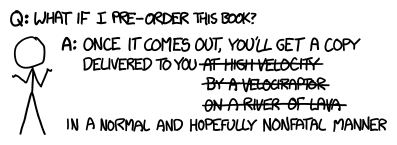
What If?: Serious Scientific Answers to Absurd Hypothetical Questions [Pre-order]
What if I wrote a book? [XKCD] 
|
|
Christian and -1 others like this
12 Mar 18:20
Sand Paintings: Temporary Street Art Will Blow (You) Away
by Urbanist
[ By WebUrbanist in Art & Street Art & Graffiti. ]



[ By WebUrbanist in Art & Street Art & Graffiti. ]
[ WebUrbanist | Archives | Galleries | Privacy | TOS ]


After 650 such works, it is perhaps no wonder that this artist generates each new sand painting spontaneously on the spot, letting the pattern evolve as he pours him efforts (and handfuls of sand) into each piece.

Joe Mangrum is a New York City painter, sculptor and all-around installation artist whose works of colorful, organic and fractal geometry often span as much as 15 or 20 feet in diameter.

Inspired by Celtic knots and Asian mandalas, he began creating these public pieces which, in turn, kept being swept up from the city streets. His story gained national attention in part due to tension with authorities, including a Parks Department in California.

Part of the beauty of his approach is its accessibility, both conceptually and physically – people can watch him work on a sidewalk for hours, and see the art evolve before their eyes.

He describes his work as “visual rebellion” against “the urban grid” – a sort of organic counterpoint to the strictly-defined and linear streets and sidewalks on which he works.

He writes of his strategy: “Each painting is spontaneously improvised, using colorful sand, poured directly from my hand. In the process of creation, I whisk a mash-up of visual cues, inspired by ancient traditions synced up with a rhythm of animation.”

His free-style approach and Pop Art colors are inspired by everything from undersea creatures to carnivorous plants, botanical geometries and other cultures experience through international travels.

His pieces have be set indoors as well as outside, and in formal as well as informal contexts: “Mangrum’s work has been exhibited worldwide. Creating over 650 public sand paintings since 2009. In 2012 he has been featured in “Swept Away” at the Museum of Arts and Design in NYC, The Flag Art Foundation’s “Watch Your Step” exhibit and at The Corcoran Gallery Rotunda in Washington DC. In 2003 Joe was awarded the Lorenzo de Medici Award at the Florence Biennale for his piece titled “Fragile” as it relates to economic structures. “
Want More? Click for Great Related Content on WebUrbanist:
Tag Before the Tide: Temporary 3D Sand Graffiti by DAIM
Artist Mirko Reisser has long developed a highly personalized (and profoundly cool) approach to making two-dimensional tags appear three-dimensional on ... Click Here to Read More »»
Colorful Contrast: Geometric Street Paintings in France
A wide strip of bold geometric patterns in bright colors painted onto the asphalt disrupts the muted historic visuals of a small city in France. Click Here to Read More »»
42 Unusual Works of Geek, Temporary & Reverse Graffiti
As graffiti and technology evolve, more and more innovative street artists are mixing media to create radical hybrids of graffiti art, design and technology. Click Here to Read More »»
[ By WebUrbanist in Art & Street Art & Graffiti. ]
[ WebUrbanist | Archives | Galleries | Privacy | TOS ]
05 Mar 03:39


Kickstarting a new Cheapass game with Patrick Rothfuss
by Cory Doctorow
Carol from the wonderful Cheapass Games writes, "Pairs is our latest project: a classic pub-style card game, designed by James Ernest and Paul Peterson. We've teamed up with Patrick Rothfuss to make decks with themes and artwork from the world of his Name of the Wind novels. We still have 10 days left in the Kickstarter, and we've got over 3000 backers, and support that's passed $100,000. As the campaign grows, we're adding more card decks for backers to choose from."
As of this morning, we've unlocked seven different card decks: two "Name of the Wind" decks with art by Shane Tyree, a pirate deck from Brett Bean, a barmaid deck by Echo Chernik, a clip art Fruit deck, a Goblin deck from Pete Venters, and a new edition of the classic Cheapass Game, "Falling". Next up are decks from Cheyenne Wright, Phil Foglio, and John Kovalic, as well as two decks by Nate Taylor: another "Name of the Wind" deck, and a "Princess and Mr. Whiffle" deck, from Rothfuss' not-for-children children's book.
In a typical James Ernest move, James will be tweeting the final hour of the campaign from a steakhouse in Las Vegas. He'll be in Vegas anyway for the GAMA game-industry trade show, and he figured there was no better place to chill after a grueling Kickstarter campaign. The party begins at 8:00 pm Pacific, on Friday March 14.
Pairs: A New Classic Pub Game (Thanks, Carol!) 
|
|
23 Feb 22:59


Math and science cutting boards
by Cory Doctorow

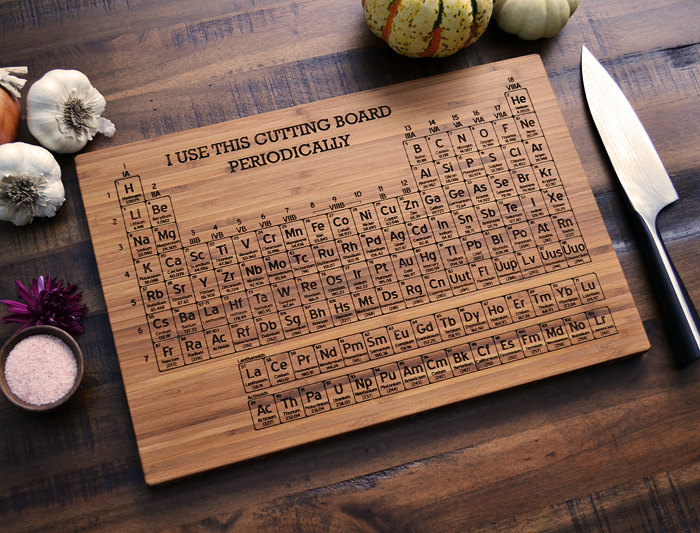 Elysium Woodworks's Etsy store is full of gorgeous, laser-etched, math- and science-themed cutting boards. They're about $35, made from bamboo, and take 5-6 weeks to fabricate.
Elysium Woodworks (via Wil Wheaton) 
|
|
hamatoyoshi, Markku.lempinen likes this
05 Feb 23:04
Put Something Interesting on the Sign, They Said...
s.spantig and -1 others like this
05 Feb 23:03


Bill Nye won the creation/evolution debate last night... but not for the reason you think
by Maggie Koerth-Baker

Sadly, says dino-science reporter Brian Switek, the reality of this church does not follow through on the potential promised by its signage. Brian took this photo in the town of Dinosaur, Colorado, near the Dinosaur National Monument.
This seems like a lovely moment to mention that the debate between Bill Nye (the science guy) and Ken Ham (the creationism guy, at least now that Kent Hovind is in jail for tax fraud) happened last night.
You can watch the debate online and also read journalist Chris Mooney's live tweets, which add a little commentary to the proceedings. Who you think won probably depends entirely on what you thought about the issue going into watching it. The big problem with a debate like this, and why I chose not to pay much attention to it myself, is that the two debaters are debating different things. Ham went in to talk about theology, the idea of man's relationship to nature and to God, and the role that belief in a deity may or may not play in ethical and moral behavior. Nye was there to talk about scientific evidence supporting evolution. It's hard to have a real debate when you're not talking about the same subjects.
It's also hard to have a real debate when one side flat-out admits that there is absolutely nothing that could or should ever change their mind — which Ham did towards the end of last night's presentation.
From what I can tell, the most valuable thing Bill Nye did also came towards the end, when he explained that Ken Ham's views don't represent all religion or even all Christianity. This isn't a debate about God or no god. There are many, many people who believe God and accept the evidence of evolution, too. As religion blogger Fred Clark pointed out, there really should have been two debates — one about evolution and a separate one about Ham's theology. Too often, scientists in this kind of situation fall into the trap of accepting that what the creationist says represents the only real, true Christian belief. Kudos to Bill Nye for figuring out that wasn't the case, and pointing it out to the audience.
|
|
J.w.dillow, Christian and one other like this
06 Dec 12:32
100 Cubic Meters: Split-Level Urban Micro-Condo in Madrid
by Urbanist
[ By WebUrbanist in Design & Fixtures & Interiors. ]



[ By WebUrbanist in Design & Fixtures & Interiors. ]
[ WebUrbanist | Archives | Galleries | Privacy | TOS ]


Good home design is not just about a perfect product but about process and context, as illustrated in this case through diagrams, videos and photos of how to make a small space work on multiple levels in Madris, Spain (both physically and proverbially).

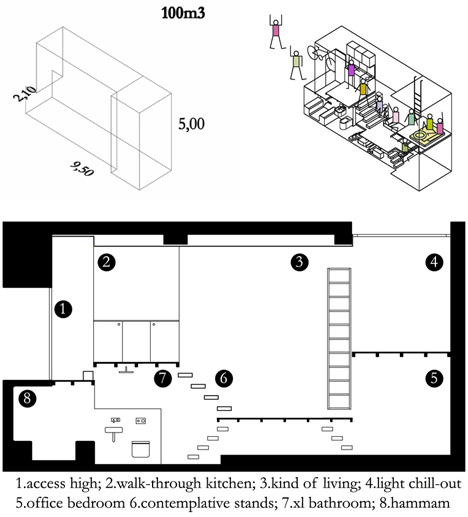
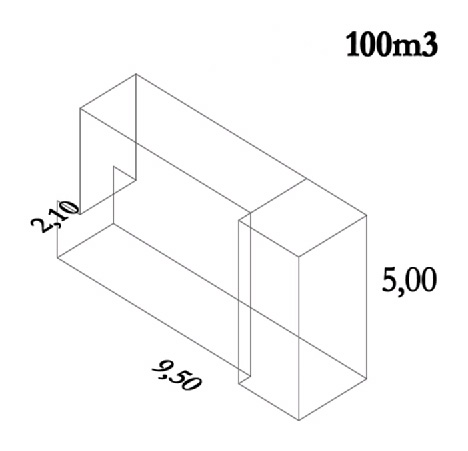
MYCC (images by Elena Almagro) managed to fit in a full bathroom, living room, kitchen, bedroom and office into this curiously-shaped urban shelter, narrow yet also relatively deep and tall (approximately: 2 meters wide, 10 meters long and 5 meters high).

A minimal combination of stairs and ladders connect the different platforms within the resulting studio, set out of the way and rendered partially transparent (staircase sans risers) or set off to the side (ladder along the wall) to help leave open lines of sight between various rooms.


A large skylight directly illuminates the work space, and, indirectly, the rest of the unit as well. The lack of horizontal space limited opportunities for plan-level complexity, but opened up spatial options in section as the dimensional diagram outline shows below.
A quirky animated video takes viewers on a short tour of the conceptual design process, starting with the entry level then splitting off to show how the various floors, nooks and crannies took shape.
Want More? Click for Great Related Content on WebUrbanist:
Constant Motion: Open-Plan, Puzzle-Piece Apartment Design
A small cubic condo with windows on only one side hardly seems an obvious candidate for a complex and dynamic plan, but from concept through execution, this ... Click Here to Read More »» Boneyard Studios: Vacant Lot Hosts New Micro-Home Village
In a bold bid to change urban landscapes, a series of tiny home builders and enthusiasts has come together to turn empty space into a microcosmic example of ... Click Here to Read More »» 9 Amazing Apartment Interior Designs & Cool Condo Plans
Color, pattern, unexpected materials and careful editing of rustic historic architectural details make these apartment and condo remodels one-of-a-kind. Click Here to Read More »» [ By WebUrbanist in Design & Fixtures & Interiors. ]
[ WebUrbanist | Archives | Galleries | Privacy | TOS ]
|
|
06 Dec 00:48
Review: XCOM: Enemy Within (PC/Sony PlayStation 3)
by Aaron Sirois

XCOM: Enemy Within
Publisher: 2K Games
Developer: Firaxis Games
Genre: Turn Based Strategy
Release Date: 11/12/2013
In case you didn’t know, Enemy Within is the expansion to the best game of 2012. As such, it might behoove you read Mark’s review of Enemy Unknown before reading further. If you’re all caught up on how this all works, feel free to read on, as this review will cover only the new stuff. Granted, there is a LOT of new stuff to talk about here, and I’ll also mention the differences between the PC and console versions. That’s right. I’m so nuts over the series that I’ve bought and played it on multiple systems. I love me some XCOM.
 So right away, it’s important to note the biggest difference between the two versions of Enemy Within. On PC, EW is an expansion. As such, you must have EU installed on your computer in order to play it. You’ll have the option of playing EW or EU when you boot up the game, so you don’t have to worry about losing your save file or not being able to play the original game without the new content. On consoles, the only way to get EW is to buy a new copy of the. This comes at a forty dollar price tag (ten dollars more than the PC expansion), but the console version includes the DLC from EU as well. Basically, you’re paying ten bucks for EU and it’s DLC. That’s not a bad deal by any stretch.
Either way you go though, you’re in for one hell of a good ride.
There’s actually a decent amount of new story content to work though. While the core story arc of Enemy Unknown remains unchanged, there are some new kinks wrinkles to distract you as you make your way through the game. For starters, there’s meld. Meld is a new miracle substance that allows for all kinds of shenanigans involving biological and/or mechanical structures. Basically, you can use it to genetically modify your troops or augment them to be able to pilot MECs. Either way, you’ll need to find more meld in the field in order to finance these upgrades.
Also new into the fray is a human group known as EXALT. They’ve decided to do all they can to sabotage XCOM’s efforts so that they can basically take over the world using alien technology. You can ignore them, but they’ll constantly pilfer your cash, slow down your research, and raise panic in your countries until you deal with them. In order to do that, you’ll need to send one of your troops on covert missions and then extract said trooper later on in order to get information. That information will help you locate EXALT’s main base, and end them once and for all. If nothing else, fighting humans with similar strategies to your own is a nice change of pace from the aliens.
 If that weren’t enough, there’s also Operation Progeny to consider. This arc was originally meant to be released as DLC for EU, but has been re-purposed to fit with EW. The basic outline is that both EXALT and the aliens are after a woman named Annette. While you’re not sure what they want with her, it becomes obvious that rescuing her would put a major dent in both of those organization’s plans. All but the first of these missions come in the latter half of the game, so they won’t interfere with your early strategy one bit. Completing the last one will even grant you some bonus soldiers to replenish your ranks. The ultimate prize is that you’ll get four soldiers guaranteed to be able to use psionic abilities. That’s huge.
As for the presentation, there have been upgrades there as well. To go with the new content, there are a host of new cut-scenes, radio chatter, and even some new songs to bolster to already impressive package. It’s still not a visual powerhouse by any means, but the look is solid throughout. New maps add a greater sense of diversity to missions, such that you’ll battle on farms, building tops, and even a dam. It’s definitely an upgrade.
Let’s talk more about meld. Meld can be found on abduction and/or UFO mission. There will be two meld canisters on the battlefield. All you have to do is find them and collect the substance. However, the canisters on a countdown. The meld will be lost if you don’t collect it time. In addition, you can’t simply forget about the aliens on the map either. Thus you’ll have to make a big decision each mission. Do you risk your soldiers in order to get the meld, or do you play it safe and risk losing the precious substance? I can assure the rewards are great if you can get them. This adds a fun new layer of strategy to these missions.
Once you’ve researched meld, you can start playing around with it. From early on in the game, you can build MECs and add gene-mods to your troops. MECs are powerhouses that can give as much damage as they dish out. The costs are prohibitive though. First, you’ll need to augment a soldier. This causes a soldier to lose their class and all associated abilities. If they had gene-mods, they lose them. However, the soldier does keep his/her rank. Then, you need to actually build the MEC, which costs money and meld as well. The suit can be worn like armor. It isn’t tied to a specific soldier. While a trooper will learn new abilities by leveling up, the suit can only be upgraded by spending resources after appropriate research has been done. Still, MECs are tough. Properly upgraded, a MEC can take multiple shots from the toughest of enemies without a hitch. They can use an ability that allows them to demolish cover, which comes in handy a lot throughout the game. Each new upgrade allows you to chose between two different attachments. For example, when you first build a MEC, you’ll have to choose between a melee attack and a flamethrower attack. The flamethrower can hit multiple targets at medium range, but it only affects organic targets. The kinetic strike can only be done up close, but a MEC with this upgrade can move further each turn. On top of that, the strike does incredible damage that will instantly kill most enemies in the game. At the next level, you’ll have to choose between being able to launch grenades at long distances or the ability to generate a AoE healing mist. It’s a tough choice to be sure.
 Gene-mods are significantly less expensive than MECs, but still offer major tactical bonuses. For example, giving a soldier the adaptive bone marrow ability allows them to leap up onto high surfaces without the use of ladders or special suits. A sniper can use this to gain height advantage and ensure a good hit. Another ability allows a player to boost the stats of all near allies whenever he/she gets a kill The crème de la crème is mimetic skin. A soldier with mimetic skin can actually cloak themselves to a degree. As long as they’re not in sight of an enemy, they can remain invisible my moving into high cover. Used properly, you can scout the entire level with just one person. This will help you time your attacks, scout out patrolling patterns, find meld, and flank enemies. I’ve used it on my support, had said support scout ahead, and then used a squad sight sniper to take out enemies before they even knew I was there. It’s insanely helpful.
The kicker is that the new upgrades can almost make you feel too powerful. It’s easy to forget that your MEC trooper can still die, or that your gene-mods will be lost if an enemy manages a lucky critical at the wrong time. While your troops will be stronger, than ever, it is now even more painful to lose them. And rest assured, the aliens are still more than capable of taking your troops down.
The aliens get two new allies as well. First up are seekers. Seekers are mechanical units that can cloak themselves in order to sneak up on troops that have separated from the pack. Then they’ll gladly strangle one of your soldiers. If you can’t free the soldier during one turn, they’re toast. These guys show up in the early stages of the game, but aren’t really too hard to deal with once you get used to their tactics. More imposing are the new mechtoids. A mechtoid is basically a sectoid in his own cyber-suit, and is capable of ruining your day. If they don’t move, they can take two shots per turn. Sectoids can still merge minds with them in order to give them a powerful shield. In this case, killing the initiator of the merge doesn’t killed the mechtoid, but does damage them slightly. The good news is that you’ll receive meld for every mechtoid you kill, which is a definite plus.
As for those EXALT missions, they bring something new to the table. When you send an operative out on a covert mission, they go alone, with only a pistol to protect them. After a few days, you’ll need to go out on an extraction mission. If you don’t, you lose the operative. However, you can still take out a full crew on these missions, meaning you’ll actually control up to seven soldiers for one mission. You’ll have one of two different goals in these extraction missions. Either you’ll be protecting computer equipment from being hacked, or you’ll need to take your operative around the map in order to hack communications array.
While EXALT might not have the sheer firepower of the aliens, they still have a few tricks up their sleeves. Like your troops, they have different classes that act in different roles. This includes a medic who’ll gladly heal up injured allies, and a heavy that will ruin your day with rockets if you get too bunched up. EXALT will also start using gene-mods later on, and they will attempt to overwhelm you with sheer numbers. Just when you think you’ve tipped the numbers in your favor, they’ll deploy more troops around the map.
 However, you’re far from defenseless. Since you can’t use EXALT corpses for study, there’s little to no penalty for just going all out with explosives. Also, your operative can hack various arrays around the map, which will force each enemy to reload on their next turn. That basically gives you an extra round to take them out, and you’ll be able to play a little more recklessly. It’s perfectly fine to run out of cover when you know there isn’t going to be any reprisal.
In the end, Enemy Within is a fantastic expansion that adds enough content to essentially double the length of the game. This new content starts pouring in on the very first mission, and all of it either offers new tactical considerations or even just new way to customize your troops. The new missions will keep things fresh and never leave you long without some sort of mission. The game is bigger, smarter, and even more fun than the original, while losing none of the challenge that made it so enthralling in the first place.
Short Attention Span Summary XCOM: Enemy Within is a fantastic game from top to bottom. New missions, soldiers, maps, enemies, and options expand the game in a number of interesting ways. There’s more variety, more options for creating your squad, and simply a heck of a lot more content to work through. If an expansion is capable of winning game of the year, I’d say this one wins it hand down. If you’ve played EU (and you should), you’ll definitely want to play this. If you’ve somehow missed that game, then make it your cause to not make the same mistake with this one.
http://diehardgamefan.com/wordpress/wp-content/uploads/2013/12/xcomcover-120×120.jpg
http://diehardgamefan.com/wordpress/wp-content/uploads/2013/12/xcombanne.jpg
16 Aug 19:59


You guys are totally fucked up. Never change.
by Jenny the bloggess
I opened up my mail today and was surprised to find a shitload of drugs in it, and I assumed it was some sort of weird sting, but turns out that my post office gave me the wrong box and the drugs were perfectly legal and are supposed to go to a clinic. I also got a home-made dead frog in the mail and that caused much less confusion, because of course I did.
My friend, Ben Hamby, author of Rise of the Steam Goddess, is a bad-ass who knows far too much about steampunk Victorian vampires, and today he mailed me this:
Yeah. So, that's a taxidermied froggie dressed as Mad Eye Moody.
He goes perfectly with my other Harry Potter-esque taxidermied creatures:
Issues. I have them.
Still on the lookout for Draco Mouse-foy, Severus Snake and Hairy Otter. Suggestions taken below.
PS. ”OMG, DUMBLE-DORMOUSE.” I just screamed that and Victor just glared at me. Victor has no appreciation for the arts.
Csvan99, Tony Gibson likes this
29 Jul 12:53


Randall Munroe finishes "Time," the 3,099-panel XKCD serial
by Cory Doctorow

Randall Munroe has finally finished Time, his 3,000+ frame slow-motion animation that began life as wordless, enigmatic single-panel XKCD installment. Since then, the panel has been slowly, slowly updating itself, running out its course over several months. Geekwagon has collected the whole series in an easy-to-control window, and the story, taken as a whole, is a beautiful and odd existentialist parable touching on the discovery of geographic knowledge; cultural first contacts; environmental disaster, friendship and ingenuity. (Thanks, @dexitroboper!) 
|
|
Shannon.steve, Christian and 4 others like this
04 Jul 19:05
aefled: Some of the TLF Travel Alerts from the last few days.
Malady579hehehe


Malady579 likes this
19 Jun 19:23
 This is a series of Disney princesses reimagined as scantily armored warriors by artist Mike Roshuk. Why all the bare midriffs? Because they're so badass they don't NEED armor there. Somebody shoots an arrow at you? Deflect it with a blade. Don't have a blade? FLEX THOSE ABS.
Hit the jump for individual shots of Ariel, Cinderella, Pocahontas, Snow White and Jasmine.
This is a series of Disney princesses reimagined as scantily armored warriors by artist Mike Roshuk. Why all the bare midriffs? Because they're so badass they don't NEED armor there. Somebody shoots an arrow at you? Deflect it with a blade. Don't have a blade? FLEX THOSE ABS.
Hit the jump for individual shots of Ariel, Cinderella, Pocahontas, Snow White and Jasmine.
Make It A Movie: Disney Princesses As Sexy Warriors
Malady579I am sure you saw this, but I had to make sure. This is hilarious.
This is a series of Disney princesses reimagined as scantily armored warriors by artist Mike Roshuk. Why all the bare midriffs? Because they're so badass they don't NEED armor there. Somebody shoots an arrow at you? Deflect it with a blade. Don't have a blade? FLEX THOSE ABS.
Hit the jump for individual shots of Ariel, Cinderella, Pocahontas, Snow White and Jasmine.
Andreas Fritsch, Malady579 and -1 others like this
No more posts. Check out what's trending.