Shared posts

09 Dec 13:47

Report Showcases How Elon Musk Undermined His Own Engineers And Endangered Public Safety

by Karl Bode

For a long time now, it's been fairly clear that consumer safety was an afterthought for some of the more well known companies developing self-driving technology. That was made particularly clear a few years back with Uber's fatality in Tempe, Arizona, which revealed that the company really hadn't thought much at all about public safety. The car involved in the now notorious fatality wasn't even programmed to detect jaywalkers, and there was little or no structure at Uber to meaningfully deal with public safety issues. The race to the pot of innovation gold was all consuming, and all other considerations (including human lives) were afterthoughts.

That same cavalier disregard for public safety has been repeatedly obvious over at Tesla, where the company's undercooked "autopilot" technology has increasingly resulted in a nasty series of ugly mishaps, and, despite years of empty promises, still doesn't work as marketed or promised. That's, of course, not great for the public, who didn't opt in to having their lives put at risk by 2,500 pound death machines for innovation's sake. Every week there's new evidence and lawsuits showing this technology is undercooked and dangerous, and every week we seemingly find new ways to downplay it.

This week the scope of Elon Musk's failures on this front became more clear thanks to a New York Times piece, which profiles how corner cutting on the autopilot project was an active choice by Musk at several points in the development cycle. The piece repeatedly and clearly shows that Musk overstated what the technology was capable of for the better part of the last decade:

"As the guiding force behind Autopilot, Mr. Musk pushed it in directions other automakers were unwilling to take this kind of technology, interviews with 19 people who worked on the project over the last decade show. Mr. Musk repeatedly misled buyers about the services’ abilities, many of those people say. All spoke on the condition of anonymity, fearing retaliation from Mr. Musk and Tesla."

Musk's bravado, and the exaggeration of the sophistication of Autopilot, helped encourage some customers to have too much trust in the product or actively misuse it. Constantly pushing undercooked software and firmware updates without proper review also created safety challenges. But the article tends to focus heavily on how Musk repeatedly undermined his own engineers through stubborn decisions that undermined both overall safety and engineer expertise, like Musk's unyielding belief that full automated driving could be accomplished with just cameras, and not cameras and radar (or other detection tech):

"Within Tesla, some argued for pairing cameras with radar and other sensors that worked better in heavy rain and snow, bright sunshine and other difficult conditions. For several years, Autopilot incorporated radar, and for a time Tesla worked on developing its own radar technology. But three people who worked on the project said Mr. Musk had repeatedly told members of the Autopilot team that humans could drive with only two eyes and that this meant cars should be able to drive with cameras alone."

The article also makes it clear that employees that were overly happy to please Musk's whims only tended to make the overall quality and safety issues worse. And when employees did challenge Musk in a bid to improve quality and safety, things very often didn't go well:

"In mid-2015, Mr. Musk met with a group of Tesla engineering managers to discuss their plans for the second version of Autopilot. One manager, an auto industry veteran named Hal Ockerse, told Mr. Musk he wanted to include a computer chip and other hardware that could monitor the physical components of Autopilot and provide backup if parts of the system suddenly stopped working, according to two people with knowledge of the meeting.

But Mr. Musk slapped down the idea, they said, arguing it would slow the progress of the project as Tesla worked to build a system that could drive cars by themselves. Already angry after Autopilot malfunctioned on his morning drive that day, Mr. Musk berated Mr. Ockerse for even suggesting the idea. Mr. Ockerse soon left the company."

None of this is particularly surprising for folks who have objectively watched Musk, but it does catalog his erratic bravado and risk taking in a comprehensive way that makes all of it seem notably more concrete. For a man whose reputation is one of engineering savvy, the report repeatedly showcases how Musk refused to actually listen to his own engineers. There's little doubt Musk has been innovative, but the report does a fairly solid job showcasing how a not insubstantial portion of his near-deified reputation is more than a little hollow.

09 Dec 13:43

Storm Drains Keep Swallowing People During Floods

by by Topher Sanders

by Topher Sanders

]

ProPublica is a nonprofit newsroom that investigates abuses of power. Sign up to receive our biggest stories as soon as they’re published.

On the night of Sept. 1, Dhanush Reddy and his fiancee, Kavya Mandli, were returning home from a North Jersey mall when the remains of Hurricane Ida turned their drive perilous.

Rain pounded down, soaking the streets with so much water that cars stalled and police shut down traffic. They felt their own car rattling, and they abandoned it in a nearby lot. Deciding they’d walk to safer ground where Mandli’s brother could pick them up, they waded hand-in-hand into murky water “until we reached the middle point of the road,” Mandli recalled, “where it just sucked us both inside.”

Never miss the most important reporting from ProPublica’s newsroom. Subscribe to the Big Story newsletter.

They were both suddenly underwater, being pulled toward a large black vacuum that seemed to be guzzling anything and everything into its wide, open mouth. Mandli managed to grab part of a bridge railing, but Reddy clutched only her hand. She shouted for help as she tried to wrest her fiance from the vortex. But it was just too wet, too slippery. Reddy disappeared. Mandli was left holding his empty jacket.

As South Plainfield police searched for Reddy, who had been sucked into a 3-foot-wide stormwater drainage pipe that ran underground, they looked where they thought it might spit him out, on the other side of the road. Mandli’s heart jumped when they told her they found a man hanging from a tree branch and calling for help.

But it was 18-year-old Kevin Rivera, who had also been pulled into a drainage pipe. “I was completely underwater,” he told ProPublica. “I couldn’t grab a grip to hold on to anything. I just covered my head with my arms and just sort of tried to ride it out till I came out on the other side or maybe got a little gasp of air.”

Reddy with Kush, the dog he and his fiancee shared and whose name they created by combining their own first names. (Courtesy of Kavya Mandli)

Reddy’s body was found the next day in a wooded area, blocks away from where he got pulled in. The engineer and construction project manager was dead at 31.

During the same storm, in the same state, three others died the same way.

There’s no official count of how many Americans get pulled into storm drains, pipes or culverts during flood events, but ProPublica identified 35 such cases since 2015 using news accounts and court records. Twenty-one of those people died; nearly half of those lost were children. Thirteen of the deaths happened in the past three years alone. The numbers are likely an undercount, since reports of flood deaths often don’t give details other than the fact that someone was swept away.

Despite records of horrific cases that span the country and stretch back decades — and the scientific consensus that climate change will only worsen flooding — federal, state and local government agencies have failed to take simple steps to prevent such tragedies from happening, ProPublica found, after more than a dozen interviews with government officials, engineers and weather experts, as well as a review of documents including death investigations, government meeting minutes and emails, and academic papers. Officials are not surveying the nation’s aging stormwater drainage systems, which are being taxed beyond capacity by record downpours, to flag openings that could pose a hazard and install grates to prevent people from being sucked in.

The bridge where Reddy and his fiancee, Kavya Mandli, lost each other in Ida’s floodwaters. (George Etheredge, special to ProPublica)

The National Institute for Occupational Safety and Health, an arm of the Centers for Disease Control and Prevention, has recommended these steps, but it has no authority to compel cities or counties to act on that advice. It issued two reports on storm drain hazards after the near-identical deaths of firefighters during flood rescues. The first died in 2000. The second died in 2015. The first report did not reach the officials who could have prevented the second death.

ProPublica found instances in which local and state governments knew about a hazard but didn’t secure it. A man who died on the same night as Reddy, in Maplewood, New Jersey, was among a group of neighbors who had warned town and state officials that a storm pipe near their homes was dangerous; the man was pulled into the large opening while trying to clear out debris. That same night, in Passaic, New Jersey, two college students were sucked into the very same drain where, just one year earlier, a DoorDash driver had been pulled in. She had been dumped into a river and survived; they were expelled into the same river, but they died.

Some local and state government leaders have pushed back against recommendations to put in grates; they can be expensive to install, they trap debris and they can make flooding worse, opponents said. People can also become pinned to them and drown. But other municipal leaders and engineers said these problems can be overcome by using angled grates that provide victims an escape, and by investing in maintenance schedules so that covered drains don’t get clogged.

“It’s life or death,” said Ken MacKenzie, the executive director of Denver’s Mile High Flood District, who has for years tried to rally officials across the country to install grates and address the problem. He worked up his own count of deaths from 1996 to 2015, and he tallied at least 20 lives lost during that period. “It’s a hidden danger in nearly every community. And yes, it might cost a couple thousand dollars. But it’s worth it to not kill someone’s child in a culvert.”

Stormwater drainage is the type of infrastructure that people rarely think about until water is rushing down the road and cars are floating away. But when you walk around your neighborhood, you’ll see evidence of these systems all around you, from the small openings that run along curbs to larger pipes and culverts designed to channel rainwater into local waterways, retention ponds or stormwater treatment facilities. These systems are built to handle only so much water, and when the amount of rain exceeds the system’s capacity, it can lead to dangerous flooding in unexpected locations.

Many of these drainage systems were built decades ago and are designed based on historical rainfall data, which was used to help predict what capacity the systems should be able to handle. But Marouane Temimi, an associate professor at Stevens Institute of Technology who researches rainfall and flooding, said those predictions rely on one big assumption: “That the climate will continue to behave the same way it has been behaving for decades now,” he said. “If the climate changes — that’s what we are witnessing — then the past is no longer a good guide for the future.”

In the Northeast, for example, the amount of rainfall from heavy events increased by more than 70% from 1958 to 2010. Ida unleashed record-breaking rainfall on the region this year. So did the remnants of last year’s Hurricane Isaias, during which at least three good Samaritans were pulled into a culvert in Hockessin, Delaware, while trying to rescue a man trapped in his flooded car, and a 16-year-old boy in Bethlehem Township, Pennsylvania, watched a 6-year-old boy get sucked into a pipe and went in after him. They all survived.

The higher the floodwater, and the more of it that’s rushing toward a culvert or pipe in a maxed-out drainage system, the more dangerous the conditions can get. To get a sense of how much force can be in play at the entrance of these pipes, consider that every cubic foot of water weighs 62.4 pounds. So if someone is standing in 4 feet of water, that’s nearly 250 pounds of force. “And that's not including any velocity that's heading toward the pipe,” said MacKenzie, the Denver flood district director. “And so if you have a full-grown man at maybe 200 pounds, he’s up against 250 pounds of water pressure pushing into the inlet of that pipe.”

Rainfall has also increased in St. Louis in the past decade, said Jim Sieveking, a science and operations officer for the National Weather Service who’s based in the area. The city is particularly at risk for flooding because the Mississippi, Missouri and Illinois rivers converge around the same region, and urban sprawl and development have reduced the amount of permeable land that can absorb excess water. “We’ve seen our fair share of flooding in these past years,” he said.

On July 10 near St. Louis, Aaleya Carter and her family were on their way home after seeing the latest Fast and Furious movie. It was Aaleya’s birthday celebration. She had just turned 12.

There were heavy rains and thunderstorms that night as her aunt drove a small SUV along Interstate 70. The aunt spotted a flooded area in the road and turned around, but the wind and the slippery conditions made the car slide down an embankment toward a drainage culvert, which was filling with water.

Aaleya Carter (Courtesy of Tracey Dean)

Bridgette Carter, Aaleya’s mom, had to think and move quickly. Her three babies — including Skylar, 8, and Carter, 6 — were in the back seat, and water was starting to pour into the car. “My first instinct was to get out the car because the doors weren't opening,” Bridgette said.

It was a frantic rush to unbuckle all of the children and then climb out of the front driver’s side window, the only one that would open. While Bridgette was placing her two youngest on a roadway that was safely out of the water, Aaleya was clinging to the vehicle. “I was reaching for Leya,” the mother said. “And it swept her in the drain. The current was so strong.”

Aaleya, a goofy, funny kid who loved making TikTok videos and often helped her mom get dinner ready, was found a few hours later in a tree near a creek where the drainage pipe emptied. She had drowned.

The drainage culvert in St. Louis that pulled Aaleya in (William Widmer, special to ProPublica) Bridgette Carter, far right, with family and friends at her daughter’s grave in St. Louis (William Widmer, special to ProPublica)

Missouri’s Department of Transportation is responsible for the drain that Aaleya was pulled through. It was last updated in 1975. State officials wouldn’t say whether they have ever reviewed drains to determine if some should have safety measures like warning signs and grates. They pointed ProPublica to the Federal Highway Administration, which couldn’t name an instance when it had done such a safety evaluation, but noted that states have the autonomy to determine whether a grate is needed and to place flood warning and depth gauge signs at drains.

The loss of Aaleya was so unbearable that Bridgette decided to move her family to McKinney, Texas. “It’s hard,” she said in a conversation punctuated by tears. “It’s too much. … Everything just reminds me of my baby.”

The danger that large pipes and culverts pose to people during floods is not unknown to the federal government. NIOSH, the occupational safety arm of the CDC, issued a key recommendation two decades ago that could have saved lives. It came after a tragedy in Denver.

On Aug. 17, 2000, the city was drenched with up to 3 and a half inches of rain, causing flooding. Firefighter Robert Crump and his partner got an alert about a woman in distress. The water surrounding the woman appeared to be about waist deep. The firefighters didn’t know she was standing on the edge of a culvert near 10 feet of water. Crump’s partner, Will Roberts, jumped into the water to save the woman and was pulled under the surface by the drainage vacuum. Crump jumped in after his partner and was able to pull him to safety.

While his partner was trying to tie a cord to himself to attempt another rescue, Crump plunged back into the water to save the woman. He was pulled into the open drainage system that runs under the road. His body was found hours later, several blocks away from where he went missing.

NIOSH’s report on Robert Crump shows a photo of the drainage pipe where he was found. (Obtained by ProPublica)

NIOSH investigated Crump’s death and, in 2002, issued a report with recommendations for cities everywhere to prevent similar accidents, holding up as an example what it said Denver had done in the aftermath: covered the drainage pipe with a grate and then identified all similar open sewers, drains and culverts to start planning for more possible grates. (When contacted by ProPublica, Denver officials couldn’t find those records or say how much of that they wound up doing.)

Fifteen years after Crump died, another firefighter died after being pulled into an open drainage pipe during heavy rains, this time in Claremore, Oklahoma.

Jason Farley and his colleagues were wading through floodwater while trying to rescue people trapped in their homes when he stepped into a catch basin and was pulled into a drainage pipe. Another firefighter jumped in after him and was also pulled in. The other firefighter traveled almost 280 feet through the pipe and was expelled into a creek. Farley got tangled up in the pipe and drowned.

NIOSH once again released an investigative report, with recommendations that echoed those it had issued after Crump’s death: Government agencies should consider requirements for “identifying, marking, and guarding underground storm drains,” the report said. Sean Douglas, chief of the Claremore Fire Department, had requested that NIOSH investigate Farley’s death. He said he sees NIOSH reports from time to time in trade journals and firefighter magazines, but that he hadn’t seen the Denver report or its recommendations. “They’re not really in front of everybody all the time,” he said of the reports. “A lot of fire departments may not even talk to other fire departments, let alone an appendage of the CDC.”

A spokesperson with NIOSH said they post the reports on their website and send them out to 79,000 announcement and newsletter subscribers. The spokesperson also said that the group’s investigations have contributed to important safety improvements for firefighters. But fire agencies aren’t responsible for the stormwater drainage reforms that NIOSH proposed; city and county public works managers usually are. ProPublica could identify no federal agency set up to inform local officials directly of these safety hazards and recommendations.

At the spot where Farley died, Claremore put up guardrails but opted against a grate, out of a concern that people would get pinned against it during a flood, but also because it would need extra maintenance to keep it free from debris that could stop water from flowing in. Douglas said the city has identified areas prone to flooding, cleared out debris before and after storms, raised awareness of the hazards through signs and instituted road closures in problem areas. He said he continues to work with the city to install more markings of the open drains and where they may lead, and Garrett Ball, the city’s engineer, said Claremore began mapping its storm drain system, an effort he hopes will be completed in the next year or two.

A few communities have aggressively tackled storm drain safety in reforms that followed tragedy. Bolingbrook, Illinois, a suburb of Chicago, reviewed more than 40 storm drain inlets and grated some of them after a 6-year-old boy was pulled into one and drowned in 1998; the community also settled a lawsuit with the boy’s family for $2.8 million.

And Cedar Rapids, Iowa, evaluated 18 inlets and decided to place grates at 15 sites, some of which were large culverts.

Logan Blake (Courtesy of Mark Blake)

The city embarked on the improvements after Logan Blake, 17, was swept into a culvert in 2014 when he went after a Frisbee during heavy rains. Logan’s friend jumped in the water to attempt to save him and was also pulled into the drain. The two teenagers traveled more than a mile and a half through the drainage pipe before being dumped into Cedar Lake. Logan’s friend survived and was able to walk to a nearby hospital. Logan’s body was found about 19 hours later.

Instead of suing, the teen’s family reached an agreement with the city to ensure it would invest in safety upgrades so that another child wouldn’t die, said Mark Blake, Logan’s father. “We just wanted them to fix one at that time,” he said. “And they came up with a plan to fix three right away because they had two other ones right next to schools in the same exact situation.”

Mark Blake at a site in Cedar Rapids, Iowa, where safety grates were installed after the death of his son Logan Blake. (William Widmer, special to ProPublica)

For guidance on how to evaluate which inlets needed safety grates and which needed less aggressive improvements, Mark Blake and the Cedar Rapids officials turned to MacKenzie, whose Denver district had developed a set of criteria for reviewing the safety of open inlets. They would assess the length of pipe, size of the pipe’s entrances, whether there were bends and turns in the pipe, and its proximity to schools and parks.

Cedar Rapids also used the Mile High Flood District’s latest design for grates that are installed at an angle, which are meant to prevent people from being pinned against them during a flood. “And the idea is that the bars would be spaced tightly enough that somebody couldn’t get in there, but they could also act as a ladder or a walkway for someone to get out,” said David Wallace, Cedar Rapids’ utilities engineering manager. For larger culverts, ones that Wallace said were simply impractical to grate, the city put up fencing and signage warning people of the danger during floods.

Cedar Rapids has put grates on 11 drains, with four more expected to be completed by the end of 2022. The city expects to spend a total of about $700,000 on the 15 locations. Flooding caused by debris clogs is a risk, Wallace said, but it can be remedied with a consistent maintenance plan. The city’s teams go out after every rain to pull debris from the grates. It takes one workday for two crews of three people with a backhoe to clear the debris after big storms. They have to do that several times a year, Wallace said. With the diligent maintenance schedule, the grates have not added any additional flooding.

“The idea is to prevent the tragedy that we had here,” Wallace said. “So sure, it adds to the maintenance activities and adds some costs that we otherwise wouldn’t have had to do, but the idea is to prevent what happened. … It’s just a safety, prevention measure that we think is necessary.”

The Mile High Flood District, Colorado’s Larimer County Dive Rescue Team, Colorado State University’s Hydraulics Lab and the engineering company AECOM have been researching how people are injured or killed in drainpipes and have been working on grate designs for different pipe and culvert configurations. The group created a physical model at the university to test its research in simulated flood waters. Part of the team’s work looks into pitch angles, bar spacing and how far away from the pipe entrance a grate should be placed — all aimed at making grates safer and less expensive. The group plans to release detailed data from its work at the World Environmental and Water Resources Congress conference in June. “What we found is really going to allow us to make the grates smaller, which will really bring down the cost,” said Holly Piza, an engineer for the Mile High Flood District. “Which is great because then local governments and municipalities will be more likely to put in safety grates where they’re appropriate.”

The bipartisan Infrastructure Investments and Jobs Act includes funding that could help communities upgrade their drainage systems’ capacity and safety. More than $50 billion in new spending from the bill will go to drinking water, wastewater and stormwater investments over 10 years. A spokesperson with the Environmental Protection Agency told ProPublica that $1.9 billion of that money was going to the Clean Water program, which allows awarded communities to install grates in addition to making other upgrades.

The storm drain accidents recorded across New Jersey during Ida show just how preventable these deaths can be.

Residents of Maple Terrace in the town of Maplewood had been complaining for years about the dangerous and inadequate drainage structure there, a 48-inch pipe sitting on three properties, one on the north side of the street and on two on the south side. Patrick Jeffrey and his wife, Beth, who lived next to one of those homes, had been among those voicing concerns. The flooding caused by the pipe routinely spilled into their yard, and they worried its large opening could be dangerous to adults walking around it or children playing near it.

A photo of the Maplewood drainage pipe that pulled in Patrick Jeffrey was included in a 2020 report about making the location safer. (Obtained by ProPublica)

Over the years, a group of the neighborhood dads developed a routine before and during rainstorms: They’d work together to remove debris from the two inlets to try to keep the flooding down. On Sept. 1, Patrick Jeffrey was doing what he always did; a neighbor was going to meet him near the inlet and help remove debris. But when the neighbor arrived at the hole, he couldn’t find Jeffrey. Fred Meyer, who lived across the street from Jeffrey, joined the search effort.

“There was like a 360-degree waterfall … charging down this hole. There was water everywhere,” said Meyer. “It was terrifying.”

The next morning, Jeffrey’s body was found along a neighboring roadway. He had been pulled into the drainage system and emerged out of a manhole. The father of two, who worked as a vice president and portfolio manager at U.S. Bank in New York, was 55.

“We were always thinking that a kid might fall into this thing,” said Meyer, Jeffrey’s neighbor. “I never thought something would happen to an adult and I never thought it would be someone dying. I still can’t believe it happened. The absolute worst thing that could possibly happen in this scenario actually has.”

One year earlier, in Pennsylvania’s Sewickley Township, a 38-year-old man died the exact same way, trying to clear debris from a pipe in his backyard.

Transcripts from Maplewood town meetings show residents had been asking since at least 2018 for the area where Jeffrey fell to be replaced by an underground pipe, but town leadership was resistant to the idea at the time. When town officials eventually came around to it, officials with New Jersey’s environmental department were against it because they said the area had a natural waterway designation that prevented such a move, according to emails. Had the problem been dealt with years ago, Meyer said, there would have been no open pipe for Jeffrey to remove debris from. He’d be alive to coach his son’s flag football team and cheer on his daughter’s softball team.

After Jeffrey’s death, state officials gave the town permission to install grates over the pipe and said they would grant an exemption that would allow the town to replace the area with an underground pipe, according to meeting minutes. The state didn’t directly answer ProPublica’s questions about why its officials had changed their minds, but in reference to the grates, a spokesperson told ProPublica the state and the town agreed that Maplewood would ask for permission to install the grates to “address the immediate concern for safety.”

The city of Passaic, too, had discussed a dangerous drain before best friends Nidhi Rana, 18, and Ayush Rana (no relation), 21, abandoned their flooded-out car and died after being sucked into the drain during Ida. In July 2020, DoorDash driver Nathalia Bruno had wound up in the same drain but survived after she fled her car during a flash flood.

Nidhi Rana, left, and Ayush Rana were crowned prom queen and king. (Courtesy of Hector Lora)

Bruno recounted her harrowing story in news accounts, and city officials talked about grates and warning signs. But city engineers said that a grate would become clogged, leading to more flooding, and that people might get pinned to them. Mayor Hector Lora also said property owners voiced concerns about permanent flash flood warning signage because of what it could do to property values. Instead, the city focused on strengthening its barricades and moving them further away from problem areas. It also rolled out temporary LED warning signs with each heavy rain and began pursuing grants to elevate the roadway.

Lora said there wasn’t pressure for more urgent reforms back then because Bruno “miraculously survived.”

When asked if there was anything the city could have done more immediately after Bruno’s accident that could have helped save the two friends who later died, Lora said he believes the city did the best it could with the information it had and that no one could have planned or prepared for the devastation brought by Ida. “I think we did everything that municipalities are supposed to do,” he said. “Sometimes crisis and tragedy become the genesis for good policy and initiatives that come later.”

Barricades at the Passaic, New Jersey, drain that pulled in Nidhi Rana, Ayush Rana and Nathalia Bruno. (George Etheredge, special to ProPublica)

The city is now moving with more urgency, Lora said. He hadn’t heard of the idea of putting grates at an angle, but after speaking with ProPublica and being shown examples of the Denver design, Lora said he has asked his engineers to review the new model. “The tragedy compels me to explore every option,” he said. Officials with MacKenzie’s team in Denver reviewed an image of the Passaic culvert and said their early assessment is that a safe grate could be designed for the location.

Permanent warning signs have also been put in place near the culvert, and the city is pursuing grants to buy a sign that will monitor water depth and alert police and the fire department when it reaches a certain height. Lora is also looking for funds to surround the culvert with a large fence that curves at the top.

As for the pipes in South Plainfield, where Dhanush Reddy and Kevin Rivera were pulled in, it’s not clear if there are plans to do anything; Middlesex County officials, who are responsible for the maintenance of the pipes, declined to answer ProPublica’s questions.

Kavya Mandli no longer lives in New Jersey. She moved to the Atlanta area after the death of her fiance. “My life just went upside down since then,” she said. “I’m still really figuring out what to do. I had to move away from that place because I really couldn’t be myself there anymore.”

Reddy (Courtesy of Kavya Mandli)

She hasn’t escaped the reminders of her loss. There was the trip they were supposed to take to Puerto Rico, two days after his death. There was what would have been his birthday gift — tickets she’d already bought to his first-ever Formula 1 race in October. Then there is their white labrador, Kush, whose name is a combination of their own first names. They were trying to get home to him quickly on Sept. 1; Reddy knew Kush would be frightened by the weather.

Every day, when Reddy got home from work, Kush would run toward the door and the two would tussle like kids. “Kush is so huge, he’s like 90 pounds, but Dhanush just picks him up like a baby and rocks him,” Mandli said.

“I sometimes think, ‘It’s around 5 o’clock, maybe he’ll come home.’”

Do You Have a Tip for ProPublica? Help Us Do Journalism.

Doris Burke contributed research.

09 Dec 12:29

Apple won’t have to allow iPhone apps to use third-party payments tomorrow after all

by Samuel Axon
Extreme close-up photograph of a hand holding a smartphone.

Enlarge / A Fortnite loading screen displayed on an iPhone in 2018, when Apple and Epic weren't at each other's throats. (credit: Andrew Harrer | Bloomberg | Getty Images)

Apple has won a last-minute stay on an injunction that would have required the company to begin allowing iPhone and iPad app developers to direct users to alternative payment options.

The requirement to allow in-app linking to third-party payment systems was ordered in a September 10 ruling by the judge in the ongoing Epic Games v. Apple lawsuit. This was one of the few wins for Epic, as Judge Yvonne Gonzalez Rogers ruled in favor of Apple on most points.

The judge gave Apple until December 9 to make the necessary changes to allow outside payment systems, so this stay comes at the last possible moment. When Judge Gonzalez Rogers rejected Apple's initial request to stay the ruling, the company appealed it to the 9th Circuit Court of Appeals. That appeal has led to this new development.

Read 5 remaining paragraphs | Comments

09 Dec 12:24

The Last Molecule

Biology is really struggling; they're barely at 93% and they keep finding more ants.
08 Dec 12:52

Omicron reduces Covid antibody protection in sm...

Omicron reduces Covid antibody protection in small study of Pfizer vaccine

Omicron significantly reduces Covid antibody protection in small study of Pfizer vaccine recipients

08 Dec 12:49

The hideous legal obstacles facing DOJ’s new anti-gerrymandering lawsuit in Texas

by Ian Millhiser
Supreme Court
Demonstrators outside the Supreme Court as it hears a case on possible partisan gerrymandering by state legislatures on October 3, 2017. | Tom Williams/CQ Roll Call

The Biden administration makes a persuasive case that Texas violated the Voting Rights Act, but the Supreme Court hates the Voting Rights Act.

On Monday, the Justice Department filed a federal lawsuit alleging that Texas’s new state house and congressional district maps violate the Voting Rights Act, which forbids gerrymanders that have the purpose or effect of abridging “the right to vote on account of race, color, or language minority status.”

The Justice Department’s complaint in United States v. Texas is a fine, workmanlike legal document that makes a strong case that Texas drew its maps in order to maximize white power within the state and minimize the impact of Black and Latino voters. It’s the sort of lawsuit that would have a good shot at prevailing — if the Supreme Court hadn’t spent the past decade dismantling nearly all of the Voting Rights Act.

As the complaint notes, between the 2010 and 2020 censuses, “Texas grew by nearly 4 million residents, and the minority population represents 95% of that growth.” Because of this population growth, Texas’s US House delegation expanded from 36 seats to 38 seats in the decennial redistricting process. Yet Texas drew its new maps so that both of the new districts will have white majorities, and it also allegedly redrew a third district to prevent Latinos from electing their preferred candidate.

The result is that white voters will gain the ability to elect two additional congressional representatives, even though Texas owes its two new seats almost entirely to Black, Asian, and Latino voters.

The Justice Department also alleges that both the new congressional maps and the new state house maps drastically underrepresent voters of color. If Latinos controlled seats proportional to their population, the complaint claims, they would control “11 Congressional seats and 45 Texas House seats.” Black voters, meanwhile, would control “5 Congressional seats and 20 Texas House seats.”

Instead, under the new maps, “Latino voters have the opportunity to elect their preferred candidates in 7 Congressional seats and 29 Texas House seats,” and “Black voters have the opportunity to elect their preferred candidates in roughly 3 Congressional seats and 13 Texas House seats.” (There is one additional congressional seat and five additional state house seats that might elect candidates preferred by a coalition of Black, Latino, and other nonwhite voters.)

Yet it’s uncertain whether the Justice Department is capable of prevailing in this lawsuit, no matter what evidence it presents at trial. That’s how hostile the Supreme Court’s Republican appointees are toward the Voting Rights Act.

As Justice Elena Kagan wrote in her dissenting opinion in Brnovich v. DNC (2021), the Court “has treated no statute worse” than the Voting Rights Act. The Court has also shielded states from federal lawsuits alleging partisan gerrymandering — a decision that potentially gives Texas a powerful weapon it can use against the Justice Department’s allegation that its new maps are an unlawful racial gerrymander.

The Supreme Court has made it nearly impossible to prove that maps were enacted with racist intent

In Rucho v. Common Cause (2019), the Supreme Court held that federal courts may not hear lawsuits alleging that a state’s legislative maps are an unconstitutional partisan gerrymander — meaning that the lines were drawn to benefit one party at the expense of another. The Court’s precedents, however, do permit lawsuits challenging racial gerrymanders — meaning that the lines were drawn to diminish the power of one or more racial groups.

In practice, however, Rucho creates a potentially serious problem for anyone alleging racial gerrymandering.

Recall that the Voting Rights Act prohibits election laws enacted for the purpose of limiting a racial group’s voting power, or that have the effect of doing so. Suppose that the Justice Department leans into the first of these two prongs: the prohibition on laws that are enacted with racist intent.

In that case, Texas is likely to argue, as it has in previous cases accusing it of racial gerrymandering, that its new maps weren’t drawn in order to reduce the power of Black and Latino voters. It will most likely argue that the maps were drawn for the purpose of reducing the power of Democratic voters.

Such an argument might even be superficially plausible. As the Justice Department argues in its complaint, “voting in Texas continues to be racially polarized throughout much of the State” — meaning that white voters tend to vote for Republicans and Black and Latino voters tend to vote for Democrats. So it’s fairly difficult to prove conclusively that the new maps were drawn with racist intent. A set of maps drawn to maximize the power of white Texans, and a set of maps drawn to maximize the power of Texas Republicans, are likely to closely resemble each other because race is a good proxy for partisan affiliation in Texas — as it is in much of the United States.

Of course, this argument that partisan gerrymandering is distinct from racial gerrymandering could fail — and, in a fair court, it probably would fail. If state lawmakers intentionally minimized the influence of Black and Latino voters because they knew those voters were likely to be Democrats, that’s still intentional race discrimination.

But if the Justice Department wants to show that Texas’s new maps were drawn with invidious racial intent, it still must overcome another of the Court’s decisions: Abbott v. Perez (2018).

Perez held that lawmakers enjoy a high presumption of racial innocence when they are accused of drawing racially gerrymandered maps. In that case, the Court considered legislative maps that Texas’s Republican legislature drew in 2011, and then altered in 2013.

The 2011 maps never took effect because of litigation alleging that they were an unlawful racial gerrymander. Yet in 2012, while this litigation was ongoing, a federal court drew interim maps that closely resembled the racially gerrymandered 2011 maps, so that Texas had something it could use to hold an election in 2012. The purpose of these stopgap maps wasn’t to declare any portion of the 2011 maps legally valid. It was just to ensure that the 2012 election could still move forward in Texas.

Then, in 2013, the Texas legislature adopted these stopgap maps as its own — including several districts that were still being challenged as unlawful racial gerrymanders.

In upholding these 2013 maps, Justice Samuel Alito’s opinion in Perez emphasizes that “whenever a challenger claims that a state law was enacted with discriminatory intent, the burden of proof lies with the challenger, not the State.” Alito then explained that this burden is quite high.

He deemed the 2013 maps legitimate because, he claimed, the evidence showed that Texas enacted them because it “wanted to bring the litigation about the State’s districting plans to an end as expeditiously as possible.”

Alito’s argument, in other words, was that the 2013 maps weren’t enacted to preserve a racial gerrymander; they were enacted to shut down litigation challenging a racial gerrymander. And this distinction was sufficient to absolve the state legislature of any allegation of racism.

Needless to say, the sort of Court that would rely on such a meaningless distinction is unlikely to be sympathetic to DOJ’s new lawsuit against Texas — and the Court has grown significantly more conservative since Perez was decided. Perez will also shape lower court decisions applying the Voting Rights Act, because lower courts are obligated to follow Supreme Court decisions.

The Supreme Court does not care about what the Voting Rights Act actually says

Alternatively, the Justice Department can argue that Texas’s maps are illegal because they have the effect of diminishing minority voting power, even if they were not enacted with racist intent. The Voting Rights Act does not simply bar intentional discrimination, it also prohibits any election law that “results in a denial or abridgement of the right ... to vote on account of race or color.”

But in Brnovich, the Court imposed a number of novel and completely atextual limits on this provision of the Voting Rights Act. Among other things, Brnovich held that there is a strong presumption that voting restrictions that were commonplace in 1982 are valid — even though the text of the law says nothing about the year 1982. Brnovich also applied a similar presumption to laws that purport to combat fraud at the polls — even though there’s nothing in the law’s text supporting this presumption either.

One of the few silver linings of the Brnovich decision is that its holding is limited to only certain kinds of cases. The Court distinguished between cases alleging “vote-dilution” — and gerrymandering cases are considered vote-dilution cases — and cases challenging laws regulating the “time, place, or manner” in which elections are conducted. The specific extratextual limits on the Voting Rights Act that were fabricated by the Brnovich opinion do not apply to vote-dilution cases.

But the Justice Department should take no comfort in that fact. Brnovich is a troubling case not only because it imposes novel and entirely made-up new limits on certain Voting Rights Act cases. It is also troubling because of what it says about the Court’s overarching approach to the Voting Rights Act.

Simply put, if the Court is willing to make up new limits on a federal statute that appear nowhere in the text of the law, and apply those limits in “time, place, or manner” lawsuits, there’s no reason to believe that it won’t invent similarly atextual limits and impose them on vote-dilution cases. As Justice Kagan wrote in her Brnovich dissent, “the majority’s opinion mostly inhabits a law-free zone.” Once a court enters that zone, there are no longer any constraints on its judges.

Brnovich doesn’t necessarily mean that the Court will never rule in favor of a voting rights plaintiff — in this case, the Justice Department. But it does suggest that the Court will do whatever the hell it wants in voting rights cases, regardless of what the law actually says.

08 Dec 12:34

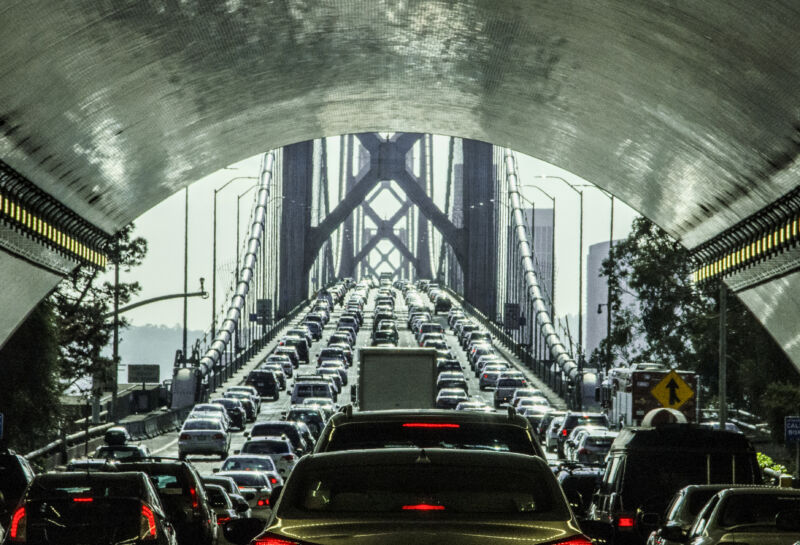
Traffic bounces back in year two of the pandemic, minus the commuters

by Jonathan M. Gitlin
This became a more common sight in 2021 as drivers returned to the roads.

Enlarge / This became a more common sight in 2021 as drivers returned to the roads. (credit: Getty Images)

As we head toward the end of the second year of a global pandemic, the effect of COVID-19 on road traffic around the world is clear. Congestion has begun to return, though not everywhere, and not to 2019 levels. Traffic patterns have changed, too, with more traffic popping up in the middle of the day as commuters continue to stay away from the office. That's according to the 2021 Inrix Global Traffic Scorecard, an annual report prepared by the traffic analytics company.

Here in the US, Chicago and New York are the worst cities for traffic, with their drivers giving up 104 hours and 102 hours of their lives respectively to congestion in 2021. Inrix actually ranks New York as number one in the country due to the higher costs traffic imposes on the city, despite the fact that Chicagoans spent an extra couple of hours behind the wheel. However, traffic in both cities remains almost 30 percent down from pre-pandemic levels.

Other cities have yet to show as much recovery. Washington DC stands out, with traffic still 65 percent lower than in 2019, which translates to 80 fewer hours in traffic per person.

Read 4 remaining paragraphs | Comments

08 Dec 12:33

Senate gives Rosenworcel new FCC term, but Republicans aim to block Gigi Sohn

by Jon Brodkin
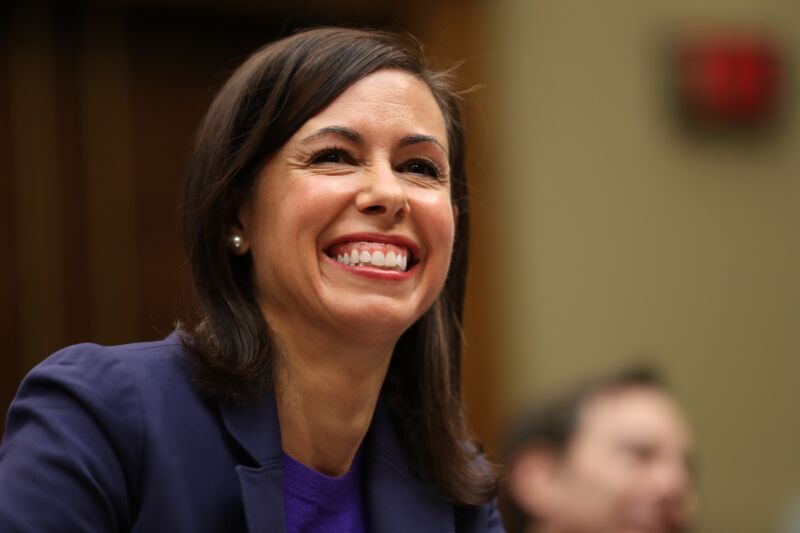
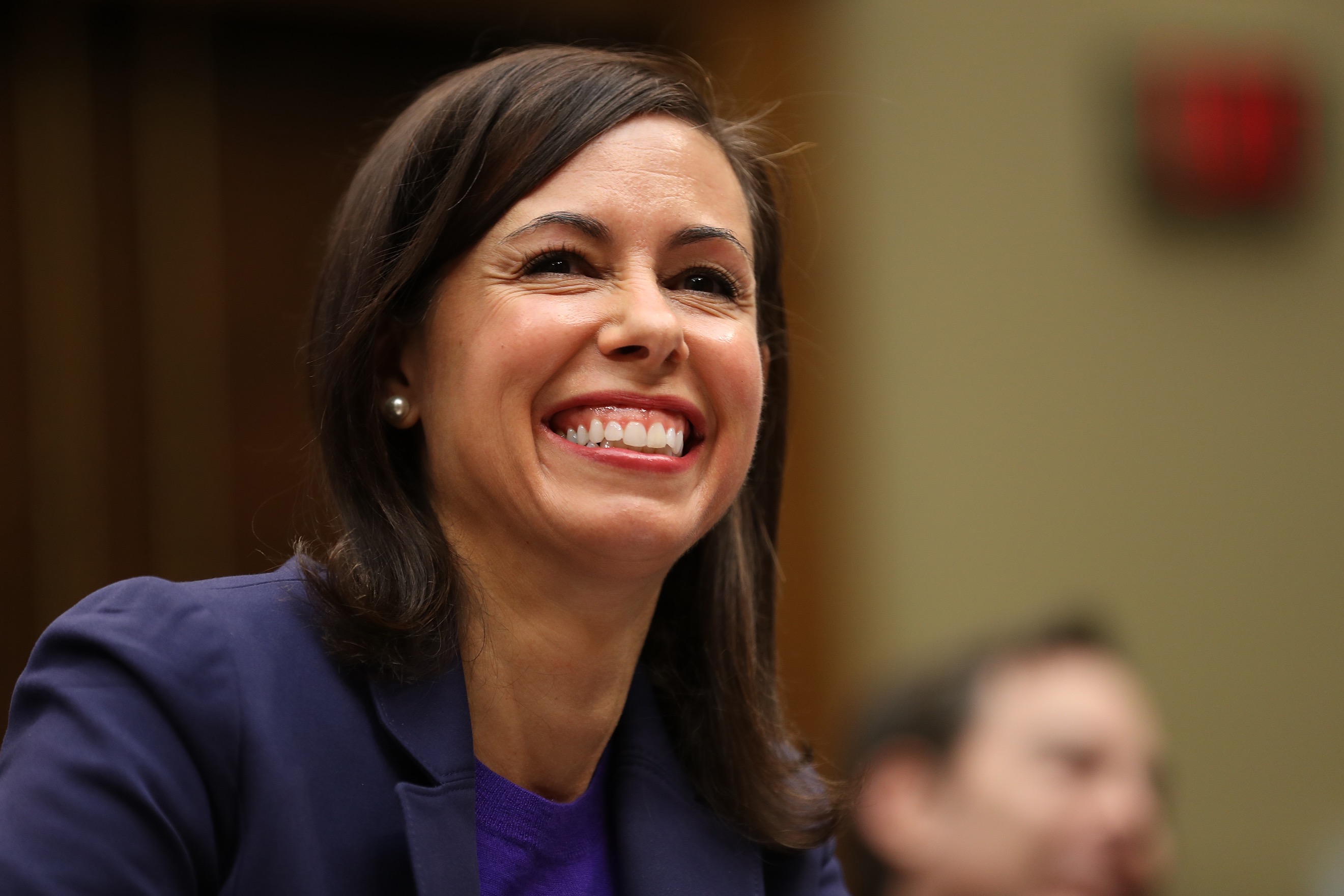
FCC Commissioner Jessica Rosenworcel smiling as she testifies in front of Congress during a 2019 hearing.

Enlarge / FCC Commissioner Jessica Rosenworcel testifies before the House Energy and Commerce Committee's Communications and Technology Subcommittee on December 5, 2019, in Washington, DC. (credit: Getty Images | Chip Somodevilla)

The US Senate today approved a new five-year term for Federal Communications Commission Chairwoman Jessica Rosenworcel. Today's vote ensured that Rosenworcel won't have to leave the commission at the end of the year. But the FCC is still deadlocked at 2-2 between Democrats and Republicans—and the GOP is mounting a serious challenge against Gigi Sohn, the Biden nominee who would give Democrats a 3-2 majority.

Today's vote on Rosenworcel was 68-31, with Democrats and some Republicans approving the renomination. We'll update this story with more specifics on today's Senate vote later, but you can see the results of last night's cloture vote to end debate on the renomination here.

"It's the honor of my lifetime to lead the FCC and serve as the first permanent female Chair," Rosenworcel wrote on Twitter after the vote. "Thank you to the President and Senate for entrusting me with this responsibility. There's work to do to make sure modern communications reach everyone, everywhere. Now let's get to it."

Read 8 remaining paragraphs | Comments

08 Dec 12:33

You can now play video games on a Tesla screen when the car is in motion

by Kyle Orland

An August video shows a game being played on a Tesla central console while the car is in motion.

When we covered the first video games available on Tesla's center-console video screen back in 2019, we noted that the feature only worked when the car was parked. Now, though, those Tesla games can apparently be played even when the car is moving, a feature that could run afoul of National Highway Traffic Safety Administration guidelines and state laws designed to combat distracted driving.

While the ability to play Tesla games outside of Park is being highlighted in a New York Times report today, the change was seemingly rolled out months ago. A YouTube video from January shows Solitaire being played on a Tesla screen while the car is shifted into Autopilot mode, for instance (though other games appear not to work with Autopilot in the same video).

In another video posted in July, a Tesla owner shows space shoot-em-up Sky Force Reloaded being played while the car is shifted into drive. That video says the new capability was added as an unannounced feature of July's 2021.12.25.6 firmware update.

Read 8 remaining paragraphs | Comments

08 Dec 12:32

Verizon overrides users’ opt-out preferences in push to collect browsing history

by Jon Brodkin
A Verizon logo.

Enlarge (credit: Getty Images | Scott Olson)

Verizon is automatically enrolling customers in a new version of a program that scans mobile users' browser histories—even when those same users previously opted out of the program when it had a different name.

The carrier announced changes to its "Verizon Selects" program along with a new name a few days ago. "Verizon Custom Experience Plus is the new name of our Verizon Selects program," Verizon said in an FAQ. Verizon is ignoring the previous opt-out preferences for at least some customers by enrolling them in "Custom Experience," which collects browser and app-usage history but doesn't use device location data and other personal information collected in "Custom Experience Plus."

Verizon says it does not sell the information collected in either version of Custom Experience and that the program "no longer supports third party advertising." But Verizon does share the data with "service providers who work for us" and says it uses the data to "personalize our communications with you, give you more relevant product and service recommendations, and develop plans, services, and offers that are more appealing to you. For example, if we think you like music, we could present you with a Verizon offer that includes music content or provide you with a choice related to a concert in our Verizon Up reward program."

Read 17 remaining paragraphs | Comments

08 Dec 12:30

Power companies band together for coast-to-coast EV fast-charger network

by Tim De Chant
Power companies band together for coast-to-coast EV fast-charger network

Enlarge (credit: Chevrolet)

It took an act of Congress and $7.5 billion in federal funding, but more than 50 of the nation’s power companies are ready to build a coast-to-coast fast-charging network for electric vehicles.

The proposal so far is light on details. Members of the National Electric Highway Coalition say they serve nearly 120 million customers across 47 states and the District of Columbia. The coalition hasn’t said how many fast chargers it will be installing, but the companies said they would focus first on gaps in existing fast-charging networks along interstate highways.

The group is “committed to investing in and providing the charging infrastructure necessary to facilitate electric vehicle growth and to helping alleviate any remaining customer range anxiety,” said Tom Kuhn, president of the Edison Electric Institute, which helped build the coalition.

Read 4 remaining paragraphs | Comments

08 Dec 12:30

Anime convention of 53K is first US case study for omicron spread, CDC says

by Beth Mole
Costumed attendees take a break during Anime NYC at the Jacob K. Javits Convention Center in New York City on November 20, 2021. Anime NYC is an annual three-day anime convention held in New York City.

Enlarge / Costumed attendees take a break during Anime NYC at the Jacob K. Javits Convention Center in New York City on November 20, 2021. Anime NYC is an annual three-day anime convention held in New York City. (credit: Getty | Ken Betancur)

An anime convention held in New York City last month may inadvertently offer the US its first case study on the spread of the omicron coronavirus variant, according to the Centers for Disease Control and Prevention.

Fifty-three thousand anime fans from all 50 states, the District of Columbia, Puerto Rico, and 27 other countries traveled to New York City for the Anime NYC convention, which ran from November 19 and 21 in the city's Javits Center. Organizers reported afterward that they were overwhelmed by the large attendance and struggled with packed rooms and crowding—conditions ideal for coronavirus transmission.

Last week, officials in Minnesota reported that a resident tested positive for the omicron variant after attending the convention. At the time, it was only the second omicron case detected in the US. But since then, officials have identified cases in at least 18 other US states, as well as over 50 countries worldwide.

Read 7 remaining paragraphs | Comments

08 Dec 12:20

Family safety app sells location data to third parties

by Nathan Yau

Life360 is a service that lets families keep track of where members are based on phone location data. For The Markup, Jon Keegan and Alfred Ng report on how Life360 then sells that data to third parties for millions of dollars:

Through interviews with two former employees of the company, along with two individuals who formerly worked at location data brokers Cuebiq and X-Mode, The Markup discovered that the app acts as a firehose of data for a controversial industry that has operated in the shadows with few safeguards to prevent the misuse of this sensitive information. The former employees spoke with The Markup on the condition that we not use their names, as they are all still employed in the data industry. They said they agreed to talk because of concerns with the location data industry’s security and privacy and a desire to shed more light on the opaque location data economy. All of them described Life360 as one of the largest sources of data for the industry.

You kind of expect this from a free app, but Life360 is a paid service that collects children’s location data. Seems questionable.

Tags: Life360, privacy, The Markup

06 Dec 15:10

Biden’s pre-K plan might not be as “universal” as he hopes

by Fabiola Cineas
Preschooler Korey Hill works on an alphabet puzzle at Patterson Elementary School in Washington, DC, in February. | Evelyn Hockstein for The Washington Post via Getty Images

Democrats want to expand preschool to all 3- and 4-year-olds but risk deepening inequities in the process.

Advocates for the universal preschool plan in Democrats’ Build Back Better Act say it could be transformative for families and their 3- and 4-year-olds: giving parents flexibility, helping children grow and develop, and offering states a big return on their investment in pre-K expansion, all while boosting the country’s competitiveness on the global stage.

The $110 billion proposal for free, high-quality pre-K could offer early learning that helps kids throughout their lives. Early childhood education experts who spoke to Vox said the initiative is ambitious.

“This is unprecedented on the part of the federal government to get involved in education in quite this way,” says Elizabeth Cascio, a professor of economics at Dartmouth College who researches education and social policy. “Helping to establish another grade in the school system is not something the federal government has ever done.”

President Biden recently touted that his plan would be free and universal: “Studies show that the earlier our children begin to learn in school, the better. That’s why we’re going to make two years of high-quality preschool available to every child,” he wrote on Twitter. But critics warn it could fall short of providing the universal, high-quality early education it promises.

First, although universal pre-K has bipartisan support in some states, Republican governors could simply opt out of the federal funds under the Biden plan — some state lawmakers have already suggested they will. States may also balk at the plan’s short-term funding. The program is currently only funded for six years, and federal assistance decreases significantly in the last two yeas.

Then there’s the question of how to measure what an effective pre-K program actually is: The proposal doesn’t lay out specifics on how to measure the quality of pre-K programs. This, education experts argue, risks worsening learning and behavioral outcomes for kids, especially those from high-needs communities.

The Biden administration’s vision is admirable but doesn’t offer a clear roadmap — one that truly bolsters the inclusion of all 3- and 4-year-olds — experts warn. “There are incredible barriers to Black and Latino families living in segregated disadvantage, which means their children are already disproportionately unable to access pre-K services,” said John Fantuzzo, director of the Penn Child Research Center and professor of human relations at the Penn Graduate School of Education. “If the federal government merely expands what already exists, without rethinking who is in need or what [high] quality is, the deployment of these services won’t move the needle for those who need it most.”

As the Senate weighs the sweeping social-spending bill, Democrats are confident that federal and state lawmakers will back the preschool proposal. “We know that these programs are good for children. There’s a very strong research base that shows that [pre-K] has a great return on investment,” said Carmel Martin, deputy director of the White House’s Domestic Policy Council for Economic Mobility and an architect of the plan. “And we know that states across the country are interested in expanding access to these programs since so many of them already have state-funded preschool programs. It’s not just something that’s popular with Democratic leaders.”

What the research says about preschool

For decades, education reformers and policymakers have searched for ways to close opportunity gaps — unequal access to the resources that children need to be successful in school and in life. As early as kindergarten, students from high-income families are ahead of those from low-income families on reading, math, and social and emotional skills, according to the Economic Policy Institute, a left-leaning think tank.

Expanding high-quality early childhood education, namely pre-K programs, has been offered up as one way to close these gaps.

Though not all studies of Head Start, the federal program that funds preschool for low-income children, have found clear long-term benefits, most research on the program has found that kids who participate are more likely to graduate high school and attend college, with benefits transferring across generations.

Studies of state-funded pre-K programs are similar: Not all have found significant, lasting positive effects, but studies have found improvements in social, emotional, and behavioral skills, graduation rates, SAT-taking rates, and employment rates as well as decreases in juvenile incarceration and teen pregnancy rates for students who participated. Researchers have often found that children from low-income families and dual-language learners benefit more than children from middle- or high-income backgrounds and those who are English proficient.

 Mary Altaffer/AP
Pre-K teacher Vera Csizmadia teaches 3- and 4-year-old students in her classroom at the Dr. Charles Smith Early Childhood Center in Palisades Park, New Jersey, in September.

Proponents also point to preschool as a boon for parents, particularly low-income parents. The opportunity to leave their children in the care of educators for a full day allows them to enter the workforce full time or pursue higher education. Washington, DC’s universal pre-K program helped lead to a 10 percentage-point increase in labor force participation for women with young children.

Forty-four states, DC, and Guam already funded some kind of preschool program during the 2019-20 school year, according to the National Institute for Early Education Research at Rutgers University. But most American kids under 5 weren’t enrolled in preschool that year: Only 34 percent of 4-year-olds and 6 percent of 3-year-olds were enrolled across the states that offer it. States spent more than $9 billion on preschool programs, spending $5,449 per child on average, that year.

“It used to be that 5-year-olds were on the margins of school entry — by the mid-1960s, only about half of states funded kindergarten,” Cascio said. “The progress has been much faster with pre-K, but there’s still a long way to go.”

Democrats’ six-year plan would offer free preschool to all 3- and 4-year-olds by sharing costs between states and the federal government to more than double the current number of preschool seats, offering slots to more than 6 million children. The bill would also require states to increase the salaries of preschool staff, establish new degree requirements for educators, develop new curricula for preschools, and regularly report progress to the Department of Health and Human Services.

But there are at least three major areas where the plan could fall short of its goal.

1) Red states might refuse federal funds for universal pre-K

In a January poll of American adults from the nonpartisan First Five Years Fund, 73 percent of Republicans and 95 percent of Democrats were in favor of making free preschool more available to all 3- and 4-year-olds whose parents want to send them.

But the bipartisan support behind pre-K expansion doesn’t mean that all states, particularly red states, will sign up. Preschool programs have thrived in conservative states like Georgia and Oklahoma for years, but there’s no guarantee that Republican governors, who have traditionally left education up to local and state leaders, will want more involvement from the federal government.

“It’s the state’s responsibility to fund government education, not the federal government’s. Each community is different,” Sherri Ybarra, Idaho’s superintendent of public instruction, told the Wall Street Journal. “If I had the opportunity to sit down with President Biden, I would say, ‘Let the states focus on where they think their students need the most intervention and the most help.’”

Republican lawmakers in multiple states, including Missouri, Minnesota, North Carolina, and New Hampshire, told the Washington Post that they were wary of parts of the program, with some citing federal overreach as a concern.

“Republican leaders have supported federal investment in preschool historically. The way the program is set up, it is not the federal government getting inappropriately involved,” says Martin. “We want to partner with states, and the program anticipates that states would be the ones administering and setting standards for the program.”

The bill also contains a backup plan that allows the Department of Health and Human Services to partner with the local governments directly should states not opt in, allowing providers, from nonprofit organizations to schools and childcare centers, within the mixed-delivery system to receive funding.

2) The money eventually disappears

From 2022 to 2024, the program would dole out money to the states based on population trends and child poverty rates — priority will be given to programs for children from families with income at or below 200 percent of the poverty line — setting aside $4 billion, $6 billion, and $8 billion for each year, respectively. Then in the next three years, from 2025 to 2027, a phase-down begins with the government picking up about 95 percent of state expenditures, down to about 63 percent in the final year. Year four of the program is the only year that government covers nearly all expected costs.

Chart: “The Build Back Better Act won’t cover all of states’ pre-K needs”

This shrinking pot of funds might turn some states away. As Matt Bruenig at the left-leaning think tank People’s Policy Project noted, the size of the program has only decreased with each iteration of the bill. In the first draft, the federal government covered 100 percent of state costs in the first three years and even picked up 60 percent of state costs in 2028.

Whether this shrunken federal contribution would be enough to entice states is left to be seen. One GOP lawmaker from Minnesota called the plan a “bait and switch,” since the money from the federal government decreases. Plus, the cost of establishing or expanding universal pre-K could vary widely from state to state: Some states may have extra space to house pre-K programs, for example, while others may need to build from scratch.

The first three years of the program will focus on pre-K expansion for children from low-income backgrounds, but some early education experts worry the targeted approach expires too soon.

States move to a universal free-for-all entitlement program in year four. But first, they have to ensure that “a majority of children” in high-needs communities have been offered the opportunity to enroll. The word “majority” could prove consequential, says Bruce Fuller, a sociologist and professor of education at the University of California Berkeley.

“If you look at states like the Dakotas or Montana, proportionately, they have huge populations of low-income and lower-middle-income class families who don’t have affordable pre-K,” said Fuller. “And how you fill that void in two to three years is going to be a pressing question.”

For many states, expanding pre-K is simply a matter of money. “The lack of funding has been a major impediment,” Cascio said. “States feeling constrained financially has been a major impediment to the expansion of these programs and meeting all children’s needs.”

And since almost all states already offer some form of free preschool, proponents of the Biden administration’s plan see federal funding as a continuation of state-level plans. “The funds are meant to supplement but not supplant dollars that states are already investing,” said Rasheed Malik, the director of early childhood policy at the Center for American Progress. “With this plan, it’s not possible to hit the pedal and go from zero to 60 right away. There’s sensitivity to the fact that states need to have a plan to make sure they’re not going to disrupt the supply of infant and toddler child care in communities.”

Federal spending increases in the first three years, with the expectation that it will take time for pre-K to be expanded into all communities in a state. Then in the final three years, the training wheels come off. “If a state government is forward-looking, they have to decide whether they’re going to be ready to ride the bike on their own,” Cascio said. “Are they going to have the state capacity and the fiscal capacity to do it on their own?”

 Andrew Caballero-Reynolds/AFP via Getty Images
A Build Back Better sign is displayed in a pre-K classroom at East End Elementary School in North Plainfield, New Jersey, on October 25, when President Biden visited the school.

The six-year time frame also comes with the hope and expectation that the plan will be renewed and extended once leaders and constituents realize the benefits, though it’s clear that the amount of years is a result of political considerations as opposed to research that shows how long it would take to implement the program. It took decades to usher in kindergarten, and it’s still not compulsory across the country. But in states like Georgia and Oklahoma, the pre-K programs experienced dramatic year-on-year increases in pre-K enrollment when they rolled out their programs. “There is evidence to suggest that when a state is interested in doing this they can ramp up fairly quickly,” Cascio said.

3) The guarantees on quality aren’t tough enough

Experts say that children from low-income families are best buoyed by high-quality pre-K, and studies show that low-quality pre-K could actually worsen outcomes for children of all circumstances.

But what “high quality” means is, in part, left to state governments to determine. To qualify for funding, if they do opt in, states will have to submit plans to the Department of Health and Human Services that estimate how much money they need to create and expand programs. States will also have certain requirements to receive the funding, like meeting quality thresholds that the states will define themselves, as long as the programs are not lower quality than Head Start.

But, some early education experts say, giving so much leeway to states could leave communities out.

“Who is defining need, and who is defining quality?” said Fantuzzo. “Do states have the capacity to understand where their preschool deserts are, and then will they have the time to get their act together to provide resources to those with the greatest need?”

The Biden administration says it wants to give states the room to develop and implement systems that work best for their population’s unique challenges and needs, and that all states will have to follow expansion strategies that are backed by research.

“The core of the approach to quality is that it gives flexibility for states to define the standards but requires them to do it based on evidence,” says Martin. “We have a fair amount of research that helps us understand what quality looks like. So states have to ensure that it’s being implemented.”

The proposal plans to press these quality provisions on states, but there’s no guarantee that states would reach high quality or distribute quality progressively, Fuller says.

Fuller’s examination of New York City’s pre-K expansion found that preschools mirrored the racial segregation of K-12 schools: Preschools serving mostly white or Asian families offered higher-quality environments than programs in the city’s Black and Latino neighborhoods since city leaders lost track of the distribution of quality.

A 2019 Education Trust study of 26 states and their preschool programs found that just 1 percent of Latino children and only 4 percent of Black children in those states were enrolled in high-quality preschool. Ultimately, Fuller fears that Biden’s blanket entitlement approach — extending free pre-K to well-off families — will cement an uneven playing field. (There’s some disagreement among experts here: Research Cascio conducted on Georgia and Oklahoma’s universal pre-K programs suggested that the presence of higher-income children may help to attract better teachers and improve quality for low-income children too.)

“States are not going to invent systems that meet the needs of the underserved. They’re just going to use what everyone else has already used, so they’re going to get the same results as before,” Fantuzzo said.

 Matt Roth for the Washington Post via Getty Images
Children play together at Little Flowers Early Childhood and Development Center in Baltimore, Maryland, in January.

The program is better than the status quo, experts agree

Taken together with the child care investments proposed in the bill, most experts agree that the Build Back Better bill’s goals are a boon for children and families and beneficial for society at large.

“It’s important for folks to understand how inaccessible and inequitable the system is currently,” Malik said. “It is determined by a family’s income right now. Current childcare dollars that do go to preschools and care for younger kids and Head Start combined really can’t even serve 1/10th of the number of low-income kids who really need it.”

Over the decades, as the public has come to embrace the benefits of early childhood education, higher-income families have spent more money on private programs, only increasing opportunities gaps in education. Martin told Vox that universal pre-K would have big returns for state economies and is one of the best investments states can make for the country’s competitiveness, for children’s futures, and for parent choice.

“Once we get to the end of the six years we are going to get a lot closer to universality than we are now, and it will be really popular and remain a really high priority for legislators who have always shown a commitment to this issue in the abstract,” Malik said. “We’ll look back at this as a major turning point in early childhood education.”

Others aren’t as optimistic as Malik but share in his hope. “Pre-K too often inadvertently hardens inequities in children’s futures,” said Fuller. “We have a chance now to build a pre-K system that’s more progressive than the public schools, but it’s going be a massive experiment.”

06 Dec 12:08

Sony drops first-look teaser trailer for Spider-Man: Across the Spider-Verse (Part One)

by Jennifer Ouellette

Shameik Moore and Hailee Steinfeld reprise their roles as Miles Morales and Gwen Stacy, respectively, in Spider-Man: Across the Spider-Verse (Part One), a two-part sequel to the 2018 Oscar-winning film Spider-Man: Into the Spider-Verse.

Sony Pictures unveiled a first-look teaser trailer for its upcoming animated sequel Spider-Man: Across the Spider-Verse (Part One) at the Comic-Con Experience in Brazil this weekend. Yep, it's going to be a two-part sequel to 2018's critically acclaimed Oscar-winning blockbuster Spider-Man: Into the Spider-Verse.

(Some spoilers for Spider-Man: Into the Spider-Verse below.)

The 2018 film was a megahit, grossing over $375 million worldwide against a $90 million budget, and won the Oscar for Best Animated Feature—a well-deserved honor. As Ars Technica's Sam Machkovech wrote in his review, "It's easily the best comic-nerd film in years to warmly embrace the kinds of viewers who know their comics canon front and back, all without intimidating the inevitable kid and newbie viewers attracted to this incredibly family-friendly adventure."

Read 7 remaining paragraphs | Comments

03 Dec 13:33

Ransomware attack on Planned Parenthood steals data of 400,000 patients

by Dan Goodin
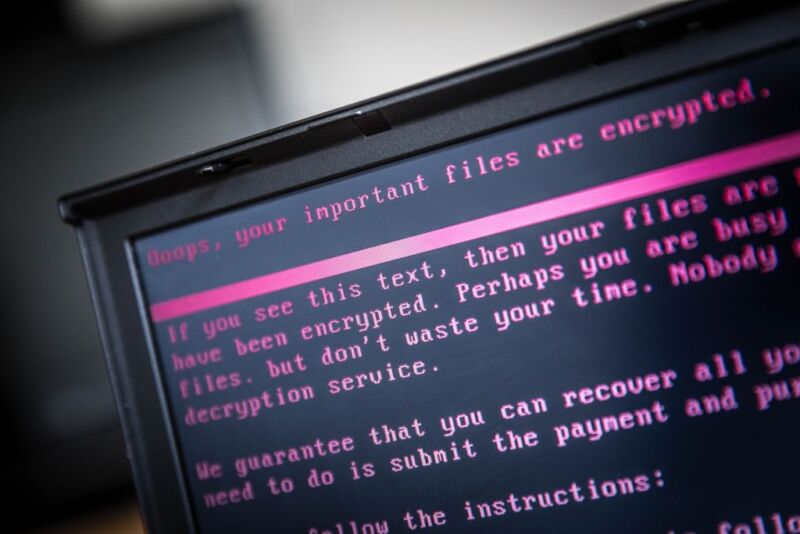
A ransom message on a monochrome computer screen.

Enlarge (credit: Rob Engelaar | Getty Images)

Ransomware hackers broke into a Planned Parenthood network and accessed medical records or other sensitive data for more than 400,000 patients of the reproductive health care group.

The disclosure came in a sample letter posted to the California attorney general’s website and a release published by the organization. Both said that the intrusion and data theft was limited to patients of Planned Parenthood’s Los Angeles chapter. Organization personnel first noticed the hack on October 17 and conducted an investigation.

“The investigation determined that an unauthorized person gained access to our network between
October 9, 2021 and October 17, 2021, and exfiltrated some files from our systems during that time,” the letter stated. It went on to say: “On November 4, 2021, we identified files that contained your name and one or more of the following: address, insurance information, date of birth, and clinical information, such as diagnosis, procedure, and/or prescription information.”

Read 5 remaining paragraphs | Comments

02 Dec 20:01

Microsoft Edge will now warn users about the dangers of downloading Google Chrome

by Andrew Cunningham
Microsoft Edge will now warn users about the dangers of downloading Google Chrome

Enlarge (credit: Aurich Lawson | Getty Images)

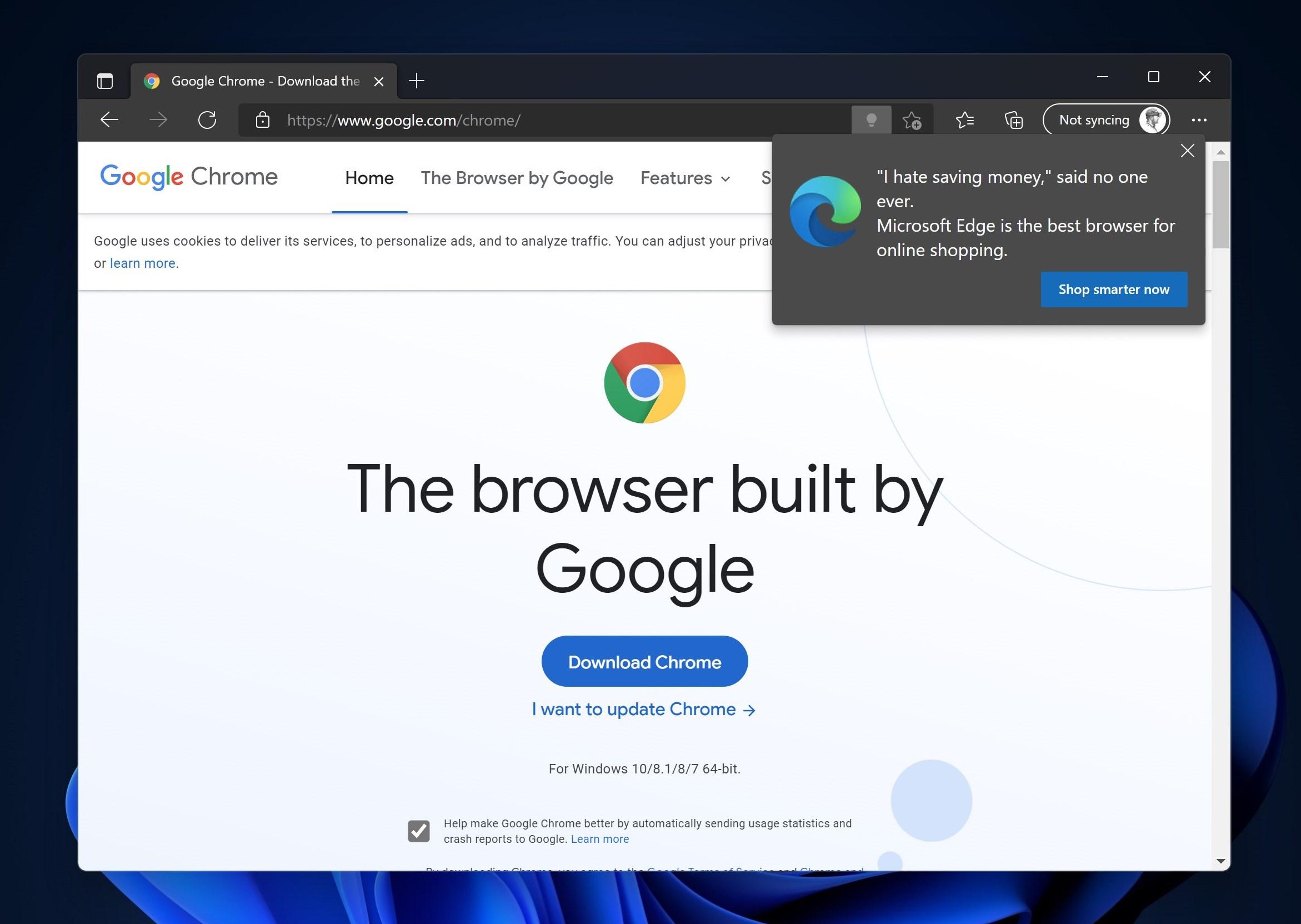
If you're a Google Chrome user setting up a new Windows PC, the most important feature of Microsoft Edge is the ability to download Chrome. Microsoft is apparently aware of this behavior and is doing something about it: Neowin has spotted new Edge pop-ups that specifically try to dissuade users from downloading and installing Chrome, a change that I promise I didn't know about when I wrote about Microsoft's annoying promotion of Microsoft Edge literally yesterday.

You won't see the pop-ups every time you try to download Chrome (I haven't yet), but Neowin and other outlets like The Verge have spotted at least three different messages:

  • "Microsoft Edge runs on the same technology as Chrome, with the added trust of Microsoft."
  • "'I hate saving money,' said no one ever. Microsoft Edge is the best browser for online shopping."
  • "That browser is so 2008! Do you know what's new? Microsoft Edge."

While the operating system-level pop-ups are a small escalation in the ongoing browser wars, this kind of behavior isn't new. If you use Bing to search for essentially any web browser, including Chrome, Firefox, Opera, Vivaldi, or Brave, a large ad for Edge appears both above the search results and in a giant box to the right of the search results. And whenever you log into Google's services using Edge or any other non-Chrome browser for the first time, you'll get a "helpful" nudge about downloading and installing Chrome. But as the provider of Windows, Microsoft definitely has more opportunities to suggest using Edge, and it takes advantage of those opportunities with frustrating regularity.

Read on Ars Technica | Comments

02 Dec 17:28

Moderna plans omicron booster for March as Biden unveils winter COVID plan

by Beth Mole
US President Joe Biden at the White House on December 01, 2021, in Washington, DC.

Enlarge / US President Joe Biden at the White House on December 01, 2021, in Washington, DC. (credit: Getty | Anna Moneymaker)

President Joe Biden will announce plans today to increase protections against COVID-19 this winter as the delta coronavirus variant continues to ravage the country and the worrisome omicron variant looms. Biden will make the announcement this afternoon in remarks during his visit to the National Institutes of Health in Bethesda, Maryland.

The president's plan includes expanding access to free at-home rapid testing and setting policy to ensure that over-the-counter, at-home tests are covered by health insurance plans. It also tightens health protocols for travel. Starting early next week, every inbound international traveler to the US will need to test negative within one day of their departure, regardless of nationality and vaccination status. The plan also calls for extending mask requirements on airplanes, trains, and public transit into March.

To fight surges in cases from delta and omicron, the administration is assembling over 60 emergency medical response teams to deploy to states in crisis. The administration is also working to secure 13 million doses of antiviral treatments.

Read 5 remaining paragraphs | Comments

02 Dec 14:45

The religious right wants states’ tax dollars, and the Supreme Court is likely to agree

by Ian Millhiser
Supreme Court Debates President Obama’s Health Care Law
A Catholic priest holds a cross in front of the Supreme Court in 2012. | Brooks Kraft LLC/Corbis via Getty Images

An emboldened religious right wants the public to pay for its schools.

The plaintiffs in Carson v. Makin, a case being heard next Wednesday, December 8, begin their brief to the Supreme Court with an absolutely ridiculous historical comparison.

“In the 19th century, Maine’s public schools expelled students for adhering to their faith,” they claim, citing one example of a Catholic student expelled for not completing lessons off a Protestant bible. Now, according to the brief, Maine is committing a similarly repugnant sin against religious people by refusing to pay state residents’ tuition at private religious schools.

Under this reasoning, there is no relevant difference between denying a public education to a Catholic student and refusing to pay for private religious education. “The times are different,” the plaintiffs’ brief claims, “but the result is the same: denial of educational opportunity through religious discrimination.”

Carson, in other words, represents a significant escalation in the war over whether the government can enact policies of which religious people — and religious conservatives on the Supreme Court — disapprove. It moves the battleground from whether religious conservatives can seek exemptions from individual laws to whether they can also demand that the public actively fund their faith.

Typically, the Court’s “religious liberty” docket involves laws and policies that prohibit religious parties from acting in a way they believe is consistent with their faith. A church wishes to hold a crowded service, for example, in violation of a public health order limiting the number of people who can gather at one time during a pandemic. Or, an employer wishes to provide its employees with a health plan that excludes birth control in violation of a federal regulation requiring the insurance to cover contraceptive care.

But Carson is not like these cases. It claims the state of Maine must spend existing tax revenue from its secular residents to pay the private school tuition of some religious students. No one in Maine is prohibited from sending their children to a religious private school. The plaintiffs in Carson already send at least one child to such schools. The question is whether the Constitution requires the government — and, by extension, anyone who pays taxes to that government — to subsidize religious education.

Notably, the state could also wind up having to pay for hate speech in the process. According to Maine’s brief, both of the plaintiff families in Carson want the state to pay for tuition at schools that discriminate against LGBTQ students and teachers. One of those schools allegedly requires teachers to sign an employment agreement stating that “the Bible says that ‘God recognize[s] homosexuals and other deviants as perverted’” and that “[s]uch deviation from Scriptural standards is grounds for termination.’”

To be fair, Carson also involves Maine’s fairly unusual public school vouchers program, so it’s unclear what immediate impact a victory for the plaintiffs in this case would have in other states. Although much of Maine operates ordinary public schools run by local school districts, some students — predominantly those who live in sparsely populated areas where there is no local school — are not assigned to a particular school. Instead, the state offers to pay the private school tuition of those nearly 5,000 students, who would otherwise have no access to a free education.

Only “nonsectarian” schools are eligible for this subsidy. Parents can still choose to send their children to an institution that seeks to inculcate those children into a particular religious faith, but they won’t receive state funds to do so.

Nevertheless, the plaintiffs in Carson claim Maine is constitutionally obligated to subsidize religious education, at least so long as it provides similar funds for secular private education.

It’s the sort of argument that would have had little chance of prevailing until fairly recently, but that is likely to prevail in a Supreme Court dominated by conservative Republicans who are quite sympathetic to the religious right.

Just last year, the Court took a significant step toward tearing down the distinction between laws that impose unwanted obligations on people of faith and laws that merely deny taxpayer dollars to religious institutions. In a worst-case scenario for the separation of church and state, Carson could obliterate that distinction.

How we got to the point where the Carson plaintiffs’ arguments are taken seriously

At the outset, the plaintiffs’ main argument in Carson seeks to push the Roberts Court’s growing deference to religion to a new level, further divorcing it from the text of the Constitution itself. The bulk of their brief argues that Maine’s system violates the Constitution’s free exercise clause, which generally bans laws “prohibiting the free exercise” of religion.

The key word here is “prohibiting.” Again, no one in Maine is prohibited from doing anything because of the state’s decision to pay tuition at only some private schools. Both of the plaintiff families in Carson currently send children to religious private schools that are ineligible for subsidies. The only question in Carson is whether Maine must use tax dollars to pay for this religious education.

Barely two decades ago, there was a serious constitutional debate about whether states are even permitted to fund religious education. As established in Everson v. Board of Education (1947), longstanding precedent holds that “no tax in any amount, large or small, can be levied to support any religious activities or institutions, whatever they may be called, or whatever form they may adopt to teach or practice religion.” In 2002, Zelman v. Simmons-Harris asked the court to consider a school voucher program that primarily benefited religious schools. Though a majority of the Court abandoned Everson’s strict approach in this case, four justices dissented and would have applied the stricter rule.

Yet even after Zelman, the Court largely viewed the question of whether to subsidize religious education as a matter within lawmakers’ discretion.

Until the Roberts Court.

Most notably, in Espinoza v. Montana Department of Revenue (2020), the Court held that states must subsidize religiously affiliated schools under certain circumstances. Espinoza held that a state may not deny a subsidy to a religious institution “simply because of what it is” — that is, simply because the institution identifies with a particular faith.

But Espinoza also maintained a distinction between religious “status” and religious “use,” which is particularly relevant to the Carson case now before the Court.

Suppose, for example, a state provides grants to help set up food banks and soup kitchens. If a church wishes to set up a soup kitchen and is otherwise eligible for the grant, it can’t be denied the grant solely because it is a religious institution. Its “status” as a Christian-affiliated entity is not a valid basis to deny a grant under Espinoza.

Now imagine a slightly different church, that wishes to use the state-funded grant to purchase Bibles that will be distributed to people at the soup kitchen. In this scenario, the church is no longer just providing a secular service, food for the hungry. It’s providing an inherently religious service, the distribution of a holy text. This kind of inherently religious activity is what the Court meant by religious “use,” and Espinoza suggests states may still be allowed to deny funding to such activities — even if they can’t deny funding to religious institutions that qualify for subsidies funding secular activity.

And this distinction between religious “status” and religious “use” is now front and center in the Carson case.

The radicalism of the plaintiffs’ arguments in Carson

Although the tuition program at the heart of the Carson case predates Espinoza, it might as well have been designed specifically to survive judicial review after that decision. As the state explains in its brief, Maine determines whether a particular school is “sectarian,” and therefore ineligible for state subsidies, by asking if it “promotes the faith or belief system with which it is associated and/or presents the material taught through the lens of this faith.”

Although “affiliation or association with a church or religious institution is one potential indicator of a sectarian school,” this factor does not determine whether a school is classified as “sectarian.” Rather, the question is “what the school teaches through its curriculum and related activities, and how the material is presented.”

Under Espinoza’s framework, in other words, Carson is a case about religious “use.”

Nevertheless, the plaintiffs seek an expansion of Espinoza, claiming that policies which require religious families to “choose between their religious beliefs and receiving a government benefit” are unconstitutional — and that Maine’s tuition program forces these families to choose between “their right to tuition assistance or their right to freely exercise their religion.”

It’s a deeply radical argument, if taken to its logical end point. This case involves an unusual school voucher program that applies only to a small minority of Maine’s children — mostly students in very rural areas where it is not cost-efficient for the state to operate a public school. But if the Constitution does not permit states to force families to choose between receiving a free education and a religious one, then any public school system is potentially at risk.

Again, the plaintiffs’ argument is that the government cannot require a religious family to “choose between their religious beliefs and receiving a government benefit.” But traditional public education, where students are assigned to a government-run school that offers a free education, is a government benefit. All families that send their children to private, religious schools choose to forgo a free public education. So, if the plaintiffs are correct that families cannot be forced to make this choice, the entire public education system may be required to pay for private tuition at religious schools.

It’s not at all clear that the Court will be willing to go that far. Indeed, in Espinoza, Chief Justice John Roberts’s majority opinion appeared to anticipate this problem, and he attempted to nip it in the bud. “A State need not subsidize private education,” Roberts wrote in Espinoza, “but once a State decides to do so, it cannot disqualify some private schools” because of their religious status.

But Espinoza was also a 5-4 decision, before Justice Ruth Bader Ginsburg’s death gave Republican appointees a supermajority on the Court. And, while Roberts is quite conservative, he’s the least conservative member of the Court’s six-justice Republican majority. Conservative litigants no longer need Roberts’s vote to prevail, and it is unclear whether Roberts’s five more conservative colleagues agree with him that “a State need not subsidize private education.”

Even if they do agree with Roberts in principle, it’s hard to draw a principled line between a school voucher program that excludes religious education and a traditional public school system that excludes religious education. In the likely event the Carson plaintiffs prevail before the Supreme Court, it is probably inevitable that someone in a traditional public school district will file a new lawsuit claiming they are also entitled to have their private school tuition paid for by their state’s taxpayers.

02 Dec 14:44

Omicron found in US—plus 23 other countries in 5 of 6 global regions

by Beth Mole
Dr. Anthony Fauci, director of the National Institute of Allergy and Infectious Diseases and the chief medical adviser to the president, delivers an update on the Omicron COVID-19 variant during the daily press briefing at the White House on December 1, 2021 in Washington, DC. The first case of the omicron variant in the United States has been confirmed today in California.

Enlarge / Dr. Anthony Fauci, director of the National Institute of Allergy and Infectious Diseases and the chief medical adviser to the president, delivers an update on the Omicron COVID-19 variant during the daily press briefing at the White House on December 1, 2021 in Washington, DC. The first case of the omicron variant in the United States has been confirmed today in California. (credit: Getty | Anna Moneymaker)

The omicron coronavirus variant has now been detected in at least 24 countries in five of six global regions—and as of this afternoon, that includes the United States.

The US Centers for Disease Control and Prevention confirmed this afternoon that the first US case was detected in a person in California who had returned to the US from South Africa on November 22 and tested positive on November 29. Researchers at the University of California, San Francisco carried out genomic sequencing identifying the omicron variant in the person, and the CDC confirmed that sequencing.

The CDC reported that the person was fully vaccinated and had only mild symptoms that are improving. In a press briefing Wednesday afternoon, top infectious disease expert Anthony Fauci said it appeared the person had not yet received a booster shot. Public health experts suggest that booster shots will significantly improve protection against the new, still poorly understood variant.

Read 7 remaining paragraphs | Comments

02 Dec 14:43

Report: U.S. Has 9th Most Expensive Broadband On The Planet

by Karl Bode

We've long illustrated how U.S. broadband is dominated by regional monopolies, which, in turn, are often coddled by state and federal governments (aka corruption). That broken market (and regulatory capture) results in all manner of problems, from spotty coverage and slow speeds, to repeated privacy violations, net neutrality violations, and some of the worst customer service of any industry in America (no small feat if you think about it).

Of course, it also results in the U.S. having some of the most expensive broadband anywhere. A new report by CompareThe Market finds that U.S. broadband is the 9th most expensive country for broadband in the world, with people paying an average of $66.13 USD per month. That's in line with prices paid in such countries like Honduras and Guatemala:

Keep in mind most of these data analysis efforts don't include hidden fees, usage caps, and broadband overage surcharges, meaning the amount Americans actually pay is usually significantly higher than what's represented here.

Like so many reports, the data breakdown just dumps this information at the readers' feet without explaining why U.S. broadband consistently ranks among the worst broadband nations in the world (whether we're talking about speed, price, or availability). And while for years the industry (and those paid to apologize for regional monopolization) tried to argue that it was simply because the U.S. was so big or because U.S. ISPs are saddled with too much regulation, that's never been true. The U.S. broadband market isn't free. It's heavily monopolized and overseen by corrupt policymakers (regulatory capture).

In 2021 the issue is no longer geography, or even technology. It's the fact that we've let a handful of giant telecom and cable monopolies not only cordon off regional fiefdoms, but all but dictate both state and federal telecom policy the vast majority of the time (including literally writing state laws and local ordinances). Instead of tackling this problem head on, feckless U.S. policy makers (enabled by a lazy and timid press) generally mumble about the causation free "digital divide," then repeatedly just throw more money at the problem.

When that doesn't work, everybody just shrugs and repeats the process the next time data shows the U.S. continues to be violently mediocre in broadband. There's a vast coalition of well-funded organizations, individuals, think tanks, consultants, and companies tasked with ensuring this dynamic never actually changes. As the data repeatedly attests, they've been winning that fight for the better part of a generation now.

02 Dec 00:12

Get it Together

by Reza
01 Dec 18:32

Psychiatrists are uncovering connections between viruses and mental health. They’re surprising.

by Brian Resnick
An illustration of a person’s head looking up out of a pool of viruses.
Christina Animashaun/Vox

Immune responses to viruses like SARS-CoV-2 may affect mental health, and vice versa. Doctors are uncovering exactly how. 

When the Covid-19 pandemic hit, one of the biggest questions was: Why do some people get so much sicker than others? It’s a question that has forced researchers to confront some deep mysteries of the human body, and come to conclusions that have startled them.

By the fall of 2020, psychiatrists were reporting that among the many groups who were high risk, people with psychiatric disorders, broadly, seemed to be getting more severe forms of Covid-19 at a higher rate. Katlyn Nemani, an NYU neuropsychiatrist, decided to dig deeper, asking: Just how much more at risk, and which conditions?

In January, she and a group of colleagues published a study of 7,348 Covid-19 patients in New York. One finding was stark: People with a schizophrenia spectrum diagnosis faced more than two and a half times the average person’s risk of dying from Covid-19, even after controlling for the many other factors that affect Covid-19 outcomes, such as cardiovascular disease, diabetes, smoking, obesity, and demographic factors — age, sex, and race.

“That was a pretty shocking finding,” Nemani says. The patients all were hospitalized in the same medical system, in the same region, which implies they weren’t receiving radically different treatments, she says. In sum, it all suggests that the risk was closely linked to the mental illness itself and not to some other variable.

Since then, more studies have come out — as well as meta-studies pooling the conclusions of those studies — showing worse Covid-19 outcomes among people with diagnosed mental health disorders including depression, bipolar disorder, and schizophrenia.

Some of this isn’t surprising; a lot of people with mental health issues experience a general increased risk of poor health outcomes. But the pandemic started to shine a brighter light on why, bolstering a hypothesis that’s been accruing evidence in recent years.

It appears that something in the body, something biological associated with these disorders, may be at play. “That suggests there’s a physiologic vulnerability there in these folks,” said Charles Raison, a psychiatrist and researcher at the University of Wisconsin Madison.

 Apu Gomes/AFP via Getty Images
A doctor checks on a Covid-19 patient at Providence Cedars-Sinai Tarzana Medical Center in Tarzana, California, on September 2.

It’s not necessarily that people with schizophrenia or mood disorders are more likely to become infected with Covid-19. Rather, once they are infected, “the outcomes are worse,” Nemani says.

Depending on the study and the severity of the mental health diagnosis, people with these conditions are, roughly, between 1.5 and 2 times more likely to die of Covid-19 than average, after adjusting for other risk factors (unadjusted risk is even higher). The level of increased risk, Nemani says, is “on par with what we’re seeing for other well-established risk factors like heart disease and diabetes.”

What’s happening? Why would mental illness make someone more vulnerable to a respiratory disease?

Psychiatrists who study these mental illnesses say the culprit might lie in a connection between mental health and the immune system. They’re finding that mental health stressors could leave people more at risk for infection, and, most provocatively, they suspect that responses in the immune system might even contribute to some mental health issues.

There’s a lot that’s unknown here. But the pandemic is giving researchers a new window into these questions. And the research “might teach us something about how to protect these people from infection going forward,” Nemani says.

How the immune system can impact mental health

In September, the Centers for Disease Control and Prevention updated its list of underlying conditions that put people at higher risk for severe Covid-19, adding mood disorders — like depression and bipolar disorder — and schizophrenia spectrum diagnoses, a group that accounts for around 34 million Americans. It was a recognition of the growing evidence published by Nemani and colleagues across medicine, and prioritizes this group for vaccines and booster shots.

Roger McIntyre, a psychiatrist at the University of Toronto, is one of the co-authors of one of two systematic review studies that the CDC cited in its change. (Nemani is a co-author on the second.) To him, it’s no surprise that mental illness imparts an infection risk. “A thread that has been woven through many of these disorders is immune or inflammatory dysregulation,” McIntyre says.

That is, problems with the immune system tend to coincide with mental health issues. And problems with the immune system can lead people to have worse outcomes when it comes to SARS-CoV 2, the virus that causes Covid-19.

“Most of the time in medicine, it’s hard to have one singular explanation for anything,” he cautions. That’s especially true here in the discussion of why people with certain mental health issues might be more at risk for severe disease. People living with mental illnesses like schizophrenia, bipolar disorder, and major depression tend to have shorter-than-average life spans and worse health overall. They’re more at risk for heart disease and obesity; they smoke at higher rates. All these risk factors put people with these mental health issues — particularly schizophrenia — at higher risk of death from many causes, including severe infections.

The studies that have been conducted to date try to control for these factors, but it’s impossible to control for them all. Other factors like economic insecurity, added isolation brought on by the pandemic, access to diagnostic testing, or behaviors at the individual level that are hard to account for in studies could play a role.

But the scientific literature does find links between mental health and immune system health. The biggest one: Studies have reported that many people with depression, bipolar, and schizophrenia (as well as other mental health issues not highlighted as Covid-19 risk factors by the CDC) have higher levels of inflammation throughout the body.

Inflammation is one of the body’s responses to dealing with dangerous invaders like the SARS-CoV-2 virus. Inflammation is literally a flood of fluids containing immune system cells. They get released from the blood into body tissues to help clear infections. This is why infected areas of the body get swollen.

 NIcolas Asfouri/AFP via Getty Images
An engineer shows a model of the coronavirus at the Sinovac Biotech facilities in Beijing in April 2020.

When inflammation is short-lived, it can help clear out an infection. When it is chronic, it can cause problems. It wears on the heart and can contribute to illnesses like diabetes. When it comes to Covid-19, scientists suspect that underlying inflammation — or underlying dysregulation of the immune system — is what causes some patients’ bodies to overreact to the virus, causing the worst symptoms that can land people in hospitals and lead to death.

As Nemani explains, the inflammation tends to increase with the severity of the mental illness. “For people with depression, you see a small increase in systemic inflammation,” Nemani says. It grows higher in people with severe depression, and higher still in people with bipolar and schizophrenia. (All these conditions exist on a continuum, and there are more and less severe versions of each.)

So people with certain mental health issues might have chronic inflammation, and that could lead to poorer outcomes when it comes to Covid-19. The question is, why do they have chronic inflammation in the first place?

Part of the reason may simply be the chronic stress that comes from living with mental health issues, McIntyre and Nemani say. Stress can provoke an inflammatory response, as can a lack of sleep.

But it’s also possible that the immune system has a role to play in generating these diseases. “Beginning in about 2000, we began to show that inflammation can make people depressed,” Raison says. “The best evidence is that there have been a number of studies where inflammatory stimuli [such as drugs known to cause inflammation] of various intensity and durations have been given to people, and they tend to make people feel depressed and exhausted.”

In depression, McIntyre says, scientists often (but not always) find elevated markers of inflammation in the blood. “Now, it may not be the causative role, although it might be,” he says. “It may be the causative role in some people, and it may be playing more of a secondary role in other people.”

This just provokes another question: Why would the immune system change our mood and influence our exhaustion?

McIntyre makes an example of the common cold to explain. “When you have the common cold, I’m not saying you have depression, but what I’m saying is you have a lot of symptoms that look a lot like depression,” he says. “You feel tired, your sleep is disrupted, you lose your appetite. You’re probably not enjoying many things. You’re quite apathetic. Things are bland in your life. That’s the immune system that’s been activated, creating those symptoms. We think that for some people with depression, that can explain your depressive symptoms.”

That is, when your immune system isn’t working properly, it could contribute to, or even possibly generate, depressive symptoms.

 Spencer Platt/Getty Images
A view of Manhattan streets in April 2020, as the coronavirus overwhelmed New York City.

Similarly, it’s possible that the immune system plays a role in generating schizophrenia. There’s a theory that viral exposure while in utero is closely tied with developing psychotic illness or schizophrenia later on,” says Ellen Lee, a psychiatrist and researcher with the University of California San Diego. It’s possible that the mother’s immune response during the infection leaves a lasting impact on the child’s brain and immune system. Other studies have suggested that having a prior autoimmune disorder puts a person at risk for schizophrenia. But, Lee stresses, “There’s so much that we don’t fully understand.”

The bigger point, Lee says, is to recognize that schizophrenia is “a whole-body disorder.” “We see inflammation increase in the brain and we see inflammation increase throughout the body.” That leaves people with schizophrenia at risk of a whole host of chronic illnesses. “The inflammation worsens metabolic health, which then in turn usually leads to obesity and worse inflammation,” Lee says. “So it’s all kind of a cycle.”

How infections could precipitate mental health issues

The evidence for this theory — that immune issues can contribute to mental health disorders — is incomplete.

For one, Raison says that while it seems as though inflammation can contribute to depression, “it has not appeared that blocking inflammation is a particularly robust way to either treat or prevent these disorders.” So there’s a big piece of the puzzle missing there. Another missing piece: There are some cases of depression where inflammation does not appear to play a big role, says McIntyre, and there are probably many unrecognized or underrecognized causes or contributors to mental health issues.

Finally, the mental health conditions mentioned in this piece — depression, bipolar, schizophrenia — are not fully understood to begin with. Scientists just generally don’t understand how much biological overlap there is among them. With depression in particular, some scientists suspect it isn’t just one disease, but perhaps many different ones that manifest with similar, overlapping symptoms.

So the big picture is complicated and incomplete.

But if it is true that the immune system can influence the mind and vice versa, it opens up some important, fascinating questions.

For instance: Can getting sick, and the immune system reaction to fighting a virus, provoke changes in mental health? Our bodies get inflamed when we fight off an infection. Could that impact and even possibly cause or contribute to a mood disorder?

Past work suggests it could. An enormous study of the health records of 3.56 million people born between 1945 and 1996 in Denmark showed that a history of infection and autoimmune disorders predicted later diagnosis of mood disorders. More specifically, the study found that the more infections a person had, the more at risk they’d be for mental health issues later on; there could be a causal pathway here. That makes it seem like the infections themselves are a risk factor.

This also might be playing out in the pandemic. “It seems like having Covid puts you at higher risk for psychiatric illness after infection,” Nemani says. A February study of 69 million individual health records, published in The Lancet, found that “the incidence of any psychiatric diagnosis in the 14 to 90 days after Covid-19 diagnosis was 18.1 percent, including 5.8 percent that were a first diagnosis.” (The study made a few comparisons. Covid infections seem to precede more first time mental health diagnoses than breaking a bone, getting a kidney stone or a gallstone, and seem to precede more diagnoses than other infections like the flu.)

Exactly how this unfolds is not fully understood. Some of it might be due to the peculiarities of Covid-19 and how it can infect nervous system tissues, and is possibly a unique symptom of long Covid. (As reported in the Lancet study, Covid-19 patients were around twice as likely to develop a psychiatric illness for the first time compared to a control group of people who were sick with the flu.) But it also could be because many viral infections can nudge people’s mental health in a poor direction.

Consider the common cold example McIntyre laid out above. What if, after getting an infection, the lethargic wasting feeling doesn’t leave? There’s some suspicion that changes to the immune system, wrought by battling the virus, could do that.

Again, this is hardly settled science. But the pandemic presents these psychiatry researchers with an opportunity to ask these questions. When it comes to mental health risk after an infection, “what we’re going to need to do is tease apart what’s due to general stress from the pandemic itself — people losing people that they love, the stress of just getting the diagnosis itself, all of the life changes that came along with it — from the potential immune effects of the virus,” Nemani says.

More questions could be answered, too. “Looking ahead, we might be able to better understand how a viral infection can lead to new onset psychiatric illness,” she says. “If we can better understand that mechanism, we might be able to identify treatment targets that could potentially help treat psychiatric symptoms ... and maybe even bolster the immune system of susceptible patients.”

Taking care of mental health can help communities prepare for outbreaks

Despite scientists having an incomplete picture of the science here, they believe it’s still useful to know that mental health issues can be a precursor to infection risk, or vice versa.

Recently, public health researchers at Yale published a study that found a county-level correlation between people’s general mental well-being and confirmed cases of Covid-19. Whereas the meta-reviews mentioned above looked at infection risk for actual diagnoses, this study looked at a more general measure of “poor mental health days.” It’s a self-reported measure that simply has people recall “the number of days that you are kind of feeling down or had some emotional issues,” Yusuf Ransome, the Yale epidemiologist who led the study, says.

In this study, “poor mental health days” is used as a way to take the mean mental health temperature of a region, and it does seem to be correlated to outbreak risk. At this zoomed-out level of analysis, it’s even harder to determine causality. But at least, Ransome says, it suggests that when it comes to the intersection of mental health and infection, we shouldn’t just focus on issues that rise to the level of a diagnosis.

 American Journal of Preventative Medicine
On the left: diagnosed Covid-19 cases between January 22 and October 7, 2020, per 10,000 people. On the right: the average number of days adults had poor mental health.

“When we are only focusing on clinical manifestations, we might miss sort of the much more lay version of how people are experiencing mental health,” he says. “We need to look at even the most basic indicators of mental well-being. We don’t necessarily need to have the whole population diagnosed by a clinician for depression to understand the severity of the impact.”

To identify communities where mental health is overall poor, he says, is to potentially target them for interventions and outreach to help deal with future viral outbreaks.

For now, the scientists who research this intersection of mental health and the immune system want the public to know that mental health disorders can be whole-body disorders. They don’t just impact the brain. And for that, they applaud the CDC’s decision to recognize these disorders as being risk factors for severe Covid-19. A lot of people with such disorders are underserved by health care in general.

“People with mental health disorders — especially schizophrenia, severe depression — they don’t receive primary care interventions as often as other people,” Nemani says. “The fact that the CDC updated their high-risk list to include some of these mental health conditions was just, you know, a really great thing that really might help save lives.”

It’s hard to think of any silver linings in the pandemic, but one is the potential to gain knowledge. “We have a single virus at a single point in time, infecting so many people at a scale that we’ve never seen before,” Nemani says.

If scientists can use the pandemic to learn even more about the nature of these mental illnesses and how they interact with the immune system, more future lives could be saved, too.

01 Dec 13:06

Womp, womp: Efficacy of Merck’s Thor-inspired COVID pill crumbles, vexing experts

by Beth Mole
A Merck sign stands in front of the company's building on October 2, 2013, in Summit, New Jersey.

Enlarge / A Merck sign stands in front of the company's building on October 2, 2013, in Summit, New Jersey. (credit: Getty | Kena Betancur)

In a 13-to-10 vote, advisers for the Food and Drug Administration narrowly supported authorizing Merck's Thor-inspired antiviral pill molnupiravir for use against severe COVID-19.

The FDA's panel of advisers—the Antimicrobial Drugs Advisory Committee (AMDAC)—struggled in an all-day meeting Tuesday to weigh the drug's risks, its modest benefits, and the limited available data. The latest analysis suggests that the pill is only 30 percent effective at preventing hospitalization and death from COVID-19 in people at high risk of severe disease. Meanwhile, the drug has the worrisome potential to cause mutations, leading advisers to agonize over whether it should be offered to pregnant people.

Molnupiravir's final data and today's vote is a significant disappointment from the early fanfare around the drug, which initially promised to be an easy-to-use oral drug to effectively prevent severe COVID-19. "Our prediction from our in vitro studies and now with this data is that molnupiravir is named after the right [thing]... this is a hammer against SARS-CoV-2 regardless of the variant," Merck’s head of research and development, Dean Li, said last month.

Read 8 remaining paragraphs | Comments

01 Dec 12:20

Bird power rankings

by Nathan Yau

Using data from Project FeederWatch, which is a community tracking project to count birds around feeders, Miller et al. estimated the pecking order among 200 species. This was in 2017. For The Washington Post, Andrew Van Dam and Alyssa Fowers worked with the researchers for an updated ranking using a more comprehensive dataset. The result is bird power rankings 2021 edition.

Tags: birds, ranking, Washington Post

30 Nov 19:53

DOJ Asks Tenth Circuit Appeals Court To Firmly Establish A Right To Record Police Officers

by Tim Cushing

Earlier this year, the Tenth Circuit Court of Appeals decided there was no right to record police officers. In a case involving a man who had his tablet seized and searched by Denver, Colorado police officers when they discovered he was recording them, the Appeals Court sided with the cops, awarding them qualified immunity. The judges did this despite the officers being specifically instructed that there was a presumed right to record police officers via training that had been in place for years prior to this incident.

The plaintiff attempted to have this case reheard by the Supreme Court, which might have resulted in the firm establishment of a right to record nationwide. Unfortunately, the nation's top court decided this wasn't worth its attention and took a pass on this case, apparently feeling the patchwork establishment of this right in a handful of judicial circuits is more than enough protection for the general public.

The Tenth Circuit is hearing another case involving the recording of police officers. It again involves officers in Colorado. In this case, an officer blocked Colorado resident Abade Irizarry from filming cops performing a roadside sobriety test. The Tenth previously dodged establishing precedent in the case it handled in April. This time it might feel a bit more pressure to actually weigh in on this issue. The DOJ (yes, that one!) has filed a brief in Irizarry's case asking the court to establish this right.

In a brief submitted to the U.S. Court of Appeals for the 10th Circuit on Wednesday, the department's Civil Rights Division advocated for the appellate court to settle the question once and for all as cases continue to arise implicating the right to record. The government indicated it has a stake in the outcome, given its authority to investigate patterns of police misconduct.

"The U.S. Department of Justice frequently relies on photos and videos of police misconduct — including photos and videos taken by members of the public — when investigating and prosecuting police officers" for constitutional violations, wrote attorneys Natasha N. Babazadeh and Nicolas Y. Riley.

The brief [PDF] specifically cites the George Floyd case, which might have vanished into the ether had it not been for recordings captured by citizens who witnessed the murder committed by Minneapolis police officer Derek Chauvin. It also points to the killing of Walter Scott by South Carolina police officer Michael Slager, who stated Scott had reached for his taser, necessitating his shooting. Bystander video showed what actually happened, which was Officer Slager shooting Scott in the back as he fled and then dropping his taser near Scott's body.

The DOJ says that it has long considered the recording of officers to be protected by the First Amendment, something it has repeatedly stated in investigations of local law enforcement agencies which have (among other frequent rights violations) detained, hassled, or otherwise deterred citizens from recording them.

As the brief points out, the lower court somehow managed to award qualified immunity to the officer despite there being plenty of case law that strongly suggested recording the police is protected by the First Amendment.

To reach that conclusion, the court cited Tenth Circuit precedents recognizing that the First Amendment protects news-gathering activities; out-of-circuit case law holding that such protections are not limited to professional journalists or established media companies; and the widely accepted proposition that the First Amendment protects the free discussion of government affairs, including sharing information about government misconduct. Nevertheless, despite holding that the First Amendment protects such a right, the court concluded that the right had not been clearly established in May 2019, when the incident that gave rise to this case occurred.

To that point, the DOJ urges the court to handle the important open questions first, rather than move straight to the qualified immunity defense, which short-circuits any judicial discussion of the relevant constitutional issue.

This Court should hold that the First Amendment protects the right to record police officers performing their duties in public (subject to reasonable time, place, and manner restrictions, as noted above) before resolving the qualified immunity question.

And, like the other case the Tenth Circuit Court mishandled in April, the cop involved in this incident had prior training informing him that citizens had a presumed right to record police officers.

Officer Yehia’s own police department explicitly instructs officers not to interfere with “the lawful efforts of the news media to photograph, tape, record and televise adult subjects in a public place.”

I hope the Tenth Circuit sees where it went wrong with the previous decision and decides to join the six circuits who've already established this right. There's always a chance the judges might decide it isn't any of the DOJ's business and go the other way out of spite, but this isn't an issue that's just going to go away if it's ignored long enough. And the longer the Tenth Circuit sides with cops, the more lawsuits its refusal to establish this right is going to generate.

30 Nov 18:30

Big Tech firms should pay ISPs to upgrade networks, telcos in Europe claim

by Jon Brodkin
A person's hand holding a roll of 50-Euro notes.

Enlarge (credit: Getty Images | Alicia Llop)

The CEOs of 13 large European telecom companies today called on tech giants—presumably including Netflix and other big US companies—to pay for a portion of the Internet service providers' network upgrade costs. In a "joint CEO statement," the European telcos described their proposal as a "renewed effort to rebalance the relationship between global technology giants and the European digital ecosystem."

The letter makes an argument similar to one that AT&T and other US-based ISPs have made at times over the past 15 years, that tech companies delivering content over the Internet get a "free" ride and should subsidize the cost of building last-mile networks that connect homes to broadband access. These arguments generally don't mention the fact that tech giants already pay for their own Internet bandwidth costs and that Netflix and others have built their own content-delivery networks to help deliver the traffic that home-Internet customers choose to receive.

Today's letter from European ISPs was signed by the CEOs of A1 Telekom Austria Group, Vivacom, Proximus Group, Telenor Group, KPN, Altice Portugal, Deutsche Telekom, BT Group, Telia Company, Telefónica, Vodafone Group, Orange Group, and Swisscom. They wrote:

Read 14 remaining paragraphs | Comments

30 Nov 12:44

Ocarina of Time has been fully decompiled into human-readable code

by Kyle Orland
Screenshot from video game shows sprite fascinated by a doodad.

Enlarge / Artist's conception of voders staring in awe at the raw C code that generates Ocarina of Time. (credit: Nintendo)

A team of volunteer coders has reportedly completed its nearly two-year-long quest to fully decompile a version of The Legend of Zelda: The Ocarina of Time, turning the executable ROM back into human-readable (and editable) C code.

"We thought for a time that we may never be able to match every function completely, so this is an incredibly exciting accomplishment," Zelda Reverse Engineering Team (ZRET) member Kenix wrote on the project's Discord server Sunday. "Dozens of people helped work on this project, and together we were able to achieve something amazing."

The final decompiled functions still need to be merged with the ZRET Github repository before the open source project is officially considered 100 percent complete, Kenix wrote. Once that submission is reviewed, though, the team should be able to run its tens of thousands of lines of C code through a compiler (alongside graphics and sound assets derived from a legitimate cartridge) to generate a bit-for-bit copy of the original Ocarina of Time ROM.

Read 8 remaining paragraphs | Comments

30 Nov 12:39

Report: Climate Change Is Messing With the Smithsonian Collections

by Jason Fontelieu
The New York Times published a distressing dispatch from the Smithsonian on Thanksgiving last week, saying that due to climate change, the museums’ collections are “extremely vulnerable to flooding, and some [buildings] could eventually be underwater.” The story says the two main threats to the Smithsonian are the Potomac River, which will eventually flood parts […]
30 Nov 12:35

Want Nothing

by Reza