Shared posts

14 Feb 12:24

It’s not aliens. It’ll probably never be aliens. So stop. Please just stop.

by Eric Berger
Spy balloon mania has taken alien mania to the next level.

Enlarge / Spy balloon mania has taken alien mania to the next level. (credit: Aurich Lawson | Getty Images)

Aliens have been having a moment in recent years.

For decades the notion of unidentified flying objects—UFOs—and little green men running around Roswell, New Mexico, remained comfortably confined along the fringes of societal discourse. But no longer. Serious people in the government are taking a serious look at the phenomenon.

The story of why this posture began to change begins about 15 years ago and is long and complex. (This New Yorker article is a good place to start.) But the basic gist is that then-Nevada politician Harry Reid, a powerful political figure who at times led the US Senate, began to take it seriously. So he started shoveling money at the Pentagon to study the issue.

Read 12 remaining paragraphs | Comments

14 Feb 12:08

Growth of Target, an Animated Map

by Nathan Yau

Watch the growth strategy behind Target stores, starting with the first location in 1962 in Minnesota.

Read More

13 Feb 19:50

ChromeOS will finally, mercifully, let you change its keyboard shortcuts

by Kevin Purdy
Child typing on a Chromebook

Enlarge / For the first time since their 2011 launch, ChromeOS devices are seemingly going to allow custom keyboard shortcuts for navigation, browsing, and other functions. (credit: Google)

ChromeOS devices have become far more useful since the Cr-48. With Linux and Android apps, and "web only" being far less of a hindrance these days, they're compelling as a secondary machine. But having to learn a whole separate set of keyboard shortcuts to use them efficiently is always going to be painful.

But help is on the way, if some experimental features in the latest beta ChromeOS release (111) are any indication. As spotted in Kevin Tofel's About Chromebooks blog, an updated version of the shortcut viewer in the Settings app—first seen in October 2022—has the early makings of a shortcut changing and adding mechanism.

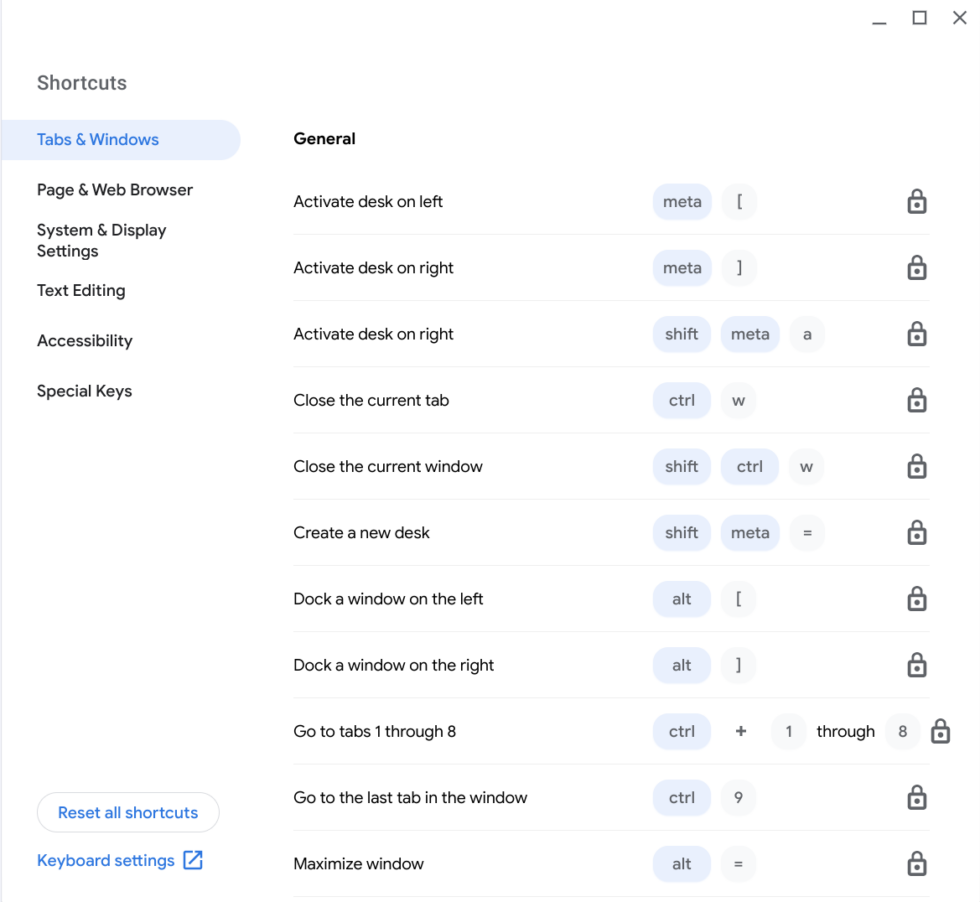
  • ChromeOS' keyboard shortcuts viewer, with experimental flags enabled and showing lock icons next to shortcuts, along with "Reset all shortcuts" button. [credit: Kevin Purdy ]

Clicking on a shortcut brings up a dialogue that allows you to, at the moment, add alternative shortcuts to common shortcuts for manipulating tabs, windows and desktops, system settings, accessibility, and other utilities. A small "lock" icon next to each suggests that you might also be able to unlock these shortcuts to remove or alter their defaults. A "Reset all shortcuts" button offers another hint. Sadly, none of the shortcuts you add seem to work for the moment, though the promise is there.

Read 3 remaining paragraphs | Comments

10 Feb 18:47

What the hard-won HarperCollins union contract means for the future of books

by Constance Grady
A protester holds a sign that reads “fair pay now, fair pay now, fair pay now.”
HarperCollins workers picket outside the company’s Manhattan office on November 15, 2022. | Spencer Platt/Getty Images

Almost 250 employees spent 66 days on strike for higher wages and increased diversity.

On Thursday night, HarperCollins announced that it had reached a tentative agreement with its union for a new contract. The news was a long time coming: It arrived only after the union’s nearly 250 members were on strike for 66 days.

Among the so-called Big Five houses that dominate trade publishing in the US, HarperCollins is an oddity: the only publishing house to be unionized. The union, which comprises roughly 250 assistant and associate-level employees across the company, dates back to the 1940s, when it was established at what was then Harper & Row. In the 80 years since, it has lasted through multiple mergers and acquisitions and consolidations to live on in the enormous modern corporation that is HarperCollins, owned by Rupert Murdoch’s News Corps and now America’s second-largest trade publisher. In the 1980s, the union joined forces with the United Auto Workers Union for more resources, and now, says union chairperson Laura Harshberger, it survives “through sheer force of will.”

For the past few decades, the union and the management have managed to negotiate with minimal strife. The last HarperCollins strike was in 1976, and it lasted for two and a half weeks. This year was different. This negotiation comes in the midst of a larger industry battle over what publishing should look like.

Publishing as an industry is 76 percent white, and its notoriously low starting salaries are part of what keeps it that way. In turn, its monolithic whiteness affects the kinds of stories publishing houses choose to invest in, a correlation that became an embarrassment during the American Dirt controversy of 2020. Publishing’s younger and more leftist workers feel that it’s time for a structural upheaval — and the HarperCollins union wanted to make it happen.

At the same time, publishing is in the midst of one of its perpetual financial crunches. The great surge in demand for books that began in the dead of lockdown has begun to ebb, and revenue has gone down with it. The supply chain is in chaos, making it ever more expensive to publish books. In the last half of 2022, HarperCollins’s profits were down $102 million. This was no time, management felt, to make big, expensive changes.

I stopped by the union’s picket line in New York’s Financial District on the 60th day of the strike. It was bitterly cold, barely in the 30s. Still, about a dozen picketers shivered outside the grand glass-and-bronze doors of the HarperCollins office, wrapped in coats and blankets and hunched over cups of Dunkin’ coffee. They’d been on strike since November 10, 2022. For 60 of those days — every day that HarperCollins was open for business — they’d been picketing.

“We have been outside for the past 60 days, walking in the same circle over and over and over again as it gets continuously colder, while management crosses our picket line,” said Genessee Floressantos, an associate publicist for the international sales department at HarperCollins and a strike picket captain for the union. “They don’t see us as individuals. They think that we’re going to give up. They don’t understand.”

In December 2021, union leadership began negotiating with HarperCollins for a new contract. The union wanted the floor for their salaries raised from $45,000 to $50,000 (still below the $56,718 the Economic Policy Institute estimates to be a living wage for a single adult in New York City). They wanted initiatives to increase diversity at HarperCollins. And they wanted a union security clause, which would make it easier for new hires to opt into the union.

No, said HarperCollins. They’d already raised their minimum wage by 25 percent in the last contract. They were willing to raise it again, but not by that much. And a union security clause would mean dues would automatically be subtracted from members’ paychecks, which, the company maintained, should be each employee’s individual choice.

In April, the union’s old contract expired, and there was still no new contract on the table. In November, the union members walked out of the office. They issued a statement asking agents to stop submitting to HarperCollins, and reviewers to stop reviewing HarperCollins books. The strike lasted through Thanksgiving, through Christmas, and through the new year, with no paychecks going to the striking workers.

Instead, they made do on money from the strike fund and unemployment benefits. “It kind of balances out,” said Cassidy Miller, a rights associate for the HarperCollins children’s department and picket captain for the union. “It doesn’t quite match my paycheck.” The union hardship fund helped when the price of eggs skyrocketed, she said.

Many of the striking workers, though, are used to living on low wages. When Miller got her first job as a sales assistant at HarperCollins rival Macmillan in 2018, she was paid $33,000 a year. “I didn’t negotiate because I didn’t think I could,” she says.

Six months after she started, Macmillan raised its starting wage to $35,000. “I was so thrilled; I remember being so grateful. Oh my god, $2,000 more a year,” she says. “And now I feel like, after actually trying to live on that for years now, it’s just not sustainable. It affects the way you live your life.”

When she started in publishing, Miller made her salary work by sharing an apartment in Brooklyn’s Bed-Stuy neighborhood with four other roommates. Now, she lives with her partner in Central Jersey. “I commute an hour and a half to get here,” she says. (During non-strike times, HarperCollins requires employees to work from the office at least two days per week.) “And it still feels worth it to work in this industry.”

That’s the general refrain from those on the picket line: Wages are too low in publishing, but the workers still love it there.

“If I had started my career at $50,000, I would be in maybe half as much credit card debt,” says Rachel Kambury, an associate editor at Harper Wave and Harper Business. “My living situation would have been very different a long time ago. I would not have undergone certain traumas that I went through.” But it’s worth it, she says, for her colleagues. “The people are amazing. They’re smart, they’re dedicated, fiercely loyal, and they care about what books are and what they can do for people, and what they can represent.”

“I definitely grew up with books. I grew up going to the library. I grew up escaping in them,” says Floressantos. “I love books, but books don’t love me.”

Floressantos describes not just low wages but also microaggressions like co-workers and bosses mispronouncing her name. She doesn’t think those incidents are isolated.

“I’ve seen about 15 women of color leave the company and I’ve only been here for a year and a half. That’s about one a month,” she says. “The company likes to pat themselves on the back and say that in the last fiscal year, 80 percent of their new hires were from marginalized communities. To that I always ask, ‘Well, what are your retention statistics?’ They refuse to share.” None of the Big Five houses share retention statistics broken out by demographic in their DEI reports.

By and large, the book industry was supportive of the strike. The Authors Guild has issued a statement of solidarity with the union, and more than 500 authors — including multiple big-name HarperCollins authors like Barbara Kingsolver and Jacqueline Woodson — signed a letter supporting the union. Many bloggers and reviewers committed not to review HarperCollins books during the strike, and dozens of literary agents signed an open letter pledging not to submit new manuscripts to HarperCollins during the strike.

Chelsea Hensley, the literary agent who put the letter together, said she thinks meeting the union’s demands would make the industry healthier. “People will be able to stay and rise in the industry. This past year alone, turnover has been wild. And that’s really disheartening,” she says. “The reason those people leave is they’re not getting paid enough, they’re not advancing fast enough, and they decide it’s no longer worth the effort. I think it’s in the interest of everybody for publishing to step up and step forward. On a basic level, just compensate people better. That is the start of resolving a lot of these issues.”

For authors whose books came out this season, the strike has had a real financial impact. “I have been explicitly told by press outlets that I had interviews lined up with that they couldn’t speak with me because they had put a freeze on all Harper coverage,” says Jeanna Kadlec, whose memoir Heretic published with Harper in October. “Beyond that, the ‘no reviews’ policy has rippled across Bookstagram and BookTok, impacting word of mouth and the extent to which folks even share what Harper books they’re reading. A lack of organic buzz negatively impacts sales, especially for books that are already not being promoted by the house.”

Kadlec supports the union and the strike, and has written multiple emails saying so to HarperCollins CEO Brian Murray. “I feel a great responsibility to the overworked, underpaid publishing employees who put our books into the hands of the reading public,” she says. “I feel especially loyal to the team I worked with, most of whom are striking. Where they go, I go, and if they say to strike, that’s what we do.”

Still, she has concerns about how the strike affected new HarperCollins books, especially those from the queer community. “LGBQIA+ authors are systemically disadvantaged in this industry: our books are published less, and we historically get significantly lower advances, on average,” she wrote in an email to Vox. “The result is that our marketing budgets are lower, too, and it’s harder to muster in-house support for the book. Publishers are especially cagey right now with book bans on the rise. Throw a strike and a ‘no review’ policy on top of all that and it’s a brutal set-up for authors who had to fight to sit at the table in the first place.”

As she waited for the strike to come to an end, she said, “We can still pre-order Harper books by queer authors and donate to the union’s strike fund.”

On January 26, HarperCollins management agreed to enter federal mediation with the union. Five days later, it announced that it would be laying off 5 percent of its workforce. A HarperCollins spokesperson attributed the layoffs to supply chain pressures and declining revenue, saying, “The timing had nothing to do with mediation.”

Because HarperCollins is the only union shop among the Big Five, the stakes here are high. It is pushed by necessity to set the labor standards for the rest of the industry: when it raises its wages, Penguin Random House raises its wages too. The hope among supporters both in and out of the union was that the new agreement would spark similar structural changes at the other Big Five houses, and maybe even inspire other houses to unionize.

Finally, at 8 pm on February 9, the union and HarperCollins together announced they had reached a tentative agreement. “The tentative agreement includes increases to minimum salaries across levels throughout the term of the agreement, as well as a one-time $1,500 lump sum bonus to be paid to bargaining unit employees following ratification,” said HarperCollins in a statement. Currently, there’s no word on whether the union also succeeded in bringing in new diversity initiatives or in getting a union security clause. The contract doesn’t become official until it’s ratified.

“I’m feeling in shock, to be honest. It hasn’t quite hit me yet and I don’t think I’ll fully believe it until we’ve ratified,” says Miller. “And until I’ve hugged and cried in joy with my fellow strikers. But excited and nervous to get back to work! And to see the ripples this has across the industry.”

10 Feb 16:57

How a shipping error more than a century ago launched the $30 billion chicken industry

by Kenny Torrella
In 2008, a Pilgrim’s Pride contract chicken farmer holds a chicken at a farm just outside Pittsburg, Texas.  | LM Otero/Associated Press

Some archaeologists believe that when future civilizations sort through the debris of our modern era, we won’t be defined by the skyscraper, the iPhone, or the automobile, but rather something humbler: the chicken bone

The reason? We eat so many chickens. So, so many. In 2022 alone, people around the world consumed over 75 billion of them, up from 8 billion in 1965. On Sunday, Americans will likely eat a record-breaking 1.47 billion chicken wings as they watch the Eagles take on the Chiefs at Super Bowl LIX. And that makes it all the more astonishing that, according to chicken industry lore, the system that makes it possible for us to eat so much chicken in the first place originated with a minor clerical error. 

Sign up for the Meat/Less newsletter course

Want to eat less meat but don’t know where to start? Sign up for Vox’s Meat/Less newsletter course. We’ll send you five emails — one per week — full of practical tips and food for thought to incorporate more plant-based food into your diet.

The story begins over 100 years ago, in 1923, with homemaker and farmer Cecile Steele of Ocean View, Delaware. Steele, like many other rural Americans in her time, kept a small flock of chickens that she raised for eggs and waited to slaughter them for meat once their productivity waned. But one day by accident, the local chick hatchery delivered 500 birds, 10 times more than the 50 Steele had ordered. 

Five hundred hens was a lot — bigger farms at the time had only 300. Returns weren’t really an option in these pre-Amazon days, so she kept them anyway, feeding and watering the chicks by hand in a barn the size of a studio apartment — 256 square feet — that was heated by a coal stove. Four and a half months later, over 100 of the original 500 chicks had died, but she still made a sizable profit off the 2-pound survivors — almost $11 per pound in today’s dollars, adjusted for inflation — and began to ramp up her operations.

Her husband, David “Wilmer” Steele, quit his job in the Coast Guard to help Cecile expand, and within three years, they were raising 10,000 chickens. Word of the Steele family’s success spread, and by 1928 there were hundreds of farmers in the area raising chickens primarily for their meat (before Steele, most farmers raised chickens just for their eggs).

Two adults and two children stand among a couple hundred chickens outdoors. There’s a row of small barns nearby.

By today’s standards, a 10,000-chicken farm is tiny — a single industrial-style chicken barn will now house upward of 40,000 birds at a time, and farmers usually own several barns apiece. But in Steele’s day, her operation was massive. And the hatchery accident occurred at a fortuitous time — it was the Roaring ’20s, a decade of immense economic growth in the US, which meant Americans had more money in their pockets to eat more meat. Simultaneous advancements in agricultural refrigeration and transportation, along with the rise of chain grocery stores and the expansion of agriculture financing, made that meat more plentiful.

Around this time, there were also seemingly small advances around nutrition that had huge implications for mass agriculture. One was the discovery of vitamin D in 1922, according to Emelyn Rude, author of Tastes Like Chicken: A History of America’s Favorite Bird. Chickens would often die of rickets when kept indoors during cold winter months (rickets is caused by a lack of vitamin D, stemming from lack of sunlight). That helped cap the number of chickens that could be raised at any given time, especially in cooler climates. But once farmers began fortifying chicken feed with vitamin D, they could suddenly raise them in larger numbers indoors and year-round.

Not only was Steele’s timing lucky, but so was her location. The Delmarva Peninsula, where Steele’s farm was located, was also the perfect place for large-scale chicken farming to take off. There was cheap, abundant land a relatively short distance from the hungry consumers of Washington, Baltimore, Philadelphia, and New York City.

Steele’s accident set off the chicken revolution as we know it. In the first half of the 20th century, chicken accounted for well under 20 percent of meat consumption in the US. Today, it’s about 45 percent. Over time, chicken benefited from perceptions that it was healthier than red meat, and became cheaper to produce, thus cheaper for consumers. Today grocery stores charge $4 to $11 a pound for beef and pork, while chicken can cost as little as $1.80 a pound. Bacon and steak may take center stage for meat lovers, but when it comes to what’s for dinner, the answer is more often poultry.

Steele didn’t live to see where her experiments ultimately led. With earnings from their burgeoning poultry empire, Steele and her husband — who had become a state senator in 1937 — bought a $10,000 yacht named The Lure. One October day in 1940 they took it out fishing with three guests, and while near Ocean City, Maryland, the carburetor backfired, causing the boat to explode. The others survived, but tragically, Cecile and Wilmer Steele did not.  

Through a mix of coincidence and ambition, Steele set off a race to put chicken at the center of the American plate, changing the face of agriculture forever. In the process, we bent the chicken to our will, pushing the species to its biological limits, polluting waterways and our lungs along the way, all to supply a growing population with cheap protein.

The chicken of tomorrow — and today

There’s disagreement over when and where humans first domesticated the spry, tropical, multicolored red junglefowl of South and Southeast Asia — the ancestor of modern-day chickens — but the latest research estimates it occurred over 3,000 years ago in what is now Thailand. Over the following centuries, humans brought the species through China, India, the Middle East, Northeast Africa, Italy, Britain, and up to Scandinavia, and at some point it was likely cross-bred with India’s gray junglefowl. Chickens have been in the Americas almost as long as Europeans, first stepping foot on what is now the Dominican Republic in 1493, on Christopher Columbus’s second voyage

As prevalent as chicken is today, archaeologists believe the birds were first domesticated for cockfighting, not farming — the ancient Greek city of Pergamum even built a cockfighting amphitheater. And even up until the 1940s, chickens played a small role in agriculture compared to beef and pork. That all changed, due to Steele and other pioneers in the 1920s and 1930s, but also sophisticated breeding techniques in the decades that followed, which transformed the chicken from a small egg-layer into a giant, meat-producing machine.

In 1946, two decades after Steele demonstrated how to raise thousands of chickens for meat indoors, a legion of scientists, government employees, meat producers, and volunteers launched a nationwide contest — called The Chicken of Tomorrow — to design a bigger bird. At the time, chickens were bred to lay a lot of eggs, but the grocery chain A&P wanted a chicken that could provide as much meat as possible. And that meant a bird with a big breast.

Out of 40 final contestants, California farmer Charles Vantress came out on top. Vantress cross-bred two varieties — the New Hampshire Red and the Cornish — to create a hybrid bird that, most importantly, converted feed to muscle more efficiently than his competitors (judges scored chickens on 18 criteria in total). For his achievement, Vantress was celebrated with a parade through Georgetown, Delaware — a 40-minute drive from Cecile Steele’s farm — replete with a Festival Broiler Queen (the industry calls chickens raised for meat “broilers”).

Two men stand over a row of processed chickens on a table.

Vantress went on to dominate the field of poultry genetics, eventually selling his breeding lines to chicken giant Tyson Foods in 1974. Twelve years later, Tyson merged his company with a breeding competitor called Cobb to form Cobb-Vantress and by 2016, almost half of the world’s chickens raised for meat were the “Cobb 500” breed.

Around the same time, there was also a leap forward in animal feed. In 1928, Alexander Fleming discovered penicillin, a class of antibiotics that revolutionized modern medicine. Two decades later, American scientists discovered that feeding the antibiotic aureomycin to farmed animals made them grow much faster, a revelation that sparked the rapid adoption of antibiotic use on the farm (one that public health officials, worried about growing antibiotic resistance in humans, have been trying to reverse for decades, with little success).

Human health concerns played a role as well: By the 1970s, public health professionals had increasingly linked consumption of dietary fat to rising rates of heart disease, culminating in a 1977 Senate report — “Dietary Goals for the United States — that advised Americans to “decrease consumption of animal fat, and choose meats … which will reduce saturated fat intake.” 

They recommended chicken, turkey, and fish instead — and for once, Americans listened to experts’ medical advice. Between 1970 and 2019, US beef consumption per person fell 28 percent, while poultry consumption has increased by 173 percent. (Pork consumption per person, despite the industry’s efforts to mimic the success of chicken with the “other white meat” ad campaign, remained largely unchanged over the decades.)

A line graph titled “Americans are eating way less beef and way more chicken each year,” with the line of poultry increasing and beef and pork decreasing or staying the same.

Soon food companies got to work. The chicken nugget was invented in 1963 by an American poultry scientist as a frozen, breaded “chicken stick,” but it wasn’t until the 1983 national launch of the McNugget, which was concocted by a French chef, that it shot into the stratosphere. Stores quickly sold out amid long lines, and over 40 years later it’s still a top earner for the company. In 2019, Americans ate an estimated 2.3 billion servings of chicken nuggets. 

Chicken has also undergone a cultural makeover. Emelyn Rude, author of Tastes Like Chicken, notes that chicken was long considered feminine, while beef was considered masculine. According to the humorism system of medicine developed by ancient Greek physician Hippocrates, chicken “was mainly just considered a weak and delicate food suitable for weak and delicate people,” Rude said. 

But over time, chicken has changed into the meat of choice for bodybuilders and Paleo dieters, due in part to the rise of nutrition science, which classifies foods by their constituent parts — protein, fat, and carbohydrates. “Chicken contained protein, so it was like other meats, but less fat, so it was superior to them, according to dietary guidelines published in the 1980s,” said Rude. “You can still see this sort of idea of red meat and masculinity. … But chicken has definitely made a lot of inroads.”

As much as the chicken has come to be an affordable source of protein, breeding over 9 billion of them for meat in the US each year has proven to be an environmental, labor, and animal welfare catastrophe. We’ve changed them, and in turn, they’ve changed us — and the planet.

What our love for chicken has done to chickens (and us) 

If you went inside one of the industrial barns that are home to America’s 9 billion chickens, you’d find most of them sitting down in their own waste. It’s not because they’re lazy, or that they like to hang out in manure. It’s because most of them simply can’t walk. 

Thousands of birds are densely packed inside a long barn.

The Chicken of Tomorrow contests of the 1940s gave way to a new breed of bird so top-heavy that their skinny legs can easily buckle under the weight of their enormous body. Back then, it took 84 days for chickens to reach their “market weight” of three pounds; today, it takes almost half the time to grow more than twice as big.

A now-famous study by Canadian poultry researchers illustrates just how far poultry companies have pushed chickens’ biology. The researchers took breeds from 1957, 1978, and 2005, and fed each bird the same diet for 56 days. At the end of the experiment, the 1957 breed had reached 2 pounds, the 1978 breed reached 4 pounds, and the 2005 breed reached a gigantic 9.2 pounds.

An illustration showing three chickens. The first, from 1957, is the smallest, weighing 905 g. The second, from 1978, is significantly bigger, at 1,808 g. The third, from 2005, is a monster compared to the first, weighting 4,202 g.

Making chickens grow bigger and faster may be good for the consumer (and the poultry companies), and, counterintuitively, today’s rapid-growth model has a smaller carbon footprint than slower-growing, “heritage” breeds. But the rapid-growth model of today is godawful for the chickens, saddling them with a long list of health problems. And as we’ve covered at Vox, the societal shift of replacing beef with chicken means we’re killing far more individual animals for food. Because chickens are so small, you have to kill about 100 of them to get the same amount of meat you would from one cow. 

And over the last 50 years, despite a growing US population, the total number of cattle raised and slaughtered for beef each year has actually declined by a few million. Meanwhile, the number of chickens killed annually has increased by 6 billion. Another way to think about it: In 1970, around 16 chickens and one-fifth of a cow were slaughtered for each American. In 2020, it was 23.5 chickens and less than one-tenth of a cow. And while conventionally raised cattle hardly have it great, chickens suffer far more.

A chart titled “The number of chickens in the US has skyrocketed since the 1970s” with the number of turkeys, pigs, and cattle on a relatively straight line through the decades while the line showing number of chickens rising sharply.

Raising and slaughtering chickens is dangerous, precarious work, too. Most chicken farmers work on contract and take on huge amounts of debt to start their farm; the margins are razor-thin, leaving some to say they feel more like a serf than a farmer, while slaughterhouse work is considered to be one of the most dangerous jobs in America

Simply living near a chicken farm or slaughter plant can be bad for your health. That much is apparent in Steele’s home state of Delaware which, despite making up less than 0.1 percent of the US land mass, raises 6 percent of the country’s 9 billion birds. Over 500 million are raised in the Delmarva Peninsula alone each year.

Sacoby Wilson, a professor of applied environmental health at the University of Maryland, said pollution from chicken manure comes in many forms: Nitrates can contaminate wells, ammonia can cause respiratory issues, and “poultry dust,” or particulate matter, can cause respiratory and cardiovascular problems. In 2022, the Environmental Integrity Project — a nonprofit that advocates for stronger enforcement of environmental laws — found that Delaware and Maryland were the only states where 100 percent of their estuaries were impaired with pollution, in large part due to the high amounts of chicken manure that leaks into streams near farms.

An aerial photo showing a huge mound of chicken waste, and a pond of liquid waste next to it.

“Chicken waste is hazardous waste,” Sacoby said. “It needs to be treated the same way we treat other major industries.” But animal farms are largely exempted from air and water regulations.


When Cecile Steele took a chance a century ago and raised 500 birds instead of 50, she had no idea of the long chain of events she would set off, and she died many years before chicken took over our plates. But she sparked a wholesale transformation of our farming and food systems, our air and water, and the chicken itself — a transformation that made meat more affordable than ever, but with a high cost diffused throughout society and the environment.

It occurred at a time in American history when such costs could hardly be conceived of, a time when people had suffered immense poverty and hunger for years during World War I. But in the 100 years since, we’ve overcorrected, valuing abundance and affordability over public health and environmental sustainability while pushing more than 9 billion chickens — and hundreds of thousands of workers and farmers — to their limit.

A red 256-square foot barn with a plaque on the side that tells Cecile Steele’s story.

And there’s seemingly no relief in sight. “The problem is we have this food system geared towards incredibly efficient meat production, so it just keeps going and keeps increasing,” Rude said. “There’s no indication that global meat consumption will decline.”

But over this next century, we may witness another overhaul of our food system. In 2022, two startups making chicken directly from animal cells, known as “lab-grown” or cellcultivated meat, received regulatory approval to sell to US consumers. One hundred years from now — if artificial intelligence hasn’t put journalists out of work — a future writer might regale us with the story of the next Cecile Steele. Instead of a farmer, she could be a scientist in a lab somewhere, cooking up the chicken-free chicken of 2125.

Update, February 9, 6 am ET: This story was originally published on February 10, 2023, and has been updated to reflect new data on chicken production and consumption and new information on lab-grown meat.

10 Feb 16:09

Pet store chain goes belly-up, Cava goes public, another new gym for Potomac

by Store Reporter
Loyal Companion

Pet store chain goes belly-up

Loyal Companion, a new England chain that bought up a bunch of locally owned pet stores in 2019, has filed Chapter 11 and will shutter all of its D.C.-area locations. In Rockville, that includes the former Bark! store at Congressional Plaza and the former Whole Pet Central store on East Gude Drive. Going-out-of-business sales are now underway, and all locations will be closed by the end of February. If you’re holding onto any store credits, you’d better hurry in.

Shin Orthodontics
Wink Eyecare Boutique
Cava

Cava goes public

Fast-casual Mediterranean chain Cava, which got its start in Rockville and Bethesda more than 15 years ago, has filed the paperwork for an initial public stock offering. The company’s rapid expansion (it now owns about 250 locations throughout the U.S.) has so far been fueled by multiple rounds of private equity funding, plus the 2018 acquisition of rival chain Zoës Kitchen. The IPO is expected to happen by summer.

Wintergreen Plaza
Lisa Nasar
F45

New gym for Potomac

F45, a chain of team training fitness centers, opened its doors this week in the old BB&T Bank building at Potomac Woods Plaza. The “F” stands for functional movement and the “45” refers to the length of the classes, which focus on either strength or cardio depending on the day. Next up for Potomac Woods Plaza: Baskin Robbins, relocating from Cabin John Village.

1to1 Fitness
Valentine's Day dinner

The Store Reporter Guide

A weekly guide sponsored by some of our favorite local businesses


DINING & DELIVERY


  • BOULANGERIE CHRISTOPHE: Authentic French bakery at Cabin John Village. We have everything you’re craving: sandwiches, salads, quiche, omelettes, crepes, fresh-baked breads, croissants & award-winning baguettes. Finish your meal with beautiful French pastries & Illy coffee. Also: Fresh-baked challah every Friday & Saturday. Follow us on Facebook & Instagram. Delivery via Ubereats. Phone: (301) 298-9878. Website:boulangeriechristophe.com.


  • DISTRICT FALAFELMohammad Badah’s D.C. food truck is now a brick-and-mortar restaurant for the Rockville/Potomac/Bethesda community. The Bethlehem native cooks authentic Middle Eastern recipes: falafel, shawarma, gyros, zaatar chicken, beef kofta, cauliflower bowls, hummus, baba ghannouj, tzatziki, labneh, pita & more. Take out or dine in at Westlake Crossing, outside Westfield Montgomery mall. Follow on Facebook & Instagram. Phone: (301) 767-3300. Email: info@districtfalafel.com. Website: districtfalafel.com.


  • FISH TACOLet’s catch up! We are family-owned and we source our food seasonally, sustainably & locally. We take pride in using the highest quality ingredients to bring our guests delicious, hand-crafted meals & empower them to connect with what’s important in life. We offer our famous fish tacos, as well as an assortment of Baja-inspired favorites. Visit us at multiple area locations, or order online at www.fishtacoonline.com.


  • GREGORIO’S TRATTORIAItalian favorites at Cabin John Village, 7745 Tuckerman Lane. Full menu and weekly specials featuring pizzas, pastas, seafood, meats, salads & more. Open indoors & outdoors for lunch & dinner, 11 a.m. to 10 p.m. We also offer curbside pickup, pay by phone & contact-free delivery. Phone: (301) 296-6168. Call for catering: (800) 749-8894. Menu for all locations: gregoriostrattoria.com.


  • PICCOLI PIATTI PIZZERIAAuthentic. Neapolitan. Greatness. We use high-quality imported Italian flour & tomatoes, locally sourced meats, organic produce & spectacular domestic cheeses to create exceptional, affordable dishes that please the whole family. Our pizza is crafted to order in the classic Neapolitan style & finished in our 900-degree brick oven. Great pastas, small plates & lunch sandwiches too! 10257 Old Georgetown Road in the Wildwood center. Call us: (240) 858-6099. Order online: piccolipiattipizzeria.com.


  • QUARTERMAINE COFFEE ROASTERSlocally owned & operated. Visit us on Bethesda Row for fresh roasted coffee by the pound, custom-made coffee & tea drinks, fresh-squeezed juices & smoothies. Try any of our drinks with oat milk, almond milk or soy milk. Want coffee shipped to your door? Subscriptions available & $5 flat-rate shipping with $30 minimum. Visit www.quartermaine.com.


  • QUINCY’S POTOMAC BAR & GRILLEat Potomac Woods Plaza off Montrose & Seven Locks. Twenty beers on tap & American bar fare: hand-cut sirloins, filets & ribeyes; fried chicken, grilled chicken kabobs, lamb lollipops, fajitas & more. We host trivia night on Mondays, karaoke on Tuesdays, bingo on Wednesdays, Family Feud on Thursdays. Follow us on Facebook & Instagram. Phone: (240) 500-3010. Menu: quincyspotomac.com.


  • SISTERS THAI POTOMAC, Asian & Thai cuisine + drinks & desserts. Indoor & patio dining with a funky, charming decor at Cabin John Village, 7995 Tuckerman Lane. Try our chicken satay, larb gai, pad thai, drunken noodles, curry dishes & much more. We’re also known for our Instagrammable desserts, cocktails, teas, fruit drinks & specialty lattes. Phone: (301) 299-4157. Menu: sistersthaicabinjohn.com.


  • THE PRETZEL BAKERYPhilly-inspired soft pretzels, hand-rolled & fresh out of the oven all day long. Breakfast sliders, calzones, pretzel dogs, sweet & savory diets, La Colombe coffee, Boylan’s sodas, Carmen’s Italian ices. Find out why we’ve been named “Best Breakfast Sandwich,” “Best Pretzel” & one of the “50 Must-Try Dishes in D.C.” Open till 5 p.m. daily at Cabin John Village, 7961 Tuckerman Lane. Follow us on Facebook & Instagram. Order ahead & pick up a pretzel box: (301) 242-3539 or thepretzelbakery.com.


  • YEKTA PERSIAN MARKET & KABOB COUNTERWe have all your Persian, Iranian & Middle Eastern favorites: Breads, spreads, yogurt drinks, coffee & tea, spices & herbs, nuts & seeds, pomegranate, sweet lemon, rock candy & much more. We also offer prepared foods and made-to-order kabobs, bowls, stews, veggie platters, sandwiches & Persian desserts. Order online for home delivery, or visit us at 1488 Rockville Pike. Kabob counter: (301) 984-0005. Market: (301) 984-1190. Menu: yektamarket.com.


CELEBRATIONS


  • FLASHBACK FILMSphoto & video montages for your special occasion — whether in-person or virtual. Professional montages at affordable prices for all your important milestones: birthdays, anniversaries, graduations, mitzvahs & more. We’re a locally based, student-run company and will work within your budget. Send us your photos and we’ll do the rest. Visit us on Instagram. For video samples & pricing, email flashbackfilms123@gmail.com.


  • JAMIE KRAMER EVENTS is dedicated to crafting authentic, memorable & customized experiences for private & corporate events. Celebrations & milestones, conferences & board meetings, team building, corporate retreats, networking & more. Whether you’re ready for an in-person event or still prefer virtual, we promise to make it unforgettable. Check us out on Instagram & Facebook, and email jamie@jamiekramerevents.com to start planning. Website: jamiekramerevents.com.


  • LILACspecial occasion wear for girls, tweens & teens. We have the perfect outfits for bar & bat mitzvahs (both service & party), recitals, graduations, cotillion & other special occasions. Our clothes are fashionable, well-made, well-priced, age-appropriate — and not typically found in department stores. Now booking private shopping appointments at www.calendly.com/shoplilacgirl. Find us on Instagram (@lilacgirlshop) and Facebook (@shoplilacgirl). For more info, email sales@shoplilacgirl.com.


FITNESS, HEALTH & BEAUTY


  • DIETITIAN BETH DORMANTake the leap & set up your free 30-minute consult. February is American Heart Month. Nutrilinxs personalized nutrition counseling, based right here in Potomac, offers easy, heart-healthy meal planning solutions that fit your family’s busy schedule. Beth Dorman, a registered dietitian nutritionist with three decades of experience, will help you address medical challenges & get off the dieting rollercoaster for good. Email: bethann@nutrilinxs.com. Phone: (301) 760-8280. Website: nutrilinxs.com.


  • LIVE LASH LOVESue & her team are experts at creating lush lashes. From subtle lifts, tints, classic & hybrid lashes to volume & mega-volume “wow” eyes, Live Lash Love will put together a look that suits your style. Specializing in NovaLash, LashBoxLA, LashMakers & Elleebana. Conveniently located at Rockville’s Federal Plaza, in the Phenix Salon Suites near Trader Joe’s. Check out the looks on Instagram. Appointments: Email sue@livelashlove.com or text 703-839-3523 visit https://livelashlove.glossgenius.com/


  • MODA OPTICCelebrating 15 years of framing your faces in Rockville. New fall releases arriving daily! From straight-up glamorous sophistication to subtle to artful, let us bring your look to life. Book an eyewear experience with one of our incredible opticians today. Appointments prioritized, walk-ups welcome. 130 Rollins Ave. Call us: (301) 881-9444. Website: www.modaoptic.net.


  • NOURISHED + WELLAre you ready to prioritize your health this year? Struggling with changing hormones or gut health conditions? Finding it difficult to lose weight & have the energy you once had? Are food cravings wrecking your health goals? Meghan Punda is a nurse practitioner and holistic nutritionist focusing on women’s health. She’ll work with you to customize a plan for a happier, healthier, more balanced life. Phone: (410) 917-2197. Email: meghan@nourishedandwellco.com. Website: nourishedandwellco.com.


  • ROCKVILLE PERSONAL TRAININGfirst three sessions $99. Our private studio on Rollins Avenue uses the latest research & technology for a fun, affordable & effective exercise program designed specifically for you. We have backgrounds in medical exercise & clinical physiology, plus a decade of experience working with ages 9-90. We disinfect between clients, & we keep you safe with HEPA & UV-C air filtration. All trainers are vaccinated. Check us out on FacebookInstagram & Twitter. Call us or text us: (240) 630-0298.


  • SHIN ORTHODONTICS is one of MoCo’s leading providers of Invisalign. Drs. Richard & Debra Shin, board-certified orthodontists, are also experts in traditional braces, lingual braces such as InBrace, Brius, & 3D-printed braces such as Lightforce that best suit your lifestyle. We treat teens, adults & kids at two convenient locations: 4701 Randolph Road in Rockville & the Cabin John mini-mall in Potomac. Call for a free consultation: (301) 750-6699. Text us: (301) 812-3011. Website: shinorthodontics.com.


  • TAFF & LEVINE D.D.S. provides state-of-the-art dental treatment in a relaxing atmosphere surrounded by caring doctors and staff. No insurance? No problem! Join our V.I.P. dental plan, pay one monthly fee for free hygiene appointments and 10% off all other dental procedures. 7811 Montrose Road in Potomac. Call 301-530-3717. Website: taffandlevine.com.


  • THE GLOSSARY NAIL SPAThe newest salon at Cabin John Village, offering manicure, pedicures & waxing. You’ll find us right next to My Eye Dr. We use the highest quality products and never re-use materials, so everything is fresh for you. Walk-ins welcome, but weekends are busy so it’s best to make an appointment. Call us: (240) 660-2192. Website: glossarynailspa.com.


  • TOTALLY POLISHED at the Cabin John mini-mall, walk in or call (301) 299-3672. Serving the Potomac community for more than 30 years. From gel manicures & dip manicures to signature pedicures & waxing, we do it all. We take great care with sanitation, including disposable pedicure tools & liners. Check out our work on Facebook & Instagram. We’re open 7 days a week. Stop by to enjoy a relaxing day!


  • WINK EYECARE BOUTIQUEDr. Rachel Cohn & her talented team of opticians will make sure you always look & see your best. We offer high-tech eye exams & assessments, plus trending frames from designers like Robert Marc, Oliver Peoples & Anne et Valentin. We’ll monitor the health of your eyes & can assist with dry eyes, allergies, contact lenses & more. We are all vaccinated, & have state-of-the-art air & UV light filters. Find us at Potomac Woods Plaza, 1095 Seven Locks Road. Call (301) 545-1111. Website: wink.net.


SHOP LOCAL


  • BONDAY is a Rockville lifestyle boutique brimming with unique clothing, shoes, purses & gifts that spark joy. Shop our new Felicity T handbag line, made in Italy. Click here for Felicity T’s special Valentine’s collection, and use code VD10 for 10% off. Find us at Federal Plaza on Rockville Pike. Shop Facebook & Instagram. Phone: (240) 249-5908. Website: lebonday.com.


  • HANNA’S CONNECTION clothing boutique, upstairs inside the Cabin John mini-mall. New sweaters, Lurex from Europe, Orna Farho from Paris. You won’t find them anywhere else! Stop in to see everything in person, schedule a private appointment, or arrange a virtual shopping session. Curbside pickup & shipping available. Shop new arrivals on Facebook and Instagram. Call us: (301) 704-0264. Website: hannasconnection.com.


  • IBHANA BOUTIQUE is the place to shop your favorite U.S. & Canadian designers: Joseph Ribkoff, IC, Snoskins, Moonlight, Lisette, Lior, Terra, Piccadilly, Habitat & more. Complete your outfit with a beautiful piece of jewelry & matching handbag, & walk out as your best self. New location: Federal Plaza in Rockville, 1776 East Jefferson Street, Suite 116. Open Monday-Saturday 10-5, Sunday 11-4. Phone: (301) 424-0906. Website: ibhana.net.


  • JOYFUL BATH CO.We make our own soaps, shower steamers, bath bombs, soy candles, Turkish towels & custom baskets. All our products are vegan & cruelty-free, paraben & phthalate-free, great for sensitive skin, no SLS or detergents, no glittery mess. We ship, we offer curbside pickup, or visit us in person: 10 a.m.-5 p.m. Monday-Friday and 10 a.m.-2 p.m. Saturdays. 5534 Wilkins Ct., North Bethesda. Call (301) 986-5320. Website: joyfulbathco.com.


  • KAUFMANN JEWELERSFine jewelry, custom jewelry, large & small repairs. Father & son George & Corey Kaufmann are carrying on the family tradition: offering an upscale shopping experience while preserving the handshake-generation, family-business mentality. Whether we’re designing your custom piece, showing you our collection or handling your repairs, Kaufmann Jewelers strives to build lifelong clients. Call us: (301) 978-7778. Visit us at Park Potomac, 12500 Park Potomac Avenue. Website: kaufmannjewelers.com.


  • LEILA JEWELS is the online address for the jewelry, gifts & Judaica shop you used to love at Cabin John Shopping Center. Since closing the shop a few years ago, owner Deb Shalom has gone virtual with a unique & beautiful selection of everything from gemstones & sterling silver to Murano glass from Venice & Judaica from Alef Bet Jewelry & Joy Stember Studios. Every price point, every occasion. Free shipping for all jewelry & hand-delivery for customers in the Potomac area. Website: leilajewels.com.


  • MOSAIQUE DESIGNSBethesda artist Shelley Dane blends traditional mosaic techniques with modern designs & resin finishes. She takes custom orders for beautiful, functional serving trays inspired by what’s meaningful to you: your home, your dog, your favorite spot, your favorite photo. Perfect for wedding gifts, anniversaries & milestone birthdays. Check out recent pieces on Instagram. Email: shelley@mosaiquedesigns.com. Phone: (301) 367-6735. Website: mosaiquedesigns.com.


  • OUR GIFT BIZWe have you covered for Valentine’s Day! We have ready-to-ship gifts on our site, or call us to create something truly unique. Each gift is wrapped beautifully & shipped with a lovely hand-written card. Gifts & gourmet food boxes are our specialty — and we carry many award-winning specialty foods to delight your recipients, leaving a memorable & lasting impression. Check us out on Facebook & Instagram. Email: bbriggs@ourgiftbiz.com. Phone: (240) 406-8701. Website: ourgiftbiz.com.


  • SAINTS VALLEYLooking for avant garde pieces? Look no further than our shop at Rockville Town Square! Explore our original jewelry designs made from Armenian silver, one of the best silvers in the world. Browse our handmade silk & wool artsy pillow cases; wall hangings showcasing traditional & post-modern designs; & cloud-soft pashminas from Kashmir. Start your epiphany of fashion at 130 Gibbs Street, Unit A. Follow us on Facebook & Instagram. Email: hisaintsvalley@gmail.com. Phone: (301) 906-3493.


  • SHEYLA VIE COLLECTIONSDesigner & luxury women’s fashions at affordable prices. Visit our Friendship Heights boutique for one-of-a-kind special occasion gowns, luxury gifts, holiday party outfits & VIP personal service. We carry everything from Gucci, Balenciaga, Yves Saint Laurent & Sam Edelman to Jovani, Temptation & Redemption — all at 10%-70% off every day. Shop Instagram, shop Facebookshop online or visit us at 5333 Wisconsin Avenue NW. Phone: (202) 506-7125. Website: sheylaviecollections.com.


SELLING YOUR JEWELRY


  • JUST JEWELSReady to sell your jewelry? Lee Siegel has been buying & selling diamonds, fine jewelry & watches for 25 years. Modern & older cuts, engagement rings, loose diamonds, vintage pieces & brands like Cartier, Tiffany, Van Cleef & Arpels, David Webb, Chopard, Bvlgari, David Yurman, Rolex, Cartier, Patek Philippe & Omega. License #2801. Call our office in Bethesda: (301) 525-7561. Email justjewelsusa@outlook.com. Website: justjewelsusa.com.


  • STX GOLD: We can help you settle any estate. Get full value for all precious metal items — gold jewelry, sterling silver flatware & silver serving pieces. We’ll do an in-home appointment, no obligation, to evaluate your items. Call (301) 318-9788. Visit our website & check the current price of gold: stxgold.com.


KIDS & TEENS


  • TIPS ON TRIPS AND CAMPSWhat are your kids doing this summer? We’re here to offer ideas, expertise & plenty of options. Tips on Trips and Camps has been around for half a century, guiding families like yours to the best summer options for their students ages 7-18+. All our services are FREE to families. No need to figure this out alone — we are happy to help, with plenty of ideas for summer 2023! To get started on your summer plan, call Lisa Bulman Mullen: (561) 703-6448 or email lisa@tipsontripsandcamps.com.


HOME & PROFESSIONAL SERVICES

10 Feb 16:07

The forgotten victims of the Adderall shortage

by Sara Morrison
An illustration of a single pill falling out of a pill container, as well as pieces of paper in the shape of pills.
Dion Lee/Vox

People with narcolepsy need stimulants, too. But many pharmacy shelves are empty.

Nicole can’t do her job without her medication. The resident physician in Wisconsin, who is in her early 30s, takes the generic version of a stimulant called Concerta to treat her narcolepsy as well as her attention deficit and hyperactivity disorder (ADHD). Untreated, her ADHD makes it difficult to keep focus and do routine tasks, and the narcolepsy makes it impossible to stay awake.

“If I sit down for any length of time, like to read a book or emails, I’ll pretty much fall asleep within five minutes or so,” Nicole said. “Around noon, I get this heaviness, that feeling like you are absolutely going to fall asleep no matter what you do.”

But starting last fall, it became progressively harder for Nicole to get her medication. At first, her regular pharmacy needed a few extra days to get it in stock. By January, none of the nearby pharmacies in her insurance’s network had it. She had to wait two weeks for her insurance to agree to cover the more expensive brand-name version of the drug at an out-of-network pharmacy, which was the only place and the only version of the drug she could find. She had to go without her medication for most of that time.

Without it, Nicole can’t drive or do certain parts of her job. She was doing a research rotation last time she ran out of her meds, so she was able to keep working. But she has a surgery rotation coming up, and she has no idea if she’ll have her meds by the time it does.

“I can’t operate without medication. It’s not safe,” Nicole said. “I can’t be a functioning doctor.”

Many people like Nicole who rely on prescription stimulants are finding the pharmacy cupboards bare. Adderall, which uses amphetamine salts as its active ingredient, is the most well-known of these drugs, and ADHD is the most well-known condition they treat. But methylphenidate-based stimulants like Concerta and Ritalin are also increasingly hard to find. And they don’t just treat people with ADHD, though the effect of the shortages of them has gotten nearly all of the attention from media, lawmakers, and drug monitoring agencies.

People who have narcolepsy need these drugs, too. They’ve largely been invisible because there are so few of them. Recode spoke to several, nearly all of whom wished to remain anonymous or not use their full name because they didn’t want an often stigmatized medical condition to become public.

“Narcolepsy can be incredibly debilitating if left untreated,” Keith Harper, board president of the Narcolepsy Network, a patient support organization, said.

The major cause of the problem appears to be remote-only telehealth companies, which were the beneficiary of a pandemic-era rule change that allowed providers to prescribe controlled substances like stimulants without ever seeing their patients in person. These services advertised aggressively on social media platforms like TikTok, promoting their ease of access to diagnoses of — and drugs to treat — ADHD. Some have been accused of overprescribing drugs through rapid and possibly inaccurate diagnoses, which led to a spike in demand for prescription stimulants that rigid regulatory restrictions made it impossible to meet. Once Adderall went into a shortage, patients had to look for alternatives, including Concerta and Ritalin.

Now those drugs, too, are in short supply. That means many people with narcolepsy can’t get access to the medications they need. Some say it’s ruining their lives.

The telehealth boom was an ADHD boom, too

Narcolepsy is a rare neurological sleep disorder. The cause is unknown, although research has linked it to low levels of hypocretin, a chemical in the brain that controls wakefulness and REM sleep. It has several symptoms, but the best known is excessive daytime sleepiness, which can cause a sudden onset of sleep. There is no cure, but prescription stimulants are one way to treat narcolepsy as well as a similar disorder called idiopathic hypersomnia. For many people who otherwise can’t stay awake, these medications are life-changing.

While an estimated 200,000 people in the United States have narcolepsy, millions of people have ADHD, which is believed to affect about 10 percent of children and 4 percent of adults. ADHD can be treated with the same stimulants, though the effects are different. Prescription stimulants also have a high potential for abuse and addiction, so they’re regulated by the Drug Enforcement Administration as controlled substances. This classification means their production and distribution are tightly managed — everyone from the manufacturers to the patients are subject to various restrictions — and only a certain number of them can be made every year.

Adderall XR tablets on a table. JB Reed/Bloomberg via Getty Images
The FDA declared a shortage of Adderall last October.

This can cause shortages even in normal times, and the pandemic was not a normal time. Telehealth boomed, and telehealth apps took advantage of the suspension of a rule that patients had to be seen in-person to prescribe controlled substances. A social media-fueled increase in awareness of ADHD and its symptoms caused some people to realize that they had the condition. Working from home brought new distractions that made it too difficult for people with untreated ADHD to function, so they sought out help. Some telehealth apps promised to provide it the next or even the same day.

Accordingly, the health information technology company IQVIA reported that prescriptions for Adderall and its generic versions increased from 35.5 million in 2019 to 41.2 million in 2021. Healthcare analytics firm Trilliant Health found that prescriptions for Adderall increased by nearly 25 percent between the beginning of 2020 and 2021 for the 22 to 44 age group, a rise it attributed to the growth of digital health platforms. Neither IQVIA nor Trilliant had data for methylphenidates available.

Some ADHD patients have credited the telehealth apps for providing treatment that was far more accessible than what they were limited to before, when they had to wait months and might spend hundreds of dollars to see a provider in person. But there have also been allegations that the apps’ providers were being pushed to prescribe potentially dangerous medications to patients for a disorder they may not even have. Some apps are reportedly being investigated by the federal government, as is at least one pharmacy that filled telehealth prescriptions. All have denied any wrongdoing.

Drug availability is not accessibility

Last October, the FDA declared that Adderall was in shortage. Teva, one of the largest manufacturers of both the brand and generic versions of Adderall, blamed labor and manufacturing issues along with increased demand for its shortage, which it says will last until at least March. Several other Adderall manufacturers said they were also experiencing issues, blaming it on a shortage of the active ingredient, supply constraints, and demand increase. Teva’s reason was simply “other.”

But the FDA does not consider methylphenidate to be in a shortage, and told Recode that it was “not aware of any nationwide availability concerns,” although there were perhaps some “temporary, localized supply issues.” But the American Society of Health-System Pharmacists (ASHP), which also tracks drug shortages, does consider certain methylphenidate drugs to be in shortage.

“Our definition of a shortage is definitely more patient-focused, and the FDA’s is definitely more overall market,” said Erin Fox, who leads the University of Utah’s Drug Information Service, which provides content for the ASHP’s drug shortage center. “They’re probably just looking at the overall numbers and not thinking about the access issues and logistics that patients have to go through to actually get the product.”

Notably, the ASHP listed Adderall as being in shortage months before the FDA did. It’s possible that the FDA will follow the ASHP on methylphenidate, too. And the methylphenidate shortage appears to have started months after Adderall’s did, possibly or partially in response to it. Some providers and patients have said that when Adderall ran out, they switched to other stimulants, creating an unexpected increase in demand.

There’s also a shortage of information about methylphenidate supply from major pharmacies and drug manufacturers. Rite Aid said that it is “aware of the nationwide shortage of these medications,” while Walgreens admitted that it has “seen some intermittent supply issues with the generic form of [Concerta].” CVS did not respond to request for comment. Recode also reached out to multiple methylphenidate manufacturers that the ASHP said were having trouble manufacturing enough of the drug to meet demand, including Amneal, Camber, Lannett, Sun, Teva, and XL Care, with questions about availability. None responded.

A Rite Aid in California. Mario Tama/Getty Images
Rite Aid says it is “aware of the nationwide shortage of these medications.”

Even if the drugs are technically available as far as the FDA is concerned, they may not be accessible. The active ingredient might be the same, but that doesn’t mean all methylphenidate drugs are created equal. Some people find certain generic versions of Concerta to be less effective than others, but those generic versions may be all they can now find. Some pharmacies have even started restricting their limited supply of stimulants to their existing customers, making them unavailable to anyone new whose regular pharmacy ran out. Or, as Nicole found, a version of the drug that their insurance doesn’t cover may be all that’s available, or it may be in a pharmacy that’s out of network, making the only source of the drug prohibitively expensive.

Meagan Turner, a 30-year-old psychotherapist in Atlanta who has narcolepsy, ended up calling around to several pharmacies to fill her Adderall prescription recently, only finding it at a small independent shop that her insurance didn’t accept. She spent about $300 out of pocket and hopes the shortage is over by the next time she needs a refill.

“Considering that even some days I can take Adderall and still need a nap, not having Adderall leaves me falling asleep left and right, or just being wildly not-present since all my energy is focused on keeping my eyes open,” Turner said.

Making or taking a controlled substance means everything is harder

The United States is subject to drug shortages even when there isn’t a pandemic wreaking havoc on supply chains. It isn’t helping matters that many health insurance plans refuse to cover certain pharmacies or drugs. But with controlled substances, the problem becomes even more difficult to solve as manufacturers can’t just make more drugs in response to more demand.

The DEA sets a quota for the maximum amounts of controlled substances that can be made in a year. There are also rules and restrictions on their manufacture and distribution. That quota can be changed, but the DEA refused to do so for 2023, despite acknowledging reports of shortages in methylphenidate drugs and the FDA-declared shortage of amphetamine salts.

“We are aware that the pharmaceutical industry is claiming that there is a quota shortage for the active ingredients in ADHD drugs,” the agency told Recode. “Based on DEA’s information — which is provided by ADHD drug manufacturers — this is not true.”

“DEA is committed to ensuring that all Americans can readily access needed medications,” it added.

The controlled substance rules make filling prescriptions more difficult for patients, too. These drugs are subject to federal laws, state laws, and even pharmacy-specific policies. Patients have to get a new prescription from their provider every time (no refills). They also run the real risk of getting flagged as a drug seeker. Healthcare providers run the risk of getting in trouble if they send too many prescriptions out for the same person.

On top of all that, controlled substance laws don’t allow patients to fill their prescriptions until a few days before their current one runs out, giving them a tight deadline to find an alternative source if their pharmacy is out of stock. For people with narcolepsy, once they run out of their medication, the process of getting more becomes infinitely more difficult. Not only are they then suffering from the symptoms of unmedicated narcolepsy, but they may also feel even worse due to the rebound effect of suddenly going off of their drugs.

“They literally expect someone whose body doesn’t know when it is day or night to have their shit together enough to make sure that during a two-day window they can spend hours driving all around the city to multiple pharmacies, stand in line, and find their medication?” said Lynne, a 30-year-old marketing freelancer in Florida who has narcolepsy.

Lynne has traveled as many as 300 miles to find a pharmacy with her stimulants, although it only had half of the amount she needed. She’s currently splitting the few pills she has left in half and quarters while she looks for another pharmacy that has them in stock.

“I’m barely getting by,” she said. “To me, these meds are my life.”

We know the shortage will end, but we don’t know when

It’s possible the stimulant shortage will get worse and last for months. Meanwhile, many manufacturers are unable to say when they’ll be able to supply more of these drugs, and government agencies seem to be doing little to help. One thing that may have an impact is when President Biden lifts the pandemic public emergency in May, as the suspension of the in-person visit rule may go with it. But some medical professionals and organizations are advocating for the Biden administration to revise that rule, and Done, one of the major ADHD telehealth apps, is paying lobbyists to push to end the in-person requirement.

Several telehealth apps have already stopped prescribing stimulants or shut down entirely when the scrutiny of their practices began last spring. If the DEA is cracking down on certain services for overprescribing, that may have a chilling effect on the ones that remain, including Done. But patients can always take their telehealth app-provided diagnoses to another provider and try to get prescriptions through them.

Rep. Abigail Spanberger. Tom Williams/CQ-Roll Call, Inc via Getty Images
Rep. Abigail Spanberger recently wrote to the FDA and the DEA expressing her concerns over the Adderall shortage.

At least one lawmaker is paying attention. Rep. Abigail Spanberger (D-VA) wrote to the FDA and the DEA regarding the Adderall shortage last December, demanding that the two agencies work together to fix the shortage and ensure that people with ADHD can get their Adderall again. (The letter doesn’t mention other stimulant shortages or people with narcolepsy.)

For people who take Concerta, however, there is a new hurdle. The authorized generic version of it was discontinued in January, which may cause another sudden spike in demand for alternatives when their manufacturers are already struggling.

Brian, a former nurse in his 50s who lives in San Diego, has severe narcolepsy and says he’s basically housebound without Concerta, which he takes the authorized generic version of. Even showering is risky without that medication, he says. Two weeks ago, his usual pharmacy finally ran out. The only place he could find more was a pharmacy in Palm Springs.

To be able to make the two-hour drive, Brian took his last pill, knowing that if the pharmacy was out when he got there, he wouldn’t be able to get back. He says he spent at least $250 between gas, food, and an Airbnb to spend the night because he couldn’t drive there and back on the same day. But he got his medication — for this month, anyway.

In a few weeks, he’ll have to do it all over again. But this time the authorized generic will have been discontinued. He has no idea what he’ll do then.

“It’s a nightmare,” he said. “It’s a nightmare disease.”

Clarification, February 10, 1:35 pm ET: A name has been changed in this story to further protect a source’s identity.

10 Feb 00:42

Android’s upcoming “app cloning” feature will make multiple accounts easy

by Ron Amadeo
Android’s upcoming “app cloning” feature will make multiple accounts easy

Enlarge (credit: Google)

Android 14 Preview 1 came out yesterday, and while Google is doing its best to hide the interesting consumer-facing features from this early release (either because they're not finished, or for a big I/O reveal), that's not stopping the Internet from finding interesting features. 'App Cloning' is a new feature apparently hidden in the shipping Preview 1 build, and Mishaal Rahman, writing for XDA, managed to enable it.

The feature leverages Android's multi-user system to have two copies of the same app but with different data, allowing you to log in to each with different accounts. Some apps support multiple accounts and some don't, but this feature would bring multiple account support to everything. It would also bring a great deal of consistency to having multiple accounts—every app could deal with multiple accounts in the same way, with one icon for account number one and a second icon for account number two. Under the hood, the whole feature sounds a lot like Android for Work but without the complicated Work Profile setup process and with the ability to pick which apps you want to duplicate.

You might have seen this feature in some Android skins and third-party apps, so this is making it into Android proper as part of the normal upstreaming process. As Android System UI lead Dan Sandler once explained at Google I/O, the System UI team's feature loop is often "we see a paradigm in the wild, we take it, we learn about it, we make it safer, and then we contribute it back to the framework for everyone to use in Android."

Read 2 remaining paragraphs | Comments

09 Feb 22:40

Controlled experiments show MDs dismissing evidence due to ideology

by John Timmer
Image of a group of people wearing lab coats, scrubs, and carrying stethoscopes.

Enlarge / Those lab coats aren't going to protect you from your own biases. (credit: Caiaimage/Robert Daly)

It's no secret that ideology is one of the factors that influences which evidence people will accept. But it was a bit of a surprise that ideology could dominate decision-making in the face of a pandemic that has killed over a million people in the US. Yet a large number of studies have shown that stances on COVID vaccination and death rates, among other things, show a clear partisan divide.

And it's not just the general public having issues. We'd like to think people like doctors would carefully evaluate evidence before making treatment decisions, yet a correlation between voting patterns and ivermectin prescriptions suggests that they don't.

Of course, a correlation at that sort of population level leaves a lot of unanswered questions about what's going on. A study this week tries to fill in some of those blanks by performing controlled experiments with a set of MDs. The work clearly shows how ideology clouds professional judgments even when it comes to reading the results of a scientific study.

Read 11 remaining paragraphs | Comments

09 Feb 12:08

Goodbye flu, RSV, and COVID waves; hello, norovirus!

by Beth Mole
An electron micrograph of norovirus.

Enlarge / An electron micrograph of norovirus. (credit: Getty| BSIP)

While cold-weather waves of flu, RSV, and COVID-19 are on a merciful decline, another common pathogen seems to be having its moment: norovirus.

The percentage of positive norovirus tests at the end of January has surpassed the peak percentage seen last year in March, according to surveillance data collected by the Centers for Disease Control and Prevention. Though the data suggests the virus may have peaked on a national level, regional data shows cases are still floating upward in the Northeast, Midwest, and Western US, with numbers in the South seemingly sinking.

Like many infectious diseases, norovirus cases bottomed out amid the pandemic health restrictions and disruptions. But in 2022, the US saw a resurgence to pre-pandemic levels—and by one metric, surpassed them. The CDC's Norovirus Sentinel Testing and Tracking (NoroSTAT) network, which collects data on norovirus outbreaks from 14 collaborating state health departments, reported that the number of norovirus outbreaks at the end of February 2022 hit a season peak exceeding that of any previous season since surveillance began in 2012.

Read 5 remaining paragraphs | Comments

09 Feb 12:06

CNET Insiders Say Tech Outlet Softened Coverage To Please Advertisers

by Karl Bode

It hasn’t been a great few weeks for CNET.

If you hadn’t seen, the company was busted using AI to generate dozens of stories without informing readers or the public. Despite newfound hype, the AI wasn’t particularly good at its job, creating content that had persistent issues with both accuracy and plagiarism. Of the 77 articles published, more than half had significant errors (Futurism’s Jon Christian’s coverage of the mess is essential reading).

It wasn’t particularly surprising if you’ve watched the outlet’s coverage over the last decade become increasingly inundated with affiliate blogspam and often toothless, corporate friendly stenography of company press releases. And who could forget that time former CNET owner CBS blocked the company from doling out a CES award to Dish Network as part of a petty legal dispute over cable box ad skipping.

A major reason for CNET’s more recent problems are thanks to its owner, private equity firm Red Ventures, which acquired CNET from CBS in 2020. Recently leaked internal communications and employee accounts from inside CNET indicate that Red Ventures was so excited by AI’s ability to generate content at scale cheaply, it didn’t really care if the resulting content was rife with inaccuracies:

“They were well aware of the fact that the AI plagiarized and hallucinated,” a person who attended the meeting recalls. (Artificial intelligence tools have a tendency to insert false information into responses, which are sometimes called “hallucinations.”) “One of the things they were focused on when they developed the program was reducing plagiarism. I suppose that didn’t work out so well.”

Amusingly, the whole point of doing this, lower costs, never materialized because editing the resulting AI content was more time consuming that editing human work:

The AI system was always faster than human writers at generating stories, the company found, but editing its work took much longer than editing a real staffer’s copy. The tool also had a tendency to write sentences that sounded plausible but were incorrect, and it was known to plagiarize language from the sources it was trained on. 

But AI aside, insiders say the environment created by Red Ventures is one in which affiliate blogspam style coverage takes precedent, and the company is all too happy to obliterate editorial firewalls and soften coverage if it makes advertisers happy:

Multiple former employees told The Verge of instances where CNET staff felt pressured to change stories and reviews due to Red Ventures’ business dealings with advertisers. The forceful pivot toward Red Ventures’ affiliate marketing-driven business model — which generates revenue when readers click links to sign up for credit cards or buy products — began clearly influencing editorial strategy, with former employees saying that revenue objectives have begun creeping into editorial conversations. 

Reporters, including on-camera video hosts, have been asked to create sponsored content, making staff uncomfortable with the increasingly blurry lines between editorial and sales. One person told The Verge that they were made aware of Red Ventures’ business relationship with a company whose product they were covering and that they felt pressured to change a review to be more favorable.

U.S. journalism is, if you hadn’t noticed, already in crisis. There’s a decided lack of creative new financing ideas. There are also endless layoffs, and homogenized, feckless content that’s increasingly afraid of challenging sources, advertisers, or event sponsors. Twice a year the entire United States tech press turns their front pages into glorified blogspam affiliates for Amazon, and nobody, in any position of editorial authority, ever seems to think that’s in any way gross, unethical, or problematic.

AI will likely help human beings in multitude of ways we can’t even begin to understand. But it’s also going to supercharge existing problems (like propaganda) in similarly complicated and unforeseen ways, whether that’s making it easier for corporations to run sleazy astroturf lobbying campaigns, or inexpensively slather the Internet with feckless clickbait and blogspam at unprecedented scale.

09 Feb 11:35

The first developer preview of Android 14

by Android Developers

Posted by Dave Burke, VP of Engineering

Making Android work well for each and every one of the billions of Android users is a collaborative process between us, Android hardware manufacturers, and you, our developer community.

Illustration of badge style Android 14 logo

Today we're releasing the first Developer Preview of Android 14, and your feedback in these previews is a critical part of making Android better for everyone. Android 14 continues our work to improve your productivity as developers, along with enhancements to performance, privacy, security, and user customization. This preview is just the beginning, and we’ll have lots more to share as we move through the release cycle.

Android continues to deliver enhancements and new features year-round, and your Android 14 developer preview and Quarterly Platform Release (QPR) beta program feedback plays a key role in helping Android continuously improve. The Android 14 developer site has lots more information about the preview, including downloads for Pixel and the release timeline. We’re looking forward to hearing what you think, and thank you in advance for your continued help in making Android a platform that works for everyone.

Working across devices and form factors

Android 14 builds on the work done in Android 12L and 13 to support tablets and foldable form factors. To help you build apps that adapt to different screen sizes, we've created window size classes, sliding pane layout, Activity embedding, and box with constraints and more, all supported in Jetpack Compose. With every release, our goal is to make it easier for you to optimize your app across all Android surfaces.

To help streamline getting your apps ready we have updated our app quality guidance for large screens, and provided additional learning opportunities around building for large screens and foldables. The large screen gallery contains proven design patterns along with design inspiration around the markets that your app supports such as social and communications, media, productivity, shopping, and reading apps.

Multi-device experiences are a big part of the future of Android. You can get started today with the Cross device SDK preview, allowing you to build rich experiences that intuitively work across different devices and form factors, and there's more to come.

Streamlining background work

Android 14 continues our effort to optimize the way apps work together, improve system health and battery life, and polish the end-user experience.

Updates and additions to JobScheduler and Foreground Services

It's more complicated than necessary to perform some background work, such as downloading large files when WiFi is available. We're creating a standard path for this work to simplify your app development and potentially improve the user experience. We're also being more opinionated about how foreground services should be used, reserving them for only the highest priority user-facing tasks so that Android can improve resource consumption and battery life.

In Android 14, we are making changes to existing Android APIs (Foreground Services and JobScheduler) including adding new functionality for user-initiated data transfers, along with an updated requirement to declare foreground service types. The user-initiated data transfer job will make managing user initiated downloads and uploads easier, particularly when they require constraints such as downloading on Wi-Fi only. The requirement to declare foreground service types allows you to clearly define the intent of the background work of your app while making it clear which use-cases are appropriate for foreground services. In addition, Google Play will be rolling out new policies to ensure the appropriate use of these APIs, with more details coming soon.

Optimized broadcasts

We’ve made several optimizations to the internal broadcast system to improve battery life and responsiveness. While most of the optimizations are internal to Android and should not impact your apps, we have adjusted how apps receive context-registered broadcasts once the app goes into a cached state. Broadcasts to context-registered receivers may be queued and only delivered to the app once it comes out of the cached state. Furthermore, some repeating context-registered broadcasts, such as BATTERY_CHANGED, may be merged into one final broadcast before it is delivered once the app comes out of the cached state.

Exact alarms

The invocation of exact alarms can significantly affect the device's resources, such as battery life. So in Android 14, newly installed apps targeting Android 13+ (SDK 33+) that are not clocks or calendars must request the user to grant them the SCHEDULE_EXACT_ALARM special permission before setting exact alarms. Apps can direct users to the settings page via an intent to toggle this permission, but we encourage you to evaluate your use cases and choose more flexibly scheduled alternatives when possible.

Clock and calendar apps targeting Android 13+ (SDK 33+) that rely on exact alarms as part of their core app workflow will be able to declare the USE_EXACT_ALARM normal permission instead (granted on install). Apps will not be able to publish a version of their app to the Play store with this permission in the manifest unless they qualify based on the policy language.

Customization

We're continuing to make sure that Android users can tune their experience around their individual needs, including enhanced accessibility and internationalization features.

Bigger fonts with non-linear scaling

Starting in Android 14, users will be able to scale up their font to 200%. Previously, the maximum font size scale on Pixel devices was 130%.

To mitigate issues where text gets too large, starting in Android 14, a non-linear font scaling curve is automatically applied. This ensures that text that is already large enough doesn’t increase at the same rate as smaller text.
Examples of text scaling showing the differences between the sizing of standard font at 100% (no scaling)on the left, standard scaling (200%) in the middle, and non-linear scaling (200%)on the rightIn Android 14, you should test your app UI with the maximum font size using the Font size option within the Accessibility > Display size and text settings. Ensure that the adjusted large text size setting is reflected in the UI, and that it doesn’t cause text to be cut off. Our documentation has more on best practices.

Per-app language preferences

You can dynamically update your app's localeConfig with LocaleManager.setOverrideLocaleConfig to customize the set of languages displayed in the per-app language list in Android Settings. This allows you to customize the language list per region, run A/B experiments, and provide updated locales if your app utilizes server-side localization pushes.

IMEs can now use LocaleManager.getApplicationLocales to know the UI language of the current app to update the keyboard language.

Grammatical Inflection API

The Grammatical Infection API allows you to more easily add support for users who speak languages which have grammatical gender. For example,

Masculine: “Vous êtes abonné à...”

Feminine: “Vous êtes abonnée à…”

Neutral: “Abonnement à…activé”

Grammatical gender is inherent to the language and cannot be easily worked around in some non-English languages. This new API lowers the effort to support viewer gender (who’s viewing the UI; not who’s being talked about) as compared to using the SelectFormat in ICU which must be applied on a per string basis.

To show personalized translations, you just need to add translations inflected for each grammatical gender for impacted languages and integrate the API.

Privacy and Security

Runtime receivers

Apps targeting Android 14 must indicate if dynamic Context.registerReceiver() usage should be treated as "exported" or "unexported", a continuation of the manifest-level work from previous releases. Learn more here.

Safer implicit intents

To prevent malicious apps from intercepting intents, apps targeting Android 14 are restricted from sending intents internally that don't specify a package. Learn more here.

Safer dynamic code loading

Dynamic code loading (DCL) introduces outlets for malware and exploits, since dynamically downloaded executables can be unexpectedly manipulated, causing code injection. Apps targeting Android 14 require dynamically loaded files to be marked as read-only. Learn more here.

Block installation of apps

Malware often targets older API levels to bypass security and privacy protections that have been introduced in newer Android versions. To protect against this, starting with Android 14, apps with a targetSdkVersion lower than 23 cannot be installed. This specific version was chosen because some malware apps use a targetSdkVersion of 22 to avoid being subjected to the runtime permission model introduced in 2015 by Android 6.0 (API level 23).

On devices that upgrade to Android 14, any apps with a targetSdkVersion lower than 23 will remain installed.

You can test apps targeting an older API level using the following ADB command:

adb install --bypass-low-target-sdk-block FILENAME.apk

Credential Manager and Passkeys support

We recently announced the alpha release of Credential Manager, a new Jetpack API that allows you to simplify your users' authentication journey, while also increasing security with support of passkeys. Passkeys are a significantly safer replacement for passwords and other phishable authentication factors and more convenient for users (they require just a biometric swipe to securely sign in on any device). Read more here.

App compatibility

We’re working to make updates faster and smoother with each platform release by prioritizing app compatibility. In Android 14 we’ve made most app-facing changes opt-in to give you more time to make any necessary app changes, and we’ve updated our tools and processes to help you get ready sooner.

OpenJDK 17 Support - This preview includes access to 300 OpenJDK 17 classes. We are working hard to fully enable Java 17 language features in upcoming developer previews. These include record classes, multi-line strings and pattern matching instanceof. Thanks to Google Play system updates (Project Mainline), over 600M devices are enabled to receive the latest Android Runtime (ART) updates that include these changes. This is part of our commitment to give apps a more consistent, secure environment across devices, and to deliver new features and capabilities to users independent of platform releases.

Easier testing and debugging of changes - To make it easier for you to test the opt-in changes that can affect your app, we’ll make many of them toggleable again this year. With the toggles, you can force-enable or disable the changes individually from Developer options or adb. Check out the details here.
App compatibility toggles in Developer Options
Platform stability milestone - Like last year, we’re letting you know our Platform Stability milestone well in advance, to give you more time to plan for app compatibility work. At this milestone we’ll deliver final SDK/NDK APIs and also final internal APIs and app-facing system behaviors. We’re expecting to reach Platform Stability in June 2023, and from that time you’ll have several weeks before the official release to do your final testing. The release timeline details are here.

Get started with Android 14

The Developer Preview has everything you need to try the Android 14 features, test your apps, and give us feedback. For testing your app with tablets and foldables, the easiest way to get started is using the Android Emulator in a tablet or foldable configuration in the latest preview of the Android Studio SDK Manager. For phones, you can get started today by flashing a system image onto a Pixel 7 Pro, Pixel 7, Pixel 6a, Pixel 6 Pro, Pixel 6, Pixel 5a 5G, Pixel 5, or Pixel 4a (5G) device. If you don’t have a Pixel device, you can use the 64-bit system images with the Android Emulator in Android Studio.

For the best development experience with Android 14, we recommend that you use the latest preview of Android Studio Giraffe (or more recent Giraffe+ versions). Once you’re set up, here are some of the things you should do:

  • Try the new features and APIs - your feedback is critical during the early part of the developer preview. Report issues in our tracker on the feedback page.
  • Test your current app for compatibility - learn whether your app is affected by default behavior changes in Android 14; install your app onto a device or emulator running Android 14 and extensively test it.
  • Test your app with opt-in changes - Android 14 has opt-in behavior changes that only affect your app when it’s targeting the new platform. It’s important to understand and assess these changes early. To make it easier to test, you can toggle the changes on and off individually.

We’ll update the preview system images and SDK regularly throughout the Android 14 release cycle. This initial preview release is for developers only and not intended for daily or consumer use, so we're making it available by manual download only. Once you’ve manually installed a preview build, you’ll automatically get future updates over-the-air for all later previews and Betas. Read more here.

If you intend to move from the Android 13 QPR Beta program to the Android 14 Developer Preview program and don't want to have to wipe your device, we recommend that you move to Developer Preview 1 now. Otherwise you may run into time periods where the Android 13 Beta will have a more recent build date which will prevent you from going directly to the Android 14 Developer Preview without doing a data wipe.

As we reach our Beta releases, we'll be inviting consumers to try Android 14 as well, and we'll open up enrollment for the Android Beta program at that time. For now, please note that the Android Beta program is not yet available for Android 14.

For complete information, visit the Android 14 developer site.

Java and OpenJDK are trademarks or registered trademarks of Oracle and/or its affiliates.

08 Feb 18:28

What banning noncompetes could mean for the US workforce

by Sara Morrison
President Joe Biden talked about the perils of noncompete agreements at his 2023 State of the Union address. | Jacquelyn Martin/AFP via Getty Images

President Biden wants to change how we think about anti-competitive behavior.

Joe Biden mentioned hamburgers in his 2023 State of the Union address.

Specifically, the president wondered why the person who rings up your burger order may have signed a noncompete agreement preventing them from working at a nearby burger restaurant that pays better — the kind of agreement that 30 million workers in the US are also beholden to. Biden vowed that these agreements will soon be banned.

That’s the current job of Federal Trade Commission chair Lina Khan, who announced in January that the agency had proposed a rule to ban the practice of forcing workers to sign noncompete clauses, which forbid employees from working for their employer’s competitors for a certain amount of time after they leave their jobs.

“The freedom to change jobs is core to economic liberty and to a competitive, thriving economy,” Khan said in a statement. “Noncompetes block workers from freely switching jobs, depriving them of higher wages and better working conditions, and depriving businesses of a talent pool that they need to build and expand. By ending this practice, the FTC’s proposed rule would promote greater dynamism, innovation, and healthy competition.”

If enacted, the proposed rule would give Americans more choice in where they work and, by extension, higher pay. They could more easily work for rival companies or start their own companies with less fear of being sued. Such mobility could make what’s already a tight hiring economy even tighter, as workers have even more options of which open jobs they can take.

The notice of proposed rulemaking came a day after the FTC sued three companies over their noncompete clauses, the first time the agency had ever done so. It also came after numerous other efforts the agency has taken to protect competition, including lawsuits to block or unwind mergers and an effort to modernize the commission and the Department of Justice’s merger rules.

The final rule will be issued following the ongoing public comment period. Congress can review and disapprove of the rule, which would void it, but that rarely happens and is especially unlikely to happen with a Democratic-majority Senate. Once the rule becomes final, its legality will likely be tested in court.

The proposed rule followed calls from advocacy groups and the Biden administration to ban the practice of noncompetes, so it’s not a surprise that Biden is lauding the FTC’s move now. His 2021 pro-competition executive order asked the FTC to use its authority to ban noncompetes, and consumer rights group Public Citizen made the same request in a letter to the FTC last December. Several pro-consumer and pro-labor groups petitioned the FTC for such a rule during the Trump administration as well. Noncompete clauses are already banned in several states, including California, where some — but not all — of the notoriously noncompete-heavy tech companies are based.

The FTC estimates the proposed rule could increase wages by $300 billion a year and impact 30 million Americans. A 2014 survey of economists found that nearly 20 percent of workers have noncompete clauses in their contracts. That number is more likely 50 percent for people in high-skilled and high-tech jobs, according to Matt Marx, a professor at Cornell University’s economics and management school, who has been studying noncompete agreements for 15 years.

“I signed my first noncompete in 1995 and didn’t realize what I was doing — and that’s the case for many if not most workers,” he said.

Marx added that these agreements don’t just specify that you can’t share a specific company’s secrets, but are often interpreted more broadly so that a person can’t use skills they had prior to working at that company — something he said can be debilitating to high-skilled workers and entrepreneurs.

One person Marx interviewed, a woman with a PhD in speech recognition who had worked at Bell Labs for nearly two decades, said she had to get a “random computer programming” job outside her field after working for 18 months at a startup where she’d signed a noncompete agreement.

“You’ve been working in this industry for 20 years? Oh, well, sorry, you can’t do that anymore because you worked for us for two years,” Marx explained. “Tough luck, you have to find something else to do.”

Detractors of noncompete clauses say the agreements prohibit workers from getting jobs with competitors or even within the same industry. In doing so, they restrict job mobility and prevent workers from being able to push for higher wages, since changing jobs is often how workers get higher pay. These clauses can send them on lengthy job searches or even “career detours.”

Pro-consumer and pro-labor groups applauded the FTC’s move, as well as the agency itself.

“The FTC’s action today to ban noncompete clauses will also provide a major boost to small businesses and entrepreneurship,” Stacy Mitchell, co-director of the Institute for Local Self-Reliance, told Recode. She added that noncompetes can make it harder for workers to leave employers to start their own businesses that might compete with them.

Sen. Elizabeth Warren (D-MA) commended the FTC’s actions to “protect workers” from “harmful contracts.” She tweeted, “Noncompete clauses give companies unfair power over workers, enabling them to cut wages and benefits without fear of workers finding a new job or starting their own business.”

Pro-employer groups like the US Chamber of Commerce have argued that noncompete clauses can actually be pro-competitive because they protect an “employer’s special investment in, training of, and disclosure of sensitive business information to its employees.” In a statement released shortly after the FTC’s announcement, the organization called the rulemaking “blatantly unlawful” since it says the FTC doesn’t have the authority to promote the rule. “When appropriately used, noncompete agreements are an important tool in fostering innovation and preserving competition,” the Chamber said in an emailed statement.

Update, February 7, 11:25 pm ET: This story, originally published on January 5, has been updated with Biden’s State of the Union call to ban noncompete clauses.

08 Feb 16:19

A federal judge mocks the Supreme Court on abortion

by Ian Millhiser
Police stand guard between a group of anti-abortion protesters and a group of pro-choice protesters outside a clinic in Little Rock, Arkansas. | Greg Smith/CORBIS/Corbis via Getty Images

A Democratic federal judge suggests that banning abortion violates the 13th Amendment’s prohibition on “involuntary servitude.”

Last June, the Supreme Court said in Dobbs v. Jackson Women’s Health Organization (2022) that “the Constitution does not confer a right to abortion.” Given that Dobbs tossed out a half-century of precedent, upended reproductive freedom in about half of the country, and effectively eliminated an entire constitutional right, you probably heard about this decision.

Nevertheless, on Monday, a federal judge in Washington, DC handed down a brief order suggesting that the Supreme Court may not have meant what it said in Dobbs. “The ‘issue’ before the Court in Dobbs was not whether any provision of the Constitution provided a right to abortion,” Judge Colleen Kollar-Kotelly, a Clinton appointee, wrote. “Rather, the question before the Court in Dobbs was whether the Fourteenth Amendment to the Constitution provided such a right.”

And that leaves open the possibility that the Thirteenth Amendment, which prohibits “slavery” and “involuntary servitude,” does forbid laws banning abortion. Judge Kollar-Kotelly’s order requires the parties to a criminal prosecution touching on abortion rights to brief whether the Thirteenth Amendment or “any other provision of the Constitution could confer a right to abortion.”

Unless the membership of the Supreme Court changes drastically, the Court is exceedingly unlikely to rule that any provision of the Constitution protects the right to an abortion. The Court’s GOP-appointed majority stridently opposes abortion rights. They didn’t just overrule Roe v. Wade. They established, in Whole Woman’s Health v. Jackson (2021), that states can effectively immunize anti-abortion laws from judicial review by using bounty hunters to enforce those laws.

Simply put, these deeply committed opponents of abortion rights are not going to reverse course because a judge appointed by a Democratic president writes a clever opinion arguing that forcing someone to carry a pregnancy to term is a form of involuntary servitude.

That said, the argument that the Thirteenth Amendment protects a right to an abortion is serious — or, at least, no less serious than much of the legal reasoning that comes out of this Supreme Court. As Harvard law professor Laurence Tribe has written, “a woman forced by law to submit to the pain and anxiety of carrying, delivering, and nurturing a child she does not wish to have is entitled to believe that more than a play on words links her forced labor with the concept of involuntary servitude.”

Moreover, while Judge Kollar-Kotelly’s order is, at most, a very thoughtful effort to troll the Supreme Court, trolling is now common practice by lower court judges throughout the federal judiciary. The United States Court of Appeals for the Fifth Circuit is dominated by right-wing trolls, who routinely hand down outlandishly reasoned decisions declaring entire federal agencies unconstitutional, ordering the Biden administration to change America’s foreign policy, or even permitting military personnel to defy orders that political conservatives do not like.

It would certainly be best if federal judges all engaged in good faith efforts to follow the law, including well-established legal precedents. But since we don’t live in that world, Kollar-Kotelly’s order raises an arresting question: Why should left-leaning judges unilaterally disarm? If Republican judges can play this game, why can’t judges who support abortion rights do the same?

The Thirteenth Amendment case against abortion bans, briefly explained

Judge Kollar-Kotelly’s order arises out of a case called United States v. Handy, a criminal prosecution of several individuals who allegedly worked together to block access to a reproductive health clinic in 2020, when Roe was still good law.

Among other things, these defendants are charged with violating a federal law that makes it a crime to conspire to “injure, oppress, threaten, or intimidate any person . . . in the free exercise or enjoyment of any right or privilege secured to him by the Constitution or laws of the United States.”

Before Dobbs, this would have been a fairly straightforward case (assuming, of course, that the government can prove its factual allegations against these defendants beyond a reasonable doubt). Prior to Dobbs, cases like Roe established that there is a constitutional right to an abortion. So blocking an abortion clinic injured the right of that clinic’s patients to exercise a constitutional right.

After Dobbs, however, the case becomes more complicated. The government still has a strong argument that blocking an abortion clinic violates a federal statute that specifically prohibits using certain tactics to block access to an abortion clinic — and the government also charged these defendants with violating this statute. Nevertheless, the prosecution’s argument that these defendants violated the broader ban on injuring constitutional rights would be stronger if it could also argue that these defendants violated a constitutional right to an abortion.

Enter the Thirteenth Amendment. Kollar-Kotelly’s order cites two sources — a scholarly article by law professor Andrew Koppelman, which argues that this amendment “is violated by laws that prohibit abortion;” and a Tenth Circuit opinion that discusses a similar argument — to support the proposition that an abortion ban might qualify as “involuntary servitude.”

The argument that the Thirteenth Amendment protects a right to abortion is fairly straightforward. In Bailey v. Alabama (1911), the Supreme Court held that this amendment sought to abolish “that control by which the personal service of one [person] is disposed of or coerced for another’s benefit, which is the essence of involuntary servitude.”

As Koppelman writes, “forced pregnancy and childbirth” by its very nature, operates “by compelling the woman to serve the fetus.”

But wait, what about Dobbs’ statement that “the Constitution does not confer a right to abortion?”

Of course, one major problem with this Thirteenth Amendment argument is that Dobbs spoke in categorical terms about the right to an abortion — or, rather, the nonexistence of that right. Dobbs states outright that “the Constitution does not confer a right to abortion.”

To get around this problem, Kollar-Kotelly rests on a notoriously hard-to-pin-down distinction between a court decision’s “holding” and something known as “dicta.”

Briefly, the portions of an opinion that respond to the specific legal question before a court are considered the court’s “holding,” and are binding on lower courts that consider similar cases. By contrast, when a judge launches into a non-sequitur or otherwise opines on issues that are not relevant to the actual legal issue in the case, those portions of the judge’s opinion are considered “dicta” and are not binding.

As Kollar-Kotelly writes, quoting from the eminent federal Judge Henry Friendly, “a judge’s power to bind is limited to the issue that is before him; he cannot transmute dictum into decision by waving a wand and uttering the word ‘hold.’”

The specific issue that was before the Court in Dobbs, Kollar-Kotelly notes, was whether the Fourteenth Amendment protects a right to an abortion, not whether any other provision does so. “That is why neither the majority nor the dissent in Dobbs analyzed anything but the Fourteenth Amendment,” she writes. Thus, the Court’s broad pronouncement that the Constitution as a whole “does not confer a right to abortion” can plausibly be dismissed as dicta.

Realistically, this argument is unlikely to persuade anyone on the Supreme Court who joined the majority opinion in Dobbs. The distinction between holding and dicta is notoriously slippery. And even if five justices were convinced that Dobbs’s broad announcement about the entire constitution is dicta, those justices would still have the formal authority to simply reject the Thirteenth Amendment argument for abortion rights on the merits.

The Supreme Court can only blame itself for Kollar-Kotelly’s order

Again, unless two Republican appointees on the Supreme Court unexpectedly leave the Court and are replaced by Democrats, the justices are about as likely to rule that the Constitution protects a right to an abortion as they are to move the Supreme Court’s building to Mordor, Asgard, or the Unseelie Court.

And, again, in a better world, judges would behave as servants of the law — rather than trying to stretch that law to serve their particular agenda.

But here in the actual world, lower courts do not always operate as loyal followers of the Supreme Court’s precedent. They often act as think tanks for new legal ideas that haven’t gained support on the Supreme Court, but that could at some point in the future. The Fifth Circuit more or less operates as a generator and legitimizer of right-wing ideas that are often, but not always, rejected by this Supreme Court. So do several federal trial judges that have become favorites among right-wing advocates seeking to move the law hard to the right.

If this Supreme Court didn’t want lower court judges to act like partisan trolls, it could communicate that to those judges by hewing more closely to legal texts and to existing precedents. But, if anything, this Court has actively encouraged judges on the rightward extremes of the federal judiciary to play games with the law.

Kollar-Kotelly’s order cannot really be defended as a serious attempt to convince this Supreme Court to change the law. But, at worst, it is simply the center-left equivalent of the kind of judicial entrepreneurship that routinely goes on at the Fifth Circuit. The Supreme Court should not be surprised that, if it refuses to rein in egregious overreach by courts like the Fifth Circuit, Democratic judges will also start behaving like they have a free hand.

07 Feb 23:04

Scale of the Chinese balloon

by Nathan Yau

I wasn’t paying much attention to the Chinese balloon that the U.S. shot down — until this graphic by JoElla Carman for NBC News floated by. The balloon was 200 feet tall, which makes the Thanksgiving parade Snoopy balloon look tiny and about equivalent to the wingspan of a Boeing 747.

Tags: balloon, NBC News, scale

07 Feb 22:58

Obesity in the age of Ozempic

by Julia Belluz
An illustration of the infinity mirror effect, with a person peering into a mirror endlessly.
Sargam Gupta for Vox

Drugs like Ozempic and Wegovy are changing how patients view their own weight struggles. Will society follow?

On a beach in San Sebastian, Spain, Aditi Juneja strutted around in the beige sand wearing a red bikini top with colorful bottoms, her mop of curly hair blowing in the breeze. A close friend and travel companion trailed behind snapping photos.

In the years before the Spain trip, Juneja, 32, a lawyer, had put on 50 pounds. She called it the “Fascist 50” — much of it gained during the Trump presidency, when her work dealt with the era’s democracy abuses.

Diagnosed with clinical obesity, she had come to embrace her larger body size. She’d been steeping herself in literature on fat acceptance and learning about the “Health at Every Size” movement, which seeks to demedicalize obesity and promote an understanding that body size is not necessarily correlated with health. On that beach day, she remembers wanting to document how far she’d come, “to celebrate this beautiful body.”

But around the same time, she was also coming to terms with health issues related to her weight. “I was experiencing the physical effects of being in a heavier body,” she says. First there were pain and mobility issues: Her back was regularly going out, and she was frequently rolling over her ankles.

Then she learned that her cholesterol levels had soared to 10 times the normal range. It was the result of a genetic predisposition and had to be treated by cholesterol medication, her doctor told her, but weight loss could help, too. Juneja was also growing concerned about how her weight would heighten her risk of Type 2 diabetes, for which she has a strong family history, and potentially complicate a future pregnancy.

When her doctor broached medication to treat the obesity — such as semaglutide, currently sold by Novo Nordisk under the brand names Wegovy and Ozempic — Juneja refused. The fat acceptance literature she’d been studying opposed weight loss as a means to health. Using an obesity drug also felt like an admission that her body was something to be ashamed about at a moment when she’d come to embrace it.

The new class of obesity drugs — referred to as “GLP-1-based,” since they contain synthetic versions of the human hormone glucagon-like peptide-1 — are considered the most powerful ever marketed for weight loss. Since the US Food and Drug Administration approved Wegovy for patients with obesity in 2021, buzz on social media and in Hollywood’s gossip mills has erupted, helping drive a surge in popularity that’s contributed to ongoing supply shortages. While celebrities and billionaires such as Elon Musk and Michael Rubin praise the weight loss effects of these drugs, regular patients, including those with Type 2 diabetes, struggle with access, raising questions about who will really benefit from treatment.

But there’s another tension that’s emerged in the GLP-1 story: The medicines have become a lightning rod in an obesity conversation that is increasingly binary — swinging between fat acceptance and fatphobia.

“It feels like you have to be like, ‘I love being fat, this is my fat body,’ or, ‘Fat people are evil,’” Juneja told me.

While many clinicians and researchers hail GLP-1-based therapy as a “breakthrough,” and one deemed safe and effective by FDA, critics question its safety and usefulness. They argue the drugs unnecessarily medicalize obesity and dispute that it’s an illness in need of treatment at all. They also say the medicines perpetuate a dangerous diet culture that idealizes thinness and weight loss at all costs.

At the same time, many of the patients currently on treatment tell a story that seems to fall somewhere between “miracle” and “useless” diet drugs. Despite all the TikTok videos decrying obesity medication as the easy way out, progress is not always straightforward. Navigating side effects, dosing, weight plateaus, and access issues are frustrating features of many patients’ journeys. Patients also told me it’s hard to know if and when to come off the drugs, or that a healthy end goal has been reached. A minority don’t respond to the drugs at all.

One thing they had in common: wanting medical help to lose weight, despite the cultural conversation around fat acceptance. Even Juneja, who eventually started using the GLP-1-based drug tirzepatide, sold as Mounjaro by Eli Lilly, argues that the medicines are part of a more nuanced story, one society needs to internalize. Rather than viewing obesity as the result of personal failing or emotional issues, easily reversed with diet and exercise, patients like Juneja say they’re beginning to see it as medical researchers long have: as a condition that arises from complex interactions between our biology and our environments. Like other complex illnesses, such as diabetes, this means it can also benefit from medical treatment.

And some patients, including those who accept their larger bodies, may want to try obesity medication for help losing weight. “You can be healthy at every size,” Juneja summed up. But “I was not healthy at the size that I was.”

On GLP-1 based drugs, it’s easier to consume fewer calories

At first, Juneja took the cholesterol medicine prescribed by her doctor but resisted the obesity treatment. She hadn’t yet put in the time to really try to improve her health through lifestyle changes alone, she thought. So for the year after her doctor first suggested semaglutide, Juneja focused on eating healthfully — more protein and vegetables, fewer snacks — and exercising five days per week, thinking these measures alone would be enough.

A year later, her cholesterol had improved on her cholesterol-lowering drugs but her levels were still too high, and the pain and mobility issues hadn’t fully resolved either. She had also lost “zero weight,” she recalls, and remained “very much concerned about the diabetes and the pregnancy thing,” referring to the fact that pregnancies with obesity are associated with a greater risk of complications, such as preeclampsia and gestational diabetes, as well as a higher risk of bias from health care workers.

In September 2022, after Juneja returned to New York City from Spain, she filled her first prescription for tirzepatide, which was approved for diabetes in 2022 and is now being used off-label for obesity. “I no longer felt guilty about exploring medication assistance as an option for weight loss,” she says.

Right away, Juneja noticed it was suddenly easier to consume fewer calories. Her hunger between meals eased, and she felt fuller faster whenever she did eat. The weight also started dropping off — roughly two pounds per week, she said, to the tune of 37 pounds by January 29, after five months on treatment.

GLP-1-based drugs “weren’t initially developed for weight loss,” Daniel Drucker, a scientist and endocrinologist at the University of Toronto who helped discover GLP-1, says. Instead, they were used in patients with Type 2 diabetes, to help manage their blood sugar, and only in those clinical trials did researchers see how many patients were also losing weight.

Researchers still don’t know the precise mechanism by which the drugs work, but they believe it has to do with mimicking the actions of hormones and their impact on the brain. Hormones are the body’s traveling messengers: Manufactured in one area, they move to another to deliver messages through receptors. The gut makes dozens of hormones, including GLP-1.

When we eat, GLP-1 is unleashed primarily in the gut (in addition to the brain stem) and stimulates the pancreas to make more insulin, lowering blood sugar and sending a signal to the brain that we’ve had enough food, which then curbs appetite.

Drugs like semaglutide and tirzepatide contain a synthetic version of our native GLP-1, and appear to be safe. There’s more than a decade of safety data on the effects of the medicines in people with diabetes, many who also had obesity. “We’ve been studying [GLP-1] in animals for 30 years and in humans for more than 18 years,” Drucker, who has consulted with Novo Nordisk, says.

So far, both semaglutide and tirzepatide have led to weight loss results rivaling bariatric surgery — without the need for an operation. In clinical trials lasting more than a year, patients lose up to 20 percent of their body weight on tirzepatide and 15 percent on semaglutide. Many patients also see their fasting glucose or insulin levels improve and their blood pressure go down.

The next generation of GLP-1-based obesity drugs appears to be even more promising, Drucker says.

Though gastrointestinal side effects — nausea, diarrhea — are common, Juneja didn’t experience any during her first four months on tirzepatide. Things were improving. Her back pain went away, and she could move around with more ease. Her cholesterol levels finally fully normalized, prompting her doctor to raise the possibility that she could reduce her reliance on cholesterol medication. And the weight loss came with an unexpected mental health benefit: It changed how she thought about her obesity, reducing the shame she felt about not being able to control her body size.

“I realized that it wasn’t my fault that I couldn’t lose weight despite making tons of lifestyle changes,” she says. “I can see how much hormones are a part of it now.”

She added: “Being on these medicines, I was like, ‘Jesus Christ, I didn’t need to have any guilt around this. I didn’t need to have any big feelings around it.’”

Easing the food stress

If anyone has tried dieting and exercise for weight loss, it’s Tracey Yukich. While she was a candidate on the reality TV weight loss contest The Biggest Loser, she had to be airlifted to a hospital to be treated for rhabdomyolysis, a life-threatening condition often caused by overexercising. Still, by the end of the season, which aired in 2009, she had managed to lose 118 pounds. And she kept a lot of the weight off years after her Hollywood stint — by exercising regularly (she’s run the Boston Marathon three times) and eating well.

By 2016, Yukich’s struggle changed. No matter how hard she tried, the weight piled on. “I would revolve my entire day around my caloric intake, and when I did splurge or have a normal meal, I gained weight easily and rapidly,” she recalls.

In 2021, Yukich decided she needed medical help. She had come to “despise diet culture” which “has consumed so much of my life,” she says, and instead of more calorie cutting and exercise, she sought the care of an obesity doctor in Boston. The doctor recommended semaglutide — Ozempic — which Yukich started taking that May. The drug helped her lose 40 pounds, she says. And, as Juneja experienced, it also took away the shame she felt asking for help and the blame she was placing on herself about her weight gain.

“It’s taken me a year to get that weight off” on semaglutide, Yukich says. “I’m still exercising the way I was a year ago. I’m still eating the same as I was a year ago. The only thing I’ve done differently is take prescription medication. Does that not prove medicine is needed for people that are obese? That they need help? I can’t think of any other proof.”

On semaglutide, Yukich experienced some dizziness and a worsening of existing constipation, but both side effects resolved. In addition to weight loss, the drug’s other major effect was that her stress around food eased.

Suddenly, she was no longer worried about whether she’d made the right choices in her last meal, or what she’d be eating next. “My day didn’t revolve around what I was going to have for food,” she says.

Clinicians who have worked with patients with obesity shared a similar view: People on these drugs don’t just shed pounds, they shed food-related anxieties, too.

“There is tremendous mental health benefits to no longer stressing around food, to no longer feeling like you’re out of control around food, and to no longer feeling like there’s something broken and wrong with you that prevents you from making those healthy choices you’d like to make,” says Yoni Freedhoff, an obesity doctor based in Ottawa who has also consulted with Novo Nordisk, which has hired many leading diabetes and obesity doctors and scientists as consultants. His patients are telling him this reduction in stress “is as valuable as the weight loss,” he says.

“For the first time in many of these patients’ lives, they have a more neutral feeling toward food,” Michelle Cardel, associate director for the Center for Integrative Cardiovascular and Metabolic Diseases at the University of Florida who heads research at Weight Watchers, observed. GLP-1-based drugs “reduce the chatter in their brain; they quiet obsessive food thoughts.”

Critics worry the drugs will only reinforce weight stigma

But not everybody embraces the new obesity medications.

Some of the most vocal opposition has come from Health at Every Size and weight-neutral health advocates, who criticize how the drugs medicalize obesity.

They point to the longstanding debate about whether obesity is in and of itself a disease state and argue that body size is not a good health metric. Some of obesity’s health consequences may also be caused by stigma and discrimination, including on the part of health care providers who under-treat patients with obesity, attributing medical issues to excess weight even when they have other causes. The situation is especially risky for people of color, who also have higher rates of obesity in the US and are less likely to be accurately diagnosed by body mass index, or BMI — the tool that’s most frequently deployed to gauge obesity and its risks.

“The idea of other health issues being ‘obesity-associated’ is scientifically questionable, since weight cycling [also known as yo-yo dieting], weight stigma, and health care inequalities are all correlated with the same health issues to which being higher weight is correlated,” explained Ragen Chastain, a patient advocate and writer focused on weight stigma and weight-neutral health, who, like many of her peers, believes weight loss should not be used as a medical intervention. Instead, she’d like health care providers to “stop calculating BMIs, stop pathologizing higher weight bodies, stop prescribing weight loss diets/drugs/surgeries, and give fat people the interventions we would give thin people with the same symptoms,” as she summed up on her blog.

This pushback has gained traction in a moment when weight discrimination has been holding firm or worsening — even while discrimination based on other factors, such as race or sex, has been declining, and obesity rates have been rising. In the US, obesity affects 42 percent of the adult population and 20 percent of children and adolescents. Globally, the World Health Organization estimates more than 1 billion people have obesity, including kids. There are legions who’ve struggled with their weight and share a history of failed weight loss attempts.

Alongside the cultural movement, there’s a growing pile of scientific evidence from obesity and diabetes researchers showing that the health risks of excess fat are more difficult to untangle than the public has been led to believe.

Some people develop complications linked to obesity, such as Type 2 diabetes, before reaching clinical obesity, while others manage to avoid obesity’s metabolic risks, including “metabolic syndrome” — a cluster of conditions that typically occur together, including high blood pressure, high blood sugar, cardiovascular disease, and high cholesterol.

These insights have led to the “personal fat threshold” hypothesis — that everybody has a different point at which fat heightens the risk of Type 2 diabetes, and that point isn’t always correlated with a high BMI. A related strand of research explores “metabolically healthy obesity,” a concept that’s been heavily debated since it can take decades for obesity’s complications to surface. People who seem “metabolically healthy” early in life may not be in the future, or they may develop obesity’s non-metabolic complications, which include sleep apnea and mobility problems.

Besides questions about the true health costs of obesity, critics also express concern that the published GLP-1 weight loss clinical trials to date have only followed up with people for up to two years and patients tend to keep off most of the weight only as long as they stay on treatment, meaning if they want to maintain their new body weight, they probably have to stay on the medicine for life.

Even the obesity clinicians and researchers who view the drugs as a major step forward acknowledge uncertainty. While it’s true that drugs containing synthetic GLP-1 alone, such as semaglutide, have been used for years in diabetes patients, some of the newer compounds — such as tirzepatide, which features both GLP-1 and a synthetic version of another similar hormone called GIP — have not. “When we add anything, it’s a very appropriate question to ask, ‘Are you going to take anything away from the safety of GLP-1 alone or maybe ideally add something to the safety,’” Drucker points out. “We cannot assume that [additional drug ingredients] have a neutral or beneficial effect.”

Still, like many of his peers, Drucker says he’s puzzled — and concerned — by how people treat obesity differently from other diseases, and downplay “the risks of leaving it untreated.” Of the long-term use of the drugs, he says, “I could give you a list of hundreds of chronic diseases that remit when treatment is discontinued — all forms of diabetes, hypertension, heart disease, atherosclerosis, arthritis. Yet somehow, we hold obesity therapy to a higher standard and ‘complain’ that chronic therapy is necessary.”

Tony Goldstone, an Imperial College London endocrinology clinician-researcher who treats patients with obesity and has previously monitored the safety data in GLP-1-based drug trials for Novo Nordisk, shared a similar view. “So we shouldn’t develop treatments for obesity, because there’s a risk that it might get abused by Hollywood celebrities who want to lose a little bit of weight?” he asked. “I mean, that isn’t how medicine works.”

Goldstone and others pointed out that there’s a mountain of evidence demonstrating that, as body weight increases, people’s health risks do, too, including problems that can’t be explained by discrimination alone, such as sleep apnea and cancer. Weight loss has also repeatedly been shown to improve health outcomes — in everything from rodent research to long-term controlled human studies of bariatric surgery.

Samuel Klein, the director of the Center for Human Nutrition at Washington University in St. Louis, who researches metabolically healthy obesity, noted that many weight loss studies include lifestyle changes, like diet or exercise, so it’s difficult to separate out the benefits of the weight loss itself from the benefits of the other changes — a point those skeptical of treating obesity as a disease make, too. “But it’s very unlikely” that weight loss is not the “primary contributor” to health improvements, he added, pointing to research that shows the more weight people lose, the more health benefits accrue.

Even with the unknowns, Klein says, people “need to get their heads out of the sand. We know very much that even moderate weight loss can prevent and improve obesity related-diseases. It improves medical health, quality of life, and the ability to be physically active and interact in activities with family and friends.”

As researchers try to untangle how all this works, and patients’ conceptions evolve, society’s “warped idea” about obesity remains stubbornly in place, journalist Evette Dionne, author of a“fat liberation” memoir, wrote recently. “It is objectively a good move to unlink the idea of moral virtue from fatness. However, in these attempts to complicate our cultural understanding of fatness, the remedy remains the same: lose weight rather than changing the ways in which our society interacts with and treats fat people.”

Caught in the middle of the debates are patients who would like to lose weight for myriad health and personal reasons, which may have nothing to do with how they look.

Those reasons can span medical conditions, such as diabetes, to simply wanting to play a sport or with their kids on the playground, to not feeling out of breath when bringing in the groceries, Marian Tanofsky-Kraff, a clinician-researcher at the Uniformed Services University in Maryland, says. But, she adds, “Many of my patients have told me their desire to lose weight due to reasons other than appearance is somehow slowing the fat acceptance movement and they feel invalidated and guilty.”

Juneja has come to her nuanced view by reconciling her embrace of body positivity with taking the drugs. Acceptance is not resignation; people can love and accept their bodies while also wanting the health benefits that come with weight loss, she says.

“While I agree that there’s an obsession with thinness in our culture, some of us do have health challenges that losing weight helps with … which is hard to do with just diet and exercise,” Juneja told me. “And it’s such a gift to be able to get ahead of things like diabetes.”

Yukich sees the drugs as something entirely apart from the diet culture she was so steeped in. “What I seek is a healthy me and while I will never be 132 pounds weighing in on the Biggest Loser stage again, I am the healthiest version of myself today and am more happy than I ever have been.”

The bumpy road for patients

The multifaceted scientific-cultural moment the GLP-1-based medicines have entered into has an additional layer of complexity: Treating obesity as a chronic disease with what experts deem a safe and powerful weight-loss medicine is new — and can be difficult. Even if the drugs themselves continue to be as promising as they currently seem, this change scales up the medical treatment of obesity, bringing it into the realm of all the common conditions marred by the inequalities inherent to the American health system.

I’ve talked to many people on obesity medication, and the range of stories I’ve heard is stunning. There are people who report incredible progress and call the drugs life-changing. For others, side effects were unmanageable or weight loss on the drugs didn’t meet their expectations. Most people felt the drugs were helpful but also less of an “easy way out” of weight problems than an entirely new maze to navigate.

These patients in the middle — including Yukich and Juneja — have had to switch or add medications after their weight plateaued far from their goal at the highest doses, or they reported interruptions to their access due to changing insurance and coupon policies and other affordability issues — or all of the above.

After Yukich shed 33 pounds on her regimen of Ozempic plus diet and exercise, her weight plateaued, 25 pounds shy of her goal weight. Her doctor suggested she switch from Ozempic to the higher-dose version of semaglutide, Wegovy. But her insurer, Blue Cross Blue Shield, would not cover Wegovy. Yukich was able to access tirzepatide but had to stop it after a month because it had the opposite of the desired effect: Her cravings increased, and she gained 10 pounds. This January, after she wrote to her insurer twice a month requesting coverage, she finally got the approval for Wegovy.

In her first two weeks on the drug, her weight started dropping again. “I hope to reach my goal, and then slowly taper off and see how I manage without,” she says.

Juneja has faced similar disruptions — and now she’s wondering whether to continue with the drug at all. After her insurer, UnitedHealthcare, rejected her initial requests to have tirzepatide covered for obesity, she got access to the drug with a coupon from its manufacturer, Eli Lilly, for $25 per month — a fraction of the roughly $1,000 she would have had to pay out of pocket.

Then, last December, Juneja learned that Eli Lilly’s coupon policy changed, to only offer the discount to people who already have Type 2 diabetes. So she’s been paying out of pocket for a month while waiting to see if UnitedHealthcare might cover another GLP-1-based drug. So far, all of her prior authorization attempts were rejected. Because of the costs, and diarrhea that surfaced during month five on tirzepatide — which she’s not certain is linked to the drug — she’s contemplating stopping, just 14 pounds short of her goal weight.

If she does quit, she’s hoping she can maintain her current weight loss with her usual diet and exercise routine, but she knows there’s a risk her weight might creep back up, along with the mobility, pain, and cholesterol issues and other health risks. And she’s not sure how concerned to be.

“Even if I lose the next 14 pounds and I’m no longer obese, I’m simply overweight, does that actually stop me from having Type 2 diabetes?” she told me.

What’s more, she’d only ever planned to be on the drug for a year — she had been told by her prescribing doctor that the medicine would reset her body’s “set point,” so that she’d be able to maintain a lower weight without medication. Today, she feels she was misled. “I would’ve never gone on [weight loss drugs] if I thought I’d have to be on them forever.”

Apart from the confusion over her own case, she’s wondering about the potential societal effects of the new medicines, and how the gaps in GLP-1 access will play out in a country where states with some of the highest rates of obesity also have some of the lowest rates of health insurance coverage.

“I worry that because of the cost — and the marketing — it’s going to perpetuate us having people who are rich and thin, and people who are poor and fat, and it’s not going to change the culture or help people that most need it,” Juneja says. “So while it’ll make a difference for individuals who can access it, our ability to change population-level obesity is still determined by the ability to access healthy foods, access health care, have the time to think about your health. And all of that is not changed by these drugs. It’s exactly where we were before.”

07 Feb 22:41

Eggs are expensive for all the wrong reasons

by Marina Bolotnikova
Hens are seen poking their heads out of the bars of battery cages.
Hens in a typical battery cage egg farm. | Burak Kara/Getty Images

If we assume eggs must be cheap, we can’t address the twin crises of factory farming and bird flu.

Last summer, I drove out to see an enormous pile of dead hens not far from where I live in Wisconsin. The egg factory farm where the hens originated had recently been hit with a bird flu infection, which meant that the chickens — all 2.8 million of them — had to be rapidly killed, in a process the industry euphemistically calls “depopulation.” By the time I went to the site, a few months after the cull took place, what remained were heaps of bones, crawling with flies and other scavengers and stretching back as far as the eye could see, giving it the ghostly air of a mass grave. Other than nearby residents who were furious that the corpses had been essentially dropped in their backyards, this place was largely unremarked upon.

When you cover a niche subject like factory farming, it’s always a bit startling to see your beat become major national news, as the avian flu outbreak has in the last few months. But the fact that the bird flu has resulted in the deaths and culling of a record-high 58 million poultry birds in the US since last year alone isn’t what’s driven most of the attention. It’s the price of eggs.

Eggs recently reached an all-time high of $4.25 a dozen on average in the US. That’s sent reporters in search of an explanation: “WTF is going on with absurd egg prices?” a Vice story asked. Is it the flu, which has created a shortage of egg-laying hens? Or, as the advocacy group Farm Action argued to the Federal Trade Commission last month, could it be primarily due to industry price gouging and collusion?

The answer is likely both (plus inflationary factors like more expensive chicken feed), and it matters that we can untangle what’s driving the price hikes. But that’s not really what I want to talk about. The problem with the egg price outrage cycle is that it takes for granted the idea that eggs should be abundant and cheap. This ignores the immense externalities of egg production, and it limits the solutions that are available to us for addressing problems like avian flu — which has not only decimated tens of millions of birds and mammals, but is also increasingly regarded as a serious threat to humans. We can’t have cheap eggs without cruel, disease-promoting factory farms where zoonoses thrive and hens suffer.

The bird flu discourse is very confused

Many people now know about the cruelty of factory farming, which is how almost all US meat and eggs are produced, but they’re reluctant to connect it to the cheap food on their plates. It’s not surprising that consumers are caught in this cognitive dissonance, yet I’ve still been surprised to see it reflected by so many journalists, both national and local, in the last several weeks. One Atlantic writer, for example, remarked in a piece recently that she was “indignant” to spend $6 on a dozen eggs. But how much is too much to pay for the product of an animal’s indignity and suffering? This view — that we have an inherent right to cheap animal products — is symptomatic of our inability to distinguish between a necessity and a luxury when it comes to the products of animal agriculture. In a fairer world eggs would be more expensive — but right now they’re expensive for the wrong reasons.

For the last year, bird flu has torn through egg farms, many of which warehouse hundreds of thousands or even millions of hens in one place, confining them in tiny, vertically stacked cages that don’t allow them enough space to spread their wings. When even a single case of flu is detected at a facility, all the animals have to be depopulated, and despite many outlets inaccurately terming this process “euthanasia,” the methods being used to mass kill birds are not pretty; the 2.8 million hens near me, like millions of others, were killed using ventilation shutdown, essentially a fancy term for heatstroke. All this has created a shortage of egg-laying hens and an opportunity for egg companies to increase prices.

Very little US media reporting on the outbreak has asked questions about what’s happening to the millions of factory-farmed birds killed in depopulations. The national conversation has instead fixated on consumer welfare and, more recently, on how to prevent bird flu from jumping to humans and turning into a catastrophic pandemic.

The most realistic prospect for doing that in the near term is to vaccinate both farm animals and humans, among other interventions, and we should absolutely do these things. The disease is highly fatal, after all, for birds and increasingly other mammals. In rare confirmed human cases, this strain of the virus has killed 56 percent of people, according to the World Health Organization. But we should also be clear-eyed about the moral hazard that the vaccination approach creates: focusing narrowly on protecting humans without disrupting business-as-usual in the poultry industry leaves us little incentive to reform the intensive confinement farming system that inflicts extreme suffering on animals and fuels disease spread.

In the egg price gouging discussion, too, I’ve sensed a desire to absolve Americans of responsibility for participating in an indefensibly cruel system. In its letter to the FTC, Farm Action argued that the more than threefold increase in egg prices in a little over a year is tantamount to “extort[ing] billions of dollars from the pockets of ordinary Americans through what amounts to a tax on a staple we all need: eggs.” While the highly consolidated livestock industry should be held to account for unfair business practices, I believe, and others have argued, that progressives’ focus in recent years on factors like collusion and price-fixing in animal agriculture is misplaced. It addresses consumer welfare without contending with the bigger and much more politically dicey problems with animal production: its scale and reliance on extreme confinement. And if we start from the assumption that eggs should be a staple rather than an infrequent indulgence, it forecloses our ability to fix or even correctly identify what’s wrong with factory farming.

What if eggs weren’t so cheap?

If eggs were priced at their true environmental and animal welfare cost, they’d surely be even more expensive than they are now. At a minimum, we would outlaw the worst depopulation methods and stop bailing out the factory farm industry for the cost of mass killing animals during emergencies, as a group of federal legislators led by Sen. Cory Booker recently proposed (you read that right — taxpayers are currently paying for depopulation).

We’d also phase out factory farms, freeing hens from the dismal battery cages where most of them are now kept and prevented from expressing natural behaviors. We’d ban the routine use of antibiotics to prevent disease in farm animals, which is already contributing to antibiotic resistance. We’d slow down reckless high slaughter-line speeds, which endanger meatpacking workers. We’d stop excluding birds from the Humane Slaughter Act, which, although currently poorly enforced, at least notionally requires that distress during slaughter be minimized. We’d stop effectively exempting the livestock industry from landmark environmental quality laws like the Clean Water Act. The list goes on.

But these animals deserve so much more than what can even be envisioned within the current constraints of our political economy. Chickens should be able to touch grass, have ample roaming space, form social bonds, and rear their offspring. They shouldn’t be forced to lay insane numbers of eggs that take a toll on their bodies, as America’s nearly 400 million egg-laying hens have been engineered to do. The red junglefowl, the wild animal equivalent of modern chickens, lays between 10 and 15 eggs per year, journalist Tove Danovich points out in her forthcoming book Under the Henfluence. Today’s domesticated hens easily lay more than 200, which makes them highly prone to painful reproductive diseases.

Fixing all these problems would be incompatible with animals having mere commodity status. But making conditions on egg farms even minimally palatable to most people would raise prices to a level that people would buy fewer eggs, and we’d produce a lot less of them. That’s a good thing — it’s how the price mechanism is supposed to work, making consumer goods reflect the true cost of producing them. As one writer put it in the Guardian earlier this week: “Imagine how you’d revere an egg if it was as rare and luxurious as a truffle: imagine how differently you’d view the creature that produced it?”

Raising the price of animal-based foods is an inherently thorny argument for progressives to make because it reads as, well, regressive. Low-income people spend a larger share of their incomes on food, and eggs are, at least before the bird flu, one of the cheapest high-protein foods available (though plant-based sources like legumes also provide ultra-cheap protein, and they’re packed with fiber). Most Americans are just trying to make ends meet, and it shouldn’t be on them to scrutinize their every food choice. A just country has to guarantee that everyone can easily afford nutritious food — but that needs to be addressed on a level independent from the decisions we make as a society about the optimal consumption levels and and prices of different foods. And that calculus must include ethical, environmental, and public health costs. Although eggs don’t have as high a carbon footprint as other animal-based foods, like beef and dairy, their emissions are still way higher than plant-based protein sources, so their optimal cost would also price in their climate impact. We don’t need abundant eggs to have abundant cheap protein.

We’re far from being able to make egg farming meaningfully more humane, but crises like the avian flu can reveal vulnerabilities in the industry and quickly organize political coalitions around shared goals. We should be clear about what we want to build toward: Confining millions of birds in conditions that endanger public health, and cruelly mass killing and dumping them when the system breaks, is unconscionable. A business model that not only permits this to happen, but treats it as normal and makes the public foot the bill, isn’t worth the cheap eggs.

07 Feb 22:34

Nobody but your doctor should know your menstrual history

by Keren Landman
Two stacks of cardboard boxes.
Miami-Dade County Public Schools forms and Florida High School Athletic Association records from students at Miami Senior High School are stored inside the office of the athletic trainer at the school on Friday, February 3, 2023, in Miami. | Matias J. Ocner/Miami Herald/Tribune News Service via Getty Images

The big problem with Florida asking for so much of its student-athletes’ health information.

Last August, two months after the Supreme Court overturned Roe v. Wade, parents in Florida’s Palm Beach County School District began raising questions about a rule requiring the state’s student-athletes to submit detailed medical history forms to their schools prior to sports participation.

For at least two decades, the forms have included a set of optional questions about students’ menstrual cycles. But now, with abortion criminalized in many states, there’s greater concern that menstrual data could be weaponized to identify or prosecute people who have terminated pregnancies. (In 2022, Florida passed a ban on abortions after 15 weeks, and its leadership has signaled interest in further restricting access to the procedure.)

And this school year, the Palm Beach County school district began offering students the option to submit the form via a third-party software product, leading to a particularly high level of alarm about data privacy.

Some district parents wanted the period questions gone. The episode also raised larger questions about whether any of the medical data collected by these forms should be held by a school or a district at all.

Over the course of several meetings, the Florida High School Athletic Association (FHSAA), which makes the rules governing student involvement in school sports statewide, leaned into a hardline position on both questions.

In January, the organization’s sports medicine committee recommended making the menstrual history questions mandatory and requiring students to turn their responses over to the school, according to the Palm Beach Post’s reporting.

Florida wasn’t the only state to ask student-athletes for their menstrual histories. In fact, a minority of states — only 10 — explicitly instruct student-athletes to keep menstrual information and other health data private.

Regardless, the proposal to require this information was extraordinarily hard to justify: It created privacy risks and defied the recommendations of national medical associations, and was at jarring odds with the state’s prevailing educational trends, which have prioritized parental rights over almost everything else.

In the end, the proposal failed after it attracted national scrutiny and prompted debates about what entities should have access to menstrual information. On February 9, the Florida High School Athletic Association voted to adopt a new medical evaluation form that does not include questions about menstrual history. Instead, students will submit an eligibility form that contains no medical details.

(Also on February 9, Florida Democratic Rep. Sheila Cherfilus-McCormick and two other representatives introduced federal legislation that would prohibit publicly funded schools from requiring students to report menstrual information.)

In a microcosm, the episode drives home a new reality of post-Roe America: Period data should only be shared between patients and their health care providers.

Periods are signifiers of health, and people should talk about them — with their clinicians

Menstrual cycles are such an important signifier of health that many health care providers call periods the “fifth vital sign.” In athletes in particular, period changes can signify a person isn’t getting enough calories to offset high levels of activity.

So yes, athletes with periods should watch and seek care for changes in their cycles, said Judy Simms-Cendan, a Miami-based pediatric and adolescent gynecologist and president-elect of the North American Society for Pediatric and Adolescent Gynecology.

“But the physician or clinician assessment of a menstrual history, and what it may or may not signify, is different than a school’s use of that information,” said Simms-Cendan. Coaches aren’t usually health care providers, so they’re not equipped to medically evaluate people based on menstrual symptoms. But also — and crucially — schools and sports programs are not required to keep health information private in accordance with federal HIPAA laws. (Schools are subject to other rules about sharing student data, but those rules permit access to data for a broader range of reasons than HIPAA does.)

The American Academy of Pediatrics (AAP) publishes separate forms for medical providers to complete when evaluating an athlete prior to their participation in a sport. One form is just for the health care provider’s eyes: a physical evaluation form that includes a warning that it’s not to be shared with schools or sports organizations. Then there’s a separate eligibility form for the physician to share with the school, with much less room for detail.

The AAP keeps unnecessary medical details off the eligibility form for a reason, said Simms-Cendan. “That’s nobody’s business. You shouldn’t have to disclose it, because it doesn’t have anything to do with your sports activity,” she said.

Good arguments against (and no arguments for) sharing period information outside a clinician’s office

Parents’ fears around sharing their kids’ health data with schools are rightly grounded. Without HIPAA protection, disclosing health information can threaten individuals’ right to privacy.

Less scrupulous period-tracking apps also pose risks, as do some apps aimed at treating addiction disorders, depression, and HIV. In 2019, the director of the Missouri health department was caught using a period-tracking spreadsheet to identify patients who may have had “failed” abortions; there’s good reason to fear that an activist state government seeking to criminalize abortion would attempt to use period information tracked online in service of that goal.

It was unclear why the FHSAA’s sports medicine committee was so eager to have Florida schools gather menstrual data from the state’s student-athletes, or how they could use that data to discriminate against students.

Florida Gov. Ron DeSantis reportedly favors a near-total ban on abortion, and in 2021, he signed a bill barring transgender girls from playing on girls’ teams in public schools. Could the questions have been intended to identify and punish students who don’t conform to the state’s gender politics?

The questions — which ask about the date of menstrual onset and the timing and frequency of periods — wouldn’t have yielded the kind of data that would help identify teens seeking abortion services, using contraception, or getting evaluated for sexually transmitted infections. They would have been poor screening questions to identify transgender students.

(The new medical eligibility form has been revised to include a non-optional question indicating the student’s sex assigned at birth. According to the Palm Beach Post’s reporting, FHSAA staff have indicated the new form aligns with the 2021 law restricting transgender girls’ sports participation.)

Insisting on the menstruation questions’ inclusion over the objection of parents was also weirdly out of sync with the state’s Florida’s Parental Rights in Education bill, often called the “Don’t Say Gay” bill, said Simms-Cendan. “Our governor is incredibly supportive of parental control over student education,” and parents should also have the right to control and protect their children’s health information, she said.

“I really don’t know what they’re trying to get at by asking this information,” she said in an interview prior to the FHSAA’s decision to change the form.

Overall, Simms-Cendan thinks it’s “really positive” that more people are talking openly about periods. But it’s one thing to educate students about menstrual health, and another thing entirely to assess and analyze someone’s personal menstrual history outside of a health care setting.

Young people need to be aware of the risks that can arise when they lose control over that information, she said. “We call our reproductive health system ‘our privates’ for a reason.”

Update, February 10, 5:30 pm ET: This story was originally published on February 7 and has been updated to reflect that the Florida High School Athletic Association is dropping the requirement for students to share their menstrual histories and has revised the new medical eligibility form to include sex assigned at birth. Also added was information about proposed federal legislation to prohibit similar requirements in other public schools.

07 Feb 22:32

Getty sues Stability AI for copying 12M photos and imitating famous watermark

by Ashley Belanger
Getty sues Stability AI for copying 12M photos and imitating famous watermark

Enlarge (credit: SOPA Images / Contributor | LightRocket)

Getty Images is well-known for its extensive collection of millions of images, including its exclusive archive of historical images and its wider selection of stock images hosted on iStock. On Friday, Getty filed a second lawsuit against Stability AI Inc to prevent the unauthorized use and duplication of its stock images using artificial intelligence.

According to the company's newest lawsuit filed in a US district court in Delaware, “Stability AI has copied more than 12 million photographs from Getty Images’ collection, along with the associated captions and metadata, without permission from or compensation to Getty Images, as part of its efforts to build a competing business.”

In this lawsuit, Getty alleged that Stability AI went so far as to remove Getty’s copyright management information, falsify its own copyright management information, and infringe upon Getty’s “famous trademarks” by duplicating Getty’s watermark on some images. Reuters reported Getty's second lawsuit against Stability AI followed last month's filing in the United Kingdom. On top of those lawsuits, Stability AI is also facing a class-action lawsuit from artists claiming that the company trained its Stable Diffusion model on billions of copyrighted artworks without compensating artists or asking for permission.

Read 6 remaining paragraphs | Comments

07 Feb 22:04

US woman has walked around with untreated TB for over a year, now faces jail

by Beth Mole
Scanning electron micrograph of Mycobacterium tuberculosis bacteria, which cause TB.

Enlarge / Scanning electron micrograph of Mycobacterium tuberculosis bacteria, which cause TB. (credit: Getty | NIH/NIAID)

A woman in Washington state is facing electronic home monitoring and possible jail time after spending the past year willfully violating multiple court orders to have her active, contagious case of tuberculosis treated and to stay in isolation while doing so.

Last week, the Tacoma-Pierce County Health Department announced that it was "monitoring" a case of active tuberculosis in a county woman who had refused treatment.

"Most people we contact are happy to get the treatment they need," Nigel Turner, division director of Communicable Disease Control, said in a press announcement last week. "Occasionally people refuse treatment and isolation. When that happens, we take steps to help keep the community safe."

Read 11 remaining paragraphs | Comments

06 Feb 18:35

Tesla raises Model Y prices after Treasury says it counts as an SUV

by Jonathan M. Gitlin
Tesla Model Y electric vehicles in a lot at the Tesla Inc. Gigafactory in Gruenheide, Germany, on Saturday, Jan. 21, 2023.

Enlarge / Tesla Model Y electric vehicles in a lot at the Tesla Inc. Gigafactory in Gruenheide, Germany, on Saturday, Jan. 21, 2023. (credit: Liesa Johannssen/Bloomberg via Getty Images)

Barely three weeks after slashing its prices to qualify for federal tax incentives for clean vehicles, Tesla has increased the prices of some of its best-selling electric vehicles. At the beginning of January, a five-seat Tesla Model Y long-range crossover cost $65,990; on January 12 Tesla dropped this to $52,990. Now, that has gone up by $2,000 to $54,990. And the Model Y Performance saw its price drop from $69,990 to $56,990; today that same EV will cost $57,990.

The original price drops in January allowed the Model Y to qualify for new clean vehicle tax credits introduced in the Inflation Reduction Act of 2022. Among other changes, the new tax credit regulations imposed a price cap on new EVs in order to qualify, with a larger $80,000 price cap for SUVs, trucks, and vans compared to sedans, which are capped at $55,000 for eligibility.

Originally, the Treasury said it would use the US Environmental Protection Agency's Corporate Average Fuel Efficiency classification to determine what was a car and what was a light truck—a category that includes SUVs and vans but excluded crossovers like the Ford Mustang Mach-E, the Cadillac Lyriq, the Volkswagen ID.4, and yes, the Tesla Model Y. (The seven-seater Model Y was classified as an SUV, however.)

Read 2 remaining paragraphs | Comments

05 Feb 22:42

Where will all the laid-off tech workers go?

by Rani Molla
A Google worker sits alone inside Google’s Bay View campus in Mountain View, California, in May 2022.
The path forward for tech workers won’t be easy, but there are options. | David Paul Morris/Bloomberg via Getty Images

The bright side to all these terrible tech layoffs.

Tech layoffs have become a fact of life over the last year and especially so in the last few months, as tech firms big and small exact layoffs to reckon with their slowing growth after seeing record profits during the pandemic. What’s less certain is just where these tens of thousands of tech workers will go next.

The good news is that there are still many open jobs for these workers, not only within the tech industry but also, increasingly, outside of it. There’s also increased interest in starting new businesses. And while the layoffs will certainly contribute to some people’s decisions to leave the tech industry or go out on their own, it’s worth looking at the problems with the industry itself, from burnout to bad layoff practices, that are making it a little easier for people to choose a life after tech.

“What drew everybody to Big Tech is because they got crazy with the perks, and it was so sexy — and everybody got so intrigued by that,” said Kate Duchene, CEO of professional staffing firm RGP. “The downside is you’re laid off with an email at 3 am. Or the reason you found out you’re laid off is because your badge doesn’t work anymore.”

This is all part of a cultural about-face happening at big tech companies, which for years gobbled up high-skilled workers by wooing them with big paychecks and lavish perks. Now these companies are preaching austerity and asking their giant workforces to act like startups again. At the same time, tech giants have gone from being exciting places to work to not much different from the rest of corporate America, leading some to question just what they saw in the industry in the first place.

Though they’ve made a lot of headlines, the recent layoffs seem more like a course correction than a bubble bursting. That doesn’t mean it’s not painful. Already this year, 78,000 tech industry workers have lost their jobs, following 160,000 last year, according to Layoffs.fyi. But while the layoffs are hugely destructive to those involved, their numbers aren’t yet enough to put a real dent in the massive tech job market.

As a whole, the US tech industry, which includes companies like Google and Apple, added employees for the 25th consecutive month in December, according to data from industry association CompTIA. The number of people working in tech occupations — the association defines these as computer-related technical roles, like software developer, network engineer, data analyst — was at a record high of about 6.5 million that month, and their unemployment rate was near a record low of 1.8 percent, compared to 3.5 percent for all jobs. It’s certainly possible those numbers shifted in January, but tens of thousands of layoffs won’t move the needle much in an industry of millions.

Most people with tech occupations — 59 percent — don’t actually work in the tech industry, according to CompTIA. That figure has remained remarkably stable for the last decade. That’s because even as finance, health care, and retail companies started requiring more tech talent to help them digitize and automate their businesses, the tech industry — especially software development — grew, too. But the balance could tilt even further to non-tech industry companies in the months and years to come.

“Heading into 2023, if we see some of these shifts that are occurring right now, it would not surprise me to see that we do see a larger representation [of tech workers] outside of tech,” Tim Herbert, chief research officer at CompTIA, told Recode. He added that he doesn’t expect some huge exodus of workers from the tech industry, but given the size of tech employment, even a 1 percentage point change would be notable.

It’s important to remember that the tech industry employs all kinds of workers. While we don’t have a breakdown of what types of jobs tech companies have been getting rid of, it’s safe to say many of them are in jobs that don’t require a computer science degree, like human resources or sales. For example, while Google’s layoffs in California certainly hit people in engineering roles, it also included nearly 30 in-house massage therapists. For the employees who were laid off in recent weeks, their decision to find a new tech job, leave the tech industry, or start their own business might depend on what exactly they did in tech.

Workers with in-demand tech skill sets, namely engineers, will likely have the easiest time finding more work, wherever they decide to go. There were about 300,000 job postings for tech professionals in December, lower than its peak but roughly consistent with the past four years, according to a December 2022 report from tech hiring platform Dice. The biggest and fastest-growing industries for tech professionals are finance, manufacturing, and health care. Meanwhile, the list of biggest employers of tech talent includes big tech companies like Google and Amazon alongside corporate giants like Wells Fargo, General Motors, and Anthem Blue Cross.

“Given the scope of the downsizing in tech and the well-publicized reasons those decisions were made, we are likely to see many tech professionals think twice about taking their next role at either a tech giant or startup,” Nick Kolakowski, senior editor at Dice, told Recode.

Michael Skaff made the decision to leave the tech industry well before the current layoffs. He spent the first half of his 30-year career in a variety of IT jobs within the tech sector and the second half outside of it. He’s currently in the top tech role, CIO, at Jewish Senior Living Group, a health care management company. While he admits that the rate of technological change is much slower outside tech, he doesn’t think tech’s ethos of “move fast and break things” would be suitable in industries like health care, despite its need for technological change.

“There are ways to change within the existing flows of operations that allow for progress without disrupting or breaking something,” Skaff said. “You don’t want to break health care.”

To companies outside tech who couldn’t offer such high salaries or didn’t have the cultural draw of the Googles of the world, the present moment is a chance for them to hire the tech workers they’ve long wanted, if they can make themselves attractive enough. Those new hires still won’t come cheap, though. While compensation is still the most important thing driving tech workers to a job — it has been this way forever — the No. 2 item on that list is a newer addition, according to a recent Gartner survey shared with Recode: work-life harmonization.

“It certainly presents an opportunity for traditional employers — banks, retailers, health care companies — to tap into and maybe win back some of the employees that left them,” said Graham Waller, a VP analyst at Gartner Research.

These layoffs also present an opportunity for workers to strike out on their own. Applications to form startups last year were the second highest they’ve ever been, and tech workers are adding to that trend.

To Joe Cardillo, starting their own business was a way to make work better for themself and others. Cardillo, who had been managing marketing teams at tech startups and was over the “grind culture,” started their own management coaching firm, The Early Manager, after going through a series of “very stressful” layoffs since the start of the pandemic. So Cardillo took what they felt they did well at their former jobs; managing and teaching others to do so, and combined it with their ideas about how to build a good workplace, like giving employees more say in the conditions of their labor.

“I’m very interested in the idea of democracy at work,” Cardillo said.

That certainly feels like a far cry from the seeming brutality of recent tech layoffs, which have left many with hard feelings. Whether people will actually get better conditions or kinder treatment elsewhere remains to be seen.

We won’t know for years exactly where the workers affected by recent tech layoffs will end up. It’s possible that this is only a brief aberration in what’s otherwise a growing tech sector, or that people will eschew Big Tech to found startups that prove to be the next big thing — what many say happens during financial downturns but what might be more myth than truth. Or perhaps, every company truly is a tech company, and these layoffs put the rest of corporate America on more equal footing with tech.

David Jacobowitz had been working for tech companies pretty much his entire career, most recently in sales and marketing at TikTok, when he decided to voluntarily leave to pursue his passion: his own sugar-free chocolate business called Nebula Snacks. He’d been through his share of layoffs and knew that “loyalty is not necessarily rewarded.”

Beyond that, though, he realized that perhaps the tech industry just wasn’t for him.

“I looked at the trajectory and the lifestyle that I would have to live for the next 10 to 15 years if I wanted to climb the corporate ladder within tech and, when I really got down to it, I kind of answered the question: I don’t want to do that.”

05 Feb 22:17

The forgotten gas stove wars

by Rebecca Leber
Black-and-white photo of two women in a 1950s kitchen with a gas stove.
Concerns about whether stoves are safe are nearly as old as gas stoves themselves. | Chaloner Woods/Getty Images

We’ve been fighting over gas stoves for decades.

Forty years ago, the federal government seemed to be on the brink of regulating the gas stove. Everything was on the table, from an outright ban to a modification of the Clean Air Act to address indoor air pollution. Congress held indoor air quality hearings in 1983, and the Consumer Product Safety Commission (CPSC) and the Environmental Protection Agency (EPA) were both investigating the effects of gas appliances.

Backed into a corner, the industry that profits from selling consumers natural gas for their heating and cooking sprang into action. It filed comments to agencies disputing the science. It funded its own studies and hired consultants to assess the threats it would face from further regulation.

To prove that voluntary action was effective and regulation unnecessary, utilities produced their own literature for consumers, like Northern States Power Company’s warning that “Homes Need Fresh Air During the Heating Season.” And it nervously eyed media reports, like Consumer Reports’ conclusion in 1984 that “the evidence so far suggests that emissions from a gas range do pose a risk” and “may make you choose an electric one.”

The research on gas stoves’ health effects was “provocative, not conclusive,” concluded a 1984 Energy Bar Association report drawn up by gas industry consultants.

Ultimately, the US did not pass new regulations. Instead, natural gas became even more embedded in American homes and lives, in 2020 supplying fuel to 70 million homes. All the while, scientists continued to warn that gas can produce a range of emissions and pollutants: nitrogen dioxide, carbon monoxide, carbon dioxide, formaldehyde, hydrogen cyanide, and particulate matter, among others. The methane from gas is a growing contributor to climate change.

Now, the US runs the risk of repeating history, and natural gas utilities find themselves in a similar position to the one they were in four decades ago. We have dozens of studies and better quantification of exposures and risks than ever, but the industry, dependent on selling fuel to tens of millions of homes, is reprising an age-old playbook used by any industry that finds itself on the defense over public health.

The gas industry takes a page from tobacco to dispute gas stove science

Even in the early 1900s, the natural gas industry knew it had a problem with the gas stove. At the time, people who didn’t have gas stoves largely used coal or wood, but new competition was on the horizon from electric stoves. Both coal and wood were known to cause health issues, but while gas companies would later position themselves as a clean alternative to these fuels, the industry was already aware it was far from clean.

At the second annual meeting of the Natural Gas Association of America in 1907, gas representatives debated how to approach the issue of ventilation around the stove. “I believe the association will go on record on that point: no gas of any kind should go into a heating stove without a flue connection,” which vents into the air outdoors, according to published minutes from the meeting.

One attendee noted, “This method of burning gas should be condemned merely from the fact that we get the gas direct and there is danger to life in getting any gas direct in your room, to say nothing of all of the by-products.” The most obvious danger of the time was carbon dioxide and carbon monoxide poisoning.

Gas grew regardless of these problems. Over the next few decades, electric and gas stoves went to war with marketing campaigns — a pre-presidential Ronald Reagan appeared in a marketing campaign for General Electric’s all-electric household in 1958, while in 1964 the Pennsylvania People’s Natural Gas Company recruited film star Marlene Dietrich. She professed in her ad, “Every recipe I give is closely related to cooking with gas. If forced, I can cook on an electric stove but it is not a happy union.”

By the 1970s and ’80s, the science had become far more nuanced. One of the seminal reports from the EPA’s appointed Committee on Indoor Pollutants published in 1981 showed, “an association between gas cooking and the impairment of lung function in children.” While many questions were unanswered, the NAS was convinced by the evidence it did have that gas appliances posed a “sufficient threat to the general public health to justify remedial action.”

The gas industry has latched onto these small uncertainties to undermine the larger body of research. The American Gas Association still heralds the federal agencies’ lack of action since the 1980s and 1990s as an argument in the stoves’ favor.

In 1986, though, the EPA sent a report back to the CPSC. The executive summary said gas from cooking or heating “is not a risk factor of great magnitude in comparison with a factor such as cigarette smoke,” but still noted the amount of research needed to understand more: “Unfortunately the majority of epidemiological studies include no information on N02, and among those that do have actual measurements, the number of homes and characterization of concentrations are very limited,” the report continued. “This suggests that better quantification of exposure is a major need in future studies.”

The EPA also kicked the issue of nitrogen dioxides to the CPSC to determine the level of emissions coming from these appliances, asking for “further efforts ... to assess the health risks associated with indoor use of kerosene space heaters and other sources of nitrogen dioxide emissions.”

None of this appeared to happen.

The EPA did issue emissions standards for wood stoves and fireplaces in 1985, but never took up gas. The prospect of any more EPA action faded from the public debate. Agencies apparently backed away from the issue. Tobacco was becoming a bigger priority, and the EPA and Housing and Urban Development started voluntary initiatives for healthier homes.

There were marginal improvements in stove and oven technology in the intervening years. The biggest change was phasing out pilot lights, a flame that would always burn gas but also is dangerous when it goes out. These helped some severe safety issues with gas appliances, like lowering the chance of an explosion, but didn’t address air quality issues when the stove was on or off. Building codes throughout the country also began to mandate lifesaving carbon monoxide detectors.

One key gas industry technology that could have improved the safety of the stove was developed around the same period, in the 1980s. It was an infrared burner device that uses less gas and lowers nitrogen dioxide emissions, one of the most concerning pollutants that comes from gas and causes asthma. According to NPR’s reporting, the idea was shelved in part because there was no demand for it; it would even do away with the iconic blue flame that made the stove so popular.

The déjà vu of the gas stove debate

As these debates have resurfaced, the gas trade groups have echoed similar lines to the ones they used in the 1980s. This time, in addition to drawing attention to the uncertainties that remain, the industry has directly disputed the scientific consensus.

Some of the defenders of the gas stove are the same consultants who have defended tobacco and chemicals industries in litigation over health problems.

A hearing in November in the Portland-area Multnomah County in Oregon on gas stoves as pollution hazards offered a glimpse of that strategy. Doctors and public advocates testified against gas appliances because of the NO2 they emit. The gas appliance had its defenders as well, including Julie Goodman, an epidemiologist employed by the consulting firm Gradient who argued that “longer-term average NO2 concentrations in homes with gas cooking are not of a potential health concern. Importantly, it is well-established that ventilation mitigates cooking emissions, regardless of the source of the energy used.”

Goodman’s firm had been hired by the American Gas Association to dispute the research on gas stoves, according to a letter to the American Medical Association temporarily published on the association’s website. The letter noted, as of September, that AGA had hired Gradient for consulting. In a recent interview in the New York Times, Goodman added, “when considering the entire body of literature, the available epidemiology evidence is not adequate to support causation with respect to gas stoves and adverse health effects.”

A similar pattern has emerged in the gas industry’s pushback on gas stoves. AGA’s replies have emphasized that there is no conclusive evidence that gas cooking poses harm, and no clear causation between asthma and pollution from the stove. After all, it’s not the only source of nitrogen dioxide or other pollutants that we’re exposed to.

But for all the talk about uncertainty around risks from gas appliances and the gas stoves in 70 million American homes, there are plenty epidemiologists, pediatricians, and other scientists feel confident about. Gas produces pollutants, and without any ventilation it can be dangerous to one’s health. Even when gas is ventilated, the emissions don’t go away; it just contributes to outdoor smog instead of poor indoor air quality.

Republicans have claimed the recent gas stove news is a front or a distraction spun by a Biden administration intent on taking people’s freedoms away (to repeat, neither Biden nor the CPSC is banning the stove). Rep. Jim Jordan (R-OH) tweeted on Friday, “Maybe if the Biden Administration wasn’t so worried about banning your gas stoves, they would have seen this Chinese spy balloon coming.” In a recent letter to the CPSC, Sen. J.D. Vance (R-OH) called the gas stove a “newfound ‘hidden hazard’ that rests on limited research.” And right-wing forums are full of conspiracies, including the theory, “The Gas Stove Ban was to keep Biden’s Mishandling Classified Docs out of the news.”

None of it is true. The pollution concerns are practically as old as the gas stoves themselves. There’s less debate over the gas stove than the natural gas industry and its allies have implied.

04 Feb 22:10

The generative AI revolution has begun—how did we get here?

by Ars Contributors
This image was partially AI-generated with the prompt "a pair of robot hands holding pencils drawing a pair of human hands, oil painting, colorful," inspired by the classic M.C. Escher drawing. Watching AI mangle drawing hands helps us feel superior to the machines... for now. —Aurich

Enlarge / This image was partially AI-generated with the prompt "a pair of robot hands holding pencils drawing a pair of human hands, oil painting, colorful," inspired by the classic M.C. Escher drawing. Watching AI mangle drawing hands helps us feel superior to the machines... for now. —Aurich (credit: Aurich Lawson | Stable Diffusion)

Progress in AI systems often feels cyclical. Every few years, computers can suddenly do something they’ve never been able to do before. “Behold!” the AI true believers proclaim, “the age of artificial general intelligence is at hand!” “Nonsense!” the skeptics say. “Remember self-driving cars?”

The truth usually lies somewhere in between.

We’re in another cycle, this time with generative AI. Media headlines are dominated by news about AI art, but there’s also unprecedented progress in many widely disparate fields. Everything from videos to biology, programming, writing, translation, and more is seeing AI progress at the same incredible pace.

Read 69 remaining paragraphs | Comments

04 Feb 21:50

The audacious rescue plan that might have saved space shuttle Columbia

by Lee Hutchinson
What might have been.

Enlarge / What might have been. (credit: Lee Hutchinson / NASA / NOAA)

February 1, 2023: One of the most tragic events in the history of space exploration is the loss of the space shuttle Columbia and all seven of her crew on February 1, 2003—a tragedy made worse because it didn’t have to happen. But just as it is human nature to look to the future and wonder what might be, so too is it in our nature to look at the past and wonder, “what if?” Today, on the twentieth anniversary of the event, Ars is re-publishing our detailed 2014 examination of the biggest Columbia "what if" of all: what if NASA had recognized the damage to the orbiter while the mission was still in progress? Could anything have been done to save the crew?

If we die, we want people to accept it. We are in a risky business, and we hope that if anything happens to us, it will not delay the program. The conquest of space is worth the risk of life.

—Astronaut Gus Grissom, 1965

It is important to note at the outset that Columbia broke up during a phase of flight that, given the current design of the Orbiter, offered no possibility of crew survival.

—Columbia Accident Investigation Board Report

At 10:39 Eastern Standard Time on January 16, 2003, space shuttle Columbia lifted off from pad 39A at the Kennedy Space Center in Florida. Just under a half-minute later, at 81.7 seconds after launch, a chunk of insulating foam tore free from the orange external tank and smashed into the leading edge of the orbiter's left wing at a relative velocity of at least 400 miles per hour (640 km/h). Columbia continued to climb toward orbit.

The foam strike was not observed live. Only after the shuttle was orbiting Earth did NASA's launch imagery review reveal that the wing had been hit. Foam strikes during launch were not uncommon events, and shuttle program managers elected not to take on-orbit images of Columbia to visually assess any potential damage. Instead, NASA's Debris Assessment Team mathematically modeled the foam strike but could not reach any definitive conclusions about the state of the shuttle's wing. The mission continued.

Read 89 remaining paragraphs | Comments

04 Feb 13:36

Excuse Me

by Reza
03 Feb 21:19

Evolution of George Santos’ biography

by Nathan Yau

George Santos, currently a U.S. representative, seems to lie about his background and qualifications. Someone will look into the details, show that they’re questionable, and the Santos story changes. For The Washington Post, Azi Paybarah, Luis Melgar and Tyler Remmel show this evolution through the lens of the Santos campaign’s about page.

Tags: biography, George Santos, text, Washington Post

03 Feb 17:42

How’s Life

by Reza
28 Jan 17:57

D&D maker retreats from attempts to update longstanding “open” license

by Kyle Orland
Artist's conception of <em>D&D</em> fans holding back WotC's attempts to change the game's license.

Enlarge / Artist's conception of D&D fans holding back WotC's attempts to change the game's license. (credit: WotC)

Dungeons & Dragons (D&D) owner Wizards of the Coast (WotC) has halted its attempts to update the longstanding Open Gaming License (OGL) that has dictated the legal use of the game's rules for decades. The move comes after weeks of controversy and belated attempts to partially scale back leaked plans for an OGL update.

The original OGL 1.0a, first released in the early '00s, will now "remain untouched," WotC announced in a tweet Friday. What's more, the entire D&D Systems Reference Document (SRD)—which also includes creative content like classes, spells, and monsters trademarked and copyrighted by WotC—is now available under a Creative Commons Attribution 4.0 International License, meaning it's free to use as long as proper credit is given.

WotC's full retreat in this licensing battle comes as WotC says survey feedback on the latest draft update to the license was "in such high volume and its direction is so plain," that the company felt it had to act immediately, as Executive Producer Kyle Brink wrote on the D&D Beyond blog.

Read 4 remaining paragraphs | Comments

28 Jan 17:51

In the last 48 hours, violence in Israel and Palestine has spiked

by Jonathan Guyer
A woman Israeli police officer wearing a camouflage uniform holds a military-style rifle and looks to her left. Behind her is an Israeli ambulance.
Israeli police investigate after 7 people were killed in an armed attack in a Jewish settlement at East Jerusalem on January 27, 2023. | Mostafa Alkharouf/Anadolu Agency via Getty Images

A shooting in Jerusalem and a raid in Jenin, briefly explained.

It’s been a violent two days in Israel and the occupied Palestinian territories. On Friday evening in East Jerusalem, a Palestinian gunman killed at least seven Israelis in the most lethal attack in the city since 2008. Israeli officials described the shooting outside a synagogue as an act of terrorism. Earlier Friday, three rockets were shot from Gaza and Israeli jets attacked an underground Hamas bomb-making facility, according to the Israeli military.

A day prior, in the refugee camp of Jenin in the occupied West Bank, Israeli commandos raided an apartment building and the surrounding area, and killed nine Palestinians and wounded 20, in what a spokesperson for the Palestinian Authority called “a massacre.” Israel said the site of the raid housed a terrorist cell of the Islamic Jihad group.

More than one Palestinian has been killed a day on average in the first month of 2023, on track to double the tragic rate of lethal violence in the occupied West Bank last year — which was already the highest on record since the United Nations began collecting this data, and double that of 2021.

Little is known about the Friday shooter or his motives; he was killed by police after attacking the synagogue.

The escalating cycle of violence comes as CIA director Bill Burns visits Israel and Palestine; Secretary of State Antony Blinken arrives there on Monday. “We underscore the urgent need for all parties to de-escalate, prevent further loss of civilian life, and work together to improve the security situation in the West Bank,” State Department spokesperson Ned Price said in a statement Thursday.

But analysts described the increasingly deadly and volatile situation as a product of foreclosed hope and other structural factors, exacerbated by an extreme-right Israeli government taking power earlier this month. At the very least, things are unlikely to calm.

The situation for Palestinians was already bad and continues to get worse, says Mairav Zonszein, an International Crisis Group analyst. “With a new far right government committed to continued dispossession of Palestinians and expansion of settlements, with the Palestinian body politic in shambles and no international stakeholder taking proactive steps, the crisis is likely to continue escalating,” she wrote in a message.

What we know about the attacks

It’s unusual, if not unprecedented, for a Palestinian attacker to respond so quickly to an Israeli raid like the one on Thursday in Jenin, an Israeli analyst speaking on condition of anonymity told me. Though it’s too soon to draw big conclusions about the particulars of each developing story, it is clear that the already dire situation could get very ugly.

On Friday evening outside a synagogue in the Israeli settlement of Neve Yaakov in East Jerusalem, a Palestinian militant shot at least 10 people and then was killed by police. The situation is still unfolding, and no militant Palestinian groups immediately claimed credit, but police have identified the shooter as a 21-year-old resident of East Jerusalem. The attack occurred on International Holocaust Remembrance Day. No information about the victims was immediately shared.

The Jerusalem police head pledged an “aggressive and significant” pursuit of anyone who abetted the attacker. “Israel will continue to act forcefully against the threat of terrorism. We will pursue and reach every terrorist who harms Israeli citizens,” the Ministry of Foreign Affairs said in a statement.

A day earlier, a deadly Israeli raid on a Palestinian home in the Jenin refugee camp killed nine, among them an elderly woman named Majida Obaid. “Most injuries that arrived at the hospital today were in the head and chest area,” read a Palestinian Ministry of Health statement Thursday on the raid, cited by the news site Mondoweiss. “This means that the shooting of live ammunition towards residents was with the intent to kill.” Israeli forces also obstructed the movement of ambulances with gunfire, the hospital’s head, Wissam Baker, told Al Jazeera.

 Nasser Ishtayeh/SOPA Images/LightRocket via Getty Images
Relatives mourn during the funeral ceremony, on January 19, of two Palestinians who were killed by Israeli army bullets during a raid on the Jenin refugee camp in the occupied West Bank.

Armed Palestinian resistance groups have been expanding in the occupied territories, including in Jenin, partially in response to the fractured nature of Palestinian leadership, the lack of opportunities for Palestinians, and the long-stalled negotiations that could lead to an sovereign state of Palestine. Over the past year, Israeli forces have responded to these new groups, notably Lion’s Den, with intensive raids with high numbers of civilian deaths.

The State Department’s top Middle East official, Barbara Leaf, told reporters Thursday that the lethal strike in Jenin had dismantled “a ticking time bomb of a threat — of a terrorist threat,” apparently amplifying comments from a senior Israeli military official.

In response to the Israeli operation, Palestine Liberation Organization chair Mahmoud Abbas said he would cut off security coordination with the Israeli government. Some experts noted that’s often been a talking point for Abbas, but one he has not always followed through on.

UN special rapporteur for human rights Francesca Albanese noted Israel’s obligation as an occupying power to safeguard Palestinian civilians in the West Bank and emphasized the “deeply alarming high rate of apparent extrajudicial killings of Palestinians of 2022 continues in this new year.”

Should we expect more violence under Israel’s new government?

In November, Israelis elected the most extreme government in the country’s history. More than 80,000 protesters demonstrated against the government’s new members and their judicial moves that would weaken the authority of the country’s supreme court. Even Moshe Ya’alon, a former defense minister who had served as a member of Prime Minister Benjamin Netanyahu’s center-right Likud party, has called the new Israeli government “a dictatorship of criminals.” But less attention inside Israel has been paid to the radical new governing coalition’s drastic implications for Palestinian citizens of Israel and Palestinians living under occupation.

“The death toll over both in the West Bank and now in Jerusalem is in fact the entirely predictable result of an extremist Israeli government that is propagating violence,” said Sarah Leah Whitson, executive director of the advocacy and research organization Democracy for the Arab World Now.

The Biden administration, for its part, has restrained its criticism of the government so far. Though the Biden administration still holds out the prospect of a two-state solution and an independent Palestinian state, those talks have been frozen since 2014, and more recently Israel has forged diplomatic relations with Arab states like the United Arab Emirates, Bahrain, and Morocco, giving the government of Israel little incentive to advance any two-state outcome.

It’s not entirely clear how Secretary of State Blinken will manage to deescalate tensions between Israelis and Palestinians during his upcoming trip. The priorities for the visit include “preserving the two-state solution to the Israeli-Palestinian conflict, and the protection of human rights and democratic values,” all which appear at risk of devolving further.

Tom Pickering, a career ambassador who previously served in Israel, is concerned that the rising violence could lead to a third Intifadah, or uprising, among Palestinians. “At the moment, the two-state outcome, as most people are fond of saying, is dead,” he told me. “But there is a no-state outcome that’s in the making” — that is, a status quo sought by the current Israeli government, in which a Palestinian state is no longer a viable possibility.

But the tragic violence of the past two days shows that’s not much of a solution at all.