Shared posts

28 Jan 17:55

The Latest Antitrust Case Against Google Is, By Far, The Most Serious

by Mike Masnick

There have been a whole bunch of antitrust lawsuits filed against Google over the last few years. The DOJ filed one in October of 2020 that was pathetically weak. That one seemed like it was Attorney General Bill Barr appeasing then President Trump with what Trump hoped would be an election-boosting attack on “evil woke big tech.” Then, in December of that year, a bunch of states, lead by Texas’ Ken Paxton filed another antitrust lawsuit, which we noted got some fairly basic things completely wrong, but had some potential to be legit depending on what was behind a bunch of redactions. That case has plodded along, and the amended complaint filed last year was much stronger than the original complaint and looked pretty damning to us. Then there was another antitrust lawsuit from a bunch of other states.

So, it seems a bit odd for there to be yet another one, again from the DOJ and also with a random assortment of states, some of which repeats allegations from the other antitrust lawsuits filed previously.

However, of all the antitrust complaints filed against Google so far, this one strikes me as the strongest, and the most damning. It’s almost as if the various attempts to rush out half-baked antitrust lawsuits wasn’t a great idea, and maybe they should have waited until they were able to put together all of these details.

This one focuses, like the Texas one, on Google’s position in online advertising, and how (according to the complaint) it has abused its position in multiple ways. Specifically detailed in the complaint are a bunch of things that certainly do seem to raise antitrust concerns: buying up competitors whose independent success would limit Google’s ability to totally dominate the market, taking such control over all parts of the ad stack that it could effectively undercut any competitive efforts and give an advantage to its own ads, effectively buying off Facebook to diminish the thread of “header bidding” which was poised to make the market more competitive, and manipulating fees to take a larger cut for itself.

We have seen some of this in practice. As we noted a year and a half ago when we pulled all Google code from Techdirt, we had to pull all ads with it. Because no matter how many companies there were offering to sell ads for Techdirt, every single one of them backstopped their inventory with ads from Google, and they kept inserting tracking code because of it. And we’d had lots of problems with Google ads on our site. At least from where we sit, there doesn’t appear to be anything approaching a competitive market in online ads. Everything seems to run through Google.

I actually thought after we wrote about all this we’d maybe hear from companies offering non-Google ads. But, none showed up, because I’m not sure any actually exist. And the complaint calls this out:

But competition in the ad tech space is broken, for reasons that were neither accidental nor inevitable. One industry behemoth, Google, has corrupted legitimate competition in the ad tech industry by engaging in a systematic campaign to seize control of the wide swath of high-tech tools used by publishers, advertisers, and brokers, to facilitate digital advertising. Having inserted itself into all aspects of the digital advertising marketplace, Google has used anticompetitive, exclusionary, and unlawful means to eliminate or severely diminish any threat to its dominance over digital advertising technologies.

I’ve notably been skeptical of many antitrust arguments. I think people throw around “antitrust” way too freely, and it often makes no sense and does not apply. All too often, failed competitors trot out “antitrust” as an excuse for their own failures to innovate and compete.

But this case seems much more legitimate, and the kind of thing that antitrust law was created to deal with.

And, honestly, the dumbest thing about this is that there’s really no reason that Google should have done most of this. It has a business that has and will continue to throw off so much cash. It didn’t need to corner the entire online ad ecosystem. Stories like these in the lawsuit seem pretty damning:

Google also sought to co-opt what it perceived to be its two biggest threats (Facebook and Amazon) into Open Bidding. In internal documents, Google concluded that while it “[c]annot avoid competing with FAN [Facebook],” it could, through a deal with Facebook, “build a moat around our demand.” Internal documents recommending a deal with Facebook revealed Google’s primary motive: “[f]or web inventory, we will move [Facebook’s] demand off of header bidding set up and further weaken the header bidding narrative in the marketplace.” Thus, for these reasons, Google ultimately agreed to provide preferential Open Bidding auction terms to Facebook in exchange for spend and pricing commitments designed to push more of Facebook’s captive advertiser spend onto Google’s platforms. Google sought to head off Amazon’s investment in header bidding technology with a similar offer, albeit without the same success.

Google also adjusted its auction mechanisms across its ad tech products to divert more transactions to itself and away from rivals that might deploy header bidding. On the publisher side, Google allowed AdX—and only AdX—to change its auction bid by altering Google’s own fee after seeing the price to beat from another exchange.

On the advertiser side, Google first considered outright blocking its advertiser buying tool from buying inventory made available via header bidding. The goal: “dry out HB [header bidding].” When Google decided that strategy would be too costly for Google, it pivoted to a different and more insidious strategy with the same effect.

Google recognized that “instead of stop[ping] bidding on HB [header bidding] queries, we could bid lower on HB queries,” and win the same impressions on Google’s ad exchange instead. No rival exchange was in a position to compete with this strategy because no rival had the scale necessary to compete against the industry giant, especially considering the built-in advantages that Google afforded its own ad exchange and publisher ad server. Google, and Google alone, had control over both the leading source of advertiser demand and the dominant publisher ad server. So, Google programmed its advertiser buying tool to advantage its ad exchange.

Google’s bidding strategy on header bidding transactions proved remarkably effective in stunting the growth of header bidding, but Google still worried that its moat was not fully secure. Google learned that some publishers were using price controls within Google’s own DFP publisher ad server to sell advertising inventory to rival exchanges outside of Google’s closed-wall system, even in instances where Google’s own AdX exchange had offered to pay more for the inventory. Publishers did so for a variety of reasons, including considerations related to ad quality, volume discounts, diversification of demand sources, data asymmetries, or other factors.

When Google identified this threat, it simply removed the feature from DFP and instead imposed competition-stifling Unified Pricing Rules. Under these new rules, publishers could no longer use price floors to choose rival exchanges or other buyers over AdX or Google Ads, no matter the reason. Google effectively took away their own customers’ right to choose what buyer or ad exchange best suited their needs. In doing so, Google once again bought itself a free pass on competition.

This strikes me, again, as the kind of thing we described recently in the “enshittification” post. As Google grew, it brought in “professional” management who was judged on Wall St.’s ever more greedy whims. And the only way to satisfy the beast is to squeeze more and more value out of the system, often at the expense of everyone else.

It’s a shame, given Google’s very public philosophy in the early days, trying to avoid shitty ads and sketchy practices that were anti-user. But, as Cory Doctorow noted in his post this is how things go:

Here is how platforms die: first, they are good to their users; then they abuse their users to make things better for their business customers; finally, they abuse those business customers to claw back all the value for themselves. Then, they die.

I still think many of the concerns about Google and things it does are way overblown. But on the ad side, Google has become a problem. It could have avoided this by just competing in the market and providing a better service. But the complaint certainly suggests it gave up on doing that, and started manipulating the market instead.

We’ll see how Google responds to this lawsuit, but, at the very least, I hope that an actually competitive market for internet ads emerges out of this, no matter what happens.

28 Jan 17:47

Where Is the Snow? DC Could Break Its No-Flakes Record.

by Tory Basile

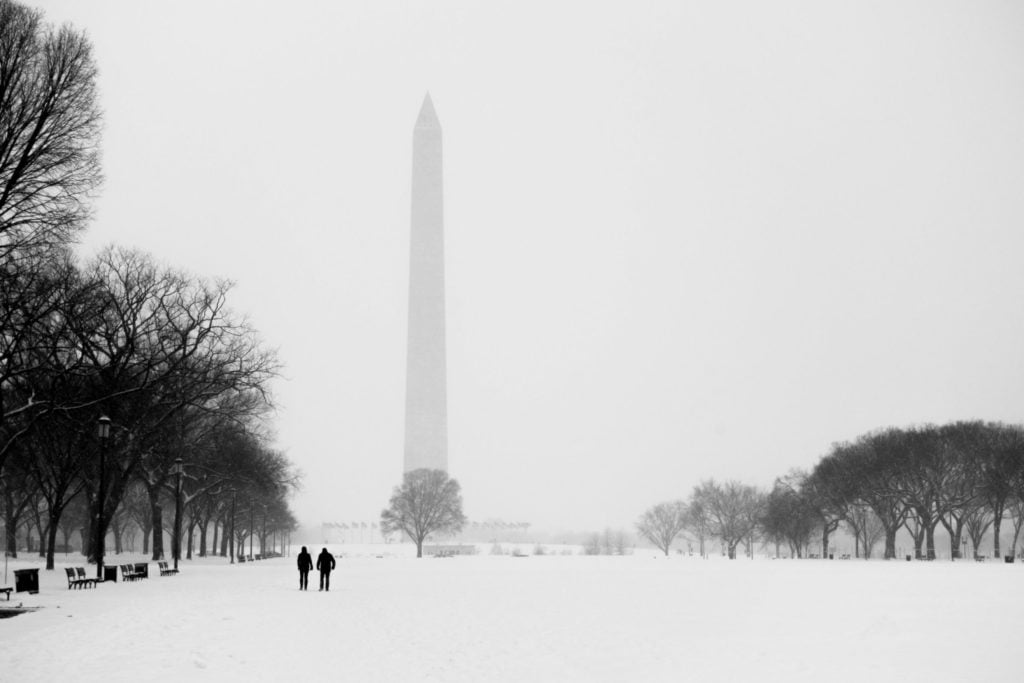
This winter has been tough sledding for sledders: DC has yet to encounter a single snowflake. If we make it until tomorrow without snow—which is a near certainty, assuming we can trust local meteorologists—the District will pass the previous mark for the fifth-latest snowfall on record. The overall record for latest snowfall is still a […]

The post Where Is the Snow? DC Could Break Its No-Flakes Record. first appeared on Washingtonian.

27 Jan 12:43

Arlington to kick off variable-price parking pi...

27 Jan 12:42

Why Teslas keep catching on fire

by Rebecca Heilweil
Glenn Harvey for Vox

EVs catch fire far less often than gas-powered cars, but firefighters still need to adapt.

When Thayer Smith, a firefighter in Austin, Texas, received the call that a Tesla was on fire, he knew that he’d need to bring backup.

It was in the early morning hours of August 12, 2021, and a driver had slammed a Model X into a traffic light on a quiet residential street in Austin before crashing into a gas pump at a nearby Shell station. The driver, a teenager who was later arrested for driving while intoxicated, managed to escape the car, but the Tesla burst into flames. As emergency responders battled the fire in the dark of night, bursts of sparks shot out of the totaled car, sending plumes of smoke up into the sky. It took tens of thousands of gallons of water, multiple fire engines, and more than 45 minutes to finally extinguish the blaze.

“People have probably seen vehicles burning on the side of the road at one point or another,” Smith, the division chief at the Austin Fire Department, recalled. “Just imagine that magnified a couple times because of all the fuel load from the battery pack itself. The fact that it won’t go out immediately just makes it a little more spectacular to watch.”

Like other Tesla fires, the fiery scene in Austin can be tied to the Model X’s high-voltage battery. In Austin, the electric vehicle ignited after a slide across the base of a traffic pole that the driver had knocked down caused the battery on the bottom of the car to rupture. At that point, the impact likely damaged one or several of the tiny cells that power the car’s battery, triggering a chain of chemical reactions that continued to light new flames. Though firefighters were able to put out the fire at the gas station, what remained of the car — little more than a burnt metal frame — reignited at a junkyard just a few hours later.

The Austin crash led to a lot of headlines, but EV fires are relatively rare. Smith said his department has seen just a handful of EV fires. While the US government doesn’t track the number of EV fires, specifically, Tesla’s reported numbers are far lower than the rate for highway fires overall, the National Fire Protection Association (NFPA) told Vox. The overwhelming majority of car fires are caused by traditional internal combustion vehicles. (This makes sense, in part because these vehicles carry highly flammable liquids like gasoline in their tanks, and, as their name implies, their engines work by igniting that fuel.)

Still, people have started associating EVs with dramatic fires for a few reasons. Videos of EV fires like the one in Austin tend to go viral, often attracting comments that condemn President Joe Biden and the electrification movement. At the same time, misleading posts about EVs spontaneously exploding, or starting fires that can’t be put out with water, have helped promote the narrative that electric vehicles are far less safe than conventional cars. The research doesn’t bear this out. Two recent Highway Loss Data Institute reports found that EVs posed no additional risk for non-crash fires, and the NFPA told Vox that from a fire safety perspective, EVs are no more dangerous than internal combustion cars.

This narrative has another nefarious side effect: It stands to distract from a more complicated EV fire problem. Although they’re relatively rare, electric car fires present a new technical and safety challenge for fire departments. These fires burn at much higher temperatures and require a lot more water to fight than conventional car fires. There also isn’t an established consensus on the best firefighting strategies for EVs, experts told Vox. Instead, there’s a hodgepodge of guidance shared among fire departments, associations that advise firefighters, and automakers. As many as half of the 1.2 million firefighters in the US might not be currently trained to combat EV fires, according to the NFPA.

“The Fire Service has had 100 years to train and to understand how to deal with internal combustion engine fires,” remarked Andrew Klock of the NFPA, which offers EV classes for firefighters. “With electric vehicles, they don’t have as much training and knowledge. They really need to be trained.”

The stakes are incredibly high. If the White House has its way, electric vehicles will go mainstream over the coming decade. An executive order signed by President Biden calls for 50 percent of new car sales to be electric by 2030, and the administration is pouring billions into building EV infrastructure and battery factories across the country on the assumption that people will buy these cars. EV fires — and misinformation about them — could stand in the way of that goal.

How an EV fire starts

An electric vehicle battery pack is made up of thousands of smaller lithium-ion cells. A single cell might look like a pouch or cylinder, and is filled with the chemical components that enable the battery to store energy: an anode, a cathode, and a liquid electrolyte. The cells are assembled into a battery pack that’s encased in extremely strong material, like titanium, and that battery pack is normally bolted to the vehicle’s undercarriage. The idea is to make the battery almost impossible to access and, ideally, to protect it during even the nastiest of collisions.

Things don’t always go as planned. When an EV battery is defective or damaged — or just internally fails — one or more lithium-ion cells can short-circuit, heating up the battery. At that point, the tiny membranes that separate the cathode and the anode melt, exposing the highly flammable liquid electrolyte. Once a fire ignites, heat can spread to even more cells, triggering a phenomenon called thermal runaway, firefighters told Vox. When this happens, flames continue igniting throughout the battery, fueling a fire that can last for hours.

The first moments of an EV fire might appear relatively calm, with only smoke emanating from underneath the vehicle. But as thermal runaway takes hold, bright orange flames can quickly engulf an entire car. And because EV batteries are packed with an incredible amount of stored energy, one of these fires can get as hot as nearly 5,000 degrees Fahrenheit. Even when the fire appears to be over, latent heat may still be spreading within the cells of the battery, creating the risk that the vehicle could ignite several days later. One firefighter compared the challenge to a trick birthday candle that reignites after blowing it out.

Because EV fires are different, EV firefighting presents new problems. Firefighters often try to suppress car fires by, essentially, suffocating them. They might use foam extinguishers filled with substances like carbon dioxide that can draw away oxygen, or use a fire blanket that’s designed to smother flames. But because EV fires aren’t fueled by oxygen from the air, this approach doesn’t work. Instead, firefighters have to use lots and lots of water to cool down the battery. This is particularly complex when EV fires occur far from a hydrant, or if a local fire department only has a limited number of engines. Saltwater, which is extremely efficient at conducting electricity, can make the situation even worse.

Michael O’Brian, a firefighter in Michigan who serves on the stored-energy committee for the International Association of Fire Chiefs, suggested that sometimes the best strategy is to simply monitor the fire and let it burn. As with all car fires, he says his priority isn’t to salvage the vehicle.

“Our fire service in general across the United States [and] in North America is understaffed and overtaxed,” O’Brian explained. “If you’re going to commit a unit to a vehicle fire for two hours, that’s complicating.”

Some EV batteries can make this problem worse. In 2021, the National Highway Traffic Safety Administration and General Motors announced an expanded recall of all the Chevy Bolts the car company had manufactured because tiny components inside some of the Bolt batteries’ cells were folded or torn. Chrysler issued a recall in 2022 after an internal investigation found that the vehicles had been involved in a dozen fires. Chrysler has yet to reveal the root cause of its battery issue and told Vox it’s still investigating. The company’s temporary solution was a software update that monitors when the car’s internal sensors determine that the battery might be at risk of igniting.

Tesla’s vehicles have their own set of problems. Tesla cars have retractable exterior door handles that only extend electronically, and only when the car has power. An emergency response guide for the 2016 Model S says that if exterior door handles aren’t working, there’s a button on the inside of the vehicle that drivers can use to open the car manually. Yet some allege that this feature makes it more difficult for emergency responders dealing with a Tesla fire. A lawsuit filed by the family of Omar Awan, a Florida doctor who died in 2019 after his Model S crashed and burst into flames, said that a police officer who arrived on the scene couldn’t open the doors from the outside.

Similarly, in a YouTube video that captured a recent Tesla battery fire in Vancouver, an owner recounts having to smash open the car’s windows because the electronics stopped working and the doors wouldn’t open. “I could feel it in my lungs, man,” he says on the recording. Tesla has also faced several other lawsuits alleging that its battery systems are dangerous. The company, which does not have a PR department, did not respond to a request for comment.

Experts Vox spoke to, including firefighters as well as fire safety officials, say that while Teslas are the most common electric cars on the road right now, EV firefighting goes far beyond any one carmaker. Perhaps the biggest challenge of all is that as EVs go mainstream, EV fires aren’t being studied as much as experts and government officials say they should be. “The unfortunate part is that we’re not really moving this as quickly as we should and updating it,” Lorie Moore-Merrell, the US fire administrator at the Federal Emergency Management Agency (FEMA), told Vox.

The national fire incident tracking system currently used by FEMA was invented in 1976 and was last updated in 2002, so it doesn’t specifically track electric vehicle fires. While the agency does plan to update the system with a new cloud platform, FEMA said it will only start building the technology later this spring, and then it will transition from the legacy system sometime in the late fall.

Firefighting in the electric era

Amid a barrage of news reports about the Model X fire in Austin last year, Tesla reached out to the city’s fire department. Michael McConnell, an emergency response technical lead at Tesla, first spoke with Smith, the division chief, on the phone and later sent him an email, which Vox obtained through a public records request, with advice on how the fire department might approach the same situation in the future.

“First of all, let’s debunk the myth of getting electrocuted. Lots of things have to go wrong in order for that to happen,” Smith said. “If the battery pack has not been compromised, then just leave it alone.”

In the long, wide-ranging message, McConnell also explained what assistance Tesla could and could not provide. He offered online training sessions but could not arrange in-person training because, McConnell explained, he had “just too many requests.” A diagram for the Model X implied there was magnesium in a part of the car that did not, in fact, contain magnesium. There was no extrication video guide for the company’s Model Y car (extrication is the firefighter term for removing someone from a totaled vehicle). It would be difficult to get a training vehicle for the Austin firefighters to practice with, McConnell added, since Tesla is a “build to order manufacturer.” Most of Tesla’s scrap vehicles are recycled at the company’s Fremont plant, he said, though a car could become available if one of Tesla’s engineering or fleet vehicles crashed.

McConnell’s long email reflects the current approach to fighting EV fires and the fact that fire departments across the country are still learning best practices. Even now, there isn’t consensus on the best approach. Some firefighters have considered using cranes to lift flaming EVs into giant tanks of water, although some automakers discourage submerging entire vehicles. Rosenbauer, a major fire engine and firefighting equipment manufacturer, has designed a new nozzle that pierces through the battery casing and squirts water directly onto the damaged cells, despite some official automaker guides that say firefighters shouldn’t try rupturing the battery. Another factor that needs to be considered, added Alfie Green, the chief of training at the Detroit Fire Department, is that there are new car models released every year, and there is particular guidance on how to disconnect different cars.

While some standards have been released, others are still being developed, and fire departments are still catching up with National Transportation Safety Board recommendations. There’s also the matter of just getting the vast number of firefighters up to speed on EVs. O’Brian, the fire chief from Michigan, told Vox that the federal government needs to take a much more active role in funding research and helping buy EVs that fire departments can practice on.

Another complication is that EV fires present different risks in different places. The New York City Fire Department (FDNY) hasn’t had to fight any electric car fires yet, but it is facing e-scooter and e-bike fires, which are on track to double compared to last year and disproportionately endanger delivery workers in the city. Batteries that lack safety certifications or are charged improperly are more likely to ignite, explains John Esposito, the FDNY’s chief of operations. In November, 43 people were injured in a Manhattan building fire that the department ultimately linked to a battery-powered micromobility device — possibly a scooter — that had been kept inside an apartment.

Small towns face unique hurdles. In Irmo, South Carolina, which is home to fewer than 12,000 people, there’s concern about getting the right equipment to deal with EV fires. While there haven’t been any high-voltage battery fires yet, Sloane Valentino, the assistant chief of Irmo’s fire department, told Vox he’s not sure whether the town has enough engines to fight a Tesla fire while also responding to other fires in the area.

“We don’t have the capacity to deal with 30,000 gallons worth of toxic runoff. Some of it’s going to turn to steam,” Valentino told Vox. “We’re kind of back to, ‘Let it burn.’ When you see the big, violent flames shooting out of the car, just kind of protect what you can — try to cool the roadway — but let the car burn.”

Engineering a safer future

While internal combustion vehicles have been around for over a century, EVs are still relatively new, which means they could become even safer as more money and research pour into the technology. Remember the melting separator in the battery that creates thermal runaway? General Motors is studying how its battery separator could contribute to improved battery safety. The Department of Energy is working on technology that could incorporate flame retardants directly into the batteries’ design. Engineers are also investigating new battery chemistries, like less-flammable electrolytes. Though research is still early, solid-state batteries, which would replace a liquid electrolyte with a solid that’s far less likely to ignite, also show promise.

“Batteries are hopefully going to be getting better over time,” said Michael Brooks, from the Center for Auto Safety. New regulation could push battery safety even further, he added.

In the meantime, fire departments are working on adjusting to this new category of fire — just another reminder that the rise of electric vehicles involves far more than simply replacing gas tanks with batteries. And firefighters will be the ones driving some of these new EVs. In May, the Los Angeles Fire Department debuted the first electric fire truck to hit the road in the US. The bright red engine is made by Rosenbauer, and it comes with a front touchscreen, a remote control tablet, two onboard batteries, and a backup diesel range extender. Other departments are now waiting for their own EV fire trucks to arrive.

Meanwhile, back at the Austin Fire Department, Smith says he has encountered at least one EV fire since the Model X accident a year and a half ago. That one didn’t involve the battery, so it was like fighting any other car fire. But in the months following the 2021 crash, the fire department did go ahead and jury-rig a new firefighting nozzle to deal specifically with EV fires. The department hasn’t heard anything more from Tesla.

Rebecca Heilweil is a reporter at Vox covering emerging technology, artificial intelligence, and the supply chain.

26 Jan 20:18

Manchin writes bill to stop temporary electric vehicle tax credits

by Jonathan M. Gitlin
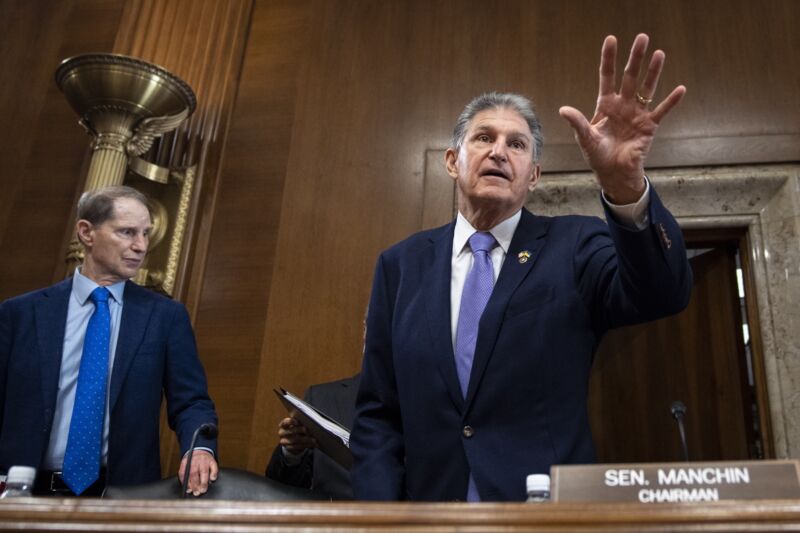
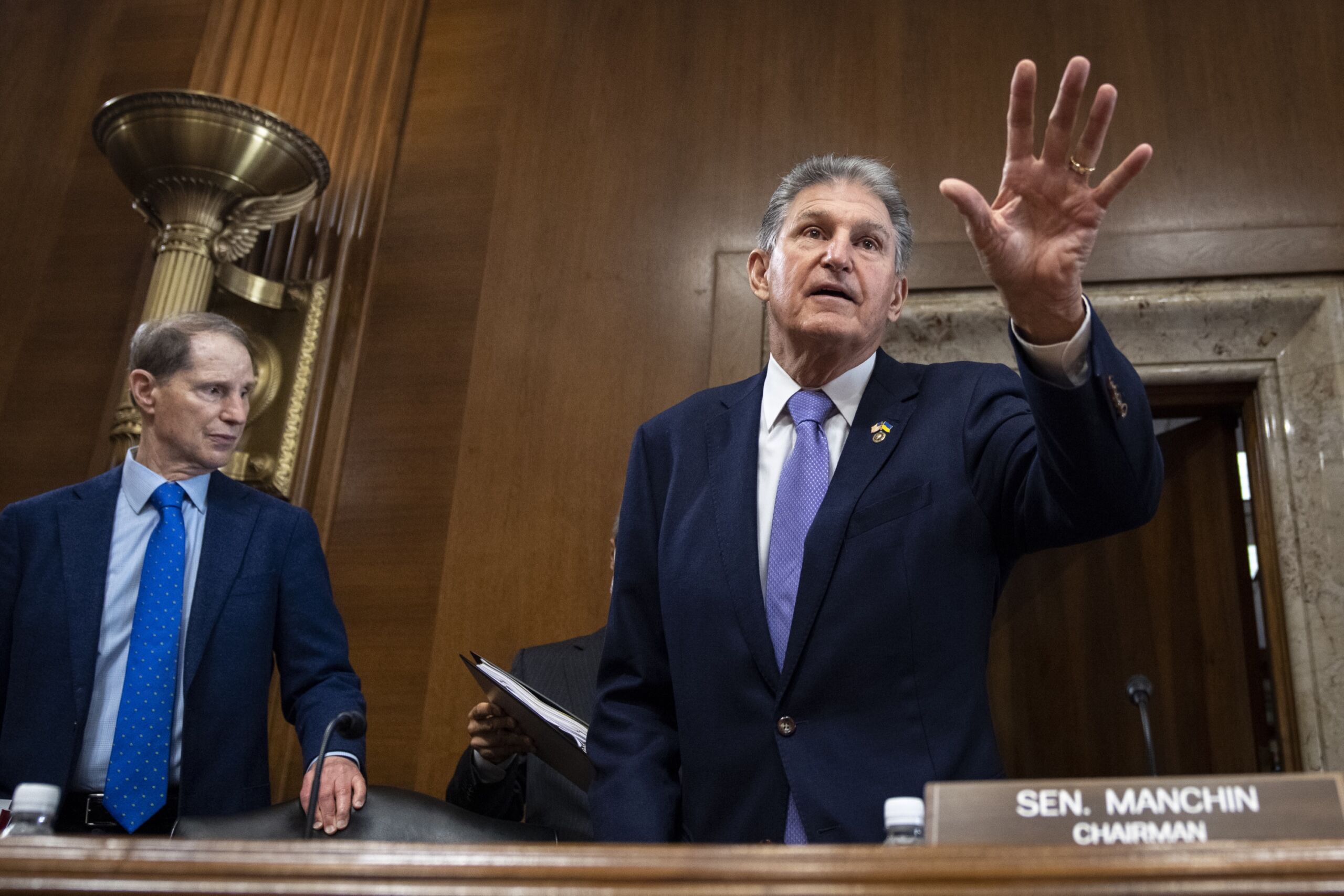
"The IRA and the EV tax credits must be implemented according to the Congressional intent to ensure the United States, as the superpower of the world, is not beholden to countries that don’t share our values," Senator Joe Manchin said in a statement sent to Ars.

Enlarge / "The IRA and the EV tax credits must be implemented according to the Congressional intent to ensure the United States, as the superpower of the world, is not beholden to countries that don’t share our values," Senator Joe Manchin said in a statement sent to Ars. (credit: Drew Angerer/Getty Images)

Senator Joe Manchin (D-W.Va.) is unimpressed with the temporary leniency shown toward electric vehicles in terms of the federal tax credit, and he's determined to do something about it. On Wednesday, the senator introduced a new bill, "the American Vehicle Security Act of 2023." The bill would immediately implement the much stricter new tax credit rules contained in last year's Inflation Reduction Act even though the Department of the Treasury hasn't finished working out how to do that. Should Manchin's bill pass, it looks unlikely that any EV would qualify.

"It is unacceptable that the US Treasury has failed to issue updated guidance for the 30D electric vehicle tax credits and continues to make the full $7,500 credits available without meeting all of the clear requirements included in the Inflation Reduction Act," Manchin said in a statement sent to Ars.

That's not all. According to some outlets, the senator wants anyone who might have been issued an EV tax credit in 2023 to have to repay it, unless they could prove the car satisfied the domestic sourcing requirements. And that could be costly news for anyone who rushed out to buy a new Tesla after that company slashed prices to allow more of its EVs to qualify for the new tax credit rules.

Read 6 remaining paragraphs | Comments

26 Jan 20:14

The State Department Just Announced a New Private Sponsorship Program for Refugees

by Keely Bastow

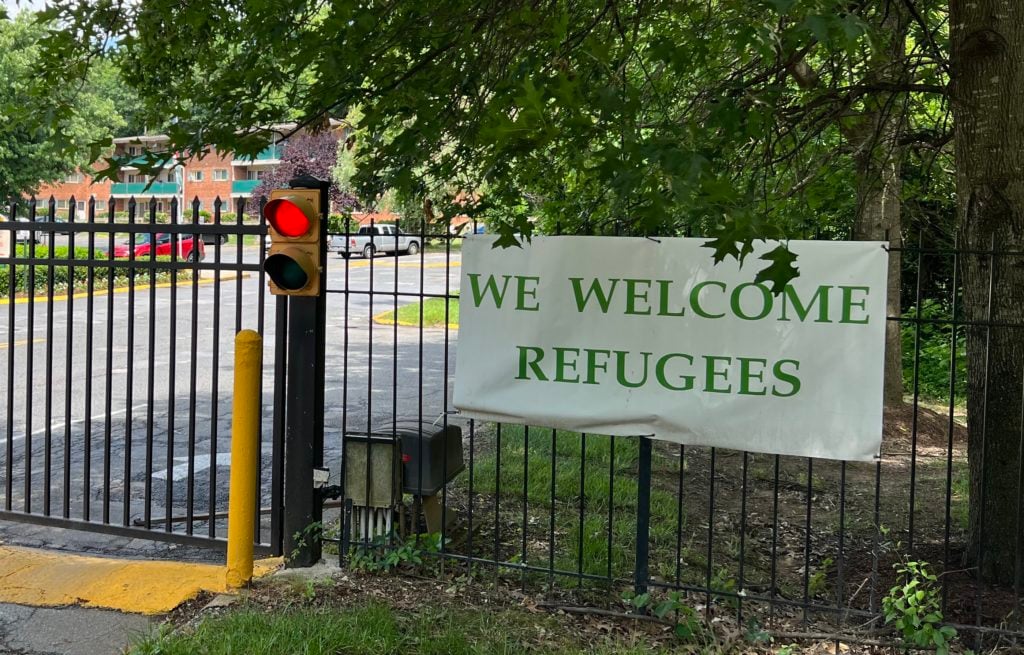
The State Department announced a collaboration with a private group last Thursday that will allow groups of Americans to sponsor refugees from any country. Welcome Corps hopes to recruit 10,000 sponsors and help 5,000 refugees in its first year.  The program opens up the available pool of resources to help a growing number of refugees. […]

The post The State Department Just Announced a New Private Sponsorship Program for Refugees first appeared on Washingtonian.

26 Jan 20:14

The DOJ sues Google for ad dominance, wants to break company up

by Ron Amadeo
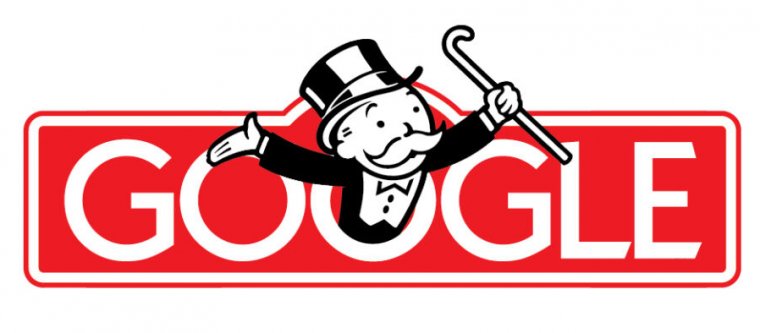
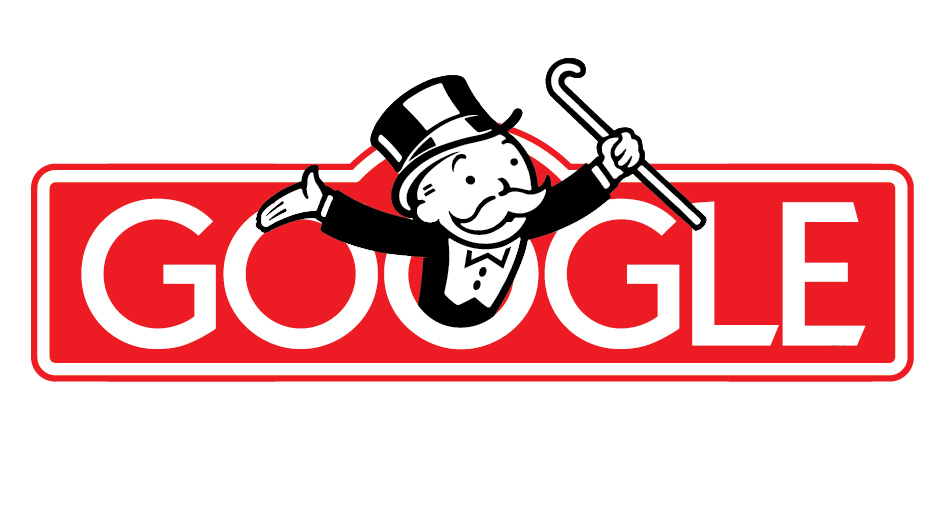
The logo for the board game Monopoly, complete with Uncle Pennybags, has been transformed to say Google.

Enlarge / Let's see, you landed on my "Google Ads" space, and with three houses... that will be $1,400. (credit: Ron Amadeo / Hasbro)

It has been expected for some time, but today the Justice Department and eight states are suing Google over its purported domination of the online advertising market. The government has a problem with Google's position in "ad tech," or the tools used to automatically match advertisers with website publishers. To solve it, apparently, the DOJ has told Google it's considering breaking the company up.

“Today’s complaint alleges that Google has used anticompetitive, exclusionary, and unlawful conduct to eliminate or severely diminish any threat to its dominance over digital advertising technologies,” said Attorney General Merrick Garland. “No matter the industry and no matter the company, the Justice Department will vigorously enforce our antitrust laws to protect consumers, safeguard competition, and ensure economic fairness and opportunity for all.”

The press release gives a quick rundown of the DOJ's list of Google’s anticompetitive conduct:

Read 6 remaining paragraphs | Comments

26 Jan 20:12

Maryland Might Experiment With a Four-Day Workweek. Would It Work?

by Katie Kenny

Maryland lawmakers recently introduced a bill that—if passed—would establish a pilot program and income tax credit encouraging public and private employers to experiment with a four-day workweek.  Slated to begin in July and run though 2028, the program would work like this: employers would be required to transition at least 30 employees to a four-day workweek without […]

The post Maryland Might Experiment With a Four-Day Workweek. Would It Work? first appeared on Washingtonian.

25 Jan 03:26

The World’s First Robot Lawyer Isn’t A Lawyer, And I’m Not Sure It’s Even A Robot

by Mike Masnick

Note: This post is an adaptation of what started initially as a Twitter thread.

I’ve been going pretty hard on DoNotPay and its founder/CEO Joshua Browder for the past couple of days, and I’ve had a lot of people defending the service, saying that it could be a real boon to those who can’t otherwise afford legal aid.

So, I thought maybe I should give it a fair shake — after all, I’m mostly arguing with what my idea of a “legal AI” is, right? So I signed up for an account at DoNotPay and took the service for a little whirl. There’s no option to test out the real-time AI, or at least not one that I could find. But the site does offer a dazzling array of services under the category “legal tools.” I used the site to undertake three different tasks: Defamation Demand Letter, Divorce Settlement Agreement, and Sue Anyone in Small Claims Court.

Those of you who know me will be unsurprised to learn that I started with “Defamation Demand Letter.” I was a little taken aback by the description “File a demand letter” — you don’t file a demand letter, you just send it — but decided to press on.

The site leads you through a fairly basic set of question and answer prompts, asking you to identify the potential defendant and the defamatory statements, state the basis for their falsity, explain how they damaged you, etc.

After I filled in the prompts, which required my full name, address, and phone number, I pressed “next,” eager to see the “expertly drafted demand letter” DoNotPay generated on my behalf with the “most relevant state legislation regarding defamation” based on my location.

Instead, I got a little progress bar, informing me that my defamation demand letter would be ready in an hour.

That . . . seems a little slow for something that is supposed to be able to respond to a judge and give instructions in real time. But whatever, let’s press on.

I went back to the front page of the site to select “Divorce Settlement Agreement,” observing in passing that DoNotPay describes itself in full color as “the home of the world’s first robot lawyer” and promises the ability to “sue anyone at the press of a button.”

Once again, I stepped through my various prompts, giving information like my address, my putative soon-to-be-ex’s address, our comparative incomes, the number of hypothetical children we had, etc. so that I could get “the fair terms [I] deserve.”

This time, after I was done, I got a little “task progress” bar that said that my divorce settlement would be ready in EIGHT hours. Y’all, eight hours seems like a really, really long time for an AI to need to generate a document. But, whatever, we’re giving it a fair shake.

Time to Sue Anyone in Small Claims Court! I typed “Sue Now” into the search bar and was greeted with the following prompt:

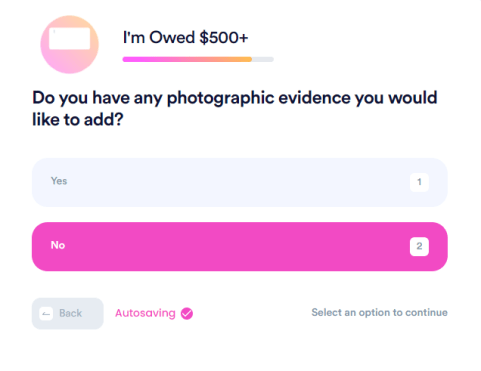
This gave me significant pause. First of all, it says “I’m owed $500” at the top, but I haven’t entered any specific information yet. Second, “generating court filings” and giving people “a script to read in court” is… I mean, that’s the practice of law. It just is. Third, though, just from a UX perspective, the prompt ends with a yes or no question (“Are you ready to proceed?”) but has a text box which will only accept a dollar amount. What am I supposed to enter here?

So I entered a dollar amount and pressed “Enter.”

The next page presented what I thought was an odd question. Why would I have received a demand letter? I’m the one suing, right?

(Later, from context clues, I managed to figure out that what they meant was if I had already generated a demand letter with DoNotPay. I guess you can only use this service to create filing documents if you have already used it for a demand letter. But I digress.)

Another UX note — I originally found this prompt from an article entitled “Sue Anyone for Assault in Small Claims Court,” but “Assault” isn’t one of the options listed here. So I figure, go with what you know.

Ooooookay. I… this is not how I would ever phrase this question. But I’m not a lawyer at all, never mind the World’s First Robot Lawyer. Let’s press on.

Fortunately, these are the only types of contracts where you could ever have a breach and be owed money damages, right? Right?

At this point in the process, I seem to suddenly have been switched from drafting a lawsuit to drafting another demand letter. Not sure when that happened — the service certainly didn’t notify me about it.

But in for a penny, in for a pound. As requested, I selected all the appropriate dates for my hypothetical breach of contract: contract formation on 9/6/2019, due date on 12/6/2019, most recent request for payment on 11/11/2022, final due date of 1/31/2023. As requested, I gave details of what services I had theoretically performed.

. . . and got this extremely puzzling prompt in reply. Photographic evidence? What? At no point did the service ask me to provide any documentary evidence or give any terms of the contract other than the date the payment was due.

And HEY PRESTO! This time, no timer, no progress bar, just an instant PDF or Word demand letter to download!

The PDF document had all my personal information in it and was somehow in a format that could not be redacted. I’ve never seen this behavior before — it persisted through all my tricks like saving it as an archivable PDF and everything.

The author of the PDF was listed as some guy named Platon Konstantinos Mazarakis.

Out of curiosity, I did the zip trick on the Word file so that I could look at the properties without opening it. Interestingly, it has some custom XML in it; I’m not much of an XML expert, so I asked software engineer Debbie Mia to take a look at it. The docprops/core.xml file has Mazarakis as the document author once again but also shows that this Word document, generated by the World’s First Robot Lawyer, was last edited by “Denise.”

In order to get the PDF into a redactable format, I had to export it to TIFF and then reconvert it. There’s a big loss in quality, unfortunately. But let’s take a look at this demand letter, generated for me when I asked to sue someone in small claims court!

There is literally nothing AI about this. This is a straight-up plug-and-chug document wizard, and it is not well done at all.

I will admit, I threw it a couple of curve balls, like placing my defendant in Canada. But it didn’t attempt to do any kind of jurisdictional analysis at all — I could have put him on the moon and it wouldn’t have mattered. There is no date on the first page of the letter.

There was no widow or orphan control. After my “signature” there’s a space for “Additional Remarks,” which it never prompted me for. There’s also a random orphaned date in the second page header.

Did the contract say I would be paid for OFFERING the following services, or for PERFORMING them?

In addition to there being zero jurisdictional analysis, there’s also zero thought to engage with the fact that depending on the choice of law in the contract (which the prompt also didn’t ask me about) this action may well already be time-barred.

Or with the fact that Small Claims Courts have an upper limit on the amount you can claim, and I’m pretty sure $17K exceeds it. And, yes, that fucking orphaned “Sincerely,” is still killing me.

Also also? The prompt never asked whether I was amenable to a payment plan. Just went ahead and hucked that in there on its own. (Also never asked me about the interest rate, I have no idea where it got that.)

Let me be clear: this is a terrible demand letter. Absolutely terrible. Useless or worse than useless — if an actual attorney saw this, she would instantly know that the sender was unsophisticated, unrepresented, and gullible as fuck.

For this service, DoNotPay charged me $36 ($18/month and it charges you for two months at a time). But hey, there’s an unlimited number of documents we can generate, right? Let’s go see how the others are doing!

Turns out… not so great, Bob. The minute the defamation letter hit its one-hour limit, it flipped over to a little clock icon and said it would need more time. Same for the divorce settlement’s eight-hour limit. That was two days ago.

No updates since then. No contact from the company, no way to generate a support ticket, no hint as to what the trouble is. Just a cheerful, brightly colored promise that it’s doing its best.

I have literally no way to know what the fuck is actually going on here, but I can think of two likely options. The first is that the whole tool is just fucking broken, and Joshua Browder is scamming people out of almost $20 a month for a service that simply does not work. The second, though — and I find this much more likely based on the one-hour and eight-hour timelines given — is that this isn’t AI at all; DoNotPay collects the information from the prompt and then hands it to a human to go find the relevant law and customize the doc.

That would explain why the defamation demand letter gave me a one-hour deadline while the breach of contract letter happened instantly. Remember, the defamation demand SPECIFICALLY promises the “most relevant state legislation” “based on your location.”

It doesn’t take an AI an hour to look up the relevant law based on a physical address. Westlaw can do it… well, I was going to say instantly, but anyone who has used Westlaw knows that’s a lie. But Westlaw can do it in thirty seconds. If there are human beings doing the Googling and making the decision as to what the “most relevant state legislation” is for a defamation action (and, let me tell you, there’s a sign of a pretty glaring error just in that phrase on its own) then any argument that this isn’t unauthorized practice of law (UPL) goes straight out the fucking window.

But hey, maybe those aren’t the only two options! Maybe Browder recognized my usage of the site — after all, I did sign up for it with my real name, which I also tweet under — and panic-blocked me because he was salty that I think his idea is dumb. Or maybe there’s some other perfectly innocent reason why this brand-new revolutionary technology that is getting its debut in a live courtroom setting in less than a month has been wedged for almost 48 hours with no updates or signs of life.

Regardless, though, I don’t think any of the lawyers I know have any cause to fear for their jobs any time soon.

P.S. Browder, who had blocked me a few days ago, unblocked and followed me today!

But apparently only for long enough to promise to listen to feedback, and then to block me again. So, you know, good talk etc.

Awww, and the robot blocked me too!

Update: Josh Browder unblocked me and messaged me again, explaining that my account was automatically flagged because my usage “didn’t seem like authentic activity” and informing me that he had refunded my subscription. I asked him if I could see the two other documents I had already generated or unlock my account so that I could generate similar documents; he said he would try to make them available by tomorrow afternoon (January 25th), explaining that “[t]he engineer who understands the blocking code is out until 12 or so.”

Josh also stressed that “the letters aren’t being typed out by hand and in general are all generated instantly 😂.” Although I did not claim, nor did I intend to suggest, that the documents on DoNotPay.com were typed by hand, I have included his statement here in the spirit of good faith and full disclosure.

24 Jan 20:29

Mass shootings calendar

by Nathan Yau

A shooting in Monterey Park, California on Lunar New Year’s eve left 11 people dead. It was the 33rd mass shooting in the United States — for the month. For The Washington Post, Júlia Ledur and Kate Rabinowitz show the regularity of such events over the past year.

Tags: Monterey Park, shootings, Washington Post

24 Jan 18:27

Amazon’s Dying Smile Donation Program… Was Really All About Amazon Keeping Referral Fees To Google Down

by Mike Masnick

You may have heard last week that Amazon has announced the end of its “AmazonSmile” program, in which you could shop at Amazon, and a portion of all of the money you paid would actually go to the charity of your choice. Amazon claimed that the program “has not grown to create the impact we had originally hoped” and (perhaps reasonably!) implied that the overhead of delivering small amounts to many different charities was not very efficient. The company noted that the “average” donation to charities was less than $230 per charity.

Of course, a simpler solution if that were really the problem would be to keep the program running, but limit the number of charities to which the money could be directed. That would likely annoy some of the smaller charities who had benefited, but still.

Some people, naturally, assumed that Amazon was doing this to claw back some of the money that it had previously been sending to the various non-profits. But, it appears the actual story here may be even more crazy.

Soon after the news broke, there was a fascinating post on Reddit from someone claiming they used to work at Amazon corporate and was around when the Smile program was launched, and claimed that the program was never designed to be as generous as it was presented. It was really just designed to fuck over Google and have to pay that company less in referral fees.

Here’s the most messed up part. I used to work at Amazon corporate, let me tell you how the entire program Amazon Smile got created.

So basically, when a customer wants to buy a product, they usually go straight to Amazon.com and enter what they’re looking for. But there’s also a large segment of customers who begin their search on google, and ends up at Amazon. Well guess what. When that type of search to purchase experience happens, Amazon has to pay google. Internally, Amazon thought that if they could force users to go straight to Amazon, offer a small but obviously less amount of money to charity from each customer than would have been paid to google, it would help kill customers going to google, save Amazon more money than paying google, and be good overall for the brand value of Amazon.

That’s why for the program to work, the user has to start shopping at smile.amazon.com. Until recently, the option to use amazon smile wasn’t even available in the app, and even then the user still had to ‘renew’ being a part of Smile multiple times a year. There is no way for a customer to go through the traditional shopping experience, and then during checkout decide they want to give a portion of their purchase to charity, because giving to charity isn’t the point of the overall program. Amazon Smile was developed by the Traffic Optimization team, whose entire purpose is increasing efficiency and lowering costs of getting customers to Amazon. A team of Amazon employees whose sole purpose is doing good in the world doesn’t exist, despite employees repeatedly asking for such a team to be built in pretty much every single all-hands meeting.

Literally everything the company does is about profits, and extended customer lifetime value. Everything. Even the charity programs are just designed to save Amazon money.

Incredible.

While there’s no way to prove that this person really did work there, it does sound accurate, and another commenter backed this up, with credible additional info:

I also used to work at Amazon, and was a founding member of the AmazonSmile program, part of the Charity Support team working with the nonprofits to help them actually receive the funds. This was 2013. Left in 2016 after fully fleshing out the program, developed the metrics reporting system for tracking charity issues, and even a blurb document to respond to the most common questions nonprofits had.

You are completely correct. The intent of the program was to be cost neutral – the amount Amazon donated to charities was about equal to the costs it saved by not having to pay Google for advertising clicks. Tax writeoff was a negligible side benefit, goodwill was just marketing fodder.

Later on that same commenter notes that another “side benefit” to doing this was to push back on some local news stories that had slammed Bezos for not being involved in enough charitable works. So this kinda killed multiple birds with a single “look at how good we’re being” stone.

From all that, I’m wondering if Amazon is now realizing that the overhead of handling this program just wasn’t worth it any more, and the fact that they made it so difficult to use didn’t really stop that many people from Google, so if they have to just write a slightly larger check to Google that’s easier than having a team figuring out how to send hundred dollar checks to charities.

24 Jan 18:27

George Washington University Rejects “Hippos” Nickname

by Andrew Beaujon

George Washington University will not embrace the nickname “Hippos,” the GW Hatchet reported last week. The moniker, which some favored to replace the school’s now-discarded “Colonials” nickname, does not align with the “guiding principles” the university has instituted to select a new nickname. Also, the university says, the Hippos name “received negative feedback during engagement […]

The post George Washington University Rejects “Hippos” Nickname first appeared on Washingtonian.

21 Jan 17:42

D&D maker still wants to revoke earlier versions of “open” gaming license

by Kyle Orland
Artist's conception of <em>D&D</em>-maker Wizards of the Coast trying to destroy its original Open Gaming License with fire.

Enlarge / Artist's conception of D&D-maker Wizards of the Coast trying to destroy its original Open Gaming License with fire. (credit: Lego / WotC)

Dungeons and Dragons (D&D)-maker Wizards of the Coast's (WotC) latest attempt to update its decades-old Open Gaming License (OGL) still includes the controversial statement that "the Open Game License 1.0a is no longer an authorized license." The news comes after the company's first attempt to draft an OGL update with similar language (and other controversial changes) was met with widespread fan outrage and alienation from the creator community.

WotC says this proposed "deauthorization" of OGL v1.0a won't affect any original content that was published under that earlier license since its debut in the early '00s and that such content won't need to be updated or relicensed to comply with any new OGL language. But any content published after the proposed OGL v1.2 goes into effect would not be able to simply choose the earlier license instead, according to the update as drafted.

In an explanatory post on the D&D Beyond blog, WotC Executive Producer Kyle Brink said that WotC realizes this planned deauthorization is a "big concern" for the community. But he added that it's a necessary move to enforce the new OGL's restrictions on illegal and/or hateful content, including "conduct that is harmful, discriminatory, illegal, obscene, or harassing," as determined by WotC.

Read 7 remaining paragraphs | Comments

21 Jan 17:38

Starlink Is ‘Forced’ To Finally Start Caring About The System’s Light Pollution And Harm To Scientific Research

by Karl Bode

For years, scientific researchers have warned that Elon Musk’s Starlink low Earth orbit (LEO) satellite broadband constellations are harming scientific research. Simply put, the light pollution Musk claimed would never happen in the first place is making it far more difficult to study the night sky, a problem researchers say can be mitigated somewhat but never fully eliminated.

Musk and company long claimed they were working on upgraded satellites that are less obtrusive to scientists (using dielectric mirror film and solar array changes to minimized reflection), but it’s Musk, so those solutions haven’t materialized years after they were promised.

That said, Space X and Starlink SpaceX has entered into a coordination agreement with the US National Science Foundation (NSF) to try and mitigate some of the worst effects its Starlink satellite network is having on ground-based astronomy observations. The issue was forced by the Biden FCC, which wouldn’t give approval full Starlink’s 30,000 satellite launches until such a deal was struck:

According to reports, the FCC gave permission for the company to launch 7,500 of the nearly 30,000 satellites it hopes to send aloft, while deferring consideration of the rest of the constellation and making a coordination agreement with the NSF a condition of the licence.

Musk being Musk, and the FCC being, well, the FCC, there’s no guarantee that the talks ever amount to much, that SpaceX and Starlink adheres to any requirements that come from the deal, or that the FCC will hold anybody accountable should Space X and Starlink fail to address concerns. That’s in large part because the agreements are entirely voluntary:

The agreement is voluntary, since beyond the FCC requirement for such an agreement in the Gen2 Starlink license there is no law or policy requiring SpaceX or other satellite operators to mitigate the effects of their constellation on astronomy.

Again, it’s worth reiterating that Musk insisted that none of this would ever be a problem. And regulators, wary of being accused of harming innovation, didn’t even consider acting until it was already a widespread problem.

It’s also worth reiterating that while Starlink is a useful service for those with no other broadband options, the system’s capacity constraints mean it can never really function at the kind of scale needed to truly address even just the U.S.’ broadband gaps. The service, with a $710 first month charge for hardware and service, still falls well short on a main obstacle to broadband adoption: affordability.

In the interim, astronomers have been forced to adopt elaborate and costly countermeasures, such as a system that tracks all low-orbit positions allowing them to turn off observatory systems when needed. The problem: the solutions place the onus on researchers, and they don’t scale to handle the massive incoming parade of low-orbit systems coming from SpaceX, Amazon, and others.

A voluntary overlay asking SpaceX and Starlink to at least try to not demolish astronomy could prove somewhat performative if there are no hard requirements or penalties involved.

21 Jan 17:34

US school runs lights 24/7/365: The smart lights have been broken since 2021

by Ron Amadeo
The Minnechaug Regional High School.

Enlarge / The Minnechaug Regional High School. (credit: Minnechaug Regional High School)

The lights at Massachusetts' Minnechaug Regional High School burn ever bright. They actually never turn off. They can't turn off. The smart lighting system for the entire building is broken, and it's stuck in the "on" position. It has apparently been this way for over a year now, and the electric bills are really starting to pile up.

“We are very much aware this is costing taxpayers a significant amount of money,” the school district's assistant superintendent of finance, Aaron Osborne, told NBC News. “And we have been doing everything we can to get this problem solved.”

The school's entire "green lighting system," some 7,000 lights, was installed over a decade ago and was supposed to save money, but according to the report, "the software that runs it failed on Aug. 24, 2021" and no one has been able to turn off the lights for the following 17 months. Teachers are adjusting by unscrewing light bulbs at the end of the day and throwing some breakers not connected to vital parts of the school. Dimming the lights to show movies or something projected on a whiteboard has also been difficult: The lights are on full brightness all the time.

Read 4 remaining paragraphs | Comments

20 Jan 13:14

How scientists discovered the universe is really freaking huge

by Brian Resnick
The first image released from the Webb space telescope shows a section of the distant universe in detail. The very faintest, smallest blips of light in this photos are images of galaxies as they existed more than 13 billion years ago, near the very beginning of time (that light has been traveling through space ever since) | NASA, ESA, CSA, STScI, Webb ERO

Edwin Hubble’s name is everywhere in astronomy. Henrietta Leavitt’s should be too.

In the early 1900s, the universe seemed to be a much, much smaller place. Back then, astronomers believed the Milky Way galaxy was all there was. They didn’t know there were billions of other galaxies; they didn’t know how small we really are.

They didn’t know this because they couldn’t measure distances to far-flung stars. Why? There was a pretty simple problem in astronomy: A bright, faraway star looks almost the same as a dim star that’s close by.

It’s the same here on Earth. Imagine you’re on the beach at night and see two lighthouse lights glowing in the distance, but one seems brighter than the other. If you knew both lighthouses used the same lightbulb, you could conclude that the dimmer light is farther away. But it’s also possible that the dimmer light just comes from a lower-wattage lightbulb, perhaps nearer to you.

Scientists needed a way to find out the intrinsic brightness of stars — to figure out their wattage, so to speak. That’s when Henrietta Leavitt, a Massachusetts-born “computer” who worked at the Harvard College Observatory, came along. In 1908, she published a discovery that may sound small but is one of the most important in the history of astronomy. As we discuss on this week’s Unexplainable podcast (see the embed above), it cracked open the universe.

 Amanda Northrop/Vox

Blinking lights provide a yardstick to measure the universe

Before Henrietta Leavitt, many astronomers looked at the stars in what’s today known as the Andromeda galaxy — some 2.5 million light-years away — and mistakenly thought they were part of our own Milky Way galaxy (which is only around 100,000 light-years in diameter).

Those Andromeda stars were orders of magnitude further away. Scientists just didn’t know it.

At the time, astronomers had some methods to figure out distances to stars, but they only worked for stars relatively close to Earth. Leavitt’s discovery — linking the pulse of one type of star to their actual brightness, as described in the graphic above — was the key to measuring objects farther and farther out into space.

If astronomers wanted to measure faraway things, Leavitt’s discovery showed, they just had to look out for cepheids. Her formula led astronomers to chart out relative distances to stars: They could use it to compare two stars and figure out which one was closer.

It took some more work by other scientists to calibrate this yardstick, to put concrete numbers on it. But once they did, and started measuring with it, the cosmos grew and grew.

Leavitt paved the way for Edwin Hubble to discover galaxies beyond our own

Fifteen years after Henrietta Leavitt’s discovery, the preeminent astronomers Harlow Shapley and Heber Curtis were locked in a heated debate.

Curtis believed that Andromeda was a separate galaxy far, far away from the Milky Way. At the time, this was an outlandish idea. Shapley represented the more mainstream view — that Andromeda was just a hazy, cloudy region within our galaxy, which he had recently estimated to be around 300,000 light-years across. That was also the assumed size of the entire universe.

If Curtis was right, it would mean the universe was double or triple the size that Shapley estimated — at least.

To settle the debate, Edwin Hubble — the namesake of the famous space telescope — looked for Cepheid stars in Andromeda. Night after night, he took photographs of Andromeda, searching for cepheids. In October 1923, he found one, blinking in one of Andromeda’s spiral arms. Another week of observations allowed him to follow Leavitt’s formula and determine its distance.

Hubble estimated it to be around a million light-years from Earth — well outside the boundaries of Shapley’s universe. (Hubble was a little off: Andromeda is closer to 2.5 million light-years away.) After reading about Hubble’s finding, Shapley reportedly said: “Here is the letter that destroyed my universe.”

 NASA, ESA, and the Hubble Heritage Team
This is a picture of the cepheid star Hubble observed in Andromeda, called “variable number one” — or V1 — captured by Hubble’s namesake telescope in 2011. V1 has been called “the most important star in the history of cosmology.”

Scientists kept building on Leavitt’s ruler to measure the universe. And as they used these measuring tools, their understanding of the universe evolved. They realized it was far bigger than previously thought, there are billions of galaxies, and it’s expanding: Those galaxies are moving further and further away from one another.

Astronomers also realized that the universe had a beginning. If galaxies are moving away from one another now, it means they were closer together in the past — which led scientists to the idea of the Big Bang.

It also led them to realize that the universe may, eventually, end.

This week’s episode of Unexplainable, Vox’s podcast about unanswered questions in science, tells that story and more.

20 Jan 12:40

Developers Of Stadia Exclusive Hide Game Inside Other Steam Game To Preserve It

by Dark Helmet

This is one of those interesting times when multiple topics we regularly cover here at Techdirt converge. Readers here will recall all the posts we did on the rollout and eventual demise of Google’s Stadia product. Stadia was primarily to be a game streaming service for existing games. That being said, the service also signed up some exclusive games for release. With Stadia’s eventual demise, one of the open questions was how that art and culture in the form of the game would be preserved, another regular topic of conversation here.

Well, in the case of one game, the developer came up with an interesting solution: hiding the Stadia exclusive game inside the Steam version of its own sequel!

Back in 2020 Necrosoft (finally) released Gunsport, a sci-fi take on 2D volleyball, as a Stadia exclusive. It was pretty cool! It was also, as a Stadia exclusive, a game that most of us never got to enjoy. In June 2022 it was followed by a sequel, Hyper Gunsport, which was much more widely available, since it came out on PC, Switch, Xbox and PlayStation.

While two completely separate games, they’ve now been brought a lot closer, with Necrosoft saying in a tweet earlier today “Since we care about game preservation we’ve made an offline version of Gunsport available in the Steam version of Hyper Gunsport, through the beta channel.”

It’s a pretty cool idea! And also notable is that the developer is essentially giving the game away for free as a value add to buyers of the sequel. Add to that the announcement came with a particular nod towards video game preservation as culture preservation.

Why is that important? For far too long, the video game industry has not done a great job advocating for itself in terms of representing its own output as an artform, akin to music, movies, or literature. There is no world in which we would accept that literature be lost simply because the library decided to close its doors. Yet, this happens in many respects in the video game industry all the time. Servers get shut down, the game goes away. DRM servers get shut down, the game is no longer accessible. Nintendo decides to put old games in the vault and go after every ROM site in existence, some games are no longer to be found.

But this move by the developer, and the reasons given for it, should spark hope that the idea of game preservation is finally beginning to enter the popular lexicon of the industry.

This is a very cool move! Not just because people are getting essentially a free video game, but because this is a super interesting way to implement a form of game preservation, one that thinks way outside the box but which, thanks to the way Steam is structured, also seems to work pretty damn well!

Indeed. We need more than this.

20 Jan 12:23

Rockville movie theater reaches “The End,” Party City goes bankrupt

by Store Reporter
Rockville Regal Cinema

Rockville theater goes dark

The final curtain is coming down on Rockville’s Regal Cinema, which will close its doors next month on East Montgomery Avenue. Parent company Cineworld, the second-largest movie theater chain after AMC, is shuttering 39 of its 500 locations after filing Chapter 11 bankruptcy last fall. Business Insider was first to report on the impending closings.

Realtor Lauren Kline
Wintergreen Plaza
Balloons

The party's over for Party City

There wasn’t much to celebrate at Party City this week, as the New Jersey-based retailer filed Chapter 11 bankruptcy after years of failing fortunes. Even before the pandemic, Party City was struggling for market share as shoppers began migrating to dollar stores, Five Below, Amazon, Target and Spirit Halloween. Then came two years of canceled festivities, plus a worldwide helium shortage that made it difficult to fill up all those party balloons. Party City currently operates about 800 stores, including one on Rockville Pike. No word yet on which locations might close.

Taff & Levine
Schuman Team
Lovisa

Lovisa opens and two stores close at the mall

Lovisa opened its doors this week, joining the booming teen scene at Westfield Montgomery mall. (See our Jan. 2nd report on newcomer Papaya.) Lovisa is dedicated to piercings, featuring a huge variety of inexpensive jewelry for ears, noses, navels and other body parts. Like Claire’s and Icing, Lovisa will pierce your ears for free with a minimum purchase. In other mall news: Swimwear boutique Everything But Water is temporarily closed for a renovation, and Covid-testing mecca Same Day Health has gone dark.

Phone in hand

The Store Reporter Guide

A weekly guide sponsored by some of our favorite local businesses


SHOP LOCAL


  • BONDAY is a Rockville lifestyle boutique brimming with unique clothing, shoes, purses & gifts that spark joy. Explore our items from Indonesia, Turkey & Africa as well as Europe. Through Feb. 20th: All European clothing is 40% off, candles are 25% off, & all accessories including shoes are 25% off. Don’t miss our new line of Felicity T handbags at felicityt.store. Find us at Federal Plaza on Rockville Pike. Shop Facebook & Instagram. Phone: (240) 249-5908. Website: lebonday.com.


  • HANNA’S CONNECTION clothing boutique, upstairs inside the Cabin John mini-mall. New sweaters, Lurex from Europe, Orna Farho from Paris. You won’t find them anywhere else! Stop in to see everything in person, schedule a private appointment, or arrange a virtual shopping session. Curbside pickup & shipping available. Shop new arrivals on Facebook and Instagram. Call us: (301) 704-0264. Website: hannasconnection.com.


  • IBHANA BOUTIQUE is the place to shop your favorite U.S. & Canadian designers: Joseph Ribkoff, IC, Snoskins, Moonlight, Lisette, Lior, Terra, Piccadilly, Habitat & more. Complete your outfit with a beautiful piece of jewelry & matching handbag, & walk out as your best self. New location: Federal Plaza in Rockville, 1776 East Jefferson Street, Suite 116. Open Monday-Saturday 10-5, Sunday 11-4. Phone: (301) 424-0906. Website: ibhana.net.


  • JOYFUL BATH CO.We make our own soaps, shower steamers, bath bombs, soy candles, Turkish towels & custom baskets. All our products are vegan & cruelty-free, paraben & phthalate-free, great for sensitive skin, no SLS or detergents, no glittery mess. We ship, we offer curbside pickup, or visit us in person: 10 a.m.-5 p.m. Monday-Friday and 10 a.m.-2 p.m. Saturdays. 5534 Wilkins Ct., North Bethesda. Call (301) 986-5320. Website: joyfulbathco.com.


  • KAUFMANN JEWELERSFine jewelry, custom jewelry, large & small repairs. Father & son George & Corey Kaufmann are carrying on the family tradition: offering an upscale shopping experience while preserving the handshake-generation, family-business mentality. Whether we’re designing your custom piece, showing you our collection or handling your repairs, Kaufmann Jewelers strives to build lifelong clients. Call us: (301) 978-7778. Visit us at Park Potomac, 12500 Park Potomac Avenue. Website: kaufmannjewelers.com.


  • LEILA JEWELS is the online address for the jewelry, gifts & Judaica shop you used to love at Cabin John Shopping Center. Since closing the shop a few years ago, owner Deb Shalom has gone virtual with a unique & beautiful selection of everything from gemstones & sterling silver to Murano glass from Venice & Judaica from Alef Bet Jewelry & Joy Stember Studios. Every price point, every occasion. Free shipping for all jewelry & hand-delivery for customers in the Potomac area. Website: leilajewels.com.


  • MOSAIQUE DESIGNSBethesda artist Shelley Dane blends traditional mosaic techniques with modern designs & resin finishes. She takes custom orders for beautiful, functional serving trays inspired by what’s meaningful to you: your home, your dog, your favorite spot, your favorite photo. Perfect for wedding gifts, anniversaries & milestone birthdays. Check out recent pieces on Instagram. Email: shelley@mosaiquedesigns.com. Phone: (301) 367-6735. Website: mosaiquedesigns.com.


  • OUR GIFT BIZWe have you covered for Valentine’s Day! We have ready-to-ship gifts on our site, or call us to create something truly unique. Each gift is wrapped beautifully & shipped with a lovely hand-written card. Gifts & gourmet food boxes are our specialty — and we carry many award-winning specialty foods to delight your recipients, leaving a memorable & lasting impression. Check us out on Facebook & Instagram. Email: bbriggs@ourgiftbiz.com. Phone: (240) 406-8701. Website: ourgiftbiz.com.


  • SAINTS VALLEY: Looking for avant garde pieces? Look no further than our shop at Rockville Town Square! Explore our original jewelry designs made from Armenian silver, one of the best in the world. Browse our handmade silk & wool artsy pillow cases; wall hangings showcasing traditional & postmodern art designs; & cloud-soft pashminas from Kashmir. Start your epiphany of fashion at Saints Valley, 130 Gibbs Street, Unit A. Follow us on Facebook & Instagram. Email: hisaintsvalley@gmail.com. Phone: (301) 906-3493.


  • SHEYLA VIE COLLECTIONSDesigner & luxury women’s fashions at affordable prices. Visit our Friendship Heights boutique for one-of-a-kind special occasion gowns, luxury gifts, holiday party outfits & VIP personal service. We carry everything from Gucci, Balenciaga, Yves Saint Laurent & Sam Edelman to Jovani, Temptation & Redemption — all at 10%-70% off every day. Shop Instagram, shop Facebookshop online or visit us at 5333 Wisconsin Avenue NW. Phone: (202) 506-7125. Website: sheylaviecollections.com.


SELLING YOUR JEWELRY


  • JUST JEWELSReady to sell your jewelry? Lee Siegel has been buying & selling diamonds, fine jewelry & watches for 25 years. Modern & older cuts, engagement rings, loose diamonds, vintage pieces & brands like Cartier, Tiffany, Van Cleef & Arpels, David Webb, Chopard, Bvlgari, David Yurman, Rolex, Cartier, Patek Philippe & Omega. License #2801. Call our office in Bethesda: (301) 525-7561. Email justjewelsusa@outlook.com. Website: justjewelsusa.com.


  • STX GOLD: We can help you settle any estate. Get full value for all precious metal items — gold jewelry, sterling silver flatware & silver serving pieces. We’ll do an in-home appointment, no obligation, to evaluate your items. Call (301) 318-9788. Visit our website & check the current price of gold: stxgold.com.


KIDS & TEENS


  • TIPS ON TRIPS AND CAMPSWhat are your kids doing this summer? We’re here to offer ideas, expertise & plenty of options. Tips on Trips and Camps has been around for half a century, guiding families like yours to the best summer options for their students ages 7-18+. All our services are FREE to families. No need to figure this out alone — we are happy to help, with plenty of ideas for summer 2022! To get started on your summer plan, call Lisa Bulman Mullen: (561) 703-6448 or email lisa@tipsontripsandcamps.com.


HOME & PROFESSIONAL SERVICES


  • MALECH LAWBethesda family law practitioner. Aggressive legal representation in high-conflict divorces, child custody & child support conflicts, spousal support & alimony battles, enforcing & modifying court orders, protective orders in domestic violence cases, & settlement agreements. Call Lloyd Malech at (202) 441-2107. Website: malechlaw.com. Family law, reenvisioned.


  • MIKE’S LOCKSMITH & SECURITYcommercial, residential & emergency. Lock repair & replacement, re-key services, touchscreen locks & high-security locks. Now offering security cameras, video doorbells & monitored security systems accessible on any device, so you can talk to visitors & unlock doors remotely. All at a low monthly fee. Labor & materials guaranteed for as long as you own your home. Appointments & after-hour emergencies: (240) 506-7500. Email: mike@mikes-locksmith.com. Website: mikes-locksmith.com.


  • TOWN & COUNTRY MOVERSfamily-owned moving and storage company, based in Gaithersburg and serving the DMV since 1977. We handle local, long-distance and international relocations, as well as short-term and long-term storage solutions. Our staging division works with local realtors to enhance listings and improve home sales. Call (301) 670-4600. Website: townandcountrymovers.com.


DINING & DELIVERY


  • BOULANGERIE CHRISTOPHE: Authentic French bakery at Cabin John Village. We have everything you’re craving: sandwiches, salads, quiche, omelettes, crepes, fresh-baked breads, croissants & award-winning baguettes. Finish your meal with beautiful French pastries & Illy coffee. Also: Fresh-baked challah every Friday & Saturday. Follow us on Facebook & Instagram. Delivery via Ubereats. Phone: (301) 298-9878. Website:boulangeriechristophe.com.


  • FISH TACOLet’s catch up! We are family-owned and we source our food seasonally, sustainably & locally. We take pride in using the highest quality ingredients to bring our guests delicious, hand-crafted meals & empower them to connect with what’s important in life. We offer our famous fish tacos, as well as an assortment of Baja-inspired favorites. Visit us at multiple area locations, or order online at www.fishtacoonline.com.


  • GREGORIO’S TRATTORIAItalian favorites at Cabin John Village, 7745 Tuckerman Lane. Full menu and weekly specials featuring pizzas, pastas, seafood, meats, salads & more. Open indoors & outdoors for lunch & dinner, 11 a.m. to 10 p.m. We also offer curbside pickup, pay by phone & contact-free delivery. Phone: (301) 296-6168. Call for catering: (800) 749-8894. Menu for all locations: gregoriostrattoria.com.


  • PICCOLI PIATTI PIZZERIAAuthentic. Neapolitan. Greatness. We use high-quality imported Italian flour & tomatoes, locally sourced meats, organic produce & spectacular domestic cheeses to create exceptional, affordable dishes that please the whole family. Our pizza is crafted to order in the classic Neapolitan style & finished in our 900-degree brick oven. Great pastas, small plates & lunch sandwiches too! 10257 Old Georgetown Road in the Wildwood center. Call us: (240) 858-6099. Order online: piccolipiattipizzeria.com.


  • QUARTERMAINE COFFEE ROASTERSlocally owned & operated. Visit us on Bethesda Row for fresh roasted coffee by the pound, custom-made coffee & tea drinks, fresh-squeezed juices & smoothies. Try any of our drinks with oat milk, almond milk or soy milk. Want coffee shipped to your door? Subscriptions available & $5 flat-rate shipping with $30 minimum. Visit www.quartermaine.com.


  • QUINCY’S POTOMAC BAR & GRILLEat Potomac Woods Plaza off Montrose & Seven Locks. Twenty beers on tap & American bar fare: hand-cut sirloins, filets & ribeyes; fried chicken, grilled chicken kabobs, lamb lollipops, fajitas & more. We host trivia night on Mondays, karaoke on Tuesdays, bingo on Wednesdays, Family Feud on Thursdays. Follow us on Facebook & Instagram. Phone: (240) 500-3010. Menu: quincyspotomac.com.


  • SISTERS THAI POTOMAC, Asian & Thai cuisine + drinks & desserts. Indoor & patio dining with a funky, charming decor at Cabin John Village, 7995 Tuckerman Lane. Try our chicken satay, larb gai, pad thai, drunken noodles, curry dishes & much more. We’re also known for our Instagrammable desserts, cocktails, teas, fruit drinks & specialty lattes. Phone: (301) 299-4157. Menu: sistersthaicabinjohn.com.


  • THE PRETZEL BAKERYPhilly-inspired soft pretzels, hand-rolled & fresh out of the oven all day long. Breakfast sliders, calzones, pretzel dogs, sweet & savory diets, La Colombe coffee, Boylan’s sodas, Carmen’s Italian ices. Find out why we’ve been named “Best Breakfast Sandwich,” “Best Pretzel” & one of the “50 Must-Try Dishes in D.C.” Open till 5 p.m. daily at Cabin John Village, 7961 Tuckerman Lane. Follow us on Facebook & Instagram. Order ahead & pick up a pretzel box: (301) 242-3539 or thepretzelbakery.com.


  • YEKTA PERSIAN MARKET & KABOB COUNTERWe have all your Persian, Iranian & Middle Eastern favorites: Breads, spreads, yogurt drinks, coffee & tea, spices & herbs, nuts & seeds, pomegranate, sweet lemon, rock candy & much more. We also offer prepared foods and made-to-order kabobs, bowls, stews, veggie platters, sandwiches & Persian desserts. Order online for home delivery, or visit us at 1488 Rockville Pike. Kabob counter: (301) 984-0005. Market: (301) 984-1190. Menu: yektamarket.com.


CELEBRATIONS


  • FLASHBACK FILMSphoto & video montages for your special occasion — whether in-person or virtual. Professional montages at affordable prices for all your important milestones: birthdays, anniversaries, graduations, mitzvahs & more. We’re a locally based, student-run company and will work within your budget. Send us your photos and we’ll do the rest. Visit us on Instagram. For video samples & pricing, email flashbackfilms123@gmail.com.


  • JAMIE KRAMER EVENTS is dedicated to crafting authentic, memorable & customized experiences for private & corporate events. Celebrations & milestones, conferences & board meetings, team building, corporate retreats, networking & more. Whether you’re ready for an in-person event or still prefer virtual, we promise to make it unforgettable. Check us out on Instagram & Facebook, and email jamie@jamiekramerevents.com to start planning. Website: jamiekramerevents.com.


  • LILACspecial occasion wear for girls, tweens & teens. We have the perfect outfits for bar & bat mitzvahs (both service & party), recitals, graduations, cotillion & other special occasions. Our clothes are fashionable, well-made, well-priced, age-appropriate — and not typically found in department stores. Now booking private shopping appointments at www.calendly.com/shoplilacgirl. Find us on Instagram (@lilacgirlshop) and Facebook (@shoplilacgirl). For more info, email sales@shoplilacgirl.com.


FITNESS, HEALTH & BEAUTY


  • DIETITIAN BETH DORMANAre you ready to make yourself a priority in 2023? Nutrilinxs personalized nutrition counseling is right here in Potomac, to help you look & feel your best. Beth Dorman, a registered dietitian nutritionist with three decades of experience, will help you discover sensible solutions to address medical challenges & get off the dieting rollercoaster for good. Email: bethann@nutrilinxs.com. Phone: (301) 760-8280. Website: nutrilinxs.com.


  • LIVE LASH LOVESue & her team are experts at creating lush lashes. From subtle lifts, tints, classic & hybrid lashes to volume & mega-volume “wow” eyes, Live Lash Love will put together a look that suits your style. Specializing in NovaLash, LashBoxLA, LashMakers & Elleebana. Conveniently located at Rockville’s Federal Plaza, in the Phenix Salon Suites near Trader Joe’s. Check out the looks on Instagram. Appointments: Email sue@livelashlove.com or text 703-839-3523 visit https://livelashlove.glossgenius.com/

 

  • MODA OPTICCelebrating 15 years of framing your faces in Rockville. New fall releases arriving daily! From straight-up glamorous sophistication to subtle to artful, let us bring your look to life. Book an eyewear experience with one of our incredible opticians today. Appointments prioritized, walk-ups welcome. 130 Rollins Ave. Call us: (301) 881-9444. Website: www.modaoptic.net.


  • NOURISHED + WELLAre you ready to prioritize your health this year? Struggling with changing hormones or gut health conditions? Finding it difficult to lose weight & have the energy you once had? Are food cravings wrecking your health goals? Meghan Punda is a nurse practitioner and holistic nutritionist focusing on women’s health. She’ll work with you to customize a plan for a happier, healthier, more balanced life. Phone: (410) 917-2197. Email: meghan@nourishedandwellco.com. Website: nourishedandwellco.com.


  • ROCKVILLE PERSONAL TRAININGfirst three sessions $99. Our private studio on Rollins Avenue uses the latest research & technology for a fun, affordable & effective exercise program designed specifically for you. We have backgrounds in medical exercise & clinical physiology, plus a decade of experience working with ages 9-90. We disinfect between clients, & we keep you safe with HEPA & UV-C air filtration. All trainers are vaccinated. Check us out on FacebookInstagram & Twitter. Call us or text us: (240) 630-0298.
 

  • SHIN ORTHODONTICS is one of MoCo’s leading providers of Invisalign. Drs. Richard & Debra Shin, board-certified orthodontists, are also experts in traditional braces, lingual braces such as InBrace, Brius, & 3D-printed braces such as Lightforce that best suit your lifestyle. We treat teens, adults & kids at two convenient locations: 4701 Randolph Road in Rockville & the Cabin John mini-mall in Potomac. Call for a free consultation: (301) 750-6699. Text us: (301) 812-3011. Website: shinorthodontics.com.


  • TAFF & LEVINE D.D.S. provides state-of-the-art dental treatment in a relaxing atmosphere surrounded by caring doctors and staff. No insurance? No problem! Join our V.I.P. dental plan, pay one monthly fee for free hygiene appointments and 10% off all other dental procedures. 7811 Montrose Road in Potomac. Call 301-530-3717. Website: taffandlevine.com.


  • THE GLOSSARY NAIL SPAThe newest salon at Cabin John Village, offering manicure, pedicures & waxing. You’ll find us right next to My Eye Dr. We use the highest quality products and never re-use materials, so everything is fresh for you. Walk-ins welcome, but weekends are busy so it’s best to make an appointment. Call us: (240) 660-2192. Website: glossarynailspa.com.


  • TOTALLY POLISHED at the Cabin John mini-mall, walk in or call (301) 299-3672. Serving the Potomac community for more than 30 years. From gel manicures & dip manicures to signature pedicures & waxing, we do it all. We take great care with sanitation, including disposable pedicure tools & liners. Check out our work on Facebook & Instagram. We’re open 7 days a week. Stop by to enjoy a relaxing day!


  • WINK EYECARE BOUTIQUEDr. Rachel Cohn & her talented team of opticians will make sure you always look & see your best. We offer high-tech eye exams & assessments, plus trending frames from designers like Robert Marc, Oliver Peoples & Anne et Valentin. We’ll monitor the health of your eyes & can assist with dry eyes, allergies, contact lenses & more. We are all vaccinated, & have state-of-the-art air & UV light filters. Find us at Potomac Woods Plaza, 1095 Seven Locks Road. Call (301) 545-1111. Website: wink.net.

Sponsored Content

mailto:publisher@storereporter.com

The post Rockville movie theater reaches “The End,” Party City goes bankrupt first appeared on Store Reporter.

The post Rockville movie theater reaches “The End,” Party City goes bankrupt appeared first on Store Reporter.

19 Jan 19:18

Experian’s Treasure Trove Of PII Breached By Simply Altering URLs

by Tim Cushing

Data brokers like Experian and Equifax pose tempting targets for malicious hackers looking to find another source for personal info they can hawk online to other malicious people. The sad thing is, no one really needs to hack their databases. They’re more than willing to just leave them exposed.

In 2017, Equifax leaked personal info pertaining to nearly half the nation (143 million people). The credit reporting agency knew of the breach as early as July but didn’t get around to notifying affected people for another couple of months. A few wrist slaps later and Equifax is still making millions while affected US residents are being asked to make do with [squints at recently received Equifax settlement check] $7.85.

Experian has its own sordid history. Not only has it been fined multiple times for misleading people about access to free credit reports mandated by federal law, it was caught selling personal info to a Vietnamese fraudster who sold this illicitly obtained stash of PII to others.

Brian Krebs was the one who broke that story in 2013. He’s on the leading edge of this one as well, which shows Experian hasn’t gotten any better at protecting the massive amount of personal info it obtains from millions of Americans who have zero say in the matter.

Identity thieves have been exploiting a glaring security weakness in the website of Experian, one of the big three consumer credit reporting bureaus. Normally, Experian requires that those seeking a copy of their credit report successfully answer several multiple choice questions about their financial history. But until the end of 2022, Experian’s website allowed anyone to bypass these questions and go straight to the consumer’s report. All that was needed was the person’s name, address, birthday and Social Security number.

Asking people to input the Big Four of PII to access their credit report via an online form is already careless. Compounding this is Experian’s ongoing disinterest in fulfilling its federal obligations to supply free credit reports. The data leak involves Experian’s verification process that is triggered by visitors to freecreditreport.com, the website through which Americans can access their federally mandated free credit reports.

Brian Krebs was alerted to this leak by Jenya Kushnir, a Ukrainian security researcher who had come across the security hole while lurking on Telegram chat channels used by identity fraudsters. He decided to take the reported breach for a spin, starting with a stop at freecreditreport.com. From there, he was sent to Experian’s site for ID validation, where problems began to develop.

[W]hen I tried to get my report from Experian via annualcreditreport.com, Experian’s website said it didn’t have enough information to validate my identity. It wouldn’t even show me the four multiple-guess questions. Experian said I had three options for a free credit report at this point: Mail a request along with identity documents, call a phone number for Experian, or upload proof of identity via the website.

So far, so good, I guess. This would prevent fraudsters from utilizing info obtained from other breaches to access people’s credit reports. If only it had ended there. Turns out there’s a workaround, and it’s really not any work at all.

But that didn’t stop Experian from showing me my full credit report after I changed the Experian URL as Kushnir had instructed — modifying the error page’s trailing URL from “/acr/OcwError” to simply “/acr/report”.

Experian’s website then immediately displayed my entire credit file.

So, without successfully performing any ID verification, Experian allowed access to a full credit report via URL alteration. That should never happen, but it’s the sort of thing that happens all too frequently. Massive corporations that have all the expertise and money needed to secure personal info somehow fail to do so with alarming frequency. And when they’re exposed, they often try to find ways to shoot the messenger or punish those who interact with their sites in unexpected ways.

Experian was notified by Krebs last month but never responded. The breach method, however, was silently patched out of existence at some point between Krebs’ Experian experiment and its acknowledgment of his breach report four days later. Adding insult to injury, Krebs notes the report he obtained was full of errors, meaning he’ll have to interact with the service that failed to protect his info multiple times to get his credit report fixed.

And, once again, a credit reporting service — one that Americans can’t opt out of having their personal information shared with — has played fast and loose with the wealth of PII it collects and sells access to. Krebs’ full report is a great, if depressing, read that helpfully provides details on other times Experian has failed to properly secure this data. Unfortunately, the most Americans can hope for is that they won’t be cut off from accessing their free credit reports because of credit reporting service incompetence. If the Equifax breach is any indication of future results, these companies will continue to be careless because they’ve been assured they’ll never truly be punished for fucking things up.

19 Jan 13:22

Time(s) for a change: State Department picks a new official typeface

by Jonathan M. Gitlin
Time(s) for a change: State Department picks a new official typeface

Enlarge (credit: Aurich Lawson | Getty Images)

Official correspondence from America's diplomats is getting a bit of a spruce-up next month. From February 6, the US Department of State will adopt Microsoft's sans-serif Calibri in 14-point size "for all paper submitted to the Executive Secretariat," according to The Washington Post's diplomacy reporter John Hudson.

The move sparked a somewhat tendentious discussion in the Ars virtual office earlier today. In the cable, the State Department refers to Times New Roman and Calibri as fonts. But teeeeeeechnically, it should have referred to Times New Roman and Calibri as typefaces. A font, rather, is how you manipulate that typeface—changing the size or weight, the character spacing, or making it italic, for example.

"If we’re being pedantic (AND I AM!), a font is a clade of a typeface, I think? And yes, while switching typefaces might mean you are also switching the style of text you’re using, it’s not a semantically meaningful phrase," said a rather pedantic colleague.

Read 7 remaining paragraphs | Comments

18 Jan 12:27

RNC loses complaint claiming Gmail spam filter is biased against Republicans

by Jon Brodkin
A woman sits at a desk in front of a computer but her head is hidden because she is covered by a massive pile of envelopes labeled

Enlarge (credit: Getty Images)

The Federal Election Commission (FEC) has rejected a Republican National Committee (RNC) complaint claiming that Google violated US law by using Gmail's spam filter on Republican campaign emails. Republicans had claimed Gmail's spam filtering amounted to "illegal in-kind contributions made by Google to Biden For President and other Democrat candidates."

But an FEC decision last week, which Google provided to Ars today, said the commission found "no reason to believe" that Google made prohibited in-kind corporate contributions. The FEC, an independent agency of the US government, also found no evidence that the Biden for President campaign committee knowingly accepted illegal in-kind contributions in the form of spam filtering preference.

The FEC told Google in a letter that it has "closed its file in this matter" and that documents related to the case will be placed on the public record within 30 days.

Read 13 remaining paragraphs | Comments

18 Jan 12:26

Tesla staged 2016 self-driving demo, says senior Autopilot engineer

by Jonathan M. Gitlin
A crashed sedan has been torn in half.

Enlarge / Walter Huang's Model X in a tow yard days after his fatal crash. (credit: NTSB)

Tesla's widely viewed 2016 Autopilot demonstration video showing the system stopping for red lights and moving off again when the light changed to green was faked, according to the director of Autopilot software, Ashok Elluswamy. Elluswamy made the statement under oath during a deposition for a lawsuit brought against Tesla following the fatal crash of Apple engineer Walter Huang in 2018.

The video, posted in October 2016 and still available on Tesla's website, begins with the caption: "The person in the driver's seat is only there for legal reasons. He is not doing anything. The car is driving itself." We then see a Tesla Model X leave a garage, and a driver enters the car as The Rolling Stones' "Paint it Black" begins to play.

The heavily edited video then shows the Model X driving around, stopping for road junctions and red lights. All the while, the human in the driver's seat has his hands near but not on the steering wheel. Upon reaching a Tesla facility, the human leaves the Model X, which goes off to park itself, avoiding running over a pedestrian in the process.

Read 5 remaining paragraphs | Comments

17 Jan 17:57

Where Matter support stands, and what devices are coming, in early 2023

by Kevin Purdy
Mui wooden board on a wall, with backlit icons underneath reaching hand

Enlarge / Mui Labs' Mui Board 2nd Gen embodies the loftiest promise of Matter: a wooden board, from a company you've likely never heard of, controlling devices made by many different companies, even if they're already connected to other apps. (credit: Mui)

First came the specification, then the release, and then CES 2023—it has been a busy few months for Matter, the smart home connectivity standard. You can't quite fill your home just yet with Matter-ready devices, but there are some intriguing options in development. Here's a look at some of the most practical, quirky, and viable gear coming soon (or soon-ish).

Some parts of Matter are already here

If you wanted to start your smart home off fresh this year with a focus on Matter-powered universal compatibility, you already have a couple pieces of the puzzle ready for you. Let's go bit by bit, starting with your phone.

Your phone, whether iOS or Android, can scan the QR code or read the Bluetooth signal of a Matter-certified device. Most platforms support adding devices to a controller through an Android app, but only Apple's HomeKit and Samsung's SmartThings have support for iOS device enrollment. Amazon has said it plans to add iOS enrollment for Thread-based devices this spring but already supports devices over Wi-Fi.

Read 11 remaining paragraphs | Comments

13 Jan 19:14

Indigenous tech group asks Apache Foundation to change its name

by Kevin Purdy
Group of men holding up the Apache Software Foundation's logo feather.

Enlarge / A 2015 photo by Zaheda Bhorat (shared by Rich Bowen) showing many of the original Apache Software Foundation's creators, with co-founder Jim Jagielski holding aloft the Foundation's feather logo. The photo is part of a set aiming to recreate a similar image taken around the time of the foundation's launch. (credit: Rich Bowen/Zaheda Bhorat (CC BY 2.0) )

A group representing Indigenous people in technology is calling on the Apache Software Foundation to change its name, based in part on the foundation's code of conduct.

Nonprofit group Natives in Tech writes in a blog post that while many organizations have appropriated indigenous culture, "none of them are as large, prestigious, or well-known as The Apache Software Foundation is in software circles." The organization takes issue with Apache co-creator Brian Behlendorf's explanation for why he suggested the name and its "Spaghetti Western" tropes, as well as the Foundation's feather logo and its stated "reverence and appreciation" for a singular, broadly described "Apache" identity.

In the 2020 self-sponsored documentary "Trillions and Trillions Served," Behlendorf says he sought a name more evocative than "New HTTPd" or the "Cyber-this or Spider-that" nomenclature that was popular at the time:

Read 5 remaining paragraphs | Comments

13 Jan 18:57

WotC Makes Major Changes To D&D OGL License, Sends Community Into A Frenzy

by Dark Helmet

If you go back and review Techdirt stories about Dungeons & Dragons, the beloved tabletop fantasy roleplaying game, you will see that most of them focus on the stupidity of moral panics, in which D&D is often swept up. This post is decidedly different. Wizards of the Coast (WotC) recently announced there would be changes to its Open Gaming License (OGL) licensing agreement for creators making content around D&D’s core ruleset. And we’ll absolutely get into that. But first: a history lesson.

The current Open Gaming License in place for D&D dates back over two decades. The purpose of that license is very clear: let creators in general use D&D’s core rules and lore to create new content, but disallow the use of certain copyrighted and/or trademarked content. Why would WotC have opened the game up like that? For the most obvious of reasons: because it was profitable to do so.

In a 2002 interview, then-WotC VP and OGL architect Ryan Dancey said the OGL was “essentially exposing the standard D&D mechanics, classes, races, spells, and monsters to the Open Gaming community. Anyone could use that material to develop a product using that information essentially without restrictions, including the lack of a royalty or a fee paid to Wizards of the Coast.”

The idea, Dancey said at the time, was directly inspired by Richard Stallman’s GNU General Public License. And this wasn’t just altruism on WotC’s part; Dancey said the license would encourage the kind of network externalities that would make the D&D rules system more popular, thus increasing sales of the game’s core rulebook and allowing others to profit off of content based on that system.

Dancey might as well have been a Techdirt reader from back in the day, but this sounds of that logic. Open things up with a generous license, get people to create their own content, and it will all lead to more purchases of the core content that WotC sells in the first place. It was simply good business, in other words. This license continues to be in use all the way up to present.

But as I mentioned, that’s about to change. WotC announced a couple of months ago that the OGL would be updated to version 1.1 and that the changes would reflect a desire to not “subsidize” large corporations that were releasing commercial content utilizing D&D core content. That led many to speculate just what the hell would be in OGL 1.1. Thanks to a leaked draft of the new licensing agreement, the public got its first look at OGL 1.1 a week or so ago. The top-line changes are certainly different, though many in the D&D community looked at these specifics with only mild irritation.

The leaked license document sets up a 25 percent royalty for any revenues a company makes beyond $750,000 in a single year. That new royalty reflects WotC’s position that the original OGL was “always intended to allow the community to help grow D&D and expand it creatively” and “wasn’t intended to subsidize major competitors,” according to the leaked document.

That lines up with WotC’s December statement, which says the license update is partly intended to prevent “large businesses [from] exploit[ing] our intellectual property.” And while the royalty in the leaked license only applies to companies with relatively large revenues, the new OGL reportedly lets WotC “modify or terminate this agreement for any reason whatsoever, provided we give thirty (30) days’ notice.”

The number of folks hitting that top tier number in the 10s of people, so we’re not talking about a ton of creators. And, while many have noted that the 25% royalty is on gross revenue rather than profit, you should also note that this is a progressive system, so the royalties only begin to be applied once you’ve made your first dollar over $750,000 in a single year. Much of the irritation instead centered on the requirement to share revenue data with WotC if a creator makes more than $50k in a year in revenue.

Are these changes going to massively effect the wider community? Not these ones, no. I’d argue they’re still counterproductive, however. After all, in the last two decades, D&D has seen a massive uptick in popularity and gameplay, much of it corresponding to creator content, such as Critical Role and the like.

But those aren’t the only and, arguably, most important changes. The new OGL also purports to replace and nullify the original OGL.

Rights and royalties aside, the most controversial part of the new OGL version 1.1 could be its potential effect on the original, decades-old OGL. The new version reportedly calls itself “an update to the previously available OGL 1.0(a), which is no longer an authorized license agreement [emphasis added].”

That wording came as a surprise to many in the community because the original OGL granted “a perpetual, worldwide, royalty-free, nonexclusive license” to the Open Game Content it described. But while that license was explicitly perpetual, the EFF points out that it was not explicitly irrevocable, meaning WotC retained the legal right to cancel the original agreement at any time, as it seems to be attempting with this updated version.

That just plain sucks. A metric ton of content has been created under the old OGL which was pitched as a perpetual license. To have that license suddenly nullified is a huge betrayal. And, frankly, additional language in the original OGL is likely to create some significant legal headaches for WotC if it wants to enforce its new restrictions in court.

For instance, there is a clause in OGL 1.0a that reads:

Even if Wizards made a change [to the license] you disagreed with, you could continue to use an earlier, acceptable version at your option. In other words, there’s no reason for Wizards to ever make a change that the community of people using the Open Gaming License would object to, because the community would just ignore the change anyway.

But the new OGL, which creators have yet to agree to, says the opposite. It says that the old OGL is nullified and no longer an option for creators. The previously quoted Dancey actually helped create the old OGL. Asked for comment on what that clause means, well…

Yeah, my public opinion is that Hasbro [WotC’s parent company] does not have the power to deauthorize a version of the OGL. If that had been a power that we wanted to reserve for Hasbro, we would have enumerated it in the license. I am on record numerous places in email and blogs and interviews saying that the license could never be revoked.

The result? Well, there are about 40k signees of an open letter to WotC stating that they will refuse to sign up under the new OGL, that the old one is still in effect per the terms within it, and that the community insists the old OGL be an option for new content moving forward.

“From what we’ve seen, OGL 1.1 is not an open license,” the group wrote. “It is a restricted license. WotC can change it at any time to create even more restrictive terms. They can remove anyone’s right to use it for any reason. It is a joke. It is a betrayal.”

This is an amazing example of a company shooting itself in the foot with the worst imaginable timing. D&D likely has never been more popular, or played/watched by more people, than it is right now. Purely because WotC decided it wanted more control, and money, from the creative community its open policies helped create, well, now that community is up in arms, angry at what it sees as a massive betrayal.

Which will lead to two things. First, a chilling effect on creators afraid to create for D&D now. Second, a community with a sizable and very loud megaphone that is very, very angry at the moment when WotC should be riding the crest of the popularity wave it helped foster.

A failed charisma check, in other words.

13 Jan 18:23

This cool new approach to refrigeration could replace harmful chemicals

by Jennifer Ouellette
Artistic illutration of an refrigeration unit, refrigerant from a spray can, and spilled salt circling the Earth.

Enlarge / Berkeley Lab scientists have developed ionocaloric cooling, a new refrigeration cycle they hope could help phase out refrigerants that contribute to global warming. (credit: Jenny Nuss/Berkeley Lab)

Scientists at Lawrence Berkeley National Laboratory have developed a novel potential means of alternative refrigeration: ionocaloric cooling. The method involves electrically charged atoms or molecules (ions) changing the melting point of a solid material, much like adding salt to roads before a winter storm changes how ice will form. Their proof-of-principle experiment used salt made with iodine and sodium along with an organic solvent to achieve energy-efficient cooling, according to a recent paper published in the journal Science.

“The landscape of refrigerants is an unsolved problem: No one has successfully developed an alternative solution that makes stuff cold, works efficiently, is safe, and doesn’t hurt the environment,” said co-author Drew Lilley. “We think the ionocaloric cycle has the potential to meet all those goals if realized appropriately.”

There's a long history of scientists looking for better alternatives for refrigeration, including a refrigerator designed by physicists Albert Einstein and Leo Szilard. The impetus for the two men’s collaboration occurred in 1926, when newspapers reported the tragic death of an entire family in Berlin due to toxic gas fumes that leaked throughout the house while they slept—the result of a broken refrigerator seal. Such leaks were occurring with alarming frequency as more people replaced traditional ice boxes with modern mechanical refrigerators which relied on poisonous gases like methyl chloride, ammonia, and sulfur dioxide as refrigerants. Einstein was deeply affected by the tragedy and told Szilard that there must be a better design.

Read 9 remaining paragraphs | Comments

12 Jan 12:11

One More Year Until Steamboat Willie’s Mickey Mouse Enters The Public Domain: Will Mickey Really Be Free?

by Mike Masnick

As you’re probably aware, now that it’s January, we’re running our annual public domain game jam, for games based on works from 1927. This is the 5th year we’ve done this, ever since the public domain (finally) returned to the US after decades with no works ever reaching the public domain, due to never-ending copyright term extension. Many people have noted that the terms seemed to extend just as Disney’s Mickey Mouse was about to enter the public domain. And while some scholars dispute the claim that Disney was the main lobbying force behind extensions, it’s uncanny how often the extensions seemed timed to Mickey’s unshackling.

A few years ago, though, it became clear that even Disney had given up on the idea of copyright term extension in the US (elsewhere, however…). After all, even one of the most extreme pro-copyright Copyright Registrars had suggested that perhaps it was time to scale back copyright terms (though only in the slightest of ways). The battle over the Sonny Bono Copyright Term Extension Act, followed by the battle over SOPA has (at least) taught the legacy copyright industries that they can’t just slip through never-ending extensions any more.

That didn’t stop a weird flood of articles last summer bemoaning the horror that would come from Disney losing the copyright on the Steamboat Willie version of Mickey Mouse, as it’s set to do on January 21st, 2024. Right before the New Year, the NY Times had a slightly more balanced article looking at what to expect on the freeing of Steamboat Willie Mickey in one year’s time.

For the first time, however, one of Disney’s marquee characters — Mickey himself — is set to enter the public domain. “Steamboat Willie,” the 1928 short film that introduced Mickey to the world, will lose copyright protection in the United States and a few other countries at the end of next year, prompting fans, copyright experts and potential Mickey grabbers to wonder: How is the notoriously litigious Disney going to respond?

As the article notes, this definitely isn’t a free-for-all for Mickey. The Steamboat Willie version is quite different from the Mickey most people know of today. It is true that Disney won’t be able to stop people from showing or sharing the original animation, but the company itself put it up on YouTube well over a decade ago anyway, so it’s free for all to see.

But there are other parts of the article that clearly suggest that Disney is prepping itself to use trademark law to scare off would-be adapters. This has always been something of a concern, and the article suggests that Disney itself has been quietly getting things ready for this kind of legal attack. As we’ve explained dozens of times, trademark and copyright law are different. Trademark law is really about not confusing or tricking the consumer into believing a product was made by someone else. So, really, the issue is in not making content that anyone might think would have come from Disney, which might wipe out a fair bit of content, but still leave plenty of open space.

But, also, trademark is about commerce, and the trademark holder has to be making use of the trademark in commerce in order for it to remain valid. But, as the article notes, over the past fifteen years or so, Disney has been gradually ramping up its commerce related to the Steamboat Willie version of Mickey.

In 2007, Walt Disney Animation Studios redesigned its logo to incorporate the “Steamboat Willie” mouse. It has appeared before every movie the unit has released since, including “Frozen” and “Encanto,” deepening the old character’s association with the company. (The logo is also protected by a trademark.) In addition, Disney sells “Steamboat Willie” merchandise, including socks, backpacks, mugs, stickers, shirts and collectibles.

My sense is that Disney will be cautiously litigious around Mickey. That is, I’m guessing that the aggressive IP enforcement team will be told not to go after just random uses of the Steamboat Willie version of Mickey, but anything borderline will bring down the lawyers screaming trademark infringement.

Of course, there’s another side to this not covered in the NY Times piece, which is that it’s unlikely Disney’s copyright in the Steamboat Willie version of Mickey is even valid in the first place. Beyond the fact that Steamboat Willie was a parody of Buster Keaton’s Steamboat Bill Jr. (which came out just a few months earlier, and will also be going into the public domain next January), a bunch of researchers have found pretty strong evidence that Disney screwed up the copyright filings for the film anyway, meaning it likely technically went into the public domain decades ago. It’s just that no one wanted to fight Disney’s litigation team on it.

11 Jan 17:27

Iran to use facial recognition to identify women without hijabs

by WIRED
Illustration of woman wearing hijab with gunsights on her

Enlarge (credit: James Marshall/Getty Images)

Last month, a young woman went to work at Sarzamineh Shadi, or Land of Happiness, an indoor amusement park east of Iran’s capital, Tehran. After a photo of her without a hijab circulated on social media, the amusement park was closed, according to multiple accounts in Iranian media. Prosecutors in Tehran have reportedly opened an investigation.

Shuttering a business to force compliance with Iran’s strict laws for women’s dress is a familiar tactic to Shaparak Shajarizadeh. She stopped wearing a hijab in 2017 because she views it as a symbol of government suppression, and recalls restaurant owners, fearful of authorities, pressuring her to cover her head.

Read 19 remaining paragraphs | Comments

11 Jan 13:00

Biden now has his own classified documents problem. Here’s how it compares to Trump’s.

by Andrew Prokop
President Joe Biden looks on during a welcome ceremony as part of the ‘2023 North American Leaders’ Summit at Palacio Nacional on January 09, 2023 in Mexico City, Mexico.
President Joe Biden looks on during a welcome ceremony as part of the 2023 North American Leaders’ Summit at Palacio Nacional on January 9, 2023, in Mexico City, Mexico. | Hector Vivas/Getty Images

And what impact it might have on the Trump investigation.

Just as former President Donald Trump is in the midst of investigation and facing possible indictment for keeping classified documents at Mar-a-Lago after he left office, news has broken that classified documents from President Joe Biden’s time as vice president were found at the University of Pennsylvania center set up for Biden in his time out of office, and at his home in Wilmington, Delaware.

There were 10 classified documents at the Penn Biden Center, among them Obama-era “intelligence memos and briefing materials that covered topics including Ukraine, Iran and the United Kingdom,” CNN reported, citing a source familiar with the matter. The White House said in a statement Monday that Biden’s personal attorneys discovered the documents in a locked closet there in November 2022. They then searched other locations and found a “small number” of additional classified records in a storage space at Biden’s residence in Wilmington, per another White House statement Thursday.

Unlike Trump, who refused repeated government requests to return his own, larger set of documents, Biden’s team returned them to the government without being asked. But that still leaves the question of how and why they got there in the first place.

Attorney General Merrick Garland initially tasked John Lausch, a US attorney based in Chicago — and a Trump appointee — with investigating the Biden matter further. Then, on Thursday, Garland announced Lausch had advised further investigation from a special counsel and that he’d appointed Robert K. Hur to the position. Hur was appointed by Trump as US Attorney for Maryland, and returned to private practice in the firm Gibson Dunn after Biden took office.

In theory, this investigation should proceed entirely separately from special counsel Jack Smith’s investigation into the documents at Mar-a-Lago. Practically, though, politics may intrude. For months, journalists covering the Trump investigation have reported on some skepticism within the FBI about whether Trump’s behavior merits indictment. This news adds pressure to ensure that any case brought by the DOJ against Trump is truly bulletproof.

The Biden documents investigation, briefly explained

Soon after Trump took office in 2017, the University of Pennsylvania announced that former Vice President Joe Biden would lead “a new center focused principally on diplomacy, foreign policy, and national security” — the Penn Biden Center for Diplomacy and Global Engagement. The center secured office space in Washington, DC, near the Capitol and opened in 2018.

According to an intern interviewed by UPenn’s student newspaper, the Daily Pennsylvanian, about 15 people worked there early that year, on matters such as speechwriting for Biden and helping him arrange public conversations with former world leaders to be held on Penn’s campus. The American Prospect also interviewed an intern, who said that Biden had his own office but “was never there.” Longtime Biden aides (and current administration officials) Steve Ricchetti and Tony Blinken ran the center at various points. But Biden took a leave of absence from the center once he announced his presidential campaign in April 2019, and did not return.

Then, in November 2022, according to a statement by White House attorney Richard Sauber, Biden’s personal attorneys were preparing to vacate the center’s office space, when they found “what appear to be Obama-Biden administration records” in a locked closet, “including a small number of documents with classified markings.” Per Sauber, Biden’s team notified the National Archives of the discovery that same day and gave back the documents the next morning.

As to what the documents were, a source told CNN’s Jamie Gangel, Marshall Cohen, and Evan Perez that there were 10 documents with dates between 2013 and 2016, and that they included “US intelligence memos and briefing materials that covered topics including Ukraine, Iran and the United Kingdom.” Personal Biden family documents dealing with such matters as Beau Biden’s funeral were also in those boxes, per CNN’s source, and some were in “an envelope with markings indicating they were the former vice president’s personal documents.”

Biden’s team subsequently searched “other locations where files from his Vice-Presidential office might have been shipped in the course of the 2017 transition,” per another statement by Sauber, and found “a small number” of additional records at Biden’s residence in Wilmington, Delaware. Most of these were in storage space in the garage, and one page was with stored materials in an adjacent room, according to the statement.

So at this point there are a variety of possible explanations, from benign to less benign, depending on what exactly the documents are, how they got there, and evidence of Biden’s personal involvement. But the early reports on the Penn Biden Center documents suggest they deal with intelligence about politically sensitive countries.

Biden said on Tuesday that he was “surprised to learn that there were any government records that were taken there to that office” and that he did not know what they were. But Garland in November asked US Attorney Lausch to investigate this further. Lausch was a Trump appointee, but both Democratic senators from Illinois previously asked Biden to keep him in the US attorney post so he could complete ongoing investigations. In a statement Thursday, Garland said that last week Lausch advised him “that further investigation by a special counsel was warranted.” Garland announced Robert Hur would serve as that special counsel Thursday.

News of this situation has only just become public, and so far there hasn’t been reporting about whether Justice Department investigators think there might have been criminal lawbreaking. So right now, we’re still missing many facts about what happened and have only speculation to go on for much of it.

The Trump Mar-a-Lago documents investigation, briefly explained

The Trump documents controversy, on the other hand, began when the National Archives realized, a few months after Trump left office, that various documents from his administration that should be archived under the Presidential Records Act were missing. A lengthy back-and-forth ensued: Trump eventually returned some boxes that contained classified material, the Archives thought he was still holding some back and asked the FBI to get involved, and Trump appeared to defy a grand jury subpoena to turn over the documents.

So in August, the FBI got a warrant to search Mar-a-Lago, and they found dozens more documents with classified markings there, per prosecutors. We still don’t know exactly what was in those documents — that’s a bit of a problem with publicly assessing the strength of cases like this, since the information remains classified.

But the Washington Post reported that some documents had “highly sensitive intelligence regarding Iran and China,” including a description of Iran’s missile programs, and prosecutors have expressed concern that the information could jeopardize human intelligence sources.

Yet reports have suggested the DOJ prosecutors and FBI agents working on this investigation are not in full agreement about the strength of the case.

According to a Washington Post report in December, the FBI initially wasn’t sure it wanted to take up the case at all, and some agents “weren’t certain” they had probable cause for a search. And back in October, Bloomberg News reported that some “internal critics” in the FBI were questioning why Trump would be charged when Hillary Clinton wasn’t in her own classified information investigation. (Clinton had some classified information in email chains sent to her personal email account that she had used for work; Trump had paper documents in boxes at Mar-a-Lago.)

Furthermore, another Washington Post story suggests that the more ominous and speculative theories about Trump’s motives in keeping classified documents weren’t founded, in investigators’ eyes. They’ve come to believe, instead, that his motive was “largely his ego and a desire to hold on to the materials as trophies or mementos.”

That would not get him off the hook for violating classified information law, but it’s certainly less of a clear-cut threat to national security than, say, the attempted selling of documents would be.

The differences between the two cases so far

There is a core similarity here in that classified documents were found at both the Penn Biden Center and Mar-a-Lago. There are also many differences, as well as other issues where we lack sufficient information to know what’s similar and different:

  • There were purportedly 10 documents with classified markings at the Penn Biden Center and a “small number” at Biden’s Wilmington residence; over 300 were at Mar-a-Lago.
  • Some of the Mar-a-Lago documents were reportedly very sensitive, involving intelligence about Iran and China. Some of the Biden Center documents were intelligence briefing materials about politically sensitive countries like Iran and Ukraine.
  • Biden’s team claims to have returned the documents as soon as they discovered them, volunteering them to the National Archives without being asked. Trump, when asked by the Archives to return missing documents, gave back some but fought hard against returning others, including reportedly ordering some boxes moved to hide them from visiting government officials.
  • Trump insisted the classified documents be kept at Mar-a-Lago. Biden’s level of involvement in keeping the documents is unclear, but they were reportedly found among other personal documents of his.
  • Investigators believe Trump’s motive in retaining the documents was his “ego,” while it’s still unclear how the Biden Center documents got there.

Prosecutors will weigh all these topics in determining whether to bring charges. But the politics will be tough to avoid, too. There were already internal skeptics of the Trump case before the Biden news broke, and they were already going to have powerful subpoena-equipped allies in the GOP-led House of Representatives. Now they will surely be more active in criticizing any perceived double standard — and Garland and Smith may well think even harder before charging Trump.

Update, January 12, 1:45 pm ET: This story was originally published on January 10 and has been updated to include the White House disclosure Thursday that additional documents were found at Biden’s Wilmington residence and the appointment of Robert Hur as special counsel.

06 Jan 00:08

FTC intends to ban noncompete clauses that bind 30 million US workers

by Jon Brodkin
Lina Khan speaks into a microphone while answering questions at a Senate confirmation hearing.

Enlarge / Lina Khan at a Senate confirmation hearing in April 2021, before she was confirmed as chair of the FTC. (credit: Getty Images | Pool)

The Federal Trade Commission today proposed a rule that would prohibit employers from imposing noncompete clauses on workers, arguing that "noncompetes constitute an unfair method of competition and therefore violate Section 5 of the Federal Trade Commission Act."

The contract clauses currently "bind about one in five American workers, approximately 30 million people," the FTC said in a fact sheet, writing that noncompetes prevent workers from seeking better jobs and prevent employers "from hiring qualified workers bound by these contracts."

"Noncompetes undermine core economic liberties," FTC Chair Lina Khan wrote. "Evidence suggests noncompetes also suppress earnings and opportunity even for workers who are not subject to a noncompete. FTC economists estimate that noncompetes lower US workers' collective income by $250-$296 billion [per year]."

Read 15 remaining paragraphs | Comments