Shared posts

14 Mar 19:43

In one dog breed, selection for utility may have selected for obesity

by Jacek Krywko

Labrador retrievers are common pets, but they also work as service dogs, aiding people with sight or hearing impairments. Unfortunately, the breed is particularly prone to getting overweight, and this tendency apparently is more severe in Labradors purpose-bred for service. To figure out the reasons behind this, researchers at Cambridge University investigated potential obesity genes in Labrador retrievers’ DNA.

It turned out increased obesity risk in Labradors was linked to the same genes and mechanisms that cause obesity in humans. These gene variants were more common in purpose-bred dogs we carefully selected, generation after generation, to maximize the results of the demanding training programs service animals must go through.

We thought we were picking the smartest Labradors to become guide dogs. But we might have been picking the ones that just wanted the snacks given as rewards the most.

Read full article

Comments

14 Mar 16:22

Inside Elon Musk’s ‘Digital Coup’

by Makena Kelly, David Gilbert, Vittoria Elliott, Kate Knibbs, Dhruv Mehrotra, Dell Cameron, Tim Marchman, Leah Feiger, Zoë Schiffer
Musk’s loyalists at DOGE have infiltrated dozens of federal agencies, pushed out tens of thousands of workers, and siphoned millions of people’s most sensitive data. The next step: Unleash the AI.
13 Mar 12:46

Washington Blues: A Government Town Faces a Gloomy Future

by by Alec MacGillis

by Alec MacGillis

ProPublica is a nonprofit newsroom that investigates abuses of power. Sign up to receive our biggest stories as soon as they’re published.

In 2008, as the Great Recession was starting to take hold, my travels reporting on Barack Obama’s presidential campaign took me to one American city after another that was reeling from major layoffs. I visited places such as Kokomo, Indiana, which was losing so many jobs at its Chrysler and Delphi plants that by year’s end it was labeled one of America’s fastest-dying towns, and Lorain, Ohio, where Obama visited a National Gypsum plant that closed four months later.

After each trip, I would return to my home in Alexandria, Virginia, in the metro Washington, D.C., area, and be struck by how removed the nation’s capital seemed from the pain being felt in so much of the country. Not only was it insulated because of its high proportion of government employment, it actually prospered as a result of the recession, since so much of the federal economic stimulus ended up staying with the Beltway contractors who administered the spending.

When my growing family started looking for a larger home in 2009, we left our corner of Alexandria. As prices in every other metro area in the country were declining, they were still rising in the inner suburbs of Northern Virginia.

The situation now is sharply reversed. As a result of Elon Musk’s relentless scythe, the Department of Government Efficiency, the big layoffs are in and around Washington. In the week ending Feb. 22, unemployment claims in the District of Columbia rose 25% from the week prior and were four times as high as one year earlier — and that’s only the beginning. The district’s chief financial officer has predicted that the city, where the federal government accounts for roughly a quarter of all wages, could lose as many as 40,000 jobs over the next few years, more than a fifth of its total, which he estimates would cost the city more than $1 billion in revenue.

The fallout is spreading through the DMV — D.C., Maryland and Virginia — a region where nearly a tenth of all jobs are with the federal government, not to mention the tens of thousands of people working for contractors dependent on federal spending.

The losses are already manifest beyond the numbers: in the resumes from highly educated professionals flooding LinkedIn, in pleas from laid-off young people seeking others to take over their apartment leases, in hushed discussions about this or that family pulling up stakes and leaving town.

It is also manifest in the very landscape of the city. The Trump administration briefly placed the headquarters of many government departments on a list of “non-core” properties that are slated for offloading because they are vacant or underused — among them the departments of Justice, Labor, Agriculture, Health and Human Services, Energy and Housing and Urban Development. This conjures the prospect that those hulking Brutalist and Classic Revival buildings constructed in the 20th century could one day stand vacant, just like the abandoned 19th-century factories looming over so many of the country’s postindustrial cities.

All of this raises a question that was unfathomable until recently: Is the nation’s capital, so long blessed by being the government’s company town, at risk of a fate resembling that of so many other company towns through the years? And if it is, why aren’t people beyond metro Washington more concerned about it? When Detroit was in free fall, Obama intervened to bail out the auto industry, deciding a great American city needed help. But now, the administration in power is itself delivering the fateful blow to a major city.

It is hard not to detect in this turnabout some resentment on the part of Trump allies and supporters from regions that have not been faring well in recent times. By 2012, when the country was finally emerging from the recession, seven of the 10 wealthiest counties were in metro Washington; the area’s number of high-net-worth households, with investable assets of more than $1 million, had risen by 30% since 2008. While Midwestern communities such as Vice President JD Vance’s hometown, Middletown, Ohio, were being crushed by the opioid epidemic, the Aston Martin dealership in Tysons Corner, Virginia, was selling hundreds of the bespoke James Bond car for about $280,000, and home prices in the District were approaching a 400% increase from the early 1990s.

There is also more recent fuel for schadenfreude over Washington’s pain: Federal workers were much slower than those in other industries to return to the office after the pandemic, making it easier for the Trump administration to cast the entire lot of them as cosseted and unproductive. The persistence of remote work in the federal government had in recent years given downtown Washington a desolate feel, as it contributed to the closure of countless fast-casual lunch locales, retail shops and a major movie theater. There is no small irony in the fact that Trump’s return-to-office order has brought more life to downtown streets at the very moment that the city is so imperiled by impending layoffs.

The DOGE cuts will not do all that much harm to the region’s true economic elite. There will still be lobbyists raking in six-figure contracts. Trump has done precious little to threaten that aspect of the so-called swamp; if anything, the DOGE assault has led many sectors, such as higher education, to spend more on lobbyists. There will still be Beltway-bandit consulting firms soaking up some of the work previously done by government workers and national security contractors lining the soulless highway approach to Dulles airport.

The actual target of the cuts will be a more modest sort: career civil servants who, in many cases, could have been making more money in the private sector, or security guards and office cleaners returning every evening to working-class neighborhoods in Anacostia or Prince George’s County. It’s these people — from housing finance analysts to food-safety researchers and administrative assistants — who are now frantically looking for other work or considering leaving the region altogether.

The cuts will fall especially hard on the region’s Black residents, who have long relied on federal employment as a ladder to the middle class. (Black people make up a disproportionately large share of the national federal workforce.)

Watching all of this unfold, I can’t help but be put in mind of another company town: my own hometown, Pittsfield, Massachusetts. It once held three major divisions of General Electric, which at its mid-20th-century peak employed more than 13,000 people in a county of about 130,000, sustaining broadly shared prosperity in a city with stellar public schools and a bustling main street.

But by the time I reached high school in the late 1980s, the company was scaling back operations at a rapid clip under the leadership of Jack Welch, who had himself come up through the ranks in Pittsfield. My classmates and I watched as, one by one, the families of engineers and managers moved away and empty storefronts proliferated downtown. Ultimately, many of us decided to build our careers elsewhere. Pittsfield’s population has fallen a quarter since 1970, and only 1,000-odd people remain employed at the company that took over one of the rump G.E. units, General Dynamics.

Washington is unlikely to suffer so stark a fate, given the many barnacles that have attached themselves to its economy beyond the bureaucracy. Tourists will still come by the thousands to admire the monuments, even if some of the big stone buildings turn vacant, like the ruins of the Roman Forum. But the experience of Pittsfield and so many larger company towns is a reminder of how wrenching the disruption is when the biggest employer in town takes a big hit and the ladder rungs toward upward mobility start to crumble. The echo of all those other cities’ plights is reason to offer some sympathy, or at least recognition, as the Beltway now absorbs its blows.

12 Mar 19:41

How Trump could potentially claw back CHIPS funding

by Ashley Belanger

Donald Trump's sudden decision last week to attack the bipartisan CHIPS and Science Act after he previously offered assurances that he wouldn't has sent shockwaves across the industry and has even given some Republicans whiplash.

Soon after Trump told Congress that the CHIPS Act is a "horrible, horrible thing," chip company executives rushed to consult their lawyers to see if Trump could possibly claw back funding or terminate their contracts, eight people familiar with the executives' moves told The New York Times. At least one expert told Ars that their fear isn't completely unfounded.

Signed into law by Joe Biden in 2022, the CHIPS Act sought to grant $52.7 billion in subsidies to bring the most advanced chipmakers into the US. The Commerce Department has already signed contracts granting a wide range of awards, including grants for chipmakers like Intel, Micron, Samsung, and the Taiwan Semiconductor Manufacturing Co. (TSMC), totaling more than $36 billion in federal subsidies.

Read full article

Comments

12 Mar 19:30

Despite everything, US EV sales are up 28% this year

by Jonathan M. Gitlin

With all the announcements from automakers planning for more gasoline and hybrid cars in their future lineups, you'd think that electric vehicles had stopped selling. While that might be increasingly true for Tesla, everyone else is more than picking up the slack. According to analysts at Rho Motion, global EV sales are up 30 percent this year already. Even here in the US, EV sales were still up 28 percent compared to 2024, despite particularly EV-unfriendly headwinds.

Getting ahead of those unfriendly winds may actually be driving the sales bump in the US, where EV sales only grew by less than 8 percent last year, for contrast. "American drivers bought 30 percent more electric vehicles than they had by this time last year, making use of the final months of IRA tax breaks before the incentives are expected to be pulled later this year," said Charles Lester, Rho Motion data manager.

With the expected loss of government incentives and the prospect of new tariffs that will add tens of thousands of dollars to new car prices, now is probably a good time to buy an EV if you think you're going to want or need one.

Read full article

Comments

12 Mar 19:23

Evan Glass announces run for Montgomery County executive

by Ginny Bixby

If elected, County Councilmember would be first openly LGBTQ+ person in the role

The post Evan Glass announces run for Montgomery County executive appeared first on Bethesda Magazine.

12 Mar 19:23

Massive Layoffs at the Department of Education Erode Its Civil Rights Division

by by Jodi S. Cohen and Jennifer Smith Richards

by Jodi S. Cohen and Jennifer Smith Richards

ProPublica is a nonprofit newsroom that investigates abuses of power. Sign up to receive our biggest stories as soon as they’re published.

With a mass email sharing what it called “difficult news,” the U.S. Department of Education has eroded one of its own key duties, abolishing more than half of the offices that investigate civil rights complaints from students and their families.

Civil rights complaints in schools and colleges largely have been investigated through a dozen regional outposts across the country. Now there will be five.

The Office for Civil Rights’ locations in Boston, Chicago, Cleveland, Dallas, New York, Philadelphia and San Francisco are being shuttered, ProPublica has learned. Offices will remain in Atlanta, Denver, Kansas City, Seattle and Washington, D.C.

The OCR is one of the federal government’s largest enforcers of the Civil Rights Act of 1964, investigating thousands of allegations of discrimination each year. That includes discrimination based on disability, race and gender.

“This is devastating for American education and our students. This will strip students of equitable education, place our most vulnerable at great risk and set back educational success that for many will last their lifetimes,” said Katie Dullum, an OCR deputy director who resigned last Friday. “The impact will be felt well beyond this transitional period.”

The Education Department has not responded to ProPublica’s requests for comment.

In all, about 1,300 of the Education Department’s approximately 4,000 employees were told Tuesday through the mass emails that they would be laid off and placed on administrative leave starting March 21, with their final day of employment on June 9.

The civil rights division had about 550 employees and was among the most heavily affected by Tuesday’s layoffs, which with other departures will leave the Education Department at roughly half its size.

At least 243 union-represented employees of the OCR were laid off. The Federal Student Aid division, which administers grants and loans to college students, had 326 union-represented employees laid off, the most of any division.

On average, each OCR attorney who investigates complaints is assigned about 60 cases at a time. Complaints, which have been backlogged for years, piled up even more after President Donald Trump took office in January and implemented a monthlong freeze on the agency’s civil rights work.

Catherine Lhamon, who oversaw the OCR under former Presidents Barack Obama and Joe Biden said: “What you’ve got left is a shell that can’t function.”

Civil rights investigators who remain said it now will be “virtually impossible” to resolve discrimination complaints.

“Part of OCR’s work is to physically go to places. As part of the investigation, we go to schools, we look at the playground, we see if it’s accessible,” said a senior attorney for OCR, who spoke on the condition of anonymity because he was not laid off and fears retaliation. “We show up and look at softball and baseball fields. We measure the bathroom to make sure it’s accessible. We interview student groups. It requires in-person work. That is part of the basis of having regional offices. Now, California has no regional office.”

The OCR was investigating about 12,000 complaints when Trump took office. The largest share of pending complaints — about 6,000 — were related to students with disabilities who feel they’ve been mistreated or unfairly denied help at school, according to a ProPublica analysis of department data.

Since Trump took office, the focus has shifted. The office has opened an unusually high number of “directed investigations,” based on Trump’s priorities, that it began without receiving complaints. These relate to curbing antisemitism, ending participation of transgender athletes in women’s sports and combating alleged discrimination against white students.

Traditionally, students and families turn to the OCR after they feel their concerns have not been addressed by their school districts. The process is free, which means families that can’t afford a lawyer to pursue a lawsuit may still be able to seek help.

When the OCR finds evidence of discrimination, it can force a school district or college to change its policies or require that they provide services to a student, such as access to disabilities services or increased safety at school. Sometimes, the office monitors institutions to make sure they comply.

“OCR simply will not be investigating violations any more. It is not going to happen. They will not have the staff for it,” said another attorney for the Department of Education, who also asked not to be named because he is still working there. “It was extremely time and labor intensive.”

The department said in a press release that all divisions at the department were affected. The National Center for Education Statistics, which collects data about the health of the nation’s schools, was all but wiped away.

Education Secretary Linda McMahon called the layoffs “a significant step toward restoring the greatness of the United States education system.” In addition to the 1,300 let go on Tuesday, 600 employees already had accepted voluntary resignations or had retired in the past seven weeks, according to the department.

Trump and his conservative allies have long wanted to shut the department, with Trump calling it a “big con job.” But the president hasn’t previously tried to do so, and officially closing the department would require congressional approval.

Instead, Trump is significantly weakening the agency. The same day Congress confirmed McMahon as education secretary, she sent department staff an email describing a “final mission” — to participate in “our opportunity to perform one final, unforgettable public service” by eliminating what she called “bloat” at the department “quickly and responsibly.”

Education Department employees received an email on Tuesday afternoon saying all agency offices across the country would close at 6 p.m. for “security reasons” and would remain closed Wednesday. That led many workers to speculate that layoffs were coming.

Then, after the workday had ended, employees who were being laid off began receiving emails that acknowledged “the difficult workforce restructuring.”

Emails also went to entire divisions: “This email serves as notice that your organizational unit is being abolished along with all positions within the unit — including yours.”

12 Mar 19:17

iRobot says there is “substantial doubt” about it as a “going concern”

by Kevin Purdy

Robotics firm iRobot, originator of the robotic vacuum Roomba facing stiff competition from lower-priced competitors, told investors Tuesday that there was "substantial doubt" about the company's survival "as a going concern" in the next year or so.

Investors took iRobot at its word, and its stock price had fallen nearly 40 percent as of 10:20 am Wednesday from the day before. The dire accounting language and market reaction are nothing new for tech firms, but iRobot's annual report suggests deeper issues than investor confidence. The company saw revenue drop 47 percent in the fourth quarter, it is actively seeking to renegotiate its largest loans, and it has launched a "formal strategic review" to consider refinancing, sale, or other alternatives.

The shaky world of consumer robotics

iRobot's fortunes have changed dramatically since 2022, when Amazon announced a $1.7 billion bid to buy the struggling but prominent firm.

Read full article

Comments

12 Mar 19:15

Donald Trump Backs His Co-President; Says Attacks On Tesla Dealerships Will Be Treated As ‘Terrorism’

by Tim Cushing

The people have spoken. And by “people,” I mean “Elon Musk.” Trump is now buying into the batshit crazy that is the current Musk/Cybertruck discourse. This, of course, leaves the nominal VP plenty of time to get into long personal arguments with critics on Twitter. But it leaves the head DOGE free to bend Trump’s ear about the apparent unfairness of purchasers of Musk’s Pontiac Aztec 2.0 being treated like the white supremacist sympathizers a whole lot of them actually are.

Extremely recently, we covered the ridiculousness that is a Cybertruck owners’ group asking their Congressional reps to treat verbal and physical assaults (of them and/or their “trucks”) as “hate crimes” with enhanced sentences for those who dare to trifle with the Sheet Metal Squad.

It’s only been a couple of days into this news cycle and Trump has already responded with an equally stupid “solution” to the apparent “Americans hate Cybertrucks/Cybertruck owners” crisis. And it’s even better than any satirist could have expected.

First, Trump purchased himself a Tesla (but NOT a Cybertruck) and insisted on paying “full price” as a show of support for the beleaguered billionaire and his hated flagship product, which generally resembles a game asset that won’t load properly.

After posing proudly by his new red Model S (which Trump almost certainly did not pay “full price” for), Trump went to work making the government stupid and his own legacy even stupider. Why bother with “hate crimes” when you can push all the buttons on the national security dashboard at once? Here’s Jeff Mason and Abhirup Roy reporting for Reuters:

Violence against Tesla dealerships will be labeled domestic terrorism and perpetrators will “go through hell,” U.S. President Donald Trump said on Tuesday in a show of support for the electric carmaker’s chief, his ally Elon Musk.

And there it is: extra protections for a single American business. I guess the hundreds of thousands of other American businesses can suck shit when their dealerships, office buildings, showrooms, retail outlets etc. are vandalized, torched, or otherwise damaged by people unhappy with their management, services, or products. Only attackers of this one company will be treated as domestic terrorists, even as the hundreds of literal domestic terrorists who raided the Capitol building for the sole purpose of preventing a democratic election from happening now roam free, thanks to Trump’s blanket pardon.

Trump’s transparent protectionism was, of course, praised by other administration officials.

White House spokesperson Harrison Fields said “ongoing and heinous acts of violence against Tesla by radical Leftist activists are nothing short of domestic terror.”

According to Reuters, Tesla share prices rose 4% on the news that the Trump administration would be treating Tesla better than any other carmaker. Of course, you’d generally expect better than a 4% jump when a company is granted “most favored nation” status, but no other company is currently run by one of the most hated people in the US, much less the US government. So, you get what you get.

Not that we should have to ask the facts to back up this assertion that Tesla is being targeted by “heinous acts of violence.” Anyone rational would know this simply isn’t true. While there have been a few instances of vandalism, most of the actions being taken against Tesla take the form of peaceful protests — peaceful protests that, by the way, result in an inordinate show of force by local law enforcement.

The party of “facts don’t care about your feelings” is still developing deep bruises from protected First Amendment activity. GOOD. Keep it up. If nothing else, we can ensure the war on stupid will be at least as bothersome as attempting to thrust and parry each daily attack from the Trump Administration’s War on Everything.

12 Mar 19:14

A Gun

by Reza
12 Mar 19:10

FTC can’t afford to fight Amazon’s allegedly deceptive sign-ups after DOGE cuts

by Ashley Belanger

The Federal Trade Commission is moving to push back a trial set to determine if Amazon tricked customers into signing up for Prime subscriptions.

At a Zoom status hearing on Wednesday, the FTC officially asked US District Judge John Chun to delay the trial. According to the FTC's attorney, Jonathan Cohen, the agency needs two months to prepare beyond the September 22 start date, blaming recent "staffing and budgetary shortfalls" stemming from the Trump administration’s Department of Government Efficiency (DOGE), CNBC reported.

"We have lost employees in the agency, in our division, and on our case team," Cohen said, explaining that "there is an extremely severe resource shortfall in terms of money and personnel," Bloomberg reported. Cuts are apparently so bad, Cohen told Chun that the FTC is stuck with a $1 cap on any government credit card charges and "may not be able to purchase the transcript from Wednesday’s hearing," Bloomberg reported.

Read full article

Comments

12 Mar 02:26

OPM chief rejects court order to testify on probationary firings as case expands governmentwide

by Eric Katz
Updated March 12 at 1:35 p.m.

A federal judge has ordered the acting head of the Office of Personnel Management to testify at a court hearing examining the legality of the Trump administration’s mass firings of federal employees, but the key workforce official has informed the court he will ignore the order. 

Acting OPM Director Charles Ezell was slated to appear in a U.S. District Court in San Francisco on Thursday after Judge William Alsup ruled on Monday that he must do so, but he will now face a to-be-determined sanction. The Trump administration had sought to block his testimony, saying it would raise constitutional concerns, but the judge rejected the argument. Ezell has already submitted written testimony, Alsup said, and now must be subject to cross examination. 

After initial publication of this story, the Trump administration Tuesday evening informed the court Ezell would not testify and withdrew his written declaration suggesting he did not order the probationary firings across government. It called live testimony "not necessary" for Ezell or any other official. The plaintiffs in the case are seeking testimony from human resources personnel throughout government. 

Alsup has already issued a preliminary ruling in favor of the American Federation of Government Employees and other groups that brought the lawsuit, finding OPM illegally ordered the firings of employees in their probationary periods—mostly those hired in the last one or two years—and demanding the agency rescind those directives. Only a handful of agencies were impacted by the temporary restraining order and implementation has varied. The Defense Department was a named defendant in the case but has continued to fire employees, while other named agencies have not yet recalled any staff. 

The judge this week has also allowed AFGE to amend its complaint to significantly expand the breadth of the case. It now includes all cabinet departments and eight large agencies, leaving the door open to sweeping judicial action that could impact vast swaths of the federal government. Roughly 30,000 employees have been fired to date. 

OPM did not respond to an inquiry into whether Ezell will show up for his court-mandated testimony. Should he decline to appear, Alsup said, “the court will have to decide the sanction.” 

Ezell previously stated in a written declaration that he never ordered agencies to fire employees. Alsup ruled that contradicted significant evidence, including an email he sent to human resources leaders directing them to separate non-mission critical probationary employees within three days. 

OPM subsequently edited guidance it issued on Jan. 20, clarifying it never required agencies to take any specific actions regarding probationary employees. Since Alsup issued his restraining order, however, at least the departments of Defense, Commerce and Homeland Security have proceeded with the terminations of probationary employees. 

Other agencies, such as the Labor Department and National Science Foundation, have recalled their probationary employees. The Merit Systems Protection Board has ordered the Agriculture Department to recall its 6,000 fired probationary employees, which followed a finding from the Office of Special Counsel that those terminations were unlawful. Hampton Dellinger, the head of OSC who issued that finding, has since been removed from his position by President Trump. 

USDA is facing a Wednesday deadline to bring all of its employees back on the rolls. The employees will be recalled and placed on paid administrative leave by Wednesday, the department said, and they will receive back pay to the date of their termination. Their firings are only set to be paused for 45 days, though OSC is expected to push for permanent reinstatement.

“The department will work quickly to develop a phased plan for return-to-duty, and while those plans materialize, all probationary employees will be paid,” USDA said in a statement. 

A source familiar with the case said the department is only placing employees on administrative leave temporarily due to the logistics of bringing that many employees back and will put them all back on their regular, official duties once it is feasible to do so. Employees began receiving notices on Wednesday morning, Government Executive has learned. 

USDA sent a message to managers on Wednesday informing them recalled employees will not yet be provided physical or systems access. There are no details on when employees will be place in their duty stations and working, the department said, and USDA is seeking approval from OSC on its implementation plan. 

"Please be cautious in terms of answering questions from the employees," USDA said. 

While Democrats have decried the firings since they began in early February, Republicans have mostly applauded the effort. On Tuesday, however, two Republicans, Reps. Michael Baumgartner, R-Wash, and Jeffrey Hurd, R-Colo., signed onto a measure put forward by Rep. Sarah Elfreth, D-Md., that aims to protect employees recalled to their jobs from being fired once again. The Protection Our Probationary Employees Act would ensure any worker who regains their job at any point in Trump’s term would not have to restart their “trial period,” but instead receive credit for the time they served. 

Elfreth said the measure was designed to protect employees who are being reinstated to their jobs. 

“These are patriots who serve our country, but instead of being thanked for their service, they were tossed to the curb and told not to let the door hit them on the way out,” said Congresswoman Elfreth. “We must protect and expand pipelines to government service and recognize their contributions and expertise.”

Sens. Chris Van Hollen, D-Md., and Mark Warner, D-Va., have introduced companion legislation in the Senate. 

Also on Tuesday, Sen. Jerry Moran, R-Kan., who chairs the Senate Veterans Affairs Committee, announced during a hearing he will put forward legislation that will also seek to put some constraints on the Trump administration’s efforts to remake the Veterans Affairs Department’s workforce. He said VA must work closely with Congress and stakeholders such as veterans service organizations when seeking to make staffing cuts. The Republican chairman added he has voiced his reservations to VA Secretary Doug Collins.

This story has been updated to reflect the Trump administration's decision not to let Ezell testify. 

]]>
12 Mar 02:23

Education Department to slash nearly one-third of its workforce with sweeping RIFs

by Eric Katz
The Education Department is preparing to lay off a significant portion of its workforce, with cuts expected to take place Tuesday evening. 

The layoffs, or reductions in force, will impact roughly 1,300 employees, around 31% of Education’s 4,200 employees, according to two sources briefed on the matter. President Trump has vowed to eliminate the department altogether, with certain statutory functions likely transferring to other agencies. Trump was expected to sign an executive order to help facilitate that effort, though he has yet to do so. 

The RIFs are expected to align with the wholesale elimination of offices throughout the department. Education’s Grant Policy Office and Performance Improvement Office are expected to be among those cut. 

All Education employees are expected to receive an email Tuesday evening that will notify them of whether they will be retained or laid off, the sources said.  

"I am writing to acknowledge the difficult workforce restructuring we are undergoing," Jacqueline Clay, the department's chief human capital officer, said in an email to employees who will remain at the department. "Today, many of our colleagues received a separate communication notifying them that they will be impacted by the upcoming Reduction in Force (RIF)."

Education has the smallest workforce of any cabinet-level federal department. It is currently led by Secretary Linda McMahon, who told lawmakers in her confirmation hearing she would seek to implement Trump’s vision to close the department. 

Prior to the RIFs, Education offered buyouts of up to $25,000 to most of its employees. They had to accept the offer by March 3 and the department warned it may not deem eligible all those who accept the offer. About 300 employees accepted the buyout, according to an employee briefed on the initiative. Those employees will separate by March 21. 

The layoffs followed Education sending an email to all employees Tuesday at 2 p.m. telling them they must vacate all offices in the Washington region by 6 p.m. and they would remain closed through Wednesday “for security reasons.” Employees with telework agreements will be permitted to work on Wednesday. 

Education has been in the crosshairs of numerous politicians since its creation in 1980. President Reagan pledged to eliminate it, as have Republican lawmakers ever since in numerous failed bills. Trump’s Education secretary in his first term, Betsy DeVos, said after her tenure the agency she led “should not exist.”

The president has called on all federal agencies to come up with plans to downsize their workforces through RIFs, with those blueprints due later this week. Education joins the Office of Personnel Management, General Services Administration and U.S. Agency for International Development in issuing widespread layoffs to date. Agencies could ultimately lay off hundreds of thousands of employees if they follow through on Trump’s directives.

"These changes can bring a mix of emotions—grief for those we will miss, uncertainty about the future, and concern for the work that lies ahead," Clay added in her email. "Please know that these decisions were not made lightly, and in no way reflect on the dedication and hard work of those who are leaving."

Trump proposed merging the departments of Education and Labor into the Department of Education and the Workforce, but Congress never took up the suggestion.

“On day one, we will begin to find and remove the radicals, zealots and Marxists who have infiltrated the federal Department of Education, and that also includes others, and you know who you are,” Trump said during his campaign. “Because we are not going to allow anyone to hurt our children.”

]]>
11 Mar 23:28

Charted history of the baby boom

by Nathan Yau

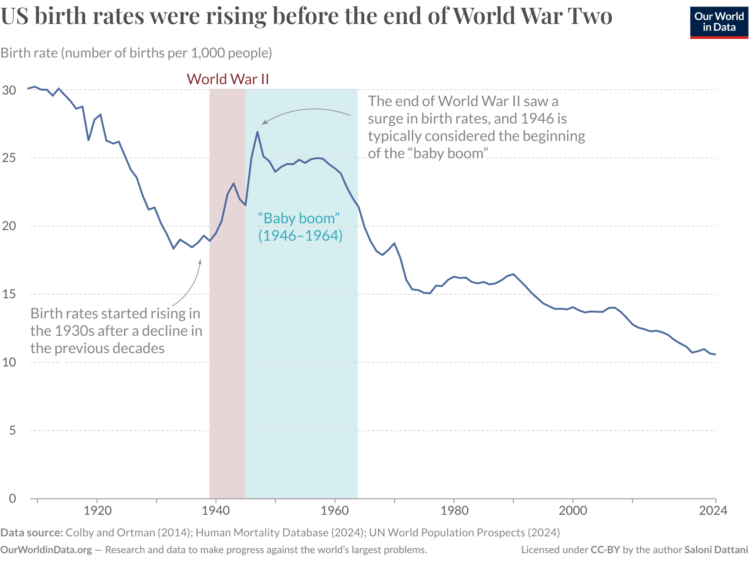
For Our World in Data, Saloni Dattani and Lucas Rodés-Guirao analyzed the various factors that led to the baby boom, typically marked by the period following World War II. As usual, it’s not that simple.

The baby boom is typically defined as the time period between 1946 and 1964. As an example, Brittanica’s entry on the baby boom states that it describes “the increase in the birth rate between 1946 and 1964”. Similarly, the US Census Bureau defines baby boomers as “those born between 1946 and 1964”, with the common belief that the baby boom started immediately after World War II.

But as the chart below shows, the rise began earlier.

Birth rates in the United States had been falling in the early twentieth century, and the decline began to slow down at the end of the 1920s. Then, in the late 1930s, they turned around and began to rise, and this continued during parts of World War II. At the end of the war, they surged, but this was part of a multi-decadal increase.

Tags: baby boomer, birth rate, Our World in Data

11 Mar 17:04

DOJ: Google must sell Chrome, Android could be next

by Ryan Whitwam

Google has gotten its first taste of remedies that Donald Trump’s Department of Justice plans to pursue to break up the tech giant’s monopoly in search. In the first filing since Trump allies took over the department, government lawyers backed off a key proposal submitted by the Biden DOJ. The government won't ask the court to force Google to sell off its AI investments, and the way it intends to handle Android is changing. However, the most serious penalty is intact—Google's popular Chrome browser is still on the chopping block.

"Google’s illegal conduct has created an economic goliath, one that wreaks havoc over the marketplace to ensure that—no matter what occurs—Google always wins," the DOJ filing says. To that end, the government maintains that Chrome must go if the playing field is to be made level again.

The DOJ is asking the court to force Google to promptly and fully divest itself of Chrome, along with any data or other assets required for its continued operation. It is essentially aiming to take the Chrome user base—consisting of some 3.4 billion people—away from Google and hand it to a competitor. The government will vet any potential buyers to ensure the sale does not pose a national security threat. During the term of the judgment, Google would not be allowed to release any new browsers. However, it may continue to contribute to the open source Chromium project.

Read full article

Comments

11 Mar 17:03

What’s behind the recent string of failures and delays at SpaceX?

by Eric Berger

It has been an uncharacteristically messy start to the year for the world's leading spaceflight company, SpaceX.

Let's start with the company's most recent delay. The latest launch date for a NASA mission to survey the sky and better understand the early evolution of the Universe comes Monday night. The launch window for this SPHEREx mission opened on February 28, but a series of problems with integrating the rocket and payloads have delayed the mission nearly two weeks.

Then there are the Falcon 9 first stage issues. Last week, a Falcon 9 rocket launched nearly two dozen Starlink satellites into low-Earth orbit. However, one of the rocket's nine engines suffered a fuel leak during ascent. Due to a lack of oxygen in the thinning atmosphere, the fuel leak did not preclude the satellites from reaching orbit. But when the first stage returned to Earth, it caught fire after landing on a droneship, toppling over. This followed a similar issue in August, when there was a fire in the engine compartment. After nearly three years without a Falcon 9 landing failure, SpaceX had two in six months.

Read full article

Comments

11 Mar 16:48

Former Google CEO Eric Schmidt is the new leader of Relativity Space

by Eric Berger

Another Silicon Valley investor is getting into the rocket business.

Former Google chief executive Eric Schmidt has taken a controlling interest in the Long Beach, California-based Relativity Space. The New York Times first reported the change becoming official, after Schmidt told employees in an all-hands meeting on Monday.

Schmidt's involvement with Relativity has been quietly discussed among space industry insiders for a few months. Multiple sources told Ars that he has largely been bankrolling the company since the end of October, when the company's previous fundraising dried up.

Read full article

Comments

11 Mar 16:48

What the EPA’s “endangerment finding” is and why it’s being challenged

by John Timmer

A document that was first issued in 2009 would seem an unlikely candidate for making news in 2025. Yet the past few weeks have seen a steady stream of articles about an analysis first issued by the Environmental Protection Agency (EPA) in the early years of Obama's first term: the endangerment finding on greenhouse gasses.

The basics of the document are almost mundane: greenhouse gases are warming the climate, and this will have negative consequences for US citizens. But it took a Supreme Court decision to get written in the first place, and it has played a role in every attempt by the EPA to regulate greenhouse gas emissions across multiple administrations. And, while the first Trump administration left it in place, the press reports we're seeing suggest that an attempt will be made to eliminate it in the near future.

The only problem: The science in which the endangerment finding is based on is so solid that any ensuing court case will likely leave its opponents worse off in the long run, which is likely why the earlier Trump administration didn't challenge it.

Read full article

Comments

11 Mar 16:23

Countywide PTA pushes for later school start times 

by Ashlyn Campbell

Resolution renews perennial conversations around importance of sleep for students

The post Countywide PTA pushes for later school start times  appeared first on Bethesda Magazine.

11 Mar 16:21

‘It’s magical’: Brookside Gardens butterfly experience returns  

by Ashlyn Campbell

Tickets on sale for Wheaton exhibit

The post ‘It’s magical’: Brookside Gardens butterfly experience returns   appeared first on Bethesda Magazine.

10 Mar 16:05

Podcasts

by Reza
06 Mar 19:21

Official who safeguards whistleblowers drops lawsuit protesting his firing by Trump

by Sean Michael Newhouse
Special Counsel Hampton Dellinger said in a statement to Government Executive that he is dropping his lawsuit to reverse his removal by Donald Trump, enabling the president to name his own person to lead the office that protects federal employees and whistleblowers from prohibited personnel practices.

A district judge on March 1 blocked Dellinger’s firing, but the U.S. Court of Appeals for the D.C. Circuit on Wednesday allowed for him to be removed while it considers the Trump administration’s appeal. 

“This new ruling means that OSC will be run by someone totally beholden to the president for the months that would pass before I could get a final decision from the U.S. Supreme Court,” Dellinger said in the statement. “I think the circuit judges erred badly because their willingness to sign off on my ouster — even if presented as possibly temporary — immediately erases the independence Congress provided for my position, a vital protection that has been accepted as lawful for nearly fifty years. Until now. And given the circuit court’s adverse ruling, I think my odds of ultimately prevailing before the Supreme Court are long.”

Dellinger, who was appointed by former President Joe Biden and confirmed by the Senate in 2024 for a five-year term, on Feb. 7 received a termination notice from the White House without a justification for the firing. His lawsuit argued that special counsels can only be removed for "inefficiency, neglect of duty or malfeasance in office.” 

The Office of Special Counsel did not immediately provide information on who is acting head of the agency. Trump had named Veterans Affairs Secretary Doug Collins as acting leader of OSC, but shortly thereafter the district judge reinstated Dellinger while she considered his lawsuit. 

Dellinger on Wednesday secured the temporary reinstatement of thousands of probationary employees at the Agriculture Department after determining that the mass firings of recently hired, promoted or transferred government workers were unlawful

Thursday would have been the one-year anniversary of Dellinger being sworn in as special counsel. 

During his tenure, he accused senior Biden White House official Neera Tanden of violating the Hatch Act by using social media to help raise money for political candidates. He also determined that former Navy Secretary Carlos Del Toro broke that law over statements he made about the 2024 presidential election. 

In his statement, Dellinger thanked OSC staff, his legal team and, “above all,” federal employees. 

“You deserve better, much better, than your recent unfair and unlawful treatment from too many parts of the United States government,” he said about government workers.

]]>
06 Mar 17:20

China aims to recruit top US scientists as Trump tries to kill the CHIPS Act

by Ashley Belanger

On Tuesday, Donald Trump finally made it clear to Congress that he wants to kill the CHIPS and Science Act—a $280 billion bipartisan law Joe Biden signed in 2022 to bring more semiconductor manufacturing into the US and put the country at the forefront of research and innovation.

Trump has long expressed frustration with the high cost of the CHIPS Act, telling Congress on Tuesday that it's a "horrible, horrible thing" to "give hundreds of billions of dollars" in subsidies to companies that he claimed "take our money" and "don't spend it," Reuters reported.

"You should get rid of the CHIPS Act, and whatever is left over, Mr. Speaker, you should use it to reduce debt," Trump said.

Read full article

Comments

06 Mar 12:49

$38b of government money that funded Musk companies

by Nathan Yau

Elon Musk has been critical of government spending, as he and DOGE fire federal employees and post questionable savings numbers. However, Musk’s own companies have benefited greatly from government funds over the past two decades, especially during the last few years. The Washington Post has the charts showing the $38 billion.

The total amount is probably larger: This analysis includes only publicly available contracts, omitting classified defense and intelligence work for the federal government. SpaceX has been developing spy satellites for the National Reconnaissance Office, the Pentagon’s spy satellite division, according to the Reuters news agency. The Wall Street Journal reported that contract was worth $1.8 billion, citing company documents.

The Post found nearly a dozen other local grants, reimbursements and tax credits where the specific amount of money is not public.

Tags: Elon Musk, government, spending, Washington Post

03 Mar 13:07

Reality of organ transplant waiting lists

by Nathan Yau

One might hope that people on a waiting list for an organ transplant were treated from top to bottom, individual by individual. It’s not that simple though. For The New York Times, Brian M. Rosenthal, Mark Hansen, and Jeremy White illustrate the complex reality of the queue.

The Times analyzed more than 500,000 transplants performed since 2004 and found that procurement organizations regularly ignore waiting lists even when distributing higher-quality organs. Last year, 37 percent of the kidneys allocated outside the normal process were scored as above-average. Other organs are not scored in the same way, but donor age is often used as a proxy for quality, and data shows there is little difference in the age of organs allocated normally compared with those that are not.

And while many people in the transplant community believe ignoring lists is reducing organ wastage, there is no evidence that is true, according to an unreleased report by a group of doctors and researchers asked by the transplant system last year to study the practice.

The animated transitions through an illustrated line of organ recipients drive the point home. Sometimes recipients are passed up because of risk factors, and sometimes the reasons seem less than ideal.

Tags: healthcare, New York Times, organ transplant, queuing

01 Mar 16:47

Texas official warns against “measles parties” as outbreak keeps growing

by Beth Mole

A Texas health authority is warning against "measles parties" as the outbreak in West Texas grew to at least 146 cases, with 20 hospitalized and one unvaccinated school-age child dead. The outbreak continues to mainly be in unvaccinated children.

In a press briefing hosted by the city of Lubbock, Texas, on Friday, Ron Cook, chief health officer at the Texas Tech University Health Sciences Center in Lubbock, offered the stark warning for Texans in his opening statements.

"What I want you to hear is: It's not good to go have measles parties because what may happen is—we can't predict who's going to do poorly with measles, be hospitalized, potentially get pneumonia or encephalitis and or pass away from this," Cook said. "So that's a foolish idea to go have a measles party. The best thing to do is make sure that you're well-vaccinated."

Read full article

Comments

01 Mar 16:40

Reddit - Dive into anything

28 Feb 20:52

Speaker Mike Johnson Is Living in a D.C. House That Is the Center of a Pastor’s Secretive Influence Campaign

by by Joshua Kaplan, Justin Elliott and Alex Mierjeski

by Joshua Kaplan, Justin Elliott and Alex Mierjeski

ProPublica is a nonprofit newsroom that investigates abuses of power. Sign up to receive our biggest stories as soon as they’re published.

In 2021, Steve Berger, an evangelical pastor who has attacked the separation of church and state as “a delusional lie” and called multinational institutions “demonic,” set off on an ambitious project. His stated goal: minister to members of Congress so that what “they learn is then translated into policy.” His base of operations would be a six-bedroom, $3.7 million townhouse blocks from the U.S. Capitol.

Recently, the pastor scored a remarkable coup for a political influence project that has until now managed to avoid public scrutiny. He got a new roommate.

House Speaker Mike Johnson has been staying at the home since around the beginning of this year, according to interviews and videos obtained by ProPublica.

The house is owned by a major Republican donor and Tennessee car magnate who has joined Berger in advocating for and against multiple bills before Congress.

Pastor Steve Berger, left, with House Speaker Mike Johnson and Johnson’s wife, Kelly, in what appears to be the Capitol Hill home the two men have been sharing (via Facebook)

Over the past four years, Berger and his wife, Sarah Berger, have dedicated themselves to what they call their D.C. “ministry center.” In addition to Johnson, who is an evangelical conservative, the pastor has built close relationships with several other influential conservative politicians. Dan Bishop, now nominated for a powerful post in the Trump White House, seems to have also lived in the home last year while he was still a congressman, according to three people.

A spokesperson for Johnson said that the speaker “pays fair market value in monthly rent for the portion of the Washington, D.C. townhome that he occupies.” He did not answer a question about how much Johnson is paying. House ethics rules allow members of Congress to live anywhere, as long as they are paying fair-market rent.

The spokesperson added that Johnson “has never once spoken to Mr. Berger about any piece of legislation or any matter of public policy.” Berger and Bishop did not respond to requests for comment.

The Bergers have described their mission as galvanizing political allies to take action. “It’s just iron sharpening iron,” Sarah Berger said on a podcast last summer, explaining the couple’s approach to political influence. “Like, ‘Oh yeah, that’s why I’m standing firm on this policy.’”

Steve Berger claims to have personally spurred legislation. “It’s a humbling thing,” he said in a sermon in late 2022. “You get a text message from a senator that says: ‘Thank you for your inspiration. Because it has caused me now to create a bill that is going to further righteousness in this country.’”

Berger’s interests extend beyond his staunch social conservatism. He and the donor who owns the house, Lee Beaman, have publicly advocated together for numerous specific policy changes, including a bill that would make it easier to fire federal employees and a regulation that would reduce fuel efficiency standards for the automotive industry. After the 2020 election, they both signed a letter declaring that President Donald Trump was the rightful winner and calling for Congress to overturn the results.

Johnson, a Louisiana Republican, did not respond to questions about how he ended up staying at the home. Beaman did not respond to requests for comment.

The earliest date ProPublica was able to confirm Johnson being at the Berger house was in mid-December. A video reviewed by ProPublica shows Johnson visiting the home on Dec. 15 with two women who appear to be his wife and daughter. They lingered outside before entering, while Johnson pointed around the building and down to the basement entrance as if he was giving a tour. Two days later, Berger sent a note to his supporters on social media: “I so wish I could tell you all the massive doors that broke open this week.”

Since the beginning of the year, videos and interviews show, Johnson has regularly left the house in the morning and returned in the evening. One day that Johnson was there recently, Berger was also at the home, opening the front door barefoot in pajama bottoms. (It appears Johnson may primarily be staying in the home’s two-bedroom basement.)

Washington pieds-à-terre can prove a significant expense for members of Congress as they split time between the capital and their home districts. Johnson is less wealthy than many other lawmakers. He worked at conservative nonprofits before he entered public service, and on his most recent financial disclosure form he did not declare a single asset. When Johnson was elevated to the speakership in 2023, news reports indicated that rather than renting an apartment, he might be sleeping in his office. (Lawmakers must report debts, income and many financial holdings on disclosure forms but aren’t required to list living expenses like rent.)

The Berger home is in an upscale D.C. neighborhood full of lobbyists and corporate attorneys. Though it’s not clear what the home’s basement would fetch on the open market, it’s not unusual for two-bedrooms in the area to rent for as much as $7,000 a month. Discounts on rent are generally prohibited by House ethics rules as improper gifts, experts said.

In sermons and on social media, Berger has mentioned some of the topics he’s discussed with Johnson and other members of Congress. Last year, Berger, a passionate supporter of the Israeli right-wing, said he’d had “a great conversation” with the speaker about Israel.

An Instagram post from Pastor Steve Berger (via Instagram)

Recently, Johnson has described his conversations with Trump to the pastor, according to Berger. After Russia invaded Ukraine, Berger said in a sermon that he’d advised “some congressmen” to see the conflict through the lens of Ezekiel 38 and 39, parts of the Bible some see as prophesying a great war before the Second Coming. He did not specify what that meant from a policy perspective.

An energetic 60-year-old with a white goatee and penchant for preaching in sneakers and jeans, Berger has strong views on a wide range of issues, including economic policy and public health. He is vehemently opposed to the World Health Organization, which Trump moved to withdraw the U.S. from last month, and recently predicted that COVID-19 vaccines will result in “young people dropping dead all over the place.” He attacked the World Economic Forum at length in a recent sermon, accusing it of “taking advantage” of COVID-19 “to implement their satanic plot.”

Berger is also against same-sex marriage, saying “it opens the door to all manner of sexual depravity and wickedness” — though he has said he has “friends who are practicing homosexuals, people I care about.” He opposes homosexuality and “heterosexual sin” in equal measures, he’s said, referring to acts like watching pornography and sex between unmarried adults.

Berger’s operation is organized as a nonprofit called Ambassador Services International, which runs on a budget of around $1 million per year, according to tax filings. The home where it is registered in Washington — and where Johnson has been staying — was purchased in early 2021. Once the home of abolitionist Frederick Douglass and later housing the Smithsonian Museum of African Art, it was advertised at the time as a “four-level Second Empire-style townhouse of impeccable elegance and exceptional scale,” offering “bespoke tranquility in a coveted location.”

The buyer was Crockett Ventures LLC. Corporate filings show its sole owner is Beaman, the donor and businessman, who built a fortune on a chain of car dealerships started by his father. He has given millions to Republican political groups, including large donations to the Trump campaign and political committees for the Heritage Foundation and the House Freedom Caucus. He’s also served as the treasurer of a congressional campaign.

Beaman was once so fed up with the restrictions that came with owning a home on a “government-controlled lake” that he bought a sprawling property with a 50-acre private lake of its own, according to a profile in an architecture book. He became a fixture of Nashville media in recent years because of sordid allegations made by his fourth wife during their divorce, including that he made her watch what he called “training films” of him having sex with a prostitute. Beaman’s lawyers wrote at the time that his wife’s filing contained “impertinent and scandalous matter only meant to harass Mr. Beaman.”

Beaman has attended a Tennessee church that Berger founded, but it’s not clear what role, if any, he plays in the pastor’s influence project in Washington. It’s also unclear whether the pastor’s nonprofit pays for the use of the Capitol Hill townhouse.

Berger came to prominence in his home state as the longtime pastor of Grace Chapel, a large church outside Nashville whose members have included the current governor of the state. In 2021, Berger left the church and he and his wife launched their project in Washington.

He soon began Bible study sessions with senators, representatives and congressional aides, according to the Bergers. Meanwhile, Sarah Berger spent her time “in relationship with and pouring into the lives of congressional wives,” tax filings say.

“Iron Sharpening Iron”

Pastor Steve Berger and his wife spoke about their project to influence politicians in a podcast last year.

(via Youtube)

Watch video ➜

Steve Berger quickly made connections at the highest levels of the Republican Party.

“Listen, I have confessed things to Steve that I wouldn't normally confess to anyone else,” Mark Meadows, a White House chief of staff in the first Trump administration who remains an important ally of the president, said at a 2023 event with Berger. “We have been praying together, having a Bible study each and every week. Not just me, but several members of Congress.”

A group of congressmen gathered on stage together to speak at the pastor’s 60th-birthday party in October, including Bishop, Rep. Barry Moore, Rep. Andy Ogles and Rep. Warren Davidson. All four are current or former members of the hardline conservative House Freedom Caucus. (None of the four responded to requests for comment.)

Evidence suggests that Bishop also recently lived at the Capitol Hill townhouse. Three neighbors told ProPublica that the FBI visited them this month asking about Bishop, seemingly as part of the background check for his White House job. “They said that address,” said one neighbor, adding that the agent showed a photo of Bishop. “They said: ‘He lived there up to a couple months ago. Do you know him?’”

Trump has nominated Bishop to be deputy director of the Office of Management and Budget, the powerful White House office that recently moved to freeze funding streams across the federal government. Berger celebrated the nomination on Instagram: “I want to congratulate my dear friend and brother, Congressman Dan Bishop, for accepting this incredible opportunity.”

Do you have any information we should know about Steve Berger or Speaker Mike Johnson? Josh Kaplan can be reached by email at joshua.kaplan@propublica.org and by Signal or WhatsApp at 734-834-9383. Justin Elliott can be reached by email at justin@propublica.org and by Signal or WhatsApp at 774-826-6240.

Jeff Frankl contributed research.

Correction

Feb. 28, 2025: This story originally incorrectly said Steve Berger and Dan Bishop did respond to requests for comment. They did not respond.

28 Feb 20:48

Sergey Brin says AGI is within reach if Googlers work 60-hour weeks

by Ryan Whitwam

Sergey Brin co-founded Google in the 1990s along with Larry Page, but both stepped away from the day to day at Google in 2019. However, the AI boom tempted Brin to return to the office, and he thinks everyone should follow his example. In a new internal memo, Brin has advised employees to be in the office every weekday so Google can win the AI race.

Just returning to the office isn't enough for the Google co-founder. According to the memo seen by The New York Times, Brin says Googlers should try to work 60 hours per week to support the company's AI efforts. That works out to 12 hours per day, Monday through Friday, which Brin calls the "sweet spot of productivity." This is not a new opinion for Brin.

Brin, like many in Silicon Valley, is seemingly committed to the dogma that the current trajectory of generative AI will lead to the development of artificial general intelligence (AGI). Such a thinking machine would be head and shoulders above current AI models, which can only do a good impression of thinking. An AGI would understand concepts and think more like a human being, which some would argue makes it a conscious entity.

Read full article

Comments

28 Feb 20:47

Unions call on senators to ‘defund’ Trump’s workforce purges

by Erich Wagner
A coalition of more than a dozen federal employee unions on Tuesday urged Senate lawmakers to reassert Congress’ constitutional power of the purse and block the Trump administration’s unilateral workforce and programmatic cuts when they seek to keep the government open next month.

As of Thursday, Congress had just over two weeks to reach an agreement to fund federal agencies and avert a government shutdown on March 15. With razor-thin margins in both the House and Senate, any deal likely will require Democratic votes to pass. And in a social media post Thursday night, President Trump called on lawmakers to pass a “clean” full-year continuing resolution that would keep agencies operating until September.

But the Federal Workers Alliance, a coalition of 15 federal worker unions including the International Federation of Professional and Technical Engineers and the National Federation of Federal Employees, in a letter to Senate Appropriations Committee Chairwoman Susan Collins, R-Maine, and Vice Chairwoman Patty Murray, D-Wash., called on senators to reassert Congress’ power of the purse and block the administration’s efforts to fire workers en masse and cancel contracts and grants unilaterally.

“The unions of the Federal Workers Alliance are urging you, as the chair and vice chair of the Senate Appropriations Committee, to step in and exercise Congress’ power of the purse by defunding the implementation of many of the illegal acts being promulgated by the Trump administration,” the group wrote. “While many of our unions are suing and seeking relief in federal court, Congress must reassert itself as a co-equal branch of the federal government.”

The groups call for language guaranteeing a “permanent halt and reversal” of the administration’s funding freezes, contract cancellations and efforts to shutter agencies like the U.S. Agency for International Development, which experts say likely violate the Impoundment Control Act and statutes establishing those agencies. And Congress should issue a two-year moratorium on changes to the federal workforce and agency operations, the unions argued.

“A two-year moratorium should be implemented, halting any reductions in force, personnel changes, agency modifications or any other actions not initiated by employees or properly authorized and appropriated,” they wrote. “We request that this pause be put in place through your appropriations measure to also include funding for a comprehensive study to assess the potential impact of future actions on the executive branch’s operations and their effects on the lawful mandates and requirements set by Congress.”

The unions also urged the lawmakers to consider clarifying congressional intent regarding two issues that were considered during Trump’s first term but ultimately never implemented.

First is the potential for the president to use authority granted in the 1978 Civil Service Reform Act to exempt “national security” positions from federal collective bargaining rights. The unions requested language clarifying that such work only refers to roles involved with intelligence, counterintelligence and investigations.

The unions also requested language to use the Holman Rule to negate the salaries of “any political appointee or principal officer” if any agency ceases offering voluntary automatic union dues deduction from employees’ paychecks. During Trump’s first term, the Federal Labor Relations Authority briefly chipped away at dues deductions, and conservative groups had urged the body to end the practice altogether.

“We fully understand hat some of the above requests may not be ideally suited to be added to a funding measure,” the group wrote. “However, given the speed by which the administration is moving its illegal actions and the impact it is having on our nation’s federal employees, our military readiness, the services that taxpayers so desperately depend on, and our very democracy itself, Congress must take extraordinary steps now to rein in this rogue administration.”

]]>