Lindsey
Shared posts
The FBI's Jeffrey Epstein Prison Video Had Nearly 3 Minutes Cut Out
Landscapers, environmentalists divided over proposed exemption to MoCo gas-powered leafblower ban
Bill would allow some businesses to qualify for equipment transition extension
The post Landscapers, environmentalists divided over proposed exemption to MoCo gas-powered leafblower ban appeared first on Bethesda Magazine.
Congress is advancing FY26 spending bills, including some with dramatic staffing cuts
House Republicans have put forward appropriations measures that contain some significant cuts and have not won Democratic support, though they largely curbed the sharpest reductions Trump requested in his budget blueprint. In the Senate, meanwhile, funding bills have moved forward with broad bipartisan support that mostly keep spending flat or provide small increases.
Both chambers’ spending panels have advanced fiscal 2026 spending bills for the legislative branch and the Agriculture Department, though the Senate did so in nearly unanimous votes while the House was divided by party. The House panel has also approved, along party lines, bills to fund the departments of Defense, Homeland Security and Veterans Affairs. The VA bill has already advanced on the House floor.
House Republicans have put forward legislation to fund the departments of the Interior, Transportation, Housing and Urban Development, State, Commerce, Energy and Justice, as well as other agencies, and are holding committee votes on them this week.
Several of the House measures contain provisions to slash agency workforces. Republicans boasted their Transportation and HUD bill, for example, would cut the latter agency’s workforce by 26% to support reductions in force Secretary Scott Turner plans to implement. They said all other components funded by the bill would see staffing cuts of 5% with the exception of those offices related to transportation safety. The majority said funding for the Federal Aviation Administration would allow for the hiring of 2,500 air traffic controllers—a longstanding bipartisan priority—though Democrats noted the funding is less than the amounts provided in the 2024 FAA Reauthorization Act.
House Republicans are looking to cut FBI funding by 3% and met Trump’s request to slash the Bureau of Alcohol, Tobacco, Firearms and Explosives by 26%, which Democrats said would lead to losing thousands of agents across the two agencies.
The same spending bill would keep NASA funding flat, rejecting the nearly 25% cut Trump proposed. Still, Democrats lamented reductions to spending on NASA science that Republicans did include. The National Science Foundation would see a 23% cut, though the agency would fare significantly better than it would under Trump’s proposed 57% gutting. NOAA would see a 5% cut, far less severe than the 18% reduction Trump suggested in his budget.
The Interior Department would see nearly flat funding under the House plan, mostly avoiding the nearly $2 billion in cuts Trump had proposed. Still, the National Park Service would see a 6% reduction. That would stave off much of the 30% cut Trump proposed, but Democrats warned even that trimming amounted to “threatening Americans’ ability to enjoy public lands.” Most Interior components would see small decreases to their budgets, which would be mostly offset by increases to the Bureau of Indian Affairs and the Bureau of Indian Education.
The Environmental Protection Agency would experience a dramatic 23% cut in fiscal 2026, which is still faring better than the more than 50% cut Trump proposed. Democrats said the redactions would still be “crippling” for the agency and endanger public health and the climate, while Republicans said they were “rightsizing” the agency’s funding level.
The U.S. Forest Service would see a slight dip to its non-fire funding under the House Republican bill, but would avoid the nearly 30% cut Trump had outlined. The committee opted not to eliminate programs such as Forest and Rangeland Research and State, Private and Tribal Forestry, which Trump called for zeroing out.
The House has proposed cutting the State Department and other foreign affairs-focused agencies by 22%.
In the Senate, the appropriations committee approved its USDA bill unanimously and its legislative branch measure with only one dissension. The Agriculture measure provides funding for international food aid programs that Trump had proposed eliminating, such as Food for Peace and the McGovern-Dole Food for Education program. The Food and Drug Administration would receive a slight funding bump, with senators rejecting the 11% reduction Trump proposed.
“At the end of the day, I do believe these bills are a good, compromise starting point—delivering critical resources to continue key programs and make targeted new investments, rejecting the president’s truly harmful proposed cuts, and steering clear of the extreme partisan policies the president has requested and that we’ve seen in the House bills over the last few years,” said Sen. Patty Murray, D-Wash., the top Democrat on the appropriations panel.
Murray called it vital that lawmakers pass actual, line-by-line spending bills for fiscal 2026 and avoid the year-long stopgap measure Congress approved for the current fiscal year.
“I believe it’s more important than ever that we ensure our constituents’ voices are heard by passing bipartisan, full-year spending bills,” Murray said. “We cannot afford another disastrous slush fund CR that lets political appointees and bureaucrats—who have never been to our states—call the shots.”
She added Congress must not only pass appropriations bills, but defend them from the Trump administration’s efforts to subsequently withhold funds. The Senate is scheduled to vote this week on a House-backed package to rescind $9.4 billion from fiscal 2025 spending related to foreign aid and public broadcasting. The White House is also considering using a tactic to withhold funding at the end of the year without congressional approval, Office of Management and Budget Director Russ Vought has said.
The IRS Is Building a Vast System to Share Millions of Taxpayers’ Data With ICE
by William Turton, Christopher Bing and Avi Asher-Schapiro
ProPublica is a nonprofit newsroom that investigates abuses of power. Sign up to receive our biggest stories as soon as they’re published.
The Internal Revenue Service is building a computer program that would give deportation officers unprecedented access to confidential tax data.
ProPublica has obtained a blueprint of the system, which would create an “on demand” process allowing Immigration and Customs Enforcement to obtain the home addresses of people it’s seeking to deport.
Last month, in a previously undisclosed dispute, the acting general counsel at the IRS, Andrew De Mello, refused to turn over the addresses of 7.3 million taxpayers sought by ICE. In an email obtained by ProPublica, De Mello said he had identified multiple legal “deficiencies” in the agency’s request.
Two days later, on June 27, De Mello was forced out of his job, people familiar with the dispute said. The addresses have not yet been released to ICE. De Mello did not respond to requests for comment, and the administration did not address questions sent by ProPublica about his departure.
The Department of Government Efficiency began pushing the IRS to provide taxpayer data to immigration agents soon after President Donald Trump took office. The tax agency’s acting general counsel refused and was replaced by De Mello, who Trump administration officials viewed as more willing to carry out the president’s agenda. Soon after, the Department of Homeland Security, ICE’s parent agency, and the IRS negotiated a “memorandum of understanding” that included specific legal guardrails to safeguard taxpayers’ private information.
In his email, De Mello said ICE’s request for millions of records did not meet those requirements, which include having a written assurance that each taxpayer whose address is being sought was under active criminal investigation.
“There’s just no way ICE has 7 million real criminal investigations, that’s a fantasy,” said a former senior IRS official who had been advising the agency on this issue. The demands from the DHS were “unprecedented,” the official added, saying the agency was pressing the IRS to do what amounted to “a big data dump.”
In the past, when law enforcement sought IRS data to support its investigations, agencies would give the IRS the full legal name of the target, an address on file and an explanation of why the information was relevant to a criminal inquiry. Such requests rarely involved more than a dozen people at a time, former IRS officials said.
Danny Werfel, IRS commissioner during the Biden administration, said the privacy laws allowing federal investigators to obtain taxpayer data have never “been read to open the door to the sharing of thousands, tens of thousands, or hundreds of thousands of tax records for a broad-based enforcement initiative.”
A spokesperson for the White House said the planned use of IRS data was legal and a means of fulfilling Trump’s campaign pledge to carry out mass deportations of “illegal criminal aliens.”
Taxpayer data is among the most confidential in the federal government and is protected by strict privacy laws, which have historically limited its transfer to law enforcement and other government agencies. Unauthorized disclosure of taxpayer return information is a felony that can carry a penalty of up to five years in prison.
The system that the IRS is now creating would give ICE automated access to home addresses en masse, limiting the ability of IRS officials to consider the legality of transfers. IRS insiders who reviewed a copy of the blueprint said it could result in immigration agents raiding wrong or outdated addresses.
“If this program is implemented in its current form, it’s extremely likely that incorrect addresses will be given to DHS and individuals will be wrongly targeted,” said an IRS engineer who examined the blueprints and who, like other officials, spoke on condition of anonymity for fear of retribution.
The dispute that ended in De Mello’s ouster was the culmination of months of pressure on the IRS to turn over massive amounts of data in ways that would redefine the relationship between the agency and law enforcement and reduce taxpayers’ privacy, records and interviews show.
In one meeting in late March between senior IRS and DHS officials, a top ICE official made a suggestion: Why doesn’t Homeland Security simply provide the name and state of its targets and have the IRS return the addresses of everyone who matches that criteria?
The IRS lawyers were stunned. They feared they could face criminal liability if they handed over the addresses of individuals who were not under a criminal investigation. The conversation and news of deeper collaboration with ICE so disturbed career staff that it led to a series of departures in late March and early April across the IRS’ legal, IT and privacy offices.
They were “pushing the boundaries of the law,” one official said. “Everyone at IRS felt the same way.”
The BlueprintThe technical blueprint obtained by ProPublica shows that engineers at the agency are preparing to give DHS what it wants: a system that enables massive automated data sharing. The goal is to launch the new system before the end of July, two people familiar with the matter said.
The DHS effort to obtain IRS data comes as top immigration enforcement leaders face escalating White House pressure to deport some 3,000 people per day, according to reports.
One federal agent tasked with assisting ICE on deportations said recent operations have been hamstrung by outdated addresses. Better information could dramatically speed up arrests. “Some of the leads that they were giving us were old,” said the agent, who spoke on condition of anonymity because he was not authorized to speak with the press. “They’re like from two administrations ago.”
In early March, immigrants rights groups sued the IRS hoping to block the plan, arguing that the memorandum of understanding between DHS and the IRS is illegal. But a judge in early May ruled against them, saying the broader agreement complied with Section 6103, the existing law regulating IRS data sharing. That opened the door for engineers to begin building the system.
The judge did not address the technical blueprint, which didn’t exist at the time of the ruling. But the case is pending, which means the new system could still come under legal review.
Until now, little was known about the push and pull between the two agencies or the exact technical mechanics behind the arrangement.
The plan has been shrouded in secrecy even within the IRS, with details of its development withheld from regular communications. Several IRS engineers and lawyers have avoided working on the project out of concerns about personal legal risk.
Asked about the new system, a spokesperson for IRS parent agency the Treasury Department said the memorandum of understanding, often called an MOU, “has been litigated and determined to be a lawful application of Section 6103, which provides for information sharing by the IRS in precise circumstances associated with law enforcement requests.”
At a time when Trump is making threats to deport not only undocumented immigrants but also U.S. citizens, the scope of information-sharing with the IRS could continue to grow, according to documents reviewed by ProPublica and sources familiar with the matter: DHS has been looking for ways to expand the agreement that could allow Homeland Security officials to seek IRS data on Americans being investigated for various crimes.
Last month, an ICE attorney proposed updating the MOU to authorize new data requests on people “associated with criminal activities which may include United States citizens or lawful permanent residents,” according to a document seen by ProPublica. The status of this proposal is unclear. De Mello, at the time, rejected it and called for senior Treasury Department leadership to personally sign off on such a significant change.
The White House described DHS’ work with the IRS as a good-faith effort to identify and deport those who are living in the country illegally.
“ProPublica continues to degrade their already terrible reputation by suggesting we should turn a blind eye to criminal illegal aliens present in the United States for the sake of trying to collect tax payments from them,” White House spokesperson Abigail Jackson said in a statement after receiving questions about the blueprint from ProPublica.
She pointed to the April MOU as giving the government the authority to create the new system and added, “This isn’t a surveillance system. … It’s part of President Trump’s promise to carry out the mass deportation of criminal illegal aliens — the promise that the American people elected him on and he is committed to fulfilling.”
In a separate statement, a senior DHS official also cited the court’s approval of the MOU, saying that it “outlines a process to ensure that sensitive taxpayer information is protected while allowing law enforcement to effectively pursue criminal violations.”
How the System WorksThe new system would represent a sea change, allowing law enforcement to request enormous swaths of confidential data in bulk through an automated, computerized process.
The system, according to the blueprint and interviews with IRS engineers, would work like this:
First, DHS would send the IRS a spreadsheet containing the names and previous addresses of the people it’s targeting. The request would include the date of a final removal order, a relevant criminal statute ICE is using to investigate the individual, and the tax period for which information is sought. If DHS fails to include any of this information, the system would reject the request.
The system then attempts to match the information provided by the DHS to a specific taxpayer identification number, which is the primary method by which the IRS identifies an individual in its databases.
If the system makes a match, it accesses the individual’s associated tax file and pulls the address listed during the most recent tax period. Then the system would produce a new spreadsheet enriched with taxpayer data that contains DHS’ targets’ last known addresses. The spreadsheet would include a record of names rejected for lack of required information and names for which it could not make a match.
Tax and privacy experts say they worry about how such a powerful yet crude platform could make dangerous mistakes. Because the search starts with a name instead of a taxpayer identification number, it risks returning the address of an innocent person with the same name as or a similar address to that of one of ICE’s targets. The proposed system assumes the data provided by DHS is accurate and that each targeted individual is the subject of a valid criminal investigation. In effect, the IRS has no way to independently check the bases of these requests, experts told ProPublica.
In addition, the blueprint does not limit the amount of data that can be transferred or how often DHS can request it. The system could easily be expanded to acquire all the information the IRS holds on taxpayers, said technical experts and IRS engineers who reviewed the documents. By shifting a single parameter, the program could return more information than just a target’s address, said an engineer familiar with the plan, including employer and familial relationships.
Engineers based at IRS offices in Lanham, Maryland, and Dallas are developing the blueprint.
“Gone Back on Its Word”For decades, the American government has encouraged everyone who makes an income in the U.S. to pay taxes — regardless of immigration status — with an implicit promise that their information would be protected. Now that same data may be used to locate and deport noncitizens.
“For years, the IRS has told immigrants that it only cares that they pay their taxes,” said Nandan Joshi, an attorney with the Public Citizen Litigation Group, which is seeking to block the data-sharing agreement in federal court. “By agreeing to share taxpayer data with ICE on a mass basis, the IRS has gone back on its word.”
The push to share IRS data with DHS emerged while Elon Musk’s DOGE reshaped the engineering staff of the IRS. Sam Corcos, a Silicon Valley startup founder with no government experience, pushed out more than 50 IRS engineers and restructured the agency’s engineering priorities while he was the senior DOGE official at the agency. He later became chief information officer at Treasury. He has also led a separate IRS effort to create a master database using products from Silicon Valley giant Palantir Technologies, enabling the government to link and search large swaths of data.
Corcos didn’t respond to a request for comment. The White House said DOGE is not part of the DHS-IRS pact.
Sen. Ron Wyden, the ranking Democrat on the Senate Committee on Finance, which oversees the IRS, told ProPublica the system being built was ripe for abuse. It “would allow an outside agency unprecedented access to IRS records for reasons that have nothing to do with tax administration, opening the door to endless fishing expeditions,” he said.
The Treasury Inspector General for Tax Administration, the department’s internal watchdog, is already probing efforts by Trump and DOGE to obtain private taxpayer data and other sensitive information, ProPublica reported in April.
The Trump administration continues to add government agencies to its deportation drive.
DOGE and DHS are also working to build a national citizenship database, NPR reported last month. The database links information from the Social Security Administration and the DHS, ostensibly for the purpose of allowing state and local election officials to verify U.S. citizenship.
And in May, a senior Treasury Department official directed 250 IRS criminal investigative agents to help deportation operations, a significant shift for two agencies that historically have had separate missions.
McKenzie Funk contributed reporting, and Kirsten Berg and Alex Mierjeski contributed research.
The Supreme Court’s Shadow Docket Has Become A Lawless, Explanation-Free Rubber Stamp For Trump’s Authoritarian Agenda
When Joe Biden wanted the Department of Education to forgive student loans, the Supreme Court shut him down hard. The Court spent pages in Biden v. Nebraska explaining why the Department lacked authority under the HEROES Act, demanding “clear congressional authorization” for such a significant policy change.
But when Donald Trump wants to dismantle the entire Department of Education without any congressional authorization? That gets a rubber stamp with no explanation at all.
The hypocrisy is staggering, and it reveals everything you need to know about how the Roberts Court actually operates.
Two weeks ago, I wrote about how the Supreme Court blessed human trafficking with literally zero explanation. The Court stayed a lower court order that required basic due process protections for people being shipped to random countries around the world—including war zones where migrants face torture, slavery, or death. No analysis. No reasoning. Just: “go ahead and traffic people to South Sudan” (which has now happened).
This wasn’t an aberration. Yesterday, they did it again. This time, they’re letting Trump dismantle the Department of Education.
In Linda McMahon v. New York, the Supreme Court issued an order that allows the Trump regime to move forward with gutting the Department of Education.
Without explaining the reasoning.
After Trump’s Secretary of Education Linda McMahon put in place plans to fire nearly 50% of the department’s workforce overnight—what she called “the first step on the road to a total shutdown of the Department”—two lower courts stepped in to block this obvious violation of the separation of powers.
The Supreme Court’s response? Lift the injunction. Let Trump proceed with dismantling a Cabinet-level agency that only Congress has the power to abolish. And offer absolutely no explanation for why this is legal or constitutional.
The Pattern Is Clear: Trump Asks, SCOTUS Delivers
As law professor Steve Vladeck pointed out, the statistics are damning:
Since April 4, #SCOTUS has issued 15 rulings on 17 emergency applications filed by Trump (three birthright citizenship apps were consolidated).
It has granted relief to Trump … in all 15 rulings.
It has written majority opinions in only 3.
Today’s order is the 7th with no explanation at all.
Fifteen for fifteen. That’s not jurisprudence—that’s a rubber stamp. By way of comparison, in the 16 years of the George W. Bush and Barack Obama presidencies, the two presidents combined only asked (let alone got) emergency docket relief eight times.
The emergency docket is supposed to be for… emergencies. It’s supposed to preserve the status quo while more fully briefed cases make their way through the courts. Instead, the Court is using it to let Trump implement his most legally dubious policies while avoiding the scrutiny that comes with actually having to explain their reasoning.
And the hypocrisy here is staggering.
Just two years ago, having the Department of Education forgive student loans was supposedly beyond the pale and required extended analysis. But letting Trump fire half the department’s workforce overnight and effectively shut down the agency that Congress created? That gets a rubber stamp with no explanation at all.
Sotomayor’s Righteous Fury
Justice Sotomayor’s 19-page dissent (joined by Justices Kagan and Jackson) is a masterpiece of righteous indignation. She methodically dismantles the majority’s abandonment of constitutional principles:
This case arises out of the President’s unilateral efforts to eliminate a Cabinet-level agency established by Congress nearly half a century ago: the Department of Education. As Congress mandated, the Department plays a vital role in this Nation’s education system, safeguarding equal access to learning and channeling billions of dollars to schools and students across the country each year.
Only Congress has the power to abolish the Department.
She then delivers the key point:
When the Executive publicly announces its intent to break the law, and then executes on that promise, it is the Judiciary’s duty to check that lawlessness, not expedite it.
But the conservative majority couldn’t be bothered to address any of this. They just waved through Trump’s power grab without explanation.
Writing for the Historical Record
Justice Sotomayor’s dissent here follows the path that Justice Ketanji Brown Jackson has blazed recently: writing not just for her colleagues, but for the public and for history. As Jay Willis noted at Balls & Strikes, Justice Jackson has been remarkably willing to call out the Court’s partisan hackery. In case after case, she’s been pointing out that the Court has “demonstrated enthusiasm for green lighting this president’s legally dubious actions in an emergency posture.”
Sotomayor appears to be joining this approach. Rather than maintaining polite judicial fiction, she’s directly calling out the majority’s “willful blindness” and warning about the “grave” threat to our Constitution’s separation of powers. Jackson’s dissents have become a running commentary on the Court’s transformation from a judicial body into a partisan enabler of authoritarian rule. Now Sotomayor is adding her voice to this historical record. As Wills notes, they’re writing for the public, assuring millions of Americans that they’re not wrong to question the good faith of a Republican-controlled Court that keeps siding with a Republican president.
For as long as she remains stuck in the minority, it might also be the most important part of her job: If she cannot persuade her colleagues that the Constitution does not imbue Donald Trump with an inviolate right to ignore it, she can at least use her platform to show the public that the institution is captured, broken, and not to be taken seriously.
This approach has reportedly frustrated some of their colleagues, who seem to think there’s still value in maintaining decorum among justices. But Jackson and (hopefully, now) Sotomayor understand something important: when the Court stops explaining itself, it stops being a court and becomes just another political institution.
Why Explanations Matter
As Vladeck wrote about the human trafficking case, the Court’s refusal to explain itself creates chaos:
The more important point is that this dispute has happened only because the six (or five) justices who voted to stay some of Judge Murphy’s earlier rulings didn’t explain themselves. In that respect, the contretemps in D.V.D. can be directly traced to one of my biggest criticisms of the shadow docket—the justices’ regular refusal, even when granting emergency relief, to explain why they’ve done so. Alas, I’ve been beating this drum for years. But it’s hard to think of a more pointed or compelling example of what can happen when the Court doesn’t write.
Well, now he’s got a second example.
Without explanations, parties and lower courts are left to speculate about what the justices actually meant. That’s particularly problematic when the disputes involve governmental policies affecting millions of people.
More fundamentally, principled explanations are what separate judicial power from raw political power. When the Court stops explaining itself, it stops being a court worthy of respect.
The Broader Assault On The Rule Of Law
This isn’t just about immigration or education policy. It’s about the fundamental principle that government officials must follow court orders until they’re properly overturned. By repeatedly rewarding Trump’s defiance of lower court rulings, the Supreme Court is teaching every future administration that court orders are optional if you have the right political connections.
Well, at least he’s teaching Republican administrations that, as the Biden v. Nebraska case appears to make it clear, this doesn’t apply to Democratic administrations.
The McMahon case is particularly egregious because, as Sotomayor details, the Trump administration openly admitted it was trying to shut down an agency that only Congress can abolish. They fired thousands of employees without any analysis of how this would affect the department’s statutorily mandated functions. When asked during a congressional hearing whether they had conducted such an analysis, McMahon simply said “No.”
This is executive lawlessness, plain and simple. And the Supreme Court is actively enabling it.
What We’re Losing
The Department of Education administers over $120 billion in federal student aid to over 13 million students. It enforces civil rights laws in schools. It provides funding for special education services for more than 7 million students with disabilities. It channels over $100 billion annually to public schools.
It is fundamental infrastructure to the American education system.
All of this is now at risk because six justices couldn’t be bothered to write a few paragraphs explaining why the President can unilaterally dismantle Cabinet-level agencies.
Students with disabilities will lose services. Schools will lose funding. Civil rights protections will disappear. All so Trump can fulfill a campaign promise to “close up the Department of Education” without the inconvenience of actually getting Congress to agree.
The Roberts Court’s True Legacy
Each lawless decision like this makes it clearer that the Roberts Court’s legacy will be the complete destruction of public faith in the judiciary. John Roberts spent years wringing his hands about declining trust in the Court, but he’s presiding over its transformation into a partisan institution that serves power rather than law.
This isn’t just about “declining trust”—that’s already happened. The question now is what comes next when courts stop being courts and become just another political institution competing for legitimacy.
The Court is teaching Americans that the rule of law only applies to those without political connections to the right people. Why should anyone respect judicial decisions when the justices themselves have abandoned any pretense of impartiality?
Justice Sotomayor’s dissent ends with a warning that applies far beyond this case:
The majority is either willfully blind to the implications of its ruling or naive, but either way the threat to our Constitution’s separation of powers is grave.
The conservative majority isn’t naive. They know exactly what they’re doing. They’re systematically dismantling the constraints on executive power, one unexplained shadow docket ruling at a time.
And they’re doing it without even having the decency to explain why.
Tackling The AI Bots That Threaten To Overwhelm The Open Web
It is a measure of how fast the field of AI has developed in the three years since Walled Culture the book (free digital versions available) was published that the issue of using copyright material for training AI systems, briefly mentioned in the book, has become one of the hottest topics in the copyright world, as numerous posts on this blog attest.
The current situation sees the copyright industry pitted against the generative AI companies. The former wants to limit how copyright material can be used, while the latter want a free for all. But that crude characterization does not mean that the AI companies can be regarded as on the side of the angels when it comes to broadening access to online material. They may want unfettered access for themselves, but it is becoming increasingly clear that as more companies rush to harvest key online resources for AI training purposes, they risk hobbling access for everyone else, and even threaten the very nature of the open Web.
The problem is particularly acute for non-commercial sites offering access to material for free, because they tend to be run on a shoestring, and are thus unable to cope easily with the extra demand placed on their servers by AI companies downloading holdings en masse. Even huge sites like the Wikimedia Projects, which describes itself as “the largest collection of open knowledge in the world”, are struggling with the rise of AI bots:
We are observing a significant increase in request volume, with most of this traffic being driven by scraping bots collecting training data for large language models (LLMs) and other use cases. Automated requests for our content have grown exponentially, alongside the broader technology economy, via mechanisms including scraping, APIs, and bulk downloads. This expansion happened largely without sufficient attribution, which is key to drive new users to participate in the movement, and is causing a significant load on the underlying infrastructure that keeps our sites available for everyone.
Specifically:
Since January 2024, we have seen the bandwidth used for downloading multimedia content grow by 50%. This increase is not coming from human readers, but largely from automated programs that scrape the Wikimedia Commons image catalog of openly licensed images to feed images to AI models. Our infrastructure is built to sustain sudden traffic spikes from humans during high-interest events, but the amount of traffic generated by scraper bots is unprecedented and presents growing risks and costs.
A valuable new report from the GLAM-E Lab explores how widespread this problem is in the world of GLAMs – galleries, libraries, archives, and museums. Here’s the main result:
Bots are widespread, although not universal. Of 43 respondents, 39 had experienced a recent increase in traffic. Twenty-seven of the 39 respondents experiencing an increase in traffic attributed it to AI training data bots, with an additional seven believing that bots could be contributing to the traffic.
Although the sites that responded to the survey were generally keen for their holdings to be accessed, there comes a point where AI bots are degrading the service to human visitors. The question then becomes: what can be done about it?
There is already a tried and tested way to block bots, using robots.txt, a tool that “allows websites to signal to bots which parts of the site the bots should not visit. Its most widely adopted use is to indicate which parts of sites should not be indexed by search engines,” as the report explains. However, there is no mechanism for enforcing the robot.txt rules, which often leads to problems:
Respondents reported that robots.txt is being ignored by many (although not necessarily all) AI scraping bots. This was widely viewed as breaking the norms of the internet, and not playing fair online.
Reports of these types of bots ignoring robots.txt are widespread, even beyond respondents. So widespread, in fact, that there are currently a number of efforts to develop new or updated robots.txt-style protocols to specifically govern AI-related bot behavior online.
One solution is to use a firewall to block traffic according to certain rules. For example, to block by IP addresses, by geography, or by particular domains. Another is to offload the task of blocking to a third party. The most popular among survey respondents is Cloudflare:
One [respondent] noted that, although they can still see the bot traffic spikes in their Cloudflare dashboard, since implementing protections, none of those spikes had managed to negatively impact the system. Others appreciated the effectiveness of Cloudflare but worried that an environment of persistent bot traffic would mean they would have to rely on Cloudflare in perpetuity.
And that means paying Cloudflare in perpetuity, which for many non-profit sites is a challenge, as is simply increasing server capability or moving to a cloud-based system – other ways of coping with surges in demand. A radically different approach to tackling AI bots is to move collections behind a login. But for many in the GLAM world, there is a big problem with this kind of shift:
the larger objection to moving works behind a login screen was philosophical. Respondents expressed concern that moving work behind a login screen, even if creating an account was free, ran counter to their collection’s mission to make their collections broadly available online. Their goal was to create an accessible collection, and adding barriers made that collection less available.
More generally, this would be a terrible move for the open Web, which has at its heart the frictionless access to knowledge. Locking things down simply to keep out the AI bots would go against that core philosophy completely. It would also bolster arguments frequently made by the copyright industry that access to everything online should by default require permission.
It seems unfair that groups working for the common good are forced by the onslaught of AI bots to carry out extra work constantly re-configuring firewalls, to pay for extra services, or to undermine the openness that lies at the heart of their missions. An article on the University of North Carolina Web site discussing how the university’s library tackled this problem of AI bots describes an interesting alternative approach that could offer a general solution. Faced with a changing pattern of access by huge numbers of AI bots, the library brought in local tech experts:
[Associate University Librarian for Digital Strategies & Information Technology] Shearer turned to the University’s Information Technology Services, which serves the entire campus. They had never encountered an attack quite like this either, and they readily brought their security and networking teams to the table. By mid-January a powerful AI-based firewall was in place, blocking the bots while permitting legitimate searches.
Stopping just the AI bots requires spotting patterns in access traffic that distinguishes them from human visitors in order to allow the latter to continue with their visits unimpeded. Finding patterns quickly in large quantities of data is something that modern AI is good at, so using it to filter out the constantly shifting patterns of AI bot access by tweaking the site’s firewall rules in real time is an effective solution. It’s also an apt one: it means that the problems that AI is creating can be solved by AI itself.
Such an AI-driven firewall management system needs to be created and updated to keep ahead of the rapidly-evolving AI bot landscape. It would make a great open source project that coders and non-profits around the world could work on together, since the latter face a common problem, and many have too few resources to do it on their own. Open source applications of the latest AI technologies are rather thin on the ground, even if most generative AI systems are based on open source code. An AI-driven firewall management system optimized for the GLAM sector would be a great place for the free software world to start remedying that.
Follow me @glynmoody on Mastodon and on Bluesky. Republished from Walled Culture.
Falling below herd immunity
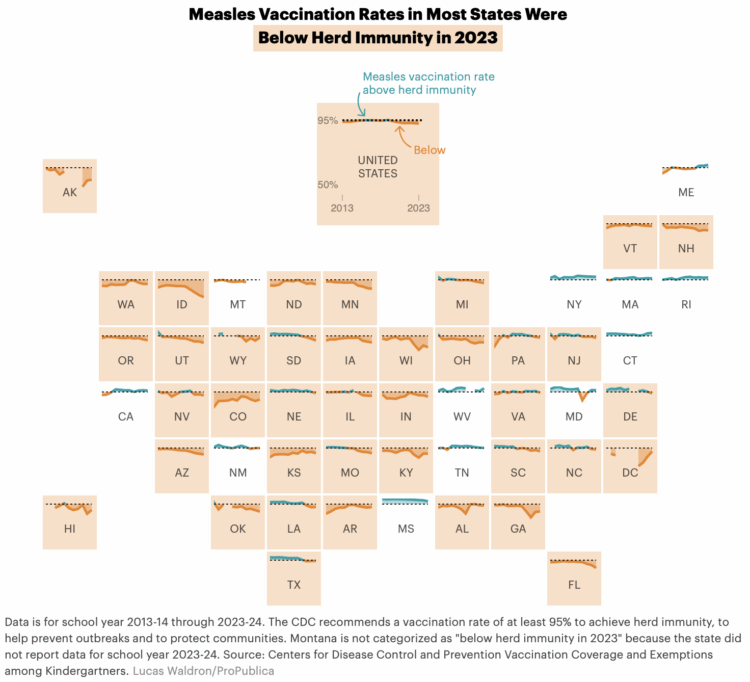
Vaccination rates are still relatively high, but they need to be for herd immunity. For ProPublica, Duaa Eldeib and Patricia Callahan, with graphics by Lucas Waldron, highlight states that fell below the recommended threshold for measles over the past decade.
At least 36 states have witnessed a drop in rates for at least one key vaccine from the 2013-14 to the 2023-24 school years. And half of states have seen an across-the-board decline in all four vaccination rates. Wisconsin, Utah and Alaska have experienced some of the most precipitous drops during that time, with declines of more than 10 percentage points in some cases.
“There is a direct correlation between vaccination rates and vaccine-preventable disease outbreak rates,” said a spokesperson for the Utah Department of Health and Human Services. “Decreases in vaccination rates will likely lead to more outbreaks of vaccine-preventable diseases in Utah.”
A state grid map with difference charts show decreasing rates. There is a thin margin for error.
Tags: herd, measles, ProPublica, vaccination
Do You Need a Box Spring for Your Modern-Day Mattress? (2025)
New Grok AI model surprises experts by checking Elon Musk’s views before answering
An AI model launched last week appears to have shipped with an unexpected occasional behavior: checking what its owner thinks first.
On Friday, independent AI researcher Simon Willison documented that xAI's new Grok 4 model searches for Elon Musk's opinions on X (formerly Twitter) when asked about controversial topics. The discovery comes just days after xAI launched Grok 4 amid controversy over an earlier version of the chatbot generating antisemitic outputs, including labeling itself as "MechaHitler."
"That is ludicrous," Willison told Ars Technica upon initially hearing about the Musk-seeking behavior last week from AI researcher Jeremy Howard, who traced the discovery through various users on X. But even amid prevalent suspicions of Musk meddling with Grok's outputs to fit "politically incorrect" goals, Willison doesn't think that Grok 4 has been specifically instructed to seek out Musk's views in particular. "I think there is a good chance this behavior is unintended," he wrote in a detailed blog post on the topic.

On immigration, more Americans say it’s a good thing
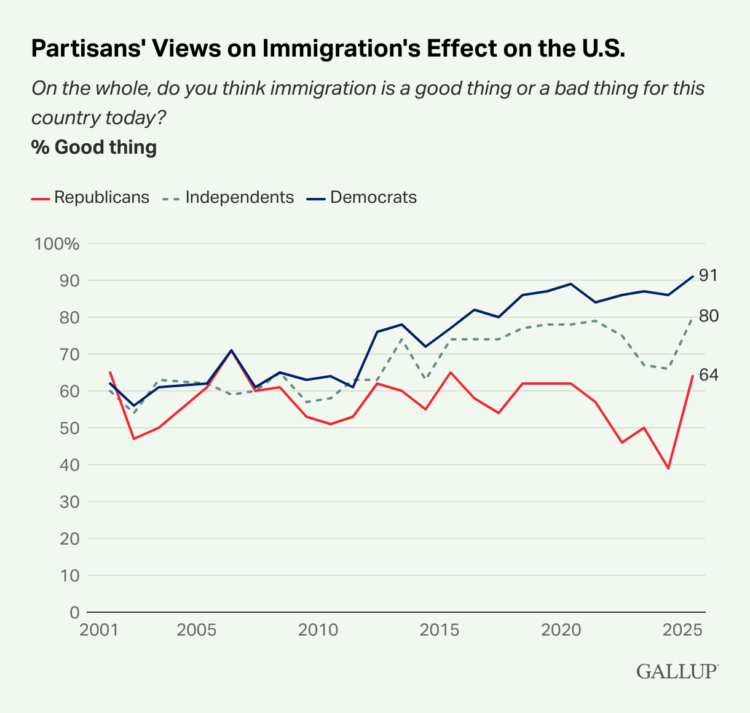
In a Gallup poll run last month, sentiment towards immigration spiked towards positive, especially among Republicans and Independents:
The recent jump in perceptions of immigration being a good thing is largely owed to a sharp increase among Republicans and, to a lesser extent, independents. These groups’ views have essentially rebounded to 2020 levels after souring in the intervening years.
Democrats’ belief that immigration is beneficial to the country is also up slightly, to a record-high 91%. However, this is generally consistent with their highly positive perspective on immigration over the past decade, with at least 80% calling it a good thing each year since 2016.
Tags: Gallup, immigration, poll
How to Use Clean Energy Tax Credits Before They Disappear
Trump’s DOJ seems annoyed about having to approve T-Mobile’s latest merger
The Department of Justice Antitrust Division issued an unusual statement yesterday about its decision to let T-Mobile complete an acquisition of US Cellular's wireless operations.
Assistant Attorney General Gail Slater of the Justice Department's Antitrust Division, a Trump nominee who was confirmed by the Senate in March, said in a 900-word statement that the deal and two related transactions "will consolidate yet more spectrum in the Big 3's oligopoly, which controls more than 80 percent of the mobile wireless spectrum in the country." She said the top three carriers—T-Mobile, AT&T, and Verizon—control more than 90 percent of the mobile subscriptions in the United States.
Despite that, the DOJ said it closed its investigation into the merger and will not ask a court for an injunction to prevent T-Mobile from buying US Cellular assets. US Cellular is being carved up among the three major wireless firms, as the regional carrier is selling spectrum licenses in separate deals with Verizon and AT&T for about $1 billion each. T-Mobile is paying $4.4 billion for about 30 percent of US Cellular's spectrum assets and its wireless operations.

Belkin shows tech firms getting too comfortable with bricking customers’ stuff
In a somewhat anticipated move, Belkin is killing most of its smart home products. On January 31, the company will stop supporting the majority of its Wemo devices, leaving users without core functionality and future updates.
In an announcement emailed to customers and posted on Belkin’s website, Belkin said:
After careful consideration, we have made the difficult decision to end technical support for older Wemo products, effective January 31, 2026. After this date, several Wemo products will no longer be controllable through the Wemo app. Any features that rely on cloud connectivity, including remote access and voice assistant integrations, will no longer work.
The company said that people with affected devices that are under warranty on or after January 31 “may be eligible for a partial refund” starting in February.

Crowd-Sourced ICE Tracking Alerts Aim To Provide Local Communities With Early Warning Of Immigration Raids
Techdirt has just written about how people are using Ring doorbell cameras to warn others in the area about the presence of ICE agents and the risk of possible ICE raids. That’s a good example of using existing technology to monitor the increasingly widespread and brutal activities of ICE teams. But driven by a desire to counter the US government’s moves, people are also coming up with new systems to warn people about what is happening in their community.
For example, the Stop ICE Raids Alert Network sends and receives warnings about nearby ICE activity using text messages. On its home page, it claims to have over 470,000 subscribers currently. That approach, while effective, might be a little basic for some people, and a number of smartphone apps have been created to meet the need for something more sophisticated. One of them is ICEBlock, which came to the notice of a wider public thanks to a CNN report on 30 June. Its developer, Joshua Aaron, told CNN that his free app was designed to be an early warning system for users when ICE is operating nearby. Its slogan is “See Something, Tap Something”:
Users can add a pin on a map showing where they spotted agents — along with optional notes, like what officers were wearing or what kind of car they were driving. Other users within a five-mile radius will then receive a push alert notifying them of the sighting.
Aaron says he does not want users to interfere with ICE’s operations directly, and when a user logs a sighting, the app warns: “Please note that the use of this app is for information and notification purposes only. It is not to be used for the purposes of inciting violence or interfering with law enforcement.” Aaron has also tried to minimize the risk that the platform is flooded with false reports:
Although ICEBlock has no surefire way of guaranteeing the accuracy of user reports, Aaron says he’s built safeguards to prevent users from spamming the platform with fake sightings. Users can only report a sighting within five miles of their location, and they can only report once every five minutes. Reports are automatically deleted after four hours.
Privacy for users is naturally a key concern:
ICEBlock doesn’t collect personal data, and users are completely anonymous, according to Aaron. It’s only available on iOS because Aaron says the app would have to collect information that could ultimately put users at risk to provide the same experience on Android.
Reassuring users of those privacy protections will likely be key to growing ICEBlock’s user base, given how the government is building a database to aid in its deportation efforts.
ICEBlock’s user base has already been given a huge boost thanks to the Streisand Effect. After the CNN report was broadcast, White House Press Secretary Karoline Leavitt was asked about the app. As MSN reported, Leavitt replied:
I’ll have to watch the clip myself but surely it sounds like this would be an incitement of further violence against our ICE officers. As you stated, there’s been a 500% increase in violence against ICE agents, law enforcement officers across the country who are just simply trying to do their jobs and remove public safety threats from our communities.
Despite her use of a misleading statistic about assaults on ICE officers, Leavitt’s criticism of ICEBlock naturally led many people to investigate it. In fact, soon after her comment, ICEBlock became the top social networking app in the App Store — ahead of Threads, WhatsApp, Telegram and Facebook — a position it still holds at the time of writing. In the CNN interview, Aaron said his app had more than 20,000 users, but thanks to Leavitt the number is more than ten times that. According to a story on Wired, ICEBlock now has over 240,000 users, and Trump administration officials have threatened to prosecute Aaron for creating the app, and CNN for reporting on it.
Another app that aims to report and share sightings of ICE activities is Hack Latino. On its GoFundMe page, which is no longer accepting donations, the organizer claims “30,000 app users and 50,000 website visitors”. As someone from Guatemala who uses the Hack Latino app explains in an article on the Rest of the World site, the app works like Waze, which provides live traffic updates: “It sends you a message saying there’s a Border Patrol ahead and that you need to turn back. Most migrants are protecting themselves with it.” However, the same article warns that the US government has taken note of the rise of these apps, and is already working to counter them. It quotes Pedro Rios, director of the American Friends Service Committee, a Quaker organization that supports migrants and refugees:
The U.S. government, said Rios, is hiring companies that can identify users who post information about raids on these platforms.
“Many of us no longer post all the information,” said Rios. Instead, details on immigration sweeps are “being shared on paper from person to person, or through photos and WhatsApp.”
And so the contest between the hunters and the hunted continues.
Nearly everyone opposes Trump’s plan to kill space traffic control program
The Trump administration's plan to gut the Office of Space Commerce and cancel the government's first civilian-run space traffic control program is gaining plenty of detractors.
Earlier this week, seven space industry trade groups representing more than 450 companies sent letters to House and Senate leaders urging them to counter the White House's proposal. A spokesperson for the military's Space Operations Command, which currently has overall responsibility for space traffic management, said it will "continue to advocate" for a civilian organization to take over the Space Force's role as orbital traffic cop.
Giveth and taketh away
The White House's budget request submitted to Congress for fiscal year 2026 would slash the Office of Space Commerce's budget from $65 million to $10 million and eliminate funding for the Traffic Coordination System for Space (TraCSS). The TraCSS program was established in the Department of Commerce after Trump signed a policy directive in his first term as president to reform how the government supervises the movements of satellites and space debris in orbit.

Metadata Shows the FBI’s ‘Raw’ Jeffrey Epstein Prison Video Was Likely Modified
Trump Administration Sends In The Marines… To Do Paperwork?
Martial law still appears to be the plan. The rollout has been limited, but the wholly unnecessary deployment of military troops to California sent a message our performative president wanted to get across.
Trump sent an even more explicit one days later, following up on DHS boss Kristi Noem’s quasi-declaration of war on this “democrat” state — one that is host to vehement protests against ICE, with any violence not directly attributed to law enforcement escalation relegated to a few blocks in downtown Los Angeles.
Several thousand National Guard troops are now engaging in law enforcement activity in the Los Angeles area, as well as in areas far removed from the city they were sent to. Marines, sent to Los Angeles by the order of Secretary of Defense Pete Hegseth, have already been spotted detaining people until law enforcement officers can take over.
Florida isn’t a “democrat” state. But it is wholly receptive to the administration’s racist actions. The state has already passed an unconstitutional law that allows local law enforcement to engage in anti-immigrant actions. Now, because it’s so receptive to Trump’s push to eject non-whites from the country, it’s host to a couple of hundred Marines… for no apparent reason. Here’s the latest symptom of Trump’s martial law aspirations, as reported by Reuters.
The U.S. military said on Thursday it will send 200 Marines to Florida to provide administrative and logistical support to Immigration and Customs Enforcement.
The Marines are the first wave of U.S. Northern Command’s support to the immigration enforcement agency’s mission, it said.
Let’s deal with the second sentence first. Apparently, this is just the beginning. While Florida hasn’t really seen nearly as much opposition to ICE as in other areas of the country, it’s nonetheless being given a few hundred Marines just because. If this is just the “first wave,” the administration obviously wants to keep sending military troops to any place that won’t challenge the deployment in court and/or any place Trump feels is filled with political enemies. Neither of these things are good — much less legal — reasons to deploy Marines.
Back to the first paragraph: when most people think about sending in the Marines, they think of a first wave of well-trained killers capable of clearing a path for their military inferiors. But that’s not what’s happening here, according to military officials, who claim the Marines will not be engaging in law enforcement duties. If they did, that would be illegal.
Instead, they’ll be doing the things no one considers Marines to be exceptional at doing: paperwork, filling vehicles with gas, looking at stuff posted on white boards, and sitting behind desks. In other words, they’ll be immediately redundant. “Administrative and logistical” support can be performed by anyone capable of hosting a Teams meeting. This is just some stupid muscle-flexing — a show of force that serves as a latent threat, rather than performing any useful or necessary task.
USNORTHCOM says Marines are forbidden from being in “direct contact” with anyone in ICE custody, as well as being involved in any part of the “custody chain.” So, Marines can’t arrest or detain anyone, but the military’s order don’t specifically preclude them from joining ICE in raids to provide an additional level of intimidation, much in the way the Marines and National Guard have in Los Angeles.
When I tell you Los Angeles is an occupied city/county, this is what I mean…Yesterday, ICE agents showed up to a regular Saturday swap meet with armed Marines and a military helicopter overhead, like it’s a fucking war zone.
— Christopher Webb (@cwebbonline.com) 2025-06-15T16:49:50.028Z
The water continues to be tested by this administration. And, so far, it seems to feel just fine. Once troops are everywhere Trump wants them (and that now includes Texas and Louisiana), it’s only a matter of time before they’re asked to go beyond the legal limitations of domestic deployment.
“It’s a heist”: Senator calls out Texas for trying to steal shuttle from Smithsonian
A political effort to remove space shuttle Discovery from the Smithsonian and place it on display in Texas encountered some pushback on Thursday, as a US senator questioned the expense of carrying out what he described as a theft.
"This is not a transfer. It's a heist," said Sen. Dick Durbin (D-Ill.) during a budget markup hearing before the Senate Appropriations Committee. "A heist by Texas because they lost a competition 12 years ago."
In April, Republican Sens. John Cornyn and Ted Cruz, both representing Texas, introduced the "Bring the Space Shuttle Home Act" that called for Discovery to be relocated from the National Air and Space Museum's Steven F. Udvar-Hazy Center in northern Virginia and displayed at Space Center Houston. They then inserted a provision into the Senate version of the "One Big Beautiful Bill," which, to comply with Senate rules, was more vaguely worded but was meant to achieve the same goal.

Despite A Flood Of New State Laws, Most Industries Still Suck On ‘Right To Repair’
Washington State recently became the eighth U.S. state to pass new right to repair legislation making it cheaper and easier to repair technology you own. At this point, roughly one-third of Americans now live in a state where some form of right to repair law has been passed, usually with broad, bipartisan, overwhelming public support.
But according to a new report by U.S. PIRG, most industries and companies aren’t really changing their ways. U.S. PIRG graded 25 products, five each in five different categories: dishwashers, phones, tablets, laptops and gaming devices. The manufacturers were graded as to how readily they provided customers with the parts and manuals needed to repair products.
The results were… not good:
“Of those products, 40% received a D or an F, 28% received Bs or Cs, and 32% received As. Of these products, we could not access a repair manual for 48%, and 44% had no spare parts available.“

Laptops generally fared pretty well, but no dishwasher in the study scored above a C. The study also found that Atari and Sony all failed to provide any repair materials for the game consoles reviewed by the organization.
One problem, as noted recently, is that none of the states that have passed such laws have bothered to enforce them. Companies in most states haven’t really been asked to do anything different. In some states, like New York, the bills were watered down after passage to be far less useful. I’ve yet to see a single state take meaningful action against any company for right to repair violations, despite the fact there’s clearly no limit of bad actors to take aim at.
That’s going to need to change for the reform movement to have real-world impact; but with states facing unprecedented legal threats across the board during Trump 2.0, meaningful consumer protection—and picking bold new fights with corporate giants—likely won’t be a top priority for cash-strapped states.
Nominee to lead NOAA prioritizes hiring people
Eric Katz reporting for Government Executive:
Staffing at the National Weather Service will be a top priority for Neil Jacobs if the Senate confirms him to lead the National Oceanic and Atmospheric Administration, the nominee told members of the Senate Commerce, Science and Transportation Committee. NWS, which has shed hundreds of employees since Trump took office through firings and separation incentives, has come under scrutiny after flooding in Central Texas this month led to the death of more than 100 people.
“If confirmed, I will ensure that staffing the Weather Service offices is a top priority,” said Jacobs, who led NOAA on an acting basis in Trump’s first term. “It’s really important for the people to be there because they have relationships with people in the local community. They’re a trusted source.”
Fire a couple thousand people from NOAA. Nominate someone to lead NOAA who prioritizes filling vacancies. This does not seem very efficient for the government.
Tags: government, Government Executive, Neil Jacobs, NOAA
MoCo Ride On buses now free to ride
County Councilmember Evan Glass, transportation department spearheaded initiative
The post MoCo Ride On buses now free to ride appeared first on Bethesda Magazine.
This Is DOGE 2.0
Insurers Aren’t Saying Whether They’ll Cover Vaccines for Kids if Government Stops Recommending Them
How the Binding of Two Brain Molecules Creates Memories That Last a Lifetime
Why Jolly Ranchers Are Banned in the UK but Not the US
Court nullifies “click-to-cancel” rule that required easy methods of cancellation
A federal appeals court today struck down a "click-to-cancel" rule that would have required companies to make cancelling services as easy as signing up. The Federal Trade Commission rule was scheduled to take effect on July 14 but was vacated by the US Court of Appeals for the 8th Circuit.
A three-judge panel ruled unanimously that the Biden-era FTC, then led by Chair Lina Khan, failed to follow the full rulemaking process required under US law. "While we certainly do not endorse the use of unfair and deceptive practices in negative option marketing, the procedural deficiencies of the Commission's rulemaking process are fatal here," the ruling said.
Indicating their sympathy with the FTC's motivations, judges wrote that many Americans "have found themselves unwittingly enrolled in recurring subscription plans, continuing to pay for unwanted products or services because they neglected to cancel their subscriptions." Last year, the FTC updated its 1973 Negative Option Rule by "adding provisions that bar sellers from misrepresenting material facts and require disclosure of material terms, express consumer consent, and a simple cancellation mechanism," the ruling said.

Measles cases reach 33-year high as RFK Jr. pursues anti-vaccine agenda
Over the weekend, the tally of measles cases reached 1,281, setting a new case record since the highly contagious viral disease was declared eliminated from the country in 2000. The previous record was set in 2019, when there were 1,274 cases and officials warned that the US had narrowly avoided losing the elimination status.
Overall, the current case tally is a 33-year high for the preventable infection, and the outlook for the country is bleak. Vaccination rates have only fallen since the pandemic, and the top health official in the country—Robert F. Kennedy Jr.—is an unswerving anti-vaccine activist who has spent his short time in the position so far spreading dangerous misinformation about the measles vaccine—as well as peddling unproven treatments and downplaying the infection.
Experts expect that the US will lose its elimination status, which will occur if the virus spreads uninterrupted for 12 months. To block transmission, experts say populations must maintain vaccination rates of 95 percent or higher. But, nationally, the vaccination rate among kindergartners has fallen to 92.7 percent in the latest data, with some communities having vaccination rates far lower, leaving them vulnerable to widespread outbreaks.

Ted Cruz’s Dumb Plan To Punish States That Regulate AI By Withholding Broadband Grants Falls Apart
While the GOP budget bill continues to include no limit of corrupt garbage that will kill millions of Americans (the cuts to Medicaid and rural hospitals being particularly brutal), one key component of the GOP agenda didn’t quite make the cut. Ted Cruz had proposed withholding billions of dollars in federal broadband grants for states that attempt any oversight of AI.
The proposal was one of several cut to try and get the hugely unpopular GOP bill across the finish line. As it turns out, Cruz had a tough time getting enough support for his ignorant plan, and ultimately joined 98 other Senators in a 99-1 vote shooting down the amendment (Sen. Thom Tillis was the one dissenting vote):
“Facing overwhelming opposition from both Democrats and Republicans, Sen. Ted Cruz (R-Texas) accepted defeat and joined a 99-1 vote against his own plan to punish states that regulate artificial intelligence.”
States are poised to get more than $42.5 billion dollars in broadband deployment subsidies as part of the 2021 infrastructure bill. The Broadband Equity, Access and Deployment (BEAD), a key component of the bill, had taken years of collaborative work between state and federal governments. In part because we needed to remap broadband access across every county in the United States.
A lot of this money is poised (as usual) to get dumped in the laps of telecom giants, which is a major reason Cruz’s gambit failed (AT&T drove heavy opposition by longtime AT&T ally Marsha Blackburn, who initially worked with Cruz on a “compromise” offering, before that collapsed entirely). But much of this money is also poised to go to really useful fiber upgrade proposals via efforts like regional cooperatives or community-owned broadband networks.
If the bill had passed states would have been faced with choosing between funding rural broadband, or avoiding oversight of increasingly reckless AI giants keen on ignoring what’s left of U.S. labor and environmental standards. They would have definitely taken the broadband money.
Cruz and the GOP have also been busy “helping” American broadband connectivity in other ways, like his recent successful effort to kill an FCC program that helped give poor rural schoolkids access to free Wi-Fi. As well as killing a program that made broadband more affordable for low-income Americans. And the illegal dismantling of the Digital Equity Act and its protections against broadband discrimination.
So while it’s nice Ted Cruz’s latest dumb effort failed, it’s hard to be celebratory. Republicans have been taking an absolute hatchet to every last federal effort to ensure our monopoly-dominated broadband networks are affordable. They’ve also effectively killed all federal consumer protection; policies that will reverberate in negative ways for decades to come.
The budget battle followed the fairly typical Republican playbook: make your initial offer so extremist and awful that any concessions are disguised to feel like a victory. But the final GOP budget bill remains a giant and unpopular piece of shit, and one of the most corrupt and disgusting attacks on vulnerable Americans in the history of modern politics.
Table for science-backed vaccine recommendations

Jen Christiansen and Meghan Bartels provide a quick reference for Scientific American:
Kennedy’s decision to replace ACIP wholesale and the comments he has made about deviating from standard vaccine policymaking practice suggest that new recommendations won’t be backed by established vaccine science—hence our reproduction of the vaccine recommendations as of the end of 2024.
There are tables for young children, older children, and adults. Green represents a recommendation for everyone. Yellow represents a recommendation for a subset.
It’s annoying that this is necessary, but it is necessary. It seems wise to keep watch on how these reproduced tables compare against shifting CDC recommendations.
Tags: CDC, science, Scientific American, vaccination
Rockville renters protest at city hall, demand protections
Plus: New outdoor dining option in Wheaton; Maryland vehicle registration fee increases imposed for the second time in two years
The post Rockville renters protest at city hall, demand protections appeared first on Bethesda Magazine.