Shared posts

09 Jul 17:27

Surveillance (Against The) State: Doorbell Cam Owners Are Tipping People Off About ICE Raids

by Tim Cushing

The cops certainly had fun partnering with Ring, the surveillance camera company now owned by Amazon. Ring handed out free cameras to cops, who handed out these cameras to citizens with the implicit expectation that they’d have warrantless access to camera footage whenever they wanted it.

It didn’t quite work out that way. Lots of cop shops sold their souls to Ring, only to have Ring limit their access after the company received months of negative press over its incestuous relationship with law enforcement.

Surveillance cameras are cheap and ubiquitous. Law enforcement agencies may have thought they were expanding their surveillance networks for free, but failed to realize a camera on every house means every house has a camera. And that sort of ubiquity doesn’t always work out in law enforcement’s favor, as the FBI pointed out a half-decade ago:

The document describes a 2017 incident in which FBI agents approached a New Orleans home to serve a search warrant and were caught on video. “Through the Wi-Fi doorbell system, the subject of the warrant remotely viewed the activity at his residence from another location and contacted his neighbor and landlord regarding the FBI’s presence there,” it states.

That’s the rub. Cameras installed for the purpose of protecting property from porch thieves and other miscreants are fully capable of capturing law enforcement officers in the act.

The latest spin involves ICE, because nearly everything does these days. Ring owners are utilizing Ring’s tie-in app — one that has a well-deserved reputation for enhancing bigotry — to give people in the area a head’s up on incoming raids, as Thomas Brewster reports for Forbes:

Neighbors, an app for Ring doorbell users, is typically used by people looking for lost pets or missing packages. But last week, horrified by ICE raids in and around Los Angeles, residents started using the Amazon app to alert their communities to immigration agents carrying out searches and arrests.

[…]

While social media sites and Nextdoor have been used to highlight ICE activity across the U.S. in recent days, Neighbors has been especially popular, with dozens of posts reviewed by Forbes over the last week.

Welcome to the surveillance state, surveillance statists. Here’s how it feels to be on the other side of dozens of unblinking eyes. Your movements no longer go unnoticed. And when they are noticed, there are plenty of apps capable of spreading news of your actions instantly.

Even if ICE decides it’s not going to raid people’s houses (which it might, because the likelihood of a mass arrest is much lower there), it can’t escape cameras owned and operated by members of the public. People are looking out for each other now that the government can’t be trusted to obey laws or respect rights.

Some posts had information on ICE agents near stores like Dollar Tree, McDonald’s, Starbucks and Target. Two alerted communities to ICE operation near elementary schools. 

If ICE doesn’t like this extra attention, it just needs to limit itself to chasing down actual felons or people suspected of committing serious crimes. But of course it won’t do that — not with an entire administration pushing it to arrest and deport as many foreigners as possible, even if that means arresting the occasional US citizen and/or dumping migrants into foreign concentration camps for the “crime” of being undocumented.

The pushback is only going to increase. And nearly every person in the US is equipped with a camera, whether it’s guarding their front door or held in their hand as they confront this marauding gang of masked officers in unmarked vehicles who invade businesses and homes for the sole purpose of destroying lives.

03 Jul 15:52

Moderna says mRNA flu vaccine sailed through trial, beating standard shot

by Beth Mole

An mRNA-based seasonal flu vaccine from Moderna was 27 percent more effective at preventing influenza infections than a standard flu shot, the company announced this week.

Moderna noted that the new shot, dubbed mRNA-1010, hit the highest efficacy target that it set for the trial, which included nearly 41,000 people aged 50 and above. Participants were randomly assigned to receive either mRNA-1010 or a standard shot and were then followed for about six months during a flu season.

Compared to the standard shot, the mRNA vaccine had an overall vaccine efficacy that was 26.6 percent higher, and 27.4 percent higher in participants who were aged 65 years or older. Previous trial data showed that mRNA-1010 generated higher immune responses in participants than both regular standard flu shots and high-dose flu shots.

Read full article

Comments

02 Jul 15:07

New ‘tech tax’ dominates list of state laws that take effect Tuesday

by Christine Condon - Maryland Matters

Others include changes to income tax, vehicle emissions, cannabis, wagering, abortion funding and solar siting

The post New ‘tech tax’ dominates list of state laws that take effect Tuesday appeared first on Bethesda Magazine.

02 Jul 15:06

Senate Democrats want more information on SSA’s use of AI on its phone lines

by Natalie Alms
Senate Democrats are asking for more information on the Social Security Administration’s use of artificial intelligence on its phone lines following reports that an anti-fraud tool degraded service over the spring and that a new AI bot on the phone lines is causing service issues for callers now.

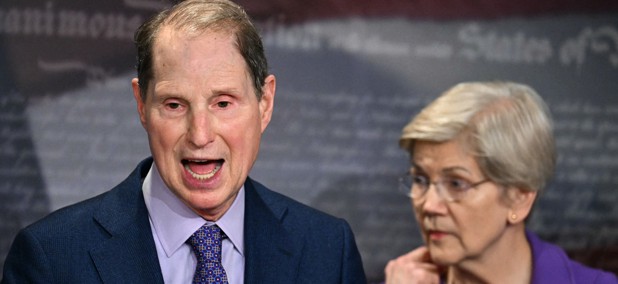
“These AI programs, which the agency deployed with little consultation with Congress, advocates, or other key stakeholders, appear to have been developed in haste and represent a troubling pattern that if continued, would significantly impede Americans’ ability to access their Social Security and Supplemental Security Income (SSI) benefits,” wrote Sens. Ron Wyden, D-Ore., Elizabeth Warren, D-Mass., Kirsten Gillibrand, D-N.Y., and Bernie Sanders, I-Vt.

SSA changed its policy of holding claims to run the anti-fraud checks in mid-May after Nextgov/FCW reported that the tool slowed retirement claim processing while only finding two claims out of over 110,000 with a high probability of being fraudulent. That fraud check was installed after DOGE and White House leaders repeated false claims about fraud on SSA phone lines.

“Only after significant public outcry did SSA decide to pare back its policy,” the letter — dated June 24 but publicly released July 1 — reads. “To date, SSA has yet to provide us any evidence or analysis demonstrating the need to change its policy from its pre-March anti-fraud measures.”

The letter also points to a new, AI-based chatbot on SSA’s national 1-800 number, which the agency plans to extend to field office numbers as well. News reports have detailed issues with the bot, like it not putting callers through to agents, as well as long wait times and disconnections before callers reach a real person.

“We have also received reports of service issues from constituents, advocates and key stakeholders, such as the chatbot responding to a different question than what the caller had asked or incorrectly disconnecting the call before the caller’s questions had been answered,” the letter reads.

The senators are asking for more information on the phone chatbot, including how SSA is evaluating it, as well as what AI the agency is planning to deploy this year.

But an agency spokesperson told Nextgov/FCW that SSA has been fully transparent — including via congressional briefings — around the use of AI on the 800 number, which is listed in the agency's publicly available AI inventory.

"The AI behind the question and answer bots simply matches the words the customer speaks with frequently asked questions. It does not generate the final response to callers questions," said SSA spokesperson Stephen McGraw, noting that the agency performs daily analytics and effectiveness can be impacted by factors like background noise or the quality of the connection.

Last week, the agency’s commissioner, Frank Bisignano, told lawmakers that he has a “technology agenda” for the agency as it sheds thousands of employees. The group of four senators appear skeptical.

“We highlight these recent cases to illustrate our concerns that the agency, under this administration, appears to be ill-equipped to develop and deploy AI,” the letter reads. “If SSA cannot learn from its mistakes in incorporating AI into basic telephone services for beneficiaries, we are concerned that SSA will make even bigger mistakes in incorporating AI into higher-risk tasks, particularly in roles that could jeopardize Americans’ financial security.”

]]>
02 Jul 15:06

FBI to move headquarters into Reagan Building, seemingly resolving decades-long fight

by Sean Michael Newhouse
The FBI and General Services Administration on Tuesday announced that the law enforcement agency would move its headquarters less than half a mile to the Ronald Reagan Building from its current downtown Washington, D.C., location, which has more than $300 million in deferred maintenance costs. 

“This is a historic moment for the FBI,” Bureau Director Kash Patel said in a statement. "Through our strong partnerships with members of Congress and GSA, we are ushering FBI Headquarters into a new era and providing our agents of justice a safer place to work. Moving to the Ronald Reagan Building is the most cost effective and resource efficient way to carry out our mission to protect the American people and uphold the Constitution."

Picking the location for a new FBI headquarters has been a decades-long pursuit that seemed to reach a conclusion during President Joe Biden’s administration when GSA, in 2023, selected a site in Greenbelt, Maryland, over one in Virginia, which prompted protests from the latter’s lawmakers as well as FBI leadership, who criticized the selection process

President Donald Trump, however, nixed those plans. Officials on Tuesday argued that building a new suburban campus for the FBI would be too time consuming and costly. 

GSA didn't immediately respond to questions regarding the timeline for such a move or if it would displace the Reagan Building’s current tenants, which include U.S. Customs and Border Protection and Environmental Protection Agency in addition to private organizations. FBI officials said that the Bureau didn't have anything further to share at this time. 

The Reagan Building previously housed the U.S. Agency for International Development, which the Trump administration has effectively eliminated

Patel told Fox News in May that the FBI would leave the J. Edgar Hoover building and move 1,500 employees outside of the National Capital Region.
 

[[Related Posts]]

]]>
01 Jul 12:29

Senator Blackburn Pulls Support for AI Moratorium in Trump’s ‘Big Beautiful Bill’ Amid Backlash

by Kate Knibbs
After critics called the bill a “get-out-of-jail-free card” for Big Tech that could make it nearly impossible to rein in social media platforms, Senator Marsha Blackburn killed her own compromise.
01 Jul 12:24

Texas politicians make headway in effort to wrench space shuttle from Smithsonian

by Robert Pearlman

A political effort to relocate the space shuttle Discovery from the Smithsonian to Space Center Houston has been merged with the so-called "One Big Beautiful Bill," a major economic and policy package now nearing a vote in the US Senate.

The "Bring the Space Shuttle Home Act," first introduced by Texas Senators Ted Cruz and John Cornyn in April, has now been added to the Senate's version of the bill championed by President Donald Trump. While the latter legislation primarily focuses on tax cuts and spending increases, the Senate Committee on Commerce, Science & Transportation, chaired by Cruz, added the retired orbiter's relocation as part of an additional $9.995 billion in funding for NASA's programs, including the return of astronauts to the Moon and sending humans to Mars.

"One of the things in the Big Beautiful Bill we're talking about, there's about a $10 billion appropriation for NASA," said Cornyn at a June 20 press conference at Space Center Houston. "We're optimistic that bill that started out as a beautiful bill in the House will become even more beautiful in the Senate this week."

Read full article

Comments

01 Jul 12:23

Drug cartel hacked FBI official’s phone to track and kill informants, report says

by Dan Goodin

The Sinaloa drug cartel in Mexico hacked the phone of an FBI official investigating kingpin Joaquín “El Chapo” Guzmán as part of a surveillance campaign “to intimidate and/or kill potential sources or cooperating witnesses,” according to a recently published report by the Justice Department.

The report, which cited an “individual connected to the cartel,” said a hacker hired by its top brass “offered a menu of services related to exploiting mobile phones and other electronic devices.” The hired hacker observed “'people of interest' for the cartel, including the FBI Assistant Legal Attache, and then was able to use the [attache's] mobile phone number to obtain calls made and received, as well as geolocation data, associated with the [attache's] phone."

“According to the FBI, the hacker also used Mexico City's camera system to follow the [attache] through the city and identify people the [attache] met with,” the heavily redacted report stated. “According to the case agent, the cartel used that information to intimidate and, in some instances, kill potential sources or cooperating witnesses.”

Read full article

Comments

01 Jul 12:21

Pay up or stop scraping: Cloudflare program charges bots for each crawl

by Ashley Belanger

Cloudflare is now experimenting with tools that will allow content creators to charge a fee to AI crawlers to scrape their websites.

In a blog Tuesday, Cloudflare explained that its "pay-per-crawl" feature is currently in a private beta. A small number of publishers and content creators will participate in the experiment. Each publisher will be able to set their own prices that bots must pay before scraping content, Cloudflare said.

Matthew Prince, CEO of Cloudflare, said the feature would ensure that the Internet as we know it will survive "the age of AI."

Read full article

Comments

01 Jul 11:22

Kristi Noem Secretly Took a Cut of Political Donations

by by Justin Elliott, Joshua Kaplan and Alex Mierjeski

by Justin Elliott, Joshua Kaplan and Alex Mierjeski

ProPublica is a nonprofit newsroom that investigates abuses of power. Sign up to receive our biggest stories as soon as they’re published.

In 2023, while Kristi Noem was governor of South Dakota, she supplemented her income by secretly accepting a cut of the money she raised for a nonprofit that promotes her political career, tax records show.

In what experts described as a highly unusual arrangement, the nonprofit routed funds to a personal company of Noem’s that had recently been established in Delaware. The payment totaled $80,000 that year, a significant boost to her roughly $130,000 government salary. Since the nonprofit is a so-called dark money group — one that’s not required to disclose the names of its donors — the original source of the money remains unknown.

Noem then failed to disclose the $80,000 payment to the public. After President Donald Trump selected Noem to be his secretary of the Department of Homeland Security, she had to release a detailed accounting of her assets and sources of income from 2023 on. She did not include the income from the dark money group on her disclosure form, which experts called a likely violation of federal ethics requirements.

Experts told ProPublica it was troubling that Noem was personally taking money that came from political donors. In a filing, the group, a nonprofit called American Resolve Policy Fund, described the $80,000 as a payment for fundraising. The organization said Noem had brought in hundreds of thousands of dollars.

There is nothing remarkable about a politician raising money for nonprofits and other groups that promote their campaigns or agendas. What’s unusual, experts said, is for a politician to keep some of the money for themselves.

“If donors to these nonprofits are not just holding the keys to an elected official’s political future but also literally providing them with their income, that’s new and disturbing,” said Daniel Weiner, a former Federal Election Commission attorney who now leads the Brennan Center’s work on campaign finance.

ProPublica discovered details of the payment in the annual tax form of American Resolve Policy Fund, which is part of a network of political groups that promote Noem and her agenda. The nonprofit describes its mission as “fighting to preserve America for the next generation.” There’s little evidence in the public domain that the group has done much. In its first year, its main expenditures were paying Noem and covering the cost of some unspecified travel. It also maintains social media accounts devoted to promoting Noem. It has 100 followers on X.

In a statement, Noem’s lawyer, Trevor Stanley, said, “Then-Governor Noem fully complied with the letter and the spirit of the law” and that the Office of Government Ethics, which processes disclosure forms for federal officials, “analyzed and cleared her financial information in regards to this entity.” Stanley did not respond to follow-up questions about whether the ethics office was aware of the $80,000 payment.

Stanley also said that “Secretary Noem fully disclosed all of her income on public documents that are readily available.” Asked for evidence of that, given that Noem didn’t report the $80,000 payment on her federal financial disclosure form, Stanley did not respond.

Before being named Homeland Security secretary, overseeing immigration enforcement, Noem spent two decades in South Dakota’s government and the U.S. House of Representatives, drawing a public servant’s salary. Her husband, Bryon Noem, runs a small insurance brokerage with two offices in the state. Between his company and his real estate holdings, he has at least $2 million in assets, according to Noem’s filing.

While she is among the least wealthy members of Trump’s Cabinet, her personal spending habits have attracted notice. Noem was photographed wearing a gold Rolex Cosmograph Daytona watch that costs nearly $50,000 as she toured the Salvadoran prison where her agency is sending immigrants. In April, after her purse was stolen at a Washington, D.C., restaurant, it emerged she was carrying $3,000 in cash, which an official said was for “dinner, activities, and Easter gifts.” She was criticized for using taxpayer money as governor to pay for expenses related to trips to Paris, to Canada for bear hunting and to Houston to have dental work done. At the time, Noem denied misusing public funds.

Noem’s personal company, an LLC called Ashwood Strategies, shares a name with one of her horses. It was registered in Delaware early in her second term as South Dakota governor, around 1 p.m. on June 22, 2023. Four minutes later, the nonprofit American Resolve Policy Fund was incorporated in Delaware too.

American Resolve raised $1.1 million in 2023, according to its tax filing. The group reported that it had zero employees, and what it did with that money is largely unclear.

Noem’s Ashwood Strategies received an $80,000 fundraising fee in 2023 for raising $800,000 for the nonprofit, according to the group’s tax filing. (Internal Revenue Service. Screenshot and highlights by ProPublica.)

In 2023, the nonprofit spent only about $220,000 of its war chest — with more than a third of that going to Noem’s LLC. The rest mostly went toward administrative expenses and a roughly $84,000 travel budget. It’s not clear whose travel the group paid for.

The nonprofit reported that it sent the $80,000 fundraising fee to Noem’s LLC as payment for bringing in $800,000, a 10% cut. A professional fundraiser who also raised money for the group was paid a lower rate of 7%.

In the intervening years, American Resolve has maintained a low public profile. In March, it purchased Facebook ads attacking a local news outlet in South Dakota, which had been reporting on Noem’s use of government credit cards. Noem’s lawyer did not answer questions about whether the group paid her more money after 2023, the most recent year for which its tax filing is available.

The nonprofit has an affiliated political committee, American Resolve PAC, that’s been more active, at least in public. Touting Noem’s conservative leadership under a picture of her staring off into the sky, its website said the PAC was created to put “Kristi and her team on the ground in key races across America.” Noem traveled the country last year attending events the PAC sponsored in support of Republican candidates.

American Resolve’s treasurer referred questions to Noem’s lawyer. In his statement, Noem’s lawyer said she “did not establish, finance, maintain, or control American Resolve Fund. She was simply a vender for a non-profit entity.”

While Noem failed to report the fundraising income Ashwood Strategies received on her federal financial disclosure, she did provide some other details. She described the LLC as involving “personal activities outside my official gubernatorial capacity” and noted that it received the $140,000 advance for her book “No Going Back.” The LLC also had a bank account with between $100,001 and $250,000 in it and at least $50,000 of “livestock and equipment,” she reported.

The fact that Ashwood Strategies is Noem’s company only emerged through the confirmation process for her Trump Cabinet post. South Dakota has minimal disclosure rules for elected officials, and Noem had not previously divulged that she created a side business while she was governor.

Noem’s outside income may have run afoul of South Dakota law, according to Lee Schoenbeck, a veteran Republican politician and attorney who was until recently the head of the state Senate. The law requires top officials, including the governor, to devote their full time to their official roles.

“There’s no way the governor is supposed to have a private side business that the public doesn’t know about,” Schoenbeck told ProPublica. “It would clearly not be appropriate.”

Noem’s lawyer said South Dakota law allowed her to receive income from the nonprofit.

Do you have any information we should know about Kristi Noem or other administration officials? Justin Elliott can be reached by email at justin@propublica.org and by Signal or WhatsApp at 774-826-6240. Josh Kaplan can be reached by email at joshua.kaplan@propublica.org and by Signal or WhatsApp at 734-834-9383.

01 Jul 00:00

Christmas comes early for Chevy Chase girl battling cancer

by Mennatalla Ibrahim

More than 270 homes decorated their properties for Saturday event with Santa, fire trucks

The post Christmas comes early for Chevy Chase girl battling cancer appeared first on Bethesda Magazine.

30 Jun 19:15

Effects of the Republican bill on your taxes

by Nathan Yau

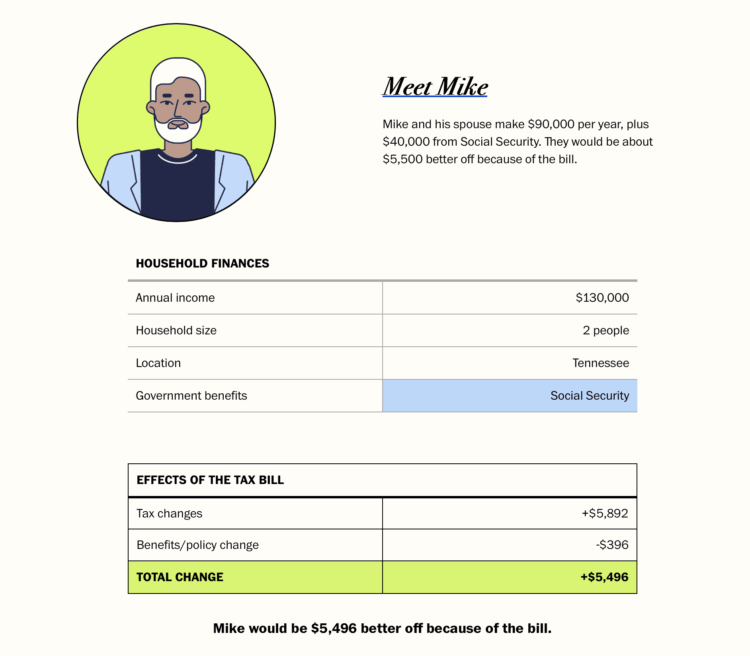
The tax bill, that seems to be on its way to passing, will affect people differently, based on income and household. The Washington Post shows concrete examples of the changes to an individual’s taxes.

I like the use of “profiles” to illustrate quick examples first. Then you can enter information for your own profile with income, state, filing status, and dependents to see how it affects you. The structure gives a point of reference to compare against.

Tags: bill, profiles, taxes, Washington Post

27 Jun 23:17

Mass layoffs likely to remain blocked, for now, thanks to a Supreme Court footnote

by Eric Katz
The Supreme Court on Friday limited individual judges’ capacity to strike down government policy on a nationwide basis, a decision with potentially far-reaching impacts on how federal agencies carry out their work. 

The high court left in place some carve outs, however, including one that could—at least temporarily—protect a judge’s ruling that is currently blocking the Trump administration from carrying out widespread layoffs. While the Trump administration applauded the Supreme Court’s decision and lamented the influence that lower-level judges have exerted over the president’s control of the federal workforce, attorneys who helped bring the lawsuit forward suggested it did not apply to the order preventing large-scale reductions in force. 

The 6-3 majority opinion in Trump V. CASA, which pertained to the president’s order to end birthright citizenship but did not yet rule on the merits of that case, found national, or “universal,” injunctions likely exceed the authority Congress bestowed upon the judiciary in 1789. Limiting injunctions narrowly to only the named plaintiffs in the case at hand, Justice Amy Coney Barrett said in the opinion, does make the relief it provides to those individuals any less complete. 

In a footnote of the opinion, however, Barrett added that nothing in the decision “resolves the distinct question whether the Administrative Procedure Act authorizes federal courts to vacate federal agency action.” District court judges in both the larger RIF injunction and one more specifically tailored to the Education Department relied in part on the APA to support their findings. 

“There is nothing in the decision that appears to undercut universal relief or vacature that you see under the Administrative Procedure Act, which is a statute that a number of the cases that have been brought against the administration to remedy their lawlessness [have] utilized,” said Skye Perryman, president of Democracy Forward, a group that has led legal challenges to many of the Trump administration’s polices and helped organize the lawsuits in the overall, and Education-specific, RIF cases. 

The APA protects Americans from "unlawful, arbitrary and capricious governmental action," Perryman added, noting the court was "quite clear" its curbing of nationwide injunctions would not apply to cases involving that law. She also pointed out the decision allows for broach-reaching injunctions when necessary to provide relief to plaintiffs on the case, and appeared to allow states to sue the federal government and receive injunctions on behalf of their citizens. The case challenging layoffs at 22 agencies applies to unions and other groups with members across the country, while the Education lawsuit was brought by 20 states. 

At the White House on Friday, President Trump and Justice Department officials spoke to reporters to celebrate the court’s decision and rebuke courts that have blocked Trump from carrying out his directives on a nationwide basis in 40 instances. The decisions, they said, created significant burdens across the administration, including as it has sought to shrink the federal workforce.  

“We had another stay of an order forcing reinstatement of fired executive branch employees, entirely within the president—and Article II—his right to do,” said Deputy Attorney General Todd Blanche. 

The larger RIF injunction has not yet required agencies to reinstate anyone, though it has at some agencies kept on the rolls employees who previously received layoff notices. The judge in the Education case has called on the Trump administration to reinstate employees to their jobs. Previous injunctions forced the Trump administration to reinstate recently hired federal employees agencies had fired en masse, but the Supreme Court already reversed those orders. 

Speaking to the larger implications of Friday’s decision, Attorney General Pam Bondi said the judiciary had attempted to “seize the executive branch’s power.” 

“It can no longer do that,” Bondi said. 

Perryman said it will be watching closely to see how the administration reacts in court to the Supreme Court’s decision. 

“It appeared as if the people from the Department of Justice, as well as the White House itself, is taking a very broad view of this ruling,” Perryman said. “And so we're going to monitor the cases as to what they may do.” 

The victory for federal employees, to the extent they can claim one after the Supreme Court's decision, may be short lived. The administration has already appealed both RIF cases to the court, where it is now awaiting resolution. It has done so seeking emergency relief and a decision is expected any day. 

Agencies across government have taken steps to swiftly implement layoffs if the Supreme Court rules in the administration’s favor.

]]>
27 Jun 23:16

SCOTUS upholds part of ACA that makes preventive care fully covered

by Beth Mole

The US Supreme Court on Friday upheld a key provision of the Affordable Care Act that requires health plans to fully cover many preventive health care services recommended by a federal panel.

The ruling means that tens of millions of Americans can continue getting a variety of preventive services for free under their plans. Those cost-free services include an array of screenings, such as cancer screenings like mammograms and colonoscopies, as well as screens for obesity, lead exposure in children, high blood pressure, diabetes, and some sexually transmitted diseases, to name a few. The free services also include recommended vaccines for children and adults, well-baby and well-child doctor visits, birth control, statins, PrEP HIV prevention drugs, and fluoride supplements and varnishes for children's teeth.

The ruling stems from a lawsuit brought by a group of conservative Christians, represented by Braidwood Management, who objected to having to cover PrEP medication, which they claim can "encourage and facilitate homosexual behavior."

Read full article

Comments

27 Jun 16:42

The Next Acetaminophen Tablet You Take Could Be Made From PET

by Fernanda González
This research could represent the first documented case of paracetamol production from plastic waste using E. coli bacteria.
27 Jun 16:38

Two Judges, Same District, Opposite Conclusions: The Messy Reality Of AI Training Copyright Cases

by Mike Masnick

Within days of each other, two federal judges in the same district reached completely opposite conclusions about AI training on copyrighted works. Judge William Alsup said it’s likely fair use as transformative. Judge Vince Chhabria said it’s likely infringing because of the supposed impact on the market. Both rulings came out of the Northern District of California, both involve thoughtful judges with solid copyright track records, and both can’t be right.

The disconnect reveals something important: we’re watching judges fixate on their personal bugbears rather than grappling with the fundamental questions about how copyright should work in the age of AI. It’s a classic case of blind men and an elephant, with each judge touching one part of the problem and declaring that’s the whole animal.

I just wrote about Judge Alsup’s careful analysis, which found that training AI was likely protected as fair use, but building an internal digital library on unlicensed downloaded works was probably not. Before that piece was even published, Judge Vince Chhabria came out with a ruling that disagrees.

The summary: AI training is likely infringing. But here, the plaintiff authors failed to present evidence, and thus, their case against Meta is dismissed. Ironically, Alsup’s ruling was probably a win for AI innovation but a loss for Anthropic. Chhabria’s is the opposite: a clear win for Meta, but potentially devastating for AI innovation generally.

Chhabria’s Flawed Market Harm Analysis

Chhabria’s ruling seems to overweight (and, I think incorrectly predict) the “effect on the market” aspect of the fair use analysis:

Because the performance of a generative AI model depends on the amount and quality of data it absorbs as part of its training, companies have been unable to resist the temptation to feed copyright-protected materials into their models—without getting permission from the copyright holders or paying them for the right to use their works for this purpose. This case presents the question whether such conduct is illegal.

Although the devil is in the details, in most cases the answer will likely be yes. What copyright law cares about, above all else, is preserving the incentive for human beings to create artistic and scientific works. Therefore, it is generally illegal to copy protected works without permission. And the doctrine of “fair use,” which provides a defense to certain claims of copyright infringement, typically doesn’t apply to copying that will significantly diminish the ability of copyright holders to make money from their works (thus significantly diminishing the incentive to create in the future). Generative AI has the potential to flood the market with endless amounts of images, songs, articles, books, and more. People can prompt generative AI models to produce these outputs using a tiny fraction of the time and creativity that would otherwise be required. So by training generative AI models with copyrighted works, companies are creating something that often will dramatically undermine the market for those works, and thus dramatically undermine the incentive for human beings to create things the old-fashioned way

I find this entire reasoning extremely problematic, and it’s why I mentioned in the Alsup piece that I don’t think the “effect of the use upon the market” should really be a part of the fair use calculation. Because any type of competition can lead fewer people to buy a different work. Or it can inspire people to actually buy more works because of more interest. Chhabria’s example here seems particularly… weird:

Take, for example, biographies. If a company uses copyrighted biographies to train a model, and if the model is thus capable of generating endless amounts of biographies, the market for many of the copied biographies could be severely harmed. Perhaps not the market for Robert Caro’s Master of the Senate, because that book is at the top of so many people’s lists of biographies to read. But you can bet that the market for lesser-known biographies of Lyndon B. Johnson will be affected. And this, in turn, will diminish the incentive to write biographies in the future.

This is where Chhabria’s reasoning completely falls apart. He admits in his own example that Robert Caro’s biography would be fine because “that book is at the top of so many people’s lists.” But that admission destroys his entire argument: people recognize that a good biography is a good biography, and AI slop—even AI slop generated from reading other good biographies—is not a credible substitute.

More fundamentally, his logic would make any learning from existing works potentially infringing.

If you go to Ford’s Theatre in DC, where Lincoln was shot and killed, you can actually see a very cool tower of every book they could find written about Lincoln. Under Chhabria’s reasoning, this abundance should have killed the market for Lincoln biographies decades ago. Instead, new ones keep getting published and finding audiences.

If any of the authors of any of those books read any of the other books, learned from them, and then wrote their own take which did not copy any of the protectable expression of the other books, would that be infringing? Of course not. Yet Chhabria’s analysis seems to argue that it would likely be so.

Or take magazine articles. If a company uses copyrighted magazine articles to train a model capable of generating similar articles, it’s easy to imagine the market for the copied articles diminishing substantially. Especially if the AI-generated articles are made available for free. And again, how will this affect the incentive for human beings to put in the effort necessary to produce high-quality magazine articles?

This argument would be more compelling if the internet hadn’t already been flooded with free content for decades. Plenty of the internet (including this very site) consists of freely available articles based on our reading and analysis of magazine articles. This hasn’t destroyed the market for original journalism—it’s just competition. And, indeed, some of that competition can actually increase the market for the original works as well. If I read a short summary of a magazine article, that may make me even more likely to want to read the original, professionally written one.

So I don’t find either of these examples particularly compelling, and am a bit surprised that Chhabria does. He does admit that other kinds of works are “murkier”:

With some types of works, the picture is a bit murkier. For example, it’s not clear how generative AI would affect the market for memoirs or autobiographies, since by definition people read those works because of who wrote them. With fiction, it might depend on the type of book. Perhaps classic works of literature like The Catcher in the Rye would not see their markets diminished. But the market for the typical human-created romance or spy novel could be diminished substantially by the proliferation of similar AI-created works. And again, the proliferation of such works would presumably diminish the incentive for human beings to write romance or spy novels in the first place.

Again, even his murkier claims seem weird. There are so many romance and spy novels out there, with more coming out all the time, and the fact that the market is flooded with such books doesn’t seem to diminish the demand for new ones.

This all feels suspiciously like the debunked arguments during the big internet piracy wars about how downloading music for free would magically make it so that no one wanted to make music ever again. The reality was actually quite different: the fact that the tools for production and distribution became much easier and more democratic, meant that more music than ever before was actually produced, released, distributed… and monetized in some form.

So the entire premise of Chhabria’s argument just seems… wrong.

The Alsup vs. Chhabria Split

Chhabria also takes a fairly dismissive tone on the question of transformativeness. And even though he likely wrote most of this opinion before Alsup’s became public, he adds in a short paragraph addressing Alsup’s ruling:

Speaking of which, in a recent ruling on this topic, Judge Alsup focused heavily on the transformative nature of generative AI while brushing aside concerns about the harm it can inflict on the market for the works it gets trained on. Such harm would be no different, he reasoned, than the harm caused by using the works for “training schoolchildren to write well,” which could “result in an explosion of competing works.” Order on Fair Use at 28, Bartz v. Anthropic PBC, No. 24-cv-5417 (N.D. Cal. June 23, 2025), Dkt. No. 231. According to Judge Alsup, this “is not the kind of competitive or creative displacement that concerns the Copyright Act.” Id. But when it comes to market effects, using books to teach children to write is not remotely like using books to create a product that a single individual could employ to generate countless competing works with a miniscule fraction of the time and creativity it would otherwise take. This inapt analogy is not a basis for blowing off the most important factor in the fair use analysis.

Here we see the fundamental disagreement: Alsup thinks transformativeness is the key factor; Chhabria thinks market impact trumps everything else. Both can’t be right, and the fair use four-factor test gives judges enough wiggle room to justify either conclusion.

Chhabria does agree that training LLMs is transformative:

This factor favors Meta. There is no serious question that Meta’s use of the plaintiffs’ books had a “further purpose” and “different character” than the books—that it was highly transformative. The purpose of Meta’s copying was to train its LLMs, which are innovative tools that can be used to generate diverse text and perform a wide range of functions. Cf. Oracle, 593 U.S. at 30 (transformative to use copyrighted computer code “to create a new platform that could be readily used by programmers”). Users can ask Llama to edit an email they have written, translate an excerpt from or into a foreign language, write a skit based on a hypothetical scenario, or do any number of other tasks. The purpose of the plaintiffs’ books, by contrast, is to be read for entertainment or education.

But he thinks market harm is more important—a conclusion that would gut much of fair use doctrine if applied consistently.

Also, while Alsup focused heavily on the unauthorized works that Anthropic downloaded and then stored in an internal “library” and Chhabria goes into great detail about how Meta used BitTorrent to download similar (and in some cases, identical) copies of books, he leaves for another day the question of whether that aspect is infringing.

Indeed, in some ways, these two cases represent the old claim that the fair use four factors is just an excuse to do whatever the judge wants to do and then try to work backwards to try to justify it in more legalistic terms using those for factors.

The Plaintiffs’ Spectacular Failure

Given all this, you might think that Chhabria ruled against Meta, but he did not, mainly because the crux of his opinion—that these AI tools will flood the market and diminish the incentives for new authors—is so ludicrous that the plaintiffs in this case barely even raised it as an issue and presented no evidence in support.

In connection with these fair use arguments, the plaintiffs offer two primary theories for how the markets for their works are affected by Meta’s copying. They contend that Llama is capable of reproducing small snippets of text from their books. And they contend that Meta, by using their works for training without permission, has diminished the authors’ ability to license their works for the purpose of training large language models. As explained below, both of these arguments are clear losers. Llama is not capable of generating enough text from the plaintiffs’ books to matter, and the plaintiffs are not entitled to the market for licensing their works as AI training data. As for the potentially winning argument—that Meta has copied their works to create a product that will likely flood the market with similar works, causing market dilution—the plaintiffs barely give this issue lip service, and they present no evidence about how the current or expected outputs from Meta’s models would dilute the market for their own works.

Given the state of the record, the Court has no choice but to grant summary judgment to Meta on the plaintiffs’ claim that the company violated copyright law by training its models with their books.

In short, the court’s ruling in this case is that the winning argument is the impact on the market, while the plaintiffs in this case focused on the claim that the outputs of AI tools trained on their works was infringing. But, Chhabria notes, that argument is silly.

The irony is delicious: Chhabria essentially handed the authors a roadmap for how to beat AI companies in future cases, but these particular authors were too focused on their other weak theories to follow it. It’s a clear win for Meta, but potentially devastating precedent for AI development generally.

What we’re watching is how the fair use four-factor test can be manipulated to justify almost any conclusion a judge wants to reach. Alsup prioritized transformativeness and found for fair use. Chhabria prioritized market harm and found against it (even while ruling for Meta on procedural grounds). Both wrote lengthy, seemingly reasoned opinions reaching opposite conclusions from largely similar facts.

This case isn’t settled. Neither is the broader question of AI training and copyright. We’re still years away from definitive answers, and in the meantime, companies and developers are left navigating a legal minefield where identical conduct might be fair use in one courtroom and infringement in another.

27 Jun 16:29

ACIP Shitshow: Panel Member Exits Due To Conflict Of Interests, All Childhood Vaccines Up For Debate

by Dark Helmet

Well, RFK Jr.’s reconstructed Advisory Committee on Immunization Practices (ACIP), just concluded its first day of meetings in Atlanta. This was over the objection of GOP Senator Bill Cassidy, who confirmed RFK Jr. to his appointment but called for a delay to ACIP’s meeting after Kennedy terminated all 17 panel members weeks ago and replaced them with 8 hand-picked members that have been described as unqualified for the role, as anti-vaxxers, or both. ACIP is really important, as the group’s guidance has typically been adopted by doctors when it comes to immunization schedules for Americans and by policy makers when it comes to standards for what health insurance providers must cover.

Most everyone expected ACIP’s meeting to be filled with vaccine skepticism, misinformation, and a departure from the scientific approach the panel has previously taken. Unfortunately, it’s so, so much worse.

Let’s start with the simple fact that only 7 members of the panel met, because one of them withdrew from the position over conflicts of interest, the very thing RFK Jr. said was the reason for disbanding the previous 17 member ACIP.

A member of the health secretary Robert F Kennedy Jr’s newly overhauled federal vaccine advisory panel withdrew after a conflict of interest review, a spokesperson has told the Guardian. Dr Michael Ross, who was involved in multiple private healthcare companies, withdrew after review of his financial holdings.

“Yesterday, Dr Michael Ross decided to withdraw from serving on ACIP during the financial holdings review,” a spokesperson for the Department of Health and Human Services (HHS) said. “The sacrifice to serve on ACIP varies from member to member, and we appreciate Dr Ross’s willingness to go through this rigorous process.”

What was the conflict of interest, you ask? Well, that should be easy enough to answer. See, Trump and Kennedy put together a whole webpage on the CDC.gov site with the sole purpose of making public any declared conflicts of interests by ACIP members made since the year of our lord 2,000. In the overview section of the page, it is made clear the webpage was created to “improve transparency about member conflicts of interest.”

None of Kennedy’s hand-picked ACIP members, including that of Dr. Ross, appear anywhere on that page. Transparency for thee, it seems, but not for he (Kennedy).

But if you thought such a black mark on the first day of meetings for ACIP would have dampened their anti-medicine spirit, you would be wrong. Everyone expected this blighted-version of ACIP to attack specific vaccines that were slated for discussion, namely the next round of flu vaccines due to the use of thimerosal to preserve multi-dose vials of the adult version of the shots, as well as RSV vaccines for children. And, while those attacks certainly did come from some panel members, ACIP thankfully ultimately voted to approve both vaccines for adults and children, with the caveat being that only single-dose shots should be given to children, which would be free of thimerosal.

But those specifics were overshadowed by the announcement that ACIP was going to globally review for assessment all vaccination schedules for both children and adults.

A federal vaccine panel entirely hand-selected by health secretary and anti-vaccine activist Robert F. Kennedy Jr. gathered for its first meeting Wednesday—and immediately announced that it would re-evaluate the entire childhood vaccination schedule, as well as the one for adults.

“In addition to studying and evaluating individual vaccines, it is important to evaluate the cumulative effect of the recommended vaccine schedule,” Kulldorff said. “This includes interaction effects between different vaccines, the total number of vaccines, cumulative amounts of vaccine ingredients, and the relative timing of different vaccines.”

This has already been studied. Extensively. As Ars notes, it’s all baked into the testing process for vaccines. During trials or testing, the vaccines are given along with the cumulative other vaccines that Kulldorff is talking about. Real world, real people stuff.

Not to mention all the other quackery that went on.

During the full-day meeting, the seven new members listened to CDC experts review data on COVID-19 vaccines and RSV vaccines and monoclonal antibodies. In the discussions, ACIP member Retsef Levi—who is an expert in operations management—made a puzzling critique that the CDC’s method for evaluating COVID-19 vaccine efficacy analysis didn’t account for “alternative” explanations like “the vaccine is actually making you more vulnerable for multiple viruses.”

Meanwhile, ACIP member Robert Malone—who has claimed to have invented mRNA vaccines and is proud to be called an “anti-vaxxer”—spread false misinformation that certain lots of COVID-19 vaccines were dangerous. ACIP member Vicky Pebsworth—a nurse who is on the board of an anti-vaccine organization—said she was “very concerned” that the CDC’s safety monitoring systems were not capturing all of the adverse events from vaccines and said the committee should have access to “data that we probably wouldn’t ordinarily have.” A CDC subject matter expert noted that there are published studies showing that the CDC’s safety monitoring systems capture a large majority of adverse events.

This is going to go precisely as you expect, for the most part, and exactly as Kennedy has willed it. That was the whole point of his hostile takeover of ACIP and his inputting a group of people ideologically aligned with his agenda. And it’s going to result in less immunization of the public, especially in children.

And that will lead, I’m sorry to say, to the filling of tiny little coffins.

27 Jun 16:26

‘Big Balls’ Is Now at the Social Security Administration

by Makena Kelly, Jake Lahut, Vittoria Elliott
Edward “Big Balls” Coristine’s placement at the SSA comes after a White House official told WIRED on Tuesday that the 19-year-old had resigned from his position in government.
27 Jun 16:26

US Supreme Court Upholds Texas Porn ID Law

by Matt Burgess
In a 6-3 decision, the Supreme Court held that age verification for explicit sites is constitutional. In a dissent, Justice Elena Kagan warned it burdens adults and ignores First Amendment precedent.
27 Jun 16:23

RFK Jr.’s CDC panel ditches some flu shots based on anti-vaccine junk data

by Beth Mole

The vaccine panel hand-selected by health secretary and anti-vaccine advocate Robert F. Kennedy Jr. on Thursday voted overwhelmingly to drop federal recommendations for seasonal flu shots that contain the ethyl-mercury containing preservative thimerosal. The panel did so after hearing a misleading and cherry-picked presentation from an anti-vaccine activist.

There is extensive data from the last quarter century proving that the antiseptic preservative is safe, with no harms identified beyond slight soreness at the injection site, but none of that data was presented during today's meeting.

The significance of the vote is unclear for now. The vast majority of seasonal influenza vaccines currently used in the US—about 96 percent of flu shots in 2024–2025—do not contain thimerosal. The preservative is only included in multi-dose vials of seasonal flu vaccines, where it prevents the growth of bacteria and fungi potentially introduced as doses are withdrawn.

Read full article

Comments

27 Jun 16:20

Supreme Court rules in favor of MCPS families in LGBTQ+ books opt-out case

by Ashlyn Campbell

Case likely to have far-reaching effects on public schools nationwide

The post Supreme Court rules in favor of MCPS families in LGBTQ+ books opt-out case appeared first on Bethesda Magazine.

26 Jun 18:38

More Than 90 Percent Of ICE Detainees Have Never Been Convicted Of Violent Crimes

by Tim Cushing

To call the administration’s “worst of the worst” claims a ruse is to give this administration too much credit. It’s not clever enough to run a con. Going after criminals was never the point during Trump’s first term. And mass deportation was the platform Trump ran on to get back to the Oval Office for this term.

Given the expectations, ICE was always going to fall short of arrest quotas if it restricted itself to actual lawbreakers. That’s why it’s casting a wider net, one that not only removes anyone looking vaguely Hispanic, but also people who happen to disagree with Trump or his policies.

And that’s why most of ICE’s high-profile raids have targeted businesses. This administration is creating a labor crisis with its shotgun approach to deportation, something that’s only going to aggravate current financial problems created by the administration’s shotgun approach to perceived trade deficits.

Who are we ejecting from this country at the rate of dozens of people per day? Hardworking, law-abiding migrants who’ve done nothing more than seek jobs, pay taxes, and carve out a better life for their loved ones. The government knows what it’s doing. After all, it already has all the evidence it needs to show its mass deportation program has nothing to do with making this nation safer or more secure.

David Blier has dug into the data for Cato, and here’s the upshot of this mass forced exodus.

As of June 14, ICE had booked into detention 204,297 individuals (since October 1, 2024, the start of fiscal year 2025). Of those book-ins, 65 percent, or 133,687 individuals, had no criminal convictions. Moreover, more than 93 percent of ICE book-ins were never convicted of any violent offenses. About nine in ten had no convictions for violent or property offenses. Most convictions (53 percent) fell into three main categories: immigration, traffic, or nonviolent vice crimes.

The pretense of making America safer has been discarded. America won’t get any safer, just as surely as it won’t get any greater under this president. For years, it’s been known that migrants commit fewer crimes than natural-born citizens. But with arrest numbers flagging after an initial, more-targeted surge, the administration made it clear it was time to hit the streets and round up any foreigners ICE might come across.

This shift in policy resulted from White House Deputy Chief of Staff Stephen Miller’s meeting at the end of May, when he ordered ICE to start arresting more non-criminals. “What do you mean you’re going after criminals?” he said. “Why aren’t you at Home Depot? Why aren’t you at 7‑Eleven?” 

ICE did indeed go to Home Depot. And for that, it’s now dealing with multiple weeks of unending protests, with the focal point being the Home Deport raid that occurred in Los Angeles.

It’s nothing more than a racist purge — something that can be ascertained even with incomplete data. As Blier points out, it’s difficult to get a complete picture on deportation efforts, now that the job has been split up between ICE, CBP, and the Border Patrol. But just looking at ICE’s numbers, it’s easy to see this isn’t about ejecting criminals. It’s about getting rid of non-white people.

Since the beginning of this year, ICE book-ins based on ICE arrests have increased nearly sixfold, from a daily average of 215 to over 1,100 per day.

As that number has exponentially increased, so has the percentage of migrants without criminal convictions, who now make up nearly three-quarters of all ICE detainees. And yet, many of these people will be routed to whatever hellhole might take them, whether it’s being stacked up in repurposed shipping containers in South Sudan or forced into general population at El Salvador’s CECOT.

And we possibly haven’t even seen the worst of this.

The White House has ordered ICE to meet an unreasonable quota of 3,000 arrests per day, a target they were nowhere near achieving as of June 14. 

Trump’s anger has been re-lit by incessant protests and an extremely low-energy birthday party. On top of all but declaring war on “Democrat” cities, Trump has ordered ICE to increase its deportations. At some point, the demands will outstrip the supply. That unavoidable fact — along with the administration’s blood lust for cruelty — increases the odds that actual citizens will be treated like disposable foreigners by people too busy to do the job right and too removed from any form of accountability to care.

25 Jun 21:51

Supreme Court Blesses Human Trafficking With No Explanation In Stunning Abandonment Of Rule Of Law

by Mike Masnick

The Supreme Court just gave the Trump administration a green light to traffic humans to random countries around the world—including war zones where migrants face torture, slavery, or death. And they did so while offering literally zero explanation for why this is legal or constitutional.

In a shadow docket ruling yesterday, the Court stayed a lower court order that required basic due process protections for people being shipped to third countries. No analysis of the complex legal issues. No acknowledgment that they’re rewarding the Trump regime for repeatedly violating court orders. Just: “go ahead and traffic people to Libya.”

This isn’t hyperbole. We’re talking about the US government grabbing people—some who entered legally seeking asylum—and shipping them to countries where they’ve never been, don’t speak the language, and face credible threats of violence. Some of those destination countries are actively selling migrants into slavery.

This non-ruling will go down in history as one of the most shameful and horrific rulings from the Supreme Court. We’re talking Dred Scott/Plessy v. Ferguson/Korematsu bad. An obviously horrific decision that attacks human rights and basic due process for no reason… and totally without explanation.

There is a righteous dissent from Justice Sotomayor that excoriates the majority for just how evil this decision is, and I was tempted to just post all of that as this post, but I fear this one requires some explanation.

The Background: How We Got To State-Sanctioned Human Trafficking

The legal backdrop makes this even more shocking. Just last month, the Supreme Court (for the second time) told the Trump DOJ it had to provide some level of “reasonable” due process to those being shipped to El Salvador under the Alien Enemies Act. For a brief moment, it seemed like even the conservatives recognized Trump’s lawlessness.

This case is a bit different. It involves people already deemed deportable. The question: can the US ship them literally anywhere in the world? Under existing law, the answer was yes—but with many limits and with guaranteed basic due process. Specifically, people facing “third country removal” had the right to a “reasonable fear” hearing where they could explain why being shipped to whatever random country the US picked might get them killed. And such removals were only supposed to take place if it was impossible to send them to countries they actually had a connection to.

This is actually important. While the issue of the US trafficking Venezuelans to El Salvador has been well covered, that was a deal with the Salvadoran government. There’s a separate issue of the US randomly shipping off people to a long list of dangerous countries, places where the people being shipped likely know no one, don’t know the language, and may be thousands of miles from anyone they do know. And some of those countries that the US is shipping people to are either war zones or engaged in selling migrants into slavery.

Even if you think immigration violations justify deportation, shipping people to countries where they face torture or slavery sounds like a crime against humanity. And many of these people entered legally seeking asylum—Trump has simply been revoking their status, another move the Court blessed a few weeks ago.

The Case: Government Defies Court Orders, SCOTUS Rewards Them

In this case (DHS v. D.V.D.), District Judge Brian Murphy had ordered DHS to provide basic due process before shipping people around the globe. The government’s response? It ignored him. Repeatedly. Remember Judge Murphy getting annoyed that DHS was shipping men to South Sudan? That was in violation of this restraining order. When he caught them lying about their removals, they kept lying.

Judge Murphy worked diligently to protect constitutional rights. The government thumbed its nose at him. And now the Supreme Court has rewarded that lawlessness.

The government not only gets away with ignoring Judge Murphy’s earlier order, it gets to effectively continue doing so. With no explanation as to why. This isn’t just horrific for due process and the people being trafficked this way, it’s a fucking insult to Judge Murphy who worked diligently to protect rights in this case.

Sotomayor’s Blistering Dissent Calls Out The Majority’s Cowardice

In matters of life and death, it is best to proceed with caution. In this case, the Government took the opposite approach. It wrongfully deported one plaintiff to Guatemala, even though an Immigration Judge found he was likely to face torture there. Then, in clear violation of a court order, it deported six more to South Sudan, a nation the State Department considers too unsafe for all but its most critical personnel. An attentive District Court’s timely intervention only narrowly prevented a third set of unlawful removals to Libya.

Rather than allowing our lower court colleagues to manage this high-stakes litigation with the care and attention it plainly requires, this Court now intervenes to grant the Government emergency relief from an order it has repeatedly defied. I cannot join so gross an abuse of the Court’s equitable discretion.

Basically, the government is doing something really obviously horrific and evil here, a lower court—somewhat heroically—stepped in to help, and the Supreme Court is saying “oh no, go ahead with the evil stuff.” It’s fucking crazy.

Sotomayor notes that these kinds of “third country removals” (i.e., to a country not of their origin nor where they have connections, but only “is willing to accept people the US removes”) are quite “burdensome” on the individuals involved and therefore extremely limited by law. That is, Sotomayor (unlike the majority of the court) recognizes that Congress has put significant conditions on such human trafficking, which the Trump regime is gleefully ignoring.

Noncitizens facing removal of any sort are entitled under international and domestic law to raise a claim under the Convention Against Torture and Other Cruel, Inhuman or Degrading Treatment or Punishment, Dec. 10, 1984, S. Treaty Doc. No. 100–20, 1465 U. N. T. S. 113. Article 3 of the Convention prohibits returning any person “to another State where there are substantial grounds for believing that he would be in danger of being subjected to torture.” The United States is a party to the Convention, and in 1998 Congress passed the Foreign Affairs Reform and Restructuring Act to implement its commands. The Act provides that “[i]t shall be the policy of the United States not to expel, extradite, or otherwise effect the involuntary return of any person to a country in which there are substantial grounds for believing the person would be in danger of being subjected to torture, regardless of whether the person is physically present in the United States.” §2242(a), 112 Stat. 2681–822, codified as note to 8 U. S. C. §1231. It also directs the Executive to “prescribe regulations to implement” the Convention. §2242(b), 112 Stat. 2681–822. Those regulations provide, among other things, that “[a] removal order . . . shall not be executed in circumstances that would violate Article 3.” 28 CFR §200.1 (2024).

The Pattern of Lawlessness

Sotomayor then details how DHS repeatedly ignored court orders not to send men subject to deportation to specific countries where they faced credible risks of significant harm. Sometimes it appeared to just outright ignore them. Other times it played games with courts, such as claiming that a temporary restraining order (TRO) against DHS removing someone to a certain country didn’t apply because the Defense Department, not DHS, handled the removal to that country.

As she notes:

The Government thus openly flouted two court orders, including the one from which it now seeks relief. Even if the orders in question had been mistaken, the Government had a duty to obey them until they were “‘reversed by orderly and proper proceedings.’” Maness, 419 U. S., at 459 (quoting United States v. Mine Workers, 330 U. S. 258, 293 (1947)). That principle is a bedrock of the rule of law. The Government’s misconduct threatens it to its core.

So too does this Court’s decision to grant the Government equitable relief. This is not the first time the Court closes its eyes to noncompliance, nor, I fear, will it be the last. See Trump v. J. G. G., 604 U. S. ___ (2025) (per curiam). Yet each time this Court rewards noncompliance with discretionary relief, it further erodes respect for courts and for the rule of law.

The sum total of the Roberts Court’s legacy is going to be “he completely wrecked any respect for the judiciary and the rule of law by making a mockery of it.” Each lawless move like this just makes and more people see the courts as illegitimate. And that’s doubly embarrassing after all of the effort Judge Murphy went through at the district court to make things work properly, despite a defiant Trump regime.

Emergency Relief For Whom?

And this raises the big question: the Supreme Court’s emergency docket is supposed to be used to put an immediate stop to something where there is imminent harm if they don’t. But here, the Court is doing the opposite. The irreparable, and possibly catastrophic, harms are being allowed to move forward, with no evidence of any real harm to the US. As Sotomayor notes:

In light of the Government’s flagrantly unlawful conduct, today’s decision might suggest the Government faces extraordinary harms. Yet even that is not the case. Rather, following a recent trend, the Court appears to give no serious consideration to the irreparable harm factor. See, e.g., id., at ___ (slip op., at ___); SSA v. AFSCME, 605 U. S. ___ (2025). Without a showing that a stay is necessary to avoid irreparable harm, however, this Court’s midstream intervention is inexcusable.

Besides the facially absurd contention that the Executive is “irreparabl[y]” harmed any time a court orders it temporarily to refrain from doing something it would like to do, see Application for Stay of Injunction 37, the Government has identified no irreparable harm from the challenged preliminary injunction.

The DOJ tried to claim irreparable harm because Judge Murphy told the government it could (voluntarily!) conduct the reasonable fear interviews in Djibouti (where the plane carrying some of the men was forced to land). Yet, as Sotomayor points out, that particular issue wasn’t even appealed by the DOJ and it was an option granted to the government after it requested it as an alternative to bringing the men back to the US (which it should have been forced to do because flying the men to South Sudan violated the existing TRO):

Instead, the Government locates the source of its injury in the District Court’s efforts to provide relief to the class members in South Sudan. Id., at 37–39. That argument is misguided. First, the District Court’s remedial orders are not properly before this Court because the Government has not appealed them, nor sought a stay pending a forthcoming appeal. Second, the court adopted the narrowest possible remedy, allowing the Government itself to choose whether it would return the class members to the United States or provide them with process where they are held. Finally, the Government is in every respect responsible for any resulting harms. Had it complied with the preliminary injunction, no followup orders would have been necessary, nor would the Government have faced a “sudden need . . . to detain criminal aliens” abroad. Id., at 39. It does not face such “need” today, as it can return the noncitizens it wrongfully removed at any time. No litigant, not even the Government, may “satisfy the irreparable harm requirement if the harm complained of is self-inflicted.”

But the plaintiffs in this case clearly face very real and immediate harms:

For their part, the plaintiffs in this case face extraordinary harms from even a temporary grant of relief to the Government. A. A. R. P. v. Trump, 605 U. S., at ___ (slip op., at 4) (recognizing detainees’ interests against removal are “particularly weighty”). The Government has made clear in word and deed that it feels itself unconstrained by law, free to deport anyone anywhere without notice or an opportunity to be heard. The episodes of noncompliance in this very case illustrate the risks. Thirteen noncitizens narrowly escaped being the target of extraordinary violence in Libya; O. C. G. spent months in hiding in Guatemala; others face release in South Sudan, which the State Department says is in the midst of “‘armed conflict’” between “‘ethnic groups.’” N. 2, supra. Only the District Court’s careful attention to this case prevented worse outcomes. Yet today the Court obstructs those proceedings, exposing thousands to the risk of torture or death.

When put that way, it feels like the kind of thing a Supreme Court is supposed to stop, not reverse a lower court on without explanation.

Sotomayor then points out the pure insanity of this decision:

Given its conduct in these proceedings, the Government’s posture resembles that of the arsonist who calls 911 to report firefighters for violating a local noise ordinance.

The Legal Arguments Are Nonsensical Too

Even worse, she notes, if you get past the procedural stuff, the merits argument by the government is nonsensical as well. She calls out some of it as “absurd.”

Ultimately, the Government says, the plaintiffs in this case object to their removal. So, they should bring their challenges in a petition for review of an order of removal. Yet the Government also claims that it need not issue or reopen any orders of removal before deporting someone to a third country. That is part of the problem plaintiffs seek to remedy: Without an applicable order of removal, they have no way to raise their claims under the Convention. In the end, then, the Government’s view is that the only way to challenge its refusal to provide orders of removal is to appeal those (nonexistent) orders. That is absurd.

Even worse, under the government’s argument, these plaintiffs get no due process rights at all—which would also be a totally absurd scenario:

Even if the Government could establish that its enjoined actions (of providing no notice or process) are integral to the “operation” of §1231(b), that in turn would raise a “‘serious constitutional question.’” Webster v. Doe, 486 U. S. 592, 603 (1988). That is because, as the Government reads it, §1252(f )(1) threatens to nullify plaintiffs’ procedural due process rights entirely. Recall that the Government claims it may remove noncitizens in the space of 15 minutes. See supra, at 4. Such noncitizens cannot practicably file individual lawsuits to vindicate their due process rights. After all, they will not know of the need to file a claim until they are on a bus or plane out of the country. Nor will their counsel, whom the Government refuses to notify. The Government can hardly expect every deportable noncitizen to file a pre-emptive lawsuit. Thus, if §1252(f )(1) precludes classwide vindication of the right to notice and due process under these circumstances, then it effectively nullifies those rights.

It is that kind of lawlessness that the Supreme Court blessed yesterday.

WITHOUT EXPLANATION.

Then there’s the Administrative Procedure Act issue, where Sotomayor again points out that the government’s interpretation of the law effectively wipes out large segments of the statute:

That leaves, finally, the merits of plaintiffs’ underlying APA and due process claims. Begin with the statutory and regulatory scheme governing removal. In the Government’s view, once a noncitizen has been found removable, she can effectively be removed anywhere at any time. That view would render meaningless the countless statutory and regulatory provisions providing for notice and a hearing. See, e.g., 8 U. S. C. §1229(a)(1) (“In removal proceedings under section 1229a . . . written notice . . . shall be given . . . to the alien or to the alien’s counsel of record”); 8 CFR §1240.10(f ) (2024) (in removal hearing, the Immigration Judge “shall . . . identify for the record a country, or countries in the alternative, to which the alien’s removal may be made”); §241.8(e) (when a removal order is reinstated after a noncitizen illegally reenters the country, noncitizen who “expresses a fear of returning to the country designated in that order” must be given an interview (emphasis added)); 8 U. S. C. §§1228(b)(1)–(3) (noncitizens determined removable due to felony conviction must be given notice under §1229(a) and 14 days “to apply for judicial review”); 8 CFR §238.1(b)(2) (requiring notice to noncitizens removable due to felony convictions).

The Government asserts that it need only comply with these provisions once, for the first removal proceeding, and can disregard them afterwards. The consequence of that view is that what happens in removal proceedings simply does not matter. The Government could designate any location in its initial order, lose before the immigration judge, decline to appeal, and promptly thereafter deport the noncitizen to a country of the Government’s choosing. Indeed, that is precisely what happened in O. C. G.’s case.

In other words, the Trump regime is deliberately defying the law:

Where did the Government find the authority to disregard Congress’s carefully calibrated scheme of immigration laws? It does not argue the third-country removal statute provides it. See Application for Stay of Injunction 13. Instead, the Government simply falls back on the Executive’s implied authority in this field. Yet “the President must comply with legislation regulating or restricting the transfer of detainees” even in “wartime.”

But, Sotomayor points out, you can’t just ignore the law like that:

It is a “‘cardinal principle of statutory construction,’” moreover, that statutes should be construed so that “‘no clause, sentence, or word shall be superfluous, void, or insignificant.’” TRW Inc. v. Andrews, 534 U. S. 19, 31 (2001). Here the Government construes the statute’s lack of “a particular process for carrying out” third-country removals, Application for Stay of Injunction 13, as conveying near-unlimited power to the Executive, rendering the remaining statutory scheme “‘void . . . or insignificant.’” TRW, 534 U. S., at 31. To make this claim is to ignore the clear statutory command that notice and a hearing must be provided. See supra, at 15. The Government cannot show a likelihood of success on plaintiffs’ statutory and regulatory claims, nor can it defend the lawfulness of its no-notice removals.

Even if Trump can ignore Congress, Sotomayor wonders how the Supreme Court can possibly bless his regime ignoring the Fifth Amendment’s promise of due process:

Turning to the constitutional claim, this Court has repeatedly affirmed that “ ‘the Fifth Amendment entitles aliens to due process of law’ in the context of removal proceedings.” J. G. G., 604 U. S., at ___ (slip op., at 3); A. A. R. P., 605 U. S., at ___ (slip op., at 3). Due process includes reasonable notice and an opportunity to be heard. Mullane v. Central Hanover Bank & Trust Co., 339 U. S. 306, 314 (1950). Of course the Government cannot avoid its obligation to provide due process “in the context of removal proceedings,” J. G. G., 604 U. S., at ___ (slip op., at 3), by skipping such proceedings entirely and simply whisking noncitizens off the street and onto busses or planes out of the country.

[….]

The Government barely disputes these basic principles. Instead, it obfuscates the issue by asserting that some (perhaps “many”) members of the class should be treated as if they never entered the United States. Application for Stay of Injunction 33–34. Yet even if that were true as to some class members, it could show at most that the class might be too broadly defined, not that the Government is likely to succeed on the constitutional merits.

As she concludes, due process is a core component of the rule of law. And here the majority is tossing it in the wood chipper with nary an explanation.

The Due Process Clause represents “the principle that ours is a government of laws, not of men, and that we submit ourselves to rulers only if under rules.” Youngstown Sheet & Tube Co. v. Sawyer, 343 U. S. 579, 646 (1952) (Jackson, J., concurring). By rewarding lawlessness, the Court once again undermines that foundational principle. Apparently, the Court finds the idea that thousands will suffer violence in farflung locales more palatable than the remote possibility that a District Court exceeded its remedial powers when it ordered the Government to provide notice and process to which the plaintiffs are constitutionally and statutorily entitled. That use of discretion is as incomprehensible as it is inexcusable.

Some of the plaintiffs in the case quickly asked Judge Murphy for a new TRO and—interestingly!—he quickly responded that such an order is not necessary because (as Sotomayor noted above) the specific orders regarding the men illegally shipped towards South Sudan, and currently held in Djibouti, was not appealed! This ruling may apply to others, but the current order regarding these men stands:

The Court’s May 21, 2025 Order on Remedy, Dkt. 119, remains in full force and effect, notwithstanding today’s stay of the Preliminary Injunction. DHS v. D.V.D., No. 24A1153, slip op. at 12 (S. Ct. Jun. 23, 2025) (Sotomayor, J., dissenting) (“[T]he District Court’s remedial orders [were] not properly before [the Supreme] Court because the Government has not appealed them, nor sought a stay pending a forthcoming appeal.”).

I imagine the DOJ will challenge that, and tragically the Supreme Court may be on their side.

What This Means Going Forward

The Supreme Court just taught the Trump administration—and every future administration—a valuable lesson: you can ignore court orders with impunity as long as you appeal to the right justices. Why bother following district court rulings when you know the Supreme Court will bail you out without even requiring an explanation?

This isn’t just about immigration. It’s about the fundamental principle that government officials must follow court orders until they’re properly overturned. By rewarding DHS’s blatant defiance, the Court has opened the floodgates. What’s to stop Trump from ignoring the next judge who tries to block his policies? Or the judge after that?

And that shouldn’t take away from the fact that the human cost will be immediate and devastating. Right now, people are sitting in detention centers knowing they could be shipped to Libya, South Sudan, or any other country the administration picks—with no meaningful chance to explain why that might get them killed. Some will disappear into war zones. Others will be sold into slavery. And five or six justices couldn’t be bothered to write a few paragraphs explaining why this is legal.

This decision completes the Roberts Court’s long-term transformation from a judicial body into a partisan enabler of authoritarian rule. Each time they reward lawlessness with their assent, they make clear that the rule of law only applies to those without political connections to the right people.

Judge Murphy tried to do his job. He followed the law, protected constitutional rights, and demanded basic due process. For his efforts, he got a Supreme Court that essentially told him to shut up and get out of the way while the government traffics humans around the globe.

That’s not justice. That’s not law. That’s just power protecting power while people die.

25 Jun 20:38

Ted Cruz can’t get all Republicans to back his fight against state AI laws

by Jon Brodkin

A Republican proposal to penalize states that regulate artificial intelligence can move forward without requiring approval from 60 senators, the Senate parliamentarian decided on Saturday. But the moratorium on state AI laws did not have unanimous Republican support and has reportedly been watered down in an effort to push it toward passage.

In early June, Sen. Ted Cruz (R-Texas) proposed enforcing a 10-year moratorium on AI regulation by making states ineligible for broadband funding if they try to impose any limits on development of artificial intelligence. While the House previously approved a version of the so-called "One Big Beautiful Bill" with an outright 10-year ban on state AI regulation, Cruz took a different approach because of the Senate rule that limits inclusion of "extraneous matter" in budget reconciliation legislation.

Under the Senate's Byrd rule, a senator can object to a potentially extraneous budget provision. A motion to waive the Byrd rule requires a vote of 60 percent of the Senate.

Read full article

Comments

25 Jun 20:37

Key fair use ruling clarifies when books can be used for AI training

by Ashley Belanger

Artificial intelligence companies don't need permission from authors to train their large language models (LLMs) on legally acquired books, US District Judge William Alsup ruled Monday.

The first-of-its-kind ruling that condones AI training as fair use will likely be viewed as a big win for AI companies, but it also notably put on notice all the AI companies that expect the same reasoning will apply to training on pirated copies of books—a question that remains unsettled.

In the specific case that Alsup is weighing—which pits book authors against Anthropic—Alsup found that "the purpose and character of using copyrighted works to train LLMs to generate new text was quintessentially transformative" and "necessary" to build world-class AI models.

Read full article

Comments

24 Jun 17:34

Satellite imagery shows avoided nuclear reactors in Iran

by Nathan Yau

Jonathan Tirone, reporting for Bloomberg:

Notably absent from the latest International Atomic Energy Agency’s damage report are three research reactors operating at the Isfahan Nuclear Technology and Research Center. One of the so-called miniature neutron source reactors, made by China in 1991, runs on 900 grams (2 pounds) of bomb-grade uranium.

It seems we’re going to see more satellite imagery in the coming weeks.

Tags: Bloomberg, Iran, nuclear, satellite imagery

24 Jun 15:46

Sneak peek: Rockville Wegmans nears Wednesday opening

by Elia Griffin

Store was bustling Monday as employees stocked shelves, prepared fresh foods, produce

The post Sneak peek: Rockville Wegmans nears Wednesday opening appeared first on Bethesda Magazine.

23 Jun 18:22

Recycled Polyester Saved This American Factory. Environmentalists Hate It

by Alden Wicker
Unifi survived competition from China by helping fashion brands meet sustainability goals. But not everyone agrees that its polyester made from recycled plastic bottles should be produced in the US.
22 Jun 17:24

Eli Lilly’s Obesity Pill Appears to Work as Well as Injected GLP-1s

by Emily Mullin
New data from a Phase 3 trial show that the daily anti-obesity pill may be as safe and effective as drugs like Mounjaro and Ozempic for weight loss and lowering blood sugar.
20 Jun 15:26

Salt Typhoon Hack Keeps Getting Worse, Telecoms Tell Employees To Stop Looking For Evidence Of Intrusion

by Karl Bode

Late last year, eight major U.S. telecoms were the victim of a massive intrusion by Chinese hackers who managed to spy on public U.S. officials for more than a year. The “Salt Typhoon” hack was so severe, the intruders spent a year rooting around the ISP networks even after discovery. AT&T and Verizon, two of the compromised companies, apparently didn’t think it was worth informing subscribers this happened.

Like most hacks, the scale of the intrusion was significantly worse than originally stated. Last week, insiders told NextGov that Comcast and data center giant Digital Realty were also caught up in the hack and had their systems compromised. The same insiders stated that government officials still aren’t really sure that they have a full grasp on the attack’s impact:

“Various agencies across the U.S. government are in possession of lists of confirmed or potential victims, but it’s not clear if the tallies are consistent with each other, adding to confusion about who may have been accessed, targeted or marked for investigation, one of the people said.”

But it’s this little bit in the report that I thought was of particular note:

“Inside two major U.S. telecom operators, incident response staff have been instructed by outside counsel not to look for signs of Salt Typhoon, said one of the people, declining to name the firms because the matter is sensitive.”

So big telecoms are so afraid of liability and government oversight they’ve just stopped looking for evidence of intrusion in one of the worst hacks the U.S. has ever seen. That’s sure to fix the problem.

The U.S. business press covering the hack refuse to talk about it, but a major catalyst for the hack was the steady and mindless deregulation of the U.S. telecom sector. Libertarians and right wingers, “free market” think tanks in tow, spent the better part of the last thirty years insisting that gutting all meaningful state and federal oversight would result in vast, near-Utopian outcomes.

Instead, freed of both pesky competition and competent oversight, major U.S. telecoms saw zero incentive to compete on price, shore up spotty access, improve quality, or even consistently, adequately invest in privacy and security standards. The results are everywhere you look, from sloppy handling of consumer location data, to companies like T-Mobile being hacked eight times in five years.

And this was all before the Trump 2.0 authoritarians came to town. Now, we’re disemboweling our telecom and cybersecurity regulators at a much faster rate, stocking our regulators with weird, incompetent, and unqualified zealots, and building a court system in which it’s genuinely impossible for telecom giants to see any sort of real-world accountability for fraud or incompetence.

Again, the second Trump administration is utterly indistinguishable from a foreign attack. Because it’s dressed up in so much domestic religious and pseudo-populist propaganda and bullshit, it’s in many ways worse.