Shared posts

18 Aug 00:44

The Trade Deal Coup

by Mike Brock

As the Jeffrey Epstein scandal continues apace, and MAGA grapples with the gaslit reality they live in, the Trump Administration continues to negotiate so-called trade deals, which are negotiated and implemented using pure executive fiat, under emergency powers, under an emergency declaration which has no rational basis, while everyone pretends this isn’t an example of a constitutional coup. It’s actually an exercise in sedition, if one were to avoid putting a finer point on it.

The mechanism is breathtakingly brazen: declare a fake national emergency, invoke emergency trade powers designed for genuine crises, bypass Congress entirely, and conduct billions of dollars in international agreements through personal presidential decree. When Japan agrees to invest $550 billion based on Trump’s “Strategic Trade Agreement,” they’re being asked to legitimize constitutional fraud that exists only through Trump’s personal authority rather than constitutional process.

Our allies aren’t stupid. They understand perfectly that what Trump is doing is illegal. The Constitution explicitly grants Congress the power “to regulate Commerce with foreign Nations”—not the president. Foreign governments have constitutional lawyers who can read Article I, Section 8 as clearly as anyone. They know there is no emergency, no “unusual and extraordinary threat” that justifies bypassing Congress to negotiate trade policy through executive decree. They must be horrified by how few Americans seem to care that their government operates through systematic constitutional violation.

They’re also not holding out hope that the Supreme Court’s conservative majority, with its expansive view of executive authority, will do much to stop this constitutional arson. Foreign leaders understand that when courts create doctrines of presidential immunity and presumptive constitutionality, they’re watching American institutions actively eliminate their own constraints rather than enforce them.

Congress could terminate these fraudulent emergencies at any time under the National Emergencies Act. Instead, Republican leaders have chosen to become active accomplices in constitutional destruction. They literally suspended the flow of time itself—declaring that calendar days would not constitute calendar days—to avoid voting on Trump’s fake emergency tariffs. When that proved insufficient, Speaker Mike Johnson simply shut down the People’s House entirely to prevent oversight votes. Senator Markwayne Mullin confessed the conspiracy on the House floor: “What we’re simply trying to do here is give President Trump cover.”

This demonstrates what a fundamentally unserious country we’ve become, with a political economy increasingly designed toward the maintenance of Trump’s personal power rather than constitutional governance. These vulgar arsonists in Congress have voluntarily transformed from co-equal branch into presidential protection service, abandoning their constitutional duties to serve one man’s authority. Every avoided vote, every suspended timeline, every shutdown of democratic process serves the same seditious purpose: eliminating constitutional constraints on executive power.

Foreign governments make contingency plans that don’t depend on American institutional reliability because American institutions have demonstrated they are no longer reliable. When your legislature suspends time to avoid constitutional duties, when your president conducts policy through fake emergencies, when your courts create immunity doctrines that make accountability impossible—you signal to the world that constitutional government has ceased to function.

Every trade deal negotiated through fake emergency powers establishes irreversible precedent that the presidency can operate beyond constitutional constraint by simply declaring emergencies. Trump has converted emergency powers designed to protect the republic into tools for dismantling republican government itself, while Congress provides the accelerant and courts provide the legal cover.

This is sedition: the systematic subversion of constitutional government by those sworn to preserve it. The American republic is being destroyed by constitutional arsonists who have discovered that the most effective way to eliminate democratic constraints is to declare them emergencies that require bypassing democracy itself. Our allies watch in horror as we demonstrate the complete transformation of American governance from constitutional republic to personal rule.

The United States is today one of the most corrupt countries in the world, as a result of the results of our election last November.

The center cannot hold when those charged with holding it have chosen to burn it down instead.

“If destruction be our lot, we must ourselves be its author and finisher. As a nation of freemen, we must live through all time, or die by suicide.” — Abraham Lincoln

Mike Brock is a former tech exec who was on the leadership team at Block. Originally published at his Notes From the Circus.

11 Aug 20:04

Mastercard Claims NSFW Game Bans Aren’t From Them, Valve Explains How Mastercard Launders Its Control

by Timothy Geigner

This whole attempted censorship of adult games on gaming platforms is becoming a thing. Collective Shout—a group out of Australia that wraps itself in a feminist flag while behaving like the religious right to get anything it doesn’t like out of the video game industry—put on a pressure campaign with payment processors, writing in to demand that processing companies stop working with the likes of itch.io and Steam over games on those platforms the group has decided are unacceptable. Couched in the claim that the group was primarily going after games that focused on horrid things like “rape” and “incest,” the end result was those two platforms delisting or deindexing all kinds of adult games that either don’t include that type of content or—and here’s why free speech is tricky—approach those topics not to promote them, but to grapple with the horrors of them in an artistic manner.

Notably, far from any cries that these platforms be more focused in their approach, Collective Shout merely cheered on the fallout, illuminating what the actual goal is here: to make game platforms more puritanical through bully campaigns. These are, it seems, the same people going on book-banning crusades that ensare such smut as Calvin & Hobbes comics.

Well, pressure campaigns can work in both directions, as it did in this case. Credit card companies began getting flooded with calls and emails from the public complaining about these puritanical attempts to suppress video games. It’s only been a few days of this, but apparently it’s gotten bad enough that Mastercard put out some messaging pushing back on the idea that it had demanded these changes of gaming marketplaces.

Mastercard has broken its silence after being thrust into the middle of a gaming culture war between anti-porn advocates and anti-censorship activists. While Valve previously laid blame for a recent purge of adult sex games from Steam at the feet of “payment processors and their related card networks and banks,” Mastercard released a statement on Friday denying any responsibility for a new wave of censorship that’s recently led some gamers to flood payment company call centers with complaints.

“Mastercard has not evaluated any game or required restrictions of any activity on game creator sites and platforms, contrary to media reports and allegations,” the company wrote in a statement published on its website on August 1. “Our payment network follows standards based on the rule of law. Put simply, we allow all lawful purchases on our network. At the same time, we require merchants to have appropriate controls to ensure Mastercard cards cannot be used for unlawful purchases, including illegal adult content.”

Got it? Mastercard is not involved in the evaluation of games or their content and has not instituted any new rules beyond those that have always existed, namely that payment may only be collected and processed for “lawful purchases.” Summarizing that statement in plain language would look something like: “Nothing has changed on our end. If a purchase is legal, it’s fine by us.”

Now, that’s demonstrably false, of course. Mastercard has built a prudish reputation for itself in multiple instances, be it pressuring OnlyFans a couple of years back, banning VPN providers, as well as its crusade against Wikileaks.

But this is slightly different. In this case, according to Valve at least, Mastercard is just playing word games.

“Mastercard did not communicate with Valve directly, despite our request to do so,” Valve’s statement sent over email to Kotaku reads. “Mastercard communicated with payment processors and their acquiring banks.  Payment processors communicated this with Valve, and we replied by outlining Steam’s policy since 2018 of attempting to distribute games that are legal for distribution.  Payment processors rejected this, and specifically cited Mastercard’s Rule 5.12.7 and risk to the Mastercard brand.”

Rule 5.12.7 states, “A Merchant must not submit to its Acquirer, and a Customer must not submit to the Interchange System, any Transaction that is illegal, or in the sole discretion of the Corporation, may damage the goodwill of the Corporation or reflect negatively on the Marks.”

It goes on, “The sale of a product or service, including an image, which is patently offensive and lacks serious artistic value (such as, by way of example and not limitation, images of nonconsensual sexual behavior, sexual exploitation of a minor, nonconsensual mutilation of a person or body part, and bestiality), or any other material that the Corporation deems unacceptable to sell in connection with a Mark.”

So, two things to say here. The first is that, whatever your moral stances may be and no matter how they align with Mastercard’s rules above, that rule is a far cry from “if it’s lawful, it’s all good.” Instead, it’s more like “If it’s lawful, it’s all good…unless we determine it’s either offensive or isn’t artistic enough for our tastes.”

Now I could carve out examples of how Mastercard doesn’t come close to enforcing its own rule in the video game space all day. After all, I’m pretty sure I’ve “mutilated a person or body part” in roughly a zillion video games and that the NPCs in question didn’t give me consent to do so. That’s called combat and it’s in a ton of games that you can purchase with a Mastercard. But let’s take a more extreme example within the rule: bestiality. It’s one of those things that sounds like an obvious thing to say: you can’t use a Mastercard to buy a good, service, or image that includes bestiality. But I bought Baldur’s Gate 3 with my own Mastercard on Steam and, as is famously known, the game has a mildly explicit scene in which you, to borrow a headline, “Bang The Bear.” This isn’t to say that BG3‘s scene should be labeled “bestiality” (the bear is actually a druid that transforms into a bear), but it certainly could be.

But the second point is more fun to make compared with highlighting Mastercard’s lies and hypocrisy. Mastercard claimed innocence over the adult games purge by stating it didn’t directly talk to game marketplaces about any of this. But, while that is likely true in a technical sense, all it’s doing is pointing out that the company isn’t even secure enough in its own rules to enforce them directly and publicly and instead are laundering its morality stances through its network of partner processing companies.

The end result is the same: run afoul of these rules from Mastercard and enforced by Mastercard through its processor network and a game marketplace can lose its payment processing partnerships with Mastercard’s network. It’s a complete non-denial and, honestly, of no material use. The outcome is the outcome and it’s clear that Mastercard’s network is in fact doing all of this at Mastercard’s request.

And all for some Aussie puritans that want to foist their morality on everyone else? C’mon, credit card companies. What’s the point of amassing hundreds of billions of dollars in market cap if you can’t tell some zealots to fuck all the way off once in a while?

10 Aug 22:07

In trial, people lost twice as much weight by ditching ultraprocessed food

by Beth Mole

In a small randomized controlled trial, people lost twice as much weight when their diet was limited to minimally processed food compared to when they switched to a diet that included ultraprocessed versions of foods but was otherwise nutritionally matched.

The trial, published in Nature Medicine by researchers at University College London, adds to a growing body of evidence that food processing, in addition to simple nutrition content, influences our weight and health. Ultraprocessed foods have already been vilified for their link to obesity—largely through weaker observational studies—but researchers have struggled to shore up the connection with high-quality studies and understand their impact on health.

The ultraprocessed foods researchers provided in the new trial were relatively healthy ones—as ultraprocessed foods go. They included things like multigrain breakfast cereal, packaged granola bars, flavored yogurt cups, fruit snacks, commercially premade chicken sandwiches, instant noodles, and ready-made lasagna. But, in the minimally processed trial diet, participants received meals from a caterer rather than ones from a grocery store aisle. The diet included overnight oats with fresh fruit, plain yogurt with toasted oats and fruit, handmade fruit and nut bars, freshly made chicken salad, and from-scratch stir fry and spaghetti Bolognese.

Read full article

Comments

10 Aug 18:25

AI industry horrified to face largest copyright class action ever certified

by Ashley Belanger

AI industry groups are urging an appeals court to block what they say is the largest copyright class action ever certified. They've warned that a single lawsuit raised by three authors over Anthropic's AI training now threatens to "financially ruin" the entire AI industry if up to 7 million claimants end up joining the litigation and forcing a settlement.

Last week, Anthropic petitioned to appeal the class certification, urging the court to weigh questions that the district court judge, William Alsup, seemingly did not. Alsup allegedly failed to conduct a "rigorous analysis" of the potential class and instead based his judgment on his "50 years" of experience, Anthropic said.

If the appeals court denies the petition, Anthropic argued, the emerging company may be doomed. As Anthropic argued, it now "faces hundreds of billions of dollars in potential damages liability at trial in four months" based on a class certification rushed at "warp speed" that involves "up to seven million potential claimants, whose works span a century of publishing history," each possibly triggering a $150,000 fine.

Read full article

Comments

10 Aug 18:23

Net neutrality advocates won’t appeal loss, say they don’t trust Supreme Court

by Jon Brodkin

Advocacy groups that tried to defend federal net neutrality rules in court won't file an appeal, saying they don't trust the Supreme Court to rule fairly on the issue.

Net neutrality rules were implemented by the Federal Communications Commission during the Obama era, repealed during Trump's first term, and revived under Biden. Telecom lobby groups challenged the Biden-era restoration of net neutrality rules and beat the FCC at the US Court of Appeals for the 6th Circuit.

While the FCC is now run by Republicans who oppose net neutrality rules, advocacy groups that were involved in the litigation could appeal the ruling. But they won't, saying in a press release that there isn't much point because of the conservative majorities at both the FCC and Supreme Court. Even if the Supreme Court overturned the appeals court ruling, the current FCC would almost certainly eliminate the rules again.

Read full article

Comments

09 Aug 13:48

Private Companies Are Now Gathering Weather Data for NOAA

by Meg Wilcox
WindBorne Systems is one of several companies launching balloons, drones, buoys, and other devices to provide critical data to the beleaguered agency’s National Weather Service, but they can’t fill all the gaps.
09 Aug 00:19

Google and Valve will kill “Steam for Chromebooks” experiment in January 2026

by Andrew Cunningham

Bad news if you're one of the handful of people using Steam to play games on a Chromebook: Google and Valve are preparing to end support for the still-in-beta ChromeOS version of Steam on January 1, 2026, according to 9to5Google. Steam can still be installed on Chromebooks, but it now comes with a notice announcing the end of support.

“The Steam for Chromebook Beta program will conclude on January 1st, 2026," reads the notification. "After this date, games installed as part of the Beta will no longer be available to play on your device. We appreciate your participation in and contribution to learnings from the beta program, which will inform the future of Chromebook gaming.”

Steam originally launched on Chromebooks in early 2022 as an alpha that ran on just a handful of newer and higher-specced devices with Intel chips inside. A beta version arrived later that year, with reduced system requirements and support for AMD CPUs and GPUs. Between then and now, neither Google nor Valve had said much about it.

Read full article

Comments

08 Aug 21:51

DOGE’s “Efficiency” Theater: Wasted $21.7 Billion While Destroying Life-Saving Programs Based On Conspiracy Theories

by Mike Masnick

We’ve talked plenty about how Elon Musk’s “Department of Government Efficiency” (DOGE) was always more about performative cruelty than actual efficiency. But a new Senate report reveals just how spectacularly DOGE failed at its supposed core mission while causing immeasurable human suffering in the process. The entire concept blew up more spectacularly than one of Musk’s Starships.

The numbers are damning. The report from the Permanent Subcommittee on Investigations shows that DOGE wasted at least $21.7 billion in just six months—between January 20 and July 18, 2025. But hey, at least they got to feel like they were “draining the swamp,” right?

As Senator Richard Blumenthal put it in the report’s release:

“This report is a searing indictment of DOGE’s false claims. At the very same time that the Trump Administration is cutting health care, nutrition assistance, and emergency services in the name of ‘efficiency’ and ‘savings,’ they have enabled DOGE’s reckless waste of at least $21.7 billion dollars.”

To recap the “efficiency”: Musk promised to save trillions, actually wasted over $21 billion. That’s some galaxy-brain efficiency right there.

To be fair, much of that “waste” comes from Musk’s Twitter-style “resign now and we’ll pay you for many months” plan to rid the government of employees. As the report notes, that cost the government $14.8 billion in salaries of people who couldn’t actually do any work and then another $6.1 billion from people DOGE fired. And I’m sure that DOGE-supporting MAGA types will try to claim that this is fine, because it’s a one-time cost and will lower government expenses going forward.

But that is untrue. Part of the problem here is that—contrary to the popular belief in MAGA circles—most people in the government were actually doing important work that the government needs to do. Firing all of them doesn’t change that. Every few weeks there are another set of stories about how the Trump admin has to scramble to try to rehire the people that DOGE fired.

Doing things that way almost certainly increases costs, because of the level of painful inconsistency and the need to convince workers to come back to this shitshow after being treated so horribly. And, when they won’t come back, then the government has to go out and find new people to fill those roles, which is also a very expensive proposition—and one the report didn’t even explore.

Not only was much of this wasteful, it was wasteful for the stupidest of reasons: much of this destruction was based on conspiracy theories that Musk found on social media.

As Don Moynihan documented in his analysis:

The destruction of USAID was remarkable in that it did not reflect any sort of broad-based consensus. While other actors in Trump’s political environment—such as the Project 2025, or the budget blueprint from the Center for Renewing America, led by Trump’s budget chief Russ Vought—called for reductions in USAID spending, they did not seek to eliminate it. The assault on USAID seemed disproportionately driven by the beliefs of one person, Musk. And those beliefs were largely disconnected from the reality of what USAID did.

For example:

  • Musk said that 90% of USAID spending never reaches communities, implying that most funding was wasted. But this claim demonstrates a misunderstanding of the budget. While 10% of the budget goes to direct payments to local organizations, another 46% goes to funding to multilateral agencies and 31% to American companies and nonprofits, much of which goes to direct provision, such as HIV programs, anti-malaria products, and emergency food services.
  • Musk claimed that $50 million was spent to send condoms to Hamas. Trump repeated this false claim, as did members of Congress. The organization that receives the funds does provide family planning, but its USAID funds were providing emergency health support to refugees in Gaza.
  • Musk has repeated other conspiracy theories about USAID found online including that it helped to create COVID-19, is rigging elections, and manufacturing media consent.
  • Musk elevated claims that USAID was protected by journalists because it had been secretly funding the media, based on government subscription services to media outlets.

Musk was not atypical of the broader Trump movement, which held conspiratorial worldviews about other parts of government it labeled as “the deep state,” but the effect on USAID was the most immediate and consequential. Such views could have been easily debunked, had DOGE been willing to talk to and trust career officials. But Musk displayed deep distrust of civil servants, labeling USAID “a viper’s nest of radical-left Marxists who hate America,” and “a criminal organization.”

Musk elevated these conspiracy theories to the mainstream on his social media platform X, reposting a small group of fringe accounts on X and promoting posts from Mike Benz, a former Trump administration official and key voice behind USAID conspiracy theories. Benz has argued that “USAID is notorious for funding the darkest, most controversial, most horrifying projects known to all of mankind” and Musk believed him. In the space of a year, Musk engaged with or elevated Benz’s messaging 160 times. Unsurprisingly, Benz has also embraced white supremacy politics.

The richest man in the world, put in charge of government efficiency, made life-and-death decisions based on conspiracy theories from fringe social media accounts. What could go wrong?

Well, everything, as it turns out.

DOGE’s crown jewel achievement was completely destroying USAID based on—and I feel the need to repeat this—conspiracy theories. A study published in The Lancet found that USAID had prevented 92 million deaths between 2001 and 2021. The agency’s destruction is now projected to cause 14 million avoidable deaths over the next five years, including 4.5 million children under age 5.

This is blood on the hands of Musk and the ridiculous nonsense peddlers he believed, rather than talking to actual experts.

Reports from the ground show the immediate human cost. As ProPublica documents:

In the southeastern African country of Malawi, U.S. funding cuts to the United Nations’ World Food Programme have “yielded a sharp increase in criminality, sexual violence, and instances of human trafficking” within a large refugee camp, U.S. embassy officials told the State Department in late April.

[….]

“We are living off the fumes of what was delivered in late 2024 or early 2025,” Landis said. On a recent visit to a facility treating malnourished children younger than 5, she said she saw kids who were “walking skeletons like I haven’t seen in a decade.”

Meanwhile, Science magazine’s reporting from affected HIV programs shows medical professionals watching decades of progress collapse in real time:

Makwindi says the termination of funding “was a shock” that baffles him to this day. He takes a generous view of the U.S. motivation: “I still believe that someone didn’t do due diligence and just terminated us.” Nuha Ceesay, Eswatini country director for the Joint United Nations Programme on HIV/AIDS (UNAIDS), has a harsher assessment. What the Trump administration has done is akin to saying, “I am going to unplug this life support machine from you,” he says. “It is up to you to find an alternative, and whether you perish or not, that’s not my business.”

The “efficiency” here is breathtaking. Rather than deliver emergency food supplies to starving people, the Trump administration chose to incinerate them instead. According to the Senate report, $110 million worth of food aid and medical supplies are spoiling in warehouses, with some literally being trucked to France to be burned at taxpayer expense.

The waste caused by lost investment is perhaps most starkly illustrated by supplies purchased by USAID sitting in warehouses around the globe that sat rotting rather than supporting their intended recipients. In February, the USAID Office of Inspector General warned that hundreds of thousands of tons of goods were at risk of spoilage as a result of DOGE’s attempt to shutter the agency. By May, 66,000 metric tons of food valued at $98 million remained warehoused at multiple facilities in Djibouti, South Africa, Dubai and Houston. Recent reporting indicated that a portion (approximately 622 metric tons) of the 1,100 metric tons of food aid stored in Dubai was spared from destruction in June but the remaining 496 metric tons valued at $793,000.00 are to be “turned into landfill or incinerated” at a cost of $100,000.00 to taxpayers. Additionally, as of June, USAID had abandoned approximately $12.4 million worth of “contraceptives and HIV-prevention medications” in Belgium and Dubai. Approximately $9.7 million of these contraceptives stuck in Belgium were being “trucked to France” to be incinerated at a cost of $160,000.00 because USAID allegedly refused to sell or otherwise transfer them to a third-party distributor at anything less than “full market value.”

But wait, there’s more! The report details how DOGE’s bureaucratic “Defend the Spend” initiative—supposedly designed to eliminate waste—actually created massive new forms of red tape. NASA employees were forced to write “several detailed paragraphs, across multiple rounds of emails” just to purchase simple fastening bolts. The FAA required written justifications for window-washing and buying pens and pencils.

Efficiency!

And let’s not forget the comedy gold of forcing nearly a million federal employees to send weekly “5-things” emails justifying their existence. The Senate report estimates this pointless exercise wasted $155 million in lost productivity. The best part? OPM had no intention of actually reviewing these emails and eventually sent auto-replies saying its mailbox was full.

The demand for weekly accomplishment reports was an unnecessary waste of time, primarily because OPM, as an external agency outside the management chain of command, is ill-equipped to meaningfully assess the work of other agencies’ employees. Moreover, employees would be forced to redact or omit any specific details to avoid confidentiality concerns, further diminishing the utility of these reports. Beyond what should have been immediately apparent, the pointlessness of this exercise was underscored when OPM briefed agencies that it intended to do nothing with the emails, and then a few weeks later, sent automatic replies back to employees stating that its “mailbox is full and can’t accept messages now.” Although the project continued through May, approximately 13 weeks in, news emerged that this project was “dying a slow, quiet death” across the government with agencies no longer requiring weekly reports.

Want to see a bunch of inefficient waste created by DOGE?

This is what happens when you put conspiracy theorists in charge of complex systems. DOGE didn’t just fail at its stated mission—it actively made government less efficient while causing humanitarian catastrophes on a massive scale. And that’s just with USAID. We’re not even looking most of the other cuts. And the report only briefly mentions the likely impact on the economy of some of these slash and burn efforts:

The full extent of the waste and harm caused by DOGE’s disruptive activities is difficult to quantify because costs remain hidden and many of the consequences have yet to fully materialize. While some analyses, such as an independent review of DOGE’s cuts at just seven agencies—CFPB, NIH, USDA, USAID, IRS, ED, and DOJ—determined that these actions could result in over $10 billion in lost economic activity in the U.S., these figures only scratch the surface

They also note that they’re not even counting the legal costs incurred from the long and ever-growing list of lawsuits DOGE’s cuts have spurred, many of which have already resulted in losses for the federal government in court.

The broader lesson here is one we’ve seen repeatedly: when you prioritize performative cruelty over actual governance, you get neither efficiency nor effectiveness. You get waste, chaos, and suffering.

DOGE should go down in history as one of the most grotesquely incompetent government initiatives ever attempted. An agency supposedly created to eliminate waste that managed to waste billions in six months, create tremendous inefficiencies in the workforce, while destroying programs that actually worked and saved lives.

The only thing it efficiently accomplished was proving that putting conspiracy theorists and tech bros in charge of life-and-death decisions with no oversight, guardrails, or expertise is a recipe for disaster on an unprecedented scale.

But hey, at least Musk got to feel important for a few months while millions of people faced death and suffering. Efficiency!

08 Aug 21:51

Courts Start Asking About The ICE Arrest Quota The Administration Is Now Pretending Isn’t A Quota

by Tim Cushing

Arrest/ticketing quotas have almost always been found illegal by courts. They used to be commonplace, but courts (at all levels) have generally ruled that quotas pervert incentives so much they encourage open, deliberate abuse of constitutional rights.

Enter the Trump administration, which only considers the Second Amendment to be sacrosanct. Trump deputy Chief of Staff Stephen Miller has spent the early months of his return to office berating ICE for not being willing to raid more Home Depots while pressuring immigration agencies to deliver 3,000 migration-related arrests per day.

Obviously, this means DHS components no longer need to concern themselves with finding dangerous criminals. Anyone looking Latino enough is grist for the deportation mill, which leverages the inherent bigotry of the current administration, along with tons of questionable law enforcement techniques, to generate hundreds of arrests per day, with most of those slated for immediate removal.

Even so, ICE has still failed to hit the 3,000/day quota. And that means every day moves it further away from the Trump administration’s desire to remove 1,000,000 migrants a year from the United States. (*Brown people only. White “refugees” are welcomed to exploit white flight conspiracy theories to secure protective asylum.)

The administration is turtles all the way down, but with racist garbage instead of turtles. Deputy Ghoul Miller thinks 3,000 racially motivated arrests is good government business. Donald Trump – who’s always been a fan of unreasonable numbers so long as they’re big enough — thinks the Land of Free should just push Lady Liberty’s corpse into the sea and send at least 1,000,000 people seeking a better life to whatever hellhole is willing to turn deportees into dead people. And that’s why this government is doing steady migration business with places like El Salvador (overseen by another authoritarian “populist”) and South Sudan (Vietnam circa 1967 but with less water and more random missile fire).

Courts have been kind of reluctant to engage with the Trump administration. There are several reasons for this.

First, some courts seem actually gobsmacked that an American administration would do the sorts of things the Trump regime has been willing to do.

Second, courts are having trouble squaring this new reality with far more sedate court filings by litigants, meaning the government tends to be given more space to operate, even when it’s clearly in the wrong.

Third, courts are seeing their orders ignored by the Trump administration, which is extremely demoralizing for courts, not to mention for the hundreds of millions of Americans the courts are supposed to be protecting.

And that brings us to the Supreme Court. More courts are being dissuaded from challenging the open consolidation of executive power because it’s become extremely clear that the nation’s top court doesn’t really consider itself to be part of the checks and balances envisioned by the Founding Fathers. Instead, this lying ass court touts “originalism” in support of its action/inaction in subservience to the Second Coming of King George III, embodied by a guy in an ill-fitting white polo who openly cheats while playing a game no one but the people playing actually care about.

Not breaking news by Trump has been caught cheating at golf again. In just 7 months, he’s spent 43 days on the course, costing US taxpayers $60.2M. Golf courses are widely known as hotspots for organized crime and clandestine meetings or information drop offs.

Anonymous (@youranoncentral.bsky.social) 2025-07-27T18:02:43.763Z

If these aren’t quotas, what even the fuck are they?

The Trump administration internally has set a goal of deporting 1 million people during Trump’s first year and has changed ICE leadership personnel three times, according to the Washington Post.

At the end of May 2025, “Stephen Miller, a senior White House official, told Fox News that the White House was looking for ICE to arrest 3,000 people a day, a major increase in enforcement. The agency had arrested more than 66,000 people in the first 100 days of the Trump administration, an average of about 660 arrests a day,” reported the New York Times. Arresting 3,000 people daily would surpass 1 million arrests in a calendar year.

If there’s no actual quota, Trump admin officials wouldn’t be doing the things they’re doing. Getting 3,000 arrests per day would accomplish 1,000,000 arrests per year. Miller has applied pressure of his own, demanding to know why ICE isn’t just raiding any place that might contain non-whites, including (direct quote) “Home Depot.” And that’s why we were unfortunate enough to witness a Fallujah-style raid of a Los Angeles swap meet with plenty of military troops in tow. Unfortunately for the reanimated corpse that is Stephen Miller, this massive raid only resulted in a handful of arrests.

Courts are now asking questions about statements Trump and Trump officials have made in relation to deportation efforts. And now that courts are asking questions, the current regime has shifted to its SOP: obvious lies.

[W]hen federal judges pressed for details about that figure last week [3,000 per day arrest quota], the administration denied any such quota existed. The contradiction came in a lawsuit that alleged the intense pressure to rack up arrests had led ICE to conduct illegal sweeps in Los Angeles.

Judge Jia Cobb has already declared this quota to be illegal, ruling against the Trump administration in a lawsuit filed in Washington. Another federal judge in California (Trina Thompson) came to the same conclusion while blocking the administration’s arbitrary decision to end the protected status of thousands of refugees.

What does the administration have to say in response to these obvious rulings in favor of justice? Not much, actually. Just more of the same “might means right” wet-brain thinking that has always defined any Trump administration:

[O]n Friday, the Justice Department said no such orders had ever been given.

“DHS has confirmed that neither ICE leadership nor its field offices have been directed to meet any numerical quota or target for arrests, detentions, removals, field encounters, or any other operational activities that ICE or its components undertake in the course of enforcing federal immigration law,” a Justice Department attorney reported to the 9th Circuit Court of Appeals Wednesday.

It’s all a lie. And it’s an obvious lie. DOJ lawyers claim the quota directly attributed to Stephen Miller on multiple occasions is nothing more than conjecture by journalists quoting “anonymous sources.” It’s nice to know the Trump administration doesn’t actually believe Fox News employs any journalists, because this is what always goes ignored when Trump officials start pretending there are no deportation/arrest quotas in place:

While DOJ attorney Yaakov Roth attributed the quota claim to “anonymous reports in the newspapers,” he didn’t mention that Miller — Trump’s deputy chief of staff and homeland security adviser — had publicly confirmed the 3,000-daily-arrest “goal” in the televised interview on Fox.

The Orwellians are alive and well. But they’re not the “Deep State.” They’re the officials demanding everyone acknowledge their version of the truth — the ones who view us as millions of inconvenient Winston Smiths that should be humiliated and silenced for daring to question the state. We are subject to a succession of racist, lying fucks. Meanwhile, Second Amendment enthusiasts are uttering their full support for encroaching authoritarianism, practically daring us to follow through with the prying of the guns from their cold, dead fingers.

03 Aug 18:10

States Are Moving to Protect Access to Vaccines

by Emily Mullin
As federal vaccine policy shifts under US health secretary Robert F. Kennedy Jr., lawmakers are looking to give state-level public health officials authority to ignore federal recommendations.
03 Aug 13:20

Developer survey shows trust in AI coding tools is falling as usage rises

by Samuel Axon

AI tools are widely used by software developers, but those devs and their managers are still grappling with figuring out how exactly to best put the tools to use, with growing pains emerging along the way.

That's the takeaway from the latest survey of 49,000 professional developers by community and information hub Stack Overflow, which itself has been heavily impacted by the addition of large language models (LLMs) to developer workflows.

The survey found that four in five developers use AI tools in their workflow in 2025—a portion that has been rapidly growing in recent years. That said, "trust in the accuracy of AI has fallen from 40 percent in previous years to just 29 percent this year."

Read full article

Comments

03 Aug 13:20

Vast majority of new US power plants generate solar or wind power

by Dan Gearino, Inside Climate News

The United States added 22,332 megawatts of power plant capacity in the first half of this year, and the vast majority of it was utility-scale solar, batteries, and onshore wind.

Natural gas was next, and there was zero new coal or nuclear, according to the Energy Information Administration.

Through 2030, the US energy landscape looks a lot like these last six months in terms of the mix of new power plants, with solar and batteries leading the way, according to the EIA’s list of planned power plants.

Read full article

Comments

03 Aug 13:19

Policy timelines for the Big Beautiful Bill

by Nathan Yau

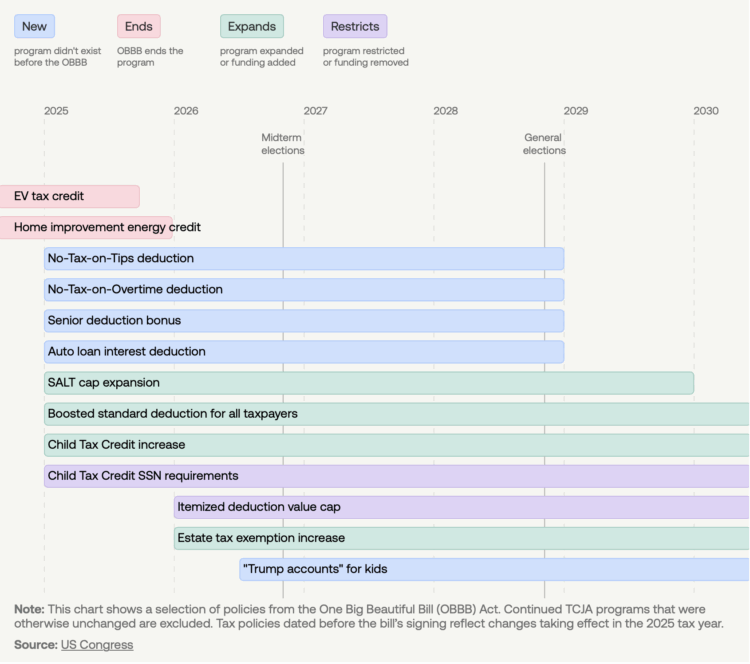
The OBBB introduced policies for taxes, government assistance, student loans, and immigration, with varying timelines and types of changes. USAFacts provides a reference that shows start and end dates for each policy, with colors to indicate if a policy is new, an end to a current policy, an expansion, or a restriction.

The view provides clarity for something that can seem amorphous to casual onlookers.

Tags: OBBB, policy, taxes, USAFacts

03 Aug 13:17

US moves to ban shady subscription auto-renewals after FTC court loss

by Ashley Belanger

Canceling a subscription should be easy, Democratic lawmakers insisted Wednesday, introducing a bill to revive the Federal Trade Commission's so-called "Click-to-Cancel" rule.

The FTC hoped to enforce the rule due to "increasing reports of consumers losing time and money from intentionally difficult subscription cancellation processes," lawmakers said. But cable companies sued to block the FTC rule last year, arguing that the FTC failed to conduct an economic impact study before making it easier to cancel over a billion paid subscriptions in the US.

Earlier this month, a federal appeals court nullified the rule, agreeing with an administrative law judge that the FTC skipped a regulatory analysis required to pass the rule since compliance costs would exceed $100 million. That study would have included cost-benefit analyses of alternatives to the rule, in addition to gauging the rule's effectiveness in comparison to those alternatives.

Read full article

Comments

02 Aug 19:49

Ukraine rescues soldier via drone delivery of complete e-bike

by Nate Anderson

The Russian invasion of Ukraine has placed unbelievable pressure on drone developers on both sides of the war, who have responded with astounding innovations that include:

  • fiber-optic drones (to prevent radio jamming)
  • kamikaze sea drones, eventually equipped with anti-air missiles
  • drones that fire shotguns
  • bomber drones that drop mines and grenades
  • drones that release flaming thermite into trenches
  • long-range, aircraft-style drones that can substitute for small cruise missiles
  • interceptor drones that hunt down other drones
  • first-person view (FPV) drones so maneuverable they can be piloted right through a broken window pane to hit indoor targets
  • ground drones for both combat and transport

Many drone developers are now chasing the next big thing—AI built right into the drone, allowing it to make autonomous targeting decisions if its communication links are cut.

But sometimes you don't need high-tech software, agility, or stealth. Sometimes, you just need a really, really big drone that can carry an entire e-bike and deliver it to a soldier stranded several kilometers away.

Read full article

Comments

02 Aug 19:48

RIP Corporation for Public Broadcasting: 1967–2026

by Ashley Belanger

Despite the protests of millions of Americans, the Corporation for Public Broadcasting (CPB) announced it will be winding down its operations after the White House deemed NPR and PBS a "grift" and pushed for a Senate vote that eliminated its entire budget.

The vote rescinded $1.1 billion that Congress had allocated to CPB to fund public broadcasting for fiscal years 2026 and 2027. In a press release, CPB explained that the cuts "excluded funding for CPB for the first time in more than five decades." CPB president and CEO Patricia Harrison said the corporation had no choice but to prepare to shut down.

"Despite the extraordinary efforts of millions of Americans who called, wrote, and petitioned Congress to preserve federal funding for CPB, we now face the difficult reality of closing our operations," Harrison said.

Read full article

Comments

31 Jul 15:10

Proposed gas-powered leafblower ban exemption killed in committee

by Ginny Bixby

Bill would have allowed use for professional landscapers in fall months

The post Proposed gas-powered leafblower ban exemption killed in committee appeared first on Bethesda Magazine.

28 Jul 23:02

Proposed legislation would ban parking in Montgomery County bike lanes

by Ginny Bixby

County Councilmember Evan Glass (D-At-large) sponsors bill

The post Proposed legislation would ban parking in Montgomery County bike lanes appeared first on Bethesda Magazine.

28 Jul 22:34

Smithsonian Air and Space opens halls for “milestone” and “future” artifacts

by Robert Pearlman

The National Air and Space Museum welcomed the public into five more of its renovated galleries on Monday, including two showcasing spaceflight artifacts. The new exhibitions shine modern light on returning displays and restore the museum's almost 50-year-old legacy of adding objects that made history but have yet to become historical.

Visitors can again enter through the "Boeing Milestones of Flight Hall," which has been closed for the past three years and has on display some of the museum's most iconic items, including John Glenn's Friendship 7 Mercury capsule and an Apollo lunar module.

From there, visitors can tour through the adjacent "Futures in Space," a new gallery focused on the different approaches and technology that spaceflight will take in the years to come. Here, the Smithsonian is displaying for the first time objects that were recently donated by commercial spaceflight companies, including items used in space tourism and in growing the low-Earth orbit economy.

Read full article

Comments

27 Jul 13:12

Supreme Court To Lower Courts: Ignore Actual Binding Precedent, Follow Our Unexplained Shadow Docket Vibes Instead

by Mike Masnick

The Supreme Court’s shadow docket has become a lawless mess. The justices are issuing extremely consequential rulings with either no explanation at all, or with barely a paragraph of reasoning. No full briefing. No oral arguments. Just vibes-based constitutional law that lower courts are somehow supposed to follow.

Now the Court has made this chaos worse by essentially telling lower courts to treat these half-baked emergency rulings as more important than actual binding precedent.

If you’re a district court judge, what do you do? Follow the actual binding precedent, or guess at what the Supreme Court’s vibes-based constitutional law might mean?

Earlier this week, we wrote about a district court judge who faced this impossible situation. She was bound by the Supreme Court’s 1935 precedent in Humphrey’s Executor, which clearly states that Presidents cannot fire the heads of independent agencies like FTC Commissioners (in Humphrey’s it’s literally about the firing of an FTC Commissioner). That’s still good law—the Court has never officially overturned it.

But Trump fired FTC commissioners anyway, creating the exact same legal question that Humphrey’s already answered. Recent Supreme Court rulings have suggested the Court might be willing to gut independent agencies, but without actually overturning the controlling precedent. The judge did what judges are supposed to do: follow binding precedent until the Supreme Court clearly overrules it.

Yesterday’s ruling in a separate case makes this impossible situation even worse. The Supreme Court issued another barely-explained shadow docket ruling that essentially scolds lower courts for following actual precedent instead of reading the tea leaves of emergency orders.

The case, Trump v. Boyle, involves Trump’s firing of Consumer Product Safety Commission (CPSC) commissioners. This follows a similar shadow docket ruling in May about the National Labor Relations Board (NLRB) and Merit Systems Protection Board (MSPB). In all these cases, lower courts applied existing law and ruled that the President lacks the power to fire these officials.

Rather than take up these cases properly with full briefing and oral arguments, the Supreme Court just waves its hand and declares that agencies like the CPSC and NLRB “aren’t really independent” because some of their functions involve executive power. Therefore, Trump can fire them.

There might be reasonable constitutional arguments for this position. We’ll never know, because the Court is making these determinations without bothering to hear them. The May ruling essentially said: “We haven’t really looked into this, but we’re pretty sure we’d side with Trump if we did.”

It’s constitutional law by vibes, and it leaves lower courts in an impossible position.

On one hand: Humphrey’s Executor, a clear binding precedent. On the other: Wilcox, a half-baked shadow docket ruling that essentially says “trust us, we’d probably overturn this if we bothered to think about it.”

In yesterday’s CPSC case, the Court’s two-paragraph ruling is openly dismissive of lower courts trying to follow actual law. The tone essentially asks: “Why aren’t you treating our unexplained emergency order as more important than binding precedent?”

Although our interim orders are not conclusive as to the merits, they inform how a court should exercise its equitable discretion in like cases. The stay we issued in Wilcox reflected “our judgment that the Government faces greater risk of harm from an order allowing a removed officer to continue exercising the executive power than a wrongfully removed officer faces from being unable to perform her statutory duty.” Ibid. (slip op., at 1). The same is true on the facts presented here, where the Consumer Product Safety Commission exercises executive power in a similar manner as the National Labor Relations Board, and the case does not otherwise differ from Wilcox in any pertinent respect.

Even Justice Kavanaugh—who clearly wants to gut independent agencies—thinks this process is bonkers. In his concurrence, he essentially says: “Look, if we’re going to overturn major precedents, maybe we should actually, you know, hear arguments about it?”

When an emergency application turns on whether this Court will narrow or overrule a precedent, and there is at least a fair prospect (not certainty, but at least some reasonable prospect) that we will do so, the better practice often may be to both grant a stay and grant certiorari before judgment.

Kavanaugh gets the core problem: You can’t run a legal system on winks and nudges. Either Humphrey’s is good law or it isn’t. Either Presidents can fire independent commissioners or they can’t. You can’t just leave everyone guessing.

In those unusual circumstances, if we grant a stay but do not also grant certiorari before judgment, we may leave the lower courts and affected parties with extended uncertainty and confusion about the status of the precedent in question. Moreover, when the question is whether to narrow or overrule one of this Court’s precedents rather than how to resolve an open or disputed question of federal law, further percolation in the lower courts is not particularly useful because lower courts cannot alter or overrule this Court’s precedents. In that situation, the downsides of delay in definitively resolving the status of the precedent sometimes tend to outweigh the benefits of further lower-court consideration.

He’s absolutely right. The Court is playing hide the ball with constitutional law, creating chaos in the lower courts while giving Trump a free pass to ignore congressional statutes.

Justice Kagan’s dissent (joined by Sotomayor and Jackson) cuts to the constitutional heart of the problem: this approach obliterates separation of powers.

The system is supposed to work like this: Congress writes the laws, the President faithfully executes them, and the judiciary determines whether both the laws and the President’s actions are constitutional.

Here, the Court is effectively eliminating two of the three branches (including itself!). Congress deliberately created these agencies as independent to insulate them from political pressure. The Court is saying that doesn’t matter—the President can ignore what Congress wrote. And by doing this through unexplained shadow docket rulings, the judiciary is sawing off its own constitutional branch.

The message is clear: the President can ignore congressional statutes, and we’ll rubber-stamp it without analysis, explanation, or precedential guidance.

That’s not separation of powers. That’s monarchy with judicial blessing.

Here’s Kagan:

In Congress’s view, that structure would better enable the CPSC to achieve its mission—ensuring the safety of consumer products, from toys to appliances—than would a single-party agency under the full control of a single President. The CPSC has thus operated as an independent agency for many decades, as the NLRB and MSPB also did. But this year, on its emergency docket, the majority has rescinded that status. By allowing the President to remove Commissioners for no reason other than their party affiliation, the majority has negated Congress’s choice of agency bipartisanship and independence.

More damning is Kagan’s critique of the Court’s circular reasoning:

And it has accomplished those ends with the scantiest of explanations. The majority’s sole professed basis for today’s stay order is its prior stay order in Wilcox. But Wilcox itself was minimally (and, as I have previously shown, poorly) explained. See 605 U. S., at (KAGAN, J., dissenting) (slip op., at 4–7). It contained one sentence (ignored today) hinting at but not deciding the likelihood of success on the merits, plus two more respecting the “balance [of] the equities.” Id., at (order) (slip op., at 1–2); see id., at __– ___ (KAGAN, J., dissenting) (slip op., at 4–7). So only another under-reasoned emergency order undergirds today’s. Next time, though, the majority will have two (if still under-reasoned) orders to cite. “Truly, this is ‘turtles all the way down.'”_

“Turtles all the way down”—that’s what constitutional law looks like when the Supreme Court abandons its responsibility to explain its reasoning. Each unexplained shadow docket ruling becomes precedent for the next unexplained shadow docket ruling, creating an infinite regression of constitutional nonsense.

This isn’t just bad legal process—it’s the systematic destruction of constitutional government. Instead of three coequal branches with checks and balances, we’re getting an imperial presidency, a neutered Congress, and a Supreme Court that has transformed from constitutional interpreter to Trump’s enabler.

The Court’s shadow docket has become the constitutional equivalent of “because we said so.” That’s not law. That’s authoritarianism with footnotes. And sometimes even the footnotes are missing.

26 Jul 18:33

Skydance deal allows Trump’s FCC to “censor speech” and “silence dissent” on CBS

by Ashley Belanger

The Federal Communications Commission has approved Skydance's $8 billion acquisition of Paramount, which owns CBS.

But the agency's approval drew fiery dissent from the only Democratic commissioner, Anna Gomez, after requiring written commitments from Skydance that allow the government to influence editorial decisions at CBS. Gomez accused the FCC of "imposing never-before-seen controls over newsroom decisions and editorial judgment, in direct violation of the First Amendment and the law."

Under the agreement, FCC Chairman Brendan Carr explained that Skydance has given assurances that all of the new company’s programming will embody "a diversity of viewpoints from across the political and ideological spectrum." Carr claimed that the requirements were necessary to restore Americans' trust in mainstream media, backing conservatives' claims that media is biased against Trump and appointing an ombudsman for two years to ensure that CBS's reporting "will be fair, unbiased, and fact-based." Any complaints of bias that the ombudsman receives will be reviewed by the president of New Paramount, the FCC confirmed.

Read full article

Comments

24 Jul 21:59

Highest suicide rates among older men in the U.S.

by Nathan Yau

For STAT, Olivia Goldhill reports on an often overlooked demographic.

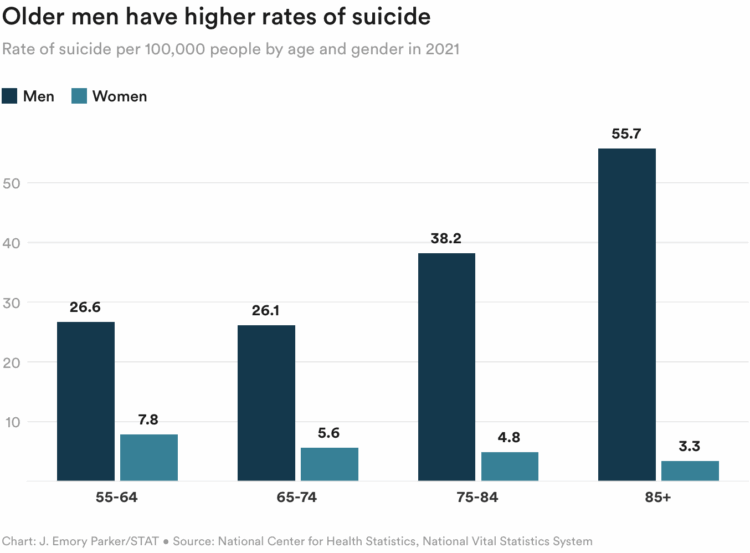
Meanwhile, another demographic has gone largely overlooked. The people most at risk from suicide aren’t those in crisis in adolescence or midlife, but men age 75 and older. Some 38.2 deaths per 100,000 among men age 75 to 84 are by suicide, which increases to 55.7 among those over 85, according to data from CDC — more than 16 times the suicide rate for women in the same age group. Researchers are calling for a public health effort, much like the one to treat youth mental health, to help address suicide in older men.

Many attribute the recent declines in youth suicides to all the attention paid to the issue, and the ample resources devoted to it, said Mark Salzer, professor of social and behavioral sciences at Temple University. “The same intensive efforts have not been made for older adults where there is a belief among some that depression is a natural part of aging,” he told STAT. “It is not.”

It is also interesting that the rate for older women, which is much lower than it is for men, goes the opposite direction showing a decreasing rate with age.

Tags: age, STAT, suicide

24 Jul 14:25

A power utility is reporting suspected pot growers to cops. EFF says that’s illegal.

by Dan Goodin

In May 2020, Sacramento, California, resident Alfonso Nguyen was alarmed to find two Sacramento County Sheriff’s deputies at his door, accusing him of illegally growing cannabis and demanding entry into his home. When Nguyen refused the search and denied the allegation, one deputy allegedly called him a liar and threatened to arrest him.

That same year, deputies from the same department, with their guns drawn and bullhorns and sirens sounding, fanned out around the home of Brian Decker, another Sacramento resident. The officers forced Decker to walk backward out of his home in only his underwear around 7 am while his neighbors watched. The deputies said that he, too, was under suspicion of illegally growing cannabis.

Invasion of the privacy snatchers

According to a motion the Electronic Frontier Foundation filed in Sacramento Superior Court last week, Nguyen and Decker are only two of more than 33,000 Sacramento-area people who have been flagged to the sheriff’s department by the Sacramento Municipal Utility District, the electricity provider for the region. SMUD called the customers out for using what it and department investigators said were suspiciously high amounts of electricity indicative of illegal cannabis farming.

Read full article

Comments

24 Jul 14:12

South Korea Plans to Build a Base on the Moon

by Javier Carbajal
The country’s newly formed space agency wants to establish a lunar base by 2045.
24 Jul 13:18

Proposed MoCo bamboo ban draws support from environmentalists, opposition from landscapers

by Ginny Bixby

County Councilmember Evan Glass’s legislation aims to reduce invasive species, promote native plants

The post Proposed MoCo bamboo ban draws support from environmentalists, opposition from landscapers appeared first on Bethesda Magazine.

20 Jul 19:16

Southwestern drought likely to continue through 2100, research finds

by Wyatt Myskow, Inside Climate News

This article originally appeared on Inside Climate News, a nonprofit, non-partisan news organization that covers climate, energy, and the environment. Sign up for their newsletter here.

The drought in the Southwestern US is likely to last for the rest of the 21st century and potentially beyond as global warming shifts the distribution of heat in the Pacific Ocean, according to a study published last week led by researchers at the University of Texas at Austin.

Using sediment cores collected in the Rocky Mountains, paleoclimatology records and climate models, the researchers found warming driven by greenhouse gas emissions can alter patterns of atmospheric and marine heat in the North Pacific Ocean in a way resembling what’s known as the negative phase of the Pacific Decadal Oscillation (PDO), fluctuations in sea surface temperatures that result in decreased winter precipitation in the American Southwest. But in this case, the phenomenon can last far longer than the usual 30-year cycle of the PDO.

Read full article

Comments

19 Jul 18:13

MoCo fire department apologizes after soaking Blair High baseball field; Thunderbolts to press charges

by Max Schaeffer

Takoma-Silver Spring Thunderbolts forced to cancel Thursday night game

The post MoCo fire department apologizes after soaking Blair High baseball field; Thunderbolts to press charges appeared first on Bethesda Magazine.

17 Jul 13:50

DOGE Put Free Tax Filing Tool on Chopping Block After One Meeting With Lobbyists

by Makena Kelly
A key operative from DOGE initiated plans to potentially kill Direct File, the free tax filing tool developed by the IRS, after offering assurances it would be spared from cuts.
17 Jul 13:49

Bill to rescind billions in government funding being amended by the Senate

by Sean Michael Newhouse
The Senate is in the middle of a vote-a-rama on legislation that would rescind $9 billion in funding that Congress previously approved for foreign assistance programs and public media. 

Under congressional rules, the Senate only needs a simple majority to approve the Rescissions Act of 2025 (H.R. 4) instead of the usual 60-vote threshold. But those rules for budget bills also enable members to offer unlimited amendments that are voted on in succession. A similar process played out when Republicans passed the One Big Beautiful Bill Act (H.R. 1). 

The GOP has until the end of Friday to clear the rescissions measure due to budget rules, but because senators are planning to adopt agreed-upon changes to the bill, the House will have to vote on it again. That chamber previously passed the legislation in a close 214-212 vote

A substitute amendment put forward by Senate Majority Leader John Thune, R-S.D., would make several modifications to the measure: 

  • Nix a $400 million cut to the U.S. President’s Emergency Plan for AIDS Relief (PEPFAR), an initiative which helps countries address the disease that has saved 25 million lives and prevented millions of HIV infections. 
  • Shield programs that prevent and treat HIV/AIDS, tuberculosis and malaria as well as support nutrition or maternal and child health. 
  • Protect funding for the countries Jordan and Egypt, plus a fund to counter Chinese influence internationally.
  • Exempt from recission programs like Food for Peace and McGovern-Dole International Food for Education that pay U.S. farmers for food that is distributed to poor countries. 

Additionally, Sen. Mike Rounds, R-S.D., said that he would support the bill after the Trump administration committed to reallocating “Green New Deal money” in order to continue grants to tribal broadcast stations. The recissions legislation would effectively eliminate federal funding for the Corporation for Public Broadcasting, which provides support to such stations. 

Foreign assistance programs have been particularly targeted by the Department of Government Efficiency, and Trump in May issued an executive order to cease funding to NPR and PBS, which are also supported by CPB, arguing that they don’t report the news in a fair, accurate or unbiased manner. 

The Senate on Tuesday took two procedural votes with respect to the measure that required Vice President JD Vance to break ties. Senate Democrats and Republicans Susan Collins of Maine, Mitch McConnell of Kentucky and Lisa Murkowski of Alaska — all of whom sit on the Senate Appropriations Committee, which allocates agency funding — voted against advancing the legislation. 

Collins, who is the panel’s chair, said the Trump administration has not been forthcoming about what specific programs would be cut. 

“The sparse text that was sent to Congress [by the Office of Management and Budget] included very little detail and does not give an accounting of the specific program cuts that would total $9.4 billion,” she said in a statement. “For example, there are $2.5 billion in cuts to the Development Assistance account, which covers everything from basic education, to water and sanitation, to food security — but we don’t know how those programs will be affected.” 

In floor remarks on July 10, Sen. Patty Murray, D-Wash., the vice chair of the Appropriations Committee, said that Republicans, by voting for the recissions bill, would be reneging on spending they previously agreed to in government funding negotiations and make future such agreements harder to achieve. 

“Pushing this through won’t just cut bipartisan investments, it will cut out the heart of the basic principles that make bipartisan deals possible,” Murray said. “How are we supposed to negotiate a bipartisan deal if Republicans will turn around and put it through the shredder in a partisan vote?”

[[Related Posts]]

]]>
16 Jul 16:37

IRS is building a vast system to share millions of taxpayers’ data with ICE

by Avi Asher-Schapiro, Christopher Bing, and William Turton, ProPublica
The Internal Revenue Service is building a computer program that would give deportation officers unprecedented access to confidential tax data.

ProPublica has obtained a blueprint of the system, which would create an “on demand” process allowing Immigration and Customs Enforcement to obtain the home addresses of people it’s seeking to deport.

Last month, in a previously undisclosed dispute, the acting general counsel at the IRS, Andrew De Mello, refused to turn over the addresses of 7.3 million taxpayers sought by ICE. In an email obtained by ProPublica, De Mello said he had identified multiple legal “deficiencies” in the agency’s request.

Two days later, on June 27, De Mello was forced out of his job, people familiar with the dispute said. The addresses have not yet been released to ICE. De Mello did not respond to requests for comment, and the administration did not address questions sent by ProPublica about his departure.

The Department of Government Efficiency began pushing the IRS to provide taxpayer data to immigration agents soon after President Donald Trump took office. The tax agency’s acting general counsel refused and was replaced by De Mello, who Trump administration officials viewed as more willing to carry out the president’s agenda. Soon after, the Department of Homeland Security, ICE’s parent agency, and the IRS negotiated a “memorandum of understanding” that included specific legal guardrails to safeguard taxpayers’ private information.

In his email, De Mello said ICE’s request for millions of records did not meet those requirements, which include having a written assurance that each taxpayer whose address is being sought was under active criminal investigation.

“There’s just no way ICE has 7 million real criminal investigations, that’s a fantasy,” said a former senior IRS official who had been advising the agency on this issue. The demands from the DHS were “unprecedented,” the official added, saying the agency was pressing the IRS to do what amounted to “a big data dump.”

In the past, when law enforcement sought IRS data to support its investigations, agencies would give the IRS the full legal name of the target, an address on file and an explanation of why the information was relevant to a criminal inquiry. Such requests rarely involved more than a dozen people at a time, former IRS officials said.

Danny Werfel, IRS commissioner during the Biden administration, said the privacy laws allowing federal investigators to obtain taxpayer data have never “been read to open the door to the sharing of thousands, tens of thousands, or hundreds of thousands of tax records for a broad-based enforcement initiative.”

A spokesperson for the White House said the planned use of IRS data was legal and a means of fulfilling Trump’s campaign pledge to carry out mass deportations of “illegal criminal aliens.”

Taxpayer data is among the most confidential in the federal government and is protected by strict privacy laws, which have historically limited its transfer to law enforcement and other government agencies. Unauthorized disclosure of taxpayer return information is a felony that can carry a penalty of up to five years in prison.

The system that the IRS is now creating would give ICE automated access to home addresses en masse, limiting the ability of IRS officials to consider the legality of transfers. IRS insiders who reviewed a copy of the blueprint said it could result in immigration agents raiding wrong or outdated addresses.

“If this program is implemented in its current form, it’s extremely likely that incorrect addresses will be given to DHS and individuals will be wrongly targeted,” said an IRS engineer who examined the blueprints and who, like other officials, spoke on condition of anonymity for fear of retribution.

The dispute that ended in De Mello’s ouster was the culmination of months of pressure on the IRS to turn over massive amounts of data in ways that would redefine the relationship between the agency and law enforcement and reduce taxpayers’ privacy, records and interviews show.

In one meeting in late March between senior IRS and DHS officials, a top ICE official made a suggestion: Why doesn’t Homeland Security simply provide the name and state of its targets and have the IRS return the addresses of everyone who matches that criteria?

The IRS lawyers were stunned. They feared they could face criminal liability if they handed over the addresses of individuals who were not under a criminal investigation. The conversation and news of deeper collaboration with ICE so disturbed career staff that it led to a series of departures in late March and early April across the IRS’ legal, IT and privacy offices.

They were “pushing the boundaries of the law,” one official said. “Everyone at IRS felt the same way.”

The Blueprint

The technical blueprint obtained by ProPublica shows that engineers at the agency are preparing to give DHS what it wants: a system that enables massive automated data sharing. The goal is to launch the new system before the end of July, two people familiar with the matter said.

The DHS effort to obtain IRS data comes as top immigration enforcement leaders face escalating White House pressure to deport some 3,000 people per day, according to reports.

One federal agent tasked with assisting ICE on deportations said recent operations have been hamstrung by outdated addresses. Better information could dramatically speed up arrests. “Some of the leads that they were giving us were old,” said the agent, who spoke on condition of anonymity because he was not authorized to speak with the press. “They’re like from two administrations ago.”

In early March, immigrants rights groups sued the IRS hoping to block the plan, arguing that the memorandum of understanding between DHS and the IRS is illegal. But a judge in early May ruled against them, saying the broader agreement complied with Section 6103, the existing law regulating IRS data sharing. That opened the door for engineers to begin building the system.

The judge did not address the technical blueprint, which didn’t exist at the time of the ruling. But the case is pending, which means the new system could still come under legal review.

Until now, little was known about the push and pull between the two agencies or the exact technical mechanics behind the arrangement.

The plan has been shrouded in secrecy even within the IRS, with details of its development withheld from regular communications. Several IRS engineers and lawyers have avoided working on the project out of concerns about personal legal risk.

Asked about the new system, a spokesperson for IRS parent agency the Treasury Department said the memorandum of understanding, often called an MOU, “has been litigated and determined to be a lawful application of Section 6103, which provides for information sharing by the IRS in precise circumstances associated with law enforcement requests.”

At a time when Trump is making threats to deport not only undocumented immigrants but also U.S. citizens, the scope of information-sharing with the IRS could continue to grow, according to documents reviewed by ProPublica and sources familiar with the matter: DHS has been looking for ways to expand the agreement that could allow Homeland Security officials to seek IRS data on Americans being investigated for various crimes.

Last month, an ICE attorney proposed updating the MOU to authorize new data requests on people “associated with criminal activities which may include United States citizens or lawful permanent residents,” according to a document seen by ProPublica. The status of this proposal is unclear. De Mello, at the time, rejected it and called for senior Treasury Department leadership to personally sign off on such a significant change.

The White House described DHS’ work with the IRS as a good-faith effort to identify and deport those who are living in the country illegally.

“ProPublica continues to degrade their already terrible reputation by suggesting we should turn a blind eye to criminal illegal aliens present in the United States for the sake of trying to collect tax payments from them,” White House spokesperson Abigail Jackson said in a statement after receiving questions about the blueprint from ProPublica.

She pointed to the April MOU as giving the government the authority to create the new system and added, “This isn’t a surveillance system. … It’s part of President Trump’s promise to carry out the mass deportation of criminal illegal aliens — the promise that the American people elected him on and he is committed to fulfilling.”

In a separate statement, a senior DHS official also cited the court’s approval of the MOU, saying that it “outlines a process to ensure that sensitive taxpayer information is protected while allowing law enforcement to effectively pursue criminal violations.”

How the System Works

The new system would represent a sea change, allowing law enforcement to request enormous swaths of confidential data in bulk through an automated, computerized process.

The system, according to the blueprint and interviews with IRS engineers, would work like this:

First, DHS would send the IRS a spreadsheet containing the names and previous addresses of the people it’s targeting. The request would include the date of a final removal order, a relevant criminal statute ICE is using to investigate the individual, and the tax period for which information is sought. If DHS fails to include any of this information, the system would reject the request.

The system then attempts to match the information provided by the DHS to a specific taxpayer identification number, which is the primary method by which the IRS identifies an individual in its databases.

If the system makes a match, it accesses the individual’s associated tax file and pulls the address listed during the most recent tax period. Then the system would produce a new spreadsheet enriched with taxpayer data that contains DHS’ targets’ last known addresses. The spreadsheet would include a record of names rejected for lack of required information and names for which it could not make a match.

Tax and privacy experts say they worry about how such a powerful yet crude platform could make dangerous mistakes. Because the search starts with a name instead of a taxpayer identification number, it risks returning the address of an innocent person with the same name as or a similar address to that of one of ICE’s targets. The proposed system assumes the data provided by DHS is accurate and that each targeted individual is the subject of a valid criminal investigation. In effect, the IRS has no way to independently check the bases of these requests, experts told ProPublica.

In addition, the blueprint does not limit the amount of data that can be transferred or how often DHS can request it. The system could easily be expanded to acquire all the information the IRS holds on taxpayers, said technical experts and IRS engineers who reviewed the documents. By shifting a single parameter, the program could return more information than just a target’s address, said an engineer familiar with the plan, including employer and familial relationships.

Engineers based at IRS offices in Lanham, Maryland, and Dallas are developing the blueprint.

“Gone Back on Its Word”

For decades, the American government has encouraged everyone who makes an income in the U.S. to pay taxes — regardless of immigration status — with an implicit promise that their information would be protected. Now that same data may be used to locate and deport noncitizens.

“For years, the IRS has told immigrants that it only cares that they pay their taxes,” said Nandan Joshi, an attorney with the Public Citizen Litigation Group, which is seeking to block the data-sharing agreement in federal court. “By agreeing to share taxpayer data with ICE on a mass basis, the IRS has gone back on its word.”

The push to share IRS data with DHS emerged while Elon Musk’s DOGE reshaped the engineering staff of the IRS. Sam Corcos, a Silicon Valley startup founder with no government experience, pushed out more than 50 IRS engineers and restructured the agency’s engineering priorities while he was the senior DOGE official at the agency. He later became chief information officer at Treasury. He has also led a separate IRS effort to create a master database using products from Silicon Valley giant Palantir Technologies, enabling the government to link and search large swaths of data.

Corcos didn’t respond to a request for comment. The White House said DOGE is not part of the DHS-IRS pact.

Sen. Ron Wyden, the ranking Democrat on the Senate Committee on Finance, which oversees the IRS, told ProPublica the system being built was ripe for abuse. It “would allow an outside agency unprecedented access to IRS records for reasons that have nothing to do with tax administration, opening the door to endless fishing expeditions,” he said.

The Treasury Inspector General for Tax Administration, the department’s internal watchdog, is already probing efforts by Trump and DOGE to obtain private taxpayer data and other sensitive information, ProPublica reported in April.

The Trump administration continues to add government agencies to its deportation drive.

DOGE and DHS are also working to build a national citizenship database, NPR reported last month. The database links information from the Social Security Administration and the DHS, ostensibly for the purpose of allowing state and local election officials to verify U.S. citizenship.

And in May, a senior Treasury Department official directed 250 IRS criminal investigative agents to help deportation operations, a significant shift for two agencies that historically have had separate missions.

This story was originally published by ProPublica, a nonprofit newsroom that investigates abuses of power. McKenzie Funk contributed reporting, and Kirsten Berg and Alex Mierjeski contributed research.

]]>