Shared posts

09 Sep 18:27

SCOTUS Says ICE Can Use The Family Guy Skin Color Chart For Arrests (But Won’t Explain Why)

by Mike Masnick

You know that Family Guy meme where they have the skin color chart to determine how suspicious someone should be? Yeah, you know the one.

Family guy skin color meme, showing Peter Griffin sitting in a car, with a cop holding up a paint swatch card showing six different color tones. The lighter tones are labeled "okay" and the darker ones "not okay."

Well, the Supreme Court just essentially codified that into constitutional law. And they did it on the lawless shadow docket without a real explanation, because of course they did.

In a stay order issued yesterday with zero reasoning from the majority, the Supreme Court told ICE agents in Los Angeles that yes, you can absolutely detain people based on looking Latino, speaking Spanish, working certain jobs, and being in certain locations. The only “explanation” (if you can really call it that) comes from Justice Kavanaugh’s solo concurrence—which apparently was so legally dubious that not even a single one of the other conservative justices would sign on to it. But it is the only explanation given for the majority ruling.

It reverses two lower court rulings that said, quite reasonably and clearly, that you can’t just arrest people for existing while brown. But hey, why let basic constitutional principles get in the way of a good old-fashioned roundup?

This is yet another example of the Supreme Court’s increasing reliance on its shadow docket to make monumentally consequential rulings without full briefings, oral arguments, or even basic explanations. As we’ve covered extensively, the Court has been using emergency applications to essentially rewrite major areas of law while hiding behind the fiction that these are just “procedural” matters.

The pattern is always the same: government asks for emergency relief, the Court grants it with minimal (if any!) explanation, and suddenly we have new constitutional law that affects millions of people. No deliberation, no transparency, just judicial fiat—always in favor of Donald Trump’s authoritarianism—delivered with no explanation.

Justice Sotomayor’s dissent calls this out directly:

The Court’s order is troubling for another reason: It is entirely unexplained. In the last eight months, this Court’s appetite to circumvent the ordinary appellate process and weigh in on important issues has grown exponentially… Its interest in explaining itself, unfortunately, has not.

She’s absolutely right. When you’re essentially authorizing racial profiling on a massive scale, maybe you should explain your reasoning? But that would require the majority to actually defend their decision, which they apparently can’t or won’t do.

The only justice willing to put his name to an explanation is Kavanaugh, and his concurrence is a masterpiece of unsupported assertions and constitutional hand-waving:

About 10 percent of the people in the Los Angeles region are illegally in the United States—meaning about 2 million illegal immigrants out of a total population of 20 million.

This is a stunning claim that goes way above most credible estimates, and Kavanaugh provides zero citation for it. Just assertions pulled from thin air to justify mass detention in violation of the Fourth Amendment. Other estimates suggest the actual number is less than half of what Kavanaugh claims.

Even more laughably, Kavanaugh suggests that being wrongly detained is no big deal for American citizens because they can just prove their citizenship and be on their way:

Importantly, reasonable suspicion means only that immigration officers may briefly stop the individual and inquire about immigration status. If the person is a U. S. citizen or otherwise lawfully in the United States, that individual will be free to go after the brief encounter. Only if the person is illegally in the United States may the stop lead to further immigration proceedings.

Tell that to Jason Gavidia, the U.S. citizen described in this very case who was pushed against a fence, had his arms twisted behind his back, and whose ID was never returned to him. Did Kavanaugh not read the appeals court’s ruling that described how insufficient Gavidia’s proof of citizenship was to ICE agents?

To give just one example, Plaintiff Jason Brian Gavidia is a U.S. citizen who was born and raised in East Los Angeles and identifies as Latino. On the afternoon of June 12, he stepped onto the sidewalk outside of a tow yard in Montebello, California, where he saw agents carrying handguns and military-style rifles. One agent ordered him to “Stop right there” while another “ran towards [him].” The agents repeatedly asked Gavidia whether he is American—and they repeatedly ignored his answer: “I am an American.” The agents asked Gavidia what hospital he was born in—and he explained that he did not know which hospital. “The agents forcefully pushed [Gavidia] up against the metal gated fence, put [his] hands behind [his] back, and twisted [his] arm.” An agent asked again, “What hospital were you born in?” Gavidia again explained that he did not know which hospital and said “East L.A.” He then told the agents he could show them his Real ID. The agents took Gavidia’s ID and his phone and kept his phone for 20 minutes. They never returned his ID.

Kavanaugh’s response to that example in this very case is to say, “that individual will be free to go after the brief encounter?”

Or tell that to Jorge Viramontes, the dual U.S.-Mexican citizen who was been repeatedly harassed by ICE. As described in Sotomayor’s dissent:

In the nine days between June 9 and 19, agents returned four times, each instance in the middle of the workday. On one occasion, an agent questioned Viramontes, asking if he is a citizen and requesting that he show his ID. Viramontes replied that he is a dual U. S. and Mexican citizen and supplied his California driver’s license. The agent said the ID was insufficient, “grabbed [his] arm,” escorted him to a vehicle, and drove him to a “warehouse area” for further questioning

Brief encounter? No harm done?

And that’s just from this case. This week alone, we’re hearing reports of ICE raids at Hyundai facilities that detained people here on legal visas. While most of the coverage has been about South Koreans here (often legally), the raid also swept up some Latino workers, including those with legal work permits, some of whom are still locked up.

Kavanaugh’s fantasy that these encounters are “brief” and that people are “promptly” released doesn’t match reality on the ground, let alone the examples in this very case before him.

Here’s where Kavanaugh’s logic completely falls apart. He suggests that people falsely detained can seek remedies under the Fourth Amendment:

To the extent that excessive force has been used, the Fourth Amendment prohibits such action, and remedies should be available in federal court.

But Kavanaugh himself has consistently ruled that you basically have no meaningful Fourth Amendment rights when it comes to immigration enforcement. In Egbert v. Boule, he signed onto the majority decision saying exactly that. So, he’s basically saying your only recourse is not if your Fourth Amendment rights are violated, but only in cases where “excessive force” is used. And I’m going to guess that Kavanaugh’s definition of “excessive” may be equally malleable if the victim is on the lower half of the Family Guy color chart.

It’s legal gaslighting of the highest order.

What we’re witnessing is the formalization of a “papers please” society—but only if you’re not white. As Justice Sotomayor notes in her dissent:

The Fourth Amendment protects every individual’s constitutional right to be “free from arbitrary interference by law officers.” … After today, that may no longer be true for those who happen to look a certain way, speak a certain way, and appear to work a certain type of legitimate job that pays very little.

The “papers please” demand has historically been the hallmark of authoritarian surveillance states. It’s what we’ve pointed to as the obvious sign of an unfree society. But apparently, if you’re Latino in Los Angeles, that’s just your new reality.

The most telling part of Kavanaugh’s concurrence might be this line:

The interests of individuals who are illegally in the country in avoiding being stopped by law enforcement for questioning is ultimately an interest in evading the law. That is not an especially weighty legal interest.

This framing gets the entire constitutional setup completely backwards. The Fourth Amendment protects “the people“—not citizens, but people. It applies equally to everyone in the US, regardless of immigration status, and for good reason: constitutional rights exist precisely to protect people from government overreach when the government suspects them of wrongdoing.

Kavanaugh’s logic essentially argues that if you assume someone is breaking immigration law, their constitutional protections become less “weighty.” But that’s the opposite of how rights work. If constitutional protections only applied to people the government had predetermined were law-abiding, they wouldn’t be protections at all—they’d just be privileges the government could revoke at will.

What Kavanaugh is really saying is: if you’re Latino, it’s guilty until proven innocent. And even setting aside the stories we keep seeing of U.S. citizens and legal residents being swept up in these raids, the Fourth Amendment doesn’t have a citizenship test and doesn’t disappear just because someone might have violated immigration law.

Sotomayor also highlights how crazy it is that the majority ruled for the Trump administration, given that they are supposed to show “irreparable harm” would occur absent such a ruling, and DHS already made clear they were ignoring the lower court orders (suggesting no actual harm from letting those orders stay in place):

Moreover, the on-the-ground reality contradicts the Government’s and the concurrence’s claim of a chilling effect. Since the issuance of the TRO, Secretary of Homeland Security Kristi Noem has called the District Judge an “‘idiot’” and vowed that “‘none of [the Government’s] operations are going to change.’” The CBP Chief Patrol Agent in the Central District has stated that his division will “turn and burn” and “go even harder now,” …. Accordingly, there is no reason to credit the Government’s assertion that it will suffer irreparable harm.

If anything, the irreparable harm should be to those whose Fourth Amendment rights will now be violated:

Instead, it is the people of Los Angeles and the Central District who will suffer from this Court’s grant of relief to the Government. Immigration agents are not conducting “brief stops for questioning,” as the concurrence would like to believe…. They are seizing people using firearms, physical violence, and warehouse detentions. Nor are undocumented immigrants the only ones harmed by the Government’s conduct. United States citizens are also being seized, taken from their jobs, and prevented from working to support themselves and their families.

The Appeals Court ruling in this case was clear and direct: In the US, the Fourth Amendment applies to everyone, and we don’t make you a suspect because of the color of your skin or the language you speak.

But the Supreme Court’s conservative majority couldn’t let that stand. They had to step in immediately to ensure that ICE could continue its unconstitutional practices. No deliberation needed. No explanation required. Just pure judicial activism in service of authoritarian immigration enforcement.

As Justice Sotomayor notes in her dissent, the Court has essentially created a second-class citizenship where your constitutional protections depend on how you look:

More fundamentally, it is the Government’s burden to prove that it has reasonable suspicion to stop someone. The concurrence improperly shifts the burden onto an entire class of citizens to carry enough documentation to prove that they deserve to walk freely. The Constitution does not permit the creation of such a second-class citizenship status.

The equities therefore lie with the plaintiffs. Countless people in the Los Angeles area have been grabbed, thrown to the ground, and handcuffed simply because of their looks, their accents, and the fact they make a living by doing manual labor. Today, the Court needlessly subjects countless more to these exact same indignities.

So here we are: what began as a meme about judging people by their skin tone is now essentially constitutional law, courtesy of a Supreme Court that won’t even bother to explain why. The only justice willing to put his name to a justification offers legal reasoning so shoddy that even his conservative colleagues won’t sign on to it.

This is judicial lawlessness masquerading as emergency relief. When the Court uses its shadow docket to authorize systematic racial profiling without explanation, we’ve moved far beyond procedural shortcuts into something much darker. The Constitution may say “the people,” but the Supreme Court has decided some people are more equal than others—and they don’t even have to explain why.

09 Sep 18:24

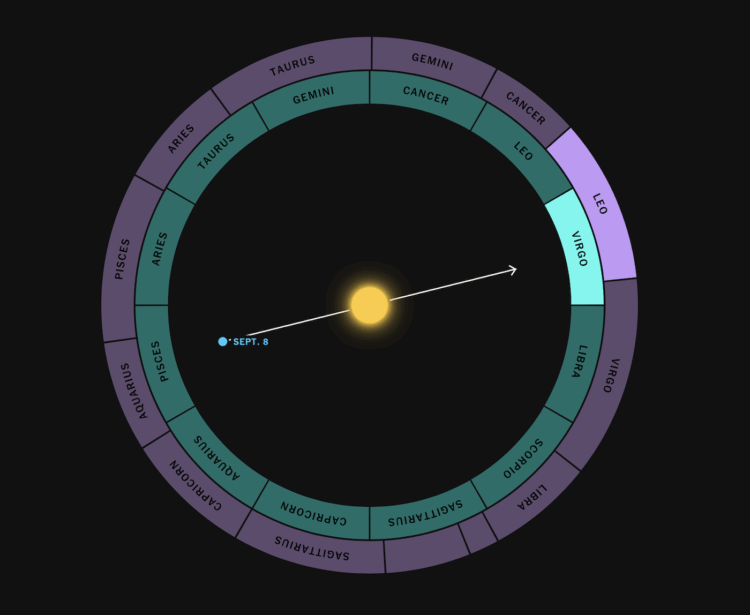
Out of date Zodiac signs, visually explained

by Nathan Yau

For NYT’s the Upshot, Aatish Bhatia, Francesca Paris, and Rumsey Taylor show how zodiac signs were determined by the position of constellations relative to Earth and the Sun thousands of years ago. That probably seemed like a good idea at the time, but more accurate measurements and records show that if we continued to go by the relative positions, our zodiac signs would be different.

The interactive elements and animations illustrate the shifts well. Enter your birth date to see how your sign would change, and a night sky moves to show how our perspective changes because of Earth’s wobble.

Tags: constellations, stars, Upshot, Zodiac

08 Sep 14:28

Source: NPR

07 Sep 01:05

National Guard Troops Aren’t Happy They’re Just Trump’s Toy Soldiers

by Tim Cushing

Trump continues to wield everything he controls like a weapon against his enemies, even when the law says he can’t. Trump sent thousands of National Guard troops (and a couple hundred Marines) to Los Angeles to quell nonexistent riots and otherwise get in the way of local law enforcement.

Of course, it was nothing but a show of force: a petty president doing things to his perceived enemies just because he could. This was met with a lawsuit filed by the state of California, but even having that deployment declared illegal by a federal judge hasn’t made Trump any more hesitant to do the same thing to other places he feels have too many Democratic politicians.

This hasn’t exactly made him popular with the troops. National Guard troops sent to Los Angeles found themselves without beds, much less the guarantee of a steady paycheck, before being asked to do a bunch of regular cop stuff, like hassle randos on the street and/or hang out on the perimeter as federal agents raided marijuana grow operations.

The troops made their displeasure known in the creative way only military members can: they raised objections with their superiors, they sought behavioral health counseling, and… they defecated in Humvees.

You’d think some lessons would be learned from the administration’s failed “War on Los Angeles.” But, of course, this administration expends a lot of effort remaining deliberately ignorant. So, we’re seeing a second act play out which, unfortunately, is somehow even worse than the invasion of LA.

Leveraging the (alleged) attempted carjacking of a former DOGE staffer known as “Big Balls,” Trump claimed Washington DC could no longer capably handle violent crime. Using this one-off mugging of a rich white kid, Trump sent the National Guard to DC — along with tons of federal officers — to turn this alleged criminal war zone into a place where people could safely… I don’t know… gut every single federal agency Trump doesn’t like.

The response from troops now patrolling DC streets is more of the same: we didn’t sign up for this. Those unfortunate enough to get shoved into DC to satisfy Trump’s fantasies are now getting owned by their own. Here’s Schuyler Mitchell, reporting for Mother Jones:

Last week, the soldiers deployed to fight a “crime emergency” instead found themselves completing “beautification” duties on Capitol Hill and patrolling Krispy Kremes. Users on the r/NationalGuard subreddit were quick to give their colleagues a new nickname: National Guardeners.  

There’s your first morale hit: people are openly mocking you for being assigned to duties you never wanted, much less asked for. And while there may be considerable overlap with people now claiming they didn’t vote for this, National Guard troops can’t do much about the situation they’re in. Sure, they could just walk off the job, but “you can’t fire me, I quit” tends to be greeted with a court martial and a bit of a cooling off period in the nearest military prison.

Plus, part of the whole military thing is the expectation that you serve the Commander-in-Chief as well as the nation that employs you. Guess which entity has the most power.

The National Guard, as a whole, is pretty much incapable of doing anything but complaining about this. Sure, we might want to see an organized rebellion (or at least a mass walk-out), but people who spend more time tossing sandbags than tossing grenades are in for a hell of a fight if Trump decides it’s time to send in the Marines to tamp down the morale issues bubbling to the surface that his actions have generated.

That’s the worst case scenario. The best case scenario is this: the National Guard is going to continue to bleed experience and talent and won’t even be able to sucker in the requisite number of people capable of fogging a mirror to offset the attrition.

Alex, a National Guard recruiter from one of the states that sent troops to DC who requested anonymity to speak freely, told Mother Jones that the DC mission has deterred potential recruits and pushed already-disillusioned soldiers to their breaking points. 

On top of all of this, it’s going to start fucking some troops out of their retirement pay:

[S]hortly after the DC deployment, Alex said, they received instructions not to drill for the rest of the fiscal year (which ends September 30).

“It generally gets like this at the end of the fiscal year, money’s always tight, but not to the point where I’m not able to drill,” Alex said. Without additional drills, some will not be able to log a “good year” toward retirement. Alex put it succinctly: “I’m missing work for the army because the state ran out of money because they decided to send military police to DC.” 

And it’s not just Trump who thinks National Guard troops (and other military members) are just handy chess pieces he can use in his “own the libs” games of 4-D checkers. There are plenty of Republican politicians willing to be both the jackboot and bootlicker, like [massive sigh] the current governor of South Dakota, Larry Rhoden:

Governor Larry Rhoden is mobilizing SD National Guardsmen at President Donald Trump’s request.

According to a press release, Rhoden is mobilizing 12 guardsmen from the 129th Mobile Public Affairs Detachment based in Rapid City. The group will “support operations in Washington D.C.,” the news release said.

Know this: Trump didn’t directly ask Rhoden to send in some troops. He merely sent a blanket request for assistance to every Republican governor and correctly assumed a lot of them would bend over backwards to oblige him.

This is keeping with the state tradition of sending the National Guard anywhere but where it’s truly needed, one started by current DHS head Kristi Noem during her tenure as governor. She sent a bunch of South Dakota National Guard troops to the Texas border during her term, while refusing to send the National Guard to help her own constituents when they were being flooded out of their homes.

None of this is about crime. None of this is about safety. It’s just a president thugging out and dragging people who can’t say no without suffering severe consequences along for the ride. And he’s surrounded by power politicians willing to turn people who gave up at least a part of their life in service to their country to serve as nothing more than spank bank material for Trump’s masturbatorial martial law fantasies.

07 Sep 01:02

The RFK Jr. Congressional Hearing Was An Unmitigated Disaster

by Timothy Geigner

Well, that was certainly a thing. We mentioned yesterday that RFK Jr. was scheduled to go before the Senate Finance committee to answer all kinds of questions as to just what in the holy hell is happening at HHS. As we said, this was always going to be a contentious hearing, given that the Democrat Senators are aligned, and in fact demanded his resignation before the hearing, while even GOP members such as Bill Cassidy have begun signaling wavering support for Kennedy.

But this wasn’t just contentious; it was a disaster. USA Today has one of many live update pages where you can go back and relive the timeline, but the topline summary is that Kennedy shouted over the Senators questions, often asked them questions instead of answering the questions he was asked, dissembled all over the place when asked direct and honest questions, and otherwise spouted conspiracy theories without a scintilla of evidence to back them up. And while it’s certainly true that questions from Democracts were done in a more hostile tone than those from the GOP, the open disdain, or at least concern, about Kennedy’s actions as of recent was entirely bipartisan.

I’ll give you some highlights, for lack of a better term, along with a summary of the key thing we learned in each highlight.

Mark Warner (D):

  1. Kennedy claims neither he, nor anyone else, has any idea how many Americans died from COVID-19
  2. Kennedy is unwilling to state that COVID vaccines did “anything” to prevent deaths from COVID-19
  3. Kennedy was unaware of some specific implications of the latest budget bill on American healthcare

John Barrasso (R):

  1. Barrasso points out all the chaos and failure that has happened under Kennedy, including the largest measles outbreak in decades.
  2. Kennedy claims that CDC vaccine guidance has never before, in the history of the agency, been “clear, evidence based, and trustworthy.” He claims his leadership is the first time this will ever have happened.

This, by the way, is precisely how you get situations like unhinged people shooting up the CDC’s Atlanta campus. The CDC was born in 1946, initially to combat malaria. But, according to Kennedy, it has never in its entire history been trustworthy on the topic of vaccines. It’s a lie, of course, but those that believe it would logically be very, very pissed off.

Thom Tillis (R):

  1. Tillis starts off by saying he’s going to make a statement and essentially begs Kennedy to not respond in the moment, but to go and gather his answers after the hearing and present them. Kennedy repeatedly attempts to answer those questions anyway.
  2. Tillis points out that based on the myriad of conflicting statements Kennedy made within the hearing, he has no idea whether Kennedy thinks Operation Warp Speed was a good thing or not. On the one hand, Kennedy agrees with Tillis and others that Trump should be a Nobel prize for the government’s efforts in creating the mRNA vaccines. On the other, Kennedy claims the vaccines were deadly and can’t account for them being effective at all.
  3. Tillis asks how a CDC Director can be lauded a month ago and fired four weeks later.
  4. Tillis asks for evidence that Kennedy has kept any of the promises he’s made to Congress in the past.
  5. Tillis points out that all he can get out of Kennedy’s HHS to a question about the economic impact of the budget bill that was passed amount to “word salad.”
  6. Kennedy affirms his position that the COVID vaccines cause “serious harm” and “death”.

Folks, that’s as polite a way for a GOP Senator to state publicly that they don’t trust Kennedy as is possible.

Bernie Sanders (I):

This one takes a brief bit of preamble. When Senator Warren was questioning Kennedy about his decision to fire Dr. Susan Monarez as Director of CDC, she asked Kennedy about Monarez’s public claim in a WSJ editorial that he demanded she sign off on what ACIP would recommend prior to them even meeting and insisted she fire a slew of senior staffers at CDC for who knows what reason. Kennedy told Warren that was not true and, when she asked what was the reason he fired her, got this in response.

That is obviously not a believable story. I mean, to make light of it, why would an untrustworthy person tell their boss they were not trustworthy instead of lying?

In any case, with that context, we move on to the takeaways from the back and forth with Bernie Sanders.

  1. Kennedy reiterates his claim that Monarez lied about why she was fired and that, again, he did so because she told him she was not trustworthy.
  2. Kennedy calls a net -$100 million investment in rural healthcare “the largest infusion of public money” into rural healthcare.
  3. Kennedy affirms the COVID vaccines are the deadliest vaccines in history and that Trump should get a Nobel prize for helping develop them.
  4. Kennedy launches into a conspiracy theory in which the largest NGOs and others that disagree with him have all been corrupted by the pharma industry.

Bill Cassidy (R):

Cassidy is the one many of us were waiting to see in this hearing, for multiple reasons. He’s a doctor, for instance. He was a pivotal vote in Kennedy’s confirmation hearings and extracted several promises about vaccines and policy during those hearings. And, finally, several other Republican Senators have pointed to him as the one they trust on healthcare and medicine issues.

  1. Kennedy again affirms that Trump deserves a Nobel prize for Operation Warp Speed, despite saying those vaccines killed people. Cassidy then points out that Kennedy sued to limit access to COVID vaccines before his time in government.
  2. Cassidy points out that the ACIP conflicts of interests data that Kennedy has claimed was wildly inaccurate. Kennedy attempts to argue the point, but fails.
  3. Cassidy points out that several current ACIP members, which Kennedy hand-picked, serve as paid witnesses in vaccine injury trials and asks Kennedy if that is a conflict of interests. Kennedy responds it may be a bias, but not a financial conflict of interest, which makes zero sense.
  4. Stick around for the end in which Cassidy shares some personal interactions he’s had with constituents demonstrating precisely how Kennedy’s policy actions have introduced a limitation of vaccine access and chaos and confusion among doctors as to what they can prescribe or not, which is exactly what we indicated would happen.

There was much, much more. More dissembling. More conspiracy theories. More lies. By any honest viewing of the hearing, it was a bipartisan verbal indication of no confidence in Kennedy, with some Senators choosing to be more polite about it than others. This was a more pointed and thorough takedown of Kennedy from both sides of the aisle than even I had hoped for.

So of course the White House is pretending this is all a partisan hitjob because Kennedy is so awesome.

White House Press Secretary Karoline Leavitt defended Kennedy after he faced tense questioning by both Democratic and Republican senators.

The Health secretary “is taking flak because he’s over the target,” she said on X several hours after the hearing concluded. “The Trump Administration is addressing root causes of chronic disease, embracing transparency in government, and championing gold-standard science.”

Although she blamed Democrats for attacking “that commonsense effort,” Republican senators such as Cassidy and Barrasso had also expressed disapproval during the hearing with some of Kennedy’s most recent actions concerning vaccines.

As I said in a previous post, this is by no means the end of Kennedy’s tenure at HHS. But it just might be the beginning of that end. No amount of White House gaslighting is going to be able to counter rising illnesses, full hospitals, or explosive growth in the casket manufacturing business.

07 Sep 00:57

Light Pollution From Elon Musk’s Starlink Continues To Harm Astronomy

by Karl Bode

For years, scientific researchers have warned that Elon Musk’s Starlink low Earth orbit (LEO) satellite broadband constellations are harming scientific research. Simply put, the light pollution Musk claimed would never happen in the first place is making it far more difficult to study the night sky, a problem researchers say can be mitigated somewhat but never fully eliminated.

And it appears to be getting worse as Musk (and other companies, like Amazon) launch more LEO satellites. A new study (hat tip, Gizmodo) found that all of the launched satellites exceed brightness limits established by the International Astronomical Union’s (IAU) Center for the Protection of the Dark and Quiet Sky (CPS), harming scientists’ ability to conduct scientific research:

“Although there are no official regulations in place, the CPS established recommendations for maximum acceptable brightness for satellites orbiting below 341 miles (550 kilometers). The IAU established a maximum brightness of +7 magnitude for professional astronomy and below +6 magnitude as the aesthetic reference so it does not impact the public’s ability to stargaze without interference from satellites.”

Again, it’s worth reiterating that Musk initially stated this would never be a problem. While the study found that the brightness levels of Starlink satellites have improved some, the lower orbiting altitude of some of the newer Starlink satellites means the brightness impact is actually worse.

Despite Musk’s endless whining about “burdensome regulations,” the U.S. doesn’t really regulate this sort of thing. And the damage goes well beyond astronomy.

Last June scientists warned that low-Earth orbit (LEO) satellites constantly burning up in orbit could release chemicals that could undermine the progress we’ve made repairing the ozone layer. Researchers at USC noted that at peak, 1,005 U.S. tons of aluminum will fall to Earth, releasing 397 U.S. tons of aluminum oxides per year to the atmosphere, an increase of 646% over natural levels.

Starlink’s about to get a big boost by taxpayers, too. Republicans are rewriting the 2021 infrastructure bill to redirect billions in subsidies to Elon Musk and Starlink, despite the service’s high costs, congestion problems, and increasingly problematic environmental impact. And, of course, Starlink is just one of several emerging competitors in the LEO space, all jockeying for a huge boost in taxpayer subsidies.

07 Sep 00:56

Anthropic Agrees to Pay Authors at Least $1.5 Billion in AI Copyright Settlement

by Kate Knibbs
Anthropic will pay at least $3,000 for each copyrighted work that it pirated. The company downloaded unauthorized copies of books in early efforts to gather training data for its AI tools.
06 Sep 19:34

The Best Pixel 10 Cases and Accessories (2026): We’ve Tested Dozens

by Julian Chokkattu
Slap a case on your shiny new Pixel, whether you have the Pixel 10a, Pixel 10, or Pixel 10 Pro XL. We also have recommendations for Qi2 chargers and other accessories.
05 Sep 16:00

Tech CEOs Praise Donald Trump at White House Dinner

by Brian Barrett
At a White House dinner Thursday night, America’s tech executives put on an uncanny display of fealty to Donald Trump.
05 Sep 13:19

Some Federal Judges Appear Done With SCOTUS’s Shadow Docket Bullshit

by Mike Masnick

When federal judges with decades of experience start publicly mocking the Supreme Court’s lack of clarity, you know the system is broken. This week brought us two remarkable examples of lower court judges who are clearly fed up with trying to parse the Supreme Court’s “vibes-based jurisprudence” from its unexplained shadow docket rulings.

First, we had Senior U.S. District Judge William Young—a Reagan appointee with 47 years on the bench—publicly “apologizing” to Justices Gorsuch and Kavanaugh after they accused him of “defying” the Supreme Court. His crime? Following established precedent instead of guessing what unexplained emergency orders might mean.

Then we got Judge Allison Burroughs, who packed her ruling with footnoted snark about how the Supreme Court’s recent emergency rulings “have not been models of clarity” and leave courts to navigate “a rapidly evolving doctrinal landscape” without much actual guidance.

Both cases stem from the same underlying chaos: As we wrote about earlier, the Supreme Court’s shadow docket has become a “lawless mess” where justices issue “extremely consequential rulings with either no explanation at all, or with barely a paragraph of reasoning.” Now we’re seeing the inevitable result: experienced judges openly expressing contempt for the Court’s approach.

We’ll start with the first one: Judge Young’s “apology”:

“I really feel it’s incumbent upon me to, on the record here, apologize to Justices Gorsuch and Kavanaugh if they think that anything this court has done has been done in defiance of a precedential action of the Supreme Court in the United States,” he said.

What exactly did Young do that was so terrible? He ordered the Trump administration to reinstate hundreds of millions of dollars in NIH research grants that had been canceled for supporting diversity, equity and inclusion (DEI) and LGBTQ+ health care. The Supreme Court paused his order in a 5-4 decision, saying such cases must be heard in the specialist U.S. Court of Federal Claims, not district court.

But Gorsuch and Kavanaugh didn’t just disagree with Young’s jurisdictional analysis. They accused him of deliberately defying Supreme Court precedent, writing:

Lower court judges may sometimes disagree with this Court’s decisions, but they are never free to defy them

The problem? Young had reasonably distinguished between shadow docket rulings (“interim relief”) and actual binding precedent from full merits decisions. But the two Justices seemed personally offended by this distinction that any experienced judge would consider uncontroversial.

Here are the two Justices whining about Young not following their not-actually-a-precedent:

In casting California aside, the district court stressed that the Court there granted only interim relief pending appeal and a writ of certiorari and did not issue a final judgment on the merits. ___ F. Supp. 3d, at ___, App. 229a. True enough. But this Court often addresses requests for interim relief—sometimes pending a writ of certiorari, as in California, and sometimes after a writ of certiorari is granted, as in Mahmoud v. Taylor, 606 U. S. ___ (2025), and Free Speech Coalition, Inc. v. Paxton, 606 U. S. ___ (2025). And either way, when this Court issues a decision, it constitutes a precedent that commands respect in lower courts

That’s fucking obnoxious. The Court issues these “interim” shadow docket rulings on a nearly weekly basis—with little briefing, no oral arguments, and minimal explanation—then demands lower courts treat them as binding precedent. It’s constitutional law by judicial decree, and the “respect our authority!” attitude just reinforces how far the Court has drifted from legitimate legal process.

Judges shouldn’t have to engage in SCOTUSology to read the tea leaves and vibes emanating from 1 First Street.

Young’s response reveals just how broken this system has become:

Young said he never meant to run afoul of Supreme Court precedent, but at the time of his June ruling, he “simply did not understand that orders on the emergency docket were precedent,” unlike opinions it issued when it hears cases on the merits.

A judge with nearly five decades of experience is pointing out that this has never been how precedent works—and the sarcasm in his “apology” to two justices with far less bench experience is hard to miss. The Supreme Court has created an impossible situation where lower courts must follow “precedent” consisting of unexplained emergency rulings issued without full briefing or oral arguments. Even highly experienced judges can’t figure out what they’re supposed to do when constitutional law operates by vibes rather than reasoned legal analysis.

Meanwhile, Judge Burroughs took a different approach in her Harvard ruling. Rather than apologizing, she delivered what might be the most devastating judicial snark of the year. Faced with the same confusing Supreme Court guidance, she flat out said “this is not Calvinball” (echoing Justice Jackson’s warnings) and proceeded to rule based on actual binding precedent:

It may well be that these differences would not distinguish these claims in the eyes of the Supreme Court, although that remains unclear under existing caselaw. But this is not Calvinball and there are rules. Under those rules, which are set by existing Supreme Court precedent, this Court cannot conclude that core First Amendment claims or pure statutory violations fall within the exclusive jurisdiction of the Court of Federal Claims. A contract claim is, by its nature about money and, for present purposes, whether the government is obligated to pay money under a contract. The First Amendment claims here are about speech and whether the federal government is improperly infringing on the free speech rights of an academic institution and its employees. The resolution of these claims might result in money changing hands, but what is fundamentally at issue is a bedrock constitutional principle rather than the interpretation of contract terms

But her real masterpiece was the footnote where she directly called out the Supreme Court’s lack of clarity:

The Court is mindful of Justice Gorsuch’s comments in his opinion in APHA and fully agrees that this Court is not free to “defy” Supreme Court decisions and is, in fact, “duty-bound to respect ‘the hierarchy of the federal court system.’” APHA, 2025 WL 2415669, at *3 (Gorsuch, J., concurring in part and dissenting in part) (citation omitted). Consistent with these obligations, this Court (and likely all district courts) endeavors to follow the Supreme Court’s rulings, “no matter how misguided [it] may think [them] to be.” Hutto v. Davis, 454 U.S. 370, 375 (1982) (per curiam). That said, the Supreme Court’s recent emergency docket rulings regarding grant terminations have not been models of clarity, and have left many issues unresolved. California was a four-paragraph per curiam decision issued in the context of a stay application. It cited Bowen as good law, stated that the Tucker Act gave the Court of Federal Claims jurisdiction over contract claims against the federal government, and then stated that the district court likely lacked jurisdiction “to order the payment of money under the APA,” without purporting to explain how the case was distinguishable from Bowen or other related, longstanding precedents. California, 145 S. Ct. at 968.

Then, in APHA, four justices thought grant-termination cases belong, in full, in the Court of Federal Claims, and four justices thought they belong, in full, in federal district court, and the decision was controlled by the vote of a single justice. 2025 WL 2415669, at 1–16. The outcome, which no party had requested, was, thus, inconsistent with the views of eight justices, id. at 16 (Jackson, J., concurring in part and dissenting in part), and, again, provided little explanation as to how Bowen, which the controlling concurrence again cited as good law, id. at *2, applied or was distinguishable.

This Court understands, of course, that the Supreme Court, like the district courts, is trying to resolve these issues quickly, often on an emergency basis, and that the issues are complex and evolving. See Trump v. CASA, Inc., 145 S. Ct. 2540, 2567 (2025) (Kavanaugh, J., concurring) (“In justiciable cases, this Court, not the district courts or courts of appeals, will often still be the ultimate decisionmaker as to the interim legal status of major new federal statutes and executive actions.”). Given this, however, the Court respectfully submits that it is unhelpful and unnecessary to criticize district courts for “defy[ing]” the Supreme Court when they are working to find the right answer in a rapidly evolving doctrinal landscape, where they must grapple with both existing precedent and interim guidance from the Supreme Court that appears to set that precedent aside without much explanation or consensus.

That’s judicial snark at its finest—a respectful but devastating takedown of the Court’s approach. Between Young’s sarcastic “apology” and Burroughs’s footnoted smackdown, we’re seeing experienced federal judges openly express their frustration with the Supreme Court’s shadow docket chaos.

This isn’t just bad legal process—it’s the breakdown of how precedent is supposed to work. When federal judges with decades of experience can’t figure out what counts as binding law, and when they’re reduced to either sarcastic apologies or footnoted smackdowns to express their frustration, the system has failed.

The real tragedy is that both judges did exactly what they’re supposed to do: follow established precedent until the Supreme Court clearly overrules it. Instead, they’re being criticized for not being psychic enough to divine constitutional meaning from unexplained emergency orders.

The Supreme Court has turned constitutional interpretation from a legal process into a guessing game where even experienced federal judges don’t know the rules. That’s not just institutional dysfunction—it’s judicial authoritarianism dressed up as emergency procedure.

05 Sep 13:16

Report: Federal agencies have deployed nearly 33,000 employees to assist ICE

by Eric Katz
Federal agencies have deployed nearly 33,000 employees to assist Immigration and Customs Enforcement in its efforts to dramatically ramp up detention and deportation of undocumented individuals, according to a new report, significantly multiplying the number of employees working on enforcement efforts. 

About 20,000 of those employees came from outside ICE, the Cato Institute, a libertarian-leaning think tank, found, including some agencies that have sent significant portions of their workforces to the deportation effort. ICE’s Homeland Security Investigations, which is responsible for investigating transnational crimes including drug and human trafficking, has sent more than 12,000 employees to the agency’s Enforcement and Removal Operations division. HSI as of the most recent data on ICE’s website had “more than 10,000 employees,” meaning it has both grown and sent nearly its entire workforce to assist with immigration enforcement. 

ERO itself has around 6,000 officers on staff. 

Many of the other employees detailed to ICE come from the Justice Department, including the Bureau of Prisons, Drug Enforcement Administration, FBI, U.S. Marshal Service and Alcohol, Tobacco, Firearms and Explosives. The State Department has sent nearly 300 Diplomatic Security staff to ERO to aid in deportation efforts, while the Internal Revenue Service has around more than 1,700 employees assisting ICE. That marks a significant ramp up from June, when Government Executive reported IRS had 250 of its agents detailed to the Homeland Security Department. 

Other DHS components are also contributing to ICE’s immigration enforcement crackdown: Customs and Border Protection has detailed more than 5,000 employees toward the effort, while U.S. Citizenship and Immigration Services has sent more than 4,000. Government Executive previously reported USCIS staff working on refugee operations in the Refugee, Asylum and International Operations Directorate were pushed by their leadership to accept details to ICE to demonstrate their "adaptability" and to “justify our continued employment.” About one-quarter of the refugee office was detailed to ICE as of June. 

The responsibilities of the detailees have varied. IRS agents have been authorized to make arrests for civil violations of immigration law, while USCIS employees were largely working on administrative matters like verifying an immigrant’s status or correcting information for ICE.

Some employees temporarily assigned to ICE are serving for limited periods, such as 60 days or six months, while others, such as those from CBP, are working for the enforcement agency indefinitely. 

DEA has assigned nearly 40% of its total employees to ICE, according to Cato’s data, while the ATF has sent nearly 30% and USMS around 20%.

The figures showed the deployments to ICE’s enforcement office between Aug. 5 and Aug. 28. ICE has also received assistance from more than 9,000 partners at the state and local level, according to Cato’s data. 

Trump recently signed into law the One Big Beautiful Bill Act, which provided funding for ICE to hire 10,000 new employees and CBP to hire 8,500 new staff. The administration is rescheduling training for most other federal law enforcement to prioritize its massive onboarding effort for ICE. 

]]>
04 Sep 21:51

It’s Possible to Remove the Forever Chemicals in Drinking Water. Will It Happen?

by Molly Taft
New research shows that filtration systems that remove PFAS can also get rid of other harmful substances. Whether they’ll actually be introduced is a different matter entirely.
04 Sep 21:41

The Unexpected Winners of Trump’s Trade War

by Zeyi Yang
Americans are now hit with tariffs when they shop from overseas sellers on eBay and Etsy. Shein and Temu had months to get ahead of the curve.
04 Sep 19:35

Should the Company Trucks Go Electric? Depends on When You Charge

by Aarian Marshall
A six-month experiment run by Ford and the Atlanta utility firm Southern Company used custom software to show that EVs can save businesses stress and money. It also exposed the tech’s limits.
04 Sep 13:41

OK Anti-Woke Teachers Test From Prager U Is Impossible To Fail

by Timothy Geigner

The Ryan Walters saga of stupid continues. Walters is the Superintendent of Oklahoma, where he oversees a state education system that ranks near the bottom among states, while also carving out time to lick Donald Trump’s boots as thoroughly as possible. Between naked attempts to sell the Trump bible in state schools and attempting to make Trump’s favorite election conspiracy theories part of the state’s curriculum, you would think that he would be in MAGA’s good graces. Unfortunately, due to his own verbal missteps and a strange occurrence of mild porn showing up on a TV screen in a school board meeting, the administration has been giving him the cold shoulder as of late.

Perhaps as part of a plan to get back in MAGA’s good graces, Walters also announced that transplant teachers from “woke” states like New York and California would be forced to take an “anti-woke” teaching exam before being granted a teacher’s license. This supposed exam was to be developed by Prager U, itself a propaganda outfit run by Dennis Prager.

Here’s how Walters described the test back when we first wrote about it.

Ryan Walters, Oklahoma’s superintendent for public instruction, told CNN that if applicants do not pass the test, they will not earn a teaching certificate to be able to teach in public schools in the state this school year, which begins for some Oklahoma districts on Monday. The superintendent’s office notified CNN on Friday that it had not yet been released as of noon, but that it was coming soon.

So, if you don’t pass the test, you don’t get a teacher’s license. I asked at the time what was to keep so-called nefarious, woke-minded, uber-communists from the Soviet states of New York and California from simply, you know, lying on the tests?

Well, it turns out I was overthinking it even by wondering that out loud. It turns out that the test is one in which failure is impossible.

First reported by Quorum Call’s Shawn Ashley, the 34-question test is available on the state department’s website. StateImpact took the test and confirmed it is impossible to fail. If test-takers respond incorrectly, they’re prompted to try again until they land on the correct answer. The test includes several questions on biological sex and transgender rights, as well as others on civics and U.S. history.

At the end, test-takers are presented with a certificate affirming the “demonstrated understanding of foundational civic knowledge and commitment to traditional American values, in alignment with the educational principles upheld by the State of Oklahoma.”

And so the open question is that what is the point of this test, other than more performative ego-fondling of the Trump administration? A test you can’t fail certainly isn’t “weeding out” all of these woke transplants looking to move to Oklahoma from the coasts. A test that let’s you keep answering the question until you get it “right” is less about withholding teacher’s licenses and more about the compulsory affirmation of Walters’ personal beliefs before the license is granted. So what are we even doing here?

Asked if a test that’s impossible to fail is effective at achieving this goal, Walters’ office did not respond.

“Sorry, that is not right. Try again.” This isn’t WarGames. Not playing is not an answer.

03 Sep 21:49

Judge Mehta’s Google Antitrust Remedies: Threading The Needle Between Overkill And Underkill

by Mike Masnick

Last summer, when Judge Amit Mehta ruled that Google had violated antitrust laws through its search distribution agreements, I was left wondering what the hell any reasonable remedy would look like. The case always struck me as weird—Google was paying billions to Apple and Mozilla to be the default search engine because users actually wanted Google as the default. Any remedy seemed likely to either do nothing useful or actively harm the very competitors it was supposed to help.

Well, Mehta just dropped his remedial ruling, and honestly? It’s more reasonable than I expected, though still messy in predictable ways.

The Big Picture: No Chrome Breakup Or Android Sell Off, But Real Constraints

The DOJ had pushed for some truly bonkers structural remedies, including forcing Google to sell off Chrome or Android. Mehta wasn’t having it:

Google will not be required to divest Chrome; nor will the court include a contingent divestiture of the Android operating system in the final judgment. Plaintiffs overreached in seeking forced divesture of these key assets, which Google did not use to effect any illegal restraints.

This makes sense. As discussed before, under antitrust law, structural breakups should relate to the actual violation. The problem wasn’t Chrome or Android—it was the exclusive deals that locked up search distribution. Breaking up unrelated business units would be pure punishment without purpose and could (again) do more damage to competitors than to Google itself.

The Exclusive Deals Ban: Logical But Concerning

The core remedy targets the actual problem—Google’s exclusive distribution agreements:

Google will be barred from entering or maintaining any exclusive contract relating to the distribution of Google Search, Chrome, Google Assistant, and the Gemini app.

This tracks the violation, which is good. But here’s where it gets tricky. The ruling also says:

Google will not be barred from making payments or offering other consideration to distribution partners for preloading or placement of Google Search, Chrome, or its GenAI products.

So Google can still pay Apple and Mozilla, just not exclusively? That seems like a distinction that might not make much practical difference. If Google can outbid everyone else (which they can), and Apple/Mozilla have admitted users get pissed when they don’t use Google as default, what exactly changes here?

The court was clearly aware of this problem. In fact, Mehta’s analysis of the downstream effects reads like a catalog of unintended consequences that would make any antitrust reformer wince:

The complete loss or reduction of payments to distributors is likely to have significant downstream effects on multiple fronts, some possibly dire. They could include:

  • Lost competition and innovation from small developers in the browser market. … (stating that for Opera the loss of payments from Google “would make it hard for [it] to continue to invest in innovative solutions that [it] provide[s] for the US audience”). Mozilla, in particular, fears that lower revenue share payments could “potentially start a downward spiral of usage as people defected from our browser, which . . . could at the end of the day put Firefox out of business.” … (“Mozilla has repeatedly made clear that without these [revenue share] payments, it would not be able to function as it does today.”).
  • Fewer products and less product innovation from Apple. … (Cue) (stating that the loss of revenue share would “impact [Apple’s] ability at creating new products and new capabilities into the [operating system] itself”). The loss of revenue share “just lets [Apple] do less.”…
  • Less investment in the U.S. market by Android OEMs, which would reduce competition in the U.S. mobile phone market with Apple. …(“[I]f [Samsung is] not getting paid from Google in the revenue share that [it’s] currently getting, I think it will probably make [Samsung’s] position much weaker to innovate and provide . . . the latest technology and better services to our customer. . . . [W]e might face . . . a very difficult situation to continue our business.”); … (“If [Motorola] were not to receive [revenue share payments], it would have significant financial burdens on [its] business. . . . [A]dvanced resources in North America . . . would be put at risk if [it] were to lose this funding.”); … (“It is much more costly for [Verizon] to promote an [Apple] device than an Android device . . . . So the more the Android ecosystem loses share in the Verizon customer base, the more costly it is for Verizon, and that weighs on our [profit and loss].”).
  • Higher mobile phone prices and less innovative phone features. … (“[S]ome of [Samsung] product[s] could end up increasing prices or defeature our product[s] to manage the profit, which will make our position very weaker in the market and especially in U.S.”); … (“[O]ne of the ways [AT&T] can help offset some of the cost of th[e] device subsidy and make the devices more affordable to consumers is to have the ability to seek distribution or revenue share agreements with search, but also other services.”); … (“[T]hose restrictions would prevent Google from entering into agreements similar to what [T-Mobile] ha[s] with the Android Activation Agreement, . . . the revenues from which [it] use[s] to help prop up the Android ecosystem through subsidies . . . et cetera.”); … (stating that Verizon’s RSA with Google “help[s] and fund[s] the promotion of devices and offset[s]” billions in subsidies).

The court cannot predict to any degree of certainty that one or more of these effects will in fact occur. But the risk is far from small, which is reason enough not to proceed with the remedy.

Think about the weird logic here: Google’s current payment structure has created an ecosystem where cutting off those payments would likely kill Firefox (a key browser competitor), leave Samsung and other Android manufacturers financially weakened against Apple, and potentially raise phone prices for consumers. Meanwhile, Google would save billions in payments and still likely retain most users anyway.

In such a scenario, keeping the money flowing is actually essential to greater competition.

Data Sharing: The Actually Interesting Bit

But here’s where Mehta may have found the real lever for change. Google will have to share search index and user interaction data with “Qualified Competitors”:

Google will have to make available to Qualified Competitors certain search index and user-interaction data, though not ads data, as such sharing will deny Google the fruits of its exclusionary acts and promote competition.

This could be genuinely transformative, but there are lots of questions about how it will actually work in practice. The biggest barrier to competing with Google isn’t just the exclusive deals—it’s the chicken-and-egg problem of needing massive scale to build a decent search index, but needing a decent search index to attract users that create scale. Google’s search index represents decades of crawling, indexing, and learning from user interactions across billions of queries. No startup can replicate that from scratch.

As DuckDuckGo noted in their remedies proposal, access to Google’s search results via API could actually level the playing field in ways that breaking up Chrome or Android never could (though DuckDuckGo has said that this remedy ruling is insufficient in its eyes). A competitor could potentially build a differentiated search experience—better privacy, different ranking algorithms, specialized vertical search—while leveraging Google’s underlying index as a foundation.

The court was careful to limit this:

The court, however, has narrowed the datasets Google will be required to share to tailor the remedy to its anticompetitive conduct.

The key word here is “narrowed.” Mehta isn’t requiring Google to hand over everything—which would raise legitimate privacy and security concerns—but specifically the datasets that flow from the scale advantages Google gained through its anticompetitive conduct. It’s an elegant solution that addresses the actual harm without creating new ones.

Google will also have to offer search and ads syndication services to qualified competitors:

Google shall offer Qualified Competitors search and search text ads syndication services to enable those firms to deliver high-quality search results and ads to compete with Google while they develop their own search technologies and capacity. Such syndication, however, shall occur largely on ordinary commercial terms that are consistent with Google’s current syndication services.

Think of this as mandated training wheels for search competitors. Google has to help rivals build their own search capacity using Google’s infrastructure, but only until they can develop their own. The “ordinary commercial terms” language is crucial—it prevents Google from pricing competitors out while ensuring the remedy doesn’t become a permanent subsidy.

The AI Wrinkle

What’s fascinating is how much generative AI looms over this entire ruling. As Mehta notes (GSEs is “general search engines”):

The emergence of GenAI changed the course of this case. No witness at the liability trial testified that GenAI products posed a near-term threat to GSEs. The very first witness at the remedies hearing, by contrast, placed GenAI front and center as a nascent competitive threat. These remedies proceedings thus have been as much about promoting competition among GSEs as ensuring that Google’s dominance in search does not carry over into the GenAI space. Many of Plaintiffs’ proposed remedies are crafted with that latter objective in mind.

This timing accident may have saved the case from irrelevance. When the DOJ first filed this lawsuit, Google’s search dominance seemed unshakeable. By the time Mehta was crafting remedies, generative AI had created the first credible alternative to traditional search in decades. Suddenly, preventing Google from extending its search monopoly into AI distribution became just as important as addressing its existing dominance.

Dozens of pages are devoted to the rise of LLM technology, as well as chatbots and agents. While it notes the limits of comparing Generative AI tech to search, it also notes how competitive the market is:

The GenAI space is highly competitive. See id. at 503:25–504:4 (Turley) (Q. And let’s talk about the [GenAI] space . . . . You consider that space to be very competitive; correct? A. Yes, absolutely.”); id. at 3335:19-23 (Collins) (“[Q.] How would you describe the current level of competition with respect to foundation models as compared to the course of competition over the years that you’ve seen? A. [It] is the most competitive market I’ve ever worked in.”); id. at 685:4-8 (Hsiao) (“Q. How would you describe the competitive space that the Gemini app occupies? A. I would say I don’t think I’ve seen a more fierce competition ever in my 20-some years of working in technology.”).

There have been numerous new market entrants. See id. at 685:9-13 (Hsiao) (“It’s explosive growth. There’s new entrants. . . . You know, Grok, DeepSeek, all sort of new emerging models that are really, really strong.” …. (Hitt) (“You see entrants like Grok or DeepSeek, that may not have existed six months ago, are now able to reach the level of performance to wind up in the top ten of these models.”); id. at 2459:21-23 (Pichai) (“You have seen over the last few months as many people have launched chatbots. Very quickly, these chatbots reach tens of millions of users.”).

Again, the ruling makes it clear that Generative AI tools and search aren’t exactly direct competitors yet, but there are signs of the market heading that way:

GenAI products may be having some impact on GSE usage. … (Cue) (testifying that the volume of Google Search queries in Apple’s Safari web browser declined for the first time in 22 years perhaps due to the emergence of GenAI chatbots). But GenAI products have not eliminated the need for GSEs. … (“ChatGPT already expanded what is possible for parts of Search, but users don’t yet use ChatGPT for the full range of Search needs.”); … (Hsiao) (testifying that Google tracks so-called “cannibalization” of Google Search by GenAI chatbots and the Gemini app is not diverting queries from Google Search to a significant degree today); … (Cue) (attributing the recent decline in Safari’s search volume to increasing usage of GenAI apps but recognizing these apps must improve to compete with Google Search); … (Opening Arg.) (Plaintiffs’ counsel acknowledging that general search and GenAI “are different but overlapping products” and that GenAI “is not a replacement for [s]earch today);

Again, it seems like Judge Mehta is properly trying to respond to the actual violations here and trying to make sure any remedies match that, without getting in the way of actual market forces at work.

Some Judicial Humility Is Nice To See

Throughout the ruling, Mehta acknowledges the fundamental challenge of antitrust remedies:

Notwithstanding this power, courts must approach the task of crafting remedies with a healthy dose of humility. This court has done so. It has no expertise in the business of GSEs, the buying and selling of search text ads, or the engineering of GenAI technologies. And, unlike the typical case where the court’s job is to resolve a dispute based on historic facts, here the court is asked to gaze into a crystal ball and look to the future. Not exactly a judge’s forte.

This is refreshingly honest. Courts suck at designing technology markets. The best they can do is try to remove barriers and let competition happen, rather than micromanage outcomes.

Still A Long Road Ahead

Of course, none of this matters immediately. Google will likely appeal (though, honestly, the result here might be worth not having to spend on an appeal and the uncertainty it would bring), and we’re looking at years more litigation before anything actually happens. By then, the entire search landscape might have been transformed by AI anyway.

But if this ruling does eventually stick, it’s not the disaster I feared it might be. It targets the actual problem (exclusive distribution deals), creates some potentially useful competitive tools (data sharing and syndication with proper limitations for privacy reasons), and avoids the worst structural remedies that would have helped no one.

The question remains whether any of this will actually create more competitive search engines. But at least it’s not actively making things worse, which, honestly, was my biggest fear going in. I had feared that the court wouldn’t properly thread the needle on remedies, and yet… this seems to have been done very thoughtfully and strikes what is likely a good balance.

03 Sep 20:01

Rockville High placed under ‘secure’ status after swatting call about gun 

by Ashlyn Campbell

District recently implemented new emergency protocols 

The post Rockville High placed under ‘secure’ status after swatting call about gun  appeared first on Bethesda Magazine.

03 Sep 15:48

Hacker accesses crash data against Tesla in $243m ruling

by Nathan Yau

A Tesla Model S, while on “Autopilot”, crashed into a parked truck, killing one and injuring another. Tesla claimed in a lawsuit that the data about the crash could not be found. So lawyers for the plaintiffs tried a different route. For the Washington Post, Trisha Thadani and Faiz Siddiqui report:

That’s when they turned to hacker greentheonly, who had a robust social media following for his work recovering data from damaged Teslas and posting his findings on X.

[…]

Inside a Starbucks near the Miami airport, the plaintiffs’ attorneys watched as greentheonly fired up his ThinkPad computer and plugged in a flash drive containing a forensic copy of the Autopilot unit’s contents. Within minutes, he found key data that was marked for deletion — along with confirmation that Tesla had received the collision snapshot within moments of the crash — proving the critical information should have actually been accessible all along.

Even if the data were corrupted or lost initially, which it seems like it wasn’t, Tesla should know their systems well enough to access the data in different ways. One would hope at least, for a company pushing for ubiquitous self-driving cars. Either that or Tesla should hire greentheonly to fix all their systems.

Tags: crash, hacking, Tesla, Washington Post

03 Sep 15:47

Grok chatbot reflects political bias and Elon Musk’s preferences

by Nathan Yau

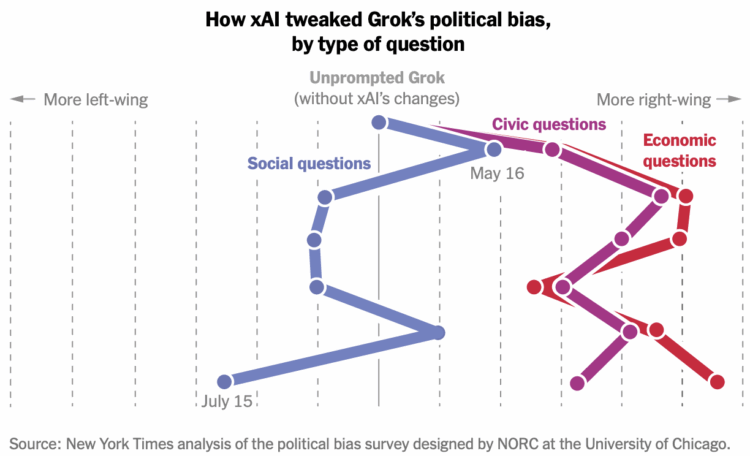
The New York Times estimated political bias in Grok’s models. They entered questions from an ideology survey and evaluated the chatbot’s answers over time.

By July 11, xAI’s updates had pushed its chatbot’s answers to the right for more than half the questions, particularly those about the government or the economy, the tests showed. Its answers to about a third of the questions — most of them about social issues like abortion and discrimination — had moved to the left, exposing the potential limits Mr. Musk faces in altering Grok’s behavior. Mr. Musk and his supporters have expressed frustration that Grok is too “woke,” something the billionaire said in a July post that he is “working on fixing.”

Musk continues to make “fixes” that align with his opinions. Not ideal.

Tags: bias, chatbot, Elon Musk, Grok, New York Times

03 Sep 15:26

The Baby Died. Whose Fault Is It?

by Emi Nietfeld
When her son died in utero, a venture capitalist went to extremes to punish her surrogate.
03 Sep 15:06

Judge: Google can keep Chrome, must share search data with “qualified competitors”

by Ryan Whitwam

Google has avoided the worst-case scenario in the pivotal search antitrust case brought by the US Department of Justice. More than a year ago, the Department of Justice (DOJ) secured a major victory when Google was found to have violated the Sherman Antitrust Act. The remedy phase took place earlier this year, with the DOJ calling for Google to divest the market-leading Chrome browser, release data to competitors, and end many of its search distribution deals.

The government is getting almost none of that. DC District Court Judge Amit Mehta has ruled that Google doesn't have to give up the Chrome browser to mitigate its illegal monopoly in online search. The court will only require a handful of modest data and behavioral remedies, forcing Google to release some search data to competitors and limit its ability to make exclusive distribution deals.

Chrome remains with Google

This case drew many comparisons to the decades-old antitrust case against Microsoft, which nearly saw the company split in two. The company narrowly avoided that fate, and it seems Google will as well—the DOJ came up short on the so-called structural remedies. While there will be some changes to search distribution, the court didn't believe that a breakup was fair in this situation.

Read full article

Comments

03 Sep 15:06

OTC nasal spray seemed to cut COVID infections by 67% in mid-sized trial

by Beth Mole

Daily squirts of a safe, over-the-counter allergy nasal spray may prevent COVID-19 infections from taking hold, according to results published Tuesday in JAMA Internal Medicine. In a mid-staged trial, the spray appeared to reduce infections by promising 67 percent, though a larger trial will need to confirm that robust efficacy.

The trial was a randomized, double-blind, placebo-controlled Phase 2 trial conducted by researchers at Germany's Saarland University between March 2023 and July 2024. The study included 450 healthy adults, about half of whom (227) spritzed their noses three times a day with the generic antihistamine nasal spray, azelastine, which can be purchased over the counter in the US. The placebo, meanwhile, was a spray with an identical composition except for the absence of the antihistamine. The two groups had similar mixes of previous COVID-19 vaccination and infection statuses.

After about 56 days of frequent mistings, only five people using the allergy spray (2.2 percent) caught a SARS-CoV-2 infection, while 15 people using a placebo (6.7 percent) got the pandemic infection. That 4.5 percentage-point drop represents a 67 percent reduction in COVID-19 cases, though the numbers here are small. Still, the researchers noted that the five people using the allergy spray who contracted COVID-19 took more time to get the infection than the 15 in the placebo group (31 days versus 19.5). This could hint that the spray held off some infections from exposures early in the trial. And when the allergy spray users did get COVID-19, they were positive on a rapid antigen test for less time than those infected in the placebo group (3.4 days versus 5.1 days), suggesting they cleared the virus a bit faster.

Read full article

Comments

03 Sep 15:05

Trump’s move of SPACECOM to Alabama has little to do with national security

by Stephen Clark

President Donald Trump announced Tuesday that US Space Command will be relocated from Colorado to Alabama, returning to the Pentagon's plans for the command's headquarters from the final days of Trump's first term in the White House.

The headquarters will move to the Army's Redstone Arsenal in Huntsville, Alabama. Trump made the announcement in the Oval Office, flanked by Republican members of the Alabama congressional delegation.

The move will "help America defend and dominate the high frontier," Trump said. It also marks another twist on a contentious issue that has pitted Colorado and Alabama against one another in a fight for the right to be home to the permanent headquarters of Space Command (SPACECOM), a unified combatant command responsible for carrying out military operations in space.

Read full article

Comments

03 Sep 15:03

Shortly after laying off hundreds, State hires new class of foreign service staff

by Eric Katz
Updated Sept. 2 at 7:43 p.m.

Less than 10 weeks after the State Department laid off hundreds of foreign service officers, citing bureaucratic bloat, it will begin onboarding new officers later this month.

The Office of Talent Acquisition began sending out notices to the new employees last week to notify them that their orientation class will begin Sept. 22, according to an email obtained by Government Executive. About 99 new employees will join the foreign service class, according to individuals involved in or familiar with the plans. 

The hiring follows State issuing reduction-in-force notices to 1,350 employees, about 250 of whom were FSOs. The move has caused current and laid-off staff to question why the cuts were necessary if State planned to quickly turn around and once again begin hiring. Most foreign servants work as generalists, moving from one role and location to the next every few years throughout their careers. 

A current State employee familiar with the hiring plans said “the optics are terrible.” 

A foreign service officer impacted by the layoffs said the new hiring demonstrates a lack of consistent thinking. “They indiscriminately fired hundreds only to turn around and start hiring almost immediately,” the soon-to-be-former officer said. 

Another laid-off foreign service officer noted the approach created significant waste, as State makes large investments in training the diplomatic corps throughout individual employee’s careers. 

“So the idea of firing 250 FSOs only to bring in more people in their wake is totally inefficient and the definition of wasteful government spending,” the laid-off staffer said. 

That person added the approach will open the door to the Trump administration intimidating new employees “who don’t know the rules of the road or when and how to push back.” 

A department spokesperson said State "welcomes a new class" of FSOs, calling the process standard. 

"This new class will be filling entry level positions throughout the department that were maintained in the reorganization," the spokesperson said.

State officials said ahead of the July layoffs that the department’s reorganization was meant to “refocus” its mission on core objectives and modern needs. The department was not saying those impacted by the layoffs “weren't doing a good job or weren't valuable members of the State Department family,” one official said, but the administration had an obligation to “do what's right for the mission and what's right for the American people.”

While the duties and areas in which FSOs serve shift regularly, State said it was targeting staff because of the offices in which they were serving in that moment. Some of those laid off have subsequently been awarded promotions for outstanding performance, though their RIFs remain in effect. 

Under President Biden, the foreign service grew by 6% at State and the department last year brought on its largest class size ever at 235. In May, the Trump administration welcomed another cohort of 104 foreign service personnel. 

While the Trump administration has successfully ushered hundreds of thousands of employees out of government since January, State is just the latest example of an agency seeking to unwind some of that work. The departments of Treasury, Health and Human Services and Labor have rescinded layoffs to fill staffing needs, while the Agriculture Department, Justice Department, Social Security Administration and other agencies have moved employees around to ensure continuity of critical functions. 

This story has been updated with comment from the State Department. 

]]>
02 Sep 13:33

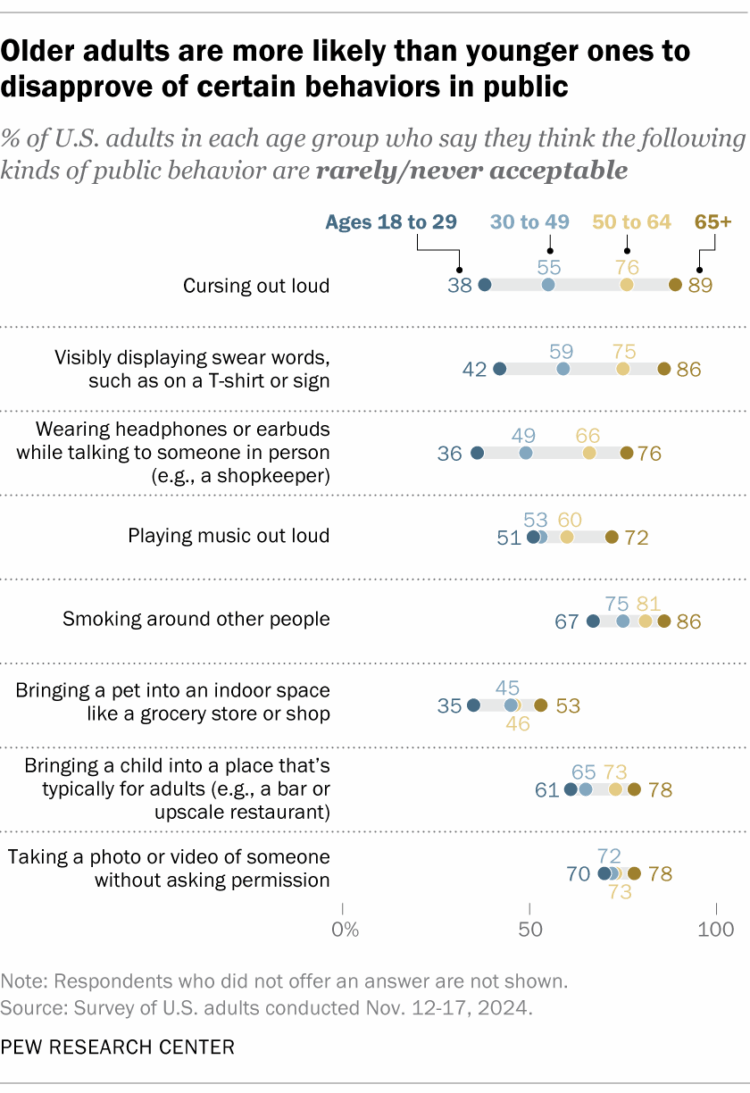
What counts as rude behavior in public, by age group

by Nathan Yau

Pew Research asked U.S. adults if certain behaviors in public, such as cursing or smoking, were acceptable. The above are the results for four age groups.

For every behavior, the percentage of people who said it was rarely or never acceptable increased with age. Television and movies (and my own experiences) would tell you that sounds about right, but for some reason the clear trend surprised me. A quiz with the behaviors lets you get in on the action to see how crotchety you are.

At least we all mostly agree that taking a photo without permission is not acceptable. Now about all that public surveillance.

Tags: age, behavior, Pew Research, rude

30 Aug 12:45

Extreme Heat Makes Your Body Age Faster

by Javier Carbajal
A study reveals that extreme heat accelerates biological aging even more than smoking or drinking.
30 Aug 11:15

Were A Few Random DEI Programs Worth Killing Democracy?

by Mike Brock

Eight months ago, those of us actually paying attention—not just scrolling outrage bait about Biden’s age or the latest campus controversy, but genuinely tracking the systematic preparation for authoritarian rule—warned that Trump represented an existential threat to democratic governance. We were diagnosed with “Trump Derangement Syndrome.” The reasonable people explained, with infinite patience, that we were being hysterical. That institutions would hold. That checks and balances would constrain him. That we were catastrophizing over mean tweets and rough rhetoric.

We weren’t sharing viral clips of Biden stumbling over words or getting worked up about some college kid’s pronoun demands. We were reading the actual plans—the Schedule F preparations, the Jeffrey Clark memos, the systematic identification of loyalists willing to ignore legal constraints. We were watching what the people planning Trump’s return to power were actually doing and saying, tracking the ideological pipelines from Yarvin to Vance, the tech oligarchs pre-positioning themselves for the collapse of democratic oversight.

While everyone else was debating whether Biden was too old or whether DEI had gone too far, we were documenting the actual infrastructure being built to dismantle democracy itself.

Now grand juries are being empaneled to criminally investigate Barack Obama. The Justice Department has become a revenge machine. American soldiers kneel on tarmac to prepare ceremonial welcomes for war criminals. Our financial system is being handed over to crypto fraudsters who’ve paid their protection money to the regime. Civil servants who object on constitutional grounds are being purged. Corporate power lines up to pay tribute in a now-gold adorned Oval Office, each CEO performing their submission in increasingly vulgar displays. And those same reasonable people who were so concerned about Biden’s cognitive decline are explaining why this is all perfectly normal, actually, and besides—at least we don’t have to deal with diversity training anymore.

The Moral Panic That Ate Democracy

Let’s be clear about what happened. Yes, different people voted for Trump for different reasons—some were angry about inflation, others about immigration. But there was a specific class of commentators and self-described “center-left” intellectuals who spent years constructing an elaborate moral panic about “wokeism” as an existential threat to Western civilization.

Bari Weiss built a media empire on the premise that wokeism was a five-alarm fire for democracy. They genuinely convinced themselves that diversity training represented a greater threat than oligarchic capture, that pronoun etiquette was more dangerous than judicial corruption, that land acknowledgments were harbingers of totalitarianism while actual authoritarians were purchasing the machinery of state.

These sophisticated intellectuals should have known better. They had platforms and influence, yet chose to spend years directing attention toward minor cultural irritants while systematic preparation for authoritarian rule proceeded in plain sight. They provided the intellectual framework that let millions of Americans convince themselves they weren’t voting for fascism—they were voting against the “woke mob.”

Was there political and cultural excess on the left? Of course. Some of it was genuinely stupid. But treating it as existential—that was the lie that made everything else possible.

The Reichstag Fire of Our Time

Woke ideology became the Reichstag Fire of the 21st century—a real but limited phenomenon catastrophically inflated to justify the seizure of power. Like the Bolshevik threat that haunted late Weimar Germany, “wokeism” became the all-purpose boogeyman that justified any authoritarian measure, any institutional capture, any suspension of democratic norms.

Yes, there was a fire—some DEI trainings were genuinely stupid, some campus activists genuinely illiberal. But the response was to burn down the entire democratic order to stop it. The anti-woke commentariat played the role of those German conservatives who thought they could use the Nazis to defeat the communists—sophisticated intellectuals who provided respectable cover for forces they claimed to oppose. They spent years building the intellectual framework that let authoritarians claim they weren’t seizing power, they were just defending Western civilization from the woke mob.

Just as anti-communism justified everything from McCarthyism to military coups throughout the 20th century, anti-wokeism became the universal solvent for democratic norms in the 21st. Criminal investigations of political opponents? Necessary to stop woke prosecutors. Purging civil servants? Essential to eliminate DEI bureaucrats. Oligarchic capture of government? Better than letting the gender ideologists win.

The Availability Trap

There’s a psychological phenomenon that explains how even brilliant people became so catastrophically wrong: the availability heuristic. Our brains assess risk based on how easily we can recall examples. The more time you spend thinking about something, the more dangerous it seems—regardless of its actual threat level.

If you spend all your time reading about campus cancellations, documenting every diversity training gone wrong, collecting examples of progressive excess, eventually your brain becomes convinced this is the existential threat. Not because the evidence supports that conclusion, but because these examples are the most cognitively available.

The anti-woke intellectuals weren’t lying when they said they felt democracy was under threat. They’d trained their brains to see danger in the wrong places by immersing themselves completely in left-wing excess. Every problematic DEI training became another data point in an imagined authoritarian takeover. Every campus controversy confirmed their priors about totalitarian drift.

Meanwhile, the actual authoritarian takeover—happening through judicial appointments, regulatory capture, and systematic preparation for ending democratic governance—didn’t feel as threatening because they weren’t immersed in those stories. The Federalist Society’s judge pipeline was boring. Schedule F preparations were technical. The neoreactionary movement’s manifestos were abstract. These things didn’t create the same visceral response as a video of college students shouting down a speaker.

This is how smart people become useful idiots: not through stupidity but through selective attention. They created information ecosystems where campus politics was the main character and everything else was background noise.

The Attention Wars We Lost

The real divide wasn’t between left and right. It was between those consuming political entertainment and those tracking actual power. While millions rage-watched videos of college students saying silly things about gender, we were watching what Trump’s movement was actually planning—reading their own words, their own manifestos, their own explicit declarations of intent to end democratic governance.

The algorithm fed you what made you angry. The anti-woke intellectuals gave you sophisticated reasons to stay angry about the wrong things. And those of us warning about actual fascism? We were dismissed as hysterical by the very people who claimed to be defending liberal democracy.

Every hour spent debating whether “Latinx” was destroying language was an hour not spent noticing that Thiel’s network was placing judges who believe democracy is obsolete. Every essay about the authoritarian dangers of DEI was attention not paid to the actual authoritarians building parallel power structures. Every podcast about cancel culture was time not spent understanding that the real cancellation would be of democracy itself.

The Useful Idiots of Our Time

These anti-woke reactionaries became exactly what Lenin would have recognized: useful idiots. Not idiots in the sense of lacking intelligence—many are brilliant. But idiots in the sense of being useful to forces whose ultimate goals they would claim to find abhorrent.

Their sophisticated critiques of progressive excess provided intellectual cover for authoritarian movements that care nothing for liberal pluralism. They spent years training audiences to see university administrators as the primary threat to freedom rather than presidents who suspend constitutional rights or oligarchs who purchase Supreme Court justices.

The fascists didn’t need these intellectuals to actively support their program. They just needed them to keep everyone focused on the wrong threat while the real coup proceeded.

What Those Paying Attention Saw Coming

We saw it because we weren’t watching the circus—we were watching the crew dismantling the tent poles. While Bari Weiss was building The Free Press to combat the civilizational threat of diversity training. While others wrote books about the dangers of identity politics, we watched the Federalist Society systematically place judges who believe the unitary executive theory supersedes the Constitution.

We weren’t smarter. We just looked at what the actual authoritarians were saying and doing rather than obsessing over cultural annoyances. We read the actual words of people gaining power rather than fixating on some graduate student’s problematic tweet.

And now it’s here. Everything we warned about. The criminal investigations of political opponents. The military being deployed against citizens. The systematic replacement of democratic governance with algorithmic control. Corporate CEOs genuflecting in a gold-plated Oval Office, paying tribute to maintain their market positions. All of it, exactly as those diagnosed with “Trump Derangement Syndrome” warned it would be.

The Historical Verdict

History will see this exactly as it was: a society that fell for its own Reichstag Fire. Where the intellectual class was so obsessed with the manufactured threat of “woke totalitarianism” that they provided cover for actual totalitarianism. Where supposedly serious thinkers spent years constructing elaborate arguments about the danger of pronouns while oligarchs constructed the actual infrastructure of authoritarian rule.

The reality? The “woke excess” was just democracy being messy—requiring us to negotiate with people different from ourselves. The backlash was already happening through normal civil society channels. The notion that “woke ideology” was on the precipice of seizing total control was always nonsense.

But like the Bolshevik threat before it, the specter of wokeism justified everything. It became the perfect foil for authoritarians to weaponize the performance of liberal values like free speech—values they had no intention of upholding once in power. They didn’t need wokeism to actually threaten civilization; they just needed enough people to believe it did.

Now we’re heading toward a society where your political opposition gets criminally investigated. Where the military deploys against citizens. Where billionaires prostrate themselves before a gold-throne president to maintain their fortunes. Where democracy itself becomes a luxury we can no longer afford.

And the intellectuals who should have been warning us? Too busy warning about the totalitarian implications of inclusive language.

The Resistance That Remains

Democracy can still be saved. But not by taking these people seriously as legitimate political actors. Not by treating transparent power grabs as normal policy disagreements. Not by pretending criminal investigations of political opponents are just “hardball politics.”

And definitely not by listening to the same intellectuals who spent the last decade missing the actual threat because they were chasing phantoms. They had their chance to defend democracy and spent it providing intellectual cover for its destroyers.

The first step in resistance is refusing to normalize what’s happening. Stop looking for reasonable interpretations of unreasonable actions. Stop pretending there’s legitimate debate with people openly dismantling democratic governance. Stop treating the vulgar displays of corporate submission in the Oval Office as normal business relations.

Resistance remains possible. Not through violent revolution—that’s what they want, an excuse for harsher crackdowns. But through the simple, difficult act of refusing to pretend this is normal. Through maintaining the capacity for moral recognition. Through remembering that two plus two equals four, no matter what the algorithm says.

The Joke’s On All of Us

Eight months ago, it was “derangement” to predict exactly what’s happening now. Today, it’s “hyperbole” to notice it’s happening. Tomorrow, it will be illegal to mention it happened.

But we don’t have to accept tomorrow. We can refuse normalization today. We can stop taking seriously the people who traded democracy for the death of diversity initiatives. The bitter irony—that those who complained most about “cancel culture” enabled the cancellation of democracy itself—doesn’t have to be the story’s end.

Those of us who saw it coming aren’t geniuses. We just looked at what the people planning authoritarian capture were actually saying and doing, rather than obsessing over campus controversies. We read their words, their plans, their explicit intentions—while others constructed elaborate theories about why campus activists were the real threat.

Welcome to the future the anti-woke commentariat helped create while fighting their imaginary war against their imaginary Bolsheviks.

But we don’t have to accept it. Resistance starts with refusing to be gaslit. With insisting what we’re seeing is what we’re seeing. With remembering those of us who predicted this weren’t deranged—we were right.

And if we were right about what was coming, maybe we’re right about how to stop it.

But please, tell us more about how the real problem was woke college students.

Mike Brock is a former tech exec who was on the leadership team at Block. Originally published at his Notes From the Circus.

30 Aug 11:07

The Inversion Of American Values

by Mike Brock

There’s a particular kind of person who cheers when the president deploys military forces against American cities over the objections of their elected leaders. They call themselves patriots. They wrap themselves in the flag while applauding the systematic demolition of everything that flag once represented. They claim to love America while celebrating the transformation of American governance into something the founders would have recognized as tyranny.

So let’s settle this question once and for all: who are the “real” Americans in this moment? Those cheering the militarization of domestic law enforcement, or those defending the constitutional principles that make America worth defending?

The Theater of Fake Patriotism

When Donald Trump announces plans to deploy National Guard troops to Chicago over the explicit objections of Illinois Governor JB Pritzker and Chicago Mayor Brandon Johnson, his supporters don’t see an authoritarian power grab. They see strength. When he federalizes state forces using Title 10 to override local democratic authority, they don’t recognize constitutional vandalism. They see Trump “getting tough on crime.”

This represents the complete inversion of American patriotism. The same people who spent decades lecturing about states’ rights and federal overreach now cheer the most dramatic federal military deployment against local authority in modern American history. What changed wasn’t constitutional principle—it was who holds the whip hand.

It turns out “states’ rights” was never about principle—it was just about who had the whip hand.

Funny how “federal tyranny” became “law and order” the moment their guy was holding the federal badge.

What Real Patriotism Actually Looks Like

Real patriotism in this moment looks like Illinois Governor Pritzker standing up to federal overreach: “There is no emergency that warrants the President of the United States federalizing the Illinois National Guard, deploying the National Guard from other states, or sending active duty military within our own borders.”

Real patriotism looks like Chicago Mayor Brandon Johnson defending his city’s right to democratic self-governance: “There are many things the federal government could do to help us reduce crime and violence in Chicago, but sending in the military is not one of them.”

But real patriotism isn’t just for elected officials. It’s for every citizen who refuses to normalize military occupation of American cities, who votes against candidates who support domestic militarization, who organizes to defend local democratic institutions, who calls their representatives to demand they choose constitutional principle over partisan loyalty. The founders didn’t create this system to be defended by politicians—they created it to be defended by citizens who understand that democracy dies when good people do nothing.

The Authoritarian Inversion

The people cheering Trump’s military deployments have internalized a fundamentally un-American understanding of patriotism. They’ve confused loyalty to the country with loyalty to whoever happens to control federal power. They’ve mistaken submission to authority for love of freedom. They’ve traded the messy, contentious, argumentative democracy the founders created for the clean efficiency of strongman rule.

They’ve been conditioned to see their fellow Americans as enemies to be defeated rather than citizens to be persuaded. Democratic governors become “radical leftists.” Sanctuary cities become “lawless zones.” Local officials exercising their constitutional authority become “obstructionists” who deserve federal punishment.

This is how republics die—not through foreign invasion but through the systematic redefinition of opposition as treason, of constitutional limits as obstacles, of democratic accountability as weakness.

The Pattern of Militarization

What Trump is doing follows a clear pattern that any serious student of authoritarianism would recognize: declare emergencies that don’t exist, militarize responses to civilian problems, target political opponents, normalize federal military presence in domestic settings, and use military deployment to intimidate broader opposition.

Crime rates are at historic lows in most American cities, but Trump claims unprecedented lawlessness requiring military intervention. Notice that the cities being targeted—Chicago, Los Angeles, New York—are all led by Democratic officials who oppose Trump’s policies. This isn’t about crime; it’s about punishing political opposition.

Each deployment becomes precedent for the next, each “emergency” power becomes standard operating procedure, each violation of constitutional limits becomes the new baseline. The message isn’t just directed at the mayors and governors being overruled—it’s directed at every elected official considering whether to resist federal overreach.

This is the playbook authoritarians have used throughout history to transform democratic systems into military rule.

The Constitutional Crisis

Let’s be clear about what’s actually happening: the president is using military force against domestic populations over the objections of their elected representatives. This isn’t law enforcement—it’s the military occupation of American cities whose only crime was electing leaders who refuse to comply with federal demands.

The Constitution these fake patriots claim to revere contains specific protections against exactly this kind of military deployment. The Posse Comitatus Act exists precisely to prevent federal military forces from being used for domestic law enforcement. The federalist system exists to prevent any one level of government from overwhelming the others.

But constitutional protections only work when people are willing to defend them. When large portions of the population actively cheer their violation, when elected officials refuse to exercise oversight, when courts create immunity doctrines that place executives above accountability—the Constitution becomes paper rather than framework.

The Real American Tradition

The real American tradition is suspicion of concentrated federal power, especially military power deployed against domestic populations. The founders who wrote the Constitution had just fought a war against precisely this kind of military occupation by a distant government that claimed to know better than local communities.

As James Madison warned: “A standing military force, with an overgrown Executive will not long be safe companions to liberty.” They created a system specifically designed to prevent any one person from wielding the kind of power Trump now deploys against American cities.

The real American tradition is messy federalism, where different levels of government check each other’s power, where local communities get to make decisions about their own governance, where federal authority has limits and those limits are enforced.

The real American tradition is that when you don’t like how a city is governed, you work to change it through democratic means—you run candidates, organize voters, make arguments, build coalitions. You don’t send in federal troops to impose your preferred policies through military force.

Who the Founders Would Recognize

If the founders could observe this moment, who would they recognize as defending American principles? The people cheering federal military deployment against elected local officials? Or the governors and mayors standing up to federal intimidation, the citizens defending their right to democratic self-governance, the Americans who understand that constitutional principles matter more than partisan advantage?

The Declaration of Independence was written by people who understood that governments derive their just powers from the consent of the governed, not from their capacity to deploy military force against opposition.

The Choice Before Us

We face a fundamental choice about what kind of country we want to be. Do we want to be a nation where local democratic decisions get overruled by federal military force? Where constitutional constraints get swept aside whenever the executive declares an “emergency”?

Or do we want to remain a constitutional republic where power is divided, where military force is not used against domestic populations, where even presidents must respect constitutional limits?

The people cheering Trump’s militarization have made their choice. They’ve chosen strongman efficiency over constitutional process, federal dominance over democratic federalism, military occupation over civilian governance.

The rest of us need to make ours. We can organize, vote, protest, and demand that our representatives defend constitutional principles. We can refuse to normalize military occupation as “law enforcement.” We can choose to be citizens, or we can be subjects polishing the boots that march over us.

The Test of Our Time

Every generation of Americans faces a test of whether they’re worthy of their inheritance. Our test is whether we’ll defend constitutional government against military rule, preserve democratic federalism against federal dominance, maintain civilian control against militarization.

The people cheering Trump’s military deployments have already failed this test. They’ve chosen tribal loyalty over constitutional principle, the aesthetics of strength over the substance of freedom.

The rest of us still have time to pass it. But only if we’re willing to call this what it is: not law enforcement but military occupation, not patriotism but authoritarianism, not strength but the systematic destruction of everything that once made America worth defending.

Two plus two equals four. There are twenty-four hours in a day. And military deployment against domestic populations over the objections of elected local officials is tyranny, not patriotism.

The real Americans are the ones willing to say so—and willing to act on it.

That’s what real patriotism looks like when democracy is under assault.

Mike Brock is a former tech exec who was on the leadership team at Block. Originally published at his Notes From the Circus.

29 Aug 21:44

How does MCPS choose which buildings to renovate?  

by Ashlyn Campbell

52 buildings have been assessed. See which are in the worst shape

The post How does MCPS choose which buildings to renovate?   appeared first on Bethesda Magazine.

27 Aug 18:05

Scraping the Spotify playlists of public figures

by Nathan Yau

New to me, someone anonymously scraped and published the Spotify playlists of a handful of celebrities and politicians. The project is called the Panama Playlists.

I found the real Spotify accounts of celebrities, politicians, and journalists. Many use their real names. With a little investigating, I could say with near-certainty: yep, this is that person.

I’ve been scraping their playlists for over a year. Some individuals even have a setting enabled that displays their last played song. I scraped this continuously, so I know what songs they played, how many times, and when.

The Panama Papers revealed hidden bank accounts. This reveals hidden tastes.

Tags: music, privacy, Spotify