Lindsey
Shared posts
The Zipper Is Getting Its First Major Upgrade in 100 Years
Gemini in Google Home Keeps Mistaking My Dog for a Cat
Proton Mail Review (2025): The Email Service You Didn’t Know You Needed
We Found That More Than 170 U.S. Citizens Have Been Held by Immigration Agents. They’ve Been Kicked, Dragged and Detained for Days.
When the Supreme Court recently allowed immigration agents in the Los Angeles area to take race into consideration during sweeps, Justice Brett Kavanaugh said that citizens shouldn’t be concerned.
“If the officers learn that the individual they stopped is a U.S. citizen or otherwise lawfully in the United States,” Kavanaugh wrote, “they promptly let the individual go.”
But that is far from the reality many citizens have experienced. Americans have been dragged, tackled, beaten, tased and shot by immigration agents. They’ve had their necks kneeled on. They’ve been held outside in the rain while in their underwear. At least three citizens were pregnant when agents detained them. One of those women had already had the door of her home blown off while Department of Homeland Security Secretary Kristi Noem watched.
About two dozen Americans have said they were held for more than a day without being able to phone lawyers or loved ones.
Videos of U.S. citizens being mistreated by immigration agents have filled social media feeds, but there is little clarity on the overall picture. The government does not track how often immigration agents hold Americans.
So ProPublica created its own count.
We compiled and reviewed every case we could find of agents holding citizens against their will, whether during immigration raids or protests. While the tally is almost certainly incomplete, we found more than 170 such incidents during the first nine months of President Donald Trump’s second administration.
Among the citizens detained are nearly 20 children, including two with cancer. That includes four who were held for weeks with their undocumented mother and without access to the family’s attorney until a congresswoman intervened.
Immigration agents do have authority to detain Americans in limited circumstances. Agents can hold people whom they reasonably suspect are in the country illegally. We found more than 50 Americans who were held after agents questioned their citizenship. They were almost all Latino.
Immigration agents also can arrest citizens who allegedly interfered with or assaulted officers. We compiled cases of about 130 Americans, including a dozen elected officials, accused of assaulting or impeding officers.
These cases have often wilted under scrutiny. In nearly 50 instances that we have identified so far, charges have never been filed or the cases were dismissed. Our count found a handful of citizens have pleaded guilty, mostly to misdemeanors.
Among the detentions in which allegations have not stuck, masked agents pointed a gun at, pepper sprayed and punched a young man who had filmed them searching for his relative. In another, agents knocked over and then tackled a 79-year-old car wash owner, pressing their knees into his neck and back. His lawyer said he was held for 12 hours and wasn’t given medical attention despite having broken ribs in the incident and having recently had heart surgery. In a third case, agents grabbed and handcuffed a woman on her way to work who was caught up in a chaotic raid on street vendors. In a complaint filed against the government, she described being held for more than two days, without being allowed to contact the outside world for much of that time. (The Supreme Court has ruled that two days is generally the longest federal officials can hold Americans without charges.)

In response to questions from ProPublica, the Department of Homeland Security said agents do not racially profile or target Americans. “We don’t arrest US citizens for immigration enforcement,” wrote spokesperson Tricia McLaughlin.
A top immigration official recently acknowledged agents do consider someone’s looks. “How do they look compared to, say, you?” Border Patrol chief Gregory Bovino said to a white reporter in Chicago.
The White House told ProPublica that anyone who assaults federal immigration agents would be prosecuted. “Interfering with law enforcement and assaulting law enforcement is a crime and anyone, regardless of immigration status, will be held accountable,” said the Deputy Press Secretary Abigail Jackson. “Officers act heroically to enforce the law, arrest criminal illegal aliens, and protect American communities with the utmost professionalism.”
A spokesperson for Kavanaugh did not return an emailed request for comment.
Tallying the number of Americans detained by immigration agents is inherently messy and incomplete. The government has long ignored recommendations for it to track such cases, even as the U.S. has a history of detaining and even deporting citizens, including during the Obama administration and Trump’s first term.
We compiled cases by sifting through both English- and Spanish-language social media, lawsuits, court records and local media reports. We did not include arrests of protesters by local police or the National Guard. Nor did we count cases in which arrests were made at a later date after a judicial process. That included cases of some people charged with serious crimes, like throwing rocks or tossing a flare to start a fire.
Experts say that Americans appear to be getting picked up more now as a result of the government doing something that it hasn’t for decades: large-scale immigration sweeps across the country, often in communities that do not want them.
In earlier administrations, deportation agents used intelligence to target specific individuals, said Scott Shuchart, a top immigration official in the Biden, Obama and first Trump administrations. “The new idea is to use those resources unintelligently” — with officers targeting communities or workplaces where undocumented immigrants may be.
When federal officers roll through communities in the way the Supreme Court permitted, the constitutional rights of both citizens and noncitizens are inevitably violated, argued David Bier, the director of immigration studies at the libertarian Cato Institute. He recently analyzed how sweeps in Los Angeles have led to racial profiling. “If the government can grab someone because he’s a certain demographic group that’s correlated with some offense category, then they can do that in any context.”
Cody Wofsy, an attorney at the American Civil Liberties Union, put it even more starkly. “Any one of us could be next.”
When Kavanaugh issued his opinion that immigration agents can consider race and other factors, the Supreme Court’s three liberal justices strongly dissented. They warned that citizens risked being “grabbed, thrown to the ground, and handcuffed simply because of their looks, their accents, and the fact they make a living by doing manual labor.”
Leonardo Garcia Venegas appears to have been just such a case. He was working at a construction site in coastal Alabama when he saw masked immigration agents from Homeland Security Investigations hop a fence and run by a “No trespassing” sign. Garcia Venegas recalled that they moved toward the Latino workers, ignoring the white and Black workers.
Garcia Venegas began filming after his undocumented brother asked agents for a warrant. In response, the footage shows, agents yanked his brother to the ground, shoving his face into wet concrete. Garcia Venegas kept filming until officers grabbed him too and knocked his phone to the ground.
Other co-workers filmed what happened next, as immigration agents twisted the 25-year-old’s arms. They repeatedly tried to take him to the ground while he yelled, “I’m a citizen!”
Officers pulled out his REAL ID, which Alabama only issues to those legally in the U.S. But the agents dismissed it as fake. Officers held Garcia Venegas handcuffed for more than an hour. His brother was later deported.

Garcia Venegas was so shaken that he took two weeks off of work. Soon after he returned, he was working alone inside a nearly built house listening to music on his headphones when he sensed someone watching him. A masked immigration agent was standing in the bedroom doorway.
This time, agents didn’t tackle him. But they again dismissed his REAL ID. And then they held him to check his citizenship. Garcia Venegas says agents also held two other workers who had legal status.
DHS did not respond to ProPublica’s questions about Garcia Venegas’ detentions, or to a federal lawsuit he filed last month. The agency has previously defended the agents’ conduct, saying he “physically got in between agents and the subject” during the first incident. The footage does not show that, and Garcia Venegas was never charged with obstruction or any other crime.
Garcia Venegas’ lawyers at the nonprofit Institute for Justice hope others may join his suit. After all, the reverberations of the immigration sweeps are being felt widely. Garcia Venegas said he knows of 15 more raids on nearby construction sites, and the industry along his portion of the Gulf Coast is struggling for lack of workers.
Kavanaugh’s assurances hold little weight for Garcia Venegas. He’s a U.S. citizen of Mexican descent, who speaks little English and works in construction. Even with his REAL ID and Social Security card in his wallet, Garcia Venegas worries that immigration agents will keep harassing him.
“If they decide they want to detain you,” he said. “You’re not going to get out of it.”

George Retes was among the citizens arrested despite immigration agents appearing to know his legal status. He also disappeared into the system for days without being able to contact anyone on the outside.
The only clue Retes’ family had at first was a brief call he managed to make on his Apple Watch with his hands handcuffed behind his back. He quickly told his wife that “ICE” had arrested him during a massive raid and protest on the marijuana farm where he worked as a security guard.
Still, Retes’ family couldn’t find him. They called every law enforcement agency they could think of. No one gave them any answers.
Eventually, they spotted a TikTok video showing Retes driving to work and slowly trying to back up as he’s caught between agents and protestors. Through the tear gas and dust, his family recognized Retes’ car and the veteran decal on his window. The full video shows a man — Retes — splayed on the ground surrounded by agents.
Retes’ family went to the farm, where local TV reporters were interviewing families who couldn’t find their loved ones.
“They broke his window, they pepper sprayed him, they grabbed him, threw him on the floor,” his sister told a reporter between sobs. “We don’t know what to do. We’re just asking to let my brother go. He didn’t do anything wrong. He’s a veteran, disabled citizen. It says it on his car.”
Retes was held for three days without being given an opportunity to make a call. His family only learned where he had been after his release. His leg had been cut from the broken glass, Retes told ProPublica, and lingering pepper spray burned his hands. He tried to soothe them by filling sandwich bags with water.
Retes recalled that agents knew he was a citizen. “They didn’t care.” He said one DHS official laughed at him, saying he shouldn’t have come to work that day. “They still sent me away to jail.” He added that cases like his show Kavanaugh was “wrong completely.”
DHS did not answer our questions about Retes. It did respond on X after Retes wrote an op-ed last month in the San Francisco Chronicle. An agency post asserted he was arrested for assault after he “became violent and refused to comply with law enforcement.” Yet Retes had been released without any charges. Indeed, he says he was never told why he was arrested.


The Department of Justice has encouraged agents to arrest anyone interfering with immigration operations, twice ordering law enforcement to prioritize cases of those suspected of obstructing, interfering with or assaulting immigration officials.
But the government’s claims in those cases have often not been borne out.
Daniel Montenegro was filming a raid at a Van Nuys, California, Home Depot with other day-laborer advocates this summer when, he told ProPublica, he was tackled by several officers who injured his back.
Bovino, the Border Patrol chief who oversaw the LA raids and has since taken similar operations to cities like Sacramento and Chicago, tweeted out the names and photos of Montenegro and three others, accusing them of using homemade tire spikes to disable vehicles.
“I had no idea where that story came from,” Montenegro told ProPublica. “I didn’t find out until we were released. People were like, ‘We saw you on Twitter and the news and you guys are terrorists, you were planning to slash tires.’ I never saw those spike tire-popper things.”
Officials have not charged Montenegro or the others with any crimes. (Bovino did not respond to a request for comment, while DHS defended him in a statement to ProPublica: “Chief Bovino’s success in getting the worst of the worst out of the country speaks for itself.”)
The government’s cases are sometimes so muddied that it’s unclear why agents actually arrested a citizen.
Andrea Velez was charged with assaulting an officer after she was accidentally dropped off for work during a raid on street vendors in downtown Los Angeles. She said in a federal complaint that officers repeatedly assumed she did not speak English. Federal officers later requested access to her phone in an attempt to prove she was colluding with another citizen arrested that day, who was charged with assault. She was one of the Americans held for more than two days.
DHS did not respond to our questions about Velez, but it has previously accused her of assaulting an officer. A federal judge has dismissed the charges.
Other citizens also said officers accused them of crimes and suddenly questioned their citizenship — including a man arrested after filming Border Patrol agents break a truck window, and a pregnant woman who tried to stop officers from taking her boyfriend.
The prospects for any significant reckoning over agents’ conduct, even against citizens, are dim. The paths for suing federal agents are even more limited than they are for local police. And that’s if agents can even be identified. What’s more, the administration has gutted the office that investigates allegations of abuse by agents.
“The often-inadequate guardrails that we have for state and local government — even those guardrails are nonexistent when you’re talking about federal overreach,” said Joanna Schwartz, a professor at UCLA School of Law.
More than 50 members of Congress have also written to the administration, demanding details about Americans who’ve been detained. One is Sen. Alex Padilla, a California Democrat. After trying to question Noem about detained citizens, federal agents grabbed Padilla, pulled him to the ground and handcuffed him. The department later defended the agents, saying they “acted appropriately.”
How We Did This
Americans have reported a wide range of troubling encounters with immigration agents. To get a wider sense of agents’ conduct, we cataloged all incidents we could find of citizens being held against their will by immigration officers.
Critically, there is no way to know the complete scope of these stops since the government itself does not track them. But we were still able to fill in the picture a bit more.
We reviewed more than 170 cases overall, which we sorted into two categories.
The first is Americans who were held because agents questioned their citizenship. We found more than 50 such cases. The second category is Americans arrested by immigration agents after being accused of assaulting or impeding officers at protests or during immigration arrests of others. In that category, we tallied about 130 Americans, including more than a dozen elected officials. In many of these cases, the government never charged these individuals or the cases were dismissed.
We also tracked another nine citizens who reported being concerned about racial profiling after being extensively questioned by immigration officials. This includes a Mescalero Apache tribal member who was pulled out of a store and asked for his passport, and a California man who was previously deported by mistake and got another deportation order in the mail.
We did all this by sifting through both English- and Spanish-language social media, lawsuits, court records and local media reports. We compiled cases from the beginning of the current Trump administration through Oct. 5. Our accounting of arrests in Portland, Oregon, and Chicago is particularly limited, since the events there are still unfolding.
We did not review cases of Americans detained in airports or at the border, where even citizens are more likely to encounter increased questioning. We also did not review cases of Americans arrested at some point after alleged encounters with immigration agents since those involved a judicial process. We similarly excluded arrests of immigration protestors by local police who, unlike many of the federal agencies, booked protesters into a local jail where they could access the legal process and their families could find them.
The post We Found That More Than 170 U.S. Citizens Have Been Held by Immigration Agents. They’ve Been Kicked, Dragged and Detained for Days. appeared first on ProPublica.
The Shadow President
On the afternoon of Feb. 12, Russell Vought, the director of the White House Office of Management and Budget, summoned a small group of career staffers to the Eisenhower Executive Office Building for a meeting about foreign aid. A storm had dumped nearly 6 inches of snow on Washington, D.C. The rest of the federal government was running on a two-hour delay, but Vought had offered his team no such reprieve. As they filed into a second-floor conference room decorated with photos of past OMB directors, Vought took his seat at the center of a worn wooden table and laid his briefing materials out before him.
Vought, a bookish technocrat with an encyclopedic knowledge of the inner workings of the U.S. government, cuts an unusual figure in Trump’s inner circle of Fox News hosts and right-wing influencers. He speaks in a flat, nasally monotone and, with his tortoiseshell glasses, standard-issue blue suits and corona of close-cropped hair, most resembles what he claims to despise: a federal bureaucrat. The Office of Management and Budget, like Vought himself, is little known outside the Beltway and poorly understood even among political insiders. What it lacks in cachet, however, it makes up for in the vast influence it wields across the government. Samuel Bagenstos, an OMB general counsel during the Biden administration, told me, “Every goddam thing in the executive branch goes through OMB.”
The OMB reviews all significant regulations proposed by individual agencies. It vets executive orders before the president signs them. It issues workforce policies for more than 2 million federal employees. Most notably, every penny appropriated by Congress is dispensed by the OMB, making the agency a potential choke point in a federal bureaucracy that currently spends about $7 trillion a year. Shalanda Young, Vought’s predecessor, told me, “If you’re OK with your name not being in the spotlight and just getting stuff done,” then directing the OMB “can be one of the most powerful jobs in D.C.”
During Donald Trump’s first term, Vought (whose name is pronounced “vote”) did more than perhaps anyone else to turn the president’s demands and personal grievances into government action. In 2019, after Congress refused to fund Trump’s border wall, Vought, then the acting director of the OMB, redirected billions of dollars in Department of Defense money to build it. Later that year, after the Trump White House pressured Ukraine’s government to investigate Joe Biden, who was running for president, Vought froze $214 million in security assistance for Ukraine. “The president loved Russ because he could count on him,” Mark Paoletta, who has served as the OMB general counsel in both Trump administrations, said at a conservative policy summit in 2022, according to a recording I obtained. “He wasn’t a showboat, and he was committed to doing what the president wanted to do.”
After the pro-Trump riots at the U.S. Capitol on Jan. 6, 2021, many Republicans, including top administration officials, disavowed the president. Vought remained loyal. He echoed Trump’s baseless claims about election fraud and publicly defended people who were arrested for their participation in the melee. During the Biden years, Vought labored to translate the lessons of Trump’s tumultuous first term into a more effective second presidency. He chaired the transition portion of Project 2025, a joint effort by a coalition of conservative groups to develop a road map for the next Republican administration, helping to draft some 350 executive orders, regulations and other plans to more fully empower the president. “Despite his best thinking and the aggressive things they tried in Trump One, nothing really stuck,” a former OMB branch chief who served under Vought during the first Trump administration told me. “Most administrations don’t get a four-year pause or have the chance to think about ‘Why isn’t this working?’” The former branch chief added, “Now he gets to come back and steamroll everyone.”

At the meeting in February, according to people familiar with the events, Vought’s directive was simple: slash foreign assistance to the greatest extent possible. The U.S. government shouldn’t support overseas anti-malaria initiatives, he argued, because buying mosquito nets doesn’t make Americans safer or more prosperous. He questioned why the U.S. funded an international vaccine alliance, given the anti-vaccine views of Trump’s nominee for secretary of Health and Human Services, Robert F. Kennedy Jr. The conversation turned to the United States Institute of Peace, a government-funded nonprofit created under Ronald Reagan, which worked to prevent conflicts overseas; Vought asked what options existed to eliminate it. When he was told that the USIP was funded by Congress and legally independent, he replied, “We’ll see what we can do.” (A few days later, Trump signed an executive order that directed the OMB to dismantle the organization.)
The OMB staffers had tried to anticipate Vought’s desired outcome for more than $7 billion that the State Department and the U.S. Agency for International Development spent each year on humanitarian assistance, including disaster relief and support for refugees and conflict victims. During the campaign, Trump had vowed to defund agencies that give money to people “who have no respect for us at all,” and Project 2025 had accused USAID of pursuing a “divisive political and cultural agenda.” The staffers proposed a cut of 50%.
Vought was unsatisfied. What would be the consequences, he asked, of a much larger reduction? A career official answered: Less humanitarian aid would mean more people would die. “You could say that about any of these cuts,” Vought replied. A person familiar with the meeting described his reaction as “blasé.” Vought reiterated that he wanted spending on foreign aid to be as close to zero as possible, on the fastest timeline possible. Several analysts left the meeting rattled. Word of what had happened spread quickly among the OMB staff. Another person familiar with the meeting later told me, “It was the day that broke me.”
What Vought has done in the nine months since Trump took office goes much further than slashing foreign aid. Relying on an expansive theory of presidential power and a willingness to test the rule of law, he has frozen vast sums of federal spending, terminated tens of thousands of federal workers and, in a few cases, brought entire agencies to a standstill. In early October, after Senate Democrats refused to vote for a budget resolution without additional health care protections, effectively shutting down the government, Vought became the face of the White House’s response. On the second day of the closure, Trump shared an AI-generated video that depicted his budget director — who, by then, had threatened mass firings across the federal workforce and paused or canceled $26 billion in funding for infrastructure and clean-energy projects in blue states — as the Grim Reaper of Washington, D.C. “We work for the president of the United States,” a senior agency official who regularly deals with the OMB told me. But right now “it feels like we work for Russ Vought. He has centralized decision-making power to an extent that he is the commander in chief.”
At the start of Trump’s second term, Elon Musk’s Department of Government Efficiency, which promised to slash spending and root out waste, dominated the headlines. A gaggle of tech bros, with little government experience, appeared to be marching into federal buildings and, with the president’s blessing, purging people and programs seen as “woke” or anti-Trump. The sight of Musk swinging a chainsaw onstage at a conservative conference captured the pell-mell approach, not to mention the brutality, of the billionaire’s plan to bring the federal government to heel.
But, according to court records, interviews and other accounts from people close to Vought, DOGE’s efforts were guided, more than was previously known, by the OMB director. Musk bragged about “feeding USAID into the wood chipper,” but the details of the agency’s downsizing were ironed out by Vought’s office. When DOGE took aim at obscure quasi-government nonprofits, such as the United States Institute of Peace, OMB veterans saw Vought’s influence at work. “I can’t imagine that the DOGE team knew to target all these little parts of the government without Russ pointing them there,” the former OMB branch chief told me. Vought also orchestrated DOGE’s hostile takeover of the Consumer Financial Protection Bureau, crippling a regulator that Republicans had hoped to shutter during Trump’s first term. “DOGE is underneath the OMB,” Michelle Martin, an official with Citizens for Renewing America, a grassroots group founded by Vought, said in May, according to a video of her remarks. “Honestly, a lot of what Elon began pinpointing … was at the direction of Russ.”
Vought, who declined to be interviewed for this story, voiced concerns about some of DOGE’s tactics — canceling budget items that the OMB had wanted to keep, for instance — but he mostly saw the department as a useful battering ram. An administration official who has worked with Vought and Musk told me that DOGE showed Vought it was possible to ignore legal challenges and take dramatic action. “He has the benefit of Elon softening everyone up,” the official told me. “Elon terrified the shit out of people. He broke the status quo.”
Vought is a stated opponent of the status quo. One of the few prominent conservatives to embrace the label of “Christian nationalist,” he once told an audience that “the phrasing is too accurate to run away from the term. … I’m a Christian. I am a nationalist. We were meant to be a Christian nation.” American democracy, he has said, has been hijacked by rogue judges who make law from the bench and by a permanent class of government bureaucrats who want to advance “woke” policies designed to divide Americans and silence political opponents. “The stark reality in America is that we are in the late stages of a complete Marxist takeover of the country, in which our adversaries already hold the weapons of the government apparatus,” Vought said in 2024, during a conference hosted by the Center for Renewing America, a nonprofit think tank that he also founded. “And they have aimed it at us.”
Listen to Vought Talk About Christian Nationalism
The central struggle of our time, he says, pits the defenders of this “post-constitutional” order — what he calls the “cartel” or the “regime,” which in his telling includes Democrats and Republicans — against a group of “radical constitutionalists” fighting to destroy the deep state and return power to the presidency and, ultimately, the people. Vought counts himself as a member of the latter group, which, in his view, also includes right-wing stalwarts such as the political strategist Steve Bannon and Stephen Miller, the architect of Trump’s mass-deportation campaign. “We want the bureaucrats to be traumatically affected,” he said in a private speech in 2023. “When they wake up in the morning, we want them to not want to go to work, because they are increasingly viewed as the villains.”
Watch: “We Want the Bureaucrats to Be Traumatically Affected”
The ultimate radical constitutionalist, Vought says, is Donald Trump. In Vought’s view, Trump, the subject of four indictments during his time out of office, is a singular figure in the history of the American republic, a once persecuted leader who returns to power to defeat the deep state. “We have in Donald Trump a man who is so uniquely positioned to serve this role, a man whose own interests perfectly align with the interests of the country,” Vought said in his 2024 speech. “He has seen what it has done to him, and he has seen what they are trying to do to the country. That is nothing more than a gift of God.” As Bannon put it, sitting onstage with Vought at a closed-door conference in 2023, Trump is “a very imperfect instrument, right? But he’s an instrument of the Lord.”
In Vought’s vision for the U.S. government, an all-powerful executive branch would be able to fire workers, cancel programs, shutter agencies, and undo regulations that govern air and water quality, financial markets, workplace protections and civil rights. The Department of Justice, meanwhile, would shed its historical independence and operate at the direction of the White House. All of this puts Vought at the center of what Steve Vladeck, a law professor at Georgetown, described to me as the Trump administration’s “complete disregard” for the law. “The president has no authority to not spend money Congress has appropriated — that’s not a debate,” he told me. “The president has no authority to fire civil servants who are protected by statute — that’s not a debate.” He added, “We are seeing exertions of executive power the likes of which we have never seen in this country.”
Vought, who is 49, has spent his entire adult life in Washington. He met his wife, Mary, on Capitol Hill, where they both eventually worked for Mike Pence, at the time a Republican congressman from Indiana. (The Voughts divorced in 2023.) Yet, after nearly 30 years in the nation’s capital, he still views himself as an outsider. He once described his upbringing, in Trumbull, Connecticut, as “blue collar” and his parents as part of America’s “forgotten men and women.”
Vought’s father, Thurlow, served in the Marines and worked as an electrician. His mother, Margaret, spent more than 20 years as a schoolteacher and administrator. Before they married each other, Vought’s parents had both been widowed in their 30s and left to raise families on their own; Russ was their only child together. In 1981, when Russ was 4, one of Thurlow’s daughters died in a car crash. Not long after the accident, Thurlow had a religious awakening. “That completely changed the direction of our immediate family,” one of Vought’s half sisters later wrote on social media.

Vought’s mother helped launch a Christian school, where the curriculum relied heavily on the Bible. One history book the school considered using included the instruction to “Defend the statement that all governmental power and authority come from God.” America was built on Judeo-Christian values, she told a local newspaper, and if the American people gave up on those values “then they’re going to have to pay the price based on sin, sickness, disease and anarchy.”
Vought attended a private Christian high school, then went to Illinois to study at Wheaton College, which is known as the “evangelical Harvard.” He moved to Washington after graduation and, in 1999, landed a job in the office of Phil Gramm, a Republican senator from Texas. Vought, who started in the mailroom, would later say that working for Gramm laid the “conservative foundation” for the rest of his life.
Gramm was an uncompromising budget hawk. He was famous for the “Dickey Flatt test,” named after a printer Gramm knew in Texas. For every dollar of federal spending, Gramm said, lawmakers must ask themselves: Did it improve the lives of people like Dickey Flatt? (In Gramm’s estimation, the answer was often no; every year, he introduced legislation designed to ruthlessly slash the budget.) Years later, when Vought testified before Congress, he said that people like his parents “have always been my test for federal spending. Did a particular program or spending increase help the nameless wagon pullers across our country, working hard at their job, trying to provide for their family and future?”
Under Gramm’s tutelage, Vought developed a reputation as a master of the arcane rules that can get legislation passed or killed. He climbed the ranks of the Republican Party, going on to advise Pence, who was then the leader of the House Republican Conference. But the closer Vought got to the center of congressional power, the more disillusioned he became. In the late 2000s, when Republican lawmakers, who professed to care about deficits and balanced budgets, voted in favor of bills loaded with corporate giveaways and pork-barrel spending, Vought felt that they were abandoning their principles and duping their constituents. He later recalled of this time, “I would say, ‘If there’s an opinion in this leadership room, I’m telling you it’s 95% wrong.’” A former Capitol Hill colleague of Vought’s told me, “I think he thought the Republican leadership was a bigger impediment to conservative causes than Democrats were.”
In 2010, Vought quit working for House Republicans and helped launch Heritage Action for America, an offshoot of the influential conservative think tank Heritage Foundation. The foundation was known for dense policy papers and its voluminous “Mandate for Leadership” governing guide. Heritage Action had a different purpose — to strong-arm Republicans in Congress into acting more conservatively.
Vought was instrumental in turning Heritage Action into the interest group that congressional Republicans feared most. He picked fights with party leaders over agriculture subsidies and greenhouse gas regulations, and published a scorecard that rated how lawmakers voted on key bills. In Heritage Action’s first year, according to a person familiar with Vought’s work there, he came up with an idea for a mailer that attacked Bob Corker, a Republican senator from Tennessee, for his vote to approve a nuclear weapons treaty with Russia. The mailer featured a photograph of Corker alongside images of Barack Obama, Vladimir Putin and the Iranian leader Mahmoud Ahmadinejad. Heritage Action’s tactics so infuriated the Republican leadership that Sen. Mitch McConnell called on Heritage donors to stop funding the group. (McConnell did not respond to a request for comment.)
In 2013, Heritage Action announced a campaign to defund the Affordable Care Act. Vought and his colleagues toured the country, whipping up the grassroots, and poured millions of dollars
into advertisements and lobbying. They wanted Republicans in the House and the Senate to insist that any spending bill passed to avert a shutdown must also defund Obamacare. The Republican lawmakers who embraced the strategy came to be known as the “suicide caucus,” and their protest led to a 16-day government shutdown. In the end, Republican leaders cut a deal to reopen the government, leaving Obamacare intact.
Heritage Action saw the 2016 presidential election as an opportunity to put a true conservative back in the White House. The group’s CEO, Michael Needham, openly supported Sen. Ted Cruz, of Texas, who, three years earlier, had helped orchestrate the shutdown. Trump, at least initially, was treated with disdain. During an appearance on Fox News in 2015, Needham called him a “clown” who “needs to be out of the race.”
Vought and Trump couldn’t have been more different: One was a deacon at his Baptist church; the other was a twice-divorced philanderer who had been caught on camera bragging about grabbing women “by the pussy.” But, after Trump won the election, Vought was offered a job as a senior adviser at the OMB, where he’d dreamed of working since his days in Phil Gramm’s office. Years later, Vought would say that, at the time, he had no ambition of one day running the agency. He had planned to help with the transition and some of the OMB’s early efforts, then go to seminary to become a pastor. But, he later said in a podcast interview, “God had other plans.”
In March 2017, Trump signed an executive order that called for a top-to-bottom reorganization of the federal government. Mick Mulvaney, a former congressman, served as Trump’s first budget director, but, inside the OMB, Vought took the lead. According to a former senior staffer at the agency, Vought initially pushed for the president’s plan to eliminate USAID and the Consumer Financial Protection Bureau. He also wanted to fold the Department of Health and Human Services, along with food stamps programs, into a new Department of Health and Public Welfare. “They wanted to call it that because they think it sounds bad,” a former OMB analyst told me. In one meeting, according to a person in the room, Vought asked, “Why do we do economic assistance abroad at all?” The former OMB analyst said, “There were very few, if any, debates where Russ wouldn’t take the most extreme option available to him, the most conservative, the most budget-cutting.”
Trump’s Cabinet secretaries resisted wholesale cuts. The former senior staffer recalled, “The general counsels at these agencies are calling the White House counsel and saying, ‘We’re not trying to introduce legislation to delete ourselves, are we?’” Few of the recommendations in Vought’s final reorganization plan, which was released in 2018, were implemented. But the document now reads like a guide to the second Trump administration. “I didn’t realize it then,” the former OMB senior staffer told me, “but I was writing the first draft of Project 2025.”
Vought increasingly clashed with the OMB’s staff over proposed cuts to popular programs. Meals on Wheels, the food delivery program, was a topic of intense debate. Even after OMB staff explained how the program, which received more than $900 million in funding from Congress, acted as a lifeline for homebound seniors, Vought and Mulvaney pushed for major cuts that would have hobbled its operations, according to the former OMB senior staffer. The staffer added that it was often hard to reconcile Vought’s deeply held Christian faith — he hosted a prayer session for select colleagues — with his eagerness to cut programs that helped the vulnerable. “It always struck me as a strange thing,” the person said. “There’s compassion, but it only extends to certain people.”
In 2018, Mark Paoletta, a former attorney in the George H.W. Bush White House, joined the OMB as general counsel. Paoletta was best known for publicly defending Clarence Thomas, who, during his Supreme Court confirmation hearing, in 1991, was accused of sexual harassment by his former colleague Anita Hill. Paoletta had worked on Capitol Hill, then entered private practice, where he advised politicians under scrutiny by Congress. Paoletta and Vought quickly forged an alliance. The former OMB branch chief told me that the office’s culture changed after Paoletta arrived. “There was a shift that we were all deep state,” he said. “They thought we were pushing back because we had our own leftist-leaning agenda.” (Paoletta declined to comment.)
It was Vought’s idea to use an obscure budgetary maneuver called a rescission to claw back funds that Congress had already appropriated, according to Paoletta’s remarks at the conservative policy summit. In 2018, at Vought’s urging, Trump sent Congress the largest rescission request in decades, asking lawmakers to roll back more than $15 billion, including money for USAID’s Ebola response, the Children’s Health Insurance Program and an Energy Department loan program for auto manufacturing. OMB employees “looked at us like we were crazy,” Paoletta said. “They just thought it was something they didn’t do.” Once again, Vought’s own party thwarted him: The measure failed by a single vote in the Republican-held Senate.
Vought also encountered resistance inside the White House. When Congress refused to give Trump billions in funding to construct new border fencing, Vought and Paoletta devised a novel strategy. Trump could declare a national emergency at the U.S.-Mexico border, giving him the authority to seize money from other parts of the government. According to Paoletta, John Kelly, the president’s chief of staff, kept the plan from Trump. Paoletta said that Kelly’s message to the OMB was “We don’t want to tell the president he has that authority, because God knows what he’ll do.”
Eventually, Trump badgered Mulvaney, the OMB director, to find him the money for his wall. Mulvaney told the president that he’d been trying to meet with him about the issue, but that Kelly had blocked him. Within days, Trump replaced Kelly with Mulvaney. Vought took over as the acting director of the OMB, and money from the Defense Department was tapped to fund the wall. (Kelly did not respond to requests for comment.)
Under Vought, the OMB produced budgets that called for more cuts than any in modern history. Congress all but ignored them. A former staffer in the OMB’s legislative affairs office recalled that Republicans didn’t believe Trump cared about the sweeping reductions included in his own annual budgets. “They kept saying, ‘The president’s not really pushing this or that cut — that’s a Russ Vought thing, isn’t it?’” the legislative affairs staffer said.
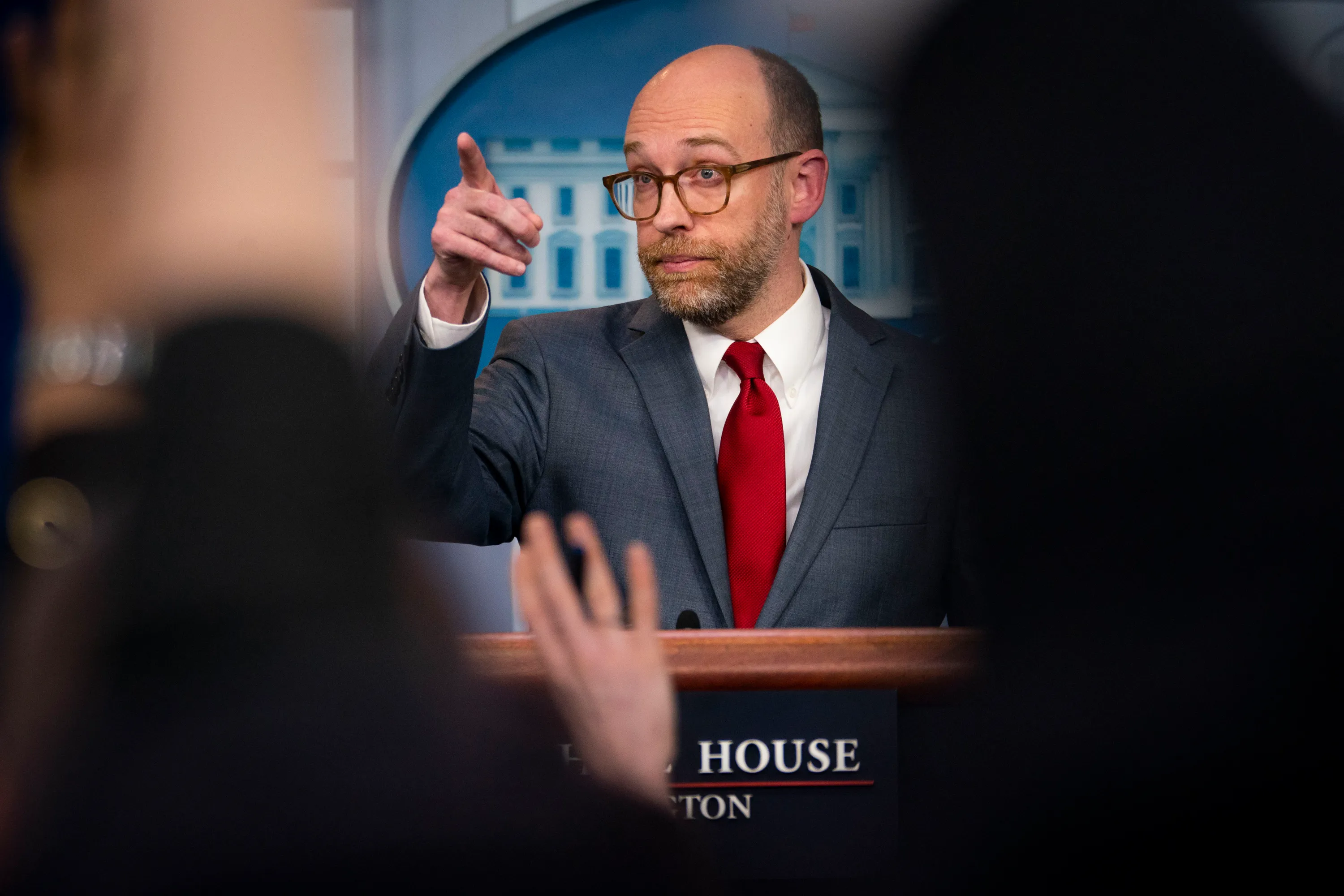
In July 2019, Trump asked the OMB to freeze hundreds of millions of dollars in security assistance to the government of Ukraine. The request coincided with a phone call Trump had with President Volodymyr Zelenskyy in which Trump pressured him to investigate Biden and Biden’s son Hunter, who had served on the board of a Ukrainian energy company. The money for Ukraine had already been approved by Congress, but Vought agreed to hold back the funds. Paoletta signed off on a memo authorizing the freeze. Under the law, the move was known as an impoundment. (The Government Accountability Office, an independent nonpartisan agency, later deemed it illegal.)
Any fan of “Schoolhouse Rock!” knows that the first job assigned to Congress in the Constitution is the power of the purse. The president, meanwhile, must “take Care that the Laws be faithfully executed,” according to Article 2 of the Constitution. Most legal scholars interpret this to mean that the president’s duty is to spend the money Congress appropriates, and that the president does not have the power to withhold funds. In 1969, William Rehnquist, the conservative future Supreme Court chief justice, wrote that the impoundment power was “supported by neither reason nor precedent.”
The question of impoundment’s legality came to a head in the 1970s, when President Richard Nixon withheld billions in congressionally approved funds for environmental cleanup efforts. Courts undid Nixon’s actions, and Congress eventually passed the Impoundment Control Act of 1974, which outlawed the maneuver, leaving only narrow exceptions — rescissions — that required congressional sign-off. (Democrats are calling for restrictions on the rescission process as part of the current shutdown negotiations.) Over the years, the Impoundment Control Act would come to be viewed as sacrosanct at the OMB. That didn’t stop Vought. “I had been personally told, ‘Look, I want the money cut off until we can figure out where it’s going,’” Vought later said of the Ukraine funding in an interview with the conservative commentator Tucker Carlson. “It was like all hell broke loose within the bureaucracy.”
The impoundment triggered congressional investigations and, ultimately, Trump’s first impeachment. (Ukraine eventually received the money.) Vought refused to cooperate with investigators, calling the probe a “sham process that is designed to relitigate the last election.” One of the impeachment articles named Vought, saying that the president had pressured him and others not to respond to subpoenas. Trump, for his part, continued to express support for impoundment, calling it the “secret weapon” that could tame the “bloated federal bureaucracy.”
In early 2021, on one of the final days of Trump’s first term, Vought visited him in the Oval Office. Both men felt a sense of unfinished business, Vought would later recall. Only a few months earlier, when Vought was sworn in as the OMB director, Trump had told him that, after 3 1/2 years as president, he had finally got the hang of the job. “Russ, we’ve got to get another term,” Trump said. “We finally figured out how to do this.”
Vought, frustrated by what he saw as years of obstruction by civil servants, had recently pushed through a new policy to vastly expand the number of at-will employees in the government, making them easier to fire. But the COVID-19 pandemic had dashed any chance of leaving the government smaller than he’d found it. Trump had signed trillion-dollar stimulus bills to prop up the American economy; by the time he left office, the national debt had swelled by $7.8 trillion. After the violence on Jan. 6, a second Trump term looked less likely than ever. Vought, however, had not given up hope.

In the Oval Office, he told Trump that he would soon launch a new political operation that would keep the MAGA movement alive while attacking the policies of the incoming Biden administration. Trump blessed the venture, with one request. That summer, in the wake of George Floyd’s murder, national protests had forced a racial reckoning in the country. Trump wanted Vought, who as OMB director had scrubbed training materials for federal employees of any references to “white privilege” and “systemic racism,” to find a way for conservatives to push back against the Black Lives Matter movement. “This was an assignment I was given from President Trump,” Vought later recalled. “I’m the budget guy. If I can talk about race, you can talk about race.”
Listen to Vought: “If I Can Talk About Race, You Can Talk About Race”
A few days after Trump left office, Vought announced the launch of the Center for Renewing America, a MAGA think tank that aspired to act as an incubator for future Republican administrations. Its activist arm, Citizens for Renewing America, would mobilize grassroots supporters to pressure elected officials to embrace the think tank’s agenda. The overarching goal, Vought wrote in an op-ed for The Federalist, was to “restore an old consensus in America that has been forgotten, that we are a people For God, For Country, and For Community.”
At the Center for Renewing America, Vought surrounded himself with other radical constitutionalists from the first Trump administration. He brought on Jeffrey Clark, the Justice Department official who had tried to use his agency to help Trump overturn the 2020 election. (A D.C. disciplinary board recently recommended that Clark, who now works at the OMB, lose his law license as punishment for those efforts, an outcome that Clark is appealing and that his lawyer called a “travesty of justice.”) Kash Patel, Trump’s current FBI director, and Ken Cuccinelli, a top immigration official in the first Trump administration, joined as senior fellows. Working at the center, Cuccinelli explained at the conservative policy summit, allowed him to “stake out the outer boundary of reasonable constitutional law.”
The Center for Renewing America’s ideas included how the president could invoke the Insurrection Act to deploy military troops to American cities to put down protests, how the White House could freeze billions in federal funding without waiting for a vote in Congress, and how agency leaders could defy government unions and fire workers en masse. The think tank also set out to create shadow versions of the OMB and of the Justice Department’s Office of Legal Counsel to anticipate legal challenges and counter internal pushback. In his 2024 address, Vought explained, “I don’t want President Trump having to lose a moment of time having fights in the Oval Office about whether something is legal or doable or moral.”
Vought and his colleagues at the center also worked closely with the House Freedom Caucus to urge other congressional Republicans to use government shutdowns as a way of forcing through major policy changes. One of their first targets was critical race theory, a once obscure academic concept that had become a flashpoint during the 2020 racial justice protests.
According to previously unreported recordings of briefings held by Citizens for Renewing America, Vought said that he had pressured members of the Freedom Caucus to yoke a ban on critical race theory to must-pass bills on raising the debt limit and funding the government. “We have to have a speaker that goes into these funding fights with a love for the shutdowns,” Vought said during a November 2022 briefing call, “because they create an opportunity to save the country.”
But Republicans never shut down the government during the Biden presidency, and Vought grew increasingly frustrated with them for not using more aggressive tactics. On one briefing call, he praised Cori Bush, a progressive Democrat from Missouri, after she camped out for several days on the Capitol steps to protest the end of a pandemic-era moratorium on evictions. Vought called her politics “very, very bad,” but he admired her methods: “We need this from Republicans.”
The centerpiece of Vought’s work during the Biden years was his campaign to popularize the concept of “woke and weaponized” government. The tagline brought together two of Vought’s rallying cries: “woke” policies, like diversity, equity and inclusion efforts and transgender rights, and a “weaponized” FBI and Justice Department that had allegedly been wielded against the Democrats’ political enemies, including, most notably, Trump. When the Center for Renewing America released a federal budget blueprint in late 2022, calling for nearly $9 trillion in cuts in the course of 10 years, the word “woke” appeared 77 times across 103 pages.
Jessica Riedl, a budget expert who works for the conservative Manhattan Institute, told me that it was “just silly” to claim, as the Center for Renewing America’s budget did, that Veterans Affairs, the Occupational Safety and Health Administration, and farm subsidies required enormous cuts for being too woke. “It’s a way to dress up spending cuts that aren’t popular on their own merits,” Riedl said. Vought described his framing as an attempt to “change paradigms.” “We have to be able to defund agencies,” he said in the private speech in 2023. “That is why these things have to be indelibly linked, and that is why we are focussing so much on ‘woke and weaponized.’”
Listen to Vought Talk About Using the Phrase “Woke and Weaponized”
Any hope that Vought had of implementing his ideas in a second Trump administration nearly ran aground last summer. He had written a chapter of Project 2025’s 887-page report, arguing for an expansion of executive power that would put the Justice Department and other traditionally independent agencies fully under presidential control. Center for Renewing America fellows had written two more chapters in the report. But, as Election Day neared, Project 2025 became a liability for the Trump campaign. Polls showed that a majority of Americans opposed its most aggressive proposals, including removing the abortion drug mifepristone from the market, eliminating the Department of Education and implementing Vought’s plan to more easily fire nonpolitical federal workers. As criticism of Project 2025 grew, Trump insisted that he knew “nothing” about it, while also claiming that “some of the things they’re saying are absolutely ridiculous and abysmal.”
The month before the election, Politico reported that Donald Trump Jr., had compiled a list of people who would not be allowed to serve in a second Trump administration, including a number of leading contributors to Project 2025. But, according to a former Trump campaign official with close ties to the White House, Vought deftly navigated the controversy. “Russ is a consummate team player,” the official told me. “He was the one person at Project 2025 that we could have a conversation with during the course of the campaign.”
A week after Trump’s victory, the president-elect announced his plans for the Department of Government Efficiency. “It will become, potentially, ‘The Manhattan Project’ of our time,” Trump said in a statement. He tapped two of his biggest backers to run it: Elon Musk, who had donated nearly $300 million to help elect Trump and other Republicans, and the biotech entrepreneur Vivek Ramaswamy, who briefly ran for president on an anti-woke platform. Two days after the announcement, Vought met with Musk and Ramaswamy at Mar-a-Lago. Vought and Musk “hit it off,” according to The New York Times; both were “on the same wavelength in terms of taking the most extreme action possible.” Soon after the meeting, Trump nominated Vought to run the OMB.
One of DOGE’s first targets was the Consumer Financial Protection Bureau. The CFPB had first been proposed by Sen. Elizabeth Warren, who, as a law professor, argued for the creation of a regulator that could protect Americans from predatory mortgages and hidden fees. Created by law in the wake of the 2008 financial crisis, the bureau developed a reputation as an aggressive enforcer of fair lending and consumer protection laws. The bureau’s work has led to nearly $20 billion in direct relief to consumers and $5 billion in civil penalties for alleged wrongdoing. For Vought, the bureau embodied the gross regulatory overreach that he loathed; outside of government, the agency’s biggest foes, Wall Street and Silicon Valley, were major funders of Trump’s second campaign.
On Feb. 7, Trump named Vought the bureau’s acting director, a role he would perform on top of his duties at the OMB. That morning, a small team of DOGE staffers arrived at the CFPB’s headquarters. According to previously unreported emails and depositions, the members of DOGE took orders from Vought as they disabled the CFPB’s website and decided which of the agency’s employees to fire. Musk weighed in on X: “CFPB RIP.”
Trump had targeted the CFPB during his first term. “There were days in Trump One where it felt like we were getting punched in the face,” one longtime employee told me. Over time, however, the president seemed to lose interest, and the CFPB’s last director under Trump, a political appointee named Kathy Kraninger, supported the bureau’s mission. In 2020, under Kraninger, the CFPB filed the second-highest number of enforcement actions in its nearly 10-year existence.
Current and former CFPB staff told me that they assumed a second Trump administration would look like the first one. “Generally, we thought there would be a conservative agenda we’d be handed, and we’d figure out how to enact it,” the veteran employee said. Soon after taking over, Vought informed Jerome Powell, the chair of the Federal Reserve, which funds the CFPB, that the agency would not need any more money. He barred CFPB employees from doing most types of work and told them not to go to the office. When confusion arose over what duties, if any, remained for the staff to do, Vought clarified the matter in a Feb. 10 email, telling employees to “stand down from performing any work task.”
In the following weeks, Vought and Paoletta stopped oversight activities, quashed ongoing investigations and froze active enforcement cases, which included matters involving some of the largest banks in the nation, such as JPMorgan Chase, Bank of America and Capital One. Rohit Chopra, the bureau’s director under Biden, said that Vought’s actions had put the CFPB “in a coma.” The bureau’s top enforcement officer resigned in June, writing in a letter to colleagues that the CFPB’s leadership “has no intention to enforce the law in any meaningful way.”
The final blow came when Vought announced a plan to lay off more than 80% of the CFPB’s employees. A federal appeals court ruled in August that the mass-firing plan could proceed. It took Vought four months to accomplish what the previous Trump administration had been unable to do in four years.
The unwinding of the CFPB, however, was quickly overshadowed by another Vought victory. That same month, he completed his assault on foreign aid. Secretary of State Marco Rubio, who had been running what was left of USAID, announced that, with Trump’s approval, he had empowered Vought to officially eliminate the agency. “Russ is now at the helm to oversee the closeout of an agency that long ago went off the rails,” Rubio announced. “Congrats, Russ.”
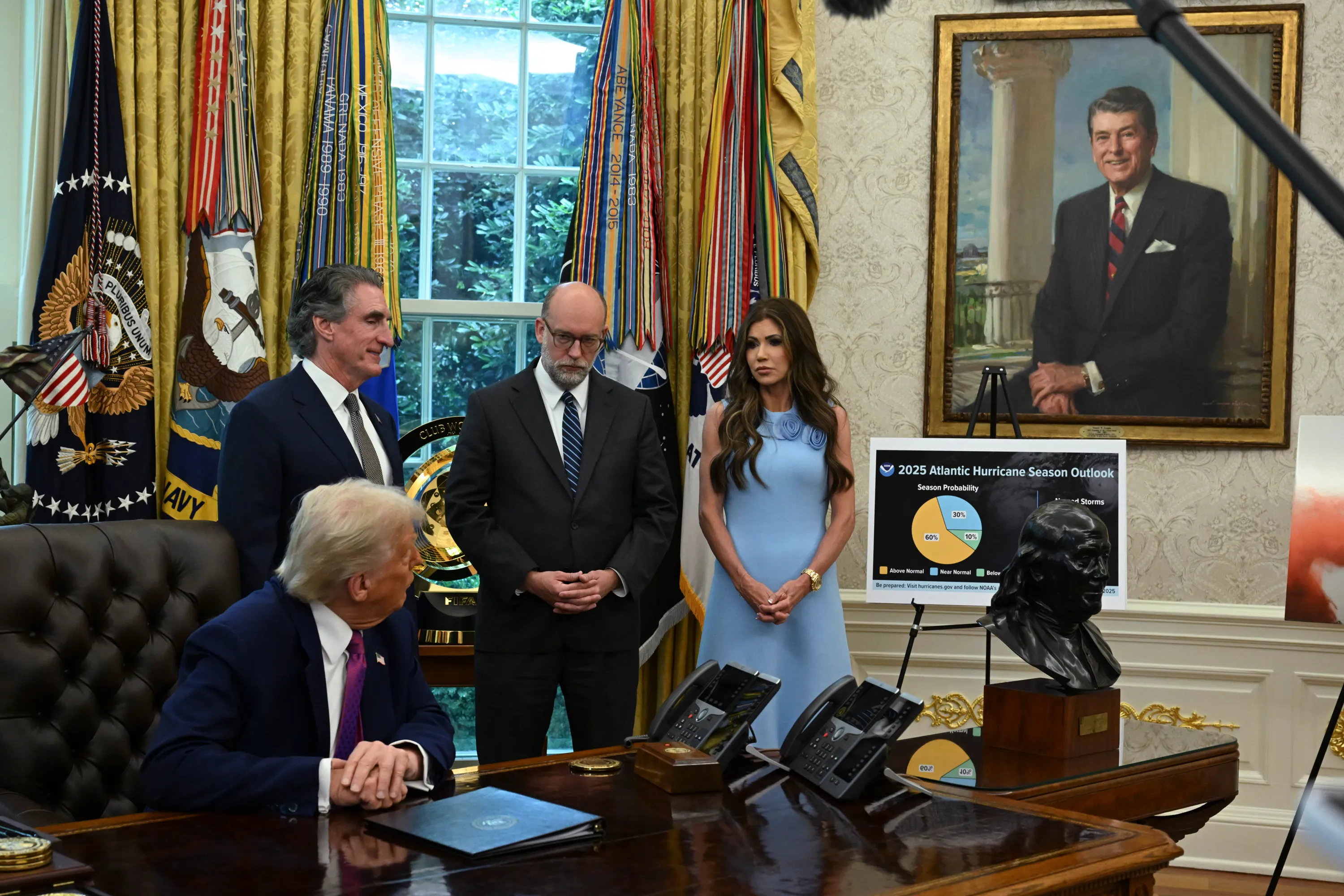
Four months before the 2024 election, the Center for Renewing America had welcomed a small group of congressional staffers to its headquarters, a few blocks from the Capitol. Some of them worked for the House and Senate budget committees, which every year help set spending levels for the federal government. The purpose of the meeting was to brief the staffers on the center’s latest policy fight — an attempt to build the case for the use of impoundment.
At the briefing, Paoletta argued that the Impoundment Control Act was unconstitutional. Spending laws passed by Congress were a ceiling, not a floor, Paoletta argued, according to a person in the room. In that view — which most legal experts dismiss as a fringe position — the White House is not permitted to spend more than a law calls for, but it has the power to spend far less. “Congress passes statutes episodically, and often with conflicting purposes and demands,” Paoletta later wrote in an essay for the Center for Renewing America. “It is left to the President and his subordinates to harmonize their execution in a coherent manner.”
According to Democrats on the House Appropriations Committee, the Trump administration has since frozen or canceled more than $410 billion in funding on everything from energy subsidies for low-income households and Head Start after-school programs to President George W. Bush’s HIV-reduction initiative, PEPFAR, and artists’ grants from the National Endowment for the Humanities. Vought directed the National Institutes of Health to withhold — illegally, according to the Government Accountability Office — an estimated $15 billion in grants for outside research projects. The NIH also moved to cap funding for so-called indirect costs, which research universities rely on to pay for their buildings, utilities and administrative staff. Scientists I interviewed said that these cuts would inevitably lead to less medical research, including into a drug that Vought’s ex-wife credited with improving the life of their 11-year-old daughter, who was born with cystic fibrosis. A scientist who receives government funding to study cystic fibrosis treatment told me that, without sufficient money for indirect costs, “we probably won’t be able to do the research and will have to relinquish the grants.”
The OMB claims that it is vetting federal spending to ensure that the money does not fund “woke” programs. “We can confirm that President Trump and Director Vought are carefully scrutinizing spending that has previously run on autopilot or worse — toward transing our kids, the Green New Scam, and funding our own country’s invasion — just as the president promised,” an OMB spokesperson told the Times in August. But blocking funds is also a way to pressure officials and agencies to comply with the administration’s demands. “OMB is like a giant funnel that everything has to go through in order to happen,” Lester Cash, a former OMB employee, told me. “You can get agencies to agree to things just to get the funnel to open back up.”
In March, the OMB took down a legally mandated public website that made it possible to track the funding freezes. The move elicited a rare show of bipartisanship. In a letter to Vought, the Democratic and Republican leaders of the House and Senate appropriations committees urged him to “restore public access to apportionment data in accordance with statute.” Vought said the information listed on the site was “predecisional” and a risk to national security. The OMB restored the site only when a judge ruled that taking it down was illegal, saying that the government’s position relied “on an extravagant and unsupported theory of presidential power.”
The OMB’s funding freezes have wreaked havoc. On June 30, the Department of Education told state agencies that congressional appropriations for after-school activities and English-as-a-second-language instruction would not arrive the next day, as planned. The unexpected shortfall affected thousands of school districts, which served millions of students, in all 50 states. The administration only backed down after both Democrats and Republicans criticized the move. “When something’s been appropriated, signed into law, and people are writing contracts based on the commitment of the federal government, and then they don’t know if they’re going to get it or not, it creates such chaos,” Don Bacon, a Republican House member from Nebraska, told me. “I’m not sure what the OMB director thought he was doing.” (A spokesperson for Vought at the OMB would not comment on the record in response to a detailed list of questions.)

In June, Trump sent a rescission request to Congress, seeking to cancel roughly $9 billion in funding for foreign aid and for the Corporation for Public Broadcasting, which supports NPR, PBS, and other public radio and TV stations nationwide. The programs were viewed, the senior agency official told me, as “soft targets,” a test to see if Vought could persuade Republicans to put aside their concerns about undermining Congress’ power of the purse. Unlike in Trump’s first term, Vought’s rescission plan succeeded. The measure, which faced opposition from Democrats and a few Republicans, passed after Vice President JD Vance cast two tie-breaking procedural votes. Jeff Merkley, the top Democrat on the Senate Budget Committee, told me, “You’ve basically said to Congress, ‘Hey, compromise all you want, but we’re going to undo that in the way we want as soon as you’ve signed the bill.’”
On the Friday before Labor Day, Vought made his most audacious move yet. The White House sent Congress a new rescissions package, targeting nearly $5 billion in foreign aid. But this time Vought informed lawmakers that he didn’t need their approval. He asserted that the president could make the request, putting a temporary freeze on the funds, then simply wait for the fiscal year to expire, on Sept. 30, at which point the money would be canceled out. Vought called it a “pocket rescission,” but it was impoundment by another name. Susan Collins, a Republican from Maine, who chairs the Senate Appropriations Committee, said it was a “clear violation of the law.”

The Government Accountability Office can sue the OMB over an impoundment or pocket rescission to get the money released. In April, Gene Dodaro, who leads the Government Accountability Office, testified that his office had opened 39 investigations into potential violations of the Impoundment Control Act by the Trump administration. The OMB has responded by attacking Dodaro’s agency. In one letter, Paoletta said that the OMB would cooperate with the Government Accountability Office only if its demands didn’t get in the way
of Trump’s agenda. In another letter, Paoletta told the Department of Transportation to ignore a Government Accountability Office ruling that found that the OMB had illegally impounded money for electric car development. Vought, for his part, has flatly declared that the Government Accountability Office “shouldn’t exist.”
Vought’s actions could provoke a challenge to the Impoundment Control Act in the Supreme Court. In the meantime, a number of current and former government employees told me that they worried about the long-term consequences of what he has already done: the terminating of vital research projects that could have led to lifesaving breakthroughs, the nation’s lost standing as an international leader, the uncertainty cast over the fundamental workings of government. “They’ve given up on the idea that they need to persuade anybody,” Bagenstos, the former general counsel at the OMB, said of Vought and Paoletta. They’re “just going to use brute force and dominance.” As the former OMB analyst told me, “They’ve dropped a grenade into the system.”
The government shutdown has illustrated, in the starkest terms, Vought’s expansive theory of executive power and his willingness to ignore Congress. On Oct. 2, Trump posted on Truth Social that he would meet with Vought to decide which “Democrat Agencies” to cut on a temporary or permanent basis. A few days later, the OMB released a memo claiming that, seemingly in defiance of a 2019 law, furloughed federal employees were not guaranteed back pay following a shutdown. Then, on Oct. 10, Vought announced that his campaign of mass firings across the bureaucracy had begun. So far, more than 4,000 employees have been laid off, disrupting government services devoted to, among other things, cybersecurity efforts, special education programs, substance abuse treatment and loans for small businesses. A federal judge put a temporary stop to the cuts, but that same day Vought predicted that the total number of firings would be “north of 10,000.” As one official texted me, “Trauma achieved.”
The post The Shadow President appeared first on ProPublica.
Man faces attempted murder charge after Rockville shooting that injured one
More than a dozen rounds fired during Tuesday night incident in residential area, police say
The post Man faces attempted murder charge after Rockville shooting that injured one appeared first on Bethesda Magazine.
Canceled $28B grants during government shutdown

There’s been a lot going on and we almost forget that the federal government is approaching its third week of shutdown. The administration has used the time to cancel and pause billions in grants in the places you might guess. Tony Romm and Lazaro Gamio for the New York Times have the analysis.
The Times conducted its analysis by examining federal funding records, which include details about the city and state where each grant recipient is based. The projects include new investments in clean energy, upgrades to the electric grid and fixes to the nation’s transportation infrastructure, primarily in Democratic strongholds, such as New York and California.
Tags: funding, government, New York Times, shutdown
CDC tormented: HR workers summoned from furlough to lay off themselves, others
The dust is still settling at the Centers for Disease Control and Prevention after a mass layoff on Friday, which former employees at the beleaguered agency are describing as a massacre.
In separate press briefings on Tuesday, a network of terminated CDC staff that goes by the name the National Public Health Coalition, and the union representing employees at the agency discussed what the wide-scale cuts mean for the American people, as well as the trauma, despair, and damage they have wreaked on the workers of the once-premier public health agency.
In a normal federal layoff—called a reduction in force, or RIF—the agency would be given a full outline of the roles and branches or divisions affected, as well as some explanation for the cuts, such as alleged fraud, abuse, or redundancy. However, the Trump administration has provided no such information or explanation, leaving current and former employees to essentially crowdsource what has been lost and only guess at the possible reasons.

“I Don’t Want to Be Here Anymore”: They Tried to Self-Deport, Then Got Stranded in Trump’s America
by Melissa Sanchez and Mariam Elba
ProPublica is a nonprofit newsroom that investigates abuses of power. Sign up for Dispatches, a newsletter that spotlights wrongdoing around the country, to receive our stories in your inbox every week.
She desperately wanted to get out of the country.
It was mid-May and Pérez, a Venezuelan mother of two, couldn’t survive on her own in Chicago anymore. She’d been relying on charity for food and shelter ever since her partner had been detained by immigration authorities after a traffic stop earlier in the year.
Pérez, 25, thought it’d be safer to return to Venezuela with her children than to stay in the U.S. Her request for asylum was still open and she had a permit to work legally, but so did a lot of other Venezuelans getting picked up on the streets and taken into custody. Authorities were detaining immigrants regardless of whether they’d followed the rules.
She had also seen how President Donald Trump singled out her countrymen, calling them gang members and terrorists, even sending hundreds to a foreign prison. She was terrified of getting detained, deported and, worst of all, separated from her young daughter and son. They were the reason the family had come to the U.S.
Then she heard about Trump’s offer of a safe and dignified way out.
“We are making it as easy as possible for illegal aliens to leave America,” the president said in a video on social media in May announcing the launch of Project Homecoming.
He spoke about a phone app where “illegals can book a free flight to any foreign country.” And he dangled other incentives: Eligible immigrants wouldn’t be barred from returning legally to the U.S. someday, and they’d even get a $1,000 “exit bonus.” Believing the president’s words, Pérez downloaded the CBP Home app and registered to return to Venezuela with her children.
Months passed. Her partner was deported. In July, Pérez said, she got a call from someone in the CBP Home program telling her she’d be on a flight out of the country in mid-August. She began packing.
But as the departure date neared and the plane tickets hadn’t arrived, Pérez got nervous. Again and again, she called the toll-free number she’d been given. Finally, somebody called back to say there might be a delay obtaining the documents she’d need to travel to Venezuela.
Then there was silence. No further information, no plane tickets. Pérez registered on the app again in August, then a third time in September, as immigration arrests ramped up in Chicago.
Today, Pérez feels trapped in a country that doesn’t want her. She’s afraid of leaving her apartment, afraid that she will be detained and that her children will be taken away from her. “I feel so scared, always looking around in every direction,” she said. “I was trying to leave voluntarily, like the president said.”
The Trump administration’s immigration crackdown is having the intended effect of terrifying people into trying to leave. There have been some 25,000 departures of immigrants from all countries via CBP Home, according to U.S. Department of Homeland Security data obtained by ProPublica.
The data indicates that of those 25,000 people, a little more than half of them returned home with DHS assistance; nearly all the others who left the U.S. ended up returning on their own.
And it’s not just CBP Home. Applications for voluntary departures — an alternative to deportation granted to some immigrants who leave at their own expense — have skyrocketed to levels not seen since at least 2000, reaching more than 34,000 since Trump’s second administration began, immigration court data shows. (The number is higher than in years past, but nowhere near the number of immigrants the administration has deported this year.)
But for many recent arrivals from Venezuela — arguably the community most targeted by the Trump administration, and whose country is now bracing for the possibility of a U.S. invasion — leaving has not been as simple as the president has made it sound.
ProPublica spoke with more than a dozen Venezuelans who said they wanted to take the U.S. government’s offer of a safe and easy return. They signed up months ago on the CBP Home app and were given departure dates. But after those dates came and went, these immigrants said they feel betrayed by what the president told them.
Part of the problem is tied to the lack of diplomatic relations between Washington and Caracas. There are no consular services for Venezuelans in the U.S. Many of the hundreds of thousands of Venezuelans who migrated to the U.S. in recent years seeking asylum or other humanitarian relief entered without valid passports, as Pérez did. But to get on a plane for Venezuela, they’re being told they’ll need a special travel document known as a “salvoconducto,” or “safe passage,” from their government.
And relations between the two countries are getting worse. The Trump administration has pushed for regime change in Venezuela, sent warships to the Caribbean and, in recent weeks, blew up four Venezuelan boats it claimed were transporting drugs to the U.S. Bracing for an invasion, Venezuelan President Nicolás Maduro has said he’s ready to declare a state of emergency to protect his country, which could make it harder for Venezuelans abroad to return home.
The Venezuelans who want to leave the U.S. described how CBP Home representatives told them that their lack of passports wouldn’t be a problem and that the U.S. government would help them obtain the travel documents they needed. Now they are being told that they’re on their own — if they get any response at all.
The Trump administration was aware of the potential challenges from the start. In his May proclamation, the president directed the State and Homeland Security departments to “take all appropriate actions to enable the rapid departure of illegal aliens from the United States who currently lack a valid travel document from their countries of citizenship or nationality.”
In a statement, a DHS spokesperson said the agency is working with the State Department “to acquire travel documents for those who lack safe passage. So far thousands of Venezuelans have already self-departed using CBP Home.” The State Department referred questions to DHS.
The internal DHS records obtained by ProPublica show nearly 3,700 departures of Venezuelans via CBP Home through late September. It’s unclear how many Venezuelans have applied. The DHS spokesperson said the agency could not confirm the numbers and would not say whether the program is meeting projections. (A congressional committee has directed DHS to include information about CBP Home departures in monthly reports the agency previously published, but has not published in this administration.)
An estimated 10,200 Venezuelans were deported between February and early October, according to deportation flight data tracked by the nonprofit Human Rights First’s ICE Flight Monitor.
Many of the Venezuelans interviewed by ProPublica are mothers of young children who say they decided to take the president’s offer after their work permits expired, their temporary protected status was canceled or their spouses were deported. Few are willing to return by land because of the dangers posed by cartel violence and kidnappings in Mexico — dangers many of them experienced when they migrated here.
Nearly all of them, like Pérez, asked not to be identified by their full names because they’re afraid of bringing unwanted attention to themselves and of the potential consequences of such attention. Interviews with Venezuelan immigrants were conducted in Spanish.
Before their departure dates came and went, they had made preparations to leave — turning over the keys to their apartments, pulling their children from school, shipping their belongings to Venezuela. And they have sunk deeper into poverty as the weeks and months pass.
Pérez applied for her family to return to Venezuela through the CBP Home app months ago but has been stuck in limbo in Chicago without a clear path forward. (Jamie Kelter Davis for ProPublica)In Los Angeles, a family of four slept in their tiny Toyota Echo for weeks to save on rent as they waited for their departure date. They sold the car and other belongings to pay for bus tickets back the way they’d come. Nearly two months after their return to Venezuela, they said they’re still waiting for the exit bonuses they’d hoped would help them start over.
In Youngstown, Pennsylvania, a mother of two said she didn’t enroll her 8-year-old son in school this fall because she assumed they would be gone by now. She recently moved into a friend’s apartment in New York City and plans to turn herself in to immigration authorities and ask to be deported.
“I don’t want to be here anymore,” the woman said, between sobs. “What am I supposed to do?”
Several immigration attorneys and advocates told ProPublica that they don’t trust the CBP Home app or the Trump administration’s promises to help immigrants self-deport. The National Immigration Law Center recently published a guide explaining some of the potential risks of using the app, such as leaving the country without closing an immigration court case and becoming ineligible for a future visa. Some lawyers said they discourage clients from using the app at all.
Ruben Garcia, director of Annunciation House, a nonprofit in El Paso that supports migrants and refugees, said in the current climate, he understands why some people might consider the administration’s offer to leave. But, he said, the offer has to be backed by action.
“If you’re going to say you’re going to do this,” Garcia added, “then you damn well better make sure that it’s truthful and that it works.”
Emily, a Venezuelan immigrant in Columbus, Ohio, holds her phone showing an email from the CBP Home program. (Maddie McGarvey for ProPublica)CBP Home replaced an earlier app that the Biden administration had promoted to try to bring order to the soaring numbers of migrants attempting to enter the country. Pérez and other asylum-seekers used that earlier version, CBP One, to make appointments to approach the border. Trump, who campaigned on the promise of mass deportations, ended that option on his first day back in the White House.
In March, he reintroduced the app with the new name and function, allowing immigrants to alert the government of their intention to self-deport. It was part of a $200 million advertising blitz meant to encourage immigrants to “Stay Out and Leave Now.” Two months later, Trump unveiled Project Homecoming and the added incentives of free flights and exit payments. The administration moved State Department funds meant to aid refugees resettling in the U.S. to DHS to help pay for the flights and stipends, according to federal records and news reports.
DHS officials have mentioned the app in dozens of press releases about policy changes and enforcement operations. For example, in the September announcement that DHS was ending temporary protected status for Venezuelans, officials also encouraged Venezuelans to leave via CBP Home. And immigrants who show up for their hearings at immigration court see posters taped on the walls about the benefits they could get if they “self-deport using CBP Home instead of being deported by ICE.”
Emily and Deybis downloaded the app in June, when it seemed as if their life in the U.S. was collapsing. They said they used the earlier CBP One app to approach the border with their two children in January 2024 and were allowed into the country with protections that were supposed to last two years. They settled in Dallas, applied for asylum and got work permits; Deybis found a job in a hotel laundry and Emily at a Chick-fil-A. Then, this spring, the Trump administration ended protections for immigrants like them and canceled their work permits.
They lost their jobs and could no longer afford their rent. On the app’s sky-blue home screen, they saw a drawing of a smiling man and woman holding hands with a child. “Let us help you easily leave the country,” another screen told them in Spanish. They agreed to share their phone’s geolocation, entered personal information and uploaded selfies.
They received an automated email from “Project Homecoming Support” explaining that they would be contacted soon by someone from a toll-free number who would help coordinate their travel. Within weeks, they got a call from an operator at that number who said she worked on behalf of DHS.
Emily said she made clear the family didn’t have Venezuelan passports but was told that wouldn’t be a problem; the U.S. government would procure any necessary documents for them. They said the operator gave them an Aug. 1 departure date and told them to expect their plane tickets by email.
Emily and Deybis sold their car and moved with their children to Columbus, Ohio, where Deybis’ nephew let them stay in his unfinished basement apartment until their departure. The plane tickets never came.
Then the nephew was detained in a traffic stop and deported. Panicked, Emily and Deybis said they called the toll-free number again and again, leaving messages that went unanswered. Emily submitted a new application and sent more emails.
In mid-September, they got an email from the “CBP Home team” telling them to contact the Venezuelan embassy in Mexico to get travel documents on their own.
“We are working very hard on your case,” the email assured.
When they called the embassy, though, the number was busy. They found travel agencies that offer to procure travel documents at a cost but said they were told the Venezuelan government requires an arrival date and proof that plane tickets have been purchased. Emily and Deybis can’t afford them.
“Thank you so much for your patience and we understand your frustration,” they heard back in another email. “Wait for new instructions from DHS.”
As they wait, they worry about how they’ll survive when winter comes. Most days, Deybis visits local food pantries and looks for discarded items in alleys and on street corners that they can resell. A few weeks ago, they sold their daughter’s bed to help pay the rent.
“We’d rather be in Venezuela with our family than suffer here,” he said.
Emily and Deybis share a basement apartment in Columbus, Ohio with their two children. They’re unable to work and have resorted to selling the few possessions they have to feed the family. (Maddie McGarvey for ProPublica)Pérez said her daughter was the family’s main motivation to come; the girl had been born with a heart defect and needed surgery they could not find in Venezuela, where hospitals operate through power outages and have limited capacity for advanced surgeries, not to mention supplies.
“We didn’t come for the American dream, or for a house, or for some life of luxury,” said Pérez. “What we wanted is for our daughter to live.”
She and her partner made the trek to the U.S. in 2023, with her daughter, then 6, and their 4-year-old son. Pérez thought they did it “the right away” by waiting in Mexico for weeks until they got an appointment to approach the border via CBP One. After they were processed, the family headed to Chicago, a city they had heard was a sanctuary for immigrants. At first they took shelter inside a police station, as hundreds of new immigrant families were doing at the time. Pérez said medical workers who visited the station learned about her daughter’s condition and connected the family to a hospital charity care program. The following spring, the frail little girl with dark brown eyes got the operation she needed.
In late 2024, the family moved to South Florida, where Pérez’s partner found work rebuilding homes damaged by hurricanes. Then in February, he was arrested for driving without a license or registration. He spent about two months in jail before he was transferred into immigration custody.
Pérez didn’t feel safe in Florida anymore. She returned to Chicago with her children.
But as the months pass without an answer from the CBP Home program, Chicago doesn’t feel safe, either. This fall, the Trump administration zeroed in on the city for immigration enforcement, sending in the U.S. Border Patrol. Pérez recently downloaded another app that tells her whether there’ve been sightings of federal immigration agents nearby, and she watches videos of other immigrants getting arrested. One day in September, a federal agent shot and killed an immigrant in a nearby suburb. Pérez wonders if she might die, too.
On a sunny September afternoon, Pérez peered down the street outside her children’s school, scanning for suspicious vehicles. Her daughter, who is now 8, bounded down the steps first, wearing a pink bow and a broad smile. Her son, now 6, in a Spiderman shirt and a blue cast from a playground accident, appeared next.
They share their mother’s anxiety. On their walk home, Pérez’s daughter leaned over her brother and chided him for speaking Spanish in public. The girl said her teacher had warned her that federal agents might be listening.
It reminded Perez that she now needs to leave the U.S. for the same reason she came: her children. She plans to register yet again on the CBP Home app.
Pérez plays with her two children in Chicago. Her partner was deported earlier this summer, leaving her unable to support the family alone. (Jamie Kelter Davis for ProPublica)Jeff Ernsthausen contributed data analysis.
A Plan to Rebuild Gaza Lists Nearly 30 Companies. Many Say They’re Not Involved
When Face Recognition Doesn’t Know Your Face Is a Face
Cost of driving an electric vehicle vs. gas car

The cost of driving an electric vehicle varies by where you charge and how much drive. It’s a lot cheaper to charge a car at home during off hours than it is to charge on the road during peak times. For NYT’s the Upshot, Francesca Paris made a straightforward calculator to estimate the true cost of going electric versus driving a gas car.
Tags: cost, electric vehicle, Francesca Paris, Upshot
New Rules Could Force Tesla to Redesign Its Door Handles. That’s Harder Than It Sounds

Despite RFK Jr.’s shenanigans, COVID shot access will be a lot like last year
The acting director of the Centers for Disease Control and Prevention has finally signed off on recommendations for this season's COVID-19 vaccines—and, with that, access to the shots will, in the end, look a lot like the access people had last year.
Here’s what to know
You still have access and coverage: For this year, anyone age 6 months and older will still have access to the shots, and the shots should be fully covered under private insurance plans and federal programs—including Medicare, Medicaid, Children’s Health Insurance Program, Vaccines for Children Program, and insurance plans regulated by the Affordable Care Act.
In fact, for private insurance plans, AHIP—the trade organization that represents major insurers—had already stated that regardless of how this year's messy federal recommendations ended up, private insurance plans would maintain their previous coverage with no cost sharing.

Synology caves, walks back some drive restrictions on upcoming NAS models
If you were considering the purchase of a Synology NAS but were leery of the unreasonably high cost of populating it with special Synology-branded hard disk drives, you can breathe a little easier today. In a press release dated October 8, Synology noted that with the release of its latest Disk Station Manager (DSM) update, some of its 2025 model-year products—specifically, the Plus, Value, and J-series DiskStation NAS devices—would "support the installation and storage pool creation of non-validated third-party drives."
This unexpected move comes just a few months after Synology aggressively expanded its "verified drive" policy down-market to the entire Plus line of DiskStations. Prior to today, the network-attached storage vendor had shown no signs of swerving from the decision, painting it as a pro-consumer move intended to enhance reliability. "Extensive internal testing has shown that drives that follow a rigorous validation process when paired with Synology systems are at less risk of drive failure and ongoing compatibility issues," Synology previously claimed in an email to Ars.
What is a “verified” or “validated” drive?
Synology first released its own brand of hard disk drives back in 2021 and began requiring their use in a small but soon-to-increase number of its higher-end NAS products. Although the drives were rebadged offerings from other manufacturers—there are very few hard disk drive OEMs, and Synology isn't one of them—the company claimed that its branded disks underwent significant additional validation and testing that, when coupled with customized firmware, yielded reliability and performance improvements over off-the-shelf components.

Not a game: Cards Against Humanity avoids tariffs by ditching rules, explaining jokes
Cards Against Humanity, the often-vulgar card game, has launched a limited edition of its namesake product without any instructions and with a detailed explanation of each joke, "why it’s funny, and any relevant social, political, or historical context."
Why? Because, produced in this form, "Cards Against Humanity Explains the Joke" is not a game at all, which would be subject to tariffs as the cards are produced overseas. Instead, the product is "information material" and thus not sanctionable under the law Trump has been using—and CAH says it has obtained a ruling to this effect from Customs and Border Patrol.
"What if DHS Secretary and Dog Murderer Kristi Noem gets mad and decides that Cards Against Humanity Explains the Joke is not informational material?" the company asks in an FAQ about the new edition. (If you don't follow US politics, Noem really did kill her dog Cricket.) Answer: "She can fuck right off, because we got a binding ruling from Trump’s own government that confirms this product is informational and 100% exempt from his stupid tariffs."

How Trump’s OPM director wants to attract tech talent after months of workforce cuts
“We have a real, acute shortage of people who have what I would call very cutting-edge, modern tech skills,” said Scott Kupor, director of the government’s personnel agency.
Kupor’s focus on beefing up the tech workforce comes after months of workforce reductions across federal agencies, including cuts to technology-focused employees, since President Trump took office.
The longtime venture capital executive from Andreessen Horowitz took over in mid-July after months acting leadership at OPM, which was an early landing place for the Department of Government Efficiency itself, the controversial effort initially led by Elon Musk that pushed many of these cuts. Nextgov/FCW spoke with Kupor in September about his priorities for the technology workforce in the federal government.
The OPM director emphasized the need for early career talent especially. Fewer than 9% of the federal workforce is under the age of 30, compared to 22.7% of all workers, according to Pew Research Center.
“Whether it's tech or non-tech, I think we have to do a better job of figuring out, ‘How do we get early career people to get excited about and be part of government?’” he said.
One way Kupor may do that is through a forthcoming tech hiring initiative that he’s hinted at. A monthslong government-wide hiring freeze for most positions is set to end in mid-October, though a shutdown initiated by Congress’ failure to pass funding legislation by Oct. 1 has also added complications for the federal workforce.
Whenever Kupor is able to start recruiting new tech talent, it remains to be seen how his pitch for tech talent will land after nine months of headlines about government layoffs and DOGE. The stakes, however, are clear.
“The technology is going to advance, whether we hire the right people or not. We’re not going to slow down the pace of technology,” said Kupor. “The only question is, are we actually equipped as an organization to be able to utilize the technology in a way that will actually drive change?”
Dealing with losses
Kupor’s focus on the government’s technology workforce aligns with the priorities of OPM directors before him. The Biden-Harris administration launched a hiring push focused on artificial intelligence in 2023 that yielded at least 200 onboarded employees. Cybersecurity staffing has also been a perennial issue across administrations.
The government needs tech-savvy talent to put many, if not most, of its policies into practice in the digital age. The 2013 healthcare.gov crash is a prime example of how technology can make or break high-profile initiatives.
What sets Kupor’s efforts to attract tech talent apart from his predecessors is the fact that they come after sweeping cuts pushed by DOGE, which is nominally focused on tech modernization but has played a large role in efforts to shrink the federal workforce.
About 300,000 people will have left the federal workforce by the end of the year, said Kupor, most via the Trump administration’s deferred resignation program, which enabled employees to take paid leave for several months before exiting government at the end of September. The administration has also conducted layoffs across many agencies.
And the number of feds exiting federal agencies could go up — the Trump administration has been threatening to implement more layoffs across federal agencies during an ongoing government shutdown. Nextgov/FCW spoke with Kupor before this funding lapse began on Oct. 1.
So far, most of the workforce departures were voluntary, Kupor emphasized, although that’s a point that Rob Shriver, former acting OPM director, takes issue with.
“The only reason that those folks were thinking about taking the ‘Fork in the Road’ is because they were being treated so miserably,” said Shriver, who now works at Democracy Forward as managing director of Civil Service Strong. “The [Trump administration’s] strategy, as stated by their own OMB director, was to traumatize federal workers.”
It’s difficult to know the scale of these losses in the federal tech workforce specifically, said Michelle Amante, the senior vice president of government programs at the nonprofit, nonpartisan Partnership for Public Service.
“There’s such a lack of transparency,” she said, although “anecdotally, we know that there were big cuts to at least newer tech employees because of the probationary period cuts.”
Presumably, that includes Biden-era AI hires, given that they were early in their government tenures.
The entire 18F office at the General Services Administration — an internal government tech consultancy of about 90 employees that worked across agencies — was laid off in the spring.
In the U.S. Digital Service — another cross-cutting tech talent team that was transformed to house DOGE on Trump’s first day back in office — dozens of employees were fired in February and over twenty more later resigned.
Agency-level technology teams also haven’t been spared. The IRS has lost 2,000 technology employees as of June.
At Kupor’s own agency, the OPM tech shop is down by an estimated 200 employees, according to budget documents. The agency’s watchdog says that the loss of IT workers combined with a hiring freeze has put the agency’s Postal Service Health Benefits Program at risk of failure.
“That’s not a surprising outcome, unfortunately, for those who have been through these things,” said Kupor when asked if layoffs ever went too far. “You do the best you can with the information you have at the time.”
Even at OPM, there are likely areas where the agency needs to hire back talent it lost, he said. That’s part of a trend across agencies, and it includes tech talent. As of mid-summer, USDS was trying to reverse some of its losses, recruiting engineering, product and design talent.
At the Labor Department, 20 to 30 IT employees are among those being brought back onboard, according to one current and one affected employee, after the department’s tech shop lost roughly 40% of its workforce.
Amante stressed that any new hires coming in won’t be effective immediately as the Trump administration fills in gaps and hires the cutting edge talent Kupor talked about. It takes time to learn the context, relationships and systems to be successful in a government environment, she said.
That’s something DOGE associates have been criticized for — that they didn’t respect institutional knowledge, rules and even laws in their work across agencies, as alleged in several lawsuits.
Government employees were “sidelined and not able to do the jobs they cared about,” said Shriver. “They were being threatened if they dared to speak up at all, to raise any kind of question about the appropriateness or the legality of what the incoming team was doing.”
Cost equations
Victor Udoewa is one technologist that no longer works for the federal government.
The Centers for Disease Control and Prevention recruited him in 2023 as a principal service designer in its then-new Office of Public Health Data, Surveillance and Technology, aimed at improving public health data after the COVID pandemic made clear the brokenness of the health data ecosystem used to track data across the country.
At the CDC, Udoewa was focused on AI, machine learning and data interoperability products and services. He also worked on a redesign of how health data makes its way across a vast health ecosystem to the CDC.
He was laid off in February as part of widespread layoffs of probationary workers across agencies, even though he was only new to the CDC, not to the government, and had already been at the CDC for over a year.
Udoewa was later brought back to the CDC as the agency faced lawsuits and then fired — only to get another CDC letter shortly thereafter telling him he was officially laid off, as if he’d been on administrative leave since February.
A federal judge has since found that the OPM illegally required mass firing of probationary federal employees, although they didn’t require the government to give fired feds their jobs back.
Udoewa — an expert in human-centered design, specifically radical participatory design — had previously worked in the U.S. Agency for International Development, General Services Administration and NASA. His first government job was through a fellowship program that placed him at the Department of Homeland Security in 2009.
You can build something that functionally works, but that doesn’t mean that people will use it, Udoewa explained.
That’s something that human-centered design is supposed to correct for by involving the end users in the process of building a product. Radical participatory design is meant to go a step further, bringing in the public for full participation, said Udoewa.
“I have more grieving to do,” Udoewa said of losing his CDC job. He’s still figuring out his next steps, although he’s been working for a digital services firm. “This is where I thought I was going to be for the rest of my life. Not because it’s the best job ever, but the meaning behind it.”
“I’m in this because I feel a vocation, like a calling to this type of work,” he said of his work in government. “I love public service.”
Beyond the personal impacts on affected employees, the various layoffs, deferred resignation offers, vacant positions, rehiring and replacing of employees have a dollar cost, too, although it’s difficult to nail down an exact number. A July report by the Senate Permanent Subcommittee on Investigations estimated that the deferred resignation program alone cost the government $14.8 billion.
Low morale also affects how well people do their work, said Amante. But determining the full effect of the Trump administration has had on employee engagement will be challenging, as this year OPM isn’t conducting the annual employee feedback survey required by Congress as it has since 2010.
There’s also the question of how the mass layoffs and departures will impact future recruitment.
“I do not think it will be easy to try to turn the tide and turn the messaging to convince young adults that, ‘Oh, now we've changed our minds, and now we do value you, and we do want you to come into government,’” said Amante. “What [the administration has] told young talent is, ‘You are dispensible.’”
Attracting new talent
In his effort to shore up government tech talent, Kupor will also be contending with perennial problems the government faces when hiring tech talent, like low starting salaries for early career tech workers as compared to the private sector and slow hiring timelines.
Kupor says that he’s focused on skills-based hiring, a common goal across both the Trump and Biden administrations, with a goal of testing job candidates for capabilities instead of using proxies like education or experience. He also hopes to address performance management.
“We have a terrible grade inflation problem here on ratings and we’re going to solve that problem,” he said. “I'm hoping the package that we will be able to roll out to an early employee is, ‘There's great things to do here, and, oh, by the way, we have created a talent management system that allows you to be recognized and progress through the organization.’”
Skills-based hiring and nonpartisan performance management improvements hold promise, although it remains to be seen if the administration is focused on loyalty or performance, said Amante. In May, OPM published a federal hiring reform plan with bipartisan initiatives as well as more controversial essay questions, including one asking what an applicants’ favorite Trump administration policy is.
But one of the biggest challenges Kupor sees in recruiting the right tech workers is the “narrative challenge,” he said, noting that he doesn’t view government compensation levels as the “overarching problem.”
Kupor was told by longtime OPM employees that “the reason people come to government is for stability and longevity of their job, basically,” he said. “I don't think that's actually a true statement anymore. I don’t think anybody has lifetime employment, no matter where they are. And I said, ‘Look — that's not, to me, a very compelling narrative.’”
That doesn’t match with what young career-seekers say they want, said Amante and Shriver, who both noted that young people are often seeking stability and mission in government work. Stability also doesn’t necessarily mean lifetime employment, said Shriver. The average tenure in the government is 11.8 years, although this varies across agencies, according to the Pew Research Center.
In Kupor’s view, “We do a terrible job of actually telling the story and recruiting people who are early career about why they should come to work for government.”
The story the government should be telling is that people can work on great problems and be able to take skills learned on a government job to the private sector later on, he said.
Asked if he thinks the last nine months have hurt the pitch for future recruits, Kupor said “the answer is unequivocally no.”
Editor’s note: The interviews for this piece were conducted before the shutdown of federal government funding that began Oct. 1.
]]>
MCPS moves all high school graduations to UMBC in Baltimore
District says change will result in lower costs
The post MCPS moves all high school graduations to UMBC in Baltimore appeared first on Bethesda Magazine.
43 MCPS families opted out of books largely centered around LGBTQ+, cultural diversity, social justice
Olney schools saw largest number of requests for lesson opt-outs
The post 43 MCPS families opted out of books largely centered around LGBTQ+, cultural diversity, social justice appeared first on Bethesda Magazine.
RFK Jr. drags feet on COVID-19 vaccine recommendations, delaying shots for kids
As respiratory virus season draws near, no federal health official has signed off on recommendations for this year's updated COVID-19 vaccines, leaving the federal vaccination schedule without an update and access to the shots in limbo for some low-income children.
According to reporting by Stat news earlier this week, two immunization program experts—who spoke on the condition of anonymity to avoid reprisal from the Trump administration—said that because there is no sign-off, states are not yet able to order COVID-19 shots for children who receive vaccines through the Vaccines for Children (VFC) program. The federal program provides vaccines to children who are Medicaid-eligible and under- or uninsured, which includes around half of all children in the US.
Typically, federal vaccination recommendations come about after a panel of expert advisors for the Centers for Disease Control and Prevention—the Advisory Committee on Immunization Practices (ACIP)—publicly reviews vaccine data and votes on recommendations for use. Then, the CDC director decides whether to adopt those recommendations. While directors don't always adopt ACIP's recommendations, they usually do—and often on the same day as the ACIP vote. After that, the recommendation becomes part of federal vaccine guidance, and insurance companies and federal programs are required to cover the recommended shots.
Illinois utility tries using electric school buses for bidirectional charging
The largest electric utility in Illinois is rolling out a program for a vehicle-to-grid (V2G) electric school bus-charging pilot with three Chicagoland school districts, testing the functionality of bidirectional chargers that could make energy cheaper for customers and reduce grid load.
The Commonwealth Edison Co. (ComEd) announced in September that it would begin the testing phase of its novel V2G electric school bus charging pilot, the first of its kind in northern Illinois, coinciding with the beginning of the school year.
The utility began testing with the River Trails, Troy, and Wauconda school districts—which have all had electric buses for more than two years—in northern Illinois. It is currently collecting data from bidirectional chargers, EV chargers that flow energy both ways. Its testing will determine how the chargers and buses can best transfer energy when parked and plugged into the grid.

Removing these 50 objects from orbit would cut danger from space junk in half
A new listing of the 50 most concerning pieces of space debris in low-Earth orbit is dominated by relics more than a quarter-century old, primarily dead rockets left to hurtle through space at the end of their missions.
"The things left before 2000 are still the majority of the problem," said Darren McKnight, lead author of a paper presented Friday at the International Astronautical Congress in Sydney. "Seventy-six percent of the objects in the top 50 were deposited last century, and 88 percent of the objects are rocket bodies. That's important to note, especially with some disturbing trends right now."
The 50 objects identified by McKnight and his coauthors are the ones most likely to drive the creation of more space junk in low-Earth orbit (LEO) through collisions with other debris fragments. The objects are whizzing around the Earth at nearly 5 miles per second, flying in a heavily trafficked part of LEO between 700 and 1,000 kilometers (435 to 621 miles) above the Earth.

Nearly 80% of Americans want Congress to extend ACA tax credits, poll finds
According to new polling data, nearly 80 percent of Americans support extending Affordable Care Act (ACA) enhanced premium tax credits, which are set to expire at the end of this year—and are at the center of a funding dispute that led to a shutdown of the federal government this week.
The poll, conducted by KFF and released Friday, found that 78 percent of Americans want the tax credits extended, including 92 percent of Democrats, 59 percent of Republicans—and even a majority (57 percent) of Republicans who identify as Donald Trump-aligned MAGA (Make America Great Again) supporters.
A separate analysis published by KFF earlier this week found that if the credits are not extended, monthly premiums for ACA Marketplace plans would more than double on average. Specifically, the current average premium of $888 would jump to $1,904 in 2026, a 114 percent increase.
Government Workers Say Their Out-of-Office Replies Were Forcibly Changed to Blame Democrats for Shutdown
How automakers are reacting to the end of the $7,500 EV tax credit
Just after midnight this morning, in addition to getting a federal government shutdown, we also lost all federal tax credits for new electric vehicles, used electric vehicles, and commercial electric vehicles.
Sadly, this was not a surprise. During last year's election, the Trump campaign made no secret of its disgust toward clean vehicles (and clean energy in general), and it promised to end subsidies meant to encourage Americans to switch from internal combustion engines to EVs. Once in power, the Republicans moved quickly to make this happen.
Federal clean vehicle incentives had only recently been revamped in then-US President Joe Biden's massive investment in clean technologies as part of the Inflation Reduction Act of 2022. To qualify for the $7,500 tax credit, a new EV had to have its final assembly in North America, and certain percentages of its battery content needed to be domestically sourced.

In 2022, the world axed a disease name seen as racist. US just switched back.
Without explanation, the US Centers for Disease Control and Prevention under the Trump administration has reverted from using the disease name "mpox" to the obsolete "monkeypox," which the world abandoned in 2022 because it was seen as racist and stigmatizing.
Mpox is the name of the disease caused by Orthopoxvirus monkeypox, a relative of smallpox and cowpox that has exploded to global prominence in recent years. In 2022 and 2024, the spread of mpox caused the World Health Organization to declare international public health emergencies.
Amid the attention, health officials became acutely aware of the problematic name.

Disney’s Stupid, Pointless Ban Of Jimmy Kimmel Lost Them 1.7 Million Streaming Subscribers
Well, that happened.
Disney’s decision to temporarily ban comedian Jimmy Kimmel for no coherent reason came with some very real costs for the Mickey Mouse club. According to journalist Marisa Kabas, Disney lost an estimated 1.7 million subscribers across Hulu, ESPN, and Disney+ due to public backlash and cancellations.
SCOOP / UPDATE — Disney saw more than 1.7 million total paid streaming cancelations during the period 9/17-9/23, a Disney source confirms to me. The total includes Disney+, Hulu and ESPN.
— Marisa Kabas (@marisakabas.bsky.social) 2025-09-29T17:19:55.663Z
Disney and ABC, hand in hand with right wing broadcast affiliates, recently tried to appease our dim authoritarian king by putting his least favorite comedian on hiatus. The claim was that Kimmel had said something insensitive about the the killing of right wing race-baiting propagandist Charlie Kirk; the real reason is the companies are lobbying Trump to eliminate the last remaining media consolidation limits.
Meanwhile Disney, like most major streaming companies, can’t help but descend down the rabbit hole of enshittification. With streaming growth saturating and streaming executives fresh out of any sort of innovation or new ideas, major media companies are looking to cut corners, embrace more pointless mergers, raise prices, and otherwise nickel-and-dime existing customers to goose stock valuations.
That’s not just included higher prices, but a steady erosion in popular feature set and an unpopular crackdown on things like parents sharing their passwords with their college kids, which the industry supported for years to goose market share.
The result is creating a streaming TV industry that’s looking increasingly like the traditional cable giants they once disrupted. Disney had already been struggling with streaming defections due to a series of relentless price hikes. The company lost 700k subscribers earlier this year due to hikes; and recently imposed another wave of hikes that made them particularly sensitive to the Kimmel backlash.
Disney’s parent company ABC is particularly keen to eliminate media consolidation limits that prevent the big four networks (ABC, CBS, NBC, and FOX) from merging, an ask past administrations wisely refused. The things customers really want (lower prices, better programming, improved feature set, better customer service) erode stock prices, while mergers goose earnings and create tax breaks.
But helping authoritarian assholes trample the First Amendment clearly came with some real-world challenges feckless Disney executives were simply too dim to consider. And if recent history holds, they’ll learn absolutely nothing whatsoever from the experience.