×You need to sign in to continue.

Shared posts

22 Oct 00:36

Christopher Allan Webber: Hitchhiker's guide to data formats

Just thinking out loud this morning on what data formats there are and how they work with the world:

  • XML: 2000's hippest technology. Combines a clear, parsable tree based syntax with extension mechanisms and a schema system. Still moderately popular, though not as it once was. Tons of tooling. Many seem to think the tooling makes it overly complex, and JSON has taken over much of its place. Has the advantage of unambiguity over vanilla JSON, if you know how to use it right, but more effort to work with.
  • SGML: XML's soupier grandmother. Influential.
  • HTML: Kind of like SGML and XML but for some specific data. Too bad XHTML never fulfilled its dream. Without XHTML, it's even soupier than SGML, but there's enough tooling for soup-processing that most developers don't worry about it.
  • JSON: Also tree-based, but keeps things minimal, just your basic types. Loved by web developers everywhere. Also ambiguous since on its own, it's schema-free... this may lead to conflicts between applications. But if you know the source and the destination perfectly it's fine. Has the advantage of transforming into basic types in pretty much every language and widespread tooling. (Don't be evil about being evil, though? #vaguejokes) If you want to send JSON between a lot of locations and want to be unambiguous in your meaning, or if you want more than just the basic types provided, you're going to need something more... we'll come to that in a bit.
  • S-expressions: the language of lisp, and lispers claim you can represent anything as s-expressions, which is true, but also that's kind of ambiguous on its own. Capable also of representing code just as well, which is why lispers claim benefits of symmetry and "code that can write code". However, serializing "pure data" is also perfectly possible with s-expressions. So many variations between languages though... it's more of a "generalized family" or even better, a pattern, of data (and code) formats. Some damn cool representations of some of these other formats via sexps. Some people get scared away by all the parens, though, which is too bad, because (though this strays into code + data, not just data) homoiconicity can't be beat. (Maybe Wisp can help there?)
  • Canonical s-expressions: S-expressions, with a canonical representation... cool! Most developers don't know about it, but was designed for public key cryptography usage, and still actively used there (libgcrypt uses canonical s-expressions under the hood, for instance). No schema system, and actually pretty much just lists and binary strings, but the binary strings can be marked with "display hints" so systems can know how to unpack the data into appropriate types.
  • RDF and friends: The "unicode" of graph-oriented data. Not a serialization itself, but a specification on the conceptual modeling of data, and you'll hear "linked data" people talking about it a lot. A graph of "subject, predicate, object" triples. Pretty cool once you learn what it is, though the introductory material is really overwhelming. (Also, good luck representing ordered lists). However, there is no one serialization of RDF, which leads to much confusion among many developers (including myself, while being explained to the contrary, for a long time). For example, rdf/xml looks like XML, but woe be upon ye who uses XML tooling upon it. So, deserialzie to RDF, then deal with RDF in RDF land, then serialize again... that's the way to go with RDF. Has more sane formats than just rdf/xml, for example Turtle is easy to read. RDF community seems to get mad when you want to interpret data as anything other than RDF, which can be very off-putting, though the goal of a "platonic form" of data is highly admirable. That said, graph based tooling is definitely harder for most developers to work with than tree-based tooling, but hopefully "the jQuery of RDF" library will become available some day, and things will be easier. Interesting stuff to learn, anyway!
  • json-ld: A "linked data format", technically can transform itself into RDF, but unlike other forms of RDF syntax, can often be parsed just on its own as simple JSON. So, say you want to have JSON and keep things easy for most of your users who just use their favorite interpreted language to extract key value pairs from your API. Okay, no problem for them! But suddenly you're also consuming JSON from multiple origins, and one of them uses "run" to say "run a mile" whereas your system uses "run" to mean "run a program". How do you tell these apart? With json-ld you can "expand" a JSON representation with supplied context to an unambiguous form, and you can "compact" it down again to the terms you know and understand in your system, leaving out those you don't. No more executing a program for a mile!
  • Microformats and RDFa: Two communities which are notoriously and exasperatingly at odds with each other for over a decade, so why do I link them together? Well, both of these take the same approach of embedding data in HTML. Great when you have HTML for your data to go with, though not all data needs an HTML wrapper. But it's good to be able to extract it! RDFa simply extracts to RDF, which we've discussed plenty; Microformats extracts to its own thing. Frequent form of contention between these groups is about vocabulary, and how to represent vocabulary. RDFa people like their vocabulary to have canonical URIs for each term (well, that's an RDF thing, so not surprising), Microformats people like to document everything in a wiki. Arguments about extensibility is a frequent topic... if you want to get into that, see Amy Guy's summary of things.

Of course, there's more data formats than that. Heck, even on top of these data formats there's a lot more out there (these days I spend a lot of time working on ActivityStreams 2.0 related tooling, which is just JSON with a specific structure, until you want to get fancier, add extensions, or jump into linked data land, in which case you can process it as json-ld). And maybe you'd also find stuff like Cap'n Proto or Protocol Buffers to be interesting. But the above are the formats that, today, I think are generally most interesting or impactful upon my day to day work. I hope this guide was interesting to you!
21 Oct 14:52

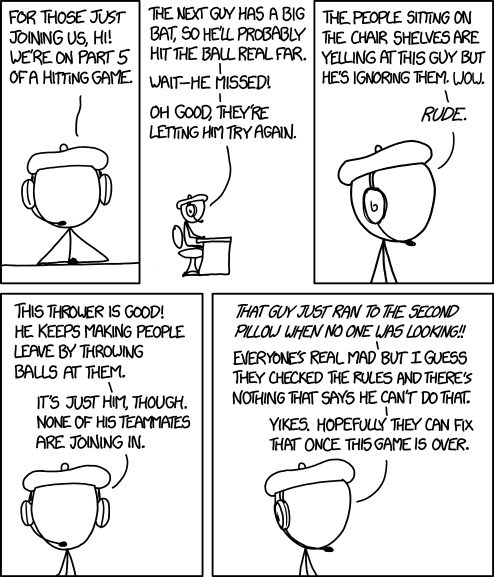
Play-By-Play

The thrower started hitting the bats too much, so the king of the game told him to leave and brought out another thrower from thrower jail.
19 Oct 14:10

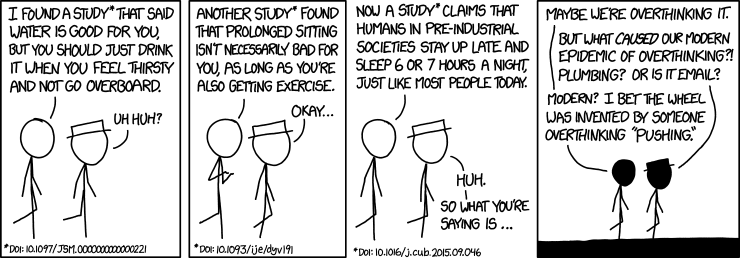
Overthinking

On the other hand, it took us embarrassingly long to clue in to the lung cancer/cigarette thing, so I guess the real lesson is "figuring out which ideas are true is hard."
16 Oct 20:22

Appeals Court Gives Google A Clear And Total Fair Use Win On Book Scanning (Techdirt)

by corbet
Here's a lengthy Techdirt article looking through the US Appeals Court ruling that Google's scanning of books constitutes fair use under copyright law. "Thus, while authors are undoubtedly important intended beneficiaries of copyright, the ultimate, primary intended beneficiary is the public, whose access to knowledge copyright seeks to advance by providing rewards for authorship."
16 Oct 18:39

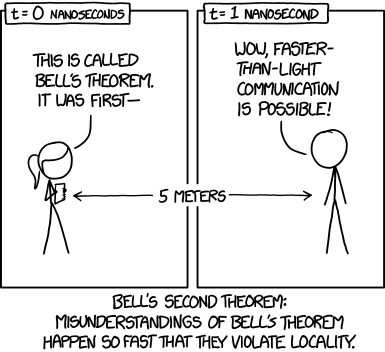
Bell's Theorem

The no-communication theorem states that no communication about the no-communication theorem can clear up the misunderstanding quickly enough to allow faster-than-light signaling.
16 Oct 18:38

The Official Biography is Days Away!

by Sørina Higgins
Grevel Lindop’s official biography, Charles Williams: The Third Inkling, published by Oxford University Press, will be released in a fortnight! I hope you have already placed your pre-order. While you’re waiting for it to arrive: Read this article Grevel wrote … Continue reading →
16 Oct 18:38

Ora2Pg 16 released

Paris, France - October 16th, 2015

Ora2Pg 16 released

Version 16.0 of Ora2Pg, a free and reliable tool used to migrate an Oracle database to PostgreSQL, has been officially released and is publicly available for download.

This major release improve PL/SQL code replacement, fixes several bugs and adds some major new features:

  • Full migration of MySQL database, it just work like with Oracle database.
  • Full migration assessment report for MySQL database.
  • New script, ora2pg_scanner, to perform a migration assessment of all Oracle and MySQL instances on a network.
  • Add technical difficulty level in migration assessment.
  • Allow migration assessment on client queries extracted from AUDIT_TRAIL (oracle) or general_log table (mysql).
  • Ora2Pg has a "made in one night" brand new Web site (still need some work) http://ora2pg.darold.net/

Example of technical difficulty level assessment output using the sakila database with some more difficulties:

Total 83.90 cost migration units means approximatively 1 man-day(s). Migration level: B-5

Here are the explanation of the migration level code:

  • Migration levels:
  • A - Migration that might be run automatically
  • B - Migration with code rewrite and a human-days cost up to 5 days
  • C - Migration with code rewrite and a human-days cost above 5 days
  • Technical levels:
  • 1 = trivial: no stored functions and no triggers
  • 2 = easy: no stored functions but with triggers, no manual rewriting
  • 3 = simple: stored functions and/or triggers, no manual rewriting
  • 4 = manual: no stored functions but with triggers or views with code rewriting
  • 5 = difficult: stored functions and/or triggers with code rewriting

This is to help you to find the database that can be migrated first with small efforts (A and B) and those who need to conduct a full migration project (C).

This release has also some new useful features:

  • Export type SHOW_TABLE now shows additional information about table type (FOREIGN, EXTERNAL or PARTITIONED with the number of partition).
  • Connection's user and password can be passed through environment variables ORA2PG_USER and ORA2PG_PASSWD to avoid setting them at ora2pg command line.
  • Improve PL/SQL replacement on ADD_MONTH(), ADD_YEAR(), TRUNC(), INSTR() and remove the replacement limitation on DECODE().
  • Add detection of migration difficulties in views, was previously reserved to functions, procedures, packages and triggers.
  • Replace values in auto generated configuration file from command line options -s, -n, -u and -p when --init_project is used.
  • Adjust lot of scores following new functionalities in Ora2Pg, ex: autonomous transactions, dblink or synomyms are now more easy to migrate.

There is some new command line options to ora2pg script:

  • -m | --mysql : to be used with --init_project and -i option to inform ora2pg that we work with a MySQL format
  • -T | --temp_dir : option to be able to set a distinct temporary directory to run ora2pg in parallel.
  • --audit_user : option to set the user used in audit filter and enable migration assessment report on queries from AUDIT_TRAIL (oracle) or general_log table (mysql).
  • --dump_as_sheet and --print_header options to be able to compute a CSV file with all migration assessment from a list of oracle database.
  • --dump_as_csv option to report assessments into a csv file. It will not include comments or details, just objects names, numbers and cost.

Some change can break backward compatibility:

  • Change NULL_EQUAL_EMPTY to be disabled by default to force change in the application instead of transforming the PL/SQL.

This release adds some new configuration directives:

  • MYSQL_PIPES_AS_CONCAT: Enable it if double pipe and double ampersand (|| and &&) should not be taken as equivalent to OR and AND.
  • MYSQL_INTERNAL_EXTRACT_FORMAT: Enable it if you want EXTRACT() replacement to use the internal format returned as an integer.
  • AUDIT_USER: Set the comma separated list of user name that must be used to filter from the DBA_AUDIT_TRAIL or general_log tables.
  • REPLACE_ZERO_DATE: the "zero" date: 0000-00-00 00:00:00 is replaced by a NULL by default, use it to use the date of your choice. Useful when you have a NOT NULL constraint.
  • INDEXES_RENAMING: force renaming of all indexes using a name with tablename_columnsnames. Useful for database that have multiple time the same index name or that use the same name than a table.
  • HUMAN_DAYS_LIMIT: default to 5 days, used to set the number of human-days limit for migration of type C.

As usual there is also some bug fixes and Oracle to PostgreSQl conversion adjustments, for a complete list see the changelog.

Links & Credits

Thanks to all contributors, they are all cited in the changelog file.

Useful Links:


About Ora2Pg

Ora2Pg is an easy and reliable tool to migrate from Oracle to PostgreSQL. It is developed since 2001 and can export most of the Oracle objects (table, view, materialized view, tablespace, sequence, indexes, trigger, grant, function, procedure, package, partition, data, blob, external table, etc.).

Ora2Pg works on any platform and is available under the GPL v3 licence.

Docs, Download & Support at ora2pg.darold.net.


14 Oct 17:38

The Source

Why did we even have that thing?
14 Oct 17:38

Três livros para compreender o Brasil

by Rodrigo Gurgel

Nos dois últimos meses, enquanto terminava a edição do meu novo livro — Crítica, Literatura e Narratofobia —, que sairá em novembro pela Vide Editorial, e preparava as aulas para a 1ª turma on-line da minha Oficina de Escrita Criativa, li três livros que me ajudaram a compreender o Brasil de hoje.

Saliento que os três autores são meus amigos — o que não significa que esta rápida análise represente algum tipo de troca de favor. Não. Acontece que, antes de sermos amigos, temos formas de pensar, de entender a política e a realidade, muito semelhantes. E é sempre uma alegria poder falar bem de alguns livros — ainda que o senso comum veja o crítico como alguém sempre predisposto a falar mal.

Do sonho à realidade

Em O cinema sonhado, Josias Teófilo busca reconstruir a figura do avô, Pedro Teófilo Batista (1929-1989), que foi aviador de formação, repórter cinematográfico, arquiteto autodidata, cineasta e inventor. Não se trata, contudo, de uma biografia, mas, sim, de redescobrir uma alma, segundo as palavras de Fustel de Coulanges, para quem o estudo da alma deve ser o objeto da ciência histórica, devendo esta “aspirar a conhecer aquilo em que a alma acreditou, pensou e sentiu nos diferentes estágios da vida do gênero humano”.

Essa “alma”, vista por Coulanges como índole ou caráter de uma sociedade, de um grupo de indivíduos, transforma-se, com Josias Teófilo, na metodologia pessoal com que analisa não somente as lembranças que restaram do avô visionário, mas suas “crenças mais profundas” e, inclusive, “o princípio interior por trás dessas crenças”.

Josias TeófiloUma questão de ordem cronológica, entretanto, complica o trabalho do ensaísta: como alcançar a vida interior de seu avô, pessoa com quem pôde conviver só até os 2 anos de idade? Fustel de Coulanges, mais uma vez, o auxilia: “Se o homem descer ao fundo da sua alma, nela poderá encontrar e distinguir essas diferentes épocas, segundo o que cada uma delas nele deixou”.

Fecha-se, dessa forma, a metodologia do ensaio: distinguir a vida do avô dentro da sua (do autor) própria alma. A biografia torna-se autobiografia. O cinema sonhado busca não apenas o avô, mas também a imagem do avô que é parte indissociável da alma do próprio ensaísta.

Ao empreender essa busca, o autor responde também à inesperada fala de sua tia Letícia: “Meu filho, você pode ser diferente do seu pai e do seu tio!” — afirmativa profética dessa mulher que me lembrou Tirésias, pronta a conclamar o autor à realização concreta e não apenas viver no mundo dos sonhos.

O livro é, portanto, auto-descoberta, resposta aos familiares e antepassados que, presos ao mundo onírico, não concretizaram o que, agora, cabe a Josias Teófilo fazer.

Mas por que o livro serve à compreensão do Brasil contemporâneo? Porque, passadas duas décadas de mentiras esquerdistas, duas décadas de mentiras oferecidas ao povo como sonhos realizados, duas décadas de retórica vazia e falsas promessas, é chegada, mais uma vez, a hora do país parar de estocar vento, prática em que os dois últimos governantes se especializaram. Semelhante ao périplo empreendido por Josias Teófilo, devemos abrir os olhos à realidade.

Multidão frenética — histeria coletiva

Por trás da máscara, de Flavio Morgenstern, não é, como muitos pensam, apenas um estudo sociológico sobre as manifestações populares violentas que ocorreram no Brasil em 2013. Trata-se, na verdade, de profunda análise sobre o comportamento da massa — ou, para usar a citação de Andrew Breitbart, de que Morgenstern tanto gosta, uma análise sobre o comportamento do “rebanho humano”.

Morgenstern denuncia a superficialidade e o caráter irresponsável da mídia, absolutamente incapaz de entender o que aconteceu naqueles meses. E desnuda os intelectuais — que ele chama, numa deliciosa ironia, de “palpitariado” — e seus eternos lugares-comuns, que nada explicam. Intelectualidade, aliás, jamais chamada a justificar seus eternos erros de análise, como o caso de Manuel Castells, que termina seu Redes de indignação e esperança elogiando a Irmandade Muçulmana por sua defesa do Islã e, acreditem!, da democracia.

Mas Por trás da máscara também não é só um libelo contra a mídia e a nossa intelligentsia. Morgenstern leva seu estudo ao cerne das manifestações de massa, mostrando sua ligação com o movimento comunista, que “se reinventa e abandona bandeiras periféricas conforme a conveniência, pois o marxismo como estrutura econômica é sempre uma catástrofe. Todavia o marxismo ainda é quase perfeito como ciência e técnica da ação revolucionária, no que não depende em nada da estrutura econômica pregada. Ou seja, ideais marxistas (‘passe livre’ incluso) são o grande motor dos movimentos revolucionários pelo mundo, mesmo que, como apregoa abertamente Slavoj Žižek, peçam o impossível, para não serem cobrados por resultados. Travestida em linguajar modernoso, esconde-se a velha logorréia comunista […]”.flavio morgenstern

A conclusão de Morgenstern a respeito desse molde revolucionário de manifestação é perfeita: “É a partir da criação de uma cultura marxista que o movimento será posto em marcha, sobretudo uma cultura que não precise dizer claramente seus objetivos — preferindo falar sempre pontualmente, ora da legalização da maconha, ora da estatização do transporte. Ora da legalização do aborto, ora do sindicato dos professores. A mensagem final, que reúne todos sob uma única bandeira, nunca é dita claramente. Todavia, inevitavelmente, será uma bandeira não apenas de esquerda, como bem próxima dos desejos dos marxistas mais ortodoxos: uma manifestação pedindo ‘passe livre’, que de repente se avacalhe em diversas bandeiras genéricas, mas sempre reivindicando algo do Estado, terá como ÚNICA conseqüência possível aumentar o tamanho do Estado e o poder dos políticos”.

Mas apegar-se a palavras de ordem ditadas por suas lideranças não é apenas um tática política. Não. Morgenstern esclarece, com todas as letras, como a esquerda realmente pensa usando slogans: ela “nunca vai além de uma palavra de ordem. Pedir que a esquerda formule um silogismo, como define Ann Coulter, é ‘como pedir que Michael Moore dance balé’”.

O diagnóstico de Flavio Morgenstern escancara o autoritarismo e a ideologia que se escondiam sob as manifestações de 2013: “Estes são os homens do totalitarismo. As multidões dos protestos brasileiros. Os homens que querem transformar todas as vidas humanas em engrenagens de uma máquina social — e sorriem e se alegram, por desejarem o fim do caos interno capaz de dar à luz uma estrela. Eles querem apenas a turba, a multidão frenética, a marchar em uma única direção, todos sob uma única ordem. Nenhum conflito, responsabilidade e dúvida dentro de si. Estes são os que odeiam a liberdade do homem de criar e viver por ele próprio — sob o ditame do ‘social’ ou do político, querem que toda a vida seja vergada ao peso da histeria coletiva”.

Em Por trás da máscara golfeja a justa indignação deste último trecho. Nesse livro empolgante, escrito num estilo barroco que lembra, muitas vezes, as sábias admoestações de Vieira, Morgenstern dialoga com os principais estudiosos dos movimentos de massa, como Elias Canetti e Ortega y Gasset, e deixa um alerta irônico às mentes lúcidas do país: “Nunca houve totalitarismo sem um povo muito revoltado com tudo isso que está aí”.

A glória do intervencionismo

Se as reflexões de Josias Teófilo voltam-se para a alma — dele e nossa — e as de Flavio Morgenstern concentram-se num momento paradigmático da história recente, Pare de acreditar no governo — Por que os brasileiros não confiam nos políticos e amam o Estado, de Bruno Garschagen, é uma revisão da história brasileira que mostra como o estatismo e o intervencionismo governamental insistem em destruir as iniciativas da sociedade.

“Um governo intervencionista não apenas constrói uma mentalidade estatista, mas apequena a sociedade. Um sistema político fundamentado na intervenção, no controle das esferas da vida social, política e econômica corrói as normas sociais, contrai o senso de responsabilidade, dilui o sentido de dever, inviabiliza o exercício da fraternidade, desestimula o trabalho das instituições sociais não governamentais e cria uma nova ordem, que é uma armadilha difícil de ser completamente destruída porque ‘construída pela engenhosidade humana e alimentada com os nossos próprios desejos’” — afirma Garschagen com lucidez.

Pare de acreditar no governo revisita cada momento da nossa história para, sem dissimulações de ordem ideológica, apontar o dedo para um irrefreável anseio despótico. Veja-se, por exemplo, o emblemático Capítulo 6, em que o golpe republicano e os governos da chamada República Velha são apresentados com seu patente autoritarismo. Raríssimas obras de análise histórica falam sobre o golpe do Barão de Lucena, em novembro de 1891; a respeito da visão autoritária e hierárquica que se escondia sob o positivismo de Benjamin Constant; ou sobre a ditadura de Floriano Peixoto, baseada no culto à personalidade — exatamente, conclui Garschagen, como, depois, fariam Getúlio Vargas e Lula.

bruno garschagenEsse, aliás, é outro aspecto elogiável de Pare de acreditar no governo: com deliciosa ironia, Garschagen está sempre pronto a atualizar “as loucuras e os crimes das nacionalidades”. Ao rever, por exemplo, o jacobinismo dos seguidores de Floriano, não deixa de comentar: “Xenófobos, os jacobinos cariocas eram nacionalistas, autoritários, anticlericais e tinham como lema ‘O Brasil para brasileiros!’, que mostrava no ponto de exclamação a natureza da sua força verbal. Na década de 1970, o governo militar, sob a presidência do sempre sorridente general Emílio Garrastazu Médici, gaúcho como Júlio de Castilhos, Borges de Medeiros e Getúlio Vargas, iria patrocinar o ‘Brasil, ame-o ou deixe-o’ como um mote igualmente acolhedor”.

Garschagen desempenha com inteligência a tarefa de rever a história brasileira em 300 páginas — e não deixa de nos alertar sobre os perigos que se escondem nos diferentes tipos de intervencionismo, perigos que afetam nossa própria intimidade: “Se os intervencionistas tentam controlar, modificar ou corromper elementos importantes da nossa cultura é porque os vêem como uma rede de proteção contra seus projetos políticos. Quando um partido fragiliza o papel das famílias mediante um ensino que atenta contra a relação de pais e filhos dentro de casa, ou adota posições que impedem os familiares de decidir o que é melhor para as suas crianças, começa a destruir as bases de formação cultural de cada um de nós. Se não há uma cultura que oriente e defina a política, a política irá orientar e definir a cultura”.

Há espaço em Pare de acreditar no governo inclusive para denunciar um crime tão grave quanto a corrupção, praticado à luz do dia pelos governos petistas, mas que não tem merecido as páginas dos jornais, infelizmente: o crime do intervencionismo estatal que se transforma em “engenharia social dissimulada, indolor e extremamente eficaz”.

Semelhante à manipulação marxista denunciada por Flavio Morgenstern, Bruno Garschagen mostra como o governo consegue fazer com que a sociedade pense e aja “segundo um código ideológico” — e é exatamente essa “a glória do intervencionismo: controlar a sociedade sem precisar de um órgão do governo responsável por persuadir ou coagir os indivíduos a se comportar de acordo com o interesse do governo de turno”.

***

Josias Teófilo, Flavio Morgenstern e Bruno Garschagen e seus livros para compreender o Brasil cumprem a tarefa do intelectual. Obrigam os leitores à reflexão, mas também à crítica do seu tempo e da sua história, pessoal e coletiva; olhando para o passado e o presente, não se enganar com as soluções fáceis do sonho, da ideologia e do Estado, mas construir a vida com nossas próprias mãos, exercendo nosso maior direito: a liberdade.

livros para compreender o Brasil

The post Três livros para compreender o Brasil appeared first on Rodrigo Gurgel.

12 Oct 16:54

My Prediction: A Cruz-Rubio Ticket

by David P. Goldman

Cross-posted from Asia Times.


Republican voters think the economy is the number one issue but can’t manage a public discussion on economic policy, as I observed Oct. 4 (“Who are you, and what have you done with the Republican Party?“). They flail at hot-button issues, defunding Planned Parenthood, for example, and look for scapegoats such as illegal Mexican immigrants (whose numbers are actually falling). It seems pointless to make predictions of any sort in the midst of the moral equivalent of a riot, but nonetheless I will go out on a limb: the Republicans will nominate Sen. Ted Cruz as president and Sen. Marco Rubio as vice-president, by process of elimination.

This conclusion seems inevitable by process of elimination. The voters are in a surly, rebellious mood and display their anger by telling pollsters they will vote for anti-Establishment candidates who never have held office (Trump, Carson, Fiorina, Paul).

CBS Poll Released October 11

Oct. 9 September
Donald Trump 27% 27%
Ben Carson 21% 23%
Ted Cruz 9% 5%
Marco Rubio 8% 6%
Jeb Bush 6% 6%
Carly Fiorina 6% 4%
Rand Paul 4% 3%
Chris Christie 3% 1%
Mike Huckabee 2% 6%

The four anti-Establishment candidates together command 58% of Republican preferences, according to the CBS poll. But it is unlikely that the party ultimately will nominate any of them. They simply are too volatile, too inexperienced and too labile to carry a presidential campaign. If that assumption is correct (and it is a big assumption), then that 58% will have to go somewhere else.

cruz

We can array the Republican candidates in a Venn diagram, with two regions denoting “experience” (holders of high political office) vs. the rebels. There is one name and one name only in the intersection of the two Venn diagrams, namely Cruz: he is perceived as anti-Establishment, but he has held high office at the state and national level.

Cruz is the likeliest person to inherit the 58% anti-Establishment vote once the Trump-Carson-Fiorina euphoria fades. It’s noteworthy that Cruz polls strongest among elected officials in the Republican race, at 9% this morning vs. 5% in September. Most of his gain appears to have come at the expense of former Gov. Mike Huckabee, which suggests that conservative evangelicals are consolidating their efforts around Sen. Cruz. The Republicans need a candidate with anti-Establishment credentials. A Jeb Bush ticket would risk defections to third-party challengers.

Cruz, moreover, has the strongest organization on the ground among all the Republican candidates. CBS news reported last week that he raised $12.2 million in the third quarter, more than twice the $6 million raised by Sen. Marco Rubio. Ben Carson, to be sure, raised about $20 million, but Carson simply will not be the candidate.  The average Cruz donation was just $66, and the Texas senator has a strong grassroots organization, perhaps the strongest of any of the Republican candidates.

Jeb Bush is weighed down by his family name, by his own diffident personality, and by his failure to persuade the big donors who supported his father and brother that he can win. He doesn’t suit the national mood. Sen. Rubio is a charming young man whose main disadvantage is to carry the baggage of the Bush administration’s failed foreign policy, tying his tongue in knots while apologizing for the Iraq War. The rest of the Republican field is hardly worth a comment. Rubio would make a terrific VP candidate. It’s a natural: with two Hispanics on the ticket, the Republicans have a better chance of capturing Latino votes.

10 Oct 21:13

Poxa, uma das minhas padocas "rootz" está se modernizando. Como assim a média não vem mais no copo americano?!?

by Eduardo Maçan

Poxa, uma das minhas padocas "rootz" está se modernizando. Como assim a média não vem mais no copo americano?!?

Poxa, uma das minhas padocas "rootz" está se modernizando. Como assim a média não vem mais no copo americano?!?

05 Oct 13:33

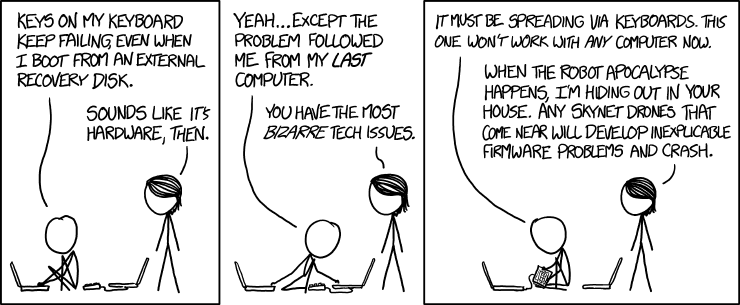
Keyboard Problems

In the future, a group of resistance fighters send me back in time with instructions to find the Skynet prototype and try to upgrade it.
05 Oct 13:32

Transcend releases new water-shock-freeze-hot-xray-proof SD card series :)

by 43rumors

Share

transcend

If you travel a lot and work in harsh condition those brand new Transcend cards are definitely for you. Their new UHS-II U3 SD card is super well built and is:
– waterproof. Resists for 30minute in water in-depth up to 1m (IS IPX7 equivalent test)
– freeze proof down to -25 Celsius
– hot proof up to 85 Celsius
– Electrostatic immunity (complies with the EMC IEC61000-4-2, and has resistance to static electricity.)
– Resistance and X-ray (ISO7816-1 compliant, will not be affected by the X-ray inspection of the airport!)
– And shock resistance

There is yet no info about release nor any preorder option. But the cards are rumored to cost 1500 Euro the 64GB and 900 Euro the 32GB.

Transcend-SD4K_Oficial_06_AA

Price info via DSLRmagazine.

Share


02 Oct 13:05

7 contos extraordinários

by Rodrigo Gurgel

Em minha relembrança de alguns contos extraordinários, gostaria de começar por (1) “Eveline”, de James Joyce, narrativa que utilizo em uma de minhas aulas da Oficina de Escrita Criativa.

Trata-se de uma narrativa curta, concentrada na personalidade da jovem que, em grande parte do texto, permanece sentada à janela, “a cabeça apoiada na cortina, aspirando o poeirento odor do cretone”. A indefectível tristeza dessa história — a de uma jovem maltratada pelo pai despótico e alcoólatra, sofrendo humilhações no emprego e apegada à lembrança da morte de sua mãe — agride-me sempre. É inevitável.

contos extraordinários rodrigo gurgel

James Joyce

O abrupto e perfeito salto no tempo, quando o narrador transfere a história para a plataforma de embarque do porto de North Wall, e a imagem da mãe que, no leito de morte, grita “— Derevaun seraun” [do gaélico: “A dor é o fim do prazer”] em “desvairada insistência” são, para mim, os dois elementos-chave, sem os quais o final não teria sua carga dramática.

Poucas coisas podem ser mais trágicas do que o temor de buscar a felicidade — mas, no caso de Eveline, a desventura é ampliada pelo fado que herdou da mãe: “uma existência de sacrifícios banais terminada em loucura”.

Outro conto incrível que faz parte de Dublinenses é (2) “Os mortos”, extensa narrativa, composta na forma de um adágio cujo crescendo nos envolve vagarosamente. Os elementos que se concentram no final são enunciados passo a passo, engendrando uma trama sutil, de fecho inesperado, protagonizada pelo culto e metódico Gabriel Conroy, dividido entre o saudosismo, a melancolia e os valores representados pelas tias — a polidez, a hospitalidade, a gratidão — e a força do presente, seu apelo à vida e à dedicação àqueles que estão vivos.

Ao mesmo tempo, o amor de Gabriel por sua esposa, o carinho, a admiração e o desejo que tumultuam sua consciência nos parágrafos que antecedem o fim, tudo se congrega para criar um personagem excepcional.

Quando as seguranças de Gabriel desmoronam, não é apenas o clima de paixão e expectativa sensual que se quebra, mas a própria vida, obrigando-o a reconhecer que este mundo também pertence aos mortos — e que temos pouco ou nenhum poder sobre eles.

Se “Eveline” possui as características de uma cutilada fatal, “Os mortos” é uma lenta prostração, um derreamento que conduz seu protagonista à completa incerteza.

Outro conto que nunca sai de minha memória é (3) “Brincadeira”, de Anton Tchekhov, o primeiro que li desse russo genial, na tradução de Tatiana Belinky. No “claro dia de inverno”, a narrativa se abre numa sucessão de tons — a “prata cintilante”, o branco da neve, a luz solar refletindo-se em tudo —, apenas para dar ainda mais vida ao pano carmim que forra o trenó.

contos extraordinários rodrigo gurgel

Anton Tchekhov

Pobre Nadiejda Petrovna, sutilmente assediada pelo narrador, um brincalhão dividido entre a futilidade e o sadismo. O trenó, sibilante, desce o morro alto, enquanto ela se ilude a ponto de enfrentar seu medo. E outra vez, e mais outra, apenas para ouvir a deliciosa mentira, deixando-se afogar no vício do amor que é apenas uma miragem invernal.

Perdida na incerteza de ter realmente escutado a declaração de amor, resta-lhe sonhar — mas sonhar para toda a vida. O presunçoso narrador fecha sua história com uma nota de tristeza, e jamais saberemos suas verdadeiras razões. Mas não importa. Nas poucas páginas, Tchekhov nos dá uma amostra das complexas relações humanas, do jogo, de suposta inocência, que se estabelece entre homem e mulher.

Ao final, tudo se dilui, temos a sensação de que eles continuam subindo e descendo o morro coberto de neve, pois esse jogo, esse estranho jogo no qual muitas vezes nos ferimos, é um jogo eterno.

O veludo da prosa de Mário de Andrade está todo em (4) “Será o Benedito!”. Em poucos parágrafos, Mário ensina como o belo despreza afetações.

contos extraordinários rodrigo gurgel

Mário de Andrade

Hospedando-se, durante alguns dias, na fazenda de um conhecido, o narrador estabelece amizade com um garoto — “o negrinho era quase só pernas, nos seus treze anos de carreiras livres pelo campo”.

A princípio acanhado, o menino sequer enfrenta o olhar do homem da cidade; e reage de maneira imprevista, disparando propriedade afora: “Deu uma risada quase histérica, estalada insopitavelmente dos seus sonhos insatisfeitos, desatou a correr pelo caminho, macaco-aranha, num mexe-mexe aflito de pernas, seis, oito pernas, nem sei quantas, até desaparecer por detrás das mangueiras grossas do pomar”.

O trecho acima é bom exemplo do estilo de Mário: o encadeamento das frases, pontuadas por escolhas lingüísticas precisas — “macaco-aranha”, “mexe-mexe”, a repetição do substantivo “pernas” —, dá vida à correria do garoto.

Campo e cidade, rural e urbano, são elementos em permanente desacordo nessa narrativa. O menino tem na cidade a sua “única obsessão” — e o narrador lhe apresenta a vida urbana, repetidamente, como símbolo do mal e da morte. O narrador, aliás, é taxativo sobre os malefícios da urbe: magro como é, o garoto morreria, com certeza, de tuberculose.

Resignado, “com profunda melancolia”, o garoto aceita permanecer na fazenda. O narrador parte. Duas semanas depois, uma carta anuncia a morte do menino, vítima “de um coice de burro bravo que o pegara pela nuca”. A última frase do texto revela, então, o porquê da narrativa: “É o remorso comovido que me faz celebrá-lo aqui”.

História tristíssima, como se vê. A inexorabilidade do destino apresenta-se com terrível desfaçatez: tentando preservar a criança em seu locus amoenus, o bondoso protetor na verdade a condena. O azar se impõe como resultado das boas intenções — e o inocente é lançado ao precipício.

A injustiça iminente, aliás, já havia sido antecipada pelo narrador, quando, diante das histórias de arranha-céus, cantores de rádio e chauffeurs, ele diz que “Benedito me mostrava os dentes do seu riso extasiado, uns dentes escandalosos, grandes e perfeitos, onde as violentas nuvens de setembro se refletiam numa brancura sem par”.

A resignação do narrador não só fecha a tragédia, mas a complementa: o que fazer diante de seu erro involuntário, a não ser experimentar, em silêncio, o vazio? Muitas vezes, o terror que o trágico impinge ao homem sequer lhe dá o direito de se desesperar.

Impossível não descobrir certa ironia no fato de a história ter sido publicada em uma coleção infanto-juvenil da Cosac Naify. Não se tratou, contudo, de escolha errada. Ao contrário, crianças e jovens devem ser introduzidos aos mistérios do trágico, esse caráter indissociável da vida. E se for pelas mãos de Mário de Andrade, tanto melhor.

Também aprecio reler Leonardo Sciascia. Siciliano apaixonado por Stendhal — aliás, da mesma forma que Lampedusa, também nascido na Sicília —, Sciascia escreveu, dentre outros, o bem-humorado (5) “A remoção”.

Usando de ironia, Sciascia coloca no mesmo patamar a fé cega de Filomena e a de seu marido, o comunista Michele Tricò. Este cobre a mulher de injúrias por ela participar de uma manifestação contra a retirada da imagem de Santa Filomena da igrejinha local, pois o Vaticano, após longos estudos, concluiu que a santa jamais existira.

Ainda acusando a esposa de ignorante, Michele senta-se para ler o L’Unità, órgão oficial do Partido Comunista Italiano, quando descobre, logo na capa do jornal, a notícia de que iriam remover a múmia de Stalin de seu mausoléu. Num rompante de indignação, o comunista age da mesma forma que sua mulher, movido pela fé infantil. A justaposição das duas personalidades resulta numa história hilariante — e o resultado, a crítica de Sciascia, fere de morte os fanatismos.

contos extraordinários rodrigo gurgel

Leonardo Sciascia

Mas há outro Sciascia, ainda melhor: (6) “O mar cor de vinho” é história marcada de lirismo melancólico, na qual certo engenheiro, próximo dos 40 anos, descobre o amor numa viagem de trem à Sicília.

Um casal de professores e dois filhos pequenos, que viajam com o protagonista na mesma cabine, despertam sua afeição à vida familiar; e ele, lentamente, deixa-se invadir pela beleza triste da jovem que acompanha o casal. “Uma viagem é como uma representação da existência, pela síntese, pela contração de espaço e tempo; enfim, um pouco como o teatro: e nela se recriam inteiramente, com um fundo de ficção inesperado, todos os elementos, as razões e as relações da nossa vida”, raciocina o engenheiro.

Todos esses sentimentos vão se intensificando no transcorrer da longa viagem, atingindo seu clímax diante da visão do mar de Taormina, que o menino Nenè, maravilhoso personagem, debochado e inteligente, compara ao vinho. O inusitado da figura completa o feitiço que toma o engenheiro.

Ao final, dividido entre o amor, a timidez, a repentina paixão e o freio que a maturidade impõe aos instintos, ele se sabe vítima de um sentimento do qual não poderá fugir — o que não o entristece, mas também não o alegra completamente.

Assim, Sciascia nos oferece uma delicada e prazerosa viagem, não à Sicília, mas em meio a essa “contração de espaço e tempo” que é o conto magistral, sem defeitos.

Para finalizar estes contos extraordinários, um de meus preferidos, (7) “A tortura pela esperança”, de Villiers de L’Isle Adam.

Basta o parágrafo inicial para que o leitor seja aclimatado, pois os elementos essenciais estão todos ali: o esterco, as manchas de sangue, os sons típicos da masmorra; e nesse ambiente pestilento, o algoz e sua vítima. Quando o primeiro fala, o que para nós soa como cinismo, para ele resume-se à expressão sincera de sua fé, fato que só aprofunda nossa repulsa.

contos extraordinários rodrigo gurgel

Villiers de L’Isle Adam

O conto é uma lição de economia de recursos: o cenário, a cela e um corredor alongado graças ao efeito semelhante que, no cinema, Hitchcock imortalizou; dois personagens centrais — e os restantes, sombras, passos, um olhar aterrador; o tempo, a eternidade nascida da esperança e do medo.

Com hábil sadismo, o narrador nos arrasta em direção à porta de saída, alimentando e destruindo nossa expectativa. Ao final, quando descobrimos que não há maior horror do que o provocado pelo próprio homem, essa mesma voz ainda nos reserva detalhes hediondos: as pontas do cilício, certo olhar — e o hálito mais repugnante que alguém pode sentir.

29 Sep 20:15

FSF News: Taurinus X200 laptop now FSF-certified to respect your freedom

This is the first product of Libiquity to achieve RYF certification. The Taurinus X200 has the same architecture and certified software as the Libreboot X200, which was certified in January 2015. The Taurinus X200 can be purchased from Libiquity at https://shop.libiquity.com/product/taurinus-x200.

The Taurinus X200 is a refurbished and updated laptop based on the Lenovo ThinkPad X200, with all of the original low-level firmware and operating system software replaced. It runs the FSF-endorsed Trisquel GNU/Linux operating system and the free software boot system, Libreboot. Perhaps most importantly, all of Intel's Management Engine (ME) firmware and software has been removed from this laptop.

The FSF has previously written about Intel's ME, calling attention to how this proprietary software introduces a fundamental security flaw -- a back door -- into a person's machine that allows a perpetrator to remotely access the computer over a network. It enables powering the computer on and off, configuring and upgrading the BIOS, wiping the hard drives, reinstalling the operating system, and more. The functionality provided by the ME could be a very useful security and recovery measure, but only if the user has control over the software and the ability to install modified versions of it.

"With a rise in manufacturing of treacherous computing chips and each successive version of Intel's Management Engine becoming more treacherous than the last, it would seem that the public is being inundated with hardware that is defective by design. Therefore, it is refreshing to have companies like Libiquity making strong commitments to computer user freedom. The FSF is excited to be able to award the use of the RYF certification mark on yet another laptop," stated FSF's licensing & compliance manager, Joshua Gay.

Libiquity (a portmanteau of "liberty" and "ubiquity") defines its mission as "freedom everywhere, in personal electronics and embedded systems." In addition to providing hardware that respects your freedom, Libiquity also leads the development of ProteanOS, an FSF-endorsed distribution, and they work in partnership with and contribute to Libreboot.

"Libiquity is proud that its first hardware product, the Taurinus X200 subnotebook, has been certified by the FSF to respect its users' freedom and privacy. We are honored to be the first US company with an RYF-certified laptop product, and we look forward to further working with the FSF and the free software community to develop and offer additional freedom-respecting products and services in the future," stated founder and CEO, Patrick McDermott.

To learn more about the Respects Your Freedom hardware certification, including details on the certification of the Taurinus X200, visit http://www.fsf.org/ryf. Hardware sellers interested in applying for certification can consult http://www.fsf.org/resources/hw/endorsement/criteria.

Subscribers to the FSF's Free Software Supporter newsletter will receive announcements about future Respects Your Freedom products.

About the Free Software Foundation

The Free Software Foundation, founded in 1985, is dedicated to promoting computer users' right to use, study, copy, modify, and redistribute computer programs. The FSF promotes the development and use of free (as in freedom) software -- particularly the GNU operating system and its GNU/Linux variants -- and free documentation for free software. The FSF also helps to spread awareness of the ethical and political issues of freedom in the use of software, and its Web sites, located at fsf.org and gnu.org, are an important source of information about GNU/Linux. Donations to support the FSF's work can be made at https://donate.fsf.org. Its headquarters are in Boston, MA, USA.

More information about the FSF, as well as important information for journalists and publishers, is at https://www.fsf.org/press.

About Libiquity

Founded by CEO Patrick McDermott, Libiquity is a privately held New Jersey, USA company that provides world-class technologies which put customers in control of their computing. The company develops and sells electronics products, provides firmware and embedded systems services, and leads the development of the innovative and flexible ProteanOS embedded operating system. More information about Libiquity and its offerings can be found on its Web site at http://www.libiquity.com/.

Media Contacts

Joshua Gay
Licensing & Compliance Manager
Free Software Foundation
+1 (617) 542 5942
licensing@fsf.org

Patrick McDermott
Founder and CEO
Libiquity LLC
info@libiquity.com

28 Sep 16:04

Tomas Vondra: PostgreSQL performance on ReiserFS

In the last two post, I've briefly discussed results of a benchmark measuring PostgreSQL performance with different filesystems. The first post compared EXT4 and XFS, and the second one was mostly dealing with the problems I've ran into when benchmarking BTRFS.

In the discussion, I've been asked to benchmark ReiserFS. I haven't really planned to benchmark this file system because ... Let's say ReiserFS does not have the best reputation when it comes to reliability due to historical reasons. According to some sources the motto of the development was essentially "performance over correctness" which is approach database folks don't really like. I don't know how much that's true for the current state of ReiserFS, or how that applies to the new ReiserFS 4 (which is not merged and I don't think it'll ever happen).

But database people are rather conservative when it comes to storage reliability, so even if all the issues got fixed and the current version is reliable, it's unlikely to become very popular in this group soon. Factor in the fact that the development of ReiserFS pretty much stopped (in favor of the Reiser4, which did not get merged for years), so the code pretty much in maintenance mode only. Which is not necessarily bad, but it also means no significant reworks necessary for new features and performance improvements (which was the purpose of Reiser4).

So let's see if ReiserFS 3 actually performs so much better than the common file systems (EXT4 and XFS), as the users often believe ...

The short answer is "no". At least not on the workload measured by pgbench (a lot of random I/O) and on this particular hardware (good SSD), ReiserFS 3 actually performs worse than both XFS and EXT4.

read-only

On read-only benchmarks, all the filesystems perform pretty much exactly the same, irrespectedly of the amount of data. For example on the large data set, you'll get something like this:

reiser3-compare-large-rw.png

The chart shows throughput (transactions per second) with different number of clients, for those three filesystems. And there's pretty much no difference at all.

The same is true for all read-only benchmarks and pretty much all traditional file systems, actually - if your workload is read-mostly, the choice of file system is going to do very little difference. The limit is going to be either at the storage or CPU level, and all the file systems perform pretty much exactly the same. (CoW-based filesystems are an obvious exception, of course.)

read-write

Read-write benchmarks are a different story - that's where the filesystems start to differ. Let's see read-write bechmarks on the large data set:

reiser3-compare-large-rw.png

EXT4 seems to be slightly faster than XFS (the difference is rather small until 8 clients, so it seems like a scalability issue). But ReiserFS is losing very visibly even on low client counts, losing ~25% on average. That's a lot, especially for a file system that was designed with performance as a primary goal.

How does it look on a smaller data set, that fits into RAM?

reiser3-compare-medium-rw.png

The difference between EXT4 and XFS pretty much disappeared and ReiserFS is catching up, but the difference is still pretty obvious. I'm not goint to show results for the small data set - in that case all the file systems perform exactly the same.

In the previous posts I've repeatedly nagged about jitter - getting high throughput is nice, but it's much less useful if the performance fluctuates a lot. This is the usual "throughput vs. latency" tradeoff where you exchange a bit of throughput for lower latency, but how much througput you need to sacrifice depends on how well the system is designed, implemented and optimized. EXT4 and XFS handle this quite well - EXT4 has slightly better throughput, XFS has a bit lower jitter. BTRFS is not mature yet and both throughput and jitter are rather awful. So what about ReiserFS?

reiser3-large-rw-16-clients.png

Not bad, I guess. Compare this to XFS (lower jitter than EXT4):

xfs-16.png

This is the one thing where ReiserFS 3 performs better - the jitter is slighly lower, and also the dips (that happen due to full page writes after CHECKPOINT) seem to be gone. That's nice, but you could also ask whether this is worth the 25% throughput drop.

Configuration

The benchmarks were done on a system with Intel i5-2500 CPU, 8GB of RAM and Intel S3700 100GB SSD, connected using SATA-III (I've previously incorrectly stated it's a S3500 model, i.e. a "lower" model, sorry for that - I do have S3500 in another system and got a bit confused).

The system is running a 4.0.4 kernel and the file systems were created/configured like this:

mkfs.ext4 -E stride=128,stripe-width=128 /dev/sda4
mkfs.xfs -f -d agcount=32,su=512k,sw=1 -l su=256k /dev/sda4
mkfs.reiserfs -f /dev/sda4

with these mount options:

/dev/sda4 on /mnt/data type ext4     (rw,noatime,nobarrier,discard)
/dev/sda4 on /mnt/data type xfs      (rw,noatime,nobarrier,discard)
/dev/sda4 on /mnt/data type reiserfs (rw,noatime,barrier=none)

It was recommended to also use "notail" mount option for ReiserFS, I don't think that makes any difference as that only applies to small files that can fit into the tree directly. But the files used for PostgreSQL are rather large and always multiples of 8kB, so not using this option should make no difference.

Summary

I'm a bit disappointed by the ReiserFS results - it's not terrible, but I've expected a bit more from a file system so much praised by the users for it's performance. I'm wondering where does this belief that it beats EXT4 or XFS comes from.

I'd guess it's at least partially due to obsolete experience - it's quite possible ReiserFS really was much faster than the other filesystems back in 2001 when it was introduced, but while EXT4 and XFS made a solid progress since then, the development of ReiserFS v3 mostly ceased (due to Namesys vanishing in 2007 and concentrating on Reiser4 which is not ready 8 years later).

Of course, ReiserFS 3 was designed for the rotational storage common in 2001, so the design might have done compromises that were irrelevant on spinning rust but are hurtful on flash storage (which is what the benchmark is using). But that only confirms the previous argument of stagnating development.

For me, the results only confirm that I'm not interested in using ReiserFS with PostgreSQL. Even if the data corruption issues were just a FUD or fixed long time ago, I don't see what I'd gain from using it instead of EXT4 or XFS.

28 Sep 13:09

Christopher Allan Webber: Userops Acid Test v0.1

Hello all!

So a while ago we started talking about this userops thing. Basically, the idea is "deployment for the people", focusing on user computing / networking freedom (in contrast to "devops", benefits to large institutions are sure to come as a side effect, but are not the primary focus. There's kind of a loose community surrounding the term now, and a number of us are working towards solutions. But I think something that has been missing for me at least is something to test against. Everyone in the group wants to make deployment easiser. But what does that mean?

This is an attempt to sketch out requirements. Keep in mind that I'm writing out this draft on my own, so it might be that I'm missing some things. And of course, some of this can be interpreted in multiple ways. But it seems to me that if we want to make running servers something for mere mortals to do for themselves, their friends, and their families, these are some of the things that are needed:

  1. Free as in Freedom:

    I think this one's a given. If your solution isn't free and open source software, there's no way it can deliver proper network freedoms. I feel like this goes without saying, but it's not considered a requirement in the "devops" world... but the focus is different there. We're aiming to liberate users, so your software solution should of course itself start with a foundation of freedom.

  2. Reproducible:

    It's important to users that they be able to have the same system produced over and over again. This is important for experimenting with a setup before deployment, for ensuring that issues are reproducible and friends and communities helping each other debug problems when they run into them. It's also important for security; you should be able to be sure that the system you have described is the system you are really running, and that if someone has compromised your system, that you are able to rebuild it. And you shouldn't be relying on someone to build a binary version of your system for you, unless there's a way to rebuild that binary version yourself and you have a way to be sure that this binary version corresponds to the system's description and source. (Use the source, Luke!)

    Nonetheless, I've noticed that when people talk about reproducibility, they sometimes are talking about two distinct but highly related things.

    1. Reproducible packages:

      The ability to compile from source any given package in a distribution, and to have clear methods and procedures to do so. While has been a given in the free software world for a long time, there's been a trend in the devops-type world towards a determination that packaging and deployment in modern languages has gotten too complex, so simply rely on some binary deployment. For reasons described above and more, you should be able to rebuild your packages... *and* all of your packages' dependencies... and their dependencies too. If you can't do this, it's not really reproducible.

      An even better goal is to guarantee not only that packages can be built, but that they are byte-for-byte identical to each other when built upon all their previous dependencies on the same architecture. The Debian Reproducibility Project is a clear example of this principle in action.

    2. Reproducible systems:

      Take the package reproducibility description above, and apply it to a whole system. It should be possible to, one way or another, either describe or keep record of (or even better, both) the system that is to be built, and rebuild it again. Given selected packages, configuration files, and anything else that is not "user data" (which is addressed in the next section), it should be possible to have the very same system that existed previously.

      As with many things on this list, this is somewhat of a gradient. But one extrapoliation, if taken far enough, I believe is a useful one (and ties in with the "recoverable sytem" part): systems should not be necessarily dependent upon the date and time they are deployed. That is to say, if I deployed a system yesterday, I should be able to redeploy that same system today on an entirely new system using all the packages that were installed yesterday, even if my distribution now has newer, updated packages. It should be possible for a system to be reproducible towards any state, no matter what fixed point in time we were originally referring to.

  3. Recoverable:

    Few things are more stressful than having a computer that works, is doing something important for you, and then something happens... and suddenly it doesn't, and you can't get back to the point where your computer was working anymore. Maybe you even lost important data!

    If something goes wrong, it should be possible to set things right again. A good userops system should do this. There are two domains to which this applies:

    1. Recoverable data:

      In other words, backups. Anything that's special, mutable data that the user wants to keep fits in this territory. As much as possible, a userops system should seek to make running backups easy. Identifying based on system configuration which files to copy and helping to provide this information to a backup system, or simply only leaving all mutable user data in an easy-to-back-up location would help users from having to determine what to back up on their own, which can be easily overwhelming and error-prone for an individual.

      Some data (such as data in many SQL databases) is a bit more complex than just copying over files. For something like this, it would be best if a system could help with setting up this data to be moved to a more appropriate backup serialization.

    2. Recoverable system:

      Linking somewhat to the "reproducible system" concept, a user should be able to upgrade without fear of becoming stuck. Upgrade paralysis is something I know I and many others have experienced. Sometimes it even appears that an upgrade will go totally fine, and you may have tested carefully to make sure it will, but you do an upgrade, and suddenly things are broken. The state of the system has moved to a point where you can't get back! This is a problem.

      If a user experiences a problem in upgrading their system software and configuration, they should have a good means of rolling back. I believe this will remove much of the anxiety out of server administration especially for smaller scale deployments... I know it would for me.

  4. Friendly GUI

    It should be possible to install the system via a friendly GUI. This probably should be optional; there may be lower level interfaces to the deployment system that some users would prefer to use. But many things probably can be done from a GUI, and thus should be able to be.

    Many aspects of configuring a system require filling in shared data between components; a system should generally follow a Don't Repeat Yourself type philosophy. A web application may require the configuration details of a mail transfer agent, and the web application may also need to provide its own details to a web server such as Nginx or Apache. Users should have to fill in these details in one place each, and they should propagate configuration to the other components of the system.

  5. Scriptable

    Not everyone should have to work with this layer directly, but everyone benefits from scriptability. Having your system be scriptable means that users can properly build interfaces on top of your system and additional components that extend it beyond directions you may be able to do directly. For example, you might not have to build a web interface yourself; if your system exposes its internals in a language capable enough of building web applications, someone else can do that for you. Similarly with provisioning, etc.

    Working with the previous section, bonus points if the GUI can "guide users" into learning how to work with more lower level components; the Blender UI is a good example of this, with most users being artists who are not programmers, but hovering over user interface elements exposes their Python equivalents, and so many artists do not start out as developers, but become so in working to extend the program for their needs bit by bit. (Emacs has similar behavior, but is already built for developers, so is not as good of an example.) "Self Extensibility" is another way to look at this.

  6. Collaboration friendly:

    Though many individuals will be deploying on their own, many server deployments are set up to serve a community. It should be possible for users to help each other collaborate on deployment. This may mean a variety of things, from being able to collaborate on configuration, to having an easy means to reproduce a system locally.

    Additionally, many deployments share steps. Users should be able to help each other out and share "recipes" of deployment steps. The most minimalist (and least useful) version of this is something akin to snippet sharing on a wiki. Most likely, wikis already exist, so more interestingly, it should be possible to share deployment strategies via code that is proceduralized in some form. As such, in an ideal form, deployment recipes should be made available similar to how packages are in present distributions, with the appropriate slots left open for customization for a particular deployment.

  7. Fleet manageable:

    Many users have not one but many computers to take care of these days. Keeping so many systems up to date can be very hard; being able to do so for many systems at once (especially if your system allows them to share configuration components) can help a user actually keep on track of things and lead to less neglected systems.

    There may be different sets, or "fleets", of computers to take care of... you may find that a user discovers that she needs to both take care of a set of computers for her (and maybe her loved ones') personal use, but she also has servers to take care of for a hobby project, and another set of servers for work.

    Not all users require this, and perhaps this can be provided on another layer via some other scripting. But enough users are in "maintainance overload" of keeping track of too many computers that this should probably be provided.

  8. Secure

    One of the most important and yet open ended requirements, proper security is critical. Security decisions usually involve tradeoffs, so what security decisions are made is left somewhat open ended, but there should be a focus of security within your system. Most importantly, good security hygeine should be made easy for your users, ideally as easy or easier than not following good hygeiene.

    Particular areas of interest include: encrypted communication, preferring or enforcing key based authentication over passwords, isolating and sandboxing applications.

To my knowledge, at this time no system provides all the features above in a way that is usable for many everyday users. (I've also left some ambiguity in how to achieve these properties above, so in a sense, this is not a pass/fail type test, but rather a set of properties to measure a system against.) In an ideal future, more Userops type systems will provide the above properties, and ideally not all users will have to think too much about their benefits. (Though it's always great to give the opportunity to users who are interested in thinking about these things!) In the meanwhile, I hope this document will provide a useful basis for implementing and thinking about mapping one's implementation against!

21 Sep 22:51

Sylvain Beucler: Rebuilding Android proprietary SDK binaries

Going back to Android recently, I saw that all tools binaries from the Android project are now click-wrapped by a quite ugly proprietary license, among others an anti-fork clause (details below). Apparently those T&C are years old, but the click-wrapping is newer.

This applies to the SDK, the NDK, Android Studio, and all the essentials you download through the Android SDK Manager.

Since I keep my hands clean of smelly EULAs, I'm working on rebuilding the Android tools I need.
We're talking about hours-long, quad-core + 8GB-RAM + 100GB-disk-eating builds here, so I'd like to publish them as part of a project who cares.

As a proof-of-concept, the Replicant project ships a 4.2 SDK and I contributed build instructions for ADT and NDK (which I now use daily).

(Replicant is currently stuck to a 2013 code base though.)

I also have in-progress instructions on my hard-drive to rebuild various newer versions of the SDK/API levels, and for the NDK whose releases are quite hard to reproduce (no git tags, requires fixes committed after the release, updates are partial rebuilds, etc.) - not to mention that Google doesn't publish the source code until after the official release (closed development) :/ And in some cases like Android Support Repository [not Library] I didn't even find the proper source code, only an old prebuilt.

Would you be interested in contributing, and would you recommend a structure that would promote Free, rebuilt Android *DK?

The legalese

Anti-fork clause:

3.4 You agree that you will not take any actions that may cause or result in the fragmentation of Android, including but not limited to distributing, participating in the creation of, or promoting in any way a software development kit derived from the SDK.

So basically the source is Apache 2 + GPL, but the binaries are non-free. By the way this is not a GPL violation because right after:

3.5 Use, reproduction and distribution of components of the SDK licensed under an open source software license are governed solely by the terms of that open source software license and not this License Agreement.

Still, AFAIU by clicking "Accept" to get the binary you still accept the non-free "Terms and Conditions".

(Incidentally, if Google wanted SDK forks to spread and increase fragmentation, introducing an obnoxious EULA is probably the first thing I'd have recommended. What was its legal team thinking?)

Indemnification clause:

12.1 To the maximum extent permitted by law, you agree to defend, indemnify and hold harmless Google, its affiliates and their respective directors, officers, employees and agents from and against any and all claims, actions, suits or proceedings, as well as any and all losses, liabilities, damages, costs and expenses (including reasonable attorneys fees) arising out of or accruing from (a) your use of the SDK, (b) any application you develop on the SDK that infringes any copyright, trademark, trade secret, trade dress, patent or other intellectual property right of any person or defames any person or violates their rights of publicity or privacy, and (c) any non-compliance by you with this License Agreement.

Usage restriction:

3.1 Subject to the terms of this License Agreement, Google grants you a limited, worldwide, royalty-free, non-assignable and non-exclusive license to use the SDK solely to develop applications to run on the Android platform.

3.3 You may not use the SDK for any purpose not expressly permitted by this License Agreement. Except to the extent required by applicable third party licenses, you may not: (a) copy (except for backup purposes), modify, adapt, redistribute, decompile, reverse engineer, disassemble, or create derivative works of the SDK or any part of the SDK; or (b) load any part of the SDK onto a mobile handset or any other hardware device except a personal computer, combine any part of the SDK with other software, or distribute any software or device incorporating a part of the SDK.

If you know the URLs, you can still direct-download some of the binaries which don't embed the license, but all this feels fishy. GNU licensing didn't answer me (yet). Maybe debian-legal has an opinion?

In any case, the difficulty to reproduce the *DK builds is worrying enough to warrant an independent rebuild.

Did you notice this?

21 Sep 18:21

One Cheer for Vladimir Putin

by David P. Goldman


There are a lot of reasons I don’t watch Republican political debates. One of them is that I might throw a whiskey glass at the television screen every time one of the contendors tries to show how tough he or she is by excoriating Vladimir Putin. Big talkers. My fellow Republicans oscillate between the view that Russia is about to implode and the view that Putin is about to make war on NATO. Both views are equally silly. Putin is playing a weak hand skillfully, trying to keep Russia in the game as a world power (if not a superpower). He also rules the one Christian country that has been fighting a war with Islamic terrorists for decades. After years of colossal American blunders in the Levant, there’s no way we can exclude Putin from a seat at the table. That’s a fact of life, and all the bloviating in the world won’t change it. It’s also a fact that Russia has interests which sometimes run counter to ours and sometimes coincide with ours. Where our interests coincide, we should work with Russia; where our interests diverge, we should foil Russia. That’s called Realpolitik and it’s what great powers do for a living.

Because the Obama administration is so beguiled by its anti-colonial, blame-America version of Wilsonian idealism, Putin just might play the pivotal role in the Levant during the next eighteen months. Below is an essay I posted under the title “Vladimir Putin: Spoiler or Statesman?” at Asia Times.

* * * * *

The great task of diplomacy in the 21st century is a sad and dreary one, namely managing the decline of Muslim civilization. There is a parallel to the great diplomatic problem of the late 19th and early 20thcentury, the dissolution of the Ottoman Empire, which the diplomats bungled horribly.

It is no job for the idealistic, namely the Americans, nor for the squeamish, namely the Europeans. The breakdown of civil order in a great arc from Beirut to Basra has already displaced 20 million people and raised the world refugee count from 40 million in 2011 to 60 million in 2014, with scores of millions at risk. After it failed to build democracy in Iraq and Afghanistan, the United States fell into a sullen torpor in which serious discussion of intervention in the regime is excluded. The hypocritical Europeans averted their eyes until millions of desperate people appeared on their doorstep, and remain clueless in the face of the worst humanitarian crisis since the last world war.

That leaves Vladimir Putin as the last, best hope of a region already halfway over the brink into the abyss. That is a disturbing thought, because the Russian leader has played the spoiler rather than the statesman in his wrangling with Western powers over the past decade and a half. Nonetheless, Russia has an existential interest in sorting out the Levant. Muslims comprise a seventh of the population of the Russian Federation, and the growing influence of ISIS threatens to give a fresh wind to terrorism inside Russia. Mr. Putin might rise to the occasion.

Putin might for example offer a compromise solution that I first heard suggested by Erik Prince, the counterterrorism expert and entrepreneur: force Syrian president Basher Assad out of power, but let Moscow pick his successor. At that point Turkey and Saudi Arabia could claim victory and withdraw their support from Sunni extremists (or be compelled to do so by the United States), and Iran could be compelled to withdraw its Revolutionary Guards from the theater and cut off support for Hezbollah. The efforts of the international community then could turn to destroying ISIS. There would be no glorious era of Arab democracy, no Arab spring, no happy ending, just a less murderous sort of despotism and an armistice rather than a real peace between Shia and Sunni. That is as good as ever it will get in that miserable region.

Unlike the feckless Europeans, who can’t abide a single casualty, or the disgusted Americans, Putin has the nerve to put boots on the ground in Syria. Large-scale combat operations by foreign armies will not solve the region’s problems, but the willingness to take bullets is the ante in this particular poker game. Putin is the only foreign leader who has paid it.

I do not know what Putin will do. But it seems clear that Russia has a deep interest in fostering such an outcome. It is at no risk of a Muslim majority by mid-century, contrary to some of the shock estimates circulating at the fringe of academia. In an April 2015 study, the authoritative Pew Research Center estimates the total fertility rate of Russian Muslims at slightly below Russia’s overall fertility rate: “While Muslim fertility is well above replacement level in many countries, it is below replacement level in Iran (1.6) and in much of Eastern Europe, including Romania (1.5) and Russia (1.6).”  Projections of a Muslim majority in Russia by 2050 failed to consider the collapse of Muslim fertility rates.

But that does not mitigate Russia’s concern about ISIS. Chechens are the largest contingent of foreigners fighting for ISIS in the Levant, including a celebrated Georgian Army special forces commander, Tarkhan Batirashvili who has been fighting in Syria since 2012. Jihadist groups in the Russian Caucasus, meanwhile, began to offer their loyalty to ISIS’ putative caliphate earlier this year. Both as a training ground for Muslim terrorists and a galvanizing force for Russian jihadists, ISIS represents a threat to Russia.

Russia tilted towards Iran in the region in order to pressure Sunni jihadists, as Putin has told Western diplomats in just those words. I have heard the same explanation from Chinese analysts for Beijing’s rapprochement with Tehran: Like Russia, China has virtually no Shia Muslims, but has a great deal to fear from Sunni fundamentalists. Russia and China were playing a balance-of-power game not much different than Washington’s, although with none of the sentimental illusions harbored by the Obama administration.

For Russia as well as China, the notion that Iran would provide a counterweight to Sunni jihadists in the region was a gigantic blunder. The Muslim world is in the throes of civilization collapse, and it is ridiculous to treat its juridical entities like pieces on a chessboard. The P5+1 nuclear deal with Iran legitimized Iran as a regional power and gave it an immediate dividend of $150 billion. This provoked the Sunni powers to throw more resources behind jihadists who are bleeding Hezbollah to death in Syria, and taking a severe toll on the Iran Revolutionary Guard Corps in Syria as well as Iraq.

The presence of 20 million people of military age, most of them without prospects, provides a virtually limitless supply of cannon fodder. Like Europe’s Thirty Years’ War, the mushrooming of mass armies that support themselves by living off the land leads to uncontrollable, self-sustaining conflicts. America’s lurch from backing a Shia majority in Iraq’s 2007 elections to sponsoring a Sunni counterweight during the 2008-2010 “Surge” made a new Thirty Years War inevitable, as I warned in 2010. America’s professional military knows this, and one of its most senior commanders, Maj. Gen. Daniel Bolger, spelled it out in a 2014 memoir, but none of the politicians responsible will own up to their stupidity and its baleful consequences. That, along with the American public’s disgust with the conduct of the Iraq campaign, paralyzes strategic debate in Washington and makes America look like a den of dangerous fools in the view of policymakers from Berlin to Jerusalem to Moscow to Beijing.

A lasting armistice is possible only if the great powers combine to twist the arms of Iran, Turkey, and the Gulf States. Iran has to ground the IRGC and disengage from Hezbollah (it might be a good time to do so, now that Hezbollah has had 1,000 of its 12,000 full-time fighters killed in Syria, with twice that probably wounded). Turkey has to end its covert support for ISIS as a counterweight to the Kurds. Saudi Arabia has to police its rogue princes and cut off covert funding for jihadi movements. Russia with some help from China can twist arms in Tehran while the Americans and the Saudis can give an ultimatum to Ankara.

The odds of such an outcome remain slim, to be sure, and not least because the Obama administration would have to take the sort of action it seems congenitally unable to take. Putin’s record, for that matter, does not evoke optimism. He had an opportunity to trump the West in Ukraine after the February 2014 Maidan revolution (or coup, depending on your point of view). Russia viewed the overthrow of Victor Yanukovich as a Western scheme to deprive Russia of its naval bases in Crimea, and responded with an illegal seizure of the Russophone province. A statesman would have proposed a referendum on the model of the Saarland in 1955, which voted to become part of Germany rather than France. Crimea would have voted to adhere to Russia, and almost certainly the Donbass as well. Ukraine would have lost most of its Russian speakers, and the remainder of the country would have been Catholic and pro-Western.

That, as Angelo Codevilla has observed, is just the outcome that Putin did not want. Rather than a partition following a plebiscite under international law, Putin wanted to keep Ukraine in perpetual instability, leaving the West with a bleeding sore on its Eastern frontier rather than a stable if smaller pro-Western state.  In pursuit of this objective, Putin displayed a higher threshold for pain and friendliness to risk utterly absent from Western capitals, and ran circles around the West. Western critics complain that Putin is a former KGB officer. That is a silly objection: the security services were the only real school of leadership in a Communist system that otherwise lived on corruption and toadyism.

After the oil price collapse, though, Russia is in a much weaker position, and perhaps more amenable to collaboration with the West.

“Collaboration with the West” is the rub. With which “West” might Russia collaborate? Washington has coddled Turkish President Recep Tayyip Erdogan since the Bush administration invited him to the White House as a presidential candidate. No matter how egregiously Turkey misbehaves, it remains Washington’s poster-child for Muslim democracy.

Turkey is one of the region’s spoilers, for reasons that are hard to get around: more than half its young people will come from Kurdish-speaking households by mid-century, and Sunni Turks will find themselves outnumbered in their own country by Kurds and the Alevis, a deviant Muslim sect that probably comprises about a fifth of Turkey’s present population. Any Syrian settlement will have to take into account Kurdish interests. The Turks don’t like that, and are willing to back ISIS and similar Sunni jihadist elements to suppress Kurdish ambitions. But someone has to take a fall, as Sam Spade told the Fat Man, and that would be Turkey. Iran won’t like it, either, but there are many things Iran won’t like about stability in the region. Iran’s Shi’ite imperial fantasy depends on instability in the first place

If Washington lacked the will to slap down the Iranians—as it easily might have done in a variety of ways—it seems unlikely that it would take part a deal in which Russia does the slapping. Russia would only do so in return for assurances that the Sunni powers will cut off support for jihadi movements. The Obama administration is so ineffectual and fantasy-ridden that it seems an unlikely partner for regional realists.

That raises an interesting question: can the rest of the world work around the vacuum that has become American foreign policy? In theory, yes: the Gulf States are the main holders of Turkey’s external debt, and the main funders of Turkey’s current account deficit, now at 6% of GDP. The Gulf States and China together have enough carrots and sticks to force Ankara to behave. Russia and China have enough clout in Iran to compel it to accept a compromise in Syria and a reduction of its support for troublemakers in the region. The Europeans have a compelling interest to staunch the flood of refugees at the source.

History brought forth a great moment, Friedrich Schiller wrote of the French Revolution, but the moment encountered mediocre people. Putin has a chance to be great, contrary to his past record and to all expectation. He is not quite the Zeitgeist on horseback, but he is the key to a possible solution. We will learn soon what he is made of. I have long believed that the most likely outcome of Islam’s civilizational crisis is a body count that would beggar the last century’s world wars. One hopes to be proven wrong about such things.

21 Sep 18:21

Travel Ghost

And a different ghost has replaced me in the bedroom.
21 Sep 18:20

Daniel Pocock: Skype outage? reSIProcate to the rescue!

On Friday, the reSIProcate community released the latest beta of reSIProcate 1.10.0. One of the key features of the 1.10.x release series is support for presence (buddy/status lists) over SIP, the very thing that is currently out of action in Skype. This is just more proof that free software developers are always anticipating users' needs in advance.

reSIProcate 1.10.x also includes other cool things like support for PostgreSQL databases and Perfect Forward Secrecy on TLS.

Real free software has real answers

Unlike Skype, reSIProcate is genuine free software. You are free to run it yourself, on your own domain or corporate network, using the same service levels and support strategies that are important for you. That is real freedom.

Not sure where to start?

If you have deployed web servers and mail servers but you are not quite sure where to start deploying your own real-time communications system, please check out the RTC Quick Start Guide. You can read it online or download the PDF e-book.

Is your community SIP and XMPP enabled?

The Debian community has a federated SIP service, supporting standard SIP and WebRTC at rtc.debian.org for all Debian Developers. XMPP support was tested at DebConf15 and will be officially announced very soon now.

A similar service has been developed for the Fedora community and it is under evaluation at fedrtc.org.

Would you like to extend this concept to other free software and non-profit communities that you are involved in? If so, please feel free to contact me personally for advice about how you can replicate these successful initiatives. If your community has a Drupal web site, then you can install everything using packages and the DruCall module.

16 Sep 15:30

A beleza salvará o mundo

by Rodrigo Gurgel

Não me lembro como descobri A beleza salvará o mundo, de Gregory Wolfe. A Internet é floresta densa, repleta de sendas obscuras, semelhantes às de uma história infantil, nas quais, de página a página, de link a link, nos perdemos sem conseguir refazer o caminho inicial.

Numa dessas pesquisas aleatórias, cheguei ao site de Wolfe e deparei-me com esse título comum — ao menos para quem se recorda de Dostoiévski — e, principalmente, com o subtítulo que sintetizava uma de minhas constantes preocupações: “Recuperando o humano numa era ideológica”.

A identificação cresceu a cada ensaio de Wolfe que descobri. E se tornou plena ao ler algumas das páginas do livro, gentilmente

a beleza salvará o mundo gregory wolfe rodrigo gurgel

Gregory Wolfe

fotografadas por uma amiga que reside nos EUA. Na primeira oportunidade, apresentei a obra aos editores da Vide e insisti para que a publicassem.

O resultado está, agora, à disposição de todos — e espero que A beleza salvará o mundo se transforme, no Brasil, no que ele já representa para muitos leitores de língua inglesa: um guia para os que acreditam, como T. S. Eliot, que “a vantagem essencial de um escritor é não ter um mundo maravilhoso com que lidar. É ser capaz de enxergar além tanto da beleza quanto da feiura; ver o tédio, o horror, a glória” — pensamento que Wolfe considera a “extensão natural da profecia de Dostoiévski”.

Preconceito e diálogo

Há muitos elementos que merecem atenção nos ensaios que compõem o livro — e abordei alguns dos principais no Prefácio que fui convidado a escrever —, mas o ponto essencial, decorrente do que citei no parágrafo anterior, é o comportamento conservador criticado por Wolfe. Aluno de Russell Kirk, o autor não teme afirmar que “a maioria dos conservadores pensa na cultura como um museu, e não como uma continuidade orgânica. Eles são todos a favor da promoção dos clássicos, mas quando se trata de cultura contemporânea, simplesmente se eximem”.

De fato, canso de ver, no meio conservador, preconceitos em relação à arte. Muitos conservadores estão apegados a uma visão simplista e superficial da realidade — e chegam mesmo a enaltecer uma estética rasteira, inócua repetição do passado, como se a arte que recusa a pauta niilista, formalista e solipsista só pudesse ser a cópia rebaixada de Homero, Virgílio ou Dante. Ou, ainda pior, devesse se restringir a uma função meramente catequética.

a beleza salvará o mundo gregory wolfe rodrigo gurgel

“Vivemos em uma era dominada pelo racionalismo econômico oco envolto na retórica dos direitos” — Gregory Wolfe

Esse comportamento preconceituoso produz conseqüências assustadoras, como jovens que se negam a ler Hemingway, Kafka ou James Joyce, alegando a busca de uma suposta pureza, só encontrável nos autores que tenham recebido, em alguma época, um Nihil obstat.

Na verdade, dar as costas à cultura moderna — ou, como afirma Wolfe, “deixar-se desesperar sobre o nosso tempo” — é uma forma covarde de jogar essa mesma cultura nos braços insaciáveis do materialismo, de sucumbir à estreiteza do pensamento politizado e ideológico, de se tornar, citando Wolfe, um “discípulo involuntário de Marx”.

O caminho proposto por Wolfe é aquele seguido por grandes escritores, como T. S. Eliot, Evelyn Waugh, Flannery O’Connor, Susaku Endo, Nathaniel Hawthorne, Walker Percy e tantos outros: não se entrincheirar na sua própria fortaleza, não se entregar a um tipo de filistinismo que recusa a cultura do seu próprio tempo sem oferecer uma alternativa, sem se predispor ao diálogo.

Diálogo, aliás, que inquestionáveis defensores da ortodoxia católica, como o cardeal Leo Scheffczyk, souberam fazer com sucesso. Leia-se, por exemplo, de Scheffczyk, O Homem Moderno (Der moderne Mensh vor dem biblishen Menschenbild), e veja-se como o autor formaliza a crítica da “perda do humano na literatura moderna” — mas também dialoga com os autores que critica, sempre disposto a encontrar “notáveis pontos de luz” em cada um deles. Ou se preferirem, leiam a análise que Henri de Lubac faz de Dostoiévski em Le drame de l’humanisme athée.

Dramatizar os conflitos de seu tempo”

A necessidade de um novo humanismo cristão é urgente inclusive para se contrapor aos religiosos secularistas e laxistas, que se apressam, como afirma Wolfe, a “batizar cada tendência secular que passa”, a aceitar qualquer modismo esquerdista sem reflexão, a não ser o filtro de um religiosidade neopagã e sentimentalista — e, portanto, vulgar em todos os sentidos.

O caminho que Gregory Wolfe propõe não é simples, mas grandes artistas o realizaram, quando se dispuseram a “dramatizar os conflitos de seu tempo e incorporar significado em suas obras de maneira profunda”.

Como afirmo no final do meu Prefácio, enquanto lemos Wolfe somos atingidos, muitas vezes, pela suspeita de que ele tenta unir realidades incompatíveis. Mas tal impressão revela-se infundada sempre que ele repete a decisão de não aceitar passivamente o mundo pós-moderno e reafirma o desejo de transformar fé e arte num “traje inconsútil”. Caso a caso, Wolfe segue a máxima paulina: “Discerni tudo e ficai com o que é bom”.

The post A beleza salvará o mundo appeared first on Rodrigo Gurgel.

16 Sep 15:28

"Freedomvote": 10 questions sur les libertés numériques pour les élections nationales Suisses

"Freedomvote": 10 questions sur les libertés numériques pour les élections nationales Suisses

En prévision des élections du parlement national Suisse (Conseil national et des Etats/Fédéral) du 18 octobre 2015, La FSFE Suisse commence aujourd'hui la campagne "Freedomvote" en collaboration avec le "Swiss Open System User Group" (/ch/open). La campagne offre un portail en ligne qui répertorie les la liste des candidats ainsi que leurs opinions concernant la politique d'Internet, le Logiciel Libre et les formats de données ouverts (standards ouverts)

La campagne "Freedomvote" consiste à donner aux électeurs des renseignements sur les candidats aux élections. Pour beaucoup d'électeurs, il est important de savoir ce que les candidats de différents horizons pensent des aspects politiques d'Internet, par exemple les droits et les libertés des utilisateurs à l'ère du numérique. Malgré cela, de nombreux politiques essaient encore d'éviter ces sujets. Avec la campagne "Freedomvote", le FSFE Suisse veut changer ces positions et amener le sujet d'Internet et de l'usage du Logiciel Libre dans l'agenda politique. Tous les candidats sont invités à répondre aux différentes questions portant sur les sujets tels que les droits des utilisateurs concernant le numérique, le vote électronique, de la neutralité du net, de l'Open Data, du matériel didactique scolaire, du Logiciel Libre et du chiffrement. En outre, les candidats sont invités à expliquer dans le détail leurs positions et fournir les réponses à chaque question dans un champ de texte. Ainsi les électeurs soucieux des droits numériques peuvent trouver des réponses nécessaires qui les aideraient dans le choix du candidat lors du vote. Pour obtenir de meilleurs résultats, il est également possible de créer un profil d'électeur afin de comparer, distinguer les réponses des différents candidats.

"Pour répondre aux dix questions, les candidats peuvent utiliser notre plateforme et nous faire parvenir les réponses par l'intermédiaire de leur parti, où nous contacter directement - explique Simon Wächter de "Freedomvote", "ce que nous souhaiterions c'est que cette initiative de transparence suscite l'adhésion des candidats de tous les partis. Plus il y a de candidats qui participent meilleure sera l'aide et les conseils offerts aux électeurs.

Le FSFE Suisse enverra des centaines de courriels et de lettres cette semaine pour demander aux candidats leur participation. Vous pouvez soutenir l'initiative en demandant personnellement aux candidats de votre zone/région de participer.

Outre le développement et la fourniture de Freedomvote par la FSFE Suisse /ch/open, la campagne est soutenue par diverses organisations de défense des droits civiques tel que Parldigi, Internet Society Switzerland Chapter, Opendata.ch, Digitalle Allmend, ainsi que Willhelm Tux. Le logiciel sous-jacent de freedomvote.ch est auto-développé et publié comme logiciel libre.

Support FSFE, join the Fellowship
Make a one time donation

11 Sep 14:03

I Could Care Less

I literally could care less.
11 Sep 14:02

DJI announced the new Zenmuse X5 Drone Series with MFT mount! And also a new 15mm MFT lens!

by 43rumors

Share

zenmuse-x5r-7

DJI announced their newest Micro Four Thirds mount Drone named Zenmuse X5 and X5R. They booth shoot 4K videos with the latter (X5R) recording in lossless RAW.

Bildschirmfoto 2015-09-11 um 06.50.48

The surprising news is that they also have a new 15mm f/1.7 MFT lens! Everything is on preorder at http://store.dji.com/

Bildschirmfoto 2015-09-11 um 06.53.43

Share


11 Sep 14:01

11 contos exemplares

by Rodrigo Gurgel

Separei hoje 11 contos exemplares. Talvez não para todos — mas para mim, com absoluta certeza. Não são exemplos geniais. Alguns assemelham-se àqueles doces da infância, organizados com certa displicência no balcão do confeiteiro e que não despertam nossa gula — mas quando decidimos experimentá-los, seu sabor explode na boca, a sensação de reconforto inunda nosso corpo. Pouco importa se, do ponto de vista de alguns colegas, podem ser exemplos secundários, pois cada um deles me concedeu autêntico prazer.

1. Começo pelos italianos. Perdoem-me por não citar Pirandello. Mas um escritor menor, Camillo Boito, deixou algumas pequenas obras-primas. Dentre elas, “Senso”, que Luchino Visconti transformou no filme Sedução da carne. A narradora, uma condessa fútil, escreve sobre a paixão que viveu no passado. Temendo a velhice que se aproxima, ela nos oferece um estudo sobre ética, vaidade e orgulho — com final surpreendente.

2. O autor de O Leopardo, Giuseppe Tomasi di Lampedusa, escreveu “A sereia”, história de amor

Lampedusa - 11 contos exemplares

Lampedusa

vivida, na juventude, por Rosario La Ciura, catedrático de literatura grega. É o encontro com o prodígio, mas pleno de volúpia e paixão. Lampedusa nos introduz em sua história por meio de gestos que poderiam ser banais, mas que se transformam na prefiguração do encontro que selará a vida de La Ciura: “Os ouriços quebrados mostravam suas carnes feridas, sangüíneas, divididas de modo esquisito. Nunca havia percebido antes, mas após as extravagantes comparações do senador, pareciam-me realmente uma seção feita em sabe-se lá quais delicados órgãos femininos”.

3. e 4. As frases de Carlo Emilio Gadda formam círculos concêntricos que se fecham sobre os personagens. Ele é o mestre das digressões e da experimentação dialetal, mas nunca a ponto de se tornar

Gadda - 11 contos exemplares

Emilio Gadda

ilegível. Introduziu, sem exageros, a linguagem popular em seus textos — ou seja, não é, como cansamos de ver na literatura contemporânea brasileira, um populista. Tem dois ótimos romances: Aquela confusão louca na Via Merulana e O conhecimento da dor. Entre os contos, escolho “A cinza das batalhas”, para os leitores que desejarem conhecer sua veia humorística e a agilidade incrível dos diálogos, e “A mãe” — originalmente, um capítulo de O conhecimento da dor —, cujos temas são caros ao escritor: a solidão, a ciência que nada explica e nunca consola, e o tempo, “ligeiro persuasor de qualquer renúncia”.

5. Os amores difíceis é a coletânea de narrativas de Italo Calvino que mais

Italo Calvino - 11 contos exemplares

Italo Calvino

aprecio. Mas há um conto que resume suas qualidades: “Um general na biblioteca”. Uso-o, inclusive, em meus cursos. Humor, ironia, crítica aos regimes despóticos e insuperável amor pela leitura: tudo pode ser encontrado nessa narrativa de aparência leve, mas que esconde fina sabedoria, representada pelo senhor Crispino, silencioso personagem, cujo poder corruptor se revela lentamente.

6. e 7. Passo aos brasileiros. Os leitores do meu Esquecidos & Superestimados sabem que admiro Simões Lopes Neto. Em Lendas do

Simões Lopes Neto - 11 contos exemplares

Simões Lopes Neto

Sul, ele superou o mero registro da oralidade e recriou as narrativas, concedendo-lhes fantasmagoria própria. Aprimorar o enredo, acrescentando lirismo ou facetas heróicas onde, antes, havia apenas uma exposição plana, pueril, não é tarefa simples. E Simões o faz numa linguagem que renova a cadência e a magia do mito. Em “O negrinho do pastoreio”, vejam, para ficar num só exemplo, como a epizeuxe enfatiza os sofrimentos do escravo e amplia nossa compaixão. Quanto ao “A Mboitatá”, o narrador que se desdiz não apenas intensifica o clima de mistério, mas dilata deliciosamente a história, enrodilhando o leitor no rebolear da cobra que devora olhos.

8. O que menos me interessa em “O poço”, de Mário de Andrade, são as relações de mando entre Joaquim Prestes e seus empregados, ou a cobiça incontrolável desse latifundiário, realmente compulsiva, que o narrador apresenta num crescendo bem estruturado, até a explosão do último parágrafo. O que me seduz nesse conto é a

Mário de Andrade - 11 contos exemplares

Mário de Andrade

linguagem. Dizer que os empregados, assim que o patrão se aproxima, levantam-se “machucando chapéu na mão” revela, com surpreendente economia de recursos, toda uma complexa gestualidade, impregnada de subserviência. Outras expressões poderiam tornar visível a neblina que sobe do rio, mas a escolha de Mário é perfeita: “o arminho sujo da névoa”. Um dos empregados gira com desespero o sarilho (espécie de cilindro no qual se enrola uma corda), para trazer o irmão de saúde frágil, que trabalha no fundo do poço, de volta à superfície, e sua extrema dedicação torna-se visível quando o narrador diz que ele usa “músculos de amor”. À medida que o fazendeiro se desumaniza, os empregados também sabem, se necessário, adular: “Acabou inventando um jeito humilhante de disfarçar a culpa inexistente, botando um pouco de felicidade no dono”. Mário de Andrade domina inúmeros recursos. A cena em que Antônio — o rapaz de saúde frágil — sobe, a última vez, do poço, enregelado e à beira da estafa, guarda raro poder descritivo: “Levou as mãos descontroladas à boca, na intenção de animar os beiços mortos. Mas não podia limitar os gestos mais, tal o tremor. Os dedos dele tropeçavam nas narinas, se enfiavam pela boca, o movimento pretendido de fricção se alargava demais e a mão se quebrava no queixo”.

9. Dez anos antes de Grande sertão: veredas, Guimarães Rosa publicou Sagarana, coletânea de contos que ainda impressiona. Na juventude, se me perguntassem qual minha história preferida, eu ficaria entre “Conversa de bois” e “A hora e a

Guimarães Rosa - 11 contos exemplares

Guimarães Rosa

vez de Augusto Matraga”. Hoje gosto mais de “Sarapalha”. A malária que frustra todas as expectativas, aquele mundo à parte — “o povoado fechou-se em seus restos, que nem o coscorão cinzento de uma tribo de marimbondos estéreis” —, no qual a natureza irrompe sem controle, onde os insetos salmodiam e os passopretos “sobem, de escantilhão, para a copa das árvores, como um borrifo de tinteiro” — tudo me agrada. E, terminada a leitura, não consigo me apartar daqueles primos irmanados na doença e na paixão, presos à sezão que marca o tempo, a vida, semelhantes a espantalhos inúteis. O que os condenou? O amor ou a malária? A resposta é indiferente, pois amor e malária são a mesma doença — cuja febre se chama Luísa.

10. Entre inúmeros bons contistas de língua hispânica, confesso ter hesitado, mas acabei optando por Horacio Quiroga. Dentre os contos desse uruguaio genial, meu preferido é “Los imigrantes”. A Colección Archivos, da Unesco, cujos volumes

Horacio Quiroga - 11 contos exemplares

Horacio Quiroga

ainda podem ser encontrados em sebos ou pequenas livrarias, publicou uma bela edição integral das suas narrativas. Em “Los imigrantes”, num cenário de absoluta desolação, o narrador focaliza um casal que empreende estafante caminhada. Não sabemos para onde seguem. E conheceremos de onde vieram apenas nas últimas linhas do conto. Não importa. Tudo se resume à fatalidade, ao desespero, ao esforço sobre-humano que, no final, nada alcança. O conto é magnífico exemplo de concisão e intensidade — amostra clara de como o artista pode ser genial sem invencionices. Autor de um curioso Decálogo do Perfeito Contista, Quiroga segue à risca, em “Los imigrantes”, a sua regra VIII: “Pega teus personagens pela mão e conduze-os firmemente até o fim, sem ver nada além do caminho que traçastes para eles”.

11. Quero terminar com Joseph Conrad. Em Amy Foster — conto ou novela? — o que se destaca é a técnica de descrever a paisagem ou os personagens secundários sem se desviar do eixo da história e, principalmente, utilizando essas descrições, digamos, acessórias, esses deslocamentos da atenção, como uma forma oblíqua de iluminar os protagonistas. Sempre que um novo detalhe do entorno ou de um personagem menor é oferecido ao leitor, não enxergamos

Joseph Conrad - 11 contos exemplares

Joseph Conrad

apenas esse elemento, mas sua luz reverbera sobre os personagens centrais. Na verdade, sob tal método de escrita se oculta profundo respeito pelo leitor: oferecer pormenores que contribuam para compor as diferentes cenas, mas sem nos aborrecer com o que é supérfluo — ou seja, não mesquinhar elementos que auxiliem ou estimulem nossa imaginação. O conto apresenta a história do náufrago lançado a uma terra estranha, onde não compreende a língua ou os costumes. Destituído de qualquer bem, impossibilitado de se comunicar e, por uma decisão ética, de retornar ao seu país, ele sofre a desconfiança da maioria dos habitantes da pequena vila. Ao se tornar objeto da aversão gratuita, ao viver na condição de “estranho”, experimenta o pior tipo de solidão: o da total incapacidade para se identificar, seja com o outro, seja com o meio. Na verdade, não é a história de um náufrago, mas de um “pássaro apanhado numa armadilha”.

The post 11 contos exemplares appeared first on Rodrigo Gurgel.

08 Sep 23:36

A importância da leitura — e o leitor ideal

by Rodrigo Gurgel

Nestes dias, refletindo sobre a importância da leitura, lembrei-me de dois escritores que me agradam por motivos diferentes.

Poucos, raros autores conseguem expressar a dor de viver sem cair no melodrama. Em A Praça do Diamante, de Mercè Rodoreda, que li há vários anos, o ritmo do existir pulsa a cada página numa dimensão real, com alegrias e tristezas, sonhos e decepções. E tudo por meio de uma voz de mulher, simples como nós, aberta aos acontecimentos, vendo o mundo girar numa velocidade às vezes alucinante, às vezes de forma tão quieta que consegue ouvir seus pensamentos.

A importância da leitura - Rodrigo Gurgel

Em “A Praça do Diamante”, de Mercè Rodoreda, o ritmo do existir pulsa a cada página.

Entre a inocência e a decepção, sem mágoas ou ressentimentos, Colometa, a protagonista, nos enlaça com sua voz, na qual, apesar de todos os desgostos, ela esconde tons de alegria, esperança e espanto.

A Praça do Diamante é um dos poucos livros que gostaria de reler.

Outro escritor que não me sai da memória é Cormac McCarthy. Em A estrada, a desolação da paisagem, o embate entre homem e natureza, a visão do futuro como um amontoado de forças obscuras, diante das quais o homem não possui poder algum, e a idéia de um Deus que, impassível, parece assistir à tragédia humana, mas que guarda sua interferência para o momento supostamente propício, formam a trama na qual a destruição tornou-se absoluta.

Nesse mundo, o herói não se defronta mais com a possibilidade de escolher entre o Bem e o Mal, pois está condenado a uma busca inesgotável — a procurar o Bem, a ansiar por ele, sem jamais encontrá-lo. E o mais terrível: se quiser permanecer vivo, a fim de lutar pelo futuro em que possa ser novamente aquele que estabelece um tempo de justiça, o herói terá de negar ajuda a seu semelhante.

A importância da leitura - Rodrigo Gurgel

O herói não se defronta mais com a possibilidade de escolher entre o Bem e o Mal, pois está condenado a uma busca inesgotável — a procurar o Bem, a ansiar por ele, sem jamais encontrá-lo.

O primeiro parágrafo de A estrada serve como síntese do que aguarda o leitor: frio, escuridão, a presença da criança pura, o cuidado do homem que a acompanha, a sujeira, a morte da nossa civilização. E a linguagem de McCarthy, tão sublime quanto trágica: “Noites escuras para além da escuridão e cada um dos dias mais cinzento que o anterior. Como o início de um glaucoma frio que apagava progressivamente o mundo”. Ou a imagem arrancada de um sonho dantesco: “A luz deles brincando sobre as paredes úmidas de rocha calcária. Como peregrinos numa fábula engolidos e perdidos nas entranhas de alguma besta de granito”.

O leitor ideal

Mas afirmei que refletia sobre a importância da leitura.

Recordei-me, então, do poema “O Leitor”, de Rainer Maria Rilke:

Quem pode conhecer esse que o rosto

mergulha de si mesmo em outras vidas,

que só o folhear das páginas corridas

alguma vez atalha a contragosto?


A própria mãe já não veria o seu

filho nesse diverso ele que agora,

servo da sombra, lê. Presos à hora,

como sabermos quanto se perdeu


antes que ele soerga o olhar pesado

de tudo o que no livro se contém,

com olhos, que, doando, contravêm

o mundo já completo e acabado:

como crianças que brincam sozinhas

e súbito descobrem algo a esmo;

mas o rosto, refeito em suas linhas,

nunca mais será o mesmo.

A interrogação que inicia o poema tem uma única resposta: “Ninguém”. Há leitores e leitores, certamente, mas este, irreconhecível à própria mãe, este é o leitor ideal, para quem o livro supera a condição de passatempo, torna-se porta de entrada à dúvida, à auto-análise — às vezes, um caminho que leva à controvérsia.

A importância da leitura - Rodrigo Gurgel

Quem pode conhecer esse que o rosto / mergulha de si mesmo em outras vidas, / que só o folhear das páginas corridas / alguma vez atalha a contragosto? — Rainer Maria Rilke

Esse leitor ideal não teme ver suas convicções abaladas. A dúvida o seduz. Ele se apossa da fé ou da hesitação de um personagem, do medo, da loucura, da paixão, do crime. Nada se perde para ele, enquanto seu olhar devora as linhas.

Walter Benjamin, em um de seus textos, “Romances policiais, nas viagens”, diz sobre os leitores desse gênero literário que “a anestesia de um medo por meio de outro é a sua salvação”. E conclui: “Entre as folhas recém-separadas” — naquele tempo, os livros não eram refilados — “dos romances policiais, ele procura as angústias ociosas, de certo modo virginais, que poderiam ajudá-lo a superar as angústias arcaicas da viagem”.

Mas o leitor ideal, o leitor de Rilke, não deseja ser anestesiado. Enquanto lê, coloca o mundo em estado de espera e, página a página, reordena a vida, dizendo “sim” ou “não” a si mesmo.

Pouco importa que o mundo se ofereça como “completo e acabado”, pois ele sabe que tudo está por ser feito. Assim, quando ergue os olhos da página, sua expressão, entre a surpresa e a desconfiança, diz: — Ainda está tudo aí? Ah… mas não por muito tempo.

Esse é o leitor ideal: um ser em perene transformação. Nenhuma linha é inútil para ele. Nada pode diminuí-lo, nem mesmo os livros ruins. Até esses ele consegue ler, apenas para, ao fechar o volume, sorver a delícia de suas poucas certezas e sorrir com ironia.

The post A importância da leitura — e o leitor ideal appeared first on Rodrigo Gurgel.

08 Sep 15:14

WOW-Lens: Zhongyi (Mitakon) about to release a f/0.95…Pancake(!) for MFT!

by 43rumors

Share

Bildschirmfoto 2015-09-08 um 07.39.52

What you see on the image above is a new Zhongyi (Mitakon) protoype lens. And on paper this really looks like a killer product: It’s a 25mm f/0.95 pancake(!) MFT lens! The fastest most compact lens of the world yet!
There is yet no info on the exact release date but the lens will come in Black (no Silver version). The price will be about the same as the Voigtlander Nokton 25mm lens (here on eBay). But the developer said the optical quality will surpass that of the Voigtlander Nokton competition. It has a 11 lens design and great close up effect. These are the very first image samples. Click on the image to see a larger version:

Looks very godo to me..what do you think?

Zhongyi-Mitakon already have two MFT lenses for sale on eBay:
Mitakon 42,5mm f/1.2 on eBay (Click here).
Mitakon 24mm f/1.7 on eBay (Click here).

Share


04 Sep 15:03

Cyberintelligence

We had gathered that raw information, but had yet to put it all together.
04 Sep 15:02

Small PEN curiosity…

by 43rumors

Share

Bildschirmfoto 2015-08-31 um 10.46.41

As you know Olympus launched the new Global Open Photo Contest. A small tidbit is that the “Grand Prize” is the “Latest Olympus PEN Camera + Lens kit and 1 Million Japanese Yen“.
Just interesting to note they didn’t write E-PL7 but “latest PEN”. maybe this means there is a new PEN coming between now and early 2016?

Share