Kurshaka
Shared posts
Joshua J Sneade’s work captures the changing times for Morocco’s nomadic tribes
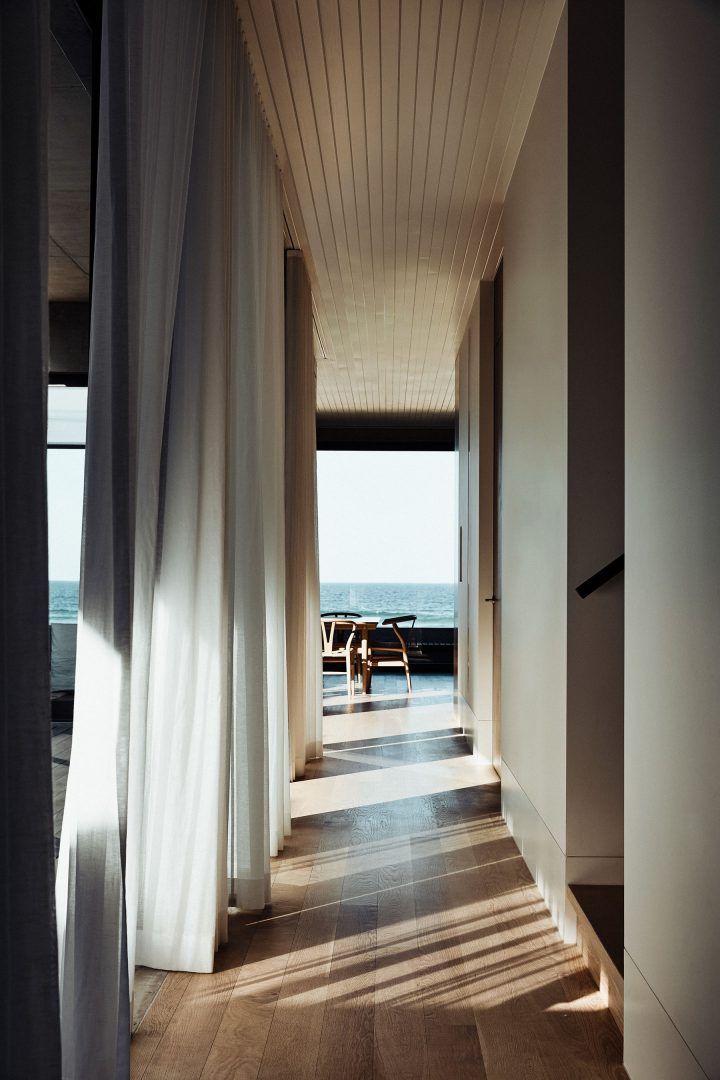
B.E Architects Design A Concrete And Wood Home On The Shores Of Australia’s Mermaid Beach

Melbourne-based firm B.E Architects has designed a two storey home with geometric forms, comprised of two stacked volumes made from exposed concrete and wood. The beachfront property is positioned on the sands of the affluent Mermaid Beach on the Gold Coast in Queensland, offering its owners the prime opportunity to live the surfer lifestyle in full.
The post B.E Architects Design A Concrete And Wood Home On The Shores Of Australia’s Mermaid Beach appeared first on IGNANT.
Cloud Appreciation Society

Justin Needham

Rob Hawkes

Michael Warren

Cecelia Cooke

Jack Maziarz

Francoise Chicot

Hans Stocker

Michele Sabatier

Suzanne Winckler

Patrick Lecoq
Aerial Embroidery Showcases the Hidden Patterns of Cultivated Farmland

Humble fields become abstracted artworks in thread paintings by Victoria Rose Richards. The artist uses a combination of tight, straight lines and lush French knots to emulate the rural patterning of closely-cropped fields divided by hedges and woods. Richards, who is 21 years old and based in South West Devon, U.K., draws inspiration from the natural beauty that surrounds her. “My art is influenced by my love of the environment and conservation, which I developed during my biology degree I completed this year,” Richards tells Colossal.
A lifelong artist who also manages chronic pain and Asperger’s syndrome, Richards landed on embroidery during college as a way to lift her spirits and engage her mind between classes and studying. “I pulled some nice blues and greens out of my grandmother’s old embroidery tin and had my first go at an embroidery landscape in October 2018,” Richards explains.
The artist is constantly learning new techniques to broaden her range of textures and patterns, finding community and inspiration through the global network of embroiderers who are connected through social media. You can follow along with Victoria Rose Richards’s thread paintings on Instagram.


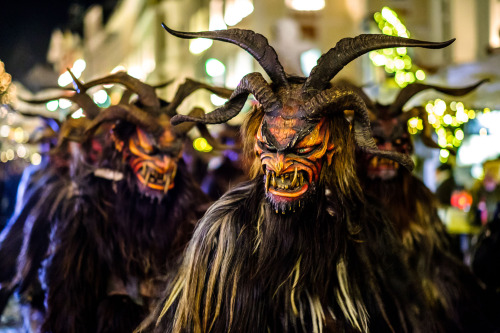
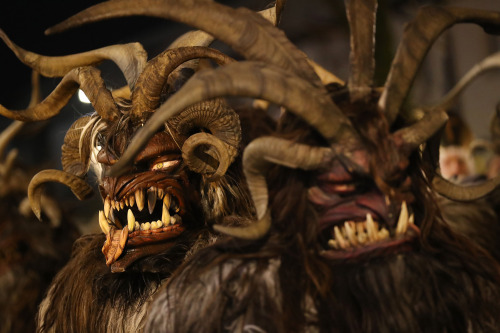
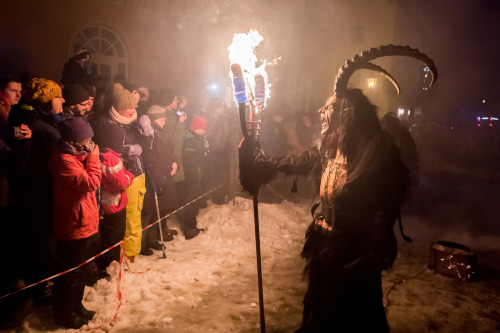
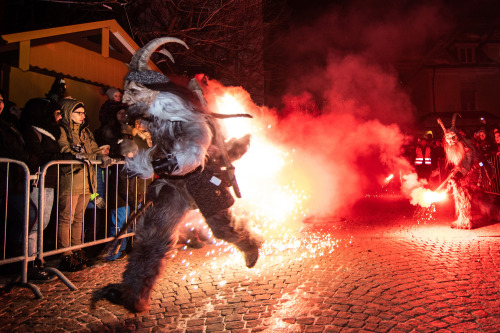
Krampusnacht

Lisi Niesner / Reuters

Angelika Warmuth / Reuters

FooTToo / Shutterstock

Jure Makovec / AFP / Getty

Sean Gallup / Getty

Falk Heller / Getty

Lisi Niesner / Reuters

Simone Padovani / Awakening / Getty
Stephanie Lüscher turns the food of The Netherlands into the mountains of Switzerland
KurshakaThis is a post about a person stacking food. Can't wait for 2020.
New Book Collects ROA’s Black-and-White Creatures in Photographs from Around the World

All photographs © ROA, shared with permission. Atlanta, Georgia, United States
Those unable to experience the black-and-white murals of Belgian artist ROA (previously) in person can admire photographs of his works in the recently published Codex. Released by Lannoo Publishers, the 352-page book contains four chapters centered on Eurasia, Africa, America, and Oceania, regions where ROA’s depictions of local animals blanket building walls. The photographs portray a snake wound around itself, six different species perched on vertical ledges, and an alligator on its back with its tail scaling a fire escape.
ROA works directly on the building, foregoing sketches and projections, and uses the architecture to inform the ways he paints birds, rodents, and other native creatures. Captivated by anatomy, the artist attempts to animate his paintings, giving energy and life to species often disregarded by humans. “Exploration of nature, more specifically of the animal world, can lead to increased empathy,” he says. “It teaches you something substantial about how one should live a good life.” The monochromatic murals’ scale often makes animals larger than their real-life bodies, securing and emboldening their monumental presence.
Codex, which is available now, also incorporates writing from RJ Rushmore, Lucy R. Lippard, Johan Braeckman, Gwenny Cooman, Robert R. Williams, and Kathy De Nève.

Johannesburg, South Africa

Puerto Rico

Vardø, Norway

São Paulo, Brazil

Perth, Australia

Las Vegas, Nevada, United States

8th Annual Light Festival Illuminates Amsterdam with Glowing Sculptural Installations
“Butterfly Effect” by Masamichi Shimada. All photographs, unless noted, © Janus van den Eijnden
This year’s Amsterdam Light Festival, running November 28, 2019, to January 19, 2020, lights up the European city with illuminated art installations. The festival, now in its eighth year, attracts tourists and engages locals at a time when the city is cloaked in darkness for about sixteen hours each day. Visitors to the Light Festival use a phone app to guide themselves through Amsterdam’s city center, perusing twenty light works by artists from around the world. This year’s show theme was “DISRUPT!” and artists reflected the concept in pieces that ruminate on climate change, national history, technology, and more. See some of our favorites here, by Masamichi Shimada, UxU Studio, Sergey Kim and others. You can explore the full line-up and programming on the Amsterdam Light Festival website.

“Butterfly Effect” by Masamichi Shimada

“Neighborhood” by Sergey Kim

“Neighborhood” by Sergey Kim. Photograph courtesy of the artist

“Nacht Tekening” by Krijn de Koning

“Big Bang” by UxU Studio

“Big Bang” by UxU Studio

“Order Disorder” by Lambert Kamps

“Order Disorder” by Lambert Kamps

“Atlantis” by Utskottet

“Surface Tension” by Tom Biddulph and Barbara Ryan

“Surface Tension” by Tom Biddulph and Barbara Ryan
Surreal Brushstroke Painting Imagines a Future Where Nature Takes Back Control
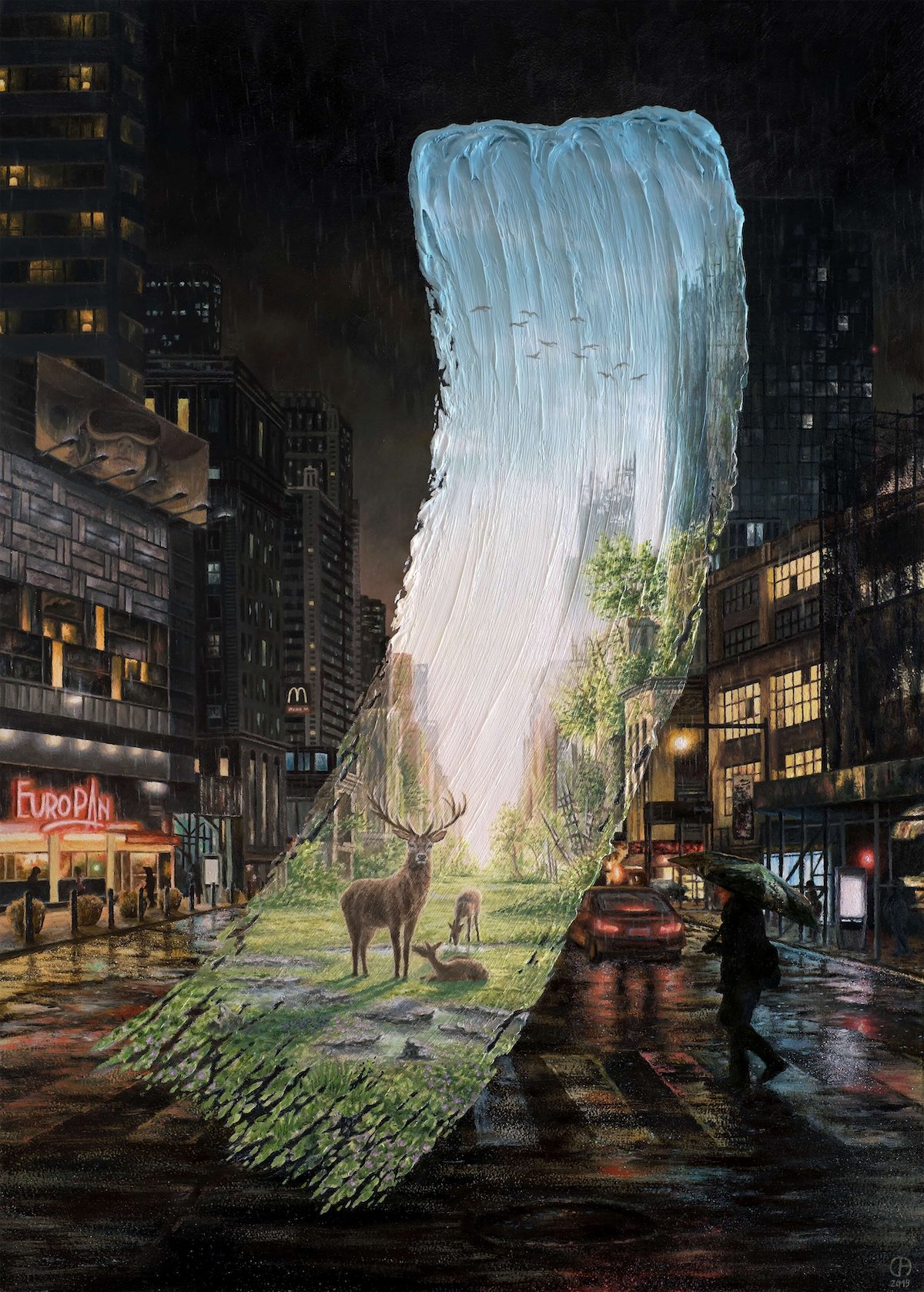
Artist David Ambarzumjan ruminates on our world through his ongoing collection of surreal paintings called Brushstrokes in Time. The beguiling works of art feature past and present landscapes that are interrupted by tactile strokes of paint, which themselves have their own scenes within them. The strokes sometimes match the era they juxtapose while other times they represent many years in either direction. Before Ambarzumjan’s latest piece titled Recover, the streaks wove the past and present within the same frame. They never considered the future—until now.
Ambarzumjan began Recover in the spring of 2019 just as we interviewed him about Brushstrokes in Time. The challenging endeavor took him many months, but it represents a new facet of the series. “I’m a big fan of post-apocalyptic stories,” he tells My Modern Met, “and I love to think about all the possible ways the world could look like if we suddenly perished away.”
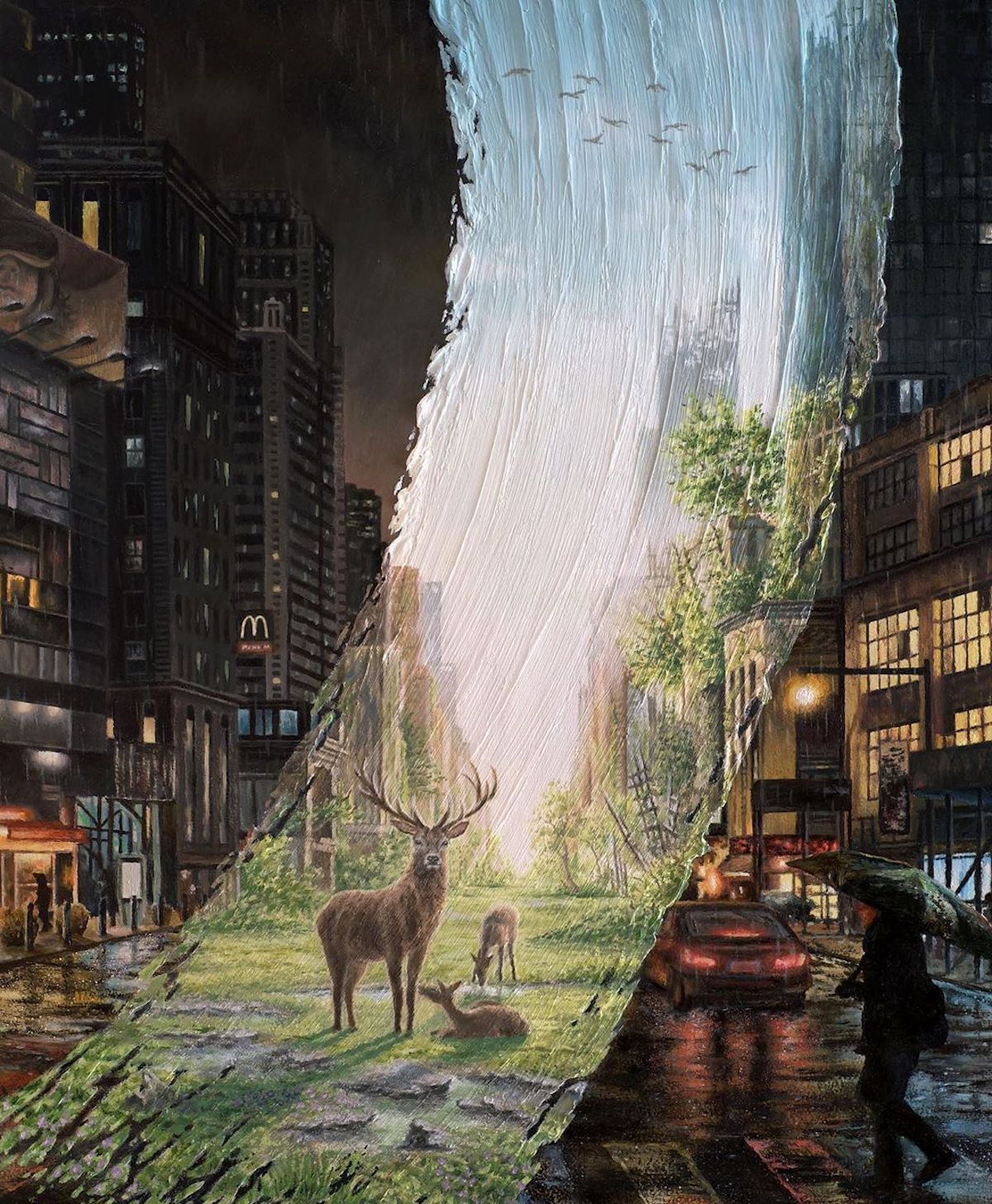
Recover features a cityscape at night. The concrete streets are illuminated by the glow of buildings, cars, and street lights just as a brushstroke cuts through the center of the composition and reveals a lighter point of view containing a pastoral field with a family of deer. “The brushstroke represents a kind of medication to the skin of the planet,” Ambarzumjan shares. “Inside, nature takes back control to a point where many people think that it shows the past rather than a possible future.”
While the piece was a conceptual challenge, it was a technical one, too. “The painting has a lot of contrasts between the brushstroke and the background, visually and thematically: city/nature, day/night, light/dark, noise/serenity and more,” Ambarzumjan explains. “With all the details and contrasts there was always the risk of the painting appearing overloaded, which is why I went back and forth with the composition a lot, but I’m very happy with how it turned out in the end.”
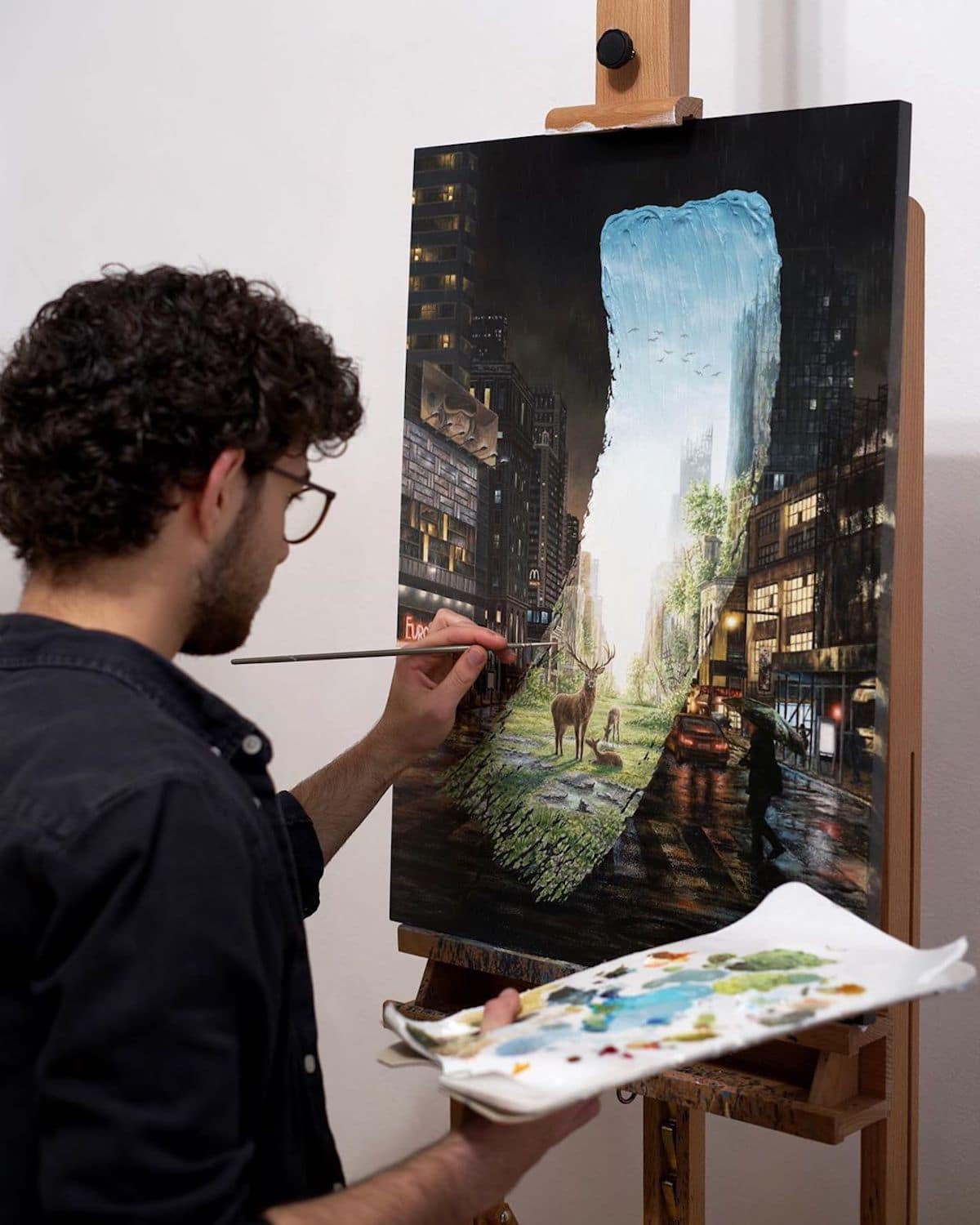
Artist David Ambarzumjan recently completed a surreal painting as part of his ongoing series called Brushstrokes in Time.
Called Recover, the piece imagines a future where nature has taken control again.
The brushstroke was painted after Ambarzumjan completed the cityscape.
David Ambarzumjan: Website | Instagram | Facebook
My Modern Met granted permission to use photos by David Ambarzumjan.
Related Articles:
Smoldering Urban Landscape Paintings Show Beauty in Decay
11 Easy Acrylic Painting Techniques for Artists of All Levels
Fascinating Paintings Reveal the Unique Studios of 5 Famous Artists
50+ Painting Ideas That Will Inspire You to Pick Up a Brush Right Now
Art History: The Evolution of Landscape Painting and How Contemporary Artists Keep It Alive
The post Surreal Brushstroke Painting Imagines a Future Where Nature Takes Back Control appeared first on My Modern Met.
Agency photog of 2019

Pilar Olivares

Felipe Dana

Felipe Dana

Rebecca Blackwell

Roman Pilipey

Delil Souleiman

Ueslei Marcelino

Pilar Olivares

Delil Souleiman
Paintings From Prado Museum Collection Given Climate Change Makeovers

Felipe IV a Caballo (1635-36), Diego Velázquez. Images courtesy of Museo del Prado / WWF
Museo del Prado (Prado Museum) recently collaborated on a project with the World Wildlife Fund (WWF) designed to coincide with the 2019 UN Climate Change Conference in Madrid. Paintings from the museum’s collection were digitally modified to reflect a future world destroyed by inaction. Rising sea levels, barren rivers, and refugee camps transform works by European painters into a campaign to save the environment.
The project is titled “+ 1,5ºC Lo Cambia Todo,” which translates from Spanish to mean “+ 1.5ºC Changes Everything.” Paintings by three Spanish artists (Francisco de Goya, Diego Velázquez, and Joaquín Sorolla) and one Flemish Renaissance painter (Joachim Patinir) were chosen for the project by WWF and museum experts. The altered works were installed on billboards in Madrid and shared online using the hashtag #LoCambiaTodo as a way to expand and continue political and social conversations through art.
“For the Museum, this project represents an opportunity to continue placing art and its values at the service of society,” Javier Solana, Prado’s Royal Board of Trustees President, said in a statement. “The symbolic value of the masterpieces and the impressive artistic recreation that we present with WWF is an excellent way to transmit to everyone and especially to the young generations what is really at stake in this fight against climate change.” [via Artnet]

Landscape with Charon Crossing the Styx (c. 1515-1524), Joachim Patinir


Boys on the Beach (1909), Joaquín Sorolla


The Parasol (1777), Francisco de Goya

Returning to Roots: A New Book Highlights How Indigenous Practices Can Create More Sustainable Technology

A young fisherman walks under a living root bridge at Mawlynnong village, India. In the relentless damp of Meghalaya’s jungles the Khasi people have used the trainable roots of rubber trees to grow Jingkieng Dieng Jri living root bridges over rivers for centuries. Copyright: © Amos Chapple
Self-described designer, activist, academic, and author Julia Watson is trying to quash the boundary between native practices and technology in a new book that explores the ways indigenous wisdom can combat the high-tech approach to design and fighting climate change. In Lo—TEK Design by Radical Indigenism, Watson shares knowledge that transcends generations and cultures in an attempt to debunk the myth that indigenous approaches are primitive and far removed from current conceptions of technology. Throughout its more than 400 pages, the book explores ideas from 20 countries, including Peru, the Philippines, Tanzania, Kenya, Iran, Iraq, India, and Indonesia, about how to tackle more sustainable technology and design. It also contains a forward from anthropologist Wade Davis.
Watson founded Julia Watson Studio, an urban design studio, in addition to co-founding “A Future Studio,” described as a collective of conscious designers. She also teaches urban design at Harvard and Columbia University. Lo—TEK is scheduled to be released this month by Taschen. If you liked this, check out the recently published Primitive Technology: A Survivalist’s Guide to Building Tools, Shelters, and More in the Wild.


A view over the sacred Mahagiri rice terraces, a small portion of the one thousand year old agrarian system known as the subak, which is unique to the island of Bali, Indonesia. Copyright: © David Lazar

In the Southern Wetlands of Iraq, an entire Ma’dan house known as a mudhif, which is built entirely of qasab reed without using mortar or nails, can be taken down and re-erected in a day. Copyright: © Jassim Alasadi

Built by the Tofinu, the city of Ganvie meaning ‘we survived’ floats on Lake Nokoué surrounded by a radiating reef system of twelve thousand acadja fish pens. Copyright: © Iwan Baan