A recent United Nations committee report says the United States fails to pursue and prosecute clergy guilty of child sex abuse.
Shared posts
21 Feb 20:18
U.N. faults U.S. for failure to prosecute abusive clerics
by Pam Cohen
Caleb Bell
Religion News Service
Washington
21 Feb 20:17
A Smart Girl’s Manifesto – Let’s Get Thinking
by Ashley Perez
Alright ladies, it’s time for some big changes. Time for women to take our place in the world amongst the best and the brightest, because frankly, I’m tired of receiving magazine after magazine adorned with the faces of men, proclaiming them the new “30 Under 30″, “World’s Top Entrepreneurs” or “The Next President of the United States”. Don’t get me wrong, I don’t hate men. I repeat: I do not hate men. One day when I’m a mother, I will be just as proud of my son’s accomplishments as my daughter’s. However, God help the person who tells me I should be proud of my (yet-to-be-conceived) daughter for accomplishing something simply because she is a woman.
This is half the problem, every time a woman does something, half of us throw a parade in her honor because she was the first woman to accomplish such a feat, while the other half criticizes her to bits because she has not accurately portrayed the life and struggles of every woman who has ever existed (e.g. the virtual stoning of Lena Dunham for seemingly anything and everything she does). Neither of these antiquated attitudes will propel us into the future.
Though the first is perhaps more tolerable, in a way it still holds women back. In labeling accomplished women separately from their male counterparts (e.g. the first female astronaut), we often imply that it is shocking a woman has accomplished such a thing. And while I understand the need to recognize pioneering women for chipping away at the elusive glass ceiling, at a certain point this system of counting and labeling women becomes detrimental. “Hillary Clinton is the 3rd female Secretary of State”. That’s great, but why are we still surprised at a woman being Secretary of State? If she’s the best person for the job, then why the hell shouldn’t she be?
Secondly and perhaps more detrimental to the cause of feminism, is the age old struggle of pitting women against one another. Most recently in the news, Jessica Chastain set the record straight concerning rumors that she “hates” Jennifer Lawrence, and went a step further by saying that pitting women against each other is detrimental and degrading to womankind as a whole:
“Please don’t allow the media to perpetuate the myth that women aren’t supportive of each other. Every time an actress is celebrated for her great work, I cheer. For the more brilliant their performance, the more the audience demands stories about women. With support and encouragement, we help to inspire this industry to create opportunities for women. And as we all know: a great year for women in film, is just a great year for film.”
After all, why is it that when George Clooney, Brad Pitt and Matt Damon get together for a film the stories to emerge from the media are of their blossoming bromance, whilst apparently women working together couldn’t possibly get along as they’re too busy clawing each other’s eyes out over “who wore it best”.
This is what I mean. It’s time for a change, and the good news and bad news is the call for change rests upon each of our shoulders. That’s right, you are the one who is going to change things. How? By changing yourself. Now listen carefully, I don’t want you to think for a second that by “changing yourself” I mean buying a new outfit, whitening your teeth or styling your hair differently. I’m talking about the deep stuff, real change. I want you to change your mind, I want you to become the smartest, most fierce version of yourself (think Sasha Fierce, Beyoncé’s alter ego). I want you to walk around feeling fearless in the morning, not because you’ve perfected your eye make-up routine, but rather because you know you could go toe-to-toe with the best of them.

Currently I am reading a book called Think: Straight Talk for Women to Stay Smart in a Dumbed-Down World by Lisa Bloom (daughter of the famous attorney Gloria Alred) and honestly it’s rocking my world! Her basic thesis is this: us girls have to get our act together and become big thinkers before everything the women before us have strived for disappears under a barrage of gossip websites and fashion magazines. One of the most shocking statistics repeatedly quoted throughout the book is the fact that 25% of young American women would rather win America’s Next Top Model than a Nobel Peace Prize, A NOBEL PEACE PRIZE!
The post A Smart Girl’s Manifesto – Let’s Get Thinking appeared first on HelloGiggles.

21 Feb 09:53
Should People Stop Reclining Their Seats?
by Megan McArdle
Close seat pitches make it hard to enjoy your trip when the guy in front of you leans back.
21 Feb 09:39
Vatican City Memo: What Do You Call a Retired Pope? And Is He Still Infallible?
by By RACHEL DONADIO
Justine Marie SherryNo. No one wonders how he can be "infallible one day and fallible again the next" -- Papal infallibility isn't a magic power, it's something the leader of the church does, "ex cathedra", in consensus with the college of cardinals, and rarely at that. It's probably a very silly belief, I agree, but it's really not nearly as ridiculous as it's made out to be. Lots of religions have non-scriptural beliefs and ways to formalize which of those beliefs are, well, canon.
Pope Benedict XVI’s decision to resign has puzzled the faithful and scholars, who wonder how a pope can be infallible one day and fallible again the next.
21 Feb 04:15
It has been far too long since I have blogged. This recipe is not only totally blog worthy but I can’t help myself from sharing its awesomeness with the world. You’re welcome. :)
Beer for Breakfast!
by Mrs. Legendary
It has been far too long since I have blogged. This recipe is not only totally blog worthy but I can’t help myself from sharing its awesomeness with the world. You’re welcome. :)
Amazing Guinness Pancakes
3 cups flour (I used 1 cup whole wheat and 2 cups all-purpose but you could use any combination you feel like)
2 t baking powder
1 t salt
1/8 - 1/4 t nutmeg (A popular northern European spice. I suppose you could try cinnamon if you like.)
1 cup sugar
2 T molasses (I didn't have dark brown sugar on hand. If you have it just use a cup of that and don’t add the molasses)
1/4 cup canola oil (You could use melted butter but that takes effort)
1 t vanilla extract
2 eggs
~1 pint Guinness beer* (I don't know the exact amount. I just added it until the batter was a little thicker than cake batter since I prefer a thicker pancake.)
2 t baking powder
1 t salt
1/8 - 1/4 t nutmeg (A popular northern European spice. I suppose you could try cinnamon if you like.)
1 cup sugar
2 T molasses (I didn't have dark brown sugar on hand. If you have it just use a cup of that and don’t add the molasses)
1/4 cup canola oil (You could use melted butter but that takes effort)
1 t vanilla extract
2 eggs
~1 pint Guinness beer* (I don't know the exact amount. I just added it until the batter was a little thicker than cake batter since I prefer a thicker pancake.)
Directions: 1/4-1/3 cup batter on a hot pan and let it do its pancake-thing with only a flip of assistance from you. I’d finish my instructions with a classic “enjoy” but I know you are already doing that… ;)
*Any leftover Guinness can be either a) chef's perk--drink up me hearty!--or b) poured over a hunk of pork in a crock-pot (along with a dash or two of Worcestershire sauce, a clove of garlic, and a squirt of Dijon mustard) for some spectacular pulled pork.
Here is a link to a blog where I got the main parts of this recipe. He suggests serving them with Baileys Butter and Whiskey Syrup (you can find the recipes in the blog) for Irish Car Bomb Pancakes.
Love from the wet side,
Mrs. Mommystars
P.S. Watch this video. Because it is awesome.
20 Feb 22:33

Three Kinds of Metaphysical Nothing
by fucktheory
Three Kinds of Metaphysical Nothing
Elena Bulygina, Lindsay Oliver and -1 others like this
20 Feb 18:28
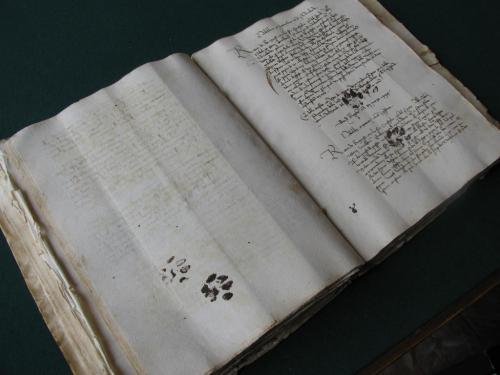
nimbuspub: Has your cat ever walked across your keyboard?...
Has your cat ever walked across your keyboard? Well, it’s not a new problem. Medieval book historian Erik Kwakkel recently Tweeted this photo of a 15th century book with… you guessed it… cat paw prints in ink on the pages! We’re part of a long and glorious historical movement, friends. (Source: Dr. Marty Becker)
Ah this is the best thing! Those medieval cats!
Cats gon’ be cats
!['Yeah, that squid's a total asshole.' [scoot scoot]](http://imgs.xkcd.com/comics/those_not_present.png "'Yeah, that squid's a total asshole.' [scoot scoot]")
20 Feb 18:13
Lady Armor- Exposed!

Finally somebody admits it. When you’re a warrior, showing skin gets you nowhere. Unless your goal was a swift, embarrassing death.
I was surprised it wasn’t on dA. I scoured the internet for the original source and only found more submissions to funny sites, so I’ll keep looking and let you know when I find it.
(FOUND: http://luckyfk.deviantart.com/art/Fantasy-Armor-355029113)
20 Feb 03:24
 Members of the Georgia Board of Pardons at Hill's July clemency hearing (David Goldman/AP)
 MORE ON WARREN LEE HILL
 In Georgia, Doctors Recant Testimony--but the Execution Will Go On
  Executing the Mentally Retarded: The Night the Lights Went Out in Georgia
  A Day in the Life of the Death Penalty: July 18, 2012

Warren Lee Hill, and His Cause, Live to Fight Another Day
by Andrew Cohen
Justine Marie SherryOr we could just change "Don't execute mentally retarded people" to "Don't execute people" and the whole problem would go away.
30 minutes before the moment of his lethal injection, two courts stay the execution of a mentally retarded prisoner so that they can evaluate his case.
Members of the Georgia Board of Pardons at Hill's July clemency hearing (David Goldman/AP) Condemned Georgia prisoner Warren Lee Hill came within 30 minutes of being executed Tuesday night -- came within 30 minutes of becoming a reluctant martyr to a constitutional principle the United States Supreme Court first announced in 2002 in a case styled Atkins v. Virginia: Thou shalt not execute the mentally retarded. He came that close -- already well into Georgia's death penalty protocol -- despite the fact that he is mentally retarded, and that every medical expert who has evaluated him since 1991 now says so.
You would think with the precedent established in Atkins, and with Hill's mental status now beyond any reasonable doubt, that the justices in Washington would have been eager to block the execution. But it wasn't the Supreme Court that came to Hill's rescue. The justices instead denied Hill's request for a stay. It is unclear tonight whether they did so because they have no interest in his cause, and thus no interest in defending Atkins; or because they were aware of two other stays issued around the same time.
MORE ON WARREN LEE HILL
In Georgia, Doctors Recant Testimony--but the Execution Will Go On Executing the Mentally Retarded: The Night the Lights Went Out in Georgia A Day in the Life of the Death Penalty: July 18, 2012 On Tuesday evening, it was the 11th U.S Circuit Court of Appeals, primarily based in Georgia, which blocked Hill's execution so its judges could look more closely at the startling new facts about Hill's mental status which emerged last week. And it was a state appellate court in Georgia which also blocked the execution Tuesday night because the judges there want to look a little more closely at Georgia's lethal injection protocols. This after another Georgia court, and the state's pardons board, had earlier in the day refused to help Hill.
So, for now anyway, Hill will be spared. There will be no execution tonight. And now the burden is on Georgia officials to convince the judges of those two other courts -- one federal, one state -- to permit Hill's execution to proceed. I can't speak to the lethal injection issue; it hasn't been on my radar. But it's hard to imagine that the 11th Circuit is going to be eager to dissolve its own stay given the recent dissolution of Georgia's argument for executing Hill in the first place: that he's not so mentally retarded that he shouldn't be executed.
Last week, Hill's attorneys informed Georgia, and thus the rest of the world, that the state's three medical experts, who in 2000 had refused to diagnose Hill as mentally retarded, had all changed their minds. Their work had been sloppy, they confessed, and they had relied upon each others' conclusions more than they should have. They didn't adequately understand the nature of mental retardation as it related to Hill, they stated, but now they do: he is mentally retarded, they now believe, and thus should be spared.
The startling recantation by the state's own expert witnesses leaves Georgia today with very little to defend before the 11th Circuit. Today, the day Warren Hill was almost executed, the state can point to no expert who is on the record in this case as saying that Hill is not mentally retarded. Let me put it another way: There is no expert evidence supporting the state's effort now. All of the expert evidence supports Hill. On the issue of his mental retardation, under Georgia's statute, the case today is about as one-sided as a capital case can be.
The 11th Circuit recognized this Tuesday night in its order staying the execution:
In other words, all of the experts -- both the State's and the petitioner's -- now appear to be in agreement that Hill is in fact mentally retarded. See, e.g., Affidavit of Dr. Thomas H. Sachy, at ¶ 6 ("I . . . concur with the conclusions (rendered previously in Mr. Hill's case) of Dr. Daniel Grant, Dr. Jethro Toomer, Dr. Donald Stonefeld, and Dr. William Dickinson that Mr. Hill meets the criteria for mild mental retardation and the bases for those conclusions which they articulated."); Affidavit of Dr. Donald W. Harris, at ¶ 22 ("I . . . concur in the findings of Drs. Grant, Toomer, Stonefeld, Dickinson and Sachy in this case.").
In light of these affidavits, we grant Hill a conditional STAY of execution and direct the parties to specifically address whether Hill can satisfy the stringent requirements found in 28 U.S.C. § 2244(b)(2) for leave to file a second or successive petition.
Specifically, the parties shall address the questions (1) whether Hill could have previously discovered the factual predicate for the claim through the exercise of "due diligence," 28 U.S.C. § 2244(b)(2)(B)(i); (2) whether he can show that the facts underlying his claim, "if proven and viewed in light of the evidence as a whole, would be sufficient to establish by clear and convincing evidence that, but for constitutional error, no reasonable factfinder would have found [Hill] guilty of the underlying offense," and (3) whether Hill's claim in this application for a successive petition "was presented in a prior application," 28 U.S.C. § 2244(b)(1). The second question includes the question of whether Hill's claim of mental retardation is cognizable as a claim of actual innocence under 28 U.S.C. § 2244(b)(2)(B)(ii).
There is a lot of legal lingo there, but you can probably tell two things from the text. First, it is by no means certain that Hill's life is going to be spared down the road given the procedural hurdles in place. Indeed, there was a very strong dissent on Tuesday from Judge Frank Hull, a Clinton appointee. Second, it's a very big deal that all of Georgia's experts now have recanted. The state courts in Georgia weren't willing to confront this new reality -- home-field advantage, you might say -- but clearly the federal judges understand it changes the factual dynamic of the case.
As it moves forward, and I hope it moves all the way to Washington, the case presents the justices with an opportunity to strengthen -- to save, really -- the letter and the spirit of Atkins. In that case, they tried to be all things to all people. It was a mistake, and they now should fix it. Even as they announced a national standard (executing those who cannot comprehend the nature of their punishment is "cruel and unusual"), the justices announced that states could weasel out of the new rule by identifying for themselves who is and who is not mentally retarded.
The result, predictably, was that some outlier states, where the politics of the death penalty still tolerate a zealous approach to executions, have done an awful lot of weaseling over the past decade. Last summer, to cite just one egregious example, Texas flouted the justices and Atkins when they executed Marvin Wilson, a man who had an IQ of 61. And then there is Warren Lee Hill, who was faced under Georgia law with the near-impossible task of proving beyond a reasonable doubt that he is, in fact, mentally retarded.
The Hill case, properly briefed, will allow the 11th Circuit and the justices in Washington to decide whether states like Georgia can be true to the mandate of Atkins while still requiring condemned prisoners to prove their mental retardation beyond a reasonable doubt. I doubt it. Atkins was never meant to make it easy for such prisoners to escape execution. But it was never meant to make it impossible, either. It's a good thing Hill is still with us, and that the questions presented by his case, especially the new questions, are going to be heard in full.
 |
 |
19 Feb 20:46
DDoS Attack on Bank Hid $900,000 Cyberheist
by BrianKrebs
A Christmas Eve cyberattack against the Web site of a regional California financial institution helped to distract bank officials from an online account takeover against one of its clients, netting thieves more than $900,000.
 At approximately midday on December 24, 2012, organized cyber crooks began moving money out of corporate accounts belonging to Ascent Builders, a construction firm based in Sacramento, Calif. In short order, the company’s financial institution – San Francisco-based Bank of the West — came under a large distributed denial of service (DDoS) attack, a digital assault which disables a targeted site using a flood of junk traffic from compromised PCs.
KrebsOnSecurity contacted Ascent Builders on the morning of Dec. 26 to inform them of the theft, after interviewing one of the money mules used in the scam. Money mules are individuals who are willingly or unwittingly recruited to help the fraudsters launder stolen money and transfer the funds abroad. The mule in this case had been hired through a work-at-home job offer after posting her resume to a job search site, and said she suspected that she’d been conned into helping fraudsters.
Ascent was unaware of the robbery at the time, but its bank would soon verify that a series of unauthorized transactions had been initiated on the 24th and then again on the 26th. The money mule I spoke with was just one of 62 such individuals in the United States recruited to haul the loot stolen from Ascent. Most of the mules in this case were sent transfers of between $4,000 and $9,000, but several of them had bank accounts tied to businesses, to which the crooks wired huge transfers from Ascent’s account; five of the fraudulent transfers were for amounts ranging from $80,000 to $100,000.
Mark Shope, president of Ascent Builders, said that when the company’s controller originally went online on the morning of Dec. 24 to check the firm’s accounts, her browser wouldn’t let her access the bank’s page. She didn’t know it at the time, but her computer was being remotely controlled by the attackers’ malware, which blocked her from visiting the bank’s site.
“It said the bank was offline for 24 hours, and we couldn’t get in to the site,” Shope said. “We called the bank and they said everything was fine.”
But soon enough, everything would not be fine from Bank of the West’s end. Not long after putting through a batch of fraudulent automated clearing house (ACH) and wire transfers from Ascent’s accounts, the fraudsters initiated a DDoS attack against the bank’s Web site, effectively knocking it offline. It’s not clear what tactics or botnets may have been used in the DDoS attack, but the cyberheist+DDoS approach matches the profile of cybercrime gangs using the Gameover Trojan – a ZeuS Trojan variant that has been tied to numerous DDoS attacks initiated to distract attention from high-dollar cyberheists.
Shope said the FBI is actively investigating the breach. The FBI declined to comment for this story. Bank of the West also did not respond requests for comment.
But a law enforcement source working the case and speaking on condition of anonymity confirmed that the bank was subjected to a DDoS attack at the time of the robbery. The law enforcement official added that Ascent may not have been the only victim that day at Bank of the West, and that several other businesses and banks in the local area had been similarly robbed on or around Christmas Eve.
Shope said Bank of the West has been able to claw back about half of the stolen funds, and expects to recover a great deal more. He said many of the bigger fraudulent transfers went to other businesses. For example, one of the mules was either running or working at a Hertz equipment rental franchise on the East Coast, and had called Ascent Builders to complain after the bank discovered the fraud and began clawing back large transfers. That mule, apparently unaware he was helping thieves launder stolen money, was calling to find out what happened to his $82,000.
“We got a call from a Hertz rental equipment company back east, and they said “Why did you take this deposit out of our account?’ Shope recalled. “I asked him what he thought it was for, and he said, “Oh, this was for some equipment that we were purchasing for you guys from Russia, and we already sent the money on [to Russia], so what’s going on?”‘
A few thoughts about this attack. If you run a business and suddenly find yourself unable to log in to your commercial account, pick up the phone and call your bank to inquire about any recent money transfer activity. Very often, malware that thieves use to steal banking passwords in these cyberheists will also redirect the victim to an error page that says the bank’s site is down for maintenance. If this happens to you, call your bank and ask them to check your accounts (don’t trust a customer service phone number offered on a “down for maintenance” page; call the number on your bank card or search online for the institution’s customer service number).
Also, get educated about the risks of banking online with a business account, and then take steps to make sure your organization isn’t the next victim. Regulation E limits the liability for consumers who lose money due to unauthorized account activity online (provided they notify their financial institution of the fraudulent activity within 60 days of a statement). Businesses do not enjoy such protections, although a couple of recent court cases brought by cyberheist victims against their banks have gone in favor of the businesses, suggesting that banks may find it increasingly difficult to disavow financial liability in the wake of these attacks going forward.
Finally, consider banking online with a dedicated system. This among several recommendations I include in a short list of other tips that small businesses should consider when banking online.
Related Posts:
19 Feb 20:21

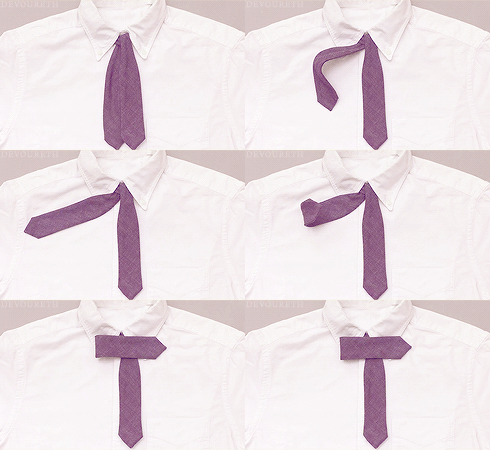
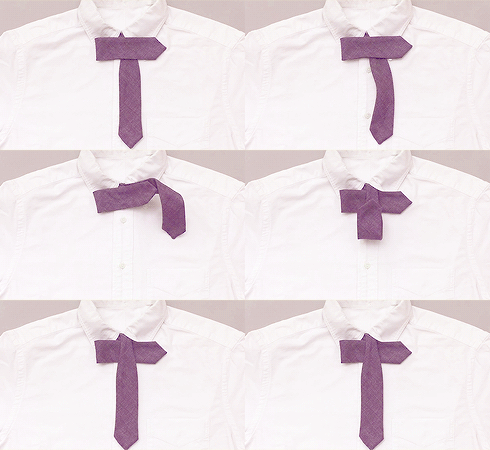
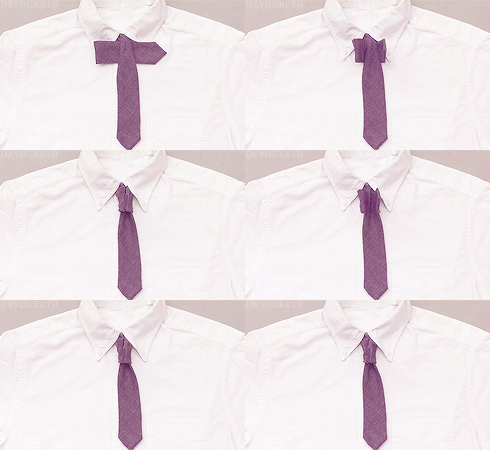
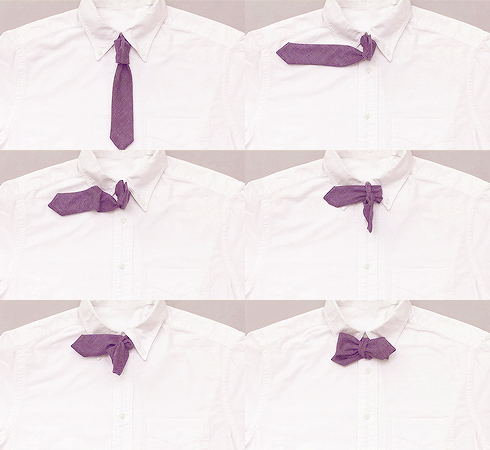

Suit And Tie...
by joberholtzer
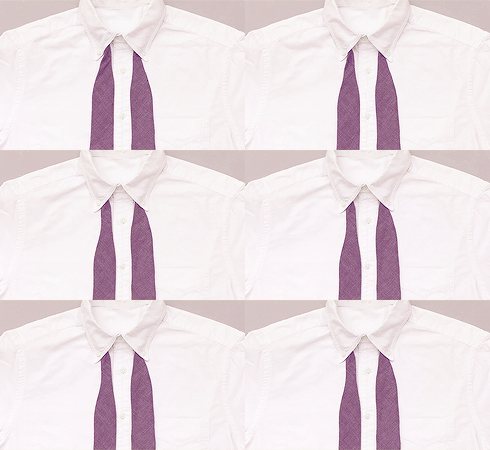
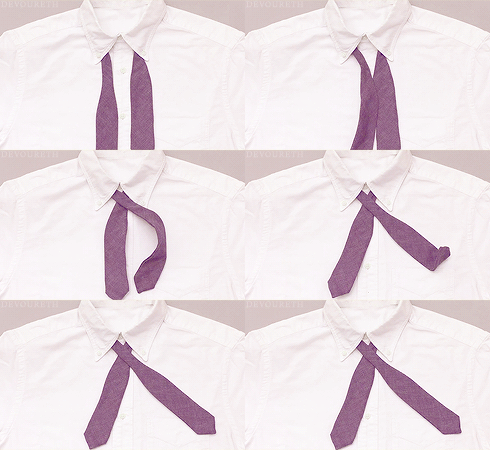
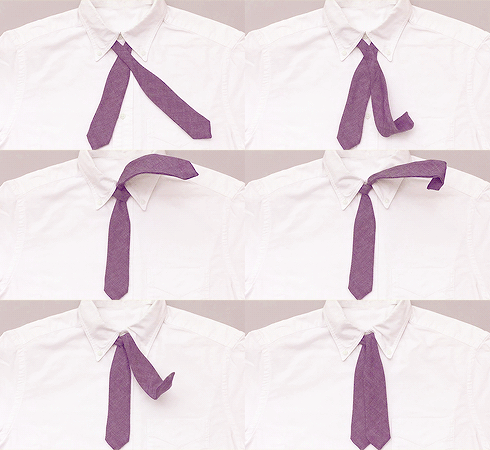
Suit And Tie Shit
via xwidep:my1950swedding:raggedybearcat:devoureth
Gentlemen and women, take note. [x]
Justine Marie Sherry likes this
19 Feb 19:10
Tagged: authority, graduate school

Stop talking like a girl
by Julia

After reading this excellent post on The Professor is In, I thought to myself that I wished someone had told me earlier in my graduate career to stop commenting in class like a girl. When “girls” ask a question in class, they preface their inquiry with a qualification like, “This may be a basic question but…” or “I’m not really sure, but it seems to me…” or “Maybe everyone one else got this, but…”
Girls sabotage themselves in group settings because if they say something that doesn’t sound perfectly correct or brilliant, they can make it clear to others that they never had delusions of their own intelligence in the first place. It is effectively saying to the world, “You can’t say that I’m not great because I’ve never claimed to be great.” Or, if you want to be a little more charitable, perhaps you could argue that girls are trying to communicate to others that their ideas are provisional and open to collaboration and critique from others (as well as their own later revisions).
After a few years of graduate school, however, it becomes clear that everyone says incorrect things from time to time and all ideas are provisional. When you frame all your comments in a hesitating fashion, most of your really great thoughts will be overlooked. When you frame your comments in a confident fashion, there is a greater chance your thoughts will be taken seriously. And, of course, only thoughts deemed serious are respectfully debated and thoughtfully critiqued.
So when you have the impulse to qualify your comments with a self-sabotaging clause, try instead to say something like, “As a point of clarification…” or “I’m not convinced that ___. Can you say more?” Though it would be too much to claim that women merely need to change their speech patterns and they will begin to be treated equally in the classroom, it is true that women aren’t helping to advance the (uphill) battle for equality by speaking like children. Speak like a grown woman who claims her own authority.
Tagged: authority, graduate school
Justine Marie Sherry likes this
18 Feb 21:21

Whew! My husband and I are mostly moved into our new house...mostly. Well, at least we've unpacked essentials like pillows, blankets, the computer, the cat, and the Kitchenaid. I'm getting used to the new kitchen, which has a gas oven instead of an electric one (weird). So far, I've managed to tackle a couple small baking projects, and I'm finally ready to post about a scrumptious raspberry cheesecake, which I originally made for Mr. Buttercream for Valentine's Day.
My husband has been pestering me about making a cheesecake for a while now. Although I've made cheesecake cupcakes a couple times, I'd never tried a cheesecake cake before. This is for two reasons: one, I had this idea in my head that cheesecake was super hard to make. Two, I don't really like cheesecake - it's a little rich for me, and so a small mini-cupcake-sized bite is about all I can handle.
Mr. Buttercream, however, can't get enough of cheesecake. When I've made cheesecake cupcakes in the past, he's eaten way too many of them and made himself sick. I thought that this would make an excellent Valentine's Day treat for him (provided I enforce some rationing).

Most cheesecake recipes call for graham crackers or oreo cookies for the crust. I didn't have either of those things, and didn't really feel like a special trip to the grocery store to get them, so I made some chocolate wafer cookies for the crust instead. In the spirit of Valentine's Day, I cut the cookies into heart shapes and served the extras on the side of the cheesecake.

Well, my husband definitely liked this cheesecake, although he would have preferred a stronger raspberry flavor. The cheesecake was creamy and rich, and the homemade chocolate crust was particularly tasty. I'm sure there will be more pestering for me to make this again soon.
Happy (late) Valentine's Day, everyone!
Raspberry Cheesecake (A Late Valentine's Day)
by Laura

Whew! My husband and I are mostly moved into our new house...mostly. Well, at least we've unpacked essentials like pillows, blankets, the computer, the cat, and the Kitchenaid. I'm getting used to the new kitchen, which has a gas oven instead of an electric one (weird). So far, I've managed to tackle a couple small baking projects, and I'm finally ready to post about a scrumptious raspberry cheesecake, which I originally made for Mr. Buttercream for Valentine's Day.
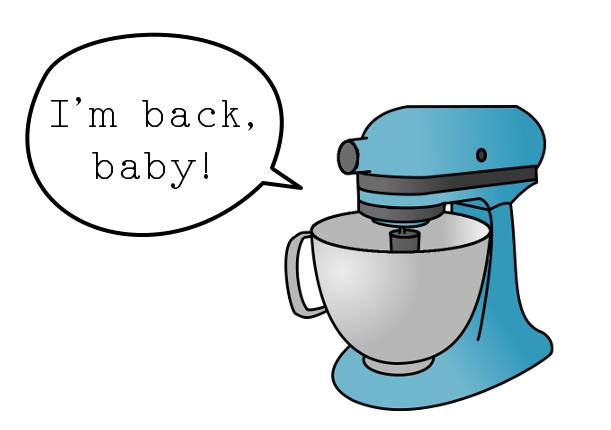 |
| I unpacked the Kitchenaid before plates or silverware. |
My husband has been pestering me about making a cheesecake for a while now. Although I've made cheesecake cupcakes a couple times, I'd never tried a cheesecake cake before. This is for two reasons: one, I had this idea in my head that cheesecake was super hard to make. Two, I don't really like cheesecake - it's a little rich for me, and so a small mini-cupcake-sized bite is about all I can handle.
Mr. Buttercream, however, can't get enough of cheesecake. When I've made cheesecake cupcakes in the past, he's eaten way too many of them and made himself sick. I thought that this would make an excellent Valentine's Day treat for him (provided I enforce some rationing).

Most cheesecake recipes call for graham crackers or oreo cookies for the crust. I didn't have either of those things, and didn't really feel like a special trip to the grocery store to get them, so I made some chocolate wafer cookies for the crust instead. In the spirit of Valentine's Day, I cut the cookies into heart shapes and served the extras on the side of the cheesecake.

Well, my husband definitely liked this cheesecake, although he would have preferred a stronger raspberry flavor. The cheesecake was creamy and rich, and the homemade chocolate crust was particularly tasty. I'm sure there will be more pestering for me to make this again soon.
Happy (late) Valentine's Day, everyone!
Raspberry Cheesecake (With a Chocolate Cookie Crust)
Makes a 6" round cheesecake. Cookies for the crust adapted from Food.com. This recipe makes about 2x the cookies you need for the crust - I served the rest as a side to the cheesecake. Note that the cookies in the crust can be substituted with graham crackers or oreo cookies to save time.
Ingredients for the Crust Cookies
2 ounces chocolate
1 cup + 2 tablespoons all-purpose flour
¾ teaspoon baking powder
¼ teaspoon baking soda
2 ounces (½ stick) unsalted butter, softened
½ cup sugar
1 teaspoon vanilla extract
1½ teaspoons milk
1 egg
2 tablespoons sugar
1 teaspoon cinnamon
Ingredients for the Cheesecake
2 ounces (½ stick) unsalted butter, melted
3 ounces raspberries (frozen or fresh)
16 ounces cream cheese, at room temperature
¾ cup sugar
2 tablespoons flour
pinch salt
1 teaspoon vanilla extract or vanilla paste
2 eggs
Method
Makes a 6" round cheesecake. Cookies for the crust adapted from Food.com. This recipe makes about 2x the cookies you need for the crust - I served the rest as a side to the cheesecake. Note that the cookies in the crust can be substituted with graham crackers or oreo cookies to save time.
Ingredients for the Crust Cookies
2 ounces chocolate
1 cup + 2 tablespoons all-purpose flour
¾ teaspoon baking powder
¼ teaspoon baking soda
2 ounces (½ stick) unsalted butter, softened
½ cup sugar
1 teaspoon vanilla extract
1½ teaspoons milk
1 egg
2 tablespoons sugar
1 teaspoon cinnamon
Ingredients for the Cheesecake
2 ounces (½ stick) unsalted butter, melted
3 ounces raspberries (frozen or fresh)
16 ounces cream cheese, at room temperature
¾ cup sugar
2 tablespoons flour
pinch salt
1 teaspoon vanilla extract or vanilla paste
2 eggs
Method
- To make the cookies, preheat your oven to 400° F. Line two baking sheets with parchment paper.
- Melt the chocolate, either in the microwave or over a double-broiler. Set aside to cool a little.
- Sift together the flour, baking powder, and baking soda in a small bowl. Set aside.
- In a medium bowl, cream the softened butter. Add the sugar and vanilla extract and beat until combined.
- Add the chocolate, milk, and egg, and beat further until combined.
- Add the dry ingredients in three batches, scraping the sides of the bowl and fully incorporating each time.
- Wrap the dough in plastic wrap and refrigerate for 30 minutes. Mix together the 2 tablespoons sugar and the cinnamon and set aside.
- Roll out the dough on a floured board until it's a little less than a ¼-inch thick. Cut the dough into any shape you like using a cookie cutter or just a knife - the cookies should be about 2-3 inches in diameter.
- Place the cookies on the baking sheet, prick with a fork in a couple places, and sprinkle with the cinnamon/sugar mixture. Bake for 8-10 minutes. Remove and transfer to a wire rack.
- To make the cheesecake, lower your oven to 325° F. Grease the bottom and sides of a 6" springform pan. If your pan doesn't completely seal, wrap the outside of the bottom and sides with aluminum foil to keep water out. Test the water-tightness of your pan by pouring water into a larger pan and placing your springform pan into it.
- Transfer 4 ounces of the chocolate cookies to a large ziploc bag. Crush them into small crumbs using a rolling pin (or your fists).
- In a small bowl, combine the crumbs with the melted butter. Press the crust mixture into the bottom and up the sides of the springform pan.
- Bake the crust in the oven for about 7 or 8 minutes so that it's set. Remove and allow to cool.
- Press the raspberries through a strainer to remove any seeds. Set aside.
- In a medium bowl, using a paddle attachment, beat the cream cheese on medium-high until light and fluffy - about 3 minutes.
- Slowly add the sugar and beat for a minute more on medium-high.
- Sift the flour into the mixture (sifting avoids clumps of flour), and add the salt and vanilla extract. Beat until well combined.
- Turn the speed down to very low. Add the eggs, one at a time. Beat until just incorporated - you don't want to get too much air in those eggs or your cheesecake might collapse.
- Transfer the cheesecake mixture to the springform pan. Use a spoon to drop dollops of raspberry on the top of the cake. Swirl with a toothpick to create any design you want.
- Put the springform pan in a larger baking dish or pan (a 12" round pan worked for me - but any bigger pan should do it).
- Transfer both pans into the oven. Pour boiling water into the larger pan, until it reaches a little more than halfway up the side of the smaller pan.
- Bake for about 40-50 minutes, or until the cheesecake looks like it's mostly set (although the middle might still wiggle a little).
- Allow to cool to room temperature, and transfer to the refrigerator. Refrigerate for a good 2 hours (or overnight) before removing from the pan and eating.
18 Feb 07:40
Onna-Bugeisha

“An onna-bugeisha (女武芸者?) was a female warrior. Members of the samurai class in feudal Japan, they were trained in the use of weapons to protect their household, family, and honor in times of war.”
- Wikipedia
Source: http://www.retronaut.com/2013/02/female-samurai/
* While female samurai existed, from what I was able to track down about this photo it actually came from a set of photos taken of a Kubiki Theater troop at the time.
firehose, Justine Marie Sherry likes this
15 Feb 20:02
![[optional image description]](http://cdn.theatlantic.com/static/mt/assets/science/ensisheim615.jpg) Colored woodcut via www.meteoritecollector.org
Colored woodcut via www.meteoritecollector.org ![[optional image description]](http://cdn.theatlantic.com/static/mt/assets/science/ensisheim_pamphlet615.gif) Latin-German pamphlet spreading the news of the "Ensisheim thunderstone," 1492 (University of Freiburg via Wikimedia Commons)
Latin-German pamphlet spreading the news of the "Ensisheim thunderstone," 1492 (University of Freiburg via Wikimedia Commons) ![[optional image description]](http://cdn.theatlantic.com/static/mt/assets/science/ensisheimmuseum615.jpg) What remains of the Ensisheim meteorite today (Wikimedia Commons)
What remains of the Ensisheim meteorite today (Wikimedia Commons) 

Thunderstone: What People Thought About Meteorites Before Modern Astronomy
by Megan Garber
Imagine a rock falling from the sky ... and not knowing that it's a meteorite.
Colored woodcut via www.meteoritecollector.org On November 7, 1492, people around the Alsatian city of Ensisheim heard an explosion, accompanied by crashes of thunder. The air lit up with fire. A smoky flash streaked, screaming, through the sky, hurtling toward Earth at a sharp angle. The source of the chaos -- a celestial stone -- finally slammed into a wheat field on the outskirts of the town.
The only direct eyewitness to this unusual event, it seems, was a young boy. He proceeded to lead the stunned residents of Ensisheim to the charred-but-shiny rock, an object whose impact had carved a hole in the ground that was more than three feet deep.
The people assumed it had been sent from God. They also assumed it might be an omen. The Austrian emperor Maximilian I, who happened to be in Ensisheim at the time -- adding, no doubt, to the superstitions -- ordered residents to expose the rock at the local church. Chaining the object on holy ground, it was thought, would mitigate any evil it might bestow on the town.
We were not so confused by the meteorite that hit Russia this morning. We knew what it was -- for the most part -- and knew what it meant (also for the most part). We recorded its impact through our Digital Age version of word-of-mouth: smartphones and blog posts and tweets and videos and gifs. And yet the chaos in Russia this morning -- the chaos that comes from a flaming space-stone, falling from the sky -- was perfectly presaged by the chaos experienced in Ensisheim.
Latin-German pamphlet spreading the news of the "Ensisheim thunderstone," 1492 (University of Freiburg via Wikimedia Commons) In his History of Siena, the Italian priest Sigismondo Tizio pieced together accounts of the meteorite from Ensisheim residents, accounts sent through both pamphlets and word-of-mouth. This is how he described the scene [pdf] that played out in the meteorite's wake -- a scene that was strikingly different from, and yet strikingly similar to, the one that played out in the Ural Mountains this morning:
At this point there has to be mention of the immense portent which was seen this year in Germany: for on the seventh day of November [1492], near the city of Ensisheim and the village of Bauenheim above Basel, a great stone fell out of the sky, triangular in shape, charred, the color of metallic ore, and accompanied by crashing thunder and lightning. When it had fallen to earth it split into several pieces, for it had traveled at an oblique angle; to the amazement of all, indeed, it flattened the earth when it struck.
Other contemporary accounts of the meteorite -- a small one, fortunately for the people of Ensisheim -- would describe the thing, rather appropriately, as a "thunderstone." They would also describe the "gruesome thunderbolt and long lasting roar" of the object as it hurtled through the sky, marveling at the crater it produced in the earth -- one "half a man length" deep. The Swiss humanist Johann Bergmann von Olpe would claim that the sound of the meteorite's screaming path could be heard as far away as Switzerland.
And in retrospect, the stone would seem to be sent from the heavens not merely as a kind of cosmic gift, but also as an omen of a changing world. Following the arrival of the thunderstone, Tizio would notice [pdf], Columbus would arrive in the Americas. Italy would be invaded by France. Europe would be struck by an outbreak of syphilis. Tizio reported the Ensisheim event, the scholar Ingrid Rowland notes, "knowing already than invasion, war, and disease followed its arrival."
So the people of Ensisheim did what most of us would do in the presence of a spectacular object: They tried to take some of it for themselves. They began to chip off pieces of the stone -- celestial souvenirs -- until the local magistrate stopped them. Officials, wanting to get the rock to the local church, gathered a group of strong men, got a cart, and transported the thunderstone to Ensisheim.
Today, though, we benefit from the crowd's frenzy: Fragments of the Ensisheim stone have now found their way to museums around the world. The primary rock, however, just over 120 pounds in weight and now a flat gray in color, remains in Ensisheim -- a permanent resident of the Regency Palace, built by Ferdinand of Austria in 1535. The thunderstone, so mysterious and terrifying to the people who saw it fall from the sky, is now encased in glass.
What remains of the Ensisheim meteorite today (Wikimedia Commons) |
|
Justine Marie Sherry likes this




14 Feb 19:19
Be My Valentine
by Sarah J Biggs
Detail of a miniature of the allegorical personifications of Friendly Expression and Courteous Manner, catching flighty hearts in their net; from Pierre Sala, Petit Livre d'Amour, France (Paris and Lyon), c. 1500, Stowe MS 955, f. 13r
Once you've picked out a Valentine's Day gift for your
sweetheart, why not give yourself a
Valentine's present, with a closer look at the Petit Livre d'Amour ('Little Book of Love')? Over the weekend, we announced the
availability of six new manuscripts as full digital reproductions on the
Digitised Manuscripts website. Among
them, the Petit Livre d'Amour is an appropriate Valentine's Day celebration, having
been a gift between lovers, from the author Pierre Sala (b. 1457, d. 1529) to
his mistress Marguerite Builloud.
The manuscript's original, custom-made case, made of wood covered in leather; from Pierre
Sala, Petit Livre d'Amour, France (Paris and Lyon), c. 1500, Stowe MS 955
References to the relationship between Pierre and Marguerite are all over the
book. The initials M and P appear often in
decorative borders, and are even carved into the intricate patterns adorning
the book's carrying case. The small
volume could be slipped inside this protective box for Marguerite to carry it
with her. The rings on the side of the
box attached to chains, by which she could suspend it from her girdle.
Detail of a
miniature of Pierre Sala dropping his heart into a daisy; from Pierre
Sala, Petit Livre d'Amour, France (Paris and Lyon), c. 1500, Stowe MS 955, f. 6r
Inside, diminutive illustrations, filling the book's small
pages, transform the object into a sumptuous jewel, while also illustrating the
love between author and reader. In one
particularly striking picture, a man – representing Pierre Sala himself – drops
his heart into the cup of a large, red-and-white flower. The flower is a daisy, a 'marguerite' in
French, and so an allegorical representation of Pierre's beloved. Close inspection of Pierre's face in this miniature reveals hints
of a plan for the picture that was never fully realized. The man's face is unfinished, showing only the
rough sketch of facial features to be added later. The illuminator left the face blank so that
another artist – most likely Jean Perréal, a friend of Pierre's – could complete the allegory with a
likeness of Pierre himself. We can
imagine how this would have looked by referring to the larger, full-page
portrait of Pierre
that Perréal did provide, at the end
of the volume. What do you think – a
candidate for most eligible bachelor, c. 1500?
Sorry, ladies -- he's taken! Detail of a portrait of Pierre Sala, made by his friend Jean Perréal; from Pierre
Sala, Petit Livre d'Amour, France (Paris and Lyon), c. 1500, Stowe MS 955, f. 17r
Across from each of the manuscript's miniatures is a brief
love poem in French, of Pierre's
own composition. These poems participate
in a lyric tradition lamenting love's hardships and uncertainties. On the page facing the image of two women capturing
winged hearts with a net (shown at the top of the post), we read a brief verse about
fickle, flighty hearts: 'Friendly Expression and Courteous Manner' (two
personification allegories) 'have stretched out their snares at the corner of
the wood, until the best time for an unstable, flying heart to pass by
there'. The word 'heart' in the middle
of the last line is not written out, but indicated with a little drawing.
A verse on flighty hearts: 'chiere amyable & cortoyse maniere / au coing du boys ont tendu leur pantiere / en atendant leure plus atreable / que par la passe <3 vollant peu estable'; from Pierre
Sala, Petit Livre d'Amour, France (Paris and Lyon), c. 1500, Stowe MS 955, f. 12v
Other poems direct their critique, if still obscurely,
toward the lover himself: 'I have no support but this branch, nor hope of
having any other help, but by folly, I cut it, and so will fall under the
water'. These sweet words – and their
elegant package – must have pleased Marguerite; their relationship prospered,
and she and Pierre eventually married.
Disaster in 3...2...1...: detail of a miniature of a man cutting off the branch on which he is standing; from Pierre
Sala, Petit Livre d'Amour, France (Paris and Lyon), c. 1500, Stowe MS 955, f. 15r
Nicole Eddy
Justine Marie Sherry likes this

12 Feb 22:45

Susan getting ready to shoot her bow in a scene from one of the...
Susan getting ready to shoot her bow in a scene from one of the Narnia movies. Not sure which one, though.
12 Feb 21:17


Help Shy Kids—Don't Punish Them
by Susan Cain
All children should learn how to make their voices heard. But grading them on class participation may not be the answer.
 rzymuR/Shutterstock
Jessica Lahey, author of the piece "Introverted Kids Need to Learn to Speak Up at School," is a teacher who obviously cares deeply for her students. She's absolutely right that reticent children need to be sensitively encouraged to push through their fears so they can make their voices heard when they have something to say, and so they can face the world with confidence and joy.
As others have pointed out in the comments, however, her article is primarily about shy children who fear social judgment, not introverts who simply prefer quieter environments and think before speaking. And grading shy kids based on class participation may not be the best way to help them.
Here are some alternative ideas for helping shy children:
1) Use the "Think, Pair, Share" technique. The teacher poses a question to the class and asks students to first reflect on or write down their answer, and then share it with a peer. Sometimes a shy student can find confidence through the encouragement of a single peer before sharing his idea with the larger classroom.
2) Wait before calling on students. After posing a question to the class, the teacher waits five or ten seconds before calling on students for an answer. This gives reflective kids a chance to think and shy ones time to gather their courage.
3) Use social media in the classroom. Shy children may feel more comfortable advancing their ideas in the form of an online response or blog entry. Once their written thoughts have been validated by the class and/or the teacher, they may gain the confidence to discuss them "in real life."
4) Strategize with the student. Both parents and teachers can work with a child one-on-one, offering strategies for participation -- such as offering a comment early in class, before anticipatory anxiety grows too strong.
5) Create groups for adolescents who are anxious about public speaking. In a classroom swirling with social and sexual politics, practicing public speaking can be so frightening that it becomes counter-productive. Desensitizing the fear in small, supportive settings is critical for students who are afraid of the spotlight.
All of these approaches can help achieve Lahey's aim of giving shy students the confidence to speak up for themselves. But none of this necessarily means we should grade students based on their class participation, since that effectively penalizes children for their fears. In other words, shy kids should be helped with a carrot, not a stick.
I'm also old-fashioned enough to believe that grades should assess a child's proficiency at math or science or history, not their ability to speak in front of a large group. Knowledge matters. Deep thought matters. Mastery of a subject matters -- even in a world that can't stop talking. It is not irrelevant that American schools, which value verbal confidence at least as highly as quiet study, are falling behind their international peers.
But here's an idea, recently advocated by the Montclair State University education professor Emily Klein: What about giving one grade for mastery of the material, and a separate grade for character? These character-based grades would reward students who contribute meaningfully to class discussion (not just speaking up to hear themselves talk). They would also value other personal characteristics such as empathy, courage, persistence, listening skills, and respect for others.
Shy kids are often brimming with these qualities -- to the benefit of us all. According to recent studies from the University of Michigan and San Diego State University, young people today are less empathetic, more narcissistic, and more self-centered than their predecessors. In a me-first world, shyness can be a civilizing force.
The author praises Rosa Parks for her courage in saying no to oppression. But Rosa Parks didn't change history through a rousing speech. She spoke with her actions, not her words.
|
|
12 Feb 06:00


Bill Gates talks polio, WinFS, and cheeseburgers in reddit interview
by Peter Bright
Justine Marie SherryWhat must be stated for the non-Seattlites, is that Gates gets his cheeseburgers at Dick's, which is basically the bestest greasiest fast food ever.
To promote his latest annual letter, Bill Gates, co-chair of the Bill & Melinda Gates Foundation—and, of course, founder of Microsoft—answered questions today in a reddit Ask Me Anything interview.
The most important topics Gates discussed were related to the Foundation's work. Gates believes that, in spite of the efforts of the anti-vax crowd, the eradication of polio is less than six years away. After polio, the focus will be measles and malaria.
Gates also stressed the importance of investment into the development of energy sources that don't produce carbon dioxide.
Read 7 remaining paragraphs | Comments
Osiasjota likes this
12 Feb 00:06
Couple engrossed in their wireless devices ignore each other (1906)
by Mark Frauenfelder
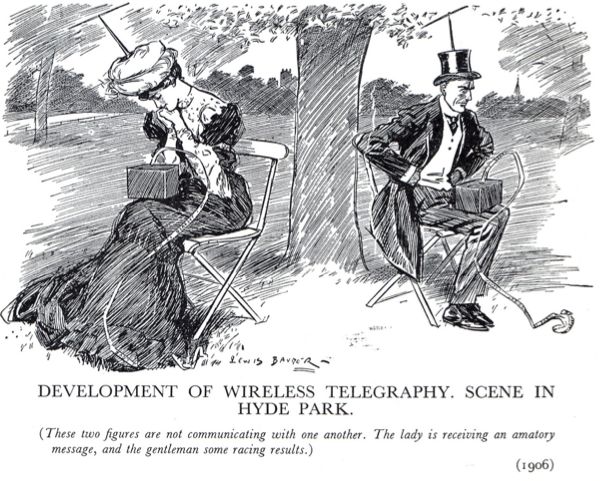 From A Century of PUNCH Cartoons. (Via
Osiasjota, Justine Marie Sherry likes this
11 Feb 22:26
Making Excuses for Fees on Electronic Public Records
by Steve Schultze
I recently posted about my draft bill to make electronic public access to federal court records free (#openpacer). Since then, I’ve had some very positive feedback from members of Congress, and I expect that the bill will be introduced with bipartisan and bicameral support once the public settles on the right language (the bill text is open for comment).
 In the meantime, I wrote a letter to Judge Hogan, Director of the Administrative Office of the US Courts. I wanted to make the case directly to him that the courts should do the right thing — and that what they are doing right now is against the law. I was assured by his colleagues on the bench that Hogan is a reasonable and judicious person, and that he would at least hear me out. Yesterday, his administrative assistant replied to me. She said that he had forwarded the letter to the people in the Public Access and Records Management Division (PARMD), and that he didn’t want to talk to me. She said that I could contact Public Affairs Office if I wanted to discuss it further. The PARMD folks have, in the past, forwarded my requests for things like the congressionally mandated Judiciary Information Technology Fund Report to the Public Affairs folks, who of course never respond.
So, rather than participating in yet another bureaucratic run-around, I thought I’d outline the series of poor excuses that the Administrative Office has offered to justify their fees. If you’re a lawyer reading this, I invite you to consider what a lawsuit might look like. My email address is *protected email*
Before we get to the excuses, however, let’s review the law. 28 U.S.C. 1913 (note) says:
The Judicial Conference may, only to the extent necessary, prescribe reasonable fees… to reimburse expenses incurred in providing these services.
Upon passing the E-Government Act of 2002, Congress noted its intent for the “only to the extent necessary” language:
The Committee intends to encourage the Judicial Conference to move from a fee structure in which electronic docketing systems are supported primarily by user fees to a fee structure in which this information is freely available to the greatest extent possible. For example, the Administrative Office of the United States Courts operates an electronic public access service, known as PACER, that allows users to obtain case and docket information from Federal Appellate, District and Bankruptcy courts, and from the U.S. Party/Case Index. Pursuant to existing law, users of PACER are charged fees that are higher than the marginal cost of disseminating the information.
The current fees are unquestionably greater than the cost of providing the services. Since passage of the E-Government Act, the cost of storing and delivering bits of data over the Internet has continued to fall precipitously, and the cost of PACER access has gone up by 42 percent. The courts conveniently compiled many of their excuses in a document entitled, “Electronic Public Access Program Summary: December 2012.” I should be clear that even if these excuses had some grain of truth, none of them could erase the simple fact that the courts are charging much more than the law allows. Nevertheless, I feel some need to point out how ridiculous they are, even on their own terms. Here’s the breakdown:
Excuse #1: “PACER is cheap”
Whether or not PACER is subjectively inexpensive is immaterial. The law says that the fees can only reimburse for the expense of the service, and the courts are charging more than that. End of story. Nevertheless, PACER is — subjectively — expensive. Although it costs “only 10 cents per page,” the system charges not only per page for documents, but per “page” of search results, and per “page” of docket listings. It is easy to quickly run up a huge bill unless you are looking for one particular thing and you know exactly how to find it. This is not the Internet way of doing things. If you are a researcher or investigative reporter who needs access to the full corpus of PACER records for analysis, my back-of-the-envelope calculations put the price at about half a billion dollars.
Excuse #2: “Fee waivers are available”
It’s true that PACER users can apply for a fee waiver from a particular district or bankruptcy court. There are, of course, a few catches. First of all, obtaining a waiver requires filing a separate request with each court, which may grant and revoke the waiver at its discretion. Individuals with fee waivers are prohibited from redistributing these public records. Many classes of individuals are not even eligible to apply, including the media. There is also my personal favorite, “An exemption applies only to access related to the case or purpose for which it was given.” So, if you are willing to give the courts your credit card, file a formal application to all of the courts for which you seek access, if the courts like the “purpose” that you state, and if they don’t arbitrarily decide to revoke your waiver, you can download (but not share) documents. What happens when a watchdog organization applies for and receives a fee waiver? Evidently they receive it, only to have it revoked shortly thereafter. Likewise, if you’re an academic, don’t criticize the court that gave you the waiver, because they may not renew it next time. Of course, anyone without a fee waiver is paying more than the cost of the service — in violation of the law. In fact, they’re paying the freight of all of those greedy fee-waiver freeloaders.
Excuse #3: “You won’t be charged for fees under $15 per quarter”
As long as you don’t rack up a PACER bill of more than $15 per quarter, you won’t be charged. Apparently this works for some users. The courts claim that “approximately 65-to-75 percent of active users have fee waivers for at least one quarter.” I don’t know what constitutes “active users,” but I can certainly believe that during some quarters, many registered users don’t use PACER much. I can also imagine that quite a few people try using PACER but give up quickly because the interface is so non-intuitive and the search is so inferior. I guess it’s nice of them to automatically waive some fees, but it doesn’t come close to addressing the more fundamental problems — or making the fee policy legal.
Excuse #4: “Congress said that we’re allowed to spend PACER funds on other things”
This is false. It’s shameful that the US Courts are misrepresenting the law. They should know better. Their excuse here is that the appropriators have indicated in a series of committee reports and letters that they have no problem with the courts expanding PACER fee use to other areas. The appropriators have a vested interest, which is of course to appropriate less. That being said, they have not made any changes to the law. Letters and report language are not the law. The law is the law.
Excuse #5: “We are making opinions available for free via the GPO”
Three years ago, the US Courts started a project in partnership with the Government Printing Office. Some courts were given the option of sending opinions over to the GPO, which would publish them — get this — for free! At the moment, only 19 of the 95 district courts are participating, but the courts recently announced that they would allow any other interested courts to join the trial. So, perhaps in a few years, all courts will upload their opinions to the GPO. The metadata aren’t as complete as what’s on PACER, and it’s hard to monitor for updates. More fundamentally, the archive omits everything other than final opinions (and it relies on judges to appropriately flag what is an opinion and what is not, which they have had trouble doing in the past). It is useless for following ongoing cases or for many types of research, but it’s better than nothing. Of course, it’s just a distraction from the fact that the courts are not following the law with respect to PACER fees.
Fun fact: Historically, the courts deposited all paper case materials with the National Archives and Records Administration. You could obtain every record from a proceeding at cost from NARA. Per NARA disposition schedule N1-021-10-2, the courts were supposed to begin depositing electronic records 3 years after a case closed, but to date they haven’t deposited any electronic records.
Excuse #6: “You can always go to the courthouse”
This is a good one. The Administrative Office will tell you that you can go to your local courthouse to access PACER records for free. Well, maybe not “local,” but you can go to the district, bankruptcy, or circuit courthouse and access PACER. Of course, you can only access records for that particular court. You can’t access other PACER records. You also can’t download the records. You can only view them. If you want to print them, that will be 10 cents per page. That’s not legal.
Excuse #7: “The heaviest users are rich”
They won’t state this explicitly, but this excuse underlies many of the courts’ statements. Let’s pick apart this quote from the “Electronic Public Access Program Summary: December 2012” :
“The largest user is the Department of Justice. Virtually all of the other high volume users are major commercial enterprises or financial institutions that collect massive amounts of data, typically for aggregation and resale.”
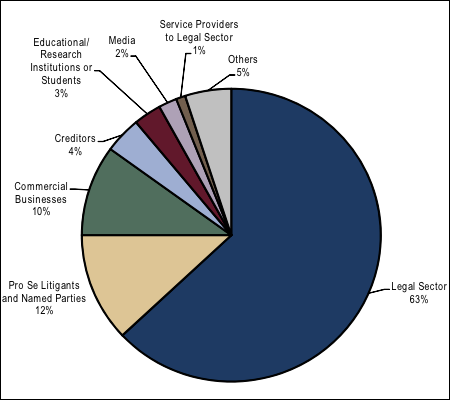 I have reproduced their pie chart here. Let’s consider the first sentence. Where in this pie chart are the Department of Justice and all other governmental entities? I can’t tell. Can you? They say that “The majority of ‘other’ users are background investigators,” so it can’t be that category. I guess that the government users are part of the “Legal Sector.” We know that in 2009, the Department of Justice alone paid $4.167 million in PACER fees. So, taxpayers are already paying millions per year in PACER fees out of general tax funds. The unstated implication here is that the “high volume users,” who are “major commercial enterprises or financial institutions,” can afford to pay for PACER, so why not tax them at a rate higher than actual cost for access to the public record? Presumably, the courts think that it is acceptable to violate statute because it affects mostly well-endowed users.
Excuse #8: “There is a high cost to providing electronic public access”
Here is how the PACER system architecture works: every court runs its own local PACER server, with local support staff and a private leased network link to Washington, DC. Are you a system administrator? Are you an average citizen who has heard the word “cloud” in the past five years? Does this system architecture seem insane? It is. It is even more offensive in light of the fact that the GSA has had, for years, a streamlined government procurement system for cloud hosting. This system is certified at FISMA level 2 security, and is hosted in a “private cloud” for the government, which is good enough for the Department of Homeland Security. It is provided by companies like Amazon at only a fraction higher cost than their commercial offerings. The courts could host all of the PACER services in the cloud — tomorrow — for under $1 million per year. They could allow all of these local system administrators to control their own PACER installations. They could obtain greater cost savings (and security) by further consolidating PACER hosting and system administration. Of course, they feel no pressure to do so when they interpret the law to allow them to charge whatever they deem necessary.
Excuse #9: “The Judiciary does not charge for access to judicial opinions”
At some point, PACER added the option for judges to specify that a particular document was an “opinion.” When users download these documents, they are not charged. But what is an opinion? There have been years of hand-wringing over this question. Courts have been wildly inconsistent in their rate of accurately flagging opinions. The Administrative Office commissioned an expensive study. This is all ridiculous, because the law makes no distinction between fees for opinions versus other records. What’s more, in order to find the opinions in the first place, the average user has to search for them (and pay) and view the docket (and pay).
Fun Fact: The PACER software allows each court to enable an RSS feed. This single feed lists every new document filed in that court (downloading the documents is not free). The feed maxes out at 200 entries. In busy districts, more than 200 documents can be filed in a matter of hours. I mentioned the uselessness of the RSS feed to a PARMD employee, who replied, “My understanding of RSS, (and I’m not an RSS expert) is that the selecting of individual cases (or individual articles/topics) from an RSS feed, is accomplished through the RSS reader.” Right. Well, in any case, the courts recently admitted that “70% of the district courts have not implemented” this useless feature anyway.
Excuse #10: “PACER users are happy”
The courts commissioned an extensive and unscientific study in order to determine that users were happy with PACER, and did not want free access. On the other hand, a Stanford Law librarian’s survey indicated that 95.5% of academic law libraries limited or rationed access to PACER for fear of paying too much. Public schools allowed students to spend less on PACER than private schools. The Administrative Office conducted a multi-year “multistakeholder” study in order to determine the “next generation” requirements for the electronic filing and PACER systems. No-fee access was not an option, nor were fees mentioned in the final report. None of the committee members represented the general public. I contacted the one person who was identified as a “stakeholder representative” for academia, who informed me, “I view it as my job to pass along thoughts; the committee decides what recommendations to make.” Of course, even if 100% of academics and the general public were happy with PACER fees, they’d still be against the law.
We have allowed the courts to pass off these silly (and irrelevant) excuses for far too long. It’s time for Congress to fully Open PACER. Perhaps it’s also time for PACER users to exercise some self-help by suing.
11 Feb 17:41
Calling All Readers: Join the Atlas Shrugged Book Club
by Conor Friedersdorf
The Atlantic will take on the controversial novel in a multi-part discussion that begins February 18.

Published in 1957, Ayn Rand's Atlas Shrugged is one of the most controversial novels in American history, and a hugely successful one too: It has sold more than a million copies ... since 2010! Alan Greenspan, Clarence Thomas, and Paul Ryan have cited it as a significant influence on their thinking. Tea Party-affiliated entertainers touted it at the height of the protest movement. And fans and critics alike found it relevant to the 2010 election.
But how many people who invoke the book have actually read it since high school? Or ever?
Since it's likely to remain a touchstone in American political discourse for the foreseeable future, some colleagues and I decided to assemble a small group to read and publicly discuss the novel -- a book club of sorts, and one we'd like to encourage every interested reader to join.
We'll be reading it in chunks, starting with Part I, Chapters 1 through 5. We'll publish our first discussion on February 18. If you decide to read along with us and have thoughts on those chapters between now and then, send an email to my address (no spoilers, please -- keep the discussion to those chapters). Your correspondence may make it into the discussion that we publish, and everyone can participate in comments or send emails following up on our initial round of discussion. Each round will end with the next reading assignment and discussion date.
We're hoping an ideologically diverse group of readers will participate, and that everyone will come away better understanding of both why so many people love and hate Atlas Shrugged.

Published in 1957, Ayn Rand's Atlas Shrugged is one of the most controversial novels in American history, and a hugely successful one too: It has sold more than a million copies ... since 2010! Alan Greenspan, Clarence Thomas, and Paul Ryan have cited it as a significant influence on their thinking. Tea Party-affiliated entertainers touted it at the height of the protest movement. And fans and critics alike found it relevant to the 2010 election.
But how many people who invoke the book have actually read it since high school? Or ever?
Since it's likely to remain a touchstone in American political discourse for the foreseeable future, some colleagues and I decided to assemble a small group to read and publicly discuss the novel -- a book club of sorts, and one we'd like to encourage every interested reader to join.
We'll be reading it in chunks, starting with Part I, Chapters 1 through 5. We'll publish our first discussion on February 18. If you decide to read along with us and have thoughts on those chapters between now and then, send an email to my address (no spoilers, please -- keep the discussion to those chapters). Your correspondence may make it into the discussion that we publish, and everyone can participate in comments or send emails following up on our initial round of discussion. Each round will end with the next reading assignment and discussion date.
We're hoping an ideologically diverse group of readers will participate, and that everyone will come away better understanding of both why so many people love and hate Atlas Shrugged.
|
|

11 Feb 09:30


Introverted Kids Need to Learn to Speak Up at School
by Jessica Lahey
Every child should be graded on class participation -- and parents don't help their children when they argue otherwise.
 Adapted from Sylverarts and PILart/Shutterstock
Next week marks the beginning of parent-teacher conferences. I can count on a few issues to come up: how I calculate grades, the degree to which I am willing to chase students for late work, and individual parents' expectations about the flow of information between school and home. But this year, I am hearing lot of questions about how to best educate introverted students and, specifically, the fairness of class participation grades.
I have experimented with many different grading strategies over the years, but class participation remains a constant in my grade book. It counts for a lot because we spend a large percentage of our of class time in dialogue. How does Pip change once he receives his Great Expectations? What does Edmund mean when he says, "Thou, nature, art my goddess; to thy law / My services are bound"?
When it comes time to assess my students' engagement with these questions, I could quiz them daily and force them to write reams about the topics I want them to consider. Or I can ask them to open their mouths, turn on their brains, and share their ideas with the rest of the class. I opt for a happy medium, and require a little bit of both.
Related Story
Caring for Your IntrovertThis is no problem for the extroverts, who live for the opportunity to talk about their ideas. However, I also teach introverts, who live in fear of being asked these sorts of questions. There are a lot of students populating the middle ground, of course, but I don't tend to hear from those students' parents at conference time. The parents of introverts complain that I am not meeting their child's unspoken educational needs, or that I am causing serious emotional trauma by requiring their child to speak up in school.
I am aware that as an extrovert, I naturally teach to and understand the needs of extroverts. Consequently, I have worked very hard to research and implement teaching strategies that work for introverted students. I have a personal interest in the subject as well, as I am married to one introvert and mother to another.
Thankfully, there's more information on introverts out there than ever before. I tapped into my amazing personal learning network of educators and gathered a towering pile of books on my nightstand, topped by Susan Cain's book Quiet: The Power of Introverts in a World that Can't Stop Talking. In her book, Cain champions the often-overlooked talents and gifts of introverts, and offers parents and educators strategies for communication and evaluation. This year, I drew on this advice and made a number of changes to my classroom in order to improve learning opportunities for my introverted students.
In the end, I have decided to retain my class participation requirement. As a teacher, it is my job to teach grammar, vocabulary, and literature, but I must also teach my students how to succeed in the world we live in -- a world where most people won't stop talking. If anything, I feel even more strongly that my introverted students must learn how to self-advocate by communicating with parents, educators, and the world at large.
Dr. Kendall Hoyt -- introvert, assistant professor of medicine at Dartmouth Medical School -- agrees. "You don't get a pass for your personality type. I understand that social anxiety is a real thing - I am an introvert, and my mother used to actually faint if she had to do public speaking - but part of my job as a teacher is to teach people how to articulate and be heard."
Hoyt applies this same philosophy to her own children, both introverts. She and her babysitter have constructed elaborate social scavenger hunts for the children, games that require them to approach strangers, look them in the eye, and ask for whatever the game requires - directions, information, or signatures.
When I asked her why she puts so much effort into her children's ability to communicate with strangers, she answered, "In order to be effective in this world, you must be able to communicate. If you can't speak up for yourself, if you can't muster the courage to tell the person you love that you love them, if you can't advocate for your own safety, the world will be a very intimidating and frightening place. I don't want my kids to be intimidated by the world."
When a parent tells me that his or her child is simply not capable of communicating educational and emotional needs, I see a child even more in need of mastering interpersonal communication. I'm not talking about the value of communication as it relates to grades here; I am talking about the value of communication as it relates to personal health, happiness, and safety. A student who is unwilling to stand up for herself and tell me that she does not understand the difference between an adverb and a verb is also less likely to stand up for herself if she is being harassed or pressured in other areas of her life.
Thanks to my students, Hoyt, and the reams of literature and research on introverts, I have a newfound respect for the people in my life who are less apt to jump into the fray of class discussion. But I also know that sometimes it's important - even imperative - to speak up for one's self. Cain starts her book Quiet with the example of Rosa Parks and the historic "No" she gave the bus driver who asked her to move to the back of the bus. Cain reports that, according to her obituary, Parks was an introvert. And yet that introvert spoke up and claimed her rightful place in the world. In honor of Rosa Parks, Susan Cain, and the many introverted students under my tutelage, I will continue to encourage them to find their voices.
|
|
11 Feb 02:13
loveanddrevenge: kraqhed: curiae: Long Distance Relationships...



10 Feb 23:42


Our Eagle Scout Badges Helped Prepare Us for (Same-Sex) Marriage
by Steven Seigel and J. Justin Wilson
When the authors stood on a hilltop and pledged their lives to each other, they also recited the Scout Law. Here's why they still believe in the group's core ideals.
 J. Justin Wilson and Steven Seigel recite the Scout Law during their 2011 wedding.
Two years ago this summer, we took a vow of marriage. And when we did, we not only pledged to love one another forever, we also recited the Scout Law: to be trustworthy, loyal, helpful, friendly, courteous, kind, obedient, cheerful, thrifty, brave, clean, and reverent.
Although it has been more than a decade since we both earned our Eagle Scout badges, we can still recite that mantra from memory. So it seemed like an obvious choice for our marriage vows—those values embodied the essence of what we learned as scouts, and they continue to guide our conduct today.
For us, earning our Eagle was about much more than learning to tie knots or build a fire in the rain. Although those are important skills scouts learn along the way, at its core, the Boy Scouts is about imparting the amorphous but critical skill of leadership. The basic premise of scouting is to build a future generation of leaders, to grow a cadre of young men who embody the moral and ethical virtues of a society and have the capacity to mobilize those values for good.
How, then, is this skill imparted to ragtag groups of young boys? By letting them learn for themselves. Boy Scouts affirms the autonomy of youth by allowing young men to make their own choices, to take responsibility for planning, training, doing, and most importantly learning from their mistakes.
The weekend we proposed to each other, we pondered what role, if any, the Boy Scouts would play in our lives if we ended up adopting a son.
This week, the 77-member National Executive Board of the Boy Scouts missed an opportunity to demonstrate that the organization itself can learn from its past mistakes. Instead of demonstrating leadership on the issue of allowing gays in scouts, the Board deferred the decision and abdicated responsibility to the 1,400 voting members of the National Council.
As any critic is likely to point out, the Boy Scouts of America does not have a good track record of leadership with respect to America's struggle with equality. It took nearly a decade after passage of the Civil Rights Act of 1964 before the last scout troop desegregated. By once again shirking their responsibility to set an example as leaders, and instead following the will of the majority, the inevitable result is continued embarrassment and social isolation. Most problematically, this decision will erode the confidence of millions of American parents who increasingly view the BSA as out of step with our society's deep commitment to tolerance and equal respect.
As potential parents, we, too, doubt that the institution's moral edifice can persist under a continued posture of discrimination. The chilly November weekend that we proposed to each other, we were backpacking along a lone ridge in the Massanutten mountain range when we came across the only other group of people braving the cold that weekend—a scout troop from Virginia. After they passed, we pondered what role, if any, the Boy Scouts would play in our lives if we ended up adopting a son. We resented the idea that a child of ours would be told, from day one, that his parents were morally deficient — so much so that they could not be trusted to participate in the day-to-day activities of scouts.
Such a message is not worthy of scouting's commitment to leadership. On the contrary, it is a moral dictate by certain BSA leaders that does not even pay lip service to the norms of kindness, tolerance, and respect that are the lifeblood of the scouting organization. It sends the message to gay youths that they are morally repugnant, deserving of ostracism and expulsion. All of this perverts the underlying goals of an organization designed to empower and inspire young men.
The choice the BSA faces is not an easy one, but leadership isn't always easy. Admitting gay scouts and scoutmasters would advance the organization's goals in ways that are true to its core objectives. It would emphasize the importance of self-knowledge and encourage young men in their struggle to figure out what is right and wrong, helping them develop a life-long commitment to truth, goodness, humanity, generosity, and respect.
|
|