Shared posts

16 May 19:24

Social Class and the College Choices of High School Valedictorians

by Lisa Wade, PhD

Cross-posted at The Huffington Post.

Sociologist Alexandria Walton Radford has some new research that is rather disheartening.  Radford was interested in the college choices of ambitious and high-performing high school students from different class backgrounds.  Using a data set with about 900 high school valedictorians, she asked whether students applied to highly selective colleges, if they got in, and whether they matriculated.

She found a stark class difference on all these variables, especially between high socioeconomic status (SES) students and everyone else.  Over three-quarters of high SES valedictorians (79%) applied to at least one highly selective college.  In contrast, only 59% of middle SES and 50% of low SES valedictorians did the same.  Admission and matriculation rates followed suit.

2

Interviews with a smaller group of these valedictorians shed light on why we see such dramatic differences in the application choices of low, middle, and high SES students.  Radford explains that most students applied to schools with which they were already familiar. High SES students were much more likely to know people who had attended highly selective colleges, so they were more comfortable applying.  They also felt more confident that they’d be successful at such an institution; less affluent students were more intimidated by these schools.

Radford concludes by arguing that it’s a mistake to leave decisions about whether and how to apply for college admission to families.  Doing so, she writes, “allows the advantages (and disadvantages) of one generation to be passed on to the next generation.”  School-based college guidance would go some way towards evening out the differences and making higher education admissions more meritocratic.

Lisa Wade is a professor of sociology at Occidental College. You can follow her on Twitter and Facebook.

(View original at http://thesocietypages.org/socimages)

15 May 20:15

Throwing Lariat

by PJM


Today's picture is from 1905, and it shows a cowboy throwing a lariat. Cowboys would "rope" cattle so that they could be branded, dehorned, or other routine maintenance. The picture is from a ranch in Colorado.
15 May 20:02

Where in Berkeley?

by Berkeleyside Editors

WIB

Know where this is? Take a guess and let us know in the Comments.

Photo: Nick Mastick.


By Berkeleyside Editors. | Permalink | 12 comments |
Post tags: Where in Berkeley?

15 May 00:49

Once you’ve dipped a body in concrete, Cambridge offers a...


Once you’ve dipped a body in concrete, Cambridge offers a suprising number of places to conceal it.

15 May 00:44

Grain Breakdown for the production of Bourbon(legally, Bourbon...

by rachitect


Grain Breakdown for the production of Bourbon
(legally, Bourbon must be at least 51% corn)

photo by Tsuyoshi Komatsu

-rachitect

15 May 00:42

Angelina Jolie Is Still a Woman

by Eleanor Barkhorn
barkhorn_jolie_post.jpg
Juan Medina/Reuters

"If I don't have breasts or a uterus anymore, am I still a woman?"

That's the question a character in Erin Brockovich asks as she recovers from a double mastectomy and hysterectomy. The answer, delivered by Julia Roberts with her characteristic crooked grin, is: "Of course, you'll always be a woman. You just won't have to buy any more underwire or maxi-pads."

This message—of course you're still a woman, even if you're missing some of the organ and tissue you were born with—is the most important part of Angelina Jolie's op-ed in today's New York Times. She writes about her own preventative double mastectomy, a three-month procedure she underwent because she has a so-called "faulty gene," BRCA1. People with a defect in this gene have a 65 percent risk of getting breast cancer. Jolie's mother died of cancer.


Related Story

'Dear Mom, Thanks for Rocking Those Gigantic Varicose Veins, Which I Caused'


Jolie first tells her readers that her status as a mother hasn't changed since the procedure. She writes that her six children "see nothing that makes them uncomfortable. They can see my small scars and that's it. Everything else is just Mommy, the same as she always was." Motherhood is an important aspect of a woman's femininity, and it's good that Jolie reassures her audience that she's still fully a mother, even after her body has changed.

But she goes on to expand her point to apply to all women, even women who don't have children: "On a personal note, I do not feel any less of a woman. I feel empowered that I made a strong choice that in no way diminishes my femininity."

This is a big deal. Angelina Jolie is sexy. Her body parts—her legs, her breasts, her hair, even her blood—have been on display throughout her career, subject to discussion and speculation. That she can lose the part of her body most closely associated with female sexuality and still feel fully female is an astonishing statement. Yes, she's a celebrity and can afford the finest reconstructive surgery in the world, a level of care that's out of the reach of most people (a fact she acknowledges). Nevertheless, the message is clear: A woman is still sexy, even after she has her breasts removed and reconstructed. It's hard to imagine a person who can say that with more authority than Jolie.

(It's also worth noting that Jolie does not shy away from the grisly aspects of her surgeries. She describes the painful "nipple delay" procedure, which left her bruised, and the eight-hour reconstructive surgery that feels "like a scene out of a science-fiction film." Many people have criticized the "pink-washing" of breast cancer, and how advocacy groups minimize the disease by associating it with pink ribbons and "save the ta tas" tee-shirts. Jolie steers away from that kind of language, which is good.)

Later in the piece, she makes an important point about masculinity as well. She thanks equally famous significant other by name for supporting her through he procedure:

I am fortunate to have a partner, Brad Pitt, who is so loving and supportive. So to anyone who has a wife or girlfriend going through this, know that you are a very important part of the transition. Brad was at the Pink Lotus Breast Center, where I was treated, for every minute of the surgeries. We managed to find moments to laugh together.

This also is a big deal. Brad Pitt is sexy, as much an icon of modern masculinity as Jolie is of femininity. And Jolie emphasizes that he supported her and cared for her in a season of pain and vulnerability. Sexy men support the women in their lives through anything, even the loss of their natural breasts.


13 May 22:10

IRS Office That Targeted Tea Party Also Disclosed Confidential Docs From Conservative Groups

by Kim Barker and Justin Elliott

May 20: Listen to ProPublica editor-in-chief Steve Engelberg talk to Kim Barker in a podcast about this story

May 17: This post has been updated.

***

The same IRS office that deliberately targeted conservative groups applying for tax-exempt status in the run-up to the 2012 election released nine pending confidential applications of conservative groups to ProPublica late last year.

The IRS did not respond to requests Monday following up about that release, and whether it had determined how the applications were sent to ProPublica.

In response to a request for the applications for 67 different nonprofits last November, the Cincinnati office of the IRS sent ProPublica applications or documentation for 31 groups. Nine of those applications had not yet been approved—meaning they were not supposed to be made public. (We made six of those public, after redacting their financial information, deeming that they were newsworthy.)

On Friday, Lois Lerner, the head of the division on tax-exempt organizations, apologized to Tea Party and other conservative groups because the IRS’ Cincinnati office had unfairly targeted them. Tea Party groups had complained in early 2012 that they were being sent overly intrusive questionnaires in response to their applications.

That scrutiny appears to have gone beyond Tea Party groups to applicants saying they wanted to educate the public to “make America a better place to live” or that criticized how the country was being run, according to a draft audit cited by many outlets. The full audit, by the Treasury Department’s inspector general for tax administration, will reportedly be released this week. (ProPublica was not contacted by the inspector general’s office.) (UPDATE May 14: The audit has been released.)  

Before the 2012 election, ProPublica devoted months to showing how dozens of social-welfare nonprofits had misled the IRS about their political activity on their applications and tax returns. Social-welfare nonprofits are allowed to spend money to influence elections, as long as their primary purpose is improving social welfare. Unlike super PACs and regular political action committees, they do not have to identify their donors.

In 2012, nonprofits that didn’t have to report their donors poured an unprecedented $322 million into the election. Much of that money — 84 percent — came from conservative groups. 

As part of its reporting, ProPublica regularly requested applications from the IRS’s Cincinnati office, which is responsible for reviewing applications from nonprofits.

Social welfare nonprofits are not required to apply to the IRS to operate. Many politically active new conservative groups apply anyway. Getting IRS approval can help with donations and help insulate groups from further scrutiny. Many politically active new liberal nonprofits have not applied.  

Applications become public only after the IRS approves a group’s tax-exempt status.

On Nov. 15, 2012, ProPublica requested the applications of 67 nonprofits, all of which had spent money on the 2012 elections. (Because no social welfare groups with Tea Party in their names spent money on the election, ProPublica did not at that point request their applications. We had requested the Tea Party applications earlier, after the groups first complained about being singled out by the IRS. In response, the IRS said it could find no record of the tax-exempt status of those groups — typically how it responds to requests for unapproved applications.)

Just 13 days after ProPublica sent in its request, the IRS responded with the documents on 31 social welfare groups.

One of the applications the IRS released to ProPublica was from Crossroads GPS, the largest social-welfare nonprofit involved in the 2012 election. The group, started in part by GOP consultant Karl Rove, promised the IRS that any effort to influence elections would be “limited.” The group spent more than $70 million from anonymous donors in 2012.

Applications were sent to ProPublica from five other social welfare groups that had told the IRS that they wouldn’t spend money to sway elections.  The other groups ended up spending more than $5 million related to the election, mainly to support Republican presidential candidate Mitt Romney. Much of that money was spent by the Arizona group Americans for Responsible Leadership. The remaining four groups that told the IRS they wouldn’t engage in political spending were Freedom Path, Rightchange.com II, America Is Not Stupid and A Better America Now. 

The IRS also sent ProPublica the applications of three small conservative groups that told the agency that they would spend some money on politics: Citizen Awareness Project, the YG Network and SecureAmericaNow.org. (No unapproved applications from liberal groups were sent to ProPublica.)

The IRS cover letter sent with the documents was from the Cincinnati office, and signed by Cindy Thomas, listed as the manager for Exempt Organizations Determinations, whom a biography for a Cincinnati Bar Association meeting in January says has worked for the IRS for 35 years. (Thomas often signed the cover letters of responses to ProPublica requests.) The cover letter listed an IRS employee named Sophia Brown as the person to contact for more information about the records. We tried to contact both Thomas and Brown today but were unable to reach them.

After receiving the unapproved applications, ProPublica tried to determine why they had been sent. In emails, IRS spokespeople said ProPublica shouldn’t have received them.

“It has come to our attention that you are in receipt of application materials of organizations that have not been recognized by the IRS as tax-exempt,” wrote one spokeswoman, Michelle Eldridge. She cited a law saying that publishing unauthorized returns or return information was a felony punishable by a fine of up to $5,000 and imprisonment of up to five years, or both.

In response, ProPublica’s then-general manager and now president, Richard Tofel, said, "ProPublica believes that the information we are publishing is not barred by the statute cited by the IRS, and it is clear to us that there is a strong First Amendment interest in its publication.”

ProPublica also redacted parts of the application to omit financial information.

Jonathan Collegio, a spokesman for Crossroads GPS, declined to comment today on whether he thought the IRS’s release of the group’s application could have been linked to recent news that the Cincinnati office was targeting conservative groups.

Last December, Collegio wrote in an email: “As far as we know, the Crossroads application is still pending, in which case it seems that either you obtained whatever document you have illegally, or that it has been approved.”

This year, the IRS appears to have changed the office that responds to requests for nonprofits’ applications. Previously, the IRS asked journalists to fax requests to a number with a 513 area code — which includes Cincinnati. ProPublica sent a request by fax on Feb. 5 to the Ohio area code. On March 13, that request was answered by David Fish, a director of Exempt Organizations Guidance, in Washington, D.C. 

In early April, a ProPublica reporter’s request to the Ohio fax number bounced back. An IRS spokesman said at the time the number had changed “recently.” The new fax number begins with 202, the area code for Washington, D.C. 

For more on the IRS and nonprofits active in politics, read our story on how the IRS's nonprofit division got so dysfunctional, Kim Barker's investigation, "How nonprofits spend millions on elections and call it public welfare", our Q&A on dark money, and our full coverage of the issue.    

Update: Testifying before a House committee Friday, former acting IRS Commissioner Steven Miller said that the disclosure of unapproved applications of conservative nonprofits to ProPublica last year, as well as the separate disclosure of confidential documents of the National Organization for Marriage, was “inadvertent.” Miller also mentioned that there had been discipline in one of the cases because procedures had not been followed.

We followed up on the issue, and the IRS sent this statement:

“When these two issues were previously raised concerning the potential unauthorized disclosures of 501(c)(4) application information, we immediately referred these cases to TIGTA [Treasury Inspector General for Tax Administration] for a comprehensive review. In both instances, TIGTA found these instances to be inadvertent and unintentional disclosures by the employees involved.”

The IRS did not respond to questions on who had been disciplined and how. TIGTA did not respond to requests for comment. 

07 May 18:04

Free Airport Parking for Congress: A Reminder that the Rich Write the Rules

by Lisa Wade, PhD

Last week the U.S. Congress made headlines when it quickly adjusted the sequester cuts that affected air traffic control. How quickly?  Parts of it were hand-written (via The Daily Show):
1 The move was interpreted as one meant to a certain class of voters, but it was also as a purely self-interested move, since Congress members fly quite frequently.

Riffing on this, Bloomberg Businessweek put together a short video about a little-known congressional perk: free and convenient parking at Reagan National Airport.

This little perk, saving congress members time and $22-a-day parking fees, is a great example of the way that privilege translates into being “above society.” The more power, connections, and money you have, the more likely you are to be able to break both the legal and social contract with impunity. Sometimes this just means getting away with breaking the law (e.g., the fact that, compared to the crimes of the poor and working classes, we do relatively little to identify and prosecute so-called “white collar” criminals and tend to give them lighter or suspended sentences when we do). But these perks are also often above board; they’re built into the system. And who builds the system again?

In other words, some of the richest people in the world get free parking at the airport because they’re the ones making the rules. I like this as a concrete example, but be assured that there is a whole universe of such rules and, like this sudden revelation about free parking, most of them go entirely unnoticed by most of us most of the time.

Lisa Wade is a professor of sociology at Occidental College. You can follow her on Twitter and Facebook.

(View original at http://thesocietypages.org/socimages)

07 May 18:02

San Francisco

by PJM


Today's picture was taken in 1906, after the earthquake and fire in San Francisco. These people are cooking in the streets presumably because of the damage. It is interesting that even in the midst of the disaster  they all appear to be well dressed and groomed.
06 May 21:53

How to Raise a Kid: Thomas Jefferson vs. Abigail Adams Edition

by Heidi Halvorson
4839598829_8a6fb10dfb_bmain.png stormwarning./Flickr

In 1783, Thomas Jefferson was in Annapolis, Maryland, serving as a Virginia delegate to the Continental Congress. At the time, he was still grieving the death of his wife Martha, who had died soon after giving birth to their sixth child a year before. When duty called, Jefferson reluctantly left Monticello and his three living children -- Martha (whom he called Patsy), Mary, and Lucy -- in the care of a family friend. Forced to perform his fatherly duties from a distance, he wrote frequently to Patsy, who at the time of the following letter was 11 years old:

My Dear Patsy,

After four days' journey, I arrived here without any accident, and in as good health as when I left Philadelphia. The conviction that you would be more improved in the situation I have placed you than if still with me, has solaced me on my parting with you, which my love for you had rendered a difficult thing. The acquirements which I hope you will make under the tutors I have provided for you will render you more worthy of my love; and if they cannot increase it, they will prevent its diminution....

I have placed my happiness on seeing you good and accomplished, and no distress which this world can now bring on me could equal that of your disappointing my hopes. If you love me then, strive to be good under every situation and to all living creatures, and to acquire those accomplishments which I have put in your power, and which will go far towards ensuring you the warmest love of your affectionate father.

A few years earlier, in the midst of the colonies' struggle for independence, 11-year-old John Quincy Adams had accompanied his father on a mission to Paris to convince France to join in the war against Britain. His mother, Abigail, was said to have missed her eldest son dearly, and wrote to him frequently. When she wrote the following letter in 1778, he had just completed the arduous Atlantic crossing:

My Dear Son,

Tis almost four months since you left your native land and embarked upon the mighty waters in quest of a foreign country. Altho [sic] I have not perticuliarly [sic] wrote to you since yet you may be assured you have constantly been upon my heart and mind.

... remember that you are accountable to your maker for all your words and actions. Let me injoin [sic] it upon you to attend constantly and steadfastly to the precepts and instructions of your father as you value the happiness of your mother and your own welfare. ..., for dear as you are to me, I had much rather you should have found your grave in the ocean you have crossed, or any untimely death crop you in your infant years, rather than see you an immoral profligate or a graceless child.

Yet you must keep a strict guard upon yourself, or the odious monster [i.e., vice] will soon loose its terror, by becoming familiar to you.

Upon first reading, it is immediately striking how remarkably frank eighteenth-century Americans were with their 11-year-olds. Beyond that similarity, these two individuals were clearly parenting their children in very different ways, and psychologists have spent the last twenty years studying and understanding the impact of these differences on the adults we eventually become.

Jefferson expresses his deep love for Patsy, while also threatening in no uncertain terms to withhold that love should she disappoint his hopes.

Let's begin with Jefferson's parenting. Notice how in his letter, he speaks frequently of his hopes for Patsy, and of his desire for her to be accomplished -- to fulfill her potential. He expresses his deep love for her, while also threatening in no uncertain terms to withhold that love should she disappoint his hopes. When parents think about their child mainly in terms of how they would ideally like the child to be, as Jefferson did, they often shape their child's behavior through providing (and withholding) positive experiences. So when the child behaves well, he is showered with praise, affection, or attention. But when he misbehaves, he gets the cold shoulder, and his happiness is replaced by feelings of emptiness and dejection.

We now know that children who are raised this way come to see their goals, at work and in life, as ways to obtain those same positive experiences -- in other words, as opportunities for gain, accomplishment, or advancement. They "play to win," and have what's called a promotion focus. Many studies, most of which have been conducted at Columbia University's Motivation Science Center, show that promotion-focused adults tend to be optimists, are more likely to take chances and seize opportunities, and excel at creativity and innovation. On the other hand, all that chance-taking and positive thinking makes them more prone to error, less likely to completely think things through, and usually unprepared with a Plan B in case things go wrong. But despite the risks, a promotion-focused person would rather say Yes! and have it all blow up in his face than feel like he let Opportunity's knock go unanswered.

Another example of Jefferson's promotion-focused parenting can be found in Senator Edward Kennedy's memoir True Compass, and the recollection of words his father, Joseph Kennedy Sr., spoke to him when he was a boy.

You can have a serious life or a nonserious life, Teddy. I'll still love you whichever choice you make. But if you decide to have a nonserious life, I won't have much time for you. You make up your own mind. There are too many children here who are doing things that are interesting for me to do much with you.

Again, if Teddy does something "interesting" (i.e., living up to his father's ideals for him), then he will be rewarded with attention -- attention that all of Joe Sr.'s many children very much wanted. If he failed to be interesting, then Father would withdraw that attention -- and Teddy was fairly warned. It's not surprising, then, that so many of Joe Sr.'s children evidenced such strong signs of promotion focus in their adulthood: ambitiousness, confidence, creativity, an eagerness to tackle new challenges, and a degree of recklessness, too.

Now, look again at Abigail's letter to young John Quincy. She doesn't promise her love as a reward for his accomplishments, nor does she entreat him to live up to his potential. Instead, she emphasizes the importance of being accountable, following instructions, adhering to moral rules, and avoiding the danger of sin and vice. In other words, she reminds her son of what he should be, and of the dire consequences of failing to live up to those expectations.

Children raised with a prevention focus don't really play to win; they play to not lose.

Parents, like Adams, who think of their child more in terms of who they believe the child ought to be -- in terms of the child's duties and obligations -- are more likely to influence their child through the providing of (and protecting from) negative experiences. When he does something that violates his mother's rules, he is criticized or punished (e.g. extra chores); but when he obeys the rules and makes no mistakes, life is peaceful.

Children raised this way become adults who often see their goals in life as opportunities to meet their responsibilities and stay safe. They don't really play to win; they play to not lose, and have what we call a prevention focus. In our studies, we find the prevention-focused to be defensive pessimists -- more driven by criticism and the looming possibility of failure than by applause and a sunny outlook. Prevention-focused people are often more cautious and don't like to take chances, but their work is also more thorough, accurate, and carefully-planned. They are also more analytical, better able to delay gratification and follow rules, better organized, and more conscientious. Their biggest regrets are the mistakes they might have avoided, if only they had been more vigilant.

No wonder, then, that young John Quincy Adams grew to become a successful life-long public servant, and a man of great personal reserve and austerity, whom the historian Paul C. Nagel described as "inordinately vexed by his own blunders and inadequacies."

So is it better to parent like Jefferson or Adams? It's worth pointing out that the difference between Jefferson's promotion parenting and Adams' prevention parenting isn't necessarily about the kinds of values you want to give your child. Two sets of parents may seek to instill the same goals and values in their children -- let's say, wanting them to do well in school, share generously with others, and be polite -- but they can go about sending the message very differently. ("If you do well in school, I'll be so proud of you!" versus "If you don't do well in school, you'll be in big trouble.") It's this difference in delivery, rather than in content, that shapes a child's dominant focus.

RECOMMENDED

The Sex Lives of Conjoined Twins

Which focus is better? The answer is, neither. Promotion and prevention focus have different strengths and weaknesses, and they can both lead to the enjoyment of successful, satisfying lives. Really, all good parenting has trade-offs. There is no particular kind of parenting that yields for children "all the benefits, and nothing but the benefits."

Of course, it is possible for child to be both promotion and prevention-focused, allowing them to be creative and analytical, good at seizing opportunities and careful planning. Taking a page from both Jefferson and Adams is probably the best approach, though you might want to lighten it up a little. The watery grave part seems, in retrospect, a bit much.


06 May 21:44

Well: Sucking Your Child’s Pacifier Clean May Have Benefits

by By ANAHAD O'CONNOR
Children whose parents sucked their pacifiers to clean them had fewer allergies, lower rates of eczema and fewer signs of asthma than those whose parents typically rinsed or boiled them.
06 May 21:43

Roadside Cooking

by PJM


This is a depression era picture which shows a woman cooking her meal on the side of the road over a small fire. This was not an uncommon scene during the great depression. The photographer asked her how things were going and she replied, "Do you suppose I'd be out on the highway cooking my steak if I had it good at home?" The picture was taken on the outskirts of El Paso, Texas. The woman was a hotel maid who had fallen on hard times.
06 May 21:41

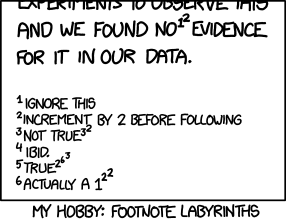
Footnote Labyrinths

Every time you read this mouseover, toggle between interpreting nested footnotes as footnotes on footnotes and interpreting them as exponents (minus one, modulo 6, plus 1).
05 May 06:17

NO, WE’RE ALL GOING TO DIE


NO, WE’RE ALL GOING TO DIE

03 May 22:12

Marissa Mayer's Potentially Revolutionary Paternity Leave Policy

by Nanette Fondas
fondas_paternity_post.jpg JodyDigger/flickr

Marissa Mayer took a lot of flak when she nixed telecommuting at Yahoo yet built a private nursery for her own baby next to her office, on the heels of her earlier statement that she intended to work through a meager two-week maternity leave.

This week, however, she announced a decidedly family-friendly policy for Yahoos who become parents: doubling paid maternity leave for mothers (from eight to 16 weeks) plus granting eight weeks for fathers. New parents also can expect to receive a gift of $500 to welcome baby and spend on things like groceries, babysitters, house cleaning, and laundry.

The policy sends the message that Yahoo seeks to keep up with its Silicon Valley peers—especially Google and Facebook—in the competition to hire and retain top talent. It also signals that Marissa Mayer realizes not every working parent, even super-smart Yahoo engineers, possesses her super-human drive, so Yahoo will try to be one of those great places to work—for both moms and dads of newborns.

Related Story

Marissa Mayer's Job Is to Be CEO

The dad part of the policy merits notice. It appears Mayer absorbed one key response to Facebook CEO Sheryl Sandberg's command for women to "lean in" to their jobs and careers. Dads need to lean in at home and share diaper duty, said mothers, journalists, and scholars. That would encourage equally shared parenting particularly and gender equality generally.

The new Yahoo policy holds potential not only to change a father's behavior during the eight weeks he spends with the baby while on paternity leave, but also to inch the country toward parity between the sexes in parenting. Catherine Rampell, in The New York Times, explains how a family-friendly policy can potentially change social expectations and norms about acceptable "father" and "mother" behaviors:

One area where there seems to be a lot of potential is paternity leave, which still has a stigma in both the United States and Europe. To remedy this bad rap, countries like Sweden and Norway have recently introduced a quota of paid parental leave available only to fathers. If dads don't take it, they're leaving money on the table. In Germany and Portugal, moms get bonus weeks of maternity leave if their husbands take a minimum amount of paternity leave. All these countries have seen gigantic increases in the share of fathers who go on leave.

This might not sound like such a big deal, but social scientists are coming around to the notion that a man spending a few weeks at home with his newborn can help recast expectations and gender roles, at work and home, for a long time. A striking new study by a Cornell graduate student, Ankita Patnaik, based on a new paid paternity-leave quota in Quebec, found that parents' time use changed significantly. Several years after being exposed to the reform, fathers spent more time in child care and domestic work—particularly "time-inflexible" chores, like cooking, that cut into working hours—than fathers who weren't exposed to the reform. More important, mothers spent considerably more time at work growing their careers and contributing more to the economy, all without any public mandates or shaming.

Even more important, fathers' heightened engagement with their newborns ignites a process of role evolution. In other words, change behavior first and changes in expectations follow—not just wives' expectations of husbands but husbands' expectations of themselves. New roles are "enacted" this way and, at a social system level, new norms emerge. Dads doing more at home—even taking charge—becomes accepted and then expected. All because an employer like Yahoo offered—and dads took—a few weeks of paternity leave.


03 May 21:54

Virginia Apgar

by raylevy

Image

Thank you to regular GGSTEM contributor, Jill Tietjen, for this post about Virginia Apgar.  Apgar’s photo is from the Library of Congress.

Do you know what your Apgar Score was?  In all likelihood, at one minute and five minutes after your birth, you received an Apgar Score (0-10) that told the doctors and your parents if you needed additional medical assistance.  Dr. Virginia Apgar developed that score in 1952 and it is used worldwide today in all hospitals to assess the health of babies!  The Apgar Score has saved the lives of countless newborn babies.

Here is a video with Dr. Apgar and a nurse discussing how to take the Apgar Score on a newborn:

The score uses her name:

A – Appearance

P – Pulse

G – Grimace

A – Activity

R – Respiration

And each letter gets a 0, 1 or 2.   The best score is a 10.

After being one of the few women admitted to the Columbia University College of Physicians, she wanted to become a surgeon.  However, she was told that at this time in our country’s history, she would starve – because no one would want a woman surgeon!  So, Apgar shifted her focus to anesthesiology.  She became the Director of Anesthesiology, the first woman to head any department at the University.  Another first for Dr. Apgar was when she became the first woman full professor at the University.

After leaving Columbia, she served as an executive with the March of Dimes Foundation, continuing her work to identify and prevent birth defects.  In 1973, she became the first woman to receive the Gold Medal for Distinguished Achievement in Medicine from the College of Physicians and Surgeons at Columbia University.

Dr. Apgar was inducted posthumously to the National Women’s Hall of Fame in 1995.  I met her great grand nephew at the induction.  His name is Eric Apgar and at the time, he worked for Apple in California.

Image

In 1994, Dr. Apgar was honored on a U.S. postage stamp.


01 May 21:35

I was right: Congress’s attack on the NSF widens

by Scott

Last month, I blogged about Sen. Tom Coburn (R-Oklahoma) passing an amendment blocking the National Science Foundation from funding most political science research.  I wrote:

This sort of political interference with the peer-review process, of course, sets a chilling precedent for all academic research, regardless of discipline.  (What’s next, an amendment banning computer science research, unless it has applications to scheduling baseball games or slicing apple pies?)

In the comments section of that post, I was pilloried by critics, who ridiculed my delusional fears about an anti-science witch hunt.  Obviously, they said, Congressional Republicans only wanted to slash dubious social science research: not computer science or the other hard sciences that people reading this blog really care about, and that everyone agrees are worthy.  Well, today I write to inform you that I was right, and my critics were wrong.  For the benefit of readers who might have missed it the first time, let me repeat that:

I was right, and my critics were wrong.

In this case, like in countless others, my “paranoid fears” about what could happen turned out to be preternaturally well-attuned to what would happen.

According to an article in Science, Lamar Smith (R-Texas), the new chair of the ironically-named House Science Committee, held two hearings in which he “floated the idea of having every NSF grant application [in every field] include a statement of how the research, if funded, ‘would directly benefit the American people.’ “  Connoisseurs of NSF proposals will know that every proposal already includes a “Broader Impacts” section, and that that section often borders on comic farce.  (“We expect further progress on the μ-approximate shortest vector problem to enthrall middle-school students and other members of the local community, especially if they happen to belong to underrepresented groups.”)  Now progress on the μ-approximate shortest vector problem also has to directly—directly—”benefit the American people.”  It’s not enough for such research to benefit science—arguably the least bad, least wasteful enterprise our sorry species has ever managed—and for science, in turn, to be a principal engine of the country’s economic and military strength, something that generally can’t be privatized because of a tragedy-of-the-commons problem, and something that economists say has repaid public investments many, many times over.  No, the benefit now needs to be “direct.”

The truth is, I find myself strangely indifferent to whether Smith gets his way or not.  On the negative side, sure, a pessimist might worry that this could spell the beginning of the end for American science.  But on the positive side, I would have been proven so massively right that, even as I held up my “Will Prove Quantum Complexity Theorems For Food” sign on a street corner or whatever, I’d have something to crow about until the end of my life.

30 Apr 23:56

WHEN A STUDENT SAYS THAT OTHER TEACHERS ALWAYS GAVE HIM A'S:

image
30 Apr 05:33

April 28, 2013


24 Apr 13:17

Doctor Who 7x09 and Sherlock 2x03 : Same location.


Doctor Who 7x09 and Sherlock 2x03 : Same location.

23 Apr 02:02

Tsarnaev's Now Been Charged: Five Questions, Five Answers

by Andrew Cohen
dtsar.jpgMassachusetts State Police/AP Images

The Justice Department Monday filed a criminal complaint in federal court in Boston charging Dzhokhar Tsarnaev with committing and conspiring to commit last week's Boston Marathon bombings. The suspect, still gravely wounded, his breathing tube only recently removed, his interrogation evidently over, was given his "initial appearance" in the civilian case by virtue of a visit, at his hospital bed at Beth Israel Deaconess Hospital, by a federal magistrate. Lesson: If the case is big enough the court comes to you when you can't come to court.

Soon, Tsarnaev will be arraigned on the charges and he will enter some sort of plea. Even sooner, he will have a defense attorney to assist him (indeed, William Fick, of the Federal Public Defender's Office in Massachusetts, already has been appointed). Absent a guilty plea, pretty soon we'll all be talking about the propriety of change-of-venue motions and prejudicial pretrial publicity. This is how domestic bombing cases begin. Judging from the national conversation Monday, however, there is still a great deal of confusion over what's happening, and why. Here are ten basic questions, and answers, on where we are and what's likely to happen next.

1. Why wasn't he treated as an enemy combatant? This is by far the least sensible question asked in the hours since Tsarnaev was caught. The simple answer is: because he couldn't have been. The Constitution, and federal statutory law, prohibit the government from treating as an "enemy combatant" a U.S. citizen accused of committing crimes on U.S. soil. End of story. You could argue, as some have, that Tsarnaev was treated as a ''combatant" because he was not immediately read his Miranda rights. But the "public safety" exception to that constitutional rule is unrelated to the government's designations of "combatants." You or I could theoretically be subject to the Miranda exception (which would be scary); we could not be considered "enemy combatants" and thrown into Gitmo (which would be even scarier).

2. What exactly happened today in that hospital room? Tsarnaev was not arraigned. He was not asked to enter a plea. He was merely checked into the federal system with his initial appearance and was advised of the charges against him. The presence of the bedside magistrate tells us that the feds want to push forward quickly here, to get the case into the federal civilian system, both to neutralize the nonsense offered up by Sen. Lindsey Graham and company and to put pressure on the defense. Soon there will be a federal trial judge assigned to the case. Soon it will look much like the hundreds of other bombing cases handled by the federal courts since the beginning of the Republic.

3. What does the federal complaint tell us? Not much that we don't already know. It's important to remember that this document is just an initial expression of the government's case against Tsarnaev. It is a document designed to keep the suspect in custody; to ensure that he is not freed by a judge or permitted out on bail or bond pending a more formal indictment. The substance of the charges are pretty basic and unsurprising to those following the case. When you use a "weapon of mass destruction" (a bomb" to blow up people, and you do blow up people, it's a federal crime. We'll likely know more when we see the grand jury's indictment and that won't come for weeks.

4. Why no murder charges in the federal complaint? Another easy one. Murder is typically a state crime and federal murder charges occur only when a murder victim is a federal employee or otherwise related to the federal government. Because the 1995 Oklahoma City bombing ripped apart a federal building, it had many such victims, which is why it included federal murder charges. By contrast, the Marathon bombing fatalities were all civilians. What will happen now is that Massachusetts authorities will wait to see how the federal case unfolds before deciding whether to prosecute Tsarnaev on state charges. Such a case would occur after the federal case. The authorities, in other words, will have two bites at this apple.

5. Is this going to be a capital case? All we know today is that this is a death-eligible case; that the charges so far against Tsarnaev are capital charges. But the Justice Department still has to make its own internal assessment about whether to seek the death penalty. That will likely come months from now, after Attorney General Eric Holder goes through this specific set of protocols, and after he consults with the victims of the bombing, the survivors, and Massachusetts officials. The Bay State, remember, does not have the death penalty as a sentencing option and that's a factor the Attorney General must consider.


22 Apr 20:10

'People Who Thought Chechnya Was the Czech Republic,' Collectors' Edition

by Megan Garber
[optional image description] publicshaming.tumblr.com

Twitter and Facebook, at their best, mimic person-to-person conversation: They provide a way for people to chat -- and laugh and argue and share -- unconstrained from boundaries of geography. And then, even better, they archive the conversations we have, giving our interactions a kind of dual residence in the worlds of real time and permanence.

The catch in all this, of course, is that sometimes our conversations are not terribly worthy of archiving -- at the Library of Congress, or in our own feeds. Sometimes the stuff we write is silly. Sometimes it's tasteless. Sometimes it's incorrect. And sometimes it's all three at the same time.

Take the tweets below. They were posted, for the most part, last week, after we learned the identity of the alleged perpetrators of the Boston Marathon bombings. They were posted by people who didn't seem to know the difference between "Chechnya" and "the Czech Republic." (And, in some cases, between "Chechnya" and "Czechoslovakia.") They have been archived by Twitter, and collected on the aptly named Tumblr "Public Shaming," under the heading of "The Definitive 'People Who Thought Chechnya Was the Czech Republic' Collection."

Screen Shot 2013-04-22 at 2.31.59 PM.png

Screen Shot 2013-04-22 at 2.32.37 PM.png

The Chech/Czech confusion was evident on Facebook, too:

Screen Shot 2013-04-22 at 2.33.18 PM.png

Should you want it, there's more -- much more -- at the Public Shaming Tumblr, here

What's remarkable about this, though, is not (just) that people didn't know the difference between two very different places. We're all ignorant, in our own ways. It's instead the shape that ignorance can take when it's expressed, and manifested, on the Internet. With the web's particular affordances -- personal comments made public, ephemeral thoughts made permanent -- ignorance (not to mention hatred, not to mention kindness, not to mention joy) can now become its own kind of media product. It is no longer geographically isolated. It is no longer temporally constrained. It is now a thing -- an object -- to be mulled over and laughed at and, either way, made aware of on its own terms. It is circumstance, transformed into evidence. 


20 Apr 07:26

Regular Programming

by carolinefryar

Well, God, glad that’s over.

In the interest of talking about the most normal, friendly, innocuous things, here’s a picture of my friend Maggie wearing the sweater I knit her for Christmas to work:

IMG_20130402_134750

It’s a Kristen Johnstone pattern; I knit it in the mountains this past fall.

More of the wonderfully banal:

  • guy’s coming to fix the sink tomorrow
  • meatballs for dinner
  • 1 week left of classes
20 Apr 07:25

Photo


20 Apr 07:22

Odelola Adeyemi and her granddaughter, Dr. Adediwura Fred-Jaiyesimi

by raylevy

Image

The Pan-African News Wire blog ran a story on March 13, 2013 entitled “Award-winning Plant Scientist Inspired by Grandmother.”  The article, by Victor Olusola and Bukola Apata, was from the Saturday magazine Life and Style.  The article says

Dr. (Mrs.) Adediwura Fred-Jaiyesimi [pictured above] is a Senior Lecturer in the Department of Pharmacognosy, Faculty of Pharmacy, Olabisi Onabanjo University, Ago-Iwoye, Ogun State [Nigeria]. In February this year, along with four other female scientists, she was given awards in recognition of her excellence in research. The occasion was the yearly meeting of the American Association for the Advancement of Science (AAAS) in Boston, United States. Her work shows the importance of plants as source of pharmacological agents and underscores the need to protect the rich tropical flora of the rainforest region.

Dr. Adediwura Fred-Jaiyesimi is quoted as saying

“I was inspired by my grandmother who loved animals and used different plants to treat them when they took ill or were in the process of giving birth. Whenever she was with them, I watched her closely. It was from her that I started looking at herbs from a positive angle.

“She is about 100 years old now but still very conscious. She stays in Lagos with one of my sisters. My grandmother strongly believes in the training of a girl-child. Her name is Odelola Adeyemi.”


18 Apr 01:46

April 17, 2013


It begins.

17 Apr 02:46

Women Boating

by PJM
Justine Marie Sherry

What in the world are they wearing on their heads.


Today's picture was taken on the Ocklawaha River near Silver Springs, Florida. We see two women in a row boat coming into the docks. The picture was taken in 1902.
14 Apr 23:00

The recent discovery of an unpublished D.H. Lawrence letter...


The recent discovery of an unpublished D.H. Lawrence letter proves that he’s got your back, ladies. Writing in response to a misogynistic 1924 article titled “The Ugliness of Women,” Lawrence lay down the law: 

The hideousness {the author] sees is the reflection of himself, and of the automatic meat-lust with which he approaches another individual…Even the most “beautiful” woman is still a human creature. If {the author] approached her as such, as a being instead of as a piece of lurid meat, he would have no horrors afterwards. 

Thank you D.H. Lawrence, meat-lust warrior. (h/t Jezebel)

14 Apr 22:59

Assimilation Among 1st- and 2nd-Generation Immigrants

by Lisa Wade, PhD

Data presented by Pew Social Trends suggests that immigrants are strongly assimilated by the second generation.  While first-generation immigrants (the children of migrants) often do worse on measures of economic security, second-generation immigrants (their grandchildren) are essentially indistinguishable from the general population.  They’re also more likely to identify as a “typical American.”

1 2

These data should calm the fears of people who think that high fertility rates among immigrants will harm the country by creating a “dependent” underclass or a dangerous population of non-patriots.

Lisa Wade is a professor of sociology at Occidental College. You can follow her on Twitter and Facebook.

(View original at http://thesocietypages.org/socimages)

14 Apr 08:34

canisfamiliaris: Bras Do Not Work and Cause More Problems The...


canisfamiliaris:

Bras Do Not Work and Cause More Problems

The findings from a 15-year, longitudinal study of more than 300 women in France, suggest that breasts would gain more tone, and would support themselves, if no bra was used. Why? Bras appear to limit the growth of supporting breast tissues, leaving the breast to wither and degrade more quickly. In fact, women who stopped wearing bras experienced a 7mm lift in their nipples each year that they did not wear a bra, and bra-less women developed firmer breasts, and stretch marks faded. And, in direct opposition to the myth that the bra eases back pain for women with larger breasts, not wearing a bra actually eased the pain, while wearing a bra did not.

Excuse me, time for some debunking. I’m tired of seeing this post being passed around like it’s a universal truth for everyone’s body. Let me pick out some facts that may make some think twice about this study (including the most infuriating quote in this post):

And, in direct opposition to the myth that the bra eases back pain for women with larger breasts, not wearing a bra actually eased the pain, while wearing a bra did not.

Actually, it’s pretty unlikely that any “women with larger breasts” were actually included in this study. The study was said to include women aged 18-24 who were “thin and athletic.” Even if there were some thin, athletic women who had larger breasts (26-30 H+ or thereabouts), we still wouldn’t be including those with a larger band size, especially those with a very large cup size. The article this post links to even states this:

“It would be dangerous to advise all women to stop wearing their [bras] as the women involved were not a representative sample of the population,” Rouillon [the leader of this study] said, according to The Connexion.

In addition to that, there was no attempt to make sure the group of women in the study who kept wearing bras were actually wearing the right size. Of course some women (especially those who are smaller-busted) could seem to be worse off in ill-fitting bras than no bra at all! We already know that ill-fitting bras can cause things like:

  • Breast tissue migration
  • Bad posture
  • Neck/back/shoulder pain
  • Push up padding can knead breasts until they lose their shape

I’m sorry, but I don’t really appreciate people who are uninformed about bra fit and big boob problems (for lack of a better term) acting like they know what’s best for everybody, regardless of boob size. It’s actually a pet peeve of mine when people assume that their experiences are universal, in general. What works for a woman who needs a 30B is going to be very different from what works for a woman who needs a 40K. Hell, even people who wear the same size have different needs depending on their age, breast shape, body type, height, comfort levels, and many more factors.

So to use a study that only includes one specific age group and body type to de-bunk a so-called “myth” (that’s actually backed up with a whole community of anecdotal evidence) (see /r/ABraThatFits), frankly, is bullshit. Even the people involved with this study agree that this information should NOT be applied to everyone, so the media needs to stop acting like it should be.

Not to mention, it seems to me like every image associated with this story is a picture of a woman/women in ill-fitting bra(s).