Jewel thieves knocked over the most famous museum on earth in broad daylight in a "daring" robbery.
Jewel thieves knocked over the most famous museum on earth in broad daylight in a "daring" robbery.
Every decade or so there is a freakout out about China’s monopoly in rare earths. The last time was in 2010 when Paul Krugman wrote:
You really have to wonder why nobody raised an alarm while this was happening, if only on national security grounds. But policy makers simply stood by as the U.S. rare earth industry shut down….The result was a monopoly position exceeding the wildest dreams of Middle Eastern oil-fueled tyrants.
…the affair highlights the fecklessness of U.S. policy makers, who did nothing while an unreliable regime acquired a stranglehold on key materials.
A few years later I pointed out that the crisis was exaggerated:
Well, we are at it again. Tim Worstall, a rare earths dealer and fine economist, is the one to read:
…rare earths are neither rare nor earths, and they are nearly everywhere. The biggest restriction on being able to process them is the light radioactivity the easiest ores (so easy they are a waste product of other industrial processes — monazite say) contain. If we had rational and sensible rules about light radioactivity — alas, we don’t — then that end of the process would already be done. Passing Marco Rubio’s Thorium Act would, for example, make Florida’s phosphate gypsum stacks available and they have more rare earths in them than several sticks could be shaken at.
Some also point out that only China has the ores with dysprosium and terbium — needed for the newly vital high temperature magnets. This is also one of those things that is not true. A decade back, yes, we did collectively think that was true. The ores — “ionic clays” — were specific to South China and Burma. Collective knowledge has changed and now we know that they can exist anywhere granite has weathered in subtropical climes. I have a list somewhere of a dozen Australian claimed deposits and there is at least one company actively mining such in Chile and Brazil.
…No, this is not an argument that we should have subsidised for 40 years to maintain production. It’s going to be vastly cheaper to build new now than it would have been to carry deadbeats for decades. Quite apart from anything else, we’re going to build our new stuff at the edge of the current technological envelope — not just shiny but modern.
As Tyler says, do not underrate the “elasticity of supply.”
The post Rare Earths Aren’t Rare appeared first on Marginal REVOLUTION.

Shohei Ohtani is the highest paid player in baseball history, and last night showed you exactly why.

As mail-in ballots began arriving for California's redistricting plan, voters in some counties have found a strange feature in their ballot envelopes: A hole that shows if they voted "no."
Jts5665Eventually you'll get some propulsion from the taco bell. It makes the miles go by faster.

In the International Taco Bell 50k Ultramarathon, you must run 50 kilometers (31 miles) over 11 hours, while continously eating Taco Bell.
China’s censors are moving to stamp out more than just political dissent online. Now, they are targeting the public mood itself — punishing bloggers and influencers whose weary posts are resonating widely in a country where optimism is fraying.
The authorities have punished two bloggers who advocated for a life of less work and less pressure; an influencer who said that it made financial sense not to marry and have children; and a commentator known for bluntly observing that China still lags behind Western countries in terms of quality of life.
These supposed cynics and skeptics, two of whom had tens of millions of followers, have had their accounts suspended or banned in recent weeks as China’s internet regulator conducts a new cleanup of Chinese social media. The two-month campaign, launched by the Cyberspace Administration of China in late September, is aimed at purging content that incites “excessively pessimistic sentiment” and panic or promotes defeatist ideas such as “hard work is useless,” according to a notice from the agency.
Here is more from Lily Kuo from the NYT. If you are spreading negative emotional contagion, there is a very good chance that, no matter what you are saying, that you are part of the problem. A more fundamental division these days than Left vs. Right.
The post China understands negative emotional contagion appeared first on Marginal REVOLUTION.
Jts5665Just waiting for the rug pull where they say he is instead sentenced to death by stoning or some other stone age punishment for blasphemy.
Hamit Coskun's criminal conviction for burning a copy of the Quran while shouting "f*** Islam" in a protest outside the Turkish consulate in London has been overturned by the Crown Court in a victory for free speech.
The post BREAKING: Hamit Coskun’s Conviction for Burning Quran Overturned by Crown Court appeared first on The Daily Sceptic.

Greta Thunberg, who has failed to reach Gaza two times as part of an anti-Israel flotilla, decided to showcase Israeli barbarism on her Instagram this week.
Google this week sent a letter to the House Judiciary Committee:
Senior Biden administration officials, including White House officials, conducted, repeated and sustained outreach to Alphabet and pressed the company regarding certain user-generated content related to the COVID-19 pandemic that did not violate its policies.
While the company continued to develop and enforce its policies independently, Biden administration officials continued to press the company to remove non-violative user generated content as online platforms, including Alphabet grappled. With these decisions, the administration’s officials, including President Biden, created a political atmosphere that sought to influence the actions of platforms based on their concerns regarding misinformation.
It is unacceptable and wrong when any government, including the Biden administration, attempts to dictate how the company moderates content, and the company has consistently fought against those efforts on First Amendment grounds.
Along with the Twitter Files and Mark Zuckerberg’s admission about Biden officials who would “scream” or “curse” about removing content, the Google letter caps the trifecta of major Internet platforms who’ve admitted to partnering with the government in systematic censorship in the pre-Trump period.
YouTube removed thousands of people from its platform at the government’s behest during the pandemic. Tens of thousands more were deamplified or labeled, often incorrectly. Even before letters like the one above, this was no secret. When reporters like me called to ask YouTube, Meta, or Twitter why this or that person had been sanctioned during the pandemic, they told us flat-out they were following parameters laid out by government. Google announced this publicly, in statements like:
Prevention misinformation: We do not allow content that promotes information that contradicts health authority guidance on the prevention or transmission of specific health conditions, or on the safety, efficacy or ingredients of currently approved and administered vaccines.
Google, Facebook, and Twitter didn’t just suppress information that contradicted “health authority guidance,” information which incidentally was often true (as in the cases of people like Jay Bhattacharya, Alex Berenson, and Harvard’s Martin Kulldorff). They made conscious decisions to leave up government misinformation. While YouTube was removing critics of the vaccine, it was leaving up a CNN Town Hall featuring President Biden saying that if you get the shot, “you’re not going to die”:
Before this year there were entire federal bureaucracies devoted to policing speech, from the State Department’s Global Engagement Center to the FBI’s Foreign Influence Task Force to the White House Office of Digital Strategy. State agencies also partnered with “private” NGOs (often, funded by government) to create secondary bureaucracies charged with policing speech, like the now-defunct Stanford Internet Observatory, which denied making content recommendations until forced to turn over documents showing they did just that. The FBI and Department of Homeland Security were having monthly (in some cases weekly) meetings with upwards of two dozen Internet companies, funneling “guidance” on content on a range of topics, from Covid to Russia to Iran to “U.S. Elections.” Like a parolee, Facebook had to send a “bi-weekly Covid content report” to Surgeon General Vivek Murthy.
Whether you blame this on the administration of Joe Biden, Barack Obama, or the first term of Donald Trump (during which some of these bodies flourished), it’s now undeniable that federal pressure or “jawboning” to suppress dissent was systematic long before Jimmy Kimmel got a few days off.
How did politicians and the U.S. media respond to confirmation that the last administration engaged in wholesale censorship not of one jerkwad talk show host, but the entire world? They pretended it didn’t happen:
The New York Times ran hundreds of stories about Covid-19 during the pandemic, including many that repeated inaccurate claims and remain uncorrected, along with countless editorials decrying Covid “misinformation” or reporting about an “onslaught” of “toxic” content. How much space did it give the Google announcement, which touched on all these things?
347 words.
From “YouTube to Reinstate Accounts Banned Over Content Related to the Pandemic and 2020 Election”:
YouTube will create a process to reinstate the accounts of content creators whose profiles were banned in recent years because they violated rules that limited misinformation about Covid-19 and the 2020 election.
This is an all-time example of burying the lede. Google couldn’t have been clearer that it was not only subject to “repeated and sustained” pressure, but that the pressure involved material that “did not violate its policies.” This was particularly shocking since as noted above, Google’s policies included the entire universe of things that might “contradict” official guidance.
What could possibly not violate Google’s broad policies but still fall afoul of the Biden administration? We know from other lawsuits and investigations that the Biden White House was upset about everything from a joke meme about future vaccine lawsuits to theories about lab-leak origin to a Tucker Carlson video that Facebook said didn’t violate its policies. The world is now losing its mind over one incident involving Brendan Carr that took place in public and ended with the “victim” back on air. The Biden White House “jawboned” Facebook into reducing by 50% the traffic to a cable segment by one of the country’s most-watched newscasters:
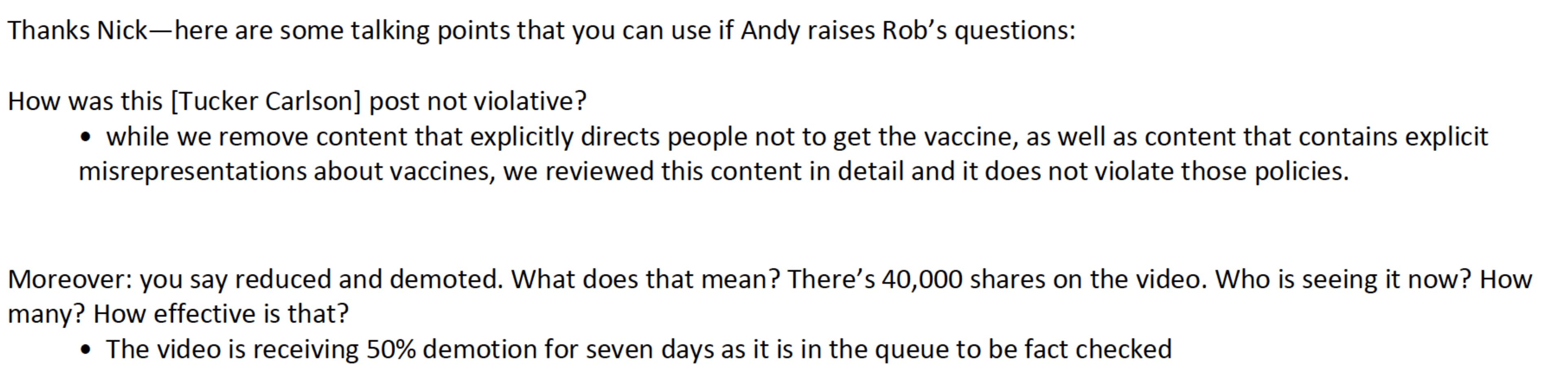
The Carlson video that was ripped at the time as “illogical conspiracy” wondered why the Biden government was saying, in April 2021, that you still need to wear a mask or socially distance, if the vaccines work. His was one of countless reports suppressed that were not violative and contained true information. Yet America’s paper of record in the lede of its thimble-sized recognition of a years-long censorship campaign focused on accounts “banned… because they violated rules that limited misinformation.” Yes, it acknowledged “non-violative” content below, but it’s become clear that papers like the Times and public figures are bending over backward to preserve the fiction that, yes, we censored, but we did it for the right reasons.
Representative Jim Clyburn in response to the Google news said it “wasn’t the same” as the Kimmel episode, because “it was a pandemic” and we couldn’t have “foolishness” and “misinformation” going on. (Note how CNN’s Abby Phillip swerves around the “non-violative” issue as well, audibling to a line about content the Biden administration “thought was disinformation.”) Meanwhile, Jake Tapper went on The Seth Myers Show and said the Jimmy Kimmel episode “was pretty much the most direct infringement by the government on free speech that I’ve seen in my lifetime”:
We’ve now moved to the stage of the Jimmy Kimmel story beyond immediate outrage and legit opposition to rank propaganda. It’s unconscionable for Tapper to say this in the same week that Google admitted submitting to “repeated and sustained” government pressure during the pandemic, pressure that happened to thousands of people instead of one and lasted years instead of days.
The pandemic speech clampdown was exactly the reason the First Amendment exists. As James Madison put it when arguing against the Alien and Sedition Acts, the state can’t use “previous restraint” to prevent criticism of its policies, because in the American system, “the people, not the government, possess the absolute sovereignty.” The obscenity of Clyburn’s point of view is in the idea that the state not only has the right to meddle with the press, but with the conversations between private citizens, and not just within the United States.
The sheer scale of the last Administration’s ambitions was breathtaking in this respect, and it’s only through a few lucky breaks (and the work of politicians like Jim Jordan) that we even know about the extent of it. For Tapper, ostensibly a news person, to look beyond such a vast amount of organized misconduct to pronounce the Kimmel episode the Worst Thing Ever is nuts.
The Trump Administration hasn’t exactly been a standard-bearer for speech. From Trump’s executive order on antisemitism to a deportations policy I join groups like FIRE in opposing to Carr’s unsubtle move on Disney (which counts as jawboning even if it wasn’t the reason for Kimmel’s suspension), this administration has bared fangs at the First Amendment more than once.
Even people who should know better, though, including some who were censored, seem to have forgotten what we escaped. What Google admitted to with regard to Covid, and what Meta and Twitter admitted to previously, represents the apotheosis of a decade-long effort to build a lavishly-funded, full-spectrum speech bureaucracy, whose vision included algorithmic “previous restraint” at the highest (e.g. Carlson) and most micro levels. That vision is in place in Europe, about which Google also complained (the Biden administration’s failure to help American companies resist laws like the Digital Services Act was another major offense). The hysteria over the Kimmel episode — Tapper’s CNN was breathlessly “counting down to Kimmel” before his return — has become a mechanism for burying that history. On speech, Trump just isn’t in the same universe as his predecessor, I suspect even Jake Tapper knows it, and the failure of people like him to admit it should worry anyone who cares about this issue.
Last year, former Hawaii Congresswoman and Presidential Candidate Tulsi Gabbard was placed in a surveillance program called Quiet Skies by the Transportation and Security Administration. Across eight flights she was subject to intrusive searches, followed by bomb-sniffing dogs, and trailed by three Federal Air Marshals per flight, who if they were following procedure were attempting to listen to her conversations, following her to airport exits to see who if anyone met her, and even recording how often and at what times she went to the bathroom.
To cover the story I contacted the TSA. They no-commented the main question – “TSA does not confirm or deny whether any individual has matched to a risk-based rule,” they said – but they added, as if in mitigation: ”Simply matching to a risk-based rule does not constitute derogatory information about an individual.”
In other words: “We can’t say if Ms. Gabbard was in the program, but if she was, don’t draw conclusions, because we do this even to innocent people.”
Before Quiet Skies was discontinued by this administration, it was a symbol of the steep decline of federal enforcement since 9/11. The government spent $200 million a year following up to 50 people a day for a program that in its history never once led to an arrest, or thwarted a single criminal act. Despite its demonstrated inutility and grave civil liberties concerns it was re-funded year after year because this is what our government does now: it gathers information on its own citizens as an end in itself.
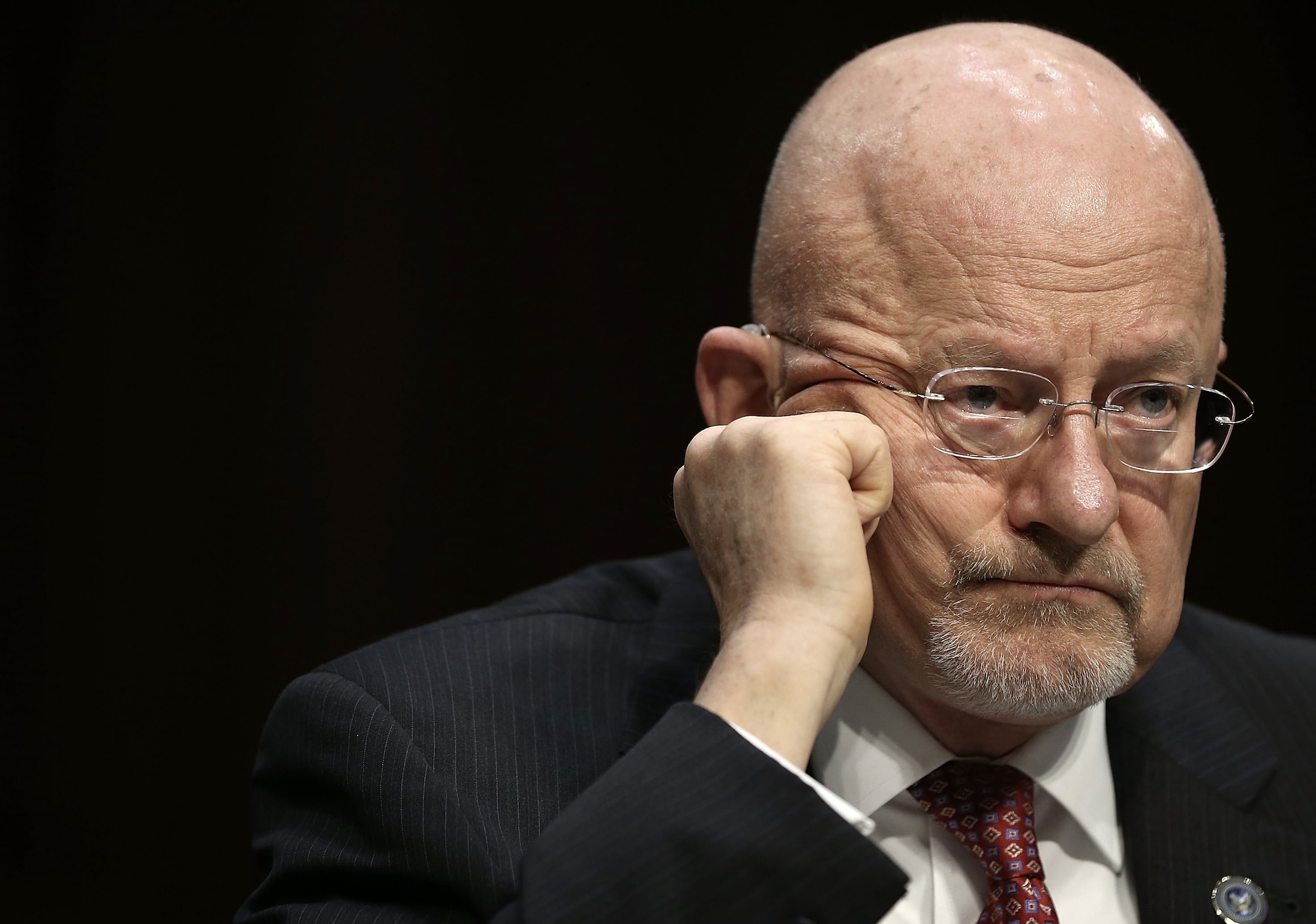
In a week in which the question of whether federal security officials always tell the truth to Congress is back in the news, it’s worth noting that it’s been 13 years since then-National Intelligence Director James Clapper answered, “No, sir,” and “Not wittingly” when Senator Ron Wyden of Oregon asked, “Does the NSA collect any type of data at all on millions, or hundreds of millions of Americans?”
Clapper later explained that he’d responded in the “least most untruthful manner.”
That episode solidified the principle that if you lie about mass surveillance programs in America, even under oath, you not only get to keep your job, you get to be hired as a professional truth-teller after retirement, a National Security Analyst for CNN. If you try to tell the truth about the same issues, your options are prison or leaving the country forever.
In those 13 years since, Americans became numb to surveillance. It was once a core principle that government couldn’t or shouldn’t spy on citizens without predication. Now much of the country accepts as inevitable the idea that every move we make is being recorded and analyzed.
We know emails and phone conversations are being collected passively, via programs of dubious legality, and the mountains of data we leave behind as our lives move online– from geolocations of cell phones to GPS tracking to travel, banking, and medical records – are increasingly fodder for overt and covert acquisition by federal analysts. As Google admitted last week, federal officials partnered with companies not just to monitor speech but to suppress it on a grand scale.
A lot of these changes have their roots in War on Terror programs that exchanged predication for a pre-crime theory out of Minority Report. Quiet Skies was the paradigmatic example of a program that could take endless liberties with the Constitution because it was secret. When you gather information with no intention of going to court, as the TSA did with Quiet Skies, you never have to justify yourself to a judge. This leads to a lot of what one court called “the exact sort of ‘general, exploratory rummaging’ that the Fourth Amendment was designed to prevent.”
This is a betrayal not just of the public but of people we trained at taxpayer expense to do real and important work. Former Marshal Robert MacLean put it best when he said “The air marshal’s job is to protect the cockpit and the pilots. Let somebody else do the intelligence.”
Similarly in the last decade current and former FBI agents – fellow witness Tristan Leavitt’s firm has represented a number of them – have talked about how since 9/11, the FBI spends less time building cases but does more generalized spying, much of it political. One agent I interviewed said “The distinction between people who believe bad thoughts and people who do bad things” has been “completely lost” on our government since 9/11.
Once you start down the road of collecting information on innocent people, it creates the intellectual justification for doing it again and again. From a contracting perspective, this is the proverbial self-licking ice cream cone, a spiral of endless expense. Morally, all this information-gathering reverses the natural political order, giving elected officials undeserved and unearned power over their bosses – the voters. These programs all need to be reevaluated. A lot of them have to go. People who lie about them in this chamber need to be fired.
Let’s hope the elimination of Quiet Skies is just the beginning. Thank you.
Last week, a 75-year-old grandmother named Rose Docherty was arrested in Scotland, for standing outside a hospital where abortions are performed while holding a sign that read: “Coercion is a crime, here to talk, only if you want.”
If that sentence sounds familiar, it’s because this was the second time Docherty has been arrested, for exactly the same reason.
In February, as my colleague Madeleine Kearns reported, Docherty was put in handcuffs and taken to a police station—because she had been silently holding the same sign outside the same hospital.
“I didn’t speak about abortion,” Docherty told The Free Press yesterday through her legal counsel. “I simply offered anyone the chance to chat about anything.”

No, friends, this is not satire.
President Trump recently boasted:
.@POTUS: “We’re going to take some of that tariff money that we made — we’re going to give it to our farmers… We’re going to make sure that our farmers are in great shape.”
A practically textbook example of Lerner Symmetry! In an earlier post, I highlighted Doug Irwin’s Three Simple Principles of Trade Policy. Principle One is Lerner Symmetry—a tax on imports is a tax on exports:
Exports are necessary to generate the earnings to pay for imports, or exports are the goods a country must give up in order to acquire imports….if foreign countries are blocked in their ability to sell their goods in the United States, for example, they will be unable to earn the dollars they need to purchase U.S. goods.
…The equivalence of export and import taxes is not an obvious proposition, and it is often counterintuitive to most people. Imagine taking a poll of average Americans and asking the following question: “Should the United States impose import tariffs on foreign textiles to prevent low-wage countries
from harming thousands of American textile workers?” Some fraction, perhaps even a sizeable one, of the respondents would surely answer affirmatively. If asked to explain their position, they would probably reply that import tariffs would create jobs for Americans at the expense of foreign workers and thereby reduce domestic unemployment.Suppose you then asked those same people the following question: “Should the United States tax the exportation of Boeing aircraft, wheat and corn, computers and computer software, and other domestically produced goods?” I suspect the answer would be a resounding and unanimous “No!” After all, it would be explained, export taxes would destroy jobs and harm important industries. And yet the Lerner symmetry theorem says that the two policies are equivalent in their economic effects.
Thus, President Trump is having to subsidize farmers because farmers are exporters. Import tariffs make it harder for exporters to sell abroad. Using tariff revenue to subsidize the losses of exporters is a textbook illustration of Lerner Symmetry because the export losses flow directly from the tax on imports! The irony is that President Trump parades the subsidies as a victory while in fact they are simply damage control for a policy he created.
The post Lerner Symmetry Bites appeared first on Marginal REVOLUTION.
From 1990 to 2010, rising numbers of H-1B holders caused 30–50 percent of all productivity growth in the US economy. This means that the jobs and wages of most Americans depend in some measure on these workers.
The specialized workers who enter on this visa fuel high-tech, high-growth sectors of the 21st century economy with skills like computer programming, engineering, medicine, basic science, and financial analysis. Growth in those sectors sparks demand for construction, food services, child care, and a constellation of other goods and services. That creates employment opportunities for native workers in all sectors and at all levels of education.
This is not from a textbook narrative or a computer model. It is what happened in the real world following past, large changes in H-1B visa restrictions. For example, Congress tripled the annual limit on H-1B visas after 1998, then slashed it by 56 percent after 2004. That produced large, sudden shocks to the number of these workers in some US cities relative to others. Economists traced what happened to various economic indicators in the most-affected cities versus the least-affected but otherwise similar cities. The best research exhaustively ruled out other, confounding forces.
That’s how we know that workers on H-1B visas cause dynamism and opportunity for natives. They cause more patenting of new inventions, ideas that create new products and even new industries. They cause entrepreneurs to found more (and more successful) high-growth startup firms. The resulting productivity growth causes more higher-paying jobs for native workers, both with and without a college education, across all sectors. American firms able to hire more H-1B workers grow more, generating far more jobs inside and outside the firm than the foreign workers take.
An important, rigorous new study found the firms that win a government lottery allowing them to hire H-1B workers produce 27 percent more than otherwise-identical firms that don’t win, employing more immigrants but no fewer US natives—thus expanding the economy outside their own walls. So, when an influx of H-1B workers raised a US city’s share of foreign tech workers by 1 percentage point during 1990–2010, that caused7 percent to 8 percent higher wages for college-educated workers and 3 percent to 4 percent higher wages for workers without any college education.
Here is the full piece.
The post Michael Clemens on H1-B visas appeared first on Marginal REVOLUTION.
Sensible people on the right and left are outraged about the fact that Federal Communications Commission chairman Brendan Carr threatened ABC over late-night host Jimmy Kimmel’s remarks about Charlie Kirk’s alleged assassin. But those angry tweets and think pieces about the importance of free speech and open markets don’t go far enough. The real issue is the existence of the FCC itself.
Whatever technical functions it might have once served—it was founded in 1934 to regulate the radio, among other forms of communications—the FCC now serves almost exclusively as a way for politicians to police speech and block business deals they don’t like, all under the maddeningly vague cover of serving “the public interest.” That one of Donald Trump’s very first executive orders issued this year reversed what he called the Biden administration’s attempts to trample “free speech rights by censoring Americans’ speech on online platforms, often by exerting substantial coercive pressure on third parties” only underscores the point. Trump was alluding to the jawboning uncovered in the Twitter Files and other investigations, but since resuming power, the president and his cabinet have felt free to openly bully media outlets, law firms, and private citizens.
“We can do this the easy way or the hard way,” Carr told MAGA podcaster Benny Johnson, sounding more like a mob enforcer than a bureaucrat committed to impartial implementation of rules. “These companies can find ways to change conduct and take action, frankly, on Kimmel, or there’s going to be additional work for the FCC ahead.”
Carr’s wish was granted. That day, Nexstar, the nation’s largest owner of television stations, including 32 ABC affiliates, was quick to announce it would not air Kimmel’s show for the foreseeable future. The company did not say whether its pending merger with Tegna and requests to loosen ownership rules, which need FCC approval, played any role in its decision. But it’s hard not to draw that conclusion.
 Yesterday, the United States entered a new and chilling stage of what I have called the “age of rage.” After two attempted assassinations of President Donald Trump, leading conservative leader Charlie Kirk, father of two, was gunned down at a campus event at Utah Valley University. I learned the news while I was in Prague to speak on my book,“The Indispensable Right: Free Speech in an Age of Rage” and the growing attacks on free speech around the world. I never imagined that I would be speaking about Charlie’s murder and what it represents for free speech.
I cannot claim to have been a close friend of Charlie Kirk, but I knew him and respected him. In his relatively short life, Charlie energized a generation of conservative college students at a time of intense liberal orthodoxy and intolerance.
Kirk came up with the brilliant idea of challenging liberals to simply debate issues from abortion to immigration. His group would go to campuses and invite debate with signs reading “prove me wrong” and encourage liberals to engage in dialogue rather than violence.
The left had particular reason to hate Kirk. Campuses have long been the bastions of the left, reinforced by faculties which now have few, if any, conservatives or Republicans. Higher education has long been an incubator for intolerance; shaping a generation of speech phobics who shout down or attack those with opposing views.
Kirk struck at the heart of that power base. Polls show that most students do not feel comfortable speaking about their values in our universities and many conservatives hide their views to avoid retaliation from faculty and students.
Kirk was changing that but showing students that they could be open and bold about their views. He told them that they did not have to yield to orthodoxy and the groupthink. Now he’s dead.
What is most chilling about the murder of Charlie Kirk is that it was not in the least surprising. Not anymore.
The response to TPUSA was all too often rage and violence. Liberals and anti-free speech groups like Antifa would trash their tables and threaten the students. Recently, at UC Davis, police simply watched as a TPUSA tent was torn apart and the tent carried off.
Violent speech has long been acceptable on campuses so long as it targets conservatives. Teachers have called for others to “take out” Trump supporters and for the Secret Service to assassinate him.
University of Wisconsin Professor José Felipe Alvergue, head of the English Department, turned over the table of College Republicans supporting a conservative for the Wisconsin Supreme Court. He reportedly declared, “The time for this is over!”
At universities, professors have called for “detonating white people,” denouncing police, calling for Republicans to suffer, strangling police officers, celebrating the death of conservatives, calling for the killing of Trump supporters, supporting the murder of conservative protesters, and supporting the attempted assassination of President Trump. One professor who declared that there is “nothing wrong” with such acts of violence as killing conservatives was actually promoted.
At Hunter College in New York, Professor Shellyne Rodríguez trashed a pro-life display of students, telling the students that “This is bulls–t. This is violent. You’re triggering my students.”
When the students tried to engage the professor and apologized for upsetting her, Rodríguez yelled, “No you’re not — because you can’t even have a f–king baby. So you don’t even know what that is. Get this s–t the f–k out of here.” In an Instagram post, she is then shown trashing the table.
Hunter College, however, did not consider this unhinged attack on students to be sufficient to terminate Rodríguez. It only fired her after she later chased reporters with a machete. She was then hired by another college. She was shown in a later rally exciting the group with references to “slitting the master’s throat.”
At the University of California Santa Barbara, they did not even bother to fire a professor who pleaded guilty to assaulting pro-life students on campus. Professors actually rallied around feminist studies associate professor Mireille Miller-Young. She was later honored as a model for women advocates at the University of Oregon.
In my book, I detail prior “ages of rage,” including periods of political violence by anarchists, socialists, and other groups. I previously warned that we were not only following this same trajectory, but it was accelerating. The reason is the curious nature of rage:
“What few today want to admit is that they like it. They like the freedom that it affords, the ability to hate and harass without a sense of responsibility. It is evident all around us as people engage in language and conduct that they repudiate in others. We have become a nation of rage addicts; flailing against anyone or anything that stands in opposition to our own truths.
Like all addictions, there is not only a dependency on rage but an intolerance for opposing views. The difference between rage and reason is often one’s own views. If one agrees with the underlying grievance, rage is viewed as passion or justified fury at injustice. If one disagrees with those views, it takes on a more threatening and unhinged quality. We seem to spend much of our time today raging at each other. Despite the amplification of views on both sides, there is also an increasing intolerance for opposing views. Those views are treated as simply harmful and offensive—and, therefore, intolerable. Indeed, to voice free speech principles in a time of rage is to invite the rage of the mob.”
That addiction to rage has now claimed another victim who had the audacity to speak boldly and openly about his conservative views. What will follow will be the usual perfunctory expressions of sympathy and denouncing of violence by the very politicians who have fueled the rage.
In recent months, some of us have warned Democratic politicians about their violent rhetoric. House Minority Leader Hakeem Jeffries (D., N.Y.) has called for people to take to the streets to save democracy and posted a picture brandishing a baseball bat.
Former Democratic National Committee deputy chair Keith Ellison, now the Minnesota attorney general, once said Antifa would “strike fear in the heart” of Trump. Liberal sites sell Antifa items to celebrate the violent group.
California Governor Gavin Newsom declared, “I’m going to punch these sons of bitches in the mouth.” It follows other violent rhetoric from Democratic leaders.
One House member explained to Axios, “Some of [our supporters] have suggested … what we really need to do is be willing to get shot.” Yet another admitted that constituents have told them to prepare for “violence … to fight to protect our democracy.” Others reported that liberals are talking about the need “to storm the White House and stuff like that.”
In one encounter, a lawmaker recounted that “I actually said in a meeting, ‘When they light a fire, my thought is to grab an extinguisher’. And someone at the table said, ‘Have you tried gasoline?’”
Some have. Protesters are burning cars, dealerships, and even lawyers and reporters on the left are throwing Molotov cocktails at police. We have also seen a massive increase in attacks on ICE officers, who are now covering their faces to avoid doxxing or retaliation against themselves or their families. The left has rolled out guillotines and chanted “We got the guillotine, you better run.”
Just before he was shot at Utah Valley University, Kirk rallied the group with its signature chant of “prove me wrong.” The response was to kill Charlie Kirk.
His death could succeed in forcing the thousands of conservative and libertarian students back into the shadows of our campuses and classrooms. We cannot allow that to happen. Charlie Kirk challenged not just the left to debate but the right to be heard in higher education.
Yes, this is an age of rage. However, amidst the rage and the violence, there are a special few who have defied the threats and the attacks. The writer George Bernard Shaw once said that unreasonable people expect the world to conform to them. He then added that that was why all history is made by unreasonable people.
Kirk was one of those wonderfully unreasonable people who refused to yield; refused to be silenced. Despite unrelenting attacks by the media and the establishment, he remained undeterred and unbowed. Students need to remember not how Kirk died, but why he died. His loss is Charlie’s final challenge to all those today wringing their hands and muttering the usual expressions of shocked regret. Kirk would likely say, “prove it.” Speak. Defy those who spend their time silencing others rather than speaking themselves. If you want to honor Charlie Kirk, speak out, speak boldly on both the right and the left. Prove them wrong.
Jonathan Turley is the Shapiro professor of public interest law at George Washington University and the author of the best-selling “The Indispensable Right: Free Speech in an Age of Rage.”
The Only Medical Specialty That Survives on Lies
by Peter C. Gøtzsche at Brownstone Institute

I am a specialist in internal medicine and have a keen interest in statistics and research methodology.1 My general approach to science has led to publications in many different areas because people came to me when they suspected something fishy in their specialty.1
In 2007, midwife Margrethe Nielsen from the Danish Consumer Council wanted to find out if history was repeating itself. I offered her a PhD student scholarship and we found out that the withdrawal symptoms are very similar for depression drugs and benzodiazepines, but they were described as dependence only for the latter.2
This started my interest in psychiatry and I quickly realised that a lot else was also misrepresented in this specialty. The lies psychiatrists convey to the public are so common and so harmful for their patients that I published my own textbook of psychiatry where I document what is wrong in the official textbooks used by medical students and psychiatrists in training.3 Much of what is claimed in the textbooks is scientifically dishonest, and frequently cited research is often totally unreliable because the data were tortured till they confessed.4
Psychiatry is the only specialty I know of that causes more harm than good; in fact, vastly more harm than good.5 This disaster can only survive because psychiatrists constantly lie to the public about what they can achieve with their drugs. Psychiatrists also routinely violate elementary human rights about informed consent and use forced treatment even though it is harmful.5,6
The title of my most recent psychiatry book summarises the issues: “Is psychiatry a crime against humanity?”5 As you shall see, I am not exaggerating.
In January 2014, I published the article, “Psychiatry gone astray,” in a major Danish newspaper, which also came out in English.7 I described ten myths in psychiatry that are harmful for the patients:
Myth 1: Your disease is caused by a chemical imbalance in the brain.
Myth 2: It’s no problem to stop treatment with antidepressants.
Myth 3: Psychotropic drugs for mental illness are like insulin for diabetes.
Myth 4: Psychotropic drugs reduce the number of chronically ill patients.
Myth 5: Happy pills do not cause suicide in children and adolescents.
Myth 6: Happy pills have no side effects.
Myth 7: Happy pills are not addictive.
Myth 8: The prevalence of depression has increased a lot.
Myth 9: The main problem is not overtreatment, but undertreatment.
Myth 10: Antipsychotics prevent brain damage.
I explained why “Our citizens would be far better off if we removed all the psychotropic drugs from the market, as doctors are unable to handle them. It is inescapable that their availability creates more harm than good. Psychiatrists should therefore do everything they can to treat as little as possible, in as short a time as possible, or not at all, with psychotropic drugs.”
I hit some sore toes. There was an outcry, spearheaded by the drug industry and their paid allies among doctors and the media, but also the biggest debate in Denmark ever about psychiatric drugs.1,6 For more than a month, there wasn’t a single day without discussion of these issues on radio, TV, in newspapers, and at psychiatric departments. But sadly, the harmful business continued as usual.
Psychiatric drugs do not have any specific effects, directed against a specific disease.8 Psychiatric disorders are merely a constellation of symptoms and psychiatric drugs have mainly two effects: They either sedate and numb people, or they stimulate them.
Brain-active drugs have such effects, e.g., also alcohol, opioids, cannabis, other psychedelics, and cocaine, but we don’t call such drugs antidepressants or antipsychotics. And the effect of antidepressants and antipsychotics is far below the minimally relevant effect, as established by the psychiatrists themselves in their research.3,6 It is therefore reasonable to say that they don’t work.
The most important effects of psychiatric drugs are not what you hear about. Because of the colossal overuse of the drugs, they are the major reason that our prescription drugs are the leading cause of death, ahead of heart disease and cancer.9 One in five citizens is on an antidepressant, which can cause falls, and when elderly people break their hip, one-fifth will die within the next year.
Many of those who don’t die will fare badly anyhow. In all countries where the relationship has been examined, the rates of disability pensions go up in tandem with increased usage of psychiatric drugs.10
You don’t hear much about sexual disturbances either. The so-called happy pills harm the sex life in half the patients, and in half of those patients, the harm is unacceptable.11 In some patients, the harms are irreversible and continue after the patients come off their drugs, which has led to suicide.12
Psychiatrists, particularly those in high positions, routinely lie to the public with the intent to protect their guild interests and their financial interests, which are huge. In the US, there are more psychiatrists collecting payments from the pharma industry than any other type of specialist.13
The American Psychiatric Association (AMA) is corrupt. Many of the psychiatrists who invented the most foolish diagnoses in its Diagnostic and Statistical Manual (DSM) for psychiatric disorders, which expanded hugely the market for psychiatric drugs, were on industry payroll. But they are not open about it. The DSM-5-TR panel members received $14 million in undisclosed industry funding.14 To a European, this is an obscene level of corruption.
The worst lie is this one: Psychiatrists routinely tell their patients that they are ill because they have a chemical imbalance in the brain and that they will receive a drug that fixes this.
An associated lie is that withdrawal effects, when the patients try to come off their drugs, are trivial, and not withdrawal effects at all, but signs that their disease has relapsed and that they still need the drugs.15
In 2018, leaders in the UK Royal College of Psychiatrists wrote in the Times that, “in the vast majority of patients, any unpleasant symptoms experienced on discontinuing antidepressants have resolved within two weeks of stopping treatment.”5 A group of clinicians and academics, including me, wrote to the authors that their statement was incorrect and that the College’s own survey of over 800 patients had found that withdrawal symptoms were experienced by 63% of the patients and that a quarter reported anxiety lasting more than 12 weeks.
The College immediately removed its survey from its website and when they refused to correct the error, we made our complaint public, which was covered by the BBC. Later, psychiatrist Sir Simon Wessely, previous president of the College, rejected any link between the pills and suicide and stated categorically in a podcast that they are “not addictive.”
We then published a most damning letter in the BMJ.16 Since guidelines from the National Institute for Health and Care Excellence (NICE) stated that withdrawal symptoms were “usually mild and self-limiting over about 1 week,” we asked for the evidence. NICE provided two short review articles, neither of which supported the one-week claim, and both articles cited numerous sources that contradicted it!
The embarrassment was now so big that the College needed to change its stance and NICE updated its guidelines.
This is one of the very rare instances where protests about psychiatry’s lies have led to any change. But the organised denial just continued. In 2025, a highly flawed systematic review in JAMA Psychiatry claimed that antidepressant withdrawal is not a problem.17,18 As usual, the authors postulated that depression after discontinuation is indicative of depression relapse.
To spread a little candlelight in the psychiatric darkness, I invented the term abstinence depression, which is not a true depression.3,18 The fact is that about half of the patients experience withdrawal effects; in half of the cases they are severe; and when patients try to stop, they often become worse than they were before they started on the drug.19 Moreover, the longer one is on the drugs, the higher the risk of withdrawal.19,20
The lies about a chemical imbalance and that abstinence symptoms are signs of relapse keep patients on their drugs for many years. Why would they ever stop when it is so clear that they need the drugs? But we don’t argue this way in relation to abuse of alcohol or narcotics. The patients never had a chemical imbalance causing their problems; but the drugs created one21,22 and caused harm.
Another big selling point is that you only need to treat a couple of patients to benefit one of them. This is also a huge lie. Psychiatric drugs cannot cure anyone. And the illusion of huge benefits is obtained by statistical manipulation.23 The trick is to dichotomise disappointing outcome data on a ranking scale and talk about response rates instead.24
This statistical hocus-pocus can convert a non-existing benefit into an almost doubling of the response rate,24 which looks very impressive. But as psychiatrist Joanna Moncrieff wrote, it is spinning straw into gold transforming ineffectiveness into the much-trumpeted idea that antidepressants work.25
The number needed to treat to benefit one patient (NNT) doesn’t exist because more patients are harmed than those who benefit. There can therefore only be a number needed to harm (NNH), which is two for sexual harms caused by antidepressants.11
Harms and benefits are rarely measured on the same scale, but when patients in a placebo-controlled trial decide whether it is worthwhile to continue in the trial, they make a judgment about if the benefits they perceive exceed the harms. My research group found that 12% more patients dropped out on a depression pill than on placebo (P < 0.00001).26 Thus, the patients will benefit by NOT being treated with antidepressants. They prefer a placebo.
The US National Institute for Mental Health (NIMH) is the most prestigious psychiatric institution in the world. In 2022, Thomas Insel, its director from 2002 to 2015, called “America’s psychiatrist,” published the book, “Healing: Our Path From Mental Illness to Mental Health.”
Insel takes on the role of a drug rep, selling the wonders of psychiatric drugs to the public, but his book is misleading and dishonest.5 It starts already with the title. Psychiatric drugs cannot heal mental disorders, and the path the psychiatrists have taken is not from mental illness to mental health, but from bad to worse. Clearly, Insel makes an unintended case for abolishing psychiatry even though he tries to support it.27
The book reflects the thinking of psychiatric leaders everywhere and encapsulates how psychiatry has consistently betrayed public trust and misinformed the public, and that it will never tell the public the truth about psychiatric drugs.
Being a former NIMH director, Insel had an ethical obligation to tell his readers about the negative long-term outcomes of treatment with psychiatric drugs, as documented in expensive and prestigious research funded by the NIMH, e.g. the STAR*D trial in depression – a $35 million fraud - the MTA trial in ADHD, and the CATIE trial in schizophrenia.5 He didn’t, even though the NIMH is the only institution in the world that funds the big, long-term drug trials. As psychiatric leaders always do, Insel sacrificed the patients and protected the psychiatric guild by keeping the long-term studies financed by his own institute hidden.
In January 2025, I notified the UK drug regulator, the Medicines & Healthcare products Regulatory Agency (MHRA), that the package inserts for antidepressants — called patient information leaflets (PIL) — contain false statements about depression being caused by a chemical imbalance, and I called for the misleading messages to be removed.28
The MHRA refused and when I sent a letter about this to four major UK newspapers and the Royal College of Psychiatrists with Joanna Moncrieff and others, they didn’t even have the courtesy to respond.
To paraphrase Lenin, editors of leading medical journals also behave like useful idiots for psychiatry and the drug industry. On 10 May 2025, an anonymous editorial in the Lancet, “50 years of SSRIs: weighing benefits and harms,” did little of what its title promised. It praised the drugs based on flawed research and glossed over the harms. When I pointed out how misleading the editorial was in a letter to the editor, it was rejected.28
Many Cochrane reviews of psychiatric drugs also contain misleading praises of the drugs and are garbage in, garbage out exercises that uncritically reproduce the flawed data the drug industry has published.1,5,29-31
Despite their pompous designation, “State of the Art” articles in leading medical journals are usually misleading and they are particularly dishonest in relation to suicides.1 A 19-page review in the BMJ claimed that depression drugs, lithium, antiepileptics, clozapine, ketamine, and electroshock can decrease the risk of suicide.32 None of the 159 references were convincing;33 the package inserts for depression drugs warn against the risk of suicide; and the package inserts for antiepileptics state that they double the risk of suicide!
In a 14-page Lancet suicide seminar from 2022, the authors tried to resurrect the lie about the chemical imbalance but the two articles they cited were gobbledygook.34,35 Among risk factors for suicide, they mentioned substance use but not depression pills, antiepileptics, or the psychiatric profession itself.35,36 A Danish register study of 2,429 suicides showed a very marked dose-response relationship:36 The closer the contact with psychiatric staff, the greater the risk of suicide.
Compared to people who had not received any psychiatric treatment in the preceding year, the adjusted rate ratio for suicide was 44 for people who had been admitted to a psychiatric hospital.36 Such patients would of course be expected to be at greatest risk of suicide because they were more ill than the others (confounding by indication), but the findings were robust and most of the potential biases in the study were actually conservative, i.e. favoured the null hypothesis of there being no relationship. An accompanying editorial noted that there is little doubt that suicide is related to both stigma and trauma and that it is entirely plausible that the stigma and trauma inherent in psychiatric treatment—particularly if involuntary— might cause suicide.37
The Lancet authors wrote that there is a possibility of exacerbating suicidal thoughts. Wrong. It is not a possibility; it is a fact. None of the 142 references were to any of the many meta-analyses showing that depression pills increase the suicide risk compared to placebo. The authors even claimed, with no references, that drug treatment can reduce the suicide risk. Which miraculous drugs can do this?
They also noted that some research has found an association with increased risk of suicide-related outcomes in young people. This is also dishonest. When the FDA looked at all the randomised trials, they found a causal relation and not just an association.
In 2023, the “experts” failed us badly again. A 16-page article in BMJ about suicide in young people, with 169 references, mentioned some risk factors, e.g. living in a home with firearms, but not depression drugs, which they recommended with “increased monitoring by the prescribing physician.”38 This is a fake fix, as people may kill themselves suddenly and unexpectedly.39
The authors considered a risk difference of 0.7% for suicidal ideation or suicide attempt between drug and placebo small and even dismissed it: “Data from more recent pediatric antidepressant trials have not shown differences between drug and placebo.” The review they quoted cannot be used to such effect and for rare events, it is unacceptable to lose statistical power by including only “recent” trials. Moreover, the review only included published trial reports, which we know have omitted many suicide attempts and suicides, even in children.6,39 It is irresponsible of the BMJ to publish such dangerous nonsense.
In 2023, I called for retraction of three fraudulent trial reports that had omitted suicidal events in children.40 Even though my letter was co-signed by 10 people who each lost a child or spouse to suicide as a direct consequence of being prescribed an antidepressant drug for a non-psychiatric condition, my request was turned down by both involved journals.41
Annette Flanagin, Executive Managing Editor, Vice President, Editorial Operations JAMA and JAMA Network, replied: “We shared your letter with the author of the study published in Archives of General Psychiatry and he does not identify any new concerns. Similarly, we do not find new evidence in support of your request to retract this article.”
So, JAMA and Graham Emslie, who omitted two suicide attempts on fluoxetine, do not think this is something to bother about. When I contacted the journal’s owner, Elsevier, they did not engage with our concerns but directed me back to the journal.
Douglas K. Novins, Editor-in-Chief, Journal of the American Academy of Child & Adolescent Psychiatry (JCAAP), wrote to me that, “Following guidelines developed by the Committee on Publication Ethics (COPE),” they had thoroughly reviewed my “critique, as well as the responses provided by the papers’ authors. We are satisfied that the critiques of the papers as outlined do not merit retraction.”
It is hard to see how Novins could have followed the COPE guidelines, as the two trial reports, by Emslie and Martin Keller, are clearly fraudulent.
In 2023, I did a Google search on suicide and antidepressants, which confirmed that the public is being massively and systematically misinformed.42,43 One of the top 10 posts was from the Danish Centre for Suicide Research that reported that depression drugs increase the risk of repeated suicide attempts by 50%.44 The research was supported by Lundbeck, and after the researchers had adjusted their analyses for many factors including psychiatric contact and use of various psychiatric drugs, they concluded that the pills do not increase the risk of suicide. It is plain wrong to adjust for something that is part of the causal chain, as it may remove a true association, but the authors surely pleased their funder.
Another post was a comment I made on the Danish Board of Health's website.45 Poul Videbech, a national icon in depression, had claimed in the Board’s journal, Rational Pharmacotherapy, that undertreatment with depression drugs is dangerous because of the suicide risk. This cannot be correct because the drugs increase the risk of suicide.
When I searched the Internet to find out what the “experts” opine currently, I found a systematic review in the psychiatrists’ flagship journal, American Journal of Psychiatry.46 It was about “evidence-based strategies,” but already the abstract was blatantly false. It claimed that “Meta-analyses find that antidepressants prevent suicide attempts.”
I don’t know of any other medical specialty whose practitioners lie systematically to the public in matters of life and death and claim the opposite of what is true.
In June 2025, I gave a talk in Capitol about suicides caused by antidepressants, invited by US war veterans who are routinely given these drugs for their war traumas.47 As expected, the effect of the veterans’ suicide prevention programme has been a notable increase in suicides corresponding to a similar increase in antidepressant usage.48,49
In the surreal upside-down world of psychiatry, all suicide prevention initiatives I have come across have included drugs that increase suicides!50
There was a press conference outside the Capitol,47 but the media are not keen to write stories about antidepressants killing people. I only saw an article in the Wall Street Journal, which I tweeted about:
Combat cocktails: US war veterans are destroyed and kill themselves because of psychiatric polypharmacy. Wall Street Journal https://bit.ly/4fjkz5P.
New winds are blowing in the US, which could profoundly change healthcare for the better.51 On 21 July 2025, the FDA held a two-hour seminar about the possible harms to the foetus of treating pregnant women with antidepressants.52 For the first time, this crucial issue was honestly debated at the FDA, by good scientists, but this could not be tolerated by the professional liars.
There was a howl of outrage from psychiatric organisations and mainstream media that accused the FDA’s panel of being alarmingly unbalanced and of spreading misinformation,53-55 which was not at all the case.
The American Psychiatric Association (AMA) wrote to the FDA four days after the meeting that it was “alarmed and concerned by the misinterpretations and unbalanced viewpoints shared by several of the panelists…This propagation of biased interpretations at a time when suicide is a leading cause of maternal death within the first postpartum year could seriously hinder maternal mental health care. The inaccurate interpretation of data, and the use of opinion, rather than the years of research on antidepressant medications, will exacerbate stigma and deter pregnant individuals from seeking necessary care.”
The AMA could hardly have been more dishonest. Antidepressants double not only the risk of suicide but even actual suicides.49,56
Without mentioning the pregnancy issue, the AMA circled the wagons again, in a tweet on 28 August:57
“IMPORTANT: Decades of rigorous research, randomized clinical trials, peer-reviewed studies, meta-analyses, national registry studies, and FDA oversight show that psychiatric medications are safe and effective. Medications like SSRIs can be lifesaving if they are taken as directed under the care of an appropriately licensed healthcare professional. Learn more: https://ow.ly/RWEQ50WNJeI.“
In just two sentences, the AMA propagated three lies. No psychiatric drug is safe. They all kill people, to a substantial degree.1,3,5,6,9 And it has never been documented that SSRIs can be life-saving while it has been documented that they take many lives. They cause suicides and homicides6 and lead to falls in the elderly,9 and when they break their hip, one-fifth will die within the next year. Psychiatric medications are not effective either, e.g. the effect of antidepressants and antipsychotics is far below the minimally relevant effect, as established by the psychiatrists themselves in their research.5,6
Not even when there is clear evidence, both from studies in animals and humans,52-55 that our children are being harmed by psychiatric drugs before they are even born, do we see any admission from the AMA that it is wrong to treat pregnant women with antidepressants. They prefer to continue lying.
Antidepressants should be banned for use in pregnant women. Psychotherapy is more effective, as it has enduring effects,5,6 and it won’t harm the unborn child.
Increasingly, the public is waking up to psychiatry’s deceptions. People are not so dumb as the AMA thinks they are, which the retweets to AMA’s tweet57 demonstrate:
“The FDA issues a black box warning for all SSRI's indicating increased risk of suicidal thoughts and behaviors, particularly in children, adolescents, and adults under 25. How could the American Psychiatric Association make such a claim? (sic) Isn't doing so extremely unethical?!”
“The APA is lying to you. SSRIs are neither safe nor effective. NOT EVEN CLOSE. And they do not magically perform better under the care of a licensed professional. Them's the facts.”
“Anytime I hear experts so-called say something is safe and effective. I immediately know that that is not the case. Thank you for confirming my suspicion.”
“Merriam-Webster defines ‘safe’ as ‘free from danger, harm, or risk.’ All classes of psych meds include black box warnings about serious or life-threatening adverse effects risks.”
“How safe is sudden death? Some of those meds can cause that.”
“Life-taking. My adult son didn’t make it past 6 weeks after his #PillPusher prescribed SSRIs within 15min of meeting him.”
“What percentage of patients who take SSRIs are cured and can stop taking them?”
“I don’t know a single person who has been cured by psychiatric drugs.”
“The good 'ol APA, brought to you by Pfizer. Maybe they will make a med for cognitive dissonance soon?”
“Psychiatry is quackery. Read the book Anatomy of an Epidemic by Robert Whitaker!”
“Psychiatry is one of the dumbest religions.”
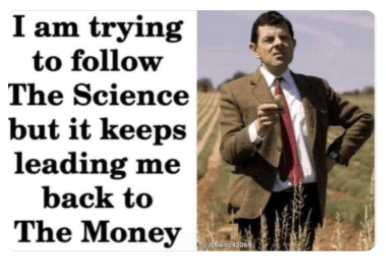
A retweeter showed this picture of Mr. Bean, which sort of explains it all:
Psychiatry is a totally corrupt specialty, ethically, scientifically, and financially, with devastating consequences for the patients, their relatives and friends, and for our national economies.
Psychiatry is a crime against humanity that must be stopped.5 It should not be a medical specialty, and patients with mental health issues should not be treated by medically trained doctors because the existing approaches, which focus on drugs, are not working.
In the UK, mental health disability has almost tripled in recent decades, and the gap in life expectancy between people with severe mental health issues and the general population has doubled.58 The World Health Organisation (WHO) and the United Nations have therefore recently called for systematic mental health reform emphasising psychosocial interventions.58
My advice to patients is: If you have a mental health issue, don’t see a psychiatrist. It is too dangerous and might turn out to be the biggest error you made in your entire life.12,59 Don’t look up a family doctor either, as they are also programmed to make psychiatric diagnoses and hand out psychiatric pills.
1 Gøtzsche PC. Whistleblower in healthcare (autobiography). Copenhagen: Institute for Scientific Freedom 2025; April 8 (freely available).
2 Nielsen M, Hansen EH, Gøtzsche PC. What is the difference between dependence and withdrawal reactions? A comparison of benzodiazepines and selective serotonin re-uptake inhibitors. Addiction 2012;107:900–8.
3 Gøtzsche PC. Critical Psychiatry Textbook: a new psychiatry is needed. Copenhagen: Institute for Scientific Freedom 2023; May 17.
4 Mills JL. Data torturing. N Engl J Med 1993;329:1196-9.
5 Gøtzsche PC. Is psychiatry a crime against humanity? Copenhagen: Institute for Scientific Freedom; 2024 (freely available).
6 Gøtzsche PC. Deadly pPsychiatry and Organised Denial. Copenhagen: People’s Press; 2015.
7 Gøtzsche PC. Psychiatry gone astray. Mad in America 2014; Jan 28.
8 Moncrieff J. The Myth of the Chemical Cure: A Critique of Psychiatric Drug Treatment. Basingstoke: Palgrave Macmillan; 2007.
9 Gøtzsche PC. Prescription Drugs Are the Leading Cause of Death. Brownstone Journal 2024; April 16.
10 Whitaker R. Anatomy of an Epidemic, 2nd edition. New York: Broadway Paperbacks; 2015.
11 Montejo A, Llorca G, Izquierdo J, et al. Incidence of sexual dysfunction associated with antidepressant agents: a prospective multicenter study of 1022 outpatients. Spanish Working Group for the study of psychotropic-related sexual dysfunction. J Clin Psychiatry 2001;62 (suppl 3):10–21.
12 Gøtzsche PC. Mental Health Survival Kit and Withdrawal from Psychiatric Drugs. Ann Arbor: L H Press; 2022.
13 Staton T. Psychiatrists dominate doc-payment database. Fierce Pharma 2010; Oct 25.
14 Burton KW. DSM-5-TR Panel Members Received $14M in Undisclosed Industry Funding. Medscape 2024; Jan 10.
15 Gøtzsche PC, Demasi M. Interventions to help patients withdraw from depression drugs: A systematic review. Int J Risk Saf Med 2024;35:103-16.
16 Davies J, Read J, Hengartner MP, et al. Clinical guidelines on antidepressant withdrawal urgently need updating. BMJ 2019;365:l2238.
17 Kalfas M, Tsapekos D, Butler M, et al. Incidence and nature of antidepressant discontinuation symptoms: a systematic review and meta-analysis. JAMA Psychiatry 2025;Jul 9:e251362.
18 Gøtzsche PC. Exposing the Lie That Antidepressant Withdrawal Symptoms are Mild and Short-Lived. Brownstone Journal 2025; July 25.
19 Davies J, Read J. A systematic review into the incidence, severity and duration of antidepressant withdrawal effects: Are guidelines evidence-based? Addict Behav 2019;97:111-21.
20 Horowitz MA, Buckman JEJ, Saunders R, et al. Antidepressants withdrawal effects and duration of use: a survey of patients enrolled in primary care psychotherapy services. Psychiatry Res 2025;350:116497.
21 Moncrieff J, Cohen D. Do antidepressants cure or create abnormal brain states? PLoS Med 2006;3:e240.
22 Moncrieff J, Cooper RE, Stockmann T, et al. The serotonin theory of depression: a systematic umbrella review of the evidence. Mol Psychiatry 2023;28:3243-56.
23 Gøtzsche PC. Number needed to treat with a psychiatric drug to benefit one patient is an illusion. Mad in America 2022; Dec 13.
24 Gøtzsche PC. Response Rates in Psychiatric Drug trials are Statistical Nonsense. Brownstone Journal 2025; July 11.
25 Moncrieff J. Chemically Imbalanced: The Making and Unmaking of the Serotonin Myth. Padstow: Flint; 2025.
26 Sharma T, Guski LS, Freund N, et al. Drop-out rates in placebo-controlled trials of antidepressant drugs: A systematic review and meta-analysis based on clinical study reports. Int J Risk Saf Med 2019;30:217-32.
27 Whitaker R. Thomas Insel makes a case for abolishing psychiatry. Mad in America 2022; Apr 30.
28 Gøtzsche PC. Protecting the false narrative about antidepressants. Mad in America 2025; July 7.
29 Gøtzsche PC. Cochrane recommends antidepressants for anxiety in a garbage in, garbage out review. Mad in America 2025; July 29.
30 Gøtzsche PC. Garbage in, garbage out: the newest Cochrane meta-analysis of depression pills in children. Mad in America 2021; Aug 19.
31 Gøtzsche PC. Cochrane reviews of psychiatric drugs are untrustworthy. Mad in America 2023; Sept 14.
32 Bolton JM, Gunnell D, Turecki G. Suicide risk assessment and intervention in people with mental illness. BMJ 2015;351:h4978.
33 Gøtzsche PC. No psychiatric drugs have been convincingly shown to decrease suicides. BMJ 2015; Dec 10.
34 Knipe D, Padmanathan P, Newton-Howes G, et al. Suicide and self-harm. Lancet 2022;399:1903-16.
35 Gøtzsche PC. A hopelessly flawed seminar in “The Lancet” about suicide. Mad in America 2022; June 1.
36 Hjorthøj CR, Madsen T, Agerbo E, et al. Risk of suicide according to level of psychiatric treatment: a nationwide nested case-control study. Soc Psychiatry Psychiatr Epidemiol 2014;49:1357–65.
37 Large MM, Ryan CJ. Disturbing findings about the risk of suicide and psychiatric hospitals. Soc Psychiatry Psychiatr Epidemiol 2014;49:1353–5.
38 Hughes JL, Horowitz LM, Ackerman JP, et al. Suicide in young people: screening, risk assessment, and intervention. BMJ 2023;381:e070630.
39 Gøtzsche PC. Depression drugs have been shown to double the risk of suicide in young people and should not be used. BMJ 2023; April 26.
40 Gøtzsche PC. Call for retraction of three fraudulent trial reports of antidepressants in children and adolescents. Institute for Scientific Freedom 2023; Aug 3.
41 Gøtzsche PC. Medical journals refuse to retract fraudulent trial reports that omitted suicidal events in children. Mad in America 2024; Mar 18.
42 Gøtzsche PC. The lie that antidepressants protect against suicide is deadly. Mad in America 2023; Nov 28.
43 Gøtzsche PC. So-called suicide experts recommend antidepressants, which increase suicides. Mad in America 2024; Oct 24.
44 Jakobsen SG, Christiansen E. Selvmordsforsøg og antidepressiva. Center for Selvmordsforskning 2019; Dec.
45 Gøtzsche PC. Misinformation om antidepressiva og selvmord. www.irf.dk 2015; March 5.
46 Mann JJ, Michel CA, Auerbach RP. Improving suicide prevention through evidence-based strategies: a systematic review. Am J Psychiatry 2021;178:611-24.
47 Harris L. Veterans Take Their “War Cry For Change” to Capitol Hill. Mad in America 2025; June 14.
48 Gøtzsche PC. Suicides increase after national suicide prevention introduced. Mad in America 2025; Feb 20.
49 Gøtzsche PC. Observational studies confirm trial results that antidepressants double suicides. Mad in America 2025; Feb 8.
50 Gøtzsche PC. So-called suicide experts recommend antidepressants, which increase suicides. Mad in America 2024; Oct 24.
51 Kennedy: A new time for America? Filmed interview with Peter C. Gøtzsche. Broken Medical Science 2025; Jan 12.
52 FDA Expert Panel on Selective Serotonin Reuptake Inhibitors (SSRIs) and Pregnancy. YouTube 2025; July 21.
53 Whitaker R. Not even the unborn are safe from psychiatric harm. Mad in America 2025; Aug 23.
54 Moncrieff J, Urato A. Antidepressants in Pregnancy -Turning a Blind Eye, Again. Mad in America 2025; Aug 25.
55 Gøtzsche PC. Psychiatrists Deny the Harm of Antidepressants for the Fetus. Brownstone Journal 2025; Aug 30.
56 Hengartner MP, Plöderl M. Reply to the Letter to the Editor: “Newer-Generation Antidepressants and Suicide Risk: Thoughts on Hengartner and Plöderl’s ReAnalysis.” Psychother Psychosom 2019;88:373-4.
57 American Psychiatric Association tweet. X 2025; Aug 28.
58 Shifting the balance towards social interventions: a call for an overhaul of the mental health system. Beyond Pills All-Party Parliamentary Group 2024; May.
59 Breggin P. The most dangerous thing you will ever do. Mad in America 2020; March 2.
The Only Medical Specialty That Survives on Lies
by Peter C. Gøtzsche at Brownstone Institute - Daily Economics, Policy, Public Health, Society
Why do media outlets the world over publish the same dubious climate scare stories? Daily Sceptic Environment Editor Chris Morrison peers behind the curtain to find out who's behind the carefully curated narrative.
The post Who’s Behind the Carefully Curated Global Climate Narrative? appeared first on The Daily Sceptic.
Jts5665They could stop prioritizing the tweet policing without the law changing, I would think.
Met supremo Sir Mark Rowley wants the law changed so police can stop policing harmless tweets, avoid getting pulled into culture war battles and focus on real-world crime instead.
The post Change Law so We Can Stop Policing Tweets, Demands Met Chief appeared first on The Daily Sceptic.
1. “Yes, we know stablecoins will have one hundred percent reserves, but we are not sure we can regulate that system into a position of safety.”
2. “Well, the rest of the financial system has nothing like one hundred percent reserves, but don’t worry we have everything there under control.”
The hole is large enough to drive a truck through. Keep this contrast in mind, because you will be hearing it, expressed in other terms of course, hundreds of times over the next year or so.
The post What the financial regulators are saying and feeling appeared first on Marginal REVOLUTION.
Trump has made various sallies against the idea of an independent Fed, including lots of rhetoric, firing Lisa Cook, aiming to have a CEA chair on the Fed board, and more. Probably the list is longer than I realize.
To be clear, I see no upside to these moves and I do not favor them. That said, I am not surprised that markets are not freaking out.
People, the Fed was never that independent to begin with!
Come 2008, the Fed, Treasury, and other parties sat down and worked out a strategy for dealing with the financial crisis. The Fed has a big voice in those decisions, but ultimately has to go along with the general agreement.
Circa, 2020-2021, with the pandemic, the same kind of procedure applied.
You may or may not like the particular decisions that were made (too little inflation the first time, too much inflation the second time), but I don’t think there is a very different way to proceed in those situations.
And given recent budgeting decisions, fiscal dominance may lie in our future in any case. The Fed is not immune from those pressures.
The Fed is most “independent” when the stakes are low and most people are happy with (more or less) two percent inflation. That is also when the independence matters least.
The real problem comes when the quality of governance is low. Then encroaching on central bank independence simply raises the level of stupidity. Some of that is happening right now.
A non-independent central bank can work just fine when the quality of government is sufficiently high. New Zealand has had a non-independent central bank since the Reserve Bank Act of 1989 (before that it had a non-independent central bank in a different and worse way). There is operational independence, but an inflation target is set in conjunction with the government. You may or may not favor this approach, but it has not been a disaster and it helped to lower Kiwi inflation rates significantly and with political cover.
Way back when, Milton Friedman used to argue periodically that Congress should set the rate of price inflation and take responsibility for it. I think that is a bad idea, especially today, but it should cure you of the notion that “independence” is sacrosanct. Every system has some means of accountability built in, and indeed has to.
I know all those scatter plot graphs that correlate central bank independence with lower inflation rates. In my view, if you could insert a true “quality of government” extra variable, the correlation mostly vanishes. Plus I do not trust the measures of independence that are used.
As Gandhi once said — “Central bank independence, it would be a good idea!”
Addendum: I also find it a little strange that many critics of the Trump actions earlier had been calling for higher inflation targets, say three or even four percent. That is maybe not an outright contradiction, but…the Fed isn’t just going to move to that on its own, right? Central bank independence for thee but not for me?
The post A few remarks on Fed independence appeared first on Marginal REVOLUTION.
Trump’s tariff policy is an agenda for pushing American output down the value chain, away from advanced manufacturing and toward making cheaper simpler goods and supplying raw materials to China.
That is from Matt Yglesias.
The post Tariff sentences to ponder appeared first on Marginal REVOLUTION.
 Mayor Brandon Johnson has long been as popular as Ebola in Chicago, a politician who has continued to spend wildly while virtually chasing businesses from the city. Johnson was brought to power with the support of the Chicago Teacher’s Union (CTU) and proceeded to approve bloated contracts and pensions demanded by the CTU. Now, both Johnson and CTU have lost a fight to secure a $200 million loan to avoid the need to reduce the budget or staff. A bill has come due, and Johnson is claiming that the criticism by some of his closest allies is due to racism.
Johnson fired the head of the school board and packed the board with his allies in order to secure the loan. However, in the end, his allies could not sign off on what would be a disastrous short-term, high-rate loan to plug the hole in the budget.
Chicago politicians have repeatedly yielded to the CTU on massive pension deals to secure the union’s support and contributions in elections. The pensions have triggered financial crises for years. Johnson’s solution was familiar: just borrow more money at ruinous rates to kick the can down the road. In the meantime, the public schools (despite a $10.2 billion budget) continue to fail students, particularly minority and poor students, in a system producing dismal performance and proficiency levels.
The $10.2 billion budget, approved by 12 of 20 board members, closes a $734 million deficit but does not include a loan, which the mayor’s office sought to cover the pension payment and other unexpected shortfalls.
After the pandemic, money from the Biden Administration ran out, and Johnson actually had to balance the books. That would have involved confronting the CPS staff and the powerful union. Instead, Johnson wanted to sign off on another loan. When the former head of the board floated cutting back on the budget and staff, Johnson and the CTU forced him out.
Even the CPS staff was raising alarms over Johnson’s new math approach to loans. They noted that this loan would be signed without any promise of future revenue. In other words, it would just push the CPS and city closer to insolvency through “crisis borrowing.” The result would be a cascading failure, with expected credit downgrades, despite the fact that CPS bonds are already rated at junk status due to past overborrowing to plug budget gaps.
Johnson, however, thinks that money magically appears with loans and that he can simply continue to borrow his way out of any budget shortfall.
It was too much even for the city council, which has approved overspending for years.
Johnson responded in signature fashion and accused his own allies, many of whom are minorities, of effective racism: “When you put a Black man in charge of a city, all of a sudden everybody wants to be an accountant.”
Of course, one does not have to be an accountant to see that borrowing almost a quarter of a billion dollars for a system near bankruptcy is irrational, especially when it involves a high-rate loan with no revenue stream to support the added burden. It is like a citizen spending wildly on a credit card without any means to pay the principal, let alone the interest. The difference is that Johnson is risking insolvency for an entire city, suppressing creditworthiness and increasing the costs of future loans.
CPS itself teaches personal finance subjects to students, though it is so heavily laden with jargon that it is hard to tell it from a social studies class. The course description on “educating for equity” seems geared more to balancing societal shortcomings than personal budgets:
“Financial Education begins with students’ identities and memberships in our communities, extends into disciplinary inquiry-based, culturally sustaining instruction that educates for broad economic inclusion, mobility, critical examination of existing systems, and financially secure individuals and communities.”
In the meantime, Chicago is now facing a $1.15 billion shortfall and Johnson is calling for increasing taxes on the wealthy and businesses despite the fact that Chicago is losing both businesses and residents. The incoming citizens are largely immigrants, including undocumented immigrants, in the sanctuary city. That has driven expenditures even higher for the city while it loses businesses and residents needed for its tax base.
As a Chicagoan, I have no illusions about the city politics. There has never been reasonable fiscal policies in the city in my lifetime. However, Johnson has moved from the dismissive to delusional in ignoring the economic realities growing in the city.
We examine how financial pressure influences rule enforcement by leveraging a novel setting: NFL officiating. Unlike traditional regulatory environments, NFL officiating decisions are immediate, transparent, and publicly scrutinized, providing a unique empirical lens to test whether a worsening financial climate shapes enforcement behavior. Analyzing 13,136 defensive penalties from 2015 to 2023, we find that postseason officiating disproportionately favors the Mahomes-era Kansas City Chiefs, coinciding with the team’s emergence as a key driver of TV viewership/ratings and, thereby, revenue. Our study suggests that financial reliance on dominant entities can alter enforcement dynamics, a concern with implications far beyond sports governance.
That is from a new piece by Spencer Barnes, Ted Dischman, and Brandon Mendez. Via the excellent Kevin Lewis.
The post They solved for the Kansas City Chiefs enforcement equilibrium appeared first on Marginal REVOLUTION.
The best definition of antisemitism/judeophobia that I’ve ever heard comes from Haviv Rettig Gur: (paraphrasing from memory) “the recurrent delusion that [racial, religious, socialist,…] utopia is at hand, and only that pesky people the Jews are standing in the way”.
There have been other such phenomena in history, of a group being slated for extermination because of this kind of messianic/eschatological mass delusion: the slaughter of the Tutsi, the Stalinist attempt to “smash the kulaks and destroy them as a class”, arguably the Armenian Genocide,… So can we come up with a “meta” term?
Rooting in Greek dictionaries with the help of ChatGPT, I ultimately came up with “messianic misomania” and “messianic misophylia”. In Greek, misos = “hatred”, mania speaks for itself, and phylos = tribe or group. Further research revealed that misomania was occasionally used in the psychological literature for the delusion of being hated (the converse of another delusion, “erotomania” — where the sufferer is falsely and obsessively convinced that somebody is in love with them). Misophylia, however, appears to be a neologism, so there you go.
One can distinguish five stages of group hatred:
The latter makes me think of Hitler (y”sh) going on about him needing to do this, because “it needs to be done, and nobody after me will do this [nach mir macht keiner das mehr]”.
We have an enemy across our border who is willing to sacrifice their entire civilian population if it will bring nearer the elimination of our people. Make no mistake: this isn’t about creating a 23rd Arab nation for the Sudeten Arabs — for the Islamists of HamaSS, “Palestinian” peoplehood is a mere pretext for the elimination of Jewish peoplehood. As a number of Arab Christians have been told by their Islamist neighbors: “And after we’re done with the Saturday people, it’ll be the turn of the Sunday people”….