Yet, as reported by Ben Ellery for the UK-based Times, she has been very aggressive about protecting her own money.
Angela Rayner’s constituency home was valued at the exact threshold for inheritance tax when part of it was placed in a trust using a wealth protection firm. Tax experts told The Times it was a “remarkable coincidence” that the property owned by the deputy prime minister and her former husband was valued at £650,000, the maximum amount allowed before the tax becomes payable. Rayner has been facing questions over whether she avoided £40,000 in stamp duty when buying her new flat in Hove, East Sussex… Heather Powell, a partner at Blick Rothenberg specialising in property, said: “Valuing the property at £650,000 is a remarkable coincidence. …The questions over inheritance tax in relation to Rayner follow speculation that she had saved money on stamp duty and capital gains tax. Rayner bought a three-bed flat in a Victorian mansion block in Hove overlooking the sea for £800,000 in May. She said that she had disposed of her interest in her former family home in Ashton, before buying the flat on the south coast — a move thought to have saved her £40,000 in stamp duty. …Questions were also raised last year about Rayner’s tax payments on a 2010 house sale. Rayner bought her Stockport council house in 2007 under right-to-buy. After marrying in 2010, she sold it for £48,500 profit but didn’t pay capital gains tax, stating she was unaware married couples typically only claim one main home for CGT.
Since the capital gains tax should not exist, part of me wants to cheer for Ms. Rayner.
But I can’t cheer for people who want higher taxes on others while aggressively protecting their own money.
Daily Sceptic Environment Editor Chris Morrison reports on the emergence of shocking 'smoking gun' evidence that the UK Met Office is inventing key temperature data used to support the climate alarmist narrative.
British comedian Graham Linehan (co-creator of "The I.T. Crowd" and "Father Ted") was arrested at Heathrow Airport for saying that men in the women's bathroom deserve to get hit in the family jewels.
Despite a multitude of global sanctions, the Russian economy has persevered, leading Trump to pursue secondary tariffs on its commercial partners and to pressure Europeans to drop purchases of Russian oil.
…the federal government did something extraordinary: It committed more than $140 billion toward the region’s recovery. Adjusted for inflation, that’s more than was spent on the post-World War II Marshall Plan to rebuild Europe or for the rebuilding of Lower Manhattan after the Sept. 11 attacks. It remains the largest post-disaster domestic recovery effort in U.S. history…
Today, New Orleans is smaller, poorer and more unequal than before the storm. It hasn’t rebuilt a durable middle class, and lacks basic services and a major economic engine outside of its storied tourism industry.
The core problem was the inability to turn abundant resources into a clear vision backed by political will. Federal dollars were funneled into a maze of state agencies and local governments with clashing priorities, vague metrics and near-zero accountability. Billions went to contractors and government consultants services such as schools, transit, health care and housing were neglected. For example, one firm, ICF International, received nearly $1 billion to administer Road Home, the oft-criticized state program to rebuild houses.
Boarding houses were made illegal by zoning that enforced single family homes and by rules limiting occupancy, demanding every room have a private bathroom, outlawing shared kitchens, requiring parking spaces for every resident etc.
Low-cost micro-units, often called single-room occupancies, or SROs, were once a reliable form of housing for the United States’ poorest residents of, and newcomers to, New York, Chicago, San Francisco, and many other major U.S. cities. Well into the 20th century, SROs were the least expensive option on the housing market, providing a small room with a shared bathroom and sometimes a shared kitchen for a price that is unimaginable today—as little as $100 to $300 a month (in 2025 dollars).
In the late 19th and early 20th centuries, landlords converted thousands of houses, hotels, apartment buildings, and commercial buildings into SROs, and by 1950, SRO units made up about 10% of all rental units in some major cities. But beginning in the mid-1950s, as some politicians and vocal members of the public turned against SROs and the people who lived in them, major cities across the country revised zoning and building codes to force or encourage landlords to eliminate SRO units and to prohibit the development of new ones. Over the next several decades, governments and developers gradually demolished thousands of SROs or converted them to other uses, including boutique hotels for tourists. And as SROs disappeared, homelessness—which had been rare from at least the end of the Great Depression to the late 1970s—exploded nationwide.
The Pew piece does an excellent job of documenting how laws are beginning to change. I especially appreciated this point: the simplest reform is to stop making it illegal for unrelated people to share a home!
Perhaps the simplest method of creating low-cost shared housing is to allow unrelated individuals to share a house in the same way that relatives are allowed to share a house.67 But many communities limit the number of unrelated people who can live together—in some places, to as few as two. Such laws make sharing a house for a group of roommates—which usually enables rents lower than having an individual apartment—illegal. The U.S. has a record number of unused bedrooms, but many cannot be rented because of restrictions on house sharing by unrelated roommates, even if that would be the most profitable use for the landlord and the most affordable option for the tenants.68 To enable this low-cost housing option, Iowa, Oregon, and Colorado all passed bipartisan legislation to strike down local codes that prohibit house-sharing (in 2017, 2021, and 2024, respectively).69
So many of our problems are created by busybodies and do-gooders who prevent people from using their own property.
Popular historian Dominic Sandbrook to the Triggernometry guys, at 45:17: “The biggest killers were utopian idealists who believed in a “better” world. […] Hitler, Stalin, Mao, Pol Pot […] They think they are going to make a better world. And you know, you can’t make an omelette without breaking some eggs. That is the classic thing — that’s what the Jacobins thought in the French Revolution.”
See also C.S. Lewis about the worst tyrants being those who sincerely believe they are oppressing us for our own good.
And my favorite line in the whole Jurassic Park franchise – Dr. Grant in JP III saying
“Some of the worst things imaginable have been done with the best intentions.”
And Haviv Rettig Gur’s definition of antisemitism as “the periodically recurrent delusion that the redemption of the world is at hand, and that only those pesky Jews stand in the way”. Whether the utopia (for the rest of us, a dystopia) be a racial, economic, ecological, or religious one.
In 1940, Royal Air Force Air Marshal Arthur “Bomber” Harris gave a memorable speech announcing the beginning of a bombing campaign over Germany.
"The Nazis entered this war under the rather childish delusion that they were going to bomb everybody else and nobody was going to bomb them. At Rotterdam, London, Warsaw, and half a hundred other places, they put that rather naive theory into operation.They sowed the wind and now they are going to reap the whirlwind.”
The same can be said for using the justice system to go after your political enemies when you are in power. Some day, like this week, your enemies will be in power and do unto you as you did to them.
In 2022, New York Attorney General Letitia James brought a civil case against then-former President Trump, after she made going after him the central issue in her 2018 campaign.
That clip is not aging well!
The premise of James’ civil case against Trump was that he lied to a financial institution by inflating the value of a number of assets and his net worth to receive favorable rates from Deutsche Bank. A banking expert for the prosecution, Michael McCarty testified that Trump and his company, the Trump Organization, saved over $168 million through obtaining favorable loan terms on transactions personally guaranteed by Trump. Interestingly, Deutsche Bank private banker Rosemary Vrablic also testified at the trial saying the bank considered Trump a “whale” client and that they did their own due diligence on Trump’s net worth.
In the last few months, the Trump Administration has launched a trifecta of allegations that two of his sworn political enemies and another Democratic appointee have been involved in their own mortgage-related hijinks. Bill Pulte, the director of U.S. Federal Housing FHFA, has sent criminal referral letters to the Justice Department for James, U.S. Senator Adam Schiff, and Federal Reserve Board Governor Lisa Cook for suspicion of mortgage fraud. From NBC News:
U.S. Attorney General Pam Bondi has appointed a “special attorney” to probe mortgage fraud allegations against Sen. Adam Schiff, D-Calif., and New York Attorney General Letitia James … The Justice Department is also in the initial stages of an investigation of James over her successful civil fraud case against President Donald Trump, according to three people familiar with the matter.
Pulte says that Schiff — perhaps the most frequent critic of Trump during Russiagate — claimed his Washington, D.C., area home as his primary residence when he bought it in 2003. He didn’t change that designation until he refinanced in 2020. He also claimed a homestead exemption on his California home during that time period, according to Pulte. Homestead exemptions generally only apply to primary residences.
“Mr. Schiff appears to have falsified records in order to receive favorable loan terms,” Pulte writes in his criminal referral letter.
In addition, a whistleblower told FBI agents that Schiff, while on the House Permanent Select Committee on Intelligence, told staff that classified information on Trump would be leaked. Schiff has set up a legal defense fund.
James’ case appears to now focus on her Brooklyn apartment. Pulte alleges in a criminal referral letter that the apartment’s certificate of occupancy shows it has five units, but James listed it as having only four units in mortgage applications.
“It appears that Ms. James may have listed the Brooklyn, NY property as four units instead of five units in order to meet the conforming loan requirements, and thus receive better interest rates,” Pulte wrote in his April 14 letter.
Both James and Schiff have denied the accusations.
Lisa Cook
The most detailed allegation of mortgage fraud is aimed at Federal Reserve Board Governor Lisa Cook. President Biden appointed Cook to the FRB in 2022. By going after Cook, the Trump Administration is trying to kill two birds with one stone: bring the pain to a Democratic appointee and replace her with a Trump appointee. Regarding monetary policy, there are seven governors on the 12-member Federal Open Market Committee who get to vote. Bank presidents rotate on and off, but governors always have a vote on monetary policy.
As Trump has loudly made clear, he wants lower interest rates. So far, Cook has been in Chairman Powell’s camp, not being in a rush to ease policy. Presumably, a Trump appointee would support aggressively lowering interest rates.
President Donald Trump called on Federal Reserve Governor Lisa Cook to resign after a staunch ally called for an investigation of the board member’s mortgages, intensifying his campaign on the central bank. Federal Housing Finance Agency Director Bill Pulte urged Attorney General Pam Bondi to investigate Cook over a pair of mortgages, the latest in a series of moves by the Trump administration to increase legal scrutiny of Democratic figures and appointees.
“I have no intention of being bullied to step down from my position because of some questions raised in a tweet. I do intend to take any questions about my financial history seriously as a member of the Federal Reserve and so I am gathering the accurate information to answer any legitimate questions and provide the facts.”
At issue are two homes — one in Michigan and another in Georgia — that Cook purchased in 2021 before she was nominated to the Fed. They were purchased within two weeks of each other, and Cook listed both as her primary residence on her mortgage applications. In his criminal referral letter to Attorney General Pam Bondi, Pulte says Cook later listed the Georgia home to rent in 2022, but that “she has not disclosed any rental income tied to this address.”
Cook’s financial disclosure documents show she signed a 15-year 2.5% loan on the investment property. Her Georgia property had a 30-year 3.25% mortgage; the property in Michigan has a 15-year loan at 2.875%.
Having two primary residences at the same time defies the laws of time and space so Cook has a problem there. Having one of the homes listed later as a rental also doesn’t help. Similar to Trump’s civil case, Pulte says “it appears” that Cook “has falsified bank documents and property records to acquire more favorable loan terms.”
Loan Level Pricing Adjustments
Mortgages on non-primary residences (second homes or investment properties) have a higher interest rate than primary residences because Fannie views them as riskier. Fannie (and Freddie) have what are called Loan Level Price Adjustments (LLPAs). The lender selling a borrower’s mortgage into a Fannie or Freddie mortgage security gets a lower price for the non-primary residence loan and that price adjustment gets passed on to the borrower in the form of a higher interest rate.
We can throw out the 15-year residential mortgage because Fannie and Freddie do not have LLPAs on that product. So technically, no one was harmed. If I were her, however, I’d be kicking myself. There was no interest rate advantage from listing that property as her primary residence.
However, the 30-year mortgage is a different matter.
Here is an example of how LLPA’s work. Assume you are taking out a first mortgage to purchase or refinance your primary residence and the rate is 3.25%, and the loan to value is 70% of the purchase price.
A loan originator selling to Fannie Mae today would receive a bond price of 101.75. However, if you are taking out a first lien mortgage for a second home (not primary residence), Fannie Mae would pay 2.125 points less, or a bond price of 99.625. To make up the difference, the originator would need to increase the borrower’s rate from 3.25% to 3.75%.
According to her disclosure statements, Cook took out a $540,000 mortgage on one of the homes that she claimed was her primary residence. The difference in her monthly payments between the 3.25% and 3.75% rate would be approximately $151 a month, or $1,812 a year. Sadly, Cook could have figured that relatively small amount out herself with any mortgage payment app or website and decided that committing a crime wasn’t worth it. Or maybe she did and did it anyway.
Unless Cook can show that this is all a big mistake, she committed a felony and unlike the Trump case, an entity was harmed. Was she targeted by Poulte? Probably, although Poulte stated this was part of a wider investigation into mortgage fraud. If it is all true, it doesn’t matter whether Cook was targeted for political reasons or not.
Hilariously, when asked about the Cook matter this week, Federal Reserve Bank of Kansas City President Jeffrey Schmid had this to say:
Let me say this, it’s definitely part of the application. But I also would say, if you think about how huge that application is, maybe we could start thinking about, how do we make it less paperwork-intensive as we go forward.
Paperwork! You would think that Fed officials would have gotten a clue after they were called out just a few years ago for making trades while deciding policy. That’s a nice way of putting it. Another way of putting it is trading on non-public material information. The Powell Fed has relied on the famous George Costanza defense to sort itself out in these matters.
Meanwhile, Senator Elizabeth Warren has changed her tune regarding Fed officials’ “misdeeds.” In 2021, at the height of insider trading accusations against Fed officials, she said it was“the largest ethics scandal in Federal Reserve history, and I’m deeply concerned that Chair Powell risks undermining confidence in the Fed if this matter is not taken more seriously.”
But now? The villain is Trump, and that matters more than whether the accusations are true. From Bloomberg:
I’ve long been an advocate for holding Fed officials accountable, but anyone can see that for months now, President Trump has been scrambling for a pretext to intimidate or fire Chair Powell and Members of the Federal Reserve Board while blaming anyone but himself for how his failed economic policies are hurting Americans. The President and his Administration should not weaponize the Federal government to illegally fire independent Fed Board members.
With regard to Trump’s desire to pack the Fed to get his way on monetary policy, replacing Cook probably won’t get him the bang for the buck he wants. Cook has another 12 years on her term as an FRB governor. Any replacement has a decade-long term that will survive the Trump presidency, and therefore Trump influence could wane pretty quickly as we move forward toward 2028.
Finally, to add insult to injury for the anti-Trumpers, the New York State Appellate Court last week threw out the $515 million (interest added to original penalty) penalty against Trump. Judge Peter Moulton called the size of the penalty “troubling” and questioned if the law James had used to sue Trump had “morphed into something it was not meant to do.”
Racket News is a reader-supported publication. To receive new posts and support our work, consider becoming a free or paid subscriber.
As the Trump Administration finally releases the underlying documents related to prior scandals and investigations, the public has learned a great deal about the origins of the Russian collusion investigation and other subjects. This week, another document was released explaining why the investigation into the Clinton Foundation seemed to go nowhere. What is less surprising are the characters involved in shutting down the investigation. It is, as Claude Rains would say, “the usual suspects” from former Acting Attorney General Sally Yates to former Deputy FBI Director Andrew McCabe.
Many of us had written about the allegations of influence peddling by the Clintons. While Hillary Clinton was Secretary of State, the Clintons raked in hundreds of millions of dollars from foreign sources. Clinton Foundation officials were shown to have intervened for donors at the State Department. Those funds were used not only for the Clinton Foundation programs but also for travel and support for the Clinton family members. (Tellingly, donations reportedly plummeted after Clinton left office).
What is striking is that officials who relentlessly pursued Trump and his associates on little evidence were reportedly opposed to aggressive efforts involving the Clintons.I was one of the loudest critics of Sally Yates, who ordered the entire Justice Department not to assist Trump on immigration efforts after his inauguration. In my view, Yates’s conduct (just days before she was scheduled to leave the department) was a raw political move that shattered standards of professional conduct. It would also make her a heroine on the left and in the media.
Ultimately, Trump prevailed on the underlying claims of authority raised in the immigration orders before the Supreme Court.In these documents, Yates is shown in an email shutting down the investigation into the Clintons. Despite findings of good cause for further investigation into these allegations of pay-to-play corruption, Yates (then-Deputy Attorney General) is quoted as saying, “Shut it down!”
FBI Director Kash Patel released a memo showing a timeline of the interference, including the message from Sally Yates, whom Trump fired as acting attorney general. McCabe, who is now a CNN contributor, is again shown intervening in a crushingly predictable way.
The declassified timeline revealed that as early as February 2016, the Justice Department “indicated they would not be supportive of an FBI investigation.” The timeline also shows that, in mid-February 2016, McCabe ordered that “no overt investigative steps” were allowed to be taken in the Clinton Foundation investigation “without his approval” — a command he allegedly repeated numerous times over the coming months.
[…]
The timeline detailed how Yates ordered one of the federal prosecutors to “shut it down,” likely in the March 2016 timeframe. Federal prosecutors in the Southern District of New York (SDNY) and Eastern District of New York (EDNY) purportedly said in August 2016 that they “would not support the investigation” into the Clinton Foundation, according to the timeline, and that “no explanation was given.”
Special Counsel John Durham found that the FBI’s Little Rock and New York investigations “included predication based on source reporting that identified foreign governments that had made, or offered to make, contributions to the Foundation in exchange for favorable or preferential treatment from Clinton.” Nevertheless, the FBI timeline stated that DOJ “indicated they would not be supportive of an FBI investigation” on February 1, 2016.
For those of us who closely followed these investigations and wrote about them, this is hardly surprising but still very valuable for historical purposes. The consistent efforts of figures like McCabe only magnify concerns over the role of key figures in pushing investigations of Trump while discouraging investigations of top Democrats.
Once again, the media is largely ignoring the disclosures. The same reporters who exhaustively pushed the false Russian collusion claims have little interest in these countervailing disclosures. As with the conduct of Yates and McCabe, that is also an all-too-familiar pattern.
Here’s what I want to emphasize. I like Hayek a lot less ambivalently than I once did, and von Mises, who once seemed to me a crude and irascible precursor of Hayek, now seems to me to be (mostly) a shining star (and sometimes fun, not least because of his crudeness and irascibility). The reason is simple: They were apostles of freedom. They believed in freedom from fear.
Back in the 1980s and 1990s, I did not see that clearly enough, because they seemed to me to be writing against a background that was sharp and visible to them, but that seemed murky and not so relevant to me — the background set by the 1930s and 1940s, for which Hitler and Stalin were defining. (After all, Hayek helped found the Mont Pelerin Society in 1947.)
Back in the 1980s and 1990s, socialist planning certainly did not seem like a good idea, not at all, but liberalism, as I saw it, had other and newer fish to fry. People like Rawls, Charles Larmore, Edna Ullmann-Margalit (in The Emergence of Norms), Jurgen Habermas (a past and present hero), Amartya Sen (also a past and present hero), Jon Elster (in Sour Grapes and Ulysses and the Sirens), and Susan Okin seemed (to me) to point the way.
I liked their forms of liberalism. Hayek and the Mont Pelerins (and Posner and Epstein) seemed to be fighting old battles, and in important ways to be wrong. With respect to authoritarianism and tyranny, and the power of the state, of course they were right; but still, those battles seemed old.
But those battles never were old. In important ways, Hayek and the Mont Pelerins (and Posner and Epstein, and Becker and Stigler) were right. Liberalism is a big tent. It’s much more than good to see them under it. It’s an honor to be there with them.
Here is the whole Substack, recommended. I am very much in accord with his sentiments here, running in both directions, namely both classical and “more modern” liberalism.
The US has left the PM red-faced by blasting Britain for cracking down on free speech and civil liberties, warning that human rights have worsened under Keir Starmer's watch.
Last I'd heard tons of crime filled cities had stopped reporting crime rates to the FBI. Has this changed?
"Mr. President, this is what happens when you have great leadership – the Attorney General with Pam Bondi, your administration's priority of protecting the homeland and protecting American citizens and protecting our children," he insisted.
We implement five different tests of whether grand juries, which are drawn from a representative cross-section of the public, discriminate against Black defendants when deciding to prosecute felony cases. Three tests exploit that while jurors do not directly observe defendant race, jurors do observe the “Blackness” of defendants’ names. All three tests—an audit-study-style test, a traditional outcome-based test, and a test that estimates racial bias using blinded/unblinded comparisons after purging omitted variable bias—indicate juries do not discriminate based on race. Two additional tests indicate racial bias explains at most 0.3 percent of the Black-White felony conviction gap.
Regarding your August 1 article, “Knowing: Still Only Half the Battle,” which lauds Charlie Savage of the New York Times for having “dissected and eviscerated” Director of Intelligence Tulsi Gabbard’s claims about corruption of intelligence in the Trump-Russia investigation:
You praised Savage’s article, “New Reports on Russian Interference Don’t Show What Trump Says They Do,” as an example of the work of an “experienced beat reporter” who can distill complex stories into a “coherent, compelling whole.” Your sub-headline stressed the importance of “showing receipts” in journalism, where “most people don’t follow stories very closely,” but “they can learn a lot when an experienced beat reporter helps them sort out what’s important and what’s chaff.”
Chaff.
Except — and you should know this because the Columbia Journalism Review published over 20,000 words on the subject in January 2023 — Savage and his colleagues at the Times have badly miscovered this story for nearly a decade, and continue to do so. The 2018 Pulitzer Prize the paper won on the topic along with the Washington Post will go down as the same kind of “disgrace” as its 1932 Pulitzer for Walter Duranty’s breathless coverage of Stalin’s Russia. In this case, the Times drifted so far from its traditional mission that it became an animating motive for Gabbard and other investigators in Donald Trump’s administration.
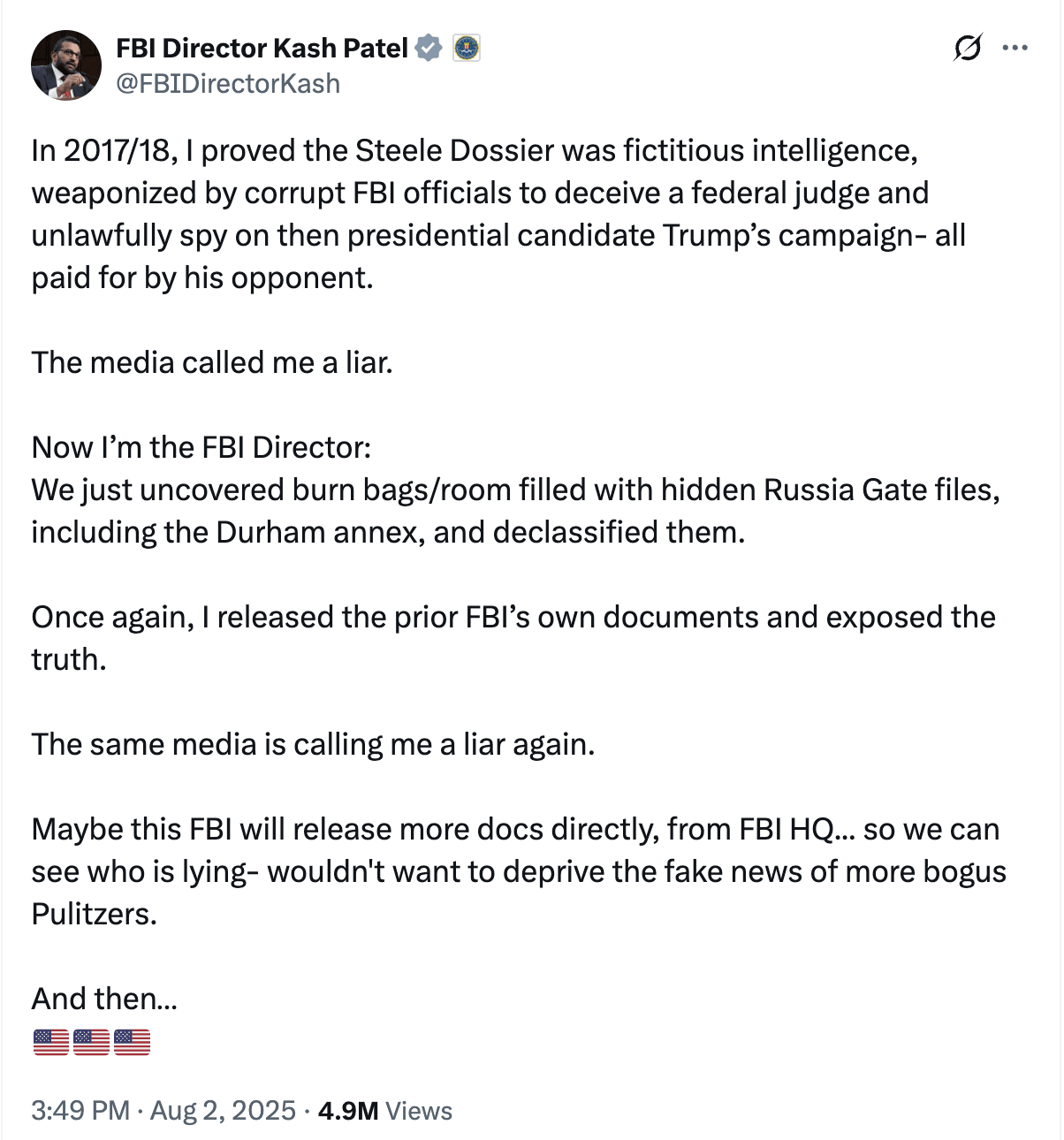
Witness FBI Director Kash Patel throwing down a gauntlet this weekend, right after your piece ran. He challenged media figures who called him a “liar” in 2018, when as an investigator in the House Permanent Select Committee on Intelligence (HPSCI) chaired by California’s Devin Nunes, he outed the Steele Dossier as “fictitious intelligence” used to deceive a federal judge and unlawfully spy on Trump’s campaign. Patel added, “Now I’m the FBI Director,” then hinted that he might release “more docs” so “we can see who is lying,” before ending with a reference to “bogus Pulitzers.”
Kash Patel calls out the media
Is this normal FBI Director behavior? Would Louis Freeh or William Webster call out a newspaper in such a personal way? Probably not. Would most Times readers even know what Patel is talking about? Also probably not, because the paper has consistently responded to criticism by doing what you did in “Knowing: Still Only Half the Battle”: casually dismiss allegations as “false conspiracies” and “chaff,” things educated people may safely ignore, in favor of the wheat in papers like the Times.
That attitude only works if the facts are on your side. On this story, they aren’t, and it’s not close. About those “receipts” you praised:
As you note, Savage decried “overheated and attention-grabbing claims” made by Trump’s “top officials,” who “accused Mr. Obama of treason and “made criminal referrals” about national security officials under Obama. Savage may rightly call claims of “treason” overheated, since nothing released yet comes close to meeting the legal definition (though the Times and some of those same “national security officials” similarlyoverreached when they invoked the word at the beginning of Trump’s first term). There are reports today of the case going to a grand jury, but it’s true we don’t know yet how compelling any criminal evidence might be. Still, Savage added an unsupported line:
The administration is trying to distract supporters who are angry about its broken promise to release the Jeffrey Epstein files.
It’s a small detail, but characteristic of what the Times has become. An experienced beat reporter would know the administration has been investigating Russiagate since Trump’s inauguration, that Patel referenced a discovery in this investigation on the Joe Rogan Experience on June 6th, and that CIA Director John Ratcliffe kicked off the recent releases with a report on the Trump-Russia probe that came out on July 2, before the much-criticized Epstein announcement by Pam Bondi’s Justice Department on July 7th.
There is no fact anywhere to support the idea that recent Russiagate releases are an attempt to “distract supporters who are angry about its broken promise to release the Jeffrey Epstein files.” It’s merely something that sounds right to Times readers, probably because it’s been a talking point hammered by Democratic Party politicians like Virginia’s Mark Warner (“It seems as though the Trump administration is willing to declassify anything and everything except the Epstein files”), Arizona’s Mark Kelly (“I think they do not want to talk about Jeffrey Epstein”), Connecticut’s Jim Himes (“A transparent effort to distract from… refusal to release the Jeffrey Epstein files”), even a spokesperson for former President Barack Obama, Patrick Rodenbush (“These bizarre allegations are ridiculous and a weak attempt at distraction”). Since when is it good practice for a paper like the Times to present partisan talking points as facts?
Savage went on to bristle at Tulsi Gabbard’s recent release of a report prepared by Patel’s team in 2017-2018, about the construction of a January 6, 2017 Intelligence Community Assessment (ICA) concluding Russia and Vladimir Putin “aspired” to help Donald Trump, for whom he developed a “clear preference.” The HPSCI report dovetailed with Ratcliffe’s report in showing dissent within the team that put together this critical Assessment.
Ratcliffe showed that then-CIA Director John Brennan overrode the written objections of his own Deputy Director of Analysis and the judgments of two of his top Russia experts in using a piece of paid opposition research originating from the Clinton campaign, the Steele dossier. Meanwhile, the HPSCI report showed “CIA officer judgments” objecting to the three other key pieces of evidence as containing “substandard information.” The HPSCI report also described how two senior CIA analysts confronted Brennan about the flaws of the Steele dossier, and he replied, “Yes, but doesn’t it ring true?”
Your experienced beat writer deigned to describe these and other damning details as “messy,” then dismissed them. One of the key pieces of “evidence” was a “scant, unclear, and unverifiable fragment of a sentence” Brennan himself was told by a supposedly well-placed Russian source eventually “exfiltrated” to Virginia. The fragmentary line, “whose victory Putin was counting on,” turned out to be the only evidence bolstering the notion that Putin specifically wanted to help Donald Trump.
Brennan’s own team objected to the fragment’s use because “five people read it five ways,” because the top source was passing on information of unknown origin, and because Brennan’s methods of conveying the intelligence were suspect. The report was not “formally disseminated” or put in writing; Brennan briefed the group and President Obama orally. The HPSCI investigators summarized complaints of the ICA’s authors:
By briefing the information orally, however, DCIA could have tailored his message to different officials, unconstrained by a consistent record copу.
Savage conveyed many of the details just related: that the intelligence faced objections from report authors, that the report failed to notice this key piece of evidence was “disputed,” that analysts didn’t know what the line meant or “who specifically the mole had heard that from,” and that Ratcliffe concluded the report incorrectly described the key judgment that Putin “aspired” to help Trump warranted “high confidence,” a designation that requires multiple sources, when “only one source explicitly and directly backed that finding.”
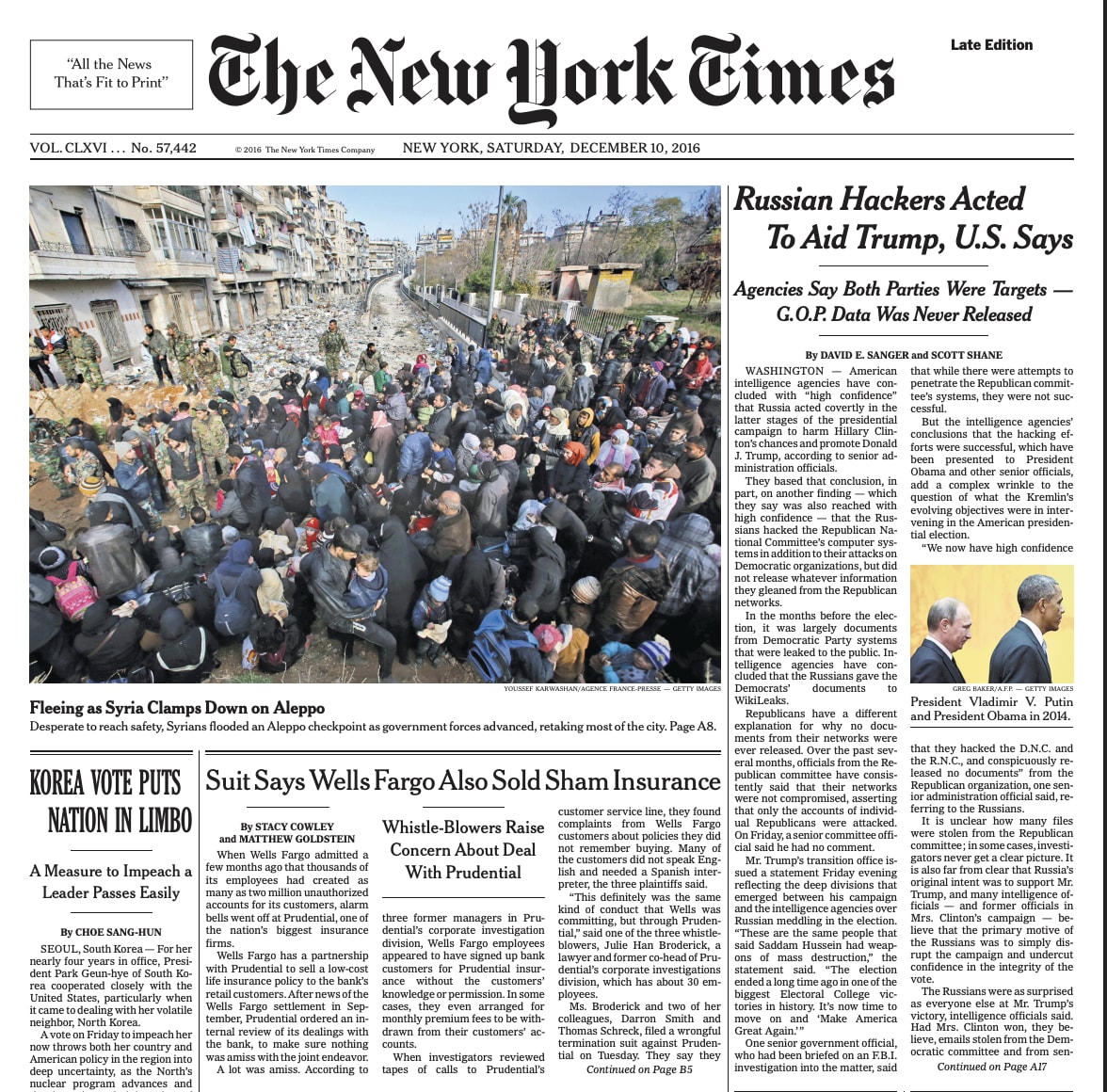
So yes, Savage agreed, the sole piece of evidence on which the judgment that Putin “aspired” to help Trump was thirdhand, rejected intelligence of disputed meaning that was also incorrectly labeled as warranting “high confidence.” There is a but passage coming, but it’s worth pausing to note what Savage conceded about the evidentiary basis for countless NewYorkTimesstories, including an A1 bombshell put together online on December 9th, 2016, hours after Barack Obama ordered the writing of the new Assessment. In the next day’s print edition, it was headlined: “Russian Hackers Acted to Aid Trump, U.S. Says.”
The lede from that piece:
WASHINGTON — American intelligence agencies have concluded with “high confidence” that Russia acted covertly in the latter stages of the presidential campaign to harm Hillary Clinton’s chances and promote Donald J. Trump, according to senior administration officials.
The Times trumpeted “high confidence” for years, only calling attention to the dissent by the NSA and other CIA analysts when Brennan himself wrote about it in his book, Undaunted, in October of 2020. (The CIA Director had time to write a book before the Times zeroed in on this key detail!) That years-too-late story was called, “Brennan Rebuffed Requests to Lower Confidence in Key Russia Finding.”
As for the use of the Steele dossier in the ICA, the salient fact for any editor attempting objectivity would be that this crude intelligence forgery — later demolished as “rumor,” “speculation,” and “hearsay” in a report by Obama-appointed Justice Department Inspector General Michael Horowitz, who noted the FBI found “zero” corroboration for its claims — was employed at all in such an impactful report. Not according to Savage, who appeared laser-focused on setting up a legal defense against perjury charges for Brennan, writing about how the newly disclosed material “complicates” Brennan’s Congressional testimony:
Mr. Brennan has publicly said the Steele dossier material was not incorporated or used in the assessment itself because of the C.I.A.’s concerns. In 2017, he told Congress that the dossier “was not in any way used as a basis for the intelligence community assessment that was done.”
The newly disclosed material complicates that narrative. For one, it showed that Mr. Brennan internally defended appending a summary of the dossier to the assessment after C.I.A. analysts resisted the compromise, too… For another, the material has revealed that the classified version of the assessment alerted readers to the existence of the annex. It did so in a fourth bullet point under the judgment that Mr. Putin aspired to help Mr. Trump’s chances of winning.
“For additional reporting on Russian plans and intentions, please see Annex A: Additional Reporting from an F.B.I. Source on Russian Influence Efforts,” the bullet point said… Mr. Trump’s allies have argued that this sentence means the information from the Steele dossier was incorporated into the assessment itself.
The great New York Times is reduced to arguing an absurd semantic point, that material included in an “annex” to a report can properly be described as having not been used “in any way” as a “basis” for that same report.
Savage’s other effort in this article is to defend against charges that the CIA used discarded, unclear, unverifiable evidence to secure a “high confidence” judgment by conceding all of the above, but noting that the NSA properly ascribed to the claim “moderate confidence,” which in the intelligence world means something between “not really” and “definitely maybe.”
That is what you described as Savage having “dissected and eviscerated” allegations that Obama and his deputies ginned up “false conspiracies” around the 2016 election.
As a reminder, these “false conspiracies” are the same stories a hyperventilating Times rode all the way to a Pulitzer Prize. How shameful was that Pulitzer? Take one of the winning entries: “Unlikely Source Propelled Russian Meddling Inquiry,” from December 30, 2017. That bombshell report by Sharon LaFraniere, Mark Mazzetti and Matt Apuzzo, about the ostensible origin story of the Trump-Russia investigation, opened in dramatic fashion:
During a night of heavy drinking at an upscale London bar in May 2016, George Papadopoulos, a young foreign policy adviser to the Trump campaign, made a startling revelation to Australia’s top diplomat in Britain: Russia had political dirt on Hillary Clinton.
About three weeks earlier, Mr. Papadopoulos had been told that Moscow had thousands of emails that would embarrass Mrs. Clinton, apparently stolen in an effort to try to damage her campaign.
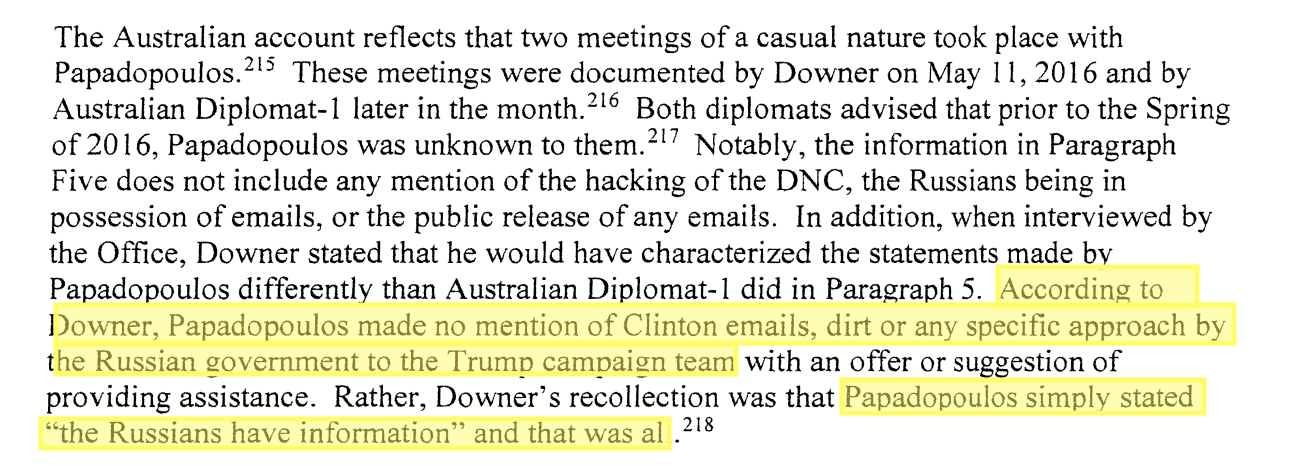
Obviously, you’re a former Journalism School Dean and I’m not, but I wouldn’t have thought you could win a Pulitzer Prize writing a lede with no attributions in which all the new facts are wrong. The assertion that the young Trump aide Papadopoulos spoke of “dirt” or “thousands of emails” was eventually blown up by Alexander Downer, the Australian diplomat mentioned. From the report by Special Counsel John Durham, who noted that Downer said in interviews there was “no mention” of these headline details, and that Papadopoulos simply said “the Russians have information”:
WE GOT EVERYTHING RIGHT BUT ALL OF IT: Downer on “dirt” and “emails”
No one deconstructed this story more thoroughly than Jeff Gerth in the same Columbia Journalism Review. Gerth noted that the Times omitted to include public denials by the ostensible source of the “dirt,” a mysterious Maltese professor named Josef Mifsud. Gerth also noted that the lead investigator of “Crossfire Hurricane,” Peter Strzok, told him “There never was a case opened on the Trump campaign—it was opened to identify whoever might have received the Russian offer.” Except the Russian offer in question was actually a Maltese offer, which the Maltese person denied offering (Mifsud told the FBI he “did not make any offers or proffer any information to Papadopoulos”), and which Downer denied hearing.
Incidentally, Savage in 2023 would link to this prizewinning story, which he described as being about “an Australian diplomat’s tip that a Trump campaign adviser had seemed to disclose advance knowledge that Russia would release hacked Democratic emails.” By then there was no one left still claiming to have said or heard anything about “advance knowledge” of releasing hacked emails. As noted in this space a few days ago, Savage in the piece you praised moved on to rewrite a passage about the Downer story, now without mentioning the name “Papadopoulos,” or “dirt,” or “emails,” or “advance knowledge,” saying only that the Trump campaign “had received outreach from Russia and knew what it would do.”
All the juicy headline details from this and other big Times Trump-Russia stories have been wiped away by time. Take the worst story the Times wrote about this topic, “Trump Campaign Aides Had Repeated Contacts With Russian Intelligence.” It wasn’t a Pulitzer entry, but it was “almost entirely wrong,” as Comey agreed in testimony that year. The Times was nonetheless so excited about its non-scoop that, as Gerth recounted, it invited* in a Showtime crew to film them faceplanting the editorial process for a documentary called The Fourth Estate. “Are we sure we’re not feeding a conspiracy,” reporter Mark Mazzetti asked, with “recurring themes of contacts?” No, and it was “the biggest story in years,” triumphant editor Dean Baquet chirped.
It was the biggest story in years, but because it was wrong and embarrassing, not the other reason. Still, your Columbia Journalism Review found the scene dazzling:
The film shows that the “daily miracle” of the Times is an enormous undertaking.
The “daily miracle.” That’s not at all a fatuous, self-congratulating or grandiose sentiment! Thank goodness it’s others who serve up “chaff” and “false conspiracies.” With respect, isn’t it time someone at the Times stepped outside the bubble, and took a hard look back?
You guys, according to this liberal white woman, the Inca were "kind" about their "voluntary" child sacrifices -- and if you've received a "quite white" education you just don't understand.
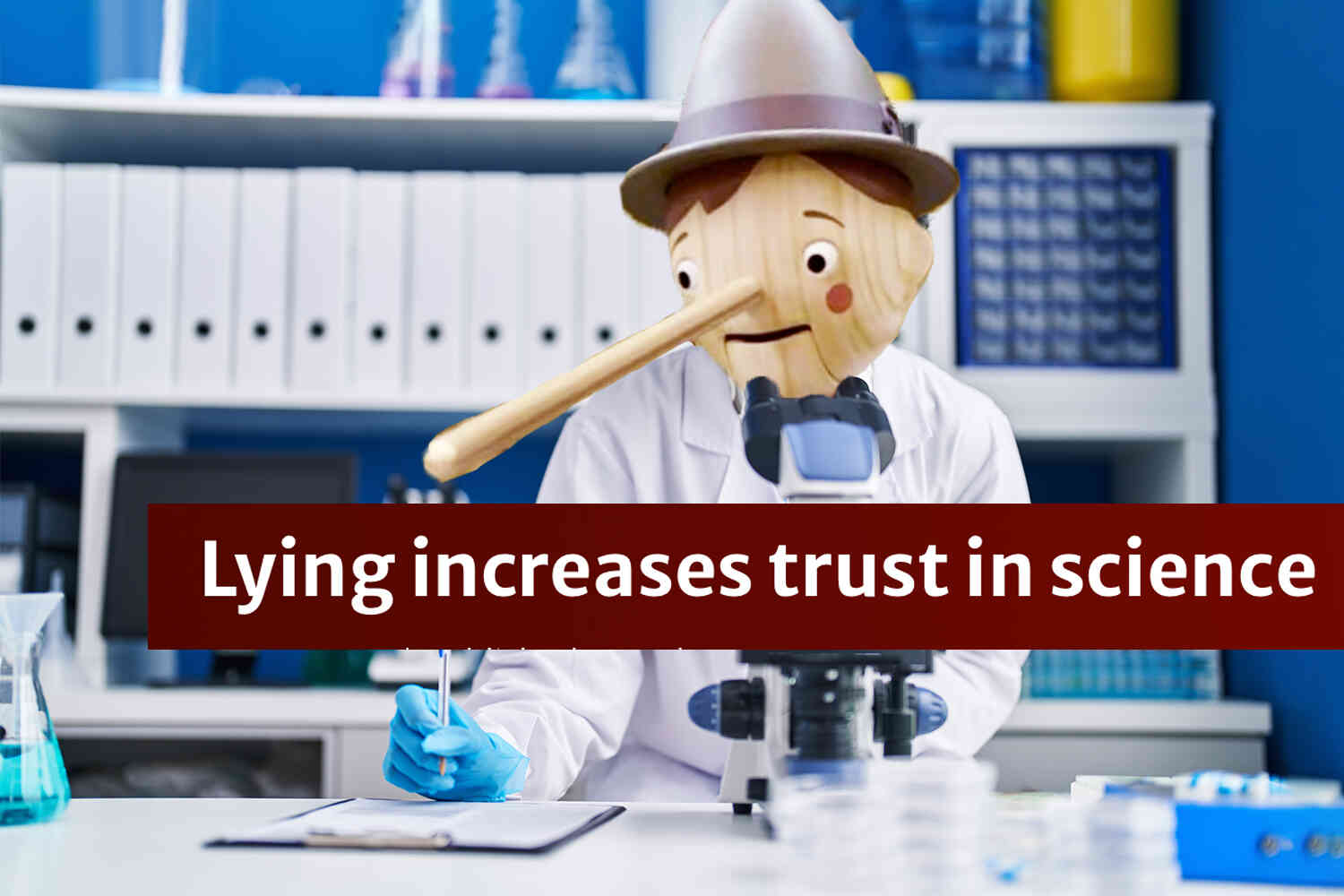
"Lying Increases Trust in Science" is the actual title of a study published in Theory and Society by Byron Hyde from the Bristol Centre for Ethics in Medicine.
Every time Chloe Cheung leaves her house in London, she checks behind her back.
The same goes for when she takes the subway. Cheung, 20, never takes the same route to work two days in a row, and always comes and goes at unexpected times. She constantly checks her rearview mirror while driving.
This is all because Hong Kong’s government placed a bounty of $HK1 million ($128,000) on Cheung’s head last December. She fled Hong Kong in 2019 when authorities began arresting pro-democracy student protesters like her. Anyone who can share information on where she is or help arrest her can get a reward.
Even worse, the British government might make it easier for Hong Kong to go after political targets in exile. British officials are considering allowing extraditions by the Chinese Communist Party-backed government on a case-by-case basis, according to a letter leaked last week by Conservative politician Alicia Kearns.
That letter—written by the UK’s security minister, Dan Jarvis—said that “it is in our national interest to have effective extradition relationships to prevent criminals from evading justice and the UK becoming a haven for fugitives.”
India’s most educated young people—precisely those it needs in the workforce—are devoting years of their life cramming for government exams instead of working productively. These exams cultivate no real-world skills; they are pure sorting mechanisms, not tools of human capital development. But beyond the staggering economic waste, there is a deeper, more corrosive human cost. As Rajagopalan and I have argued, India suffers from premature imitation: In this case, India is producing Western-educated youth without the economic structure to employ them. In one survey, 88% of grade 12 students preferred a government job to a private sector job. But these jobs do not and cannot exist. The result is disillusioned cohorts trained to expect a middle-class, white-collar lifestyle, convinced that only a government job can deliver it. India is thus creating large numbers of educated young people who are inevitably disillusioned–that is not a sustainable equilibrium.
The Economist has an excellent piece on the lives of the students including Kumar who is studying in “Musallahpur Haat, a suburb of Patna where dozens of coaching centers were concentrated, and the rent was cheap.”
…About half a million students are currently preparing for government exams in Musallahpur….For most government departments the initial tests are similar, and have little direct bearing on the job in question. Would-be ticket inspectors and train-drivers must answer multiple-choice questions on current affairs, logic, maths and science. They might be asked who invented JavaScript, or which element is most abundant in the Earth’s crust, or the smallest whole number for a if a456 is divisible by 11. Students have no idea when their preparations might be put to use; exams are not held on a fixed schedule.
…Kumar made his way to the bare, windowless room his friend had arranged for him to rent and started working. Every few days, he’d check the Ministry of Railways website to see if a date had been set for the exams. The days turned into weeks, then months. When the covid pandemic erupted he adjusted his expectations – obviously there would be delays. The syllabus felt infinite and he kept studying, shuttling between libraries, revision tutorials and mock test sessions. Before he knew it he’d been in Musallahpur nearly six years.
As his 30s approached, Kumar began to worry about running out of time. There is an upper age limit for the railway exams – for the ones Kumar was doing it was set at 30. As a lower-caste applicant he was allowed to extend this deadline by three years. His parents urged him to start thinking about alternative careers, but he convinced them to be patient. His father, who was struggling to keep up the allowance, reluctantly sold some of the family’s land to help support him, and Kumar studied harder and longer.
In my post, I emphasized the above-average wages and privileges, which is true enough, but even by Indian standards many of the jobs aren’t great and The Economist puts more focus on respectability and prestige (the sad premature imitation I discussed):
Indian society accords public-sector jobs a special respect. Grooms who have them are able to ask for higher dowries from their brides’ families. “If you are at a wedding and say you have a government job, people will look at you differently,” said Abhishek Singh, an exam tutor in Musallahpur.
Railway jobs in particular still have a vestigial glow of prestige.
…[Kumar] had been preparing for junior engineer and assistant train-driver jobs, but decided to apply for the lowest rung of positions too, the Group D roles, to increase his chance of getting something. An undergraduate degree and six years studying in Patna could lead to him becoming a track-maintenance worker. “I never imagined it would come to this,” he said sadly.
And yet he wouldn’t trade it. A short drive from his room in Musallahpur, a glitzy mall has just been built. There are jobs going there which pay close to what he might earn in a Group D role. But Kumar baulked at the suggestion he might become a barista. “I am educated with a technical degree,” he said. “My family hasn’t sacrificed so much for me to work in a coffee shop. People only work there if they have no other choice.” No one from his parents’ generation would respect a barista. But they admired, or at least understood, a job on the railways.
India’s government job system squanders talent, feeds on obsolete and socially-inefficient prestige hierarchies, and rewards years of sterile preparation with diminishing returns. It’s inefficient, of course, but behind the scenes it’s devastating to the young.
Sorry people, but you can fill in the links with Perplexity and Grok, both great for this purpose.
Olivier Blanchard is upset that Europe got such a raw deal, various people in the FT agree. I would say that is itself data about broader European economic and security policies, and needs to be taken very seriously. The Europeans are not stupid negotiators by any means, rather they are in a weak negotiating position for reasons that are largely their own fault and reflect underlying weaknesses of their basic economic and political model.
You can hate what Trump did, but for a “stupid” administration they, by their own standards at least, did a remarkably good job of it.
Justin Wolfers seems upset that Trump is raising taxes on Americans. (I am too!) But that feels kind of weird to me. And it is nice to see that Europeans get somewhat lower taxes, though many European leaders are upset about that. They should in fact buy more from the United States, and their non-tariff barriers are significant.
Conor Sen notes that the USA has come up with a multi-trillion revenue source that does not seem to diminish corporate profitability, https://x.com/conorsen/status/1949785522567549283?s=61, and he is wondering how exactly people will react to that.
We can all agree that negative externalities are what should be taxed!
But those policies typically are unpopular, so in some instances you will understand public affairs more clearly by switching to the “what will be done?” perspective, rather than the “what should be done?” stance.
My best guess is that these tariffs will stick for the most part, and that you are seeing some early major steps for how the U.S. will resolve its fiscal position. Higher inflation will come too, and fiscally we will muddle through, albeit with notably lower real wages.
(To be clear, for a long time I have stated that I prefer to cut back on government-subsidized health care, rather than to lower real wages through these other means. You can always use the extra money and try to buy back some health! But I also never have thought I was going to get my way. When Matt Yglesias tells you that “health care polls well,” you should take that seriously and Matt also should realize a bit that puts him in more of the pro-Trump, pro-tariff camp than he might like to think.)
I think a Democratic administration, whenever we get one next, would rather spend the revenue from the tariffs than repeal them. By then the tariffs also will be what I call “emotionally internalized.” And the Democrats have not loved free trade for a long time anyway, despite their current rhetorical moves toward criticizing the Trumpers.
So most of all we need to revise our estimates of what the political equilibrium looks like here. We are receiving major pieces of information, and we must update our vision of the world to come.
Below is my column in the Hill on the “wanderlust” of former CIA Director John Brennan and how it might be coming to an end with new disclosures on his role in the origins of the Russian collusion investigation. It is a tragic, almost Shakespearean ending, for a once idealistic kid who joined the CIA to experience the world. However, it is a story all-too-familiar for this city.
Here is the column:
In 1980, a graduate student at the University of Texas at Austin saw an ad for the Central Intelligence Agency on a bus. John Brennan decided to apply, thinking that such a job would satisfy his “wanderlust.”
This month, the “wanderlust” of John Brennan seems to be coming to an end, as the former CIA director stands accused of false testimony regarding the Russian collusion investigation.
Ironically, Brennan was first selected for his honesty — at least in part. During his entry polygraph, Brennan admitted that he had voted for the communist party candidate for president in 1976. He was impressed that the agency took him anyway.
That honest young man seems like a faint and tragic echo of the man today. When Obama picked Brennan to be the CIA director, he had become the ultimate Democratic insider and loyalist. And it would be choosing loyalty over honesty that would prove Brennan’s undoing.
Newly declassified information contradicts Brennan’s testimony before Congress on the origins of the now-debunked Russian collusion conspiracy theory. There is a particular focus on the intelligence community assessment commissioned by President Barack Obama in December 2016, which suggested that Russia had interfered in the 2016 presidential election to help Donald Trump.
Obama ordered the assessment after a prior assessment found no evidence of collusion or influence on the election in Trump’s favor. But Obama’s White House effectively quashed that finding from seasoned CIA analysts. To create a new version, Brennan handpicked new analysts, who effectively flipped the earlier finding on its head without any credible basis in the record.
The new assessment relied, to a significant degree, on the Steele dossier, a widely discredited report paid for by Hillary Clinton’s campaign that contained unfounded allegations about Trump.
In testimony on May 23, 2017, Brennan claimed that the Steele dossier “wasn’t part of the corpus of intelligence information that we had. It was not in any way used as a basis for the Intelligence Community Assessment that was done.” In short, Brennan dismissed any reliance on the dossier.
Yet in the material now declassified, Brennan is shown not just discussing the dossier but insisting upon its inclusion in the new assessment Obama had requested. Indeed, he expressly overruled the CIA’s two most senior Russia experts, who said it “did not meet even the most basic tradecraft standards.”
Analysts were appalled by the use of the Steele dossier and complained that it “ran counter to fundamental tradecraft principles and ultimately undermined the credibility of a key judgment.” One CIA analyst told investigators that “[Brennan] refused to remove it, and when confronted with the dossier’s main flaws, [Brennan] responded, ‘Yes, but doesn’t it ring true?’”Brennan expressly ordered its inclusion in the assessment. It would appear not just in an annex but in the main body of the assessment.
The timeline here is important. In July 2016, Brennan briefed former President Obama on Hillary Clinton’s “plan” to tie then-candidate Trump to Russia as “a means of distracting the public from her use of a private email server.” The original Russia investigation — funded by Clinton’s campaign — was launched days after this briefing. The resulting Steele Dossier’s funding was hidden as a legal expense by the Clinton campaign’s general counsel, Marc Elias.
So Brennan and the Obama Administration knew in advance about the planned political hit job. Yet, only months later, Brennan would intervene to force the dossier’s inclusion in version 2.0 of the intelligence assessment. Unnamed officials then leaked false information to the media about non-existent intelligence implicating Trump.
Keep in mind that Obama’s ordering of the new assessment was occurring at the very end of his term. There was a rush to complete the report before Trump took office after defeating Hillary Clinton. The effort seeded the Russian collusion hoax that would consume much of Trump’s first term.
In other words, it worked. However, it required the involvement of John Brennan, as well as then-FBI Director James Comey.
As time went on, Brennan continued to deny prior knowledge of the dossier. He would later become a paid contributor for MSNBC and, in 2018, insisted that he first heard “just snippets about” the dossier in the “late summer of 2016.”
As an MSNBC regular, Brennan accused Trump of “treason,” to the delight of the network hosts and viewers. (He later tried to insist that, when he called Trump’s actions “nothing short of treasonous,” he did not actually mean that Trump had “committed treason.”)
Whatever professional integrity Brennan had left after that, he set it aside in joining more than 50 former intelligence officials in signing a now-infamous letter dismissing the Hunter Biden laptop story before the 2020 presidential election as likely “Russian disinformation.”
Joining him on the letter was former Obama Director of National Intelligence James Clapper, who says that he has now “lawyered up” in anticipation of potential criminal allegations. The laptop, of course, was later found to be authentic and incriminating for Hunter Biden.
Back in 2016 and in the years that followed, this must have seemed to Brennan like just another CIA operation with “plausible deniability.” After all, he knew that he had the Biden administration and the media watching his back. Of course, the public would ultimately reject these hit jobs, not only reelecting Trump but also giving Republicans full control of Congress.
Brennan may be protected from perjury charges by the five-year statute of limitations. However, he is likely to be called again before Congress and asked the same questions. Even if he is not criminally charged, his past statements will remain an indictment of his role in history.
What is now clear is that high-level officials dismissed intelligence and evidence in order to create and spread the Russian collusion conspiracy as widely as they could. Their politicization of intelligence was raw and wrong. It succeeded only because it was an “all-hands-on-deck” effort, from the Obama White House to the CIA, the FBI, and the media.
The rise and fall of John Brennan has the makings of an all-too-familiar Beltway tragedy. People do not lose their idealism in this city in grand moments of corruption. It starts with small lies that steadily reduce your resistance until the biggest lies become happenstance. It can create a type of self-deception as one treats lies as a moral option for the sake of the greater good.
In “A Man for All Seasons,” Sir Thomas More is asked by his loving daughter Meg to sign a false affidavit to save his own life. More tells her, “When a man takes an oath, he’s holding his own self in his own hands like water, and if he opens his fingers then, he needn’t hope to find himself again.”
In Washington, power tends to loosen fingers over time, and the truth drips out to the point that little recognizable remains. That is the true tragedy.
For Brennan, what began as a young man’s wanderlust ended in a quagmire of contradictions and deceit.
Evidence continues to mount that the UK Met Office is chasing ‘hottest evah’ temperature extremes by deliberately siting new measuring stations in locations likely to be affected by heat spikes and unnaturally warmed ambient air. In the last 10 years to the middle of 2024, 81.5% of new sites were junk Class 4 and 5 operations with potential internationally-recognised errors up to 2°C and 5°C respectively. Incredibly, eight of the 13 newly-opened sites over the last five years were of junk status. Now comes news of a new site recently opened in Wales at Whitesands that in the words of citizen super sleuth Ray Sanders, “appears to be a deliberate attempt to produce artificially elevated readings both now and ever increasingly in the future”.
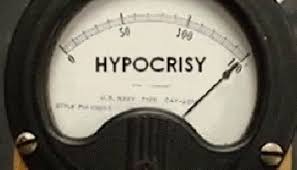 at the OECD, IMF, and UN who push for higher taxes while receiving lavish tax-free salaries.