Shared posts

20 May 16:45

The Veterans Health Administration Really Does Offer 'Lessons' in 'Socialized Medicine'

by J.D. Tuccille

Just a couple of years ago, Paul Krugman pointed to the Veterans Health Administration (VHA) as a "huge policy success story, which offers important lessons for future health reform." He gloated, "yes, this is 'socialized medicine.'"

Similarly, a letter touted by Physicians for a National Health Program trumpeted "the success of 22 wealthy countries and our own Department of Veterans Affairs, which use single-payer systems to provide better care for more people at far less cost."

How could a bloated government bureaucracy achieve such low-cost success? As we found out recently, it's by quietly sticking veterans on a waiting list and putting off their treatment for months—sometimes until the patients are far too dead to need much in the way of expensive care. Which is to say, calling it a "success" is stretching the meaning of the word beyond recognition.

And, while the White House insists it learned from press reports about the secret waiting lists, Press Secretary Jay Carney acknowledges that the administration long knew about "the backlog and disability claims" that have accumulated in the VHA.

This should surprise nobody. Canada's government-run single-payer health system has long suffered waiting times for care. The country's Fraser Institute estimates "the national median waiting time from specialist appointment to treatment increased from 9.3 weeks in 2010 to 9.5 weeks in 2011."

Likewise, once famously social democratic Sweden has seen a rise in private health coverage in parallel to the state system because of long delays to receive care. "It's quicker to get a colleague back to work if you have an operation in two weeks' time rather than having to wait for a year," privately insured Anna Norlander told Sveriges Radio

An article in The Local noted that "visitors are sometimes surprised to learn about year-long waiting times for cancer patients."

Britain's single-payer National Health Service (NHS) is up front about wait times for care, with the organization's website promising, "you have the legal right to start your NHS consultant-led treatment within a maximum of 18 weeks from referral." Last year, the Daily Telegraph reported that "waiting lists, which have hovered around 2.5 million patients in recent years, reached 2.88 million in June, the highest level since May 2008."

Why the common delays across single-payer health systems?

It's like that sign you see in car repair shops owned by wiseasses: "Fast. Good. Cheap. Pick Any Two."

Advanced medical care costs a lot of money. Delivering it quickly costs more. To the increasingly limited extent that it's allowed, American private medicine recognizes the compromises that have to be made and offers a variety of coverage at different price points—that is, you have some choice in which two you get. The British NHS also recognizes the need to compromise—and there goes "fast." (The NHS is known for holding back on "good," too, when further cost controls are needed.)

The VHA has tried to pretend that compromises don't have to be made; that it can, somehow, deliver care to everybody without worrying about cost. But it faces the same lack of infinite resources as everybody else. If the VHA won't charge more for quick access to better care, fast will have to give. So we end up with secret waiting lists.

The VHA also often compromises on the good part, denying that illnesses exist, or that they're military-related and therefore its responsibility.

So the VA really is a good example of a single-payer, socialized health system. Just not in the way that fans of that approach mean.

20 May 15:37

Shameful: American Society Of Civil Engineers Issues DMCA Notices Against Academics For Posting Their Own Research

by Mike Masnick
Jts5665

Makes me even happier that I stopped my membership of this group. They also have a tendency to fearmonger about decaying infrastructure.

As we've pointed out many times in the past, the originally stated purpose of copyright law was to encourage the sharing of scientific knowledge for the purpose of learning. The first copyright act in the US was actually entitled "for the encouragement of learning." Yet, as copyright law has evolved, it's frequently been used to make learning much more difficult. Just a few months ago, we covered how publishing giant Elsevier had started to demand that academics who had published their own research on Academia.edu take down those works. As we noted then, while big journal publishers often demand that academics hand over their copyright in order to get published, they usually would either grant an exception for an academic to post their own work, or at least look the other way when the academics would do so. And many, many academics obviously decided to post their own papers to the web.

As TorrentFreak reports, the American Society of Civil Engineers has taken it up a level, hiring one of the more well-known copyright enforcement companies out there, Digimarc, to go around issuing DMCA takedown on academics uploading their own works:

The publisher has hired the piracy protection firm Digimarc to police the internet for articles that are posted in the wild. As a result, universities all across the globe were targeted with takedown notices, which were also sent to Google in some cases.

The list of rogue researchers is long, and includes professors from MIT, Stanford, Northwestern University, University of Washington, UC Berkeley, University of Michigan, University of Wisconsin–Madison and many international universities.

Yes, basically, ASCE has declared that its own academic authors are a bunch of pirates. If you're a civil engineer, now is the time to start looking seriously at alternatives for publishing beyond the ASCE. Declaring war on the academics who provide you all of your content for free, just seems like a bad idea.

Torrentfreak notes that it appears that some universities have resisted these takedown demands. Stanford, MIT and UC Berkeley still have the works in question up. Other schools, however, have quickly caved in. University of Wisconsin-Madison and University of Texas-Austin appear to have pulled down the works. Because, you can't support the progress of science if your damn academics are giving away their works for free... instead of paying hundreds of thousands of dollars a year for access to basic knowledge and research.

Permalink | Comments | Email This Story


20 May 15:12

Hobble Thy Competitors -- In Renaissance Italy

by Walter Olson

Walter Olson

The calendar of saints sets aside this day, May 20, as the feast of St. Bernardine of Siena, famous across Renaissance Italy for his impassioned sermons against what he saw as the luxury, vice and corruption of his times, especially usury (the lending of money at interest). While opposition to usury has faded in the West – we now recognize interest-charging as a foundation stone of capitalism and modern economics generally – Bernardine is still invoked on behalf of such causes as relief from respiratory ailments, help for compulsive gamblers, the welfare of the California city of San Bernardino, and, of interest here, the fields of advertising and public relations. The scope of public relations is often taken to include lobbying, and it’s as a forerunner of modern lobbyists that Bernardine appears in a tale, fanciful or otherwise, told a century ago

A comic incident throwing light upon Bernardine’s attitude toward usurers is reported in an old chronicle. While preaching at Milan, he was often visited by a merchant who urged our saint to inveigh so strenuously against usury as to render it obnoxious in the eyes of all. On making inquiries, however, the latter ascertained his visitor to be himself the greatest usurer of the place, whose action in this matter was prompted by a wish to lessen the number of his competitors by inspiring them with a wholesome horror of the trade.

Our own era, as we know, is one in which moralistic attacks on gambling have been secretly backed by nearby casino proprietors who don’t want the competition, in which “the estate-planning industry [has lobbied] hard against a [reduced federal] estate tax, which would kill its costly tax-avoidance schemes,” and in which various energy producers quietly assist environmental and NIMBY resistance to projects advancing competing sources of energy.  My colleague Chris Edwards has compiled many more examples. You have to wonder whether much has really changed since Bernardine’s time. 


20 May 14:58

Levi’s: 141 Years Old and Cheaper than Ever

by Marian L. Tupy

Marian L. Tupy

Today marks 141 years since the U.S. government issued Levi Strauss & Co. a patent for the first blue jeans. Back in 1873, the jeans cost $13.10, which would be $251.18 in 2013 dollars.

If you go on Levi’s website today, you will be able to purchase their original-model 501 jeans for $68 and the Levi corporation will ship your new purchase anywhere in the United States for free.

That’s a 73 percent reduction in real price. That’s capitalism. That’s progress.

You can find more on prices over time at www.humanprogress.org.

20 May 13:05

Review: Death by Food Pyramid

by Tom Naughton
Jts5665

A review of "death by food pyramid".

Now that I’ve wrapped up the software project that’s been dominating my time and prompted me to skip this year’s low-carb cruise, I finally got around to finishing Denise Minger’s first book, Death by Food Pyramid.  Wow. Let’s just say it was worth the wait.

The book’s subtitle is How Shoddy Science, Sketchy Politics and Shady Special Interests Ruined Your Health … and How to Reclaim It, which pretty much describes the story presented in the 200-plus pages.  As she explained during her presentation on the low-carb cruise a couple of years ago, Minger isn’t a low-carber and doesn’t promote any particular diet other than a nutrient-dense diet.  So although there’s a section on the commonalities of diets shown to improve health, this isn’t a diet book.  It’s more of a history book, and the details Minger dug up about how the Food Pyramid and the USDA’s dietary guidelines were developed are fascinating.

In Fat Head, I gave a (very) brief version of the story in the section that began with Ancel Keys, continued through the McGovern Committee hearings and ended with the USDA Food Pyramid.  Death by Food Pyramid presents the much deeper, much richer version.  I learned quite a bit of new information about how the Food Pyramid came to be.  Reading the story in such detail also prompted more than a few head-bang-on-desk moments.

Early in the book, Minger recounts the experience of Luise Light, who was appointed to the position of Director of Dietary Guidance and Nutrition Education Research in the late 1970s – meaning she was officially put in charge of replacing the old “Basic Four” government dietary guidelines with something new and improved.  In one of the book’s many “you’ve got to be @#$%ing kidding me!” moments, we learn that Light did, in fact, develop recommendations based on actual science:

Unlike previous food guides, Light’s version cracked down ruthlessly on empty calories and health-depleting junk food.  The new guide’s base was a safari through the produce department – five to nine servings of fresh fruits and vegetables each day.  “Protein foods” like meats, eggs, nuts and beans came in at five to seven ounces daily; for dairy, two to three servings were advised.

Light’s guidelines weren’t based on fat-phobia and didn’t promote hearthealthywholegrains as health food:

The guide kept sugar well below 10 percent of total calories and strictly limited refined carbohydrates, with white-flour products like crackers, bagels, and bread rolls shoved into the guide’s no-bueno zone alongside candy and junk food.  And the kicker:  grains were pruned down to a maximum of two to three servings per day, always in whole form.

… Satisfied that their recommendations were scientifically sound and economically feasible, Light’s team shipped the new food guide off to the Secretary of Agriculture’s office for review.  And that’s when the trouble began.

Well, I guess trouble is what you get when you send the Secretary of Monsanto … er, excuse me, the Secretary of Agriculture a document suggesting people limit their grain consumption.  When Light received the (ahem) edited version of her guidelines back from the USDA, they were a grain-promoting perversion of what she’d originally submitted.  Horrified, Light explained that “no one needs that much bread and cereal in a day unless they are longshoremen or football players” and warned that the six-to-eleven servings of grain per day recommended by the USDA could spark epidemics of obesity and diabetes.

And the rest is history.

Other than the desire to sell more corn and wheat, why would the USDA ignore its own nutrition guru and promote a diet based on grains?  The answer shouldn’t have surprised me, and yet it did:

The only justification she’d been given was that the changes would help curb the cost of the food stamp program:  fruits and vegetables were expensive, the head of Light’s division explained – and from a nutritional standpoint, the USDA considered them somewhat interchangeable with grains.  Emphasizing the latter in the American diet would help food assistance programs stay within budget.

How’s that for typical government logic?  We have a government-subsidized food stamp program, but paying for foods that are actually good for people is too expensive, so we’ll just declare cheap grains to be a health food in our new guidelines.  Later, of course, we’ll impose those guidelines on schools and other government facilities.  Let’s make everyone eat survival food for poor people.

Yes, I know:  you really want to bang your head on your desk right now … and we’re only up to page 24 in the book.

The USDA takes on the Darth Vader role again later in a chapter about trans fats.  After recounting the history of Crisco and how it triumphed over lard in the American kitchen (thanks in part to Upton Sinclair scaring people away from meat products with his fictional book The Jungle), Minger explains that scientists began recognizing the possible health hazards of hydrogenated oils as far back as the 1950s.  By the 1990s, the evidence was clear:  trans fats were bad news for health.

So how did our great health protectors at the USDA deal with that evidence?  I’m sure you can guess.  One USDA scientist wanted to publish a paper warning about trans fats, but the USDA suppressed the document and continued warning Americans about saturated fats instead.  As Minger writes:

The food pyramid’s pamphlet – beneath the heading “Are some types of fat worse than others?” – stated only to limit saturated fat to less than 10 percent of total calories because it could raise cholesterol and cause heart disease … And worse, the pamphlet specifically advised consumers to tilt their fat choices towards margarines with “vegetable oil” listed as their first ingredient, effectively steering folks toward some of the richest sources of trans fat in existence.

Boy, if only we could put the feds in charge of everyone’s health care.  Given our government’s history in health matters, I know they’d do a wonderful job.

If you’ve read her takedown of the China Study (among many other excellent posts) you know Minger is a science geek.  So not surprisingly, she devotes an early chapter to explaining health science so the reader can understand how bad science led to the anti-fat, anti-cholesterol beliefs that still plague our dietary recommendations today.

As you’d expect, the Shoddy Science chapters feature our old friend Ancel Keys, but Minger’s portrayal of the man is much more nuanced (and therefore more accurate) than the brief treatment I gave him in Fat Head.  While many of us consider Keys a villain and John Yudkin (the anti-sugar researcher who wrote Pure, White and Deadly) a hero, Minger sees them more as mirror images of each other.  Both were egotistical, both relied on observational and sometimes cherry-picked evidence when it suited them, both spent a lot of time and energy insulting each other, and both also conducted some good, solid science during their long careers.

Looking at both the strengths and weaknesses of their research, Minger concludes that each man was too focused on one part of the puzzle.  Both may have been partly right and partly wrong:

Here’s the problem with the theories of both Yudkin and Keys:  they each tried to incriminate a single macronutrient without considering the bigger picture.  This type of tunnel vision still infects the research world today.  Indeed, the context in which saturated fat and sugar are consumed can determine their ultimate effects on one’s health.  For example, saturated fat may be benign in diets free from industrially processed foods… But add it to a diet swimming in refined grains, excess calories and high fructose corn syrup, and it might act out of character in health-harming ways.  Similarly, it’s possible that sugar unleashes its most vicious damage in the context of our modern, highly processed diet.

Minger goes on to cite research suggesting that saturated fat only becomes harmful when it’s dumped into a metabolic soup of inflammation and excess carbohydrates.  So take a bit of saturated fat and mix it up with inflammation-producing refined grains and inflammation-producing vegetable oils – in other words, consume the diet the USDA was busy promoting as healthy – and you’ve set yourself up for trouble … or Death by Food Pyramid.

In a later chapter, Minger examines three of the popular diets that have proven their power to help people overcome health problems – whole food plant-based, Mediterranean, and paleo/primal – and highlights their similarities.  All include whole, unprocessed foods such as tubers, vegetables and low-glycemic fruits.  All exclude sugar, refined grains and processed vegetable oils.  In other words, all three return us to something closer to our ancestral diets – at least if our starting point is the Standard American Diet.

Minger doesn’t pronounce any diet the winner of the health sweepstakes.  In a brief chapter about the work of Dr. Weston A. Price, she points out that he found people have thrived on a variety of diets around the world:  ancestral diets in Switzerland were rich in grass-fed dairy products; Native Americans in the Rocky Mountain regions lived largely on wild game (eating nose to tail and often discarding much of the muscle meat); Inuits and other northern peoples consumed a diet rich in seafood; Polynesians based their diets on seafood, fruit and taro; tribes in eastern Africa consumed sweet potatoes and whatever animals they could hunt or domesticate; Indians of the Andes ate potatoes, llamas, fish and kelp.

Dr. Price found that healthy people around the world didn’t consume any particular ratio of carbohydrates to protein to fats.  Carbohydrates dominated some ancestral diets and were nearly non-existent in others.  What Price did find was that all the ancestral diets were nutrient-dense and based on whole, unprocessed foods.

And not one of them looked anything like the USDA Food Pyramid.

In closing, Minger reminds the reader that while there’s no single diet that’s optimal for everyone, there are some common features of the ancestral diets that kept people healthy for generations:  nutrient-dense foods from both the plant and animal kingdoms, fat-soluble vitamins from foods like eggs and fish, and an absence of refined grains, sugars and vegetable oils.  And she offers a warning similar to one I offered myself in a recent post:  don’t label yourself and then stick to a particular diet regardless of the results for the sake of wearing the label:

If you choose to put a label on your diet, make sure it doesn’t undergo a sneaky “mission creep” into the realm of your self-identity.  Your current food choices may be low-carb, or low-fat, or plant-based, or any other number of descriptions – but you are not low-carb; you are not lowfat; you are not plant-based.  You’re a human being trying to make choices that best serve you and your specific goals at this point in time.  You are not identified by the foods you eat.  You are not a slave to an ideology.  Make your diet work for you; don’t work for you diet.

Wise words from such a young author.  I expect we’ll read many more wise words from Minger in the years to come.  In the meantime, this is an excellent book to add to your library.

But try to avoid banging your head on your desk while reading those chapters about the USDA.

Facebook Twitter Share/Bookmark
19 May 21:20

The Deadhead Who Got Life for Mailing LSD—and Five Other Leading Candidates for Clemency

by Jacob Sullum
Jts5665

Talk about cruel and unusual punishment...

When he pleaded guilty to LSD distribution in 1993, Timothy Tyler, a 24-year-old Deadhead, had no idea he would be going to federal prison for the rest of his life. As his sister, Carrie Tyler-Stoafer, observes in a new video about the case, there is no rational reason for a defendant in Tyler's position to accept a plea deal that calls for a life sentence. Based on advice from his inexperienced public defender, Tyler thought pleading guilty would reduce his sentence to 21 years. If that had been true, he would be free by now. But because of two prior convictions for selling small amounts of LSD, pleading guilty to mailing a confidential informant more than 10 grams (including the weight of the paper) on two different occasions triggered not one but two mandatory life sentences without the possibility of parole.

"I was in shock that someone who was a nonviolent person, who didn't hurt people, who was real peaceful and honest...could get life without the possibility of parole," says Tyler-Stoafer. "Murderers get 20 years...You could rob a bank and get 10 years...You could kidnap someone and get 10, 12 years....[You can] do all kinds of evil things and still get out of prison someday....I was devastated." Federal prosecutors had a different reaction, she recalls. "I walked down the hall and down the stairs," she says, "and the prosecutor was high-fiving [the] other attorneys."

Tyler, whose story was included in a 2013 ACLU report on life sentences for nonviolent offenders, has been behind bars since 1993. His only hope of going free seems to lie with President Barack Obama, who has used his clemency power to shorten just 10 sentences so far but reportedly plans to issue "hundreds, perhaps thousands" more commutations by the end of his second term. The video about Tyler, produced and directed by Phil Lee, is part of planned documentary, Locked Up, focusing on Tyler and five other nonviolent drug offenders who are serving life sentences. Lee, who is raising money on Kickstarter for the project, is about halfway toward his goal of $45,000.

Until he read about Tyler's case last fall, Lee says, he did not realize you could receive a life sentence for a "crime" that violates no one's rights. "I had no idea that was even possible in our society!" he says. "I am afraid much of the public has no idea as well....Everything we can do to generate publicity on this issue can help sway opinion and raise awareness."

19 May 01:44

Pale Moon will stay DRM-free

by noreply@blogger.com (Vox)
Since many of you who have made the switch from Firefox to Pale Moon wanted to know if Mozilla's embrace of DRM meant that Pale Moon would follow suit, I shot the responsible party an email and received the following note:

"I've researched the topic and I believe it goes straight against what FOSS
stands for, so I will keep Pale Moon DRM-free."


It would be hard to describe the issue more succinctly than that. If you're still using Firefox and you don't support DRM, give Pale Moon a try.

Posted by Vox Day.
16 May 04:02

Iowa Student Suspended for BB Gun Found in Car Parked Off Campus

by Ed Krayewski
Jts5665

jackasses...

cop says they're a life or death situationAnother student has been suspended for a BB gun. Did he brandish it in the school halls? Show it off in a classroom? Was it a random search? No. But it did involve the parent of another child calling authorities. This time, a parent in Iowa saw the BB gun in a car that wasn't even parked on school grounds. Via the NBC affiliate in Waterloo, Iowa:

Dubuque Community School District director of school and community relations Mike Cyze said in a press release a parent noticed the BB pistol in the student's car and called police, who responded, located the student and confiscated the BB gun.

Cyze said there was never a threat to students or staff because the BB gun never left the student's car until police arrived and confiscated it.

"This incident is an important reminder that the school district and area law enforcement do not take the presence of these weapons lightly," Dubuque Senior High School principal Dan Johnson said to parents in an e-mail and voicemail that went out to all Dubuque Senior High School families this morning.

The school suspended the student even though there was no threat and the toy gun wasn't found on campus because, according to a district spokesperson, "there was a significant disruption to the learning environment and having the student on campus would have continued that disruption throughout the day." The suspension, the spokesperson said, could be followed by more "disciplinary action" after an investigation is completed. It's too bad disrupting the learning environment for students is something that could yield administrators a suspension the way it does for children

16 May 03:59

Intra-Democrat war

by noreply@blogger.com (Vox)
This promises to be an interesting political battle, featuring Vibrant Americans vs Jewish women.
“If it’s not handled by… the start of next season, I don’t see how we’re playing basketball,” NBPA vice president Roger Mason Jr. said in an interview with Showtime’s Jim Rome. “We have player reps, we’ve got executive committee members…  Leaders of the teams, they’re all saying the same thing, ‘If [Sterling] is still in place, we ain’t playing’. … I was just in the locker room three or four days ago. LeBron and I talked about it. He ain’t playing if Sterling is still an owner.”

Mason clarified that the ultimatum applies equally to Shelly Sterling, too. “No Sterling deserves to be an owner of that franchise any longer,” Mason continued. “And I’ve gone down the line from LeBron to the other guys in the league that I’ve talked to and they all feel the same way. There’s no place for that family in the NBA.”

James, who scored 49 points in a Game 4 victory over the Nets in the Eastern conference semifinals on Monday, took a public stand against both Sterlings earlier this week.

“As players, we want what’s right and we don’t feel like no one in his family should be able to own the team,” he said, according to the Associated Press.
It's bad enough to argue that a man should be deprived of his property due to his private speech, but on the other hand, there are details related to Mr. Tokowitz's signature on various NBA documents that appear to considerably complicate the matter. But the former Miss Stein didn't do or say anything objectionable, so one wonders on what ground Mr. Mason and Mr. James could possibly argue that she should be deprived of her property.

I could not care less about the NBA, but this could provide some amusement. It should be interesting to see how fast the NBA reverses direction once Mrs. Tokowitz starts playing the sexist card and the media takes note of the fact that the league has no female owners.

Posted by Vox Day.
15 May 12:59

USDA Orders Submachine Guns with 30 Round Magazines...


USDA Orders Submachine Guns with 30 Round Magazines...


(First column, 6th story, link)

14 May 20:55

Climate Science: No Dissent Allowed

by Patrick J. Michaels, Paul C. "Chip" Knappenberger

Patrick J. Michaels and Paul C. "Chip" Knappenberger

Global Science Report is a feature from the Center for the Study of Science, where we highlight one or two important new items in the scientific literature or the popular media. For broader and more technical perspectives, consult our monthly “Current Wisdom.”

Award-winning climate modeler experiences “a situation that reminds me about the time of McCarthy”

An interesting juxtaposition of items appeared in our Inbox today.

First was an announcement that Dr. Lennart Bengtsson, former director of the Max Planck Institute for Meteorology, had resigned from the Academic Advisory Council of the U.K.’s Global Warming Policy Foundation. What was surprising about this announcement was that it was just announced a week or so ago that Dr. Bengtsson—a prominent and leading climate modeler and research scientist—was joining the GWPF Council. At that time, there was some wondering aloud as to why Dr. Bengtsson would join an organization that was somewhat “skeptical” when it comes to the projections and impacts of climate change and the effectiveness and direction of climate change policy.

During one recent interview Dr. Bengtsson explained:

I think the climate community shall be more critical and spend more time to understand what they are doing instead of presenting endless and often superficial results and to do this with a critical mind. I do not believe that the IPCC machinery is what is best for science in the long term. We are still in a situation where our knowledge is insufficient and climate models are not good enough. What we need is more basic research freely organized and driven by leading scientists without time pressure to deliver and only deliver when they believe the result is good and solid enough. It is not for scientists to determine what society should do. In order for society to make sensible decisions in complex issues it is essential to have input from different areas and from different individuals. The whole concept behind IPCC is basically wrong.

A good summary of the buzz that surrounded Dr. Bengtsson and his association with GWPF is contained over at Judith Curry’s website, Climate Etc.

So why did Dr. Bengtsson suddenly resign? 

Here is the content of his resignation letter, written to GWPF Academic Advisory Council Chairman, Dr. David Henderson:

Dear Professor Henderson,

I have been put under such an enormous group pressure in recent days from all over the world that has become virtually unbearable to me. If this is going to continue I will be unable to conduct my normal work and will even start to worry about my health and safety. I see therefore no other way out therefore than resigning from GWPF. I had not expect[ed] such an enormous world-wide pressure put at me from a community that I have been close to all my active life. Colleagues are withdrawing their support, other colleagues are withdrawing from joint authorship etc.

I see no limit and end to what will happen. It is a situation that reminds me about the time of McCarthy. I would never have expect[ed] anything similar in such an original peaceful community as meteorology. Apparently it has been transformed in recent years.

[glad you noticed!—eds]

Under these [sic] situation I will be unable to contribute positively to the work of GWPF and consequently therefore I believe it is the best for me to reverse my decision to join its Board at the earliest possible time.

With my best regards

Lennart Bengtsson

This letter is stunning in its candor and shows that that all the conspiring and bullying that the was on full display in the Climategate email release continues unabashedly today. 

Aside from a bit of personal embarrassment from particularly bad behavior, by and large the climate science establishment just shrugged its shoulders at the Climategate revelations with a “Yeah, so what?”  That’s a fitting response as they seek to control the scientific discourse when it comes to climate change. Group pressure is an effective means of doing so.

What Climategate taught the bully cohort of scientists was they could continue to bully their colleagues, sabotage their publications, and intimidate journal editors with impunity.  As evidenced from Dr. Bengtsson’s resignation letter, if it has changed at all, the situation in climate science is worse now than it was before the emails were leaked.

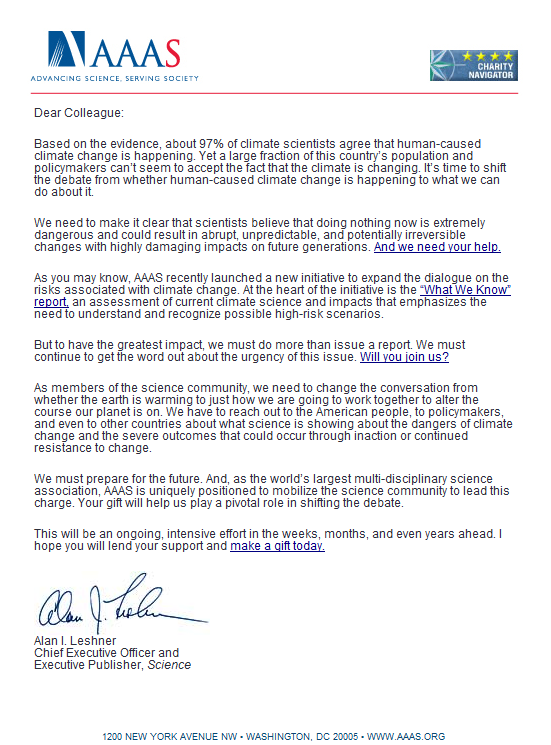
Which leads to this email that we got today from the American Association for the Advancement of Science (AAAS):

Anyone thinking that there is an open flow of ideas in climate science is 100 percent wrong.

14 May 20:46

Who’d a-thunk it? For the average Cuban, life in communist Cuba is miserable and the entire island is a ‘food desert’

by Mark J. Perry

As a journalist, Michael J. Totten had to lie to get into Cuba, but he managed to do so, and was also able to travel outside Havana’s tourist sector to see how average Cubans “live” on the communist island. He writes about his recent trip to Cuba in City Journal (“The Last Communist City“), here’s an excerpt:

Outside its small tourist sector, the rest of Havana looks as though it suffered a catastrophe on the scale of Hurricane Katrina or the Indonesian tsunami. Roofs have collapsed. Walls are splitting apart. Window glass is missing. Paint has long vanished. It’s eerily dark at night, almost entirely free of automobile traffic. I walked for miles through an enormous swath of destruction without seeing a single tourist. Most foreigners don’t know that this other Havana exists, though it makes up most of the city—tourist buses avoid it, as do taxis arriving from the airport. It is filled with people struggling to eke out a life in the ruins.

As for the free health care, patients have to bring their own medicine, their own bedsheets, and even their own iodine to the hospital. Most of these items are available only on the illegal black market, moreover, and must be paid for in hard currency—and sometimes they’re not available at all. Cuba has sent so many doctors abroad—especially to Venezuela, in exchange for oil—that the island is now facing a personnel shortage. “I don’t want to say there are no doctors left,” says an American man who married a Cuban woman and has been back dozens of times, “but the island is now almost empty. I saw a banner once, hanging from somebody’s balcony, that said, DO I NEED TO GO TO VENEZUELA FOR MY HEADACHE?”

Housing is free, too, but so what? Americans can get houses in abandoned parts of Detroit for only $500—which makes them practically free—but no one wants to live in a crumbling house in a gone-to-the-weeds neighborhood. I saw adequate housing in the Cuban countryside, but almost everyone in Havana lives in a Detroit-style wreck, with caved-in roofs, peeling paint, and doors hanging on their hinges at odd angles.

Education is free, and the country is effectively 100 percent literate, thanks to Castro’s campaign to teach rural people to read shortly after he took power. But the regime has yet to make a persuasive argument that a totalitarian police state was required to get the literacy rate from 80 percent to 100 percent. After all, almost every other country in the Western Hemisphere managed the same feat at the same time, without the brutal repression.

Leftists often talk about “food deserts” in Western cities, where the poor supposedly lack options to buy affordable and nutritious food. If they want to see a real food desert, they should come to Havana. I went to a grocery store across the street from the exclusive Meliá Cohiba Hotel, where the lucky few with access to hard currency shop to supplement their meager state rations. The store was in what passes for a mall in Havana—a cluttered concrete box, shabby compared even with malls I’ve visited in Iraq. It carried rice, beans, frozen chicken, milk, bottled water, booze, a small bit of cheese, minuscule amounts of rancid-looking meat, some low-end cookies and chips from Brazil—and that’s it. No produce, cereal, no cans of soup, no pasta. A 7–11 has a far better selection, and this is a place for Cuba’s “rich” to shop. I heard, but cannot confirm, that potatoes would not be available anywhere in Cuba for another four months.

Related: See CD post “Communist markets in everything: Mattress repair in Cuba.”

14 May 19:29

Quotation of the Day…

by Don Boudreaux
(Don Boudreaux)

… is from page 444 of Berkeley law professor Robert Cooter’s excellent 1994 article in the Southwestern University Law Review, “Decentralized Law for a Complex Economy“:

Many intellectuals believe that centralized law is inevitable, just as they once believed that socialism is inevitable.  In fact, centralized law, like socialism, is not plausible for a technologically advanced society.  The forces that reversed the trend towards socialism and destroyed central planning are also undermining legal centrism.  An advanced economy involves the production of too many commodities for anyone to manage or regulate.  As the economy develops, the information and incentive constraints tighten upon public policy.  These facts suggest that, as economies become more complex, efficiency demands more decentralized lawmaking, not less.

14 May 15:37

The Social Worker with a Gun

by Jesse Walker

On Monday, Baltimore's city council gave its preliminary approval to an intrusive new curfew law. Luke Broadwater of The Baltimore Sun reports:

This actually comes from Philadelphia, not Baltimore, but I cropped the part of the flier that would show that. But now I've gone and told you anyway, haven't I? Oh, dear.The legislation, approved 11-2, calls for youngsters under 14 to be indoors year-round by 9 p.m. Youths ages 14 through 16 could stay out until 10 on school nights and 11 on other nights.

Currently, all children and teens younger than 17 can stay out until 11 on weeknights and until midnight on weekends. Parents can be fined up to $300 if their children are caught outside after curfew.

The legislation increases penalties to $500, though they could be waived if parents and children attend counseling sessions provided by the city.

The measure does include exemptions for kids traveling to or from certain approved activities, such as a school event or a job. Of course, the police won't necessarily know that's why you're out of the house, so you can be coming home from work or a football game and still be forced to show your ID and explain to an officer why you're using a public walkway.

The Sun quotes the bill's sponsor, Councilman Brandon Scott, claiming the law is for the children's own good. "This bill is not about arresting kids," he reportedly said. "This bill is not about dropping crime. It's about connecting young people and their families with the services they need." That's quite a euphemism, isn't it? "Connecting young people and their families with the services they need" has a much friendlier ring than "first a cop hassles you, then you have to see a 'counselor' if you won't pay a steep fine."

It's true that a kid out late might be in need of help—his family could be homeless, for example. But "help" imposed at the end of a gun ceases to be assistance and starts to be something else.

The bill will probably pass its final vote next month. Mayor Stephanie Rawlings-Blake has promised that if it comes to her desk, she'll sign it.

Bonus statistics: When Scott proposed the law last year, the Sun noted that "Gun violence in Baltimore involving juveniles has been on a steep decline in recent years, though there has been an uptick in 2013....Police arrest data show that juvenile arrests for aggravated assault, drug abuse violations and larceny—the three largest categories—are all down this year compared with the same time last year, though robberies are up 65 percent and stolen car arrests are up 52 percent." Meanwhile, "Of the five youths killed this year in city street violence, only one would have been considered in violation of curfew at the time her killing occurred."

13 May 19:12

Government is Just All of Us Together, Preventing Each Other From Feeding the Hungry

by Brian Doherty

For the "why do libertarians get so mad at the state, which only exists so the less well off won't get screwed by the wealthy and powerful?" file, via NBC News.

In Daytona Beach, Florida, a couple—Debbie and Chico Jimenez—out of the kindness of their hearts have for the past year on Wednesdays offered full cooked meals to the city's homeless in Manatee Island park. Over 100 hungry are typically fed.

Naturally, they've been fined by the city for it, along with some of their helpers—including a wheelchair-bound man who himself just escaped homelessness. (Maybe this fine can push him back in it! See this previous article from me about how even the pettiest of state fines can ruin lives.)

The crew of criminal philanthropists owe a total of $2,238 in fines.

Why? Some people don't like what homeless people do in the park, including human acts of excretion and drunkenness. (As if the people feeding them invented the homeless, or provided or police the park.)

Daytona Beach Police Chief Mike Chitwood stands by his act:

"They were told (the previous Wednesday) that if they come back there, they would be cited and they could risk going to jail," Chitwood said. "There is a segment of the homeless population that is homeless by choice. I don't want to impugn them all. But some are homeless because they are sex offenders, substance abusers and bank robbers. That's why we ask (Good Samaritans) to coordinate with our social service agencies, because they know who needs to be served."

Daytona Beach isn't alone in making sure care for the hungry is centralized and bureaucratized:

According to a report co-released by the National Coalition for the Homeless and the National Law Center on Homelessness & Poverty, during the past seven years Gainesville, Fla., began “enforcing a rule limiting the number of meals that soup kitchens may serve to 130 people in one day;” Phoenix, Ariz., “used zoning laws to stop a local church from serving breakfast to community members, including many homeless people, outside a local church;” and Myrtle Beach, S.C., “adopted an ordinance that restricts food sharing with homeless people in public parks.”

I wrote for Reason back in 2013 about a lawsuit over a similar situation in Dallas that ended with making feeding the homeless a thoughtcrime, OK if done for a religious motive, not if not.

13 May 13:44

Quotation of the Day…

by Don Boudreaux
Jts5665

Ironically those labeled liberal today are probably the most conservative if the dictionary definition of this term is used.

(Don Boudreaux)

… is from page 230 of my colleague Larry White’s excellent 2012 volume, The Clash of Economic Ideas (original emphases):

The free-market or classical liberal position supported by spontaneous-order theory is sometimes labeled “conservative.”  But this label is misapplied, if conservative means “defending the status quo.”  Adam Smith was a leading critic of the status quo policy system in his day, mercantilism.

09 May 21:51

Pentagon will spend $20 BILLION for new presidential helicopters...


Pentagon will spend $20 BILLION for new presidential helicopters...


(Second column, 11th story, link)

09 May 20:33

UPDATE: AMAZON bans company that threatened to sue over negative customer review...

Jts5665

good move on Amazon's part.


UPDATE: AMAZON bans company that threatened to sue over negative customer review...


(Second column, 17th story, link)

08 May 20:07

The Next Shoe Drops Just 2 Days After The Last One

by Tyler Durden

Submitted by Simon Black of Sovereign Man blog,

Imagine for a moment that you have a neighbor who is in debt up to his eyeballs.


This guy is flat broke. He’s racked up six figures worth of consumer debt wasted on worthless knick-knacks. About the only thing he has of any value is his big, beautiful house.


It’s a gorgeous home. Ornate, elegant. It’s by far the nicest in the neighborhood.


You’d think he would want to take pretty good care of it given that it’s his only remaining asset. It would make sense to keep the grass cut, the pool clean, and the roof in good condition.


At a minimum, it would at least make sense to do absolutely nothing.


But no. Your neighbor is such a moron, he decides to ‘renovate’ with a chainsaw and a stick of dynamite.


Needless to say, it doesn’t take very long for your neighbor to destroy the only worthwhile asset he had left.


It’s such an eyesore, in fact, everyone else on the block wants to move.

I know what you’re thinking– no one would ever be so stupid. Yes they would. Because that’s exactly what the US government is doing to the banking system.

Two days ago in our latest Podcast release, I told you about how the US is destroying its banking system.

Just like our pretend neighbor, it’s as if they’re deliberately trying to weaken one of the few things that still gives the US a shred of power in the world anymore.

Global commerce would grind to a halt if it weren’t for the interbank system in New York. This gives the US tremendous power in the world.

Yet everything they’re doing, from devaluing the currency to shutting down interbank ‘nostro’ accounts to regulating everyone on the planet, is EXACTLY what you would do if your goal was to destroy your banking system.

Rather than repeat myself from Monday’s podcast, though, I wanted to alert you to a new development.

The FT reported yesterday that JP Morgan has started freezing accounts, declining credit card charges, and terminating customer relationships with foreign diplomats and politicians.

All of this is under pressure from the US government to scrutinize banking relationships with ‘politically exposed persons’, or PEPs.

(Only foreign PEPs, of course. Members of Congress can bank without any problems.)

Jose Ocampo, a former finance minister of Colombia, told the FT “I had all my money frozen. I am being treated like a criminal.”

I had lunch on Monday in New York with a friend of mine who used to be a minister in Macedonia. He told me he was also being heavily scrutinized, even though he had retired long ago.

Apparently once you’re a PEP, you’re always a PEP. So banks are simply shutting these relationships down.

Talk about shi**ing where you eat!

Banks and governments are in bed with each other. And by unilaterally severing their ties with foreign politicians, the US is practically begging its former clients to create an alternative system that doesn’t rely on the US.

This is such an insane story. And it’s happening so quickly.

It was just 8 days ago that Bank of America embarrassingly admitted they had been overstating their capital for years.

And just two days ago the US imposed this ridiculous FATCA deadline. And now this.

Practically every day, the US goes deeper into debt. They print more money. They create more absurd regulations. And they deliberately make themselves weaker.

How long can this persist before there’s a major reset?

08 May 14:27

Or Is Pennsylvania Ave. the Address of Saints?

by Don Boudreaux
(Don Boudreaux)

Here’s a letter to the Washington Times:

I agree with Cato’s Paul Knappenberger that “[t]he National Climate Assessment is a political call to action document meant for the president’s left-leaning constituency.  What pretense of scientific support that decorates it quickly falls away under a close and critical inspection” (“National Climate Assessment report raises false alarm,” May 8).

But here’s the mystery.  Suppose that Facebook released a report that, after listing a slew of possible dangers of people’s failure to connect even more fully to social media, demands policies that compel greater use of Facebook.  Such a report would rightly be greeted with extreme and widespread skepticism.  It would be seen as Facebook’s self-interested plea for policies that enhance its power, reach, and profits.  So why does so little skepticism greet a government report that demands policies that compel greater use of government?

Why, in other words, does the same healthy distrust of a private company’s alleged demonstration of all the good that will come from forcing people to use more of its services not carry over to government’s alleged demonstration of all the good that will come from forcing people to use more of its services?

Sincerely,
Donald J. Boudreaux
Professor of Economics
and
Martha and Nelson Getchell Chair for the Study of Free Market Capitalism at the Mercatus Center
George Mason University
Fairfax, VA  22030​

07 May 18:45

STUDY: Avoiding sunshine doubles risk of death...


STUDY: Avoiding sunshine doubles risk of death...


(Third column, 15th story, link)

07 May 16:22

FEDS: DRUDGE FACES REGULATION...


FEDS: DRUDGE FACES REGULATION...


(Third column, 8th story, link)

07 May 14:08

Federal Judge Halts Wisconsin "John Doe" Criminalization-of-Politics Probe

by Walter Olson

Walter Olson

In a huge victory for the First Amendment, a Wisconsin federal judge has ordered a halt to a wide-ranging secret prosecutorial probe aimed at groups supporting Gov. Scott Walker. From pp. 1-2 of the court opinion (which is short enough to read, here): “Defendants instigated a secret John Doe investigation replete with armed raids on homes to collect evidence that would support their criminal prosecution.” Judge Rudolph Randa goes on to cite stunningly abusive conduct by the secret prosecutors and law enforcers under their command. (This article has more on Wisconsin’s distinctively broad law allowing so-called John Doe proceedings intended to determine whether a crime has been committed.) 

“The subpoenas’ list of advocacy groups indicates that all or nearly all right-of-center groups and individuals in Wisconsin who engaged in issue advocacy from 2010 to the present are targets of the investigation,” the judge writes. At the homes of targets across the state in the predawn hours of Oct. 3, 2013, “Sheriff deputy vehicles used bright floodlights to illuminate the targets’ homes. Deputies executed the search warrants, seizing business papers, computer equipment, phones, and other devices, while their targets were restrained under police supervision and denied the ability to contact their attorneys.” Target groups were also ordered to turn over essentially their entire records of public advocacy activity over a period of years.

I covered the probe and raids earlier at Overlawyered herehere, and most recently here. One of the most remarkable and harsh aspects of the raids was that they included gag orders forbidding the targets to talk about the episode with anyone other than their lawyers. That is one reason the story seeped out to the public only slowly and partially over a period of months. The Wall Street Journal editorial page helped bring the raids to national attention a month and a half after they took place, and has continued to follow the story since.

The citizens of Wisconsin must now demand a full accounting of how these raids could have happened. They should also insist on changes in state law, in particular the “John Doe” law, aimed at ensuring that nothing like them ever happens again.

07 May 13:29

How The US Gov't Destroyed The Lives Of A Muslim American Man's Entire Family After He Refused To Become An Informant

by Mike Masnick
We recently wrote about a new lawsuit from some Muslim men, suing the US government after they were all placed on the no-fly list for refusing to become informants. Some of the stories were ridiculous, displaying just how aggressive and coercive the FBI has been in trying to force totally innocent people into becoming informants, even when they lack any actual connection to any terrorists or terrorist organizations. But those disgusting stories pale in comparison to a story reported by Nick Baumann at Mother Jones, in which it becomes quite clear that the US government wrecked the lives of multiple family members (mostly US citizens) after one American muslim man refused to become an informant.

You should read the full story of how it all came about, but through a series of events, the FBI came into contact with Naji Mansour, after his (perhaps naive) abundant display of hospitality resulted in two men associated with terror staying in his mother's house in Nairobi. His mother, an American woman from Rhode Island, worked for the US government (as a part of USAID). Eventually, the FBI appears to have realized that Naji had no real connection to the two men, but then they focused on doing everything possible to force him to become an informant. And when he refused, they basically set about to wreck his life, and then his family's lives. After refusing to become an informant, the family suddenly found it difficult to travel:
...the Mansour family headed to the Nairobi airport to fly to Uganda for a visit with Naji's ex-wife and their children. When Naji handed his passport to a security officer, she glanced at her computer screen, stared at him, and asked, "What did you do?" Kenyan security officers detained the family for several hours, releasing them just before their flight took off.

When the family returned five days later, Kenyan airport police questioned Naji again. "The deputy immigration officer said, 'We have nothing wrong with you, but we have a directive not to let you in,'" Naji recalled. Soon, Fogarty and Jones showed up at the airport. The FBI agent reiterated the US government's desire that Naji become an informant. Naji once again declined.
Another time, his mother stopped by the US Embassy in Kenya to add more pages to her passport -- only to have her passport seized. She was told it would only be returned if she met with the FBI agent who had been pushing to turn Naji into an informant. He asked her where Naji had moved to, because they had apparently lost track of him. The very next day, Naji, who had moved to Sudan, and his wife found themselves detained by Sudanese law enforcement:
So on Monday, June 29, Sandra sat down with FBI agent Mike Jones. "He asked, 'Where's Naji now?'" she recalled. "I said, 'He's with me in Juba.'"

The next morning, June 30, Naji and Nasreen—who had come to visit her husband in Juba while Sandra was in Nairobi looking after their children—were about to go out for breakfast when they noticed a man peering through the window. Naji opened the door to find two men in suits, sweating in the heat, with guns on their hips. "One of them looked like African James Bond," Naji told me. "And I say, 'Yes, hello?' And they're like, 'Naji Mansour?' and I'm like, 'Yes.' And they just came in." The agents of the South Sudan Security Bureau asked Naji to bring Nasreen out, and then they took the couple's phones and laptops and hustled them into separate unmarked cars.
His wife was detained for over a week -- never charged with anything and then finally released. Naji was held for over a month. In the middle of his detention, a US State Department official suddenly showed up and told him he should meet with the same FBI agent, Mike Jones, who had been trying to recruit him as an informant. When Naji agreed, Jones immediately walked in with another FBI agent. They demanded some "useful info" to help him get released. He tried to come up with any information he could think of, but the agents told him it was not enough, and then said "All right, Naji, good luck... I hope everything works out for you, buddy" and left.

After a month he was released. No explanation, no charges. A few months later, Jones asked to meet again, and Naji said he wanted to talk by phone first, leading to some calls that Naji recorded, in which Jones appears to directly threaten Naji's family while denying having anything to do with his detention. There's a lot in there (you can read the transcript at the link above), but it becomes clear that they're dragging his mother into this towards the end of the conversations:
Mike Jones [FBI]: As I said, Naji, you know, there's scrutiny on you, and that's not going to go away. There's scrutiny on your mom, she's a contractor with the embassy, that's not going to go away unless we sit down and get down to business. You don't want to come into the embassy, for good– you say for good reason, but meanwhile your mom is employed at the US consulate. So for you to say as an American, "I don't want to go into the embassy to meet with you, and there's a good reason for that." It's just, to us, it should have been done there. We did you a favor by agreeing to do it outside of the embassy, here, in this city. So, you know, Naji, there's really just not more I can say right now.

Naji Mansour: I'm even trying to decipher what you're trying to say right now.

MJ: What I'm trying to say is, you don't want to come into the embassy to do it. Fine. You know, I- we said we'd do it outside of the embassy. This isn't a, meeting hasn't been a priority to you. In fact, you haven't wanted to sit with us, since we've talked, since I've been back in country. Okay. You say you want to get things resolved. I say there's scrutiny on you. There's scrutiny on your mom. She's employed by the consulate, and yet you don't want, or she's employed at the consulate, through a contractor, and you're saying you don't want to come to the embassy, and there's a good reason for that. So I said meet us.

NM: Exactly. My position hasn’t changed. My position hasn't changed. The scrutiny on my mother has nothing to do with anything, unless you you're making a threat. And currently I told you the situation here, [Mike], that in this country I'm kind of like, have you heard of the expression that beggars are not choosers? I'm on contract. I'm on contract, so I'm not giving you any illegitimate excuse. While you're here, I've bent over backwards. And I really don't like your tone. I don't like your tone, [Mike]. I don't like your tone.

MJ: Naji–

NM: You have scrutiny on me for what? What do you have on me? You have nothing on me. I've done nothing. You cannot tell me…

MJ: Then let's sit down and talk about it.
Later in the call, Jones hands the phone over to another FBI agent (who also showed up in the Sudanese prison earlier), Peter Stone (a pseudonym), and Stone is much more direct about the threat:
PS: A series of events is going to be put into motion. And once you put it into motion, and honestly I, I'm out of it. I honestly do not care. I'm going home, you know I got a vacation to plan, I got this [inaudible] other kinda stuff, my life goes on. Yours might change. And it's not going, it might not be necessarily to your liking. But, this is what's going on, but the whole dodging, you're telling, oh, no, this time, that time, all that kind of stuff, frankly I don't believe it. And again, I really don't care. I'm getting ready to pack my bags and go. But when I go, when [Mike] goes, you know, that door closed on ya. A new chapter will open up for ya, and it's going to be a new chapter of your life, but you’re going to remember that this was the day where I could walked through that door, and ya didn't. But that's all I'm going to say, and I'm going to give you back to [Mike], and…

NM: No wait, hold up [Peter], you can't just…

PS: ...and you guys can say nah nah nah nah…

[crosstalk]

NM: That's a blatant threat, and you're going to put in your report that I, how are you? [crosstalk] That I don’t have an excuse to come, when I'm trying to frickin accommodate.

PS: Dude, dude, dude, no let me tell ya, I was not born yesterday. I haven't been doing this job since yesterday, okay? I know when somebody is yanking my chain. Okay? And I'm seeing...

NM: This ain't the states! This ain't the states!

PS: ... a major chain yank. Okay, this is not the first time, believe me. I've dealt with guys who've done that, and all that kind of stuff, and I've just learned, you know I've got a callus built up. I walk away. And then, whatever happens then, honestly, all I know is I can sleep at night knowing that every opportunity was given, you know, the guy decided not. I've helped people out, on the opposite side, people have been helped out tremendously, and that's something that I'm very proud of. People that were in deep shit, who are no longer in shit, and are living a good live, because I was there for them, and they took that door, they took the opportunity and walked through that door, man. And seriously, honestly, it's the same thing that's available to you. But again, you will remember this day, and you're gonna say, "Shit, I shoulda talked to these guys. And I shouldn't have been doing all excuses." If you didn't have any business going on today, or any kind of a things like that, you're gonna find how minuscule and worthless it was compared to this fork in the road, that you're about to take.

NM: What are you talking about? No, why don’t you come out and say it? Why'n't you come out and say what fork in the road are you talking about?

PS: Dude, I honestly don't care. I'm getting out of here. I don't care. Okay? And, you know, when I tell somebody, hey, you know what, if you cross the street without looking you're gonna get run over, that's not a threat. You know, that's advice. [crosstalk] You're about to cross the street without looking both ways...

NM: No.

PS: And I'm telling you, you know what You might get hit by a car—that is not a threat. That is a solid piece of advice. But you don't want to take it. But seriously I'm done, here's [Mike].
It's not too surprising (though no less disgusting) to see what happened next:
Four days later, on November 17, a State Department security officer visited the offices of Management Systems International in Juba. Sandra was fired the same day—less than a week after the company had renewed her contract for another year. She was told her position had been eliminated, but MSI posted the same job a month later. Stefanie Frease, one of Sandra's supervisors, told me the dismissal came at the behest of the US government.

"We all thought she was blackballed," said Inez Andrews, a former foreign-service officer working in the US compound in Juba at the time. "It's awful she hasn't been able to clear this up, that she's being held hostage to a system that was trying to extract information."
Later, his mother was blocked from returning to her own home in Nairobi, and told by an immigration official that it was because of the US government: "If the Americans don't want you here, you ain't coming in." And, then, of course, the US went after other members of Naji's family, including his siblings who are in the US military.
Other members of Naji's family have been targeted, too. In 2011, Naji's sister, Tahani, was detained at the Nairobi airport for three days. "I've heard, 'It's your people'"—that the US is behind her family's troubles with customs officials—"more times than I can count," she told me. "I go to airports now and there's this constant sense of trepidation. Am I gonna make it? Am I gonna get locked up again?"

"As a family we have always been mobile and traveling our whole lives, and as a result completely took it for granted," she told me. "The removal of the liberty to travel was crippling."

One of Naji's brothers says he is frequently questioned about Naji when he crosses an international border. The other, a Marine veteran based in Virginia, was visited by members of the Navy's criminal investigative service, who grilled him about Naji. The FBI even interviewed Naji's uncle and aging grandmother in Rhode Island in 2009.

"They didn't get to me, so they had to target my family," says Naji.
The story is horrific, but chillingly consistent with similar stories that we've heard about the way the FBI operates. Yes, it's important for the FBI to try to find out information about possible terrorists, but they seem to have no concern at all for wrecking the lives of totally innocent people in their pursuit of anyone. These are the kinds of activities that you hear about from authoritarian police states. It's the kind of thing that we were always taught the US doesn't do. Whether or not it was always a lie, it's clearly not the case today.

Permalink | Comments | Email This Story


07 May 13:15

Police Misconduct -- The Worst Case in April

by Tim Lynch

Tim Lynch

Over at Cato’s Police Misconduct web site, we have identified the worst case for the month of April.  It was the story of the five Chicago police officers who each took the witness stand to testify about how evidence was obtained in connection with a drug case. Each officer got up on the witness stand and told the same story, but not one of them was telling the truth.  Video evidence offered by the defense contradicted the coordinated falsehood that the police agents offered up.  This practice (called “testilying” by some) is a serious flaw in the U.S. justice system.  Every now and then, like here, the veil is pulled back—this time thanks to video evidence.  

A few questions to consider:

  • Was this the very first time that these officers committed perjury? 
  • How many cases like this are out there?

Readers help us to track police misconduct stories from around the country–so if you see an item in the news from your community, please take a moment and send it our way using this form.

07 May 13:11

Sophisticated economics

by noreply@blogger.com (Vox)
Lest you be under the impression that the Federal Reserve is in control of anything, consider this informal Q&A with Ben Bernanke:
RUHLE: ... you recently had dinner with Ben Bernanke. What went down? We didn’t get to be there.

EINHORN: Well, it was -- I watched him for years in front of Congress and speaking and watched him on TV and “60 Minutes” and --

RUHLE: And what was your opinion of him before you had dinner?

EINHORN: I was -- I’ve been critical. I’ve been critical of him for a very long time. And the dinner for me, in one way it was cathartic because I got to ask him all these questions that had been on my mind for a very long period of time, right? And then on the other side, it was like sort of frightening because the answers weren’t any better than I thought that they might be.

SCHATZKER: What did you ask him?

EINHORN: I asked several things. He started out by explaining that he was 100 percent sure that there’s not going to be hyperinflation. And not that I think that there’s going to be hyperinflation, but it’s like how do you get to 100 percent certainty of anything? Like why can’t you be 99 percent certain and like how do you manage that risk in the last 1 percent? And he says, well, hyperinflations generally occur after wars and that’s not here. And there’s no sign of inflation now and Japan’s done a lot more quantitative easing than we’ve done, and they don’t have it. So if there is a big inflation, the Fed will know what to do. That was kind of the answer.

RUHLE: What did you say?

EINHORN: That was it. Then it went to the next question. So then a few minutes later it came back and I got to ask him about the jelly donuts. And my thesis is that it’s like too much of a good thing. Like lowering rates and quantitative easing and these stimulative things, they help but with a diminishing return. And eventually you go too far and it’s like eating the 35th jelly donut. It just doesn’t help you. It actually slows you down and makes you feel bad. And my feeling has been that by having rates at zero for a very, very long time the harm that we’re doing to savers outweighs the benefits that might be seen elsewhere in the economy. So I got to ask him about this.

SCHATZKER: Okay, and what did he say?

EINHORN: Well first of all he says, you’re wrong. That it was good. And then he said the reason is if you raise interest rates for savers, somebody has to pay that interest. So you don’t create any value in the economy because for every saver there has to be a borrower.

And what I came back to him was I said, but wait a minute. You said for a long time we haven’t had enough fiscal stimulus, and who’s on the other side of the low interest trade? It’s the government. And so if the government -- if we raise the rates, the government would have to pay more money to savers. You’d have the bigger deficits. You’d create the stimulus, the fiscal stimulus that you’ve been complaining that Congress wouldn’t give to you, right? And savers would benefit from the higher rates and because savings is spent at a very high rate in terms of interest -- interest income on savings is spent at a high percentage, you’d get a real flow through into the economy.
It gets incredibly tiresome hearing these idiot Keynesians - and yes, monetarists are Keynesians - constantly reminding everyone that for every buyer, there has to be a seller. Although Bernanke's formulation is technically incorrect, as there does NOT have to be a borrower for every saver because not all savers are lenders.

We can cut him some slack on that; it was an informal conversation and since the discussion concerned interest rates, only savers who are lenders, (which is to say depositors), were in context here. But what we cannot cut him any slack on is the idea that this statement of the obvious actually addressed the issue.

The real reason there isn't a risk of hyperinflation is the same reason rates have been keep artificially low for years: we are in an ongoing state of credit disinflation. All that cheap credit has gone into the banks and the equity markets to prop them up, but as Einhorn has noted, the law of diminishing returns is beginning to take effect.

Karl Denninger explains the problem with quantitative easing:
The basic economic equality is MV = PQ; that is, "Money"(ness) X Velocity (times each unit of "moneyness" is spent in a given amount of time) = Price (of each item or service produced) X Quantity (number of goods and/or services sold.)

This is a fact and nothing can change it.

Now here's the problem -- we state "PQ" (otherwise known as GDP) in units of "M".

If you don't understand the problem that QE presents (indeed, that any borrowing presents) with this you're not very bright.

Short-term borrowing -- that is, a loan that is quickly extinguished -- doesn't change "M".  It time shifts a transaction but economically is otherwise a non-event from a monetary perspective.  If I borrow $100 from you to buy a night at the bar, get paid on Friday and give you back your $100 (with or without interest) I have simply changed the night at the bar's economic event from Friday to Tuesday; further, the event Tuesday now cannot happen on Friday (as well) because the $100 has already been spent.

I have not changed whether it happens at all.

QE, however, is a permanent change in "M".  It is intended to "make up" for private borrowing for which there is either no demand or no supply.  That is, in the market today there is insufficient incentive for private capital to be loaned either because the interest rate that can be earned doing so is unattractive for the risk inherent in the loan or there is nobody willing and able to borrow at the offered rate.

But since "QE" is not "paid back" and withdrawn it permanently changes the amount of "M" in the system.  Since GDP is stated in "M" to get an accurate account of GDP you must subtract back off any permanent change in "M" from GDP.

QE, on a rolling 12 month basis, is about $1 trillion.  The US Economy is about $17 trillion.  Therefore you must subtract the amount of QE added back out, which is about 5.9% of the total economy!

In other words with the current GDP "growth" of effectively zero (0.1%) the economy is in fact in deep recession as the actual "growth rate" is currently -5.8%.

This is caused by QE.

Posted by Vox Day.
06 May 19:13

Are New York Cops Raiding a Dead Man's Home Just to Squeeze His Son?

by J.D. Tuccille

SWATMost of the headlines about the bizarre New York City Police Department raids on the Brooklyn home of long-dead James E. Jordan focus on the macabre nature the repeated vists have taken on. Jordan's widow, Karen Fennell, has taken to posting his death certificate on the door so cops forcing their way in can't claim that they don't know he died in 2006.

But if you read the federal lawsuit Fennell filed against the raiding police and New York City (PDF), it looks like the cops may not be as forgetful as they claim. They may just be using the raids premised on a dead man's outstanding warrant to put the screws to his son.

Fannell's lawsuit points out that her husband died on March 17, 2006, and "since that time, including at least four (4) separate occasions this year, defendant officers have appeared at the plaintiffs' home on numerous occasions claiming that they had an arrest warrant for the late James E. Jordan."

Even though the plaintiffs have been forced to take the extraordinary step of affixing James E. Jordan’s Death Certificate on their front door indicating that James E. Jordan passed away in March 2006, defendant officers still continue to force their way into the plaintiffs’ home under the guise of executing an arrest warrant against said deceased individual.

But do they have any real interest in Jordan Sr.?

Along with Fennell, the plaintiffs in the lawsuit against the federal government include James Jordan, Jr. and his friend, Anthony Solis. The lawsuit alleges that James and Anthony were arrested for weapon possession (his lawyer says it was a knife) and other "unspecified charges" after police "stormed into the plaintiffs’ home without any warrant and proceeded to perform a warrantless search." The warrantless searches are said to be a regular feature of the police visits, with officers removing personal items when they leave.

Defendants are listed as "John Doe and Jane Doe #1-20 (hereinafter 'defendant officers')," so the latest incident wasn't a casual visit. It was a raid in force.

While at the precinct, James was interrogated by defendant officers who kept asking James to provide them with information concerning drugs and guns in his neighborhood and concerning certain individuals who James doesn’t even know.

Eventually, after detaining James and Anthony for several hours, defendant officers released James and Anthony from their unlawful detention but directed them to appear in court to defend the false charges levied against them.

Eventually, after multiple court appearances, the false charges levied against James and Anthony were summarily dismissed.

All that effort, and the charges just go away?

Not surprisingly, given the nature of the intrusions, the plaintiffs are making claims against the raiding cops on grounds involving the Fourth, Fifth, and Fourteenth Amendments. They also allege a failure to train, supervise, and discipline against the NYPD.

But if police are actually interested in the younger Jordan yet have nothing on him, the cops may well know what they're doing. They may well be using the raids in search of a man they know to be dead in order to squeeze the real target of their interest.

Watever the suspected crimes of the younger Jordan, deliberate constitutional violations as a pressure tactic should raise even more concerns than the possibility of a police department too incompetent to acknowledge that a suspect died eight years ago,

06 May 18:45

Why We Need Guns

by Stephanie Rugolo

Stephanie Rugolo

There are plenty of reasons to support the Second Amendment’s guarantee of our right to bear arms, but an expectation of being the victim of society-collapsing chemical warfare shouldn’t be one of them. Wayne LaPierre, CEO and executive vice president of the National Rifle Association, recently said at the organization’s annual meeting:

“We know, in the world that surrounds us, there are terrorists, home invaders, drug cartels, carjackers, “knock-out game”-ers, rapers [sic], haters, campus killers, airport killers, shopping mall killers, and killers who scheme to destroy our country with massive storms of violence against our power grids or vicious waves of chemicals or disease that could collapse the society that sustains us all.”

People tend to overestimate their vulnerability because politicians, reporters, and interested individuals like LaPierre stand to gain from such misperceptions. My colleague John Mueller reported that as recently as late 2011, 75 percent of Americans polled believe that another terrorist attack causing large numbers of American lives to be lost in the near future is somewhat or very likely. The reality is much tamer: outside of war zones, Islamist terrorism claims about 200 to 400 lives each year worldwide. And the United States is less violent now than it has been in years. In the short 35 years between 1973 and 2008, murder dropped by over 40 percent. Rape dropped by 80 percent over the same period.

The mismatch between perceived vulnerability to violence and reality is one of several public misconceptions that the website HumanProgress.org hopes to amend. This is not to say that the right to self defense is superfluous—quite to the contrary, it is fundamental and firearm ownership is an important component of securing that right. That alone is justification for the right to defensive weapons. But there is no need to exaggerate dangers such as probable and imminent threats from terrorists and psychopaths.

06 May 15:04

How to Keep Your Poop Where it Belongs

by Squatchy
Jts5665

Apparently Leaky Gut is a theme on the paleo food blogs today. More good info here.

Hey everyone!

As many of you know, gut health is becoming a hot topic, and for good reason. There’s more and more information coming out about it all the time. Just search PubMed for terms like “gut permeability” and “gut bacteria”. You’ll come up with thousands of results for each search term. We’ve been talking for years about how important gut health is, and how it can be implicated in so many health issues that it almost sounds crazy. If you’ve read The Paleo Solution, listened to the podcast, or read our blog, you’ve probably heard us stress the importance of gut health numerous times.

Well we’re happy to welcome Jordan Reasoner of SCDLifestyle with this guest post on the oh-so-important topic. He and Steve Wright (who you have probably heard as the co-host of Chris Kresser’s podcast) run SCDLifestyle.com, and have been helping many people with digestive and gut problems for a long time. They even recently created a great program to help guide people in finding out if they have leaky gut issues and what to do about it. Lets face it, it can be confusing, and sometimes you need help. If you think you have health issues that could be related to leaky gut and gut health, check out this post and their free questionnaire and webinar in the links. If you’re one the many people who does have leaky gut and health issues, you may even want to check out their program. It’s good stuff!


—–

Guest post by: Jordan Reasoner

Leakygutcartoon

[Enter Jordan]

I’ll never forget reading Robb’s book, “The Paleo Solution” a few years ago.  I was casually sitting in my office sipping some coffee when I turned over page 81 and snorted hot brew out my nose!

Right there at the top of the page, chapter six was titled “Grains and Leaky Gut – or – Keep Your Poop Where it Belongs.”  When I read it I couldn’t stop laughing (and blowing my nose).

Best. Title. Ever.

The genius of the title isn’t that it made me laugh… but that it was gross enough to get the average reader to keep reading, even if they’ve never heard of leaky gut.  Anyone who reads “Keep Your Poop Where it Belongs” HAS TO find out what this dude is talking about.  To this day, I still can’t believe the publisher let him slip that title into the book and I know it singlehandedly saved a lot of people’s lives.

Because untreated leaky gut is making TONS of people sick

Later on in the poop chapter, Robb shared a ‘short’ list of the problems associated with leaky gut and autoimmune response:

  • Infertility
  • Type 1 diabetes
  • Multiple sclerosis
  • Rheumatoid Arthritis
  • Lupus
  • Vitiligo
  • Narcolepsy
  • Schizophrenia
  • Autism
  • Depression
  • Huntington’s
  • Non-Hodgkin’s lymphoma
  • Hypothyroidism
  • Porphyria

I love that he said ‘short list’ – because it’s the truth.  Nowadays, you can put just about any condition into Google along with “Intestinal Permeability” and find hours of research papers associating the two.

Here’s a few examples (link will open a Google search in a new window):

Then there’s Dr. Alessio Fasano’s groundbreaking “Leaky Gut Theory of Autoimmunity” – which suggests that the 100+ Autoimmune Diseases begin with leaky gut.   With over 10,000+ published research papers on intestinal permeability, you’d think modern medicine would be talking about it like Robb did in his book 4 years ago, but they’re not.  If you ask the average Doctor, very few have heard about it and those that have still think it’s “quackery.”

How do you know if Poop is leaking into your body?

Leaky gut is a tricky condition.  It can masquerade as fatigue, anxiety, depression, digestive symptoms, weight problems, and other serious conditions… and it’s still nicknamed the “Disease Your Doctor Can’t Diagnose.”

It’s not obvious.  In fact, only 70% of people with leaky gut have digestive problems.  You can even find it in people that “look” healthy.

To put it simply: if you’re struggling with chronic health complaints, you’re at risk for leaky gut.

As you can see in the research above, gut health is important for just about every system in the body, and in turn, it can create symptoms and problems in just about every system in the body.  So how do you know if you have it?

There are two common ways to test for Leaky Gut:

1) The Lactulose-mannitol intestinal permeability test

2) Cyrex labs “Array #2”

Both tests have their benefits, for example the Lactulose-mannitol test is commonly used as the gold standard in research settings.  The Cyrex panel is possibly a better option to measure the immune response from leaky gut, but both of these tests have inherent unreliability.

It’s like Chris Kresser always says: “Will the test result change the outcome of the treatment?”

In the case of testing for leaky gut, not necessarily.  Personally, I think you can save money by instead focusing on your risk factors for leaky gut, which is why we put together a leaky gut risk analysis in this free leaky gut quiz.

Of course, an interactive quiz like this can’t diagnosis anything, but it can help you screen for the most important leaky gut risk factors in your life.  Education is the best prevention and with this quiz, instead of knowing whether or not you have leaky gut, knowing WHAT risk factors are damaging your gut can help you take the next steps to start fixing it.

The Pink Elephant in the Room…

I learned this lesson the hard way in my life: Sometimes diet isn’t enough.

If you’re like me, you started the Paleo diet because of chronic illness.  Celiac Disease almost killed me years ago… I was having diarrhea 10-15X a day.  I was definitely a “tough case.”

I got better when I changed my diet.  The diarrhea finally stopped.  But I was still very sick.

Diet was the first step.  I would argue it’s the most important step.  But a common problem I see is that many people stop at changing their diet and don’t take the next step.

At my recent Paleo f(x) talk, I asked people to raise their hand if they started eating Paleo because of digestive problems and about 75% of the room raised their hand.  Next, I asked them to keep their hands up if they STILL have digestive problems on Paleo.  50% of the room still had their hand raised.

So if you’re reading this and you’re still having chronic health problems even after eating a Paleo Diet, you’re not alone.  The first place to start is to address your gut health and common mistakes that can keep your gut leaking.

How to Keep Your Poop Where it Belongs

There are three really common mistakes I’ve seen over the years when people switch to eating real food, but still struggle with chronic health problems.

I’m not talking about your average athlete that eats Paleo for better performance.

I’m talking to those “tough cases” like me struggling with chronic conditions like: autoimmunity, asthma, diabetes, rheumatoid arthritis, depression, anxiety, irritable bowel, kidney disease, psoriasis, chronic fatigue syndrome, and heart failure…

If that’s you, there’s a good chance you’re dealing with leaky gut and these three mistakes could be making things worse for you.

Mistake 1: Eating Holes in Your Gut

If you have leaky gut and you’re still struggling with chronic illness, the 80/20 rule doesn’t fly.  Eat gluten on the weekends?  Stop it.  Occasional beer with your friends?  Stop it.  The research is very clear that gluten contributes to leaky gut and when it comes to dealing with serious health problems, there’s no room for “Cheat Day.”

I get it.  I understand it has its place… for healthy people.  One day you too might be able to live a happy healthy life with 80/20 Paleo.  But not today.

If you haven’t yet, the very first step is to switch to the Paleo Autoimmune protocol.

With leaky gut, there are un-digested food particles sneaking right into your bloodstream, which causes the immune system to attack them as foreign invaders.  That starts a cascade of inflammation.  The autoimmune protocol removes many of the most problematic foods for people with leaky gut, things like eggs, tomatoes & eggplants, peppers including bell peppers and hot peppers, spices such as curries, paprika, and chili powder, and nuts and seeds.

For the majority of us, if we just remove certain classes of foods that are harder to digest and follow the autoimmune protocol, we can begin to reverse leaky gut and hopefully get some relief in the process.

Mistake 2: Popping Pills that Poke Holes in Your Gut

Who hasn’t reached for an Advil or Motrin in times of pain?  I used to get 2-3 headaches a week and carried them around in my wallet.  Then there’s all those aches and pains that follow you home from sports and the gym.  Those mornings when you wake up and your body is locked up and screaming at you.

The inconvenient truth is: Non-Steroidal Anti-inflammatory drugs (NSAIDS) cause your gut to leak.

The worst part is MANY doctors prescribe these meds and NEVER tell people what it’s doing to their gut.

Research shows that 50%-70% of long-term NSAID users have increased leaky gut and 5 days of prescription use can cause 3x increase in permeability.

If you take NSAIDS, especially the stronger kind that are used to treat autoimmune and inflammatory conditions, you’ll be putting your gut barrier at risk.  Immediately talk with your primary care doctor to explore other solutions.

Mistake 3: Stressing Your Gut Apart

If we discovered that sleeping more and reducing our stress would make us live forever, I think we’d all still die.  I’m sure you’re tired of hearing from Robb and everyone else telling you that you need to get 8 hours of sleep and take a breath, so let’s not beat a dead horse.  But here’s the problem: not many people ACTUALLY do it. I’ve struggled with it too and it’s still a focus of mine.

But when you’re sick, it’s the same as the 80/20 diet rule… there’s no room for stress and sleep deprivation if you want to keep your poop where it belongs.

Studies like this are very clear that stress wrecks your gut and makes it leaky.  You WILL not heal your gut if it’s experiencing chronic stress.  Think about it like having a broken bone… we put it in a cast for a reason.  So it stays protected and can heal.

But here’s the rub: sometimes stress isn’t what you think.  Sure, stress can be emotional, like a crappy job or a bad relationship.  But it can also be physical stress, like overtraining.  Working out too hard can be extremely stressful on your body if you’re struggling with chronic illness.

If you’re still sick and doing CrossFit more than 2x a week, stop for a while.

There’s another hidden stressor we’ve seen in about 80% of our consulting clients: gut infections.  Those parasite and bacterial infections are a constant stressor on your body, sometimes just as powerful as guzzling gluten flavored shakes every day.

So if you’re still sick and haven’t had a stool test yet, do it.  I know pooping in a plastic tube doesn’t sound like a party, but trust me: its way better than letting a nasty infection live on in your body.

How to Fix Leaky Gut

Rome wasn’t built in a day… so let’s stick with the clichés – your gut isn’t going to heal in a day.  If you’re already on the autoimmune protocol, avoiding NSAIDs, and reducing your stress… but still suspect your poop isn’t staying where it belongs, there’s more work to do.

Like I said, many of us are “tough cases” and we need more than just the Paleo Diet to heal.  Complex problems rarely ever have simple answers.  But as humans we like simple ideas.  Single causes.  Magic pills and smoking guns.  When it comes to leaky gut, there’s at least 19 common triggers in the research that can be contributing to your problems.

We’re going to be covering these triggers and how to fix leaky gut in a free webinar coming up on May 8th called, “How to Solve Leaky Gut and Reverse Chronic Disease.”

If you need more help healing your gut, click here to register.

Hope to see you there,

- Jordan Reasoner


jordan-reasoner


BIO: Jordan Reasoner is a mechanical engineer turned health engineer. Celiac Disease almost killed him in 2007, but he transformed his health using real food and saved his life. Since then, he’s known for starting SCDLifestyle.com with Steve Wright to help others naturally overcome chronic digestive problems and enjoy perfect poops. He lives in Bozeman, MT with his two children, two mutts, and loves hiking in the mountains.


06 May 14:59

A Primal Primer: Leaky Gut

by Mark Sisson
Jts5665

If you have an autoimmune disease, RA for example, you almost certainly have a leaky gut. Some good info on the subject in this article.

smallintestineAfter I mentioned it in last week’s 10 Principles of Primal Living (Finally) Getting Mainstream Media Coverage post, several readers emailed asking about leaky gut. What is it? How do I know if I have it? Why should I care if I have it? What do I do if I have it? And so on. Turns out many and maybe most people have but a vague idea of what leaky gut actually means.

Today, I’m going to fix that.

In most popular conceptions of human physiology, the gut exists primarily as a passive conduit along which food travels and breaks down for digestion and absorption. It’s where bacteria hang out and digestive enzymes go to work. It’s a “place,” an inert tunnel made of flesh and mucus. Lots of things happen there but the gut itself isn’t doing much.

Except that the gut serves another very important and active role: as a dynamic, selective barrier between us and the external world with all its nasties. Dynamic in that it responds differently depending on what’s trying to get through. Selective in that it’s supposed to let in good things and keep out harmful things.

Lining the gut are epithelial cells whose cell membranes fuse together to form protein complexes called tight junctions. The tight junction is the doorman. These are the dynamic, selective parts of the gut. Like the doorman, the tight junction’s job is to discern between what belongs inside and what doesn’t. What gets passage through the gut lining into our body and what is denied. Tight junctions keep out pathogens, antigens, and toxins while admitting nutrients and water.

That’s in a perfect world, though. Sometimes the doorman shows up to work drunk. Sometimes the doorman can’t turn down the $100 bill enfolded in a handshake. Sometimes the doorman lets the pretty girl and all her friends cut in line. Many variables can affect the doorman’s ability to discern between who belongs and who doesn’t. And the same goes for intestinal tight junctions.

How do you know if you have leaky gut?

Everyone’s gut is a little leaky, a little permissive if not downright permeable.

One way is to take an intestinal permeability test. You drink a solution containing a pre-measured amount of mannitol and lactulose, two indigestible sugars. You collect your urine over the next 6 hours and measure the amount of excreted mannitol and lactulose to determine how much permeated through your gut.

Another way is to measure levels of blood zonulin, a reliable marker of intestinal permeability. You might have trouble convincing your doctor to order this one.

You can also look at the list of conditions commonly associated with elevated intestinal permeability. If you have any or all of them, you may have leaky gut. Put another way, if you have leaky gut, you may be at a greater risk for some of these. What are they?

Celiac disease: When gluten is broken up into fragments in the gut, those fragments induce the release of zonulin, which tells the tight junctions to become more permeable. This happens to everyone whose guts come into contact with those gluten fragments, but the effect is enhanced in people with celiac. Their gluten-induced leaky gut is way more leaky than it should be, and it stays leaky long after the gluten has been gone. In fact, a common test for celiac is the very same intestinal permeability assessment I just mentioned.

Inflammatory bowel disease (IBD): Patients with Crohn’s disease, an inflammatory bowel disease characterized by severe inflammation of the gut lining, tend to have leaky gut. And in general IBD, which includes Crohn’s and ulcerative colitis, high intestinal permeability precedes the development of the disease.

Irritable bowel syndrome (IBS): As discussed yesterday, IBS patients often show increased gut permeability. Some researchers suggest that leaky gut leads to the kind of chronic, low-level inflammation that characterizes IBS.

Asthma: There is a high prevalence of leaky gut in people with moderate to severe asthma, though researchers aren’t sure whether it’s a cause or consequence of the asthma.

Food allergies and intolerances: The transportation of the food allergen across the gut lining appears to be a necessary step in the development of a food allergy, and a 2011 review concluded that an overly leaky gut facilitates this transportation and leads to the inducement of allergy.

Autism: Children with autism and their first-degree relatives tend to have abnormal gut permeability, suggesting a gene-environment component to autism. This is present in some, but not all people with autism.

Rheumatoid arthritis, ankylosing spondylitis, and other autoimmune diseases: Both RA and AS have been linked to leaky gut, and the connection may hold for other autoimmune diseases, too.

Obesity and metabolic syndrome: Both obesity and metabolic syndrome are often linked with intestinal permeability, and a recent paper explores all the potential mechanisms that might explain the link.

Depression: By some accounts, 35% of depressed patients have leaky gut.

Eczema: Going back as far as 1986, researchers have found leaky gut to be common in eczema patients.

Interesting, huh? Leaky gut really gets around. It may not be the whole story, and some of these connections may be coincidental, but plausible mechanisms exist for most of them and I’m confident that fixing leaky gut will improve many seemingly disparate health problems.

Plus, even if it wasn’t the proximate cause of your health problems, leaky gut probably isn’t helping you get better and you should try to fix it. Multiple feedback loops which make teasing apart cause and effect nearly impossible also make it possible to step in the middle of the loop(s) and break it up.

What should you do?

First, avoid things that might cause it.

Gluten. Gluten begets gliadin releases zonulin induces leaky gut. I discussed this in the celiac section above, but it’s important to reiterate that gliadin has this leaky effect on every gut, not just in celiacs. Celiacs just get it worse than non-celiacs.

Stress. Stress can directly induce leaky gut (PDF) and stress can take many forms, as we all know. Bad finances, marital strife, unemployment, too much exercise, lack of sleep, extended combat training, and chronic under-eating all qualify as significant stressors with the potential to cause leaky gut, especially chronically and in concert.

Too much alcohol. Ethanol increases intestinal permeability by changing the gene expression of the proteins involved in tight junction function. If you do drink, be sure to follow best practices and definitely do not drink on an empty stomach. Alcohol also depletes zinc, which is a crucial pro-gut nutrient.

Poor sleep habits. In one recent study, mice whose circadian rhythms were disrupted were more susceptible to liver damage and alcohol-induced intestinal permeability.

NSAIDs. Non-steroidal anti-inflammatory drugs like aspirin and ibuprofen can be helpful in certain situations, but they are far from benign. One of their worst and most pronounced effects is leaky gut.

Then, take proactive steps to improve gut barrier function.

Take whey protein isolate and glutamine. Both supplements have been shown to reduce leaky gut in patients with Crohn’s disease.

Try resistant starch and other prebiotics. Whether potato starch, green bananas/plantains, mung bean starch, inulin powder, jersualem artichokes, leeks, pectin, or apples, start eating RS and other prebiotics on a regular basis. They increase butyrate production (which reduces intestinal permeability) and support the growth and maintenance of healthy microbial populations.

Take probiotics and/or (preferably “and”) eat fermented food. Prebiotics are important, but you also need to provide the right gut bugs if you’re deficient. You can do it with both supplements and food. L. rhamnosus and L. reuteri supplements reduce leaky gut and improve symptoms in kids with atopic dermatitis. L. rhamnosus also helps restore the gut barrier in kids with acute gastroenteritis. In rats with leaky gut, yogurt improves gut barrier function.

Get adequate sunlight and/or take vitamin D3 supplements. Vitamin D helps protect against injuries to the intestinal lining, while a vitamin D deficiency promotes intestinal permeability and inflammation.

Get enough zinc. Oysters, red meat, supplements – zinc supplementation reduces leaky gut.

Make broth, eat gelatinous cuts of meat. I don’t have any scientific references for this one, but it’s such a staple piece of advice in the “healing your gut” scene that it’s worth including. Plus, oxtails are magic, and science can’t quite explain magic just yet.

Exercise intelligentlyIntense, protracted exercise induces leaky gut. This is normally transient and totally manageable, but if taken to the extreme as in chronic cardio, exercise-induced leaky gut can become a chronic condition. The same goes for any kind of chronic exercise. Even too much strength training can probably do it, though you’d have to do a ton of volume without much rest. Meanwhile, moderate exercise improves gut barrier function. The tried and true triumvirate of lifting heavy things, walking lots, and sprinting occasionally is the safest bet.

Check out a free Solving Leaky Gut webinar this Thursday. If you want to hear direct from the experts who’ve helped patients solve and cure leaky gut and many of the aforementioned health issues related to it, you’ll want to attend the webinar this Thursday, May 8 at 9 PM Eastern. It’s part of a larger package called Solving Leaky Gut that gets way deeper into the condition and offers specific, proven tips, tricks, and strategies for improving your gut function, reducing food intolerances, and boosting immune health.

If all this stuff seems daunting and far-reaching, that’s because it is daunting and far-reaching. The gut affects nearly everything. But look at the bright side: fixing your gut may be the key to good health for many of you. It’s actually quite empowering. Don’t you think?

Thanks for reading, everyone!

Not a Subscriber? You Are Missing Out. Subscribe for Free Today and Instantly Get 8 Primal eBooks and So Much More!