Shared posts

05 May 18:34

The Jobs Report Was In Fact a Disaster

by Phoenix Capital Research

About that jobs report.


Upon closer inspection, the report was a total disaster. You wouldn’t know this from the financial media’s coverage, but it was.


The establishment survey shows a gain of 288,000 jobs last month. However, the household survey shows that that the economy lost 73,000 jobs in April.


This is critical. The household survey does not allow for “duplication of individuals,” meaning that if someone holds more than one job, they’re only counted once. In contrast, if someone is working multiple low paying jobs, every single job will be counted in the establishment survey.


Put it this way. If you go from one solid full time job to working as a waiter, cab driver, and tossing pizzas, the establishment survey will show that the economy created TWO jobs (one job lost plus three started= two jobs net) whereas the household survey will show NO growth (one person lost a job and started working elsewhere).


With this in mind, you should be paying attention to the household survey. The household survey shows 73,000 jobs were LOST. This negates the claim that 288,000 were created.


Aside from this oddity, we find that 806,000 people left the labor force. Moreover, reentrants (folks returning to the labor force after being unemployed) fell 417,000. And new entrants (folks entering the labor force for the first time) fell 126,000.


So the number of people in the labor force fell as did the number of people returning to the labor force and the number of folks entering the labor force for the first time.


And yet somehow the jobs picture is supposedly rosy?


In all honesty, this report was totally abysmal. Anyone who spent 2-3 minutes digesting it knows this. But this doesn’t stop the media from trumpeting the drop in the unemployment rate (due to nearly 1 million people leaving the labor force), nor does it counter the claims that 288K jobs were created.


The economy is showing serious warning signs. The fact that stocks are holding up based on misguided hope and delusion makes for a very dangerous environment similar to that of late 2007.


Be warned.


This concludes this article, swing by www.gainspainscapital.com for a FREE investment reports Protect Your Portfolio, which outlines how to protect your portfolio from bear market collapses.


Best Regards


Phoenix Capital Research


05 May 15:10

Guest Worker Visas Can Halt Illegal Immigration

by Alex Nowrasteh

Alex Nowrasteh

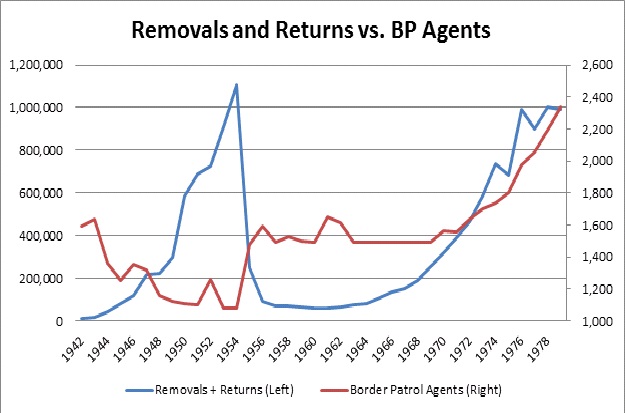
There is a trade off between the number of lower skilled guest worker visas and the number of unauthorized immigrants.  More lower skilled guest workers means fewer unauthorized immigrants.  Fewer guest workers mean more unauthorized immigrants.  We just have to look back to the Bracero program to see this relationship.   

The number of removals and returns is an approximation of the stock of the unauthorized immigrant population and flows.  Many, but not all, of those removed or returned during this time period were funneled into guest worker visas.  Beginning with the adoption of the Bracero program and the H2 visa in the early 1950s, there was a flurry of removals and returns whereby many migrants were funneled into the guest worker visa programs.  After that, my thesis is that the large numbers of work visas decreased the number of apprehensions by shrinking the pool of unauthorized immigrants and channeling future ones into the legal system.  After Bracero was ended in the mid-1960s, the number of removals and returns began a steady increase along with an increase in the stock and flow of unauthorized immigrants deprived of their previous lawful means of entry and work.

Ending the lower skilled guest worker visa programs preceded the modern increase in unauthorized immigration. 

Source: Department of Homeland Security and Immigration and Naturalization Service annual reports.

The more low skilled guest workers there are, the fewer unauthorized immigrants there are to deport. 

One legal worker on a visa seems to be worth more than one unauthorized immigrant worker – meaning a pretty favorable trade off in numbers for those concerned about the numbers of immigrants.  In 1954, 1 guest worker visa replaced 3.4 unauthorized immigrants, meaning that one legal worker seemed to be equal to more than three illegal workers.  If an important goal of a lower skilled guest worker visa is to eliminate the American economic demand for unauthorized immigrants, relatively few guest worker visas can replace a much larger unauthorized immigrant population.

Increases in Border Patrol and border enforcement are also unnecessary to get this result.  By allowing unauthorized immigrants to get the work visas, by not punishing them or employers for coming forward, and by making work visas available to those who want to enter, almost all future and current unauthorized immigrants can be funneled into the legal market without a large increase in enforcement.  This was the policy followed in the 1950s and it appears to have worked:   

Sources: Department of Homeland Security and Immigration and Naturalization Service annual reports.

This chart zooms in on the 1942 through 1965 time period when the Bracero guest worker visa was in effect:

Sources: Department of Homeland Security and Immigration and Naturalization Service annual reports.

This is not to say that Bracero was a perfect program and that it should be replicated today.  There were a lot of problems with it, namely that migrants were constrained in changing employers, migrants were limited to working only in agriculture, and the work visa was annual – all issues that should be fixed in any new lower skilled guest worker visa adopted.  A lower skilled guest worker visa is indispensable to vastly reduce or even halt unauthorized immigration. 

05 May 13:32

John Kerry Claims US Is On The 'Right Side Of History' When It Comes To Online Freedom And Transparency

by Tim Cushing

Once you've ceded the high ground, it's very difficult to reclaim it. At this time last year, the Secretary of State could have gotten away with the following remarks, but just barely. The NSA documents had not yet been revealed, but the US government had been giving up chunks of free speech high ground for quite some time.

Now, with the NSA's programs exposed, along with this administration's quest to punish whistleblowers and maintain the opacity left behind by the Bush administration, there's no approaching the high ground. But that didn't stop John Kerry -- in his remarks to the Freedom Online Coalition Conference -- from planting a flag halfway up and declaring it the summit. (h/t to Dan Froomkin of the Intercept)

[L]et me be clear – as in the physical space, cyber security cannot come at the expense of cyber privacy. And we all know this is a difficult challenge. But I am serious when I tell you that we are committed to discussing it in an absolutely inclusive and transparent manner, both at home and abroad. As President Obama has made clear, just because we can do something doesn’t mean that we should do it. And that’s why he ordered a thorough review of all our signals intelligence practices. And that’s why he then, after examining it and debating it and openly engaging in a conversation about it, which is unlike most countries on the planet, he announced a set of concrete and meaningful reforms, including on electronic surveillance, in a world where we know there are terrorists and others who are seeking to do injury to all of us.
First off, almost every "cyber security" bill has pushed for security at the expense of privacy. CISPA has done this twice. The new CISPA, being presented by the Senate, does the same thing.

Second, the reforms set up by the administration are hardly "concrete and meaningful." They're shallow and limited and do very little to walk back the expansive readings of outdated laws (something Kerry references earlier in his remarks) that have led to these programs being declared "legal." There is a review currently underway, but almost everything the review board has suggested has been ignored.

As for "examining and debating" domestic surveillance, the president only did so because he could no longer ignore it. The leaks weren't simply going to stop and so he finally "welcomed the debate" he'd been making stand out in the foyer for the past several years.

But here's where Kerry treads deepest on his faux moral high ground.
And finally, transparency – the principles governing such activities need to be understood so that free people can debate them and play their part in shaping these choices. And we believe these principles can positively help us to distinguish the legitimate practices of states governed by the rule of law from the legitimate practices of states that actually use surveillance to repress their people. And while I expect you to hold the United States to the standards that I’ve outlined, I also hope that you won’t let the world forget the places where those who hold their government to standards go to jail rather than win prizes.
That last sentence is incredible, in the most pejorative sense. This administration has prosecuted more whistleblowers -- the people who "hold their government to standards" -- than all other administrations combined. And this administration isn't done yet. The infamous "Insider Threat" program, one that tells US government employees to look for warning signs like "dissatisfaction with government policies," began during this administration. Further efforts are being kicked around in the wake of Snowden's departure from the NSA with thousands of documents, including the Director of National Intelligence telling employees they can no longer speak to the media. The CIA spies on the Senate while a Senator sends the DOJ on a mission to find out who leaked bullet points from the still-secret CIA Torture Report to journalists.

As for the prizes, I presume Kerry is referring to the awarding of Pulitzers to journalists who reported on the Snowden leaks. If so, that's a very self-serving statement, considering the government had exactly nothing to do with awarding these prizes and if it was in the administration's hands, those prizes would not have gone to The Guardian and the Washington Post.

Kerry caps it off by casting the internet freedom fight as a battle between right and wrong -- which it is -- but portrays the US government as being firmly on the "right" side.
[T]his debate is about two very different visions: one vision that respects freedom and another that denies it. All of you at the Freedom Online Coalition are on the right side of this debate, and now we need to make sure that all of us together wind up on the right side of history.
This is a very chilling statement, one that suggests the Freedom Online Coalition needs to side with the US government if it wishes to "wind up on the right side of history." As it stands right now, the "right side of history" is almost diametrically opposed to the administration's protection of abusive agencies and persecution of whistleblowers. Kerry's words read more like a subtle threat. Fight the good fight, he says, but never forget history is written by the winners. Your "privacy" will never be worth more than your "security," not when those values are determined by the government.


Permalink | Comments | Email This Story


02 May 14:04

800K QUIT LABOR FORCE IN APRIL...


800K QUIT LABOR FORCE IN APRIL...


(Third column, 1st story, link)
Related stories:
01 May 21:52

Tech firms defy authorities, notify users of secret data demands...


Tech firms defy authorities, notify users of secret data demands...


(Second column, 16th story, link)
Related stories:
01 May 21:49

Cops Harass Wheelchair-Bound Vet, Take His Cellphone Out of Spite, Arrest Him on Probation Violation After Story Goes Viral

by Ed Krayewski

an hero copHealthcare through the Department of Veterans Affairs (VA) is, for now, the closest the U.S. has to government healthcare. Like with all things government, the VA has its own police force. Like other police forces, they seem to have a problem with being recorded, and disrespected.

Wheelchair-bound veteran Todd MacRae says VA police snatched his phone from him while he was trying to record them. He says it all started when he ordered VA cops to leave the room while he was visiting his doctor. They were called when McRae got upset his doctor didn’t accept his answer to a question about his drinking habits. He had calmed down by the time they got there, and the doctor said she could finish her appointment with McRae. Witness what can happen when government and healthcare collides in the worst way.  via Carlos Miller of Photography is Not a Crime reports:

They accused him of “disturbing the peace,” and ordered him, along with his dog, to follow them downstairs to their office, where they could cite them.

“I told them, ‘write me a ticket or shut the fuck up,’” he said, acknowledging that he doesn’t hesitate to speak his mind to the cops…

A week later, his 23-year-old daughter dropped him off for his weekly blood tests, but because she had to attend class at the local college, she left him two hours earlier than his appointment.

So he entered the Starbucks on hospital property with his dog, which is completely allowed, but then one of the cops from the previous week entered, recognized him, and started hassling him about his “vicious dog” not being muzzled.

The cop ordered him off the hospital under threat of trespass arrest, which caused MacRae to miss his weekly appointment for his blood tests that enables him to survive despite having more than 20 pieces of metal in his neck.

“I had to call my daughter to come pick me up and she had to leave school,” the former construction worker said.

On Tuesday, he was at the hospital for another appointment, minding his own business in front of the hospital, when a VA cop walks up and begins hassling him about his dog.

Unlike the two prior incidents, MacRae began recording with his phone, only for the cop to lie and say he was not allowed, then eventually snatching it from him.

Among the problems with this story: state law doesn’t require service dogs to wear muzzles. Neither is recording police against the law in Tennessee. Nevertheless, cops pointed to a federal statute prohibiting unauthorized photography to issue him a citation. So this story has government healthcare, police abuse, and the war on terror.

Even worse, Carlos Miller reports McRae was arrested on a probation violation stemming from a decade-old incident just hours after story went live on Photography is Not a Crime. Read more and watch the video McRae took here.

01 May 18:26

Tim Pawlenty: GOP Should Support 'Reasonable' Minimum Wage Increase

Jts5665

facepalm...

Former Minnesota Governor and failed 2012 GOP presidential candidate Tim Pawlenty said that Republicans should support increases in the minimum wage, though he was against the Senate bill to raise the minimum wage to $10.10 an hour. 

“If you’re going to talk the talk about being for the middle class and the working person, if we have the minimum wage, it should be reasonably adjusted from time to time," Pawlenty, CEO of the Financial Services Roundtable, said on Wednesday. 

He added, "For all the Republicans who come on and talk about, ‘we’re for the blue-collar worker, we’re for the working person,’ there are some basic things that we should be for. One of them is reasonable increases from time to time in the minimum wage."

Pawlenty, who also said on MSNBC that Jeb Bush could win the GOP presidential nomination in 2016, later said that he, too, was for amnesty legislation, which the Congressional Budget Office determined would lower the wages of American workers. 


01 May 16:23

WILL: IRS seizes innocent citizens' assets...


WILL: IRS seizes innocent citizens' assets...


(First column, 15th story, link)

01 May 15:55

GAO Report: Pentagon To Destroy $1.2 Billion in Ammunition Amid Widespread Shortage

The Pentagon plans to destroy $1.2 billion in ammunition amid widespread ammo shortages for private citizens.

According to a Government Accountability Office (GAO) report acquired by USA Today, the ammunition is being destroyed because the Pentagon does not know what ammunition is new and viable and what is not. This is due to the fact that "the Defense Department's inventory systems can't share data effectively," leading to "an inaccurate accounting of ammunition."

Homeland Security and Governmental Affairs Committee chairman Senator Tom Carper (D-DE) said, "There is a huge opportunity to save millions, if not billions of dollars if the (Pentagon) can make some commonsense improvements to how it manages ammunition."

Question: If portions of the ammunition are in a caliber popular in the civilian market, why can the ammo not be sold at a reduced price, as is, to private citizens who are told beforehand that some of it may unknowingly be outdated? 

In this way the Pentagon could recoup a hefty portion of the $1.2 billion it is preparing to throw away and law abiding citizens could get their hands on some of the very ammunition they can no longer find on store shelves.

Follow AWR Hawkins on Twitter @AWRHawkins  Reach him directly at awrhawkins@breitbart.com.


01 May 15:43

Mich. Right-to-Work Law Results in Mass Exodus of Home Caretakers from Union

by Scott Shackford

They've probably stopped clapping.What can we extrapolate about the state of unionized labor in America when 80 percent of one group’s members dropped out in a single year once presented the opportunity to do so?

That’s what happened in Michigan. That hard-fought right-to-work law gave home healthcare workers the chance to choose whether Service Employees International Union (SEIU) would actually represent them. Home healthcare workers, who are often family members of the patients they serve and sometimes not even actually paid, were forced by the state beginning in 2005 to accept SEIU as their bargaining representative and pay them dues, which were deducted from state Medicaid checks for the people the workers were serving.

Now that Michigan workers have been granted the right to refuse union representation and decline to pay union does, the home care workers are showing SEIU Healthcare Michigan the door. According to federal reports examined by the Michigan-based Mackinac Center for Public Policy, 44,000 home care workers have dropped their membership from the union, leaving just under 11,000 members.

Fox News interviewed a couple who had been forced into the union while caring for their own children and had little good to say about their membership. The husband is a retired Detroit police officer. How bad do you have to be to lose them?

[Patricia] Haynes said that every month, $30 was deducted from their children’s Medicare payments, and, while it did not break their bank, they objected on principle.

“They couldn’t get me a raise, they couldn’t get me more vacation time and they certainly did nothing to improve my children’s care,” she said. “I’d hate to say it, but in my opinion, they were stealing.”

Haynes also says that they are also hoping to help others who had to pay dues.

“We are not anti-union. I just don’t understand why we were forced to join because I have two disabled kids,” she said. “That we were told that we had to join a union just because we chose to keep our kids at home to care for them.”

The Mackinac Center calculates that SEIU has skimmed more than $34 million from the Medicaid payments across the state and will lose more than $4 million in annual dues and fees from the plunge in membership. The Mackinac Center is suing to try to get some of those dues the union has already taken back.

Michigan isn’t the only state that has forced caretakers into accepting union representation, and similar requirements in Illinois have led to a Supreme Court case. The court heard arguments for and against forced caretaker unionization in Harris v. Quinn in January. I wrote a summary of the case here, and SCOTUSblog attended and analyzed the arguments presented to the court here. We're still waiting on the decision.

UPDATE: After posting this, Joseph G. Lehman, president of the Mackinac Center for Public Policy, contacted me to clarify that the passage of the right-to-work legislation was not actually what ended the practice of forcing home care workers into SEIU representation. A lawsuit from Mackinac was followed by some complex legislative action and decisions by Gov. Snyder that ultimately ended the practice in a timeline that happens to coincide with Michigan's right-to-work laws.

01 May 15:20

Despite China’s impressive growth, on a per capita basis, the US economy is still a century ahead of China

by Mark J. Perry

In a post this morning (“Sorry, China, the US is still the world’s leading economic power“) Jimmy Pethokoukis reported on a story in today’s Financial Times titled “China poised to pass US as world’s leading economic power this year.” Here’s a key excerpt of the FT story:

The US is on the brink of losing its status as the world’s largest economy, and is likely to slip behind this year, sooner than widely anticipated, according to the world’s leading statistical agencies. The US has been the global leader since overtaking the UK in 1872. Most economists previously thought China would pull ahead in 2019.

Here are some of Jimmy’s comments about the FT story:

Some important context here: on a per person basis, PPP GDP is $51,000 in the US vs. $11,000 in China. Anyway you slice the data, China is still a much poorer nation than America. (More than 30 million Chinese, basically the population of Texas, live in caves.) And at market rates, the US economy is about twice as large as China’s. Also note that within two decades or so, China will have an older population than the United States. The Middle Kingdom has become old before it has become rich. In addition to demographic problems, China is still trying to transition to a sustainable, consumer-driven growth model. So the other team has its problems, too.

Now here is what the FT’s headline, “China poised to pass US as world’s leading economic power this year,” really gets wrong. The US remains the world’s leading economic power due to its technological innovation. Most global innovation surveys put the US at or near the top. For instance, the World Economic Forum ranks the US as the 7th most innovative economy, China the 32nd. Bloomberg puts the US at third, while China did not make the top 30. And which global economy is most critical to expanding the technological frontier, say, Sweden, Bloomberg’s #2 ranked economy with a population of 9.5 million and a $400 billion economy, or the #3 US with its 315 million people and $16 trillion economy. Pound for pound, no nation innovates like America. It’s our deep magic, and a competitive advantage we should be careful not to squander.

MP: The chart above adds some additional context to the FT’s claim that China will overtake the US this year as the world’s leading economic superpower. Displayed above is real GDP per capita in the US (in 2013 dollars), on an annual basis back to 1800, using historical data from Global Financial Data (subscription required). According to the International Monetary Fund, per capita GDP in China last year reached $6,747, which was a level of economic output per capita that was first reached in the US back in 1882, more than 130 years ago. Adjusting for purchasing power in China to make a more accurate comparison between output levels per capita in the US and China, the IMF data show that China’s per capita GDP (PPP) last year was $9,844, which was the level of economic output per person first reached in the US back in 1912, more than a century ago. Even if China’s per capita GDP continues to grow at say 7% for the next three years, it would still only reach the equivalent level of America’s output per capita in 1939. And even if China’s output per person grew at 7% for the next decade, it would still only be at a level the US reached in 1951.

Bottom Line: Yes, it’s true that China has made phenomenal economic gains over the last several decades to become the second largest economy in the world, and it’s true that China will probably surpass the US to become the world’s largest economy this year based on economic output. But adjusted on a per-capita basis, America’s output is still a full century ahead of China, and it could take many decades of economic growth in China before it even comes close to approaching the level of per-capita GDP that the US reached fifty years ago. Before breaking out the champagne and cigars for China’s status as the “world’s leading economic power,” let’s keep it all in perspective!

01 May 15:17

Man's Body Found Inside Fortune Cookie Company's Dough Machine...


Man's Body Found Inside Fortune Cookie Company's Dough Machine...


(Second column, 12th story, link)

29 Apr 22:21

Who’d a-thunk it? The USPS used its coercive monopoly power to squash the digital mail startup Outbox?

by Mark J. Perry

How good does this sound? Stop receiving junk mail forever (about 95% of the mail I receive) and receive all of your “real” mail (bills, letters, correspondence, etc.) in digital format online or via smartphone, accessible from anywhere, for only $5 a month? Hey, sign me up!

That was exactly the brilliant idea of two former Capitol Hill staffers (Evan Baehr and Will Davis) who went to Harvard Business School and then launched the mail digitizing service called “Outbox.” The goal was to revolutionize the way we receive mail by offering customers an opportunity to receive “digitized mail” as alternative to the traditional, physical delivery of postal mail. Here’s the pair’s business model, described in the article “Outbox vs. USPS: How the Post Office Killed Digital Mail” by Derek Khanna:

They wanted to allow consumers to digitize all of their postal mail so that individuals could get rid of junk mail, keep important things organized and never have to go out to their mailbox again. Customers would opt-in for $5 a month with “Outbox” to have their mail redirected, opened, scanned and available online or through a phone app.  Consumers could then click on a particular scanned letter and ask that it be physically delivered, or that certain types of letters not be opened (e.g., bills etc.).

Will and Evan may have been inspired by their time working on Capitol Hill, as this is essentially the type of technology used in every Congressional Office to manage the deluge of millions of letters from constituents to Congress.  If it’s good enough for Congressional offices, they thought, why shouldn’t average people have access to similar technology?

The pair started out with an idea and received funding from Silicon Valley, including from well-known venture capitalist Peter Thiel (one of the major backers of Facebook and PayPal). They started out small, testing their hypothesis that consumers would want to limit or eliminate their junk mail, save a copy of their mail forever like e-mail, and be able to access their most recent mail anywhere in the world while traveling. And they were right.

They launched in Austin, Texas, and grew quickly. They were limited mainly by their ability to expand and meet demand. Users were gushing with positive reviews and Outbox had hundreds of paying users signing up and loving their service.  Once customers had experienced digital mail, they didn’t want to go back. As one customer, Marcia Navratil, explains “I don’t know why anyone wouldn’t get their mail this way, unless you just really like having paper delivered to your house.”

But what about the USPS – the government mail delivery monopolist? Well, it turns out that Outbox could actually save money for the USPS.

If consumers started to opt-in to Outbox, or other services like Outbox, then the Post Office could receive the full benefits of the stamped envelope but never have to deliver those packages, which is one of the biggest costs for the Post Office. In fact, if properly implemented, when a customer sends a letter from Austin, TX to Alaska, if the Post Office knew that they weren’t going to receive the letter anyway, then the Post Office could forward the letter from Austin directly to Outbox, and never have to ship the letter across the continent. Thus digitization of mail could actually save the Post Office a large amount of money.

But that wasn’t how the Post Office would see it. If Outbox sounds almost too good to be true for customers, it was way too good for consumers to be good for the coercive mail monopolist USPS. Without the cooperation of the USPS, it was very difficult (and costly) for Outbox to survive, and in the end the USPS proceeded to shut its upstart competitor down.

At a meeting at USPS headquarters in DC, Postmaster General Patrick Donahoe told the digital mail entrepreneurs:

You mentioned making mail service better for our customers; but the American citizens aren’t our customers—about 400 junk mailers are our customers.  Your service hurts our ability to serve those customers.

The USPS Chief of Digital Strategy added:

Your market model will never work anyway. Digital is a fad. It will only work in Europe.

Khanna summarizes the situation of Outbox vs. USPS:

Outbox was a disruptive innovation. Outbox offered utility for many consumers and offered new technology that the Post Office should have been offering for years. In a well-functioning market, we would expect a company like Outbox to disrupt the dominance of the incumbent and force them to either innovate or die. But of course, USPS is not a normal company; rather, it is an entity of the US government, and the market forces that lead to innovation and growth in the free market are completely missing in DC bureaucracy.

Unlike in the free market, USPS didn’t have to compete with Outbox on the merits of their services; instead, they could simply tell them that they wouldn’t cooperate because Outbox could “disrupt” their service. Anyone who has looked at USPS’s balance sheets can tell you, if any government bureaucracy is in need of disruption, then it surely is the USPS.

But Postmaster General Donahue didn’t apparently want any “disruption,” even if it may have saved him money by reducing the expense of physical delivery.

Read the rest of the article here and here’s the final blog post from Outbox’s founders announcing in January that the startup was closing after two years in business. One of their final thoughts is:

You may think government organizations are completely, insanely backwards; you are wrong—they are worse.

Economic Lesson: Private companies (in some cases monopolists or near-monopolists) that control a large share (or even 100%) of the market (e.g. Alcoa, IBM, Microsoft) are not generally a threat to consumers, as long as there are no significant barriers to entry. Dominant firms are disciplined by both existing competition, and even when that’s not a significant threat, more importantly, dominant firms are disciplined by the threat of potential competition as long as there are no significant barriers to new entrants. The threat to consumers comes from government-created “coercive monopolists” like the USPS that is legally protected from competition and new entrants like Outbox. It’s a big difference. Neither IBM nor Microsoft can use government force to shut down competition; but the USPS can and did, in the case of Outbox.

And don’t forget: YOU are not the USPS’s customer! Unless of course you are one of the country’s 400 “junk mailers.”

29 Apr 20:30

VIDEO: Man Arrested, Charged With Obstruction Of Justice For Recording Man's Arrest On Cell Phone...


VIDEO: Man Arrested, Charged With Obstruction Of Justice For Recording Man's Arrest On Cell Phone...


(Second column, 16th story, link)

29 Apr 20:30

POLL: Young People 'Historic Low' Levels Of Trust In Govt...


POLL: Young People 'Historic Low' Levels Of Trust In Govt...


(Third column, 5th story, link)

29 Apr 19:32

3 Policies That Are More Racist Than Donald Sterling and Cliven Bundy

by Nick Gillespie

Racist rants by federal lands moocher Cliven Bundy and vile comments attributed to Los Angeles Clippers owner Donald Sterling have put old-school racism back in the news.

But let’s get real. However contemptible, Bundy and Sterling aren’t what’s holding down blacks and other minorities in today’s America.

Here are three policies that, whatever their original intentions, systematically screw over poor blacks and other minorities.

They include:

1. Barriers to work.

Whether it’s absurd licensing laws for at-home hair braiders, day care operators, and other small-time entrepreneurs or minimum wage laws that price young, unskilled black kids out of their first jobs, barriers to the labor market take their biggest toll on those with the least education, skills, and professional connections.

2. The Drug War

Created amidst fears of cocaine-snorting negroes, opium-smoking Chinese, and pot-puffing Mexicans, the drug war not only locks up black and minorities in vastly unfair and unjustifiable numbers, it also concentrates black-market violence in poor urban neighborhoods. Blacks don’t use drugs more than whites—they just pay a much steeper price.

3. The Education Monopoly

Despite more than doubling real per-pupil expenditures since the early 1970s, America’s graduating high school seniors have shown no meaningul improvements in math, reading, and science. It’s black and Hispanic kids in inner cities whose parents lack any real choice in schools that suffer the most. And yet politicans, teachers, and parents who can afford to exercise choice for their own kids do everything they can to keep poor kids trapped in failing schools.

At a combined 140 years old, Bundy and Sterling are survivors from an older, uglier America that died well before the election of Barack Obama.

They can (and should) go fuck themselves, but if the rest of us actually want to address the sort of racism that is screwing over today’s minorities, we’d do well to bust down barriers to work, end the drug war, and tear apart the school monopoly.

About 2 minutes. Written and hosted by Nick Gillespie and produced by Meredith Bragg.

Scroll down for downloadable versions and subscribe to Reason TV's YouTube channel for automatic notification when new videos go live. 

25 Apr 19:40

WaPo’s Bridge Story Is Structurally Deficient

by Chris Edwards

Chris Edwards

Oh dear, yet another scare story about falling-down bridges. A Washington Post headline today in the hardcopy is “63,000 Bridges Structurally Deficient, U.S. Says.”

The Federal Highway Administration (FHWA) has released its annual data on bridge conditions, and indeed the data show that 63,522 bridges were “structurally deficient” in 2013. That sounds like a lot, but it is out of 607,751 total U.S. bridges.

Here’s what nearly all media stories on this topic gloss over: the share of U.S. bridges that are structurally deficient has been falling steadily for more than two decades. The chart below (based on FHWA data) shows that the share of U.S. bridges that are structurally deficient fell from 22 percent in 1992 to just 10 percent in 2013.

The chart clearly shows good news on the bridge front, but many reporters focus on the bad news angle favored by construction lobby groups.

The WaPo story reflects lobbyist pleas that the states need the federal government to fix their bridges. But why? If Pennsylvania has “the nation’s worst problem,” then the Pennsylvania legislature should find a solution—either reprioritize the state budget, start privatizing bridges, charge bridge tolls, or find other funding sources. No need to look to Washington. Uncle Sam is not Santa Claus.

For more on our (supposedly) crumbling infrastructure, see here, here, here,  

23 Apr 16:07

Supreme Court upholds Michigan decision to end ‘racial profiling,’ ‘affirmative discrimination’ in college admissions

by Mark J. Perry

In a landmark decision yesterday in favor of advancing equal treatment for all and moving towards a colorblind society, the Supreme Court voted 6-2 to support Michigan voters’ decision in 2006 to end the discriminatory practices of affirmative action discrimination and racial preferences profiling for admissions to the state’s public universities.  Here’s from today’s front page WSJ article “Court Backs Affirmative Action Discrimination Ban“:

The Supreme Court on Tuesday upheld Michigan’s decision to end affirmative action discrimination at its public universities in a 6-2 ruling, but the justices were divided in their reasoning, suggesting continued uncertainty over the broader issue of racial preferences profiling.

The ruling leaves in place a 2006 Michigan ballot initiative where voters ended race-based admissions at state schools, and means racial preferences profiling won’t soon return to the University of Michigan—or any other public university in states that have chosen to end the practice.

The court’s ruling didn’t alter the ability of universities in states without bans to consider race as one factor among others in admissions. Instead, the court chipped away at affirmative action discrimination by giving its blessing to one path for foes to challenge admissions policies: ballot initiatives. Opponents have also gone to courts and state legislatures to end affirmative action discrimination practices in a decades-long battle over university policies.

I’ve made this argument before, and will make it again today following the Supreme Court decision, that to understand why it’s time to end racial preferences profiling in higher education, we should consider the following hypothetical scenario of race-based grading.

A university professor walks into class at the beginning of the semester. After a review of required texts, assignments and examinations, the professor discusses the grading policy. The professor explains that there is a new university policy that applies a double standard for grading and is an extension of the university’s race-based admissions policies.

The professor explains that a standard grading scale will apply to all white, Asian and Arab students. African-American and Hispanic students will automatically receive extra points for all assignments and will receive a final letter grade based on a preferential grading scale. Most people would find this blatant form of discrimination objectionable for many reasons.

1. The students receiving academic favoritism might justifiably complain that they are being stereotyped as a homogeneous group. It would be offensive to many of those students to assume automatically that they all need preferential academic treatment.

2. This form of academic profiling creates a disincentive for preferred minorities (black and Hispanic students) to study as hard as they would otherwise.

3. The racially advantaged students could face a special-preference stigma when they enter the job market or apply to graduate school. If a student graduates from college with a 3.5 grade point average, a prospective employer or graduate program would justifiably question the academic credentials and potential abilities of those students who received race-based adjustments in all of their undergraduate course work.

4. Finally, most everyone would object to the fundamental unfairness of giving preferential treatment to certain groups of students. The students who didn’t receive special grading preferences would rightfully feel they were being treated unfairly and being discriminated against. Why should an Asian student with an 85% score in an accounting class get a letter grade of B if a black or Hispanic student with the same percentage score gets an A?

These and many other reasons explain why the only acceptable practice in the classroom is the equal treatment of all students as individuals, without regard to race, sex, ethnicity or religion. And yet the hypothetical classroom-based discrimination is exactly the type of admission-based discrimination that prevails today at many American universities. And it is the obvious objections to academic favoritism in the classroom that explain why racial favoritism profiling in college admissions has been legally challenged.

Students are treated as individuals without regard to race by university professors once they enter college. Treating all students as individuals when they first apply to college will ultimately move us further along toward the ideal of a colorblind society than maintaining the current admissions practices of double standards, special preferences and racial profiling.

President John F. Kennedy said: “Simple justice requires that public funds, to which all taxpayers of all races and national origins contribute, not be spent in any fashion which encourages, entrenches, subsidizes or results in racial discrimination.” Fortunately, President Kennedy’s vision prevails in Michigan, now that the Supreme Court has voted to support the state ban on state-sponsored racial discrimination in admissions to public universities in the state.

Bottom Line: How can it be logically and legally consistent for somebody to support affirmative action discrimination when practiced by a staff member in the admissions or financial aid office of a university in one building on a college campus, but object to “affirmative action grading” when practiced by a college professor on that same college campus in another building? If race-neutral grading is the accepted standard for the treatment of college students IN the classroom, then race-based preferences cannot be justified when selecting students for admission to the university in the first place.

Note: I think that substituting the term “racial profiling” for “racial preferences” and the term “affirmative discrimination” for “affirmative action” also help to understand why those practices are objectionable. Words and terminology matter. As George Carlin said, “Words are all we have, really. We have thoughts but thoughts are fluid. Then we assign a word to a thought and we’re stuck with that word for that thought, so be careful with words.”

23 Apr 14:52

7 Things You Had No Idea Gut Bacteria Could Do

by Mark Sisson

gutbacteriaIf you’re a regular Mark’s Daily Apple reader, you probably have at least a generally accurate if somewhat vague notion of the important functions performed by our gut bacteria. They’re a “big part” of our immune systems. They “improve digestion” and “eat the fibers and resistant starches” that our host enzymes cannot digest. Yeah, gut bacteria are hot right now. Everyone’s talking about them. And, since our host cells are famously outnumbered by our gut bacteria, 10 to 1, we need to be apprised of all that they do.

We don’t know everything yet – and we probably never will – but here are some of the most interesting and unexpected functions of our gut bacteria:

They learn from each other.

Bacteria are simple, straightforward organisms. They don’t have all the hangups that we mammals do, all the middle men and physiological bureaucracy between “us” and outside information. Bacteria can directly exchange genetic material – defense mechanisms, enzymatic functions, and other characteristics – from other bacteria they come into contact with in the gut. They’re very quick learners operating on an entirely different time scale.

One example: in most Japanese people, certain strains of gut bacteria have picked up the genes for seaweed digestion from the bacteria found on seaweed. The seaweed bacteria itself didn’t colonize the Japanese guts; only the genetic material transferred. Other groups whose gut bacteria weren’t exposed to the seaweed-digesting strains and never picked up the relevant genes have more trouble digesting the seaweed polysaccharides.

They improve our bone mineral density.

Feeding fermentable fibers to our gut bacteria isn’t just about the short chain fatty acids they produce in response. It’s also about the improved bone health, which occurs through numerous gut bacteria-mediated mechanisms: “increased solubility and absorption of minerals because of increased bacterial production of short-chain fatty acids from prebiotic fermentation; the enlargement of the absorption surface by lactate and butyrate; increased expression of calcium-binding proteins; improvement of gut health; degradation of mineral complexing phytic acid; release of bone-modulating factors such as phytoestrogens from foods; stabilization of the intestinal flora and ecology, also in the presence of antibiotics; stabilization of the intestinal mucus; and impact of modulating growth factors such as polyamines.”

They nullify anti-nutrients.

Phytic acid is an anti-nutrient found in seeds, grains, legumes, nuts, and many other foods. It binds to and prevents the absorption of various minerals, and high phytic acid diets have the potential to cause nutrient deficiencies. Unless you have the right gut flora.

Certain gut flora can actually turn phytic acid into inositol, preventing mineral-binding and releasing a nutrient involved in mood regulation and insulin sensitivity. The more phytate-rich foods you eat, the better your gut bacteria get at breaking it down (they learn, remember?).

There’s also evidence that the right gut flora can reduce the allergenicity of gluten and dairy proteins.

They manufacture vitamins.

When gut bacteria consume substrates, they produce various metabolites, the most famous of which are the short chain fatty acids butyrate, acetate, and propionate. But they also produce vitamins in the process, particularly vitamin K and the B-vitamins. According to Dr. Art Ayers, an optimally-outfitted human gut biome given sufficient dietary substrates can manufacture all the vitamins a person requires.

It seems Vitamin K2, that sweet little variant of vitamin K we love so much, can also be made in the gut. There’s very little direct evidence of this, but broad spectrum antibiotic usage leads to lower levels of vitamin K2 in the human liver. What we do make in the gut can absolutely be absorbed and utilized.

They form a large physical barrier against pathogens.

Bacteria are made of matter, even though they’re invisible to the naked eye. They take up physical space on the gut lining. They plug holes, fill nooks. They cross arms and stand together, steadfast against encroaching pathogens seeking residence. Sheer brute force is one of, if not the most primary immune function of our gut bacteria.

They represent a “second brain.”

The enteric nervous system, found in the gut, has more neurons than the spinal column or central nervous system. Long thought to be only concerned with directing digestive contractions, the enteric nervous system has a direct conduit to the brain: the vagus nerve, 90% of whose fibers are dedicated to communication from the gut to the brain. If you’ve ever gotten butterflies in your stomach from young love or anxiety (or both), or felt like you knew something “in your gut,” that may have been your gut brain relaying the message to your, um, brain brain.

Here’s where the bacteria come in: gut flora produce a ton of neurotransmitters, about 95% of our serotonin and half of our dopamine. Imagine if those voices in our head that seem to originate elsewhere are the result of your gut bacteria coming to a consensus position and delivering it via a chemical slurry of neurotransmitter secretions directly up to your brain? After all, the thoughts we have, the desire we feel, and the words we form come from chemical chatter between neurons. It’s possible that the brain can’t tell where the chatter originates, from “us” or the gut flora. Is there even an “us”? Maybe it doesn’t matter. Maybe “us” is closer to the truth than “me.”

They can make us depressed, anxious, obsessive-compulsive, and even autistic.

Researchers have long noticed that people with disorders “of the mind,” like depression, obsessive compulsive disorder, and autism, tend to also have gastrointestinal issues. It’s becoming clear that these aren’t chance correlations. The emergence of the gut-brain axis, the knowledge that gut bacteria manufacture neurotransmitters, and direct clinical evidence (albeit mostly with non-human animals) suggests that the gut bacteria disturbances are mediating the disorders. We see this in:

Gut bacteria help determine the nutrient content of our meals. They mediate our subjective interpretation of everyday life and our interpersonal dealings with others. They’re constantly learning new things and defending us from interlopers and communicating with and perhaps even telling us what to think and how to act. It’s almost overwhelming to even imagine.

Hopefully you’re beginning to understand why the gut biome is shaping up to be the biggest health story of the century and why we ignore it at our peril.

Thanks for reading, everyone. What’s the most surprising thing gut bacteria can do, in your opinion?

Not a Subscriber? You Are Missing Out. Subscribe for Free Today and Instantly Get 8 Primal eBooks and So Much More!

23 Apr 14:49

Guest Post: Piketty's Gold?

by Tyler Durden

Originally posted at The New York Sun,

With all that has been written in respect to Thomas Piketty's new book, “Capital,” you would think that someone — Paul Krugman, say, or Jonathan Chait or David Brooks or Hendrik Hertzberg; we’re not worried about who it might be so much as someone among the liberal intelligentsia — would have remarked on an odd coincidence of timing. We’re speaking here of the timing of the rapid rise of the blasted inequality over which Professor Piketty is so upset. After all, this inequality has become the cause celebre of the season for President Obama and his entire political party. It’s the issue of the hour. Yet when it comes to the timing at which this phenomenon presented itself, nada. Omerta.

Well, feature the chart that Professor Piketty publishes showing inequality in America. This appears in the book at figure 9.8; a similar version, shown alongside here, is offered on his Web site. It’s an illuminating chart. It shows the share of national income of the top decile of the population. It started the century at a bit above 40% and edged above 45% in the Roaring Twenties. It plunged during the Great Depression and edged down in World War II, and then steadied out, until we get to the 1970s. Something happened then that caused income inequality to start soaring. The top decile's share of income went from something like 33% in 1971 to above 47% by 2010.

Hmmm. What could account for that? Could it be the last broadcast of the “Lawrence Welk Show?” Or the blast off of the Apollo 14 mission to the Moon? Or could it have something to do with the mysterious D.B. Cooper, who bailed out of the plane he hijacked, never to be seen again? A timeline of 1971 offers so many possibilities. But, say, what about the possibility that it was in the middle of 1971, in August, that America closed the gold window at which it was supposed to redeem in specie dollars presented by foreign central banks. That was the default that ended the era of the Bretton Woods monetary system.

That’s the default that opened the age of fiat money. Or the era that President Nixon supposedly summed up in with Milton Friedman’s immortal words, “We’re all Keynesians now.” This is an age that has seen a sharp change in unemployment patterns. Before this date, unemployment was, by today’s standards, low. This was a pattern that held in Europe (these columns wrote about it in “George Soros’ Two Cents”) and in America (“Yellen’s Missing Jobs”). From 1947 to 1971, unemployment in America ran at the average rate of 4.7%; since 1971 the average unemployment rate has averaged 6.4%. Could this have been a factor in the soaring income inequality that also emerged in the age of fiat money?

This is the question the liberals don’t want to discuss, even acknowledge. They are never going to get it out of their heads that the gold standard is a barbarous relic. They have spent so much of their capital ridiculing the idea of honest money that they daren’t open up the question. It doesn’t take a Ph.D. from MIT or Princeton, however, to imagine that in an age of fiat money, the top decile would have an easier time making hay than would the denizens of the other nine deciles, who aren’t trained in the art of swaps and derivatives. We don’t belittle the skills of the top decile. We tend to view them the way we view great baseball players or violinists — heroic figures. Neither do we make a totem out of economic equality; in inequality, after all, are found incentives.

In terms of public policy, though, we favor honest money. It works out better for more people. And there is a moral dimension to the question of honest money. This was a matter that was understood — and keenly felt — by the Founders of America, who almost to a man (Benjamin Franklin, a printer of paper notes, was a holdout), cringed with humiliation at the thought of fiat paper money. They’d tried it in the revolution, and it had been the one embarrassment of the struggle. They eventually gave us a Constitution that they hoped would bar us from ever making the same mistake.

There is an irony here for Monsieur Piketty. It was France who gave us Jacques Rueff, the economist who had the clearest comprehension of the importance of sound money based on gold specie. He was, among other things, an adviser of Charles De Gaulle. It was De Gaulle who in 1965, called a thousand newspapermen together and spoke of the importance of gold as the central element of an international monetary system that would put large and small, rich and poor nations on the same plane. We ran the complete text of Professor Piketty’s book “Capital” through the Sun’s own “Electrically-operated Savvy Sifter” and were unable to find, even once, the name of Rueff.

23 Apr 03:14

Gas Prices Are Pinching Again, and You Can Thank U.S. Trade Policy For Some of the Pain

by Scott Lincicome

Scott Lincicome

The summer driving season is still weeks away, but rising U.S. gas prices are already back in the news.  Last week, the average price for regular gasoline at U.S. gas stations hit $3.6918 a gallon – the highest since March 22, 2013 and up 43 cents this year.  Much of this price depends on global supply and demand, but certainly not all of it.  In fact, two archaic, little-known U.S. policies – vigorously defended by the well-connected interest groups who benefit from them – restrict free trade in petroleum products and, as a result, force American consumers to pay considerably more at the pump.

First, the Jones Act - a 94-year-old law that requires all domestic seaborne trade to be shipped on U.S.-crewed, -owned, flagged and manufactured vessels – prevents cost-effective intrastate shipping of crude oil or refined products.  According to Bloomberg, there are only 13 ships that can legally move oil between U.S. ports, and these ships are “booked solid.”  As a result, abundant oil supplies in the Gulf Coast region cannot be shipped to other U.S. states with spare refinery capacity.  And, even when such vessels are available, the Jones Act makes intrastate crude shipping artificially expensive.  According to a 2012 report by the Financial Times, shipping U.S. crude from Texas to Philadelphia cost more than three times as much as shipping the same product on a foreign-flagged vessel to a Canadian refinery, even though the latter route is longer.

It doesn’t take an energy economist to see how the Jones Act’s byzantine protectionism leads to higher prices at the pump for American drivers.  According to one recent estimate, revoking the Jones Act would reduce U.S. gasoline prices by as much as 15 cents per gallon “by increasing the supply of ships able to shuttle the fuel between U.S. ports.”

Some of these costs could potentially be mitigated if it weren’t for the second U.S. trade policy inflating gas prices: restrictions on crude oil exports.  As I wrote for Cato last year, current U.S. law – implemented in the 1970s during a bygone era of energy scarcity and dependence – effectively bans the exportation of U.S. crude oil to any country other than Canada.  Because U.S. and Canadian refinery capacity is finite, America’s newfound energy abundance has led to a glut of domestic oil and caused domestic crude oil prices (West Texas Intermediate and Louisiana Light Sweet) to drop well below their global (Brent) counterpart.  One might think that this price divergence would mean lower U.S. gas prices, but such thinking fails to understand that U.S. gasoline exports may be freely exported, and that gasoline prices are set on global markets based on Brent crude prices.  As a result, several recent analyses – including ones by Citigroup [$], Resources for the Future and the American Petroleum Institute - have found that liberalization of U.S. crude oil exports would lower, not raise, gas prices by as much as 7 cents per gallon.

Thus, the Jones Act and the crude oil export ban – each implemented decades ago – together inflate U.S. gasoline prices by as much as 0.22 per gallon – or about 6% of the current price at your local gas station.  Not everyone in the United States, however, is harmed.  In the case of the Jones Act, the American shipping unions and shipbuilders that benefit from the law have long opposed any type of reforms, regardless of the pains imposed on the American economy and U.S. consumers.  The crude oil export restrictions, on the other hand, have found new support from a small group of U.S. refiners who profit handsomely from depressed domestic crude prices and the lack of any legal limits on their exports.  As is always the case with protectionism, these groups win and U.S. consumers lose.

Given this political dynamic, reform of either law appears unlikely in the near future, regardless of how dramatically the U.S. trade and energy landscape has changed since the laws were imposed.  So the next time you fill up the tank, note that about 6 percent of your bill pads the bottom lines of a few well-connected cronies.

22 Apr 21:52

#myNYPD Backfires as TWITTER Users Share Photos of Police Brutality...


#myNYPD Backfires as TWITTER Users Share Photos of Police Brutality...


(Second column, 3rd story, link)

22 Apr 18:38

Revisiting Resistant Starch: Part Three

by Tom Naughton

Here’s the third and final installment of my interview with Richard Nikoley, Tim “Tatertot” Steele and Grace Liu on the subject of resistant starch.  They’re writing a book on the topic, and I will of course let everyone know when it’s available.

Fat Head: Several of your readers have reported that after adding resistant starch to their diets, they finally broke through a weight-loss stall.  Any idea why that happened?  Do we understand the mechanism?

Grace: RS is one of the bionic fuels that feed and replenish our ancestral gut bugs, and we need these for not just optimal gut health but for optimal body fat, hormones and brain function. In human and animal trials, RS improves body composition (higher lean mass, lower body fat). The co-owner of the Australian Mt. Uncle green banana farm told me the story how he became inspired to sell green banana flour after having to trash 40% of his delicate ladyfinger banana crop each year because, darkening so easily, a high percent failed to meet grocery specs. Rob Watkins gave the cows and steers on his farm the reject green bananas and noticed within weeks that they appeared healthier, stronger, and more muscled. In other words, they appeared to have less body fat and better hormones!

And this is the case in the fiber clinical trials. RS alone rarely induces net weight loss, however RS combined with soluble fiber or as a whole food or supplement (green banana flour or green plantain flour) leads to significant weight loss. Additionally, we have many anecdotal stories at  Free The Animal about overcoming weight-loss stalls. The mechanisms behind this may include: fixing tight junctions and intestinal permeability, improved whole-body insulin sensitivity, improved adrenal/thyroid health, lower inflammation, and improved testosterone and progesterone levels.  For my case, which I discuss here on my Animal Pharm blog, I also had a tremendous weight-loss stall after many gut disruptions (mercury, titanium, antibiotics, Tetanus vaccine) but resolved it after the gut microbiota improved.

Tim: RS by itself isn’t generally a great weight loss tool, but it is known to repair broken metabolisms.  In the short term, RS can lead to weight gain as your intestines get healthier and harbor more friendly microbes, but in the long run, the increase in signaling of hunger hormones and insulin sensitivity should lead to long-term health consequences and weight loss for the overweight or weight gain for the underweight.  Best bet for long-term weight loss and weight maintenance is a diet with ample food that feeds gut microbes.

Richard: Debates over things always seem to get framed in terms of “it’s either this, or it’s that—or maybe it’s something else, but it’s got to be some one thing.” Then people align themselves with one theory or the other and prepare for the cage match to the death, looking for every opportunity to become even more entrenched.

Many times in the past, over various issues across the board, I’ve always said, “Well, what if it’s both?” Or what if some aspects of all these “opposing” ideas have some parts that are true, and if you put all the true parts together, then you have a kind of Hegelian dialectic where you’ve synthesized something closer to the truth.

I recently put up this post to advance just such a thing in the obesity debate. So there are all these competing theories out there like it’s the calories, no it’s the carbs, no no no it’s all genetic, or everyone is all wrong because it’s clearly food engineering and the reward value of stuff.

I happen to think there’s some truth in all of those ideas, but I think the unifying one is the genetic theory — only I’m not talking about our 25,000 genes; I’m talking about the other 3 million genes in our gut biome, evolving to the tune of six generations per day. Chewing on it in those terms, understanding the influence gut microbes have on our behaviors, feelings, mood, sleep and hormonal regulation, and all of a sudden you might begin to understand that all these theories weren’t just arrived at by stupid people — except for the one you hold, of course — but that they saw one part of the whole truth, but didn’t have that unifying piece that brings them all together.

Anyway, that’s my pet theory and I plan on defending it to the death against all the “stupid ideas” out there.

[Note:  Richard assures me has was smiling in a self-deprecating sort of way when he wrote that last part -- Tom.]

Fat Head: I’ve lost weight when my ketone levels were low, so I don’t think ketosis is necessary for weight loss and I don’t aim for ketosis with my diet.  For me, it’s more about keeping blood sugar in a healthy range and maintaining my ability to efficiently release and burn fat for fuel.  But for people who feel better and lose weight more quickly in ketosis, does resistant starch kick them out of it?

Tim: We’ve done quite a few experiments.  Potato starch will not kick anyone out of ketosis, probably no matter how much you take.  It’s 66% to 87.5% RS, depending on which method you use to measure it, with the remaining fractions being mostly water and some slowly digested starch.  Other isolated RS sources like banana flour or tapioca starch may have varying results, since they are not as concentrated as potato starch, ranging from 30 to 50% RS.

Richard: In the post I previously linked above dealing with the Inuit and ketosis, I have to pretty much conclude that chronic ketosis is not a good thing. Ketosis is wonderful as a survival adaptation to starvation, ensuring glucose is available for the brain. But in order to pull this off, your metabolism has to essentially say “Hey, we don’t give a flying @#$% about your cellular insulin sensitivity. What good are insulin-sensitive cells to someone who’s brain dead?” And I think ketosis ought to be exercised just like you might do with sprints to get your heart rate up — intermittently. So, yeah, put yourself in ketosis now and then via a fast, like 24 to 48 hours. There are probably beneficial hormesis and autophagy involved.

But if you’re going to do LC, then I think follow the Inuit model, which is high (very high) in protein. Yeah, it’s high fat too, but keep in mind fat has twice the energy density, so 135 fat grams can come to 50% of calories, whereas twice as many grams in protein might be 35% of calories. Guaranteed it will be a lot tougher to get down the 250 grams of protein. And unless you’re getting glycogen and prebiotic glycans from fresh raw animals, then you’ll need to get your 50 to 60 grams of carbs from something like a safe starch, some fruit maybe. Then get some prebiotics like resistant starch. Now you’ll be closer to what the Inuit actually did instead of the folklore, and you might find that LC actually works better for you.

Fat Head: If resistant starch preferentially feeds the good bacteria in our guts and improves gut integrity, then it’s almost certainly been part of the human diet for a long, long time.  But I’m pretty sure Paleo Man wasn’t buying bags of Bob’s Red Mill Potato Starch at Whole Foods.  So what does that tell us about the notion that the paleo diet was all meat, fish, eggs, low-sugar fruit in season and some leafy greens now and then?

Tim: Tiger nuts and yams have been man’s staples since Day One in Africa and are full of RS.  When we started cooking, we developed a second kind of resistant starch, RS3, the retrograded kind from cooling cooked starch.  Man didn’t cook on-demand like we do now.  He built a big fire, laid roots in and around it and ate them for days after the fire went out.  We evolved for millions of years alongside raw starch and cooked and cooled starch (RS2 and RS3).  As man spread North and East, he found cattail roots, sago palms, rice, beans, corn, potatoes, and numerous other foods full of starch.  Where there was little starch, such as in the deserts of America, Paleo-Indians ate loads of inulin containing plants … cactus pads, onions, agave and others that we would be hard-pressed to eat today.

Richard: Coprolites are also often full of small bones, hair, connective tissues of small animals. Many of these bits are resistant to our digestion, but food for gut microbes. Offhand, I’d also imagine that the carcasses and outer shells of various bugs and insects that were eaten also served a role in feeding the gut.

Grace: Coming from an Asian background, no doubt my ancestors ate plenty of underground storage organs leaving Africa and migrating across Eurasia. Cordain et al in 2000 wrote that underground storage structures (tubers, roots, and bulbs) represented 24% of the current worldwide hunter-gathers’ diet. Last December Brown et al discussed the paleo nutriscape and the role played by RS-containing carbohydrate sources including plants, particularly those with underground storage organs such as reed mace, common reed, water chestnut and yellow water lily. Most of our common ancestral foods are very low glycemic index, high fiber, and contain greater than 10g RS per 100g-cooked serving.

Fat Head: So for those who want to get some resistant starch into their diets without stirring potato starch into a yogurt smoothie, what foods are good sources of resistant starch?

Tim: RS from foods is easy to do with a bit of planning.  Pre-cook potatoes, rice and beans and freeze them in serving-sized containers.  Thaw as needed.  Potatoes don’t freeze well, so keep them in the fridge.  Preparing these foods in this manner turns them into the starches our ancestors ate, full of retrograded RS.  Potatoes for instance, will go from 0 grams of RS in a small potato to 10 grams … just from cooling it down!  It’s even OK to reheat it; in fact the RS fraction will grow a tiny bit more if you quickly fry it in some oil or butter.  For another quick blast of RS, eat a slice of raw potato when you are cleaning them up to cook.  A half-inch slice has about 5 grams of RS.  Green bananas are another great source.

Richard: Tim compiled a 7-page PDF of the RS content of foods that’s diet-agnostic, so there’s even something there for your vast cadre of grain-eaters, Tom.

Fat Head: My grain-eating fan club, yes.  I met him once.

Grace: I’m actually very fortunate that in Asia, RS-rich purple potatoes, white mountain yams, taro, sweet potato, yams, cellophane mungbean noodles, heirloom corn, water chestnuts, lotus roots, green bananas, and whole grains and beans (adlay, sorghum, purple rice, black rice, red rice, brown rice, millet, red beans, green beans, kidney, adzuki, etc) are all readily available. Often I cook rice or tubers then eat them later at room temperature or re-heated by steaming or with hot bone broth. After a workout, I’ll eat a few purple potatoes for a snack. There’s some protein, plant antioxidants, and it’s low net carb. Each potato has  about 20 grams of RS.

Fat Head: You’ve been adding potatoes and other starches back into your diet and ending up with lower fasting glucose levels and better tolerance for starch than when you were on a very-low-carb diet, thanks at least in part to the resistant starch.  I’m finding similar results so far in my own n=1 experiment.  I had a small baked potato with my meatloaf and broccoli for dinner recently, and my glucose peaked at 126 mg/dl.

But in Denise Minger’s latest book, she makes the case that some people really and truly do have a genetically low tolerance for starches.  They get blood-sugar spikes beyond what the glycemic index would predict and their glucose stays high for hours.  For them, consuming resistant starch and then reintroducing rice or potatoes to their diets might be a bad idea.  Would they benefit from supplementing with resistant starch even if they skip other starches entirely?

Tim: Our gut bugs deserve a chance to thrive.  They can’t do it on steak and eggs.  If someone is truly ‘carb sensitive’ then a diet filled with non-starchy plants and some supplemental RS, such as potato starch or banana flour, may do them a world of good.  They could also go with inulin, glucomannan, or the other prebiotics we discussed.  RS is just an easy source.  If you were eating zero starch or RS, I would highly, highly suggest looking into inulin and glucomannan!

Richard: Don’t discount the possibility that poor gut health may be the root cause of this starch insensitivity. Recall some of my previous answers where for some people, myself included, there was a kind of self-fulfilling prophesy going on. On the other hand, everybody is a snowflake (nobody has precisely the same gut microbes, or in the same proportions), so the only way to tell if your starch insensitivity is real or induced is to get your gut healthy over some months with the supplemental RS and SBO probiotics while remaining LC, and try again.

However, give yourself a chance to not freak yourself out. A week of BG spikes isn’t going to kill you, so toss the meter for a week or two, introduce the starches slowly, like maybe a half cup per meal for few days, three-quarters per meal, up to a cup per meal. Two weeks later, check your sugars. See where you are. Note, I would not suggest anyone clinically diagnosed as diabetic to ever do this. You could still try, but under your normal monitoring. I’d just give yourself a little leeway.

Incidentally, many diabetics, both type 1 and type 2, have reported the need to reduce their doses of insulin once commencing potato starch supplementation in order to not go hypoglycemic. But that also presents an opportunity. They could simply remain on their same insulin dose and make up the difference with a few tasty starches, instead of reducing insulin. After all, last I heard, the pancreas actually produces insulin, so long as blood levels are in the normal range, I doubt insulin is the Satan’s spawn it’s sometimes made out to be.

Fat Head: Name any food, and somebody somewhere will have a bad experience from eating it.  Are there any downsides you’re aware of from consuming resistant starch?  Any concerns about feeding the wrong kind of gut bacteria in people who have intestinal issues?

Tim: There are people with guts that are truly jacked.  Yeasts and microbes that are perfectly fine and harmless in the large intestine become mean and nasty in the small intestine.  If they are there, they can theoretically digest RS in the small intestine and cause all sorts of problems.

Richard: In a world with this many people, you will get all kinds. The other day I was reading a forum post by a guy somewhere and the title was something like “Potato Starch Made Me Crash!” I expected to read this account about how he’s been pounding the stuff to the tune of 16 tablespoons per day with massive fartage, heartburn, autoimmune flair ups, etc.

Turns out he had “built himself up” to ONE ENTIRE TEASPOON per day over a period of weeks, and all of sudden he was too fatigued to get out of bed. Now, I don’t want to make fun of anyone’s experience (though one commenter did remark “Hell, that’s less than I spill on the counter when preparing my mixture!”), only point out that there are some folks seemingly bulletproof out there, and others who may be truly sensitive for any number of reasons. Over many months reading thousands of anecdotes, it does seem like there are some folks who, once they begin talking potato starch, will instinctively assign it as the cause of any bad thing that subsequently happens or that they perceive to have happened.

Fat Head: So let’s suppose some of the people reading this interview want to start experimenting with resistant starch in their diets.  How would you recommend they get started, and what markers, if any, should they track as they go?

Tim: Start slow.  Start with real foods…the cooked and cooled starches, green bananas, and also start looking at the inulin contents in food.  Eventually you’ll want to be getting 20 to 40 grams per day of prebiotics.  The easiest source is RS, either from real food or a raw starch supplement.  Start eating just a serving or so of RS-rich food per day, which will get you probably 10 grams of RS — twice the U.S. average.  Hardly anyone sees issues at this level.  Double it again by eating a green banana every day.  Learn to fix all your starches in a manner that maximizes the RS, and on days when you aren’t getting much RS, take a few spoonfuls of potato starch or banana flour in a glass of water or smoothie.   Lots of people jumped straight into this by taking 4TBS a day of potato starch.  This is a good therapeutic dose, approximately 25 to 30 grams, but few people are able to tolerate this dose in the short term.  Work your way up to it, do it through real food.  Cook your starches like our ancestors did.  If you experience discomfort…farts, bloating, pain…stop, get on some probiotics, and resume slowly — you need it worse than anyone!

Richard: What Tim said; but also, I have a Resistant Starch Primer for Newbies, and for those interested in also bringing in or back the Safe Starches, my Resistant Starch-Based Dietary Guidelines.

Grace: I think everyone should first start with probiotics in order to ‘seed’ the gut. Even if you are a barefoot hippie in Berkeley, everyone seems to have had at least a single course of antibiotics. The average is more like 10 to 20 courses. Studies are showing more and more how even a single course of antibiotics ravages the gut populations, leaving them extinct where the core beneficial species never resume abundance or diversity even two years later.  The markers to track are any health marker someone is interested in — HgbA1c, mood, sleep, skin, hair, libido, hormones, reversal of inflammatory conditions and digestive disorders, etc. Functional medicine labs are the best ones to track I believe.

Fat Head: Okay, one final question:  like many other people have reported on your blog, after adding potato starch to my diet, I started having long, complex, Technicolor dreams.  I may have even dreamed the entire sixth season of The Walking Dead, which I hope to transcribe and sell to the producers.  What the @#$% is up with these dreams?

Tim: It’s the neurotransmitters, Dude! (said with a California surfer accent).

One of the biggest factors in our overall health is sleep.  Deprive yourself of it and your health deteriorates rapidly.  One convincing demonstration of the brain-gut connection is a molecule secreted by gut bugs known as “Factor S.”  One phase of our sleep cycle is known as slow-wave sleep.  This cycle is known as “deep sleep” and is the time when the brain recovers from its daily activities and new thoughts are “cut and pasted” into the long-term memory drives of your brain.  This is also when human growth hormone is secreted, and disruptions in this cycle can result in bedwetting, nightmares, and sleep-walking.  In other words—it’s a very important part of our 40 winks.

Gut bugs have a massive hand in ensuring we get a good night’s sleep, and in turn, our entire physiology.  They want us to remember where that wonderful patch of microbe-encrusted wild onions is, and they want us to have the strength to get there again.  Factor S is how they do it.  As animals get sleepy, Factor S accumulates in their brain and promotes sleep onset and the shift into slow-wave sleep.  Additionally, other brain chemicals such as serotonin and melatonin are generated by gut bugs and contribute further to our dreams, rest and recuperation.

Richard: When I first reported this early in my own experimenting on the blog, I was almost reluctant to do so, because it seemed so outlandish and implausible. “Wait, so you’re telling me that if I go to the supermarket and pick up a bag of Bob’s for 4 bucks, take 2 TBS before bed, that I’m going to have the most amazing, complex dreams of my life?”

But once I did, the anecdotes began pouring in. Perhaps others were just as reluctant. Interestingly, it seems to be the females reporting having the X-Rated ones. Form your own opinions!

There’s also a weird time dilation sometimes. Just last night, I had this amazingly involved dream that went on and was long and complete, and for some reason, I woke up. I thought at once it was probably soon time to get up, so I looked at the clock. I’d been asleep for 1 hour and 15 minutes.

Grace: Tom, I believe the microbes synergized your gut-brain axis! Thank you so much for exploring and opening conversations about the gut and having us!

Fat Head: Many thanks to all three of you for taking the time to answer so many questions about an important topic that I initially overlooked. My gut thanks you too.

Facebook Twitter Share/Bookmark
22 Apr 16:46

Obama and the Most [REDACTED] Administration in History

by Gene Healy

Good news: thanks to a ruling by the 2nd U.S. Circuit Court of Appeals Monday, the "most transparent administration in history" is going to have to tell American citizens when it believes it's legally entitled to kill them.

The lawsuit arose out of Freedom of Information Act requests by two New York Times reporters for Office of Legal Counsel memoranda exploring the circumstances under which it would be legal for U.S. personnel to target American citizens. The administration stonewalled, asserting that "the very fact of the existence or nonexistence of such documents is itself classified," and a federal district judge upheld the refusal in January 2013.

A month later, however, someone leaked a Justice Department "white paper" on the subject to NBC News, forcing a re-examination of the question in light of changed circumstances. On Monday, the three-judge panel held "it is no longer either 'logical' or 'plausible' to maintain that disclosure of the legal analysis in the Office of Legal Council-Department of Defense Memorandum risks disclosing any aspect" of sensitive sources and methods.

In matters of transparency, the Obama Team can always be counted on to do the right thing — after exhausting all other legal options and being forced into it by the federal courts.

When "peals of laughter broke out in the briefing room" after then-press secretary Robert Gibbs floated the "most transparent administration" line at an April 2010 presser, the administration should have taken the hint. But it's one soundbite they just can't quit. Gibbs' successor Jay Carney repeated it just last week, as did the president himself in a Google Hangout last year: "This is the most transparent administration in history…. I can document that this is the case."

Actually, any number of journalists and open government advocates have documented that it's not. As the Associated Press reported last month: "More often than ever, the [Obama] administration censored government files or outright denied access to them last year under the U.S. Freedom of Information Act."

It wasn't supposed to be this way. In the hope-infused afterglow of his first inauguration, President Obama declared, "for a long time now, there's been too much secrecy in this city," and ordered his attorney general to issue newly restrictive standards for government use of the "state secrets privilege," which allows the government to shield national security secrets from civil or criminal discovery. Attorney General Eric Holder pledged that the administration would not "invoke the privilege for the purpose of concealing government wrongdoing or avoiding embarrassment."

Easier pledged than done, apparently. Earlier this year, in a case involving a Stanford graduate student erroneously placed on a no-fly list, we learned that the government had cried "state secrets" to cover up a paperwork error. Holder himself assured the court that assertion of the privilege was in keeping with the new policy of openness. When the presiding judge found out the truth, he said: "I feel that I have been had by the government."

In fact, the Obama administration has driven state secrecy to new levels of absurdity. We're not even allowed to know who we're at war with, apparently, because letting that secret slip could cause "serious damage to national security."

Over the last year, thanks in large part to illegal leaks, we've learned that we're living in a [REDACTED] republic. In the president's version of "transparency," the Americans have no right to debate even the most basic public questions–like the legal standards for spying on or killing American citizens–unless, of course, that information leaks, at which point the administration "welcomes" the debate.

This column originally appeared in the Washington Examiner.

22 Apr 16:44

Obamacare vs. Flexible Insurance Plan Design

by Peter Suderman

Obamacare is often described as an attempt to make sure that most everyone has, or at least has access to, health insurance. But it's more than that: It's an attempt to make sure that everyone has a specific kind of health insurance. It's not enough for the law's authors and administrators to tell you that you need to be covered. They also want to tell you how.

Case in point, a regulation proposed last month by the Department of Health and Human Services (HHS) which would prohibit people in most states from purchasing standalone fixed indemnity insurance. Fixed indemnity coverage is a form of limited, low-cost insurance that pays out a flat rate in response to certain prescribed events—say $75 for a doctor's visit or $15 for a prescription—regardless of the cost. Because the coverage payouts aren't variable, and because some major medical costs aren't covered at all, monthly premiums are often quite low, meaning that it offers a way for people to have some coverage at relatively affordable rates.

It may not be an option for much longer. The proposed regulation would essentially outlaw standalone indemnity policies, making it illegal to sell them except as an addendum to the more robust, more expensive plans that meet the law's minimum essential benefits requirements.  Under the proposed rules, indemnity insurance sold by itself would be classified in such a way that it has to meet all the requirements for "major medical coverage."

It's as if regulators suddenly decided that anyone selling scooters had to make sure those scooters were as powerful (and thus expensive) as motorcycles. Otherwise, scooters could only be sold as sidecars to people who already owned motorcycles.

The result is that scooters probably won't be available at all. Basically, the indemnity policies would have to meet a slew of Affordable Care Act requirements that would increase their cost and, in the process, make them too expensive and troublesome to sell.

In some ways it's really sort of bizarre. Prior to this proposal, the expectation was that individuals would be able to pay the mandate penalty and then purchase fixed indemnity insurance on the side. If this proposal goes through, that won't happen. Which would likely mean fewer people with some kind of coverage.

In other ways, of course, it makes a certain sort of sense. If you understand that the goal of the law is not merely to drive people into some form of health coverage, but also to specify what type of coverage they have, then this certainly fits the bill.

It's another example of the many ways the law attempts to control and limit the flexibility of insurance carriers to offer a variety of plans and coverage types. The health law's supporters have regularly sold it as a market-based system that promotes private insurer competition. But as we see with these sorts of rules, it in fact ends up heavily restricting the kinds of insurance market competition that is acceptable, and transforming the individual insurance market into what is effectively a quasi-public regulated utility. 

22 Apr 15:45

More Drinking Hours, Fewer Accidents

by Jeffrey Miron

Jeffrey Miron

Does restricting access to alcohol reduce traffic accidents? Not necessarily, according to a recent study by economists from the University of Lancaster: 

Recent legislation liberalised closing times with the object of reducing social problems thought associated with drinking to “beat the clock.” Indeed, we show that one consequence of this liberalization was a decrease in traffic accidents. This decrease is concentrated heavily among younger drivers. Moreover, we provide evidence that the effect was most pronounced in the hours of the week directly affected by the liberalization; late nights and early mornings on weekends.

The authors also suggest that the restrictive closing times caused more traffic congestion (everyone left the pubs at the same time), increasing the scope for accidents.

So more freedom seems to generate better outcomes, presumably because most people use increased freedom sensibly.

22 Apr 02:43

18 spectacularly wrong apocalyptic predictions made around the time of the first Earth Day in 1970, expect more this year

by Mark J. Perry

On the 30th anniversary of the first Earth Day in 1970, Ronald Bailey wrote an excellent article in the May 2000 edition of Reason Magazine titled “Earth Day, Then and Now.” In that article, Bailey noted that around the time of the first Earth Day, and in the years following, there was a “torrent of apocalyptic predictions” and many of those predictions were featured in his Reason article.  Well, now that more than 40 years have passed, how accurate were those predictions around the time of the first Earth Day? Wrong, spectacularly wrong, and here are 18 examples:

1. Harvard biologist George Wald estimated that “civilization will end within 15 or 30 years unless immediate action is taken against problems facing mankind.”

2. “We are in an environmental crisis which threatens the survival of this nation, and of the world as a suitable place of human habitation,” wrote Washington University biologist Barry Commoner in the Earth Day issue of the scholarly journal Environment.

3. The day after the first Earth Day, the New York Times editorial page warned, “Man must stop pollution and conserve his resources, not merely to enhance existence but to save the race from intolerable deterioration and possible extinction.”

4. “Population will inevitably and completely outstrip whatever small increases in food supplies we make,” Paul Ehrlich confidently declared in the April 1970 Mademoiselle. “The death rate will increase until at least 100-200 million people per year will be starving to death during the next ten years.”

5. “Most of the people who are going to die in the greatest cataclysm in the history of man have already been born,” wrote Paul Ehrlich in a 1969 essay titled “Eco-Catastrophe! “By…[1975] some experts feel that food shortages will have escalated the present level of world hunger and starvation into famines of unbelievable proportions. Other experts, more optimistic, think the ultimate food-population collision will not occur until the decade of the 1980s.”

6. Ehrlich sketched out his most alarmist scenario for the 1970 Earth Day issue of The Progressive, assuring readers that between 1980 and 1989, some 4 billion people, including 65 million Americans, would perish in the “Great Die-Off.”

7. “It is already too late to avoid mass starvation,” declared Denis Hayes, the chief organizer for Earth Day, in the Spring 1970 issue of The Living Wilderness.

8. Peter Gunter, a North Texas State University professor, wrote in 1970, “Demographers agree almost unanimously on the following grim timetable: by 1975 widespread famines will begin in India; these will spread by 1990 to include all of India, Pakistan, China and the Near East, Africa. By the year 2000, or conceivably sooner, South and Central America will exist under famine conditions….By the year 2000, thirty years from now, the entire world, with the exception of Western Europe, North America, and Australia, will be in famine.”

9. In January 1970, Life reported, “Scientists have solid experimental and theoretical evidence to support…the following predictions: In a decade, urban dwellers will have to wear gas masks to survive air pollution…by 1985 air pollution will have reduced the amount of sunlight reaching earth by one half….”

10. Ecologist Kenneth Watt told Time that, “At the present rate of nitrogen buildup, it’s only a matter of time before light will be filtered out of the atmosphere and none of our land will be usable.”

11. Barry Commoner predicted that decaying organic pollutants would use up all of the oxygen in America’s rivers, causing freshwater fish to suffocate.

12. Paul Ehrlich chimed in, predicting in his 1970 that “air pollution…is certainly going to take hundreds of thousands of lives in the next few years alone.” Ehrlich sketched a scenario in which 200,000 Americans would die in 1973 during “smog disasters” in New York and Los Angeles.

13. Paul Ehrlich warned in the May 1970 issue of Audubon that DDT and other chlorinated hydrocarbons “may have substantially reduced the life expectancy of people born since 1945.” Ehrlich warned that Americans born since 1946…now had a life expectancy of only 49 years, and he predicted that if current patterns continued this expectancy would reach 42 years by 1980, when it might level out.

14. Ecologist Kenneth Watt declared, “By the year 2000, if present trends continue, we will be using up crude oil at such a rate…that there won’t be any more crude oil. You’ll drive up to the pump and say, `Fill ‘er up, buddy,’ and he’ll say, `I am very sorry, there isn’t any.’”

15. Harrison Brown, a scientist at the National Academy of Sciences, published a chart in Scientific American that looked at metal reserves and estimated the humanity would totally run out of copper shortly after 2000. Lead, zinc, tin, gold, and silver would be gone before 1990.

16. Sen. Gaylord Nelson wrote in Look that, “Dr. S. Dillon Ripley, secretary of the Smithsonian Institute, believes that in 25 years, somewhere between 75 and 80 percent of all the species of living animals will be extinct.”

17. In 1975, Paul Ehrlich predicted that “since more than nine-tenths of the original tropical rainforests will be removed in most areas within the next 30 years or so, it is expected that half of the organisms in these areas will vanish with it.”

18. Kenneth Watt warned about a pending Ice Age in a speech. “The world has been chilling sharply for about twenty years,” he declared. “If present trends continue, the world will be about four degrees colder for the global mean temperature in 1990, but eleven degrees colder in the year 2000. This is about twice what it would take to put us into an ice age.”

MP: Let’s keep those spectacularly wrong predictions from the first Earth Day 1970 in mind when we’re bombarded tomorrow with media hype, and claims like this from the official Earth Day website:

The fight against climate change is at an impasse and life on Earth hangs in the balance. Help us save polar bears and other wildlife as their habitats disappear and their food sources become scarce. Like the polar bear, human life is under threat, too. Storms are becoming stronger, droughts are becoming more severe, and rising sea levels encroach on our cities. We need an active informed public to stand tall, stop and reverse climate change and protect our children’s future!

Finally, think about this question, posed by Ronald Bailey: What will Earth look like when Earth Day 60 rolls around in 2030? Bailey predicts a much cleaner, and much richer future world, with less hunger and malnutrition, less poverty, and longer life expectancy, and with lower mineral and metal prices. But he makes one final prediction about Earth Day in 2030: “There will be a disproportionately influential group of doomsters predicting that the future–and the present–never looked so bleak.” In other words, the hysteria and apocalyptic predictions will continue, promoted by the “environmental grievance hustlers.”

21 Apr 16:37

Stop Attacking Charter Schools

by A. Barton Hinkle

Try a little thought experiment. Suppose somebody invented a new kind of hospital. At first, nobody—not even the inventors—knew whether these new hospitals would work. But gradually the evidence came in—and it showed the new hospitals working better than the old ones. Not all of them, and not all the time. But most of them and more often than not.

In the new hospitals, the patients got better faster. Not only that: The new hospitals worked special wonders with the sickest patients—the poor and minority cohorts traditional hospitals often wrote off as hopeless. And just to put a cherry on top of the sundae, the new hospitals usually charged less. Sometimes much less.

Naturally, word got around. More and more of the new-format hospitals began opening. Yet demand for space in them grew even faster. People joined lotteries and waiting lists, hoping they could get in. They held rallies demanding new-format hospitals and wrote to politicians, asking for help in getting a new-format hospital in their neighborhood.

Well, you could imagine what would happen next. The old-fashioned hospitals would start raising heck. They would complain that the new hospitals were cherry-picking patients. That they were kicking out patients who didn't heal fast enough. That they were in the hospital business to make money, not to help cure the sick.

And when those claims turned out to be false, the old-fashioned hospitals would accuse the new ones of stealing patients and dollars from them in order to destroy the traditional-hospital system. The new hospitals, they would argue, had to be stopped in order to protect the traditional ones.

Confronted with an argument like that, most people would scratch their heads. Just whom is a hospital supposed to be for, anyway—the patients or the employees? If the old hospitals don't want to lose business, then why don’t they do what the new hospitals are doing? 

This, essentially, is the story of the charter-school movement. In the past decade the number of charter schools in America has more than doubled, and the number of students enrolled in them has more than tripled. That growth has been driven by one simple factor: success. Although charter schools are not working miracles, they frequently are leaving traditional public schools in the dust.

For instance: A 2013 study by Stanford University, examining charter schools in 27 states, found that charter-school students did roughly as well as their public-school peers in math and considerably better in reading. "The results reveal that the charter school sector is getting better on average and that charter schools are benefiting low-income, disadvantaged, and special education students," Stanford reported.

A follow-up study of charter schools in Los Angeles found that the typical charter student made gains equivalent to about 50 extra days of instruction in reading and 79 extra days of instruction in math. The biggest gainers: black and Hispanic students, students in poverty and middle-school students.

It's the same story in New York. Nicholas Simmons, a teacher at one of the city’s Success Academy charters, notes that while 29 percent of sixth-grade students in the regular public schools passed a state math test—and only 15 to 17 percent of blacks and Latinos—83 percent of his school’s sixth-graders did. (Nearly all of Simmons' students are black or Latino, and three-fourths are low-income.)

Moreover, while only 7 percent of special-needs students in New York's traditional public schools passed the state math exams, 56 percent of those at his Success Academy did.

Well, maybe Simmons is biased. But even The New York Times editorial page has cited research showing "the typical New York City charter student learned more reading and math in a year than his or her public school peers."

And Times columnist Nicholas Kristof recently noted that "some of the most successful schools in the inner cities have been charters in the Knowledge Is Power Program, showing what is possible even in troubled cities."

Then there's New Orleans, which handed over operations of most of its schools to charter organizations after Hurricane Katrina. The result? According to the Christian Science Monitor: "The academic gains have been dramatic. The city has surpassed the state average for high school graduation by several points. . . . Yet another bright point: the percentage of students qualifying for college scholarships from the state based on ACT scores and grade-point averages. Prior to Katrina, less than 6 percent of students in 14 high schools later taken over by the [Recovery School District] qualified for these scholarships. . . . In 2013, 27 percent did."

Naturally, traditional public school interests have not taken any of this lying down. In New York, Mayor Bill DeBlasio has waged a strident campaign against charters. In Illinois, the state legislature has been considering almost a dozen bills meant to restrict the growth of charters. "Charter schools are being used to destroy traditional public schools," says Karen Lewis, president of the Chicago Teachers Union, who sees "no reason to open more of them." Chicago parents feel differently; hundreds of them recently flocked to the State Capitol's Rotunda to denounce the anti-charter legislation.

In Massachusetts, friends of the traditional school system also have tried to stop the charter-school movement because it ostensibly drains resources. "In Boston," noted The Boston Globe last month, "the school system is losing $87.5 million in state aid to about two dozen charter schools this year." And in Nashville, where the number of charter schools has grown from four to 21 in just five years, nine more have applied—provoking a backlash over the same "fiscal concerns" as those in Massachusetts. But if a student goes to a different school, why should the money stay with her old one? Shouldn’t the dollars follow the pupil?

Here in Virginia—which has all of six out of the country’s 6,440 charter schools—lawmakers have imposed high hurdles to the creation of new ones, and in recent years have quashed efforts to lower the barriers.

Legislators from suburban areas with good school systems see little reason to rock the boat, and some legislators from urban areas remember the grim days when "school choice" was just a cover for white supremacy.

Those days are long gone. Yet like yesteryear's Massive Resistance, today’s defense of the status quo still does considerable harm to minorities. Instead of standing in the way of progress, the defenders should take the same advice most people would give to our hypothetical old-fashioned hospitals: Physician, heal thyself.

This article originally appeared in the Richmond Times-Dispatch.

20 Apr 04:01

The ‘Collected Works of Milton Friedman’ project

by Mark J. Perry

miltonThe thousands of Milton and Rose Friedman fans out there will be happy to know about the Hoover Institution’s “Collected Works of Milton Friedman” project showcasing the lifetime work of Milton and Rose Friedman. Maybe “happy” would an understatement, and “ecstatic” would be a better adjective, to find such a well-organized (searchable and sortable) treasure of Milton and Rose Friedman’s archived books, columns, photos, quotations, audio and video materials, tributes and accolades, congressional testimonies, all of his academic articles, etc. For example:

1. Milton Friedman wrote 121 op-eds that appeared in the Wall Street Journal between 1961 and 2006, here is a complete list (with full text) of those op-eds that can be sorted by title and date.

2. Between 1966 and 1984, Milton Friedman wrote more than 300 op-eds for Newsweek, and those are available here (full text), sortable by date and title.

3. Friedman wrote 22 op-eds that appeared in the New York Times between 1964 and 2002, and those are available here.

4. Here’s a comprehensive list of more than 800 of Milton Friedman’s popular and public policy columns and articles that appeared between 1943 and 2006.

5. Here is a database of Milton Friedman quotations, conveniently organized by 29 different topics with the following description:

It’s a testament to Milton Friedman’s influence and legacy that many contemporary politicians, economists, and academicians still ask, “What would Milton say?” Rather than attempting to put words into Milton’s mouth, why not let Milton answer that question himself? Click on a topic to see Milton’s thoughts on issues ranging from bureaucracy to taxes.

6. Here is a list and database of Milton Friedman’s congressional testimony starting in 1942.

7. Here is a list and database of 250 articles of Milton Friedman that appeared in academic journals and other publications between 1935 and 2005.

8. Here’s a database of thousands of photographs and slideshows of Milton and Rose Friedman through the years, including the one above taken at the Nobel Ball in 1976.

And the resources above are just a fraction of what’s now available online at the Hoover Institution’s “Collected Works of Milton Friedman.” Enjoy!

18 Apr 21:13

Peoria Mayor Jim Ardis, It is Now Past Time to Google "the Streisand Effect"

by admin

The Peoria, IL mayor used the city police to raid and shut down the owners of a Twitter account that mocked the mayor.  The original twitter feed probably had about 12 followers when it was shut down.  I suggest that it is now past time for him to Google the "Streisand Effect"

Streisand_Estate

Too bad she didn't have a police force.

Update:  Told you so.  Popehat has a go