Shared posts

10 Feb 04:33

Quotation of the Day…

by Don Boudreaux
(Don Boudreaux)

… is from page 17 of Thomas Sowell’s 2009 volume, Intellectuals and Society:

Why the transfer of decisions from those with personal experience and a stake in the outcome to those with neither can be expected to lead to better decisions is a question seldom asked, much less answered.

10 Feb 01:57

Man Stops Robbery with His Taser, Is Charged with Felony Possession of a Weapon

by Robby Soave

TaserA woman attempted to rob a bar in La Crosse, Wisconsin, but was thwarted by a customer with a taser. The police are making sure justice is served and have arrested the woman.

They arrested the man with the taser, too. That's because it's against the law in Wisconsin to carry a taser without a permit.

The incident took place in the early morning hours at King's Korner bar. A former employee pointed a gun at the bartender and demanded the money in the cash register. But customer Jeff Steele brandished his taser at the burglar, and she ran off. She was apprehended shortly thereafter.

Steele didn't actually use the taser, according to the batender. Still, he will face a felony weapons charge, according to WKBT:

Steele is being charged with possession of an electronic weapon, which is a felony, because he doesn't have a concealed carry permit for his Taser.

"You can have it in your home and on your private property without a concealed carry permit, but you do need to keep a concealed carry permit to carry it out in public," said Officer Lisa Barrix, with the La Crosse Police Department.

"When I bought it off the Internet it said basically that it's legal to have in the state of Wisconsin, but didn't go into any depth on it, so I assumed that it was legal to carry around, otherwise why would you buy one to leave it at home? How is it for defense then?" Steele said.

Barrix says because Steele tried help he wasn't immediately taken to jail.

What a great message—exercise your Constitutional rights and defend someone from a potentially violent crime and you won't be taken to jail immediately.

For his part, Steele claims he ordered the taser online and didn't know he was only allowed to keep it in his home. He lives in a rough neighborhood, and if he can't leave his house with the taser in tow, it defeats the entire purpose.

I hope he learned his lesson. About helping people. And protecting himself.

07 Feb 03:44

Wisdom of the Day: Candles Frequency Evolving Remembered Revolution Lowe Phone Weatherpersons

by Frank J.

There's no way Sixteen Candles could happen today. The plot would be that only 10 people wrote "hbd" on Samantha's Facebook wall.

— LBJohnson (@ladybirdj) February 4, 2015

The man who shot down Brian Williams' helicopter reportedly shouted "what's the frequency Kenneth?!"

— Jimmy (@JimmyPrinceton) February 4, 2015

What? Your Pokémon is evolving! *hundreds of years later* Squirtles are now slightly less susceptible to the flu.

— Glenn (@justabloodygame) February 5, 2015

Let he who has never falsely remembered himself in a helicopter hit by rocket-propelled grenades cast the first stone.

— Josh Greenman (@joshgreenman) February 5, 2015

"Damn this war — this dirty, stinking war!" – Brian Williams playing Dance Dance Revolution

— David Burge (@iowahawkblog) February 5, 2015

"I'm Rob Lowe" "And I'm lied about my helicopter getting hit by an RPG Rob Lowe" #BrianWilliamsMisremembers

— Anthony Bialy (@AnthonyBialy) February 5, 2015

I just called Brian Williams cell phone and got a voice mail for Vandelay Industries.

— John Nolte (@NolteNC) February 5, 2015

today is National Weatherpersons Day. or maybe it isn't. pretty good chance though. I'd plan for it. or not. maybe check back later?

— Dave Ditell (@davedittell) February 5, 2015

Send to Kindle
05 Feb 01:03

Behold SubTropolis: The Underground City Located In An Excavated Kansas Mine

by Tyler Durden

More than 1,000 people spend their workdays in an industrial park housed in an excavated mine the size of 140 football fields. As Bloomberg reports, the underground industrial park known as SubTroplis opened for business in 1964 in an excavated mine below Kansas City, Mo. attracting tenants with the lure of lower energy costs and cheap rents...


About 10 percent of Kansas City's commercial real estate is underground, says Ora Reynolds, president of SubTropolis landlord Hunt Midwest. Landlords have made a cottage industry out of underground industrial space, thanks to rock formations near the Missouri River that allow trucks to drive into the old mines instead of tenants needing to use elevators to get things in and out.


Industrial chic: Subtropolis boasts 17-foot-high ceilings supported by rough-hewn columns. The 270-million-year-old limestone deposits are six times stronger than concrete, according to Hunt Midwest's marketing materials.


Subtropolis's cool climate helped attract cloud computing company LightEdge, which has become the anchor tenant in what Hunt Midwest hopes will develop into a major data center.


The U.S. Postal Service uses Subtropolis as a distribution hub for postage stamps, storing hundreds of millions of stamps in the facility.


The USPS rents more than 500,000 square feet at SubTropolis.
 

The National Archives and Records Association keeps old tax records and federal court documents at the facility. Pick a fight with the Internal Revenue Service and the paper trail may lead to these shelves.


Vanguard Packaging prints retail packaging and supermarket displays in its 500,000-square-foot space. Vanguard calls itself the most sustainable packaging company in North America.


Journey to the center of the earth—or at least, to EarthWorks, an educational program that schools students on the Midwest's natural habitats in a 32,000 square-foot space in SubTropolis.


Some cannisters in this archive hold the original film from Gone with the Wind.


"I have no idea how many pounds of coffee I have down here," says Joe Paris, vice president at Paris Brothers, a specialty foods company. "I have thousands of bags. Some of them are 60 or 70 kilos. It's a lot."


SubTropolis is down the road from an assembly plant at which Ford manufactures F150 pickups. This has attracted companies such as Knapheide, shown here, which manufactures steel bodies that get rigged onto Ford trucks.


One tenant in SubTropolis's Automotive Alley is Ground Effects, which provides a variety of conversion services.


Road runners have been competing in 5-kilometer and 10k races inside SubTropolis's seven miles of roadways for 33 years.

Source: Bloomberg


04 Feb 20:02

A Unified Theory of Poor Risk Management: What Climate Change Hysteria, the Anti-GMO Movement, and the Anti-Vaccination Movement Have in Common

by admin

After debating people online for years on issues from catastrophic man-made climate change to genetically-modified crops to common chemical hazards (e.g. BPA) to vaccination, I wanted to offer a couple quick thoughts on the common mistakes I see in evaluating risks.

1.  Poor Understanding of Risk, and of Studies that Evaluate Risk

First, people are really bad at thinking about incremental risk above and beyond the background risk  (e.g. not looking at "what is my risk of cancer" but "what is my incremental added risk from being exposed to X").  Frequently those incremental risks are tiny and hard to pick out of the background risk at any level of confidence.  They also tend to be small compared to everyday risks on which people seldom focus.  You have a far higher - almost two orders of magnitude - risk in the US of drowning in your own bathtub than you have in being subject to terrorism, but which do we obsess over?

Further, there are a lot of folks who seem all-to-ready to shoot off in a panic over any one scary study in the media.  And the media loves this, because it drives the meter on their earnings, so they bend over backwards to look for studies with scary results and then make them sound even scarier.  "Tater-tots Increase Risk of Ebola!"  But in reality, most of these scary studies never get replicated and turn out to be mistaken.  Why does this happen?

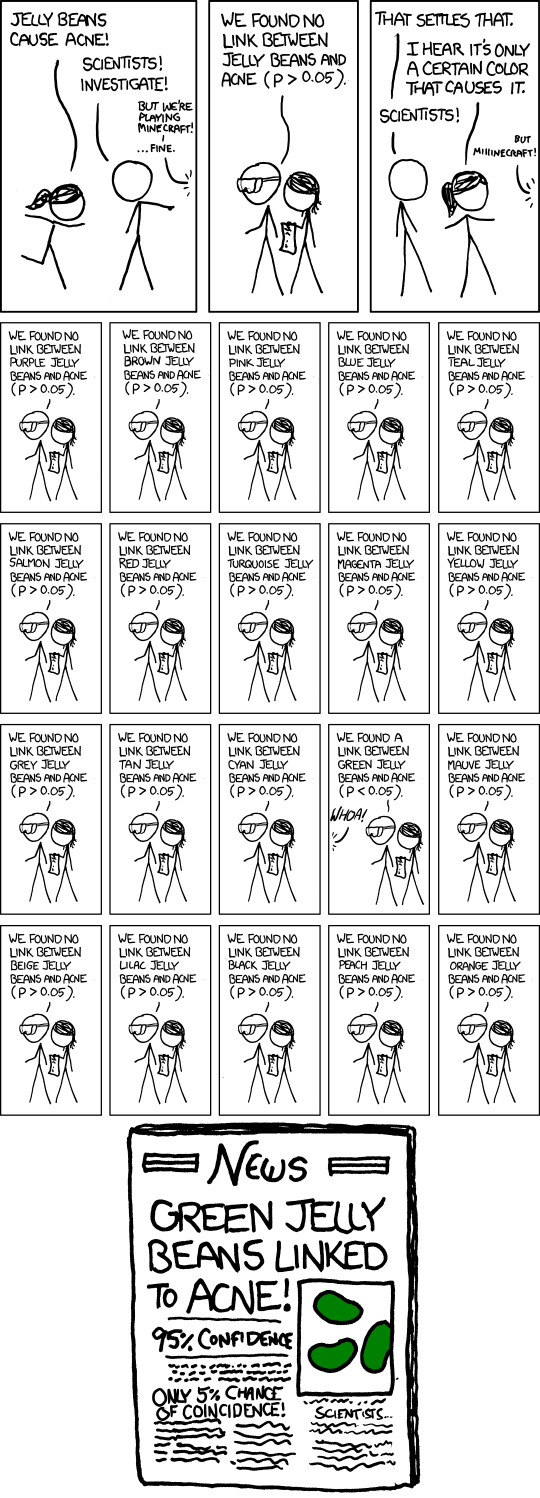
The problem is that every natural process is subject to random variation.  Even without changing the conditions of an experiment, there is going to be random variation in measurements.  For example, one population of white mice might have 6 cancers, but the next might have 12 and the next might have zero, all from natural variation.  So the challenge of most experiments is to determine whether the thing one is testing (e.g. exposure to a particular substance) is actually changing the measurements in a population, or whether that change is simply the result of random variation.  That is what the 95% confidence interval (that Naomi Oreskes wants to get rid of) really means.  It means there is only a 5% chance that the results measured were due to natural variation.

This is a useful test, but I hope you can see how it can fail.  Something like 5% of the time that one is measuring two things that actually are uncorrelated, the test is going to give you a false positive.  Let's say in a year that the world does 1000 studies to test links that don't actually exist.  Just from natural variation, 5% of these studies will still seem to show a link at the 95% confidence level.  We will have 50 studies that year broadcasting false links.  The media will proceed to scare the crap out of you over these 50 things.

I have never seen this explained better than in this XKCD cartoon (click to enlarge):

click to enlarge

All of this is just exacerbated when there is fraud involved, an unfortunate but not unknown occurrence when reputations and large academic grants are on the line.  This is why replication of the experiment is important.   Do the study a second time, and all but 2-3 of these 50 "false positive" studies will fail to replicate the original results.  Do it three times, and all will likely fail to replicate.   This, for example, is exactly what happened with the vaccine-autism link -- it came out in one study with a really small population and some evidence of fraud, and was never replicated.

2.  The Precautionary Principle vs. the Unseen, with a Dollop of Privilege Thrown In

When pressed to the wall too hard about the size and quality of the risk assessment, most folks subject to these panics will fall back on the "precautionary principle".   I am not a big fan of the precautionary principle, so I will let Wikipedia define it so I don't create a straw man:

The precautionary principle or precautionary approach to risk management states that if an action or policy has a suspected risk of causing harm to the public or to the environment, in the absence of scientific consensus that the action or policy is not harmful, the burden of proof that it is not harmful falls on those taking an action.

I will observe that as written, this principle is inherently anti-progress.  The proposition requires that folks who want to introduce new innovations must prove a negative, and it is very hard to prove a negative -- how do I prove there are no invisible aliens in my closet who may come out and eat me someday, and how can I possibly get a scientific consensus to this fact?  As a result, by merely expressing that one "suspects" a risk (note there is no need listed for proof or justification of this suspicion), any advance may be stopped cold.  Had we followed such a principle consistently, we would still all be subsistence farmers, vassals to our feudal lord.

One other quick note before I proceed, it turns out that proponents of the precautionary principle are very selective as to where they apply the principle.  They feel like it absolutely must be applied to fossil fuel burning, or BPA use, or GMO's.  But precautionary principle supporters never apply it in turn to, say, major new government programs and regulations and economic interventions, despite many historically justified concerns about the risks of these programs.

But neither of these is necessarily the biggest problem with the precautionary principle.  The real problem is that it focuses on only one side of the equation -- it says that risks alone justify stopping any action or policy without any reference at all to benefits of that policy or opportunity costs of its avoidance.   A way of restating the precautionary principle is, "when faced with risks and benefits of a certain proposal, look only at the risks."

Since the precautionary principle really hit the mainstream with the climate change debate, I will use that as an example.  Contrary to media appellations of being a "denier," most science-based climate skeptics like myself accept that man is adding to greenhouse gasses in the atmosphere and that those gasses have an incremental warming effect on the planet.  What we deny is the catastrophe -- we believe we have good evidence that catastrophic forecasts from computer models are exaggerating future warming, and greatly exaggerating resulting forecast climate changes.  Whenever I am fairly successful making this argument, the inevitable rejoinder is "well, the precautionary principle says that if we have even a small percentage chance that burning fossil fuels will lead to a climate disaster, then we have to limit their use immediately".

The problem with this statement is that it assumes there is no harm or risk to reducing fossil fuel use.  But fossil fuel use pays enormous benefits to everyone in the world.  Even if we could find near substitutes that don't create CO2 emissions (and it is every much open to debate if such substitutes currently exist), these substitutes tend to be much more expensive and much more infrastructure-intensive than are fossil fuels.  The negative impact to the economy would be substantial.  One could argue that one particular impact -- climate or economy -- outweighs the other, but it is outright fraud to refuse to discuss the trade-off altogether.   Particularly since catastrophic climate change may only be a low-percentage risk while economic dislocation from reduction in fossil fuel use is a near certainty.

My sense is that if the United States chose to cut way back on fossil fuel use in a concerted effort, we could manage it and survive the costs.  But that is because we are a uniquely rich nation.  I am not sure anyone in this country understands how rich.  I am not talking just about Warren Buffet.  Even the poorest countries have a few rich people at the top.  I am talking about everybody.  Our poorest 20% would actually be among the richest quintile in many nations of the world.   A worldwide effort to eliminate fossil fuel use or to substantially raise its costs or to force shifts to higher cost, less easily-used alternatives  would simply devastate many developing nations, which need every erg their limited resources can get their hands on.  We are at a unique moment in history when more than a billion people are in the process of emerging from poverty around the world, progress that would be stopped in its tracks by a concerted effort to limit CO2 output.   Why doesn't the precautionary principle apply to actions that affect their lives?

College kids have developed a popular rejoinder they use in arguments that states "check your privilege."  I thought at first it was an interesting phrase.  I used it in arguments a few times about third world "sweat shops".  I argued that those who wanted to close down the Nike factory paying $1 an hour in China needed to check their privilege -- they had no idea what alternatives those Chinese who took the Nike jobs were facing.  Yes, you middle class Americans would never take that job, but what if your alternative was 12 hours a day in a rice paddy somewhere that barely brought in enough food for your family to subsist?  Only later, I learned that "check your privilege" didn't mean what I thought it meant, and in fact in actual academic use it instead means "shut up, white guy."  In a way, though, this use is consistent with how the precautionary principle is often used -- in many of my arguments, "precautionary principle" is another way of saying "stop talking about the costs and trade-offs of what I am proposing."

Perhaps the best example of the damage that can be wrought by a combination of Western middle class privilege and the precautionary principle is the case of golden rice.  According to the World Health Organization between 250,000 to 500,000 children become blind every year due to vitamin A deficiency, half of whom die within a year of becoming blind. Millions of other people suffer from various debilitating conditions due to the lack of this essential nutrient.  Golden Rice is a genetically modified form of rice that, unlike conventional rice, contains beta-Carotene in the rice kernel, which is converted to vitamin A in humans.

By 2002, Golden Rice was technically ready to go. Animal testing had found no health risks. Syngenta, which had figured out how to insert the Vitamin A–producing gene from carrots into rice, had handed all financial interests over to a non-profit organization, so there would be no resistance to the life-saving technology from GMO opponents who resist genetic modification because big biotech companies profit from it. Except for the regulatory approval process, Golden Rice was ready to start saving millions of lives and preventing tens of millions of cases of blindness in people around the world who suffer from Vitamin A deficiency.

Seems like a great idea.  Too bad its going nowhere, due to fierce opposition on the Left (particularly from Greenpeace) to hypothetical dangers from GMO's

It’s still not in use anywhere, however, because of the opposition to GM technology. Now two agricultural economists, one from the Technical University of Munich, the other from the University of California, Berkeley, have quantified the price of that opposition, in human health, and the numbers are truly frightening.

Their study, published in the journalEnvironment and Development Economics, estimates that the delayed application of Golden Rice in India alone has cost 1,424,000 life years since 2002. That odd sounding metric – not just lives but ‘life years’ – accounts not only for those who died, but also for the blindness and other health disabilities that Vitamin A deficiency causes. The majority of those who went blind or died because they did not have access to Golden Rice were children.

Note this is exactly the sort of risk tradeoff the precautionary principle is meant to ignore.  The real situation is that a vague risk of unspecified and unproven problems with GMO's (which are typically driven more by a distrust on the Left of the for-profit corporations that produce GMO's rather than any good science) should be balanced with absolute certainty of people dying and going blind.  But the Greenpeace folks will just shout that because of the "precautionary principle", only the vague unproven risks should be considered and thus golden rice should be banned.

Risk and Post-Modernism

A few weeks ago, I wrote about Naomi Oreskes and the post-modern approach to science, where facts and proof take a back-seat to political narratives and the feelings and intuition of various social groups.  I hadn't really thought much about this post-modernist approach in the context of risk assessment, but I was struck by this comment by David Ropeik, who blogs for Scientific American.

The whole GMO issue is really just one example of a far more profound threat to your health and mine. The perception of risk is inescapably subjective, a matter of not just the facts, but how we feel about those facts. As pioneering risk perception psychologist Paul Slovic has said, “risk is a feeling.” So societal arguments over risk issues like Golden Rice and GMOs, or guns or climate change or vaccines, are not mostly about the evidence, though we wield the facts as our weapons. They are mostly about how we feel, and our values, and which group’s values win, not what will objectively do the most people the most good. That’s a dumb and dangerous way to make public risk management decisions.

Mr. Ropeik actually disagrees with me on the risk/harm tradeoffs of climate change (he obviously thinks the harms outweigh the costs of prevention -- I will give him the benefit of the doubt that he has actually thought about both sides of the equation).  Fine.  I would be thrilled for once to have a discussion with someone about climate change when we are really talking about costs and benefits on both sides of the equation (action and inaction).  Unfortunately that is all too rare.

Postscript:  To the extent the average person remembers Bjorn Lomborg at all, they could be excused for assuming he is some crazed right-wing climate denier, given how he was treated in the media.  In fact, Lomborg is very much a global warming believer.  He takes funding from Right-ish organizations now, but that is only because he has been disavowed by the Left, which was his original home.

What he did was write a book in which he looked at a number of environmental problems -- both their risks and costs as well as their potential mitigation costs -- and he ranked them on bang for the buck:  Where can we get the most environmental benefit and help the most people for the least investment.  The book talked about what he thought were the very real dangers of climate change, but it turned out climate change was way down this ranked list in terms of benefits vs. costs of solutions.

This is a point I have made before.  Why are we spending so much time, for example, harping on China to reduce CO2 when their air is poisonous?  We know how to have a modern technological economy and still have air without soot.  It is more uncertain if we can have a modern technological economy, yet, without CO2 production.   Lomborg thought about just this sort of thing, and made the kind of policy risk-reward tradeoffs based on scientific analysis that we would hope our policy makers were pursuing.  It was exactly the kind of analysis that Ropeik was advocating for above.

Lomborg must have expected that his work would be embraced by the environmental Left.  After all, it was scientific, it achnowleged the existence of a number of environmental issues that needed to be solved, and it advocated for a strong government-backed effort led by smart technocrats doing rational prioritizations.  But Lomborg was absolutely demonized by just about everyone in the environmental community and on the Left in general.  He was universally trashed.  He was called a climate denier when in fact he was no such thing -- he just pointed out that man-made climate change was way harder to solve than other equally harmful environmental issues.  Didn't he get the memo that the narrative was that global warming was the #1 environmental threat?  How dare he suggest a re-prioritization!

Lomborg's prioritization may well have been wrong, but no one was actually sitting down to make that case.  He was simply demonized from day one for getting the "wrong" answer, defined as the answer not fitting the preferred narrative.  We are a long, long way from any reasonable ability to assess and act on risks.

04 Feb 18:46

The vaccine scaremongers

by noreply@blogger.com (Vox)
It is increasingly obvious that the hysterical scaremongers among the pro-vaccinists are either pharma propagandists or probability-challenged:
Inquisitive Mind ‏@livebeef
Your decision to not vaccinate your children puts my children's health at risk. You are the worst kind of person.

Vox Day ‏@voxday
Your decision to drive your children in your car puts their health at much greater risk. You are an even worse person.

Vox Day @voxday
Deaths from measles in last 10 years = 0. Automobile deaths in last 10 years = 383,542

Vox Day @voxday
Deaths from measles in last 10 years = 0. Deaths from bicycles = 6,770. ONLY A MONSTER WOULD LET KIDS RIDE BIKES!

Inquisitive Mind ‏@livebeef
What the hell is WRONG with you people? (Posts scary propaganda cartoon.)

Vox Day ‏@voxday
We're just not idiots like you who embrace totalitarian government because someone said BOO! Measles deaths in 2014 = 0

Inquisitive Mind ‏@livebeef
Do you not understand what the concept of "almost eradicated" means? Look up the death count it used to have.

Vox Day ‏@voxday
I have. And most of the deaths stopped long BEFORE widespread vaccine availability. You are misinformed.

Inquisitive Mind ‏@livebeef
Prove it.

Vox Day ‏@voxday now
Measles deaths dropped 91.5 percent by 1960, 2 years BEFORE vaccinations. You are misinformed.
 In the unlikely event that anyone is interested in the actual historical facts of the matter:
In 1962, immediately preceding the licensure of the first measles vaccines in the United States, when measles was a nearly universal disease, Alexander Langmuir described the medical importance of measles to the country and put forth the challenge of measles eradication. Although most patients recovered without permanent sequelae, the high number of cases each year made measles a significant cause of serious morbidity and mortality Langmuir showed that >90% of Americans were infected with the measles virus by age 15 years. This equated to roughly 1 birth cohort (4 million people) infected with measles each year. Not all cases were reported to the public health system; from 1956 to 1960, an average of 542,000 cases were reported annually. By the late 1950s, even before the introduction of measles vaccine, measles-related deaths and case fatality rates in the United States had decreased markedly, presumably as a result of improvement in health care and nutrition. From 1956 to 1960, an average of 450 measles-related deaths were reported each year (∼1 death/ 1000 reported cases), compared with an average of 5300 measles-related deaths during 1912–1916 (26 deaths/ 1000 reported cases).
Note that even in the ABSOLUTE WORST CASE, which is a completely unvaccinated scenario with 90 percent infection rates that assumes absolutely no improvement in health care in 55 years, we're talking about 450 deaths per year.  Realistically, we're probably talking around 200, given the advancements in medical technology. THAT is what all the pro-vaccine scaremongers are going on about. Americans would do better to ban bicycles, as they would save three times more lives per year.

The pro-vaccine propaganda is just more creeping totalitarianism, albeit one of bizarre appeal to the supposedly conservative and libertarian right. But it cannot be rationally defended on any material grounds, nor balanced against its infringements on personal liberties and human rights.

UPDATE: Sweet Salk, but the pro-vaxxers are stupid.
Utes Byfive ‏@Utesbyfive
Natural immunity produces carriers: Typhoid Mary, Someone vaxxed can't be infected. CANT FUCKING CARRY

Posted by Vox Day.
02 Feb 16:40

Brickbat: It's the Law

by Charles Oliver

The Ecuadoran government is using U.S. law to silence its critics. The government is filing complaints under the Digital Millennium Copyright Act, claiming copyright violations against videos and posts critical of the government. Websites hosting the material automatically take it down. Those who posted the material are generally able to get it reinstated, but that takes time and effort.

31 Jan 19:20

Quotation of the Day…

by Don Boudreaux
(Don Boudreaux)

… is from page 128 of Thomas Sowell’s 2009 book, The Housing Boom and Bust:

Few things blind human beings to the actual consequences of what they are doing like a heady feeling of self-righteousness during a crusade to smite the wicked and rescue the downtrodden.

31 Jan 01:35

Even the Benefit of the Doubt Won't Save EPA’s Mercury Rule

by Andrew M. Grossman

Andrew M. Grossman

Challenging an agency’s assessment of scientific research in court is typically seen as a fool’s errand. The courts may keep the regulatory state on a close leash where matters of constitutional law are concerned, and will give challenges regarding the proper interpretation of statutes a fair hearing before (usually) deferring to the government’s view. But an agency has to go seriously off the rails before the courts will second-guess its assessment of the scientific record underlying a regulation.

That’s what makes EPA’s super-expensive Mercury and Air Toxics Standards (MATS) rule so interesting: the agency’s own assessment of the scientific research shows there was no good reason to regulate in the first place. The Supreme Court is now reviewing EPA’s decision to plow ahead regardless, irrespective of the costs of doing so.

The Cato Institute’s amicus brief in Michigan v. EPA unpacks EPA’s own scientific assessment to show that regulation certainly is not (as the statute requires) “appropriate and necessary.” 

Power plants emit trace amounts of mercury, and mercury poses a risk to human neurological development when pregnant women consume fish tainted by it. But, as EPA has explained, mercury deposition in the United States “is generally dominated by sources other than U.S. [power plants].” In fact, the agency’s figures show that those plants are responsible for only about one half of one percent of airborne mercury.

Common sense would therefore suggest that reducing or even eliminating emissions from U.S. plants could have little or no appreciable effect on public health. And EPA actually agrees, finding that “even substantial reductions in U.S. [power-plant] deposition…[are] unlikely to substantially affect total risk.”

To escape that seemingly inescapable conclusion, the agency had to assume the existence of “women of child-bearing age in subsistence fishing populations who consume freshwater fish that they or their family caught” in enormous quantities. And not just any fish, but the most contaminated fish. And even then, placing its thumb on the scale at every step of the way, EPA still struggled to find any real risk, ultimately concluding that mercury from domestic power plants might cause the hypothetical children of these hypothetical women to suffer a hypothetical loss of 0.00209 IQ points apiece—an amount that cannot be meaningfully distinguished from zero.

Why would EPA go through all this trouble to contrive a risk worthy of regulation, while ignoring costs that the agency projects to hit $10 billion per year? The answer is that EPA has long wanted to comprehensively regulate power plants but (due to the cooperative-federalism structure of the Clean Air Act) has been forced to defer to the states on whether and how to address individual sources. Minimizing Section 112’s “appropriate and necessary” requirement allows EPA to circumvent the statutory limitations on its authority and directly achieve its intended goal: imposing new requirements on power plants.

So what seems like a complicated statutory case actually boils down to a familiar story: a federal agency twisting statutory language to aggrandize its own power at the expense of the states’. The Supreme Court can take EPA’s evaluation of the science at face value and still reject this power-grab.

29 Jan 23:37

How to Justify Continued Federal Meddling in Internet Service? Just Keep Changing the Goals!

by Scott Shackford

We need the government to make sure you can stream "House of Cards" here without any problems. IT'S IN THE CONSTITUTION, PEOPLE!Barack Obama and the Federal Communications Commission (FCC) have been flogging continued federal involvement in the providing of private broadband Internet service with the argument that some citizens’ Internet speeds just aren’t fast enough. It manifested recently in a call for local governments to get into the business of competing with private service providers and offering municipal broadband (oblivious to the reality that typically local governments have been the barrier to better Internet service, not the solution).

The news today is that, in order to flesh out the assertion that there are enough folks who can’t get decent broadband, the FCC has voted, 3-2, to simply change the definition of broadband, increasing the base benchmark speed and, by regulatory fiat, declaring that millions of Americans who had "high-speed Internet" yesterday are now listening to Spotify with soup cans on strings. From The Guardian:

In a 3-2 vote, the commission approved a measure that increases the minimum standard for broadband speed, giving the agency more power to force internet service providers to improve their service.

The definition of broadband is set to be raised from 4 megabits per second (Mbps) to 25Mbps for downloads and 1Mbps to 3Mbps for uploads.

With that speed as the benchmark, significantly fewer Americans have access to high-speed broadband. Under the previous definition, 19 million Americans were without access; the new definition means that 55 million Americans – 17% of the population – now do not have access to high-speed broadband, according to the FCC’s 2015 Broadband Progress Report, which is in the final editing process but was cited at the hearing.

It’s like mission creep within mission creep. The Telecommunications Act of 1996 pushed the FCC into involvement in making sure broadband spreads across the country (like the FCC was needed for this in any way, shape, or form). As broadband improves, the FCC is going to make sure they get to keep their spoon in the stew (or whatever "too many cooks" metaphor applies) by just ordering innovation via regulation. Who is this "we" Commissioner Mignon Clyburn refers to?

"We are never satisfied with the status quo. We want better. We continue to push the limit, and that is notable when it comes to technology. As consumers adopt and demand more from their platforms and devices, the need for broadband will increase, requiring robust networks to be in place in order to keep up. What is crystal clear to me is that the broadband speeds of yesteryear are woefully inadequate today and beyond."

All of this is true, and yet none of what Clyburn says is an argument for direct FCC involvement. Commissioner Michael O’Rielly dissented, pointing out, "Selecting an artificially high standard and applying it in a way that is impossible to meet in order to reach all Americans certainly in the near term makes a mockery of a process that was supposed to provide an honest assessment of broadband deployment in the United States." He wondered that, because some people believe we’re on the way to teleportation technology, whether the FCC should estimate the bandwidth needs for that as well. Don’t give them any ideas.

In an interesting bit of a sort of cronyism as a result of the limits of technology, telecom companies that offer DSL services through the phone lines—AT&T and Verizon, for example—will not be forced to adapt to these new demands because it’s physically impossible. This means broadband providers will be required by the FCC to improve their Internet speeds up and probably far beyond what many of their customers need, therefore driving up their prices and encouraging customers who don’t need bleeding edge download speeds to consider dumping them for their phone company competitors to save money. No wonder cable companies are upset by the news.

From 2010, here’s Nick Gillespie and Reason TV with three reasons why the FCC needs to stay away from the Internet. (Spoiler: "mission creep" is one of the reasons):

29 Jan 03:28

Why Rand Paul's Case for 'Judicial Activism' Scares Both Liberals and Conservatives

by Damon Root

Earlier this month Sen. Rand Paul (R-Ky.) told an audience of conservatives that the legal philosophy known as judicial restraint has been an abysmal failure throughout American history. So Paul offered an alternative: The Supreme Court should stop deferring to the other branches of government and should instead spend more time striking down government infringements on individual liberty. "I'm a judicial activist when it comes to the New Deal. But I'm also a judicial activist when it comes to Brown [v. Board of Education]. I think the [Supreme Court] was right to overturn state governments that were saying separate but equal is fine," Paul declared.

The response to Paul's speech has been instructive. Conservative law professor and former George W. Bush administration official John Yoo, for example, attacked Paul's "immature views on politics and the Constitution," arguing that "Paul's claims about judicial activism raise fundamental doubts about his positions on social issues."

On the left, meanwhile, Vox's Andrew Prokop faulted Paul for "voic[ing] his support for an infamous and long-obsolete Supreme Court ruling asserting that 'liberty to contract' was a fundamental Constitutional right."

For conservatives like Yoo, the problem with Paul's speech is that he explicitly endorsed the Supreme Court’s 1965 ruling in Griswold v. Connecticut, which struck down a state law banning the use of birth control devices by married couples on the grounds that it violated their right to privacy. According to many conservative legal thinkers—including both the late Robert Bork and current Supreme Court Justice Antonin Scalia—the Griswold Court had no business interfering with the state's broad power to regulate morality and private sexual behavior.

For liberals like Prokop, the problem with Paul's speech is that he endorsed the Supreme Court's 1905 ruling in Lochner v. New York, which struck down a state law limiting the working hours of bakery employees on the grounds that it violated the Due Process Clause of the 14th Amendment. Liberals dislike Lochner because they think the Court had no business interfering with the state's broad power to regulate economic affairs.

What these two views share in common is that they each support what amounts to virtually unchecked majoritarian rule over certain aspects of American life. For conservatives, judicial deference means that lawmakers get the last word when it comes to banning birth control and prohibiting "homosexual conduct." For liberals, judicial deference means that lawmakers get the last word when it comes to bulldozing private property in the name of eminent domain. Each approach demands judicial passivity in the face of its preferred forms of government action.

Rand Paul, by contrast, is offering a third way, something that we might call a principled libertarian approach. "If we believe in judicial restraint we presume the majority is correct. We presume that laws are constitutional until we can prove otherwise," Paul observed. But "maybe we should start with the presumption of liberty.... Maybe we should be presumed to be free."

To say the least, Paul's approach is at odds with the reigning pro-government orthodoxies on both the legal left and the legal right. No wonder he's got both sides running scared.

28 Jan 03:22

CBO Refuses to Score; Ignores 15 Tax Hikes...


CBO Refuses to Score; Ignores 15 Tax Hikes...


(First column, 14th story, link)
Related stories:
25 Jan 04:46

David Stockman: Woodrow Wilson's War & Why The Entire 20th Century Was A Mistake

by Tyler Durden

Submitted by David Stockman via Contra Corner blog,

The Epochal Consequences Of Woodrow Wilson’s War

Remarks by David Stockman

Committee for the Republic

Washington DC January 20, 2015

My humble thesis tonight is that the entire 20th Century was a giant mistake.

And that you can put the blame for this monumental error squarely on Thomas Woodrow Wilson——-a megalomaniacal madman who was the very worst President in American history……..well, except for the last two.

His unforgiveable error was to put the United States into the Great War for utterly no good reason of national interest. The European war posed not an iota of threat to the safety and security of the citizens of Lincoln NE, or Worcester MA or Sacramento CA. In that respect, Wilson’s putative defense of “freedom of the seas” and the rights of neutrals was an empty shibboleth; his call to make the world safe for democracy, a preposterous pipe dream.

Actually, his thinly veiled reason for plunging the US into the cauldron of the Great War was to obtain a seat at the peace conference table——so that he could remake the world in response to god’s calling.

But this was a world about which he was blatantly ignorant; a task for which he was temperamentally unsuited; and an utter chimera based on 14 points that were so abstractly devoid of substance as to constitute mental play dough.

Or, as his alter-ego and sycophant, Colonel House, put it:  Intervention positioned Wilson to play “The noblest part that has ever come to the son of man”.  America thus plunged into Europe’s carnage, and forevermore shed its century-long Republican tradition of anti-militarism and non-intervention in the quarrels of the Old World.

Needless to say, there was absolutely nothing noble that came of Wilson’s intervention. It led to a peace of vengeful victors, triumphant nationalists and avaricious imperialists—-when the war would have otherwise ended in a bedraggled peace of mutually exhausted bankrupts and discredited war parties on both sides.

By so altering the course of history, Wilson’s war bankrupted Europe and midwifed 20th century totalitarianism in Russia and Germany.

These developments, in turn, eventually led to the Great Depression, the Welfare State and Keynesian economics, World War II, the holocaust, the Cold War, the permanent Warfare State and its military-industrial complex.

They also spawned Nixon’s 1971 destruction of sound money, Reagan’s failure to tame Big Government and Greenspan’s destructive cult of monetary central planning.

So, too, flowed the Bush’s wars of intervention and occupation,  their fatal blow to the failed states in the lands of Islam foolishly created by the imperialist map-makers at Versailles and the resulting endless waves of blowback and terrorism now afflicting the world.

And not the least of the ills begotten in Wilson’s war is the modern rogue regime of central bank money printing, and the Bernanke-Yellen plague of bubble economics which never stops showering the 1% with the monumental windfalls from central bank enabled speculation.

Consider the building blocks of that lamentable edifice.

First, had the war ended in 1917 by a mutual withdrawal from the utterly stalemated trenches of the Western Front, as it was destined to, there would have been no disastrous summer offensive by the Kerensky government, or subsequent massive mutiny in Petrograd that enabled Lenin’s flukish seizure of power in November. That is, the 20th century would not have been saddled with a Stalinist nightmare or with a Soviet state that poisoned the peace of nations for 75 years, while the nuclear sword of Damocles hung over the planet.

Likewise, there would have been no abomination known as the Versailles peace treaty; no “stab in the back” legends owing to the Weimar government’s forced signing of the “war guilt” clause; no continuance of England’s brutal post-armistice blockade that delivered Germany’s women and children into starvation and death and left a demobilized 3-million man army destitute, bitter and on a permanent political rampage of vengeance.

So too, there would have been no acquiescence in the dismemberment of Germany and the spreading of its parts and pieces to Poland, Czechoslovakia, Denmark, France, Austria and Italy—–with the consequent revanchist agitation that nourished the Nazi’s with patriotic public support in the rump of the fatherland.

Nor would there have materialized the French occupation of the Ruhr and the war reparations crisis that led to the destruction of the German middle class in the 1923 hyperinflation; and, finally, the history books would have never recorded the Hitlerian ascent to power and all the evils that flowed thereupon.

In short, on the approximate 100th anniversary of Sarajevo, the world has been turned upside down.

The war of victors made possible by Woodrow Wilson destroyed the liberal international economic order—that is, honest money, relatively free trade, rising international capital flows and rapidly growing global economic integration—-which had blossomed during the 40-year span between 1870 and 1914.

That golden age had brought rising living standards, stable prices, massive capital investment, prolific technological progress and pacific relations among the major nations——a condition that was never equaled, either before or since.

Now, owing to Wilson’s fetid patrimony, we have the opposite: A world of the Warfare State, the Welfare State, Central Bank omnipotence and a crushing burden of private and public debts. That is, a thoroughgoing statist regime that is fundamentally inimical to capitalist prosperity, free market governance of economic life and the flourishing of private liberty and constitutional safeguards against the encroachments of the state.

So Wilson has a lot to answer for—-and my allotted 30 minutes can hardly accommodate the full extent of the indictment. But let me try to summarize his own “war guilt” in eight major propositions——a couple of which my give rise to a disagreement or two.

Proposition #1:  Starting with the generic context——the Great War was about nothing worth dying for and engaged no recognizable principle of human betterment. There were many blackish hats, but no white ones.

Instead, it was an avoidable calamity issuing from a cacophony of political incompetence, cowardice, avarice and tomfoolery.

Blame the bombastic and impetuous Kaiser Wilhelm for setting the stage with his foolish dismissal of Bismarck in 1890, failure to renew the Russian reinsurance treaty shortly thereafter and his quixotic build-up of the German Navy after the turn of the century.

Blame the French for lashing themselves to a war declaration that could be triggered by the intrigues of a decadent court in St. Petersburg where the Czar still claimed divine rights and the Czarina ruled behind the scenes on the hideous advice of Rasputin.

Likewise, censure Russia’s foreign minister Sazonov for his delusions of greater Slavic grandeur that had encouraged Serbia’s provocations after Sarajevo; and castigate the doddering emperor Franz Joseph for hanging onto power into his 67th year on the throne and thereby leaving his crumbling empire vulnerable to the suicidal impulses of General Conrad’s war party.

So too, indict the duplicitous German Chancellor, Bethmann-Hollweg, for allowing the Austrians to believe that the Kaiser endorsed their declaration of war on Serbia; and pillory Winston Churchill and London’s war party for failing to recognize that the Schlieffen Plan’s invasion through Belgium was no threat to England, but a unavoidable German defense against a two-front war.

But after all that—- most especially don’t talk about the defense of democracy, the vindication of liberalism or the thwarting of Prussian autocracy and militarism.

The British War party led by the likes of Churchill and Kitchener was all about the glory of empire, not the vindication of democracy; France’ principal war aim was the revanchist drive to recover Alsace-Lorrain—–mainly a German speaking territory for 600 years until it was conquered by Louis XIV.

In any event, German autocracy was already on its last leg as betokened by the arrival of universal social insurance and the election of a socialist-liberal majority in the Reichstag on the eve of the war; and the Austro-Hungarian, Balkan and Ottoman goulash of nationalities, respectively, would have erupted in interminable regional conflicts, regardless of who won the Great War.

In short, nothing of principle or higher morality was at stake in the outcome.

Proposition # 2:  The war posed no national security threat whatsoever to the US.  Presumably, of course, the danger was not the Entente powers—but Germany and its allies.

But how so?  After the Schlieffen Plan offensive failed on September 11, 1914, the German Army became incarcerated in a bloody, bankrupting, two-front land war that ensured its inexorable demise. Likewise, after the battle of Jutland in May 1916, the great German surface fleet was bottled up in its homeports—-an inert flotilla of steel that posed no threat to the American coast 4,000 miles away.

As for the rest of the central powers, the Ottoman and Hapsburg empires already had an appointment with the dustbin of history. Need we even bother with the fourth member—-that is, Bulgaria?

Proposition #3:  Wilson’s pretexts for war on Germany—–submarine warfare and the Zimmerman telegram—-are not half what they are cracked-up to be by Warfare State historians.

As to the so-called freedom of the seas and neutral shipping rights, the story is blatantly simple. In November 1914, England declared the North Sea to be a “war zone”; threatened neutral shipping with deadly sea mines; declared that anything which could conceivably be of use to the German army—directly or indirectly—-to be contraband that would be seized or destroyed; and announced that the resulting blockade of German ports was designed to starve it into submission.

A few months later, Germany announced its submarine warfare policy designed to the stem the flow of food, raw materials and armaments to England in retaliation.  It was the desperate antidote of a land power to England’s crushing sea-borne blockade.

Accordingly, there existed a state of total warfare in the northern European waters—-and the traditional “rights” of neutrals were irrelevant and disregarded by both sides. In arming merchantmen and stowing munitions on passenger liners, England was hypocritical and utterly cavalier about the resulting mortal danger to innocent civilians—–as exemplified by the 4.3 million rifle cartridges and hundreds of tons of other munitions carried in the hull of the Lusitania.

Likewise, German resort to so-called “unrestricted submarine warfare” in February 1917 was brutal and stupid, but came in response to massive domestic political pressure during what was known as the “turnip winter” in Germany.  By then, the country was starving from the English blockade—literally.

Before he resigned on principle in June 1915, Secretary William Jennings Bryan got it right. Had he been less diplomatic he would have said never should American boys be crucified on the cross of Cunard liner state room so that a few thousand wealthy plutocrat could exercise a putative “right” to wallow in luxury while knowingly cruising into in harm’s way.

As to the Zimmerman telegram, it was never delivered to Mexico, but was sent from Berlin as an internal diplomatic communique to the German ambassador in Washington, who had labored mightily to keep his country out of war with the US, and was intercepted by British intelligence, which sat on it for more than a month waiting for an opportune moment to incite America into war hysteria.

In fact, this so-called bombshell was actually just an internal foreign ministry rumination about a possible plan to approach the Mexican president regarding an alliance in the event that the US first went to war with Germany.

Why is this surprising or a casus belli?  Did not the entente bribe Italy into the war with promises of large chunks of Austria? Did not the hapless Rumanians finally join the entente when they were promised Transylvania?  Did not the Greeks bargain endlessly over the Turkish territories they were to be awarded for joining the allies?  Did  not Lawrence of Arabia bribe the Sherif of Mecca with the promise of vast Arabian lands to be extracted from the Turks?

Why, then, would the German’s—-if at war with the USA—- not promise the return of Texas?

Proposition #4:  Europe had expected a short war, and actually got one when the Schlieffen plan offensive bogged down 30 miles outside of Paris on the Marne River in mid-September 1914.  Within three months, the Western Front had formed and coagulated into blood and mud——a ghastly 400 mile corridor of senseless carnage, unspeakable slaughter and incessant military stupidity that stretched from the Flanders coast across Belgium and northern France to the Swiss frontier.

The next four years witnessed an undulating line of trenches,  barbed wire entanglements, tunnels, artillery emplacements and shell-pocked scorched earth that rarely moved more than a few miles in either direction, and which ultimately claimed more than 4 million casualties on the Allied side and 3.5 million on the German side.

If there was any doubt that Wilson’s catastrophic intervention converted a war of attrition, stalemate and eventual mutual exhaustion into Pyrrhic victory for the allies, it was memorialized in four developments during 1916.

In the first, the Germans wagered everything on a massive offensive designed to overrun the fortresses of Verdun——the historic defensive battlements on France’s northeast border that had stood since Roman times, and which had been massively reinforced after the France’s humiliating defeat in Franco-Prussian War of 1870.

But notwithstanding the mobilization of 100 divisions, the greatest artillery bombardment campaign every recorded until then, and repeated infantry offensives from February through November that resulted in upwards of 400,000 German casualties, the Verdun offensive failed.

The second event was its mirror image—-the massive British and French offensive known as the battle of the Somme, which commenced with equally destructive artillery barrages on July 1, 1916 and then for three month sent waves of infantry into the maws of German machine guns and artillery. It too ended in colossal failure, but only after more than 600,000 English and French casualties including a quarter million dead.

In between these bloodbaths, the stalemate was reinforced by the naval showdown at Jutland that cost the British far more sunken ships and drowned sailors than the Germans, but also caused the Germans to retire their surface fleet to port and never again challenge the Royal Navy in open water combat.

Finally, by year-end 1916 the German generals who had destroyed the Russian armies in the East with only a tiny one-ninth fraction of the German army—Generals Hindenburg and Ludendorff —were given command of the Western Front. Presently, they radically changed Germany’s war strategy by recognizing that the growing allied superiority in manpower, owing to the British homeland draft of 1916 and mobilization of forces from throughout the empire, made a German offensive breakthrough will nigh impossible.

The result was the Hindenburg Line—a military marvel based on a checkerboard array of hardened pillbox machine gunners and maneuver forces rather than mass infantry on the front lines, and an intricate labyrinth of highly engineered tunnels, deep earth shelters, rail connections, heavy artillery and flexible reserves in the rear. It was also augmented by the transfer of Germany’s eastern armies to the western front—-giving it 200 divisions and 4 million men on the Hindenburg Line.

This precluded any hope of Entente victory. By 1917 there were not enough able-bodied draft age men left in France and England to overcome the Hindenburg Line, which, in turn,  was designed to bleed white the entente armies led by butchers like Generals Haig and Joffre until their governments sued for peace.

Thus, with the Russian army’s disintegration in the east and the stalemate frozen indefinitely in the west by early 1917, it was only a matter of months before mutinies among the French lines, demoralization in London, mass starvation and privation in Germany and bankruptcy all around would have led to a peace of exhaustion and a European-wide political revolt against the war makers.

Wilson’s intervention thus did not remake the world. But it did radically re-channel the contours of 20th century history. And, as they say, not in a good way.

Proposition #5:  Wilson’s epochal error not only produced the abomination of Versailles and all its progeny, but also the transformation of the Federal Reserve from a passive “banker’s bank” to an interventionist central bank knee-deep in Wall Street, government finance and macroeconomic management.

This, too, was a crucial historical hinge point because Carter Glass’ 1913 act forbid the new Reserve banks to even own government bonds; empowered them only to passively discount for cash good commercial credits and receivables brought to the rediscount window by member banks; and contemplated no open market interventions in debt markets or any remit with respect to GDP growth, jobs, inflation, housing or all the rest of modern day monetary central planning targets.

In fact, Carter Glass’ “banker’s bank” didn’t care whether the growth rate was positive 4%, negative 4% or anything in-between; its modest job was to channel liquidity into the banking system in response to the ebb and flow of commerce and production.

Jobs, growth and prosperity were to remain the unplanned outcome of millions of producers, consumers, investors, savers, entrepreneurs and speculators operating on the free market, not the business of the state.

But Wilson’s war took the national debt from about $1 billion or $11 per capita—–a level which had been maintained since the Battle of Gettysburg—-to $27 billion, including upwards of $10 billion re-loaned to the allies to enable them to continue the war. There is not a chance that this massive eruption of Federal borrowing could have been financed out of domestic savings in the private market.

So the Fed charter was changed owing to the exigencies of war to permit it to own government debt and to discount private loans collateralized by Treasury paper.

In due course, the famous and massive Liberty Bond drives became a glorified Ponzi scheme. Patriotic Americans borrowed money from their banks and pledged their war bonds; the banks borrowed money from the Fed, and re-pledged their customer’s collateral.  The Reserve banks, in turn, created the billions they loaned to the commercial banks out of thin air, thereby pegging interest rates low for the duration of the war.

When Wilson was done saving the world, America had an interventionist central bank schooled in the art of interest rate pegging and rampant expansion of fiat credit not anchored in the real bills of commerce and trade; and its incipient Warfare and Welfare states had an agency of public debt monetization that could permit massive government spending without the inconvenience of high taxes on the people or the crowding out of business investment by high interest rates on the private market for savings.

Proposition # 6:   By prolonging the war and massively increasing the level of debt and money printing on all sides, Wilson’s folly prevented a proper post-war resumption of the classical gold standard at the pre-war parities.

This failure of resumption, in turn, paved the way for the breakdown of monetary order and world trade in 1931—–a break which turned a standard post-war economic cleansing into the Great Depression, and a decade of protectionism, beggar-thy-neighbor currency manipulation and ultimately rearmament and statist dirigisme.

In essence, the English and French governments had raised billions from their citizens on the solemn promise that it would be repaid at the pre-war parities; that the war bonds were money good in gold.

But the combatant governments had printed too much fiat currency and inflation during the war, and through domestic regimentation, heavy taxation and unfathomable combat destruction of economic life in northern France had drastically impaired their private economies.

Accordingly, under Churchill’s foolish leadership England re-pegged to gold at the old parity in 1925, but had no political will or capacity to reduce bloated war-time wages, costs and prices in a commensurate manner, or to live with the austerity and shrunken living standards that honest liquidation of its war debts required.

At the same time, France ended up betraying its war time lenders, and re-pegged the Franc two years later at a drastically depreciated level. This resulted in a spurt of beggar-thy-neighbor prosperity and the accumulation of pound sterling claims that would eventually blow-up the London money market and the sterling based “gold exchange standard” that the Bank of England and British Treasury had peddled as a poor man’s way back on gold.

Yet under this “gold lite” contraption, France, Holland, Sweden and other surplus countries accumulated huge amounts of sterling liabilities in lieu of settling their accounts in bullion—–that is, they loaned billions to the British. They did this on the promise and the confidence that the pound sterling would remain at $4.87 per dollar come hell or high water—-just as it had for 200 years of peacetime before.

But British politicians betrayed their promises and their central bank creditors September 1931 by suspending redemption and floating the pound——-shattering the parity and causing the decade-long struggle for resumption of an honest gold standard to fail.  Depressionary contraction of world trade, capital flows and capitalist enterprise inherently followed.

Proposition # 7:  By turning America overnight into the granary, arsenal and banker of the Entente, the US economy was distorted, bloated and deformed into a giant, but unstable and unsustainable global exporter and creditor.

During the war years, for example, US exports increased by 4X and GDP soared from $40 billion to $90 billion.  Incomes and land prices soared in the farm belt, and steel, chemical, machinery, munitions and ship construction boomed like never before—–in substantial part because Uncle Sam essentially provided vendor finance to the bankrupt allies in desperate need of both military and civilian goods.

Under classic rules, there should have been a nasty correction after the war—-as the world got back to honest money and sound finance.  But it didn’t happen because the newly unleashed Fed fueled an incredible boom on Wall Street and a massive junk bond market in foreign loans.

In today economic scale, the latter amounted to upwards of $2 trillion and, in effect, kept the war boom in exports and capital spending going right up until 1929. Accordingly, the great collapse of 1929-1932 was not a mysterious failure of capitalism; it was the delayed liquidation of Wilson’s war boom.

After the crash, exports and capital spending plunged by 80% when the foreign junk bond binge ended in the face of massive defaults abroad; and that, in turn, led to a traumatic liquidation of industrial inventories and a collapse of credit fueled purchases of consumer durables like refrigerators and autos. The latter, for example, dropped from 5 million to 1.5 million units per year after 1929.

Proposition # 8:  In short, the Great Depression was a unique historical event owing to the vast financial deformations of the Great War——deformations which were drastically exaggerated by its prolongation from Wilson’s intervention and the massive credit expansion unleashed by the Fed and Bank of England during and after the war.

Stated differently, the trauma of the 1930s was not the result of the inherent flaws or purported cyclical instabilities of free market capitalism; it was, instead, the delayed legacy of the financial carnage of the Great War and the failed 1920s efforts to restore the liberal order of sound money, open trade and unimpeded money and capital flows.

But this trauma was thoroughly misunderstood, and therefore did give rise to the curse of Keynesian economics and did unleash the politicians to meddle in virtually every aspect of economic life, culminating in the statist and crony capitalist dystopia that has emerged in this century.

Needless to say, that is Thomas Woodrow Wilson’s worst sin of all.

24 Jan 00:09

The Rider And The Elephant And The Biggest Losers

by Tom Naughton

Readers send me links to articles all the time.  (Bless all of you who do.)  Some articles are particularly newsworthy or timely and become fodder for blog posts.  Others don’t and end up in what I now think of as the Cold Case Files.  They’re old, but still worth digging out now and then for a second look.

I just came across one that deserves a second look because it relates to my recent posts on how U.S. News ranked the popular diets and The Rider And The Elephant.  I poked fun at how U.S. News ranked the Slim Fast diet #13 while placing the paleo diet 35th out of 35 – because it’s just so darned hard to follow, you see.  What I didn’t mention in that post is that the Biggest Loser diet was ranked #9.  The U.S. News panel of experts had this to say about eating like a Biggest Loser:

The diet received high marks for short-term weight loss, safety and soundness as a regimen for diabetes, and it was rated moderately effective for heart health.

Good for short-term weight loss — and it must not be hard to follow, because according to the (ahem) logic the panelists cited while putting paleo at the bottom of the list, a difficult diet should earn a bad score.

We know the Biggest Loser diet is good for short-term weight loss because we see people losing impressive amounts of weight during weekly weigh-ins on the TV show, right? Uh-huh … so let’s take a look at an article from an Australian news service I found in my Cold Case Files:

Andrew ‘Cosi’ Costello was a contestant on the Biggest Loser in 2008 … Today, Cosi writes exclusively for news.com.au about what contestants really have to go through on the hit Channel 10 show.

“The only thing that really disappoints me about the Biggest Loser is the length of time between the weigh-ins. Have you ever wondered how the contestants manage to lose a staggering 12 kilos in a single week? We don’t. In my series a weekly weigh-in was NEVER filmed after just one week of working out. In fact the longest gap from one weigh-in to the next was three and a half weeks. That’s 25 days between weigh-ins, not seven. That “week” I lost more than nine kilos. I had to stand on the scales and was asked to say the line, “wow, it’s a great result, I’ve worked really hard this week”. The producers made sure that we never gave this secret away, because if we did, it created a nightmare for them in the editing suite. The shortest gap from weigh-in to weigh-in during our series was 16 days. That’s a fact.”

So that short-tem weight loss isn’t as impressive as the U.S. News panelists think it is.

“The thing is, overweight people get inspired by watching the Biggest Loser. They get off the couch and they hit the gym. But after a week in the real world, some people might only lose 1kg so they feel like they’ve failed and they give up.  That’s where the show is misleading. You need to remember it’s a TV show, it’s not all real. In fact, not even the scales we stood on were real.”

Awesome.  So people watching the show try starving themselves and horsewhipping themselves into hours of exercise so they can achieve a similarly awesome seven-day weight loss … except the weight loss might have actually required 25 days and was measured on a not-real scale, at least while the cameras were rolling.

“I would say that about 75 per cent of the contestants from my series in 2008 are back to their starting weight. About 25 per cent had had gastric banding or surgery.”

If 75 percent are back to the their starting weight and 25 percent had bariatric surgery, that would leave … hang on, let me get out the calculator … almost nobody achieving long-term weight loss.

Yes, but … uh … the short-term weight loss is good.  Just ask the experts consulted by U.S. News.

“Anyone can lose weight in a controlled environment; I’d say it’s almost impossible not to lose weight on the Biggest Loser.  But the show doesn’t address the reasons why people like me are so obsessed and addicted to eating excess amounts of food; it doesn’t get to the root of the problem.”

Bingo.  People who go on The Biggest Loser are (as the article makes clear) agreeing to be in lockdown.  Same goes for people who participate in metabolic ward studies.  And yes, under those circumstances, you can probably demonstrate that all weight-loss diets work as long as the dieter sticks to the diet, as some internet cowboys like to point out.  So what?  All that tells us is that if you lock the elephant in a cell, he doesn’t run away — because he can’t.  But he’ll be miserable the whole time, and when he’s no longer in lockdown, he won’t be hanging around for long – even if the rider thinks he should.

When Ancel Keys conducted his semi-starvation study in the 1940s, the participants were in lockdown.  Yup, they lost weight.  They also lost their energy, their ability to concentrate, their sex drive, their desire to talk about much of anything besides food, and – in a couple of cases – their sanity.  One man bit off his own finger to get released from the study.  That’s an elephant being pretty damned determined to run away.  Soon after the study ended, all of the men regained the lost weight, and some gained more than they’d lost.  After being starved, the elephant wanted to protect itself against future starvation.

So again, I don’t give a rat’s rear-end what the (ahem) experts consulted by U.S. News consider a good diet.  A good diet is a diet that keeps the elephant happy instead of dragging him to a place he doesn’t want to go.  And I doubt the Biggest Loser diet fits that definition for most people.

Share

23 Jan 02:42

Barrett Brown Gets 63 Months in Jail, Nearly a Million Fine

by Brian Doherty

Journalist Barrett Brown, after already serving 31 months in jail, was today sentenced to 63 months total, and a $890,000 fine, which of course no normal human could ever pay off. The Guardian reports on the background:

In September 2012, Brown was arrested by the FBI for allegedly threatening a federal agent in a video posted to YouTube [after the FBI had raided his home and searched his computers, for reasons detailed below]. In October 2012, after being held for two weeks without charge, he was indicted on charges of making an online threat, retaliating against a federal officer and conspiring to release personal information about a government employee.

Two months later, he was indicted on 12 further charges related to the hacking of private intelligence contractor Stratfor in 2011.

Jeremy Hammond, the hacker who actually carried out the Stratfor breach, was sentenced to the maximum possible 10 years. Writing for the Guardian from prison in December, Hammond bemoaned that Brown “continues to await his sentencing for merely linking to hacked material”.

Brown, who was accused of sharing a link to the data Hammond obtained from the breach (as well as several further indictments related to withholding or hiding evidence and obstructing the FBI), at one point faced a possible sentence of 105 years.

He will reportedly be eligible for supervised release after one year, and once released will have his computer equipment monitored. The $890,250 in restitution payments will go to Stratfor and other companies targeted by Anonymous. He will pay $225 in fines....

I blogged about Brown's case back in June 2013. Excerpts:

To simplify a pretty complicated story, Brown dumped the contents of an Anonymous-released dump of documents grabbed from Stratfor, a private intelligence/security company into a public wiki dedicated to investigative journalism he ran called ProjectPM, and began looking into a mysterious company called "Endgame Systems," an info-security firm with multi-million dollar yearly subscriptions services supposedly involving giving away info on how to exploit systems vulnerabilities in computers.

The FBI got a warrant for his laptop, raided his mother's house, and later tried to subpoena data on everyone who had accessed Brown's journalism site Project PM. An angry Brown released an ill-advised video threatening harrassment of an FBI agent and his family, and the arrest and indictment followed.

Scott Shackford wrote in March about the feds dropping many of the charges against Brown while he still languished behind bars, including the ones for essentially hyperlinking to hacked documents. (Many links on the charge-dropping.)

Shackford notes something interesting about the charges that remained, for which Brown was sentenced today after pleading guilty to three of them: "of the charges that remain, all but one are an outcome of the FBI targeting him for something they now acknowledge is not a criminal act." That is, they can come after you for no particular good reason and if you don't cooperate to their satisfaction, you are a criminal, and if they drive you to say publicly you might want revenge for them wronging you, you are again a criminal.

Brown made an interesting statement before being sentenced, in which he expressed both some regret and some defiance. He said he regretted threatening an FBI agent on tape, and trying to hide some laptops from them.

But he went on to excoriate the government's case and how they pursued it. Excerpts:

.....there is also the matter of the dozens of people around the world who have contributed to my distributed think tank, Project PM, by writing for our public website, echelon2.org. Incredibly, the government has declared these contributors — some of them journalists — to be criminals, and participants in a criminal conspiracy. As such, the government sought from this court a subpoena by which to obtain the identities of all of our contributors. Your Honor denied that motion and I am very grateful to Your Honor for having done so. Unfortunately the government thereafter went around Your Honor and sought to obtain these records by other means. So now the dozens of people who have given their time and expertise to what has been hailed by journalists and advocacy groups as a crucial journalistic enterprise are now at risk of being indicted under the same sort of spurious charges that I was facing not long ago, when the government exposed me to decades of prison time for copying and pasting a link to a publicly available file that other journalists were also linking to without being prosecuted....

Brown also accused agents of lying in the service of keeping him in jail:

At the September 13th bond hearing, held in Magistrate Judge Stickney’s court the day after my arrest, Special Agent Allyn Lynd took the stand and claimed under oath that in reviewing my laptops he had found discussions in which I admit having engaged in, quote, “SWATting”, unquote, which he referred to as, quote, “violent activity”, unquote. Your Honor may not be familiar with the term SWATting; as Mr. Lynd described it at the hearing it is, quote, “where they try to place a false 911 call to the residence of an individual in order to endanger that individual.” He went on at elaborate length about this, presenting it as a key reason why I should not receive bond. Your Honor will have noted that this has never come up again. This is because Mr. Lynd’s claims were entirely untrue.....

In what Brown thinks is a particularly bizarre and dangerous move:

.....in response to our motion to dismiss the charges of obstruction of justice based on the hiding of my laptops, the government claimed that those laptops contained evidence of a plot I orchestrated to attack the Kingdom of Bahrain on the orders of Amber Lyon. Your Honor, Amber Lyon is a journalist and former CNN reporter, who I do know and respect, but I can assure Your Honor that I am not in the habit of attacking Gulf state monarchies on her behalf. But I think it’s unjust of them to use this court to throw out that sort of claim about Miss Lyon in a public filing as they did if they’re not prepared to back it up. And they’re not prepared to back it up. But that won’t stop the Kingdom of Bahrain from repeating this groundless assertion and perhaps even using it to keep Miss Lyon out of the country — because she has indeed reported on the Bahraini monarchy’s violent crackdowns on pro-democracy protests in that country, and she has done so from that country. And if she ever returns to that country to continue that important work, she’ll now be subject to arrest on the grounds that the United States Department of Justice itself has explicitly accused her of orchestrating an attack on that country’s government.

Brown notes that the government's power to decide who is and isn't a journalist is inherently subject to abuse, and mocks their shifting standards for when to credit someone's denial of being something, making much of the fact that he once expressed contempt for the profession and denied being a journalist, he said in the same colloquial sense a politician might deny being a politician.

In the September 13th criminal complaint filed against me, the FBI itself acknowledges that I do not claim any official role within Anonymous. Likewise, in last month’s hearing, the prosecutor accidentally slipped and referred to me as a journalist, even after having previously found it necessary to deny me that title. But, there you have it. Deny being a spokesperson for Anonymous hundreds of times, and you’re still a spokesperson for Anonymous. Deny being a journalist once or twice, and you’re not a journalist. What conclusion can one draw from this sort of reasoning other than that you are whatever the FBI finds it convenient for you to be at any given moment. This is not the “rule of law”, Your Honor, it is the “rule of law enforcement”, and it is very dangerous.

A Reason TV interview from last April with Kevin Gallagher of the group Free Barrett Brown:

21 Jan 23:07

How The Feds Lied to Help Kill an Oyster Business in California

by Brian Doherty

Michael Ames at Newsweek has an interesting tale of how the federal government helps environmentalists crush the oystering industry, even with scant evidence that oystering is hurting the environment in a meaningful way. Dianne Feinstein comes out as a hero of private business in this one.

Excerpts:

the DOI and its National Park Service spent much of the past decade using scientifically unsound, and at times bizarre, tactics to prove the oyster farm had to go. "The Park Service has falsified and misrepresented data, hidden science and even promoted employees who knew about the falsehoods, all in an effort to advance a predetermined outcome against the oyster farm," [Sen. Dianne] Feinstein [defending her constituents in a particular oyster farm north of San Francisco] wrote to then-secretary of the interior Ken Salazar in March 2012. "It is my belief that the case against Drakes Bay Oyster Company is deceptive and potentially fraudulent.”

The Park Service wanted that oyster farm out, and were overzealous in service of that desire:

Feinstein called on the NAS to conduct an external review of the Park Service’s environmental studies. The resulting report concluded that Park Service scientists, in setting out to prove the farm was causing environmental harm, had "selectively presented, over-interpreted, or misrepresented the available scientific information" and “exaggerated the negative and overlooked potentially beneficial effects of the oyster culture operation.”

For example, when they saw seal numbers dropping, scientists made targeted assumptions about the oyster farm that ignored critical variables, such as nosy kayakers and shifting sandbars. Such limited data, the NAS said, “cannot be used to infer cause and effect.” Ultimately, the NAS “conclude[d] that there is a lack of strong scientific evidence that shellfish farming has major adverse ecological effects on Drakes Estero.”

Environmentalists painted the oyster farm as an "ecological disaster" but it is Ames's conclusion, in his well-reported story, that there was insufficient real evidence for that, and that the agencies wanting to get rid of oystering there even concealed some photographic evidence that belied the notion that oyster operations were harassing or damaging the seals. Both Department of Interior and U.S. Geological Survey (USGS) reports Ames cites agree with the notion that the seal threat was overstated or false.

But the USGS, study author Brent Stewart told Ames, actively changed his findings in order to harm the oyster industry:

when the USGS published its final report that November, Stewart discovered that his findings had been altered and that the study reached conclusions his research directly contradicted. "It's clear that what I provided to them and what they produced were different conclusions and different values," says Stewart. "In science, you shouldn’t do that."

For example, the USGS had deleted his words “no evidence of disturbance” for one date, and in its analysis stated that two disturbances “were associated with boat activity”—despite Stewart’s study that showed otherwise. Strangely, USGS went back to Stewart months later and asked him to double-check his work on two dates in particular. He did as requested and reiterated his findings, but even this did not alter the final report’s inaccuracies. In its Final Environmental Impact Statement, the Park Service took this alteration one step further by implying causation between the boats and the seals, something Stewart had explicitly ruled out. Eventually, this Impact Statement would beused by Department of Justice lawyers in their arguments against Lunny [the oyster company operator] before the 9th U.S. Circuit Court of Appeals.

Stewart told his contacts at the USGS that their report had errors and asked if he could correct them. “The response I got was, ‘No, it's done. It can’t be changed.’ That was a bit shocking.”

The whole long story is well worth a read, and casts shade on how government will misuse science to support preconceived notions about how human industry and protected portions of the environment should interact.

19 Jan 17:20

Let's Pay for 'Free' Community College by Taxing College Savings!

by Scott Shackford

There are alternative solutions out there.President Barack Obama's State of the Union Address tomorrow proposes $320 billion in taxes over the next 10 years. Pretty much every new story is presenting it as "increasing taxes on the wealthiest" to pay for programs to help the middle class. That's bad enough. It's not like he's proposing increasing taxes to pay for fundamental government operations. It's just a wealth transfer to cover the "costs" of offering up tax credits to famillies with two working parents (screw you, stay-at-home moms and dads!). But beyond that, Americans for Tax Reform looked at the package and point out several ways these tax increases are going to potentially come back and hurt others besides the richest among us.

Obama previewed his plan for "free" community college for students seeking associate's degrees a couple of weeks ago. The administration has put a price tag of $60 billion over 10 years for it (which means it's likely to be much higher). Part of how Obama plans to pay for it is to tax the special saving funds, called 529 plans, that people can use to gather money to pay for their children (or themselves) to go to college:

Under current law, 529 plans work like Roth IRAs: you put money in, and the money grows tax-free for college. Distributions are tax-free provided they are to pay for college.

Under the Obama plan, earnings growth in a 529 plan would no longer be tax-free. Instead, earnings would face taxation upon withdrawal, even if the withdrawal is to pay for college. This was the law prior to 2001.

As you may recall, I argued that Obama's "free community college" plan was a subsidy for college administrators and bureaucrats, not students. Nothing could make my analysis more clearly true than to literally tax people's college savings in order to give more money directly to colleges.

Read more analysis from Americans for Tax Reform here

18 Jan 15:44

An apt metaphor

by noreply@blogger.com (Vox)
For the charade of globalist "leadership":
Once again the mainstream media peddled the spoon-fed propaganda that world leaders "led the march" to honor the victims of the Paris shootings last week. Glorious photo-ops of Merkel, Hollande, Poroshenko, David Cameron (oh, and not Barack Obama) were smeared across front pages hailing the "unity in outrage." However, as appears to be the case in so many 'events' in the new normal managed thinking in which we live, The Independent reports, French TV has exposed the reality of the 'photo-op' seen-around-the-world: the 'dignitaries' were not in fact "at" the Paris rallies but had the photo taken on an empty guarded side street.


We are living in a Potemkin world. Take nothing reported by the media at face value.

Posted by Vox Day.
18 Jan 15:11

EPA Reform: 6 Crucial Areas Congress Should Investigate

by Jon Basil Utley

Congressional hearings should be used to investigate and shed light on shady science, ties, and practices from the Environmental Protection Agency (EPA). Although many failings of the EPA have already been exposed, proper investigations into these issues could help publicize the agency's looniness and also yield further details about EPA's questionable methods and relationships.

Congressional investigations and publicized hearings provide a way for the public to understand the real objectives of extreme environmentalists (known as "radical greens") and the incredible costs these impose upon America, in terms of both lost jobs and wasted resources. But such an undertaking needs to be done intelligently, with skilled, persistent questioning and sustained focus on particular, egregious issues, not just letting congressmen grandstand for their home districts. Below are six issues these hearings should address to help bring about reform at the EPA and remind Americans to be skeptical of exaggerated EPA warnings. 

Oil Spill Inaction

A good issue to start with would be exposing the EPA’s role in exacerbating the damage done by BP’s giant oil spill in the Gulf of Mexico in 2010. Few Americans know that the spill might have easily been prevented from reaching shore. Holland offered during the first days to send over its experienced skimmer boats from the North Sea, which take up oil off the sea surface and separate most of it. The Dutch even offered to train Americans in their procedures. But EPA regulations stated that any cleaned ocean water must be 99.9985 percent free of oil before being dumped back into the ocean.

Despite the emergency, the agency refused to modify the regulation until a month later, when oil was already reaching shore. (Many more details are in my 2010 Reason article, "Government’s Catastrophic Response to the Oil Disaster.") A Congressional hearing with subpoena power could get to the bottom of who at the EPA was responsible for this delay, how, and why.

Regulation through Litigation

Second, Congress should subpoena emails sent between EPA officials and their radical green (RG) brethren on the outside concerning the multibillion-dollar scam known as "sue and settle" litigation. Here's how it works: RG lawyers sue the EPA demanding it tighten standards on some obscure but costly issue. The EPA then "settles" the suit by agreeing to new, often impossibly-tight standards. An October '14 report from the National Center for Policy Analysis found these regulations "run the gamut from dictating precisely how much sulfur is allowed in a gallon of gasoline to setting efficiency standards for microwaves." A 2013 paper from the U.S. Chamber of Commerce reported that "EPA chose not to defend itself in over 60 lawsuits from special interest advocacy groups" between 2009 and 2012, resulting in more than 100 new regulations.

Natural Gas Nannying

The EPA's shutting down of coal mines—and wasting tens of billions on subsidies for "alternative" energy—is already on Congressional agendas. Coal may be the EPA’s first target, but natural gas is next. In its crosshairs is hydraulically fractured oil drilling ("fracking"), with new plans to force drilling rigs to shut down unless they pay for very expensive collection of flared methane gas, now burned away when gas pipelines are not close by.

Distorted Science

EPA’s distorted use of its own "science" and methodology needs serious questioning and exposure. The agency's carbon dioxide rulings are already under fire, and I have written in detail about how its radiation limits were preposterously irrelevant to real threats. Under these limits, a "dirty" nuclear-radiation dispersal device which actually contaminated a hundred-foot distance would require an emergency evacuation of half a city. The Government Accounting Office even insisted that EPA revise the limits.

EPA's rules come from the discredited "linear no threshold theory" (LNT). Explaining to the American public the basis for this theory is vital and needs repeating over and over again. Its main premise is extrapolating any possibility to illogical extremes. For example, LNT deducts that, if 100 aspirin is a fatal dose for healthy humans, then out of 100 people each taking one aspirin, one of them will die. This nonsensical model is used to decree that even a few parts per billion of something or other will cause a cancer somewhere, with someone, and on this basis it shuts down industries and orders the spending of billions of dollars upon non-existent problems.

Another example of the agency's poor science is the Clean Air Act, where EPA uses standards and regulations set for densely populated cities to demand that oil drillers keep the air above the Arctic Ocean pristine clean. This requirement cost Shell Oil a whole year in lost drilling, because it was effectively forced to close during the few months of the year when drilling is permitted by the extreme weather.

Lead Paint Regulation

Lead paint is another hyper-scare where EPA policies are hurting more than helping. Its removal or painting-over should be done properly and carefully. But stringent EPA requirements for precisely how contractors must go about this (and the fines they'll pay if they don't) has some home contractors scared to work on houses built before lead-paint use was discontinued. Threatening small contractors with $37,000 per day fines for scraping paint from an outside window is preposterous. Congress could cut through the hype and highlight how such strict rules for removing lead paint harm American workers and businesses, without making us any safer. 

Ground-Ozone Regulation

The EPA wants industry to spend tens of billions more to bring ground-level ozone further down, from 75 part per billion to 65 to 70 parts per billion, all based on its LNT theory. In 2011, it said that costs could reach $90 billion to gain public health benefits of $100 billion. It should explain the methodology! And the alleged benefits that this reduction will bring.

Unfortunately, we can expect to see more action on ozone regulation in 2015: last December, an appeals court overturned (at the behest of the National Resources Defense Council) EPA rules allowing states more flexibility and time in complying with ozone regulations. "All statutory indications militate against allowing the agency’s lengthening of the periods for achieving compliance with revised air quality standards," the court ruled. Last week, the White House announced that "EPA will develop new guidelines to assist states in reducing ozone-forming pollutants." 

16 Jan 17:20

Red Meat Increases Cancer Risk Because of Toxic Immune Response

by Kevin Cann

Written by: Kevin Cann

I am sure seeing this headline on the Paleo Solution blog caught your attention. That title was the title of a January 2, 2015 article published in Discover magazine. If you live in a cave and have not yet been inundated with this via your Facebook newsfeed check it out first, http://blogs.discovermagazine.com/d-brief/2015/01/02/red-meat-cancer-immune/ , and here is a copy to the research, http://www.pnas.org/content/early/2014/12/25/1417508112 . Typically I do not get into these debates anymore as it is just the same old arguments. However, this study mentioned something a bit different. These researchers are blaming a sugar molecule, Neu5Gc, found in beef, lamb, and pork.

Their argument is that the human body cannot digest this sugar molecule and this causes an inflammation response. Neu5Gc cannot be synthesized in humans due to an irreversible mutation of gene CMAH. This gene is actually found in other mammals including apes. Neu5Gc is immunogenic in humans and DOES cause an inflammation response. (http://www.ncbi.nlm.nih.gov/gene/8418 ).

Researchers, just like anyone else, want to get their names out there. Showing the dangers of red meat has always had some media sex appeal. Science has already known that Neu5Gc causes an immune response in humans, so why would researchers need to do further research on mice? My guess would be to get their names published in a magazine.

These researchers knocked out the CMAH gene in the mice to “humanize” them. They then fed them the mouse equivalent of red meat. This was mouse chow enriched with the Neu5Gc. They then fed the mice this for the next 12 weeks. The mice were then injected with the antibodies for Neu5Gc to mimic the human response. The mice fed the enriched chow were 5 times more likely to develop tumors then the mice fed a normal diet.

The mice in this study tended to develop tumors mostly in the liver. However, the popular claim against red meat is colon cancer. The fact that the mice were developing tumors in different areas brings to question the difference in the digestion of the sugar molecule between the two species. Knocking out certain genes in mice is good for metabolic research, but for cancer research it gets a bit dodgy. Humans and mice will disburse Neu5Gc throughout their tissues in different ways. This may explain why the mice were developing liver cancer and the suspected outcome would have been colon cancer. Also, the fact that the mice were developing liver cancer makes me question the dosages they were receiving. Our liver is our major detox organ and if the dosage of a “poison” was superiorly high, this could be the cause of the liver cancer. Remember the poison is in the dose.

All foods contain at least one compound that can lead to negative health outcomes when taken at extreme doses. However, none of these compounds tend to show these same negative health outcomes when taken in the amount found in a normal dietary setting. If I am a researcher and I want my research published in magazines this is exactly how I would do it. I would overwhelm a mouse with an amount of one of these compounds that is larger than any human would ingest on a given day, slap a catchy title on it like “Red Meat Causes Cancer” and send it out for everyone to read. The layperson is none the wiser and my name is published in major media outlets. Not saying that this is what happened, but definitely something to keep in mind.

Research has shown using the same mouse model that Neu5Gc is present in cancerous cells. However, just because the sugar molecule is there does not mean that it is the cause of the tumor. We know that some tumors require sugar for the energy to continuously divide. Perhaps Neu5Gc is one of the sugars it can utilize as fuel. This would make sense from an evolutionary perspective since humans do not synthesize the sugar.
After quite a bit of digging I was able to find that the dosages that they gave the mice in the study were about 100 times higher than the dosages that humans consume when we look at how much Neu5Gc was consumed per kg of bodyweight. Also, 12 weeks is about half of the lifespan of the mice they used in the research. To sum it up these mice were fed 100 times more of the sugar molecule then humans would consume per day for half of their lives. To add even more, this was not within the context of their normal diets.

My question would be, what would happen if we consumed normal amounts of Neu5GC within the context of a normal diet consisting of fruits, vegetables, nuts, seeds, and healthy fats? I have written about the meat and inflammation link in past articles (http://robbwolf.com/2013/12/26/meat-leads-inflammation/ ). Meat is an important source of many critical nutrients including our B vitamins and iron. If the sugar molecule Neu5Gc is toxic to humans within the context of a realistic diet we should expect to see increased cancer rates amongst populations that consume high meat diets. These increased cancer rates should correlate directly with the amount of meat consumed as well. However, this is not what we see.

There are a few hunter gatherer groups that can be found across the planet. One of them being the Maasai eat a high fat diet from animal products, but yet do not suffer the same lifestyle diseases that are so abundant in the Western hemisphere (http://sciencenordic.com/maasai-keep-healthy-despite-high-fat-diet ). Two other groups that are compared often are the Mormons and the Seventh-day Adventists. The Mormons eat meat and the Seventh-day Adventists do not. Other lifestyle factors between the two groups are very similar. Their smoking rates are lower, they have strong spiritual connections, and they drink less. Their total life expectancies are comparable at 2-4 years higher than the general population. They also both have cancer rates much lower than the general population. This includes colon cancer, a cancer in which red meat is supposed to negatively affect (http://www.ncbi.nlm.nih.gov/pubmed/1449267 ).

I am going to go out on a limb here and say that Neu5Gc is not a major cause of cancer. It comes down to a plethora of lifestyle behaviors. The more positive actions we take to take care of our health the better off we will be. Manage your stress, move around a bit, get some sunlight, hug your mom, and eat some steak.
For more information on this checkout the podcast with guest Chris Kresser:

http://robbwolf.com/2015/01/13/episode-253-chris-kresser-red-meat-again-and-neu5gc/

15 Jan 14:32

Bonus Quotation of the Day…

by Don Boudreaux
(Don Boudreaux)

… is from David Ricardo.

My policy is, as it has always been, to use as Quotations of the Day (and as Bonus ones) only quotations that I’ve run across in my own readings.  For a variety of reasons I don’t take suggestions from readers – and that policy will not change.  But today I make an exception for an unsolicited suggestion that comes from a scholar whose work – and whose person – I admire unreservedly.  My dear and good friend Bob Higgs sent this suggestion from David Ricardo’s posthumously published [1824] “Observations on Parliamentary Reform“:

The quantity of employment in the country must depend, not only on the quantity of capital, but upon its advantageous distribution, and above all, on the conviction of each capitalist that he will be allowed to enjoy unmolested the fruits of his capital, his skill, and his enterprise.  To take from him this conviction is at once to annihilate half the productive industry of the country, and would be more fatal to the poor labourer than to the rich capitalist himself.

Ricardo here concisely summarizes (1) the Austrian understanding that an economy’s ‘microeconomic’ details at least match in importance any considerations of aggregate demand, and (2)  Bob Higgs’s own deep understanding of the depressing consequences of regime uncertainty.

14 Jan 17:41

Child Services Still Hounding Couple Who Let Their Kids Play Outside

by Lenore Skenazy

Kid with ramYou may recall the story last month of a family threatened by the authorities for letting their kids walk outside. Here's the latest from the mom, Danielle Meitiv, who is hoping the rest of the media takes note. I hope so, too.

Meitiv explains via email:

Dear Reason: On Monday, a Montgomery County child protective services worker went to my children's school and interviewed them without my knowledge or consent. Why?

Because last month we'd let them walk home from the park by themselves. It's a mile away. They are 6 and 10. We live in suburban Maryland. Let me recap the story and then tell you where we're at.

On a Saturday afternoon in December, my husband, Alexander, gave our kids permission to walk home from the local playground. I was out of town at the time. When they'd walked about halfway, a Montgomery County Police patrol car pulled up. A "helpful" neighbor had called 911 to report unaccompanied children walking outside. Our kids were brought home in a police cruiser.

At the door the police officer asked to see my husband's ID, but did not explain why. When he refused, she called for backup.  

A total of six patrol cars showed up.

Alexander then agreed to get his ID and went to go upstairs. The officer said—in front of the kids—that if he came down with anything else, "shots would be fired." She proceeded to follow him upstairs, and when he said she had no right to do so without a warrant, she insisted that she did.

Our 10 yr. old called me crying and saying that the police were there and that Daddy was going to be arrested. Alexander stepped outside to continue the conversation away from the kids. When he disagreed with one of the officers about the dangers that walking alone posed to children, she asked him: "Don't you realize how dangerous the world is? Don't you watch TV?"  They took notes and left.

Two hours later a CPS worker arrived with a “temporary safety plan,” which she told my husband to sign. It stated that he would not leave the children unsupervised at any time before Monday morning, when someone from their office could contact him. He refused to sign it. She informed him that if he didn’t, she would instruct the police to take the children away immediately. He signed.

free-range-kidsWe were then contacted by a CPS social worker named W. Don Thorne who made an appointment for us to come to his office on Friday,  Jan. 9. A little while later he called back saying that he needed to come to us, so that he could see our house. We told him we would meet with him at his office, not our home. He said he would speak with his supervisor and call us back.

On Monday, Mr. Thorne showed up at our door unannounced, accompanied by a police officer. He insisted that he had the right to come into our house without a warrant. I said that I was invoking my Fourth Amendment rights against unwarranted search, and would not let him in, but repeated my willingness to go to his office to answer questions. Then I noticed that he had a visitor’s sticker from my children’s elementary school on his jacket. Had he been to my children's school to interview them?!

He didn't answer that question and they quickly left. I have since learned that he visited my children’s school and spoke to my children without my knowledge or consent.

We do not know what actions CPS will take next.

We are frightened and confused. We are good parents, educated professionals, and our children are happy, healthy, well-adjusted, and academically successful.

As difficult as it is for us to believe, all of these events occurred as the result of allowing our children to walk along public streets in the middle of the afternoon without our supervision.

My husband grew up in the former Soviet Union. Now he wonders if we have to just go along with whatever the authorities want us to do. I keep reminding him that we have RIGHTS in this country and that neither the police nor the bureaucrats can arbitrarily dismiss them.

Read more from Reason on the Meitiv family's problems with CPS here.

14 Jan 14:56

GOP Considering Gas and Other Tax Hikes

by Lactose the Intolerant

(AP) – Sounding much like their Democrat counterparts, GOP Senators Hatch, Inhofe and Thune have been considering raising the federal gasoline tax in the wake of the rapid decline of gas prices nationwide.  “With gasoline prices at lows not seen since 2009,” Senator Inhofe has said, “now is the ideal time to raise the tax on gas.  People have become accustomed to the higher gas prices and have budgeted for it. Now that the prices have dropped, they can afford to pay their fair share to upkeep our nation’s highway system.”

“Nothing is off the table,” Senator Hatch commented.  “I don’t know why anyone would complain about this.  The American citizens didn’t do anything to drive down the price of gasoline.  They did nothing to earn this sudden windfall of money.  Is it really too much to ask them to give back some of this undeserved cash?  I can’t believe Americans are that selfish.”

Senator Thune, however, felt that raising the tax on gasoline didn’t go far enough.  “There are many occasions when the American public benefits economically without warrant.  When they head over to Super Target or Smith’s Marketplace to stock up during their annual case lot sale, they are getting quite the bargain and are saving quite a bit of money.  They did nothing to earn this savings.  Isn’t it just to expect them to spread these savings around for the greater good?  That is why I am proposing that all such undeserved income be considered windfall profits and be taxed appropriately.  I propose that anytime someone pays less than the MSRP for any product, those savings will be considered windfall gains and taxed at 75%.  The citizen gets to keep 25%of this unearned income, so what do they have to complain about?  Savings from coupons will also be taxed at 75% except for on double-coupon Tuesday when the extra savings will be taxed at 90%.  Kohl’s cash, being illegal currency in my opinion, will be justly confiscated and turned over to the congressmen’s wives and mistresses for disposal.”

When Speaker of the House John Boehner was asked his opinion about this, he merely said, “We have to pay for President Obama’s executive amnesty somehow.  Illegal immigrants can’t be expected to pay for themselves.  In addition, it is anticipated the oversight of these new taxes would create on the order of 10,000 jobs in the IRS, and in this economy, we need all the jobs we can get.  If the CBO calculations are correct, these new taxes will almost cover the salaries of these new federal employees (not counting benefits, of course), and those are the kind of budget numbers I can stand behind.  It would likely also require that all retailers hire additional accountants and software/capital equipment to comply with collecting these new taxes, and that would cost the government nothing, and that’s a win in my book.”

When asked to comment, Rand Paul merely shook his head forlornly and tossed Hatch, Inhofe and Thune into the Boston Harbor.

Send to Kindle
13 Jan 19:58

Great Moments in Bad Economic Policy

by admin

This article on bad bipartisan energy laws and regulations from Master Resource brought back some old memories of the 1970s.

Folks who are at all economically literate understand the role that government price controls (specifically price caps) had on gasoline shortages in the 1970s.  When there was a supply shock via the Arab oil embargo, prices were not allowed to rise to match supply and demand.  As in the case of all such price control situations, shortages and queuing resulted.

It is too bad in a way that most folks today can't really remember the gas lines of 1973 and again in 1978.  It was my job in 1978 as the new driver in the family to go wait in line for gas for all the family cars.  I wasted hours and hours sitting in gas lines. I wonder if anyone has every computed the economic value of the time lost to Americans sitting in gas lines because politicians did not want the price to rise by 20 cents.

A number of my friends who knew my dad was an Exxon executive were surprised at my waiting in lines, and wondered why we didn't get some sort of secret access to gas.  But my family waited in lines like everything else.

Well, almost like everyone else.  Because of my dad's position, we did have a bit of information most people did not have, at least in the first shock of 1973.  It was not a secret, it was just totally unreported in the media.  The key was the knowledge of a piece of Congressional legislation called the Emergency Petroleum Allocation Act of 1973.  It had an enormous impact on exacerbating the urban gas lines, but either out of a general ignorance or else a media/academic desire not to make government regulation look bad, it is as unknown today as it was unreported in 1973.

What the law did was this -- it mandated that oil companies distribute gasoline geographically in the US in the same proportion that it was sold in the prior year.  So if they sold x% in area Y last year before the embargo, x% must be distributed to area Y this year after the embargo.  I can't remember the exact concern, but Congress had some fear that oil companies would somehow respond to price signals in a way that caused gasoline allocations to hose someone somewhere.

Anyway, the effect was devastating, probably even worse than the effect of price controls.  The reason was that while Congress forced gasoline supply distribution patterns to remain the same as the prior year (in classic directive 10-289 style), demand patterns had changed a lot.  Specifically, with the fear that gas might not be available over the road and looming economic problems, people cancelled their summer long-distance driving trips.

Everyone stayed home and didn't drive the Interstates cross-country.  So there was little demand for gas at the stations that served these routes.  But by law, oil companies had to keep delivering gasoline to these typically rural stations.  So as urban drivers fumed sitting in gas lines for hours and hours, many rural locations were awash in gas.  Populist Congressmen berated oil companies in the press for the urban gas shortages and lines, all while it was their stupid, ill-considered laws that created a lot of the problem.

So this was the fact that should have been public, but was not: That instead of sitting in urban gas lines for four hours, one could drive 30 minutes into the countryside and find it much easier.  Which is what we did, a number of times.

By the way, it was about this time that I read Hedrick Smith's great book "The Russians."  It was, for the time, a nearly unique look at the life of ordinary Russians under Soviet communism.  I wish the book were still in print (I would love to see one of the free market think tanks do a reissue, at least on Kindle).  Anyway, about 80% of the book seemed to be about how individual Russians dealt with constant shortages and ubiquitous queuing.  It seemed that a lot of the innovation in the general populace was channeled into just these concerns.  What a waste.  Dealing with the 1970s gas lines and shortages is about the closest I have ever come to the life described in that book.

13 Jan 19:53

Lobbyists Deal -- Easily -- with a Changing Congress

by David Boaz

David Boaz

On NPR’s “Morning Edition,” Peter Overby discusses the way lobbyists are adjusting to the new Republican Congress. Some are hiring former Republican lawmakers and congressional staff. Some are reminding clients that there are still two parties, as in this nice ad for superlobbyist Heather Podesta, former sister-in-law of White House eminence John Podesta:

OVERBY: Even in a Republican Congress, lobbyists will need to court Democrats, too. Heather Podesta is happy to point that out. She runs her own small Democratic firm.

HEATHER PODESTA: The power of the Congressional Black Caucus has really grown.

OVERBY: In fact, she says CBC members are expected to be the top-ranking Democrats on 17 House committees and subcommittees.

PODESTA: Corporate America has to have entree into those offices. And we’re very fortunate to have the former executive director of the Congressional Black Caucus as part of our team.

After every election, the lobbyists and the spending interests never rest. The challenge for the tea party and for groups such as the National Taxpayers Union is to keep taxpayers even a fraction as engaged as the tax consumers.

In the last analysis, as I’ve written many times before – and in my forthcoming book The Libertarian Mind – the only way to reduce the influence of lobbyists is to shrink the size of government. 

As Craig Holman of the Nader-founded Public Citizen told Marketplace Radio, “the amount spent on lobbying … is related entirely to how much the federal government intervenes in the private economy.” Marketplace’s Ronni Radbill noted then, “In other words, the more active the government, the more the private sector will spend to have its say…. With the White House injecting billions of dollars into the economy, lobbyists say interest groups are paying a lot more attention to Washington than they have in a very long time.”

Big government means big lobbying. When you lay out a picnic, you get ants. And today’s federal budget is the biggest picnic in history.


13 Jan 19:31

American Household Income, 1975 to Now: More Richer, Fewer Poorer

by Brian Doherty

Don Boudreaux over at Cafe Hayek highlights this interesting chart showing household income distributions from 1975 and roughly today, and the news ain't terrible. It shows that the percentage of households in every income distribution from fewer than $15 thousand a year to $75-$100 thousand a year has fallen, with the only rise--a pretty big 11.7 percent--in the over-$100K-a-year category.

As Boudreaux explains:

The percentage of American households with what might commonly be regarded to be middle-class incomes is indeed falling – but so, too, is the percentage of American households with what are surely “poor” incomes.  So once-middle-class Americans are not becoming poor.  Instead, they’re becoming rich; their real monetary incomes are rising.  The percentage of American households earning high incomes ($100,000 annually and above) is on the rise – and impressively so.  Let me emphasize: A much greater percentage of households today (compared to 1975) have annual incomes of $100,000 or more (in 2013 dollars).....

 the average number of persons per American household today (2013) is 13.6 percent fewer than in 1975, so each real dollar of household income is today shared by fewer people than in 1975 – meaning that the increase in “per-person-in-household” annual real incomes is even more impressive than these data show....these data are pre-tax yet post-cash transfers (such as Social Security payments),

Nick Gillespie from November on three more illuminating charts from Congressional Budget Office data on American income, income growth, and income inequality.

13 Jan 17:28

Why You Should Care That Trial of Ross Ulbricht, Accused of Running Silk Road, Begins Today

by Nick Gillespie

The trial of Ross Ulbricht, whom federal authorities say ran the "dark web" site Silk Road, starts today after multiple delays. If you care about Internet freedom and basic civil liberties, you should watch the proceedings with great concern.
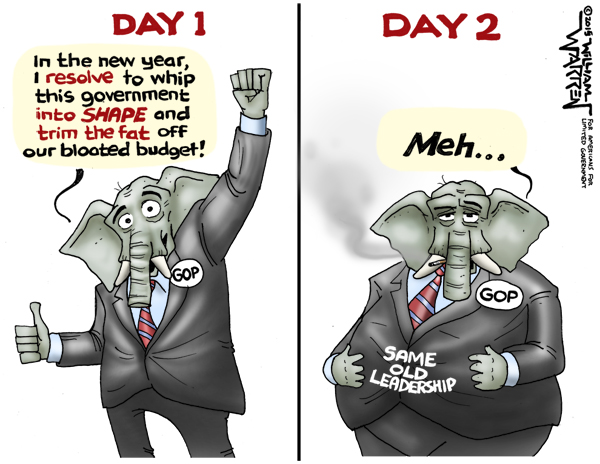
Silk Road is best known as a bitcoin-enabled online marketplace for drugs (read Brian Doherty's feature on the topic). But the case against Ulbricht, who war arrested in 2013, raises hugely important questions about Internet freedom and due process. When they nabbed Ulbricht, the feds made sure everyone knew that he had allegedly tried to hire hitmen to take care of drug-selling rivals. The New York Times Magazine ran a story that underscored the feds' one-sided portrait as Ulbricht's transformation from a literal Eagle Scout to the power-drunk "Dread Pirate Roberts" who was getting rich and insane from his role as proprietor of Silk Road.

Yet when it came time to, you know, actually charge him with crimes, the conspiracy to commit murder charges weren't entered. Well, not exactly. They're in the court documents but won't actually be vetted by the court:

In addition to the drug and conspiracy charges, U.S. District Judge Katherine Forrest ruled last week that she will allow prosecutors to try to prove their case by presenting evidence that Ulbricht discussed six different murder-for-hire plots to protect Silk Road.

That's one way the feds are stacking the deck against Ulbricht, who may or may not be guilty of running Silk Road (I have no idea; but in the interests of disclosure, I contributed $100 to his defense fund out of concern of the way in which he is being prosecuted). The feds also have not explained to the defense how they tracked down Ulbricht, raising concerns that the evidence was initially gathered via intelligience operations that functioned without a legal warrant. That's troubling, as is the government's position that regardless of whether he profited from the site or actually trafficked in drugs himself, he should be responsible for what was going on at Silk Road. That charge flies in the face of existing laws that exempt ISPs and site operators from responsiblity for the actions and speech of users. The outcome of that specific issue could well chill the Internet well below absolute zero.

To paraphrase Joe Biden, this is a big fucking deal. Not simply because Ulbricht may be railroaded but because the way in which the prosecution is proceeding potentially threatens all of us who run websites, transact business online, and want to live in a country where the government has to be transparent about where it got its evidence against us.

Reason interviewed Lynn Ulbricht, who lays out the larger issues raised by the trial of her son:

13 Jan 03:42

Wholly Stupid Conclusions About Whole Grains

by Tom Naughton

Take a look at this headline from a Shape magazine online article – but I’m warning you, if you’re prone to head-bang-on-desk incidents like I am, you’d best don your helmet before continuing.

Low Carb Diet Linked to Shorter Life Expectancy

That’s the headline.  Here’s the subhead:

If your healthy diet doesn’t include breads, rice, oats, and other whole grains, you may be missing out on a huge health perk, says new science.

And here’s the opening paragraph:

Swearing off carbs may mean forgoing health perks as well: People who ate more whole grains throughout their lives lived longer than those who didn’t, reports a new study in the JAMA Network Journals.

Better eat your bread and other grains, because a low-carb diet is linked to an early death.  That’s the takeaway message.  So obviously, the study being reported by the Shape magazine writer compared low-carb diets to diets rich in whole grains, right?

Wrong.  The study wasn’t about low-carb diets at all.  The headline and the opening paragraph are both complete nonsense.  Hardly a week goes by when I don’t see some goof in the media misinterpret a study (often with help from the researchers), but I ignore most of those articles these days simply because they’re so common.

But this article … wow … I found myself asking the same question I often ask when politicians give speeches:  Is this goofball knowingly dishonest, or just plain stupid?

So let’s put on our Science For Smart People hats and ask some questions about the study that prompted the Shape reporter (and others, no doubt) to conclude that a low-carb diet is linked to shorter life expectancy.

Q: Is this a clinical study or an observational study?

A: It’s an observational study.  Actually, researchers dug data out of two ongoing observational studies.  Here’s a quote from the study abstract:

We investigated 74,341 women from the Nurses’ Health Study (1984–2010) and 43,744 men from the Health Professionals Follow-Up Study (1986–2010), 2 large prospective cohort studies.

I’ve written about those studies before.  The Reader’s Digest version is that they’re based on occasional food questionnaires, which are notoriously unreliable.  Whenever I see a new analysis of the same old data from either one of these studies, I know it’s time to roll my eyes and walk away.  Move along folks, nothing to see here.  But for the sake of argument, let’s assume food questionnaires are reliable and observational studies actually tell us something useful.

Q: What was the actual difference?

A:  Well, you can refer to the abstract for the details, but here’s what got the researchers and members of the media all excited:

After multivariate adjustment for potential confounders, including age, smoking, body mass index, physical activity, and modified Alternate Healthy Eating Index score, higher whole grain intake was associated with lower total and CVD mortality but not cancer mortality…. We further estimated that every serving (28 g/d) of whole grain consumption was associated with a 5% lower total morality or a 9% lower CVD mortality, whereas the same intake level was nonsignificantly associated with lower cancer mortality.

So people eating whole grains had lower mortality.  Which leads to the next question …

Q:  Compared to what?

A:  Well, from the headline in Shape magazine online, you’d think researchers compared diets rich in whole grains to low-carb diets.  But like I said before, that’s not the case.  All this data shows is that people who ate more whole grains were less likely to die prematurely.  So … if a person eats more whole grains, wouldn’t that mean he or she is eating less of something else?  Which leads us to ask …

Q: If A is linked to B, could it be because of C?

A:  That’s the $64,000 question.  And the answer in this case is almost certainly yes.  Whole grains are associated with better health outcomes, but that’s because people who eat whole grains usually choose them over refined grains.  This study was conducted at Harvard, which trumpeted the results in the media and promoted the idea that there’s something especially health-enhancing about whole grains.  Here’s a quote about the study from a Harvard press release:

“This study further endorses the current dietary guidelines that promote whole grains as one of the major healthful foods for prevention of major chronic diseases,” said Qi Sun, assistant professor in the Department of Nutrition and senior author of the study.

Wow, so it turns out the government dietary guidelines are correct!  We just proved it here in our government-funded study!  (The NIH funded the study, according to the same press release.)  People who ate more whole grains lived longer, so that proves whole grains — in and of themselves — are good for you.

Uh-huh.  But here are some quotes from a different Harvard press release, commenting on earlier data extracted from the same two observational studies:

Refining wheat creates fluffy flour that makes light, airy breads and pastries. But there’s a nutritional price to be paid for refined grains. The process strips away more than half of wheat’s B vitamins, 90 percent of the vitamin E, and virtually all of the fiber. It also makes the starch easily accessible to the body’s starch-digesting enzymes.

A growing body of research shows that returning to whole grains and other less-processed sources of carbohydrates and cutting back on refined grains improves health in myriad ways.

Eating whole instead of refined grains substantially lowers total cholesterol, low-density lipoprotein (LDL, or bad) cholesterol, triglycerides, and insulin levels. Any of these changes would be expected to reduce the risk for cardiovascular disease.

More recent findings from this study (the Nurses’ Health Studies I and II) and the Health Professionals Follow-Up Study suggest that swapping whole grains for white rice could help lower diabetes risk: Researchers found that women and men who ate the most white rice—five or more servings a week—had a 17 percent higher risk of diabetes than those who ate white rice less than one time a month.

In other words, the supposed magic of whole grains comes down to them being a somewhat better choice than refined grains that jack up blood sugar, triglycerides, insulin, etc.  That tells us absolutely nothing about the health effects of whole grains vs. no grains.

The researchers noted that “replacing” one serving per day of red meat with whole grains was also associated with lower mortality.  I put “replacing” in quotes because people in these studies don’t check a box that says I am now swapping one serving of red meat for one serving of whole grains in my daily diet.  Those daily servings are the result of number-crunching by the researchers.  Their conclusion just means that given what they consider a “serving,” people who ate one serving less of red meat and one serving more of whole grains lived longer.

As I’ve explained before, the “red meat” in these studies most often comes in the form of pizza, burritos, deli sandwiches, hot dogs, etc. – in other words, processed meats that are served with a generous helping of white flour.  So when the researchers inform the media that “replacing” red meat with whole grains was associated with greater longevity, it could simply be the result of comparing people who eat pizza for dinner to people who eat chicken, vegetables and brown rice for dinner.  That doesn’t tell us diddly about what would happen to your health if you swapped a steak for a plate of whole-wheat pasta.

The folks at Harvard may understand that (not that you can tell from their conflicting press releases), but the reporter from Shape magazine clearly doesn’t.  She somehow managed to interpret this study as demonstrating a link between low-carb diets and an early death, even though the data doesn’t deal with low-carb diets at all.

To illustrate the depth of the stupidity, let’s take the smoking analogy I used in Science For Smart People and extend it a bit.  Suppose we conduct an observational study of smokers and find that those who smoke filtered cigarettes have lower rates of lung cancer than those who smoke unfiltered cigarettes.  The proper conclusion is that filtered cigarettes might be a better option than unfiltered cigarettes.  It would be stupid to conclude that our study proves filtered cigarettes are good for you.

But our Shape magazine reporter took that level of stupidity a step further.  To borrow a phrase from the comedy Tropic Thunder, she went full retard.  Her headline is the equivalent of reading a press release about our observational study on smoking and then writing a headline like this:

Non-Smoking Linked To Higher Cancer Rate

Like I said, I can’t tell if she’s being intentionally dishonest or is just plain stupid.  Either way, it’s not comforting to know she writes for a major health and fitness magazine.

You may now bang your head on your desk.

Share

09 Jan 12:59

U.S. News Ranks the Diets

by Tom Naughton

It’s January, which means millions of people are either already on a weight-loss diet or considering one.  If you watch TV this time of year, you can’t help but see ads for Jenny Craig, NutriSystem, Weight Watchers and all the other usual suspects.  So many options out there … which one should people choose?

Well, let’s suppose you were offered these choices:

On one plate, you’ve got a slice of grass-fed beef, some eggplant and green vegetables drizzled in olive oil, and perhaps a small sweet potato.  On the other plate — wait, make that in the other glass – you’ve got a brew of FAT FREE MILK, WATER, SUGAR, COCOA (PROCESSED WITH ALKALI), CANOLA OIL, MILK PROTEIN CONCENTRATE, FRUCTOSE, GUM ARABIC, CELLULOSE GEL, MONO AND DIGLYCERIDES, HYDROGENATED SOYBEAN OIL, HIGH FRUCTOSE CORN SYRUP, POTASSIUM PHOSPHATE, MALTODEXTRIN, SOY LECITHIN, CELLULOSE GUM, CARRAGEENAN, NATURAL AND ARTIFICIAL FLAVOR, SODIUM BICARBONATE, SUCRALOSE AND ACESULFAME POTASSIUM (NONNUTRITIVE SWEETENERS), SODIUM CITRATE, CITRIC ACID.

That brew in the glass contains 18 grams of sugar, by the way.

So which meal should you choose?  Why, the glass of Slim-Fast, of course.  (How many of you guessed it from the list of ingredients?)

I know the Slim-Fast is a better option because a group of (ahem) experts says so.  Here are some quotes from an article on the NPR site, and from an article in U.S. News:

Despite the buzz about paleo and raw food diets, a new ranking of the 35 top diets puts these two near the bottom of the list.

Why?

I’m guessing it’s because the list was created by a bunch of nutritionists who still believe the same old anti-fat, anti-salt, hearthealthywholegrains nonsense they’ve been preaching for years.

The U.S. News & World Report rankings are based on evaluations by a panel of doctors, nutritionists and other health experts. For each diet, the experts evaluated short-term and long-term weight loss, ease of adherence, and how the advice stacked up against current dietary guidelines.

… and how the advice stacked up against current dietary guidelines.  In other words, the diets may as well have been ranked by the guiding lights at the USDA.

One expert concluded that “a true paleo diet might be a great option: very lean, pure meats, lots of wild plants.” But the problem, according to the report, is that it’s too difficult to follow in modern times.

Well, yes, if you tried to go out and track down a Megaloceros giganteus, you’d be sorely disappointed.  But the paleo diet is about eating nutrient-dense whole foods and avoiding Neolithic foods, not recreating the exact diets of our caveman ancestors.

The experts say that in avoiding dairy, grains and other mainstays of the modern diet, paleo followers may miss out on key nutrients.

Yeah, that’s why Custer kicked ass at Little Big Horn.  The Sioux and Cheyenne were perpetually weak and sick from a lack of dairy, grains, and other mainstays of the modern diet.

The paleo diet, by the way, was ranked 35th out of 35 – you know, because it lacks those mainstays of the modern diet.  The Slim-Fast diet – which requires consuming shakes that contain all those ingredients I listed above, including hydrogenated soybean oil –was ranked 13th.

Meanwhile, a  vegetarian diet was ranked 11th … because while we shouldn’t give up grains and other mainstays of the modern diet, giving up a mainstay of the modern diet is fine and dandy if the mainstay is meat.  And while the paleo diet was ranked last largely because it’s “too difficult to follow in modern times,” apparently switching to a vegetarian diet isn’t difficult at all.

Here’s what the U.S. News article said about the vegetarian diet:

As a health diet, vegetarianism is solid. It’s decent at producing rapid weight loss, according to experts, and is strong in other areas, such as heart health and nutritional completeness, that arguably are more important.

But if you take a vegetarian diet and remove the grains while adding meat, it’s no longer nutritionally complete, according to the (ahem) experts.

As for heart health, well geez, that must explain why vegetarians don’t die of heart disease.  No, wait … I seem to recall that they do.  As I recounted in a previous post, Bill Clinton’s own vegan-promoting doctor warned him against eating bread:

When Caldwell Esselstyn spotted a picture of him on the Internet, eating a dinner roll at a banquet, the renowned doctor dispatched a sharply worded email message: “I’ll remind you one more time, I’ve treated a lot of vegans for heart disease.”

And in another post, I quoted from a study titled Mortality Among British Vegetarians:

The mortality of both the vegetarians and the nonvegetarians in this study is low compared with national rates. Within the study, mortality from circulatory diseases and all causes is not significantly different between vegetarians and meat eaters.

Hmmm, kind of makes you wonder if these diet rankings are a bunch of poppycock.

The U.S. News article included a link to the panel of experts who ranked the diets.  I’ve never heard of most of them, but I have heard of Dr. David Katz.  He created something called the NuVal system, which is supposed to help shoppers choose healthier foods at the grocery store.  Foods are ranked from 100 (excellent) to zero (might just kill you.)  I wrote about NuVal in a previous post.  Here are how some foods rank on Dr. Katz’s NuVal scale:

Post Shredded Wheat ‘N Bran – 91
Silk Soymilk Light – 82
Silk Soy Milk Chocolate – 68
Chicken Breast (boneless) – 39
Turkey Breast – 31
Ham – 27
Coconuts (husked) – 24

So according to Dr. Katz, a big bowl of wheat is an excellent choice.  A cup of chocolate soy milk containing 17 grams of sugar is a good choice.  But a chicken breast, a turkey breast, a slice of ham or a coconut is a bad choice.  No wonder he thinks Slim-Fast is better for you than a paleo diet.

The #1 ranked diet was the DASH diet.  Here’s what U.S. News has to say about it:

DASH was developed to fight high blood pressure, not as an all-purpose diet. But it certainly looked like an all-star to our panel of experts, who gave it high marks for its nutritional completeness, safety, ability to prevent or control diabetes, and role in supporting heart health.

The theory: Nutrients like potassium, calcium, protein and fiber are crucial to fending off or fighting high blood pressure. You don’t have to track each one, though. Just emphasize the foods you’ve always been told to eat (fruits, veggies, whole grains, lean protein and low-fat dairy), while shunning those we’ve grown to love (calorie- and fat-laden sweets and red meat). Top it all off by cutting back on salt, and voilà!

But if you take way the whole grains and low-fat dairy and add in some red meat, it’s now a paleo diet and the ranking drops from first to last — 22 spots lower than the Slim-Fast diet.  Yeah, that makes perfect sense.  And the extremely low level of salt allowed on the DASH diet is not only unnecessary for most people, it might actually be bad for your health, according to a study published recently in the New England Journal of Medicine.

So here’s what we’ve got with the U.S. News diet rankings:  the same group of idiots who’ve been pushing low-fat, low-salt, low-meat diets for decades were asked to rank diets and – surprise! – they chose the low-fat, low-salt, low-meat diets as the best … which means ordinary folks looking for advice to help them fulfill that New Year’s resolution to lose weight will read that a diet of meats and vegetables isn’t good for them.  Nope, a decent diet is based on meal-replacement shakes that include FAT FREE MILK, WATER, SUGAR, COCOA (PROCESSED WITH ALKALI), CANOLA OIL, MILK PROTEIN CONCENTRATE, FRUCTOSE, GUM ARABIC, CELLULOSE GEL, MONO AND DIGLYCERIDES, HYDROGENATED SOYBEAN OIL, HIGH FRUCTOSE CORN SYRUP, POTASSIUM PHOSPHATE, MALTODEXTRIN, SOY LECITHIN, CELLULOSE GUM, CARRAGEENAN, NATURAL AND ARTIFICIAL FLAVOR, SODIUM BICARBONATE, SUCRALOSE AND ACESULFAME POTASSIUM (NONNUTRITIVE SWEETENERS), SODIUM CITRATE, CITRIC ACID.

Head. Bang. On. Desk.

And that’s why the same people will be making the same weight-loss resolution next year.  And the year after that.  And the year after that.

Share

09 Jan 02:00

Cartoon: GOP Resolution

by NetRight Daily

gop resolution

The post Cartoon: GOP Resolution appeared first on NetRight Daily.