A pile of children’s shoes marks the entrance to the Busia Community Library. The library walls don’t exactly shine white, and the ubiquitous Kenyan dust tints the floor a dull reddish-brown that no amount of scrubbing can erase. But the pile of shoes is significant—it represents the start of the information revolution in Busia.
The library has made books, computers, and other information resources available to the community. But to have impact on people’s lives, to be worthy of being called a revolution, merely making information available isn’t sufficient—it needs to be made relevant. Mobile phones exploded in popularity because they were affordable and their use was immediately apparent, but computers and the Internet have to overcome a steeper learning curve, higher cost, and a more distant payoff.
Baseline Busia
In this rural town of roughly 40,000, the appetite for information is voracious. Strangers pass newspapers around buses and cafes, and outdoor bar parking lots fill with patrons peering over concrete barriers to catch a glimpse of the Swahili TV news. But Busia’s Internet cafes are prohibitively expensive for the majority, and bookstores stock little beyond what’s required for schools.
Recognizing this gap, community leader and banana farmer Maria Wafula organized a library construction project. In 2006, in a small government office, the Busia Community Library opened its doors. Two years later, my colleague Ariel Schwartz and I founded Maria’s Libraries to support the fledgling project.
In a short period of time, community members began to request specific types of books. People were, understandably, interested in things that were relevant—farmers wanted new agricultural techniques, herbalists sought alternative medicines. Many students requested business books. Human biology also proved to be popular—Busia’s District Commissioner would visit the library every day during his lunch break and pore over Our Bodies, Ourselves.
Establishing Relevance
In the beginning, use of the library’s Internet-enabled computers was significantly lower than the demand for books — information services needed to be introduced in a relevant way.
Students aged 13-15 face the KCPE, a high-pressure secondary school eligibility exam. One successful program introduced them to the Internet in this context, without formal instruction. Participants began with digital scavenger hunts to familiarize them with the Internet through play, and culminated in self-guided searches to find applications that could help prepare them for the test. Using the Internet became both essential and relevant.
Most importantly, the kids became ambassadors for the tablets and computers to their parents and teachers. About a month into the program, the headmaster of a local school came into the library, inspired by his students. He sat down at a computer in the adult corner but seemed at a loss for what to do. Emily, a student in his school, approached him and shyly asked what he wanted to know. She spent two hours teaching her headmaster the basics of using the Internet.
Emily’s headmaster was not the only member of the community to be drawn in by these early young users. As teachers, parents, and other children became interested in using technology, the library added programs to teach them. The library’s job is not to prescribe how people use computers, but to seed and support the demand.
Looking Ahead
Busia’s library continues to evolve based on the needs of the community. Focus groups and observation highlight unmet demand, reviews of other projects provide potential solutions, and trial-and-error ultimately determines what works in Busia. A new building is currently under construction, which will include traditional library services as well as a citizen science center for agricultural experimentation, an oral history lab, and a co-working space. And as the library develops, the pile of shoes inside the door continues to grow.
“My name is Jean Wani my brother is working in unicef and I live in Carfour 11 Alentyerye I have 2 people that are still alive under the building! Send Help!”
This text message, originally sent in Haitian Creole seven days after the January 12, 2010 earthquake, reported one of the many ensuing emergencies. With this note and thousands of others like it, disaster relief entered the Information Age—in a country where Internet penetration falls under 10 percent.
Once sent, the message traveled through a global network of emergency responders, many of whom had never set foot in Haiti. The response was cobbled together by a group of people from disparate organizations, largely online. One of them was Ushahidi, a Kenyan organization originally created in response to Kenya’s 2007 post-election crisis. The group’s open-source mapping technology allowed residents to crowdsource information about ongoing riots and emergency needs via SMS.
After the earthquake in Haiti, Ushahidi and others rapidly developed and deployed an SMS response system to report and monitor needs. The system would connect victims with volunteers abroad analyzing reports, translators among the Haitian diaspora, and ultimately crews on the ground who could locate them and provide aid.
Brian Herbert, a software developer for Ushahidi, worked on the earthquake response from his apartment in Athens, Georgia. “It kind of grew very organically,” he says. “There was no plan in the beginning for how it would work. So as we needed expertise in different areas, different organizations were willing to help out in different parts.”
Once deployed, Haitians could send critical messages to a 4636 shortcode. People across the earthquake-affected area needed only a mobile phone to call out for help, a crucial feature. While Haiti’s Internet infrastructure lags behind nearby countries like the Dominican Republic and Jamaica, cell phone ownership is common. The country of about 10 million people had an estimated 4.2 million mobile subscriptions last year.
Digicel, the country’s largest telco, had originally set up the 4636 shortcode to broadcast weather notices during hurricane seasons. The company’s network suffered damage in the quake but remained operational, and it donated the number for emergency response. Repurposed, 4636 became a two-way channel. Port-au-Prince radio stations informed listeners about the service and stressed that people include location information with 4636 texts. Eventually, some 45,000 messages poured in, which needed to be translated, categorized, and marked as actionable or not. Many were non-urgent or noise.
Most of those messages landed in Patrick Meier’s living room, which he dubbed the Haiti Situation Room. At the time, Meier was Ushahidi’s Director of Crisis Mapping and working on his PhD at the Tufts university Fletcher School in Boston. In the Situation Room, volunteers used social networks like Facebook and Twitter to find people who could translate Haitian Creole. More than a thousand members of the Haitian diaspora responded. Many had lived in Port-au-Prince and used their local knowledge of its geography to approximate messagers’ locations.
One translator, Carline Ferailleur-Dumoulin, grew up in Port-au-Prince and Miami and returned to Haiti for a few years in the late 90s. She now runs a professional translation company in Atlanta and translated emergency messages from her home after the quake.
“A lot of these messages were cries for help from people being stranded,” Ferailleur-Dumoulin wrote in an email, “and some others were reporting thefts taking place. Others were requesting food and shelter. Reading these messages and knowing they were coming from people back home was heart-wrenching. But I still had to basically be emotionless and focus on the task at hand.”
The Fletcher volunteers also used platforms like Open Street Map (a Wikipedia-style crowdsourced world map) to refine geolocations. The day before the earthquake, the OSM map of Port-au-Prince featured only a handful of major avenues. Google Maps wasn’t much better and couldn’t be edited.
“Port-au-Prince essentially didn’t exist on the [OSM] map,” says Herbert. “There was nothing there.” But after just two days, the map of the capital was an intricate web of thoroughfares, streets, and backroads. Volunteers had used satellite imagery to trace streets onto OSM. It remains the most detailed and accurate digital map of Port-au-Prince.
Ultimately, the coordination made its way back to Haiti. Herbert recalled a particular message sent about a young woman in labor. “One of the volunteers was able to take that and find down to the almost exact spot where they were,” Herbert says, “and she was able to get help.” The US Coast Guard reported that the latitude and longitude provided were accurate to five decimal points.
For her and many others, Ushahidi’s response made all the difference. Meier noted in a paper, “The United Nations took weeks to respond, while the technology community took hours. This is a classic case of technology and innovation leading regulation.” Craig Fugate, administrator of the US Federal Emergency Management Agency (FEMA), praised the Ushahidi crisis map as “the most comprehensive and up-to-date map available to the humanitarian community”.
Yet the project had its hitches. In one instance, another organization used the shortcode to blast a notice to all subscribers. Residents responded to 4636 en masse, creating a spike in noise that taxed volunteers who could have been translating emergency texts.
Meier and others have since formalized their strategy into a Standby Task Force, a network of digital responders trained in crowdsourcing and mapping. The initiative and its technologies will help ensure volunteers a continent away can contribute during future emergencies, as Herbert, Ferailleur-Dumoulin, and many others did for Haiti. Having since mapped crises in Libya and Syria and monitored South Sudan’s referendum, task force members say their impact is felt.
“I was motivated to volunteer on some of those assignments,” Ferailleur-Dumoulin says. “Mainly on a humanitarian level but also because this disaster had literally hit home, where my family members and friends were. And to me, this was the best way I could help out since I could not physically be at the scenes to lend a hand.”
Sparkler's IBM 402 is not a traditional computer, but an automated electromechanical tabulator that can be programmed (or more accurately, wired) to print out certain results based on values encoded into stacks of 80-column Hollerith-type punched cards.
Companies traditionally used the 402 for accounting, since the machine could take a long list of numbers, add them up, and print a detailed written report. In a sense, you could consider it a 3000-pound spreadsheet machine. That's exactly how Sparkler Filters uses its IBM 402, which could very well be the last fully operational 402 on the planet. As it has for over half a century, the firm still runs all of its accounting work (payroll, sales, and inventory) through the IBM 402. The machine prints out reports on wide, tractor-fed paper.
The Table Top Wool Wagon is among the largest animal-drawn road vehicles ever built. It was a unique Australian invention, built to transport wool from sheep farms to train stations and harbours.
As many as forty bullocks, or thirty horses, pulled the vehicles over distances of up to 1600 km.
Table Top Wool Wagons (also known as "jinkers" or "ships of the desert") appeared at the end of the nineteenth century and remained in use until the 1920s, when they were replaced by trucks.
The Table Top Wool Wagon evolved from a somewhat smaller vehicle that
appeared in the 1870s and carried a load of between 5 and 6 tonnes of both wool and wheat. The larger versions, especially designed for wool,
appeared in the 1890s when road conditions improved. They reached their zenith in the 1910s.
Below is a picture of a medium sized wagon (5 m long, 2 m wide) with a removable hay frame.
The Table Top Wool Wagon was up
to 8.5 m long and 2.5 m wide, and its wheels were up to 2.5 m in diameter
and 20 cm wide. The wagon had no sides, hence its name, but
the platform curved upwards by 5 cm at the front and rear. This caused the
bales of wool to lean towards the middle and steady the load. The
vehicles had a loading capacity of 10 to 15 tonnes, with record loads of over 17 tonnes.
The Engine
Such
heavy loads required large
teams of draught animals, especially on muddy roads. Four horses were needed just to move the
vehicle around when it was empty. When fully loaded, up to forty bullocks or thirty
horses could be yoked to the front, and donkeys and camels were also used. Drivers did not sit on their wagon loads, but led the way on horseback or by walking, and the vehicle was
steered by the lead-horses.
Road and weather conditions usually determined whether horse teams or
bullock teams were used. When roads were either very rough, or did not
exist at all, bullocks were of much greater use than horses.
The driver was often accompanied by his wife and family who rode in a horse-drawn wagonette that the women drove. A cattle dog completed the gang.
The Routes
Many wagons were driven from Ilfacombre to Rockhampton, a journey of almost 800 km. The trip took three months -- longer when it rained, and only half as long to return with empty carts. Ilfacombre had the largest wool scouring plant in Queensland, with most of the wool from that area being washed there.
Washed wool was a lot lighter, so you could put a
lot more washed and dried wool into a bale and ship it more cheaply. Other destinations of the Table Top Wool Wagons were Adelaide,
Sydney, Melbourne, Brisbane, and Perth, with travel distances of up to
1600 km.
The Challenges
There are records of wagons taking two years to complete a journey to the coastal markets. All too often, a wagon would tip over, particularly after rain. The only remedy was to unload, upright the wagon, and wait for the road to dry.
Hills presented another challenge. The most common form of slowing the descent involved chaining a felled log
to the back of the wagon. To cope with
steep hills, some wagons had their wheels 'spragged' -- that is, they
thrust a sapling between the spokes of each pair of wheels so that it
jammed against the wagon floor.
Table Top Wool Wagons disappeared in the 1920s, when they were replaced by trucks and the gradually extending railways.
Woah! Since I can't figure out how to tag or share with specific people I'm following (@Jfpeterson?) I'll just email it to her, but woah.
Earlier this week, Mendeley was bought by Elsevier. I posted the announcement on Twitter to state that I would be quitting Mendeley. This tweet sparked a conversation between me and the head of academic outreach at Mendeley (William Gunn) that could only go so far in 140 character chunks. I was trying to highlight that, while I respected the Mendeley team’s decision to do what’s best for them, I could not support them as a customer knowing that this would empower a company that I think undermines scholarship, scholars, and the future of research.
I feel the need to respond to this implicit attack on my character and affiliation. When I’m critical of Elsevier, I’m speaking as a scholar, not on behalf of Microsoft or even Microsoft Research. That said, I get that everyone’s associations shapes how they’re perceived. But I’m not asking people to buy my ?product? or even the products of my employer. I’m making a public decision as a scholar who is committed to the future for research. I believe in making my research publicly available through open access initiatives and I’m proud to work for and be associated with an organization that is committed to transforming scholarly publishing. I’m also committed to boycotting organizations that undermine research, scholarship, libraries, and the production of knowledge.
I also think that it’s important to explain that there are huge differences between Microsoft and Elsevier. I fully recognize that I work for a company that many people think is evil. When I joined Microsoft four years ago, I did a lot of poking around and personal soul-searching. Like many other geeks of my age, I spent my formative years watching an arrogant Microsoft engage in problematic activities only to be humiliated by an anti-trust case. Then I watched the same company, with its tail between its legs, grow up. The company I was looking to join four years ago was not the company that I boycotted in college. It had been a decade since United States vs. Microsoft and even though many of my peers are never going to forgive my employer for its activities in the 90s, I am willing to accept that companies change.
There are many aspects of Microsoft that I absolutely love. For starters, Microsoft Research (MSR) is heaven on earth. Overall, MSR offers more freedom, flexibility, and opportunities to scholars than even the best academic institutions. They share my values regarding making scholarship widely accessible (see: Tony Hey’s 6-part series on open access). And, unlike research entities at other major corporations, Microsoft Research has supported me in doing research that’s critical of Microsoft (even when I get nastygrams from corporate executives). Beyond my home division, there are other sparkly beacons of awesome. I love that Microsoft has made privacy a central value, even as it struggles to ethically negotiate the opportunities presented by data mining. I have been in awe of some of the thoughtful and innovative approaches taken by the folks at Bing, in mobile, and in Xbox. Even more than the work that everyone sees, I get excited by some of the visioning that happens behind closed doors.
Don’t get me wrong. Like all big companies, Microsoft still screws up. I’ve facepalmed on plenty of occasions, embarrassed to be associated with particular company decisions, messages, or tactics. But I genuinely believe that the overall company means well and is pointed in a positive, productive, and ethical direction. Sure, there are some strategies that don’t excite me, but I think that the leadership is trying to move the company to a future I can buy into. I’m proud of where the company is going even if I can’t justify its past.
I cannot say the same thing for Elsevier. As most academics and many knowledge activists know, Elsevier has engaged in some pretty evil maneuvers. Elsevier published fake journals until it got caught. Its parent company was involved in the arms trade until it got caught. Elsevier played an unrepentant and significant role in advancing SOPA/PIPA/RWA and continues to lobby on issues that undermine scholarship. Elsevier currently actively screws over academic libraries and scholars through its bundling practices. There is no sign that the future of Elsevier is pro-researchers. There is zero indicator that Mendeley’s acquisition is anything other an attempt to placate the academics who are refusing to do free labor for Elsevier (editorial boards, reviewers, academics). There’s no attempt at penance, no apology, not even a promise of a future direction. Just an acquisition of a beloved company as though that makes up for all of the ways in which Elsevier has in the past _and continues to_ screw over scholars.
Elsevier’s practices make me deeply deeply angry. While academic publishing as a whole is pretty flawed, Elsevier takes the most insidious practices further at each and every turn, always at the expense of those of us who are trying to produce, publish, and distribute research. Their prices are astronomical, bankrupting libraries and siloing knowledge for private profit off of free labor. As a result, many mathematicians and other scientists have begun stepping off of their editorial boards in protest. Along with over 13,000 other scholars, I too signed the Cost of Knowledge boycott.
I see no indication of a reformed Elsevier, no indication of a path forward that is actually respectful of scholars, scholarship, librarians, or universities. All I see is a company looking to make a profit in an unethical manner and trying to assuage angry customers and laborers with small tokens.
Mendeley’s leadership is aware of how many academics despise Elsevier. In their announcement of their sale, they justify Elsevier through some of the technologies they developed. There’s no indication that the “partnership” is going to make Elsevier more thoughtful towards academics. Mendeley’s reps try to explain that the company is a “large, complex organization” full of good people as though this should relieve those of us who are tired of having our labor and ideas abused for profit.
All companies have good people in them. All companies are complex. This is not enough. What matters is the direction of the leadership and what kinds of future a company is trying to create. People may not like either Microsoft or Elsevier’s past, but what about the future?
In Mendeley’s post, they indicate overlap in their vision and Elsevier’s vision as a company. This does not make me more hopeful of Elsevier; this makes me even more dubious of Mendeley. Elsevier has a long track record with no indication of change. It is the parent company. Startups don’t get bought by big companies to blow up the core company. New division presidents or vice-presidents do not have penultimate power in big companies, particularly not when their revenue pales in comparison to the parent company’s. I wish Mendeley employees the best, but I think that they’re naive if they believe that they can start a relationship with the devil hoping he’ll change his ways because of their goodness. This isn’t a Disney fairy tale. This is business.
I genuinely like Mendeley as a product, but I will not support today’s Elsevier no matter how good a product of theirs is. Perhaps they’ll change. I wouldn’t bet on it, but I am open to the possibility. But right now, I don’t believe in the ethics and commitments of the company nor do I believe that they’re on the precipice of meaningful change. As minimally symbolic as it is, I refuse to strengthen them with my data or money. This means that I will quit Mendeley now that they’re part of Elsevier. In the same vein, I respect people who disagree with my view on the future of Microsoft and choose to not to use their products. I believe in consumer choice. I’m just startled that a head of academic outreach would try to brush off my critique of his new employer by implicating mine. I guess that’s the way things work.
I believe that the next place for me is probably Zotero, but I’m trying to figure out how to get my data (including the PDFs) over there. I’m hopeful that someone will write the scripts soon so that I don’t have to do this manually. If you’ve got other suggestions or advice, I’m all ears.
Filmed at 780 fps with a Phantom Flex from the back of a moving SUV, James Nares' Street depicts people walking New York streets in super slow motion.
The film runs 60 minutes (depicting about three minutes of real time footage), Sonic Youth's Thurston Moore did the soundtrack, and it's on display at The Met until the end of May.
I got taken too the one time I saw Elvis, but in a totally different way. It was the autumn of 1971, and two tickets to an Elvis show turned up at the offices of Creem magazine, where I was then employed. It was decided that those staff members who had never had the privilege of witnessing Elvis should get the tickets, which was how me and art director Charlie Auringer ended up in nearly the front row of the biggest arena in Detroit. Earlier Charlie had said, "Do you realize how much we could get if we sold these fucking things?" I didn't, but how precious they were became totally clear the instant Elvis sauntered onto the stage. He was the only male performer I have ever seen to whom I responded sexually; it wasn't real arousal, rather an erection of the heart, when I looked at him I went mad with desire and envy and worship and self-projection. I mean, Mick Jagger, whom I saw as far back as 1964 and twice in '65, never even came close.
Dustin Cohen made a lovely little film about shoemaker Frank Catalfumo, who has been making and repairing shoes in Brooklyn since before World War II.
Frank Catalfumo is a 91 year old shoemaker and repairer in Bensonhurst, Brooklyn. He first opened the doors to F&C Shoes in 1945 and continues to work five days a week alongside his son Michael. If you're ever in the area, make sure to stop by the shop and listen to one of Frank's amazing stories about life in Brooklyn back in the day.
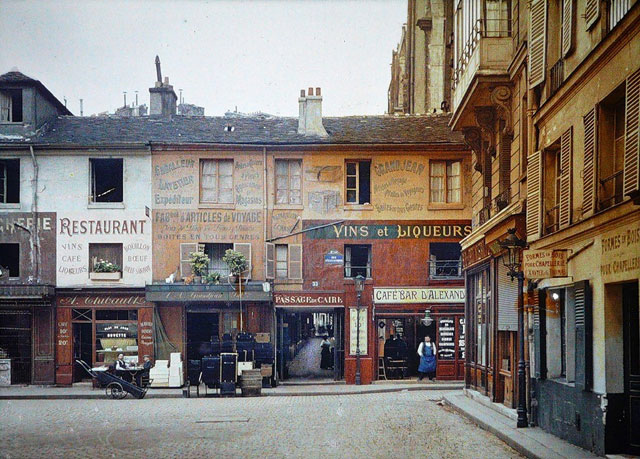
In past few months, I linked to twocollections of color photos of Paris taken in the 1910s and 1920s under the direction of Albert Kahn.
Recently Rue89 sent photographer Audrey Cerdan to recapture some of those old scenes in modern day Paris and knocked up an interface so that you can slide back and forth between the old and current photos. In some of the pairs of photos, pharmacies, tabacs, and boulangeries are in the same places. (thx, christophe)
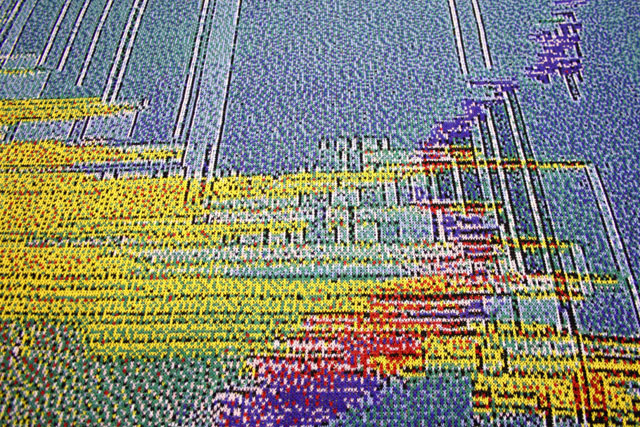
Artist Phillip Stearns makes blankets and tapestries out of glitch art. Some of the source images are taken from intentionally short-circuited digital cameras.
All items are woven in the US and cost $200 and up (plus shipping).
things to know when shopping for delicious whiskey.
Because of the tea-bag effect, after a point, spirits don't necessarily get better the longer they age. Bottled liquors don't age positively at all which doesn't have anything to do with tea bags.
What distinguishes these two approaches is what Pickerell refers to as "the tea-bag effect": The first time a tea bag (or barrel) is used, there's more flavor to draw out. Resting in brand-new barrels, bourbon needs less time to extract what Pickerell calls "wood goodies" -- it sucks vanilla and caramel flavors, as well as spice-like notes, out of the wood with ease. Many of those same bourbon barrels, once emptied, make their way to Scotland, where they are used to age Scotch whisky. At this point, most of the "wood goodies" have been depleted, so scotch often needs a longer aging time to suck out the remainders. Evaporation plays a role, too: In the dry climate favored by bourbon distillers, liquid evaporates more quickly, and the product becomes concentrated more quickly.
Also, according to the article, the ideal age range for whisk(e)y is as follows:
Rye whiskey: 9-11 years.
Bourbon: 6-10 years.
Scotch: 20 years.
"Following McLuhan and his mentor Harold Innis, a persuasive case can be made that print played the key role in the rise of the nation state and capitalism, and also in the development of our notions of privacy and the primary focus on the individual over the collective. Social reading experiments and massive multi-player games are baby steps in the shift to a networked culture. Over the course of the next two or three centuries new modes of communication will usher in new ways of organizing society, completely changing our understanding of what it means to be human." Let us only hope.
I'm in Milan for the ifbookthen conference. Corriere della Serra (the leading Italian newspaper) asked me for an opinion piece they could publish in La Lettura, their weekly magazine, on the occasion of the meeting. This is what I gave them.
The Future of the Book
As someone who made the leap from print to electronic publishing over thirty years ago people often ask me to expound on the "future of the book." Frankly, I can't stand the question, especially when asked simplistically. For starters it needs more specificity. Are we talking 2 years, 10 years or 100 years? And what does the questioner mean by "book" anyway? Are they asking about the evolution of the physical object or its role in the social fabric?
It's a long story but over the past thirty years my definition of "book" has undergone a major shift. At the beginning I simply defined a book in terms of its physical nature -- paper pages infused with ink, bound into what we know as the codex. But then in the late 1970s with the advent of new media technologies we began to see the possibility of extending the notion of the page to include audio and video, imagining books with audio and video components. To make this work conceptually, we started defining books not in terms of their physical components but how they are used. From this perspective a book isn't ink on bound paper, but rather "a user-driven medium" where the reader is in complete control of how they access the contents. With laser videodiscs and then cd-roms users/readers started "reading" motion pictures; transforming the traditionally producer-driven experience where the user simply sat in a chair with no control of pace or sequence into a fully user-driven medium.
This definition worked up through the era of the laser videodisc and the cd-rom, but completely fell apart with the rise of the internet. Without an "object" to tie it to, I started to talk about a book as the vehicle humans use to move ideas around time and space.
People often expressed opposition to my freewheeling license with definitions but I learned to push back, explaining that it may take decades, maybe even a century for stable new modes of expression and the words to describe them to emerge. For now I argued, it's better to continuously redefine the definition of "book" until something else clearly takes its place.
A Book is a Place
In 2005 when the U.S. based Macarthur Foundation gave me a huge grant to explore how publishing might evolve as it moves from the printed page to the networked screen I used the money to found what I playfully named The Institute for the Future of the Book. With a group of young people, just out of university and coming of age in the era of the social web, we carried out a number of experiments under the rubric of "networked books."
This was the moment of the blog and we wondered what would happen if we applied the concept of "reader comments" to essays and books. Our first attempt, McKenzie Wark's Gamer Theory, turned out to be a remarkably lucky choice. The book's structure -- numbered paragraphs rather than numbered pages -- required my colleagues to come up with an innovative design allowing readers to make comments at the level of the paragraph rather than the page. Their solution to what at the time seemed like a simple graphical UI problem, was to put the comments to the right of each of Wark's paragraphs rather than follow the standard practice of placing them underneath the author's text.
Within a few hours of putting Gamer Theory online, a vibrant discussion emerged in the margins. We realized that moving comments from the bottom to the side, a change that at the time seemed minor, in fact had profound implications. Largely because Wark took a very active role in the unfolding discussion, our understanding at first focused on the ways in which this new format upends the traditional hierarchies of print which place the author on a pedestal and the reader at her adoring feet. With the side-by-side layout of Gamer Theory's text and comments, author and reader were suddenly occupying the same visual space; which in turn shifted their relationship to one of much greater equality. As the days went by it became clear that author and reader were engaged in a collaborative effort to increase their collective understanding.
We started to talk about "a book as a place" where people congregate to hash out their thoughts and ideas.
Later experiments in classrooms and reading groups were just as successful eventhough no author was involved, leading us to realize we were witnessing much more than a shift in the relationship between author and reader.
The reification of ideas into printed, persistent objects obscures the social aspect of both reading and writing, so much so, that our culture portrays them as among the most solitary of behaviors. This is because the social aspect traditionally takes place outside the pages -- around the water cooler, at the dinner table and on the pages of other publications in the form of reviews or references and bibliographies. In that light, moving texts from page to screen doesn't make them social so much as it allows the social components to come forward and to multiply in value.
And once you've engaged in a social reading experience the value is obvious. Contemporary problems are sufficiently complex that individuals can rarely understand them on their own. More eyes, more minds collaborating on the task of understanding will yield better, more comprehensive answers.
Our grandchildren will assume that reading with others, i.e. social reading, is the "natural" way to read. They will be amazed to realize that in our day reading was something one did alone. Reading by one's self will seem as antiquated as silent movies are to us.
The difficult thing however about predicting the future of reading is that everything i've said so far presumes that what is being read is an "n-page" article or essay or an "n-page," "n-chapter" book," when realistically, the forms of expression will change dramatically as we learn to exploit the unique affordances of new electronic media. Ideally, the boundaries between reading and writing will become ever more porous as readers take a more active role in the production of knowledge and ideas.
Clemens Setz, the author of the literary novel Indigo watched the conversation unfold as 40 students in a class at Hildesheim University outside Berlin carried out an extensive conversation with over 1800 comments. At a recent symposium Setz said that knowing his readers would be playing an active role in the margin will effect how he writes; he'll make room for their participation.
Follow the Gamers
And lest, you think this shift applies only to non-fiction, please consider huge multi-player games such as World of Warcraft as a strand of future-fiction where the author describes a world and the players/readers write the narrative as they play the game.
Although we date the "age of print" from 1454, more than two hundred years passed before the "novel" emerged as a recognizable form. Newspapers and magazines took even longer to arrive on the scene. Just as Gutenberg and his fellow printers started by reproducing illustrated manuscripts, contemporary publishers have been moving their printed texts to electronic screens. This shift will bring valuable benefits (searchable text, personal portable libraries, access via internet download, etc.), but this phase in the history of publishing will be transitional. Over time new media technologies will give rise to new forms of expression yet to be invented that will come to dominate the media landscape in decades and centuries to come.
My instinct is that game makers, who, unlike publishers, have no legacy product to hold them, back will be at the forefront of this transformation. Multimedia is already their language, and game-makers are making brilliant advances in the building of thriving, million-player communities. As conventional publishers prayerfully port their print to tablets, game-makers will embrace the immense promise of networked devices and both invent and define the dominant modes of expression for centuries to come.
The Future of the Book is the Future of Society
"The medium, or process, of our time -- electric technology -- is reshaping and restructuring patterns of social interdependence and every aspect of our personal life.
It is forcing us to reconsider and re-evaluate practically every thought, every action, and every institution formerly taken for granted. Everything is changing: you, your family, your education, your neighborhood, your job, your government, your relation to "the others. And they're changing dramatically." Marshall McLuhan, The Medium is the Message
Following McLuhan and his mentor Harold Innis, a persuasive case can be made that print played the key role in the rise of the nation state and capitalism, and also in the development of our notions of privacy and the primary focus on the individual over the collective. Social reading experiments and massive multi-player games are baby steps in the shift to a networked culture. Over the course of the next two or three centuries new modes of communication will usher in new ways of organizing society, completely changing our understanding of what it means to be human.
"Straw Bale Gardening is simply a different type of
container gardening. The main difference is that the container is the
straw bale itself and is held together with two or three strings."
"Once
the straw inside the bale begins to decay the straw becomes 'conditioned' compost that creates an extraordinary plant rooting
environment. Getting the straw bales conditioned is an essential part
of the process, and should be started two weeks prior to your target
planting date wherever you are located."
"This gardening technique works
well anywhere in the country or the world for that matter." Read more: here and here.
"The reaction of most people when I tell them I’m a scythe teacher is the same: incredulity or amusement, or polite interest, usually overlaid onto a sense that this is something quaint and rather silly that doesn’t have much place in the modern world. After all, we have weed whackers and lawnmowers now, and they are noisier than scythes and have buttons and use electricity or petrol and therefore they must perform better, right? Now, I would say this of course, but no, it is not right. Certainly if you have a five-acre meadow and you want to cut the grass for hay or silage, you are going to get it done a lot quicker (though not necessarily more efficiently) with a tractor and cutter bar than you would with a scythe team, which is the way it was done before the 1950s. Down at the human scale, though, the scythe still reigns supreme."
"A growing number of people I teach, for example, are looking for an alternative to a brushcutter. A brushcutter is essentially a mechanical scythe. It is a great heavy piece of machinery that needs to be operated with both hands and requires its user to dress up like Darth Vader in order to swing it through the grass. It roars like a motorbike, belches out fumes, and requires a regular diet of fossil fuels. It hacks through the grass instead of slicing it cleanly like a scythe blade. It is more cumbersome, more dangerous, no faster, and far less pleasant to use than the tool it replaced. And yet you see it used everywhere: on motorway verges, in parks, even, for heaven’s sake, in nature reserves. It’s a horrible, clumsy, ugly, noisy, inefficient thing. So why do people use it, and why do they still laugh at the scythe?"
"To ask that question in those terms is to misunderstand what is going on. Brushcutters are not used instead of scythes because they are better; they are used because their use is conditioned by our attitudes toward technology. Performance is not really the point, and neither is efficiency. Religion is the point: the religion of complexity. The myth of progress manifested in tool form. Plastic is better than wood. Moving parts are better than fixed parts. Noisy things are better than quiet things. Complicated things are better than simple things. New things are better than old things. We all believe this, whether we like it or not. It’s how we were brought up."
The tension between experience for its own sake and experience we pursue just to put on Facebook is reaching its breaking point. That breaking point is called Snapchat.
It is a nostalgic time right now, and photographs actively promote nostalgia. Photography is an elegiac art, a twilight art. Most subjects photographed are, just by virtue of being photographed, touched with pathos. An ugly or grotesque subject may be moving because it has been dignified by the attention of the photographer. A beautiful subject can be the object of rueful feelings, because it has aged or decayed or no longer exists. All photographs are momento mori. To take a photograph is to participate in another person’s (or thing’s) mortality, vulnerability, mutability. Precisely by slicing out this moment and freezing it, all photographs testify to time’s relentless melt.
—Susan Sontag, from On Photography (1973)
A photograph is made of time as much as it is of light — a frozen shutter-speed-size gap of the present captured within a photo border. Despite this, photographs have always been a way to cheat death, or at least to declare the illusion of immortality through lasting visual evidence. There’s always the possibility that the next photo you take will one day be lovingly removed from a box by some unborn great-grandchild; the Polaroid developing in your hands might come to be pinned to someone’s bedpost in posterity. To update that to more contemporary terms, your selfie on Instagram might be a signpost for the future you of what it was like to be this young.
On Snapchat, images have no such future. Fittingly, its logo is a ghost.
By refuting the assumption of the permanence of the image, Snapchat is a radical departure. It inaugurates temporary photography, in which photos are seen once by their chosen audience and then are gone in 10 seconds or less. Millions of people have done this a billion times with the Snapchat app (to say nothing of Facebook’s copycat, Poke).
The temporary photograph’s abbreviated lifespan changes how it is made and seen, and what it comes to mean. Snaps could be likened to other temporary art such as ice sculptures or decay art (e.g., Yoko Ono’s famous rotting apple) that takes seriously the process of disappearance, or the One Hour Photo project from 2010 that has as its premise to “project a photograph for one hour, then ensure that it will never be seen again.” However, whatever changes in the aesthetics of photographic vision Snapchat is effecting are difficult to assess, given that no one really knows what its self-deleting photos collectively look like. In many ways, this is exactly the point.
To understand the emergence of temporary photography, one must understand it in relation to the inflating archive of persistent images and their significance on how we perceive and remember the world.
The logic of the camera is that reality is real only to the extent that it is photographable. It pulls individuals out of the moment and makes them see it (and themselves) as an object for the future as well as always already of the past. This seizing of experience’s ephemerality — to possess the present, docile and durable — is what Andreas Kitzmann called a “museal gesture,” what Jean Baudrillard called “museumification,” and what André Bazin called the “mummy complex,” the “need to have the last word in the argument with death by means of the form that endures.” It’s ownership of the present by proxy.
As Susan Sontag wrote in On Photography,
there is something predatory in the act of taking a picture. To photograph people is to violate them, by seeing them as they never see themselves, by having knowledge of them they can never have; it turns people into objects that can be symbolically possessed.
Sontag notes that this makes for a nostalgic gaze, an understanding of the world as primarily documentable. For those who live with status updates, check-ins, likes, retweets, and ubiquitous photography, such an understanding is near inescapable. Social media have invited users to adopt a sort of documentary vision, through which the present is always apprehended as a potential past. This is most triumphantly exemplified by Instagram’s faux-vintage filters.
There’s always tension between experience-for-itself and experience-for-documentation, but social media have brought that strain to its breaking point. Temporary photography is in part a response to social-media users’ feeling saddled with the distraction of documentary vision. It rejects the burden of creating durable proof that you are here and you did that. And because temporary photographs are not made to be collected or archived, they are elusive, resisting other museal gestures of systemization and taxonomization, the modern impulse to classify life according to rubrics. By leaving the present where you found it, temporary photographs feel more like life and less like its collection.
The photograph, for all its promised immortality, always hinted at death. This was central to Roland Barthes’s analysis in Camera Lucida, that the enduring image “produces Death while trying to preserve life.” Documenting the present as a future past, as conventional photographs do, asserts the facts of change, impermanence, and mortality. The temporary photograph does the opposite: It interrupts the traditional photographic fixation of the present as impending history by positing a present moment that’s not concerned with the past or the future. As such, the temporary photograph is necessarily less sentimental and nostalgic. By being quick, the temporary photograph is a tiny protest against time.
***
Let’s face it, much of photography was already becoming Snapchat even before Snapchat existed. While much is justifiably, if hyperbolically, made of “the death of privacy” in the age of information immortality, the likely fate of the vast majority of images today is to be briefly consumed and quickly forgotten. As well as offering relief from deepening documentary vision, the temporary photograph also responds to this photographic abundance, which has deflated the value of images. As making more and more photos becomes easier, each individual shot means less and less. Snapchat is an attempt at re-inflation.
In their scarcity, photographs can age like wine, with grace and importance. In their abundance, photos can sometimes curdle, spoil, and rot. But from the beginning, technological innovation in photography has driven toward creating visual abundance. Daguerre is widely credited as inventing photography, in 1839, in part because earlier mechanical image-capturing techniques — most famously Niepce’s so-called heliography — did not create as many images as quickly and reliably. In subsequent decades, major advances shortened exposure times and made images even more easily reproducible, chiefly through replacing photographic plates with paper. Photography democratized dramatically with the introduction of Kodak’s small, cheap, and easy-to-use personal cameras at the turn of the 20th century. The ads proclaimed, “You press the button, we do the rest.” And then there is the rise of digital photography and smartphone cameras that make taking, duplicating, and viewing photos something many people do almost anytime and anywhere.
As photographic technology expanded photography’s user base, the photograph went from a rare prized possession to common keepsake to a nuisance that clutters our visual memories. Writing of this visual oversaturation, Michael Sacasas worries that
digital photography and sites like Facebook have brought us to an age of memory abundance. The paradoxical consequence of this development will be the progressive devaluing of such memories and severing of the past’s hold on the present. Gigabytes and terabytes of digital memories will not make us care more about those memories, they will make us care less.
By simulating the aesthetic of photographic scarcity, Instagram works as a response to (or overcompensation for) this fear — the enchanting landscape, disarming portrait, the bold statements and delicate textures look like moments captured from the past for posterity. These are the visual cues of photography pre-digital-devaluation, right down to the warm colors, faded glow, and false paper scratches and borders. Instagram’s faux-vintage filters, as I argued previously, reassure that present lives are just as authentic and worthy of nostalgia as the life captured in the seemingly scarce images from the analog past. Photographs are becoming too easy, so, dammit, here’s my life framed like it’s 1942.
But having an Instagram account is like having an abundance of money in a dead currency. So much nostalgia and meaning have been shoveled at us that the aesthetic has lost much of its ability to affect. Merely making your photos evocative of photo scarcity doesn’t make them actually scarce or make others covet them. There’s a deep mismatch between the aesthetic language of Instagram and the affordances of the network. Despite all the manufactured nostalgia, your photo disappears down the stream, largely unnoticed.
So whereas Instagram merely evokes the look of scarcity, temporary photography by definition enforces a certain rarity that imbues the image with a heightened aura of meaningfulness. Snapchat inspires memory because it welcomes the possibility of forgetting. Instead of being shared with a large number of people on a popular website, temporary photographs are taken specifically for and shared with one other person or a small group of people. The meaning of the photo doesn’t rest just in its content but in the choice to restrict its consumption — the choice to send that particular image to that particular person at that particular time, to the exclusion of other images, other recipients, and other times.
The ephemerality sharpens viewers’ focus: Once received, a Snapchat count-down is a kind of time-bomb that demands an urgency of vision, a challenge to exhaust the meaning from the image before the clock runs out. Unlike a paper photo that fades slowly over the years, the temporary photo disappears suddenly. Given only a peek, you look hard.
The temporary photo will wrongly be called frivolous or trivial — after all, only unimportant images could be so easily parted with. But as we have seen, there is meaning in witnessing ephemerality itself, an appreciation of impermanence for its own sake. By carving a space away from the growing necessity to record and collect life into database museums, temporary photography encourages an appreciation of the importance of experiencing the present for its own sake.
We might be witnessing an extraordinarily rare, even if minor, countertrend to photography’s increasing abundance — a sort of photographic population control. In this way, the rise of self-deleting photographs might be as much about reinstating the importance of nontemporary photos as it is the enactment of photographic disposability.
If everyday photography becomes temporary photography — if more people switch to apps like Snapchat and Poke — photos saved to more permanent locations like Facebook will become correspondingly more scarce and perhaps seem more important. Photographs taken and shared as temporary will impart more meaning to those chosen to be permanent. In the age of digital abundance, photography desperately needs this introduction of intentional and assured mortality, so that some photos can become immortal again.
Paul Frampton is a 69-year-old theoretical particle physicist who has co-authored papers with Nobel laureates. In late 2011, the absentminded professor met a Czech bikini model online. Over email and Yahoo chat, they became romantically involved and she sent him a plane ticket to come meet her at a photo shoot in Bolivia. Then she asked him to bring a bag of hers with him on his flight.
While in Bolivia, Frampton corresponded with an old friend, John Dixon, a physicist and lawyer who lives in Ontario. When Frampton explained what he was up to, Dixon became alarmed. His warnings to Frampton were unequivocal, Dixon told me not long ago, still clearly upset: "I said: 'Well, inside that suitcase sewn into the lining will be cocaine. You're in big trouble.' Paul said, 'I'll be careful, I'll make sure there isn't cocaine in there and if there is, I'll ask them to remove it.' I thought they were probably going to kidnap him and torture him to get his money. I didn't know he didn't have money. I said, 'Well, you're going to be killed, Paul, so whom should I contact when you disappear?' And he said, 'You can contact my brother and my former wife.' " Frampton later told me that he shrugged off Dixon's warnings about drugs as melodramatic, adding that he rarely pays attention to the opinions of others.
On the evening of Jan. 20, nine days after he arrived in Bolivia, a man Frampton describes as Hispanic but whom he didn't get a good look at handed him a bag out on the dark street in front of his hotel. Frampton was expecting to be given an Hermès or a Louis Vuitton, but the bag was an utterly commonplace black cloth suitcase with wheels. Once he was back in his room, he opened it. It was empty. He wrote to Milani, asking why this particular suitcase was so important. She told him it had "sentimental value." The next morning, he filled it with his dirty laundry and headed to the airport.
In the 1970s, hoodies made their way into hip hop and skater culture. They kept breakdancers warm while they waited their turn to hit the floor. They served another purpose. Hoods are cheap instant anonymizers. They protected graffiti artists and skateboarders as they trespassed to perform their art. They protected muggers as they performed their art too.
It is December 25th, 2012 and the Zuckerberg family is gathered around the kitchen island. They're playing with the new Facebook Poke app and everyone has exaggerated expressions of joy. Mark is in the background, watching over them, smiling. He's wearing his hoodie.
Remember the guy who rode the alleged 100-foot wave? Here's a video of some other tow-in surfers from that same location (Nazare, Portugal) on the same day. The waves aren't quite as big as 100 feet, but the sequence starting at 1:52, where the guy falls off his board and swims like hell to get out of the way before the whole ocean crashes down on top of him (watch the top of the wave), gives you a real sense of how insane this sport is.
Great use of high definition and slow motion. (via @alexismadrigal)
During a walk with noise historian Hillel Schwartz, Peter Andrey Smith discovers that parts of Manhattan, which many think of now as quite deafening, used to be even noisier.
"There was a constant flotilla of barges taking construction detritus away from the city, toward the Jersey shore," he said. "All of these Irish tugboat captains probably knew the service staff, and they would be signaling to them, 'Hi, I'm coming by!' But they would be signaling with these huge horns! And they would be signaling late at night, also, to their complement of workers, who were now on shore, drinking heavily in a nearby tavern: 'O.K., time to call it quits!' The number of horns recorded over the course of an evening amounted to thousands. I hesitate to call them toots. They were horn swarms."
The New York TImes published an article today about Snapchat -- the service that lets you send photos and texts that quickly self-destruct as soon as the person you've sent them to has seen them. Impermanence is the point.
Before digital (BD), that is in the era of print, photographs were intended to be printed and preserved; indeed that was the whole point -- to save a moment in time. And the focus on preservation followed us into the digital era. We are endlessly making back-ups, making sure that everything is always with us. The terminology itself is deeply rooted in the paradigm of print -- digital libraries, file systems, folders, etc.
When people started talking about the possibility of media that isn't frozen at the moment of publication, works that are always in process, a hue and cry went up expressing concern about versions. If there weren't clearly identified versions people asked, how would we be able to refer to a work and carry on a conversation over time. In response I suggested that future media would be more like life, flowing like a river, always changing, always in motion.
Snapchat which is being adopted quickly by the generation that has grown up with Facebook indicates an historic shift, the upending of preservation as the core issue of future media. The long-term future of discourse will not be dea. intellectual output will flow like streams into rivers. the whole will be much greater than the sum of its parts.
For anyone interested in this subject, I would also recommend David Gelernter's article in Wired this week. I don't agree with Gelernter on a lot of things, but in terms of a shift from space-based to time-based reality i think he's been right on this since he first put it forward in the 90s. The implication is that the long-term future of discourse is not to be divided and frozen into archival versions; rather intellectual output will flow like streams into rivers and the whole will be much greater than the sum of its parts.
At the Remediating the Social conference a couple of weeks ago, Israeli artist Romy Achituv presented a data visualization project of the books in the Garden Library for Refugees and Migrant Workers in South Tel-Aviv. A unique element of this library is the use of emotional judgments from the readers to organize the books. This project resulted from a collaboration between Romy and me, where the main goal was to create a working prototype of a Web-based visualization of the “emotional history” of the books.
I was interested in participating in this project for a couple of reasons. The first reason is the social relevance of the library itself. The Garden Library was founded in 2009 by ARTEAM, an interdisciplinary art collective whose members are Hadas Ophrat, Romy Achituv, Marit Benisrael, Tali Tamir, Nimrod Ram, and Yoav Meiri. It is an outdoor library with no guards, walls, or door, and it serves the refugees and migrant workers of Tel-Aviv. Designed by Yoav Meiri in collaboration with the other ARTEAM members, it is located in a park near the central bus station, where migrant workers congregate on weekends, and is comprised of two wall bookcases, one with books for adult readers and the other with children’s books. A permanent canopy between the bookshelves creates a shelter for browsing, reading, and socializing. The library currently contains approximately 3,500 books in Amharic, Arabic, Thai, Bengali, English, French, Hebrew, Hindi, Nepali, Russian, Spanish, Tagalog, Thai, Tigrinya, and Turkish. In a challenging time for the migrant communities in Israel, the Garden Library provides a space for expression and identity.
The second reason that made this project very interesting to me is the classification system used to index the books. As previously mentioned, the Garden Library has a unique emotion-based system where readers rate the books according to seven emotional categories: amusing, bizarre, boring, depressing, exciting, inspiring, and sentimental. Every time a book is returned to the shelves, the emotional judgment assigned by the last reader is added to the growing emotional history of the book. ARTEAM’s goal with this system is to give the readers the possibility to determine the organization of the library in a more open and playful way. As Marit Benisrael put it: “The idea is that the books will wander in the library like people do in the world, and that every person can change something.”
With this background in mind, the visualization aims to function as a tool for exploring the contents of the library, as well as a documentation of its evolution, ultimately determined by the changes in the migrant community itself. The multiple roles that the visualization needed to play prompted us to create different representations of the same book data. The visualization currently includes three views that cover various degrees of abstraction and function: bookshelf view, wheel view, and history view.
The bookshelf view arranges the books horizontally, where they are grouped according to language. Each bar represents a single book and its entire emotional history. The vertical direction is time: the bars are subdivided in segments of constant color and variable length depending on how the emotional assignments change in time. Hovering over a book causes a contextual information box to appear, displaying basic information about the book, such as title, author, and language.The wheel view arranges the books according to emotion. Each arc in the wheel represents one emotion, and the spikes on its outer side are the books that have that emotional judgment at the selected time point. Since the emotional assignments are variable, books move between different areas of the wheel as the user of the visualization navigates back and forth in time.The history view represents the entire history of each book as a trajectory that moves across the different emotional categories. Each book is represented by a horizontal line, so this view depicts the total number of books as well as the number of books in each emotional category at a particular point in time.
The bookshelf and wheel views have different levels of zooming that allow the visitors to get a panoramic glimpse of the entire data, and then focus on specific subsets of it.
The bookshelf view, completely zoomed out, shows all the books in each language. The empty black areas represent books that haven’t been checked out yet.Zooming into a selected language will show the individual books available in that language. The language bar can be scrolled horizontally in order to browse through all the books in the language.
As a way to make the link between the emotional history of the books and the current events affecting the migrant communities more explicit, the timeline displays a popup containing news that occurred near the selected time point:
A central element in all these views is the dynamic nature of the emotional judgments, and how they respond to local events and changes and shifts in the migrant communities that use the library. As Romy Achituv described it:
The history of the emotional judgments will permit dynamic illustration of “wandering maps,” displaying the relative placements of the books at any point in time and the dynamic changes over time. The visual mapping is intended to familiarize site visitors with the library’s reader communities, their opinions and preferences.
In this book J. C. R. Licklider discussed how information could be stored and retrieved electronically. Although he had not read Vannevar Bush’s “As We May Think,” he realized that Bush’s ideas had been diffused through the computing community enough to have provided a base for his own ideas. His theoretical information network, which he called a “procognitive system” sounds remarkably similar to Tim Berners-Lee’s World Wide Web: “the concept of a ‘desk’ may have changed from passive to active: a desk may be primarily a display-and-control station in a telecommunication-telecomputation system-and its most vital part may be the cable (‘umbilical cord’) that connects it, via a wall socket, into the procognitive utility net”. This system could be used to connect the user to “everyday business, industrial, government, and professional information, and perhaps, also to news, entertainment, and education.” (source)
Based on a study sponsored by the Council on Library Resources, Inc., and conducted by Bolt, Beranek, and Newman, Inc., between November 1961 and November 1963.
Publisher MIT Press, 1965
ISBN 026212016X, 9780262120166
219 pages
via Archive.org (where it is not available anymore)
Julia! There's an article in here called "Fuck Peer Review"!
Continent. maps a topology of unstable confluences and ranges across new thinking, traversing interstices and alternate directions in culture, theory, politics and art.
Continent. exists as a platform for thinking through media. text, image, video, sound and new forms of publishing online are presented as reflections on and challenges to contemporary conditions in politics, media studies, art, film and philosophical thought.
Contributors to this issue: Alexander R. Galloway, Peter Burleigh, Isaac Linder, Nico Jenkins, Vincent W.J. van Gerven Oei, A. Staley Groves, Eileen A. Joy, Bernhard Garnicnig, Paul Thomas and Tim Morton
Edited by Paul Boshears, Jamie Allen, Nico Jenkins
Creative Commons Attribution 3.0 License
ISSN 2159-9920
The typewriter, the card index, and the filing cabinet: these are technologies and modalities of the archive. To the bureaucrat, archives contain little more than garbage, paperwork no longer needed; to the historian, on the other hand, the archive’s content stands as a quasi-objective correlative of the “living” past. Twentieth-century art made use of the archive in a variety of ways—from what Spieker calls Marcel Duchamp’s “anemic archive” of readymades and El Lissitzky’s Demonstration Rooms to the compilations of photographs made by such postwar artists as Susan Hiller and Gerhard Richter. In The Big Archive, Sven Spieker investigates the archive—as both bureaucratic institution and index of evolving attitudes toward contingent time in science and art—and finds it to be a crucible of twentieth-century modernism.
Dadaists, constructivists, and Surrealists favored discontinuous, nonlinear archives that resisted hermeneutic reading and ordered presentation. Spieker argues that the use of archives by such contemporary artists as Hiller, Richter, Hans-Peter Feldmann, Walid Raad, and Boris Mikhailov responds to and continues this attack on the nineteenth-century archive and its objectification of the historical process.
Spieker considers archivally driven art in relation to changing media technologies—the typewriter, the telephone, the telegraph, film. And he connects the archive to a particularly modern visuality, showing that the avant-garde used the archive as something of a laboratory for experimental inquiries into the nature of vision and its relation to time. The Big Archive offers us the first critical monograph on an overarching motif in twentieth-century art.
Publisher MIT Press, 2008
Art: Cultural Studies series
ISBN 0262195704, 9780262195706
219 pages
“Scorescapes investigates how sound mediates our relationship to the environment, and how contemporary multidisciplinary art practices can articulate this relationship. It joins my own artistic practice with a theoretical analysis of the field, highlighting how relationships to the environment drawn through sound are profoundly bound up with technology. Key concepts include: making the inaudible audible; underwater sound and cetacean communication; field recordings and the contextual basis of sound; typologies of listening; the score as relationship; and techno-intuition.
Scorescapes negotiates a role for the artist and composer as a researcher, creating hybrid methods and developing alternative forms of knowledge that heighten personal awareness through direct engagement with sonic environments. Working closely with composers David Dunn, Alvin Lucier and Pauline Oliveros, and with bio-acoustic scientist Michel André, I tested and applied theoretical ideas, generating unexpected artistic research questions and methods. These included the need to distinguish between audification, sonification and visualization processes, the paucity of research on underwater sonic environments and the anthropocentric bias towards environmental sound.” (from the Abstract)
PhD thesis
Academy for Creative and Performing Arts, Faculty of Humanities, Leiden University
Supervisors: Frans de Ruiter, David Dunn, Bob Gilmore
146 pages
via leidenuniv.nl


 Students aged 13-15 face the KCPE, a high-pressure secondary school eligibility exam. One successful program introduced them to the Internet in this context, without formal instruction. Participants began with digital scavenger hunts to familiarize them with the Internet through play, and culminated in self-guided searches to find applications that could help prepare them for the test. Using the Internet became both essential and relevant.

 Digicel, the country’s largest telco, had originally set up the 4636 shortcode to broadcast weather notices during hurricane seasons. The company’s network suffered damage in the quake but remained operational, and it donated the number for emergency response. Repurposed, 4636 became a two-way channel. Port-au-Prince radio stations informed listeners about the service and stressed that people include location information with 4636 texts. Eventually, some 45,000 messages poured in, which needed to be translated, categorized, and marked as actionable or not. Many were non-urgent or noise.
 Ultimately, the coordination made its way back to Haiti. Herbert recalled a particular message sent about a young woman in labor. “One of the volunteers was able to take that and find down to the almost exact spot where they were,” Herbert says, “and she was able to get help.” The US Coast Guard reported that the latitude and longitude provided were accurate to five decimal points.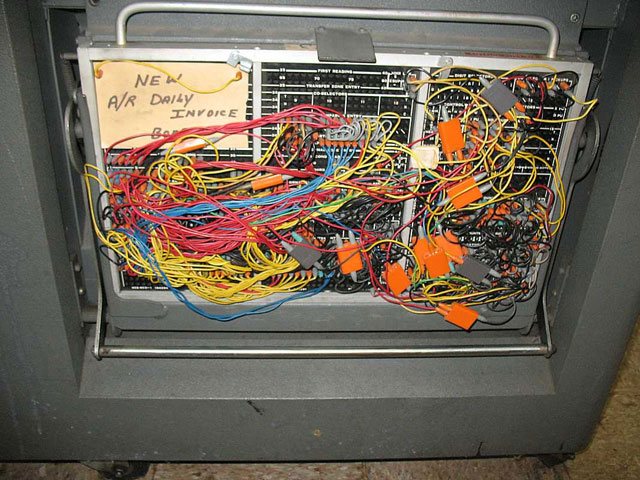

 Earlier this week, Mendeley was bought by Elsevier. I posted the announcement on Twitter to state that I would be quitting Mendeley. This tweet sparked a conversation between me and the head of academic outreach at Mendeley (William Gunn) that could only go so far in 140 character chunks. I was trying to highlight that, while I respected the Mendeley team’s decision to do what’s best for them, I could not support them as a customer knowing that this would empower a company that I think undermines scholarship, scholars, and the future of research.