Submitted by: Unknown
Shared posts
20 Nov 16:31
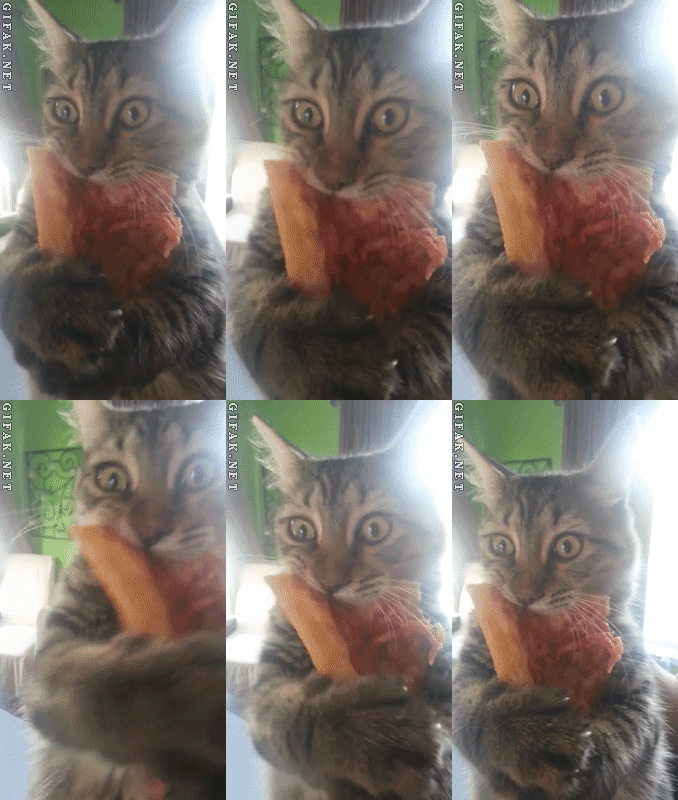
What a Purrfect way to Start Your Morning
DeniseAndy has experienced this.
Denise likes this
20 Nov 16:29

Trigger the cat when asked to do mental math.
DeniseI don't do math in public!
Trigger the cat when asked to do mental math.

11 Nov 15:32
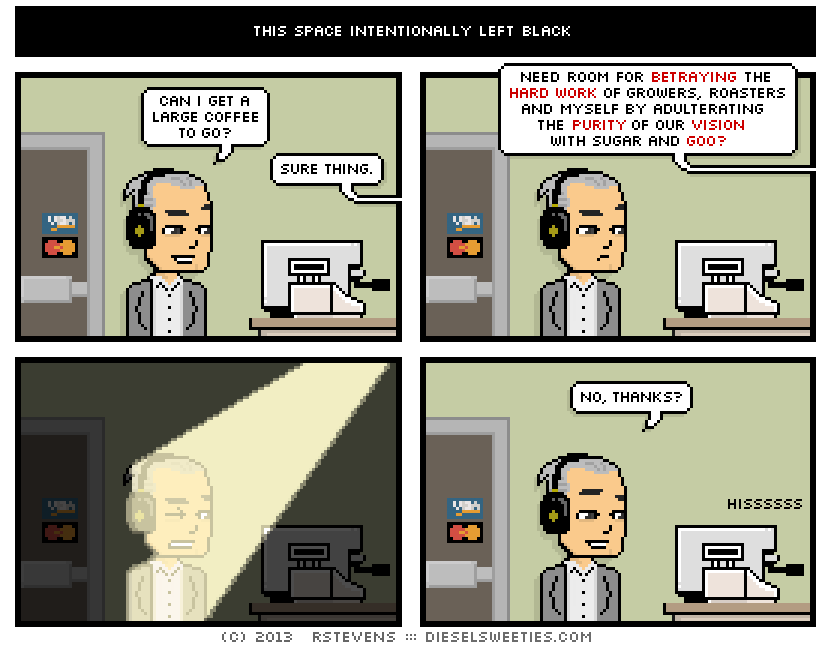
My Internet Startup Technique Is Unstoppable
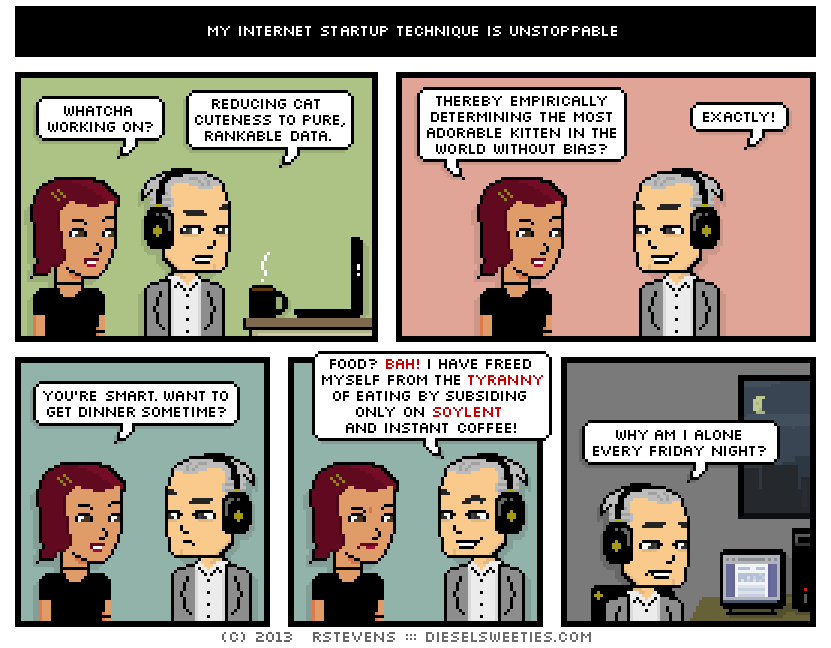
Tonight’s comic is about kittens, Big Data and food.
I have to go back to a Monday-Wednesday-Friday comics schedule for a little while. A couple of too amazing to fuck up opportunities to work with people I adore have come along and I'd kick myself if I missed them. I'll let you know about them soon as I'm able!
Denise and -1 others like this
18 Oct 20:23
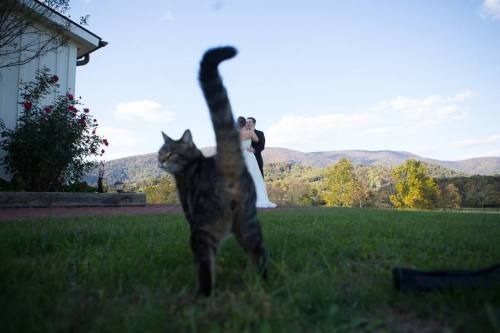
Everybody Needs a Cat Chute
DeniseThis almost makes me want to revitalize our laundry chute... but I am reluctant to give up the storage space we created at the bottom.

18 Oct 20:19
Dress your cats up with heroin.
by Jenny the bloggess
DeniseI'm primarily sharing this for the link about WINE FOR CATS!
Part three (of four) of my ongoing “Who-has-the-geekiest-costume” contest currently taking place in my home.
You’ve already seen Hailey and me, but I think it’s important that we include all members of the family, and that includes the cats, because OF-COURSE-IT-DOES-DON’T-QUESTION-ME.
The cats were surprisingly not that into wearing costumes because they hate Halloween and don’t care about my joy. I considered buying some wine for my cats to loosen them up because apparently that’s a thing now, and I think that you can’t be a complete crazy cat lady unless you’ve gotten to point where you’re sharing your cheap wine with your cats, but then I read that grapes are toxic to cats so I decided to just go the safe route and inject them directly with heroin. But then I couldn’t find any heroin so we had to do this sober. This is why the cats look so pissy. Because I didn’t have enough heroin. And because they don’t like wearing pants. WELCOME TO MY WORLD, CATS.
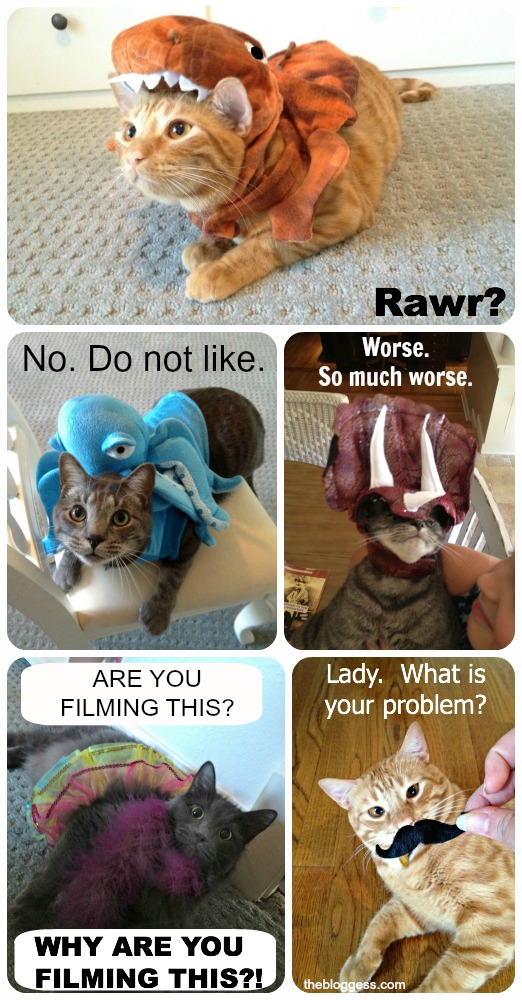
Happy Meowloween, y’all.
15 Oct 14:26
I WANT TO BELIEVE in RSS
DeniseI want that top shirt. RSS is NOT dead! I refuse to believe (and gitoffm'damnlawn!)
Permission to be nerds here? Hell with it, I'm giving myself permission.
I made I WANT TO BELIEVE because I still really, really love RSS no matter how many people say it's dead. You will want to grab this one quickly, as I don't think I'm printing any more.
Also! A bonus shirt today, from Warren Ellis and Ariana.
It's almost Goth Xmas! Are there BLOOD WORMS in your stockings yet??

15 Oct 14:24
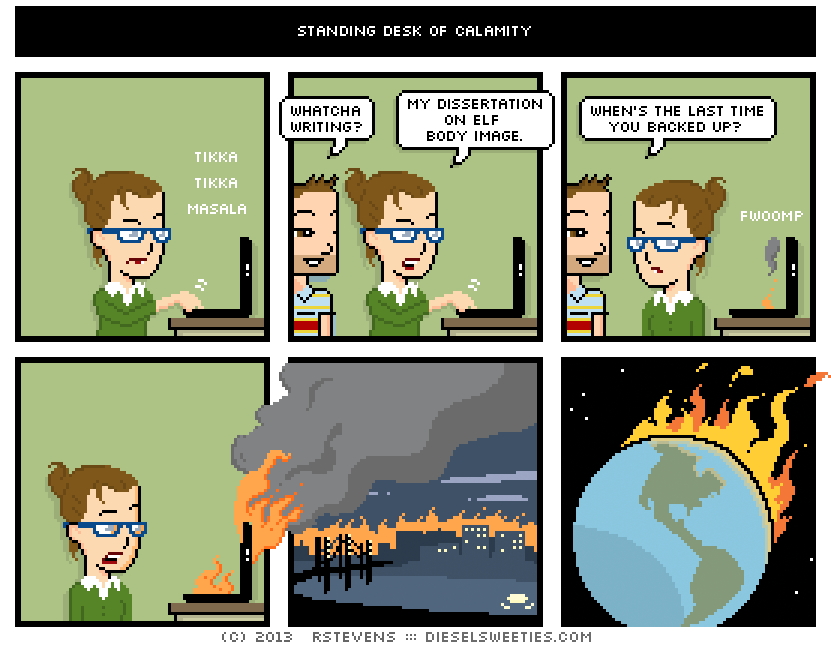
Standing Desk of Calamity
DeniseNEVER ASK THAT QUESTION. It angers the back-up gods.
Denise likes this





04 Oct 20:02
Power is intoxicating. Everyone loves having the ability to make their decisions into reality — to think "this should be something that happens," and then actually be able to make that thing happen.
But they like it.


I just experienced them differently.


They did figure it out eventually, though.


Menace
by Allie
DeniseShe's back! And I wonder what costume I wear...
It is also dangerous.
And it is especially dangerous when applied to four-year-olds.
Four-year-olds lack the experience to wield power responsibly. They have no idea what to do with it or how to control it.


The dinosaur costume was the greatest thing that had ever happened to me. The previous Halloween, which was the first Halloween I could actually remember, my parents had dressed me as a giant crayon, and the whole experience had been really uncomfortable for me.


But being a dinosaur felt natural.


And powerful.


The feeling had been slowly intensifying ever since I put the costume on that morning, and, as I stood there in the middle of the classroom, staring off into the distance in an unresponsive power trance, it finally hit critical mass.
I had to find some way to use it. Any way. Immediately.


I had to find some way to use it. Any way. Immediately.


The other children screamed and fled. The teacher chased me, yelling at me to stop. But I couldn't stop. I was a mindless juggernaut, a puppet for forces far greater than myself. I had completely lost control of my body.


All I knew was that being a dinosaur felt very different from being a person, and I was doing things that I had never even dreamed of doing before.


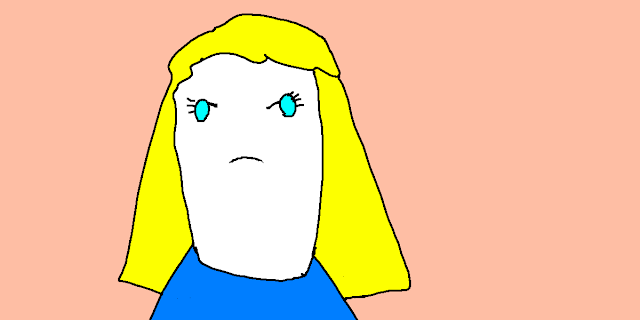


Of course, I had always had the ability to do these things — even as a person — but I didn't know that. I'd just assumed that I was unable. As a dinosaur, I didn't have any of those assumptions. It felt like I could do whatever I wanted without fear of repercussions.


The repercussions were also exactly the same as they were before I became a dinosaur.


I just experienced them differently.


My parents had to come pick me up at noon that day. The teacher explained that it must have been all the Halloween candy. "Some kids really can't handle sugar," she said. "It turns them into little monsters."


I suppose it was a reasonable enough conclusion, but it only served as a distraction from the real problem.


The thing about being an unstoppable force is that you can really only enjoy the experience of being one when you have something to bash yourself against. You need to have things trying to stop you so that you can get a better sense of how fast you are going as you smash through them. And whenever I was inside the dinosaur costume, that is the only thing I wanted to do.
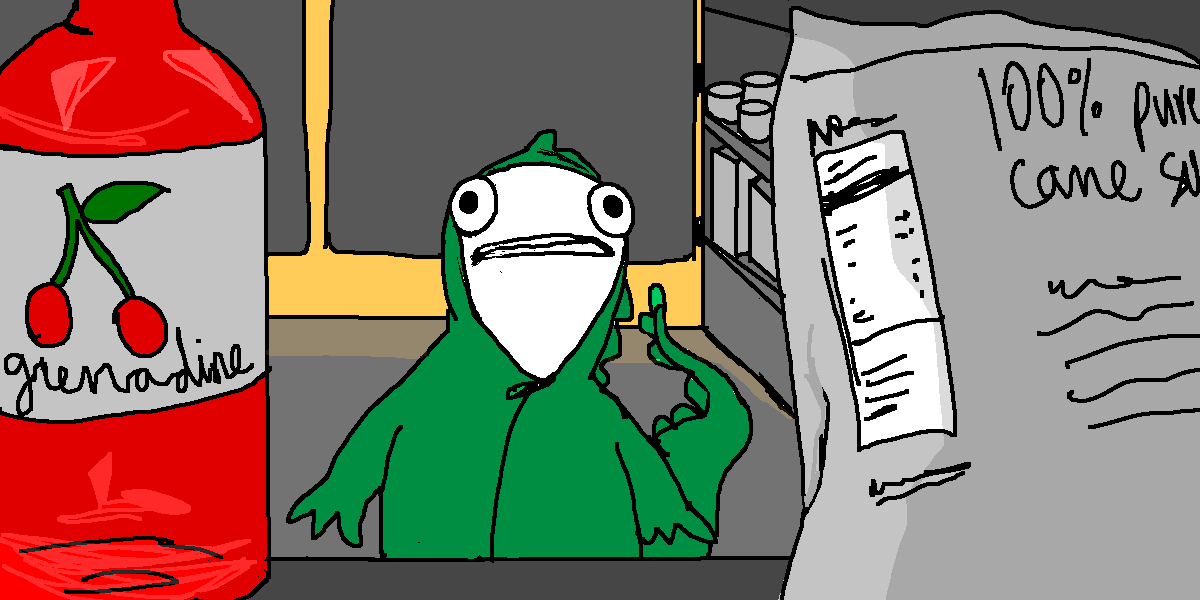
The ban on sugar provided a convenient source of resistance. As long as I was not supposed to eat sugar, I could feel powerful by eating it anyway.


I'm sure the correlation started to seem rather strong after a while. I'd find some way to get sugar into myself, and then — drunk on the power of doing something I wasn't supposed to —I would lapse into psychotic monster mode. To any reasonable observer, it would appear as though I was indeed having a reaction to the sugar.


My parents were so confused when the terror sprees continued even after the house had been stripped of sugar. They were sure they had gotten rid of all of it. . . did I have a stash somewhere? Was I eating bugs or something?
They still weren't suspicious of the costume.
They still weren't suspicious of the costume.


I lost weeks in a power-fueled haze. I often found myself inside the costume without even realizing I had put it on. One moment, I would be calmly drawing a picture, and the next I'd be robotically stumbling toward my closet where the dinosaur costume was and putting myself inside it.
It started to happen almost against my will.


It started to happen almost against my will.


Surely my parents made the connection subconsciously long before they became aware of what was really going on. After weeks of chaos, each instance punctuated by the presence of the costume, I have to imagine that the very sight of the thing would have triggered some sort of Pavlovian fear response.


They did figure it out eventually, though.


And the costume was finally taken away from me.


I was infuriated at the injustice of it all. I had become quite dependent on the costume, and it felt like part of my humanity was being forcibly and maliciously stripped away. I cursed my piddling human powers and their uselessness in the situation. If only I could put on the costume . . . just one more time.


But that was the costume's only weakness — it couldn't save itself. I had to watch helplessly as it disappeared inside a trash bag.
There was nothing I could do.


And so my reign of power came to an end, and I slowly learned to live as a person again.


04 Oct 16:17


Issy and Kelli Stapleton: Murder, Suicide, and Family
by Adrienne
DeniseBreak the silence. Help more. Love each other, and everyone. And don't be afraid to offer help, even if it's just a listening ear.
I have been deeply disturbed for weeks. I keep trying to write this blog post and backing away from it, over and over. I have decided not to publish it, and alternately been compelled to publish it. Ultimately, this is my truth. This is what my family survived, and if it was the reality for my family, then it’s the reality for other families because we aren’t unique. But back up; this doesn’t begin with me, but with another family.
The facts of the story: On September 3, 2013, Kelli Stapleton published a blog post in which she described an IEP meeting that ended with the district school refusing to provide services for Issy, Kelli’s 14-year-old autistic daughter. Issy had just been discharged from an inpatient treatment program in Kalamazoo, MI (three hours from the Stapleton home) where she was being treated for, among other things, aggressive behavior related to her autism. While at her inpatient program, Issy had developed a good relationship with a teacher in the junior high she attended while she was in treatment. Kelli and her husband, Matt, decided that Kelli and Issy would move to Kalamazoo so Issy could attend school there and Matt and the couple’s other two children would remain at home.
Later that same day, police found Kelli and Issy in the family’s van in a rural area near their home, both unconscious, during an apparent attempt by Kelli to end both their lives. Issy spent about a week in the hospital and is now recovering at home. Kelli is being held without bond on a felony attempted murder charge.
Kelli’s act set off a virtual bomb in the special needs/disability blogosphere, and especially in the autism world. I will not guess at Kelli’s motives for trying to kill herself and her daughter (we will only know her motives if and when she tells us), but I do know how I got to the edge of the cliff that Kelli went over.
I have been consumed by what Kelli did since I heard the news. Part of that is because I know Kelli and part is because I have been close to doing what she did. Since the news broke, the cry that has gone up from autistics and people with other disabilities is, we have been dehumanized. We are not considered valuable or worthy of consideration, kindness, freedom, or even our very lives.
That is true. Our culture as a whole, and we as individuals, have not honored every person as we should. We have hurt, isolated, ostracized, assaulted, sterilized, tortured, and killed people we don’t understand. We have deemed those who seem different less worthy, and often we have done the hurting in the name of helping, calling it therapy, treatment, or religion. If you or someone you love have been on the whip-crack end of that terrible phenomenon, I am sorry. You deserve better. You deserve all good things, all the support and kindness and love that this world and the family of humanity has to offer. The people who hurt you were wrong. If they had good intentions but hurt you anyway, they were wrong. If they loved you but hurt you anyway, they were wrong.
All that said (and all that true), there is a complexity that we’re losing by insisting that a discussion of what may have caused Kelli to do what she did (or that any discussion of why so many caregivers kill or attempt to kill the disabled people in their care) is necessarily devaluing Issy and other victims. Condemning Kelli will not stop the next desperate parent from taking a similar action, and in fact may prevent people from reaching out when they are in danger.
Kelli and Issy were (and are) victims of the same system, and that system made them victims of each other. When we, the ground-level stakeholders (people with disabilities, caregivers, and people who would like the world to be more just), focus on the ways Kelli and Issy victimized each other, we let all the other people off the hook. When we vilify Kelli, or autism, or the various therapies (on which I am no expert, since my disabled child has serious mental illness, not autism), we don’t scrutinize all the people who hold the power and the pursestrings.
Think in terms of power and investment. Kelli and Issy and the rest of the family were relatively powerless. Therapies, education, and help for Issy would only come via the bureaucracies that hold the purse strings, as they do for most of us who don’t have a few million dollars at our disposal. So let’s say the Stapleton family needed a level of help we’ll call X. That X represents the amount of help that enables the family to have a life that is life. Issy goes to school all day and there is adequate care there for her to be safe, healthy, and to learn as much as she can. There is enough help in the evenings and on weekends so that the other Stapleton children can have the attention of their parents, help with homework, family meals together, and regular outings. The Stapleton parents have the space they need to nurture their relationship and their individual interests. Issy has all the appropriate therapies that her team parents, teachers, and other care providers agree she needs, and her parents and siblings have therapists, too. There is so much help that the parents are not overwhelmed and the children are not afraid.
The Stapleton parents are completely invested in the family getting help level X. Their desire is for a life that resembles normal family life as much as possible. I’m making that assumption, of course, but it’s based on what I want for my own family so it’s not a big stretch.
What are the chances that they will get help level X? In my experience, nearly zero. I know dozens of families in which there are children with extraordinary needs, and the amount of help they get is always X minus at least half.
In late 2009, I had begun to consider that suicide was reasonable, as was ending the life of my mentally ill son, Carter, then 7 years old. There was no hate in me for Carter; in fact, it seemed to me that ending our lives was the only loving thing I could do. When I read of people condemning Kelli’s actions, saying that autism or disability is no excuse for murder, I am perplexed because I wasn’t looking for an excuse to kill my son; I was looking for an excuse not to. I believed that ending our lives was the only loving response to my son’s illness and suffering that was available to me.
(Pause. Breathe. We are all well now, and very safe.)
I’m not a stupid person, nor am I in general delusional, but when I lived with unrelenting and profound stress, fear, grief, and anger, coupled with severe sleep deficit, I changed. I watched the light go out in my other children’s eyes, watched my husband descend into periodic despair, and that changed me. Some people told me I was overreacting and others told me I was a saint, an angel, and a hero, and that changed me too.
Everything about Brian’s and my lives was shredded in the early years of Carter’s life. All the things we did that gave our lives meaning and joy were gone: church, prayer, sex, family relationships, play, conversation, reading, walking, writing. All the things we did that made our lives work were destroyed, or minimized to the point of dysfunction: maintaining our home, maintaining our yard, keeping up with the laundry, preparing meals, shopping. Those things that kept us feeling good about ourselves disappeared: hobbies, friendships, art, routine medical and dental care, taking care of our personal appearance, even hygiene, and of course sleep. We slept so little for so long, I’m not sure how we functioned at all.
I’m not talking about things that we experienced occasionally, or sometimes, or during the day, or for a few weeks here and a few weeks there. I’m talking about every minute, day and night, for months and years. We know that war and poverty change the structure and function of the brain; it’s not a stretch to assume that living with unrelenting and profound stress at home can do the same. And just as some infants come out of their painful early years in Russian or Bosnian orphanages just fine, and some come out deeply damaged, parents come to special needs parenting with our own strengths and weaknesses. Some of us will bounce, and some of us will eventually shatter.
In the midst of the chaos of our home life, we were condemned and criticized everywhere. I was patted on the head (once literally) and called a worried mom (many times, in many ways) when I told doctor after doctor after doctor that my child did not sleep, could not laugh, smashed his own face into the floor, and was not happy. I spent hours on the phone with the insurance company and got very little in return for my efforts because we just don’t cover developmental delay. I heard the questions again and again, searching for how Carter’s problems were my fault: did you take medicine, what do you feed him, were your other kids this way? I saw the nasty looks and heard the foul words from people at the grocery, the post office, and restaurants. We called for help and were added to waiting lists for tests, waiting lists for appointments, waiting lists for services.
I begged for help and heard, in a million ways and on a thousand days, no, we can’t help you. There’s nothing to be done. Go home. Deal with it.
I never devalued my son’s life. Our culture, society, and systems did that. When I waited on the playground for the kindergarten bell to ring and none of the other parents would talk to me because my son was “that boy,” the one who attacked other kids, couldn’t sit still, and occupied all of the class aide’s time and attention, I felt that shame, but it wasn’t mine. That shame belonged elsewhere—with the principal, lawmakers, and supervisors who refused to provide appropriate placement. They devalued my son and my family. Doctors who saw me, frantic and pleading, for a standard 5-minute visit, and handed me a book about sleep instead of sitting and hearing me and working with me to find a solution—they devalued my son, my family, and me, but I felt the shame.
In the midst of all of that, with my life swirling in pieces around me, the dominant emotion was sorrow. My little boy was in agony. He was afraid, sick, psychotic, depressed, aggressive, suicidal, manic, and miserable. Even the most basic pleasures of life, a good night’s sleep or an easy poop, were denied him. I would have happily chewed off my arms if that would have eased any portion of his pain. I have held him through thousands of hours of sleepless anguish, pulled him back from the brink of his own attempts to hurt himself or end his own life, and watched a million hurts chip away at his heart. I would have done anything to fix it. I did everything I knew to do, and still, he suffered.
We lived like that for eight years. It changed me. It very nearly broke me. I didn’t get to the place where suicide and murder seemed like appropriate actions because I was selfish. I didn’t get there because of hate or even anger. The world was hopelessly dark, help far too scarce, and the shame too large. Most of all, the agony seemed endless, limitless. I have read over and over in the weeks since Kelli Stapleton tried to kill herself and her daughter, “A mother should protect her child!” Sometimes, I couldn’t see any way to protect Carter except to take him home to Jesus.
We have enough help now. Carter isn’t nearly as sick as he was, and my husband and I have more ability as caregivers than we used to. We survived long enough to get to the tops of some waiting lists, and we finally gained access to an excellent pediatric psychiatrist, a therapist, and a behavioral management specialist. We found a parent support group and a wonderful school that my parents have paid for. We began the process of turning our lives around, and while it hasn’t gotten easy, it has gotten manageable. There is joy again. My gratitude for Carter’s relative health and my family’s improvement runs deep like a river, but many families don’t get to experience the relief we have enjoyed in the past few years.
Violence perpetrated upon people with disabilities is a dark and ugly part of the human story, but I refuse to believe that we’re not capable of thinking around the corner and separating the cruel perpetrators from the desperate ones. Issy, Kelli, and the whole Stapleton family were left twisting in the wind. They had services, but they weren’t enough. When someone in a family is repeatedly aggressive, that means that family needs more help. When people in a family are repeatedly seen in the hospital for injuries sustained at the hands of a family member (Kelli sustained brain injuries when she was attacked by Issy), that family needs more help. When people are being bitten, scratched, and punched; when people are not able to stop biting, scratching and punching; when some children are hiding in closets dialing 911 (as one Stapleton child is said to have done); that family needs more help.
Silence and condemnation are not the solutions to those problems. The only solution to the problem of not enough help is more help.
We need a serious cultural shift in the way we think about family and caregiving in general, and caring for people with disabilities specifically. Even in the worst times, I was not a cruel or bad mom who hated my child; I was a desperate and isolated mom of a very sick child who I loved. We have to speak the truth, listen to each other, and insist that we all deserve better.

04 Oct 16:15


Dear People Who Do Not Have a Child With Disabilities…
by Adrienne
I have yet to meet a parent of a child with disabilities who hasn’t heard a whole lot of nonsense from people who never intended to speak nonsense.
I’m not speaking here of the jerks, the people who say things intended to be mean. Those people are heartless and lost and bummer for them because how sad, to live in a world that has so little kindness in it. I’m talking about ordinary people, the well-meaning man at the grocery store, the group of friendly acquaintances at church, and even the best friends who, when face-to-face with the parent of a child with disabilities, don’t know what to say.
If I sound at all bitter anywhere here, I apologize. I have no high-horse on which I may stand. I said some of these things before I became a parent of a child with disabilities.
Any bitterness that comes through is only a result of the incomplete job I have done so far in letting go of the anger and disappointment that engulfed me in Carter’s early years. If someone had told me these things before I had Carter, I would have tried very hard to listen and learn, and I know that when I said these things I meant no harm. In fact, I believed I was helping.
With those caveats in mind, here is a long list of things we parents of kids with mental/emotional/social issues hear often and that hurt us, and a much shorter list of things that I wish I had heard back in the years when life was all crisis, all the time.

What you said: God never gives us more than we can handle.
What we heard: You’re fine. Quit whining.
We’re not fine. Also, it is very dangerous to bring God into conversation with a person whose faith you don’t know intimately (and sometimes even then). We bring God to these conversations by bringing kindness. We bring God by seeing, hearing, and connecting.
 What you said: He seems fine to me! Or, All kids do that!
What we heard: You are a very dramatic person and you should get over yourself. Also, you are very likely a huge liar.
If you said this to me now, I would raise my left eyebrow to you and make a mental note never to discuss anything related to Carter again. Back when I was in agony pretty much all the time, it was like being punched in the guts. It didn’t help that I heard it often. Carter was occasionally distracted from his incessant wailing by new surroundings, new faces, and especially fluorescent lighting. Plus, I rarely left the house unless he was at his best, so people heard my descriptions of a baby who cried hours and hours on end while said baby looked around from his perch in the sling in which I wore him.
Here is a good rule for all of us when we are talking to a person in pain: do not contradict. Even if the person you’re talking to seems to be completely full of crap, acknowledge the pain. See the person in front of you, because the person matters infinitely more than the facts, and this isn’t a courtroom. Even if I had been radically exaggerating the extent of Carter’s crying, I was in pain. Even if, as he got older, I was wildly overstating the rages, the migraines, the constipation, the sleep disorder, and the despondency of his depressions, my pain was real.
What you said: You must be a very special parent for God to give you such a special child.
What we heard: We are fundamentally different. I’m not even going to try to understand you.
When I first heard this, I would imagine God sitting at a school desk with a paper in front of him, just like the worksheets we used to get when we were in elementary school. There would be a list of babies on the left and a list of parents on the right. God would draw a line from the most difficult baby to the strongest parent, then second most difficult to second strongest, etc. In my imagination, a dog (God loves dogs) comes bounding into the misty, ephemeral scene, distracts God, and oops! God sent the wrong baby to those wacky Joneses!
There was an accident, and the accident broke Carter’s brain. I don’t know why, but I know I’m not special, and I need you to see and hear me and my struggle.
What you said: You are an angel! I could never do what you’re doing.
What we heard: Hey, sounds tough. What a bummer. It’s a good thing you can totally handle it and you don’t need anything from me!
Yes, you could handle it. The alternative is…what? It’s your kid. You handle it. Not with any grace or style (no points for those things, anyhow), but you just do. Ordinary you, ordinary me.
We aren’t different, we parents of special needs kids. I promise I’m just like you. I kick ass at some parts of parenting, and I’m lousy at other parts, and I’m very ordinary at most of it. You’d be horrified if you heard a group of parents of kids with issues like Carter’s talking amongst ourselves; we use gallows humor and and talk in ways we know would alienate you, and we are very un-angel-like. We are deeply angry sometimes. Wounded. Broken.
But if you come to us and say, hey, I’m in trouble, I have a kid with problems and I think I belong in your club, we will gather you into our circle so fast you won’t quite know what hit you. We will listen to you cry and we won’t tell you to stop. We won’t tell you to be strong because we know you are being exactly as strong as you can be. We know that your need is deep and that you can’t handle this, even as you are in the midst of handling it.
What you said: Every child is a blessing.
What we heard: Suck it up, buttercup!
 First, duh! Of course my child is a blessing. I love him like fire. That does not invalidate my pain. In fact, my love is causing my pain because if I didn’t love him, why would I even care?
This is the Italy/Holland/Sudan problem. In 1987, Emily Perl Kingsley wrote an essay (which every parent of a child with disabilities is contractually obligated to receive in his or her inbox a minimum of 40 times in the year following initial diagnosis) comparing having a child to taking a trip to Italy. You’re planning this lovely vacation in Italy, and if your child has disabilities, it’s like accidentally going to Holland, and it’s very different and you’re disappointed, but hooray! It turns out Holland is fabulous!
Our plane landed in Sudan, and Carter and my husband and our other children and I are dodging bullets, rapists, and starvation, praying to escape with our lives. Windmills and tulips and charming sidewalk cafes sound damn good from here. I don’t owe it to anybody to put a smile on my face and pretend my blessings are different, but just as wonderful. Yes, there are some things about Carter’s illness that have made me a better person, but I would trade it all in an instant if it meant that Carter could have his brain intact and my other children could have had a childhood that didn’t include all the crises that their brother brought with him into the world.
What you said: Your faith will get your through! Or, God doesn’t bring us to it unless he plans to bring us through it! Or, With God all things are possible!
What we heard: You’re only having trouble because your faith is crappy and weak.
Here’s the deal: my faith did get me through, or rather, God did. I was more broken by the time Carter had his second birthday than I have ever revealed publicly, and I spent long, wakeful nights in the manner that is familiar to millions of people of faith: on my knees, the holy book of my tradition open in front of me, begging God for relief for me and my family and healing for my child. I told God that if we couldn’t have relief and healing, that I would very much like a carbon monoxide leak to take us all quietly in our sleep, and if that could be arranged while Jacob and Abbie were at their dad’s and Spencer was with his mom, then that would be infinitely preferable.
I am 90% convinced that if the house we lived in at that time had a garage, I wouldn’t be writing this to you now. The presence of God in the universe doesn’t let people of faith off the hook and platitudes like this don’t help anyone except the person who says them. Glib sayings about faith are all well and good when life is swell and the sun is shining. People who are suffering need something more substantial. If you are a person of faith, we need you to live that faith by caring for us and hearing how we’re struggling.
What you asked: Did you take medicine while you were pregnant?
What we heard: How did you cause this?
This was a question someone asked me while Carter was a toddler, screaming and fretting through his second year of life. What I know now is, when people ask me questions designed to figure out how I caused Carter’s various disabilities and issues, they are really saying, this would never happen to me. And while I want to reassure you that it probably won’t happen to you, it could. Yes, you. You, who give money to charity and always wear your seatbelt and feed your family organic foods and are a very nice person who never kicked a puppy. I know that it is very, very painful to live in a world of uncertainty and fear because I live on a cliff every minute, but there are no guarantees in this life. We don’t have (will never have) answers to questions like why this child? Why our family? There are no answers to those questions, or at least none to which we have access during this lifetime.
There are dozens of variations of this question, all of them probing for a cause, seeking to lay blame on the feet of that traditional whipping post, dear old mom. When he was a baby, my friends who practiced natural and attachment parenting thought I wasn’t doing natural and attachment parenting hard enough (A baby whose needs are met won’t cry! Pfffffffft. Suck it, Dr. Sears.). My friends who practiced more conventional parenting thought I was spoiling Carter by nursing and carrying him so much. No matter which way I turned, someone assumed it was my fault, as if I wasn’t already trapped in a giant web of self-doubt and recrimination. I tried to give him away to foster care (Thank God Brian stopped me because I really do love that kid.) because I was sure he needed a better mother.
As he got older, people gave me books about discipline and my father-in-law offered to take Carter for two weeks to make him shape up. Do not succumb to this temptation. Ordinary, fallible parents do not cause serious disabilities in their children. We have not traumatized them into their problems by being human. Resist the impulse to make assumptions about a child’s parents based on that child’s behavior.
The world is uncertain and sometimes horrible, even here in middle class America where the grocery stores overflow with food and the roads are paved and talk radio churns its way ever forward. Crappy things happen to perfectly ordinary people, and most of the time there is no one and nothing to blame. It’s lousy and it feels horribly unfair; nevertheless, it’s the truth.
One note underlies all of these statements, and it is this: Please be quiet. You don’t mean to say that, but platitudes are conversation stoppers, and when we hear them, we hear you begging us, please don’t show me this anguish because I can’t bear it. I don’t know what to do and if you would be quiet I would be much more comfortable. I’m telling you this because I think most people don’t want to be saying that, but what is there to do? A friend (or family member, or acquaintance, or stranger) is in pain, and what am I to do? I don’t understand this. It’s scary. It’s weird. It’s so other you might as well be beaming me a message from Planet Zergon.
I’m going to tell you. Here is your map.
- Listen. Just listen. Open yourself up. Yes, it hurts and it’s very scary. That’s OK. There is a person in front of you who is in pain. Don’t leave her alone with it.
- Know that you can’t fix it. Don’t try. We have doctors and therapists and other professionals for treatment. Also, that diet/book/supplement you heard about that can cure all the problems? We’ve heard of it already. We’re on the internet while you sleep, and anyway, 26 of our Facebook friends already sent us the link.
- Acknowledge and affirm. Say, wow, that sounds hard. Say, oh, my God, how painful! Say, I hate that it’s so difficult for you.
- Treat our kids the same way you treat other children in your life. Of course you should be sensitive, especially with kids who have emotional/social/behavioral issues, because many of them don’t want to be touched or may not be verbal, but in general, if you usually engage kids in conversation, do that with our kids too. Say hello. Smile. They might not respond predictably, if they respond at all, but they see you.
- Offer to help, but only if you mean it (people in pain are sensitive; we know when you’re saying words you don’t mean so you can feel good about yourself). My mom sometimes came to my house and gathered all my laundry baskets and every scrap of dirty laundry in the house (which completely filled the trunk of her car) and brought it all back a day or two later, clean and folded. Our friends from church occasionally brought us meals. A friend drove Carter and me to some of his appointments during the worst months because I didn’t feel safe driving alone with him. Those things meant the world to me. As much as I appreciated the clean clothes, meals, and rides, I was even more grateful to feel a little less alone in the world.
- Send a note, a text, or an email. Parenting a child with special needs can be profoundly lonely. It’s also hectic and chaotic and we may not respond to you, but do it anyway. The world starts to feel very far away when life is all appointments, crisis, chaos, and praying for survival. Stay connected, even if it feels one-sided.
- If you’re very close, spend a little time learning about your friend’s child’s diagnosis. There is no need to become an expert, but an evening spent learning will only make you a better listener. If you don’t know what to read, your friend will gladly tell you.
- Keep listening. Just show up and listen. There’s nothing any person in pain needs more.
Denise likes this
03 Oct 21:17

Rube Goldberg for Today's Hipster
strip for October / 2 / 2013 - Rube Goldberg for Today's Hipster
Rube Goldberg for Today's Hipster
Jump to a Random Strip in the Archives! | Buy This Original Art | Archives | E-mail Dave