Read more of this story at Slashdot.

Read more of this story at Slashdot.
firehosegreat
Read more of this story at Slashdot.

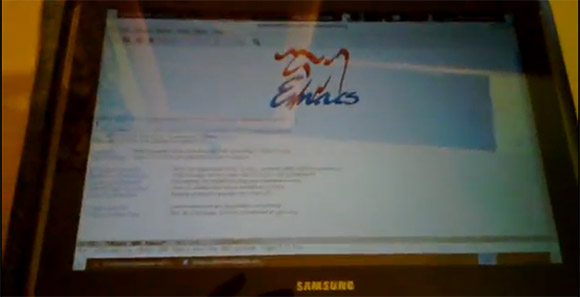
Over on the xda developers forum, [exception13] shows us the work he’s put into geting Debian running on his Samsung Galaxy Note 10.1, allowing him to dual boot Android and Linux on a single device.
The project is still in a fairly early state, but so far [exception13] has most of the goodies required for a decent Linux experience running already. There’s WiFi, bluetooth, sound, usb-otg and touchscreen support, as well as support for the Note’s S Pen, the Wacom digitizer that basically turns the Galaxy Note 10.1 into an Intuos touch pad.
There’s still a lot of work work to be done, including getting the camera up and running, as well as enabling the GPS receiver. Still, it’s a very cool project that puts the power of a proper desktop interface into a tablet with enough horsepower to get something useful done.
If you’d like to get this running on your Galaxy Note, [exception13] has a download avaiable over on Google Code. There’s also a video [exception13] put together demoing all the cool stuff his Note can do, you can check that out after the break.


Read more of this story at Slashdot.


Gallery: Way of the Dogg


Continue reading 'Way of the Dogg' combines fighting, music games and Snoop
 'Way of the Dogg' combines fighting, music games and Snoop originally appeared on Joystiq on Tue, 05 Mar 2013 10:30:00 EST. Please see our terms for use of feeds.
 |
| Mortellan's Greyhawk Art |
making my way downtown
This has been on my blog like 5 times today and i am not regretting anything
 According to a report on GamesRadar, BioWare San Francisco - the studio formerly known as EA2D and responsible for titles like Dragon Age Legends and Mirror's Edge 2D - has been closed by EA, leaving between 25 to 30 employees jobless. Citing a source inside the studio, the report suggests EA felt it was "too expensive" to make mobile games in Redwood Shores, CA.
Report: BioWare San Francisco closes, up to 30 staffers laid off originally appeared on Joystiq on Mon, 04 Mar 2013 20:00:00 EST. Please see our terms for use of feeds.

I would just like to show you all the best Cosplay at Emerald City Comicon. All other cosplays can go home.
firehoseShared for acronym
I was at SFMOMA with Erika a few weekends ago and we saw an exhibit showing the work of Lebbeus Woods – a futuristic architect and illustrator.

A quote at the beginning of the exhibit caught me off guard… I had never really thought about light this way:
I dearly love the form of things. Particularly because forms
make light visible, and light is a sublime substance. We only
see light when it is reflected from the surfaces of forms and
the diverse materials of which they are made. It is not only
that light pervades the universe and is a kind of messenger of
the histories and mysteries of time and space....
- Lebbeus Woods
This thought stuck with me: the whole history of Earth and Mankind is still out there in the universe, streaming away in an expanding sphere of light.
What if we could get out there somewhere and see that light? It would be like time travel with read-only access.
As I walked around the rest of the exhibit I started to get a crazy thought
6,000 years ago, our ancestors were wandering around the globe with pointy little spears. And, just like every day since, the Sun was shining and light was reflecting off their heads, back into space.
Over the next 3,000 years that light zipped off into the galaxy, never to be seen again.
But suppose a tiny portion of that light was headed right for a black hole.
And then suppose a tiny portion of that tiny portion of light encountered the black hole at just the right angle so that it wasn’t sucked away forever. But instead, got bent exactly 180 degrees, boomeranged around the black hole and headed straight back to Earth.
After the second 3,000 year leg of its journey, that light is streaming back through your window.
The idea is tantalizing to me – that by staring at a black hole we could literally look back in time. I couldn’t put it to rest, so I dug through some physics literature and pieced together just how (in)feasible this observation would be.
It turns out it’s possible. Almost.
According to Einstein’s Theory of General Relativity, light is affected by massive objects because they curve spacetime. We don’t need to understand the physics deeply. The point is that massive objects like black holes and galaxies can bend light significantly:

This is picture a of Einstein’s Cross, a distant “Quasar” repeated four times, gravitationally lensed around the galaxy in between us and the Quasar.
But just how far does the light bend? For low deflection angles the calculation is straight forward, but we’re interested in light that’s practically grazing the surface of the black hole. These higher deflection angles are extremely complicated to calculate, but Valerio Bozza put it together in 2007:

Below the asymptote on that plot is where light gets sucked into the black hole and is never seen again. But we don’t want that, we want the light to be completely reflected.
To be reflected, so that we could see ancient Earth in the black hole, we’d need a deflection of 180 degrees, or pi radians. Looking at the graph you can see that this “reflection” happens near the asymptotic “edge” of the black hole.
The biggest black holes sit at the center of galaxies and have masses millions of times bigger than our Sun.
These seem like perfect candidates for observing our “reflection” but there’s a glaring problem. Around these huge black holes there’s an accretion disk of gas, with stars colliding and exploding everywhere. This creates a huge amount of light that would drown out any “reflection” of ancient Earth.
If you take a look at Sagittarius A*, the black hole at the center of our own galaxy, you’ll see what I mean. We could never spot ourselves in the middle of this:

What we need is a nice, simple black hole that’s minding it’s own business in a quiet neighborhood.
MACHO is a whimsical name for “dark” massive objects. It includes black holes that don’t have big messy accretion disks.
The only way we can detect a MACHO is when it moves between us and a distant galaxy, creating a “gravitational lensing event” where the brightness of the distant object suddenly increases and decreases:

These MACHOs are much better candidates for our attempt to observe a “reflection” of the Earth or our Sun. The best candidate so far is a black hole named MACHO-96-BLG-5, which was observed at a distance of about 3,000 light years from Earth. It’s “best” because it’s the closest one we’ve ever seen, and closer means the “reflection” of ancient Earth would be brigther.
In 2002 Daniel Holz and John Wheeler investigated this idea and ran all the calculations in their paper Retro-MACHOs: Pi in the Sky?
The short answer is no, not with current telescopes.
The problem is that even the “reflection” of the Sun is far too dim. Holz and Wheeler ran the calculations for hypothetical black holes that might wander within a couple light-years of Earth. Under those unlikely circumstances, observing the reflection is doable with existing telescopes, or on the brink of doable with telescopes being planned.
Here’s their results for black holes (BH) with 1 or 10 times the mass of the sun, within 1 parsec (3.24 light-years) of Earth:

To help you understand the magnitude scale: a higher positive magnitude is dimmer. The Sun at noon is magnitude -27. The full Moon is -13. The Hubble Space Telescope has detected stars with a magnitude of just 30. As you can see in the table, Hubble might just barely be able to observe the reflection in some (improbable) cases.
Their results are for MACHOs we might observe, but for MACHO-96-BLG-5 they simply say there’s no way we could observe the Sun in the “reflection”… which means the magnitude must be 50 or higher. Extremely dim.
The light-gathering capacity of a telescope is limited by the surface area of its mirrors. The Hubble has a collecting area of 4.5 square meters and a diameter of 2.4 meters.
In order to observe a magnitude 40 observation like the one in the table above, we’d need a 240 meter diameter telescope. For a magnitude 50 observation, we’d need a 24 kilometer diameter telescope. The largest telescopes currently under consideration are the European Extremely Large Telescope or the even more hilarious Overwhelmingly Large Telescope with diameters of 40 meters and 100 meters each.
So even though occasional photons from 6,000 year-old ancient Earth are coming back through your window, it’ll be a while before we can see them.
The hunt for more MACHOs is still on. And there’s good hope that we’ll find one significantly closer than 96-BLG-5.
According to research published in 2002 the expected density of MACHO black holes in the vicinity of the Sun suggests that there’s probably a MACHO within 10 parsecs (32.4 light-years) of Earth. Of course, then you’d only be looking back at an “ancient Earth” from 65 years ago.
Until then, let’s figure out how to build bigger space telescopes :)
Many thanks to Ian Storm Taylor and Erika Reinhardt for their comments and ideas.

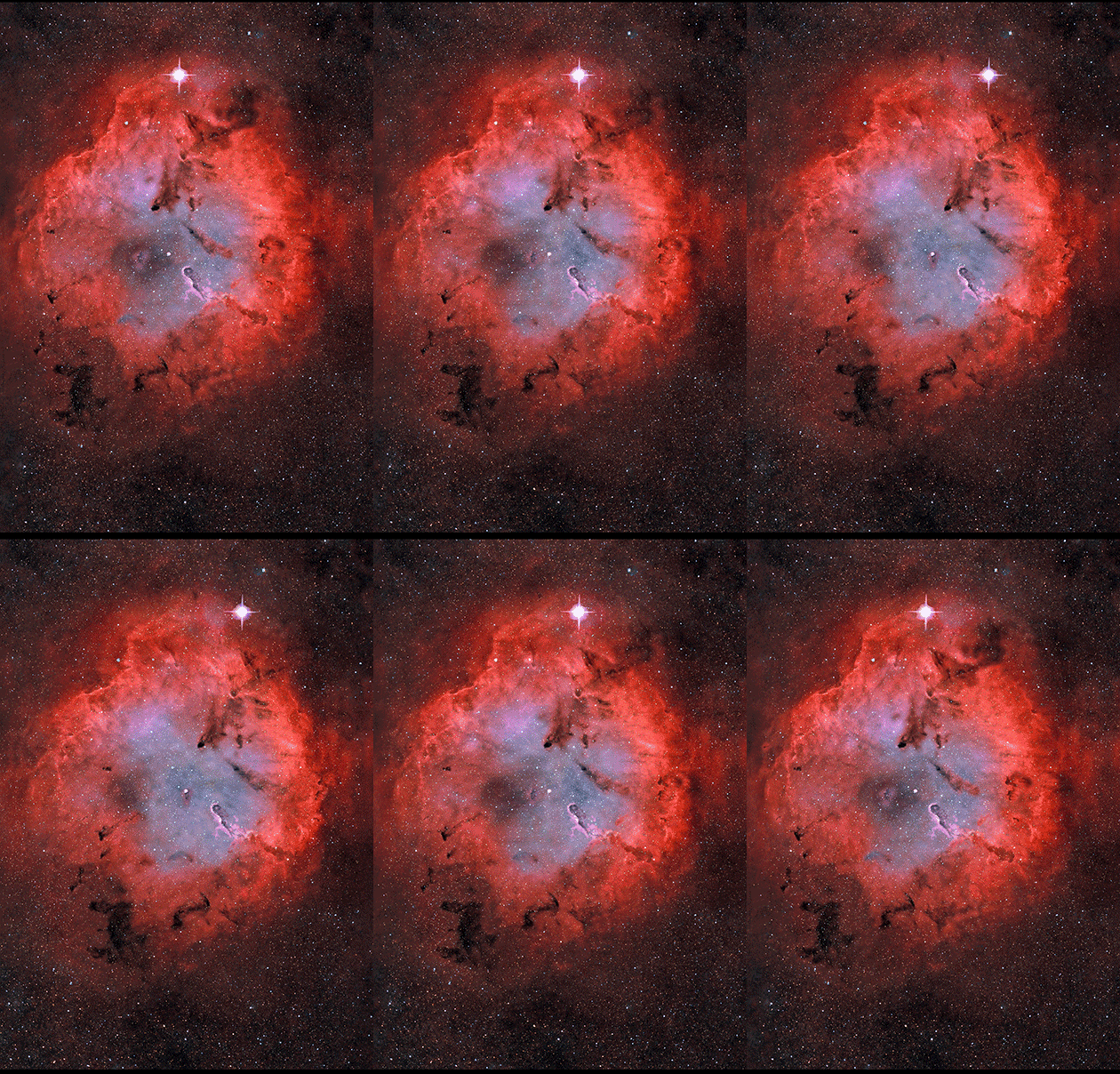
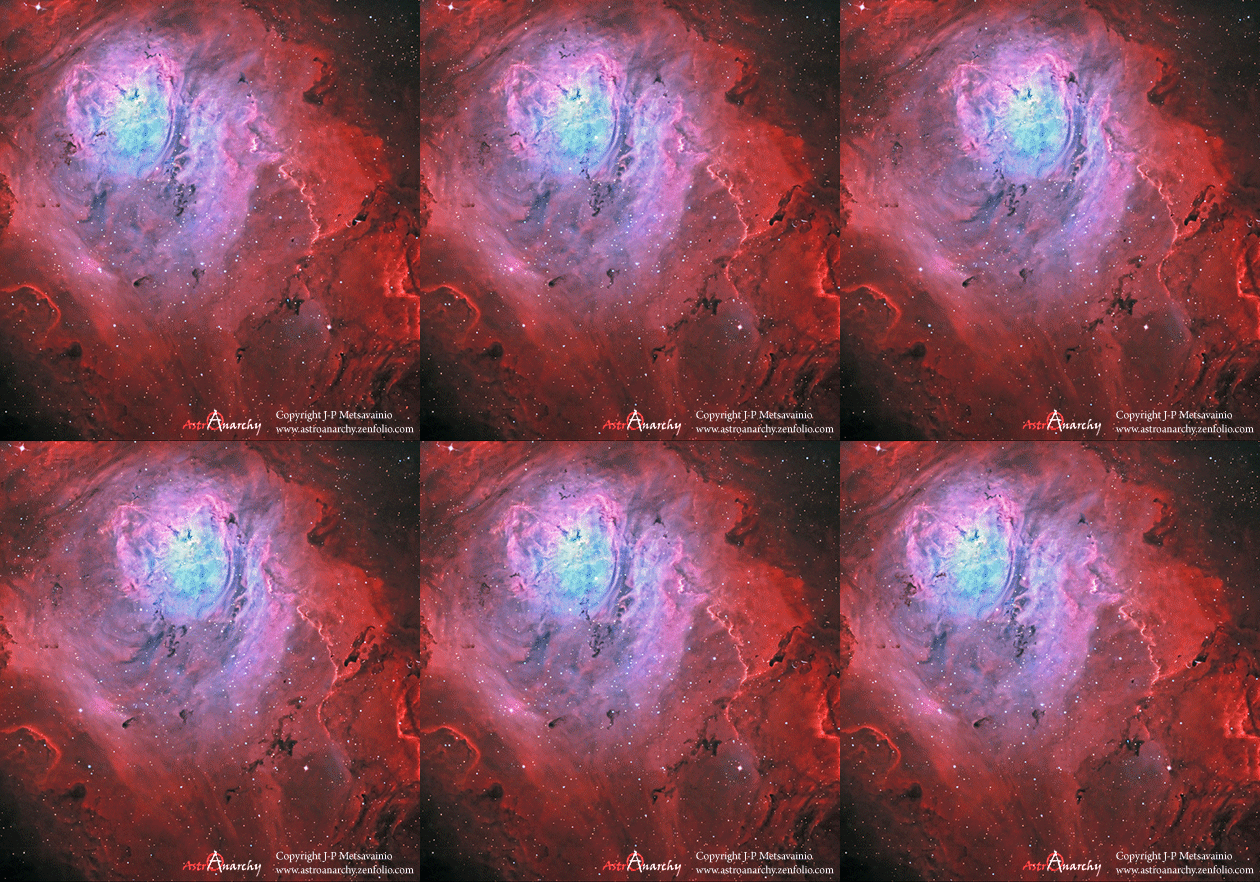
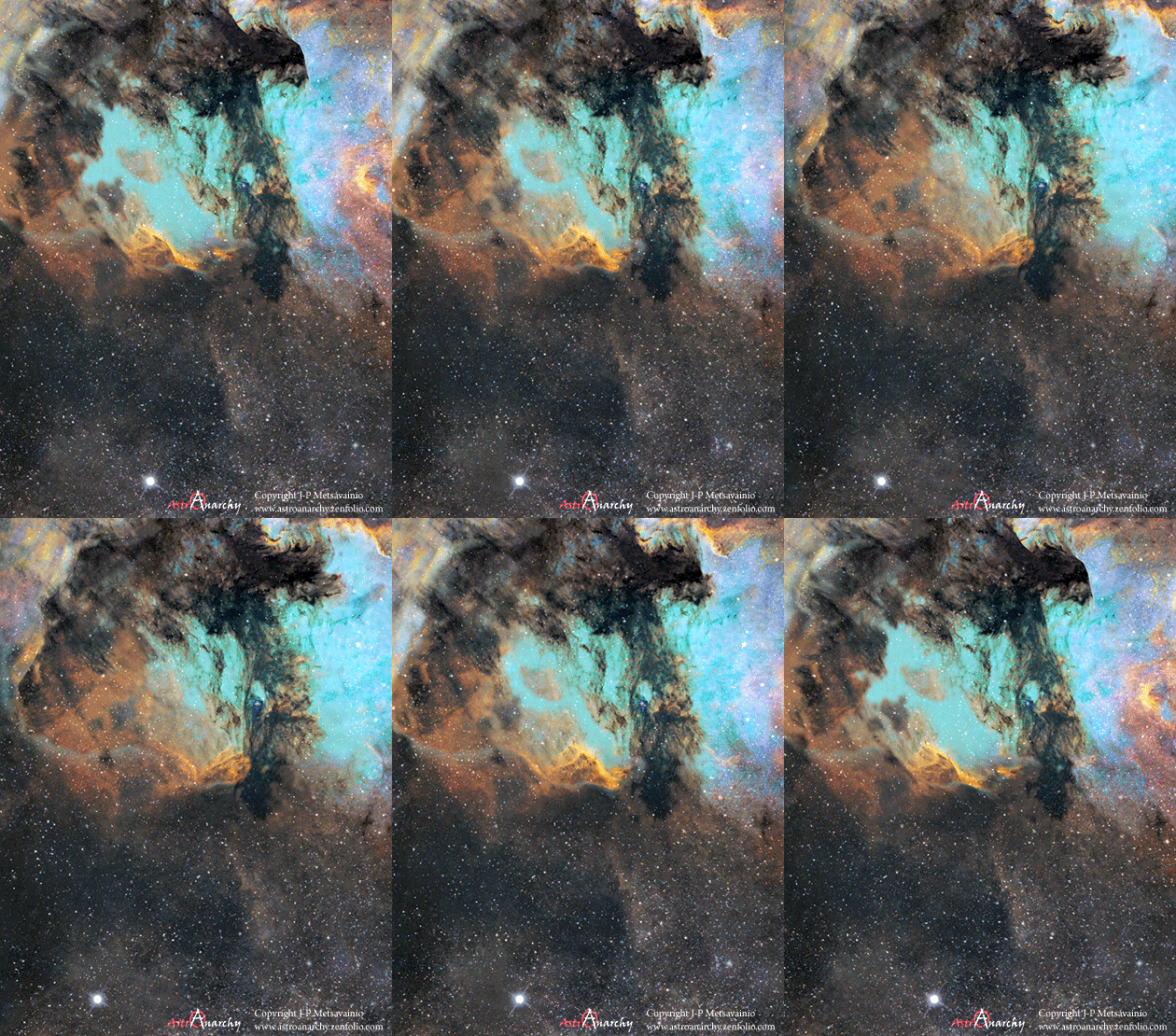
Parallax 3D images use two photos captured from slightly different vantage point to create the appearance of depth. In astrophotography, however, the distance between human cameras and distance objects are so great that real parallax generally cannot be achieved.
Finnish astrophotographer J-P Metsavainio has developed a brilliant experimental technique that overcomes this (kinda): he converts astrophotographs into 3D volumetric models, and then uses those models to create dazzling 3D animations of nebulae.
Metsavainio tells us that his technique is a mixture of science and art. He first gathers specific information about the nebula in his photo prior to doing the 3D conversion. More important is the distance information of known stars, which allows him to place them at correct relative distances from one another in his resulting model.
If distance information about certain stars cannot be obtained, he falls back on a rule of thumb he has developed: “brighter is closer.” It may be a very rough approximation, but so far it has worked well. He also tell us that many shapes in a nebula can also be determined by simply studying the photos carefully. It also helps that many nebula share similar features, such as stellar wind blowing gas away from the cluster and forming an empty space around it.
How accurate the final model is, depends how much I have known and guessed right. The motivation to make those 3-D-studies is just to show, that objects in the images are not like paintings on the canvas but really three dimensional objects floating in the three dimensional space. This generally adds a new dimension to my hobby as an astronomical imager.
Here are some of the animated GIF he has created so far:

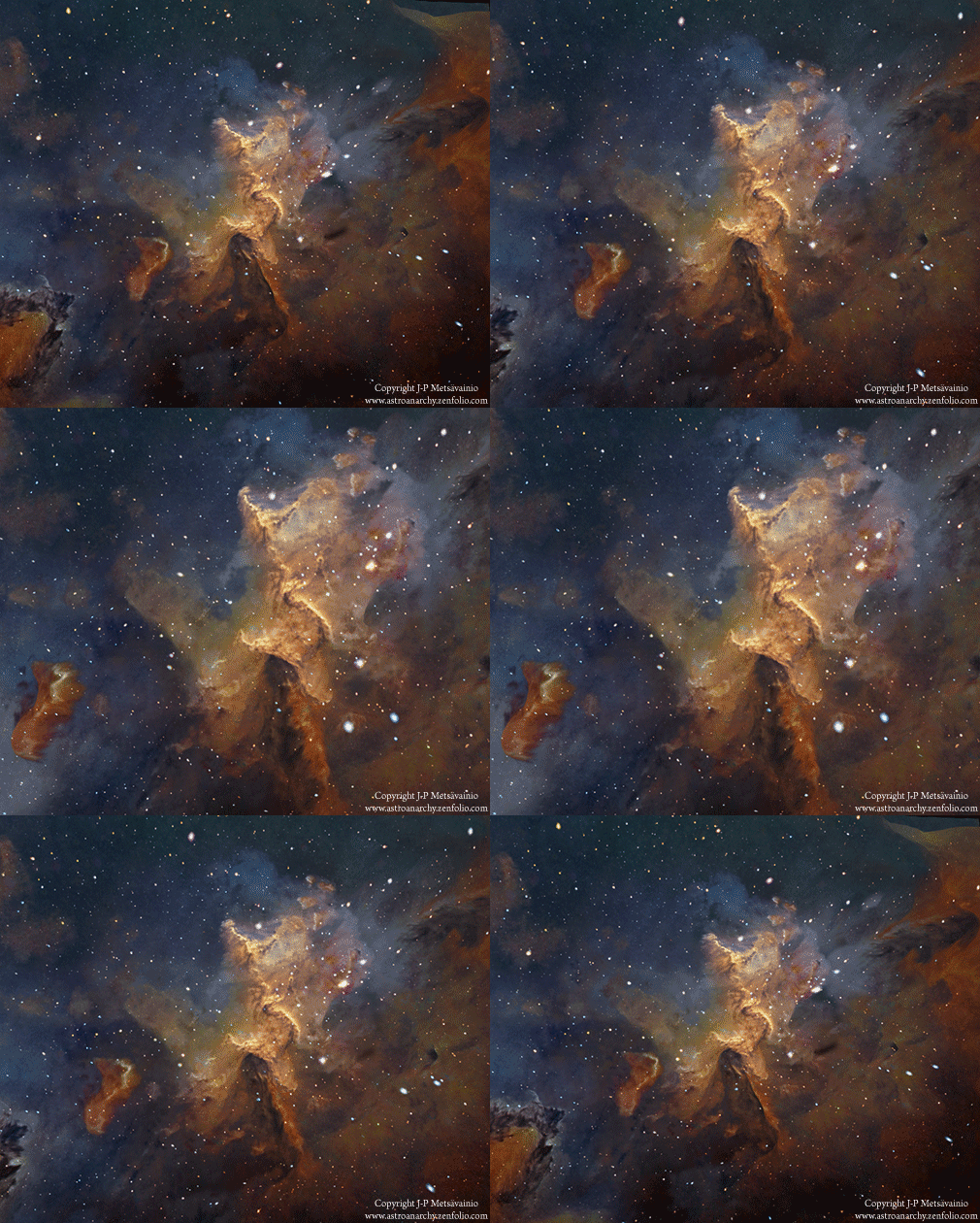
Want to know more details about how the 3D conversion is done? Here’s what Metsavainio tells us,
After the first step [gathering the info about the stars], the nebula layer of the image get splitted to an elemets by it’s structure. Then a 3d-mesh is made by the brightness of the nebula. This can be done since the gas in the nebula emits a light of it own and the thickness of the nebula can be estimated by the amount of light.
Then I split the star image to a separate layers by the star brightness and the color index. If there are stars with a known distance, like ones coursing the emission of the nebulosity, I separate them to a different layers, all the steps are done “semi automatic”.
At the final step all the image information, nebula and stars, are projected to complex 3D-suffaces and some tweaking can be done three dimensionally.
Rest of the work is traditional animation work.
You can find more of Metsavainio’s work over in his portfolio and on his blog. He is also sharing animations as videos through a YouTube channel, and you can follow along with his work through Facebook as well.
(via Gizmodo)
Image credits: Photographs by J-P Metsavainio and used with permission
Read more of this story at Slashdot.

firehoseEternal auto-reshare yak of ranger
OK autocorrect, you can have that one



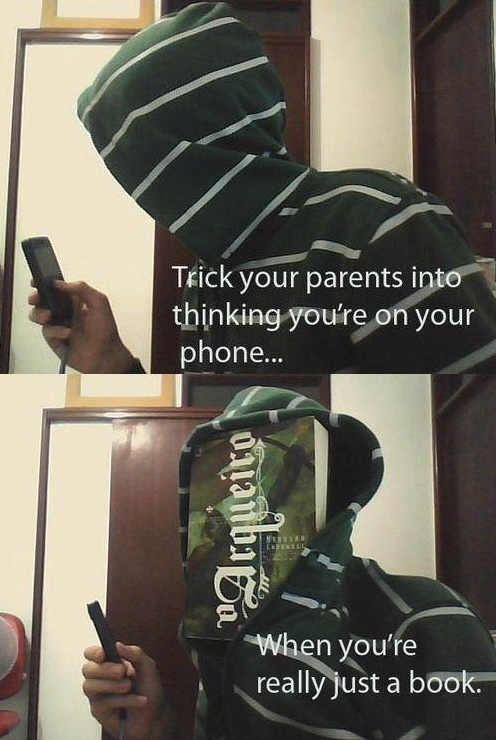

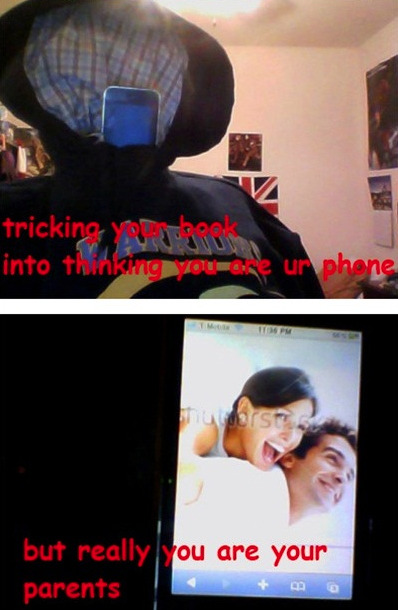
Well, that’s enough internet for me today.
im dying
Well that escalated quickly
My decision to continue to stay on Apple’s Macintosh platform was not a particularly easy one. Three of our last four Macs have come to untimely deaths. Since 1984 dozens of Macs have lived on my desk and I have fond memories of several of them. My problems with Apple hardware might be unusual, but it is my reality and gave me some reservations about sending more of my money to Cupertino.
As I was coaxing the last few DVDs out of my iMac, the infamous iLemon (see My iMac Has Turned Into An iLemon, And It Makes Me Concerned About Apple), I placed an online order for Apple’s least expensive Macintosh, the Mac mini.
For those not familiar with Macs, the Apple store price for that model is $599 and it comes with 2.5 GHz I5 processor, lots of ports, but almost nothing else except an HDMI-to-DVI connector. I also ordered additional memory from Amazon Prime. And I bought an external Samsung DVD drive, for a lot less than the Apple model.
My growing frustration with my dying iMac meant the Mac Mini rested on the sofa in my office for just 24 hours after it arrived.
 My Mac mini with DVD drive just behind the keyboard, and an external LaCie Firewire 800 hard drive on top of the Mac mini.
One of the great things about Apple products for the last several years has been the migration assistant, which helps you move everything from an older Mac to a new one. I used it with my iMac and it worked flawlessly. However, given that my iMac had problems that even Apple couldn’t solve, and that I was running it off an almost completely full external hard drive the same size of the drive in my new Mac Mini, I thought it best to start from scratch.
I sort of expected there to be some conflict when I plugged the Samsung into the Mac mini, given all the court cases, but it worked great as I installed my Microsoft Office 2011 for the Mac. My other software, Rapidweaver 5, Nisus Writer Express, Fetch, SnagIt, Chrome and Firefox were all downloaded without a hitch.
But when you get a new Mac, you almost immediately end up at the App Store. Surprisingly Apple’s App store was where the real pain started.
My first shock came when I arrived at the App store and clicked the “Update All” button. It didn’t take long before things ground to a halt. The first thing I noticed was a message “We could not download iPhoto” because OS X version 10.8.2 or later is required.

Next I got a message that I needed to do an EFI firmware update. For those not familiar with EFI, it is basically today’s version of the BIOS. Of course, the EFI message immediately made me think I had slipped back into the world of DOS. But the Mac Mini that I purchased was introduced on October 23, 2012, not even three months ago.
Anyway, the EFI update wasn’t a problem other than it had to be done separately. Then I went through a huge system update to bring my brand new Mac Mini from OS X version 10.8.1 to 10.8.2. Only then would the App Store let me update my iPhoto. The net of this was far more rebooting than I normally experience when bringing up a new Mac.
It occurs to me that maybe Microsoft should shoot a new version of the old iMac commercial where a boy and a dog race a man and a desk full of boxes to see which can get on the Internet first. I think Windows 8 might win. I say that because I got my Mac mini only a week after I first booted up a new Lenovo desktop tower PC. I know this will bring howls from the Apple crowd, but it was easier to get started using the Lenovo PC than it was to get the Mac mini going.
There were more challenges along the way. Apple’s Mail wizard did not know how to configure my old .Mac email accounts. I did a Google search to find the right settings. Postbox on my Windows 8 machine did a better job.
The surprises were not over. As I've noted before, my decision to stay on the Mac platform was largely based on the tight integration of the iLife products, iPhoto, iMovie, and iDVD. While I checked to make sure iLife was included, I didn’t think to check to see if the definition of iLife had changed.
I was floored when I found out that iDVD not only wasn’t included, but it no longer exists. A little searching confirmed that Apple had indeed ditched iDVD. I missed the news because when I migrated to my iMac in October 2010, the migration assistant brought iDVD along. Given I was using iDVD on my external drive just before I started unpacking the Mac Mini, I was floored.
This turn of events made it essential that I boot my Mac Mini from my external Firewire hard drive so I could use iDVD. This being a Macintosh, I thought it would be no problem. After all I have been booting Macintoshes from external drives of one sort or another almost since the Mac was introduced. And my current external drive was successfully running my dying iMac just a few minutes earlier.
But apparently thinking that it would work easily pushed me into some sort of reality distortion zone. It's time to admit that some things no longer just work on a Mac. My new Mac would just hang when trying to boot from the external drive. Given that both drives have the same version of the OS, I knew talking to first-tier Apple support was a waste of my time, so I went a little higher up the ladder to find out the real scoop.
Turns out that the Mac Mini requires the absolute latest build of OS X 10.8.2. My external hard drive likely has an earlier build. I bought Mac OS X Mountain Lion for my iMac this fall and it got the update to 10.8.2 on October 4, 2012. Who knew we had to keep track of build numbers for Mac OS X?
Well I thought, no big problem, I paid for a copy of Mountain Lion, I will just go download the latest and greatest version from Apple’s App Store. Sorry folks, this journey into the magical mystery world of Apple isn’t going to end that nicely.
Just to be sure I did not dream the whole thing, I just tried downloading it again, and the message is still the same. “Mountain Lion isn’t compatible with your computer.”

Well this is actually a pretty ugly turn of events. I checked back with my Apple contact. He too was mystified, but assured me that all will be well whenever Mac OS X 10.8.3 is released.
Really, that's what he said.
There are more adventures in this, but here's one more tidbit. During all of this I installed VMware’s Fusion software. With zero challenges, I got Xbuntu Linux running on the Mac mini. Maybe Linux running perfectly on Mac is a message from Steve that the gnomes in Cupertino need to focus a little more on OS X?
 The Assassin's Creed team at Ubisoft never imagined placing a woman in the lead role during the era of the Kenways, which spans Assassin's Creed 3 and Black Flag, director Ashraf Ismail told IGN.
AC4 director: Another leading lady 'wouldn't be surprising' in the future originally appeared on Joystiq on Mon, 04 Mar 2013 21:00:00 EST. Please see our terms for use of feeds.
firehoseglwt
 Curt Schilling, founder of defunct 38 Studios, asked a judge to throw out The Rhode Island Economic Development Corporation's lawsuit that alleges Schilling and studio executives misled the agency in securing a $75 million taxpayer-guaranteed loan. The lawsuit accuses Schilling and his crew of fraud, racketeering and conspiracy.
Schilling asks judge to throw out lawsuit over $75 million loan originally appeared on Joystiq on Mon, 04 Mar 2013 19:15:00 EST. Please see our terms for use of feeds.