
firehose
Shared posts
06 Mar 23:18
Steven Sanders creates world from ground up in ‘Symbiosis’
by Chris Arrant

After wowing us with Five Fists of Science, shocking us with Our Love Is Real and winning over the mainstream with Wolverine & The X-Men and S.W.O.R.D., Kansas City comics creator Steven Sanders is going back to square one with a simple idea: Create a whole new world.
Sanders is doing so with his elaborate mixed-media book Symbiosis, now the subject of a Kickstarter campaign. He describes Symbiosis as “exploring a world where all technology is powered by biological engines that are deeply linked to humans,” told through a series of texts and illustrations.
“[Symbiosis] explores a world where there are no mechanical sources of power,” the writer/artist explains on his Kickstarter page. “Instead, humanity has learned to utilize biological engines that harness a ‘bio-ether’ present on the planet. They can control and feel what these bio-engines feel via a ‘Resonance Tooth.’ Consider it 1940s era bio-punk.”
Planned to be more than 100 pages, it will be available both in digital formats as well as a high-end print edition. And when Saunders says “high-end,” he means it. The print edition of Symbiosis will be an 11-inch by 17-inch hardcover monstrosity with a clam-shell box, gold foil, debossed logos, and tipped-in vellum sheets. The artist says this immense production is an “ode to old books” he read as a child and now collects. But no matter which format you buy Symbosis in, it promises a full-on experience that looks part comic book, part RPG and part life.
firehose likes this
06 Mar 23:17
Pinboard Numbers 2013 [Link]
by Gabe
firehoseBookmarks stored 68 million
Active users 22,400
Known URLs 42 million
Data archived last month 456 GB
Tweets archived last month 1.4 million
Users with only private bookmarks 6,700
Users with only public bookmarks 10,100
Users with only unread bookmarks 396
Users without a single bookmark 845
...and who paid for archiving 23
Fandom, self-declared 2717
Use a non-English version of Pinboard 1556
Yes, I love Pinboard. These are some very interesting statistics on Pinboard subscribers and bookmarks. I love that nearly 1/3 of the subscribers have only private bookmarks.
06 Mar 23:07

Redesigning the Wine Bottle: An Interview with Luke Jerram
by Nicola
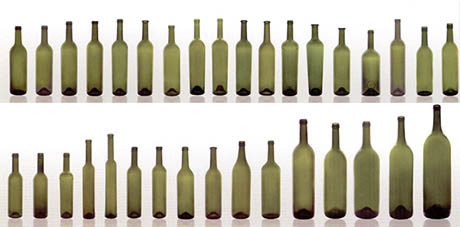
IMAGE: Bordeaux-style wine bottles, available from Silver Spur Corporation.
A couple of weeks ago, one of my favourite artists, Luke Jerram, tweeted: “Just commissioned to design a new red wine bottle. Fun and challenging. Any ideas?”
Well, yes. My idea was to interview him, twice: at the start of the bottle design process; and then again, later, when the final product is ready to be unveiled. Excitingly, Jerram generously agreed to my suggestion, and even offered to share drawings and photos along the way.
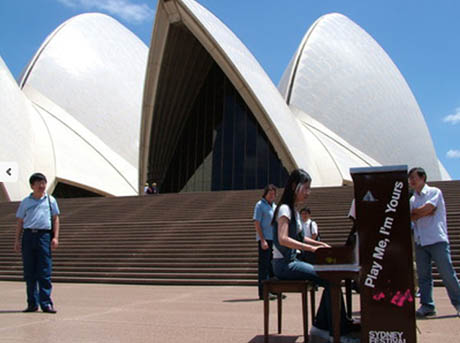
IMAGE: A street piano in Sydney, Australia, from the “Play Me, I’m Yours” website.
Many of you will have encountered Jerram’s work already, through his wildly successful “Play Me, I’m Yours,” which has installed more than 700 pianos on the streets of thirty-four cities. I first discovered him through his wonderful hot-air-balloon-powered dawn chorus, “Sky Orchestra,” and then, while I was working on Landscapes of Quarantine, his eerily beautiful glass virus and microbe sculptures, so I’m thrilled to finally have a wine-bottle-shaped pretext to interview him for Edible Geography.
An edited transcript of our first conversation appears below; check back in the coming months to see how Jerram’s bottle design develops.

IMAGE: Part of Jerram’s “Sky Orchestra” over Stratford; photograph by Chip Horne, RSC.
• • •Edible Geography: Can you tell me where this wine bottle commission came from, as well as a bit more about the design brief?Luke Jerram: The commission comes from a really interesting chap called Ruggero Ama. He originally contacted me about buying Aeolus, my giant singing sculpture. We’ve had an interesting dialogue about this new winemaking business that he’s developing in the Veneto region of Northern Italy. He’s making a type of red wine called Amarone, which has an unusual history — apparently it was first made by mistake, when someone left grapes in a basket and forgot about them for a couple of months.
Even the name of his company — Pipai — has a really nice story to it as well. It’s the nickname that Ruggero’s father used to call him, and it means “little cork” in the dialect of Ferarra, where he was born.
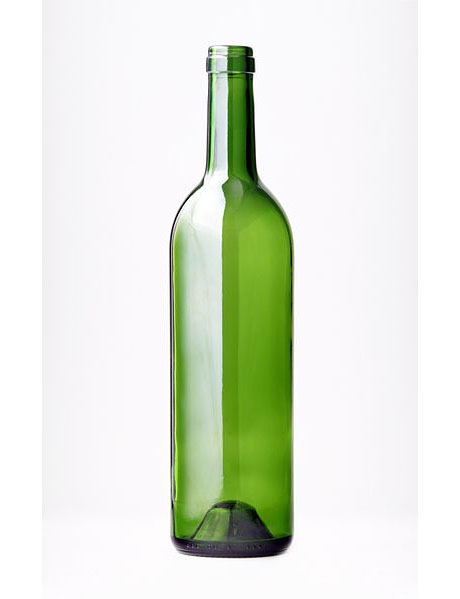
IMAGE: A Pomerol wine bottle, via Wikipedia.
In any case, he liked my glass sculptures, so he basically asked me to apply my creativity to designing some wine bottles. Originally, I was thinking, “Oh crikey, designing a wine bottle that’s going to be produced in the thousands is quite difficult.”
If you start looking into the history of the wine bottle and how it functions, a wine bottle looks as it does for all sorts of interesting reasons. You can read all about it on Wikipedia. For example, an ordinary wine bottle has got that little dimple at the bottom, which is there for reasons to do with pressure and channeling sediment. Obviously, you’ve got to put a cork in the top, under pressure, so you are talking about something that has to be quite sturdy. Then the curve of the shoulders is designed to collect any sediment as you’re pouring it. And, of course, the bottle’s got to be a certain strength for storing and for transporting. I’ve even read that the size, 750 ml, is roughly the average exhalation volume of the human lungs.
So a wine bottle — a standard wine bottle — is quite specific. Luckily, Ruggero doesn’t want me to redesign that. It’d be like redesigning the wheel. What he’s asked me to do is design something like a limited edition of, say, ten bottles, as a special thing that he could give to his investors or to friends and family, or put up for auction, or something like that.
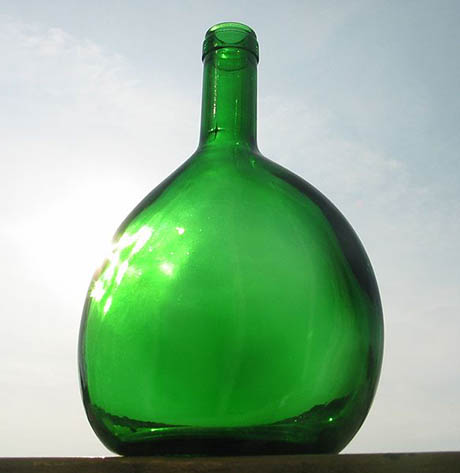
IMAGE: A Bocksbeutel, used for wines from Franconia in Germany, via Wikipedia.
Edible Geography: Are you planning to design a single bottle and then fabricate it in an edition of ten?
Jerram: I think that’s the idea. Alternatively, you know, I could create ten different bottles that come together to form something. They would each be individual sculptures that, when they are together, turn into something else. There are all sorts of opportunities — it’s quite fun, really.
I suppose this is what I do — I spend a lot of my time just generating ideas. Most of the time I’m designing art works, but I’m quite happy to apply my creativity to anything. This is the first time I’ve ever tried to design a wine bottle, but, by working with specialists, I am actually able to make anything or to produce anything. I can work with a hairdresser and produce a new style of haircut; I worked with a jeweler to make a portrait-projecting wedding ring for my wife; and I’m working with an architect at the moment to redesign the front of a hospital here in Bristol.
I am equally happy to design a wine bottle, or a giant singing sculpture, or a new kind of clock. Anything is possible and it’s quite liberating, really.
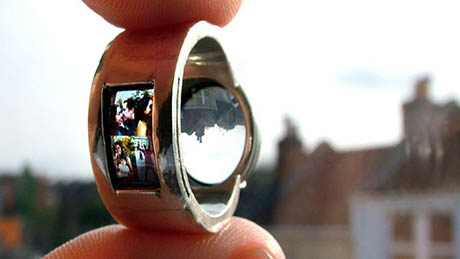
IMAGE: Luke Jerram’s “Portrait Projecting Ring.”
I try to work with local specialists wherever possible so that I can support local businesses and craftsmen, and also so that I can keep an eye on what’s going on. I’m a bit of a control freak and it’s just easier to manage people if they are nearby.
Edible Geography: I’d also imagine that some of the design development will happen during fabrication itself, either through serendipitous accidents or through the process of manipulating the materials you’re working with.
Jerram: Absolutely. With all of these things, I end up learning a huge amount about the limitations and the possibilities of a particular craft or a particular skill. For example, I’ve been working with a glass team who helped me create the viral sculptures for about eight years now. They’re working with cold glass — it’s the same skill that you need to make distilling equipment and test tubes and that kind of thing.
I also did a residency at the Museum of Glass in Washington. They use hot glass. You get a punty and a blowpipe and the hot molten glass is like honey when you blow it. Those are two very distinct methods for working with glass, each with quite different constraints and possibilities.
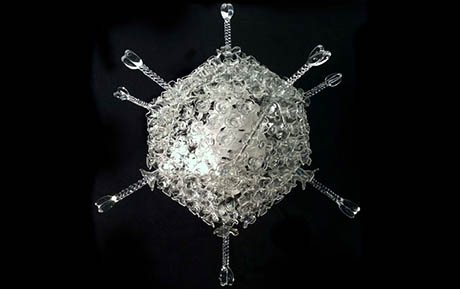
IMAGE: “Adenovirus,” Luke Jerram.
Edible Geography: Which method do you think you might use for this wine bottle project? Or do you have to arrive at a basic form first, before you could answer that?
Jerram: I don’t necessarily need the form, but I have to arrive at a concept, at least. I’ve been generating all sorts of ideas, and now it’s a question of filtering out the good ones from the bad. I used to generate fifteen ideas and I’d hand them to someone and tell them they could choose. Nowadays, I still generate about fifteen ideas, but I’ll only present three or so, each of which I would be happy to make.
Edible Geography: In addition to Wikipedia, have you been looking at any other bottle-related resources for inspiration?
Jerram: I went to the V&A Museum last week and had a look around at their glass collection. I’ve also got friends who are scientists and engineers, so when I put the idea out there, they come back with all sorts of crazy suggestions. It’s a nice thing to talk about in the pub.
One of the things that I am dealing with is that red wine bottles generally have a lot of colour to them, to protect the wine from ultraviolet radiation. If you’ve got a clear bottle full of red wine, sunlight will make the wine go off. But I’m colour-blind, and all of my sculptures are made in transparent glass.
Luckily, Ruggaro’s also open to the idea of making something that’s more like a decanter, which could be clear — and which could be open to the air, to avoid the cork/pressure problems.
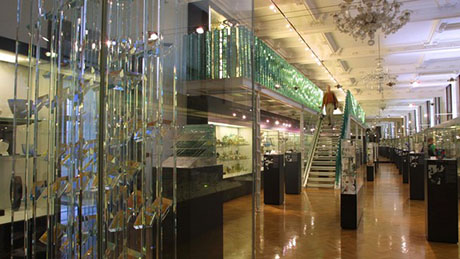
IMAGE: Glass gallery at the Victoria & Albert Museum, London.
Edible Geography: That’s interesting, because the two have quite different purposes. The decanter is about letting the wine breathe, but it’s also about pouring and displaying the wine at a table. Meanwhile, one of the most interesting things about bottles is the idea of distance and distribution — that the wine can now travel between producer and consumer. A bottle — and I suppose, before that, a barrel or an animal skin, even — is the answer to the question of how you get wine from where it is made to where you’re going to drink it.
Jerram: Exactly. The brief really is quite open in that way, which I like. I can choose to be inspired by completely different aspects of the idea of a wine container. I’m really right at the beginning of this journey, just knocking ideas around. Perhaps none of the things that I’m thinking about right now will get made. I’ve got hundreds of ideas, some of which have been on the shelf for five years or more, just waiting for an opportunity to be made.
I had one idea to create Dalí-like glass bottles that are melting. You could display them hanging from the ceiling and then you could create melted labels to go with them. That would be a quite nice thing, but is it good enough? Is it interesting enough? I’ve also been thinking about Klein bottles as well, which are these mathematical shapes that only have one surface.
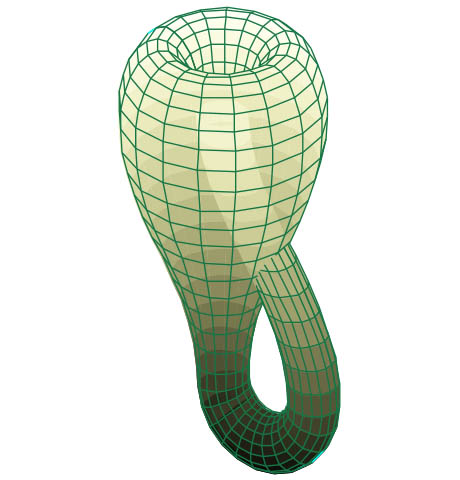
IMAGE: A two-dimensional representation of the Klein bottle, via Wikipedia.
Then there’s the history of wine and what it has meant to us in different eras and cultures and medical regimes. I could make a giant heart-shaped bottle and fill it full of red wine. We could suspend it in a clear jar almost like a pickled formaldehyde sample. That would be quite nice as well. There are all these ideas, and the trick is to choose something has the potential to be far more interesting than you could imagine it to be. In the best projects, it’s not until you actually make the idea that you see that the final result is far more interesting or far better than you thought it could be.
Edible Geography: How long will this idea-generating and winnowing phase take, do you think?
Jerram: Well, I have about twelve projects on the go at the moment, including this one. I don’t know — sometimes you can just spiral around a thing for days or weeks, and then an idea will just fall into your lap at two in the morning, when you were just on the edge of sleep. And then I can also boil up a vat of energy and brainstorm ten ideas within ten minutes. Or I can come up with a few ideas on the train and write them down and then wait for things to fit together.
Edible Geography: Do you drink wine, and, if so, have you found yourself looking at bottles differently as you’re pouring a glass of wine over dinner, or thinking about the role that wine plays in your own life?
Jerram: I can’t really drink red wine. I’ve got a sensitive stomach and red wine does me in. I’m a traditional Englishman, so I drink warm, flat beer.
I have been looking at bottles with a different eye, though. If you go around the V&A’s collection, they’ve got bottles there going back to Roman times. There’s one beautiful glass jug: it’s about twenty-five centimeters tall, and it’s all polished and engraved with a little handle. That’s nice, you think — and then you realize that it is a thousand years old and it has been carved out of a single piece of quartz crystal.
Just imagine starting off with a lump of solid glass and chipping away at it and scooping out the inside to make this incredibly delicate jug. The glass is only about four millimetres thick all around, and the whole thing is carved and etched and it’s absolutely exquisite. Completely bonkers.
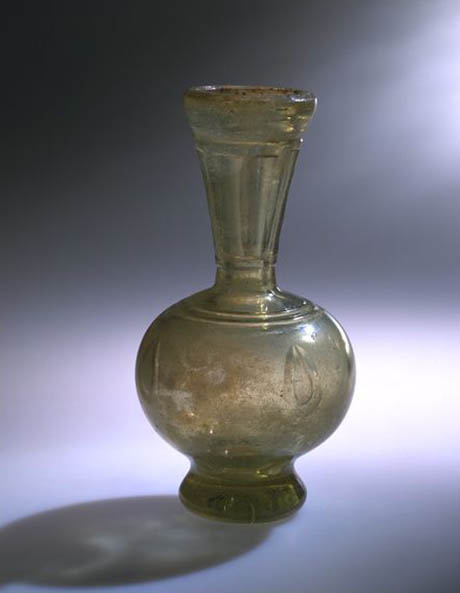
IMAGE: Bottle; unknown; 900-1100, from the collection of the V&A.
Edible Geography: That’s amazing. It probably took as long to make as the wine that filled it did.
Jerram: Yes — I would have to imagine that this would take at least six months, and maybe even a year, of continuous work. Then you wonder how many other jugs did they have to make and break before they were able to create one that didn’t get smashed to pieces by accidentally scooping away too much glass from the inside.
Edible Geography: You are drawn to working with glass, clearly, but it does seem like a very nerve-wrackingly fragile material.
Jerram: It is, but I enjoy it. You get quite good at handling it. In a very specific way, it calms you right down.
I lent a couple of my glass viral artworks to the BBC for filming for a program on virology a couple of weeks back. They called, and they said, “Are you sitting down? We are really, really sorry. One of our cameramen knocked it with his elbow and it came off the table and smashed into a million pieces.” They were really apologetic. I was thinking, that’s fine, isn’t it? That’s a sale, as far as I can tell!
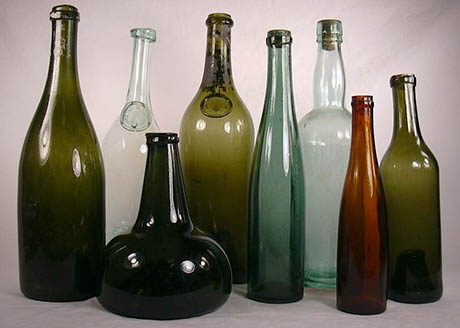
IMAGE: A group of wine bottles, from the incredibly thorough Bottle Typing web page maintained by Bill Lindsey for the Society of Historical Archaeology.
Edible Geography: Something about that story makes me think about the afterlife of a wine bottle. After all, the wine is only intended to be in there temporarily, so what happens to the bottle after its contents are gone, other than just becoming a cheesy candle holder for a student flat? Can you design for a post-wine purpose?
Jerram: That’s an interesting question. Actually, one of the ideas that I had was to create a chandelier or a candelabra that was clear and hollow and then you would fill it up with wine. I quite liked the idea of taking a completely different object, like a door or a really ornate frame, and turning it into a bottle by making it hollow. After all, literally anything can be made into a bottle if it’s hollow.
The cork or the seal is the trickiest part. With a cork, you’ve got to put a lot of force into it to get it to work, which then dictates the shape of your bottle to a certain degree. One idea I had was to not to have any cork and, instead, to completely seal the bottle. You wouldn’t be able to drink the wine unless you broke off the top of this long sealed stem. It’s got a bit of a “break in an emergency” feel to it.
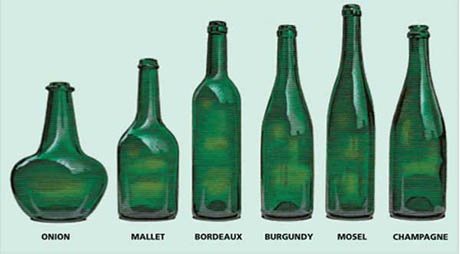
IMAGE: Typical wine bottle shapes via Readers’ Digest Australia.
Edible Geography: It reminds me of launching a ship, too. It feels quite ceremonial.
Jerram: I haven’t quite worked that aspect out yet — the closure — although it is quite fundamental. I don’t know. There are so many options. But I’m only ten days into the project!
Check back in the coming months to see how Luke Jerram’s wine bottle design develops….

06 Mar 22:34
Filed under: Raspberry Pi, transportation hacks, video hacks


Dynamic bicycle headlight uses the open road as a display
by Mike Szczys

This thing is so cool it almost looks fake. But [Matt Richardson] isn’t a hoaxster. He actually built what might be called a heads-down display for your bicycle. He refers to it as a headlight because it borrows a similar function. It mounts on the handlebars and shoots light off the front of the bike. But it’s more than just a battery and a bulb, this uses a pico-projector to give that light some meaning. In the video after the break he shows it off on the streets of NYC.
So far he’s only displaying information that has to do with the speed of travel, but the proof is there just waiting for a brilliant new use. Feeding the projector is a Raspberry Pi board. For this prototype [Matt] mounted it, along with the portable cellphone charger which plays the role of the power source, on a hunk of hardboard strapped inside the bike frame.
If you’re thinking of doing this one yourself beware of the BOM price tag. That projector he’s using runs upwards of $400. We wonder if you could hack together a rudimentary replacement with an old cellphone screen and this diy film projector?
Filed under: Raspberry Pi, transportation hacks, video hacks
firehose likes this
06 Mar 22:34
Famous Music Album Covers Reimagined With Comic Superheroes
by Justin Page

Cyclops: Bad by Marco D’Alfonso

Bad (1987) by Michael Jackson
Online comics magazine Comic Book Resources holds a weekly mashup art collaboration with a series of artists and suggestions from readers titled The Line It Is Drawn. Last week, with their 128th theme titled Music Album Cover Homages, the artists showcased an awesome series of famous music album covers that were reimagined with comic book superheroes. You can view more artwork and learn more about the contributing artists at Comic Book Resources.


Sgt. Pepper’s Lonely Hearts Club Band (1967) by The Beatles

Ding Dong Daddy Days by Bill Walko

Demon Days (2005) by Gorillaz

Marvel: Make It Big by Steve Howard

Make It Big (1984) by Wham!


The Breakfast Club: Original Motion Picture Soundtrack (1985)
images via Comic Book Resources and credited artists
via XombieDIRGE, Pleated-Jeans
06 Mar 22:33
Top Secret Drum Corps, A Swiss Precision Drumming Team
by EDW Lynch
firehosedrum corps beat
Top Secret Drum Corps is a Swiss drumming group that performs incredibly precise, military-style drumming displays. Formed in 1990 in Basel, the group gained fame in 2003 with their first performance at the Royal Edinburgh Military Tattoo, an international exhibition of military bands and display teams. They’ve now performed four times at the exhibition (see performances in 2009 and 2012).
06 Mar 22:33
"He was acting really peculiarly, car-hopping around a procession of black Bentleys, surrounded by..."
firehoseCanadian motorcycle gang beat
““He was acting really peculiarly, car-hopping around a procession of black Bentleys, surrounded by motorbikes, all sporting Canadian flags while traffic was at a standstill. It was all a bit odd.””
- Justin Bieber Fuels Meltdown Rumours With ‘Peculiar Antics’ After O2 Arena Concert - Yahoo! omg! UK
- Justin Bieber Fuels Meltdown Rumours With ‘Peculiar Antics’ After O2 Arena Concert - Yahoo! omg! UK
06 Mar 21:37


The Architectural Ride at Battersea Power Station by Atelier...
The Architectural Ride at Battersea Power Station by Atelier Zündel Cristea via Dezeen
London’s Battersea Power Station is transformed into a museum of architecture and encased inside a giant roller coaster in these competition-winning proposals by French studio Atelier Zündel Cristea.
The conceptual plans were awarded first prize in the international competition coordinated by ArchTriumph, which invited applicants to suggest how the crumbling brick landmark could be used as an exhibition centre dedicated to architecture.
firehose likes this
06 Mar 21:37

On top of a Zeppelin
On top of a Zeppelin
Tertiarymatt, firehose and -1 others like this
06 Mar 21:21
 In October, Incredipede developer Colin Northway introduced us to the Offspring Fling process of submitting an indie game to Steam:
"Apply to Steam, be rejected, release without it, get popular, be noticed by Valve, release on Steam."
Steam has since overhauled its submission process with Greenlight, a crowd-sourced method of voting games onto the service. Now from a developer's perspective, the indie submission system needs a related makeover and a new name. We suggest the Incredipede process:
"Post on Greenlight, be rejected, release without it, get popular, be noticed by the IGF and through an award nomination get a deal to release on Steam without Greenlight at all, haters."
It's a little more complicated and relies on a smidgen more luck, but the Incredipede process is one of many new ways to get an indie game on Steam. No matter the system, the goal remains the same - a Steam launch can propel an indie game from "hobby" to "day job," or change a sales outlook from "disappointing" to "happy."
"More and more Steam is the place to be for indie games," Northway tells me. "If I had $15 for every time I heard the comment, 'I would buy this if it was on Steam,' then I'd be much happier with the sales. Which is why I'm really looking forward to the Steam release."
Through its own convoluted yet successful process, Incredipede is coming to Steam for PC and Mac on March 18.
How indie creature feature Incredipede stumbled onto Steam
by Jessica Conditt
firehosewhy crowdsourcing still sucks
In October, Incredipede developer Colin Northway introduced us to the Offspring Fling process of submitting an indie game to Steam:"Apply to Steam, be rejected, release without it, get popular, be noticed by Valve, release on Steam."
Steam has since overhauled its submission process with Greenlight, a crowd-sourced method of voting games onto the service. Now from a developer's perspective, the indie submission system needs a related makeover and a new name. We suggest the Incredipede process:
"Post on Greenlight, be rejected, release without it, get popular, be noticed by the IGF and through an award nomination get a deal to release on Steam without Greenlight at all, haters."
It's a little more complicated and relies on a smidgen more luck, but the Incredipede process is one of many new ways to get an indie game on Steam. No matter the system, the goal remains the same - a Steam launch can propel an indie game from "hobby" to "day job," or change a sales outlook from "disappointing" to "happy."
"More and more Steam is the place to be for indie games," Northway tells me. "If I had $15 for every time I heard the comment, 'I would buy this if it was on Steam,' then I'd be much happier with the sales. Which is why I'm really looking forward to the Steam release."
Through its own convoluted yet successful process, Incredipede is coming to Steam for PC and Mac on March 18.
Continue reading How indie creature feature Incredipede stumbled onto Steam
 How indie creature feature Incredipede stumbled onto Steam originally appeared on Joystiq on Wed, 06 Mar 2013 15:30:00 EST. Please see our terms for use of feeds.
firehose likes this
06 Mar 21:20
 I don't like writing game reviews. I'm a news guy, comfortable moving within and reporting on the binary conclusions of business in the video game industry. Reviews are emotional. Always have been. With SimCity and Diablo 3, I think the already tempestuous machine of game reviews in this industry has changed forever, and as a collective we haven't yet determined how to proceed. SimCity and Diablo 3 aren't just games, they are also services. The question: Should these games be reviewed separately from their service elements or should they be reviewed in combination?
Comparing this to the restaurant industry, the game is the food and the internet-required connection is the table service. Back of the house and front of the house. What we've seen following the launches of Diablo 3 and SimCity are people paying money to walk into the restaurant on opening day and not being served a meal. In a restaurant there would be immediate and dire consequences for such poor customer service. In the video game industry, there's no shortage of apologists justifying the outcome. Nobody genuflects to poor customer service excuses in a restaurant. Any restaurant review would treat the meal and service as one singular expression of the experience.
Editorial: SimCity, Diablo 3 and a review of customer service
by Alexander Sliwinski
I don't like writing game reviews. I'm a news guy, comfortable moving within and reporting on the binary conclusions of business in the video game industry. Reviews are emotional. Always have been. With SimCity and Diablo 3, I think the already tempestuous machine of game reviews in this industry has changed forever, and as a collective we haven't yet determined how to proceed. SimCity and Diablo 3 aren't just games, they are also services. The question: Should these games be reviewed separately from their service elements or should they be reviewed in combination? Comparing this to the restaurant industry, the game is the food and the internet-required connection is the table service. Back of the house and front of the house. What we've seen following the launches of Diablo 3 and SimCity are people paying money to walk into the restaurant on opening day and not being served a meal. In a restaurant there would be immediate and dire consequences for such poor customer service. In the video game industry, there's no shortage of apologists justifying the outcome. Nobody genuflects to poor customer service excuses in a restaurant. Any restaurant review would treat the meal and service as one singular expression of the experience.
Continue reading Editorial: SimCity, Diablo 3 and a review of customer service
Editorial: SimCity, Diablo 3 and a review of customer service originally appeared on Joystiq on Wed, 06 Mar 2013 16:00:00 EST. Please see our terms for use of feeds.
firehose likes this
06 Mar 21:19
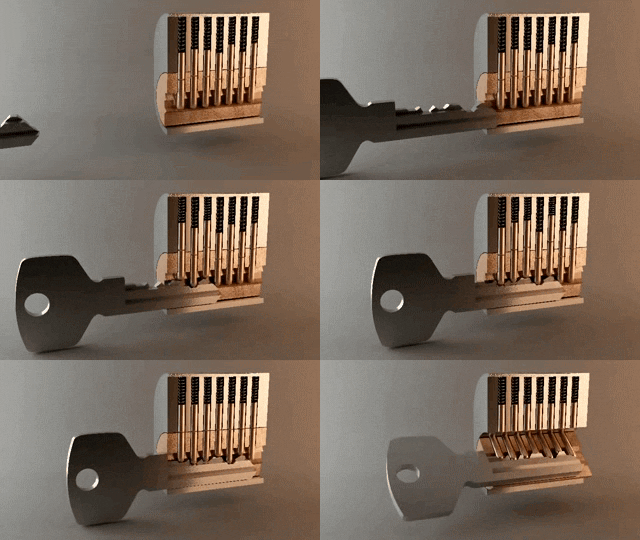
decaffeinate-o: samfosho: randomredux: flyajess: so that’s...
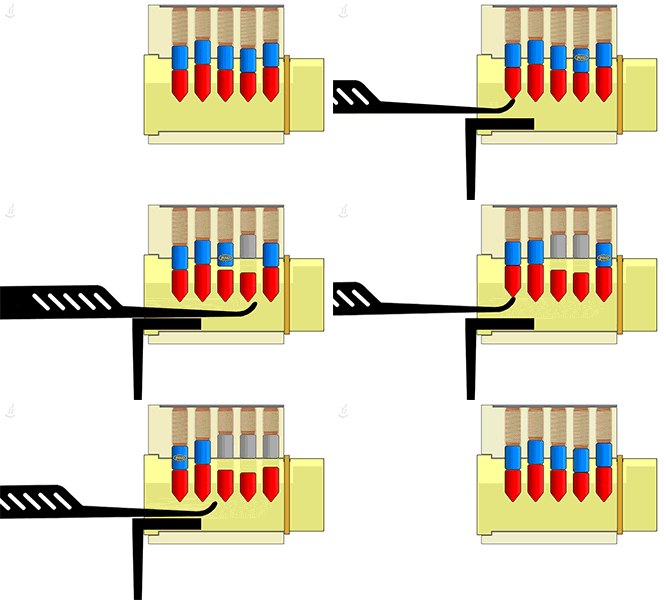
so that’s how keys work.
YOU HAVE NO IDEA HOW HAPPY I AM TO FINALLY SEE HOW THIS WORKS.
I REFUSE TO BELIEVE UNTIL SOMEONE SHOWS ME HOW PICK IT.
Rosalind, Tertiarymatt and -1 others like this
06 Mar 21:08
Dove releases rogue Photoshop action that undoes 'real beauty' manipulations | The Verge
Dove releases rogue Photoshop action that undoes 'real beauty' manipulations | The Verge:
Clever, but:
After all, other brands owned by Dove’s parent company, Unilever, don’t seem to be taking the real beauty message seriously — just look at Axe’s commercials.
06 Mar 21:07

New Neon Skull Lights by Eric Franklin
by Christopher Jobson

Skull No. 3 / Flameworked borosilicate glass, ionized neon and mercury, wood, electronics. 14″x14″x14″. 2013.

Skull No. 3 / Detail.

Skull No. 3 / Detail.

Skull No. 1 / Flameworked borosilicate glass, ionized neon, wood, electronics. 14″x14″x14″. 2013.

Skull No. 1 / Detail.

Skull No. 1 / Detail.

Skull No. 2 / Flameworked borosilicate glass, ionized neon and krypton, wood, electronics. 14″x14″x14″. 2013.

Skull No. 2 / Detail.

Skull No. 2 / Detail.
Portland artist Eric Franklin (previously) just completed three new works, a trio of neon glass skulls lit internally by ionized neon, krypton, and mercury. The structure of each human skull is deviously complex, made from a network of glass tubes that have to be perfectly sealed to create the vacuum necessary to light them, a process that leaves the figures somewhat misshapen and admittedly a bit creepy. A completely amazing sort of creepy. All three artworks are currently available for acquisition through Chris Forney over at Artworks Gallery. All images courtesy the artist.
firehose likes this
06 Mar 20:42



rurone: ferdisanerd: If they ever make a live action batman...
firehoseI just remembered who this actually is
she's Power Girl
If they ever make a live action batman movie with Stephanie Brown as Batgirl, I think I found the perfect candidate.
Samantha Wright.
Gymnast turned weightlifter. Cute, agile and powerful.
OHMIGOSH IT’S HER!
firehose, Nathan Fhtagn likes this


06 Mar 20:37
A student tweeted about a test, and the next day it was the...
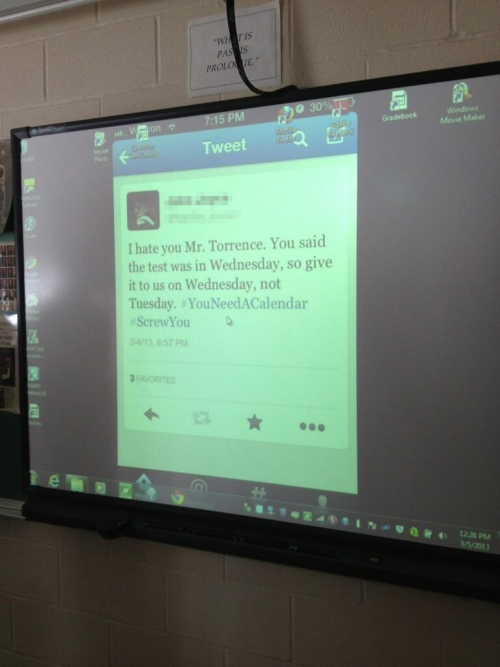
A student tweeted about a test, and the next day it was the teacher’s desktop background.





06 Mar 20:18
 Well, that was fast. After its launch this morning, the Kickstarter campaign to finance Inxile's latest endeavor Torment: Tides of Numenera has reached its goal of $900,000. Funding will be open for potential backers until April 5, 2013.
Torment: Tides of Numenera is a sequel inspired by the classic game Planescape: Torment, a single-player RPG game set in the Numenera role-playing system created by Monte Cook. Inxile's first Kickstarter campaign was a success, and the studio is currently working to produce a sequel to another classic IP, Wasteland 2.
'Torment: Tides of Numenera' meets Kickstarter goal, raises over $900K
by David Hinkle
firehosewokka wokka
Well, that was fast. After its launch this morning, the Kickstarter campaign to finance Inxile's latest endeavor Torment: Tides of Numenera has reached its goal of $900,000. Funding will be open for potential backers until April 5, 2013.Torment: Tides of Numenera is a sequel inspired by the classic game Planescape: Torment, a single-player RPG game set in the Numenera role-playing system created by Monte Cook. Inxile's first Kickstarter campaign was a success, and the studio is currently working to produce a sequel to another classic IP, Wasteland 2.
'Torment: Tides of Numenera' meets Kickstarter goal, raises over $900K originally appeared on Joystiq on Wed, 06 Mar 2013 15:02:00 EST. Please see our terms for use of feeds.
06 Mar 19:57


TV: Newswire: Community is doing an all-puppet episode, with actual puppets
by Sean O'Neal
Echoing criticisms that they've become hollowed-out caricatures of themselves, the ever-meta characters of Community will be transformed into actual puppets next month, rather than the metaphorical ones they’ve sometimes felt like this season. That revelation (and the above glimpse of what that will look like) was dropped at the show’s PaleyFest panel, during which it was spoiled that the April episode—featuring previously announced guest star Jason Alexander, as “a friendly mountain man”—will see the group attempting to one-up that one episode of Angel by turning the entire cast into puppets, which they'll use to confront a recent “awkward” experience in the woods in the adorable manner of all children's shows and children's sexual abuse cases.
Other things we learned from the panel: Jim Rash used his Oscar-winning abilities to draft a Freaky Friday-referencing episode in which Troy and Abed apparently switch ...
Read more
06 Mar 19:56


Music: Great Job, Internet!: Today in "really?": The guy who played rapper and mathlete Kevin G in Mean Girls is a calligrapher now
by Marah Eakin
Almost every day, the Internet shines a light on a little tidbit of pop culture information no one necessarily needed to know, but everyone’s oh so glad they do. Today’s weird factoid, courtesy of the nostalgia-fueled staff at Buzzfeed Shift, is that the guy who played mathlete and rapper Kevin G in Mean Girls now makes his living as a professional calligrapher.
Rajiv Surendra came to the business of fine penmanship after becoming enchanted with letters written in the mid-1800s. Surendra started fooling around with writing, and eventually started fooling around with wooden penholders, ink, and tiny metal nibs that were used before the invention of the ballpoint pen. All his work now is done on a worktable dating back to the 1820s, save the chalkboard projects he’s done for restaurants and offices.
Interested parties—and who’s not interested in the dying art of calligraphy—can ...
Read more
firehose likes this
06 Mar 19:56
person: you need to smile more
person: you need to smile more
me: you need to fuck off
me: you need to fuck off
Rosalind, Tertiarymatt likes this
06 Mar 19:36


Film: Watch This: A documentary about Wilco found the band—and the music world—on the brink
by Mike D'Angelo
firehoseattn: lg
Every day, Watch This offers staff recommendations inspired by a new movie coming out that week. This week: Don’t Stop Believin’: Everyman’s Journey has us thinking about other “inside the band” documentaries.
I Am Trying To Break Your Heart (2002)
When former photographer Sam Jones signed on to document the creation of Wilco’s Yankee Hotel Foxtrot, he had no way of knowing the band was about to lose two of its members and be dropped by its label. Looking back a decade later, neither event turned out to be such a Bravo Foxtrot Delta—Wilco has persevered, releasing a new album every two to three years like clockwork, and few lament the loss of guitarist Jay Bennett or drummer Ken Coomer from the lineup of what’s really always been Jeff Tweedy And Friends. At the time, however, it seemed as if the very future of indie ...

