firehose
Shared posts
You Won’t Finish This Article
firehosetl;dr: "With ebooks and streaming movies and TV shows, it’s easier than ever, now, to switch to something else. In the past year my wife and I have watched at least a half-dozen movies to about the 60 percent mark. There are several books on my Kindle I’ve never experienced past Chapter 2. Though I loved it and recommend it to everyone, I never did finish the British version of the teen drama Skins. Battlestar Galactica, too—bailed on it in the middle, hoping to one day jump back in. Will I? Probably not.
Maybe this is just our cultural lot: We live in the age of skimming. I want to finish the whole thing, I really do. I wish you would, too. Really—stop quitting! But who am I kidding. I’m busy. You’re busy. There’s always something else to read, watch, play, or eat."
but really, it's because everyone fired their editing staffs and writers think diarrhea like this article is engaging or clever
Nicholas K Outerwear

I know, I know. It’s nearly summer. The last thing I should be doing is drooling over jackets. But these from Nicholas K almost make me wish it was fall.


"Whatever happened to punctuation"
Wall Street bankers say “Game of Thrones” is just like real life for them
firehoseof course they do, they all went to Harvard, where they were members of competitive houses, treated women like shit, sneered at the poors, and climbed random walls so they could pump-and-dump redheads

Tech geeks in Silicon Valley are obviously die-hard fans of the HBO fantasy series Game of Thrones. Apparently, so are finance geeks on Wall Street. Bankers, lawyers and hedge funders adore the backstabbing and score settling in the show, which echo cutthroat dealings on finance.
The show, which is based on a book series, is about several noble families battling for control of the Iron Throne. The political scheming and surprising twists are one source of appeal; galling bloodbaths are another. (It is now one of the most watched shows on cable TV.)
Case in point: A senior banker at one of the largest Wall Street firms told Quartz that one episode reminded him of the time his father died. When he was away from the office to arrange and attend the funeral, one of his closest colleagues cozied up to a longtime client with whom he was having issues. “I considered him as kind of a brother and he tried to steal my client. I came back to work earlier than expected to stop him,” the banker said. “People are vicious in this business, including me.”
Treachery, another Game of Thrones theme, is also pertinent to Wall Street. Although much has been made about banks working to reduce conflict of interest issues, it’s common for firms to switch from one client to another. For example: switching from the seller in a deal to the buyer to maximize profit. Law firms do it, too, although to a lesser degree. “We switch loyalties all the time because it’s all about where you can get the most fees,” one banker at a European firm said. “So the lesson is there is no real loyalty.”
Eric Jackson, founder of hedge fund Ironfire Capital, says the show highlights all the lessons he needed to learn about business. He even wrote a piece for Forbes about it. Some of his tips from the show are “no one ever forgets a slight,” “trust no one,” and “never underestimate the power behind the throne.”
Brian DeChesare, who founded the website Mergers & Inquisitions (which gives tips on how to break into investment banking) is also a fan. He said on the site that Game of Thrones is all about “political intrigue, fighting over petty issues and grudges, family feuds, betrayal, and backstabbing people in order to advance. In other words, exactly what you do in finance all day.”
He uses quotes from various Game of Thrones characters as lessons for budding investment bankers. For instance, from the quote, “Can a man still be brave if he’s afraid? That is the only time a man can be brave.” DeChesare derives the following: “If you want to start your own hedge fund or other business, you haven’t been through anything until you almost lose it all and survive by the skin of your teeth (or lose it all and have to start over).”
The finale of the third season of Game of Thrones airs June 9 in the US.

How a 'Lady in Red' became the symbol of Turkey's unrest
Last week, Ceyda Sungur was an academic in Istanbul. On May 28th, she became the "Lady in Red" — an unwitting symbol of Turkey’s anti-government protests, and the disproportionate force used to quell them.
Sungur, a research assistant at Istanbul Technical University’s school of urban planning, was among the hundreds of demonstrators gathered at Istanbul’s Gezi Park last week, where environmentalists and others had been staging a peaceful protest against government plans to convert the area into a shopping center.
By the time Sungur arrived at the park last Tuesday, the scene had devolved into violence, with police attempting to disperse protesters with tear gas, pepper spray, and water cannons. The clashes at Gezi Park have since sparked larger movements across the country, with demonstrators taking to the streets in protest against Prime Minister Recep Tayyip Erdogan, who many see as increasingly authoritarian and socially conservative.
Dressed in a red cotton dress and carrying a white tote bag, Sungur soon found herself nearly face-to-face with a policeman’s pepper spray canister. That’s precisely when Osman Orsal, a photographer for Reuters, captured what may be the defining image of this month’s unrest — Turkey’s small-scale equivalent of the tank at Tiananmen.
With her stance relaxed and face downturn, Sungur, through Orsal's lens, is the epitome of passive resistance. As onlookers cover their faces and turn away, Sungur keeps her shoulders nearly squared to the officer, whose gas mask and crouched stance seem almost comically disproportionate to his target. With a barricade of shields framing the action with ominous uniformity, she stands alone and absorbs the spray.

Paul Hansen, a Swedish photojournalist who won the 2013 World Press Photo of the Year award, says Orsal's image derives much of its power from the stark dissonance between its principals.
"For me, it's the contrast between the aggressive posture, gear, and action by the policeman, and the young woman in a red dress, looking like she would be on her way to a celebratory event or something," Hansen said in an email to The Verge. "A little bit of Beauty and the Beast, to put it in Disney terms."

Istanbul-based NarPhotos captured this shot of Sungur amid the mayhem at Gezi Park
Orsal's photo spread like wildfire across Twitter and Facebook, with Sungur's likeness spawning a meme of its own. Across Turkey, artists have appropriated her red dress, handbag, and swirling black hair to create posters, graphics, and, in at least one instance, a cardboard billboard in Izmir, where people are invited to place their face above a drawing of Sungur's body.

Observers, too, have pointed to it as a bold rebuttal to Erdogan, who earlier characterized Turkey's protesters as "extremists" and "looters."
"There’s something jarring about seeing a policeman deploy such casual and one-sided force," writes Max Fisher of the Washington Post, comparing the image to a 2011 photo of a police officer pepper spraying UC Davis students with chilling nonchalance.
On a thematic level, Sungur’s image bears a remarkable likeness to another photo of a woman being sprayed with a water cannon in Istanbul. The image, captured from different angles by the Associated Press and Turkey’s Anadolu news agency, shows an unnamed "Lady in Blue" standing proudly in front of the cannon, her arms outstretched as water cascades down on her.

In each case, Sungur and her anonymous counterpart succumb to police force, albeit in different ways. Whereas Sungur’s stance is casual and unassuming, the Lady in Blue seems to dare the police to hose her down, extending her arms in a defiant show of non-aggression.

It’s also somewhat fitting that two of the most powerful symbols of Turkish resistance would be women. Although Turkey's protests stem from a wide range of issues and government policies, some of the most hotly contested are those with a direct impact on the country's female population.
"One of the truly remarkable aspects of the recent protests in Istanbul and around the country has been the level of participation and visibility of women," says Anna Wood, an American freelance journalist living in Istanbul. "Easily half the crowd at any given protest that I've seen has been female."
Wood, 24, says the response from female protesters likely stems from a series of controversial policies implemented or proposed under Erdogan's 10-year tenure. On previous occasions, the prime minister has urged every woman to have at least three children, and has pushed legislation restricting access to abortions and birth control.
"very real and very serious threats to female autonomy in Turkey."
"In the past year alone, abortion, voluntary cesarean sections and the morning-after pill have all come under attack," Wood said in an email to The Verge. "These are very real and very serious threats to female autonomy in Turkey, where women — particularly better-off, better educated women — have long been a prominent and liberated part of society."

Sungur, for her part, seems reluctant to embrace her newfound fame and national symbolism. Save for one interview with a Turkish media outlet, she has declined to discuss the photo or the circumstances surrounding it with the press. Repeated emails and phone calls from The Verge went unanswered.
Instead, she has downplayed her significance as a galvanizing force across Turkey, saying her story is no different from the thousands of others that have emerged from this month's protests.
"Every citizen defending their human rights, every worker defending their human rights, and every student defending university rights has witnessed the police violence I experienced," Sungur said in an interview with Turkish press this week.
"A lot of people no different from me were out protecting the park, defending their rights, defending democracy," she continued. "They also got gassed."
- Image Credit ReutersAssociated Press
- Related Items politics photo turkey protest middle east government istanbul demonstration photojournalism lady in red ceyda sungur


A brief history of the US government’s awful graphic design
firehoseattn: multitasksuicide
The revelation that major US technology companies are participating in a National Security Administration surveillance program was shocking enough. And that was before we saw the top-secret slides used by the government to describe the spying operation. They are, to put it mildly, heinously ugly…

The slides immediately attracted scorn on Twitter, even inspiring graphics luminary Edward Tufte to weigh in:
Dreadful spy-PRISM deck sets new record for most header logos per slide: 13
washingtonpost.com/wp-srv/special… #powerpoint #ppt http://t.co/KUUyRikE2l—
Edward Tufte (@EdwardTufte) June 07, 2013
The US government, though, is no stranger to bad graphic design. The Department of Defense is a particularly egregious offender, with its hopelessly complex network diagrams…


…and tacky flow charts.

But the military is hardly the only offender.
From the Department of State:


The Environmental Protection Agency:

NASA:

The US Small Business Administration:

From New York Governor Andrew Cuomo (pdf):

And, finally, from the Department of Homeland Security, a design that’s not exactly ugly but certainly disorienting:


Brain brew: can coffee stave off maladies of the mind?
firehosedon't care keep pouring it into my mouth
Sure, a cup of coffee in the morning can add a little pep to your step. But it might very well do much more than that, according to a growing body of research into the potential health benefits of moderate java consumption. Most intriguing? The prospect that coffee could help stave off dementia.
Several studies, on both animals and people, indicate that caffeine alters the biochemical environment of our brains in a manner that actually thwarts neurodegeneration. In an overview of that research, The New York Times points out one particularly fascinating 2012 study on adults with early signs of Alzheimer's disease: after following that group for several years, researchers found that those with three cups' worth of caffeine circulating in their bloodstreams were significantly less likely to have developed the illness. Of course, the findings are by no means definitive — nor do they determine whether coffee itself is key, or whether any caffeine does the trick. Still, for those looking to justify an $11,000 coffee pot, preventing dementia is a pretty good way to do it.
- Source New York Times
- Image Credit puuikibeach (Flickr)
- Related Items coffee caffeine alzheimer's disease neurodegeneration dementia alzheimer's
The Amish Are Getting Fracked


Read more of this story at Slashdot.

XCOM arcade cabinet lands at Firaxis
firehoseunf unf unf unf
XCOM: Enemy Unknown developer Firaxis accepted delivery late this week of a pair of matched, custom-built XCOM arcade cabinets. The cabinets, custom-built for 2K Games, were originally deployed as demo units for the Rezzed PC and indie game show in Brighton, UK, and have now come home.
Inside are a pair of Xbox 360 units with flat-screen monitors. The control buttons and joysticks correspond to the Xbox controls, making play somewhat intuitive, if a bit complex. Solomon said it controls well, but the cabinet does not, contradictory to lead developer Jake Solomon's tweet about it, accept quarters.
We caught up to Solomon as he was inspecting the cabinets.
"This was just delivered today. It's pretty sweet," Solomon said.
Solomon has been busy recuperating from the chaotic development of XCOM, which lasted close to a decade, all-told. Polygon chronicled the game's development (and the rise of Solomon's career) earlier this year.
When asked how many hours he had put into playing XCOM after finishing it, Solomon let out a huge sigh of equal parts frustration and disbelief.
"It's funny, because I'm actually playing through again right now. It's very useful to ... put myself in the shoes of the people who have played and beaten the game multiple, multiple times so that their frustrations can become my frustrations ... and I can say 'Yes, I see what you're saying. That is irritating.'
"Every map I know so well. I remember these maps from when they were just grey boxes in a row."
Release of XCOM was followed for Solomon by the birth of his daughter, who was born premature and spent the first several days of her life in the NICU ward. She is now six months old and doing fine, but she struggled for her first ten days.
"She had a really hard time," Solomon said. " After that she came home and she's like the biggest, strongest tank in the world. It made her stronger.
"If we were, like, in medieval times, I would be a king. It's a sign of wealth to have a big, fat baby."
Solomon feels stronger as well, after enduring the tortuous ups and downs of development on XCOM, his first game as a lead designer, he feels that the experience has also made him stronger.
"I don't think I'll ever again have that experience where everything is as intense."
"I have a little more space now," he said. "Now I look back on everything very fondly. Everything's got the Instagram filter on it now.
"Now I see it for what it is: such an awesome opportunity. It's never going to be like that for me again. It's such a blessing. That one for me ... I don't think I'll ever [again] have that experience where everything is as intense."
Solomon said that during XCOM's development, he told his wife they would have to move away from Maryland, where Firaxis is based, so that he could work at another studio. He believed the game would fail and that he himself was a failure.
She reminds him of this now, whenever he's stressing about something else, although these days, after launching XCOM to near-universal acclaim, that happens a lot less often.
"My wife would tell you, it's completely changed my personality. I'm so much more laid back about things. ... Once you have a couple of those under your belt you realize how much you love what you do."
Solomon said that overall, however, game development, however complex, can't compare to the experience of watching your child suffer in the hospital.
"It's those experiences, they actually remind you how much you take everything for granted," he said. "When things work out, and you come out of those ... those are the things that make you a much better person because it's very hard for other things to rattle you."
Language Log » About those dialect maps making the rounds…
(yup)
(Full disclosure: HUP publishes DARE)
Unless you've been living under a rock, you've probably already seen Business Insider's "22 Maps That Show How Americans Speak English Totally Differently From Each Other." (Or, as it was originally titled, "22 Maps That Show the Deepest Linguistic Conflicts in America.") The piece has truly gone viral, garnering more than 21 million views, according to Business Insider. But there's been some confusion about the origins of the dialect survey data.
As Business Insider's Walter Hickey explains, the maps were generated by Joshua Katz, a PhD student in statistics at North Carolina State University. Katz's heat-map visualizations of dialectal variants are attractive and eye-catching, but they're based on a resource that's been readily available for about a decade now: the online dialect survey conducted by Bert Vaux and Scott Golder in the early aughts. The survey dates back to Vaux's time at Harvard — he later taught at University of Wisconsin-Milwaukee (which continues to host the survey results), and he is now at Cambridge University, where he and Marius L. Jøhndal are conducting the Cambridge Online Survey of World Englishes.Vaux and Golder's survey was based entirely on the self-reporting of students and online participants, with questions given in multiple-choice format. The survey covered phonological variation (e.g., caramel, grocery), lexical variation (e.g., soda/pop/coke), and even some syntactic variation (e.g., Are you coming with?). Now, clearly this type of online elicitation is less than ideal for a dialectological study, particularly when it comes to the phonological variants. But in a relatively short amount of time Vaux and Golder were able to amass a sizable amount of data from around the country, without requiring an army of researchers making field recordings, as the Dictionary of American Regional English did with its famous Word Wagons.
The fact that Katz's maps are based on a decade-old survey has been lost in the media attention generated by the Business Insider piece. (When the piece first went up, following Katz's posting of his mapping project on the linguistics subreddit on Reddit, it didn't even mention Vaux and Golder, but that was eventually rectified.) See, for instance, this segment on the Today Show:
This is hardly the first time that Vaux and Golder's survey data has been repurposed with its provenance lost in the process. As Vaux writes on his website,
In 2011 or so, people started posting on youtube videos of themselves performing their answers to some of the questions on my old Harvard Dialect Survey. This internet phenomenon normally goes under the name "(Regional) Dialect Meme", "Accent Tag", or "(Tumblr) Accent Challenge".
Vaux posts links to a selection of the hundreds of videos that have been created. The Regional Dialect Meme also popped up recently in a WBEZ piece on varieties of African American English in Chicago and around the country. Even though the writer was conscientious enough to interview such sociolinguistic experts as Richard Cameron, Dennis Preston, John Baugh, and Walt Wolfram, Vaux and Golder again go unmentioned.
It's heartening to see so much public interest in dialectal variation, but it would also be nice to give credit where credit is due.
(The voracious public appetite for dialect maps makes me hopeful that the forthcoming digital edition of DARE, complete with more maps than you can shake a stick at, will be a raging success.)

Google Wallet Is Leaking Money
firehose"The idea was to collect data on consumer habits and target ads to them. Google pays such high fees to the credit-card companies it works with, though, that it loses money on every transaction, says Osama Bedier, who stepped down as head of Wallet on May 20 and will shortly leave the company."
People Lost All of These Gaming Systems on the New York City Subway

I’ve lived in New York City my entire life and I’ve never lost anything terribly significant in the city’s underground subways. A scarf or a hat, maybe. Never lost a phone but I understand why that would suck. But losing an entire Xbox 360 console? That would be the worst. And, as you can see in the picture above, it’s happened to at least two unfortunate people.
The two Xbox 360 units in the photo come from a public auction being held by New York City’s Metropolitan Transit Authority, the body responsible for the mass transit of NYC. I can understand losing handhelds like a 3DS or PSP on the train. They’re small and can fall from bags or pockets if you’re not careful. I’m hard pressed to understand how you’d leave behind those Microsoft consoles or a Wii and all those accessories. I’ve found that the heavier and more annoying something is to carry in the subways, the more likely I am to remember it. Apparently, that rule doesn’t apply to everyone.
But, hey, look: a Game Boy Pocket! I don’t really see those during my daily commute. No sign of a PlayStation Vita, though. Are people not buying them or are they just not losing them? Those unlucky souls who lost these gaming items are in luck, though, because they’ll be able to buy them back from the MTA. Today’s the last day of that auction so they’ll need to hurry.
This Is Your Last Chance To Nab The MTA's Old Crap [Gothamist via Twitter]
Google CEO: people won't 'collapse in terror' when someone uses Glass in a bathroom
firehose'the Google chief said "you don't collapse in terror that someone might be using Glass in the bathroom just the same as you don't collapse in terror when someone comes in with a smartphone that might take a picture."'
however, I would punch a motherfucker who walks into a bathroom holding a camera that's always recording everything at eye level
Google CEO Larry Page has again moved to reassure shareholders over the privacy implications of Google Glass. Speaking at the company's annual shareholder meeting, Page told investors that privacy fears will fade as people begin to integrate wearable technology into their lives, noting "it is not that big a concern." Comparing Glass use to taking a photo or video on a smartphone, the Google chief said "you don't collapse in terror that someone might be using Glass in the bathroom just the same as you don't collapse in terror when someone comes in with a smartphone that might take a picture."
In the past month, Google has been forced to address privacy concerns surrounding Glass, which have grown louder since it was introduced last year. In May, the company clarified that the device was built to alleviate concerns before it even shipped and said it will not approve apps with facial recognition features — although it left open the possibility that such features may be allowed in the future. Congress also wrote a letter to Page asking the CEO to clear up whether Glass "could infringe on the privacy of the average American."
"It is not that big a concern."
"Obviously, there are cameras everywhere," Page said at the meeting, when asking attendees who owned a smartphone capable of taking photos. The difference with Glass is that it requires its owner to stare at the subject — resulting in some potentially awkward social situations.
- Source AP (Yahoo)
- Related Items google larry page glass privacy wearable tech
Giving it Away
firehose"It's not the collection of data that is a problem. It is the aggregation and correlation that concerns me."
Funny, I've been collecting and reading references for a very different article than this. But yesterday I deleted all of the words because The Guardian changed the story.
The danger of ad companies like Google and Facebook isn't that they are selling aggregated personal data. The danger is that they are aggregating unprecedented amounts of information. I applaud Google for fighting against the Justice Department but the problem, as The Guardian has shown, is that Google will lose much more than they will win.
The danger in Facebook collecting conversations in a restaurant is not that they will know what kind of perversions you might enjoy and sell you appropriate paraphernalia. The danger is that Facebook holds an enormous index of identifiable, personal information in one place.
These stashes are natural bait to those that would do evil, including government organizations.1 It's not the collection of data that is a problem. It is the aggregation and correlation that concerns me.
I, for one, will do as much as I can to avoid giving it all away at will.
-
Ok fellow Americans, don't get your undies in a knot. This goes for all governments. If this story was about Iran, it would be the same travesty. ↩
My Mom’s Computer Keyboard
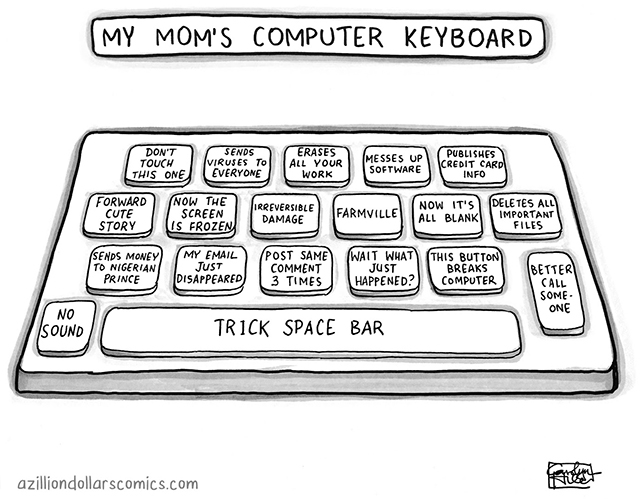
“My Mom’s Computer Keyboard” is a funny comic by Carolyn Hiler of A Zillion Dollar Comics visualizing a customized computer keyboard layout catered to the not so computer savvy mothers out there. Sorry mom!
The Shutter: SE's Matchbox Lounge Closes After Six-Year Run
firehose:/

After six years in business, SE Division's Matchbox Lounge — known for its stand-out burger and unofficial status as Pok Pok waiting room — has called it quits. Owner Michael Huffman confirms the shutter, saying, "While it is bittersweet it is a very positive decision and great things will come of it." In an official announcement, Huffman signs off:
"While we will miss the great happy hours, awesome burgers, and fun nights we shared with you, we are excited to hand off the space to a great group of people with an exciting new concept. Our little space has some big plans in store for it, and you will start seeing an amazing new place for the neighborhood emerge in the coming months."
More as it becomes available.
· Matchbox Lounge [Official site]
→ NSA secretly monitoring user activity directly from major tech companies’ systems
firehose"Times like this show the great value, to society as a whole, of widely available cryptography and open-source software. Even people with nothing to hide shouldn’t tolerate or permit overreaching government spying."
getting in an arms race with the government != not "tolerating or permitting overreaching government spying"
Appalling, yet not surprising (which, itself, is appalling).
Spokespeople from some of the tech companies are denying involvement, but I don’t trust those denials at all: not only have they left a lot of potential loopholes in the wording, but the post-9/11 U.S. federal government, especially via the executive branch under Presidents Bush and Obama, has instituted conditions under which they can order online businesses to disclose user information and prevent them from ever disclosing the order’s existence or the actions taken.
PRISM claims to only be intended for monitoring “foreign” communications, but that’s just lip service: they have access to everything, they try to establish that a target may be foreign, and then they collect two degrees of Kevin Bacon out from them even if it includes Americans.
Let’s see if Obama has anything to say about this. And, more importantly, let’s see if he takes any action to restore reasonable rights to our citizens and businesses. My guess: he might say something promising, but probably not; either way, he won’t actually do anything about it. (Not that any other viable candidates would have.)
Times like this show the great value, to society as a whole, of widely available cryptography and open-source software. Even people with nothing to hide shouldn’t tolerate or permit overreaching government spying.

NHTSA and DOT Want Your Car To Be Able To Disable Your Cellphone Functions
firehosewhat could possibly
Read more of this story at Slashdot.

Obama embracing some Bush-era anti-terror policies - Sioux City Journal
|
Obama embracing some Bush-era anti-terror policies
Sioux City Journal Five years into his presidency, Barack Obama presides over a national security apparatus that in many ways still resembles the one left behind by President George W. Bush. Drones are killing terrorism suspects, the U.S. military prison at Guantanamo Bay, ... and more » |
Tom Hardy to star in Takashi Miike's first Hollywood movie, 'The Outsider'
Acclaimed and often controversial director Takashi Miike's first English-language movie will star The Dark Knight Rises' Tom Hardy, according to Deadline Hollywood. Miike, who gained international recognition with extreme movies such as Audition, Ichi The Killer, Gozu, and Visitor Q, has over 50 cinematic releases to his name, but has never directed a non-Japanese feature.
Beyond Hardy's starring role and Miike's directorial duties, little is known about the movie. Dubbed The Ousider, it's based on an original story idea from Sons of Anarchy executive producer John Linson, and was scripted by Andrew Baldwin. The movie will center on a former American G.I. and ex-prisoner-of-war who rises through the ranks of the Japanese Yakuza.
- Via Variety
- Source Deadline Hollywood
- Image Credit Chrysler Group (Flickr / Creative Commons)
- Related Items japan the outsider tom hardy takashi miike japanese film john linson andrew baldwin
Music: Great Job, Internet!: Kanye Quest 3030 makes Yeezy the star of his own sci-fi 2D RPG
firehosesomehow doubt this rises to the levels of Shut Up and Jam Gaiden
but really, what ever could

Video game adaptations of current cultural touchstones have been in vogue for a few years now. Game Of Thrones, Breaking Bad, and The Wire all got comic adaptations of their plots to old-school video games, The Great Gatsby got a playable NES-style game, and Joy Division inspired an interactive art piece. But for someone as mythically megalomaniacal and contradictory as Kanye West, the only game that could encompass his persona is a science fiction RPG. Though it’s not endorsed by Kanye himself, the Dragon Warrior-esque Kanye Quest 3030 transports Yeezy to a dystopian future where he must battle clones of famous hip-hop stars under the control of a godlike dictator. Kanye finds a microphone inside a power box, talks with a 2Pac clone, and attempts to enter the Based Cathedral, all scored to a piano rendition of “Power.” Though the alpha version is only playable on PC, you ...
Read moreEvery Xbox One game will be available digitally on its release date
firehosefuck your retail
also I missed this bit of Orwellian friend definition:
"Disc-based games can be permanently given to friends through a license transfer process that can only occur once for a particular copy of a game, as long as the recipient has been on a person's Xbox Live friends list for at least 30 days."
Every disc-based Xbox One game will also be available to purchase from Xbox Live on its release date, Microsoft confirmed yesterday.
It's a very different policy from the situation on Xbox 360, where select disc-based games may eventually show up as downloadable titles in the Games on Demand section of the Xbox Live Marketplace, sometimes not months until after their retail release.
All Xbox One titles must be installed to the console's hard drive, so game discs essentially serve as little more than game delivery mechanisms — although installing a game from its disc will likely be faster than downloading it, depending on your internet bandwidth. Microsoft said when it unveiled the Xbox One last month that users will be able to start playing games as soon as the installation process begins.
The disc can be put aside once a game is installed: The Xbox One must check in with Xbox Live every 24 hours to ensure that a user is licensed to play a game, Microsoft confirmed yesterday. Disc-based games can be permanently given to friends through a license transfer process that can only occur once for a particular copy of a game, as long as the recipient has been on a person's Xbox Live friends list for at least 30 days.
Physical retail games can also be traded in at "participating retailers" and resold by those stores, and while Microsoft will not charge a "platform fee" to retailers, publishers or consumers for that practice, publishers may decide to charge for trade-ins or choose not to support them at all. Loaning or renting of games will not be supported at launch, although Microsoft said it is "exploring the possibilities" of allowing those practices in the future.
Apple probably drank 6% of Samsung’s milkshake
firehosetl;dr: Investors are upset that Apple will undercut Samsung in price, lol

Just weeks after opening sales of their new flagship phone, the Galaxy S4, Samsung Electronics Co has lost $12 billion in market value. The 6 percent share slide, the biggest Samsung has seen in nine months, was sparked by downgrades in global sales forecasts for the third quarter—from 30 million handsets to 25 million.
Samsung, which released both a high-end and “mini” version of their flagship phone to broaden its range of price points, just overtook Apple in smartphone sales for the first time since the iPhone 5 was launched. So what’s with the downgrade?
According to Reuters, sales have already dropped off for the Galaxy S4. With high-end headset sales lagging for all smartphone players, investors may be worried that Samsung’s heavy investment in the S4 won’t pan out, especially if their low-range headset is undercut by cheaper options.
Another worry for investors: Apple’s recently announced plan for an iPhone trade-in program, which will pay users for their older models to encourage them to upgrade. That, along with the rumors swirling about the launch of a cheaper iPhone, sets up Apple to knock Samsung out of the mid-range handset market, as high-quality refurbs from the trade-in policy hit the market. Overall smartphone sales are also on the decline, with 56 percent of Americans already owning smartphones. That argues for Samsung to focus on easy upgrades for its existing customers, rather than new smartphone owners.


(via tinycartridge)
firehoseill neva hav 2 c you ugly fuks again

Candigato Morris, a Cat, Could Probably Win Xalapa’s Mayoral Race
firehoseBongo Superduty beat