


Read more of this story at Slashdot.

firehose"the current PHP renaissance is well underway", Overbey
Read more of this story at Slashdot.
The Queen’s filly Estimate wins the Ascot Gold Cup — making her the first reigning monarch ever to have their horse win that race. She gets really excited, and her racing manager beside her is, well, beside himself…
Read more of this story at Slashdot.

firehose'There's a long list of bugs that Digg needs to work out before its public launch, as well as very basic tweaks like importing favicons for feeds and adding the word "Reader" to the logo at the top of the page. It also looks much better on Mac OS than on Windows. We noticed intermittent slowness, especially for actions such as unsubscribing from feeds. (We also had to use up two invite codes in order to test it in different browsers because the login page was not working.)'
surprisingly no word of Instapaper integration despite being a sibling of Digg in the Betaworks family of buyouts
The design for the new Digg Reader.
On July 1st, Google sunsets its popular RSS reader and millions of users will migrate elsewhere. Digg wants its new RSS reader to be ready when they do. The company had just three months to build Digg Reader, which explains why the first version has minimal features, missing graphics, and a number of bugs. It's nowhere near parity with Google Reader or some of the other competitors already on the market such as Feedly, Newsblur, and NetNewsWire. However, with Digg's access to a wealth of data about what people are reading, the potential is there for this to be a great tool.
For the first iteration, Digg has basically copied Google Reader: subscriptions on the left, headlines on the right, with keyboard shortcuts to save, Digg, and scroll through articles. The import of subscriptions and folders from Google Reader was smooth and speedy, although Digg is not providing a raw data import yet — users have to sign in with a Google account.
Orange dots appear beside headlines that are popular with Digg readers, so you can skim through your feed quickly and prioritize what to read. You can Digg, save, and share stories to Facebook and Twitter from the reader. In addition to your subscriptions, Digg provides a feed of the most popular stories across its network. The team has also curated a list of suggested feeds organized into categories for RSS users who want to find more sources to follow.
Digg is sending out invites for the highly anticipated RSS reader to more than 17,000 beta testers on Monday, and then will open to the public on July 26th. The iPhone app will also become available then. Both products are free for now, although Digg is planning some premium features in the future.
There's a long list of bugs that Digg needs to work out before its public launch, as well as very basic tweaks like importing favicons for feeds and adding the word "Reader" to the logo at the top of the page. It also looks much better on Mac OS than on Windows. We noticed intermittent slowness, especially for actions such as unsubscribing from feeds. (We also had to use up two invite codes in order to test it in different browsers because the login page was not working.) However, many of these bugs and other issues should be fixed by the time Digg Reader goes fully public.
Furthermore, the July 26th deadline does not mean work will stop. Digg made major changes to the Digg.com homepage after it launched last summer, and that's likely to happen with Digg Reader as well. A few missing features, such as not being able to search for feeds, may be a bit painful in the interim. And at the end of the month, Google Reader users will be looking for an RSS tool they can use immediately; Digg Reader may not be fully featured enough yet for the true power user.
In a survey conducted by Digg, users said they wanted a reader that was fast, did not look like a magazine, and synced with mobile. We couldn't test that last criterion, but it looks like Digg Reader delivers on its basic promise. It is functional as a reader, but its pitch to Google Reader refugees relies on minimalist design and the promise of future features.

firehosehopefully they're also backing stuff up these days
Pixar has a long history of building new software between projects (most recently overhauling its rendering software for Brave), but in the run-up to Monsters University, the changes cut particularly deep. As planning kicked in, director of photography Jean-Claude Kalache announced he wanted to change how light worked at Pixar.
"We wanted to stop being engineers and be artists."
"What if we made these lights just work?" Kalache told The Verge, in a Jobsian turn of phrase. Instead of building reflections and shadows manually, why not do it automatically every time an artist placed a light source? "It was as if every time you took a photograph, you built a new camera," Kalache says. "It takes away from the art of taking a picture. We wanted to stop being engineers and be artists." The result was Global Illumination, the lighting system getting its first public debut on Thursday with Monsters University.
It sounds harmless when Kalache describes it, but Global Illumination represented a complete overhaul of the lighting system that had served Pixar since the Toy Story days, and left many artists relearning the basic elements of their job. "It was extremely controversial," said Pixar's technical director Chris Horne in a recent interview, "but it made a huge impact."
"It was extremely controversial, but it made a huge impact."
The change has to do with ray-tracing — the technique of mapping out every ray of light in a given scene, as it bounces off walls and characters, casting shadows and producing reflections. It's closer to the way light works in the actual world, where a single light source will bounce light into every corner of a room. It's already common in partial-CGI environments like the Transformers and Iron Man movies, where Industrial Light & Magic used the technique to create metallic reflections. But for Pixar's full CGI environments, mapping out the millions of beams of light was seen as too arduous to be practical. Instead, Pixar relied on manually placed shadows and a network of direct light sources, a setup that was becoming increasingly intricate as the models and setups became more advanced.
Part of On The Verge — watch the full episode here
Global Illumination did away with all that, producing automatic reflections and shadows based on a simple placement of lights. If a wall is blue, the light coming off it will be exactly as bluish as it should be, at least to start with. Since Pixar is still, as Kalache puts it, "a company that makes cartoons," the system leaves room for artists to blow out lights and shadows beyond what’s realistic, but the baseline is a naturalism that’s based on the physics of light. And instead of artists planning out soft lights and shadows, everything is moved into hardware. That leaves less work for the designers but more work for the render farm, which works at night while the designers sleep. "It's all in the memory," says Christophe Hery, the global illumination core architect for Monsters University. Because of the intensely interconnected nature of the light, everything had to be processed at once, which resulted in incredible RAM demands. Describing one scene, Hery says, "We had the full campus. We had the trees, the grass, the people, the crowds, all held in memory at once. At some point, the rendering engine can try to be clever" about what doesn’t need to be rendered, "but you can only hide so much."
The biggest struggle was to keep each frame down to 20GB of memory
That's a lot to keep in RAM. The biggest struggle was to keep each frame down to 20GB of memory. Pixar’s render farm uses machines with 96GB of RAM each, but since the machines need to process four frames in parallel, anything much higher than 20GB was dangerous. That might seem like a lot for a single frame, but it has to hold every object in the scene, on-and-off camera, right down to the hairs of each monster’s fur. As long as it’s reflecting light, it needs to be in memory. And if any of those hairs move, the light has to be completely recalibrated — usually in another overnight turn through the render farm.
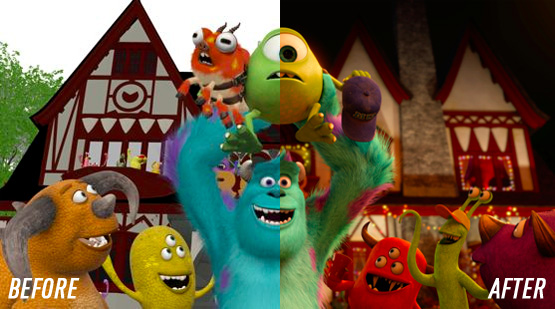
Lit and unlit renderings from Monsters University
"Successful lighting is silent lighting."
The result was more time spent on models, and more complex setups than would have been possible in the past. Kalache points to a Monsters University scene in a tunnel, where sea urchins provide thousands of moving light sources, each reflecting back and forth off the tunnel walls. Calculating each reflection individually would have meant five times as much work, a mind-bogglingly intricate setup for designers.
But even in less complex setups, you can see the effects of Global Illumination. Monsters University scenes have more soft shadows, fewer eerily well-lit backgrounds than earlier Pixar films. It’s more on par with the lighting and cinematography you’d see in a live-action film, owing less to the cartoony flatness of cel animation. Audiences may not notice, but it doesn’t seem to bother the team. Unlike Optimus Prime, this kind of effect is designed to live in the background, helping the story from behind the scenes. In Kalache’s words, "successful lighting is silent lighting."
firehose'One blogger wrote (registration required), “If Starbucks couldn’t manage to stay on, how can regular people afford to?” Another said, “This highlights the rising costs of rent and labor.” '

At noon in Beijing today, Starbucks’ first store in China served its last drink. The day passed uneventfully, but Chinese bloggers reflected on the reasons why one of the biggest foreign chains in the city would be closing a storefront.
Rumors of the closing of Starbucks’ store on the bottom floor of China World Shopping Mall in downtown Beijing had circulated on Chinese social media since early June. Bloggers wondered whether it was because of Beijing’s surging rent prices. The company has since said the closure is because it plans to move to a new nearby location (link in Chinese) with bigger space and better décor. But the Financial Times reports today (paywall) that staff members have cited rising rent.
And that’s where Chinese residents and Starbucks have something in common. Over the past few months, the government has been trying to rein in runaway real estate prices that have put renting or buying homes out of reach for many regular Chinese. But prices have been slow to come down. One blogger wrote (registration required), “If Starbucks couldn’t manage to stay on, how can regular people afford to?” Another said, “This highlights the rising costs of rent and labor.”
China’s harsh real-estate landscape might make it hard for Starbucks to keep its pledge to have 1,000 stores in China by the end of the year. Most of its stores now are in major cities like Beijing, where authorities are paying less attention to reining in commercial property prices. Commercial property in Beijing grew 23% in May, compared to 15.2% in residential real estate. Regardless of where Starbucks moves in Beijing, it might have trouble making rent.

firehosevia saucie
first one is good stuff


As a former resident of Boston and a frequent consumer of Flour Bakery's jam-filled doughnuts during those years, this cookbook brings me great joy. Flour Bakery is a special place and the food they serve — everything from vegan berry muffins to chicken pot pie! — is the kind to make you happy in both belly and in spirit. And although it's not quite the same as sitting at one of their sun-dappled café tables on a Saturday morning, being able to re-create favorite Flour Bakery treats at home is definitely the next best thing.
More
    
|
 |
rachel
shared this story
from  私信. 私信.
|

|
rachel
shared this story
from  Universal Hub - All Boston, all the time: Universal Hub - All Boston, all the time:
|
| :( |
Just in from the organizers of our iconic celebration, through which Bostonians have rung in the New Year since 1975:
The Board of Directors of First Night Boston announced today that the agency does not currently have the funds to continue planning First Night Boston 2014, which should take place on December 31, 2013. The board of directors voted to cease operations for the private non-profit organization that was founded in 1976 and has produced 37 First Night festivals. First Night Boston 2014 would have been the 38th edition of the event.
The Board cites declining foundation and sponsorship dollars as the main reason First Night would not be able to raise the funds necessary to produce this year’s event. First Night will lay off staff and close its offices on June 30, 2013. This will mean the loss of three full-time positions, one part-time position, six year-round contractor positions and various seasonal contract festival production positions. First Night does have a small reserve, and will be able to pay its bills before closing its doors.
The Board of First Night hopes to transfer the First Night Boston trademark to the City of Boston. The Board, recognizing that First Night is one of the City’s signature events, plans to work with the City to identify an organization that can assume the First Night brand and eventually produce an event containing at least some of the elements of a First Night celebration.
Steven Aquino has a wonderful article on TidBits about using Markdown as a visually impaired writer:
The less time I have to look at the screen, the better my eyes feel. Thus, what makes using Markdown so great is that I don’t have to waste time trying to locate buttons or menu options. I just glance down at my keyboard to ensure I’m pressing the right keys.
I couldn't agree any more. I'm pretty efficient with the tools I practice with. If I used a word processor all day, I'd probably be pretty efficient at using it too. But Markdown means I'm proficient at writing, not just using the tool.
firehoseprefab supertower follow-up

The world’s tallest building might be the sort of place you wouldn’t want to live. Sure, Sky City One, which will rise from an empty field in Changsha, China, will be a miracle of efficient construction that will be built in only 90 days, resist magnitude-9 earthquakes, and save energy just by allowing its residents to travel less. But as with all design compromises, those superlatives come at a price. In this case, it could be livability.
All of the parts of Sky City One will be pre-fabricated in factories owned by Broad Sustainable Building (BSB). The company has already proved the technology in a 30-story hotel erected in just 15 days in Changsha, known as the T30. To get that speed, the hotel was built out of individual pre-fabricated blocks, like Legos.

The problem is that each of these blocks is relatively small. That means interior spaces in the hotel are cramped. Here’s how Lauren Hilgers, writing for Wired, described her trip to the T30:
Compared with the West’s elegant modular buildings, Zhang’s skyscrapers are aesthetically underwhelming, to say the least. On a tour of the T30, my guide gestures at a scale model and says, “It’s not very good-looking, is it?” To create a sufficiently spacious lobby for the hotel, an awkward pyramid-shaped structure had to be attached to the base. Inside, the hallways are uncomfortably narrow; climbing the central stairway feels like clanging up the stairs of a stadium bleacher.

Now imagine 202 floors of “uncomfortably narrow” hallways and equally narrow individual living units.
A look at the plans (below) for Sky City One reveal that the maximum width of each unit of the building will be just 3.9 meters, or 12.8 feet. That’s the width of a “single-wide” mobile home in the US. Save a dizzyingly tall interior atrium extending from the first to the 170th floor, any interior spaces wider than that will be interrupted by the steel columns that define the edge of each pre-fabricated unit.

Zhang Yue, founder of BSB, has acknowledged that his building prioritizes efficiency above flashiness—this is no vanity project along the lines of Dubai’s Burj Khalifa, but an experiment in creating a new kind of vertical, and environmentally-friendly, urbanism. And China is home to countless strange and poorly-constructed buildings, so for many of Sky City One’s residents, their new home will be an upgrade from their current living circumstances.
It may simply be that in a frugal future, this is the new face of “world’s tallest” structures—a transition from projects designed to awe to projects designed merely to put as many human beings in as small a footprint as possible.

firehose<3 this game forever


Area 88 aka UN Squadron (Capcom - arcade - 1989)
Read more of this story at Slashdot.

firehoseYOU HEARD IT HERE FIRST
BELICHICK FRAMED HERNANDEZ
SO HE CAN MOVE TEBOW TO TE
firehosetrains!
The second video is of the SkyTrain at Düsseldorf International Airport, taken last March. It took three visits before I got any decent footage of this one.
Whee!
firehose"the timeline for the announcement of the new Doctor is likely sometime in either August or September"

A key returning Captain America cast member is spotted on the sequel set. Do we already know the villains of Doctor Strange? Brad Bird's retro epic Tomorrowland is zeroing in on its female lead. How will Transformers 4 incorporate China into its story? And the BBC explains when they'll reveal the Twelfth Doctor. Spoilers below!

|
|
firehoseBogost said that when we talk about books or films or paintings and photography, we have had and continue to have the ability to distribute these materials in a number of ways. But with the App Store, and increasingly with electronic books through networks like the Kindle through iBooks, we don't have that ability.
"We have a kind of one-way path through the bottleneck of corporate approval before we can distribute something with the iPhone or the iOS platform," Bogost said. "Even on the Mac now, because of the Mac App Store, you have to have a signed app or the operating system will say this file is dangerous because it isn't approved by Apple. That approval is less moral on their part than it is financial.
"So the objection that Apple should be able to do whatever it wants because it's a corporate sandbox ... that's sort of exactly the problem to oppose. It's like, yes, of course they can do what they want. That's the problem. The problem is we're now living in an era in which there are fewer and fewer ways to create and disseminate ideas, and more and more of them are under the direct control of a small number of large companies."
By Tracey Lien
on June 21, 2013 at 9:00a
When the iPhone launched in 2007, it changed the video game landscape in a way that no one could have predicted. Where gaming was once confined to PCs and consoles, millions of people — self-identified gamers or not — now had a device in their hands that could play games. Anyone — as long as they had the programming and design savvy — could make a video game and distribute it to millions of potential players. Developers didn't need big teams with even bigger budgets to be successful; some of the best-selling games on the platform were made by obscure studios or one-person teams. It seemed like a video game-making democracy had been reached.
In the years since the device's launch, the mobile app market has become saturated with games. The iTunes App Store charts are increasingly dominated by established studios, from large publishers like Disney and Electronic Arts to independent studios that experienced freakish success on the App Store like Rovio (Angry Birds) and HalfBrick (Fruit Ninja) and have been on a roll ever since. It's a tougher market to be in, but the widely held belief is any developer, no matter how big or small, can still participate.
Except, that isn't true.
In recent years, a number of "serious games" (games designed for a primary purpose other than to entertain) have been removed or outright rejected from Apple's App Store for falling foul of its guidelines — guidelines that the developers we spoke to described as vague and subjectively applied. There's EndGame: Syria — a trading card game that explores the conflict in Syria. There's Sweatshop HD — the cartoonish management game where players operate a sweatshop. There's also In A Permanent Save State and Phone Story — two stylized games about the Foxconn suicides. And these are just some of the more high-profile bans.
Most people who use iOS devices aren't privy to Apple's curation process for its App Store, and very few are aware of the rejections that have taken place. The developers Polygon spoke to believe that the removal of serious games from the App Store is an unfair act of censorship, of sanitizing the App Store and it denies video games the cultural status as a medium that can tackle serious issues. They believe it needs to change. And they're not alone.
Rejection
Apple's guidelines for app developers seem straightforward on the surface. There are rules against creating apps that contain pornographic content and anything that falls in the category of hate speech, such as defamatory or mean-spirited games, or anything likely to expose a group to harm or violence. While most video games submitted to the App Store steer so far from these areas that the guidelines are a non-issue, serious games are increasingly being caught in the net.
Tomas Rawlings is a developer at GameTheNews, an independent studio that covers global events as games. The studio wants to be known for its ability to respond to breaking news with games that have their own playable twists, but it is perhaps better known for numerous times Apple rejected its trading card game app, Endgame: Syria.

Endgame: Syria
"I'd been following the news and the seed of the game actually came from when I was watching some pundits debate whether or not the West should arm Syria, and they were speculating all the possible outcomes," Rawlings told Polygon. "That's when it struck me that, actually, that non-linear scenario with multiple outcomes could be well-expressed in a game. A game is a good way to express that because, as the user, I can make that decision, see the outcome, then make the other decision and see the outcome of that."
He set out to make Endgame: Syria, a trading card game where players explore the politics and military side of the conflict in Syria by deciding what political paths to choose and which military units to deploy, all while maintaining support from the people. If support is lost on either side, the game is over. The game can also end in a peace deal between both sides.
Apple rejected the game.
Rawlings told Polygon that his initial correspondence with Apple had a degree of personalization to it. He received an email stating the guideline the game had broken, along with three screenshots that illustrated the violations. According to the email, Apple found that the app "contain[ed] content or features that include people from a specific race, culture, government, corporation, or other real entity as enemies in the context of the game, which is not in compliance with the App Store Review Guidelines.
"Specifically, we noticed your app includes a simulation with specific targeted enemies within Syria."
The screenshots included showed the game referencing the Assad Regime, Palestinian groups and militia groups.
"That kind of gave us the clear signal that, look, you can't mention these groups, you need to get rid of those references," Rawlings said. "The guideline we broke was about how you're not allowed to make apps that make specific groups the enemy, but that's open to interpretation. You can see for example that an app about the second World War with Nazis as the enemy could theoretically be rejected, but some of those games are passed.
"So I thought they might use nuance in judging that, but as it happened, they didn't."
Rawlings responded to the rejection by going through the game and removing every reference to any group. Hezbollah became a "militant group", Palestinians became "refugees". The game was now a more generic simulation of an unspecified military and political conflict. It was resubmitted. Apple rejected it a second time, citing the same guidelines, but this time it did not provide any screenshots or further explanation.
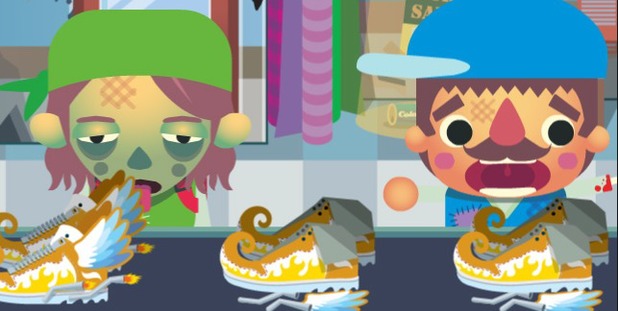
Sweatshop HD was removed Apple's store because it was uncomfortable with the recreation of a sweatshop
Following a phone conversation with an Apple employee who suggested that they reword the actual App Store text to make clear what the game was about, they submitted the game a third time and had it rejected again. Earlier this year, Rawlings appealed the third rejection, but the appeal was also rejected. At this point, the game referenced nations like the U.S., U.K., Syria and Iran, but did not reference any groups. The guidelines only specified that groups were not to be referenced — there was nothing about not being able to reference nations.
"The same thing happened — they gave us the guideline we broke, then nothing else. There was no additional information," Rawlings said.
"I get what Apple is trying to do with that," he said. "You don't want somebody producing something that can be used as either an overt or covert sexist, misogynist or some kind of hate-type application, and I would completely support them not wanting that on their system.
"But we're arguing there's a bit more granularity here. This isn't about saying you must hate these groups. This is about saying we want you to understand what's going on."
Endgame: Syria was released on Android, where guidelines are much more relaxed and the market is less regulated, and a heavily modified version of Endgame Syria — Endgame: Eurasia (a reference to George Orwell's 1984) — was successfully passed on the iOS App Store. Unfortunately, much of the meaning and original intention of Endgame: Syria has been lost as a result.
"I'm finding it very frustrating because we're obviously not doing the sort of thing I imagine those guidelines are there to stop," Rawlings said. "We're not doing any unfair, nasty targeting. We're not looking at any of that. Yet, we're being caught in the same net designed to stop that. It makes me wonder if Apple is just shying away from anything that's even a little bit controversial. And if you're going to make serious games, that's a huge problem."
The removals
In 2010, Foxconn, a large contracting manufacturer with clients like Apple, HP, Dell, Motorola and Sony reported 18 suicide attempts from its employees. The suicide attempts, which led to 14 deaths, were believed to be the result of the employees working more than 72 hours without breaks in inhumane conditions and for low pay.
Two games were made about the issue. Unlike Endgame: Syria, both were approved by Apple and were available on the Apple App Store for download. But both were removed shortly after.
Phone Story was one of the games. Developed by Molleindustria, the game consists of four minigames that require players to complete activities like forcing children in the Third World to mine coltan and preventing the suicides at Foxconn.
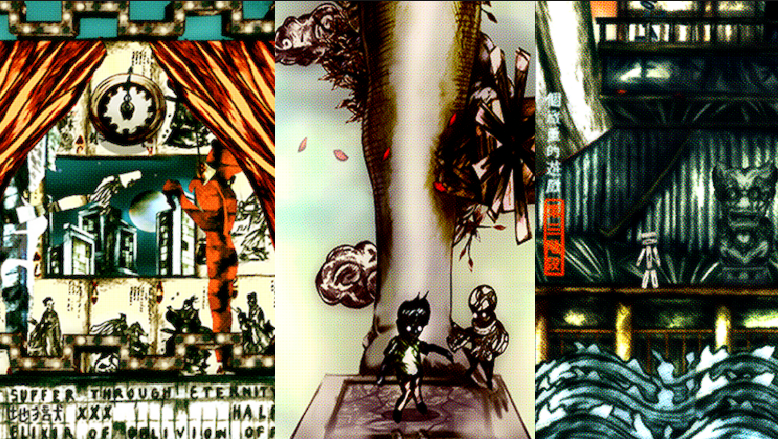
Triptych of In A Permanent Save State
"It's very easy to get banned if you want to get banned, but with Phone Story, we weren't trying to mess with the guidelines," said the game's developer, Paolo Pedercini. "There are no explicitly graphic depictions, there are no depictions of pornography, there was no copyright infringement. The idea was to make a game that was actually compliant with the guidelines, and it was in fact compliant with the guidelines because it was approved."
Benjamin Poynter's In A Permanent Save State was the other game to tackle the Foxconn suicides. Instead of putting players in charge of Foxconn and giving them the ability to prevent the suicides, it takes a more fantasy/spiritual approach by allowing players to follow the narrative of seven of the deceased workers from the Foxconn factory through the afterlife, where each worker represents a certain stage of the afterlife in Chinese culture.
"What inspired me was finding the humanity in what was going on between Apple and Foxconn," Poynter said. "The iPhones that were being made here, they're beautiful devices. But I wanted to find the humanity behind it — what souls have been crushed to make them and what was the cost of creating this fantasy that a lot of us live in.
"I wanted to challenge where the devices that we cherish — the devices that we carry — where they come from. Ironically, the game seems to be a correct vessel for it, or at least I think so, because these workers are the very people who manufacture these fantasies. I believe that in death, these workers were not interested in aspects of reality or politics. They wanted to see their own dreams and fantasies come true, at an expensive cost."
In A Permanent Save State was removed from the Apple App Store two hours after it was approved and went live. Phone Story was removed after four hours on the App Store.
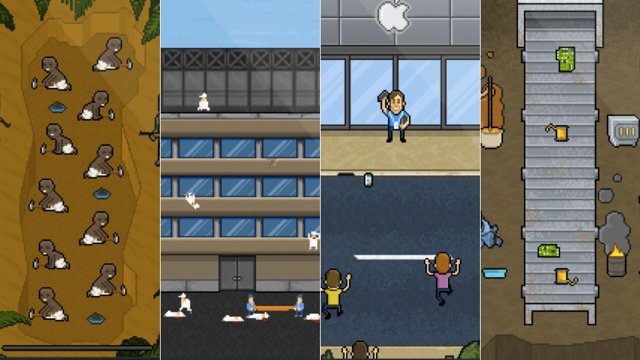
Phone Story
Poynter received his notice of the game's removal via email. He later received a phone call from an Apple representative who cited three reasons for the game's removal: 1) Casting a corporate or racial villain, 2) Pushing ethical boundaries and 3) Mean-spiritedness.
Pedercini's app removal came with four guideline violations: 1) Depicting violence or abuse of children, 2) Presenting excessively objectionable or crude content, 3) Including the ability to make donations through a paid app and 4) Collecting donations through a non-Safari website or SMS.
Pedercini told Polygon that the last two violations were technical and could have easily been fixed, but the first two were frustratingly vague.
"The violence and abuse of children is only in the first level and it's very abstract," he said. "You're not beating up children or anything, and you understand from the voiceover the context of what is happening. I asked the Apple representative how I was supposed to talk about violence or abuse of children with depicting it, and the guy was like, 'Oh, it's your business, really.'
"Another thing I asked for clarification for was the main leverage they had, which was 16.1 — excessively objectionable or crude content. So making a game about the Syrian uprising is objectionable, and it turns out making a game about the ghosts of factory workers navigating the afterlife is also objectionable.
"So they essentially reserve the right to decide case by case what they like and what they don't, so the guidelines are really just a way to guide you through what they tend to like, instead of being an ultimate document."
Apple's rules
The experience many developers have had with Apple is it will not budge, even when a developer explains the intent of his or her game.
In the introduction of Apple's App Store guidelines, it explicitly states in the second paragraph: "We view Apps [as] different than books or songs, which we do not curate. If you want to criticize a religion, write a book. If you want to describe sex, write a book or a song, or create a medical app. It can get complicated, but we have decided to not allow certain kinds of content in the App Store."
It continues: "We're really trying our best to create the best platform in the world for you to express your talents and make a living too. If it sounds like we're control freaks, well, maybe it's because we're so committed to our users and making sure they have a quality experience with our products. Just like almost all of you are, too."
When we reached Apple on numerous occasions during the writing of this story, the company declined to comment.
The developers we spoke to said that these guidelines show a bias against video games and limit what games can be.
"To me, what [Apple] is trying to do is create a sort of exception to the concept of software," Phone Story developer Paolo Pedercini said. "They are renaming software as apps. The app is a kind of self-contained software, and one thing they want to do besides pushing the prices down and making it as modular and as easy to consume as possible is essentially deny the app a cultural status.
"They are saying books and music — we will never censor those because they're culture. But the app is something different. The app is more akin to a screwdriver or a spoon or a chainsaw. It's not something that's supposed to produce meaning. And that, to me, is the main problem of what they're trying to do. That is something that needs to be challenged and discussed."

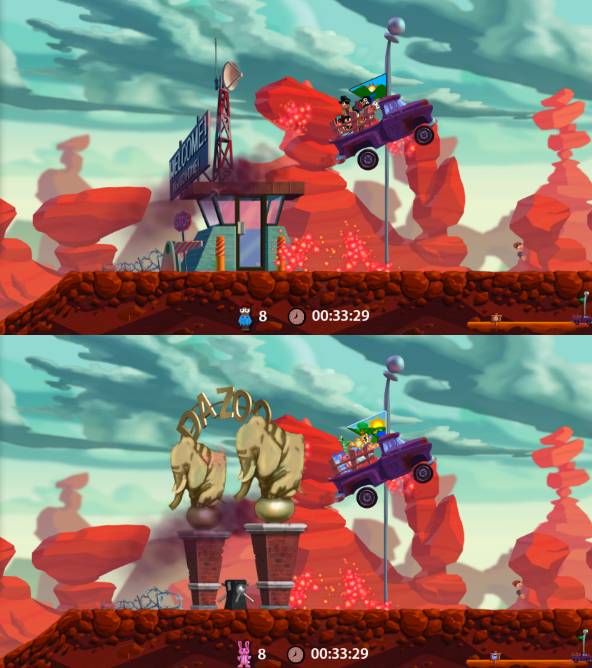
Alex Schwartz is a developer from Owlchemy Labs, a studio that has worked on games like Jack Lumber and Shoot Many Robots. In 2010, the studio made a game called Smuggle Truck in response to the difficulty it had getting a visa for a fellow developer to come work with the team in the U.S.
The satirical game poked fun at the complexities of obtaining a green card by getting players to drive through and over obstacles to get across the U.S. Border. Apple rejected the game, with Schwartz saying the reason it provided being vague and non-descript.
The night the game was rejected, the development team came together and decided to turn Smuggle Truck on its head as a joke. It would change the game's characters to stuffed animals. The animals would attempt to get to the zoo so they could get free animal healthcare. The name would be changed to Snuggle Truck. Schwartz said the team had its artist change only three assets: the characters, the logo and border. Apple approved the game.
Polygon spoke to the American Civil Liberties Union (ACLU) about what rights developers have versus the rights of Apple as a privately-owned corporation. The ACLU's senior analyst, Jay Stanley said there are two ways to view a platform like the Apple App Store: one is as an independent publisher like the New York Times, which has the right to publish what it wants and to not publish what it doesn't, and the other is to look at it as a kind of public platform where speakers who appear on that platform have free speech rights.
"Clearly, as a legal matter at the current time, Apple's platform is closer to the first," Stanley said. "Legally, Apple is regarded more as a publisher, and they have the right to exclude what they want to exclude because it's a private platform."
And this is the bigger problem at play, according to a professor at the Georgia Institute of Technology, game designer and author of Persuasive Games The Expressive Power of Video Games, Ian Bogost. The real problem, he says, isn't Apple's guidelines — the real problem is how we've allowed a corporate-owned channel to dominate the distribution of software. What we should be worried about is the corporate ownership in control of a very popular, increasingly important distribution channel.
Speaking to Polygon, Bogost said that when we talk about books or films or paintings and photography, we have had and continue to have the ability to distribute these materials in a number of ways. But with the App Store, and increasingly with electronic books through networks like the Kindle through iBooks, we don't have that ability.
"We have a kind of one-way path through the bottleneck of corporate approval before we can distribute something with the iPhone or the iOS platform," Bogost said. "Even on the Mac now, because of the Mac App Store, you have to have a signed app or the operating system will say this file is dangerous because it isn't approved by Apple. That approval is less moral on their part than it is financial.
"So the objection that Apple should be able to do whatever it wants because it's a corporate sandbox ... that's sort of exactly the problem to oppose. It's like, yes, of course they can do what they want. That's the problem. The problem is we're now living in an era in which there are fewer and fewer ways to create and disseminate ideas, and more and more of them are under the direct control of a small number of large companies."
Antitrust issues
The notion of "Apple's rules, Apple's way" can be disempowering for many developers, but according to antitrust expert and a professor at the University of New South Wales, Michael Peters, there are government bodies looking out for content creators.
Antitrust laws exist to protect consumers from uncompetitive behavior from businesses and to prevent companies from monopolizing a market. In the U.S., Apple is currently going through a civil antitrust trial over claims it colluded with publishers to fix e-book prices, and in Australia it is currently under investigation by the Australian Competition and Consumer Commission for uncompetitive behavior.
Top: Smuggle Truck / Bottom: Snuggle Truck
According to Peters, the "Apple's rules, Apple's way" mantra may have been OK in the 80s when Apple was a small company and its products were relatively niche, but now that it has grown to what it is today, it has corporate responsibilities and the company is teetering on the edge of breaking antitrust laws. He likens Apple's current situation to that of Microsoft's famous antitrust case of the late '90s when the company was taken to court for bundling Internet Explorer with its operating system, which effectively knocked out competition like Netscape and Opera. But he says Apple could potentially be in a trickier situation than Microsoft was because not only does it provide the software and operating system, it also manufactures the hardware.
"Apple could potentially be what is called a structural monopoly, which means you can't do anything with it is because, as a monopoly, it's not as if Apple software can be used with anything else. It's only available with Apple. You can't break up these guys."
Peters told Polygon that if a developer believes that a company's terms are not fair and don't promote competition, they should immediately report them to the competition commissioner of their territory for investigation.
"Once a company becomes as successful as Apple, it's got certain obligations," Peters said. "Microsoft discovered it in the late '90s, Google is discovering it — it's in court in almost every country — and these organizations need to come to terms that their success has got nothing to do with their effort. It's got to do with the market tendency out there and the way they behave in the marketplace."
But even if Apple is found to not breach antitrust laws, the ACLU's Jay Stanley says that censorship is not only barred by the constitution when it comes to government, "it's also a bad idea."
"It would be much better if Apple would protect free speech within its private forum," Stanley said. "For one thing, when you start to act as a censor, you quickly get entrapped. Every time something comes up that people find 'controversial,' you're going to get attacked, and every time you don't allow something that people think you should allow, you're going to get attacked.
"And of course, line-drawing and censorship decisions are always complicated and it's very difficult to be consistent. It ends up seeming arbitrary and capricious. I think as forums like these emerge as central platforms, it is important that they remain open to all viewpoints and content."
Limiting the medium
Most of the developers Polygon spoke to have either released their games on non-iOS platforms or modified them to accommodate Apple's guidelines. While there's a bigger and much longer debate on antitrust laws to be had, many independent developers aren't interested in involving themselves in the specifics of competition law. They just want their games to have the best shot possible and, for now, that means having them on a platform like the Apple App Store.
Endgame: Syria developer Tomas Rawlings believes that if Apple continues to exclude content via its vague application of guidelines, it won't just be developers who take issue with its practices.
"What I think is going to be increasingly difficult for Apple as its devices become more popular is people will naturally ask, 'Why can't I see this? Why are you making these decisions for me?' So I think Apple is going to have to revisit how they treat things like serious games, and I'm sure we're not the only category of application that they are getting friction from," Rawlings said.
"So really, the ball is in Apple's court to show it recognises the difference between completely inappropriate content and those people who are just trying to do something a bit different. I would like to see them balance it more toward the developers who are taking these issues seriously, and who do want to use games as an experimental form to explore it."
firehoselol
|
A&F Discontinues Taylor Swift Joke T-Shirt After Rabid Fanbase Flips Out
Cosmopolitan (blog) Abercrombie and Fitch — hardly a paragon of moral standards before this anyway — has discontinued a t-shirt that makes fun of Taylor Swift's serial dating after "Swifties" came down on them like a ton of angry, feelings-having bricks, reports Buzzfeed. and more » |
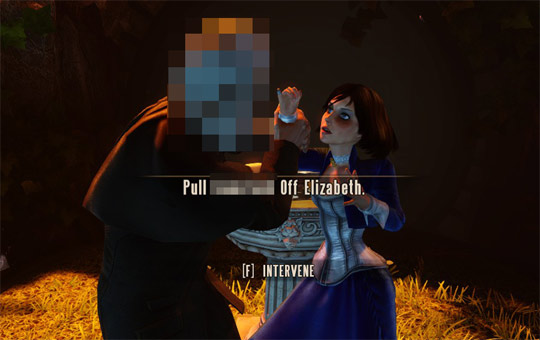
firehose'The game is waiting and will not continue, and it is literally telling you to press [F] -- another hotkey tooltip, as if you've forgotten to use [W] to walk or [SPACE] to jump. The game thinks you are stupid and it is telling you how to win the story and experience narrative involvement.
Feel these emotions, dummy! Don't you understand that this is the climax?
Here, in a single crystallized moment, was a game with Ambitions of Meaning which suddenly demanded an emotional reaction that it didn't earn at all and never had a chance of earning, strained through the exact same controls and impulses used to dig through countless trash cans.'


firehoseMing Doyle is awesome beat

Each week, Big Issues focuses on a newly released comic-book issue of significance. This week, it’s Mara #5. Written by Brian Wood (X-Men, Star Wars) and drawn by Ming Doyle (Fantastic Four, Guardians Of The Galaxy Infinite Comic), it’s a stunning climax to a miniseries that has successfully experimented with superhero conventions. Warning: spoilers ahead.
There are superpowers in the pages of Mara, but this is not a book about a superhero. Mara Prince is a 17-year-old volleyball superstar in a war-torn future where sports have become the primary mode of escape for an oppressed populace. She gains worldwide recognition and loads of corporate sponsors for her prodigious performance in the arena. The first issue was a fascinating look at sports culture and how it can be used for political manipulation—in the future, the armed forces has modified its focus to attract sports-minded individuals seeking glory and ...
Read morefirehosevia Russian Sledges
maybe they'll be accessible PDFs and won't be a scanned copy of a single printout
maybe I'll eat twelve pizzas for lunch today
By Craig Pearson on June 21st, 2013 at 6:00 pm.

You have about 20 hours left to take advantage of GOG’s DRM Free sale, put togeether to celebrate today being the longest day of the year. The games are free of the lumpen, ugly additional code that bootstraps their code to your PC. If for some reason you own a million PCs, you would be allowed, nay encouraged, to install them on each and every one. I wouldn’t, because that would involve a lot of work, not least in acquiring an entire planet to source the resources for such a PC collection, but the hypothetical scenario still stands. You really should look over the whole list, but below I’ve gathered a few treats to entice you in.
If you’ve somehow managed to miss the previous 156,344 times space-based roguelike FTL has been on sale, it’s now only $2.50. Worth it for such an adventure-filled space romp. Another top-down treat, the horrendously sick and wonderful Hotline Miami is all the threes, $3.33.
Other indies are available, the tip-top hat Fez is only $4.99, while Robert Florence would be delighted to know you can experience what he experienced in Waking Mars for only $2.49.
While there are plenty of brains to splat, for something more traditionally cerebral there’s the Wadjet Eye selection, which have an 80% discount when bought together (for $8.96), or you can grab any game from the pack for 50% off. If that’s not taxing enough, the Turn-Based Strategy Pack for $12.43 includes Sid Meier’s Alpha Centauri, Master of Magic, Master of Orion 1+2, Sid Meier’s: Colonization, Fragile Allegiance, Galactic Civilizations I: Ultimate Edition, and Space Empires IV: Deluxe.
Oh, and my personal recommendation for something odd, charming, and cheap is Miasamata. It’s only $3.74.
Feel free to recommend games in the comments, because I’ve definitely missed loads.

The burger formerly known as the “UB Double Double Burger.”
Chef Chris Shepherd of Houston-based restaurant Underbelly recently received a cease and desist letter from fast food chain In-N-Out Burger that threatens legal action for naming his “UB Double Double” burger after their own “Double-Double” burger. In response, Shepherd has simply changed the name of his “UB Double Double” burger to the “Cease and Desist Burger.” Eater Houston has more of the story.
In-N-Out Burger has, of course, heard of our Double Double Burger. Henceforth known as the "Cease and Desist Burger." #AskForItByName
— Underbelly (@UnderbellyHOU) June 18, 2013
via Eater Houston, Austin CultureMap
Thanks Lori Dorn!


