firehoseHUBSPOT

Nothing much happening here, just a trunk full of Ood heads.
just your average day on a BBC set.
doesn’t anyone find this at all a bit Ood?

Microsoft's rumored "major restructuring" looks set to be unveiled by July 1st. All Things D reports that the reorg, which will focus on the devices and services vision, is being led by CEO Steve Ballmer without the consultation of all Microsoft's executives. The upcoming changes are said to be major, leaving some executives worried for their own positions and the plans for the company as a whole. All Things D quotes one insider as saying they're "titanic" changes, noting they might be attached to Ballmer's legacy at the company. "It’s the first time in a long time that it feels like that there will be some major shifts, including some departures," says the alleged insider.
Could Windows and Windows Phone move closer together?
Ballmer is reportedly considering a new structure that would create four separate divisions: enterprise business, hardware, applications and services, and an operating systems group. Bloomberg reported earlier this month that the OS group could be jointly led by Windows Phone chief Terry Myerson and head of Windows engineering Julie Larson-Green. Sources familiar with Microsoft's plans have revealed to The Verge that the new structure would see a significant focus on further aligning the Windows and Windows Phone operating systems. Microsoft moved to a shared Windows 8 kernel in October for Windows Phone, but applications that run on both platforms still need tweaking by developers, and the two Windows stores remain separate.
Microsoft is heading to San Francisco on Wednesday to host its annual Build developer conference. The software maker will unveil improvements to its Windows 8 OS in the form of a Windows 8.1 update that will enter public preview this week. Microsoft plans to finalize and ship the Windows 8.1 update in time for new 7- and 8-inch devices later this year. It's also expected to play a role in new Surface devices expected for the holidays. Any reorg news, internally at least, would likely come during the Build conference as Microsoft switches to its new financial year on July 1st.
If Ballmer's rumored reorg takes places then it will be the first company-wide structural change at Microsoft under Ballmer's leadership. The 57-year-old took over the CEO role from co-founder Bill Gates in January 2000, and made some significant changes in 2008 ahead of the company's Windows 7 software. Ballmer recently let former Windows chief Steven Sinofsky go, in an unexpected move just weeks after the company shipped Windows 8. It's clear a significant change is underway at Microsoft, and Ballmer has detailed a as it moves to a combination of hardware and software.

firehoseHmm
'Sony in cooperation with AMD must have developed their own graphics driver for the PlayStation 4 with FreeBSD or at least ported the Catalyst code-base to BSD.'

 Dragon Age: Inquisition drops the '3' to drive home a non-linear narrative originally appeared on Joystiq on Sun, 23 Jun 2013 15:00:00 EST. Please see our terms for use of feeds.
World War Z has already earned $66 million in North America and $111.8 million worldwide this weekend, making it the biggest debut of Brad Pitt's career. So it's no surprise that Paramount is already planning a sequel. It seems the zombie apocalypse will have to go on a bit longer.

    
|
firehosepopular cartoon and games voice actress (Avatar, Scooby Doo, Diablo 3, Baldur's Gate 2, Tomb Raider, DC/Marvel/Cartoon Network rosters)
(Note: I know she has done much more than this, but I had trouble getting receipts as one of the blogs in question is down, and she deleted many of the offending posts.)
firehosevia Toaster Strudel
Company cries foul over appearance of genetically modified wheat plants but scientist who found it doubts claim of sabotage
It is a mystery that could cost the American farmer billions: how rogue genetically modified wheat plants turned up on a farmer's field in Oregon.
The scientist who first discovered the renegade grain – by dipping a plastic strip into a tube of pulped plant, in order to check its genetics – believes the GM wheat could have entered America's food supply undetected years ago, and could still be in circulation.
"There's a lot of potential for how it could have got into the supply," said Carol Mallory-Smith, a professor of weed sciences at Oregon State University. "It could have already been processed. It could have gone for animal feed somewhere or it could have gone for something else. It could have gone for storage."
The Department of Agriculture, which is conducting a secretive investigation into the renegade GM wheat outbreak, maintains the GM wheat remained confined to a single 125-acre field on a single farm in eastern Oregon. Officials said there was no evidence the contaminated wheat was in the marketplace.
Monsanto, which manufactured the altered gene and conducted field trials of the GM wheat several years ago, strongly suggested in a conference call with reporters on Friday that the company was the victim of sabotage of anti-GM campaigners. Robb Fraley, Monsanto's chief technology officer, said:
It's fair to say there are folks who don't like biotechnology and who would use this as an opportunity to make problems.
The real story is unlikely to emerge – if at all – until the publication of the final report by 18 Department of Agriculture investigators who are now scouring grain elevators, farmers' fields and university research stations in eastern Oregon, hunting for a few grains of suspicious wheat.
The stakes are high for America's wheat exports, with Japan and South Korea cancelling shipments; for Monsanto, which faces lawsuits from farmers for falling wheat prices and a consumer backlash against GM products; and for the US government, which must shore up confidence in the safety and integrity of the food supply.
The crisis for wheat farmers began in late April, with a phone call from a crop consultant seeking the advice of researchers at Oregon State University in Corvallis. The consultant had sprayed Roundup, a weed killer also manufactured by Monsanto, on some fallow land. Ordinarily, glyphosate, the active ingredient in Roundup, would be expected to clean out the entire 125-acre field. This time, however, some plants survived.
The consultant, fearing he had come across a "superweed", got in touch with the university and sent some plants in for testing. A clump of plants, carefully wrapped in plastic to keep them green, arrived by Fed-Ex on 30 April. Scientists separated 24 samples and tested them for the presence of Monsanto's Roundup Ready gene, CP4, which was developed to be resistant to glyphosate, the active ingredient in Roundup weed killer.
"They all came up positive," she said. So did a second battery of tests by another lab at the university and independent testing on a different set of wheat plants collected by researchers from the Department of Agriculture. The scientists were still slightly disbelieving, however. The only chance for contamination by the GM wheat, it was thought, was from field trials Monsanto conducted in the late 1990s until 2005.
The wheat was grown in more than 100 test plots in 16 states over several years, but the company wound down the last of the trials in 2005, because it saw little market potential. Unlike the other big crops – corn, soybeans, cotton and canola – American farmers have never raised GM wheat on a commercial basis. The US exports much of its wheat and Asia and Europe, who do not want GM products. The Oregon field trials stopped in 2001.
"Our customers have zero-tolerance for GM wheat," said Wally Powell, president of the Oregon Wheat Growers League.
Monsanto is currently testing a next generation of GM wheat in North Dakota and Hawaii. The company insists the seeds from those earlier trials were shipped backed to its labs in Missouri or destroyed in the field and driven deep into the earth with a backhoe.
"Most of the seed was destroyed in the field," said Jeff Koscelny, who heads Monsanto's wheat sales team. "It never left the site, and it was buried. To us, it's not logical there were any seeds out there."
While Monsanto's chief technology officer suggested eco-activists were to blame, Mallory-Smith said deliberate contamination was the least likely scenario:
The sabotage conspiracy theory is even harder for me to explain or think as logical because it would mean that someone had that seed and was holding that seed for 10 or 12 years and happened to put it on the right field to have it found, and identified. I don't think that makes a lot of sense.
She was also sceptical of Monsanto's claims to have gathered up or destroyed every last seed from its earlier GM wheat trials. In recent years, as American farmers rely increasingly on GM crops, there have been a spate of such escapes, including rice, corn, soybean, and tomato. Oregon is still trying to contain a 2006 escape of GM bentgrass, used on golf courses, which has migrated 13 miles from where it was originally planted.
"Once we put a trait or a gene into the environment we can not expect that we are going to be able to retract or bring back that gene and find every last gene that we put out there," said Mallory-Smith. Tracing the course of an escape so long after Monsanto's field trials will be even more difficult, she said. "It's like finding a needle in a hay stack," she said.
One morning in late June, farmers from wheat-growing areas in Oregon, Idaho and Washington state drove their pick-up trucks to the station, to learn about the latest advances in farm technology – including toy-sized drones – and to catch up on the latest on the GM wheat escape. Some of the farmers were relatively relaxed – those whose land sits relatively high up and don't expect to harvest their crop until August.
Wheat prices reached historic highs before the GM discovery. If there is no further evidence of contamination, they figure they can ride out the crisis, store their wheat, and wait until Japan and South Korea place orders again. But there is also an undercurrent of suspicion and anger at the unidentified farmer who reported finding GM wheat on his land – consequently putting all of their crops in jeopardy.
"It's a mystery to me how they even found that GM wheat," said Herb Marsh, 80, who has been farming in eastern Oregon his entire life. "It's hard for me to swallow that he would go, and actually get it tested.
"It's just a big mystery," he said.
firehosevia Toaster Strudel
'technology is shifting our way of seeing the world, that we have become "happily, even giddily, governed by the values of utility, speed, efficiency and convenience", so that we now "ask of things not if they are true or false, or good or evil, but how they work".'
I once thought the world of the internet would be the same as before, only faster. In fact, it's altering every corner of human life
In this future, the past has been forgotten. Not entirely: there are still a few rebels who cling to whatever memories they can pass on, in whispers and in defiance of the law. But all they have are fragments, many of them misremembered. Navigating their way around the ruins of a post-apocalyptic London, they travel up Great Poor Land Street looking for Kings Curse or Waste Monster (perhaps the latter name is not so mistaken). They gather in a slum they know as the Limpicks to worship the giant metal figure of the Red Man – unaware they are in the Olympic Village of 2012, bowing down to the Orbit.
Such is the vision set out in Memory Palace, a new novella by Hari Kunzru and also the centrepiece of a V&A exhibition. Like all dystopias, it aims to say something about our own time. Specifically, it urges us to see the value of today's technology, forcing us to realise how much we would miss it if it were gone. In Kunzru's story, civilisation was destroyed by the great Magnetization, when all digital data was wiped at a stroke.
That notion contains a warning about the fragility of memory. Humanity increasingly stores its collective knowledge virtually, in the clouds, making it vulnerable to catastrophic loss. But even without a global disaster, memory is at risk. Things we used to remember – quotations, phone numbers – we now outsource to machines: why learn Kipling by heart, when you can Google it?
More troubling, perhaps, we are depriving future generations of the memory of us. Read the early chapters of Charles Moore's biography of Margaret Thatcher and it's clear he, and therefore we, would have only the sketchiest picture of her youth were it not for the stash of letters she sent her older sister, Muriel. There will be no such letters written by the prime ministers of tomorrow who are adolescents today. Though we now reveal so much more – teenagers especially – we leave behind so much less. Texts, tweets and Facebook updates exist in abundance, but they rarely provide the depth of a letter. And few would bet on them surviving 70-odd years.
The Margarets and Muriels of 2013 are trading Instagrams and Vines, but these exchanges will not linger in an attic to be found at the end of the century; they will vanish, along with the photographs that would once have endured for posterity in thick albums, but which will now be lost, either rendered unreadable by the next generation of technology or discarded with the hard drives that held them.
The point is that a fundamental aspect of human life – memory – is being altered by the digital revolution, and it is far from the only one. I confess I long avoided bowing to such a conclusion. In the 1990s, I was among those who wanted to believe the internet represented a shift in scale or form, rather than in kind: emails would be the same as letters, only faster. But increasingly, it seems, that was to underestimate the nature of the change.
Take two areas of human activity, both highlighted this week. Initially it appeared as if "cyber-porn" would be no different from the old variety, the screen merely replacing the mag. Now most people accept that the ease and availability of a dizzying range of pornography, easily accessed by the very young, represents more than a change of platform. Images that are now commonplace were once visible only to those who were determined to seek them out, knew where to go and were not ashamed to reveal their appetite for them. Now they can be reached at a click, without fear of disclosure or embarrassment. There is no shame. And that may well be altering, if not distorting, the sexuality of the next generation.
Friday was Stop Cyberbullying Day. The old response, that bullying is timeless, misses two key differences: as has been argued in these pages, the pre-digital tormentor rarely followed his victim into the home, as he can now, and always had to witness the consequences of his actions in the flesh, which for some probably acted as a brake. In the virtual age, both those constraints have gone. The effect of the great technological upheaval on politics, as social media mobilises protest in Brazil and Turkey, and on privacy has been well-documented, especially since the Guardian's revelations about state surveillance. But the change manifests itself in other, less obvious ways, too. The global response to the death of the actor James Gandolfini prompted the political scientist Ian Bremmer to remark that "Twitter reduces the famous-person-mourning cycle from days to hours," a comment he made via Twitter of course. The speed with which an event becomes old news has deprived us of the time to process experiences, both public and private.
The American intellectual Leon Wieseltier recently told of his fears for reading. "Reading is a cognitive, mental, emotional action, and today it is under pressure from all this speed of the internet and the whole digital world." What's more, he believes technology is shifting our way of seeing the world, that we have become "happily, even giddily, governed by the values of utility, speed, efficiency and convenience", so that we now "ask of things not if they are true or false, or good or evil, but how they work".
Perhaps there was similar angst at the birth of the printing press. But this change is reaching into every corner of our humanness. Once it looked like hype, but now those pioneers seem right: the internet really has changed the world completely – and us along with it.
Twitter: @j_freedland
firehosevia Toaster Strudel
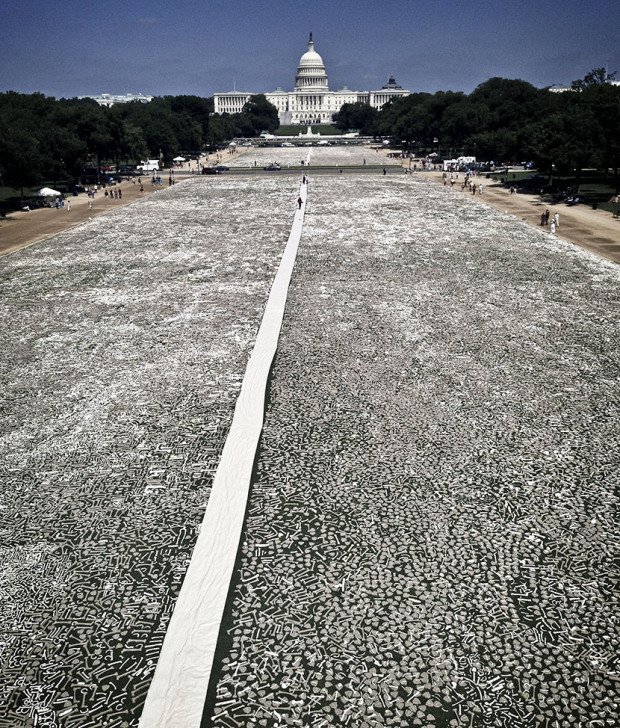
Last weekend the National Mall in Washington, D.C. was covered in one million handcrafted human bones in the collaborative art project, “One Million Bones.” The installation served as a “visible petition” against ongoing genocide and mass atrocities in Sudan, South Sudan, the Democratic Republic of Congo, Burma, Somalia, and Syria. The bones, made of paper maché, clay, and other materials, were made over the past 3 years by 100,000 people in 30 countries. “One Million Bones” was created by The Art of Revolution.


photos by Teru Kuwayama
firehosewhat could possibly


Read more of this story at Slashdot.


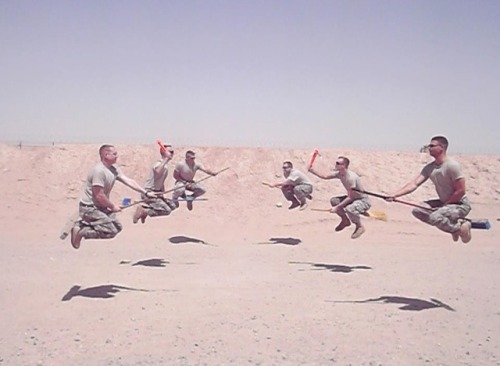

Merica
I understand that the air force has been through budget cuts but damn
90% of war is hurry up and wait.
This is that 90%.
(also it occurs to me that our soldiers are now young enough to have grown up with Harry Potter)
The Obama administration has taken a hard line on secrecy and internal security, aggressively prosecuting leakers and using surveillance programs to uncover journalists' anonymous sources. And according to the McClatchy news agency, a program aimed at preventing leaks could be discouraging whistleblowing by equating it with treason. McClatchy has apparently reviewed documents for the administration-wide Insider Threat Program, which was created in 2011 after Bradley Manning released classified cables to WikiLeaks.
The program is meant to make it easier for agencies to prevent employees from leaking information, asking them to evaluate workers' trustworthiness and set severe penalties for intentionally breaking security protocol or failing to report a breach. But it also supposedly leaves the actual definition of a threat broad, meaning that almost anything could fall under the program's jurisdiction. While the administration has attempted to make it easier for would-be whistleblowers to report problems through internal channels, McClatchy says a Defense Department document describes any kind of security breach as a kind of espionage. "Hammer this fact home," it apparently says, "leaking is tantamount to aiding the enemies of the United States."
"Are they cheery? Are they looking at Salon.com or The Onion during their lunch break?"
The program also directs agencies to monitor their employees, which is standard practice in any high-security area. Frequently, that means watching for high-risk indicators like financial or marital problems, which can provide leverage for blackmailers or foreign intelligence agencies. But some non-intelligence agencies apparently encourage employees to watch each other for potential risk factors, which could fuel mistrust — especially since these factors can be something as innocuous as working at unusual hours.
At worst, it can mean telling employees to be suspicious of anyone who doesn't seem happy enough. "It's about people's profiles, their approach to work, how they interact with management. Are they cheery? Are they looking at Salon.com or The Onion during their lunch break? This is about The Stepford Wives," complained an anonymous Pentagon official.
The Obama administration has been public about the need for tracking insider threats, and we've known for years that there's a fine line between looking for spies and cracking down on "disgruntled" but trustworthy employees. President Obama and other officials have also been open about the fact that they consider even principled leaking treasonous. These revelations about the Insider Threat Program underscore this, while making it clear that we'll likely see even bigger crackdowns in the wake of Edward Snowden's attempt to evade prosecution for espionage.
|
Don't want mug shot online? Then pay up, sites say
Albany Times Union After more than seven years and a move 2,800 miles across the country, Christopher Jones thought he'd left behind reminders of the arrest that capped a bitter break-up. That was, until he searched the Internet last month and came face-to-face with his 2006 ... and more » |
firehoseHive's RSS feed doesn't credit original sources

firehosegreat
WE ALREADY KNOW, ASSHOLE
Read more of this story at Slashdot.

firehoseCumber_world follower beat
President Barack Obama's 2012 re-election campaign proved a landmark moment in political data mining — Obama's team ran non-stop simulations based on poll data and used the information they'd collected about supporters to perfectly time appearances. But when the election was over, they were left with a fine-tuned machine that had outlived its purpose. The New York Times looks at where members of Obama's campaign analytics team have gone since last year, whether that's attempting to rethink commerce by putting like-minded people in touch or helping Caesar's Palace keep its customers from defecting to other casinos. "When you go where the money is and you go where people get reached, you have a transformational effect," says former campaign media tracking director Chauncey McLean. "Money creates change."
firehoseaka all architects working in Florida and coastal Texas, Louisiana, Mississippi, and Alabama for the last 50 years
Or in NYC lingo, none

Daniel Horn, a fresh New York architecture graduate, has launched a global competition around a tricky design question—what is the most aesthetic way to raise the elevation of an entire neighborhood block by eight to 10 feet?
Call it extreme weather architecture. Horn, a 23-year-old graduate of the New York Institute of Technology (more on him below), is part of a boom in design competitions and urban reconstruction initiatives built around climate change. A rash of storms, drought and fires in recent years has ignited this contemplation of a new school of design cutting across cities and shorelines, homes and commercial buildings.
The emerging class of architecture suggests the onset of a global design-and-construction industry worth tens of billions of dollars in the coming years. Places such as the Netherlands have had to build around environmental- and weather-related challenges for years. But to the degree that extreme-weather architecture and construction moves to the mainstream, it would become one of the biggest infrastructure businesses on the planet, straddling US, Europe, Asia and Latin America. The cost of one recent set of recommendations alone, by New York Mayor Michael Bloomberg, responding to the ravages of Hurricane Sandy in October 2012, is estimated at $20 billion. Studies of the spending to come around the world range well into the hundreds of billions of dollars.
Already, there are signs of a big trend. In addition to Bloomberg’s initiative, Shaun Donovan, the US secretary of housing and urban development, on June 20 unveiled a competition called Rebuild By Design, whose winning concept will be built using public and private funds. On June 13, the American Institute of Architects and three other groups announced the Designing Recovery competition, which seeks new housing designs for storm-prone areas.
Horn’s contest is called the 3C Competition (for Comprehensive Coastal Communities). At college, Horn had a mind to carve out a career in environmentally minded architecture—as his undergraduate thesis, Horn did a redesign of Newtown Creek, an industrial hub between Brooklyn and Queens near the East River.
But when Hurricane Sandy struck, the industrial businesses lining the creek were hit hard by flooding, and Horn re-conceived his thesis. Now he incorporated the risk of massive flooding. In order to absorb a Category 3 storm surge (the level that Sandy reached at its peak), Horn equipped the building around which his thesis centered with walls resembling a canal lock. Floodwaters entering the lock would be channeled into adjacent wetlands.
Horn thinks that the idea would scale up. There could be “an entire connected system of these ‘bulkhead buildings,’ as I call them, working together as a public space system and a storm water filter system which would also alleviate the area in a strong storm surge,” Horn told Quartz.
As it happened, Mayor Bloomberg’s group looked at Newtown as well in his $20 billion plan for redesigning the city.


Horn and a few college classmates also wondered why the New York area was generally unprepared for such weather. Extreme architecture clearly needed to move beyond conceptualized theses to a fundamental reshaping of the construction along the region’s shorelines.
But how? A single homeowner could elevate his own house on a high foundation, but that would do nothing to save the neighborhood, not to mention that it would look strange next to everything else around it. Horn’s group decided that a holistic approach was needed. That led to the competition.
The 3C Competition invites architects to select any community along the US northeast coast, and suggest a design for elevated homes in the context of the surrounding landscape and topography. The top three winners are to be announced in New York in October.
More than 210 teams from about 30 countries have entered so far, says Horn.
The field is young—Horn as yet has not found registered architects specializing in extreme weather work, but it is the talk of fresh graduates and architecture students. And it is they who will lead the way.

Did you ever watch Inspector Gadget and wish you could talk on your phone simply by sticking out your thumb and pinky finger? Designer Sean Miles of Designworks suggests that gloves are the perfect place to keep your phone's microphone and receiver.

|
|
firehosechrist
Mediaite |
NBC's Gregory riles Guardian's Greenwald by asking why he shouldn't be ...
Washington Post WASHINGTON — NBC “Meet the Press” host David Gregory got a rise out of Glenn Greenwald by asking the Guardian reporter why he shouldn't be charged with a crime for having “aided and abetted” former National Security Agency analyst Edward ... David Gregory Is Just Wondering If Glenn Greenwald Should Face Criminal ...New York Magazine Glenn Greenwald asked why he 'shouldn't be charged with a crime'MSNBC As leaker Snowden flees, defender and critics clash over national security risksNBCNews.com Daily Caller -WRIC all 37 news articles » |

19XX: The War Against Destiny (Capcom - arcade - 1995)
firehosevia Vjuliao
autoreshare
firehosevia Vjuliao


The Reading Nest is a new site-specific installation by artist Mark Reigelman outside the Cleveland Public Library. Reigelman obtained 10,000 reclaimed boards from various Cleveland industrial and manufacturing sites and worked with a team of people over 10 days to construct the nest which was completed earlier this month. From his statement regarding the project:
For centuries objects in nature have been associated with knowledge and wisdom. Trees of enlightenment and scholarly owls have been particularly prominent in this history of mythological objects of knowledge. The Reading Nest is a visual intermediary between forest and fowl. It symbolizes growth, community and knowledge while continuing to embody mythical roots.
You can see many more hotos of the Reading Nest over on his website. (via colossal submissions)
firehosevia Tertiarymatt: "Rusty on the bee killing in Oregon. Appears they sprayed for aphids, for some reason. The law was definitely broken, though, and I hope the responsible parties feel the consequences."