firehose
Shared posts
All The President's Hitmen
The Adroit accessible gaming controller

I saw this controller for a second in the video for the able gamers foundation and was never able to find it. I heard it was at Evilcontrollers, but it I didn’t see it in their list. Today, I noticed it. I’m not sure if it only recently appeared or if I had just missed it repeatedly.
The Adroit controller system looks like a pretty good commercial solution. It offers not only a switch interface for Xbox gaming but customization as well. You can map buttons however you want as well as set options like “holding” or “turbo”.
China’s Communist Party says controversial PX chemical is not harmful, might even taste good

The carcinogenic petrochemical paraxylene has been the subject of heated protests in China in recent months, but the state-run The People’s Daily wants citizens to know that it is basically harmless—and even possibly delicious.
In a full-page editorial, the newspaper quotes a spokesman for Sinopac, the country’s largest oil producer, as saying the chemical is “a transparent, colourless liquid with a fragrant smell, and even tastes slightly sweet.” People’s Daily also claimed that paraxylene, also known PX, was less harmful than coffee, and that there was “inadequate evidence to conclude that PX is carcinogenic.”
The tens of thousands of Chinese citizens who have protested plans to build PX factories in their cities would certainly disagree—as would the state-owned news agency Xinhua, which has called PX “a carcinogenic petrochemical used to create raw materials for the production of polyester film and fabrics.” The People’s Daily editorial coincides with the China-South Asia expo in Kunming, where protesters have tried to stop the construction of a PX facility.
Chinese social media users were incredulous. The South China Morning Post quoted one microblogger: “Can People’s Daily assure us that the production process of PX is completely non-toxic? As a party newspaper, coming to such a rash conclusion is obviously speaking for the [petrochemical] interest groups. This is irresponsible at a time when air pollution is so severe.”
Other users pointed out that it was not just the chemical they did not trust, but the management and safety records of the factories that made it. PX protests in Dalian were sparked when a protective dyke around an industrial complex was destroyed by rain and high waves. China has been plagued in recent months by a long series of industrial scandals, and trust in factory owners has plummeted. On the same day that the People’s Daily published its PX defense, six workers were critically burned in Shanghai’s second petrochemical plant fire in as many days.

Apple in-app purchase settlement claims website goes live
The official website governing a class action settlement from Apple for those who claim that a minor bought in-game items without their knowledge or permission went live recently.
In February, Apple proposed a settlement that would see it offering credit where minors have spent more than $5 through "bait apps" and a cash refund of minors spent more than $30. Bait apps are considered to be free apps and games with real-world money charges for in-game currency and items.
Through the website, claimants can search for qualified apps, make a claim, view claim form instructions and FAQs. Qualified apps include those in the games category with an age rating of 4+, 9+, or 12+ that offer in-app purchases of consumable game currency. Claimants have until Jan. 13, 2014 to submit a claim.

Kinograph: preserving 1920s movies with a Raspberry Pi
A great motivator for us in developing the Raspberry Pi was bringing down the cost of computing. Nobody should be excluded from being able to learn about computing, or from using it for work or pleasure, by what’s in their pocket.
The pricing of electronics means that some important and useful tools have historically been outside the reach of anyone without a large chunk of capital behind them. You’ll have seen the photography hacks we feature here, which use a Pi to make very, very inexpensive versions of photography equipment like time-lapse rigs, gigapixel rigs, water droplet setups and the like. Off-the-shelf versions of equipment like this can cost thousands of pounds, but a Pi and some ingenuity can bring the cost right down to levels which are sensible and affordable. These projects are not just for amateurs: we have seen professional photographers using Pi-based, home-hacked equipment in preference to the expensive stuff. It works just the same, and there’s a lot to be said for the warm glow you get from making your work tools yourself.
It’s not just individuals and small businesses who are sometimes priced out of doing worthwhile stuff by the price of electronics. Libraries, museums and other public institutions are often priced out of being able to digitise collections by the prohibitive cost of equipment.

Isolating audio
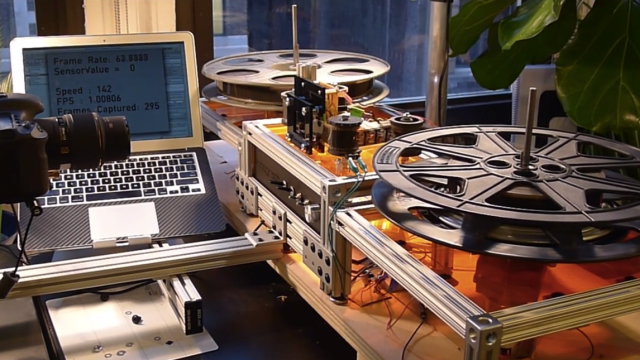
Kinograph is an astonishing thesis project from Matthew Epler, an artist and film historian. It’s a Pi-powered, open-source, scalable device for digitising old film stock, complete with the ability to stabilise images (another application for OpenCV) and recapture sound. A good DSLR camera is the most expensive part of the setup, at about $2000; the rest of the equipment comes to $1200. (Matthew is working on getting that figure down below the magic $1000.) Compare that to the $480,000 it would cost you to digitise 50 films on reels at a film lab, or the $175,000 it’d cost you to buy a Kinetta (the nearest commercial equivalent device) and a whole world of possibilities opens up. Film stock, be it celluloid, acetate or nitrate based, is not stable, and being able to record and save our film heritage is a pressing concern. We’ve already lost more than 90% of all silent movies, and around 50% of the films with audio made before 1950.

Kinograph at work – note the 3D printed rollers
I have what could probably be called a bit of an old movie problem; my bedroom wall has framed pictures of pre-talkies Norma Shearer, Lupe Velez and Anna May Wong, like the bedroom of a teenager who’s been time-shifted 90 years. I howl with frustration at poor Eben, who has to share that bedroom, when I read the synopses of pre-code movies I’d give my right arm to see, which have gone forever. We’ve got shelves of books on silent movies, along with boxes of DVDs and old fan magazines. That the Raspberry Pi is a part of this project makes me unspeakably proud.
Here’s a two and a half minute video about the technology.
Matthew is working to iron out a few remaining bugs and to bring the cost down further. He expects to be posting the materials, instructions, and code online at the end of July. Watch this space!
Two cannons have been raised from Blackbeard's sunken ship

After resting at the bottom of the Atlantic ocean for nearly 300 years, a pair of cannons from Blackbeard's Queen Anne's Revenge have been lifted to the surface.

    
|
Back to the Future’s Grays Sports Almanac iPad Case

Firebox has released a Back to the Future iPad Case that quickly turns your ordinary iPad into the Grays Sports Almanac from the iconic 1985 film, Back to the Future. This destiny changing case will protect your device (really) and make you rich (not really)! It is available to purchase online.
It’s what old Biff gave to young Biff in 1955 which he eventually used to become a crooked millionaire (in the process ‘killing’ the old version of Biff) by betting on all the sporting events that had yet to happen, but which this almanac had the results of inside. Marty McFly (McFlyyyyyyyy!) eventually nicks it back and knackers Biff’s plans, which is a bit selfish.
What makes this SO ingenious, is that with your iPad wedged safely inside – you could use the internets to easily find the actual results of all the sports results – and create your own golden future. If you only could find the keys to the DeLorean.


images via Firebox
Lunchtime TV: Watch the Premiere Episode of Drunk History

1) Get yourself a sandwich! 2) Get yourself a drink! 3) An alcoholic drink! 4) Sit down, eat the sandwich, drink the drink. 5) Watch the premiere episode of the hilarious Drunk History (formerly a hilarious web series) debuting on July 9th on Comedy Central! 6) Laugh at this inebriated history of Washington, D.C. which drunkenly recounts the Watergate scandal, the Lincoln assassination, and Elvis meeting President Nixon. 7) Say, "Hey... that's Bob Odenkirk, Jack Brayer, Adam Scott, Dave Grohl, Jack Black and more!" 8) Drink another drink. 9) An alcoholic drink.
Is Google Voice Doomed To Be 2nd-Class Messaging System?


Read more of this story at Slashdot.

Valve's Portal Leaves Beta On Steam For Linux
All the president's hitmen: tracking Washington's secret army
In February 2010, in a village near the city of Gardez in Afghanistan, an American military raid resulted in the death of five civilians, including two pregnant women and one teenage girl. The two male victims were local officials, a police chief and a prosecutor. After the raid, the United States issued a press release in which it claimed that a combined American–Afghan force had been following up on intelligence that placed the Taliban at the family's home when it happened upon some sort of ritual "honor killing." Unfortunately, the story goes, they were too late to save the lives of the women.
"The Americans were probably given bad intelligence," explains Richard Rowley, director of the companion film to Scahill's book. "They [arrived] at a compound where a party was happening, where they were celebrating the birth of a child. They were having a naming ceremony, and there were dozens of people and music playing and women there without head covers."
The attackers, thinking they had entered a Taliban stronghold, started firing. Afterwards, Rowley says, "They covered it up. Witnesses [and] forensic evidence collected afterwards indicated that they dug the bullets out of the bodies of the women, and then blamed it on the family themselves. And took all the men off to another province to be interrogated."
"An all-star team made up of the Army’s Delta Force, SEAL Team Six, Army Rangers, and the 160th Special Operations Aviation Regiment."
Eventually, the United States would change its story, and admit that the incident was a tragic mistake. Soon thereafter, Rowley says, "Early in the morning an armored convoy rolls up to this compound, and a US admiral gets out and offers to sacrifice two sheep at the doorstep of this family, and offers an apology, saying his men were responsible for this." But the press in Afghanistan doesn't recognize the admiral. "He's not from NATO command," Rowley continues. "He's not from RC [Regional Command] East, which owns the battle space. He's not part of the conventional force in Afghanistan at all."
The man in the photograph was Admiral William McRaven, the commander of JSOC, or the Pentagon's Joint Special Operations Command. Scahill refers to JSOC as "an all-star team made up of the Army’s Delta Force, SEAL Team Six, Army Rangers, and the 160th Special Operations Aviation Regiment." Speaking in more mythic terms, an anonymous Navy SEAL once told Dana Priest and William M. Arkin of The Washington Post that JSOC was "the dark matter ... the force that orders the universe but can’t be seen."
Operating under the authority of a confidential order signed in 2004 by Donald Rumsfeld with the blessing of President Bush, JSOC has the authority to attack the al-Qaeda terrorist network anywhere in the world. This was part of an ongoing evolution of the American military, a process that began secret detention, extraordinary rendition, and warrantless wiretaps, according to Eric Schmitt and Mark Mazzetti of the New York Times.
The "covert" in covert ops doesn't just apply to specific operational details. One of JSOC's strengths is that it exists in a legal black box, where the executive branch rarely briefs Congress in advance of a mission, and "usually not afterward," according to Priest and Arkin. Of course, some victories will get acknowledgement — the White House started springing leaks as soon as Osama bin Laden's corpse was dumped into the ocean — but it was some time JSOC took any responsibility for Gardez.

Director Richard Rowley
Our wars will be fought with a massive covert army responsible directly to the president
As Rowley explains, "This is the new paradigm of American militarism. It'll be a long time before [another] George Bush-style ground invasion of a country in Asia, [with] 200,000 troops on the ground and the idea that we're going to build a new democracy." Instead, our wars will be fought in secret, with "a massive covert army that is outside of the conventional chain of command, that's responsible directly to the president, [with] little meaningful oversight and no scrutiny in the press."
In Yemen, Scahill met the family of two American citizens, the infamous radical Muslim cleric Anwar al-Awlaki and his not-at-all radical, non-clerical, teenage son Abdulrahman. Both father and son were targeted and killed in separate drone strikes in late 2011. The elder al-Awlaki had long been in the US government’s crosshairs, having gained his greatest notoriety as al-Qaeda’s chief propagandist in the Arabian Peninsula. He was the very definition of a traitor, as Tom Junod has pointed out, even if he had never been indicted. The elder Awlaki met his fate in a drone strike manned by the CIA, as JSOC and some ground troops stood by to assist if necessary.
Abdulrahman was not in the same league as his father. Born in Denver, Colorado, he has been described by the New York Times as a pretty typical kid who had just turned 16, a hip-hop fan who "liked sports and music and kept his Facebook page regularly updated." On October 14th, 2011 at about 9:00 PM, a Predator drone fired the missile that killed Abdulrahman and several other teenage members of his family as they ate at an outdoor restaurant.
Nasser al-Awlaki is Anwar's father and Abdulrahman's grandfather, a Fulbright Scholar who earned his master's degree at New Mexico State University and a doctorate at the University of Nebraska. After the attack that killed his grandson, relatives located the teenager's body. "He was buried with the others in one grave," Scahill writes, "because they were blown up to pieces by the drone." All that could be recognized of his grandson was his hair. "But they could not recognize his face or anything else."
While media outlets cited "unnamed officials" inside the White House who confirmed its responsibility for the attacks, the official government line was feigned ignorance, delivered in a particularly arrogant manner. "For over the past year, the Department of State has publicly urged US citizens not to travel to Yemen and has encouraged those already in Yemen to leave because of the continuing threat of violence and the presence of terrorist organizations ... throughout the country," reads one of the highlights of a press conference by National Security Council spokesman Thomas Vietor. In the same statement, he acknowledged the existence of press reports that a known terrorist named Ibrahim al Banna was killed in the strike, "and that several others, including the son of Anwar al-Awlaki, were with al Banna at the time."
This was only the beginning of the misinformation that surrounded the killing. Banna's outfit, Al-Qaeda in the Arabian Peninsula, issued a statement saying that the terrorist was in fact alive and well — which raises the possibility that the strike had nothing to do with him in the first place. US officials, speaking at the time of Abdulrahman's death, variously claimed that the younger Awlaki was 21 years old, or that he was a militant himself, neither of which turned out to be true.
When asked at the time about Abdulrahman's death, former White House press secretary Robert Gibbs (speaking for Obama's re-election campaign) replied with characteristic compassion when he said that the boy "should have [had] a far more responsible father."

Jeremy Schaill
we have to rely on journalists like Scahill and Rowley to reconstruct the events, as if this were a mystery novel
They're called "lily pads," because they're small, temporary locations that our covert army can use as a jumping-off point into regional combat, much as a cartoon frog might, if that frog was an elite, trained killer (which would make the terrorists cartoon flies, I suppose). Technically known as a CSL or Cooperative Security Location, the lily pad is central to our current war on terror. Just as the Pentagon obscures its battles by waging wars with covert troops, it obscures its empire of bases around the world by relying on lily pads established at foreign military bases. According to the US Air Force, this gives the military a springboard for attacks in places like Dakar, Entebbe, and Libreville, Gabon. There is no exact number available, but including the CSL sites it's been discovered that the American military has over 700 bases outside the United States.
Just like the number of overseas bases (and, as Nick Turse points out in The Complex, the number of overseas military golf courses), JSOC operations are rarely commented upon and almost never officially acknowledged. Instead, we have to rely on journalists like Scahill and Rowley to reconstruct the events, as if this were a mystery novel.
In Dirty Wars, Scahill pieces together one operation that took place in early 2007, at the beginning of the US-backed Ethiopian invasion of Somalia. JSOC, he writes, "Had quickly set up its makeshift 'lily pad' at the discreet US base in Manda Bay, Kenya ... and was waiting to pounce." It finally had its chance on January 7th, when a Predator drone launched from Camp Lemonnier [Djibouti] located a convoy of vehicles in southern Somalia. As it tracked the convoy, an AC-130 gunship arrived, attacking it "just before it disappeared into a forest along the Kenya–Somalia border." According to US officials, as many as a dozen fighters were killed in the engagement. Afterwards, JSOC personnel arrived to take DNA samples of the dead.
This was among the first overtures in a bloody invasion that ran over two years and killed approximately 10,000 people, creating 1.1 million refugees in the process, according to Human Rights Watch. And this is now the American way of war: small, mobile "lily pad" bases and covert operations that remain secret, so when we see the humanitarian crisis unfold on the TV news, we have no idea that our government played a hand in creating it.
In the fall 1998 issue of Covert Action Quarterly, former United States attorney general Ramsey Clark offered some insight into the nature of government secrecy. Its main purpose, he writes, isn't to hide things from our enemies as much as it is to hide things from the American people. "The Cambodians knew they were being bombed," he explains. "So did the Libyans. The long suffering Iraqis know every secret the US Government conceals from the people of the United States and every lie it tells them."
Indeed, the family of Abdulrahman al-Awlaki knew the origin of the drone strike that killed their loved one, as did the families of those killed in that village near Gardez. The only reason for a cover-up was to keep the true nature of war from mainstream America's eyes and ears.
This is why Scahill's book is such an important document. It shines a light on those things that are being done in our name, things that are being kept secret.
The next time the dim-witted pundits on cable TV "news" ask their viewers why "the terrorists" hate America, you can point to this book for the answer.
But let's hope it doesn't come to that.
The IRS vs. Open Source
Read more of this story at Slashdot.

Microsoft to launch web-based version of Xbox Music next week
When we first heard Microsoft's plans for Xbox Music, there was a mention of web, iOS, and Android versions. Next week the software maker will launch a web version of Xbox Music so that subscribers can access the service across various platforms from a browser. Microsoft previously launched Xbox Music on its Xbox 360 console, Windows 8, and Windows Phone 8 in October, providing a Spotify-like streaming service for music, but the service was limited to the company's own products.
Sources familiar with Microsoft's Xbox Music have revealed to The Verge that the web-based version will launch next week at music.xbox.com. Microsoft has already started updating its Xbox Music pages in preparation, noting on some, that it's "now available on the web." Xbox Music on the web will work in a similar way to Spotify's own web version, letting you stream music through the browser and manage playlists. While it won't launch until next week, it's possible that Microsoft may highlight the upcoming release during its Build developer conference that starts on June 26th.
Alongside the web version, Microsoft is also refreshing its Xbox Music app for Windows 8.1. The new design includes a two panel interface that improves discoverability and quick access to collections of songs. The app will also support music files from SD cards, and improve Play To support for songs outside of the Xbox Music catalogue. Microsoft will release a preview version of Windows 8.1 on June 26th.
- Related Items release feature update web music player xbox entertainment html5 xbox music

eveningowl: im-deadpool-god-dammit: I love how majestic the bald eagle looks from the side but...
I love how majestic the bald eagle looks from the side
but from straight on it just looks scared and confused


App.net | breakingnews: More: Putin says Snowden is still in transit area ...

We love this group portrait, taken sometime in the 1980s, of...
firehosevia Snorkmaiden

We love this group portrait, taken sometime in the 1980s, of Muhammad Ali, Hulk Hogan, Cyndi Lauper, Liberace, and Wendi Richter. There’s so much mighty awesomeness radiating from this photo that there are sparks shooting out of our computer screen.
[via Retronaut]
His Song Got Played on Pandora 1 Million Times and All David Lowery Got Was $16.89
firehosevia Overbey
David Lowery:
Soon you will be hearing from Pandora how they need Congress to change the way royalties are calculated so that they can pay much much less to songwriters and performers. For you civilians webcasting rates are “compulsory” rates. They are set by the government (crazy, right?). Further since they are compulsory royalties, artists can not “opt out” of a service like Pandora even if they think Pandora doesn’t pay them enough.
The rest of RSS
firehosesee previous posts on my tumblr for more detailed reviews of other readers
right now the queue is:
- InoReader
- dotdotdot
- readable.cc
- CurataReader
- 1kpl.us
I've gotta say I'm most excited about dotdotdot. It actually does something usefully different--like a genuinely new idea instead of replicating GReader--while still encompassing nearly everything that made social GReader great.
 |
firehose
shared this story
from  drwnng: drwnng:
|
| see previous posts on my tumblr for more detailed reviews of other readers right now the queue is: - InoReader - dotdotdot - readable.cc - CurataReader - 1kpl.us I've gotta say I'm most excited about dotdotdot. It actually does something usefully different--like a genuinely new idea instead of replicating GReader--while still encompassing nearly everything that made social GReader great. |
- Shows blog posts and comments in one seamless stream, tracks what was read and displays only new discussions next time. Comments from Reddit, Livejournal, blogs with RSS feeds for comments, Disqus and Facebook widgets are supported.
- Read full distilled post content right inside rss reader thanks to great Readability service.
- OPML import and export
- Email, Twitter, FB, G+ sharing; Del.icio.us, Instapaper read-it-later
- Subscribes to G+ and FB pages as though they had RSS feeds
Why not review it? I read in an RSS reader to get away from blog comments. Never read the comments.
- Lovely, fast, functional interface
- Optional but encouraged $9/year subscription
Why not review it? No OPML import, slow to update feeds, zero sharing. May come back when it’s more finished. I’m rooting for Yoleo on its interface alone.
- View Facebook feeds as RSS
Why not review it? No OPML import, no list view, zero sharing. May come back when it’s more finished.
- API already being used by mobile apps
- NewsBlur’s three-pane interface without NewsBlur’s painful UX
- $2/month
- OPML import/export, and starred-item JSON import from GReader Takeout
- Many components are open source
Why not review it? I’ve used it before; there’s no social and no plans for it. It aims to be more of a backend for other apps, which is a good thing, just not very reviewable.
- PC Magazine Editor’s Choice; one of two such picks along with Feedly. The Old Reader is reviewed and also gets 4 stars but no editor’s choice.
- Broadly localized: English, Spanish, French, Mandarin, Russian, Czech, Slovak.
- Supports OPML import. (Why is this even rare?)
Why not review it? Signups are down because they’re overloaded. PC Mag notes that it’s slow.
- Focus on mobile-friendly design.
- OPML import and export.
- Basic third-party sharing (FB, Twitter).
- Training a la NewsBlur.
- SEARCH! A LITTLE CLUNKY BUT THERE’S FULL-TEXT FILTERING AND SEARCH!
Why not review it? No sharing. Interface loves wasting space on desktop. Slow to respond to feeds due to the GReader exodus. Near the top of the review list, though.
- OPML import and export.
- SEARCH! Full text! With AND/OR operators! And phrase search!
- Social features (sharing, commenting) with some privacy controls (authorization required for connection requests; can control who sees your online status, statistics).
- Tagging!
- Automatically push feeds to external services (Email, Instapaper, Pocket); more third-party sharing options than I can list, including in-app emailing (no mailto links)
- Highly customizable interface: toggle unread counts, icons, colors; control scrolling, width of reading area; can filter out duplicate articles based on matching URLs, titles; themable.
- GReader/vim-style keyboard shortcuts. Even / for search works.
- Localized in German, French, “Chinese Simplified”, Japanese, Russian, Czech, Magyar, Italian; Spanish, Polish, Romanian in progress. Uses a POT for POEdit, so anyone can submit a translation.
- Subscription bookmarklet.
- Flexible mark-all-as-read.
- Detailed feed stats.
Why not review it? It’s next on the list. Nobody I know is on it, so it’s hard to judge the social features and privacy options. Interface is not elegant by any definition.
- One of the few original ideas in the RSS space: think Instapaper with a built-in RSS reader and a little bit of Zotero’s featureset, plus GReader’s social tools, all wrapped in a very slick (and new) design. AND it supports ebook imports.
- You can highlight, comment, share, and tag individual passages of text within items, as well as discuss full items.
- Per-share privacy options.
- Chrome extension lets you clip web pages LIKE THE BOOKMARKLET.
- Has some traction and community, despite not coming up in the post-GReader conversation very much.
Why not review it? I’m still wrapping my head around it. This is my “Note in Reader” dreams come true, though; def. on my list.
- River of News reader with OPML import/export.
- SEARCH! Search ALL feeds, your feeds, or a single feed!
- Training feature a la NewsBlur purportedly promotes/demotes stories.
- Your feed folders are public and anonymous, making it easy to share bundles of feeds with others. (Sadly, these folders don’t have their own RSS feeds.)
- Open-source AMP app, feasibly self-hostable.
Why not review it? No social, now or planned. Not a fan of rivers of news, but if you hate unread counts, give it a try.
- In-app social sharing with comments, just like Google used to make. Even with freestyle Note in Reader-style notes.
- OPML import, but no export.
- 3-week trial, no-account-required demo, $5/mo.
Why not review them? Need other people I know on there to test social. On the list, otherwise.
- Open-source, self-hostable
Why not review them? None of them are interested in using any sort of federated social protocol, like say I dunno the JSON Activity Streams that GReader uses and dumps as part of Takeout. (It’s worth noting that CommaFeed is delightfully simple to install via OpenShift, and TTRSS can be setup to generate an RSS feed of shares. BOTH SUPPORT SEARCH, though it can be tough to set up on TTRSS.)
PikaReader, FeedRebel, NuesByte
- Reads RSS Feeds
Why not review them? They don’t do anything of note compared to the competition. Hell, PikaReader costs €6/year but doesn’t even do OPML import.
RSS Miner
- Down
Why not review them? LOL
Drones and Art


Bridle's work these days focuses on "the New Aesthetic," a research project in which he collects " material which points towards new ways of seeing the world, an echo of the society, technology, politics and people that co-produce them."

Mahwish Chishty, X-47B, 2012
James Bridle, Dronestagram ("May 29 2013 - A strike on a mud-built house in Miranshah or the nearby village of Chashma, at 3am, killing 4-7 people. According to local resident Bashir Dawar, “The bodies were badly damaged and beyond recognition.”
James Bridle, Drone Shadow 002, 2012
When the Monks Come to Town
firehosevia Russian Sledges
Why hundreds of Buddhist monks moved from Taiwan to Prince Edward Island, buying up thousands of acres of land in the process.
Justice Alito Was a Real Dick to Justice Ginsburg
firehosevia Diane
"There has to be some ironic joke I can make about how Alito, (a) guy who literally today authored a Supreme Court opinion that made it easier for workplace bullies to get away with it(,) is himself acting like a workplace bully, but I can't bring myself to imagine anyone trying to shove Ruth Bader Ginsburg into a locker."

The inscrutable ballet of the Supreme Court continued it fancy dance this morning, with the court ruling on cases ranging in scope from one about drug warning labels to that one Affirmative Action case where that girl claimed that she didn't get into the University of Texas because she's white rather than because she's dumb. But among the attempted parsing of complicated legalese, one thing didn't need any analysis: the supreme stinkface Justice Samuel Alito gave Justice Ruth Bader Ginsburg as she read her dissenting opinion on two employment discrimination cases.

|
|
Vino, Vino! Connery and Bardot.
firehosevia multitasksuicide

Vino, Vino!
Connery and Bardot.
Replace Worn-Off Appliance Lettering with Sugru
firehoseSugru beat

If you have some old appliances, gadgets, stereo equipment, or anything else with imprinted lettering that's worn off, Sugru user Deborah P shows off how to fix those grooves using Sugru.

|
|
If The Avengers Were Real, What Would Magazine Covers Look Like?
firehosenicely done
lexflippinluthor submitted: Love the blog and I thought I’d...


lexflippinluthor submitted:
Love the blog and I thought I’d submit some images from Pacific Rim. Mako’s suit just looks so good imo while distinctly feminine it’s not being insanely explicit. I think, for a movie that’s paying homage to mecha which can contain a lot of female over-sexualization, it’s especially nice.
Ugh, I’m in love!
Whenever I hear someone saying: "I don't care about PRISM nor my privacy, I have nothing to hide".

by @RlIxOTA4