Ronald Searle - "The living room at 221B Baker Street"
Ronald Searle - "The living room at 221B Baker Street"
Edward Snowden's revelations about the NSA, PRISM, and the US government's broad surveillance tactics were shocking to many people — but maybe they shouldn't have been. There's plenty of precedent, says David T. Z. Mindich for the New York Times, dating all the way back to Abraham Lincoln and the Civil War. In 1862, Lincoln authorized sweeping control over the American telegraph infrastructure for Edwin Stanton, his secretary of war. Telegraphs were re-routed through his office, and Stanton used his power to spy on Americans, arrest journalists, and even control what was or wasn't sent. It was a critical tool in wartime, but a massive invasion of privacy that surely angered citizens.
Mindich argues that despite the huge differences in scope and technology, the Lincoln-era example is a neat comparison to the current war on terror. For those that take issue with the current NSA procedures, he says, the only real solution is to end the war — that's the only way Stanton's grasp of the telegraphs was loosed. "As the war ended, the emergency measures were rolled back. Information — telegraph and otherwise — began to flow freely again." Until this war is over, Mindich cautions, invasive governmental overreaching is a fact of life; whether it's Western Union or Microsoft, Lincoln or Obama, that's how it's always been.

CBC.ca |
Protesters near Taksim Square blasted with tear gas
CBC.ca Turkish police fired volleys of tear gas at protesters who tried to enter a cordoned-off park near Istanbul's landmark Taksim Square on Saturday, hours after the city's governor warned the demonstration was illegal and participants would be dispersed. Turkish police crack down on protesters in IstanbulXinhua Istanbul's governor warns against new protestNewsday Femen stages topless protest against Turkey PMThe News International RadioFreeEurope/RadioLiberty -Reuters UK -Aljazeera.com all 99 news articles » |
Hey assholes who harassed me on the street last weekend- Go Fuck Yourselves.
It was 1 AM and I was walking the 4 blocks back to my car after a show. I was alone, female, and wearing a short dress. I saw a group of guys standing on the sidewalk and GUESS WHAT? I switched to the other side of the street to avoid you.
That you then started shouting at me that I was afraid of black people was frightening- not because you were right, but because I was now a woman alone on a pitch black street with a group of guys shouting at me. Then, when you abandoned your righteous anger and focused on certain body parts that you were intrigued by- shouting them after me as if they were my name- that’s when I really got scared.
I’m not from a town with safe streets like Portland. I'm not an idiot. To be a woman alone at night is a dangerous thing. I've been raped and all my friends have been, too. I have to look after myself.
Let me ask you- if your sister or your girlfriend was walking alone at night, and she came across a group of guys being loud on the street, what would you want her to do?
Yeah. I thought so. Fuck you.
I get righteous indignation, I really do. I'm feeling it right fucking now. But congratulations- your shallow, ego-driven rage helped to perpetuate a stereotype, and it has nothing to do with race. What it taught me is that men are disgusting fucking predators, and that I was apparently not nearly scared enough.


Read more of this story at Slashdot.

Paper helmets could be protecting the heads of cyclists in under 12 months according to one of their inventors, Thomas Gottelier.
Paper Pulp Helmets are a type of cheap, disposable bicycle helmet made entirely from recycled newspaper. Designed by former Royal College of Art (RCA) students Thomas Gottelier, Bobby Petersen, and Edward Thomas, the helmets could cost as little as $1.50 and are 2-3 mm thick.
The helmets are "safe, biodegradable, recyclable and waterproof," Gottelier told Wired.co.uk.
Read 13 remaining paragraphs | Comments
It's not hard to see how an insect could get trapped in a spider's web; its strands are sticky, ultra-strong, and well-concealed. But according to a new study published in the journal Scientific Reports, spiders may also use a more subtle tool to catch their prey: electricity.
In a paper published this week, Victor Manuel Ortega-Jimenez and Robert Dudley of the University of California Berkeley found that spider webs change their shape in response to the electrostatic charges of insects, and that positively-charged bugs are actually attracted to the webs. It has long been assumed that spiders change the shape of their web to catch different bugs, but until now, researchers were unsure as to how they do it.
A girl's toy leads to a 'Eureka' moment
Ortega-Jimenez hypothesized that electricity may hold a clue, after noticing that a spider web changed shape every time his daughter's electrostatically charged toy wand passed in front of it. Intrigued, he and Dudley began collecting strands of spider webs from the UC Berkeley campus, and placed them in front of honeybees, aphids, fruit flies, and water droplets.
Bees and other insects have been shown to generate electricity as they fly, typically by rapidly flapping their wings. In their experiments, Ortega-Jimenez and Dudley found that positively-charged insects were indeed attracted to a spider's web, and that the web would actually change shape. In some cases, the web would bend inward as a flying bee approached, making the insect more likely to get trapped.
But it remains unclear whether this technique is widely used among different spider species. Ortega-Jimenez and Dudley focused their study on the web of a cross spider, which is not known to eat honeybees. The arachnids mostly eat flies, which have yet to be tested for electrostatic charges.
firehose3D-REX LOLOLOL


A 3D-Printed Tyrannosaurus Rex Sculpture by Namisu
"A contrast between old and new. Through the 3D-REX project we wanted to explore the possibilities of 3D-printing for sculpture. We came up with the concept of a wireframe fossil, a complex geometric mesh representing one of the most ancient and iconic creatures: the Tyrannosaurus Rex. The concept really appealed to us because it represents a contrast between old and new, mixing nature’s own amazing creations with technological advances of today."
Support this Project at kickstarter
firehoseattn: RSS application developers
it's not too late to adopt this EIGHT-YEAR-OLD STANDARD for subscription interop
firehoseour next-door neighbor's band
firehoseof course he has a LiveJournal
tl;dr: Pedro Pascal is Chilean, he never intended the Red Viper to be black, and he race-swapped some characters for balance

firehoseAll told, it asks:
- To modify and delete contents stored on your phone
- To prevent the phone from sleeping and view a list of all running apps
- For your location, via the GPS
- For full network access
- To see who you're talking to on the phone
- To run at startup
- To test access to protected storage
- To control the phone's vibration
- To view accounts set up on the phone
When you launch it, "first you need to sign in with either a Facebook or a Twitter account. Then, you need to verify your age."
for this, you get
- the (completely DRM-free) 160Kbps MP3s in the device's Music folder, where they can be played in the local music player app or copied to a computer via USB.
- poorly-presented PDFs of the liner notes and lyrics
"Samsung probably considers this marketing campaign to be a success on the grounds that we (and the New York Times, among many others) are even talking about it in the first place."
As you may have heard by now, Samsung and Jay-Z have teamed up to offer users of Galaxy S III, S 4, and Note II phones the opportunity to hear his new album, Magna Carta Holy Grail, three whole days before anyone else.
Samsung has its own music store that it could, in theory, use to drop this musical treasure trove into the hands of the Galaxy-toting masses, but the company instead chose to distribute the music through a Google Play app. That's strange enough on its own, but actually installing and using the software is a free master's class in how not to make an app.
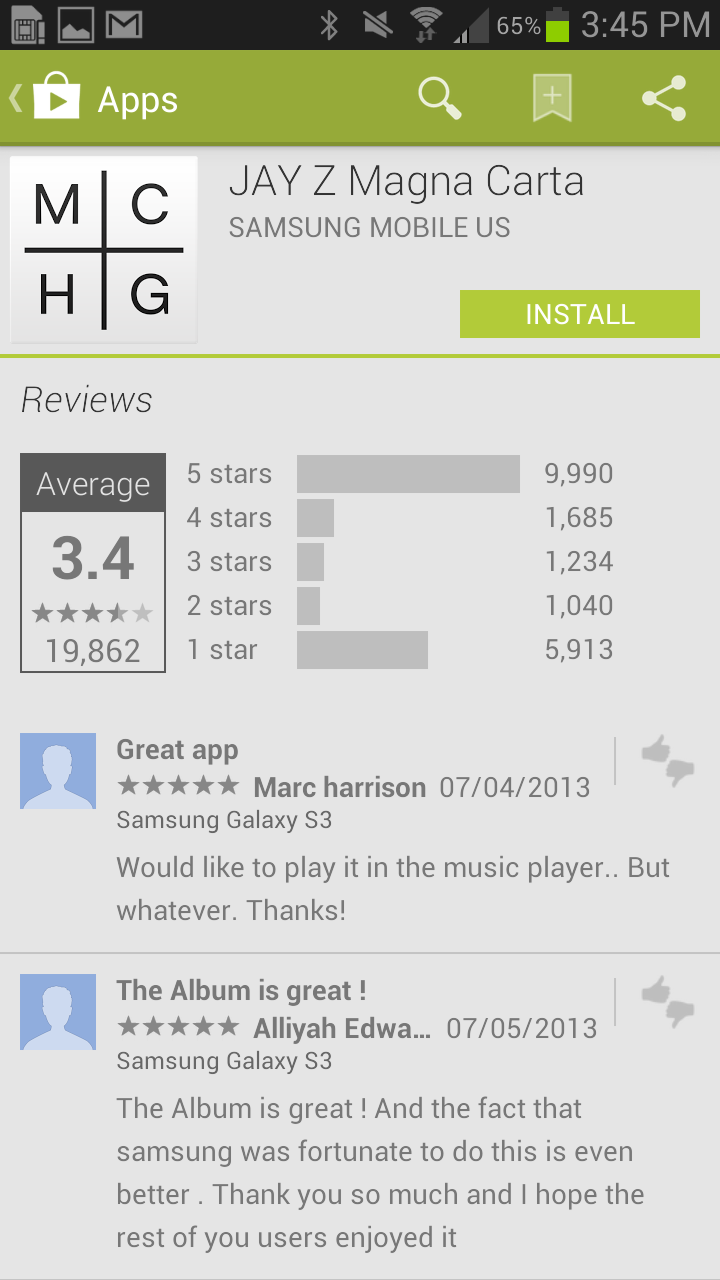
Downloading most applications from Google Play prompts a permissions window that you have to click through before the application will install. The best apps don't ask for anything they don't need, and most restrict their requests to things that make sense. Yes, a Web browser will need Internet access. Yes, a photo-editing app will need access to your device's storage. Yes, a map app will need access to your GPS.
Read 8 remaining paragraphs | Comments
firehosetrains~

Retired from the tracks, many old trains find themselves in glorious graveyards, filled with car upon rusted car. Photos of these scrapyards let us witness the magnificent decay of these mighty vehicles.

    
|

Birthday ouroboros!
Does that mean I stay the same age or age a year every day?
firehosevia Vjuliao
delicious






The Cement Factory was discovered in 1973, it was an abandoned cement factory and partially in ruins, comprised of over 30 silos, underground galleries and huge engine rooms; Ricardo Bofill bought it and began renovation works. He identified the program; The Cement Factory was to be used as architectural offices, archives, a model laboratory, and exhibition space, an apartment for him, as well as guest rooms and gardens.
firehosevia Vjuliao
NSFW