
firehose
Shared posts
20 Aug 22:24
Creating Meaningful Video Games—Game|Life S1—WIRED
by wired

20 Aug 21:46
Half-Naked Man Had One Man Drug And Dance Party On Merkel's Jet
Wearing only underpants and high on drugs, he danced on a wing, sprayed foam around and pushed cockpit buttons.
20 Aug 19:51
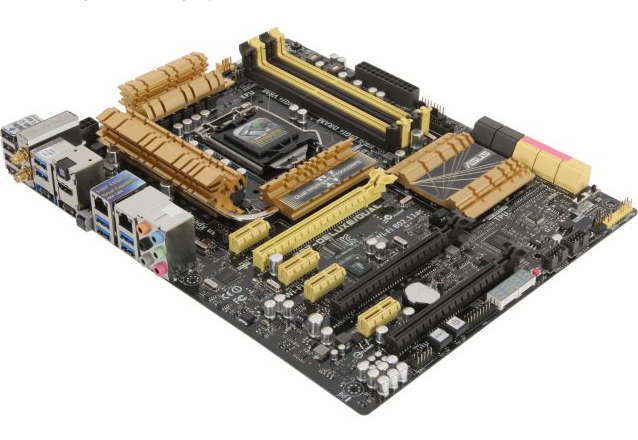


Asus is first to the party with a Thunderbolt 2-certified motherboard
by Andrew Cunningham
Asus' fancy (and expensive) new Thunderbolt 2-equipped motherboard.
Asus
If you use Thunderbolt accessories but aren't an Apple user, some good news: Asus has just announced its Z87-Deluxe Quad, a Haswell motherboard that is the first to include Intel's newest Thunderbolt 2 controller. As we've written before, these controllers double Thunderbolt's theoretical bandwidth from 10Gbps to 20Gbps, which improves support for 4K displays while allowing you to simultaneously drive a display and transfer files.
The new motherboard (which is based on Intel's Z87 chipset) includes two Thunderbolt 2 ports as well as six USB 3.0 ports (plus support for two more via a USB header), four USB 2.0 ports (plus header support for four more), HDMI out, dual Gigabit Ethernet ports, 10 SATA III ports, integrated dual-band 802.11ac and Bluetooth 4.0, and two PCI Express 3.0 ports with 16 lanes apiece. Unfortunately, the premium motherboard also comes with a premium price tag: Newegg currently lists it for a wallet-busting $349.99.
This news comes shortly after the announcement of USB 3.1, a new version of the spec designed to support Thunderbolt-esque maximum speeds of 10Gbps. Thunderbolt and Thunderbolt 2 are available today, while USB 3.1 devices are still months or years away at best, but one of the largest barriers to widespread Thunderbolt adoption has been the ubiquitous availability of the fast-enough, cheap-enough USB spec. The retail availability of Thunderbolt 2 controllers means that we can expect other motherboards and systems that use the spec to follow in the coming months. The most significant of these is the new cylindrical Mac Pro, which will include six of the new ports, but we also suspect that new Retina MacBook Pros could pack Thunderbolt 2 ports to differentiate them a bit from the 2013 MacBook Airs.
Read on Ars Technica | Comments
    
|
20 Aug 19:51

reubenwu: the-editorial: Reuben Wu featured on Shoot the...
Reuben Wu featured on Shoot the Breeze!
http://the-editorialmagazine.com/Shoot-the-Breeze-Reuben-WuA mosque I spotted from the taxi back from San Vincente, Palawan. I’ve never shouted the word STOP so much before in one sentence.
firehose likes this
20 Aug 19:46


Contest: Win a copy of Rick Moranis' album My Mother's Brisket
by The A.V. Club Staff
Rick Moranis retired from acting in 1997 (and mostly stayed away, with the exception of some animated film voice work), but he also had a comedy music career in the 1980s, putting out three albums—two with Dave Thomas as the duo Bob and Doug McKenzie—and then The Agoraphobic Cowboy in 2005. Though he’s stayed away from the Ghostbusters rumors and the rest of show business, he’s still an active comedian and songwriter. His first record in eight years is My Mother’s Brisket, a comedy album with songs and sketches billed as love songs to his Jewish heritage (“Oy, The Mistakes I Made,” “Live Blogging The Himel Family Bris”).
We’ve got five copies of the album to give away to five lucky Rick Moranis fans. Just send an email here with your name and mailing address, and you’ll be entered to win a copy ...
Read more
Lblock likes this
20 Aug 19:45


TV: Great Job, Internet!: Attention: Don't use the GPS coordinates in Breaking Bad to go looking for fake money
by Sean O'Neal
Unfortunate news for anyone hoping to use the coordinates mentioned in Sunday’s episode of Breaking Bad to unearth their own buried treasure: Breaking Bad is a television show whose characters and situations are purely fictional, and also, those coordinates don’t actually lead where the episode suggests they do. In “Buried,” Walter White has his money stuffed into barrels that he then drives out into the middle of the desert, using a GPS tracker to pinpoint their secret location as +34° 59′ 20.00″, -106° 36′ 52”, right next to the little bush. Yet anyone who actually goes looking in that spot for his ill-gotten spoils definitely won’t find a barren landscape concealing the fortune of a fake man.
Instead, they’ll find the home of Albuquerque Studios, the production facility where much of Breaking Bad has been filmed alongside other projects such as The Avengers—so, a ...
Read more
20 Aug 19:44
Maryland Green Party U.S. Senate Candidate Dies in Bike Crash | Environment News Service
by gguillotte
The Green Party candidate for U.S. Senate in Maryland has died after being hit by an SUV while riding her bike in Prince George’s County early Sunday morning.

20 Aug 16:41
Who remembers these prices?
by ThePEOPLEOFMB

Does anyone remember these prices?
June 1, 1970 edition of the Nashua Telegraph
firehose likes this
20 Aug 16:40

After buying Waze, Google adds realtime incident reports to mobile Maps apps
by Chris Welch
It's been two months since Google bought out mapping competitor Waze, and today users will begin seeing the fruits of that acquisition. Google has announced that it's adding realtime incident reports — sourced from the Waze community — to its mobile Google Maps apps on Android and iOS. Accidents, construction zones, road closures and other travel inconveniences will now show up in Maps in addition to the standalone Waze app. Users in the United States, UK, Argentina, Brazil, Chile, Colombia, Ecuador, France, Germany, Mexico, Panama, Peru, and Switzerland will have access to the realtime data at launch.
But the benefits go both ways, with Google also incorporating some of its own data within Waze. Google Search can now be used to find destinations during navigation. And Waze's map editor now includes Google's street view and overhead satellite imagery "to build out the map and make it easier to correct map errors reported by the community."
- Source Google
- Related Items google maps waze location mapping incident reports realtime Google
20 Aug 16:39

Algorithmic symphonies from one line of code -- how and why?
by djempirical
Lately, there has been a lot of experimentation with very short programs that synthesize something that sounds like music. I now want to share some information and thoughts about these experiments.
First, some background. On 2011-09-26, I released the following video on Youtube, presenting seven programs and their musical output:
This video gathered a lot of interest, inspiring many programmers to experiment on their own and share their findings. This was further boosted by Bemmu's on-line Javascript utility that made it easy for anyone (even non-programmers, I guess) to jump in the bandwagon. In just a couple of days, people had found so many new formulas that I just had to release another video to show them off.
Edit 2011-10-10: note that there's now a third video as well! http://www.youtube.com/watch?v=tCRPUv8V22o
It all started a couple of months ago, when I encountered a 23-byte C-64 demo, Wallflower by 4mat of Ate Bit, that was like nothing I had ever seen on that size class on any platform. Glitchy, yes, but it had a musical structure that vastly outgrew its size. I started to experiment on my own and came up with a 16-byte VIC-20 program whose musical output totally blew my mind. My earlier blog post, "The 16-byte frontier", reports these findings and speculates why they work.
Some time later, I resumed the experimentation with a slightly more scientific mindset. In order to better understand what was going on, I needed a simpler and "purer" environment. Something that lacked the arbitrary quirks and hidden complexities of 8-bit soundchips and processors. I chose to experiment with short C programs that dump raw PCM audio data. I had written tiny "/dev/dsp softsynths" before, and I had even had one in my email/usenet signature in the late 1990s. However, the programs I would now be experimenting with would be shorter and less planned than my previous ones.
I chose to replicate the essentials of my earlier 8-bit experiments: a wave generator whose pitch is controlled by a function consisting of shifts and logical operators. The simplest waveform for /dev/dsp programs is sawtooth. A simple for(;;)putchar(t++) generates a sawtooth wave with a cycle length of 256 bytes, resulting in a frequency of 31.25 Hz when using the the default sample rate of 8000 Hz. The pitch can be changed with multiplication. t++*2 is an octave higher, t++*3 goes up by 7 semitones from there, t++*(t>>8) produces a rising sound. After a couple of trials, I came up with something that I wanted to share on an IRC channel:
main(t){for(t=0;;t++)putchar(t*(((t>>12)|(t>>8))&(63&(t>>4))));}
In just over an hour, Visy and Tejeez had contributed six more programs on the channel, mostly varying the constants and changing some parts of the function. On the following day, Visy shared our discoveries on Google+. I reshared them. A surprising flood of interested comments came up. Some people wanted to hear an MP3 rendering, so I produced one. All these reactions eventually led me to release the MP3 rendering on Youtube with some accompanying text screens. (In case you are wondering, I generated the screens with an old piece of code that simulates a non-existing text mode device, so it's just as "fakebit" as the sounds are).
When the first video was released, I was still unsure whether it would be possible for one line of C code to reach the sophistication of the earlier 8-bit experiments. Simultaneities, percussions, where are they? It would also have been great to find nice basslines and progressions as well, as those would be useful for tiny demoscene productions.
At some point of time, some people noticed that by getting rid of the t* part altogether and just applying logical operators on shifted time values one could get percussion patterns as well as some harmonies. Even a formula as simple as t&t>>8, an aural corollary of "munching squares", has interesting harmonic properties. Some small features can be made loud by adding a constant to the output. A simple logical operator is enough for combining two good-sounding formulas together (often with interesting artifacts that add to the richness of the sound). All this provided material for the "second iteration" video.
If the experimentation continues at this pace, it won't take many weeks until we have found the grail: a very short program, maybe even shorter than a Spotify link, that synthesizes all the elements commonly associated with a pop song: rhythm, melody, bassline, harmonic progression, macrostructure. Perhaps even something that sounds a little bit like vocals? We'll see.
Hasn't this been done before?
We've had the technology for all this for decades. People have been building musical circuits that operate on digital logic, creating short pieces of software that output music, experimenting with chaotic audiovisual programs and trying out various algorithms for musical composition. Mathematical theory of music has a history of over two millennia. Based on this, I find it quite mind-boggling that I have never before encountered anything similar to our discoveries despite my very long interest in computing and algorithmic sound synthesis. I've made some Google Scholar searches for related papers but haven't find anything. Still, I'm quite sure that at many individuals have come up with these formulas before, but, for some reason, their discoveries remained in obscurity.
Maybe it's just about technological mismatch: to builders of digital musical circuits, things like LFSRs may have been more appealing than very wide sequential counters. In the early days of the microcomputer, there was already enough RAM available to hold some musical structure, so there was never a real urge to simulate it with simple logic. Or maybe it's about the problems of an avant-garde mindset: if you're someone who likes to experiment with random circuit configurations or strange bit-shifting formulas, you're likely someone who has learned to appreciate the glitch esthetics and never really wants to go far beyond that.
Demoscene is in a special position here, as technological mismatch is irrelevant there. In the era of gigabytes and terabytes, demoscene coders are exploring the potential of ever shorter program sizes. And despite this, the sense of esthetics is more traditional than with circuit-benders and avant-garde artists. The hack value of a tiny softsynth depends on how much its output resembles "real, big music" such as Italo disco.
The softsynths used in the 4-kilobyte size class are still quite engineered. They often use tight code to simulate the construction of an analog synthesizer controlled by a stored sequence of musical events. However, as 256 bytes is becoming the new 4K, there has been ever more need to play decent music in the 256-byte size class. It is still possible to follow the constructivist approach in this size class -- for example, I've coded some simple 128-byte players for the VIC-20 when I had very little memory left. However, since the recent findings suggest that an approach with a lot of random experimentation may give better results than deterministic hacking, people have been competing in finding more and more impressive musical formulas. Perhaps all this was something that just had to come out of the demoscene and nowhere else.
Something I particularly like in this "movement" is its immediate, hands-on collaborative nature, with people sharing the source code of their findings and basing their own experimentation on other people's efforts. Anyone can participate in it and discover new, mind-boggling stuff, even with very little programming expertise. I don't know how long this exploration phase is going to last, but things like this might be useful for a "Pan-Hacker movement" that advocates hands-on hard-core hacking to greater masses. I definitely want to see more projects like this.
How profound is this?
Apart from some deterministic efforts that quickly bloat the code up to hundreds of source-code characters, the exploration process so far has been mostly trial-and-error. Some trial-and-error experimenters, however, seem to have been gradually developing an intuitive sense of what kind of formulas can serve as ingredients for something greater. Perhaps, at some time in the future, someone will release some enlightening mathematical and music-theoretical analysis that will explain why and how our algorithms work.
It already seems apparent, however, that stuff like this stuff works in contexts far beyond PCM audio. The earlier 8-bit experiments, such as the C-64 Wallflower, quite blindly write values to sound and video chip registers and still manage to produce interesting output. Media artist Kyle McDonald has rendered the first bunch of sounds into monochrome bitmaps that show an interesting, "glitchy" structure. Usually, music looks quite bad when rendered as bitmaps -- and this applies even to small chiptunes that sound a lot like our experiments, so it was interesting to notice the visual potential as well.
I envision that, in the context of generative audiovisual works, simple bitwise formulas could generate source data not only for the musical output but also drive various visual parameters as a function of time. This would make it possible, for example, for a 256-byte demoscene production to have an interesting and varying audiovisual structure with a strong, inherent synchronization between the effects and the music. As the formulas we've been experimenting with can produce both microstructure and macrostructure, we might assume that they can be used to drive low-level and high-level parameters equally well. From wave amplitudes and pixel colors to layer selection, camera paths, and 3D scene construction. But so far, this is mere speculation, until someone extends the experimentation to these parameters.
I can't really tell if there's anything very profound in this stuff -- after all, we already have fractals and chaos theory. But at least it's great for the kind of art I'm involved with, and that's what matters to me. I'll probably be exploring and embracing the audiovisual potential for some time, and you can expect me to blog about it as well.
Edit 2011-10-29: There's now a more detailed analysis available of some formulas and techniques.
firehose likes this
20 Aug 16:38


How to completely traumatize your child after watching Tron
by Rob Bricken

Calve12 showed the movie Tron to his young daughter, who promptly had a nightmare about her father getting sucked into a computer. Here is what the daughter encountered when waking up the next morning. Ha ha, it's funny because he'll be paying for years of therapy!
|
|
20 Aug 16:38
Wacom Announces Cintiq Companion And Companion Hybrid Standalone Mobile Tablets
by Caleb Goellner

Following months of teasers in the form of comics strips, Wacom has officially announced its pair of standalone mobile tablets. Set to roll out in September and October, respectively, are the Android-powered Cintiq Companion Hybrid and Windows 8/Windows 8 Pro-powered Cintiq Companion. As expected, these units are essentially the Cintiq 13HD with the same HD 1920 x 1080 pixel screen and Pro Pen with 2048 levels of pressure sensitivity and stand, plus newly added multi-touch functionality, WiFi, Bluetooth, headphone jack, microphone, audio speakers, and various multimedia ports.

The Cintiq Companion Hybrid can be used just like a traditional Cintiq when plugged into a PC or MAC using the same 3-in-1 cable with HDMI and USB connectors and AC power adapter as the 13HD. When unplugged and in standalone mode, it can run Android apps (like, say, SketchBook Pro mobile) for what Wacom describes as “light” work on its Nvidia Tegra 4 processor and Jellybean OS guts. Work done on the device can be transferred to a Mac or PC via the device’s ASTRO file manager — and big files probably will need to be frequently — since the device comes in smaller 16GB and 32GB versions priced at $1,499 and $1,599, respectively. It’s set to debut in mid-September.

Unlike the Hybrid, the fully standalone Cintiq Companion can’t be used as a traditional Cintiq with your existing Mac or PC and must fly solo when it arrives in mid-October. The two Companion models are powered by a 3rd generation Intel Core processor and Intel HD Graphics 4000. The model with 8GB memory and 256GB SSD with Windows 8 will cost $1,999 and the 8GB memory, 512GB SSD with Windows 8 Pro will cost $2,499. Wacom says the Companion optimized for the latest version of Photoshop Creative Cloud and other products in Adobe’s creative suite.
You’ll also notice that one of Wacom’s main promotional images for the tablet (like the one at the top of this article) shows the tablet paired with a wireless keyboard. While the tablet will be able to interface with such devices, sadly, it’s not included with either of the models.
Both models are currently available for preorder from the Wacom eStore. You can see both models in action in Wacom’s official promotional videos below.

20 Aug 16:20
The War Inside: fighting depression in Palestine
by Jesse Hicks
Ever since he was 18, when Omar Danoun started med school, they’ve called him “doctor.” Friends and family, cousins and neighbors — everyone in Rantis, the West Bank village he’s lived in his whole life. It’s a close-knit population of around 3,000, belonging to six clans and spread over a little more than 100 acres of arid, rocky hillside, dotted with olive trees that cut hard shadows in the ochre earth. The carved-stone ruins of Roman wells and cisterns abound, traces of a centuries-long history of human habitation. Donkeys graze at the outskirts of town, and nearby a small brown dog lopes after a chicken, yapping as he goes. A group of giggling children sends a soccer ball skidding across a concrete roadway in the last of the fading daylight.
To the west, just over the next ridge from Rantis, lies the Green Line, the border separating the West Bank and Israel. A wire fence and gravel track run along the ridge; on the other side, the Israeli military conducts training exercises, and occasionally the flat crack of automatic weapons fire echoes dully in the valley. From the village summit one can look over the ridge and the wall, to the far horizon and the rising skyline of Tel Aviv, and beyond it, the placid immensity of the Mediterranean Sea.
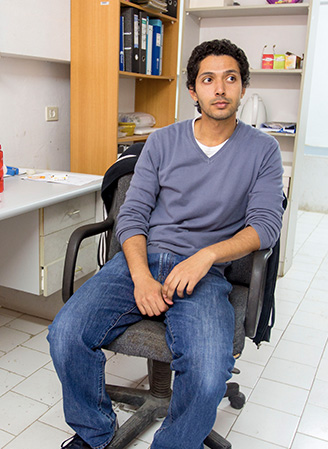
Omar has lived here his entire 26 years, and they call him doctor now because that is what he does. He ministers to the sick, helps to heal the afflicted: the work of doctors everywhere. Tall and slender, with dark, closely cropped hair and beard, he has a quiet intensity as he attends to his fellow villagers, farmers mostly, whether they need just a quick checkup or immediate attention, something that can’t wait for the 45-minute drive over dusty roads to Ramallah, the nearest city. Children, adults, everyone.

You could say he was raised to do this work. When Omar was born, his father, who once taught English literature and now manages student textbooks for the Ministry of Education, started an apiary in the valley west of Rantis. The family came to raise more and more bees, selling their honey to pay for Omar’s education. He graduated and opened his clinic, committing himself to the long hours of caring for his people. Today, he says, “I want to go back and repay them what they paid me. Because they spent a lot of money and effort on things for getting me education. So it’s a kind of payback.”
Omar wants to pay back his parents not only by becoming the village doctor, but in another way, one almost completely foreign to Palestine. He’s among a group of students and researchers who’ve formed the Palestinian Neuroscience Initiative, hoping to kickstart sophisticated scientific research in a country with only the most basic medical infrastructure, and where specialization — in narrow but vital areas including pediatric cardiology, but also broader fields such as neurology and psychiatry — is almost completely absent.
Even among typically ambitious medical students, the idea of establishing a foundation for original neuroscience research in Palestine seemed daunting. The students were too busy or simply uninterested in clinical research; there were few qualified teachers; there was little equipment, or money to buy any. What there was in abundance was skepticism.
That was four years ago. Today the Initiative has more than 20 students doing original research, and partnerships with Rutgers University–Newark, Harvard University, Switzerland’s École Polytechnique Fédérale de Lausanne, and the International School for Advanced Studies in Italy. It has produced four published papers; four more are currently under review. Last September, it received a National Institutes of Health grant, considered among the most prestigious in the field, a marker of serious, professional work. It’s making the kind of steady progress necessary to build an institution.
But most importantly to Omar and his colleagues, it’s giving them an opportunity to help. To give back.
Building a foundationBuilding a foundation
On a sunny summer afternoon, Omar walks through a door with a computer-printed piece of paper taped to the outside. “Al-Quds Cognitive Neuroscience Lab,” it reads, and the door opens into a rectangular, white-walled classroom dominated by a long wooden table. Just over a dozen students are seated around it. The women sit on the left, nearly all wearing hijabs, and the men sit on the right.
At the head of the table, umbilicalled to the wall by a long extension cord, sits a MacBook. On-screen, the slightly pixelated face of Mohammad Herzallah leads the day’s discussion, shifting black squares representing his curly hair. His voice, originating almost 6,000 miles away, in Newark, New Jersey, asks about the role of the hippocampus in treating depression. An extended answer follows about the workings of selective serotonin reuptake inhibitors, a popular class of antidepressant drugs that includes Prozac, Zoloft, and Paxil.
Or rather, “popular” in the United States. According to the World Health Organization, 19.2 percent of US adults surveyed experienced a major depressive episode in their lives; the Centers for Disease Control found that about one in every 10 Americans aged 12 and over takes antidepressants, including SSRIs. As both diagnoses of depression and use of antidepressants rose in the US, “Prozac” became a household name. More than just a drug, it has become a cultural signifier for debates about mental illness and its proffered cures.
Depression in the West Bank is at 36 percent — nearly double that of the US
In Palestine, by contrast, television does not air commercials for antidepressants, nor do magazines feature full-page, pastel-colored ads suggesting you ask your doctor if a particular pill is right for you. Depression itself remains stigmatized. “People don’t want to speak about it, people don’t want to mention it, people don’t even want to speak about family members who have it,” says Herzallah, co-founder and director of the Palestinian Neuroscience Initiative. Depressed patients often don’t seek medical attention; if they do, they often couch their ailment in physical terms, complaining about, for example, lower back pain. And they try hard not to be seen leaving a mental health clinic.
Beneath the collective reticence, Palestine has a problem. According to one published study, 25 percent of Palestinians will experience a major depressive episode in their lifetimes. Herzallah believes data gathered by the Initiative indicates that rate in the West Bank is closer to 36 percent — or nearly double that of the US. Yet, as Herzallah puts it, “We have about 20 psychiatrists and 14 neurologists to serve 2.8 million inhabitants of the West Bank in Palestine.”
“People don’t want to speak about it, people don’t want to mention it, people don’t even want to speak about family members who have it.”
A high rate of depression, and not enough trained medical professionals to treat it. It was a serious problem, yes, but also a potential opportunity. And Mohammad Herzallah knew how to recognize an opportunity. He hadn't planned to be a doctor. Growing up in Jenin, in the northern West Bank, he wanted to be a physicist, either astro- or nuclear. His father, himself a professor, cautioned him that physics and Palestine don’t mix: if you want to do science and get support to go somewhere else to do it, he said, go for it. If not, consider something else. Always interested in biology, Herzallah chose medical school at Al-Quds University, a Palestinian school in Abu Dis, on the outskirts of Jerusalem. When he arrived, he focused on neuroscience, teaching himself.

He faced down a lot of skepticism in those early days. Neuroscience simply wasn’t being done at Al-Quds. “As an eager young medical student who wanted to become a researcher,” he says, “there were no opportunities at all.” No facilities, no resources, and, perhaps most crucially, no understanding that research mattered. And doctors lacking the basic tools to treat their patients weren’t likely to be swayed by Herzallah’s youthful enthusiasm; they’d tell him he was crazy to focus on such specialized research when people needed medical help now. Even his father told him he was crazy: he was on his own.
Until his fifth year, when he met Dr. Mark Gluck and Dr. Adel Misk. Brought together by previous collaborations on Parkinson’s research, the two neuroscientists sought to establish the infrastructure for neuroscience and mental health research in Palestine. It was a daunting goal: their two schools, Rutgers University–Newark for Gluck, Al-Quds University for Misk, had joined together, but as Gluck says, “It was very hard to find any student who would work for free on a project most of them thought would go nowhere.” Comparing their resources — teachers, technology, and money — with the million-dollar labs at cutting-edge world institutions, he says, provoked not just skepticism, but despair.

Among those initial recruits, though, was Herzallah, who Gluck dubs “an absolute superstar.” And soon enough the neuroscientists recognized the one problem they’d come together to address also provided an opportunity. In Palestine, there were many depressed patients to treat, and most of them had never taken any form of antidepressant. That enabled research on how antidepressants affect previously unmedicated brains — study difficult in, for example, the United States, where a much higher percentage of the population has taken such drugs.
Palestine has a relatively homogenous gene pool
Palestine had another advantage: a genetically homogenous population. Different people react differently to antidepressants; up to half of patients gain no benefits at all. Genetics play a role in how patients react, adding one more variable to any study. It’s especially difficult to control in a country like the United States, where centuries of immigration and intermarriage have diversified the gene pool. Palestine, by contrast, has a relatively homogenous gene pool thanks to a lack of immigration and a tradition of inter-familial marriage: relatives marrying one another.
Those marriages lead to genetic homogenization in the next generation, which can create serious health problems as negative traits get amplified. Rare genetic disorders such as juvenile-onset Parkinson's disease (in children as young as 14), familial schizophrenia, and early-onset Alzheimer's disease are more prevalent among Palestinians, says Herzallah, in part because of a lack of genetic diversity. That gives the budding neurogeneticists at the Initiative a tragic opportunity to study the links between genes and these rare diseases.
The students had one more unique opportunity. More than half of Palestine’s people are younger than 24. Rates of depression vary with age, and having so many young people offered an opportunity to study those differences.
From the beginning, the Initiative’s founders focused on turning problems into opportunities, and on building a foundation that would last, not just for the students involved, but for the whole community. “We train students to do research,” Herzallah says, “but what we want to do is invest in people.” In the long run, Herzallah and his colleagues believe, they’re helping to create not just researchers, but invested citizens who’ll fight the Palestinian “brain drain” by staying to help their homeland and people.

“research lies at the heart of medicine, and healthcare should be concerned with providing service, but with finding answers as well.”
The inner voice
The inner voice
“The quality of life here is... I mean, it’s bad, it’s not the best. Finances are bad. So everything is against people coming back here,” says Ibrahim Mughrabi, a postdoctoral researcher with the Palestinian Neuroscience Initiative. The unemployment rate in Palestine is over 20 percent, with a poverty rate nearly as high. Over half the labor force works in the service industry, and economic growth is driven almost entirely by donor aid and government spending, with very little private development. With the import and export of goods and labor controlled by Israeli security policies, Palestine has difficulty utilizing local resources. Smart people can see more opportunities elsewhere, and seize them where they can.
But Mughrabi, like his colleagues, chose to stay. He helped establish the neurogenetics program, with studies examining genetic markers that confer risk for psychiatric disorders. He also examines how genotype affects responses to therapy, studying how genetic differences determine whether antidepressants help a patient. He describes the Initiative as taking the first steps toward a Palestinian Neuroscience Institute that would support researchers, educate clinicians and students, and inform the public about mental health issues. Like many of his colleagues, he believes “research lies at the heart of medicine, and healthcare should be concerned with providing service, but with finding answers as well.” Palestine needs doctors and clinicians, and it needs the medical infrastructure to support them. But it also needs researchers willing to remain and address their country’s unique problems.
Many in the Initiative echo Mughrabi’s sentiment. Sundus Shalabi, a fifth year medical student, says, “I believe that you can do much more good for the whole community than just being a doctor. If you’re a researcher, you can help so many people out there who are suffering.” She’s worked on genetic research with the lab for two years; she’s grateful to be doing the kind of work she believes in. “I think as a doctor, as a medical student, and as a researcher, you have to make some sacrifices if you want to do some good for this country. I’m willing to make these sacrifices because I think it’s a very good thing to do for the people. We have very much to offer for our people and for the country, but this energy is wasted, so we need to collect it.”
Collecting energy, harvesting brainpower and putting it to productive, local use. That’s what the Initiative’s all about. It’s a long-term endeavor, as everyone acknowledges. “We’re starting a new generation of not only good medical students,” Shalabi says, “but also motivated young researchers who are willing to do something good for this country other than just prescribing medicine.” And for some students that means sacrifice: giving up potentially lucrative jobs elsewhere, declining the clear path to becoming “just” a doctor, and dedicating themselves to a project the provokes skepticism in even their fellow medical students.
“I think as a doctor, as a medical student, and as a researcher, you have to make some sacrifices if you want to do some good for this country.”
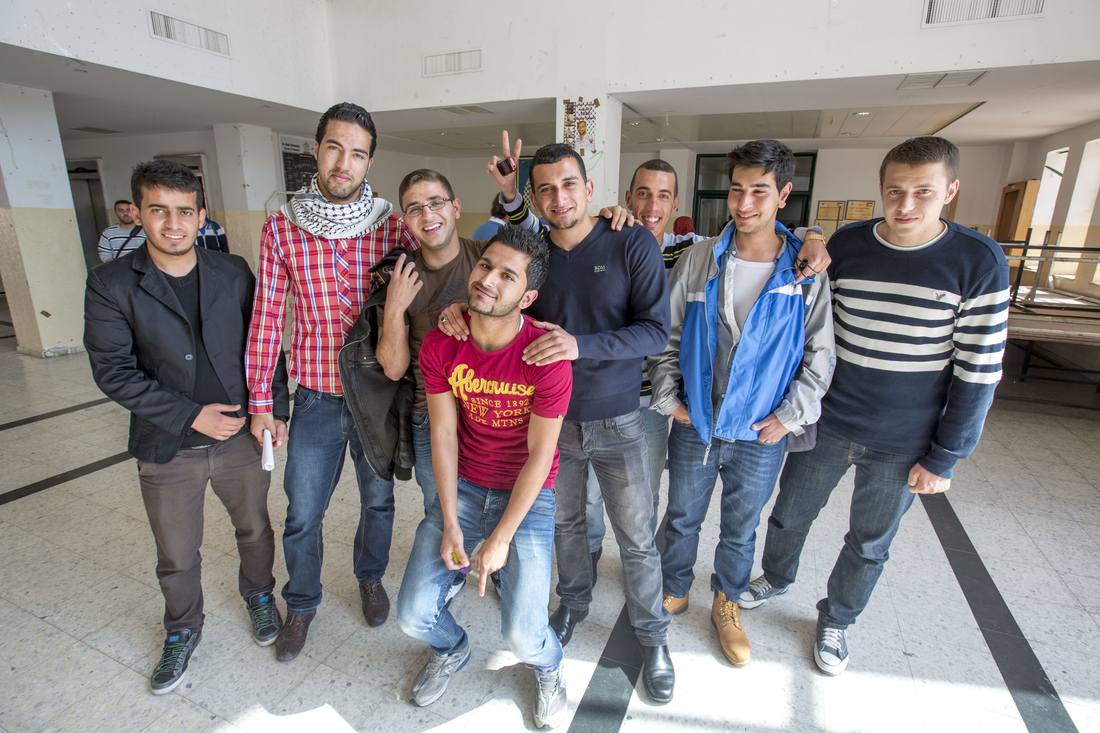
“You have to have faith to do this. Without hearing anybody, you have to go with your inner voice to do things, especially in Palestine,” says Aya Imam, a sixth year medical student from East Jerusalem. She was among the first to join the lab in 2010; she saw it as an opportunity to study abroad, and later spent two months as an intern in Switzerland. During that time, she says, “All I was thinking about was going back home. Because whatever you do outside, okay, you're benefiting, but you don't feel like you're giving.” She wasn’t giving until she was back home, doing her part for the people around her. Currently she’s working on antidepressant research, looking for impairments in cognitive function among patients taking SSRIs.
“‘You want to do what in Palestine? You know, we don’t have roads,’” laughs Mousa Hamad, describing the skepticism he often still encounters when talking about the Initiative. He works alongside Mohammad Herzallah at Rutgers–Newark, doing research and helping to publicize their work. It can sound crazy to outsiders. Even Herzallah’s father still thinks he’s crazy — if maybe a little less so than before. Maybe you have to have that inner voice. For his part, Herzallah says, “I'm not against the idea of being crazy, because everyone who achieved something important in history was crazy.”
“We don't lack the brains. We don't lack the ambition. We don't lack the availability of smart people.”
Looking to the future
Looking to the future
Of course, not everyone thinks he’s crazy. Herzallah can point with pride to the partnerships with prestigious universities worldwide; he can talk about the 35 students trained on cognitive neuroscience research methodologies, about the 14 working with partner institutions such as Columbia and NYU; he can offer the four published research papers and the other four under review. He can talk about the NIH grant and about being on campus at 7:30AM every Monday to Skype with his students, seven hours ahead of him in Abu Dis. Call him crazy if you want, but for him there’s no reason to think neuroscience can’t come to Palestine. “We don't lack the brains,” he says, “We don't lack the ambition. We don't lack the availability of smart people.” And the Initiative continues to grow, with more students applying every year.
With that success comes hope that as Ibrahim Mughrabi puts it, they “will inspire our colleagues to start their own initiatives and maybe help channel and train future graduates into the much-needed specialties in Palestine.” The crazy idea just might spread.
Meanwhile, Omar Danoun is leaving his small village, Rantis. But not forever. He’s leaving to learn more, heading to the University of Detroit Mercy to study. (His relatives can’t resist making jokes about sending him off to Detroit with a bulletproof vest.) He will go there to learn, and then he will come back, bringing with him the knowledge he’s gained. Back to his culture, to his family, and to the people who call him doctor.
20 Aug 16:20
Norm Lopez, A Popular 26-Pound Cat From Sacramento
by Kimber Streams

Norm Lopez is a 26-pound cat that lives in Sacramento with his human, Tyler Lopez. Recently while Tyler was on vacation, a stranger mistook Norm for a pregnant cat and took him to the Front Street Animal Shelter. Staff recognized Norm and returned him to his home. Norm has since received an ID chip (and is also on weight-control food), and a pub crawl to benefit the shelter in his honor is being held on August 31st, 2013. For more photos of the popular fat cat, take a look at this story by The Sacramento Bee and Norm’s Facebook page.


images via Norm Lopez
video via The Sacramento Bee
via Cute Overload
firehose likes this

20 Aug 16:19


LinkedIn thinks your 14-year-old needs a professional resume, and it’s right
by Rachel Feltman
firehosefuck you
go fuck yourself
yes, yes, help people with data privilege
ignore people without access
yes
yes startups yes
yes today is a great day
i'm not drunk yet today, it can get better
fuck today
aaaaaaaaaaaaa sharing
When should kids start branding themselves for getting into college and, by extension, a job? At 14, apparently. LinkedIn announced yesterday that its new University Pages feature—which allows colleges some of the same networking and recruiting powers that employers hold on the site—will usher in the age of LinkedIn for kids. With profiles now available for ages 14 and up (13 in some countries, and 16 and 18 in the Netherlands and China, respectively) LinkedIn looks to be honing in on the college admissions process.
Now colleges have another place to try and woo you
LinkedIn
It may be a little troublesome to think of high school freshmen fluffing up their LinkedIn profiles, but don’t think it’s not a game they’re already playing: A 2012 study by Kaplan (pdf) found that 26% of college admissions counselors admitted to visiting applicants’ Facebook pages and 27% owned up to general Googling. That number isn’t too high yet, but 87% of schools use Facebook as a recruiting tool—and once students are “liking” a school’s page, it’s hard to imagine that admissions staff aren’t looking at their profiles.
And that’s not going well for students. In 2011, only 12% of counselors who used social media reported finding information that made them less likely to admit an applicant. By 2012, that had risen to 35%. Advice for would-be students includes hiding everything except for pictures of yourself receiving awards. But since bragging about your achievements is the number one cause of Facebook “un-friending,” not many people may want to do that.
Dr. Bernie Hogan of the Oxford Internet Institute told the BBC that having a separate profile on LinkedIn for “professional” life, as so many adults do, may be the lesser of two evils. It could help children “differentiate between the public profile they want for employment [and] the personal profile they share on Facebook with their friends and family.” Employers or schools, meanwhile, shouldn’t look at Facebook pages, he said, because “the risk of unintended discrimination is very high.” In other words, if getting into college requires having a whitewashed internet presence full of accolades and honor societies, at least let the kids have a carefree personal life as well. In addition, LinkedIn’s default privacy settings for youth profiles seem more stringent than those on Facebook.
It could very well be that LinkedIn is hoping to partially automate the admissions process, using the same big data it applies to job searches to help counselors sort through their applicants. Hopefully it’ll help applicants choose between colleges too.
20 Aug 16:10


Do villains have to commit "taboo" acts for us to hate them?
by Esther Inglis-Arkell

Do villains need to rape, torture or mutilate people for us to hate them? Or maybe the reverse is true: Sometimes we can invest more in a villain, if his or her evildoing is creative and leaves more to our imaginations. Sometimes with villains, brutality is the lesser path. Here's our plea for more subtle monsters.
|
|
20 Aug 15:59
The Creator Of Luther Is Going To Write For The 12th Doctor
firehoseand it won't do any of the things such a combination would do best


20 Aug 15:54
Wacom Announces Pressure-Sensitive Intuos Creative Stylus for iPad [iOS Blog]
by Juli Clover
Wacom today debuted its Intuos Creative Stylus (via Engadget), which uses Bluetooth 4.0, integrated shortcut buttons, and 2,048 levels of pressure sensitivity to create "a realistic pen-on-paper feel" when drawing on an iPad. It's designed for sketching, drawing, and painting and aims to deliver "professional-grade performance" to iPad users.

The pen comes in blue or black brushed aluminum with a case, extra nibs, and a replacement AAA battery. It is compatible with the third generation iPad, the fourth generation iPad, and the iPad mini. While it is meant to work with the company's Bamboo Paper app, it will apparently be compatible with other apps as well, including SketchBook Pro, ArtRage, and ProCreate.
Wacom's Intuos Creative Stylus will be available in Best Buy Stores for $99 beginning in October.
Bamboo Paper is an iPad app that can be downloaded for free from the App Store. [Direct Link]


The pen comes in blue or black brushed aluminum with a case, extra nibs, and a replacement AAA battery. It is compatible with the third generation iPad, the fourth generation iPad, and the iPad mini. While it is meant to work with the company's Bamboo Paper app, it will apparently be compatible with other apps as well, including SketchBook Pro, ArtRage, and ProCreate.
Providing the power to produce professional results on an iPad, the Intuos Creative Stylus's advanced technology comes in form of a best-in-class pen experience and pressure sensitivity of 2048 pressure levels. This means that it can reproduce the feel and artistic control of traditional brushes and markers, so it's ideal for sketching, illustrating and image editing. It is also highly responsive, even reacting to light strokes, while rejecting unintentional touches when used with compatible creative apps that integrate Wacom's industry-leading technology.In addition to announcing the stylus, Wacom has released a new version of its Bamboo Paper app. Version 2.0 of the app includes Tumblr and Dropbox sharing, along with premium notebooks, improved palm rejection software, new color palettes, and new tools.
Wacom's Intuos Creative Stylus will be available in Best Buy Stores for $99 beginning in October.
Bamboo Paper is an iPad app that can be downloaded for free from the App Store. [Direct Link]
|
|
Gautam.dey77, Paul Thompson and -1 others like this
20 Aug 15:39

Here is one of the illustrations I did for Ryan North’s To...
firehoseotters: "wtf is John Keogh doing nowadays"
Here is one of the illustrations I did for Ryan North’s To Be Or Not To Be, aka Choose Your Own Adventure Hamlet, aka The Coolest Book In Town.
I was lucky enough to be able to illustrate one of the scenes that was in the actual standard Shakespeare version of the story, in which Hamlet commandeers a pirate ship, fires himself out of a cannon at Claudius, and consequently explodes. I’m pretty sure this is in there.
I’m not entirely happy with the coloring, should have paid more attention to value & using it to direct the eye, rather than the obvious “yeah just color everything the color it’s supposed to be.” Also should have better differentiated the sails and the sky. OH WELL.
What I am entirely happy with, and which more than balances out any disappointment, is that I managed to put the letter C on Claudius’ person three times, which is hilarious, and that alone is enough to give this image a pass into Success City.
20 Aug 15:28


Summer In The City: Great Job, Internet!: Hear A.V. Fest headliner Neko Case’s new album in its entirety
by Kevin McFarland
firehoseattn: saucie
We’re two weeks away from the release of Neko Case’s new album The Worse Things Get, The Harder I Fight, The Harder I Fight, The More I Love You—and she headlines A.V. Fest on September 6, just a few days after that release. Now the whole album is available to stream over at NPR. Littered over the course of 12 new tracks—a cover of Nico’s “Afraid” among them—are guest turns from undercover veteran Kelly Hogan, M. Ward, fellow New Pornographer A.C. Newman, Visqueen’s Rachel Flotard, and many others.
Watch the lyric video for “Night Still Comes” below, and buy tickets to A.V. Fest here.
Read more
20 Aug 15:25
Google patents 'pay-per-gaze' eye-tracking that could measure emotional response to real-world ads
by Adrianne Jeffries
firehoseeverything is always watching beat
"latent pre-searching"
"The data on these searches would, of course, be stored and could be used for future ad-targeting"
Advertisers spend heaps of cash on branding, bannering, and product-placing. But does anyone really look at those ads? Google could be betting that advertisers will pay to know whether consumers are actually looking at their billboards, magazine spreads, and online ads. The company was just granted a patent for "pay-per-gaze" advertising, which would employ a Google Glass-like eye sensor in order to identify when consumers are looking at advertisements in the real world and online.
From the patent application, which was filed in May 2011:
Pay per gaze advertising need not be limited to on-line advertisements, but rather can be extended to conventional advertisement media including billboards, magazines, newspapers, and other forms of conventional print media. Thus, the gaze tracking system described herein offers a mechanism to track and bill offline advertisements in the manner similar to popular online advertisement schemes.
The idea is to measure how long a person looks at an ad, as well as their emotional response as indicated by pupil dilation. The company, by now very used to allegations of privacy invasion, was careful to preempt the Big Brother argument by noting that users can opt out of "pay-per-gaze" tracking and data will be anonymized.
The patent also includes a provision for "latent pre-searching," which would display search results over a user's field of vision using Glass or another wearable computer. The data on these searches would, of course, be stored and could be used for future ad-targeting.
The system would show how long you look at an ad and your emotional response
Even if this patent is never used in a product, eye-tracking for advertisements online and in the real world seems inevitable as advertising analytics get more sophisticated and devices like Google Glass become more common.
- Via Phys.OrgMarketing Land
- Image Credit USPTO
- Related Items advertising google patents eye-tracking google glass pay-per-gaze
20 Aug 15:05
Introducing the Newest Obama - Sunny
by whitehouse
 |
The Obamas welcomed the newest member of their family -- a little girl (puppy) named Sunny! You can learn more here: http://www.whitehouse.gov/meet-sunny Sun...
|
From:
whitehouse
Views:
2111084
  
9650
ratings
|
| Time: 00:44 | More in News & Politics |
firehose and -1 others like this

20 Aug 14:55

…Once he stayed me on the palace-stair and whispered,...
…Once he stayed me on
the palace-stair and whispered, ‘Lo, my son,
Thy young reign draweth nigh — prepare!’ — So passed
And vanished as a wraith, so wan he was!
From The Flying Islands of the Night, James Whitcomb Riley, illustrated by Franklin Booth
Russian Sledges, firehose likes this
20 Aug 14:55
Twitter hires former Google exec to drive movie, TV expansion
by Amar Toor
firehose'a sales team to market Twitter as a valuable "social soundtrack" for televised events, and may look to branch into video games'
ha ha
ha aha haha
Twitter has hired Jennifer Prince, former head of Google's media and entertainment ad sales, to expand its movie and TV partnerships. As Variety reports, Prince will hire a sales team to market Twitter as a valuable "social soundtrack" for televised events, and may look to branch into video games, as well. She officially starts her tenure as head of entertainment sales, based in Santa Monica, California, on August 19th.
Twitter has made several TV-focused moves over the past few months, striking a partnership with Nielsen in December, and expanding its Amplify program in May to push more targeted content to live viewers. Last week, the company reportedly began testing dedicated TV "cards" that would appear in user timelines to promote trending shows.
"All entertainment brands are working with Twitter, but they’re just scratching the surface."
The company clearly sees Hollywood as a potential goldmine, as evidenced by Prince's hire; according to Variety, this is the first time that Twitter's ad sales have targeted a vertical industry, rather than a given region. Prior to joining Google in 2011, Prince worked as head of branded ad sales at Demand Media, following a brief tenure as a sales team manager at YouTube.
Prince's specific game plan remains unclear, though she says there's substantial opportunity for expansion. "All entertainment brands are working with Twitter, but they’re just scratching the surface," Prince said. The company, meanwhile, says it has no plans to branch out into content licensing. "This is not a content play," a spokesperson told Variety.