firehose
Shared posts
Make $377K Trading Apple In One Day
It's Going To Be A Really Good Year For Apples
Need a little extra security in your life? Here’s the...

Need a little extra security in your life?
Here’s the Bullet That Has Your Name On It.
wtf-viz: Disconnected subway map? Sequential, linear...
firehosefrom IBM's Watson team, apparently

Disconnected subway map? Sequential, linear relationships?
Possibly one of the worst uses of the “subway map” design metaphor I’ve ever seen. I can’t even bring myself to comment any further.
Cardboard Children: TRAINS.
firehoseTRAINS
By Robert Florence on August 31st, 2013 at 12:00 am.

Hello youse.
TRAINS! TRAINS! TRAINS! You there, young man! Do you like TRAINS?! You there, young lady! Do you like TRAINS?! TRAINS TRAINS TRAINS!
TRAINS!
“Just picked up a new game.”
“Cool. What’s it called?”
“TRAINS.”
“Goodbye.”
You, Rock Paper Shotgun reader! Do you like TRAINS?! Read on, regardless. TRAINS.
TRAINS

TRAINS. It takes a big old set of balls to call your board game TRAINS. There are a lot of train games out there. There’s Ticket To Ride, which is a family game about trains. There’s Steam, which is about trains. There’s the 18XX games, which are about trains. There’s games like Martian Rails, which is set on Mars and is about trains. I could go on. I could, honestly. But this game is called TRAINS. Just TRAINS, and that takes a big old set of balls. It’s like saying “Yeah, sure there are other train games, but when someone thinks TRAINS they are going to think TRAINS. They are going to think US. TRAINS.”
As your man from Dragon’s Den might say “It’s a confident pitch from the young board game, but will it stand up to the Dragons’ analysis?”

Do you like Dominion? Dominion is a card game that changed the landscape of tabletop gaming a fair bit. It introduced that whole “deckbuilding as you play” thing, and for better or worse it spawned a league of imitators. I like the game. I don’t think it’s spectacular. I certainly haven’t played it a lot, because while I find it “enjoyable” I hardly find it a gripping experience. There’s almost too little going on, and there’s no real sense of theme, so the mechanics are way out there front and centre. And like I said, I enjoy those mechanics, but in the same way I used to enjoy playing a game of Patience with a normal deck of cards. It’s a relaxing, mechanical, chill-out thing – and that’s GREAT – but it’s not often what I’m wanting from a board gaming session. (I should state here that I don’t own even one Dominion expansion, so I’m basing all this on the base game alone.)
Why am I talking about Dominion? Well, you will soon see a lot of people calling TRAINS “Dominion with a board.” And while I think that’s a bit of a lazy thing to say, it’s very hard to argue with as a shortcut to understanding what this game is. The deckbuilding element of the game is a lot like Dominion. Play cards to pay the cost to buy other cards. Put new purchases into your discard pile. Shuffle up, hope for your new cards. The fun comes from the additional actions that cards introduce to your game, and your attempts to get some kind of synergy rolling. And unlike Dominion, there is no limit on playing actions in your turn.
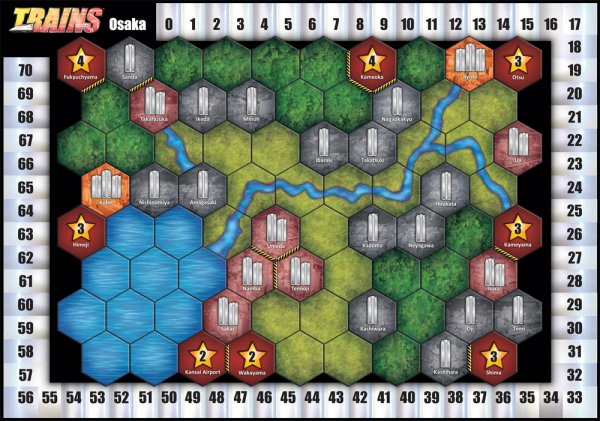
But here’s where TRAINS differs from Dominion. In a turn, as well as playing and buying cards, you can play cards that let you build stations and lay tracks. All that building stuff happens on a board. The board is laid out in hexes, and shows some Japanese cities. Players will lay tracks across the board, scoring points at the end of the game for tracks laid in cities with stations and tracks reaching to remote locations. The cost of laying tracks is paid for with cards too, so there’s a lot of deciding whether to spend money on refining your deck or on laying track. (Of course, you can only lay track when you play the card that allows you to do it, so you need to ensure your deck is spitting out enough of these cards.)
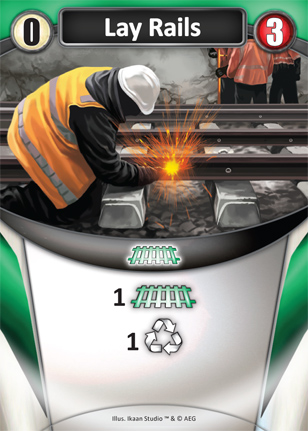
Here’s my favourite part of the game, though. It feels like everything you do creates waste. When you build a station in a city (and remember, you have to develop cities in this way to have your track be worth anything) you need to take a Waste card. When you lay rails, you need to take a Waste card. When you lay rail into a hex that already contains another player’s rail, that’s ANOTHER Waste card. And Waste cards do nothing. No actions, no value – nothing. In Dominion, for example, a major element of the game is trying to get rid of the weak early starting cards, to thin your deck. In TRAINS, it’s all about Waste. Your starting cards will always be useful, but your deck will start to clog up with Waste. Thankfully, you can skip a turn to take a “Rest” action, allowing you to ditch any Waste cards in your 5-card hand. But there are other, better ways. You can buy Landfill cards that allow you to trash waste, and you can even buy Freight Train cards that will carry off your Waste and get you PAID for that shit. Yep, you can even make your Waste work for you.
With Waste alone, the theme of TRAINS really comes through. In Dominion, you never feel like you’re building a kingdom, but in TRAINS you do feel like you’re building a little rail network and paying the economic and environmental cost for your constant expansion. Just having that board there, and being able to see your little network grow, elevates TRAINS above the other deckbuilders of this type.
There’s a lot to like here. I like how the scoring works. I like how your rails only generate points if they’re in cities with stations. I like how that forces you to build towards other players’ rail networks, to take points in cities full of stations you had no hand in building. I like how you can buy cards that lower the cost of you building into your opponents’ networks. I love how clean and simple the deckbuilding element is, allowing you to think equally about board and deck and hand. I love how fast it plays. I love the variety in the game, with the random selection of card piles at the start of every game. I pretty much just love it. By placing those rail cubes on that board, you have a completely different experience to any other deckbuilder I’ve played.
The theming of the game is great, I think. The art is lovely, and I’m delighted that the game is still set in Japan, the land of its origin. Cards that let you tunnel, pull freight, run tourist trains, build bridges – all of that stuff just seems to click more naturally than other games of this type. It’s such a solid marriage of design and theme.
What else is there to say? It plays 2-4 players and absolutely will take an hour to play at most. If you’re a fan of Dominion, this is a definite buy for you. It’s some mechanics you recognise and love with some fun “building” in the mix too. If you don’t like Dominion, this is still worth trying. I think it improves on the Dominion model, so you might like this game despite Dominion not clicking with you. If you’ve never played Dominion, I’d honestly recommend TRAINS over it. Many will disagree, I’m sure, because people LOVE Dominion. But I just think that when you compare base game with base game, TRAINS comes out on top with its elegant theming and the extra layer of light strategy that the board provides.
So. Do you like trains? Do you? It doesn’t matter, because I think you’re going to love TRAINS.
BROTHER GETHSEMANE WRITES…
“Fear not, Gethsemaniacs. The Midnight Table will return at regular intervals, with a darker look at board gaming, and the profane experiences you can expect from games good… and BAD.”
JAMES PUREFOY WRITES…
“Sorry, I’m not contributing anything to this column.”


The Ready Player One MMO was Metaplace


MMORPG.com has an article about a hypothetical Ready Player One MMO.

For those who haven’t read it, Ready Player One
The book is full of geek references. The skillful playing of Joust is a key point; so is the ability to recite Ferris Bueller’s Day Off from memory. But of course, part of what captivates a gamer is the description of OASIS itself: a giant network of virtual spaces, capable of encompassing pretty much every sort of virtual space you might want.
So the article asks, what about building something like that. Well, we did.
Metaplace predated the novel. But really, the book describes basically what we built, and which is now gone. (The tech survives, within Disney, but isn’t used in this fashion anymore).
I think many MMORPG fans were barely even aware it existed, because really, it got almost no marketing. And while we were around, people were perpetually confused as to what it was. Frankly, I found it too big an idea to wrap up well in a marketing message.
- a generic server architecture that could handle anything from arcade games to MMOs. Servers ran in the cloud, so it was designed to be really, really scalable. Just keep adding worlds. At the time we closed it, there were tens of thousands of them.
- the ability for players to own and make their own spaces. You didn’t even need to know how to make stuff in 3d modeling, it imported SketchUp from Google Warehouse even. You didn’t need to host your own art.
- scriptable to the point where you could make a whole game in it. The scripting used Lua, which was a barrier for people. We had made moves towards letting people snap together behaviors (drag and drop AI onto something in the world, for example) but probably didn’t go far enough.
- full web connectivity in and out, so that you could have stuff from the real world manifest in the games, or game stuff feed out to the web. Like, an MMO where the mobs are driven by stock quotes was easy to make. Or hooking a Metaplace world up to say Moodle (for education) or having NPCs read their dialogue from external sources. We had one world which performed any Shakespeare play by reading the plays off of a remote server, spawning NPCs for all the parts, and interpreting the stage directions.
- agnostic as far as client, so you could connect lo-fi or full fancy 3d — in theory. We never got to the 3d, but we had clients running on mobile devices, PCs, and in web browsers. If we were still pursuing it, you can bet we’d be doing an Oculus version right about now.

- worlds connected to one another, and you might change from world to world, but you also had a common identity across all the worlds. You could walk from Pac-Man into Azeroth, so to speak.
I think a lot of people were turned off by the 2d graphics, and a lot were turned off by the fact that there wasn’t a full MMO there to just play, and a lot of people found building too hard. A huge part of why we didn’t succeed is that we were too many things to too many different people, and that split our efforts in far too many directions. The result was a tight but small community that never started to really grow.
But if you were ever wondering why something like the Ready Player One/Snow Crash style world hasn’t been made — well, there it was… open from 2007 to 2009. It saddens me to see it forgotten so quickly, though in many ways it really did end up as just a footnote in virtual world history. I get a lot of “the last thing you did was SWG in 2003″ from people who clearly didn’t know it existed or weren’t interested because it wasn’t a hack n slash gameworld.
I might spend the time to dig through some screenshot archives and post up some examples of what got made. I miss that community a lot.
Ohio State Introduces Massive Open Online Calculus


Read more of this story at Slashdot.

Here’s why India is never going to be safe for women
firehose"Let us just take the case of of the city of Mumbai, arguably India’s most commercially important metropolis. Mumbai has a sanctioned police strength of approximately 45,000 officers. Around 3,000 of these posts are currently vacant. The effective number police on the streets are even lower. The New Indian Express recently said that Mumbai had a serving police force of 33,000 officers.
Earlier this month, in response to a Right To Information request, Mumbai police revealed that in the first two months of this year 27,740 police personnel had been deployed on VIP security duty, generally meaning they guard politicians.
...
One estimate puts the annual budget of Mumbai’s police force at about 6 billion rupees (or $91 million). Almost all of this, around 85%, goes toward paying salaries. Can Mumbai, the beating heart of India’s economy afford to, say, double this? Given that the budget of the city of Mumbai is 280 billion rupees ($4 billion), and the city has a GDP which is at least 10 times as much, an escalation wouldn’t break the bank.

A few days ago, after news of the sexual assault case in Mumbai broke out, someone on Twitter said something that got me thinking. A female resident of Mumbai, presumably, lashed out after seeing the umpteenth tweet asking women in Mumbai to “take care” and “be safe.”
Enough of this patronizing nonsense, she said. Instead of asking women to “take care” it was time that men actually did something to make the city safer for women.
In the days since that attack, such outbursts from men and women alike have become common. And they have been part of a much broader collection of discussion and debates about women’s safety. There are several concurrent threads to these debates: How can we teach our men to respect women better? Is violence against women an expression of social faults, if so which ones? How can these faults be alleviated? How does the portrayal of women, women’s issues and violence against women in mass media play a role in making things better or worse? Should minors involved in sex crimes be treated as adults? What can we do to make our neighborhoods safer? More recently there has been substantial debate on the trivializing of the idea of rape in the form of jokes and in other contexts not directly related to sex crimes.
Essentially, I suppose we are all trying to figure out how India can be made safer and more empathetic for all women. And these lines of questioning are legitimate. They might eventually help us make our cities, towns, and homes safer. But not immediately, not right now.
Right now, make no mistake about it, we need something that forms the foundation of a safe society: a functioning law-and-order system. No amount of soul searching, cultural self-flagellation, sex education, local activism, and behavioral conditioning will succeed unless our streets are well-policed and our courts function with speed and efficiency.
And this is exactly why I am afraid India will remain an unsafe country for women for the foreseeable future. Now I know this is not the message that many campaigners for women’s safety want to hear. Many of them are optimistic that some kind of governmental or non-governmental campaigning will make India safer. But as long these campaigns are divorced from a substantial overhaul of law and order mechanisms, they will not work.
Let us just take the case of of the city of Mumbai, arguably India’s most commercially important metropolis. Mumbai has a sanctioned police strength of approximately 45,000 officers. Around 3,000 of these posts are currently vacant. The effective number police on the streets are even lower. The New Indian Express recently said that Mumbai had a serving police force of 33,000 officers.
Earlier this month, in response to a Right To Information request, Mumbai police revealed that in the first two months of this year 27,740 police personnel had been deployed on VIP security duty, generally meaning they guard politicians. It is unclear if these deployments were short or long term. But there is no question that this substantially reduces the number of police officers the city actually needs on its streets.
An optimistic estimate suggests that, on an ongoing basis, Mumbai police has around 20,000 police taking care of its population of around 20 million residents. Therefore, Mumbai enjoys an effective police coverage of approximately 100 police officers per 100,000. (This number can vary somewhat depending on how you approximate police and population. But by my reckoning, it gets no better than around 165 per 100,000.) The United Nations recommends coverage where a population of 100,000 are served by 220 to 250 police officers.
What about courts? It is common knowledge that Indian courts have millions of cases pending at any given point in time. Yet another Right To Information request, filed by the same applicant in June, found 49,170 cases of crimes against women pending in courts across the state of Maharashtra (Mumbai is its capital). This number has increased by 40% between 2008 and 2012. Of the 14,414 rape cases tried in Maharashtra last year, 13,388 remain pending.
To be sure, better police and faster courts will not solve these problems alone, and columnist Praveen Swami explains this, but I can think of no conceivable solution that does not include better police and faster courts as key elements.
The need for immediate intervention is staring us in the face. So why don’t the people who run Mumbai, Maharashtra or India see this? What prevents them from overhauling the police force and legal system? Why does law minister after law minister lament about the masses of pending cases in Indian courts … and then actually do nothing radical about it?
This situation is doubly ludicrous when you consider that the government is also struggling to create sufficient jobs each year to occupy its exploding youth demographic. The nation is simultaneously drowning in both unemployed youth and undelivered public services.
Is it because these reforms are overly complex?
Cleaning up the courts is admittedly complex. But surely hiring a few thousand policemen can’t be as complex as rolling out multi-billion dollar job guarantees, food security or biometric identity schemes? Those are all initiatives the government has somehow managed to undertake.
Is it too expensive?
One estimate puts the annual budget of Mumbai’s police force at about 6 billion rupees (or $91 million). Almost all of this, around 85%, goes toward paying salaries. Can Mumbai, the beating heart of India’s economy afford to, say, double this? Given that the budget of the city of Mumbai is 280 billion rupees ($4 billion), and the city has a GDP which is at least 10 times as much, an escalation wouldn’t break the bank.
Then why not?
Your guess is as good as mine. But I think it is because overhauling Mumbai’s police or drawing up a radical plan to create new courts and hire new judges is exactly the kind of granular reform that, from a political perspective, Indian governments find difficult to execute. And unless these reforms deliver an immediate return (and one that can be politically leveraged), most stakeholders aren’t going to be interested in at all. In a given term in office there are only so many fights you can fight. So why pick the tough ones?
This is perhaps why the life cycles of legislation such as the Food Security Bill are relatively short, while those of a politically unsexy but economically important nature such as a new Companies Bill take decades.
There is a peculiar pattern that often pops up when “India’s problems” are discussed on social networks or in the comments section of news websites. Somehow while all of India’s problems are all universal—rapes happen in the US also, corruption happens in China also, malnutrition happens in Indonesia also—all the solutions to India’s problems become unique and complex. Police reform is complex, education is complex, food is complex, taxation is complex and on and on.
Not always. Some of India’s problem are simple things with simple solutions that unfortunately have no political capital.
I am afraid efficient courts and more and better police are among these problems. And I don’t think we should expect major reforms any time soon. Of course I hope I am proven completely wrong and Mumbai, and Delhi, and every other local administration immediately implements steps to improve law and order. Volunteer action, social awareness campaigns and neighborhood watch programs can all make marginal improvements. They will not, however, make up for a law and order system that works.
Until that happens—and I have no intention of being patronizing or sexist here—my fellow citizens will have to take care and be safe.
Follow Sidin on Twitter @sidin. We welcome your comments at ideas@qz.com.

UK High Court Gives OK To Investigation of Data Siezed From David Miranda
Read more of this story at Slashdot.


My Neighbour Totoro (1988) A huge favorite…




My Neighbour Totoro (1988)
A huge favorite…
Casio's ready to battle Samsung, Sony, and anyone else looking for smartwatch supremacy
firehoseoh shit Casio bout to throw downnnnnnnnnnnnnn
Casio CEO Kazuo Kashio is sending a clear message to Samsung, Apple, and any other company considering a move into smartwatches: "we're prepared." Speaking with the New York Times, Kashio notes that "suddenly, everyone's discovered the wrist," referencing the recent onslaught of smartwatches from Pebble, Sony, and others. "We've known for a long time it's prime real estate. We're prepared."
The market is ready for a smarter smartwatch
Amid the constant Apple iWatch rumor mill, Samsung has been readying the world for its first Android-based smartwatch, the Galaxy Gear. The Korean manufacturer, which sells more smartphones than any other company, has confirmed that the watch will be unveiled during a September 4th Samsung event at the IFA consumer electronics conference in Berlin. Samsung has been dabbling in smartwatches for a long time, but the successful release of the Kickstarter-backed Pebble has opened the door for a smarter smartwatch.
Both Motorola and Sony have released smartwatches in recent years, and Sony recently unveiled its SmartWatch 2 to lukewarm response. Samsung's model is expected to operate in a similar manner to Sony's, with most of the configuration taking place through an Android management app. Apple, as you'd expect, has been coy about its plans to enter the market, with perhaps the clearest hint being a statement by CEO Tim Cook back in April hinting the company was readying to enter an "exciting new product category."
- Source The New York Times
- Related Items watch android kickstarter ifa smartwatch ifa 2013 kazuo kashio SmartWatch 2 Pebble MotoACTV Motorola Samsung Pebble Sony Apple Casio Wearables
"Everybody hates you. So fucking what?! Some people, they just fucking love to hate. Some people,..."
- Malcolm Tucker, The Thick of it (via havssol)


Fort Hood shooting probe slams Pentagon policies - Fort Worth Star Telegram
MiamiHerald.com |
Fort Hood shooting probe slams Pentagon policies Fort Worth Star Telegram WASHINGTON — A Pentagon investigation into the Nov. 5 rampage at Fort Hood, Texas, that killed 13 soldiers and injured 32 others concluded that Department of Defense's policy on carrying personal weapons on military bases was "inadequate" and that ... Texas lawmakers push for compensation for Fort Hood victims and their familiesMiamiHerald.com Wis. mom reacts to Fort Hood shooter's sentenceHouston Chronicle Convicted Fort Hood gunman begins sentencing phaseDeseret News FOX 4 News all 70 news articles » |

Paul Revere - Wikipedia, the free encyclopedia


Film: Newswire: Luther might get a movie prequel
firehoseprequel means no Alice :(

While the third series of Luther doesn’t start airing in the U.S. until September 3, it’s never too soon for fans here and abroad to begin impatiently anticipating an additional Luther thing beyond the Luther thing they’re already impatiently anticipating. So creator Neil Cross has let it be known that he’s already written the script for a big-screen prequel to his cult favorite detective show, one he hopes to make sometime next year. Cross tells the BBC the film would follow Luther “in the earlier days, when he is still married to Zoe, and the final scene in the film is the first of the initial TV series”—a retracing of Luther’s formative years that could be similar to (or even draw from) events in the Cross-penned prequel novel The Calling from last year. Anyway, Idris Elba has already said he’d be interested ...
Read more
    
|
Ars does Soylent, Day 4: The Soylent-powered man
firehose"This is actually extremely useful. I eat as I drive, multitasking like a baws. I could really have used this stuff at jobs past, where I've alternated between elaborate client lunches on some days and fast food hamburgers frantically eaten while driving and running a sales call at the same time. Sometimes you really don't have time to eat."
Three days ago, Senior Reviews Editor Lee Hutchinson took a vow to spend a week eating nothing but Soylent, a nutritionally complete meal replacement created by engineer and entrepreneur Rob Rhinehart. He's documenting his freedom from solid food by day. Read about Day 3 here.
Closing out day 3
As you can see in the video below, Matt and Steve came over as promised and a wonderful time was had by all. Matt was less than impressed with Soylent's mouthfeel; after three full days, I've become used to it, but his description of it being like "a little kid was playing in the dirt and spilled his Purple Drank in the dirt and then slurped it up" isn't inaccurate.
According to the latest Soylent blog entry, the chalky texture is the result of the "mesh size" of Soylent's rice protein. Matt and I seem to mind it more than some past Soylent beta testers have, but Rob Rhinehart and crew are aware and are looking at a smaller-sized rice protein as they near a shipping product.
Read 19 remaining paragraphs | Comments

|
|
The Shutter: Pho Van will soon close...
firehose'... to focus his attention on Pho Van's burgeoning chain in Beijing: "It's a lot easier to make money in China right now." '

Pho Van will soon close its SE Hawthorne location, the Oregonian reports. Pho Van's other three area locations — on SE 82nd, in the Pearl District, and in Beaverton — will remain open. Owner Lam Van says that the Hawthorne restaurant's lease is up, and he thus plans to focus his attention on Pho Van's burgeoning chain in Beijing: "It's a lot easier to make money in China right now." [OregonLive]
It's A Dumbphone, But It's The Nicest Dumbphone You Can Buy
firehoseSeries 40, lol





TV: Newswire: Westworld is going to be an HBO show now
firehose"it’s executive produced by J.J. Abrams, because it involves remaking an old sci-fi property"

After years of being considered for a big-screen remake, occasionally involving Arnold Schwarzenegger, the 1973 sci-fi film Westworld is headed to HBO as a potential TV series, where the cable network can finally combine the respective settings of Deadwood, Rome, and Game Of Thrones into one big show with robots. Westworld will be written and directed by Jonathan Nolan, who’s already enjoyed great success exploring the rocky relationship between man and machine on Person Of Interest, and it’s executive produced by J.J. Abrams, because it involves remaking an old sci-fi property. (Fittingly, Abrams already has a robot TV show.)
No doubt due to Abrams’ and Nolan’s involvement, HBO has taken the unusual step of giving it a pilot production commitment, in addition to a commitment to ignoring Beyond Westworld and hoping no one ever brings it up. As of now it’s unclear how closely Westworld ...
Read more
|
|
when we get out of the office for a two hour lunch
firehosevia Dmitry Krasnoukhov; cf. http://americablog.com/wp-content/uploads/2012/11/OBAMA.gif
it's been so long since I've seen the original GIF that I forgot what that was from

Señor Gif Contributor Hunter sent me this gif. He is appreciated.
Wonder Woman Has A New Look in "Justice League War"

Seamus Heaney's Beowulf is the Best Beowulf
firehose"Heaney’s evocations of grim medieval badassitude are (there’s really no other phrase for it) fucking metal."

As mentioned in Good Morning News, the renowned Irish poet, Seamus Heaney, has died. I had plenty of his poetry foisted upon me in my senior high school English class, and various obituaries and appreciations today will no doubt extol his original work. However, the work of Heaney’s that made the biggest impression on me wasn’t his poetry. It was his verse translation of Beowulf, which is probably the best version of the poem that you can read.
Beowulf, for those of you who didn’t have it foisted upon you, is the story of a mighty dude who fights monsters (sometimes while naked) drinks mead, and then dies in glorious combat after fighting a dragon to the death. It is (and I do not use this term lightly) fucking metal. It’s also a poem with missing parts written in an obsolete version of the English language. Any translation of Beowulf (or any old poem, really) has to balance translation with form. The translator has to make everything comprehensible to the modern reader, but in doing so may sacrifice the beats and rhythms that were part of the original work. There are some prose translations of Beowulf out there, and while they might tell you what happens in the poem, they lose the spirit of the work. Beowulf was poetry, after all, and meant to be spoken aloud in a rhythmic fashion. Heaney’s translation preserves the meter of the original poem, makes it comprehensible to the modern reader, and yet still feels like something that could have echoed off medieval stone walls.
Here’s Heaney describing the monstrous Grendel getting ready for a home invasion. For greatest effect, imagine these words being spoken aloud to a bunch of guys drinking ale in a medieval great hall.
In off the moors, down through the mist bands
God-cursed Grendel came greedily loping.
The bane of the race of men roamed forth,
hunting for a prey in the high hall.
Under the cloud-murk he moved towards it
until it shone above him, a sheer keep
of fortified gold. Nor was that the first time
he had scouted the grounds of Hrothgar's dwelling—-
although never in his life, before or since,
did he find harder fortune or hall-defenders.
Spurned and joyless, he journeyed on ahead
and arrived at the bawn. The iron-braced door
turned on its hinge when his hands touched it.
Then his rage boiled over, he ripped open
the mouth of the building, maddening for blood.
Can you not imagine some dude with a magnificent beard intoning that solemnly to a gathering fellow beard-havers? Imagine listing to those words, in a stentorian baritone, ringing through some archaic stronghold. Imagine dudes pumping their fist while another dude tells of Beowulf ripping Grendels arms off. Imagine them hoisting flagons into the air when told of Beowulf’s heroic dragon-based battle death. That shit wouldn’t be out of place on a Manowar cover. Heaney’s evocations of grim medieval badassitude are (there’s really no other phrase for it) fucking metal. As great as Heaney's poetry is, he also made an important work of English literature a lot more accessible to a lot more people, and that's no small thing.
So, read Seamus Heaney’s Beowulf. Unless you can read Old English. In which case, read the original Beowulf.
And after you’re done with that, read John Garnder’s Grendel.
Coming Distractions: Trailer: Palo Alto
firehose"Gia Coppola, whose entry into the family business, like her aunt Sofia, begins with making a movie about bored, beautiful, rich people, and therefore finds a kindred spirit in Franco’s loosely autobiographical stories about growing up bored, beautiful, and rich."

Earlier this summer, James Franco came up just slightly short in his campaign to raise enough money so that underprivileged kids could receive the benefit of James Franco’s stories of privileged kids. But fortunately, he didn’t have to rely on the generosity of ordinary strangers to get a movie out of his Palo Alto short-story collection. He just needed Gia Coppola, whose entry into the family business, like her aunt Sofia, begins with making a movie about bored, beautiful, rich people, and therefore finds a kindred spirit in Franco’s loosely autobiographical stories about growing up bored, beautiful, and rich. Fulfilling all the necessary dimensions of Franco, Franco himself plays a soccer coach who takes far too much interest in a teenager (a plotline ripe for psychological interpretation), while all around him various actual teenagers do teenage things, like getting drunk, driving recklessly, and mouthing off to the ...
Read more
|
|