Wow, this solution is so simple and elegant. I can’t even believe it works.
Joshua literally glued a golf tee and paperclip to the trigger with hot glue. The angle that it is mounted allows it to work as the trigger, but also, when depressed instead of pushed, it actuates the bumper. Brilliant.
He is winning with this exactly the way it is, though I do intend to make a 3d modeled one for uploading to model hosting services.
oh no Overbey, what will the Seahawks do without lol j/k
The wide receiver has been undergoing rehab for an injured hip for several months, and after targeting a Week 7 return his status now appears much more uncertain. Harvin suffered a slight tear in the labrum of his hip and had surgery over the summer.
"the grants will be used to tear down and refurbish buildings"
The Obama Administration has pledged $320 million in aid to Detroit as the city emerges from bankruptcy. Bloomberg reports that a delegation of administration officials arrived in the onetime auto-manufacturing capital on Friday and announced a package of federal, state, and private aid.
Detroit, which declared the largest US municipal bankruptcy on July 18th, has more than $18 billion in debts and other obligations. Administration officials pledged grants for addressing crime, transportation, and housing needs. Meanwhile, President Barack Obama appointed Don Graves as deputy assistant secretary of the U.S. Treasury Department to oversee the recovery effort.
Administration officials have said that Congress lacks the political will to fund a federal bailout of Detroit, leaving them to assemble the patchwork of grants and private aid announced this week. Among other things, the grants will be used to tear down and refurbish buildings, Bloomberg reported. The city has nearly 70,000 abandoned homes and 80,000 empty lots, the report said.
Martin Freeman has been signed up to star in the TV adaptation of the movie Fargo.
The British actor will join Billy Bob Thornton in the 10-part series based on the Coen brothers 1996 Oscar-winning crime drama, which starred Frances McDormand.
Sherlock star Martin will play small-town insurance salesman Lester Nygaard, who is based on the character William H Macy played in the film, according to The Hollywood Reporter.
Deathspawner writes "The EU has been known to make a lot of odd decisions when it comes to tech, but one committee's latest vote is one that most people will likely agree with: Standardized smartphone chargers. If passed, this decision would cut down on never having the right charger handy, but as far as the EU is concerned, this is all about a reduction of waste. The initial vote went down on Thursday, and given its market saturation, it seems likely that micro USB would be the target standard. Now, it's a matter of waiting on the EU Parliament to make its vote."
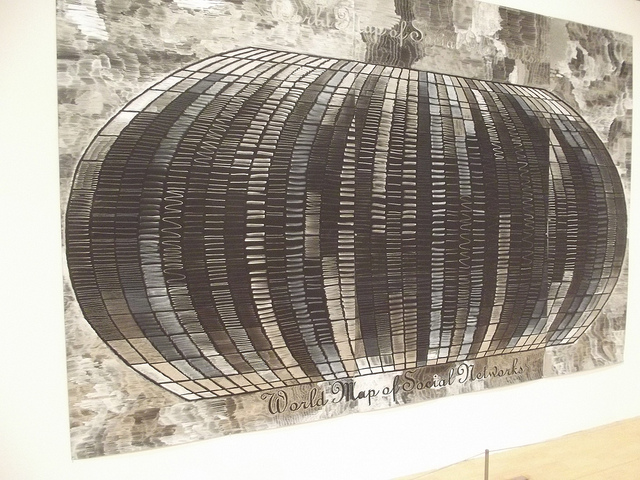
The New York Timesreported on Saturday that the National Security Agency has been collecting social data pertaining to Americans for the past three years, using 94 different “entity types” of metadata, “including phone numbers, e-mail addresses, and IP addresses.” With this, the agency has been able to construct maps of an individual's personal associations “for foreign intelligence purposes,” even if that person is a US citizen.
This latest news is based on former NSA contractor Edward Snowden's leaked documents, one of which is a January 2011 memorandum from the NSA. That memo addressed a November 2010 policy shift that allowed the agency to conduct “large-scale graph analysis on very large sets of communications metadata without having to check foreignness,” the memo said. Prior to that change in policy, such analysis was permitted only for foreigners.
"[T]he decision to revise the limits concerning Americans was made in secret, without review by the nation’s intelligence court or any public debate,” wrote NYT reporters James Risen and Laura Poitras.
have not played, but heard good (but not great) things
Real-life board game Pandemic is coming to iPads on October 3 as Pandemic: The Board Game, developer Z-Man Games has announced. Pandemic: The Board Game will join iOS games like Pandemic 2.5 and Plague Inc, the latter of which is developed by Ndemic Creations. Because none of these names could possibly confuse anyone.
In Pandemic: The Board Game, up to four players take on one of seven roles, such as Scientist and Medic, to help stop the spread of deadly diseases. The game will feature an animated interface, interactive tutorial and multiple difficulty levels.
It is unknown whether or not it will also include tips on how to tell friends about the game without confusing them as to which Pandemic you are talking about.
More than 200 employees of an Oscar-winning visual effects studio could finally get their back pay after two of their colleagues reached a $1 million settlement over layoffs earlier this year, Variety reports. Rhythm & Hues, which won Academy Awards for its visual effects on Babe, The Golden Compass, and Life of Pi, filed for bankruptcy on February 11th, leaving 238 people without jobs. Thomas Capizzi and Anthony Barcelo sued their former employers under the Worker Adjustment and Retraining Act, which requires that companies provide two months' notice in advance of mass layoffs.
Attorneys for the men reached an agreement with Rhythm & Hues' debtors, Variety reported. Each would get $10,000, with the remainder divided between the other employees and attorneys' fees. A bankruptcy judge still has to approve the settlement.
Nearly 500 visual effects artists gathered outside the Oscars earlier this year to protest the Rhythm & Hues layoffs and what they regarded as unfair treatment amid a string of recent studio closures. During the ceremony, event organizers cut off the microphone of one of the winning artists during his acceptance speech for the Life of Pi visual effects award.
Jinx, the Loose Cannon, will be the next addition to the League of Legendsroster, developer Riot Games announced on Thursday. The Joker-like criminal loves mayhem, as evidenced by a wanted poster on the League of Legends site which lists some of her crimes: "murder," "making fun of the peace," "murder again" and "forging of official wanted posters."
Jinx is a marksman champion, meaning she uses long-range weaponry to deal physical damage to her enemies. Her "Switcheroo!" ability swaps between her two equipable weapons, Fishbones the rocket launcher and Pow-Pow the minigun. Her "Zap!" ability damages and slows the first enemy it hits, and her "Flame Chompers!" ability lays down incendiary grenades which root champions who walk over them to the ground. Jinx's ultimate ability, "Super Mega Death Rocket!," can travel across the map and deals damage to the first champion it hits, as well as all nearby enemies based on a percentage of their missing health.
Jinx is currently in beta, with no set date as to when her mischievous hi-jinx will go live.
via saucie "mainly drawn from the Hanoverian nobility"; hey Russian Sledges
The Mops-Orden, or Order of the Pug was a para-Masonic society founded by Roman Catholics. It is believed that it was founded in 1740 by Klemens August of Bavaria to bypass the papal bull Eminenti Apostolatus Specula of 1738. The constitution of the Order of the Pug allowed women to become members, as long as they were Catholic. The pug was chosen as a symbol of loyalty, trustworthiness and steadiness.[1] Members called themselves Mops (the German for Pug), novices were initiated wearing a dog collar and had to scratch at the door to get in. The novices were blindfolded and led around a carpet with symbols on it nine times while the Pugs of the Order barked loudly to test the steadiness of the newcomers. During the initiation, the novices also had to kiss a Pug’s (porcelain) backside under its tail as an expression of total devotion. Members of the Order carried a Pug medallion made of silver. In 1745, the secrets of the order were “exposed” in a book published in Amsterdam with the title L’ordre des Franc-Maçons trahi et le Secret des Mopses révélé which included the ritual and two engravings illustrating their rite.[2] The Order was banned by Göttingen University in 1748. Loge Louise des ehrwürdigen Mopsordens or Lodge Louise of the Venerable Order of the Pug had been formed the previous year as a student society, mainly drawn from the Hanoverian nobility. The lodge fees and their control over their members formed the excuse for the closure, and after a government investigation, the lodge documents were passed to the University authorities.[3] While German sources state that the order was short-lived,[4] they were reportedly active in Lyon as late as 1902.[5]
London-based artist Leonardo Ulian (previously) has completed a new body of work titled Sacred Space. Inspired by Hindu and Buddhist symbolism, Ulian continues his exploration of technology and spiritualism with these carefully sculpted mandalas created with soldered computer and radio components. Via Beers.Lambert:
Ulian’s reflexive use of the geometrical mandala can also be seen as a nod to his ‘past-life’ as an technican, but through his application, Ulian divorces the electronic components from their origins, giving new life to these (now defunct) technological bits, creating a new type of hybridization that is equal parts spiritualization and contemporary critique: “We live in a society that worships electronic technology,” he states “both for necessity but also because it makes us feel better, not unlike its own new form of fashionable spirituality.”
Of particular note in this solo show is an amazing little three-dimensial bonsai tree titled Centrica Bonsai. If you happen to be in London, Sacred Space opens tonight at Beers.Lambert Contemporary. All photos courtesy Oskar Proctor.
via saucie: "During his demotion, Billy suffered numerous indignities. He was charged with “unacceptable behavior,” “disobeying a direct order” and “lack of decorum.” Fellow fusiliers were no longer required to salute him or stand at attention, as had been the case when he was a Lance Corporal."
'There was a royal goat that was charged with prostitution in the late 19th century after being offered up for stud services, though the charges were eventually lowered to “disrespect of an officer.” '
William (Billy to his friends), was quickly rising up the ranks of the 1st Battalion of the Royal Welsh, an infantry battalion of the British Army. (Goats, you see, have a long history in the British army, serving since the American Revolutionary War onward.) At the age of six, he had earned the rank of Lance Corporal and had even snagged an overseas commission, serving in the ranks in Cyprus.
But it was Billy’s first stint overseas where everything started to go south. Perhaps it was the new environment. Perhaps the pressure got to him. Perhaps he was just feeling rambunctious. Whatever the cause, at a parade celebrating the Queen’s 80th birthday in June of 2006 on the south coast of Cyprus, Billy went buck wild. Despite repeated orders, he refused to keep in line during his regimental parade. His handler, Lance Corporal Dai Davies, was unable to control Billy. During one particularly dark moment, he attempted to headbutt a drummer.
William Windsor, in full military dress.
For his actions in Cyprus, Billy was disciplined and demoted from the rank of Lance Corporal to Fusilier (for those not up on their British military ranks, that’s about the same as being busted down to the rank of private — not something you want to have happen).
“The goat, which has been the regiment’s mascot since 2001, was supposed to be leading the march, but would not stay in line,” said Captain Crispian Coates, speaking to the Washington Post. “After consideration, the commanding officer decided he had no option but to demote Billy.”
During his demotion, Billy suffered numerous indignities. He was charged with “unacceptable behavior,” “disobeying a direct order” and “lack of decorum.” Fellow fusiliers were no longer required to salute him or stand at attention, as had been the case when he was a Lance Corporal. Even for a goat, that must have stung. An Canadian animal rights group even protested on behalf of Billy, saying he was simply following his goat nature — “acting the goat” — but to no avail.
Luckily, there’s a happy ending. After a time in the wilderness, Billy was reinstated with full honors in August of 2006. Captain Simon Clarke said at the time, “Billy performed exceptionally well, he has had all summer to reflect on his behavior at the Queen’s birthday and clearly earned the rank he deserves.”
While many goats have served with distinction within the British Army, there have been a few others with a checkered past. There was a royal goat that was charged with prostitution in the late 19th century after being offered up for stud services, though the charges were eventually lowered to “disrespect of an officer.” Another royal earned the nickname “the rebel” after the goat headbutted a colonel bent over adjusting his trousers — catching him full in the rear, as it were — “knocking him over and blacking both his eyes.” For this act, the goat was charged with a “disgraceful act of insubordination.”
As for Billy? He’s put his wild days behind him. He left the military in 2009, with a farewell parade in his honor, with soldiers lining both sides as he was walked from his pen to the transport truck. He now lives at the Whipsnade Zoo in Bedfordshire, spending his days at the children’s petting zoo. According to the zoo, “four female White Windsor goats took a lively interest when Billy arrived.” Not a bad retirement.
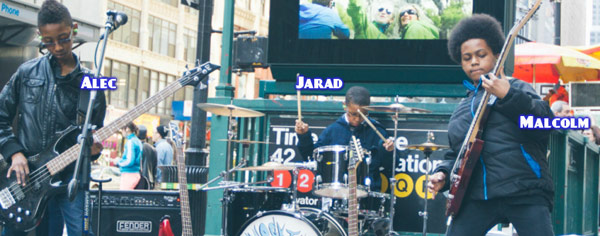
I'm loving this short film about two sixth-grade metalheads from Flatbush, Brooklyn.
There is a particular moment right before fame strikes a young musician – between the full flowering of talent and believing in a dream so pure and strong as to feel bulletproof – which at the same time is almost imperceptible as it is happening. This metaphysical friction is in full effect in a certain Flatbush, Brooklyn family basement. Unlocking the Truth, a metal band composed of twelve year old Malcolm Brickhouse and eleven year old Jarad Dawkins, is playfully arguing about which member can play a faster and more forceful rendition of their self-composed instrumental blast “Physical Therapy.”
While Jarad is technically the drummer (he mastered the instrument by the age of two), he is convincingly demonstrating his guitar chops. Being the precoucious, and yet consummate, professionals that they are, the band wants to make sure that in a worst case scenario – say, a member fainting onstage – each could play the other’s instrument flawlessly. It is not atypical for Unlocking the Truth to practice for up to ten hours on weekends.
They are so immersed in their music that they barely notice anything going on around them, including their parents, who usually have to force them to stop practicing when it’s bedtime. While their classmates mostly listen to radio pop or rap, Malcolm and Jarad’s enthusiasm for metal was nurtured while watching generous amounts of WWE professional wrestling. But this is no passing phase for the two boys. The band has already written two albums, Madness and Paranoid, respectively, and recently auditioned for America’s Got Talent.
Amazingly, they manage to keep up good grades in school. So watch out, America – two smart, young metalheads from Flatbush are coming to a town near you in the near future.
This amazing shot was captured last year by photographer Denis Budkov in an ice cave near the Mutnovsky volcano in an area of northern Russia. Known for an abundance of precipitation the area is often covered in several meters of snow and ice that cover mountain streams like this creating vast caves that look like something out of a science fiction movie. This particular cave was nearly 300m (980 ft.) long and several photographers in Budkov’s group also snapped a few amazing shots. The photographer also captured this jaw-dropping photo of some tourists in front of a volcanic explosion earlier this year. The power of depth of field, right? (via Russia Travel Blog)
In most instances the interaction between law enforcement and goats seems to be limited to Keystone Kop-style antics, with the wily animals outmaneuvering the lumbering lawmen. The Internet is rife with videos, including these from Australia, Japan and the United States.
It seems goats have a nasty reputation for randomly taking people out at the knees, and thanks to YouTube and similar sites, Modern Farmer readers can watch goats go wild, as in this video from Brazil, where a goat randomly attacked passersby and even managed to tackle a motorcycle.
The Childhood Goat Trauma Foundation (the organization seems rather tongue-in-cheek) has documentary evidence of this behavior under their “Goat Trauma in Action” page. Although some of the images are clearly altered, the video of the kid (goat) taking down a kid (human) appears real enough. It’s worth perusing the entire site.
In November 2012, a seriously frightening looking goat named Voldemort stalked a 14-year-old paperboy in Utah. The goat knocked Jaxon Gessel off his bike and then tracked the young man for more than an hour until the police — following up on a report of a missing child — came to the rescue.
Gessel told local news agencies that he got a lot of ribbing from friends for the incident. When people ask him why he’s scared of goats he answers, “I’m like, that was a freaky goat. I think it’s like possessed or something.”
On a more serious note, in October 2010, a hiker died when he was gored in the thigh by a 370-pound mountain goat at Olympic National Park in Clallam, Washington. His widow’s lawsuit against the federal government was tossed out of court in August. The suit alleged park officials were aware of the aggressive animal but did nothing about it. A park ranger later shot and killed the mountain goat. In this instance, it was a wild animal involved in the crime and not a domesticated goat — violence not being normal domesticated goat behavior.
In Gresham, Oregon, in August, two police officers spotted a goat on the roof of a home, but when they approached to investigate, the were warned away by a neighbor who told them to be careful because the goat “only respects one man.” That man was the animal’s owner, who was able to get the goat off the roof without further incident. The goat was not charged with intimidation.
So what happens when the police catch up to the malefactors? In Germany in 2009, the cops cuffed a flock of errant goats that had wreaked havoc on rush-hour traffic in Bielefeld. The officers defended their actions, saying “We’re not farmers and we don’t know about animals. But we do know about handcuffing troublemakers so that’s what we did.”
In India, Israel and Nigeria misbehaving goats were taken into custody for damaging a new police cruiser, trespassing and um, carjacking respectively.
The officers defended handcuffing the goats, saying ‘We’re not farmers and we don’t know about animals. But we do know about handcuffing troublemakers so that’s what we did.’
In June, police in the southern Indian city of Chennai detained three goats of an alleged gang of 12 that had climbed onto a brand new police cruiser “damaging the wipers and glass, and scratching the paint of the bonnet and body.” Their owner was charged and the goats were handed off to the Society for the Protection of Animals.
Police in Israel arrested Geula the goat, along with four human teen companions, in 2011 for trespassing after being caught allegedly trying to set up an illegal outpost in the West Bank. She was the last to be released from custody because there was a dispute about whether she would have to post bail or have her owners sign a statement agreeing to keep her away from the outpost. She was eventually released without conditions.
But it’s Nigeria, where a belief in witchcraft and wizardry is alive and well, which leads the pack in strange confrontations between goats and the police. The country seems to be the epicenter for goat perpetrated misdeeds, including carjacking and political hanky-panky.
The most widely reported incident was in March 2009 when police in Kwara state, a region in western Nigeria, held a goat on suspicion of armed robbery after a vigilante mob brought the animal to police insisting that it was not an actual goat but a man who attempted to carjack someone and then magically transformed himself in order to avoid capture.
Those wily Nigerian goats were back in trouble two years later when they allegedly sabotaged Nigerian opposition party leaders who had to make an emergency landing when their runway was overrun by goats. Their plane was damaged and they “narrowly escaped death” they alleged. The members of the Action Congress of Nigeria believed the goats were working for their political rivals.
This anti-goat zeal isn’t just a modern phenomenon. Historically, goats have gotten a bad rap — at least on the Judeo-Christian end of the religious spectrum. An ancient Jewish rite on Yom Kippur involved sacrificing a goat to God and releasing another into the desert, the animal acting as a vessel for the sins of the people. The term scapegoat is an English translation of the Hebrew word for that desert-bound, sin-laden goat. In Medieval Europe, Christians began to associate goats with witchcraft and the Devil, a concept that continues to inspire metalheads to wear t-shirts emblazoned with pentagrams that feature goat imagery.
Speaking of guilt by association, Whitey Bulger was photographed with a baby goat just before going on the lam in 1995. The goat wasn’t charged as an accessory in any of the crimes the infamous Boston gangster was recently convicted of, but they say you can tell a person, or goat, by the company they keep. The same goes for Betty the goat, the pet of Congolese rebel leader Laurent Nkunda.
Nkunda, who was captured in 2009, was allegedly responsible for using child soldiers in a conflict that helped instigate “a humanitarian crisis of catastrophic dimensions.” He’s accused of various war crimes, but Betty remains above the fray.
For those crime-committing goats that make it to court, sometimes justice prevails. In Australia this past January, Gary the Goat and his owner had vandalism charges dismissed in a flower eating incident outside the Museum of Contemporary Art in Sydney. Gary was not required to give evidence and quietly waited for his owner outside court surrounded by photographers and wearing a rainbow colored cowboy hat.
'Leary’s games, brought back to life thanks to an emulator that reproduces the environment of a mid-1980s computer on the library’s modern machine, hardly look trippy by today’s standards. But in Leary’s floppy disks and paper documents, the archivists also found traces of more ambitious forgotten projects, including a choose-your-own-adventure-style “mind movie” based on William Gibson’s novel “Neuromancer,” which was to have included graphics by Keith Haring, music by Devo, photographs by Helmut Newton and writing by William S. Burroughs.
That game, which at one point was to be called “Keith Haring’s ‘Neuromancer’ ” (Haring agreed to a character based on his likeness, as long as he was given top billing, according to documents in the archive), doesn’t seem to have gotten very far. Leary’s disks contain only small piece of working software from the project, Mr. Mennerich said. And one surviving image, showing a character based on David Byrne, shows background graphics by the digital artist Brummbaer, not Haring.'
A dozen or so video games from psychologist, writer and LSD advocate Timothy Leary have been discovered by the New York Public Library, The New York Times reports.
Games will be on display and, in a few cases, playable at the library on a computer located with rare books and manuscripts. The games, developed in the 1980s, were reportedly found in the 375 computer disks that make up the Leary archive. According to Donald Mennerich, the digital archivist leading the project, games were still in development and will be "buggy" for those who play them.
Leary did release a commercial title in 1985 called Mind Mirror. The game is based on his 1950 Ph.D. Thesis, "The Social Dimensions of Personality," and allowed players to create, evaluate and role-play as different personalities. For more on Leary's newly discovered games, check out the full story from The New York Times.
[% var len = Math.min(data.comments.length, data.settings.autoUpdateAlertMaxShown) %]
[% for (var i = 0; i
[% if (comment.parent) { %]
replied to [%= comment.parent.user.display_name %]
[% } else { %]
posted a new comment
[% } %]
[% } %]
the only way to stop a bad guy with a gun; 'the culmination of a long-running feud fueled by what a relative said Saturday was the woman's "hatred" for her family.'
via saucie on one hand, yes delicious on the other hand, SE Division is gentrifying about as close to overnight as you can get
Baker Dominique Geulin will tap as many as 12 different ciders, both local and French, at his upcoming St. Honore Bakery, which will open next to the Southeast Division Street Salt & Straw ice cream shop this fall.
'A veteran of Portland bars including Teardrop Lounge and Kask, Klus also interned at the renowned Bruichladdich distillery on Islay, a peat-covered island on Scotland's northwest coast ... Multnomah Whiskey Library (which uses the American spelling of "whiskey" in its name, despite the Scots' preference for "whisky") features the spirit in all its geographic styles, from Southern bourbons and Irish whiskies to more esoteric American craft spirits and "global" whiskies from Japan, India and Australia. The bar also features a curated selection of rums, gins and other spirits.
But the whiskies from Scotland occupy a special part of the limelight. "We represent single malts pretty hard, and we've really scored with some old editions that had come into Oregon five, six or 10 years ago, and had been sitting on a shelf because someone didn't know what it was," Klus says, mentioning prizes such as a 1964 Bowmore, and older expressions of Glenlivet and Macallan. Klus says the bar is also working closely with the state liquor system in an effort to track down hard-to-find whiskies and spirits from independent bottlers such as Gordon & MacPhail, and share them with their customers.'
When it's darker and colder outside, there's something appealing about sitting down with a nice, smoky scotch
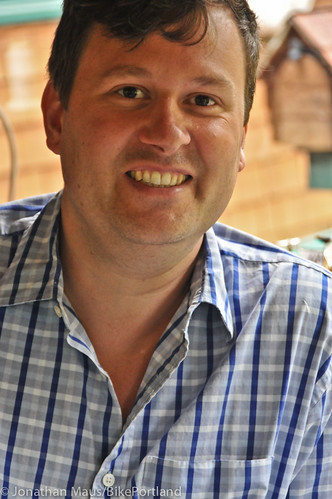
Starting a new small business is always a bit stressful; but 40-year-old Silas Beebe has the added pressure of carrying on a family name that spans three centuries in Portland business circles. And he's doing it with a line of bicycling accessories.
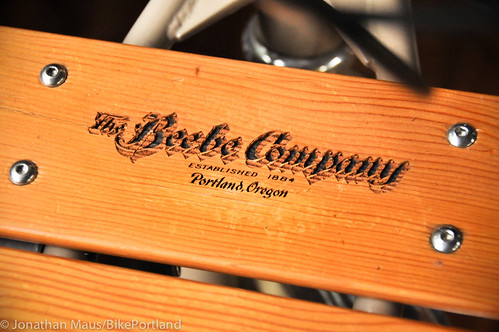
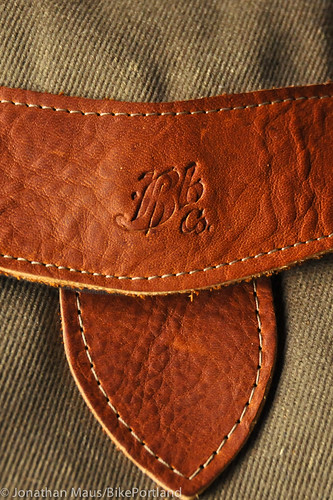
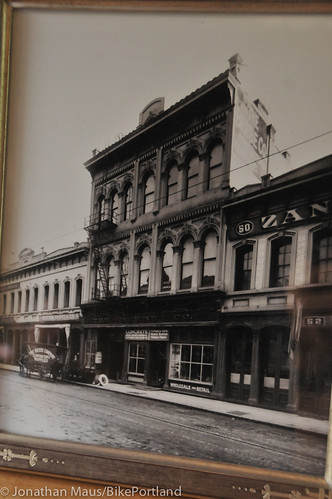
The Beebe Company first set up shop in Portland and Astoria in 1884 as a supplier to the shipping and fishing industries. Over the next 100 years, the family business evolved with the times. As the 20th century dawned, The Beebe Company became added hardware and boat-building to its operations in downtown Portland. From the 1950s to 1970s, the Beebe name adorned a marina on the west side of the Sellwood Bridge. In the 1980s, Robert Beebe — Silas' grandfather — opened a shop downtown that sold and repaired knives, keys, locks, and so on. Silas worked in that shop as a kid; but after his grandpa retired in the 1990s, the family name went dormant.
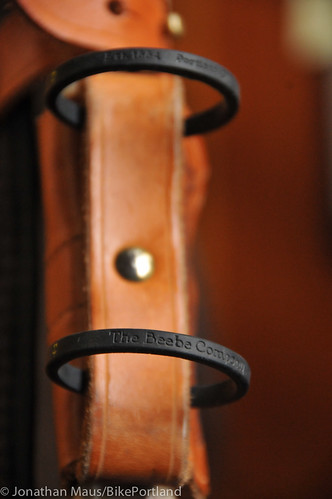
Beebe uses the same the same font that his ancestors used on letterhead and stationary 129 years ago.
A photo of The Beebe Company storefront in downtown Portland circa 1910.
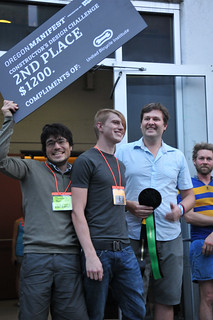
Beebe (light blue shirt) and his team placed 2nd in a contest to design the "Ultimate modern utility bike."
Now, drawing on years of industrial design experience, Silas Beebe is the latest member of the family to work under The Beebe Company banner. "When I started looking for brand names and logos, nothing sounded right," Beebe shared during my visit to his home workshop in the Willamette Heights neighborhood last week, "Beebe originally made products for transportation, so I'm bringing it back with bikes since that's what I love."
After a successful first foray into the bicycle world earned him second place at the 2011 Oregon Manifest Constructor's Design Challenge (where he teamed up on a bicycle with local builder Rob Tsunehiro), Beebe has refined his product line and is working to establish a solid foundation for his fledgling business.
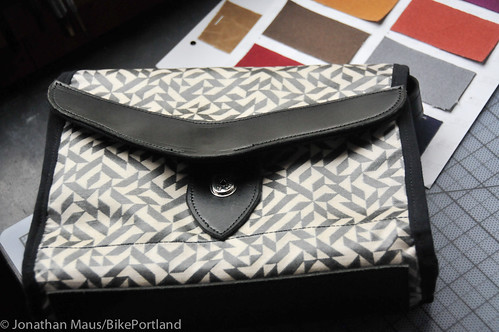
Like many product designers, Beebe has found an online home for his products on Etsy. His "Camilla" bike-friendly purse and handlebar bag ($199) was on the "Trending" list last week. Like all of his products, the Camilla is made from an assortment of high-quality materials including: black "English bridle" leather, water-resistant canvas, brass buckles and snaps, and reflective touches.
The Camilla bar bag/purse.
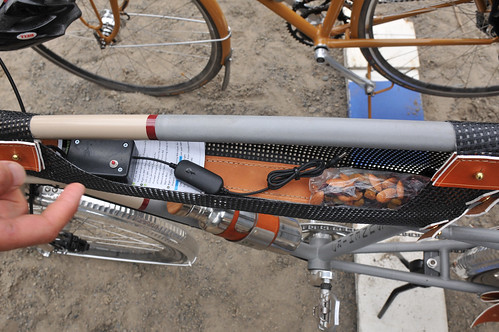
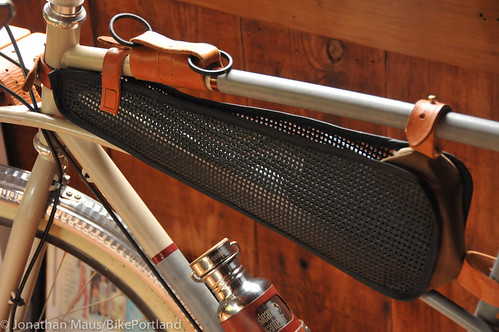
Other stand out items in Beebe's line include his 'Thurman' phone holder and my favorite, the 'Center Console' — a frame bag that's a perfect place to quickly stash and grab tools, a light jacket, or other small items.
An early version of the 'Center Console' appeared on the Oregon Manifest bike he created with builder Rob Tsunehiro.
The Center Console
The Thurman phone holder
Beebe says he's trying to fill the niche between bike shops and fashion/product retailers. Think of shops like Canoe that sell high-quality and premium-priced housewares or bike shops like Hub and Bespoke in Seattle. Just last week Beebe announced his products are now available at Manifesto Bicycles in Oakland, California.
Ultimately, he foresees only about 25% of his dealer base being bike shops. So far he's seen strong interest in his products from Europe and he's been approached by retail shop owners in Japan and Singapore.
In his home workshop, Beebe only does the prototyping and design. He's partnered up with Last U.S. Bag company in Vancouver, Washington for manufacturing.
When it comes to his approach to bike products, Beebe sees he's trying to break new ground. "There are lots of people making panniers, I'm trying to innovate and make something new." That sentiment is captured on his product labels, which read, "Water and trend resistant: Bold fashioned supplies."
And Beebe isn't just all talk. He worked for Ziba Design out of college and spent several years at a design consultancy in Stockholm where he specialized in shoe design. At age 27, he won first place — and a $10,000 cash award — from Price Pfister for his innovative faucet design.
While he definitely has the talent, Beebe knows it takes much more than good products to build a successful business — especially one that will stand the test of time. "It's a bit of pressure," he admitted, in trying to carry on the family name. But with his background and knack for product design, I won't be surprised to soon find The Beebe Company sign hanging once again in downtown Portland.
Middle school, as anyone whose lived through it knows, can be a social minefield. But having friends of different ethnic backgrounds can make kids feel safer.
According to new research published in the journal Child Development, middle-school students who reported friendships across ethnic lines felt less vulnerable to harassment by peers, more secure in the school environment, and less lonely.
The study, by researchers from the University of California, Los Angeles, and the University of Groningen, the Netherlands, looked at the relationships among 396 African-American and 536 Latino students from 66 classrooms in 10 middle schools in greater Los Angeles. As part of a larger, multiyear study, they were asked about their friendships with kids of all ethnic groups, including whites and Asians.
As might be expected, the students said they had more friends within their ethnic group than outside it. This follows a principle that social scientists call "homophily." But in more diverse classrooms, another principle of friendship emerged – "propinquity." That word is used to describe the tendency to make friends with the people who are available to you – those in your workplace or school. In more diverse classrooms, kids formed more friendships across ethnic lines.
Diversity itself is not enough to overcome the tendency that kids have to self-segregate.
The number of cross-ethnic friendships a kid reported, researchers found, was an accurate predictor of how safe that student felt in the rough-and-tumble social world of middle school.
Such friendships, previous research shows, are more likely to occur when the kids share similarities other than ethnic background – when they have similar levels of academic achievement, for instance, or are perceived as being in the same social ranking of cool. But as researchers in this study note, even in schools with a diverse population, organizational systems such as academic tracking limit the chances kids have to mix meaningfully with classmates from different ethnic backgrounds.
As the researchers note, previous studies have shown the positive effects of cross-ethnic friendships among children and adults alike. People with such relationships tend to look on others more favorably, and in turn to be regarded more favorably by others. They are less prejudiced toward members of other groups. They also feel safer in general.
The researchers in this study note that the school-age population of North America is increasing in diversity at a rate that outpaces any other age group. As U.S. schools grow increasingly multicultural, they suggest, it’s important for educators to pay attention to the way the school’s underlying structures and mechanisms either encourage or discourage social mixing opportunities among students of different ethnic backgrounds. Diversity itself is not enough to overcome the tendency that kids have to self-segregate.
“[C]hildren and adolescents alike still prefer same- to cross-ethnic friends,” they write, “and even classrooms and schools that enjoy a great deal of ethnic diversity may not always be organized in ways that promote cross-ethnic friendships.”
Those friendships, the researchers suggest, could be a key part of creating schools where children feel safe to grow and learn.