A Famous Person’s 5-Step Guide to Becoming an Architect | Via
1. Your new wardrobe budget is $175.
2. Your personability is too personal.
3. Dumb-down your life experiences.
4. You’re still too young.
5. Less bling, more books.
A Famous Person’s 5-Step Guide to Becoming an Architect | Via
1. Your new wardrobe budget is $175.
2. Your personability is too personal.
3. Dumb-down your life experiences.
4. You’re still too young.
5. Less bling, more books.

A very warm welcome from the Cal Poly Mustangs!
Last week I had the privilege of speaking to students at Cal Poly in beautiful San Luis Obispo. Many of the students are just beginning their journeys to become game designers, so I took the opportunity to share my own experience from consumer to creator. I also talked about how game designers of various skill levels conceive of games and approach game creation.
No matter what level of game designer you are, I hope taking a broader look at the process will give you some insights on how to make your next game even better!
Stage 1: Consumer
We all begin our game designer lives as game consumers. Most children play games, and for many people games are significant and meaningful. If you want to make games, you probably already love games.
To consumers, game design is pure magic. Consumers believe that a game designer imagines a game, then creates it exactly as he or she envisioned it. (That’s not how it works, fyi.)
Stage 2: Tinkerer

If you’ve ever made a magic card up, you’re a tickerer. Image from igeektrooper.
Games like Little Big Planet and Starcraft offer their players an awesome gift: a level editor. These allow players to get involved in a whole new way. Almost any non-digital game can be tweaked in this way, and programs like Magic Set Editor make it especially easy.
Tinkerers tend to imagine new games in terms of modifications (often additions) to existing games, sticking closely to their underlying rule sets. Tinkerers begin to realize that game design is not magic, but it is a lot of work.
Stage 3: Masher
At this point, the designer is creating entirely new games, but the design process tends to involve mashing existing genres, mechanics, and themes together.
Mashers envision new games as collages of existing game components. They tend to focus on the mechanics and theme rather than on the player experience.
Stage 4: Creator
Before long, a game designer will shift his or her focus and work style. Instead of having visions of a specific game, the designer will be interested in exploring broad or incomplete ideas: the way reflections ripple on almost still water; the way that digging through a discard pile can return to the past; the way it feels to end a date by watching the sunset together. The ideas can be about theme, they can be about mechanics, they can be about player experiences… really, they can be about anything.
What’s important is that the ideas do not make strict, specific demands on the final game. In fact, designers at this stage approach new games with a healthy emotional distance. Obviously, they are excited by their ideas, but they know many ideas never work out, so it’s dangerous to become attached to an untested one. They also know that the initial conception is very rarely the best implementation, so keeping an open mind and keeping nothing sacred will tend to result in better final games.
By this point, designers should have discovered and embraced the iterative design process, an extremely useful tool for guiding game design.

The iterative design process in all its circular glory.
Every game takes its own journey from concept to product, but skilled designers use the iterative design process.
Ideas
All games start out as ideas. Some games come from one powerful idea, but most are formed by combining many ideas to create a unique whole. It’s very possible that initial ideas will be (or should be) abandoned, and lots of new ideas will be considered during the process.
Advice about ideas:
- Come up with more ideas than you’ll need.
- Never rule out an idea as bad until you’ve tested it.
- Never accept an idea as good until you’ve tested it.
- Do not get emotionally attached to ideas.
Planning & Prototyping
Once a designer has promising ideas, it’s time to test them. Here, the keys are minimalism and focus.
Your playtest (coming up next) is an experiment, so be prepared for it. Identify what the most important questions you want to answer are and figure out the quickest way of discovering those answers.
Your questions will change as your game develops. Here is the typical progression of questions:
1. Potential: For your first prototypes and playtests, identify the core ideas of your game and test them as simply as possible. Do they have potential? Do they seem interesting and fun?
2. Requirements: You will almost certainly have more ideas than should be in your game. Early on, determine what your game actually needs.
3. Problems: Throughout the process, identify problems and attempt to fix them.
4. Accessibility: Some people might play your game over and over, but everyone who plays your game will play it for the first time. Make sure people can easily learn your game without your help.
5. Balance: It’s essential that your game has no dominant strategies or options that are so bad no one would ever want to use them. Don’t worry about this until you’ve solidified your basic game structure.
6. Aesthetics: For most games, you will not want to worry about how they look (and sound and feel) until everything else has settled. That said, games often need a bare minimum of art to concisely communicate the game state to players, and some games (very few) have aesthetics at their core. In these cases, test aesthetics earlier.
Create a prototype that answers the questions at hand. Resist the urge to add anything else to the prototype. You will often need some supporting structure to test what you need to test, but that extra stuff should only have a support role–don’t waste time on it.

This first prototype of Corporate America wasn’t pretty. It was barely even functional!
If your goal is to honestly test your game (as opposed to promoting it or looking for praise), it’s better for your prototype to be ugly. It needs to be functional, but investing time and energy into making it look nice will leave you less willing to change it.
Here are some tips for planning and prototyping:
- First thing’s first: figure out what you need to know about your game. These are your questions.
- Design your prototype to answer your questions.
- Don’t include anything in your prototype you don’t need to answer your questions.
- Your prototype needs to be functional, but it shouldn’t be pretty.
- Don’t get emotionally attached to your prototype.
Playtesting
Playtesting is how game designers get real information about their games. Empirical evidence is vastly superior to intuitive judgements, especially judgements tainted by pride. Playtesting allows you to gather valuable data so you can make informed decisions.
When you playtest, your goal should be to answer questions you have about your game. Take your playtest seriously. Write down important information (how long the playtest took, scores throughout the game and at the end, very good or bad experiences, etc). Write down feedback from your playtesters, and honestly consider it. Don’t accept it as dogma, but don’t reject it outright.
Taking criticism is a skill that many of us lack. When playtesters have negative things to say, remember that it’s about the game, not you. Don’t interrupt your playtesters, don’t get defensive, and don’t tell them they’re wrong, even if a playtester is technically wrong. Remember that perception of your game is as important as how it actually works.
When playtesting:
- A playtest is not a way to boost your ego. Take it seriously as a way to gather information.
- Focus on the questions you want to answer. Don’t waste your playtesters’ time by asking them to do irrelevant things (like play a part of your game you’re not testing).
- Take notes so you can compare relevant information between playtests.
- Take the feedback from your playtesters seriously.
Evaluation
After you playtest, consider your data. How does it answer your questions? If you were testing the quality of an idea, did it pass the test, or should it be thrown out? If you saw problems, what caused the problems, and what can you do to fix them?
Evaluation is difficult because there are no hard and fast rules. The data may be quantitative, but your interpretation is subjective. The more information you have to make you decisions, the better, but the information will never make your decisions for you.
Knowing when to give up can be difficult. Throwing out ideas is a natural part of the game design process. Not every idea will work, and you won’t know if an idea will be good or bad until you experiment with it. When big problems persist, it might be time to put the idea aside. You can always come back to it later; sometimes, a break is all you need for a fresh perspective.
Knowing when a game is finished can be even more difficult. A game is never finished, it’s just due. But you often won’t have external due dates, so it can be tempting to go on making tiny tweaks ad infinitum. Eventually, you’ll have to accept that a game is as good as it’s going to get. I look back on every game I’ve released with both pride and embarrassment since there are so many things that could have been better. But I couldn’t look back on them at all if I hadn’t eventually released them, imperfect as they may be.
Prototyping and playtesting allow you to test the quality of your ideas. That’s really important for a number of reasons:
- Ideas are extremely plentiful, but most of them suck. It might not seem like they are so abundant when you start coming up with game ideas, but with time you’ll have more ideas than you know what to do with.
- Most games require many, many ideas, so you’re going to need to evaluate many moving parts and systems. Bare bones prototypes can help you test these in isolation.
- Turning ideas into a game takes a lot of time and money (as indicated by my own experience with Corporate America). Make sure you invest your resources into something that will be worth it.
- Even if your initial prototype is awesome, that particular implementation probably isn’t optimal. Experiment with similar (and very different) alternatives to look for a better option.
This post has followed my own personal journey to becoming a game designer, but I believe most game designers follow a similar path. Where are you on the path? Perhaps this will help you avoid some of the mistakes I’ve made.
Before I go, I want to emphasize that we all have the potential to grow and improve, just like our games. After giving this talk, I took the opportunity to evaluate one of my current projects, Factions (described briefly towards the end of this post). The game is far from complete, but it has been heavily tested and shows a lot of promise.

A card from the streamlined version of Factions.
However, I realized I’ve been guilty of a beginner mistake: I’ve tested the game with many frills, but still don’t have a great grasp of the core. Writing this has inspired me to create a bare bones prototype to get a better understanding of what makes the game tick. This should help with balancing and should also provide a more robust skeleton those exciting special rules will eventually flesh out.
Here’s hoping that this perspective inspires you to approach your current project in a new way too.

Shirt ideas for the store, 2013 - To the last, I grapple with thee. From hell’s heart, I hug at thee
NBCNews.com |
Former NYPD sergeant questions sister's killing by police in Washington Reuters By Edward Upright. NEW YORK | Sat Oct 5, 2013 4:36am EDT. NEW YORK (Reuters) - Police in Washington could have avoided shooting dead a woman pursued by officers in a car chase that led to the lockdown of the Capitol this week, the driver's sister, ... Sisters question fatal shooting in DC police chaseBusinessweek NYC sisters of woman killed by police in DC following chase question use of ...Fox News Miriam Carey, Capitol Suspect, Suffered Post-Partum DepressionABC News New York Times -Independent Online all 871 news articles » |
It's come to this. After a phenomenally successful first year, in which the British press described us as "the sound of the summer" and "London's two most eligible bachelors", team SU&SD are now cold, alone, and reviewing a board game about trains. It's called Trains. This is us at our lowest, surely.
On frosty Autumn nights like these, we're glad for the company of the SU&SD supercomputer. She's our one true friend. ...Right?
Above: Xena will kill you with her glare alone.
I’ve been asked to explain why I disagree with Jay the Barbarian. I really enjoyed the general article, but here’s what made me hesitate to fully bestow my breast-plated blessings.
Jay says,
"Ironically, boobplate has been a relative non-issue in live performance, looking at the rash of armored women over the last few decades.”
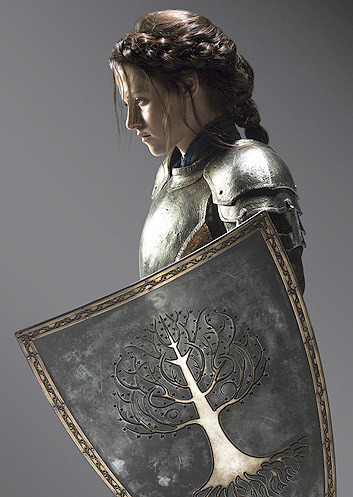
So… Rashes are usually measured in days, not decades. I want to point out that the four women he shows are wonderful well-armoured exceptions to the trend, along with personal favourites Kristen Stewart as Snow White and Cate Blanchett again as Maid Marian.
Let it be said- girls may thoroughly kick arse, but four is not a high number of warrior women, nor is six, or even forty (if we could find them), if you measure them against the thousands of fictional medieval films of the last few decades (and that’s just live action feature films, not even mentioning animated, independent, or web series).
Above:Long live Colleen Atwood and Janty Yates, the wonderful costume designers for (respectively) ‘Snow White and the Huntsmen’ and ‘Robin Hood’.
I understand Jay’s point, it’s relatively a larger group of reasonably-attired women on film than the female-fighter-in-media cliche suggests.
Yay for us having role models! I want to be clear that it’s still not *nearly* enough.
The fact Jay calls it a “relative non issue” should show just how bad the situation really is for want of strong, capable, feminine, not-overly-sexualised female role models.
Then, there is his response to Mr Jabberwock the Armourer regarding the twin peaked, Madonna-esque, Double Domes of Wonder style of boob plate, and the ongoing argument about how it will crack a ribcage through poor design. Jay says,
"So she trips and falls, and lands boob-first. Obviously, the breast cups aren’t going to compress or absorb. This transfers the force to the sternum through the padding…. And to the entire rib cage, in the case of this piece, which results in spreading the force throughout the torso. You know, the exact same thing that an unarmored fall would do? Or even a fall in a non-boobed plate would do?”
I agree with Jay that Mr Jabberwock’s original statement (that he worries constantly about a poor lass tripping and cracking herself open by means of her gravitationally-bound steel encased bossumry) is insulting and reflects a truly medieval view of women.What I contest is that there really is more danger of falling in boob plate than falling unarmored or in flatter plate, on account of having two overinflated steel spheres getting in the way. Breasts are meant to move around, not be permanently fixed in place like Han Solo in Jabba’s dungeon.
Boob plate is a hazard, not only to the wide-eyed opponent.
Above: The best kind of bra for fencing- the 800+ bustiere-long Cardrona Valley Bra Fence in Otago, New Zealand.
Any lady who has trained wearing the plastic version of the Double Domes of Wonder should be able to confirm the design isn’t suited to deflect thrusting weapons, which rules out usefulness for practicing historically-accurate fencing styles.
"Surprisingly, this is not that big a deal. One reason is that inside shots are rare and easy to defend. Most attacks against an armored opponent come from the outside, and often at an angle."
I don’t know what Jay is talking about, but it’s not Western or Historical European Martial Arts. Possibly SCA heavy fighting, or medieval reenactment, or HEMA synthetic longsword competitions, or Battle of Nations, or something that doesn’t involve working from the bind?
A thrust to the torso is far from stupid: controlling the centre line opens the opponent up for manipulation and eventual defeat. I’d like to see a good thrust *not* tip someone off posture, and once you have them locked out with their attacks disabled, piercing through their armour is irrelevant. It sounds like Jay is not familiar with medieval martial arts armoured fighting techniques, but more Hulk-smash styles that have been so popularised in fictional media.
Above: Talhoffer’s 15th Century armoured duelists not only control the centre line, but they attack with the non-pointy end as well.
Apart from those statements I heartily applaud Jay’s views, and will be thinking of him the next time I need a woman’s armourer with a lot of sense and humour.Best,
~S
(You can read Jay’s entertaining and well-reasoned article here: http://blog.jaythebarbarian.com/2013/04/chainmail-and-boobplate/)
This should be mandatory reading for all game developers. This woman has actually tested it, and knows that boob cups don’t work. Additionally, as someone trying to compete in Battle of the Nations (the HMB championship), I’ve found out that HMB fighters aren’t allowed to wear boob cups for the exact same reasons she lists here (on top of the mandatory requirement that all armor is based on historic documents).
firehosenever go
National sports writers respond to Ole Miss controversy Jackson Clarion Ledger The accusations of Ole Miss athletes hurling anti-gay slurs at student performers during a play in Oxford this week has drawn the attention of national sports writers, prompting some to call for disciplinary actions against any football player ahead of Saturday's ... and more » |
 OnlyMrGodKnowsWhy
This gets worse and worse. :(
WASHINGTON —A Connecticut woman shot to death by police after she tried to drive through barricades outside the White House held the delusional belief that the president was communicating with her, a federal law enforcement official said Friday.
firehoseattn: saucie
Okay, this works brilliantly.

Delicate, beautiful, and terrifyingly gory, antique medical drawings give us a window on the history of science. Over at Indiana University Bloomington's Lilly Library, there's an incredible display of historical anatomical drawings. Here's a gallery.

    
|
firehoseautoreshare
firehosemost depressing injury of the season
firehosethe only way to stop a bad guy with a gun
firehoseattn: Overbey
firehoseattn: Overbey
firehoseupdate; hours after he was re-indicted on the crime
firehose"The Saints' tight end bubble is literally off the chart."
that sentence is infinitely parseable
Over at Deadspin's new, nerd-inspired "Regressing" blog, Reuben Fischer-Baum created bubble charts for each offense based on DYAR at the four major skill positions.
firehosenever go
firehosevia Russian Sledges

There are a number of reports that a man set himself on fire at the National Mall in D.C. this afternoon.
The news first spread on Twitter, where witnesses described the scene:
Just witnessed the craziest thing ever... a man set himself on fire and danced down the Mall. #horrifying
— Vanessa Sink (@LiveMusicGirl) October 4, 2013
Witness tells me incident on Mall may involving camping stuff/belongings of a homeless person. Very strange. @nbcwashington
— Jackie Bensen (@jackiebensen) October 4, 2013
A D.C. Metro Police spokesperson confirmed to Business Insider that they were responding to a report of a man on fire at the National Mall. The spokesperson added that the man was conscious and breathing, and that the incident began around 4.24 p.m.
A number of Twitter users have been posting pictures of police at the Mall:
Police respond to self immolation on the mall pic.twitter.com/QDEo4QiTz3
— Laura Wernick (@wernick7633) October 4, 2013
Massive fire & EMS response on National Mall. Medivac helicopter just took off from scene. Developing... pic.twitter.com/uY155U8nOs
— Jeff Goldberg (@jgoldbergABC7) October 4, 2013
Holy shit, someone just lit himself on fire in the middle of the National Mall pic.twitter.com/qzGgl9OuUo
— Ellie Hess (@Smellie03) October 4, 2013
According to reports on social media, the fire was put out by bystanders:
A runner and passerby put the flames out. It was incredible.
— Vanessa Sink (@LiveMusicGirl) October 4, 2013
My mom was near the guy who lit himself on fire on the Mall. Says these guys put it out with their shirts pic.twitter.com/xJToYEurqI
— Justin Sink (@JTSTheHill) October 4, 2013
The incident occurs barely 24 hours after police shot and killed 34-year-old Miriam Carey after a dramatic car chase outside the Capitol.
Join the conversation about this story »

|
|
OnlyMrGodKnowsWhyFor resharing widely
ABC News |
Biker cop joined in SUV beatdown, hit vehicle New York Post An off-duty undercover cop who had claimed he took no active role as fellow bikers pulled a Manhattan dad from his SUV and beat him to a pulp was actually pounding the vehicle with his fists at the height of the bloody road-rage attack, sources told The Post. Another biker arrested in NYC attack on SUV driverCBS News Fourth arrest in motorcycle gang beating on New York highwayReuters New police arrest in investigation into NYC biker attackFox News Huffington Post -New York Times -USA TODAY all 715 news articles » |

In his latest comic, xkcd addresses the frustrating proliferation of extremely tall infographics. Self-indulgent graphic designers: you’re on notice.
firehosemenswear beat; "In the end, Phoenix dons his familiar suit and lapel pin in a sequence that should make long-time series fans quite happy indeed."
By John Funk on Oct 04, 2013 at 6:30p
A new anime-style story trailer for Phoenix Wright: Ace Attorney - Dual Destinies gives the ace attorney himself a speaking voice.
The trailer focuses on the devastation in the courtroom after a bomb blast tears it apart, and features Phoenix talking on the phone to someone whose identity is left unmentioned. He discusses his new partner Athena Cykes and her new "power," though said partner makes less than a stellar showing on the courtroom steps.
In the end, Phoenix dons his familiar suit and lapel pin in a sequence that should make long-time series fans quite happy indeed.
Dual Destinies hits Nintendo 3DS as a download-only title on Oct. 24.
Tap for more stories