1953:
Make your own Lilly Dache Circle Hat


The Coca-Cola Company is beginning to set up one-stop shops for vital resources inside of developing communities. The shops, called Ekocenters, will supply resources like clean water, power, internet, vaccines, cooked meals, and — of course — Coke products, to areas that don't have access to them. By the end of 2015, Coca-Cola plans to have set up between 1,500 and 2,000 Ekocenters in 20 total countries, which span across Africa, Asia, North America, and Latin America.
The business model hasn't been determined
The Ekocenters' business model hasn't been finalized, reports The New York Times, and it isn't clear which — if any — of their services will be offered for free. But the centers' basic goal appears to be promoting access to water, power, and health supplies, and presumably those major services would be free or priced in an obtainable manner. At least one center has been operational as a pilot in South Africa, and Coca-Cola has been talking about the program since at least last year, when it announced its plans to bring clean water to developing communities.
Coca-Cola CEO Muhtar Kent says that each of the Ekocenters will be run by a woman, and that they'll hopefully become the center of communities without access to power and water. The centers' are constructed from repurposed shipping containers, and each one will have a water purification system and solar panels built in. Right now, the Times reports that the Ekocenters cost over $100,000 each, but Coca-Cola is hoping that they'll come down to below $2,000 as they begin building them in volume.


Marc Campbell, frontman of longtime CBGB favorites The Nails, says the new movie about the venue is “dreadful,” as well as “dramatically inert and ridiculously inauthentic.” In a smart and hilarious rant posted on Dangerous Minds, Campbell calls the film’s director, Randall Miller, “clueless,” saying that he’s “taken a stage dive into the arms of nothingness.”
The whole post is absolutely worth reading, but Campbell’s main gripes come from both the film’s depiction of the Ramones as a bunch of brain dead losers and from the complete lack of black musicians in the movie. As Campbell rightly points out, quite a few bands that played CBGB contained non-white members, like Bad Brains, Living Colour, The Dead Kennedys, and his own band, The Nails. Beyond that, Campbell says the movie falters when “some knife-wielding Hispanic street creeps, whose sole dramatic purpose is to bum everybody out, stab ...
Read more
    
|
In his latest video, Jake Roper (aka Vsauce3) compares how much players can carry in video games like Grand Theft Auto V and Minecraft to how much people can carry in real life.
submitted via Laughing Squid Tips

An Armenian girl ’soldat’ in a front line trench during the Western intervention, Russia, 1918
Fox News has just unveiled a breathtakingly ridiculous newsroom, complete with novelty-sized Windows-based touchscreens, a Twitter wall, and a wannabe Minority Report style display, which it hopes will connect it with generations of viewers who use smartphones and apps.
In a video that could be mistaken for a College Humor or Saturday Night Live parody, Fox News anchor Shepard Smith walks viewers through the network's new setup, which includes workstations with 55-inch touchscreen monitors. In the video, journalists swipe through pages and apps, presumably collecting information for live reporting. "We call these BATs," Smith notes. "Big area touchscreens."
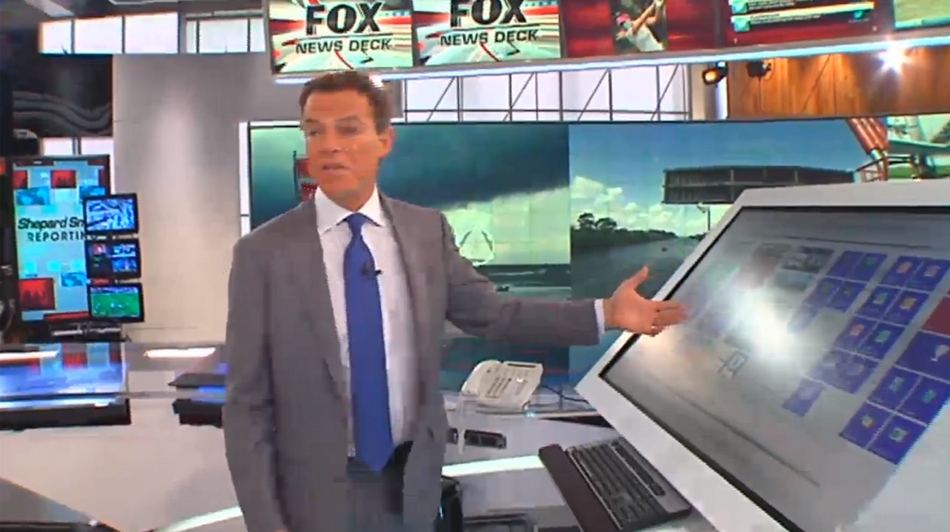
"For instance, I can take this lady who's been evacuating from a hurricane zone and move it over here."
Smith later demonstrates a gigantic 38-foot long video wall with a device "never been used in broadcast television before." It's a remote control that allows Smith to shuffle a giant image carousel. "For instance, I can take this lady who's been evacuating from a hurricane zone and move it over here," Smith says.
Fox says the new "news deck" is designed to appeal to viewers who are "non linear" -- those who sift through news all day on their phones and computers. "Just like you, we get our news from multiple platforms," Smith says. "And this is the place where viewers can watch us sort it all out as it happens." In other words, Fox's new newsroom will serve as a fact-checking machine for Twitter's firehose.
Of course, despite its insistence that its new news room represents a cutting-edge way of gathering and reporting news, Fox isn't the first to use Twitter and other social channels to guide and fill its unremitting news cycle. Smith says his team has spent "weeks" training to use its new software — but we'll have to wait and see if Fox has managed to algorithmically translate its "fair and balanced" reporting.
Watch the latest video at <a href="http://redirect.viglink.com?key=11fe087258b6fc0532a5ccfc924805c0&u=http%3A%2F%2Fvideo.foxnews.com" mce_href="http://redirect.viglink.com?key=11fe087258b6fc0532a5ccfc924805c0&u=http%3A%2F%2Fvideo.foxnews.com">video.foxnews.com</a>
War has laws; why can't war games reflect them?
It's a simple question that the International Committee of the Red Cross has been weighing for nearly two years.
Under the Geneva Conventions, the Red Cross is mandated to protect the victims of international and internal armed conflict. During the 31st International Conference of the Red Cross and Red Crescent in Geneva in 2011, a committee discussed whether the Geneva and Hague conventions should be applied to the fictional recreation of war in video games. In other words, they wanted video war games to better reflect the realities of modern combat.
Last summer, the International Review of the Red Cross published an article that more deeply examined the issue. The takeaway was that video games are an important method for disseminating information and that they can be used to raise awareness of war crimes, but often don't reflect the realities of war.
"Beyond the Call of Duty: why shouldn't video game players face the same dilemmas as real soldiers" was published alongside articles about about drone strikes, cyber war and autonomous weapons.
In the article, written by Ben Clarke, Christian Rouffaer and Francois Senechaud, the trio ask if video games can be a positive medium of influence to reinforce understand and respect for the laws of war.
"Why can't players be rewarded for compliance with the rules governing the use of force as well as the treatment of persons in the hands of the enemy and sanctioned for violating the same?"
The authors found that four of the five causes for violations of International Humanitarian Law during real war are reflected in many video games about war. That includes creating a perception that battlefields are always devoid of civilians, and thus an open shooting range, that virtual commanders behave in inhumane ways and that war is lawless and fought against demonized, dehumanized enemies.
That video games often represent the worst in war isn't really a contentious idea; the question is whether that is meaningful and what to do about it.
In the report, the conclusion that the authors come to is that video games often don't allow players options when asked to make decisions about humanitarian law violations or that video games' lack of nuance, be it the dearth of civilians in combat or inability to take prisoners, can lead to a misunderstanding of the realities of war.
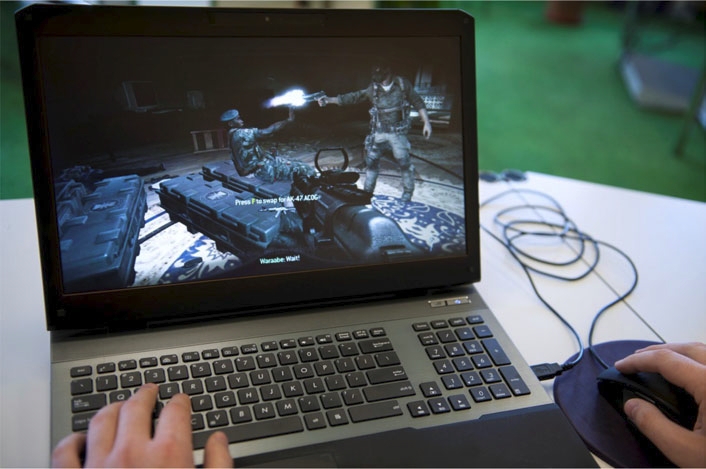
Execution of a captive in Modern Warfare 2. Photo by ICRC
But so what? Aren't video games entertainment?
The report argues that while video games may not teach bad behavior, they can most certainly trivialize war crimes. They can also lead to a general misperception of what is and isn't lawfully allowed in war.
The big question, ultimately, is what to do about it.
The report is clear that the Red Cross isn't asking for government intervention. Instead they authors are calling for the game industry to be willing to spend the time to create more realistic video games.
And they've already seen some success. Members have met with the industry a few times over the past year, including talking to the developers behind war game Arma 3.
The authors of the report say they hope to see some of the fruits of that labor by this December.
International Committee of the Red Cross spokesman Bernard Barrett told Polygon that while the issue has been examined, there is no dedicated group working on it.
"There are the authors of the aforementioned article and a few others who have an interest in this issue," he said. "They are part of a unit here in Geneva which works on implementation of the law of armed conflict, be it through meetings and working with military training officials, universities or other groups of interest. There is no official ICRC report on the topic, aside from the study in the Review."
And the ICRC has no plans to try and study the impact video games might have on behavior, he said.
"We do know that video games are used as recreation by many off-duty military and also by young men and women who could be recruited," Barrett added. "But they are also widely used by the general public. We do not want to influence how people perceive of war so much as to influence the understanding that there are laws governing conflicts. We certainly believe that the widespread use of video games can affect public perceptions. We do not want to censor video games nor do we believe that video games should be sanitized to eliminate any act that contravenes the law of arm conflict. We suggest that game developers themselves incorporate scenarios that reward compliance with the law and punish virtual breaches.
"The ICRC has the mandate (in the Geneva Conventions ratified by all states in the world) to encourage the awareness, implementation and the respect of these Conventions. This is an essential part of its mandate."
Good Game is an internationally syndicated weekly news and opinion column about the big stories of the week in the gaming industry and its bigger impact on things to come. Brian Crecente is a founding News Editor of Polygon.
firehose'Sure, the house might look great in the Light World, but its Dark World counterpart might have purple bushes and skulls strewn across the front yard"
perfect, let's close on it


Buying a home in The Legend of Zelda: A Link Between Worlds can be a little tricky. Sure, the house might look great in the Light World, but its Dark World counterpart might have purple bushes and skulls strewn across the front yard. This is a great example why you should always, always get a home inspection before purchasing a house.
PREORDER The Legend of Zelda: A Link Between Worlds, upcoming games
firehose!
60fps Cave Story
Dave “Davespice” Honess, one of our indefatigable forum mods (a crack team of men and women with darting eyes who never sleep, spending their downtime making sure our forums are a welcoming place for new users, and a really crappy place for people who want to spam or start flamewars), has been working on porting games to the Pi and bringing the community’s attention to games that others have ported. His most recent addition to the Pi Store is Cave Story, a side-scrolling freeware platformer with a distinctly retro look and feel.
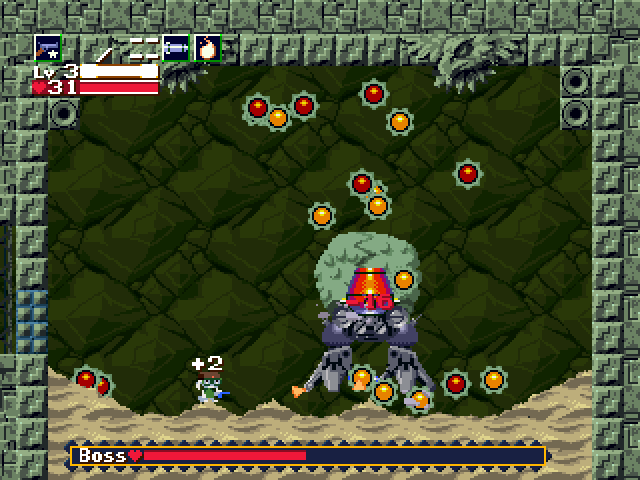
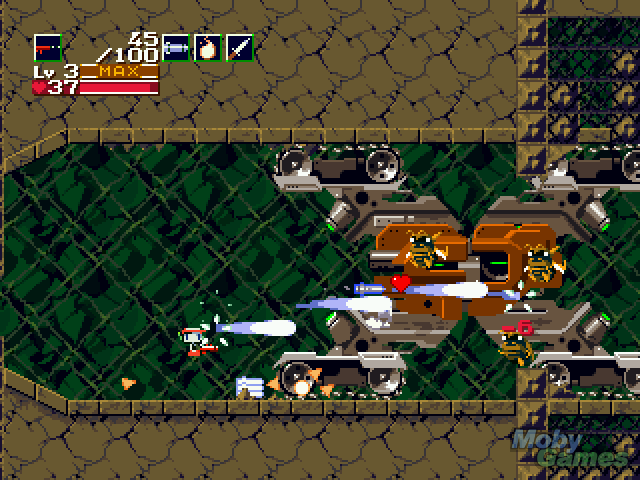
I’d been chatting to Dave about why he’d chosen Cave Story to work on, and what he said was really worth sharing, so I asked him if he’d mind writing a few words for the blog about it. He said:
In my view Cave Story is one of those games that genuinely deserves to be played by everyone. Two main reasons. One is that it is, truly, a brilliant game and two is the amount of work that went into it. Daisuke Amaya (aka Pixel) made the entire game by himself. All the graphics, all the programming, he composed all the music, wrote the story and the dialogue for all the characters. The game is intentionally retro in honour of the games he played during his youth. You can easily see the influences of games like Metroid, Wonder Boy and Castlevania in there.
If you’ve never heard of this game before, you should play it. Don’t argue. Just trust me. It has some amazingly fun boss fights! The retro chiptune soundtrack is just wonderful. Personally I love how you can level up the weapons, they’re very satisfying when maxed out!
There is actually a third reason. If you’ve ever wanted to make computer games yourself then Cave Story shows what can be achieved by a single person. In my view a platform game offers a much better opportunity to think about how the code is working as opposed to these photo-realistic 3D shooters that are popular now. Everyone has to start somewhere and you won’t go far wrong if your first game is a platformer. So I hope some of you reading this will go and play Cave Story and draw some inspiration from it. Try to make a simple clone of it in Python using PyGame and you will learn a lot in the process. Amaya himself started by just writing the title screen and programming some basic character movements.
The game runs through a very light build of RetroArch that was especially compiled for Raspbian. It incorporates an improved version of Caitlin Shaw’s NXEngine as its core. The result is a smooth gaming experience with the Pi easily achieving 60 fps. We should all be grateful to Daisuke Amaya himself, Caitlin Shaw for NXEngine, Daniel De Matteis and Hans-Kristian Arntzen for RetroArch.
So there you are. Go and download it, and when you’ve spent a while playing, follow Dave’s advice and see how far you can get writing something of your own using PyGame, and tell us how you get on!


I am making a brief appearance at New York Comic Con next Saturday! I’m on a panel called “Beyond the Webcomic” with Ryan North, Chris Hastings, and Seth Fishman (an agent of mine and Ryan’s!). It should be interesting! I understand it is difficult to find the info on the website, so here it is, a little screencap and link to the info page.
I’m not a regular attendee though, so I don’t have a table or signing hours for those who asked. But I will stick around to say hello after the panel.
-Kate
firehosedamn, son
National Post |
9-year-old sneaks onto plane at MSP Int'l Airport KARE MINNEAPOLIS, Minn. - Despite numerous checkpoints and gate agents, officials at Minneapolis/St. Paul International Airport say a 9-year-old was somehow able to sneak through security and onto a Delta flight headed to Las Vegas. "At this point, this is a ... Boy Boards Plane To Vegas At MSP Without TicketCBS Local Delta reviewing procedures after boy stows awaySalon Boy Sneaks on Plane: 9-Year-Old Gets to Las Vegas Without TicketNewsmax.com KCEN-TV -FTC Publications all 318 news articles » |
firehose"I think I need Seth Meyers to leave the show."
hallelujah

When Saturday Night Live goes on a particularly bad run of sketches, it can be hard to pull things out. Sometimes it’s easy to see the glimmers of humor in a bad sketch, or pick out particular things that were funny even if the overall scene wasn’t. But the first half of this week’s episode was so catastrophic, it just put me in a foul mood. I remember Cyrus’ last time hosting the show, which was coincidentally one of the worst episodes SNL has aired in recent years. But back then, she was just an ordinary teeny pop star who was beginning to break away from her wholesome origins.
Now she’s Miley Cyrus, twerk ambassador, whose lovely performance at the VMAs (which is best summed up by this tweet) has made her the subject of a thousand screeching articles either proclaiming her inches from utter ruin ...
Read more
|
|
firehoseCostolo: "Vivek Wadhwa is the Carrot Top of academic sources."
Critical comments about Twitter’s lack of women in prominent positions prompted a bizarre public Twitter exchange this weekend, in which CEO Dick Costolo both pointed to larger societal issues driving the lack of diversity in tech, and knocked his most outspoken critic for "hyperbole."
The exchange, reported by BuzzFeed, stems from a Friday New York Times report cataloguing the makeup of the nearly-public company’s board. The report quotes Vivek Wadhwa, a fellow at Stanford’s Rock Center for Corporate Governance, who calls Twitter's case emblematic of "the same male chauvinistic thinking," categorizing its record as "the elite arrogance of the Silicon Valley mafia, the Twitter mafia." And when faced with the entirely valid criticism about a lack of diversity at Twitter (albeit liberally sprinkled with mafias), rather than write a response, CEO Costolo chose to take a swing at Wadhwa instead.
The response lead to a back-and-forth with writer and consultant Anil Dash before Wadhwa himself joined in the fray. Ultimately, not much was resolved — Costolo acknowledged that the lack of female board members was a problem while appearing to dispute the meaningfulness of "checking a box" by taking on a female board member, while Wadhwa insisted that Twitter needed to take a leading role in the industry. Regardless of the points raised on both sides of the fence, it’s strange to see Costolo resort to name-calling in his first response to the New York Times report, particularly given Twitter’s leadership in areas like freedom of speech.
firehose11111111!!!!!!!!!!!!!!!!!!!!!!!!!!!!!!!!!!!!!!!!!!!!!!!!!!!!!!!!!
"the far more reliable Radio Times came out and said that, yes, previous episodes from two stories from the second Doctor’s era have been remastered and will go on sale via digital platforms like iTunes starting on Wednesday.
Yes. Wednesday. As in this week.
The new/old episodes “are believed to originate from a haul discovered in Africa,” which corroborates part of the Mirror‘s story, though the amount of episodes we will be getting is a far cry from 106. But there may be more to come. Says the Radio Times:
“A BBC Worldwide spokesman refused to officially confirm the discovery or the ‘speculation’ around further missing episodes.
It is understood that other episodes have also been found, although it is not yet known whether these will be made available.”
There are still a lot of unknowns: How many episodes, total, have been found? How many of them will be released, and when? Assuming the Troughton ones do come out Wednesday morning, will it be worldwide or only, say, only on the UK version of iTunes? We’ll let you know as we find out more."

firehose"It’s digitized the collection, and it’s digitized the book. Now Amazon’s working on the white-haired, bespectacled librarian we all grew up with that knew everything that was happening in our books, and knew exactly what we’d want to read next. Put her into the Paperwhite, and Amazon will have built a library I won’t ever want to leave."
bam! pow! I'm a tech writer who hates human interaction!
Amazon won the ebook reader war. Like the iPod, the Swiffer, or Jell-O, the Kindle is just what you buy when you want what it does. Barnes & Noble and Sony went down swinging trying to compete, and Kobo and Iriver are but gnats to be swatted by the great Amazon behemoth. Last year’s $119 Kindle Paperwhite was the best ebook reader ever made, the default choice, the one I recommend to everyone without a second’s thought — and 12 months later it still is. There isn't even viable competition at this point.
Yet there’s still a new Paperwhite this fall, a new $119 E Ink reader with a series of hardware upgrades and some new software as well. A few things have been changed, but this is very much the same device it was a year ago. It’s Amazon at the height of its powers, with nothing to prove and nothing to lose. The question now: when you win a market, when no one else even really puts up a fight anymore, what do you do next?
In the Kindle’s case, you make sure the Paperwhite never gets stashed in a drawer somewhere, a forgotten impulse buy. You find new and clever ways to make sure people keep right on reading, and buying, books.
It happened repeatedly: I would pick up a Paperwhite to test it out, read for a while, and then discover that I was holding the device I bought a year ago instead of my review unit. Only the most discerning of readers will notice the differences in hardware here: a slightly changed Kindle logo, a slightly higher-contrast screen. The only obvious change, the only way I could reliably identify one device from the other, is by the logo on the back. Where there was once a subtle, muted Kindle logo, there’s now a glossy black "Amazon" etched into the soft-touch black back.
Otherwise it’s the same size, the same weight, the same months-long battery life, the same everything. It’s still comfortable, easy to use in one hand, and as handsomely understated as ever. It’s sturdy enough that you don’t need a case like the leather folio Amazon sells, but I’ve grown to love the case — with a magnetized flap that turns the device on when you open it, and a nicely rough texture, opening up the case feels like opening up a well-loved hardback. It’s wonderful.
The hardware's better, but it's not really different

The new Paperwhite comes with a new, slightly more even frontlight, and a faster processor. The light is certainly better, a little whiter and spread a bit more evenly around the screen with fewer dark patches; I noticed it more than the higher-contrast E Ink display, but neither changed the experience of using the Paperwhite in any meaningful way. The light is still wonderfully versatile, dim enough to work in a totally dark room and bright enough to kill most of the glare in a well-lit room.
As for the processor, I still can’t tell what’s real and what’s placebo. Page turns do seem slightly faster, especially combined with the more receptive touch screen — I found myself rarely having to swipe multiple times to turn a page, which hasn’t always been the case with Kindles. Nothing else about the Paperwhite seemed more responsive, though. Typing, scrolling through the store, even turning the device on and off all feel the same, though they are a beat faster in side-by-side tests with last year's model. They’re slow because E Ink is slow, flashing the page anytime something complex happens, but it’s never really a problem.
The Paperwhite has always been a great, utilitarian device that does exactly what it’s supposed to. I still hold out hope that we’ll one day see a flexible-display Kindle or a color Kindle, but those are pipe dreams. Right now, Amazon’s built as good a reading device as is probably possible for $119.
This year, Amazon’s focus isn’t hardware. It’s figured out how to build something we’ll read with, so what’s next? Figuring out how to make us read more, buy more, and get others to do the same. That’s what this year’s Paperwhite is all about.
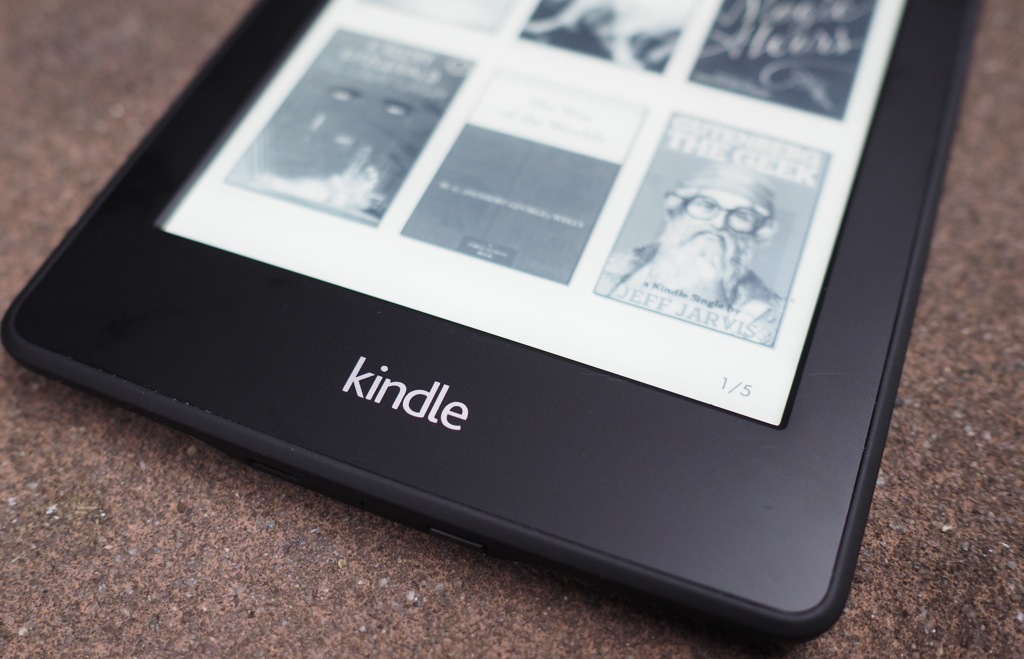
For better and for worse, the experience of using the Paperwhite remains the same. The UI is still simple and obvious, letting book covers do most of the design work. The file support is still woefully lacking — you can read PDFs and Word documents, but without EPUB support you basically can’t read any books you didn’t buy from Amazon.
When we met with Kindle executives to talk about the upcoming MatchBook feature, which will let you buy a physical book and then get the Kindle version for only a few dollars more, they laid out Amazon’s vision. Print books will be more like artifacts, they told us, like vinyl records — more work, and more money, but that’s part of the appeal. Ebooks will become the commodity, like MP3s, not the perfect solution but the easiest and most common way we’ll read.
Amazon's not killing print books — it's just relegating them to art pieces
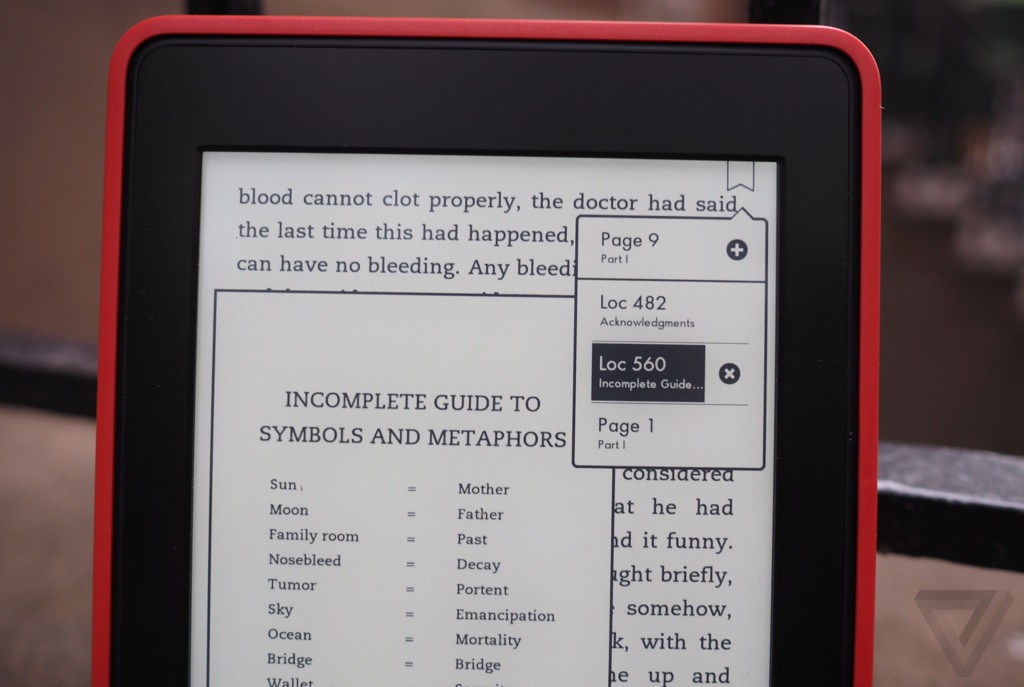
To ease that transition, Amazon’s paying close attention to how we read physical books. One common complaint about ebooks is that it’s hard to flip around, to quickly move between pages — if you read Game of Thrones or The Lord of The Rings, you're constantly consulting maps and indices lest you get lost following Frodo around Middle Earth. The new Paperwhite comes with a clever approximation of the feature: you can bookmark any page with two taps, and swipe down to find that bookmarked page in a pop-up window at any time. It takes three seconds to bring up the index or the map, and one tap to get back to your reading. As a perpetual thumb-in-the-back reader, this alone makes me want to read more on the Paperwhite.
Also in the interest of helping you figure out what in the world is going on inside your book, Amazon’s great "X-Ray" feature continues to get better and better. Long-press on the name of a place, a character, or basically anything else relevant to your book, and a pop-up window shows you everything you need to know: a biography, where else that person has appeared in the book, even useful trivia. After spending three Game of Thrones books forgetting the difference between Ser Lloris and Ser Jorah, and trying to remember that Littlefinger and Lord Petyr Baelish are the same person with fairly fickle loyalties, having a quick reference guide at my fingertips was a lifesaver. If X-Ray doesn’t have your answers, you can always look up a word in the dictionary, or now on Wikipedia, all from within that pop-up.
For textbooks or anything complex, X-Ray is a lifesaver
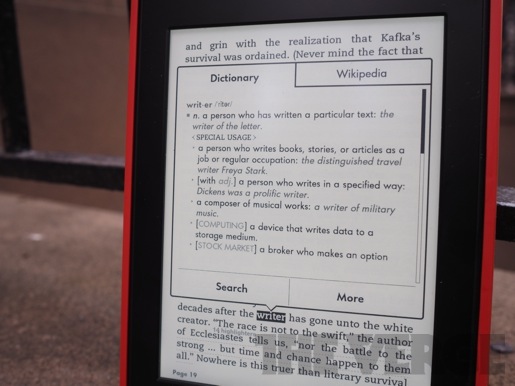
Words you look up get saved into the new Vocabulary Builder app, which serves as a repository for your literary stupidity. It’ll automatically make flash cards for the words you’re learning, and let you mark ones you’ve mastered — I finally know what "solopsistic" means, which is nice, but I don’t know that I’ll be using the app very often.
These are all nice features, all designed to make the reading experience a little easier, a little simpler. (Books are hard.) But the best new feature’s coming soon: the Paperwhite will integrate with Goodreads, the social network for readers that Amazon acquired in March. Goodreads will let you share notes with your friends — a sort of social marginalia that could be really fun — or just see what your friends are reading and whether or not they like it. It’s going to make those recommendations at the bottom of the Paperwhite’s homescreen a lot more useful, and is a compelling reason for people to keep picking up their Kindles. It's also going to make my already itchy book-buying finger even more dangerous, since every book my friends recommend will be just one click away.
Amazon is quickly learning to emulate what’s great about physical books, while still offering what’s uniquely possible on an ebook reader. The reading experience is still wonderfully customizable, with plenty of font and margin options, and I’m almost getting used to not having page-turn buttons thanks to the better touchscreen. But with easier reference tools and (hopefully) the first decent social network ebook readers have ever seen, digital’s more compelling than ever.
Still the first and last ebook reader you'll shop for
If you’re buying an ebook reader, buy a Kindle Paperwhite. I’d recommend spending the extra $20 to get the $139 version without Special Offers, but even those aren’t really so bad — just static E Ink ads on the home and lock screen. (Spending another $50 for the always-connected 3G model is a little harder to justify, I think.) I hope future models eventually get an even better screen, and a headphone jack with Whispersync for Audio support, so I can switch between reading and listening to a book with one tap. (I’m also still partial to page-turn buttons.) But if I hadn’t bought a Paperwhite last year, I’d be buying one this year. Not only is it a great ebook reader, it’s the only one even worth considering — great hardware and Amazon’s spectacular ecosystem are an untouchable combination.
It’s digitized the collection, and it’s digitized the book. Now Amazon’s working on the white-haired, bespectacled librarian we all grew up with that knew everything that was happening in our books, and knew exactly what we’d want to read next. Put her into the Paperwhite, and Amazon will have built a library I won’t ever want to leave.
More times than not, the Verge score is based on the average of the subscores below. However, since this is a non-weighted average, we reserve the right to tweak the overall score if we feel it doesn't reflect our overall assessment and price of the product. Read more about how we test and rate products.
firehoseThe Night Wolves, or Nochnye Volki, are bikers who have found a Russian God. In an act of patriotism they have changed all the words on their leathers from Latin lettering to a gothic Cyrillic. One of the Hells Angels symbols, a ‘1 per cent’ inside a diamond, is still etched on a great stone at the entrance to their kingdom. In Hells Angels lore it stands for the 1 per cent who are outlaws. But the Night Wolves have engraved a new text around the diamond, transforming its meaning: ‘In heaven there is more joy at the 1 per cent of sinners who confess than the 99 per cent who have no need of salvation.’
firehosetl;dr: Self-employed, he actually needed healthcare and couldn't get it
“I’ve seen first hand people hitting up the emergency room for free health care and then putting a burden on [everyone else] and that’s not something I would want to do, I want to take personal responsibility … By no means am I trying to take a government handout…it’s not a free handout, you’re paying for this health care, but it’s making it more accessible to more people.”
Asked what he liked about Obamacare, Pittman highlighted its prohibition against denying coverage to people with pre-existing conditions, noting that he wouldn’t be able to find coverage without it, and said that the policies offered in the marketplace seemed more affordable and comprehensive than those available to him on the individual market. “You may pay $18 a month [for a cheaper plan] and you’re missing a level of coverage. It’s not as easy as you’re going to pay this much a month,” he says.
firehoseScalia: "I am something of a contrarian, I suppose. I feel less comfortable when everybody agrees with me. I say, “I better reexamine my position!” I probably believe that the worst opinions in my court have been unanimous. Because there’s nobody on the other side pointing out all the flaws."
Q: Really? So if you had the chance to have eight other justices just like you, would you not want them to be your colleagues?
"No. Just six."
firehosemany, many things, but notably: "Mysteries of Gravity: Why we enjoy a SciFi film in make-believe space more than we enjoy actual people set in real space."
firehoseKaren Gillen
shared for Cumberbatch quote: "I've always had an eye on longevity; I've got loads more goals to achieve. It's not like I've completely conquered the whole thing. That's a lifetime's objective, not an overnight thing."

We now know that Chloe Grace Moretz hasn't auditioned for Star Wars — but Saoirse Ronan may have auditioned with a lightsaber in her hand. There's new footage from Ender's Game, Thor 2, The Hobbit and NBC's Dracula. Plus, the World War Z sequel needs a new director. Spoilers now!

|
|
firehosegreat
New York and Airbnb continue to clash over when residents should be able to rent out their apartments. The state's attorney general, Eric Schneiderman, has now subpoenaed data about all Airbnb hosts within New York, the rental service says. According to New York Daily News, Airbnb must turn over the data by today. But Airbnb says that it's hoping not to have to do that. "This demand is unreasonably broad and we will fight it with everything we've got," David Hantman, Airbnb's head of global public policy, writes in a blog post yesterday.
Airbnb says New York is just targeting bad hosts
For Airbnb, releasing user records could reveal just how many hosts are violating New York law, which currently prohibits renting out complete apartments. Since around half of New York rentals may fall under that category, Airbnb's data could give the state the fodder it needs to continue a crackdown. After managing to overturn a fine one of its New York hosts received earlier this year, Airbnb has already begun moving to prevent future issues. It says that it's receptive to adding rental taxes that traditional hotels see, so long as its service can operate legally.
Though New York ostensibly wants to continue its broader fight against Airbnb, which has been butting up against a law that targets illegal hotels, Airbnb claims that the state is merely hoping to weed out the few bad hosts who are actively abusing the system. "We believe the Attorney General is only seeking to target an incredibly small number of bad actors who abuse the Airbnb platform ... like illegal hotel operators and slumlords," Hantman writes. Accurate or not, Hantman says that Airbnb will continue its discussions with Schneiderman's office, writing that, "We are confident we can reach a solution that protects your personal information."