'about a social networking-obsessed woman who suddenly achieves unwanted fame due to a viral video. In order to repair her image, she seeks mentoring from “a marketing expert at her company.” '
Emily Kapnek’s Suburgatory may be slipping in the ratings, prompting a move to midseason and a shortened 13-episode order, but a new put pilot order suggests the network wants to keep her around. Kapnek's Selfie is based on Alan Jay Lerner and Frederick Loewe's 1956 musical My Fair Lady (which is in turn based on George Bernard Shaw's Pygmalion), taking the story of a Cockney flower girl trying to pass as high society and turning it into a sitcom about a social networking-obsessed woman who suddenly achieves unwanted fame due to a viral video. In order to repair her image, she seeks mentoring from “a marketing expert at her company.” Presumably this means corporate synergy, romance, and a scene of someone crafting a tweet with another person looking over their shoulder to tell them it doesn’t sound “authentic” enough, so they should use a hashtag ...
Seven months ago I transitioned out of a corporate job in market research to work for myself full-time. By the time I left my day job to become a personal finance coach, I had nine clients, $22,000 in savings to cover my living expenses and $5,000 in a business account. This is how I did it.
Head Start programs have been shuttered, small businesses can’t get loans and hundreds of thousands of federal government employees are furloughed. But the exclusive gyms available only to members of Congress have remained open throughout the shutdown.
“Historically speaking, animating female characters are really, really difficult, ’cause they have to go through these range of emotions, but they’re very, very — you have to keep them pretty and they’re very sensitive to — you can get them off a model very quickly. So, having a film with two hero female characters was really tough, and having them both in the scene and look very different if they’re echoing the same expression; that Elsa looking angry looks different from Anna (Kristen Bell) being angry.”
When I saw this quote circulating around Tumblr last night I assumed it was made up. Did Lino DiSalvo, Frozen's head of animation, really say that animating female characters is difficult because they're so "sensitive" and "you have to keep them pretty"? Unlike male characters, who are far, far more stoic than we emotional womenfolk, amirite? But no. It appears that this is a legit thing that he actually said.
"The iOS7 upgrade has been unsettlingly similar and it's not creating happy and confident users. It's creating frustration and distrust. When users are nagged into submission and are then required to re-enter every password and re-learn how to use a utilitarian device, it's not a testament to the success of the new OS. It's a testament to our common threshold for nagging."
Like many, I was impressed with how quickly the iOS user base upgraded to iOS7. Surely it's a marvel of deployment and user education to have so many non-technical users upgrade to a new operating system so quickly. But there's a secret cost that nerds tend to ignore and it's the trust and comfort many mainstream users had for their Apple devices.
While I anxiously awaited the arrival of the new operating system, millions of other users walked around oblivious to their flat and washed out future. But they could not escape their fate. Even against my explicit warnings to not upgrade until I could assist, many of my relatives unwittingly accepted the iOS7 update.
Within days of the availability of iOS7 I also began to find tweets full of surprise and confusion tinged with anger. It's far too easy to dismiss the plebs and tell ourselves that this upgrade is for their own good but let's change shoes for moment.
I have a cable box that works. It changes channels and records most shows I tell it to. Periodically I receive a notification that the system needs to be updated. No intelligent change list or warnings are provided. There are just "OK" and "Cancel" buttons. If I press "Cancel" I'm allowed to go about my regular activities for some unspecified, but I ultimately receive the prompt again and again. This is not opt-in, it's nag-in.
Inevitably I breakdown and accept the terms of our arrangement. Each update makes me enjoy using the device and service less. There has never been a time when I've looked forward to reprogramming a device and re-learning how to perform the same functions from the day before.
The iOS7 upgrade has been unsettlingly similar and it's not creating happy and confident users. It's creating frustration and distrust. When users are nagged into submission and are then required to re-enter every password and re-learn how to use a utilitarian device, it's not a testament to the success of the new OS. It's a testament to our common threshold for nagging.
Getting to this page on the Healthcare.gov site is just the start of the battle for would-be insurance customers.
Sean Gallagher
Amid all the attention, bugs, and work happening at Healthcare.gov in light of the Affordable Care Act, potential registrants talking to phone support today have been told that all user passwords are being reset to help address the site's login woes. And the tech supports behind Healthcare.gov will be asking more users to act in the name of fixing the site, too. According to registrants speaking with Ars, individuals whose logins never made it to the site's database will have to re-register using a different username, as their previously chosen names are now stuck in authentication limbo.
The website for the Affordable Care Act (aka "Obamacare") launched just last week. With all the scrutiny and debate happening, if ever there was a website launch that was "too big to fail," this was it. So, of course, it did—depending on how you define "failure." The inability of Obamacare portals to keep up with the traffic demands initially put upon them has been seized by politicians and conservative pundits as evidence that Obamacare "is not ready for prime time" in the words of Sen. Orrin Hatch (R-Utah). Now, a week later, the site appears to be stabilizing, with waiting times dropping dramatically for those who haven't been able to register before.
A test of the site this morning had me waiting four minutes to get to the signup page; others got on instantly. But problems persist beyond the front door. The contractors responsible for the exchange—CGI Federal for the website itself, Quality Software Systems Inc. (QSSI) for the information "hub" that determines eligibility for programs and provides the data on qualified insurance plans, and Booz Allen for enrollment and eligibility technical support—are scrambling to deploy more fixes. Technical support call center operators continue to handle an onslaught of calls from users who can't get back into the system after registering.
Scientists have struggled for years to pinpoint the cause of the global crash in bee populations, an affliction known as Colony Collapse Disorder. Everything from pesticides to poor nutrition to automotive exhaust has been blamed for the apian apocalypse. But if British scientists are right, bees that pollinate much of the world’s crops are dying because they’re stressed out.
A ground-breaking new study by researchers at the Royal Holloway University of London investigated the impact of non-lethal doses of agricultural pesticides on the social organization of bumble bee colonies. If correct, the findings go a long way to explaining why exposure to pesticides can prove fatal to beehives if not to individual bees.
“Social bee colonies depend on the efficient cooperative performance of multiple individual workers so that essential tasks like foraging, thermoregulation and brood care, sustain and enhance overall colony function,” they wrote. “They have many workers and are able to buffer some effects of stress. However, if too many bees become behaviorally impaired, irrespective of the reason, the colony reaches a tipping point and is set on a path to failure through moderate, but chronic, levels of stress.”
Over 42 days, the scientists fed eight bumblebee colonies neonicotinoids, a class of agricultural pesticide linked to bee deaths, in sub-lethal doses that bees would typically be exposed to as they collect pollen. Eight other colonies were fed non-contaminated pollen as a control. Researchers monitored the growth of the colonies, counting bee deaths and larvae hatching. They fed that data into an algorithm that predicted the impact on the colony’s growth of bees that became stressed.
After the first three weeks of the 42-day study, only control colonies continued growing, while treatment colonies began to shrink, according to the scientists. They concluded that the delayed decrease in colony size suggested that low pesticide exposure affected colony function rather than mortality.
In other words, as the pesticide stresses individual bees, they become sluggish and unable to perform their tasks in the beehive. As those bees turn into zombies, they affect healthy bees’ ability to do their jobs and keep the colony functioning.
While the scientists only tested the pesticide’s impact on bees, they noted that other factors—from poor nutrition due to a dearth of wildflowers to bad weather—could result in accumulated stress on individual bees that push a colony to collapse. “This can explain why finding the link between colony failures and a single specific stress factor has so far proved elusive,” they wrote.
'A 9-year-old boy who evaded airport security and stowed away on a flight from Minneapolis to Las Vegas has also stolen a car and sneaked into a water park, and he is known to child protection investigators, according to a confidential county government memo.' ... 'The boy became "violent" and was hospitalized in Las Vegas, where hospital staff reported he was "uncontrollable" at first but eventually calmed down, she said.'
Report: Stowaway boy hospitalized in Las Vegas Las Vegas Sun A Delta Airlines jet in flight. The airline said Monday, Oct. 7, 2013, that it is reviewing its policies and procedures after a 9-year-old boy stowed away on a flight from Minneapolis to Las Vegas on Oct. 3, 2013. Associated Press. Tuesday, Oct. 8, 2013 | 10:15 ...
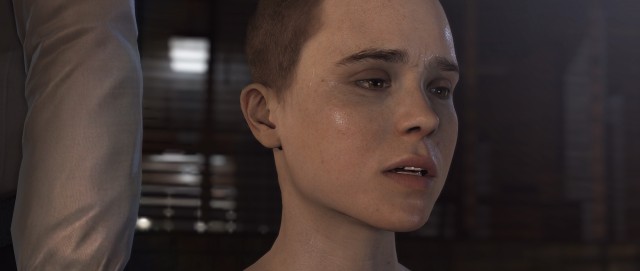
"the story is written and presented with all the subtlety and artificial gravitas of a high school freshman trying to write something Important-with-a-capital-I. Through it all, there's a sense of explicit emotional manipulation. There are constant moments where the music swells, characters' faces get scrunched up, and the game practically throws up a big metaphorical sign saying "Feel something, dammit!" Only you feel nothing, because the plot and writing are way too overwrought and earnestly direct, and because the game never really succeeds at making Jodie a relatable and believable character with interesting motivations or reactions" ... "like a glorified version of Dragon's Lair, only dumbed down so that it's almost impossible to fail—and with no significant penalty if you do (and without the expressive animation, either)." ... "The game represents a huge step back from its predecessor, and the lost potential could single-handedly set back the cause of interactive storytelling a great deal."
This was approximately what my face looked like when trying to make sense of Beyond's story.
In 2010, Heavy Rain changed the way I looked at game narratives. For all the problems with its characterizations and story structure (and there were quite a few), the game was notable for a free-flowing narrative that responded and adapted to player choices well past the point that other games would have forced a "Game Over" and a reload from the last checkpoint. Few other games before or since have combined such cinematic storytelling with so many meaningful choices, with consequences that echo heavily through the game even to the point of allowing for the death of one or more of the multiple protagonists. The result of this sprawling-but-never-out-of-control narrative structure was a game that gave a real sense of tension to even small decisions, one where I frequently paused and carefully considered my options before choosing what to do next.
I rarely if ever stopped to consider a choice in Beyond: Two Souls, Quantic Dream's much-anticipated, PS3-exclusive follow-up to Heavy Rain. Instead, I mainly sleepwalked through a seemingly endless sequence of practically preordained story beats, struggling to care as I was dragged through a clichéd plot with no sense of meaningful agency. This would be somewhat acceptable in a game where tight gameplay is the focus and where the story acts as nothing more than a glorified excuse to set up the next action scene. For a game as story-focused and gameplay-free as Beyond, though, it's downright unforgivable.
A mess of a story
Beyond is the story of Jodie, a "special" young woman (as we're told many a time), and Aiden, the invisible, ghostly companion that she sort-of-but-not-really controls (the game stresses that Aiden makes his own decisions, but Jodie is frequently seen directly controlling him). Their story is told in a series of disjointed flashbacks to Jodie's memories, jumping backward and forward in time in a way that slowly fills in a complete backward-looking story arc where we see her as an emotionally abandoned young girl, scientific test subject, (somewhat hard-to-believe) elite CIA agent, and incredibly predictable savior of the world.
“This happened and as of today the United States is willingly, knowingly, intentionally sending arms to terrorists, now what this says to me, I’m a believer in Jesus Christ, as I look at the End Times scripture, this says to me that the leaf is on the fig tree and we are to understand the signs of the times, which is your ministry, we are to understand where we are in God’s end times history," Bachmann told Jan Markell, radio host of "Understanding the Times," on Saturday.
“Rather than seeing this as a negative, we need to rejoice, Maranatha Come Lord Jesus, His day is at hand,” Bachmann added later.
Yes, Bachmann is referring to our policy in Syria, but don't think her End Times theology doesn't inform the rest of her politics (to the extent that it is informed by anything). And the same can be said of much of the rest of the Tea Party right.
Yeah, sure, some of them just don't understand how money works, and thus have no idea what sort of economic disaster they are courting. But some of them do, and just don't care. Because the end is nigh! So who cares about destroying the full faith and credit of the United States government within the context of an impending divine apocalypse?
Really. There's an unmistakable millennialist spirit to the Tea Party movement, even when it's expressed in a purely secular form. These are people who are courting some sort of apocalyptic confrontation—who almost seem to welcome it and the purifying suffering it would bring. Individual teabaggers may not even be aware of their End Times inspiration—in the same way that you don't need to be a Protestant to be an unknowing adherent to the so-called "Protestant ethic"—but the End Times inspiration is clearly there.
So don't underestimate the willingness of these people to destroy an economy they believe is already destined to be destroyed.
"No such thing as too much BUTT? Depends on if you're takin' it to the stage or to the GRAVE! @FOX29philly Getting REARS N GEAR 2NITE @ Ten"
"THE POLE RULES! @FOX29philly See grandma work it well. TONIGHT at TEN! Watch out now!"
Yesterday I alerted you to the hilariously tone deaf tweet by Philly's FOX 29 reporter Joyce Evans, who compared a local drive-by shooting/murder to an episode of Breaking Bad in order to lure in viewers. Though she's furiously backpedaling at the moment, and I suggested she should have her Twitter feed taken away forever, a quick look at her other tweets shows that this is a reporter WHO REALLY KNOWS WHAT SHE'S DOING on social media! Don't stop, Joyce!
I know you wanna see it.@FOX29philly How DO you fix earlobes stretched wide open by those heavy gauges. Ooh Wee! Tonite on Fox29NewsAt 10 — Joyce Evans (@JoyceEvansFox29) October 3, 2013
Husband hides as wife HAS TWINS ON BATHROOM FLOOR @FOX29philly local man accused of vile act inside Disney World bathroom. Tonite @ Ten — Joyce Evans (@JoyceEvansFox29) August 19, 2013
How you livin'? Longer! How you feelin'? Uhhhhhh @FOX29philly I'm Baaack! Tonight at 10pm — Joyce Evans (@JoyceEvansFox29) July 22, 2013
How far would you go to stop your thighs from rubbing together? @FOX29philly the skinny on Thigh Gap tonight at 10pm — Joyce Evans (@JoyceEvansFox29) July 10, 2013
No such thing as too much BUTT? Depends on if you're takin' it to the stage or to the GRAVE! @FOX29philly Getting REARS N GEAR 2NITE @ Ten — Joyce Evans (@JoyceEvansFox29) November 16, 2012
THE POLE RULES! @FOX29philly See grandma work it well. TONIGHT at TEN! Watch out now! — Joyce Evans (@JoyceEvansFox29) November 1, 2012
Cookie Monster has been getting around lately. First he engaged in a battle of wits with Loki, and now he's gone on the BBC's Newsnight as their "last word," discussing his decision to come appear on a new show on CBBC. Watch as Cookie Monster has the perfect answer to everything. [Thanks, Tony!]
'The problem isn’t that a better smoke alarm needs to come and fix this — smoke alarms that go off when filled with smoke are doing their job. The problem is that most people annoyed by their smoke alarms can’t move them to a more appropriate location that would minimize false alarms, usually because they’re in smaller areas like apartments that don’t have better places, or they’re renting and aren’t allowed to relocate or disable the smoke alarms.'
'Nest’s app is so clunky that this isn’t as easy as it should be. It’s a fantastic example of good-looking visual design but abysmal functional design. Anyone who calls Nest’s app “well-designed” probably hasn’t used it.'
With a big Wired story by Steven Levy:
Its experience with the thermostat showed that people will pay several times the price of a conventional device for a sexy, high tech, high-performing alternative. It hopes for the same with the Protect. At $129, it costs far more than a simple smoke alarm, which can go for less than $20, and it’s still expensive compared to combo smoke–CO detectors, which typically cost under $60. Nest’s pitch is that it is delivering something incomparable, with Wi-Fi, multiple sensors, pre-alarms, and an emotional tug that transforms a mechanical wallflower into a beloved digital blossom.
On the surface, it seems like this logically follows from their success in the thermostat market and may even be a higher-volume business. Smoke alarms are required in almost every home and apartment in wealthy countries — in New York, as in many places, a smoke alarm is currently required on each floor of a house or apartment, inside every bedroom, and on the wall or ceiling outside any bedroom area (usually a hallway). So a compliant two-story, four-bedroom house in New York needs one CO alarm and probably at least six smoke alarms. (In new construction or renovations, the smoke alarms need to be hard-wired and interconnected, too, so they all freak out when any one detects smoke.)
Like thermostats, smoke and CO alarms are also all terrible. Thanks to the market’s constant push for cheaper, more disposable consumer products, it’s nearly impossible to buy one that’s not a piece of junk with a pretty good chance of deciding its battery’s dead or malfunctioning at 3 AM sometime in the next year. (Smoke alarms rarely malfunction quietly or during the day, resulting in a process that angers residents so much that they’re motivated to set the world on fire, negating most of the safety benefits of smoke alarms.) Oh, and now you’re required to have six of them in your house. Good luck ever sleeping again.
Two of the biggest draws of the Nest thermostat were its remote-controllability via mobile apps and its learning algorithms, neither of which solve very common problems for smoke alarms.
I bought Nest thermostats so I could turn on the heat or air conditioning from the car an hour before returning home from a weekend trip, or adjust all thermostats in the house while sitting on the couch.1
Most people’s biggest annoyance with smoke alarms, besides having to change their batteries at 3 AM, is frequent false alarms while cooking.2 Nest’s new Protect smoke/CO detector has features to address and mitigate this which sound nice.
But the biggest cause of false alarms is bad placement. The smoke alarm that’s required on the same floor as your kitchen probably doesn’t need to be anywhere in or near your kitchen, as long as there’s not a bedroom immediately adjacent.
The problem isn’t that a better smoke alarm needs to come and fix this — smoke alarms that go off when filled with smoke are doing their job. The problem is that most people annoyed by their smoke alarms can’t move them to a more appropriate location that would minimize false alarms, usually because they’re in smaller areas like apartments that don’t have better places, or they’re renting and aren’t allowed to relocate or disable the smoke alarms.
The Protect follows the apparent Nest mission of premium, “smart” updates to widely hated, “dumb” household devices, but I don’t think it’s providing a big enough benefit to a big enough problem for many people to upgrade. If your smoke detector has too many false alarms, moving it is going to be a far more effective upgrade. And if you can’t move it, you probably also can’t replace it.
Nest’s app is so clunky that this isn’t as easy as it should be. It’s a fantastic example of good-looking visual design but abysmal functional design. Anyone who calls Nest’s app “well-designed” probably hasn’t used it. ↩
Don’t fry in olive oil — it has a low smoke point, and if you’re frying hot enough to make it smoke (likely if you’re frying, say, chicken), you probably won’t notice the taste difference, and a higher-heat oil will cause much less smoke. I prefer safflower.
Ventilation helps more. Little residential range hoods rarely do much, but a good box fan on the windowsill (or shoved in the window), blowing out, will do wonders. ↩
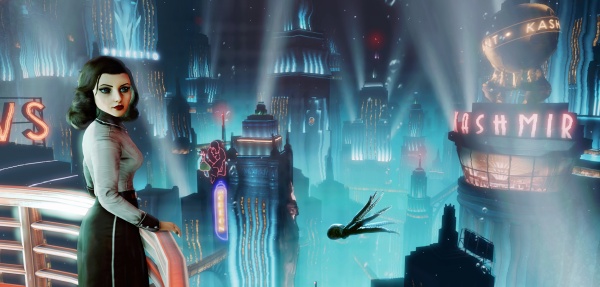
Bioshock has that one part, the stunning moment that locks the game in the memory forever. I’m talking, of course, about the opening plane crash and the first view of the lighthouse. The descent into Rapture, like the ascent into Columbia, employed tidy, efficient techniques to build a world that was eerie, allusive and oddly attractive. Alec wrote an entire post about that first sight of Rapture. The opening five minutes of Burial At Sea, Bioshock Infinite’s narrative DLC, contain a different side of Rapture, as Booker and Elizabeth walk the corridors before the Fall. Spoilers abound, obviously, with the plot’s initial direction outlined as the two take in some familiar sights.
Things I have noted:
1) Femme fatale Elizabeth likes to perform a sassy hand on hip wiggle-walk but when investigations begin, she immediately jogs off into the distance but doesn’t bother to ditch her cigarette first.
2) Rapture used to have the same shoeshine booths as Columbia!
3) Old-timey music!
4) I am very amused by people having conversations while one appears to be running away from the other.
5) Little Sisters are creepy.
6) I probably should have known this one already, but I hadn’t realised this is ‘chapter one’ of Burial At Sea.
The Affordable Care Act took a major step toward implementation last Tuesday with the launch of the online insurance exchanges, limping across the finish line despite three years of Republican obstruction that culminated in this week's 11th hour attempt to dismantle the law by shutting down the federal government.
It’s easy to forget, amid the hyper-partisan controversy, that the main purpose behind President Obama’s signature health-care reform law is not to curtail individual freedom or send senior citizens to death panels, but to give more Americans access to health insurance. Whether you think the Affordable Care Act is the right solution or a dangerous step toward tyranny, it’s hard to dispute that the U.S. health-care system is broken. More than 48 million people lack health insurance, and despite having the world’s highest levels of health-care spending per capita, the U.S. has some of the worst health outcomes among developed nations, lagging behind in key metrics like life expectancy, premature death rates, and death by treatable diseases, according to a July study in the Journal of the American Medicine Association.
For some Americans, the reality is far worse than the national statistics suggest. In particular, growing health disadvantages have disproportionately impacted women over the past three decades, especially those without a high-school diploma or who live in the South or West. In March, a study published by the University of Wisconsin researchers David Kindig and Erika Cheng found that in nearly half of U.S. counties, female mortality rates actually increased between 1992 and 2006, compared to just 3 percent of counties that saw male mortality increase over the same period.
"I was shocked, actually," Kindig says. "So we went back and did the numbers again, and it came back the same. It’s overwhelming."
Kindig’s findings were echoed in a July report from University of Washington researcher Chris Murray, which found that inequality in women’s health outcomes steadily increased between 1985 and 2010, with female life expectancy stagnating or declining in 45 percent of U.S. counties. Taken together, the two studies underscore a disturbing trend: While advancements in medicine and technology have prolonged U.S. life expectancy and decreased premature deaths overall, women in parts of the country have been left behind, and in some cases, they are dying younger than they were a generation before. The worst part is no one knows why.
The Kindig study does note strong relationships between county mortality rates and several cultural and socioeconomic indicators. In particular, location appears to have an outsized effect on mortality rates. Counties with rising female mortality rates, marked in red, paint a broad stroke across Appalachia and the Cotton Belt, moving across to the Ozarks and the Great Plains. The Northeast and the Southwest, on the other hand, have been largely untouched.
But it’s not clear how these geographical differences play a role in mortality, or why the effect would be so much greater on women than on men. "Clearly something is going on," Kindig says. "It could be cultural, political, or environmental, but the truth is we don’t really know the answer."
Other researchers have pointed out the correlation between education rates and declining female health outcomes. The most shocking study, published in August 2012 by the journal Health Affairs, found that life expectancy for white female high-school dropouts has fallen dramatically over the past 18 years. These women are now expected to die five years earlier than the generation before them—a radical decline that is virtually unheard of in the world of modern medicine. In fact, the only parallel is the spike in Russian male mortality after the fall of the Soviet Union, which has primarily been attributed to rising alcohol consumption and accidental death rates.
"It's unprecedented in American history to see a drop in life expectancy of such magnitude over such a short time period," says Jay Olshansky, the lead author of the study. "I don't know why it happened so rapidly among this subgroup. Something is different for the lives of poor people today that is worse than it was before."
Education alone does not explain why female high-school dropouts are so much worse off than they were two decades ago. But researchers have used it as a proxy to determine more significant socioeconomic indicators, like access to health care and income opportunities, as well as health behaviors like smoking and obesity. Smoking in particular appears to have had a significant impact on female mortality rates, as the health consequences of previous decades of tobacco use set in. Olshansky points out that female obesity and drug abuse have risen dramatically over the past two decades, and may also play a role in mortality rates.
Researchers are hopeful that the expansion of health-care coverage under the Affordable Care Act will help ameliorate some of the health risks for poor and uneducated women. But access to health insurance is only part of the puzzle—in fact, Kindig’s study found that medical care factors had no discernible impact on death rates at the county level. “Health care is far from the whole story,” Kindig tells me. "More and more people are beginning to realize that the non-health-care factors are at least as important."
In May, Jennifer Karas Montez, a social demographer who studies health inequalities, co-authored a study that was the first to investigate how quality of life might be playing a role in the early deaths of female high-school dropouts. Montez found that while smoking accounts for half of the decline in life expectancy among these women, whether or not a woman has a job is equally significant. "Women without a high-school degree have not made inroads in the labor force, especially in post-recession America," Montez says. In fact, only one-third of women without a high-school diploma are employed, compared to half of their male counterparts, and nearly three-quarters of better-educated women. When they are employed, Montez said, it is usually in low-wage jobs that offer no benefits or flexibility. Smoking and other destructive behaviors, she added, may just be symptoms of the heightened stress and loneliness experienced by women who don’t graduate from high school.
"Life is different for women without a high-school degree than it was a few decades ago, and in most cases it’s a lot worse," she says. "It’s really just a perfect storm."
"It
is a moment, an expression. My philosophy of fashion is humour, jokes and
games. I make my own rules,” said one of the last grand doyennes of fashion,
Anna Piaggi in 1978 in an interview with WWD. As Milan Fashion Week, drew to a close, you wondered where the humour,
jokes and games were. Fashion here is a
serious business - big textiles mills, big companies, big advertisers. All of that bigness doesn’t leave much room
for the sort of whimsicality and eccentricity that Piaggi demonstrated in her
life as a fashion editor, muse and extraordinary style icon. One year after the passing of Piaggi, an
exhibition entitled Hat-ology, feting Piaggi’s love of hats, which was curated
by Stephen Jones, just opened last week at the Palazzo Morando Costume Moda
Immagine. We see a recreation of her office in Milan, where she created and
edited more than twenty years worth of Doppie Pagine double page spreads for
Vogue Italia, typed up on a red Olivetti Valentine typewriter. Hats from all origins - Phillip Treacy,
tourist caps, Chanel, Prada, vintage Schiaparelli and Jones himself are dotted
around the space - a seemingly eclectic and crazed jumble that actually speaks
of consummate fashion curation and knowledge.
Of her hats, Piaggi said in 2011, “My hat is personal. It is what contains the soul, the feeling,
the sensation that moves this little world around.”
Seeing
Piaggi’s hats on display in the midst of a slew of Milanese shows that were
precisely the opposite of anything crazed or eclectic was bittersweet. Piaggi danced to the beat of her own drum in
Milan with her blue hair, penchant for Comme mixed with vintage Poiret, and she
stood quite alone. What she represented
and believed in wasn’t necessarily being reflected in Italian fashion, with a
few notable exceptions (thank you Miuccia Prada). The weird and wonderful is not the done thing
in Milan. We’re here to see perfectly
well-made clothes, expressing conventional notions of glamour, sexiness and
femininity in big razz-ma-tazz venues.
The
cracks are starting to appear though.
Piaggi’s peers in fashion have begun to recognise the failings and weaknesses
of Milan Fashion Week and with grumblings about its lagging state behind the commercial
hub hub of New York, the grassroots creativity of London and the queen bee
status of Paris, changes are supposedly a-coming. Board members of the Camera Nazionale della Moda Italiana such as Patrizio Bertelli of Prada
Group and Diego della Valle of Tod’s Group are eager to usher in change and so
we’ve had a week where young designers have been given a bigger spotlight in
amongst the power brands. Marco de
Vincenzo, Stella Jean and Fausto Puglisi have been touted as a “new wave” of
young Italian designers. It’s hardly a
wave but it’s a start. Freedom of
expression on the level of Piaggi though is still sorely lacking. Some might say Piaggi was a persona rooted to
a particular time in fashion, when flamboyance and whimsicality, were de rigueur. That’s the conundrum of fashion at present -
what exactly is left if our time in fashion
is defined by profit margins, marketability and pure product?




 “Historically speaking, animating female characters are really, really difficult, ’cause they have to go through these range of emotions, but they’re very, very — you have to keep them pretty and they’re very sensitive to — you can get them off a model very quickly. So, having a film with two hero female characters was really tough, and having them both in the scene and look very different if they’re echoing the same expression; that Elsa looking angry looks different from Anna (Kristen Bell) being angry.”
When I saw this quote circulating around Tumblr last night I assumed it was made up. Did Lino DiSalvo, Frozen's head of animation, really say that animating female characters is difficult because they're so "sensitive" and "you have to keep them pretty"? Unlike male characters, who are far, far more stoic than we emotional womenfolk, amirite? But no. It appears that
“Historically speaking, animating female characters are really, really difficult, ’cause they have to go through these range of emotions, but they’re very, very — you have to keep them pretty and they’re very sensitive to — you can get them off a model very quickly. So, having a film with two hero female characters was really tough, and having them both in the scene and look very different if they’re echoing the same expression; that Elsa looking angry looks different from Anna (Kristen Bell) being angry.”
When I saw this quote circulating around Tumblr last night I assumed it was made up. Did Lino DiSalvo, Frozen's head of animation, really say that animating female characters is difficult because they're so "sensitive" and "you have to keep them pretty"? Unlike male characters, who are far, far more stoic than we emotional womenfolk, amirite? But no. It appears that 





![[IMAGE DESCRIPTION]](http://cdn.theatlantic.com/newsroom/img/posts/FemaleMortalityRatesMapLG.jpg)
