Voltage Fighter Gowcaizer (Technos - Neo Geo - 1995)
- Captain Atlantis to Stinger
Check your DNS against over 1500 global DNS servers.
In short, [DNSYO is]
nslookup, ifnslookupqueried over 1500 servers and collated their results.

Always out to decry brainwashing in any form that doesn’t directly serve it, Fox News has exposed yet more TV making viewers witless and single-minded in the wrong way by arguing that The Walking Dead is “seriously hurting American society”—that bumbling assemblage of oafs who are always but one unsavory pop culture moment away from killing each other and having sex with the skulls. Fortunately, the more healthily paranoid Fox News audience have received early warning to don their protective anti-skull-sex helmets from Fox Health News senior managing editor Dr. Manny Alvarez, whose years of experience as an OB-GYN has made him expertly qualified to handle babies.
“Hate me all you want, or call me paranoid and misinformed,” says “Dr. Manny,” instantly predicting and therefore negating all criticism, “but there is one common theme that is pervasive in American pop culture today: violence. Even more specifically, zombie ...
Read more
    
|
John J. O’Connor of The New York Times describes Daria “as sharp as B. & B. are dimwitted.”[6] John Allemang of The Globe and Mail described Daria in Beavis and Butt-head “the prematurely wise girl who could be counted on to put their idiocy in perspective.”[7] Beavis and Butt-head often call her “Diarrhea”.
A consumer VPN service called CryptoSeal Privacy has shut down rather than risk government intrusions that could cost the company money in legal fees and threaten user privacy.
CryptoSeal will continue offering its business-focused VPN, but the consumer service is done, the company announced:
With immediate effect as of this notice, CryptoSeal Privacy, our consumer VPN service, is terminated. All cryptographic keys used in the operation of the service have been zerofilled, and while no logs were produced (by design) during operation of the service, all records created incidental to the operation of the service have been deleted to the best of our ability.
Essentially, the service was created and operated under a certain understanding of current US law, and that understanding may not currently be valid. As we are a US company and comply fully with US law, but wish to protect the privacy of our users, it is impossible for us to continue offering the CryptoSeal Privacy consumer VPN product.
VPN services let consumers gain extra privacy and security while using the Internet. A user establishes an encrypted connection with a VPN service, routing all Internet traffic to the VPN before sending it on to the rest of the Internet.
Read 10 remaining paragraphs | Comments

|
|
firehoseclickthrough
No matter if you're a fan, game maker, or game distributor, every pinhead marks the annual Chicago Pinball Expo on their calendar. The annual event is filled with seminars, tours, parts, game sales, and booths showing off the latest toys.
This year's expo, the 29th annual, wrapped up over the weekend. Ars was there to check out the main attraction on the show floor, a section devoted to custom games built using the P-ROC controller board. Some of these games are one-offs that will live on only as cool projects, while others are readying for commercial production. The following gallery has a selection of the custom games plus some other fun elements found on the show floor.

Aurich Lawson
It wasn't fully functional, but the upcoming Predator game was on the show floor. 250 of these will be made for private collectors.
37 more images in gallery
Read on Ars Technica | Comments

|
|
firehoseWest Coast and New England "high in openness and oriented toward creativity, innovation and entrepreneurship. It is also low in extroversion (less-outgoing, more introverted) and agreeableness and especially low in neuroticism (in other words, it has higher levels of emotional stability)."
Sunbelt, Rustbelt, Energy Belt – geographers, economists and urbanists have long endeavored to map the economic, political and cultural structures of America's regions. But to what extent do these places have their own distinctive personalities?
We all have our handy stereotypes for regional personalities, of course. Stolid Midwesterners, indolent but mercurial Southerners, and nervous, fast-talking New Yorkers make repeat appearances in pop culture. But can we identify the actual psychology, the deep personality traits that define regional distinctiveness?
Those questions are at the center of a new study in the Journal of Personality and Social Psychology. "Divided We Stand: Three Psychological Regions of the United States and Their Political, Economic, Social and Health Correlates" is a collaboration among a team of leading social psychologists including Peter J. Renfrow (whose research I have long admired and with whom I've collaborated), Michal Kosinski, and David J. Stillwell of the University of Cambridge; Markus Jokela of the University of Helsinki; Samuel D. Gosling of the University of Texas at Austin; and Jeff Potter.
The study draws on a wide body of data and information collected from five separate internet survey samples over 12 years, covering 1.5 million individuals across the 48 contiguous states. The primary objective of the study, according to the researchers, was to map the "psychological topography of the United States," composed of "geographically coherent psychological regions." To do so, they used a statistical technique known as "cluster analysis" to examine how five major personality traits – openness, conscientiousness, extroversion, agreeableness and neuroticism – are distributed and cluster across American states and regions.
The study identifies three main regional types: friendly and conventional, relaxed and creative, and temperamental and uninhibited. The maps below, from the study, show how these line up across America's states.

The shaded areas on the maps above, from the study, show where the three profiles predominate.
The Friendly and Conventional Region is the blue area that runs from Michigan through the Midwest and much of the Sunbelt and traditional South. This region is defined by low levels of openness (the trait most closely associated with innovation, creativity and entrepreneurship), lows levels of narcissism (the counterpoint to which is a high level of emotional stability) and moderate to high levels of extroversion, agreeableness and conscientiousness. This composite of traits shapes a regional personality that is sociable, considerate, dutiful, and traditional.
As the authors note, "the psychological profile and all the social indicators betray a region that is marked by conservative social values." This ethos maps onto a region whose residents are primarily white and politically conservative, less likely to move, and more likely to remain close to family and friends. They also have relatively lower levels of education, wealth, innovation, and social tolerance. This region has high levels of social capital and engagement in religious and traditional civic organizations. As the authors conclude, "taken together, the characteristics of this psychological region suggest a place where traditional values, family, and the status quo are important."
The Relaxed and Creative Region is the green area along the West Coast and Rocky Mountains through Idaho, Arizona, and New Mexico. There is also a weaker concentration, identified by the much lighter green shading in parts of the Sunbelt (especially North Carolina) and some of New England (including Massachusetts). This regional profile is high in openness and oriented toward creativity, innovation and entrepreneurship. It is also low in extroversion (less-outgoing, more introverted) and agreeableness and especially low in neuroticism (in other words, it has higher levels of emotional stability).
Demographically, the population includes relatively high levels of college grads, more affluent people and higher levels of ethnic diversity. "Social capital is comparatively low here, but tolerance for cultural diversity and alternative lifestyles is high," the article notes. Befitting its historical origins as the destination for pioneers, it is an "area where significant numbers of people are choosing to settle, as indicated by the positive association with residential mobility.... It is also a place where residents are politically liberal, as well as psychologically and physically healthy."
The Temperamental and Uninhibited Region is the deep orange area that covers the Northeast, New England and Middle Atlantic states. There are also lighter concentrations in the contiguous areas of Ohio and Indiana, as well as Texas. This region's psychological profile is defined by very high levels neuroticism (hence the temperamental moniker), moderately high levels of openness, low levels of extroversion (or high levels of introversion) and very low levels of agreeableness and conscientiousness. This constellation of personality traits depict a type of person that is "reserved, aloof, impulsive, irritable, and inquisitive," while also being "passionate, competitive, and liberal." This region is highly educated and affluent, with high levels of ethnic and cultural diversity and a liberal political orientation.
Beyond cocktail party chatter and fodder for magazine sidebars—if Ohio was a celebrity, who would it be?—the study examined the extent to which these regional personality traits correlate to key economic, political, social and cultural characteristics of states and regions.
The authors suggest that their psychological analysis:
Challenges the standard methods of dividing up the country on the basis of economic factors, voting patterns, cultural stereotypes or geography that appear to have become ingrained in the way people think about the United States. At the same time, it reinforces some of the traditional beliefs that some areas of the country are friendlier than others, while some are more creative.
Take politics for example. While most analysts focus on the concretely measurable attributes of a place (its ethnic and cultural divisions, religious orientation or economic characteristics), these findings suggest that psychological factors play a role. The profile and traits of the Midwest (Friendly and Conventional) implies a regional cluster of personalities that are family-oriented, religious, and thus drawn to more conservative political orientations.
There is a psychological dimension to highly innovative, entrepreneurial and creative places
Their research also offers potentially new insights for economic development, specifically for understanding the geographic clustering of talent and innovation. The study suggests "part of the reason why certain regions of the United States are economically vibrant may have to do with the psychological characteristics of residents."
It calls attention to the selective migration of certain regional personality types. People in the Friendly and Conventional Region are more likely to stay close to family and friends. People in the other regional types are much more likely to be drawn to and engage in inventive, entrepreneurial and creative activity as well. This helps explain the cluster of innovative and creative activity in places like Silicon Valley, San Francisco, New York and Boston. The orange shading in Texas also helps explain the high level of innovation and creativity in Austin and around Houston.
This has important implications for regional efforts to bolster creative economic development. Perhaps it's not simply clusters of research universities, entrepreneurial firms, or even high-skill and creative talent that drive entrepreneurial economic growth, but clusters of personality types. In other words there is a psychological dimension to highly innovative, entrepreneurial and creative places that contribute to and reinforce economic dynamism and performance.

|
|
firehoseLos Angeles Rams!
firehoseChuck Taggart beat

Photo by Stuart Mullenberg
This original cocktail from Chuck Taggart of gumbopages.com is fruity, spicy and warming all at once.
2 oz. apple brandy or Calvados
1/2 oz. pimento dram
1/2 tsp. dry pear brandy
1/4 oz. Punt e Mes
1 dash Fee Brothers old-fashioned aromatic bitters or
Angostura bitters
Cracked ice
Tool: barspoon, mixing glass, strainer
Glass: cocktail
Garnish: cinnamon stick or star anise
Combine first five ingredients in a mixing glass. Fill with cracked ice and stir briskly for 30 seconds. Strain into a chilled glass and garnish.
firehoseportland has a long and shitty history of systemically segregating racial minorities; cf. all northside gentrification, Japanese internment, city services east of 52nd (and especially east of 82nd), Vanport, sanctioned KKK events in the '20s, and the "deportation" of Romanis to Texas
 hodad
hodad@firehose @saucie
“When is history not history?” asks Walidah Imarisha, at a recent Why Aren’t There More Black People in Oregon? presentation sponsored by the Oregon Humanities Conversation Project. Imarisha, a Portland State University and Oregon State University instructor, poses the question to our group after we have spent 90 minutes examining, wrestling with and, mostly importantly, discussing with one another the history of black people and black communities in Oregon. The question is imposing – forcing us to look to the past and present for answers, and demand an honest reckoning for the future.
There are small posters on the walls of our conference room in the Midland Branch of the Multnomah County Library, forming a timeline of history ostensibly relating to black Oregonians. On one, there is a picture of Marcus Lopes, the first person of African descent in Oregon. Another item features Alonzo Tucker, a black man who was lynched in Coos Bay. A local newspaper described the lynch mob as “quiet and orderly” and found the lynching was not an “unnecessary disturbance of the peace.”
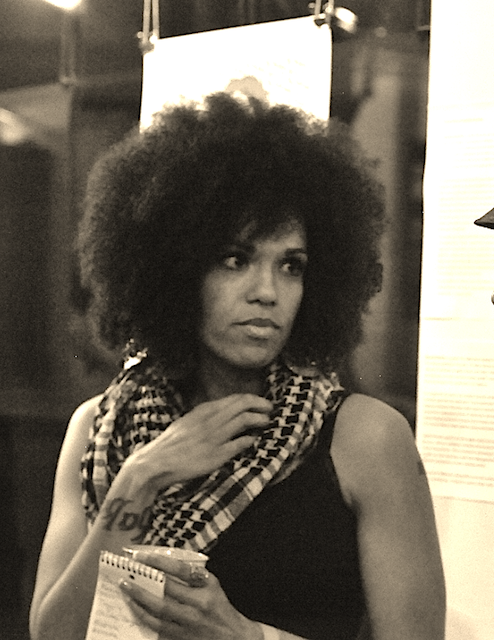
Portland State University and Oregon State University instructor Walidah Imarisha.
Time may move along, but progress can seem frozen in its eddies. A law prohibiting black people from voting remained in the state constitution until 1927. A connection to the Confederacy with a law prohibiting interracial marriages, only repealed in 1951. An item about Legacy Emanuel’s 1970 expansion that ripped a hole in the Albina neighborhood, after the project lay stagnant for nearly two decades resulting in vacant lots and boarded up buildings. It is still being completed. A photo of Mulugeta Seraw, the Ethiopian graduate student and father beaten to death by two skinheads in 1988. Laws, events, customs–all the stuff not just of history, but also of resistance, achievement, and ultimately, survival.
In 1844, pre-state Oregon declared slavery illegal. But making slavery against the law and embracing a diverse society are two different items, and from its beginnings Oregon was modeled as a white homeland. That same 1844 law ordered all black people out of the Oregon Territory under threat of lashing. This “Lash Law” mandated black people be publicly flogged every six months; however, before it could be enforced, it was modified and the whippings were replaced with forced labor.
In 1849 another law excluded any more blacks from settling in the territory. The passing of the Oregon Donation Land Act of 1850, granted free land to Whites only. The 1859 constitution included in its Bill of Rights a racial exclusion clause banning black people from emigrating to Oregon, as well as prohibiting them from owning land and entering into contracts. Although the 14th and 15th Amendments to the United States Constitution rendered such exclusion illegal, it wasn’t until the 1920s that the ban was officially repealed from Oregon’s constitution.
This history, hardly exhaustive, is the substrate of the state of Oregon, and yet it tends to be seldom acknowledged, and, when recognized, usually depicted as an artifact of the past. This is one point where history is not history – when events are isolated, ignored, or otherwise relegated to a sphere where that is rarely discussed and where the societal effects of that history dwell without context. When you digest and discuss all those images and descriptions on the wall – as Imarisha encourages you to do with people whom you do not know – a narrative emerges. These snapshots that unto themselves seem aberrant, the work of vile individuals or groups, such as the Ku Klux Klan, start running together, becoming a movie with obvious currents that formed with the state and flow into the present.
Measure 11, establishing mandatory minimum sentencing for several crimes, was passed 150 years after that first exclusion law. It applies to all defendants over 15 years old and require the accused of the listed crimes be tried as adults. Despite making up only 4 percent of Oregon’s youth population, black youth account for 19 percent of Measure 11 indictments. It seems William Faulkner was right: the past isn’t even past.
But if our state story reveals some of the horrific and disgusting acts committed, laws promulgated, and customs enforced, it also depicts acts of resistance that in themselves form a narrative. Resistance is a slippery concept, for its successes may come incrementally and some seem nothing more than drops upon a toxic pool.
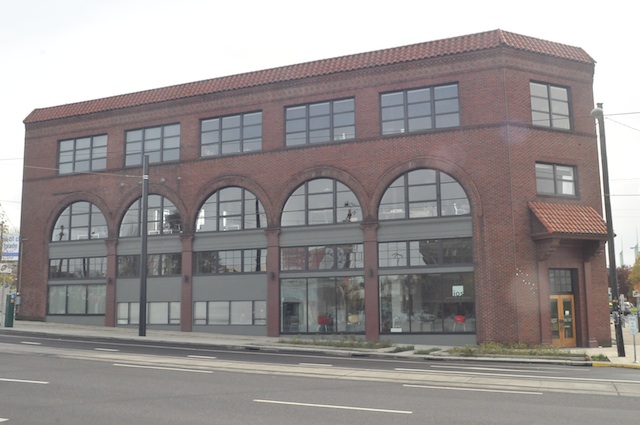
The Hazlewood Building on Weidler near the Memorial Coliseum used to be home to Dude Ranch, a jazz club. It is the only remaining building of the approximately ten jazz clubs that were destroyed to make room for the Memorial Coliseum and the interstate freeway. Photo by Pete Shaw.
For example, in Bend in 1925 there was a sign that read, “We Cater To White Trade Only.” The black community in Bend, already aware of the local restaurants in which they were unwelcome, protested the sign. The city council agreed to remove it and similar Jim Crow signs, with the expectation that black people would now police themselves. Though the victory may seem Pyrrhic, it was an important step for those forced to daily encounter the signs and be reminded of the ways in which they were unwanted. It took thousands of these small largely unknown victories, won by tens of thousands of people you and I will never know, that ultimately led to the Civil Rights Act of 1964.
Many of the institutions that shape our lives today are rooted in the Oregon constitution, and the legacy of the exclusion clause can be seen by observing where those institutions grant favor. One of the most glaring examples lies in housing and development. For the black community in Oregon, it has often been a history of taking and denial. Since homeownership is a foundation of generational wealth development, it becomes clear that Oregon’s black community is being denied an opportunity to develop wealth.
The places where black people could own property were limited through extra-legal means, such as The Portland Real Estate Code of Ethics (1919), which mandated real estate agents refuse to sell to people whose race would “be determined to lower property values in that neighborhood.” During World War II, over 13,000 black people moved to Vanport to build ships for Kaiser – a sixfold increase in the number of black people in Oregon. The Vanport flood of 1948 forced integration on Portland, as black survivors moved a couple of miles north to the Albina neighborhood, the only place the city would allow them to resettle.
The 1960 construction of Memorial Coliseum resulted in the destruction of over 400 homes and many black owned businesses, and created a physical rift in the community, particularly in Jumptown, the cultural center that ran between NE Williams and King. The construction of the interstate highways destroyed over 1100 housing units in South Albina.
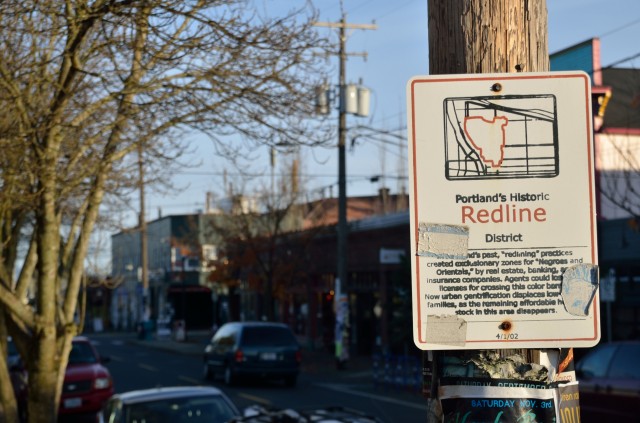
A sign on NE Alberta Street tells the story of redlining in Portland’s past. Photo by Paul.
Banks refused mortgages to black people who tried to move outside “acceptable” boundaries, and often refused them within the red lines as well, because those loans were considered risky. More recently banks were willing to lend money in the form of subprime loans, often when people actually qualified for prime loans. These subprime loans largely targeted minority communities, and the current foreclosure crisis has hit communities of color hard. Black and Latino homeowners have been almost twice as likely as white people to lose their homes to foreclosure, a result, according to the ACLU in a recent lawsuit against Morgan Stanley, of the seemingly illegal and certainly unethical decision to encourage predatory mortgage loans to low-income African American borrowers.
Despite the trauma, a black community is still extant in Portland. As Imarisha noted when one black woman stated, “I don’t feel like I live here. I survive here,” sometimes survival is winning. “For a black community to exist here in Portland is incredible,” said Imarisha, “because it wasn’t supposed to exist at all.”
History is not history when some actors are denied acknowledgement of their roles at the expense of other actors who have parts that remain privileged. The importance of Why Aren’t There More Black People In Oregon? is difficult to understate. It keeps the unprivileged stories alive. Though Imarisha has made this presentation all over the state, she has only met one person who attended an Oregon public school who was aware of it. None of the ten people in our group who had attended school in Oregon had been taught this information. That is when history is not history.
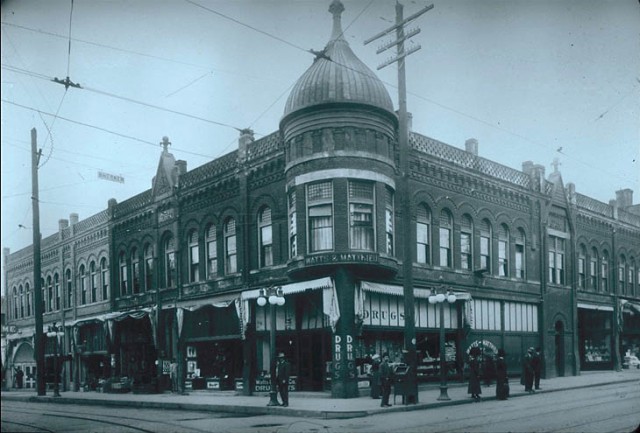
The Hill Block Building was built by Charles H. Hill, Albina’s first mayor. Located at the corner of Russell and Williams it was at the center of the business district for Albina.
But history is history when people refuse to let go, when they fight for their stories to be heard, and when they spread those stories to other people who in turn pledge to keep them alive. That is real power of this presentation. It is not a lecture. It is a series of discussions, some one-on-one, some in groups of four or five, and some with the group as a whole. Real people and their stories spoken, life breathed into the material hanging from the walls.
When a woman notes how in the early 1950s the majority of restaurants in Portland would not serve black people, we see how that step taken in Bend in 1925 formed a link in a chain to today where, at the very least, such obvious segregation is unacceptable. When a man talks about how he has to pay an extra fee for his son to play in the school jazz band, it is easy enough to draw a line between the razing of four or five jazz clubs that stood in the way of the future Memorial Coliseum. Their demise meant not only fewer opportunities to experience a unique American art form, but also fewer popular culture venues where white and black people actually mixed. Though jazz has declined in popularity to the extent that students must pay extra for it, still it survives, vibrantly. That is a victory.
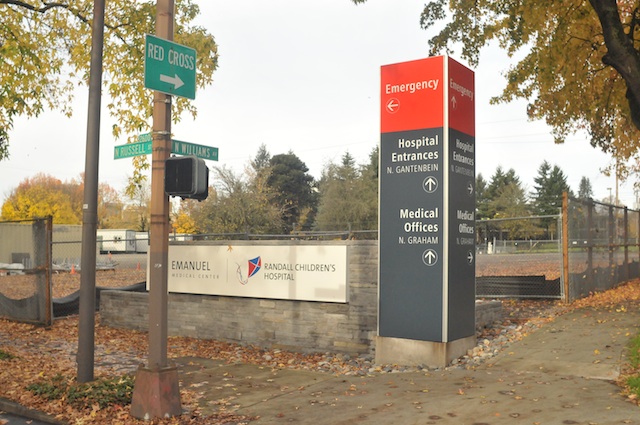
This is where the Hill Block Building stood. 40 years later, the Legacy Emanuel expansion has yet to be completed. Photo by Pete Shaw.
Much of the physical structure of the black community in Portland has been demolished many times over. Nature took a hand in Vanport, but it was the usual systemic oppression of the wealthy and powerful that led to Memorial Coliseum, the construction of the interstate highways, and the expansion of Legacy Emanuel. The black community has rebuilt every time. These are all huge victories.
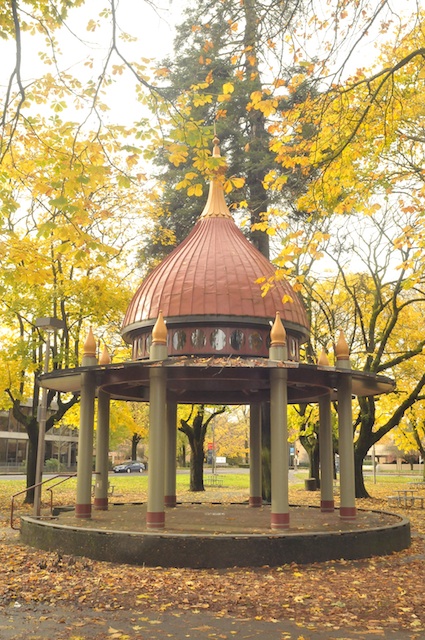
Dome from the Hill Block Building, located on the Northwest corner of NE Russell and Williams. The building was razed during the Legacy Emanuel expansion. It now lies in Dawson Park, across from Legacy Emanuel. Photo by Pete Shaw.
Perhaps history becomes history when it expands beyond boundaries and reaches a greater audience. The point of Why Aren’t There More Black People In Oregon? is meant not to focus solely on the black community and its history, but to explore issues of race, identity, and power in the greater community.
The struggles and victories of black people are not unique. As can be seen with Multnomah County Sheriff Staton’s collaboration with Immigration and Customs Enforcement (ICE), Latinos are facing their own trials. The exclusion laws from the early Oregon Territory and Oregon state constitution echo loudly, as the brave people proclaiming themselves Undocumented and Unafraid speak of the terror they experienced from being identified as people who do not belong, and whose existence within the community can be severely punished. The same scenario is going on nationwide.
A history that ignores uncomfortable aspects – whitewashes them, if you will – so that what is presented is a sanitized account with no accountability, is at best insular. It does not require thought, and therefore, does not challenge. It only asks that we accept its narrative as truth. It is mythology, not history.
The posters that form a timeline ostensibly related to black Oregonians actually relate to us all. They are a part of our history, informing our present and likely our future as well. How just a future we craft largely depends on how wide and deep a sense of history we bring along on the journey forward.
“When we see these events as part of a cycle,” Imarisha said, “then we can see what is really happening and can create a place we want to live in.”
firehose'far and away the best thing that happened in this episode was that Rogue called a dude “peckerwood” on the senate floor'

The early ’90s were spoiled for choice when it came to comic book adaptations. Not only was Batman: The Animated Series on the air, but X-Men led Marvel’s push to get on the small screen, diving right into the often convoluted continuity of everyone’s favorite mutants, luring in a generation of fans, and paving the way for cartoons to follow. That’s why we’ve set out to review every single episode of the ’90s X-Men animated series. This week: “Time Fugitives, Part One!” Because everybody loves these nonsense time travel stories, right? Right.
Previously, on X-Men:
Last week, the series of episodes focusing on individual characters’ origin stories continued with a look at Gambit’s past. Shocking absolutely no one, it turns out that the X-Men’s resident scumbag was also the New Orleans Thieves Guild’s resident scumbag who caused no end of problems when he peaced out of an arranged marriage, jilted his bride at the altar, and went up to New York to start making card-based puns. Fortunately, he remained sympathetic by somehow having the least annoying Cajun accent in the entire episode.
Speaking of, a good number of you were able to suss out that our discussion question of the best and worst accents in comics really only had one right answer:

Good job, readers. Good job.
Now let’s dive into this week’s adventure in Days of Incomprehensible Plotlines Past with the first part of “Time Fugitives”, from writer Michael Edens and supervising producer Scott Thomas!

Remember in the ’90s, when we all used to care about Bishop? Well, get ready for a return of those halcyon days as this episode throws us into a story of not one, but two time-traveling X-Men trying to wreck the past! We open in the grim darkness of the year 3999 in New York City (or “City: New York” as they call it in the future), where we see Cable fighting a bunch of Terminators.
Seriously: Aside from those things that I can’t stop seeing as smiley face kneepads, they’re not even trying to make the killer robots anything other than Terminators, right down to doing a zoom in on a glowing red eye set into a metal skull and then showing its red-hued digital readout of the battlefield. It is ridiculously blatant, but to be fair, it does sort of get across the idea that Cable is Mutant John Connor, which is probably the most elegant summary of just what that dude’s deal is that we’ve ever gotten.
Anyway, Cable’s launching his final, victory-or-death assault on Apocalypse and his army of T-800s with the help of a few other mutant soldiers, inlcuding one dude who looks like he’s wearing Colossus as a jacket:

There’s some posturing from Apocalypse — who you’d think would be more pro-mutant than pro-Terminator, but whatever — until a “temporal storm” breaks out. We know it’s a temporal storm because a) it looks like a tornado except that an oddly out-of-scale Bishop is spinning around inside it, and b) because Apocalypse looks up at it and goes “A TEMPORAL STORM!” Clearly, in the world of the X-Men, expository shouting is a useful evolutionary trait.
The timenado rages across the post-apocalyptic (and currently Apocalyptic) landscape, and Cable gets some more exposition from a cube that sounds like Siri about what’s going on: Bishop has been mucking around in the timestream, which of course has caused a bunch of tornados that showed up and sucked in everyone who shouldn’t be alive. No word on whether they were also just spitting out weird shoulda-been babies to replace them or why they showed up now to to erase people who appear to be in their mid-thirties, but, you know, time travel. It’s weird.
Siri also mentions that Cable’s timeline is going to cease to exist, and considering that CNY is in ruins with Apocalypse in charge, you’d think that would be a good thing. Sadly, Cable cannot even begin to comprehend a world free of glowing eyes and guns the size of tree-trunks, so he sets about trying to fix it.
From there, we catch up with the cause of this whole mess, Bishop in (City:) New York (City), 2055 AD which is far more pleasant than the last time we saw it:

Bishop is celebrating about stopping the assassination back in season one , and also celebrating that they are reusing the same footage for a second, until they switch angles and decide that the room should be pink and Wolverine’s adamantium skeleton should look more like an inflatable Halloween decoration:

But what’s this? According to Forge, Bishop’s mission was a complete failure! The plague is still raging unchecked through the streets of CNYC!
“Wait a second,” you might be asking yourself, “Plague? I thought Bishop went back in time to keep the Sentinels from being manufactured. Is Forge dabbling in some poetic language, referring to their oppression by robot overlords as some kind of plague of their timeline?” No. He means an actual plague. See, while Bishop did change time and got rid of the sentinels, the timestream realigned itself with a whole new set of problems so that when he gets back, the Forge of this timeline sent him back to stop a plague that was transmitted by mutants and offed a big chunk of the mutant population.
I’m not sure why Forge doesn’t mention the time tornados that showed up and started blasting everyone with plague germs, since, as we’ve already seen, that’s how changes to the time stream happen, but I guess he just thought it wasn’t worth mentioning. I mean, the only other explanation is that they forgot how their own dumb rules about time travel work within two minutes, and that would just be crazy.
After a significant amount of eye-rolling and even more exposition about how the plague mutated within the bodies of mutants and how Forge has never heard of the X-Men because they were killed early in the plague — even though he is standing literally ten feet away from Wolverine’s collector’s item skeleton — Bishop agrees to head back to see if he can’t sort out this mess, too. One again, he faceplants in an alley back in Good Ol’ 1955 1993, only to find out from the reliable journalism that you can only find in Magazine 2 that the plague has already started:

So just so we’re clear on where we stand here at the seven-minute mark, changes to the timestream are both completely imperceptible and also giant lightning tornados, and you can literally travel back in time and still be late for whatever it is you were doing. Hoo boy.
So with a plague already raging through the streets of State: New York, the X-Men have decided it’s a good time to head down to the mall so that Jubilee can get her CD player repaired:

Unfortunately for Jubilee and her DiscMan, she’s spotted on her errand by an anti-mutant creep who has a calculator watch pre-loaded with pictures of known mutants. Oddly enough, Jubilee’s mugshot is, like, 40% pink sunglasses, so I’m pretty sure this whole mess could’ve been avoided if she’d just taken the time to try some different accessorizing, but alas. Hindsight is 20/20, even without pink shades.
The creep blasts the repairman with a gas gun — because apparently the Friends of Humanity just roll up to the mall with biological weapons stuffed in their mismatched double-breasted suits — and when he goes out to tell Jubilee that her DiscMan is a lost cause, he’s already showing signs of the Plague. Which, as it turns out, just makes you look like you’re going as The Concept Of Computers for Halloween:

Adrian faceplants on the counter, and the FOH lackey is there to loudly point out that Jubilee is “one of those plague-carrying mutants,” drawing a crowd that only takes about four seconds to be whipped up into a mob. Fortunately, Storm is there to help, which she does in true Storm fashion by “bringing forth a mist to blind their hatred!”
At the X-Mansion, Beast checks Jubilee out and pronounces her free of diseases, and Jean shows up to talk about how crazy this whole plague that has never been mentioned or acknowledged on the show in any way before this episode is making everyone. Beast decides to investigate the store clerk to see if he can learn anything more about this disease, so he breaks into a hospital, grabs some “records,” and then looks through a microscope to find tiny robotic ticks attacking a pair of yellow boobs.

Well that’s what I saw. Bet you didn’t expect to see me take a Rorshach when you clicked on this article, did you? That makes two of us.
While Beast continues to perv on blood samples, the government has begun quarantining mutants in response to the hysteria that’s sweeping the city(: New York). This, predictably, also turns violent, and the X-Men arrive to find that Bishop is there grumpily blasting at the pavement and yelling about how everyone’s being way too mean to mutants. That’s Bishop, who, the last time we saw him, had a job rounding up mutants and bringing them to concentration camps so they could be executed by robots. Dude has had a change of heart, it seems. Anyway, he’s back in the 20th century, and this is news that Wolverine responds to by asking “what’s that time-jockey doin’ back?” So, there’s that.
At this point, Cyclops immediately turns into the Angry Police Captain from every ’80s action movie.

CYCLOPS: You really did it this time, Bishop! You turned this situation into a riot!
BISHOP: I was tryin’ to SAVE LIVES!
And then later:
CYCLOPS: Get him back to the Blackbird before he starts another riot! If you can’t keep your head, you’re no good to the team!
If this episode would’ve gone on two minutes longer, Cyclops would’ve demanded his badge and gun and told him not to show his face within ten miles of the Mayor’s party.
After explaining everything for the fourth time this episode, the X-Men decide to try to calm everyone down by getting Beast to testify at some senate hearings about the disease, with the help of President Kelly. But at Friends of Humanity HQ, Graydon Creed reveals something we already know, which is that it’s all a scheme they cooked up to discredit mutants, using a virus cooked up by yet another nameless dork in a double-breasted suit. I wonder if he’ll be important later.
At the hearings, everything is going predictably poorly, with Creed stirring up anti-mutant sentiment, claiming (accurately) that Kelly is biased in favor the X-Men because they saved his life, demanding to see Beast’s birth certificate, filibustering in protest of XavierCare, etc., when Bishop charges the stage and tackles him to the ground.

What Bishop saw — and what everyone else missed, including the entire team of X-Men sitting in the first row who are supposed to be watching for anything suspicious — was that Creed had pulled out an aerosol can with a gigantic spike on it and was planning to shoot Beast full of computer diseases right there on the senate floor. I’m not sure how exactly Creed thought he was going to get away with that, what with it being the least subtle attack to happen in a congressional hearing since Preston Brooks brained Charles Sumner with his cane (shout out to all my South Carolinian history students), but as the record shows, this show is full of bad choices.
At this point, violence breaks out yet again, with Rogue throwing around “rednecks” while the harmonica soundtrack from Road House plays. Creed ends up accidentally injecting himself, tearing his shirt open on national television and somehow trying to blame this on mutants.
Hey, remember Cable? From like a thousand hours/15 minutes ago? He’s back, watching the X-Men on his iCube while running to nowhere in particular past a suspiciously Hanna-Barberian background.

The X-Men decide to follow Creed to wherever he goes to get his disease taken care of, tracking him down to a mansion with a secret base underneath it, because there has never been a mansion in a superhero story that didn’t have a secret base underneath it. Jean probes around to see what’s going on in there, finding out that Creed’s not alone, and that whoever’s down there with him is powerful enough to know he’s being telepathically spied on. It’s the Double-Breasted Suit Guy from earlier, and he zaps her with Pink Lightning, which has officially replaced Sonic the Hedgehog rings as this show’s go-to visual representation of superpowers.
Jean then does what she does every single time she attempts to use her powers on this show, which is to yell and fall over. Good hustle, Jean.
Down in the basement lab, DBSG tells Creed that he deserves to suffer from computeritis for failing him, and Creed flips out. This is about when the X-Men show up, casually walking in from stage left. What’s crazy about this is that in the previous scene, Bishop asked how they were going to get into the lab and Cyclops delivered a steely “leave it to me.” Then they just walked in. People. This show is dead set against ever showing Cyclops doing anything even remotely enjoyable. It’s not my fault, I promise.
Oh, so it turns out that other dude was Apocalypse.

Sadly, the X-Men have no jet to ram into Apocalypse this time, but Bishop does have a hand grenade that he uses to blow up the virus and thereby solve all of their problems, or so they think. Back in the future — after Cable collapses to his knees shouting “NO! NOT APOCALPSE!”, which is exactly what I did when this episode started — Siri reveals that the plague was actually kind of a good thing? Maybe? It caused the creation of “antibodies key to the future stablization of the mutant genetic code,” and without it, uncontrolled mutations killed off even more people than the plague.
So basically, the future’s going to suck no matter what you do. See you next Saturday, kids!

Discussion Question: I skipped over it above, but far and away the best thing that happened in this episode was that Rogue called a dude “peckerwood” on the senate floor. I had to rewind it three times just to make sure I wasn’t mishearing, but nope, she said it, and that is amazing. So in all of animation for kids, what are the moments you can’t believe made it on the air?
Next Week: More Bishop! More Cable! More Apocalypse! More of me drinking to get through it!


Kanye West’s new tour merch certainly isn't boring. Rather than make cheap, giant T-shirts emblazoned with his name and the Yeezus tour dates, West has opted to make a run of fairly dark merch, including shirts featuring praying skeletons, Confederate flags, and bleak images of a computerized West. West even co-opted a little bit of Metallica’s style, both for the shirts’ bleakness and for the typeface used for his Yeezus logo. The shirts run $35 and are being sold at West’s tour stops, all of which are listed below.
And about those tour dates: West has only done one Yeezus show so far (a scheduled second night was suddenly canceled and rescheduled under "unforeseen circumstances"), but judging from the early reviews, the production sound bananas. Filled with religious imagery, the show involves not only 12 dancing apostles and a bunch of dancers swinging incense burners, but ...
Read more
|
|
firehoseAdam WarRock beat

Your favorite nerdcore rapper is at it again. Adam WarRock, a.k.a. Eugene Ahn, is putting his deft blend of lyrical skill and comic knowledge into a brand new album, titled The Middle Of Nowhere. We’ve written in the past about the connections between hip hop and comics, and Adam WarRock is at the forefront of the next wave of emcees to hone their craft while inspired by the comics and characters they love. Simply put, WarRock is dope, and he’s just debuted the video for his first single off the album, titled “B.S.F.X.” (Batman Sound Effects). You can check out the video, featuring WarRock flanked by ComicsAlliance’s own superhero sartorialist Betty Felon and fellow cosplayer AK Wood, below.
The video for “B.S.F.X.” was shot by Joey Miller. The Middle Of Nowhere, which features contributions from James Urbaniak (Dr. Venture), MC Frontalot, is available for pre-order now on WarRock’s website. The album goes on sale November 5th.
firehosevia Osiasjota
lol hockey

firehoseclick through for all the pizza maps you ever wanted

Using data from AggData, FlowingData has created a map of the contiguous United States showing where popular pizza chains are located. Read more of their findings at the FlowingData site.
firehoseVi Hart beat
In lessons one and two of “Doodling in Math Class,” Vi Hart explains fractals like dragon curves and Koch curves using drawings of dungeons and dragons and lots of references to The Hobbit by J.R.R. Tolkein.
Welcome to the first episode of ComicsAlliance Presents Kate or Die, a new series of exclusive comic strips created by one of our longtime favorite webcomics cartoonists, Kate Leth!
Also a contributor to BOOM! Studios’ Adventure Time line, IDW’s Locke & Key and Image’s The Strange Talent of Luthor Strode, Kate’s self-published work, seen on Tumblr and comic cons and elsewhere, has earned her a dedicated following for its idiosyncratic blend of adorable irreverence and brutal honesty (often equally adorable) toward topics of all kinds, from dating to depression to Doctor Who. For ComicsAlliance, Kate or Die will focus mainly on the sort of subject matter you’ve come to expect from the site, but you should also anticipate Kate taking the strip to some unpredictably cool places.
In this episode, Kate takes on a topic that the forces of creepery will never lay to rest: cosplay and consent.

Kate will be back in two weeks with an all-new episode of ComicsAlliance Presents Kate Or Die!
firehosewhat
President Barack Obama said today that the administration is working with top private tech companies to resolve the numerous technical issues with Healthcare.gov, the website where Americans are supposed to be able to purchase insurance under the new Affordable Health Care Act.
He didn't specify which tech companies were involved, but it looks like Microsoft — or at least one person with access to the Internet Explorer Twitter account — wants to help.
"Hello @BarackObama politics aside... we can help you with your website #Obamacare," the official Internet Explorer account tweeted shortly after the president gave a speech about Healthcare.gov's woes.
It appears to be a marketing ploy to insert the Microsoft browser, which has been losing market share, into the national conversation. The president compared the bumpy rollout of Healthcare.gov to the bugs in the latest iPhone software update. It'd be great for Microsoft if Internet Explorer could be seen as a potential fix.
It's unclear if the offer is meant seriously or in jest. We've reached out to Microsoft for comment.
firehosethe free encyclopedia anyone* can edit
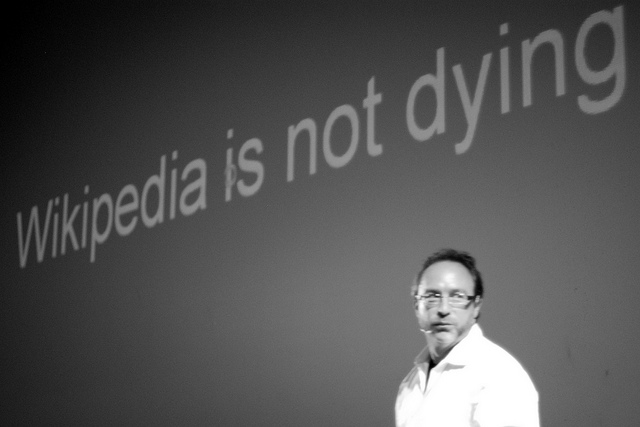
Wikipedia editors have disabled hundreds of paid Wikipedia editing accounts in recent weeks as part of a campaign against so-called "sockpuppetry."
The efforts were described in a statement published this morning by the Wikimedia Foundation, in which director Sue Gardner acknowledged that "as many as several hundred" accounts belong to editors who are being paid to promote products or services on the site. That's a violation of Wikipedia policies and terms of use, Gardner noted. "As a result, Wikipedians aiming to protect the projects against non-neutral editing have blocked or banned more than 250 user accounts," continued Gardner. "The Wikimedia Foundation takes this issue seriously and has been following it closely."
The statement follows reports earlier this month in the The Daily Dot and last week in Vice. The stories describe the increasing amounts of money flowing toward paid editing of English-language Wikipedia pages. According to both articles, Wikipedia editors attribute the growth in paid edits to a company called Wiki-PR.
Read 3 remaining paragraphs | Comments

|
|
firehoserofl
Independent developer InterWave Studios released a statement on Steam yesterday explaining that the reason its recently-released survival horror game Dark Matter ends abruptly is because of the studio's failed Kickstarter campaign.
The studio launched a Kickstarter fundraising campaign in June of this year in the hopes of raising £50,000 to make Dark Matter. It only raised £6,227 of the goal, which meant it had to abandon its plan to make Dark Matter a longer, bigger game.
The game was released on Steam yesterday, and some players took to its discussion board to complain that it felt incomplete and that the ending was too abrupt. Players also took issue with the "To be continued..." text that ran at the end of the game, since they were under the impression they had bought a complete, self-contained title.
In the statement released by the studio yesterday, CEO Erik Schreuder said the idea was to make Dark Matter an episodic series, with each episode selling at a "budget price" of $14.99. "Any further episodes would, however, need to be dependent on the success of the previous instalment. The first instalment is what was launched recently on Steam and is simply called Dark Matter."
Schreuder stressed that the game's description on Steam is accurate — that it contains all 14 levels promised, and that it has "something like 5-9 hours of absorbing and highly entertaining gameplay." On the community discussion board, a developer from the studio added that the current Dark Matter on Steam "is a complete game in itself."
He apologized that the end of the game caused confusion and said the studio is working on a fix to make it more conclusive.
firehosejournalism, lol


Read more of this story at Slashdot.

firehosewe love you too
After spending a week back in my home state, I realize I am not looking forward to returning to my adopted home of Portland. I'd almost forgotten what it was like to be around people who are open, warm, direct, caring, and genuinely interested in others. Now I get to go back to the aloof, passive-aggressive, cowardly, paranoid, suspicious, xenophobic, closet-racist, elitist, hipster, trashy, sleazy, gentrified redneck pit of despair. I'll be plotting my next escape soon. One can only hope that an earthquake or volcano eventually erases this miserable hole for all eternity.
firehoseDick beat

Joining those recently announced adaptations of Ubik and The Man In The High Castle in the ever-growing lineage of Philip K. Dick adaptations, a big-screen version of Dick’s 1964 science-fiction novel Martian Time-Slip is in the works. As reported by Deadline, Pariah director Dee Rees will be helming the project, whose story revolves around an autistic young man in a Martian colony who perceives reality in such a way that allows him to see time itself from a variety of angles, and thus assemble the single, ideal version of Blade Runner in his mind's eye and consequently lecture you about it at a sci-fi convention.
As for the commercial viability of such a film, what with its futuristic setting and colonial themes and preternaturally gifted boy protagonist: It’s hard to say, as Dick was not fortunate enough to be a raging racist and homophobe. But hey, at ...
Read more
|
|
firehoseNBC will never air a holiday episode of any show on or near the actual holiday

As was reported on Friday, NBC announced the return of Community by also announcing the preempting of Parks And Recreation, thus ensuring the continued balance of good/irritating NBC news that keeps our planet from wobbling off into the sun. Sensing that we may still be getting a little too close for comfort to Mercury, the network today clarified that, not only will Parks not be seen again until Nov. 14, when it will “catch up” by burning off two episodes back to back, that delay means bumping both this week’s scheduled second appearance from Orphan Black’s Tatiana Maslany, as well as the Parks Halloween episode that would have fortuitously fallen on actual Halloween, were NBC not determined to squander its every good fortune.
And so, in the place of the conclusion of Maslany’s guest arc, this week that 8 p.m. hour will be filled—as ...
Read more
|
|
firehosevia Tadeu
firehose"Brooklyn Nine-Nine received a full-season pickup on Friday—along with the coveted post-Super Bowl time slot—despite its soft L+SD ratings. But the network was encouraged by its positive delayed viewing gains: In its third week, its L+7 ratings jumped 73% in the demo and 65% in total viewers. ...
FX's The Americans saw a 93% demo lift."

The fall TV season is only a month old, but four of the 24 new broadcast shows that have debuted so far have already been canceled. ABC’s Lucky 7 and CBS’s We Are Men were yanked earlier this month, and last Friday NBC pulled the plug on Welcome to the Family and Ironside.
Yet despite the growing number of casualties, the broadcast networks are actually being more patient than ever with their freshman series. As viewers increasingly wait longer to catch up with shows via DVR or video on demand (VOD), networks are in turn relying more heavily on Nielsen’s “live plus seven” (L+7) ratings, which factor in DVR and VOD use over a seven-day period in addition to the initial “live” tune-in.
Delayed-viewing is “significantly higher” than last year, CBS research chief David Poltrack told USA Today, adding that even older viewers, historically late adopters of new technology, are jumping on board. “The world has definitely changed,” says Poltrack.
While only roughly half of US households with TVs have DVRs, those L+7 bumps can be significant. The L+7 data for the second week of the 2013-14 TV season, released on Sunday, revealed that the new hit NBC drama The Blacklist added a record 6 million viewers (from 11.4 million “live plus same day” (L+SD), which includes DVR/VOD viewing the same night of its premiere, to 17.9 million L+7).
Now, “if we get positive feedback from viewers and see substantial catch-up viewing, we know that audience is going to build,” Poltrack said. “That’s the new strategy, and everybody’s doing it, particularly with shows that are in really tough time periods.”
Case in point: the heavily promoted CBS drama Hostages was trampled by The Blacklist in its debut, with a disappointing 7.4 million viewers. L+7 data added an additional 3.6 million, a 48% increase, for a total of almost 11 million. In its second week, its L+7 data lead to a 66% increase in the advertiser-desired 18-49 demographic number, along with 52% bump in viewers. With those positive L+7 ratings, CBS can afford be more patient with a show that it likely would have already canceled just a year or two earlier.
Meanwhile, FOX’s sitcom Brooklyn Nine-Nine received a full-season pickup on Friday—along with the coveted post-Super Bowl time slot—despite its soft L+SD ratings. But the network was encouraged by its positive delayed viewing gains: In its third week, its L+7 ratings jumped 73% in the demo and 65% in total viewers.
Several new cable shows this year have also been saved from likely cancellation by their impressive L+7 increases. FX’s The Bridge more than doubled its demo rating (105%) while the network’s The Americans saw a 93% demo lift, and USA’s new summer series Graceland surged 92% in the demo.
Tellingly, the L+7 lifts for the already-cancelled shows—many of which debuted to record low ratings—were minimal. Welcome to the Family increased a mere 18% in the demo, Lucky 7 jumped 15% and We Are Men rose 12%.
While L+7 ratings are extending the life of some series, they aren’t yet funneling more ad revenue back to their respective networks. Audience’s delayed-viewing habits are changing faster than the current business models, as most ads are still bought and sold based on “live plus three” (L+3) ratings.
That, however, will be a network/advertiser battle for down the road. First, the networks are trying to maximize their advertiser money by driving viewers away from DVRs, where they routinely skip ads, to VOD, where fast-forwarding is usually disabled. “Our goal now,” CBS’s Poltrack told the New York Times, “is to move as much DVR viewing to VOD as we can.”
You can follow Jason on Twitter at @JasonLynch. We welcome your comments at ideas@qz.com.