Read more of this story at Slashdot.

Read more of this story at Slashdot.
Read more of this story at Slashdot.

firehoseDespite the summary, the article barely covers the stupid fucking NYC garden, summarizing the full story, which is behind a WSJ paywall: http://online.wsj.com/news/articles/SB10001424127887324635904578642163297319032
Most of the rest covers people who are assholes all over our great amercia
firehose"The folks I encountered in Ever, Jane were primed and ready for some serious, serious roleplay. As I strolled the sparse streets of my quiet village, I imagined players huddled in little gossipy circles, tipping their hats to friends, filling their inventories with gifts, joining big RP events in the middle of the road. I saw the future, and it was full of Janeites and fanfic authors in absolute joy."

firehosevia Snorkmaiden: "DVCK IST KRIEG"
oblig. https://www.youtube.com/watch?v=wG6G4XBnvLQ, http://metalmadnessreports.files.wordpress.com/2012/07/483373_324429147647504_1748322629_n.jpg

firehose'Computers, "financial engineering" and credit, social media, algorithms that predict what you want, NSA surveillance, giant new holding corporations called Master Limited Partnerships - all of these surround us and wrap us into a complicated modern web. Some of it is wonderful, other parts of it are threatening - while even more parts are just incomprehensible.
And behind it is the new money power - giant institutions, and individuals that can bend politicians to their will. The repeal of the Glass Steagall act in 1999 - which arguably did a great deal to create the financial corruption of our age - is just one example.
While the old institutions that grew up over the past hundred years to protect us now find themselves unable to comprehend or cope with the new systems of power. Politicians, regulatory institutions, intelligence agencies, the mainstream press, the police, the BBC, the colleges of academia- all of them, as McClure said in 1903:
"They do not understand"
And cut off from the real power struggles - these old institutions are starting to prey on each other. Leaving us both confused and undefended.'
What the Fluck! The point at which journalism fails and modern power begins.
Picked this up via @antonyjohnston. It’s a long read, and if you’re in the US, at least, the videos don’t run.
You don’t need the videos.
(Edited to add: apparently the videos DO run. But you still don’t need them.)
It is an excellent, excellent blog post by Adam Curtis, and if you’ve any concern whatsoever about the state of the world, the corruption of capitalism, the destruction of democracies, and the hope of stopping where we’re headed, it is well worth your time.

The Atlantic has posted a fantastic photo gallery of traditional European festivals involving Krampus, the demonic beast of Alpine folklore who deals out punishment to bad children during Christmastime. As we posted recently, Krampus is coming to Los Angeles this year for Krampusfest 2013.


photos by Sean Gallup/Getty Images
The damages retrial for last year's Apple vs. Samsung legal battle recently wrapped, and new court documents reveal how much Cupertino paid to get its wins: over $60 million. The revelations come as Apple requests that Samsung reimburse a portion of its legal costs. According to recent court filings, Apple wants its rival to pay a third of that, coming out to more than $15.7 million in attorney's fees.
Apple primarily employed two law firms for its case: Morrison & Foerster, LLP handled the offensive side of the battle, while Wilmer Cutler Pickering Hale and Dorr, LLP covered the company's defense against Samsung's own claims of patent infringement. According to the documents, WilmerHale billed for around $2 million, where Apple expects to pay Morrison & Foerster $60 million all on its own — and that's with the fee reduced due to the firm's longstanding relationship with Apple. "Apple's in-house attorneys managed this case to a very disciplined budget," attorney Rachel Krevans writes in the filing. "As a result of all of these efforts and reductions, the hours underlying the fees at issue are reasonable."
The filings also detail the various trial-related costs incurred during the process, including transcriptions, discovery expenses, and translators. In order to argue why the costs should be reimbursed, Apple offers a glimpse into where some of that money went. Apple is asking for approximately $100,000 for the expense of setting up a "secure room" where Samsung's team was able to examine unreleased Apple prototypes, while over $1.5 million is earmarked between the two firms for photocopying documents during the discovery process. Judge Lucy Koh has yet to rule on Apple's motion, but given the more than $900 million Samsung already must pay Apple for patent infringement, another $22 million won't likely make much of a difference. Then again, this is Apple and Samsung we're talking about, and with another trial on the horizon for next year there's no telling what could happen next.


There's going to be a Shannara TV series. (Hooray!) And it's going to be on MTV, which is... interesting. And with Iron Man's Jon Favreau directing. Can Favreau really recreate our epic-fantasy dreams on basic cable?

    
|
By Nathan Grayson on December 6th, 2013 at 6:00 pm.

I played a lot of Final Fantasies during my rock-bottom console gamer phase. Final Fantasy VIII was not one of them. Well, that’s not entirely true. I tried a demo disc from some old PlayStation magazine once, and it chugged, whimpered pitifully, and died on me about ten minutes into the opening cut-scene. Beyond that, I heard too many mixed things and decided to get my fantastical fix elsewhere. Did I make a boo-boo, though – perhaps even the biggest boo-boo of all, Boo-boo-aga? If so, just say the word and I’ll duct-tape a gun to a sword, don a poofy, pouty coat, and load up the newly released Steam version of FFVIII.
It’s exactly what it sounds like: Final Fantasy VIII, but, you know, on Steam. Also, the epic tale of love, loss, and hair gets some additional features for our hallowed platform of choice:
“Optimized for modern high-definition PCs and fully integrated with the Steam platform, this version includes a range of new features such as a Magic Booster that enables players to power up their spells, Steam cloud support, and 45 integrated achievements to encourage players to explore various facets of the game. Also included is the Chocobo World, previously unavailable to Western players on the original release.”
Chocobo World! How can Squall stay all mopey and sad when there are infinite bright-as-the-summer-sun horse birds, ripe for frolicking with? I guess we’ll find out.
Speaking of Squall, while – again – I have never played Final Fantasy VIII, I know for a fact that this image is incontrovertibly the best thing to emerge from it. Shame that dumb HD-optimized graphics will probably ruin it. Horrifically jagged 32-bit polygons for life, yo.
__________________
firehoseamercia
Haters pls ignore her.
This is Missouri senator Claire McCaskill talking about the Tigers' upcoming SEC Championship showdown with Auburn:
Ok,haters out there pls ignore me for 48 hours.My Mizzou has big ass game on Sat & I'm obsessed.My couch: pic.twitter.com/OWF4We11Ux
— Claire McCaskill (@clairecmc) December 6, 2013
So, yeah, that's "haters", "big ass", and a picture of a near-life-size plush tiger (never mind that Auburn are also the Tigers) in a single tweet from an elected U.S. official. Nelly is no longer the most crazed famous Mizzou fan:
Is it just me that feels alil disrespected that @espn is talking like AU has already won the SEC title..!Like the ZOU ain't bout that life
— Nelly_Mo (@Nelly_Mo) December 4, 2013
Senator McCaskill (D-Mo.) knows the ZOU is bout that life.
There’s a hierarchy of products that celebrities can endorse. Up top, you’ve got watches, cars, perfumes, and high-end liquors. Next, you’ve got your prestige products that anyone can buy, like Proactiv. Then come Jenny Craig, Weight Watchers, and other diet programs. Way, way below that, you’ll find Bosley, the hair restoration company that now boasts ‘N Sync’s Joey Fatone as a spokesman.
Fatone claims to be a client of the company, even posing for before and after pictures of the top of his head, but it’s a sad move for a guy who (in theory) has millions and millions of dollars. To make matters worse, Fatone is joined in the ad below by renowned has-been Christopher Knight, better known as “Peter” from The Brady Bunch. While the ad does explain Fatone’s ill-advised fedora period, it’s pretty cringeworthy, firmly placing Fatone in the awkward, washed-up company of other ex-boy ...
 Rachel Dukes
Last week, cartoonist Rachel Dukes posted some eye-opening statistics to her Tumblr about a comic she made about what life as a cat owner is like. She originally published the comic with a copyright notice and a URL to her website. That version of the comic has been seen about 81,600 times.
Another version, from which someone removed the URL and copyright info, has been seen nearly 600,000 times, mostly on Tumblr and Facebook. This problem of lack of credit is one that lots of artists have dealt with and quite a few have talked about over the past several years, but it continues to persist. It makes me wonder if there could be some kind of fix.
Since the early days of webcomics, one go-to solution for artists who understood people would share their art online, knew things would turn up in image searches and even encouraged spreading around images, was watermarking, or at the very least throwing a copyright notice in there. Of course, those notices are often very easily removed, as Dukes’ was, or just as often they’re ignored altogether.
Here’s a recent example that just happens to involve ComicsAlliance. On Monday, Buzzfeed posted a list titled “50 things that comics imply about Christmas” that was far less of a list of actual implications than a bunch of (mostly Silver Age) comic covers the poster gathered up and reposted from other places.
All the images did have source credits, though none actually included artist credits. Crediting cover artists, especially from the Silver Age, can be tricky, since many of them never got official credits in the comics themselves, so that’s understandable. Plus, I don’t really think sites have an overriding responsibility to credit the artists of mainstream comic book covers–people who are credited and paid for their work in a publication–the way they do for art that is posted to the Internet, often for free.
That said, the credits for the sites the images came from are questionable at best considering this image from a 2010 “Great Comics that Never Happened” piece slipped in with the photo credit “dccomics.com.” Not only is there a ComicsAlliance bug on there where the DC button would be, but the title on the fake comic is “Action Christmas,” and I am 100 percent sure the image couldn’t have come from DC’s website.
Someone eventually pointed this out to Buzzfeed, which moved the image to the bottom of the post and noted it came from ComicsAlliance, though it still doesn’t mention the name of the actual artist, Dean Trippe, who is very prominently credited in the original CA post.
So that’s where we are. If it isn’t actual, malicious removal of credits, it’s a sort of benign ignorance about them.
It certainly seems like there’s not a lot that can be done about this, and a lot of folks would argue that there doesn’t need to be. They’d say that as soon as an image is posted on the Internet, it is officially the property of the community. And let’s be clear: The mechanisms that are in place at the moment support that view. You can search up any image on Tumblr or DeviantArt with relative ease, right-click it, save it, and do whatever you want to it in Photoshop. There’s nothing to stop that.
I’m not sure there should be. I’m just as apt to open up something in Photoshop and make a dumb joke out of it as anybody. But there’s got to be a middle ground, right?
Musicians who use Soundcloud or Bandcamp have something of a way to deal with this. Via creative commons, they can label songs as fully under copyright, free to use and share, or even free to remix commercially. Is it a total safeguard against someone taking a copyrighted track and remixing it? Of course not. But it’s at least something that gives the creator’s intent upfront.
Then again, Flickr has those same Creative Commons categories, and that stuff gets shared all the time. There are always ways around it.
Ultimately, this is a problem that will probably only get solved the hard way, and that means changing attitudes about art on the Internet. That’s going to be hard. Super hard. But there are a few things that could help change the landscape. First, big sites like Buzzfeed, which are run by editors, have to start respecting artists, giving them credit, and paying them, if that’s what it takes. (Cartoonist Matt Bors has been trying to get Buzzfeed to pay an invoice for its reuse of one of his cartoons in a “community” piece since July.)
On Tumblr, which is more of a free-for-all, people can start leading by example. Next time you reblog an art post, make sure there’s an artist’s name on there. Don’t assume the source link at the top is enough. Write the person’s name in the caption box at the bottom.
I’m guilty of assuming doing the least is enough. I need to stop that. We all do.
firehosemeanwhile, in Portland
 |
submitted by thornsandroses [link] [62 comments] |
firehosevia otters
firehosefollowup

Iceland grieves after police kill a man for the first time in its history
December 5, 2013It was an unprecedented headline in Iceland this week — a man shot to death by police.
"The nation was in shock. This does not happen in our country," said Thora Arnorsdottir, news editor at RUV, the Icelandic National Broadcasting Service.
She was referring to a 59-year old man who was shot by police on Monday. The man, who started shooting at police when they entered his building, had a history of mental illness.
It’s the first time someone has been killed by armed police in Iceland since it became an independent republic in 1944. Police don’t even carry weapons, usually. Violent crime in Iceland is almost non-existent.
"The nation does not want its police force to carry weapons because it’s dangerous, it’s threatening," Arnorsdottir says. "It’s a part of the culture. Guns are used to go hunting as a sport, but you never see a gun."
In fact, Iceland isn’t anti-gun. In terms of per-capita gun ownership, Iceland ranks 15th in the world. Still, this incident was so rare that neighbors of the man shot were comparing the shooting to a scene from an American film.
The Icelandic police department said officers involved will go through grief counseling. And the police department has already apologized to the family of the man who died — though not necessarily because they did anything wrong.
"I think it’s respectful," Arnorsdottir says, “because no one wants to take another person’s life. “
There are still a number of questions to be answered, including why police didn’t first try to negotiate with man before entering his building.
"A part of the great thing of living in this country is that you can enter parliament and the only thing they ask you to do is to turn off your cellphone, so you don’t disturb the parliamentarians while they’re talking. We do not have armed guards following our prime minister or president. That’s a part of the great thing of living in a peaceful society. We do not want to change that. "
can you even imagine if the u.s. mourned people killed by police
like a real national outpouring
that moment of silence should last for yearswtffffffff
The kind of gun culture I approve of.
firehoseaaaaaaaaaaaaAAAAAAAAAAAAAAAAAAAAAAAAA

The Forever Pillow by Huzi is a long pillow in the shape of a Mobius strip that can be used in a variety of positions. The project is currently seeking funding on Kickstarter.


images via Huzi
via swissmiss
firehoserich? hate your friends? obsessed with the gold iPhone? boy do I have the perfect gift for you to give to everyone you know
firehose'With the way you can download all the books now and everything is collected in trades, I’m not even sure I buy into the validity of the argument that every issue should be able to be read as if it was somebody’s first issue.'
lol are you telling us to pirate the entire Marvel back catalogue? OK
otherwise nobody can afford to download all the books
firehoseshared to delight Overbey

Defensive tackles in coverage, linebackers darting around the field and pass rushers in unexpected places, the Seattle Seahawks' do-it-all front seven clamped down on Drew Brees and revealed what makes it the most feared unit in the NFL.
The Saints came into Seattle on Monday averaging 27.7 points per game, 6.17 yards per play, and 43 consecutive games in which quarterback Drew Brees had passed for more than 200 yards. This incredible streak by Brees was just two shy of the all-time NFL record, but ended against a stifling Seahawks' defense that held the high-octane Saints' offense to seven points, 3.4 yards per play and just 147 yards passing. How did Seattle manage this against such an excellent and consistent offense?
It was a combination of things. The Seahawks' well-known secondary certainly did their part to limit Brees and the Saints' explosive passing game, but with a well-rounded and resourceful offense like that of New Orleans, you really need a solid effort from every positional group on the defense to throw a wrench in the Saints' gears. Seattle's versatile front seven played a huge role in this. Basically, with Brees unable to pass deep against Richard Sherman, Earl Thomas, and the rest of secondary with much effectiveness, Sean Payton and the Saints turned to their trusty intermediate and short passing game. Seattle's linebacking corps and defensive line completely shut that down as well.
They were able to do this by varying pressure schemes and fronts, which confused the offensive line, allowed pressure, and forced Brees to hurry many of this throws. They varied their usage of personnel, particularly in coverage of Jimmy Graham, which suppressed a normally surgical signal-caller and frustrated a pass catcher and matchup nightmare.
The Seahawks executed the schemes they had devised with adroit efficiency. Let's take a look at the tape to see how Seattle was able to do all this.
The backbone of Seattle's defensive scheme is versatility within their personnel. Their safeties can play up at the line or deep in coverage. Their corners can play off, press, zone, man, can blitz, can tackle, and are functional inside and out. Defensive linemen Red Bryant (6'5, 323 pounds) and Michael Bennett (6'4, 273) can both play either inside or on the edge. Cliff Avril and Chris Clemons can rush the passer and cover in the flats and do so from multiple angles and platforms (i.e., two- or three-point stances). Bruce Irvin can be a pass rusher one play and a run-in-coverage linebacker on the next. Their linebackers too can blitz, stop the run, cover, and tackle.
With this kind of versatility, Seahawks defensive coordinator Dan Quinn can change looks, confuse the offense, and he can rely on a multitude of his players to execute whatever jobs he needs done, whether it's in rushing the passer or running in coverage, or both.
As Greg Cosell of NFL Films put it over the offseason:
"With Irvin, a returning Chris Clemons, and newly signed Cliff Avril, the Seahawks have three players who can align anywhere in their nickel sub-package. They all have what we call "Joker" ability, the talent to line up in either 3-point or 2-point stances and rush from different positions and angles. What you have is an ideal mix of physical athleticism, and multiple schemes. It's the new age pressure concepts in the NFL. It's very difficult to line up with four defensive linemen in conventional positions, and create consistent pressure on the quarterback. Not only is it difficult to find four players who can do that, it's tactically easier for the offense to protect against those more basic fronts.
"What defenses are trying to accomplish is pass protection indecision based on front alignments, coupled with athletic mismatches. The Seahawks are well positioned to do that with their personnel."
More generally, as Pete Carroll put it:
"Our defense is a 4-3 scheme with 3-4 personnel. It's just utilizing the special talents of our guys."
This was apparent this week as the Seahawks utilized their athleticism at linebacker and defensive end (and even defensive tackle) to counter New Orleans' normal advantage in mismatches.
2-9-NO 21 (5:48 1st Quarter) #79 eligible D.Brees pass incomplete short left to J.Graham (B.Irvin).
Bruce Irvin played free safety in junior college, transferred to West Virginia where he played in the the trenches of a 3-3-5 stack, then played as a rush defensive end for Seattle's 4-3 in his rookie season. In 2013, the Seahawks have moved Irvin to the starting strongside linebacker position, and he's thrived. To say he's versatile is an understatement. Irvin's fluid and explosive athleticism (he ran a 4.4 at the Combine) shows up on the field, and while he has little experience in linebacker zone drops, he looks like a natural at it.
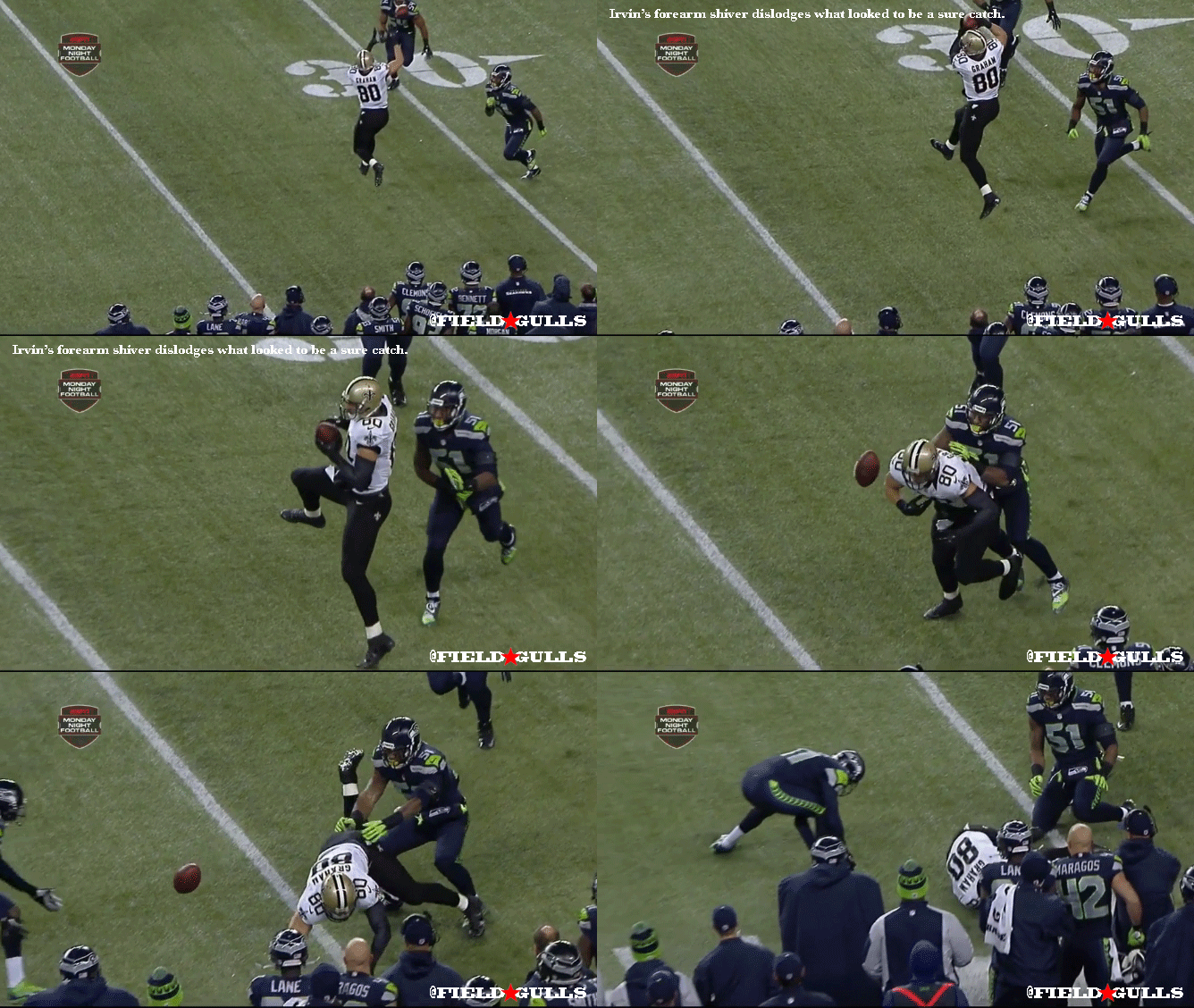
Take this play below, early on in the game. The Saints go to one of their bread and butter zone killers with Jimmy Graham running a deep out to the hole in the zone at the sideline, underneath the corner and past the linebacker. Marques Colston pulls the corner to the left side of the field deep, and the running back runs a short route outside underneath that pulls Irvin forward. Brees lets it go to Graham, and Irvin is out of position, but his excellent recovery speed allows him to make a play.
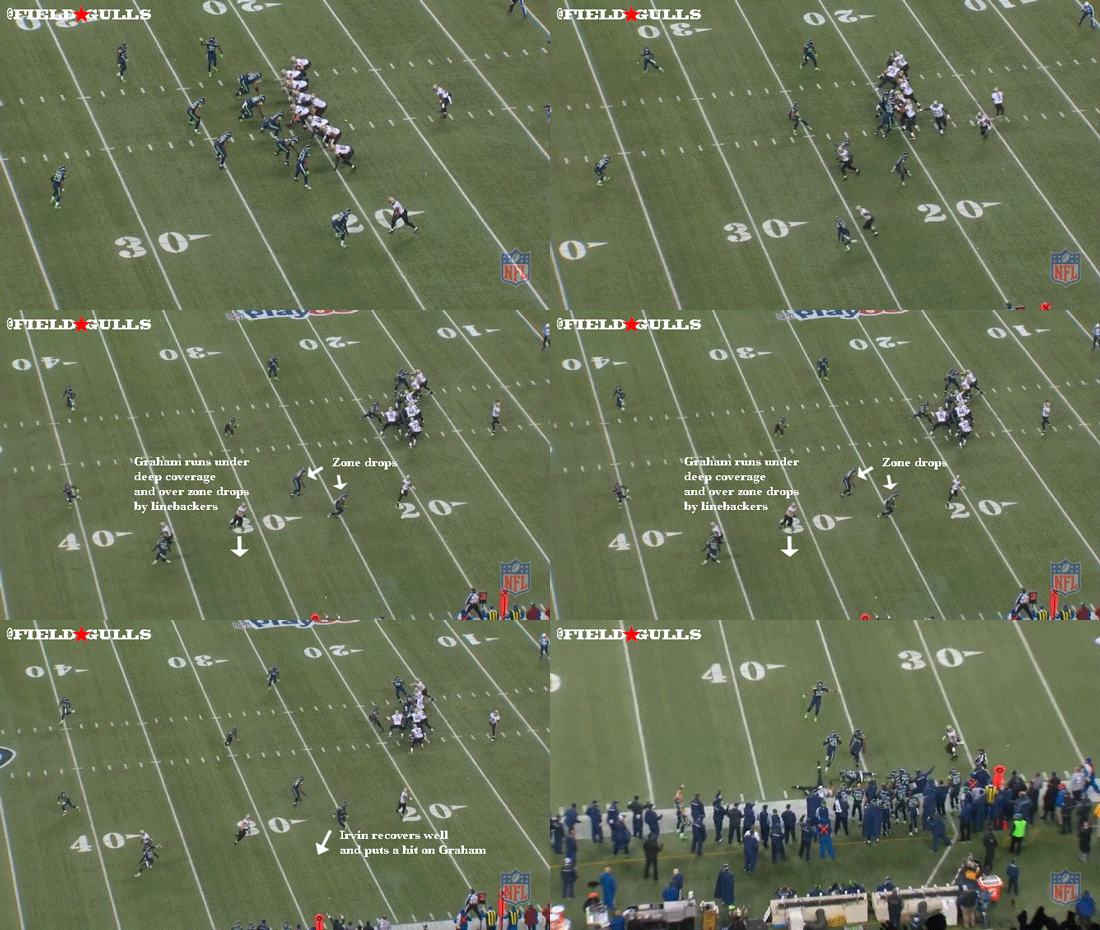
It helps that Irvin can recover so quickly with 4.4 speed, but it's an added bonus that he can deliver the hit of a 255 pound linebacker.
Seattle's defense is somewhat unique in that Irvin is not their only linebacker with 4.4 speed. Starting middle linebacker Bobby Wagner ran a 4.45 40 at his pro day and registered a 39.5" vert at 241 pounds, which is the kind of athleticism that allows him to make a play like this below, and the type of 'special talents' that Pete Carroll is talking about above.
4-1-SEA 22 (9:37 4th Quarter) D.Brees pass incomplete short right to J.Graham (B.Wagner).
Zone coverage and zone drops have been an area that needed some improvement from Seattle's linebacking corps over the past year or so. (It's not all butterflies and lollipops in Seattle, guys). This play demonstrates some of the techniques that they've undoubtedly been working on.
After biting forward on the Brees play-action fake, Wagner recognizes it's a pass, then gets on his horse to recover and get to his zone. In short order, he sees the likely intended target (Graham again), gets to his spot, then turns to find the ball at the correct time, jumping to get into the flight path and disrupt the play.
This isn't luck. This is route recognition, spacial awareness, and in scoutspeak, ball skills. It comes from a lot of practice and tape study. Watch Richard Sherman too, in what looks like zone in this play, he recognizes that Graham is running an out-cutting route to his area and flips his hips to put himself into a position to make a play. When you have two guys converging on a receiving threat with their eyes on the football, good things happen.

Former Seahawks' defensive coordinator and now-Jaguars head coach Gus Bradley was asked about Seattle's philosophy in player acquisition at the linebacker spot last year, and this is what he had to say:
"Well, you need the speed for the times that we're playing 4-3, and then you need the stoutness to when you go to a 3-4. You're seeing a guy like K.J. Wright - he's 6'3 and a half, 250 pounds, but can run real well. To us, that's ideal. He can play at the line of scrimmage, he can be a MIKE linebacker in 3rd down situations. So, it's the same with Bobby Wagner - he's 242 pounds and ran a 4.4... so, we kind of evolved to those bigger, stouter guys but they also have to have the ability to run. So, when we're getting ready for the draft, and looking at guys, that's the mindset that we have."
"I think it's a unique combination that we're looking for. In the 3-4, the linebackers are big, physical type guys; the guards are going to come right at them and they have got to be stout enough to take on the guard. Then, the 4-3, you want speed. The Lance Briggses, the Derrick Brookses, the guys that can really move well, lateral movement, and those guys are always protected. Well, we do both. Instead of maybe the 260 pound linebackers, or the 225 pound guys, we like that guy that's 240 and can run a high 4.4. So, we're getting that hybrid that can do both. That's what we're really trying to be looking for. But, we try not to put them in too many positions where they're taking on the guard, so we're probably leaning more towards the 4-3 principles."
In the Seahawks' defensive system, a self-described '4-3 with 3-4 personnel', there are three distinct 'positions' that have very little actual physical distinction: the "LEO", or weakside defensive end (Chris Clemons), the SAM linebacker (Bruce Irvin), and even the strongside defensive rush end (Cliff Avril). All three of these guys can rush the passer or drop into coverage, they're all about 6'3 and 255/260 or so, and the cool part about Seattle's schemes this year is that Dan Quinn is allowing/asking them to do both with great frequency
Examples from Monday:.
1-10-SEA 12 (9:33 2nd Quarter) (Shotgun) D.Brees pass incomplete short left to M.Colston.
PENALTY on SEA-R.Sherman, Unnecessary Roughness, 6 yards, enforced at SEA 12 - No Play.
This ended up being a non-play, but watch Clemons drop into the flats to take slot receiver Marques Colston. Yes, that's a defensive end matched up in zone with a receiver. The Hawks only rush three because of this, meaning they have eight in coverage against five Saints' receiving options.
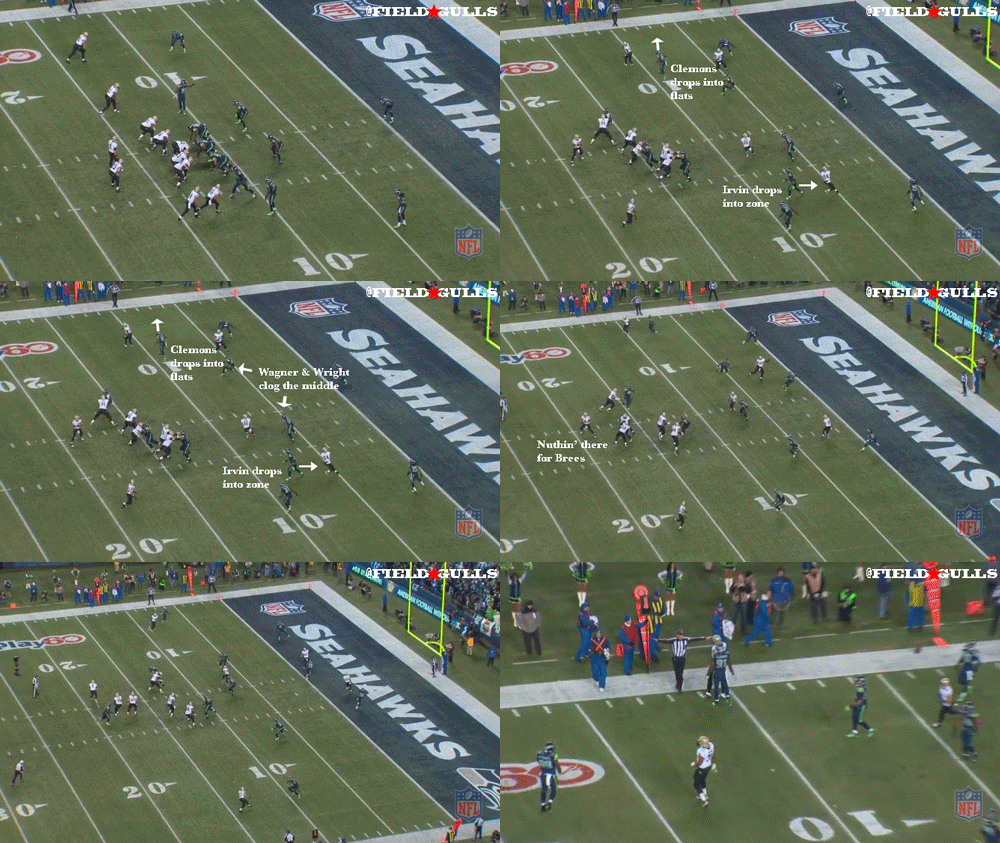
Brees has nowhere to go with the ball.
As you can see below, this 'looks' like a 3-4 type of defense with two stand up defensive ends (what would be linebackers in a real 3-4) and three down linemen. As Bradley shared last year:
"Back in the Tampa days we played Tampa-2, we played a little Over [front], a little Under [front] defense, but I think the idea [here] is that Pete (Carroll) wanted to try and incorporate both the 3-4 and the 4-3. The hard part of it is to try and make it simple enough that you can run both defenses, and we feel like we're on our way to doing that."
"We really developed this defense so you can play multiple positions. It's not as advanced as maybe some 3-4 teams and maybe not as advanced as some 4-3 teams, but, we can do both. And, that's where I think we create some issues for offenses. They look and say, "gah, we can't put in our 3-4 plan, or our 4-3 plan, because they do both, and it might limit some of the things they do."
1-18-NO 9 (12:28n 3rd Quarter) D.Brees pass incomplete short right to M.Colston.
Here's another look at the varied concepts they try to bring. Below, after starting out in a similar alignment as the play above, Seattle instead sends five, rushing Bruce Irvin from the strongside end from a 2-point platform, then blitzing middle linebacker Bobby Wagner in behind him.
With Irvin and Wagner running through the same gap, there's a moment of confusion between the fullback and running back to that side in terms of protection, and Bruce is able to sneak through for the pressure.
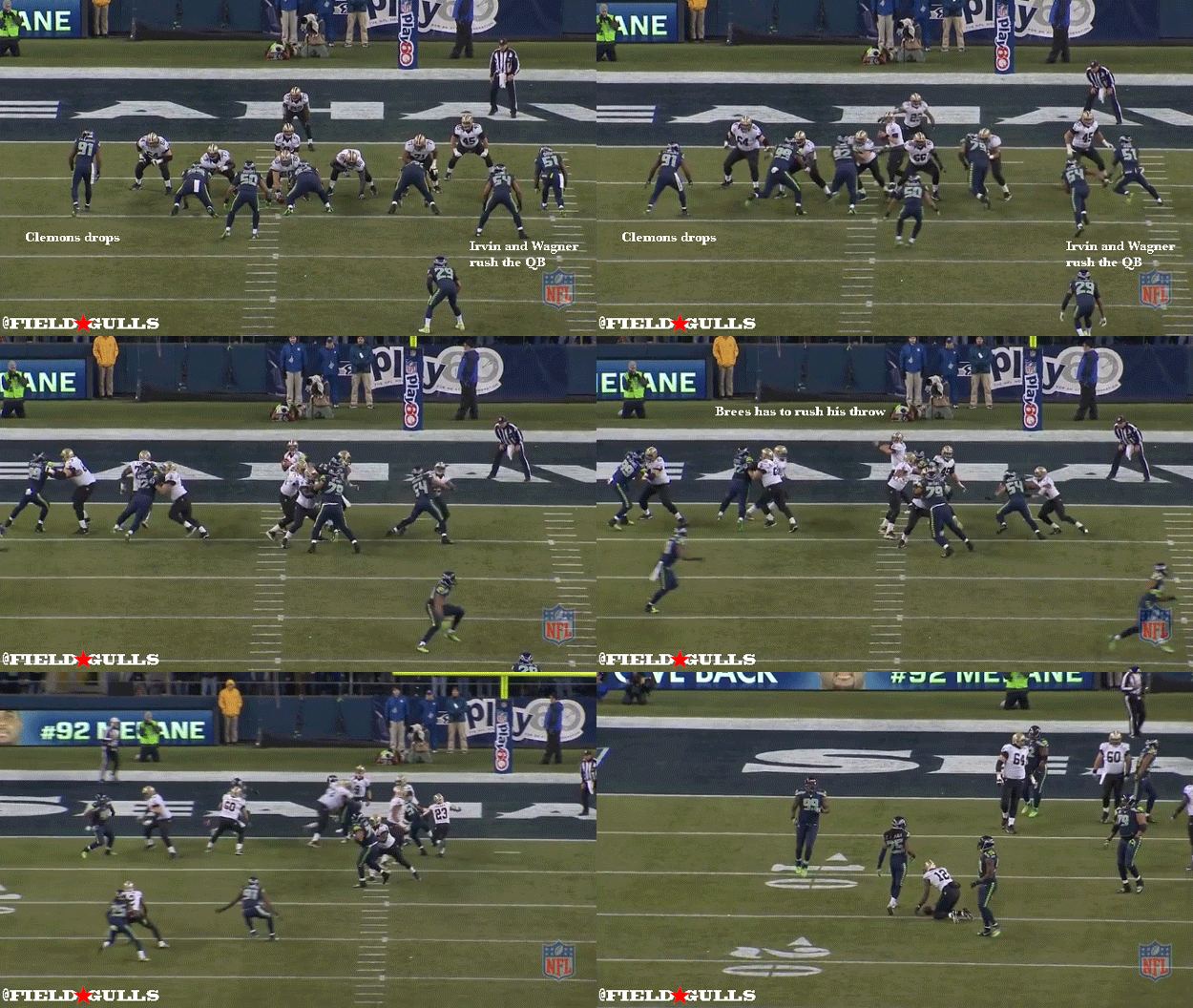
Chris Clemons, the defensive end/linebacker to the weak side, drops into coverage over the middle, taking weakside linebacker K.J. Wright's spot in the zone as Wright takes Wagner's spot in the zone. Brees, of course, is forced to rush his throw as the pass rush gets through, and it falls incomplete.
Again, the bottom line reason for collecting players like this is that you can use any number of them in any number of roles. The play below illustrates:
3-10-SEA 32 (14:00 4th Quarter) (Shotgun) D.Brees pass incomplete deep left to K.Stills.
It's third-and-10 and Seattle is in their nickel pass rush package. Along the line from left to right you can see Chris Clemons aligned wide in a three point stance, Cliff Avril in a stand-up stance hovering over the guard, Clinton McDonald at the nose, and Michael Bennett back on the outside at the other defensive end spot (Bennett plays a majority of his snaps inside). At the snap, Bennett pinches down, running what almost looks like a stunt with linebacker Bobby Wagner, who blitzes in behind him.
Cliff Avril drops into coverage over the middle, taking Bobby Wagner's spot, and on the weakside, K.J. Wright rushes the passer (Wright is a pretty good pass rusher as an outside linebacker, by the way).
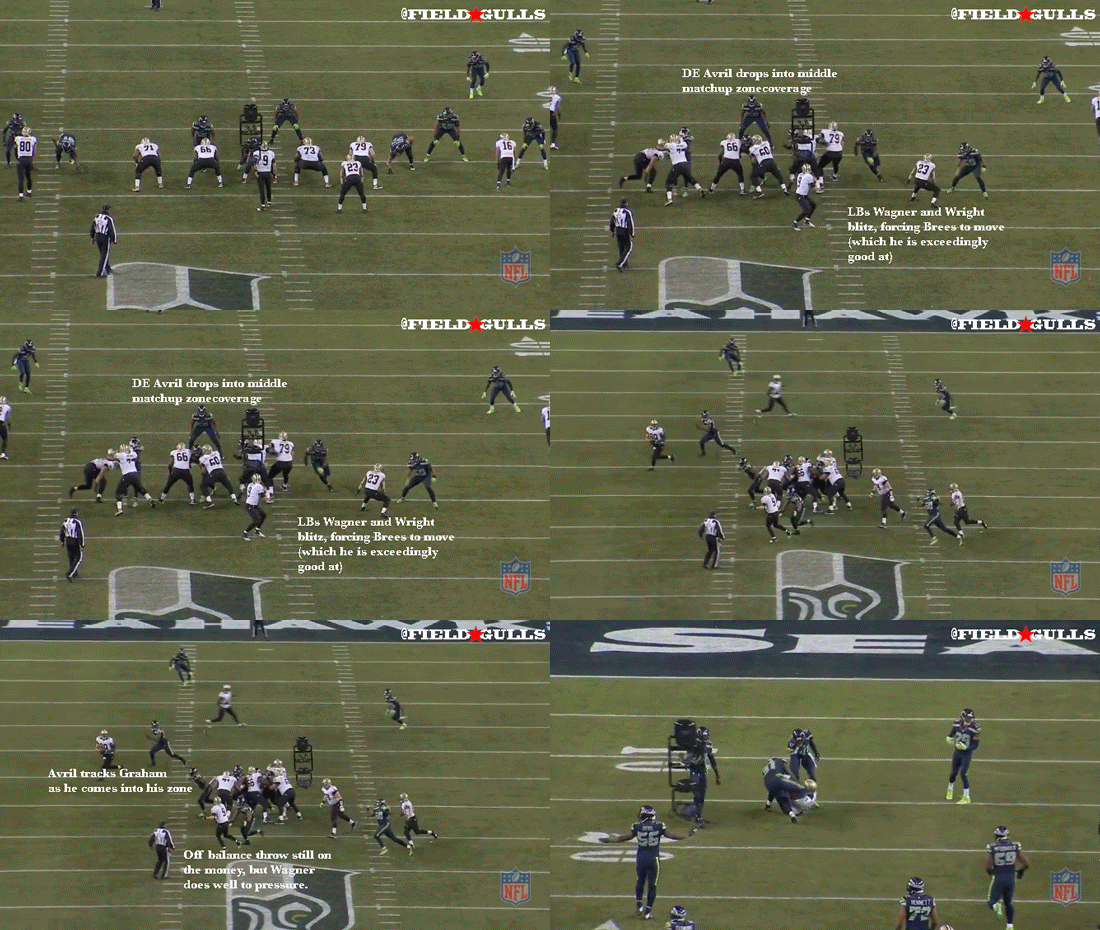
The play ends up being a win for the Hawks despite a great play by Drew Brees and a dropped pass by his receiver, but the scheme did work, in theory. The pressure came from the right side by two linebackers, and the de facto 'defensive tackle' in Cliff Avril dropped into middle zone coverage (oh by the way, Avril started 12 games at linebacker at Purdue).
As Field Gulls' contributor Greetings From Lord Humongous explained in the comments section:
There are many issues that zone blitzing creates for offensive lines: If you blitz Wagner or Wright or Earl Thomas or Kam Chancellor on some of these plays and drop Avril or Irvin instead, then the offensive line needs to account for more than four rushers. You create some confusion and doubt that can help you later in the game. The "fire-zone,", as it's called, creates more "gaps" for the line to protect in ways similar to how the read-option creates more gaps for the defense to protect.
In other words, when your 'defensive tackles' or defensive ends can drop into coverage, as we saw Cliff Avril do above, you end up getting offensive linemen mirroring no one (because they thought that DT/DE was going to rush), which means you're going to get free rushers, as Wagner is able to do above.
Seattle is not afraid to do put the real defensive tackles in coverage, either.
3-1-SEA 22 (9:52 4th Quarter)(No Huddle, Shotgun) D.Brees pass incomplete short middle to J.Graham [M.Bennett].
Below, nose tackle Clinton McDonald rather drops into coverage in the short flats, mirroring Jimmy Graham and getting in the passing lane for Brees. Seattle only sends three here. Michael Bennett, back on the outside again and still doing awesome things, forces the throwaway and almost gets the sack.
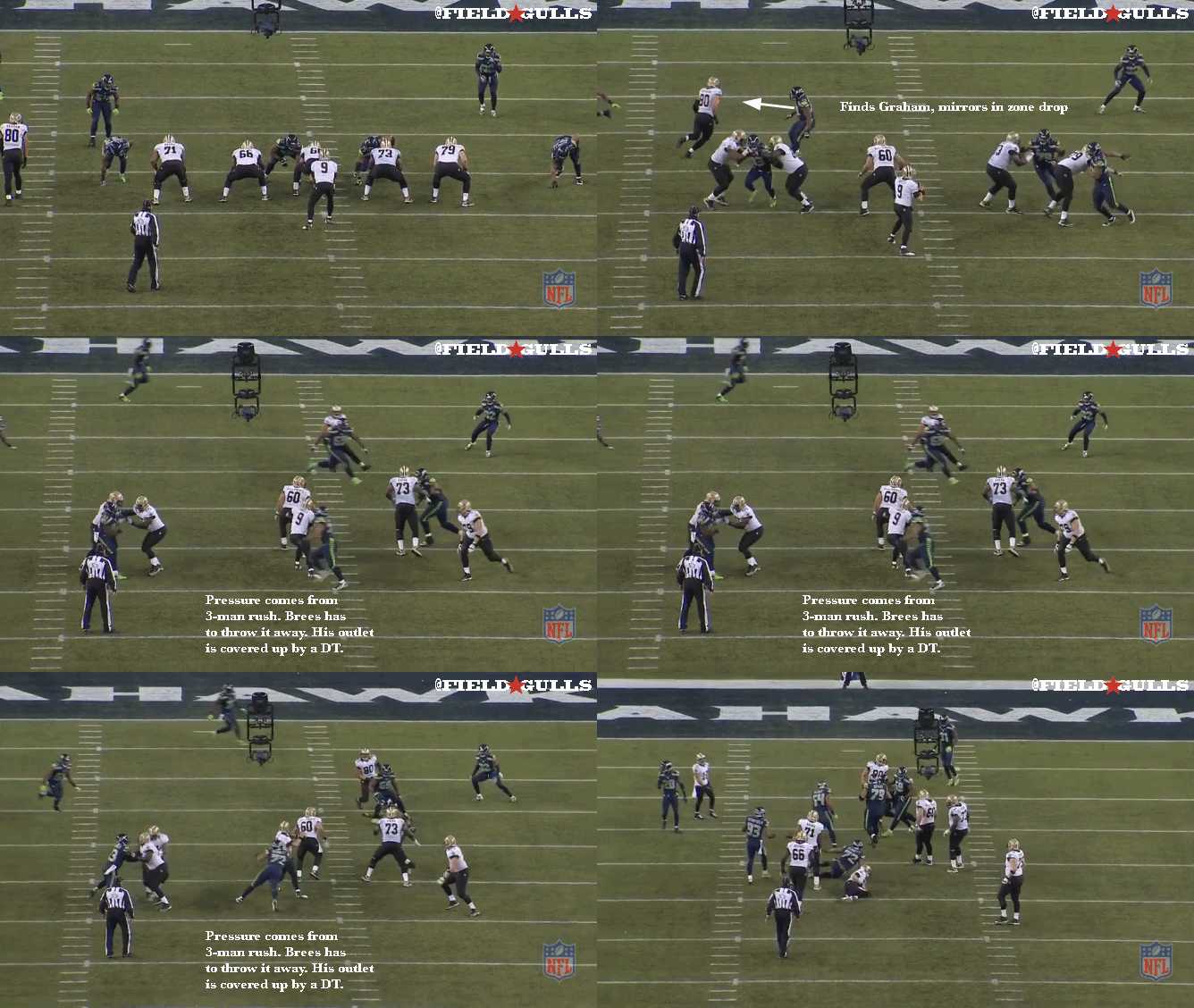
Similar scheme below from a little earlier in the game and in a much different down/distance (because you gotta mix up when you use it, man; can't be too predictable):
1-10-NO 25 (2:32 3rd Quarter) (Shotgun) D.Brees pass short right to L.Moore to NO 30 for 5 yards (J.Lane).

I tweeted this out from my seats, in a state of barley-induced bliss, during the game:
KJ is the screen whisperer. Don't you dare run a screen on him
— Danny Kelly (@FieldGulls) December 3, 2013
Of of the defining characteristics about K.J. Wright, is that he's extremely adept at sniffing out and blowing up screens. This is not luck or instincts; it's tape study, play recognition, perceptible tendencies... and yeah, ok, and some instinct.
Exhibit A:
3-9-NO 21 (5:41 1st Quarter) (Shotgun) D.Brees pass short right to D.Sproles to NO 24 for 3 yards (K.Wright) [M.Bennett].
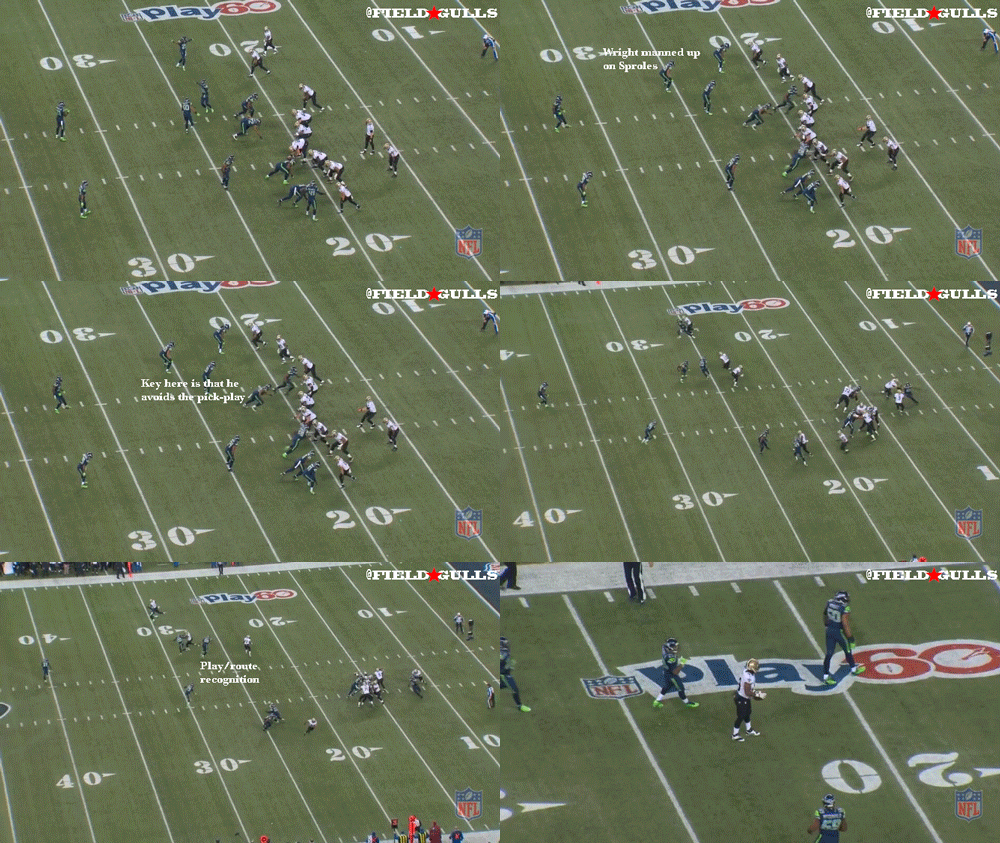
Exhibit B:
3-10-NO 45 (5:16 3rd Quarter) (Shotgun) D.Brees pass short left to D.Sproles to NO 41 for -4 yards (K.Wright).
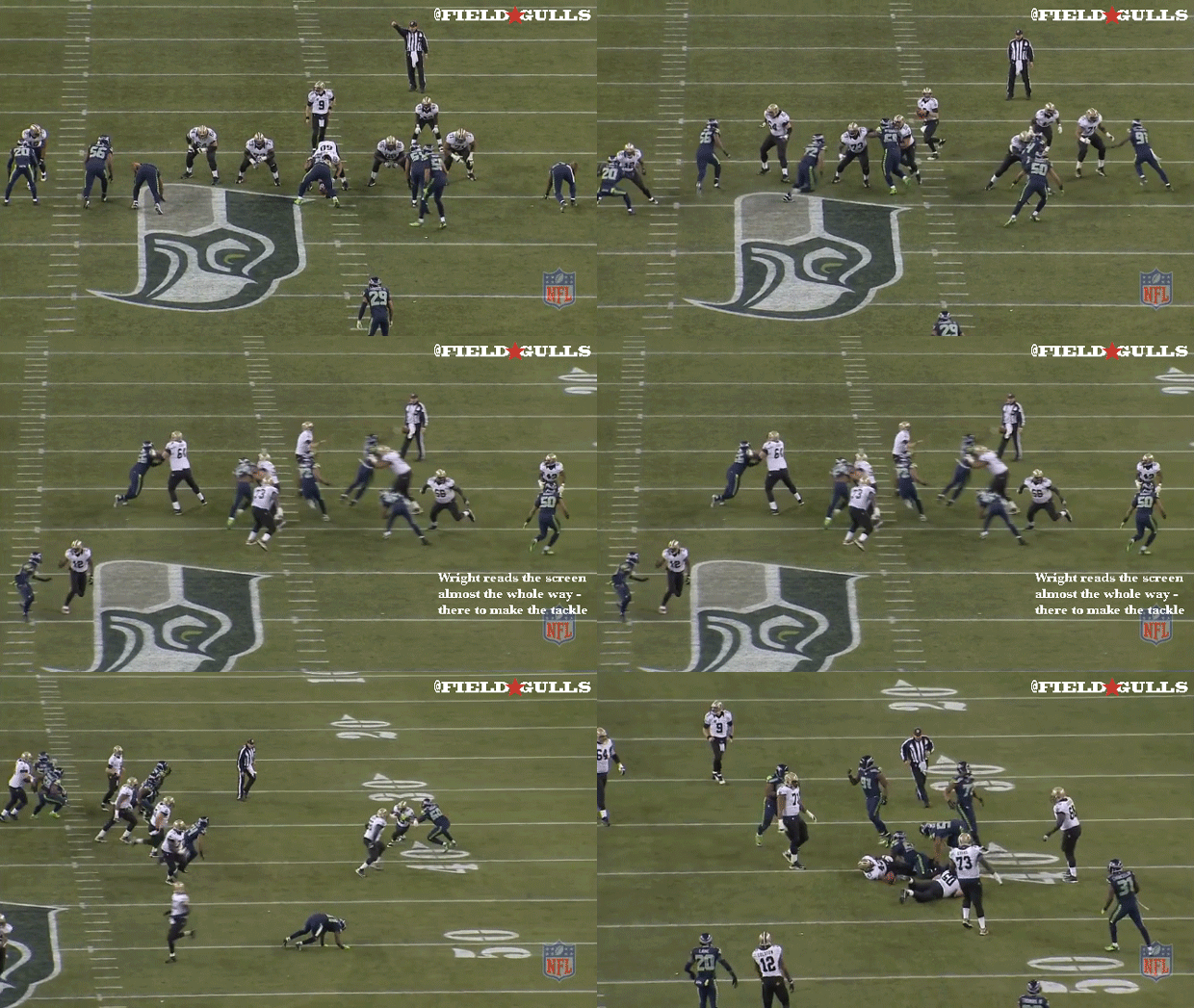
Exhibit C:
1-10-NO 43 (11:45 4th Quarter) (Shotgun) D.Brees pass incomplete short right to D.Sproles.
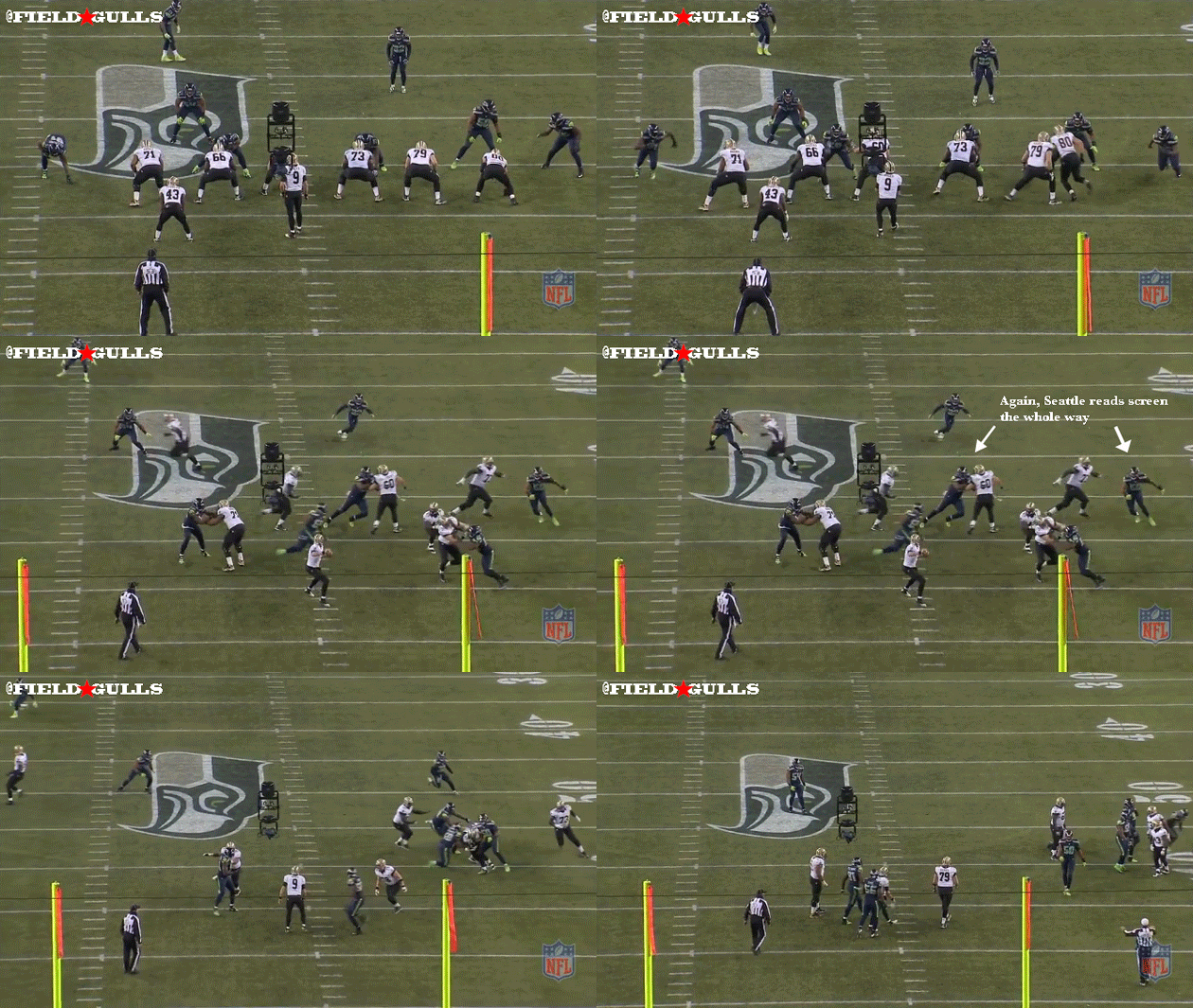
That's three in one game! I could find probably fifty if I went back over the past few years.
K.J. Wright might've been the MVP of this game, in all honesty, and apart from the ability to tackle, blow up screens, and drop into his zones, K.J. has shown the ability to run in man-to-man coverage with some of the better tight ends in the league. This is pretty rare, and Wright is criminally underrated for his complete skillset. He's not Patrick Willis, but you don't find many guys that are solid in so many areas.
More examples from tape, just from Monday's game:
1-10-SEA 32 (14:17 4th Quarter) D.Brees pass incomplete deep middle to B.Watson (K.Wright).
Wright uses his speed to track Benjamin Watson and his wingspan to break up the pass.
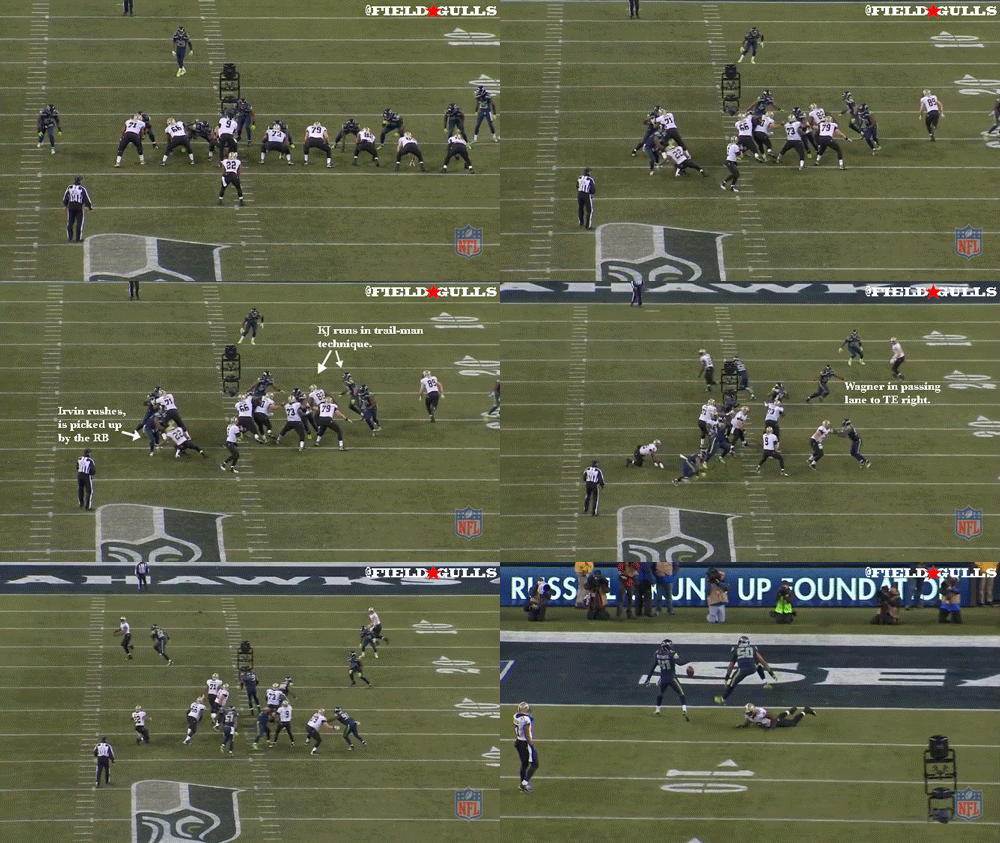
4-10-SEA 32 (13:53 4th Quarter) (Shotgun) D.Brees pass incomplete deep right to J.Graham [K.Wright].
Later in the game, on a fourth and 10, Seattle had the audacity to match Wright up with Jimmy Graham on the outside, and it's worth noting that's Richard Sherman following a receiver across the formation. Many had wondered aloud if Sherman would do this to Graham in this game, but Seattle trusted their linebacker in Wright so much that they allowed him to cover the elite TE man-to-man.
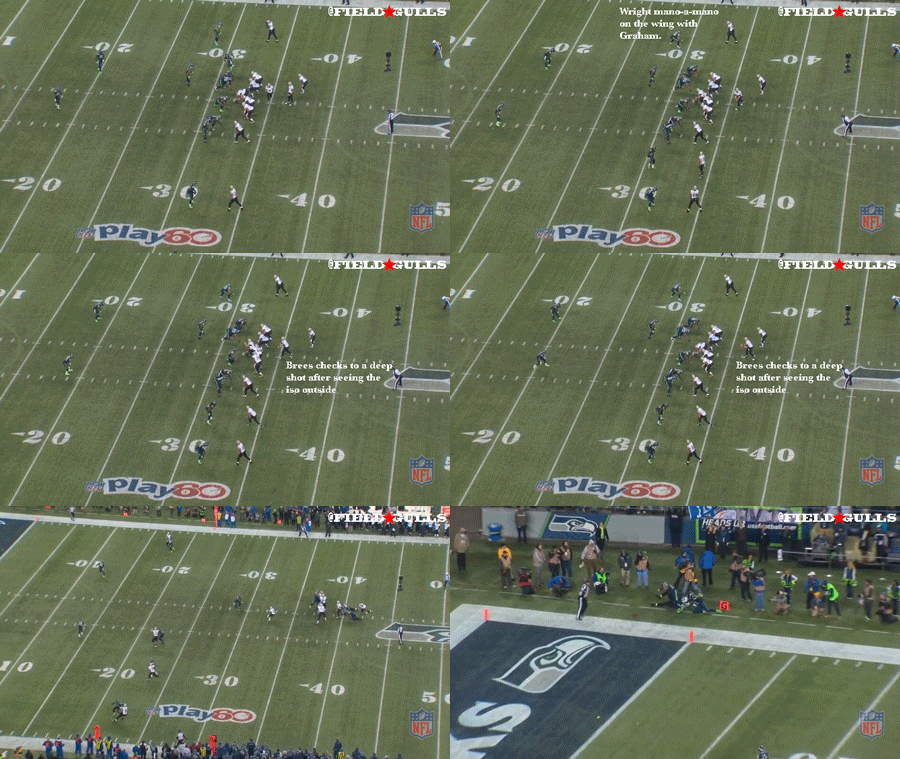
Not pretty, but gets the job done. As Jon Gruden exclaims in the broadcast, "how many linebackers go out there in man coverage with Jimmy Graham? Not many."

The bottom line? Seattle has at its disposal, talented and versatile athletes on their defense that can be used in a variety of ways to maximize specific talents and create confusion for the offense. In Sunday's win over the Saints, Pete Carroll and Dan Quinn's linebacker corps and defensive line unit did exactly that.
• Breaking Madden: A land where 'offsides' has no meaning
• The Notebook: Who are the NFL's best pass rushers
• Week 14 expert picks | Picks vs. the spread

Al Jazeera America, the US-based news outlet that just went live a few months ago, is now on more TVs across the country. Starting today, Time Warner Cable is carrying the channel in its major markets of New York, Los Angeles, and Dallas, and Bright House is also including the network in its lineups. Time Warner Cable plans to roll out the channel to the rest of its customers in March. The deals, which were struck back in October, bring Al Jazeera America to 55 million homes around the country, up from the 44 million it was in previously. About 100 million homes subscribe to cable and satellite TV. Both cable operators previously dropped the channel back when it was Al Gore's Current TV, so a new agreement had to be made.
The Qatar-owned network has prided itself on in-depth reporting of important news stories. John Seigenthaler, one of the high-profile TV journalists who's now working for the network, said earlier this year that "they are not interested in ratings, they are interested in delivering the news." To date, Al Jazeera America has struggled to gain any sizable viewership, with roughly 25,000 tuned into the channel depending on the time of day. Now that large parts of New York and Los Angeles can view the channel, however, that might pick up. Notably, both Time Warner Cable and Bright House will have HD versions of the network, unlike Comcast, Verizon FiOS, DirecTV, and Dish.
firehosebacklit, standard layout, configurable layouts on Windows
"The KB-460 offered everything of the Razer Black Widow while being much quieter. I didn't encounter any instances of keys not being registered or other shortcomings aside from Func not having any Linux software."
firehose"there’s a strain of Harley Quinn fandom that creeps me right the heck out. Like I said, she’s an easy character to identify with, and the reason she’s so tragic and compelling is precisely because she’s built on a metaphor that’s simultaneously universal and personal. It’s something that resonates with me as much as any other character.
It’s when they start idealizing her relationship with the Joker that things go off the rails. They’re not tragically star-crossed lovers, they’re not two people madly in love and united against the world. She’s obsessively codependent and he’s an abusive sociopath. If you finish those comics and wistfully sigh and hope you can find your own Harley and/or Mistah J someday, then you should probably go back and read them again. But, you know, to be fair, taking any relationship advice from an Ask Chris column is probably not a good idea either.
Either way, this is where you start to see problems from a character standpoint, too. Because she’s so easy to identify with and relate to, and because she rocketed almost immediately to a level of popularity that was pretty evenly split between people who identify with her central tragedy and dudes who just want more sexxxy chixxx in skintight latex, there’s a push to take what looks like a pretty obvious step and recondition her as a protagonist in her own right. The thing is, as obvious as it might seem, it’s not so simple.
It never really works, because it can’t work. Harley orbits around the Joker in the same way that the Joker orbits around Batman. You need to remove him and at least partially resolve that obsession if you’re going to have her as a protagonist, because you can’t really have your protagonist obsessively pining for a character you’ve spent 70 years shaping as a remorseless obsessive and utterly unsympathetic killer. But if you do that, if you remove that obsession, then you’re not only taking away the foundation of the character, you’re also taking away the one thing that makes her so easy to relate to. You’re left with just a standard issue manic pixie dream girl, and that gets real old, real fast.
...
If Harley’s aiding and abetting the Joker because she’s obsessively in love with him, then she’s a tragic and sympathetic figure. If she’s deciding on her own to commit acts of mass murder and terrorism, that’s a fundamental change that removes that sympathy. Unless you choose to ignore this particular issue, and I can’t imagine a scenario in which this is not the sensible choice, she’s impossible to root for. She killed a bunch of kids. That’s a big deal. And then a month later they launched an ongoing series that promises zany adventures featuring roller derby and puppies."

Q: What do you think about Harley Quinn? –@Gavin4L
I’ll be honest with you, Gavin: Harley Quinn is a tough character to write about. I’ve been struggling for a long time now trying to figure out how to get started, because there’s so much there built around a single character that gets into a lot of tricky, complicated areas, from her almost accidental creation and often mystifying popularity to how much she’s changed and been altered in a relatively short period of time, and how you can almost chart the changing aesthetic of the entire company just by looking at a single character. It’s a lot to get through, even if you’re someone who lived through every bit of it as a fan.
Really, I guess that’s as good a starting point as any. What do I think? Well, I like the character a lot, but when you get right down to it, she’s one of the most misunderstood and misused characters in all of superhero comics.
 And when I say she’s misunderstood, I don’t just mean that in my usual grumpy, increasingly bitter old man way, where I’m frustrated with the creators and editors behind how she’s been presented in comics. It’s the fans, too, and that’s where things start to get dicey, but I’ll come back to that in a minute.
It’s almost impossible to really overstate the impact that Paul Dini, Bruce Timm and Batman: The Animated Series have had on Batman (and, by extension, DC as a whole) over of the past two decades. For a while, it was taken pretty much for granted that it was the single best version of that franchise that had ever existed, and even if you think that’s being a bit over the top with the praise, it’s a hell of a lot harder to argue that it didn’t launch DC’s most creatively successful venture into mass media. The movies are nice to have and all, and they probably brought in more financially than the animated series ever did — especially once everyone realized they really like superhero movies and you got a story where the Joker tried to blow up a couple of boats that literally made a billion dollars — but in terms of influencing and shaping the source material and bringing in new fans, BTAS beats ‘em all hands down.
You just need to look at the track record: BTAS definitely wouldn’t exist without the success of Burton’s Batman ’89, but while the movies stalled out after Schumacher, there hasn’t been a time since 1992 when Batman hasn’t been a fixture on television with those cartoons. Admittedly, he was never really gone thanks to reruns of Batman ’66 and Superfriends, but BTAS redefined the aesthetic, and provided a foundation that they’ve been building on ever since. All you really have to do to chart it is sit down and think about how many times you’ve heard Kevin Conroy growling about being The Night. We got Superman: The Animated Series because of Batman, and we got Batman Beyond and Justice League because of those. Even when the initial “DC Animated Universe” had run its course, it’s easy to argue that we got Batman: The Brave and the Bold specifically as a reaction to the darker tone that Dini and Timm had taken when they launched BTAS, and in terms of story and approach, we wouldn’t have gotten the Arkham Asylum video game without it.
That’s where the show really had its impact: with its approach. At a time when comics were getting increasingly caught up in continuity, BTAS was spearheading what would eventually become the movement towards focusing on the “iconic” versions of the characters. If you go back and read Dini, Timm and Mitch Brian’s original BTAS Writer’s Guide, which you should because it’s amazing, you’ll see that one of the first things they do is explicitly forbid origin stories in favor of focusing on a version of the character that’s already established and geared towards having adventures right now. They trim away all the baggage and leave just the important stuff — if you watch closely, they even establish everything you need to know right there in the 57 second opening sequence — and the result is that they’re operating with much leaner versions of the characters, where the metaphors and motivations are a lot closer to the surface.
That might be the greatest lasting impact of Batman: The Animated Series. It didn’t just give us a Batman who was stylish and cool and so dark that he was actually drawn on black paper, it gave us a Batman who was easy to understand and relate to. The darkness of his motivations is right there on the surface when he relives his origin after the Scarecrow doses him, but the affection for Alfred and the fatherly partnership with Robin is there too, right on the surface. That’s what really drew people in, even if the red skies, art-deco Batmobiles and blimps were more obviously awesome.
I mention all this because that approach didn’t stop with Batman. It happens with the villains, too — maybe the single best example of which is that the episode that introduces the Riddler is actually called “If You’re So Smart, Why Aren’t You Rich?”, neatly summing up his entire motivation in an eight-word title card. It’s all right there, in a way that makes them accessible without sacrificing the complexity of their characters.
That’s the kind of aesthetic that produced Harley Quinn, and it’s worth noting that she was created almost by accident. When she first appears in “Joker’s Favor,” it’s as a one-note joke, a gag character designed to set up the twist of the episode, that the Joker hounds and stalks and threatens this poor nobody over the course of years so that he can open a door as part of a larger scheme. Keep that in mind, too, because the secret of that episode is that it’s also Harley Quinn’s entire story in miniature.

That’s all Harley was meant for initially, but they’d accidentally hit on this magic combination that made her a keeper instantly. There’s so many great things just in that first appearance, from the incredible Bruce Timm design to Arleen Sorkin’s voice and mannerisms (on which the character was loosely based), but I think the most important thing is that she gave the Joker something he’d never really had. For better or worse, and for as many hack jokes as it invites, she was suddenly Joker’s Robin, in a twisted funhouse mirror way that shows exactly how different from Batman the Joker really is.
The Joker had a couple of short-lived associates before, of course, because when you’re a character that’s been a pretty constant presence in comics since 1940, there’s not a lot of stuff you haven’t done. There was Gaggy Gagsworthy, a truly terrifying one-shot sidekick from 1966 who also dressed like a harlequin (and was later resurrected by Paul Dini and Guillem March as a foe for Harley), and you could argue that Harley’s pretty directly descended from the various molls and henchwenches that palled around with the arch-criminals on the TV show, but there’s something different that sets her apart that was developed when she returned: She was hopelessly in love with the Joker.
When I say “hopeless,” I don’t mean it in the cute “I’m a hopeless romantic” sort of way, either. I mean that what she feels is utterly, tragically devoid of hope. Because she’s a Batman villain, she’s built around a simple metaphor that’s made to contrast with Batman. Since she’s inextricably tied to the Joker, that core metaphor is built around his, too, and because she was developed and honed in that lean animated series aesthetic that put that metaphor right at the forefront, she’s actually a really fascinating character in a lot of ways. At heart, at the core of what she is, she’s the living embodiment of obsession, in a way that contrasts with both Batman being driven to fight crime, and the Joker’s pseudo-romantic obsession with Batman — and only with Batman.
See, that’s the tragedy of Harley Quinn, the thing that makes her so compelling underneath all the bright, poppy cheer. She’s in love with someone who will never, ever love her back. Someone who can never, ever love her back, because he’s thoroughly obsessed with someone else. It’s something that we’ve all been through, and that’s what makes her so easy to identify and sympathize with. But because it’s an obsession, an addiction, it’s phenomenally self destructive (something else we can all probably relate to), and because it’s playing out in the grand metaphorical stage of superheroes, everything about it is taken to its horrifying extreme.
Ryan North did a great installment of Dinosaur Comics that perfectly captured the feeling of being a kid with a crush and believing that the object of your desire was “objectively the best girl ever,” and Harley follows that to its logical tragic end — the flaws she’s overlooking are that he’s a terrifying mass murderer obsessed with killing the Batman. That is not a solid foundation for a relationship, and when that relationship actually does happen, such as it is, it becomes one of the most genuinely tragic things in comics.
That’s the thing about superheroes: They don’t really do things by half measures. It’s not just that the Joker doesn’t love Harley back, it’s that he doesn’t even see her as anything that could possibly be desired. There’s only one other person in the Joker’s world, and everyone else is just an object that he can use against Batman. And to make things worse, it’s not just that he doesn’t return her love, it’s that he uses it. There’s no “let’s just be friends” with the Joker, there are just things that can be made into deathtraps. He’s every sociopath who broke someone’s heart taken to this huge extreme, manipulative and abusive in a way that’s frightening and disturbing, not because it originates from the shock value of hack writers trying to be mature, but because it operates on the same superheroic, metaphorical level of Batman’s determination and Superman’s kindness. It feels horrifyingly natural in that universe, and it all gets directed at Harley, because she’s the one object that’s always around, because she can’t stop herself from coming back. As far as he cares, she’s just there to open the door.
I thought Arkham Origins was a total snooze, and I thought it was goofy as all hell that they condensed the Joker’s seduction (such as it is) of Harley into a five minute cutscene rather than playing it out over the course of months, but I actually do like the way that it’s presented. It’s done as a conversation between the two characters that you hear while you’re playing from the Joker’s point of view, and he’s talking about his obsession with Batman, using those same terms that cast it as a twisted version of romance, this obsession with his perfect match that he knows he’ll be with forever, while Harley is getting flustered because she thinks he’s confessing his love for her, which she’s more than willing to accept. Again, it’s as hilariously over-the-top as everything else in that game, and falling head-over-heels for the Joker in the span of ten minutes doesn’t really do Harley’s character any favors, but it’s a nice presentation, carried off well by Troy Baker and Tara Strong’s acting.
Dini and Timm’s Mad Love, which tells Harley’s origin story, however, is darn near perfect. It’s a great piece of comics, because it takes those exact feelings that we’ve all had in those self-destructive crushes and plays it right out on the page. It’s the Buzzcocks song translated directly to the page, and one of the things that really makes it work is how easy it is to find yourself in her shoes. She doesn’t just develop a crush on someone, she obsesses over him and tries to make herself more like something she thinks he’d like:

Incidentally, this is a scene that actually made me re-evaluate her godawful redesign for the New 52. I mean, look, it’s still awful, but if you look at it in a certain way, it kind of makes sense. When Harley reinvents herself for the Joker, she dresses herself in a way that’s explicitly designed to be for him, and that fits with the way he presents himself. That classic Bruce Timm costume is great, and part of that is because those vivid, blocked colors look like they fit next to Timm’s Joker. One clearly follows from the other. If, however, Harley was reinventing herself to fit in with a version of the Joker who cuts his own face off and wanders around for a year with no face on and then ties his face skin to his head with a pair of belts, then she’s probably going to end up with something a hell of a lot dumber, which she did. I hate to admit it because neither one of those things is actually very good, but you have to admit they’re equally stupid. It might not look good, but it highlights the obsession, and that’s the key part.
Getting back on track, it’s that obsession that motivates her, just like we’ve all had that intense infatuation that’s made us want to change ourselves to better fit someone’s idea of what we should be like. But because that obsession is operating at a superheroic level, once she reinvents herself like that, there’s no going back. She’s too far gone to ever fully pull herself back. She can’t quit loving the Joker, no more than Batman can stop fighting crime, or Spider-Man can stop helping people who need him. It’s stitched into the fabric of who she is.
That’s what makes the end of Mad Love so tragic and affecting, because we all want there to be hope for her, just like we want there to be hope for ourselves that we can get over our broken hearts and move on, but for Harley, there never is. No matter what the Joker does to her, no matter how blatantly he’s manipulating and abusing her, she just can’t get out.

She’s hopelessly in love.
It’s great, but it’s also where the misunderstanding starts. There are fans out there who have what I’d consider to be weird ideas about almost every character that spring from not quite getting what they’re all about — you know, the classics like “Batman should just kill the Joker!” “Superman’s too nice!” and “People care about Aquaman!” — but there’s a strain of Harley Quinn fandom that creeps me right the heck out. Like I said, she’s an easy character to identify with, and the reason she’s so tragic and compelling is precisely because she’s built on a metaphor that’s simultaneously universal and personal. It’s something that resonates with me as much as any other character.
It’s when they start idealizing her relationship with the Joker that things go off the rails. They’re not tragically star-crossed lovers, they’re not two people madly in love and united against the world. She’s obsessively codependent and he’s an abusive sociopath. If you finish those comics and wistfully sigh and hope you can find your own Harley and/or Mistah J someday, then you should probably go back and read them again. But, you know, to be fair, taking any relationship advice from an Ask Chris column is probably not a good idea either.
Either way, this is where you start to see problems from a character standpoint, too. Because she’s so easy to identify with and relate to, and because she rocketed almost immediately to a level of popularity that was pretty evenly split between people who identify with her central tragedy and dudes who just want more sexxxy chixxx in skintight latex, there’s a push to take what looks like a pretty obvious step and recondition her as a protagonist in her own right. The thing is, as obvious as it might seem, it’s not so simple.
It never really works, because it can’t work. Harley orbits around the Joker in the same way that the Joker orbits around Batman. You need to remove him and at least partially resolve that obsession if you’re going to have her as a protagonist, because you can’t really have your protagonist obsessively pining for a character you’ve spent 70 years shaping as a remorseless obsessive and utterly unsympathetic killer. But if you do that, if you remove that obsession, then you’re not only taking away the foundation of the character, you’re also taking away the one thing that makes her so easy to relate to. You’re left with just a standard issue manic pixie dream girl, and that gets real old, real fast.
I think that’s why the original Harley Quinn ongoing series, despite launching with a creative team I really like, ended up being kind of a mess, and got downright unreadable when it got a new team that attempted to make it a dark, gritty crime book starring a lady in a clown costume. And by the same token, I think that’s why people tend to gravitate to those Poison Ivy/Harley Quinn team-up stories — for reasons beyond the obvious slashy sexxxy chixxx action, I mean. Ivy herself is one of the more sympathetic villains, but she’s still rooted (haw haw) firmly enough on the side of the bad guys that it doesn’t pull Harley too far out of her orbit. Even better, Ivy works as a viewpoint character for the reader. She’s eternally frustrated because she sees exactly what we see, and her annoyance with Harley comes from knowing that she’s never going to be able to free herself from the Joker. She cares, but can only express it in that same negative, villainous way that leads her to hold the city hostage until they have ended the tyranny of lawnmowers. But even that can’t last — it only works in short bursts.
Harley just fundamentally isn’t built to be a protagonist, even a damaged and psychologically scarred antihero. And yet there’s this myopic idea that continues, that a character this compelling and popular needs to be a star, and of late it’s created this schizophrenic take where she’s being bounced around from one incarnation to another. I mentioned that her terrible new costume actually does make a certain amount of sense, but that’s about the only thing that does. She’s been bounced around since the reboot, where people are trying to fit her into the roles of a vicious killer on par with the Joker and wacky lovesick rascal at the same time, and the end result is a character that’s now impossible to relate to.
Nothing quite solidifies it more than her atrocious “Villain Month” appearance in Matt Kindt and Neil Googe’s Detective Comics #23.2, which casts her as a Joker-in-absentia in a way so tone-deaf that it tanks the past 20 years of the character. If you missed it, well, lucky you, but the core idea is that having freed herself of the Suicide Squad, Harley decides to murder children on-panel by giving away exploding video games.

There’s no way to come back from that. If Harley’s aiding and abetting the Joker because she’s obsessively in love with him, then she’s a tragic and sympathetic figure. If she’s deciding on her own to commit acts of mass murder and terrorism, that’s a fundamental change that removes that sympathy. Unless you choose to ignore this particular issue, and I can’t imagine a scenario in which this is not the sensible choice, she’s impossible to root for. She killed a bunch of kids. That’s a big deal. And then a month later they launched an ongoing series that promises zany adventures featuring roller derby and puppies.
Any chance that I had of getting behind this new version of Harley Quinn as a character in her own right, any hope that I would’ve had about their chances of synthesizing what works about the character and putting in a new form that could be separated from the Joker without losing its foundation, is now completely overshadowed by the fact that a comic with her name on the cover featured her murdering around twenty people on-panel (with more implied), most of whom were children. How fun is that roller derby comic going to be when it’s following that? How am I supposed to reconcile these two ideas that they’re giving to me about the same character at the same time?
And in the end, that’s what we’re left with. A fascinating, compelling character that was created to perfectly fit into a specific role in a larger context that ended up working so well that she outgrew it, and has spent the last few years being hammered into shape to fit a new role. She’s a character I like a lot, but they sure are making that a difficult thing to do.
Ask Chris art by Erica Henderson. If you’ve got a question you’d like to see Chris tackle in a future column, just send it to @theisb on Twitter with the hashtag #AskChris.
firehose'Chang has worked for the Church of Scientology: "It was in a Disney-like castle in the middle of the desert," he says. "They put all of us non-Scientologists in a separate room with no access to the internet. It was sort of a sweatshop where I was creating propaganda 3D art." '

Michael Chang "Instead of hiring a hundred animators to animate all these tiny bits of graphics they hired three programmers."
There's a joke among Taiwanese nationals, Chang says, that goes like this: If every man, woman and child in China spits in the ocean it will drown Taiwan. It's part of the reason he's a first-generation American, the son of immigrants who came looking for opportunity outside a sphere of influence that practically smothered them.
"For a lot of Taiwanese citizens you either stay there due to pride, or you don't have any other reason to stay there," he says. "It's your hometown, but for a lot of people it's their dream to move to America. So that [was] my parents' dream. They wanted to have a yard and cars and stuff."
Chang helped to build the family business in high school. His parents import easels from China and sell them to artists online in the U.S. using a website he built when he was a teenager, something he laughs about now.
"It's terrible," he says. "It's made in Dreamweaver out of templates. It works, but it still hasn't changed. Like any kid at that time my parents were like, 'Hey you know computers. You can make websites!'"
E-commerce wasn't his passion. He wanted to be an animator at Pixar, to make the kind of movies he grew up watching. His parents convinced him to do something a bit more practical with their stack of easel cash. That's how he ended up at UCLA in the Design Media Arts program. He studied programming like some would study oil painting — as a medium for expression.
"It allowed me to take my artistic skill set, but then to transform it. ... I became this sort of jack of all trades kind of guy, where any problem that presented itself just sort of clicked for me."
His specialty was procedural animation, a way of teaching computers to draw on their own.
"Instead of painting a painting," Chang says, "it's more like I'm teaching an animal to perform. And the animal might do what you want, but it won't do the exact thing every time."
One of his first tastes of success was building a program that made simple drawings come to life. As soon as the user lifted their pen a creature would begin to swim around the screen. It was exactly the kind of work that appealed to Will Wright when he was conceptualizing Spore.
"It was during their prototyping phase," Chang says. "Wright basically had a bunch of people look for hacker programmer types. … I've been a Will Wright fan for my whole life and I'd played SimCity. So I applied instantly, and I got the internship.
"The art director would have us go and print out some random imagery," Chang says. "During lunch … there would be these printouts laying out of fucking ramen noodles and a basketball and the Space Shuttle or whatever. He'd say, 'I want you to take each of these images and shuffle them and sketch out a planet made from those things.'"
Chang went on to design many early versions of the user interface elements that went into Spore's Creature Creator.
After college he joined the new elite of mercenary work-for-hire programmers in Los Angeles. He traded the chance at a steady job and medical benefits for a string of highly paid projects. As a result his work history is certifiably weird.
Chang has done data visualization for Yahoo: "They collect so much data about their users," he says. "They want a way of plotting it. And they want to see it in a cool, Tron-like way."
Chang has worked in the advertising industry: "Instead of hiring a hundred animators to animate all these tiny bits of graphics they hired three programmers," he says.
Chang has worked for the Church of Scientology: "It was in a Disney-like castle in the middle of the desert," he says. "They put all of us non-Scientologists in a separate room with no access to the internet. It was sort of a sweatshop where I was creating propaganda 3D art."
Chang worked from Shanghai for a startup that he cannot name: "I wanted to travel," he says. "It just seemed really cyberpunk, and I already spoke the language. ... Our clients included Sony and Microsoft, the usual guys."
And he did all of that, and much more, before he turned 30.
But the whole time he was also making a game.
"In 2006 a friend and I were sitting in the living room," he says. "Super bored. We're saying to ourselves, 'Look, Jedi Knight 2: Jedi Outcast was a great game. It happened, but people stopped playing it. We really need something to scratch the sword fighting itch that we have.'" And so they began to make a game together.