I described [the medievals] as literate people who had lost most of their books. And what survived was, to some extent, a chance collection. It contained ancient Hebrew, classical Greek, classical Roman, decadent Roman and early Christian elements. It had reached them by various routes. All Plato had disappeared except part of the Timaeus in a Latin version: one of the greatest, but also one of the least typical, of the dialogues. Aristotle’s logic was at first missing, but you had a Latin translation of a very late Greek introduction to it. Astronomy and medicine, and (later) Aristotle, came in Latin translations of Arabic translations of the Greek. That is the typical descent of learning: from Athens to Hellenistic Alexandria, from Alexandria to Baghdad, from Baghdad, via Sicily, to the university of Paris, and thence all over Europe…
A scratch collection, a corpus that frequently contradicted itself. But here we touch on a real credulity in the medieval mind. Faced with this self-contradictory corpus, they hardly ever decided that one of the authorities was simply wrong; never that all were wrong. To be sure, in the last resort it was taken for granted that the Christian writers must be right as against the Pagans. But it was hardly ever allowed to come to the last resort. It was apparently difficult to believe that anything in the books - so costly, fetched from so far, so old, often so lovely to the eye and hand, was just plumb wrong. No; if Seneca and St Paul disagreed with one another, and both with Cicero, and all these with Boethius, there must be some explanation which would harmonize them. What was not true literally might be true in some other sense; what was false simpliciter might be truesecundum quid. And so on, through every possible subtlety and ramification.
It is out of this that the medieval picture of the universe is evolved: a chance collection of materials, an inability to say ‘Bosh’, a temper systematic to the point of morbidity, great mental powers, unwearied patience, and a robust delight in their work. All these factors led them to produce the greatest, most complex, specimen of syncretism or harmonization which, perhaps, the world has ever known. They tidied up the universe.
”- C. S. Lewis on how Medieval scholars rationalized the available canon of philosophy and protoscience in the ancient world: from “Imagination and Thought in the Middle Ages”


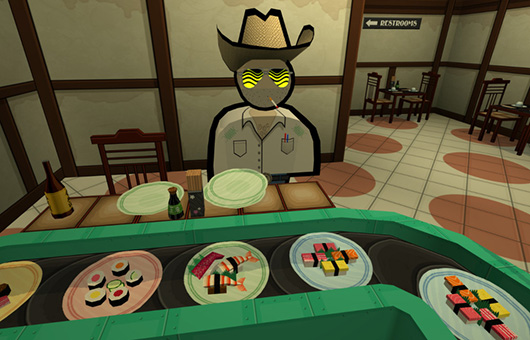 As an adventure game rife with pop cultural spoofs and slapstick comedy, it makes a certain kind of sense that the latest Jazzpunk trailer would be an extended riff on the 1995 Keanu Reeves "classic" Johnny Mnemonic.
In development at Necrophone ...
As an adventure game rife with pop cultural spoofs and slapstick comedy, it makes a certain kind of sense that the latest Jazzpunk trailer would be an extended riff on the 1995 Keanu Reeves "classic" Johnny Mnemonic.
In development at Necrophone ...









![[link]](http://i.imgur.com/oG9htzC.png)