Daily Beast |
Palin Backs Alligator Taming Senate Candidate Daily Beast On Thursday, Sarah Palin announced her support for conservative hopeful Rob Maness in Louisiana's wide open U.S. Senate campaign. Alligator-tamer, retired U.S. Air Force Colonel, and Republican candidate for the United States Senate in Louisiana, Rob ... and more » |
firehose
Shared posts
08 May 23:06
Palin Backs Alligator Taming Senate Candidate - Daily Beast
firehosemy people, my people
08 May 23:05
HGTV Pulls Show After Discovering Hosts Are Anti-Gay Anti-Abortion Activists - Design & Trend
firehosefollowup
Design & Trend |
HGTV Pulls Show After Discovering Hosts Are Anti-Gay Anti-Abortion Activists Design & Trend HGTV has pulled a show that was to be hosted by the Benham brothers. They brothers are anti-gay, anti-abortion activists. (Photo : Reuters). What's one thing a major TV network doesn't want to host? Well, bigotry for one. HGTV has announced that it's ... HGTV cancels 'Flip It Forward' over hosts' controversial viewsNew York Daily News Benham brothers disappointed with HGTV decision to cancel 'Flip it Forward'Detroit Free Press all 251 news articles » |
08 May 23:04



Massachusetts “Romneycare” site killed after rejecting Obamacare transplant
by Sean Gallagher
The Massachusetts Health Connector is getting its plug pulled.
Nevada, Maryland, Massachusetts, Minnesota, and Oregon are members of a club that no one wants to join—all of these states have largely failed at getting their electronic health insurance exchange sites to work properly (or, in some cases, at all). Given the legislatively mandated deadline, the delays in delivery of requirements by the federal government, and the scale of the task that faced states developing their own healthcare exchange sites under the Affordable Care Act, people familiar with government information technology projects might tell you that it’s surprising that any of the websites worked at all.
But if any state had a greater shot at success, it was Massachusetts—the state that served as the model upon which the Affordable Care Act was based. Now, Massachusetts' health exchange has decided to shutter its own site at least temporarily, switching to the federal exchange to buy time for a better fix.
States running their own exchanges need to be ready by November 15 for the next round of open enrollment for health plans. That has put a number of states with floundering exchange sites in a pinch. Oregon was the first state with its own exchange to completely abandon its own website after spending more than $300 million in federal grants on the project.
Read 8 remaining paragraphs | Comments
firehose likes this
08 May 23:04

Apple outlines process for handing over your data to law enforcement
by Chris Welch
A new page at Apple's website offers a public overview of how US law enforcement can request personal data on the company's millions of users. More importantly, the "legal process guidelines" also spell out what information Apple has at its disposal. And it covers everything from iOS devices to web services like iCloud. The guidelines emphasize that law enforcement agencies must stick closely to the law and provide any required document — be it a subpoena, search warrant, or court order — if they hope to obtain any data they're after.
Any name, address, email address, or phone number you've entered when registering an Apple product can be handed over, though the company notes it doesn't make any effort to verify this data. Records from visits you've made to the Apple Store (both online and in-store) along with Genius Bar and other customer service interactions are all fair game. As you might expect, iTunes is a treasure trove of your digital activity. Apple can produce a list of every app, song, TV show, and movie you've ever downloaded from its servers. And it doesn't record those things just once; Apple tracks things like app update history and even records when you've re-downloaded something from the cloud. Further, authorities can request connection logs that reveal IP addresses you've recently connected to iTunes with.
Apple knows plenty about its users, but none of it should surprise you
Requirements get a bit tighter if law enforcement wants to peek inside your iCloud account. Apple can offer up email logs dating back 60 days containing time, date, and the email addresses of everyone taking part in a thread. But producing the actual content of your email isn't nearly as easy; Apple warns that iCloud only stores the emails that users knowingly leave sitting in their account. It's not possible to reproduce deleted messages, Apple says, and the same applies to your PhotoStream, documents, contacts, calendars, bookmarks, and even iOS backups. Once they're gone from Apple's servers, they're gone for good.
Find My iPhone can't help cops track you down
If you've ever wondered whether authorities can use Find My iPhone — the tool that helps users located a lost iPhone or iPad — to track you down, it turns out they can't. Not in the way you'd expect, at least. Apple can produce a connection log that outlines when you've used Find My iPhone, but it can't turn on the feature remotely or use it to track your GPS coordinates on demand. Several times in the document, Apple underlines the fact that it's simply unable to pull up a device's location using GPS. Law enforcement can view requests you've made to remotely lock or wipe a device with a subpoena, however.
And if the cops should find themselves locked out of a device thanks to a passcode, Apple can help retrieve a limited set of dat, but only from its own apps. Your SMS history, photos, videos, contacts, audio recordings, and call history can all be extracted from a locked iPhone, but Apple says it has no way of getting at data from third-party apps. And as Apple has said previously, FaceTime and iMessage are completely inaccessible since both are tightly encrypted. The requirements for this extraction process are extremely stringent, and it can only be performed at Apple's Cupertino headquarters.
Apple says that in most cases it will gives users a heads up when law enforcement wants to snoop around — except when prohibited via a non-disclosure order or if doing so "may pose immediate risk of serious injury or death to a member of the public or the case relates to a child endangerment matter."
- Source Apple
- Related Items apple law enforcement data requests user data legal process guidelines
firehose likes this
08 May 23:03



Four weeks on, huge swaths of the Internet remain vulnerable to Heartbleed
by Dan Goodin
Aurich Lawson / Thinkstock
More than four weeks after the disclosure of the so-called Heartbleed bug found in a widely used cryptography package, slightly more or slightly less than half the systems affected by the catastrophic flaw remain vulnerable, according to two recently released estimates.
A scan performed last month by Errata Security CEO Rob Graham found 615,268 servers that indicated they were vulnerable to attacks that could steal passwords, other types of login credentials, and even the extremely sensitive private encryption keys that allow attackers to impersonate websites or monitor encrypted traffic. On Thursday, the number stood at 318,239. Graham said his scans counted only servers running vulnerable versions of the OpenSSL crypto library that enabled the "Heartbeat" feature where the critical flaw resides.
A separate scan using slightly different metrics arrived at an estimate that slightly less than half of the servers believed to be vulnerable in the days immediately following the Heartbleed disclosure remain susceptible. Using a tool the researcher yngve called TLS Prober, he found that 5.36 percent of all servers were vulnerable to Heartbleed as of April 11, four days after Heartbleed came to light. In a blog post published Wednesday, he said 2.33 percent of servers remained vulnerable. It's important to remember the results don't include the number of Heartbleed-vulnerable servers providing services such a virtual private networks or e-mail.
Read 3 remaining paragraphs | Comments
08 May 23:03
Man Deeply Suspicious After Insurer Covers Prescription Without Hassle
GAS CITY, IN—Taking for granted that his employer’s insurance would not cover the cost of his prescription antibiotics, local man Aaron Lasser was reportedly left deeply suspicious Thursday after being told by the pharmacist his plan had in fa...


08 May 22:58
Hearthstone tips: A beginner's guide to losing less
by Griffin McElroy
firehosenever play hearthstone
Hearthstone is a difficult game to get better at.
It's not that the game has a steep learning curve — it's that it has like, 75 discrete learning curves, each with their own unique gradient of steepness. What's tricky isn't figuring out what cards have the best synergies, or how to counter the strategies of each class; oftentimes, the hardest part of Hearthstone is just figuring out why you lost. Other than the obvious, which is to say, you got hit too much and all your health went away.
In the video above, we try to introduce some broad concepts that, while not applicable 100 percent of the time, should help you come to a better understanding of Hearthstone's general mechanics. There's a lot, lot more to the game than this guide can cover — but if you've found yourself stuck in a rut after a few hours of Ranked losses, there might just be something in there that can help you out of it.

08 May 22:40


Great Job, Internet!: Here's a nine-minute loop of one part of Spin Doctors' "Two Princes"
by Marah Eakin
Because it’s Thursday and Thursday is when the world’s citizens collectively listen to Spin Doctors—Wednesday is when we wear pink—a YouTube user has uploaded a nine-minute loop of what they consider “the best part” of “Two Princes,” or the part of the song known to the layman as “the beginning.” The clip is dedicated to the maker’s “wonderful girlfriend,” who must be wonderful indeed if she was even in the same building as this video’s editor when this masterpiece was being created. [via Uproxx]

Corey likes this
08 May 22:31
On Rape In A Virtual World
firehoseTW: everything
Kim Correa loves the online game "DayZ," which lets you interact with other humans during a zombie apocalypse. The appeal of "DayZ" is that it allows weird, spontaneous interactions between players. It also allows really terrible ones.
08 May 22:28


Coming Distractions: The trailer for Rage gives him a stage where Nicolas can Cage
by Sean O'Neal

Nicolas Cage’s newest thing he did for a month, Rage, finds him playing a family man pushed to the very edge of Nicolas Cage after his daughter is kidnapped, forcing him to draw upon his shady past for the certain set of skills required to get her back. As noted when it was announced last year, it’s a premise remarkably similar to 2012’s Nicolas Cage movie Stolen, which was itself incredibly similar to Taken—which was only a Liam Neeson away from being Seeking Justice or Trespass anyway. And really, they are all part of the indistinguishably interwoven tapestry of life, in which our time on Earth can be measured in the laced warps and wefts of Nicolas Cage shouting theatrically and holding as many guns as he can carry. Anyway, this one has also snared Peter Stormare as a wheelchair-bound Russian gangster and Danny Glover ...
firehose likes this
08 May 22:25
Report: Journalists Are Miserable, Liberal, Over-Educated, Under-Paid, Middle-Aged Men
firehosehi~
Mostly.
firehose likes this
08 May 22:25
How Cyberbullying Is Making Sexual Assault On College Campuses Even Worse
As Dartmouth makes efforts to combat sexual assault, posts on an anonymous online forum have students terrified.
08 May 22:25
23 Police Officers Fired At Least 377 Rounds At Two Unarmed Men
firehoseFlorida #nevergo
On December 10, more than two dozen police officers from across Miami Dade County converged on a blue Volvo that had crashed in the backyard of a townhouse on 65th Street just off 27th Avenue. Then, for almost 25 seconds, they unleashed an unrelenting torrent of bullets.
08 May 22:24


Newswire: Mark Wahlberg's new Boston reality show is about nerds making nerd beer
by Sean O'Neal
Mark Wahlberg continues to put the “Boston” in “I’M MARK WAHLBERG. I’M FROM BOSTON,” selling A&E his fourth straight reality show about the city of Boston, where Mark Wahlberg is from. Titled The Big Brew Theory, after that sitcom full of nerds that Mark Wahlberg could take, the series aims to follow four “quirky and highly intelligent MIT grad students” who apply that collective brainpower—and their life savings—toward creating their own microbrewery. These graduates of one of the nation’s most advanced academic institutions will try to succeed with the help of “a beautiful MIT undergrad,” as well as the endorsement of Mark Wahlberg, an actor who just last year achieved his high school diploma in between earning millions of dollars and pitching reality shows to A&E where something happens in Boston, maybe this time with burgers or beer.

08 May 22:20
Gawker Working at Amazon Is "a Soul-Crushing Experience" | Jalopnik Watch A Sinkhole Open Before You
by Jessica Smith
firehose'I worked for a manager that slept in his car on Sunday's so he could be in the office bright and early for the weekly business review with top management. This was after running data reports every Sunday beginning in the morning and not finishing until very late at night. This happened weekly. And during business planning (Operational 1 and 2) twice a year, it was common for us to sleep in the office so we could get the giant data pulls done that management asked for.'
'The team was made up of recent college grads and 30 somethings. I thought it was strange that I was the only person that had a family. But it became apparent that it wasn't really looked upon as a good thing. I had to miss a conference call with India for my daughter's school play and was told that I was expected to work around their schedule because they weren't authorized for overtime.'
'I have been with the company for less than 5 years, and have been there longer than nearly 80% of the employees.'
'Anyone with a brain knows that $5,000 to quit your job is a terrible deal. It's mostly intended for the poor performers—a way for Amazon to avoid firing an employee and paying unemployment.'
'If you want a raise—you better figure out a way to eliminate the job of someone below you.'
'The bottom line is that you should never have an emotion. Ever. Of it will be seen as a weakness. Your manager can complain and gossip to you endlessly about people on your team or on other teams, but never do the same. It will come up on your review that you're a complainer.'
'I have known people who have been screamed at by their managers, cursed at, and even had comments made to them that were blatantly racist.'

08 May 22:17
NFL Draft profiles for Superheroes
by awesomeocalypse
firehose'Absorbed power from sun, transforming into edge rusher ... Died in 1992, so durability is a concern'
I enjoyed this.
http://www.slate.com/articles/sports...hulk_toad.html
Superman
defensive end, junior, 6-foot-3, 225 pounds, Smallville
Overview: Refugee from dying planet, immigrated to Earth as young boy. Absorbed power from sun, transforming into edge rusher. Daily Planet first-team All-American. Registered 345 tackles, 85 sacks, and 14 reversals of the Earth’s rotation. Missed two games due to adverse reaction to glowing green substance.
Strengths: Plays bigger than his size. Massive upper body strength makes him unblockable at times. Vertical is off the charts. Can really fly. Exhales freezing air and releases bursts of heat from eyeballs.
Weaknesses: Questions about level of competition in Smallville. NFL scouts voice concerns about commitment to football. Will take plays off, telling coach he has to “save the world.” Loner, often retreats to Fortress of Solitude. Lacks killer instinct—believes injuring opponents is immoral. Refuses to undress in front of teammates. Died in 1992, so durability is a concern. A bit stiff in the hips.
Draft outlook: Generational prospect. Likely No. 2 selection behind Jadeveon Clowney.
Spider-Man
cornerback, senior, 5-10, 180 pounds, New York City
Overview: Orphaned when parents killed in plane crash. Bitten by spider irradiated by particle accelerator, developed arachnid-esque agility and climbing prowess. Wracked with guilt after allowing uncle who raised him to be murdered by an intruder. Led conference in interceptions. Once punched a dinosaur so hard that it lost consciousness.
Strengths: Excels in press coverage—always sticks to his man. Catches balls at their highest point. “Spider-sense” allows him to undercut routes. Unprecedented flexibility due to highly elastic tendons and ligaments. Great power. Great responsibility.
Weaknesses: A bit undersized. Some concern that mutagenic spider enzymes may infect teammates. Struggles with zone concepts. Rumors of secret identity could be locker room distraction. Habit of wrapping up receivers with webbing ejected from wrist-mounted shooting device makes him susceptible to pass interference calls.
Draft outlook: Top 10 pick, and top defensive back off the board. Cross between Champ Bailey and a mutant spider.
Hulk
nose tackle, junior, 7-foot-8, 1,400 pounds, Dayton, Ohio
Overview: Son of an alcoholic father who murdered his mother. Earned Ph.D. in nuclear physics and developed Gamma Bomb. After bomb detonated in his presence, gained ability to change into gigantic monster. Anger issues. Ejected from every game he’s ever played.
Strengths: Great motor. Classic run stuffer who plays with natural leverage. Rare combination of size, speed, and agility. Maintains great pad level despite not wearing pads. Strong hands. Terrifying mean streak.
Weaknesses: Emotions can get the best of him. Not coachable. Team that drafts him must install “Hulk Smash” defense. Shreds jerseys and uniform pants at alarming rate, testing patience of equipment manager. Tendency to destroy stadiums could draw discipline from league office.
Draft outlook: High first-rounder. More disciplined version of Ndamukong Suh.
Flash
wide receiver, senior, 6 feet, 195 pounds, Fallville, Iowa
Overview: Like most players in this year’s draft, his mother was murdered when he was a child. Off the football field, took home first prize in Fallville County Fair Agricultural Competition. Proposed to longtime girlfriend on a Ferris wheel. Shot up prospect rankings after combined lightning strike and chemical spill.
Strengths: Superhuman speed. Plays fast with pads on. Great burst off the line and accelerates quickly. Set combine record with 0.00-second 40-yard dash. Speed-reading ability will allow him to pick up new system quickly. Can catch a stray bullet with bare hands.
Weaknesses: Needs more polish as a route-runner. Will screw up offense’s timing by running through the end zone before quarterback catches shotgun snap. Invented cosmic treadmill, a time-travel device, but has not figured out how to use it without altering course of history.
Draft outlook: Not high on most teams’ boards, but Raiders will reportedly trade up to draft him in first round.
Wolverine
linebacker, redshirt sophomore, 5-foot-3, 300 pounds, Alberta, Canada
Overview: Son of rich landowners. As a child, killed a man with claws that emerged from the backs of his hands. Later, accidentally impaled the woman he loved with same razor-sharp claws. Started every game in his career. Butkus Award finalist. Has played inside and outside. Fluent in Japanese, Cheyenne, and Spanish.
Strengths: Disruptive playmaker. Can cover from sideline to sideline. Every-down player. Skeleton bonded to indestructible adamantium. Proven ability to rip out receivers’ internal organs. Quick healer.
Weaknesses: Loyalty to team could be compromised by allegiance to Avengers, S.H.I.E.L.D., X-Men, HYRDA, Horsemen of Apocalypse, the Hand, and other shadowy organizations. Though he will recover from most injuries, can be killed if burned with acid. Facing murder charges in multiple jurisdictions. Can be overaggressive at times.
Draft outlook: Top of the second round. Fits best in a 3-4 defense in which everyone else is also a mutant.
Toad
safety, senior, 5-foot-9, 169 pounds, York, England
Overview: An orphan, was taunted ceaselessly as a child on account of his freakish appearance. Developed debilitating inferiority complex and subservient personality. Known for poor hygiene. Member of the Brotherhood of Evil Mutants.
Strengths: Paralyzes opponents with mucus. Superior tongue strength. Lack of self-esteem makes him extremely coachable.
Weaknesses: Is toadlike.
Draft outlook: Likely undrafted free agent, unless defensive scheme requires a toad.
It also got me thinking, where would other superheroes rank if you analyzed their draft stock like this?
For example:
Batman
Quarterback, senior, 6'2" 220 lbs, Gotham City
Overview: After being orphaned at a young age, attended elite prep schools for the majority of his childhood before travelling the world to "find himself." Frequently seen in the company of beautiful women, though rumors persist these may be Manti Te'o style fake relationships. Held a leadership role on the Justice League, as well as mentoring numerous at-risk youth.
Strengths: Wonderlic score is off the charts. Impeccable throwing motion. Surprisingly elusive in the pocket. No stranger to long sessions spent analyzing tape.
Weaknesses: High probability of committing a Belichick-style spying scandal. Tendency to alienate teammates. Might just buy the team out from under you if it underperforms. Low tolerance for working with criminals, which may be a problem in the NFL.
Draft Outlook: High first round. A taller Johnny Manziel with an even greater tendency to refer to himself in the third person.
http://www.slate.com/articles/sports...hulk_toad.html
Quote:
Superman
defensive end, junior, 6-foot-3, 225 pounds, Smallville
Overview: Refugee from dying planet, immigrated to Earth as young boy. Absorbed power from sun, transforming into edge rusher. Daily Planet first-team All-American. Registered 345 tackles, 85 sacks, and 14 reversals of the Earth’s rotation. Missed two games due to adverse reaction to glowing green substance.
Strengths: Plays bigger than his size. Massive upper body strength makes him unblockable at times. Vertical is off the charts. Can really fly. Exhales freezing air and releases bursts of heat from eyeballs.
Weaknesses: Questions about level of competition in Smallville. NFL scouts voice concerns about commitment to football. Will take plays off, telling coach he has to “save the world.” Loner, often retreats to Fortress of Solitude. Lacks killer instinct—believes injuring opponents is immoral. Refuses to undress in front of teammates. Died in 1992, so durability is a concern. A bit stiff in the hips.
Draft outlook: Generational prospect. Likely No. 2 selection behind Jadeveon Clowney.
Spider-Man
cornerback, senior, 5-10, 180 pounds, New York City
Overview: Orphaned when parents killed in plane crash. Bitten by spider irradiated by particle accelerator, developed arachnid-esque agility and climbing prowess. Wracked with guilt after allowing uncle who raised him to be murdered by an intruder. Led conference in interceptions. Once punched a dinosaur so hard that it lost consciousness.
Strengths: Excels in press coverage—always sticks to his man. Catches balls at their highest point. “Spider-sense” allows him to undercut routes. Unprecedented flexibility due to highly elastic tendons and ligaments. Great power. Great responsibility.
Weaknesses: A bit undersized. Some concern that mutagenic spider enzymes may infect teammates. Struggles with zone concepts. Rumors of secret identity could be locker room distraction. Habit of wrapping up receivers with webbing ejected from wrist-mounted shooting device makes him susceptible to pass interference calls.
Draft outlook: Top 10 pick, and top defensive back off the board. Cross between Champ Bailey and a mutant spider.
Hulk
nose tackle, junior, 7-foot-8, 1,400 pounds, Dayton, Ohio
Overview: Son of an alcoholic father who murdered his mother. Earned Ph.D. in nuclear physics and developed Gamma Bomb. After bomb detonated in his presence, gained ability to change into gigantic monster. Anger issues. Ejected from every game he’s ever played.
Strengths: Great motor. Classic run stuffer who plays with natural leverage. Rare combination of size, speed, and agility. Maintains great pad level despite not wearing pads. Strong hands. Terrifying mean streak.
Weaknesses: Emotions can get the best of him. Not coachable. Team that drafts him must install “Hulk Smash” defense. Shreds jerseys and uniform pants at alarming rate, testing patience of equipment manager. Tendency to destroy stadiums could draw discipline from league office.
Draft outlook: High first-rounder. More disciplined version of Ndamukong Suh.
Flash
wide receiver, senior, 6 feet, 195 pounds, Fallville, Iowa
Overview: Like most players in this year’s draft, his mother was murdered when he was a child. Off the football field, took home first prize in Fallville County Fair Agricultural Competition. Proposed to longtime girlfriend on a Ferris wheel. Shot up prospect rankings after combined lightning strike and chemical spill.
Strengths: Superhuman speed. Plays fast with pads on. Great burst off the line and accelerates quickly. Set combine record with 0.00-second 40-yard dash. Speed-reading ability will allow him to pick up new system quickly. Can catch a stray bullet with bare hands.
Weaknesses: Needs more polish as a route-runner. Will screw up offense’s timing by running through the end zone before quarterback catches shotgun snap. Invented cosmic treadmill, a time-travel device, but has not figured out how to use it without altering course of history.
Draft outlook: Not high on most teams’ boards, but Raiders will reportedly trade up to draft him in first round.
Wolverine
linebacker, redshirt sophomore, 5-foot-3, 300 pounds, Alberta, Canada
Overview: Son of rich landowners. As a child, killed a man with claws that emerged from the backs of his hands. Later, accidentally impaled the woman he loved with same razor-sharp claws. Started every game in his career. Butkus Award finalist. Has played inside and outside. Fluent in Japanese, Cheyenne, and Spanish.
Strengths: Disruptive playmaker. Can cover from sideline to sideline. Every-down player. Skeleton bonded to indestructible adamantium. Proven ability to rip out receivers’ internal organs. Quick healer.
Weaknesses: Loyalty to team could be compromised by allegiance to Avengers, S.H.I.E.L.D., X-Men, HYRDA, Horsemen of Apocalypse, the Hand, and other shadowy organizations. Though he will recover from most injuries, can be killed if burned with acid. Facing murder charges in multiple jurisdictions. Can be overaggressive at times.
Draft outlook: Top of the second round. Fits best in a 3-4 defense in which everyone else is also a mutant.
Toad
safety, senior, 5-foot-9, 169 pounds, York, England
Overview: An orphan, was taunted ceaselessly as a child on account of his freakish appearance. Developed debilitating inferiority complex and subservient personality. Known for poor hygiene. Member of the Brotherhood of Evil Mutants.
Strengths: Paralyzes opponents with mucus. Superior tongue strength. Lack of self-esteem makes him extremely coachable.
Weaknesses: Is toadlike.
Draft outlook: Likely undrafted free agent, unless defensive scheme requires a toad.
For example:
Batman
Quarterback, senior, 6'2" 220 lbs, Gotham City
Overview: After being orphaned at a young age, attended elite prep schools for the majority of his childhood before travelling the world to "find himself." Frequently seen in the company of beautiful women, though rumors persist these may be Manti Te'o style fake relationships. Held a leadership role on the Justice League, as well as mentoring numerous at-risk youth.
Strengths: Wonderlic score is off the charts. Impeccable throwing motion. Surprisingly elusive in the pocket. No stranger to long sessions spent analyzing tape.
Weaknesses: High probability of committing a Belichick-style spying scandal. Tendency to alienate teammates. Might just buy the team out from under you if it underperforms. Low tolerance for working with criminals, which may be a problem in the NFL.
Draft Outlook: High first round. A taller Johnny Manziel with an even greater tendency to refer to himself in the third person.
08 May 22:13
Atlas Games Gloom 2.0 To Press!
by RPGnet News
I've just sent Gloom 2nd Edition to press, along with revised editions of Unhappy Homes, Unfortunate Expeditions, and Unwelcome Guests. Woot!
For all you Gloomies out there, here's a list of what you can expect to see in the new versions:
NEW FEATURES
RULES CHANGES

(Original RSS Post)
For all you Gloomies out there, here's a list of what you can expect to see in the new versions:
NEW FEATURES
- New packaging (telescoping box for the core set, larger footprint on the tuckboxes for the expansions by doing them as 2 half-decks side-by-side)
- Timing icons from Cthulhu Gloom and Unquiet Dead are now incorporated throughout.
- Rules cards and icon reminder cards are included in each set for easy reference.
- The cardlist and effect text have been polished for a better play experience (complex cards like Body Thief and cards with delayed effects have been removed, for example).
- Three Modifiers have been turned into Transformations in Unwelcome Guests
- Residences and Mysteries have been reworked so that you no longer end up with unusable cards in your hand
- All the Story icons and a few family icons have been redrawn by Todd Remick
- Core Gloom now uses the discard rule from Cthulhu Gloom
- Horror icons have been removed, to save them for Cthulhu Gloom
- Death cards now have a central art piece, as per Cthulhu Gloom, and blank Story icon at top right. Characters no longer flip upon death.
- Event cards now have a center illo and a blank icon in the top right spot, to give them the same silhouette as a Death card.
- Guests now have reminder text in the family icon spot, as Cthulhu Gloom does.
- Backwards compatibility is maintained
RULES CHANGES
- The beginning more clearly states the objective of the game.
- The opening text is streamlined. It also presents the idea that you're competing to prove who has it worst... you're not simply tormenting your family, you're explaining how you've had it harder than the others.
- Pulled out the detailed descriptions of each family for space.
- Removed the term "Pathos Points", replacing it with "Self-Worth Points" to avoid unnecessary proliferation of game terms.
- Mechanical changes -- timing icons, symbols on Event cards, and the new Discard rule -- have been accounted for.
- Beyond that, it's generally streamlined in line with Cthulhu Gloom.
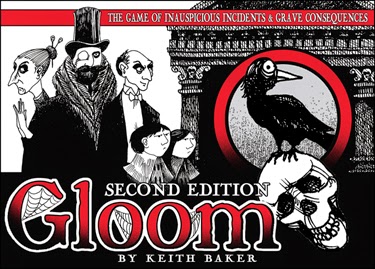
(Original RSS Post)


08 May 22:09
Eve Online permanently bans three players for defacing Iceland monument
by Alexa Ray Corriea
firehoselol already
CCP Games permanently banned three players for vandalizing the Reykjavik, Iceland, monument commemorating players of Eve Online, according to a post on the game's forums from community manager "CCP Falcon."
The monument, which was unveiled a little over a week ago before festivities kicked off for Eve Fanfest 2014, was vandalized shortly after the expo ended. A sticker bearing the insignia of one of Eve's in-game factions, the Goonswarm, was placed on the monument's face and one player bragged about having scratched out the name of another player.
In his post, CCP Falcon stated that Eve community members helped track down those responsible for the vandalism, including players complicit with the vandalism and members of the vandals' alliances. Falcon called the monument's defacing an insult to the entire Eve Online community, and said CCP Games will "continue to operate a zero tolerance approach to dealing with harassment and victimization in the Eve Universe."
As a result, three players — with seven Eve Online accounts and one Dust 514 account between them — have been permanently banned from Eve; another indirectly involved with the incident is facing a six-month ban. These four individuals, whom Falcon refused to name, are also blacklisted for life from future Eve Fanfest events.
"While the community has been justifiably outraged and a number of people have requested that we release the in-game identities of those who carried out the act, we feel that this would be contrary to our privacy policies," Falcon said. "As such we will deal with this incident in line with our current policies, and the identities of those responsible will remain confidential.
"With this in mind, we now consider this issue resolved within the Eve Universe, and any further action taken outside the virtual world relating to criminal damage or recovery of costs for repairs to the Eve Universe Monument will remain confidential between CCP Games, the authorities and those involved," he added.
For a more in-depth look at CCP Games' Eve Online monument, check out our coverage from Eve Fanfest 2014.
firehose likes this
08 May 22:07
Oculus Rift can now be used to simulate being a bird
by Alexa Ray Corriea
firehoseberd simulator
A group of deisgners at Zurich University in Switzerland have figured out a way to simulate bird travel using the Oculus Rift virtual reality headset: meet Birdly.
Birdly uses the Rift, along with a fan, scent machine and rather complex setup to make players feel like they're birds. Players "flap" their wings by laying stomach-down on the mechanism and pushing down with their arms. Through the Rift, players can view terrain from a bird's perspective and using the team's mechanism players can control where they go by tilting their hands.
The fan adds the wind-in-your-face (or feathers) effect, and the scent machine adds a smell component to up the realism factor. Players will be able to smell their environment as they fly through, dodging other birds and checking out the farmland and mountains spread out below.
Check out the video above to see the Birdly project in action.
08 May 22:06
Former Civ IV Lead On Strategy’s Future, Making Another Civ
by Nathan Grayson
firehoseshared for "Baton Roguelike, Louisiana."
By Nathan Grayson on May 8th, 2014 at 7:00 pm.
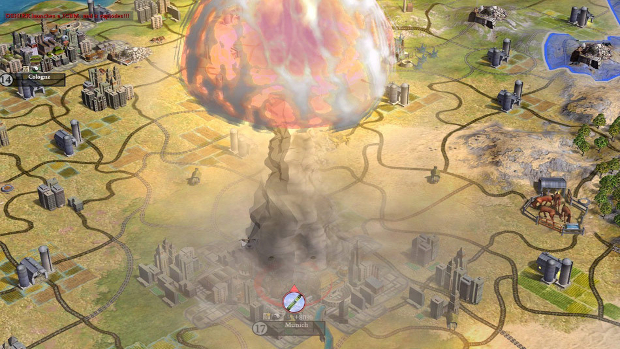
Once upon a time, Soren Johnson was the main brain behind Civilization IV. Now he has a mohawk. An indie mohawk. Also, he’s making a game about managing a crazy intricate (yet disarmingly accessible) economy on Mars. Last time around we talked about how a Mars economy simulator even works, boardgames, and the current state of strategy gaming, and today we continue that discussion with the future of strategy (and its alleged “death”), MOBAs, the advantages and disadvantages of working at a company like Firaxis, whether or not Johnson will ever make a game on the scale of Civilization ever again, and why Johnson is *glad* that big publishers aren’t paying attention to strategy games. It’s all below.
RPS: Your setting is Mars, but what kind of Mars? Because there are lots of Mars-es. Wacky Mars, pseudo-realistic Mars, entirely realistic Mars which is completely dead and really boring, Mars bars, etc.
Johnson: I think we’re probably somewhere in the middle. It’s not really hard sci-fi. The reason you colonize Mars is so you can supply food to people in the Asteroid Belt. You have people on Mars. They create water and oxygen and food, and they ship that to the Asteroid Belt, because Mars is a lot smaller than earth. It cost a lot less fuel to get ships off of Mars than Earth. So even though obviously it’s a lot easier to grow food on earth, it takes a larger amount of fuel to escape Earth’s gravity. So that’s theoretically one of the ideas behind the usefulness of Mars.
Though at the same time, we have some somewhat goofy technology. Teleportation, perpetual motion, cold fusion, just some stuff that type of futurism and whatnot. It’s not something I would ever put forward as, “This is an educational game about Mars.” It’s just a nice setting. What I really like about the setting is it’s a plausible empty environment that will get developed quickly with modern stuff. We could theoretically make this game in the new world of 1500, right? But you don’t really have an energy market to produce interesting resources quickly. Things happen a lot more slowly. This is a nice place to be able to start with an empty map, which is always a real nice thing in a strategy game.
Dorian: I think of it a little bit like a Firefly world, where you have sort of the wild west. Where you imagine Mal came from. Where they talk about his journey of having a pirate ship. That idea of it’s sort of the wild west, and it’s an emerging market. What you’ll learn isn’t so much of the actual practical details of space exploration. I think the actual education is a free market situation.
Johnson: To appreciate what supply and demand really mean. What happens when only one person has a specific resource?

Dorian: That’s how I imagine people rushing to California, and a lot of the West pops up. In the Asteroid Belt you have the platinum market, or the precious metals. The newly discovered metals that are now being used for all electronics are being mined in the asteroids. So you have a bunch of guys there that have nothing to spend their money on except the goods coming from Mars. That’s the opportunity.
Johnson: I could probably talk about this for awhile because I have a lot of experience working on Civ, and people looking at it as an educational game. I think one of the big mistakes when you look at games in terms of education is people often think it should be about teaching facts. You get this specific information into the players’ heads. That can happen in games, but what games really do is make you experience something. You get the feeling of what it feels like to be running a corporation that doesn’t have enough food, and the price is going up, and what are you going to do? Just internalizing that feeling, which is something that’s hard to do in a documentary or whatever, but easy to do here.
RPS: I agree with you, definitely. I think it’s kind of a problem with education at large, is that it’s, “Fact. Fact. Fact. We won’t really teach you anything else. Just facts. Now ace that test full of information you’ll never see again in your entire life.”
Dorian: I played the game Papers Please, and completely loved that. None of those are actual states that you could live in, but I felt like I learned a lot more about the plight of someone in a very oppressive but organized society, and it wasn’t because I got more information. It was that they instantly motivated me in a very mundane way, and all of a sudden I was doing my job even though I didn’t believe in my job. And I was like, “I just learned a tremendous amount.” I could go and do research on what had been going on maybe in Russia. And it inspired actual learning on my own. Education should inspire you to self-teach, to self-learn.
RPS: Definitely. I think the best thing school, or really any form of education can do, is teach you to be a lifelong learner. To be interested in just learning stuff, thinking abstractly, being fascinated by everything. Unfortunately, it sometimes seems like people want the opposite out of games. Or at least, that’s what the mainstream perception seems to be – that people don’t want to struggle with complex systems in strategy games. That they’d prefer to just blast everything and move on to a different corridor with exciting new chips in its gray paint. Strategy’s definitely not dead, but it doesn’t seem as prominent as it once was.
Johnson: It’s a production cost issue, I think. At this point game budgets have gotten so high that the only strategy games we can keep going are the ones that have already succeeded. And every once in a while one of the franchises kind of blows it. I can’t name any names, but there’s some where they had a couple bad ones and that was it basically. Each one of them that goes, there’s only so many left, right? I mean now you’ve got Civ, you’ve got Starcraft, you’ve got Total War…

Dorian: XCOM jumped back into the mix.
Johnson: The rebirth, yeah. So it’s possible. We can tell you from time and practice, it was a long process trying to get that to go. I left before the version of that that came out really started. But even before that it was years trying to get a project like that off the ground. That was still a struggle.
Dorian: Ultimately, it became problematic in my mind when I was at Firaxis, because the president of the company. When XCOM was being developed, I was watching this great game being made, there was a lot of passion. And he does an interview and in a throw away statement he says, I don’t know the exact quote, but basically strategy games aren’t as relevant. They’re not contemporary. And that’s a real kick in the ass to a studio, or to any human being that’s really pouring their energy in to that.
I would watch the XCOM team, and they were spending a lot of hours really trying to make the best game they could. And you’d have the guy that’s in charge leading your way, and he says something that’s a little bit of a downer. But the thing was, I don’t think he meant it mean. I really think he just believes that’s the direction. The direction of games, in a lot of companies minds, is that they’re more action oriented, more experiential, they’re more in the moment, they’re more like The Last of Us. And they’re less like a Civilization title, or less like an XCOM title.
Johnson: People who play strategy games have this common lineage that you just don’t find among big publishers. They don’t get it. It’s not in their bubble. The strategy games that are going to be interesting and important are going to bubble up from unexpected places. They come from indies, or they’re going to be like DotA, which sprung from a mod. They’re going to come from places that we aren’t aware of yet.
Dorian: But the other thing is, usually, there’s a history of genres becoming really popular, and then leaving for awhile. And usually that’s the moment when it’s the best time possible to make them. Games tend to be cyclical, like XCOM came back. There’s a period where people forget, “Oh these were fun games. I remember playing that game.”
RPS: Remember when people didn’t like roguelikes for 20 years?
Dorian: Yeah! And now they’re my favorite thing.
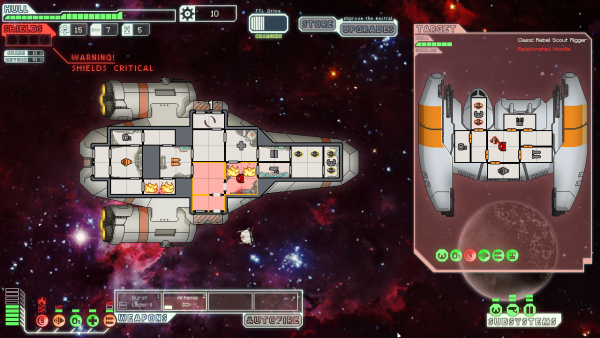
RPS: Now everything is a roguelike. I’m a roguelike. You’re a roguelike. This is Nathan Roguelike, reporting to you live from the Roguelike Center in Baton Roguelike, Louisiana.
Dorian: It’s almost unfortunate because not every game should be. Anyway it’s that idea that I think it’s an interesting time to come back with strategy games as a… well we’re not coming back to it but it’s an interesting time to think about it as important. More important now than ever, because they’re a little bit more than they were in the past. Like studying art history, there are trends in art history like that.
Once a movement is declared as dead, that’s the best time to be doing something in that.
Johnson: We’ll say it straight, we don’t want the big publishers to be paying attention to strategy games. We’d rather them think that no one wants strategy games, move along. Because it just creates a lot of opportunity for us, right? There’s not many people making games for fans, and of course strategy gamers.
RPS: Triple-A has also become increasingly layoff heavy, to a point where I think it has to affect creativity and team-building, if only because it’s frequently so sudden and unexpected. I hear far too many developers say, “We found out when you did.” Having worked for so long in triple-A, what do you think needs to change on that side of things – especially in regards to strategy?
Johnson: Well I definitely think it’s detrimental. I mean that’s why I don’t want anything to do with it. That’s why we started a small company, and we’re going to be very hesitant to grow much larger than we are now. If we need extra resources there are great people you can work with, who live somewhere else in the world, that just want to work on your project for a while as a contractor and contribute what they do, and then they can do multiple things at the same time. There are a lot of people out there who are doing that between major projects.

But when you’re taking about these huge games, the one’s that require two, three, four, five hundred people, and to be clear it’s almost beyond what I see or experience myself. Spore was maybe about a hundred people, and that seemed needlessly large at the time. That’s not even a team anymore. It’s kind of mind boggling to me, and I still don’t have an answer for that.
I think the studios are trying to do the best they can. I don’t think anyone wants to be forced to lay off people in this kind of cyclical nature. But the reason you have that many people is you have a lot of content to create, and there are moments in a games development when it’s ready for that. You’re like, “Ok, we’ve got something for all of these people to do.” The problem is there’s someone else out there who’s laying the tracks, and you’re ahead of time, trying to figure out what those guys are going to be doing next year. What are they going to be doing the year after that?
It’s very easy to slip into the situation where you’re like, “Wow, we’ve got 50 artists and we don’t really have a use for any of them right now.” It’s tough. The Hollywood model works for them because you get everyone in one place, and it’s kind of an assumption that you join one project. Everyone is a contractor.
Dorian: But it’s also that, Hollywood has unions, there’s the knowledge that you’re working for hire, and the work is smaller scope. Unless you’re in the special effects industry, and that has gone through a similar cycle as with the game industry, almost everyone else on a film production crew is there for 6 weeks to 6 months. That might be the scope. So you know, “Here’s my gig. In the future I’m going to line up this other gig.” And good directors have crews that they tend to work with exclusively. If a director has a special film, he always checks out that same crew, and they might make twice as much, three times as much because they’re contractors, not salaried.
In the games industry you have the problem where you’re hiring people on salary, so they’re not really set up as contractors. That means their insurance is tied with their jobs. There’s not a union that protects their wage things, or negotiates that stuff. A lot of times it’s a long term project, it’s a 3 year project. It’s usually a surprise when it happens. Part of the makeup of corporations are they sort of want to surprise people with layoffs so people wont think they’re bad to their employees. So all of those things combined create a very different environment than the one in Hollywood. But, the special effects industry is going through the same issue, because there are no unions, there’s no protection. You can have an effects company that gets an academy award, and they’re closed down the next week.
Johnson: It seems obvious to me, talking about having 500 person teams, and people doing very very specialized jobs, yeah there probably should be a union. That’s kind of a situation where you need one. But you know, the truth is, if that happens games are just going to get more expensive. Which , I would prefer for there to be a union. I want for the game developers to have a good situation, but that’s a challenge for the industry right now. Games are already expensive. That’s limiting their diversity, and that’s limiting their ambition.
Dorian: Ultimately the fear of not making money is greater than the fear of laying people off. And I almost feel like entertainment companies inherently shouldn’t be publicly traded, because there’s a huge risk. And a lot of times, is you look at movies that succeed or don’t succeed… No one really thought Avatar was going to be a top selling movie, nor did they think Passion of the Christ was going to be a top selling movie. Like no one would say, “Blue things in space, or the retelling of Jesus’s last 12 hours. Those would be the ones that are going to be solid gold.”

Because of that the risk and reward is so asymmetric, investors like predictability, and entertainment at it’s nature is hard to predict. Or the more predictable you make it the less entertaining it is. So we have a situation where the only way to really raise capital is to go public, and there’s a lot of incentive to push people into the public. So that’s also a big problem as well in the industry itself. That’s why staying small and independent is very desirable because you’re, “Ok, that game didn’t work as well as we liked. But no one has an investor who’s really mad about that.”
Johnson: It’s just such a great time right now to be indie, because the tools are good enough now that we’ll never be able to make our game look as good as a Blizzard game, but we’ll be able to get close enough that it doesn’t necessarily matter. And when you’re comparing 5 people to 500 people, the differences that come into that are so enormous.
Dorian: When companies get larger, inherently they get a little bit slower.
RPS: So many people are flowing from triple-A to indie, as you’ve said, there are clear reasons why. Do you think the tide will ever turn back the other way? Will triple-A regain its footing as a place where creativity and job security, er, exist?
Dorian: I think it’s still a viable option for talented people. The real issue is, the majority of people who make games, that’s where it’s an issue for them. I think that if you’re recognized as being a top talent, someone will let you come in. You may not have the ability to decide what you do next, but you will be paid to do what they want you to do really well. If you’re starting out and you’re portfolio is hot, you’re from a design school, you’ll get an entry job.
But it’s the people that are in the middle that don’t really have a hold on their future, don’t necessarily have a sail for what they’re doing, have dedicated a lot of their time and energy, and are quite good, but they’re not quite recognized as the decision makers. Those are the folks that the game industry really burns out. And those are the people that you really want to connect with. Those are the people that I’d try to hire. I want someone who loves games, is really good at what they do, and hasn’t had a huge opportunity to help make decisions. They’ve been kept out of the loop.
In some degree that’s the kind of person that Valve hired. They hired amazing people that didn’t have a say over what they wanted do, and they said, “Why don’t you join us, and make games with us?” It’s unfortunate that the largest companies can’t offer something similar. That is the predicament that a lot of people fall into. And I don’t know if the large companies want to actually pivot to give people more control.

I think they could pivot to make different types of games, better games, but the question is what does the game industry look like? Every industry has a decision to make every generation, and in games the generations are about 5 years. The decision is what do we want to look like five years from now? At the moment we have a group of people, I don’t know if they’re deciding this, larger teams, bigger budgets. If the game doesn’t sell five million copies it’s a failure.
And then there’s a bunch of people that are placing these small side bets. Small teams, independent games, and in five years this is great regardless of what happens, because you sort of need that diversity. When everyone puts all their bets in the same location, it sort of sucks for everyone. In five years we should have a really interesting swathe of games. The thing though is at the end of that cycle, where are the people going to want to work? Where are the environments they’re going to want to commit to? You want to make things that are beautiful, but you also want to have a life that is meaningful outside of your job. So the question is, how sustainable are those two models? Is the indie model going to be sustainable long term? I’m betting that it will be. Is the large company going to be sustainable? Yes, but how is working there going to be? And that’s the conflict.
RPS: You’ve gone indie, and you’re working with a smaller team, is there any desire to eventually do something of a larger scale, having worked on things as immense as Civ? Is there a part of you that misses that?
Johnson: Yeah. I mean I think we can work on things that are of a larger scale, in terms of game design, not necessarily in terms of game production. Especially since we’re strategy games. If our background was more of a content based game, like a Walking Dead game, someone’s got to write all of that stuff, and someone’s got to build every level and design all of the interactions. They consume it maybe once, maybe twice. There you have major production problems, if you want to do a larger scale thing. But Sid [Meier] made Civ 1 by himself back in 1990. So if that’s possible we should be able to make a pretty large scale game with the team we have, with the tools we have, in 2013.
Dorian: On the scope, a lot of it is symbolic in how you decide to portray that information. Interestingly enough, one of the advantages that strategy games have is the environmental scope is small compared with most games. You make a version of a world, and you make it so it’s procedurally driven based on the art that you decide to do, but you can make a lot of different worlds without having to hand craft every scene, building every trash can and streetlight.
Johnson: At it’s core, Civ is, the code is not necessarily all that big. It just generates a lot of interesting situations.
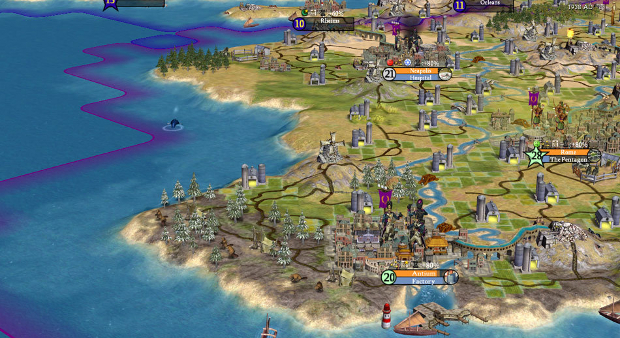
Dorian: But it’s about the experience. The scope is what people feel like they’re going through. We’re definitely equipped to do it, if we have the right symbology we have the right game play, scope isn’t going to be a huge issue. A lot of times strategy games are a diving board for people’s imaginations. They’ll play the game that they really want to be playing. The art is a little bit symbolic. Not that the art is all iconography, but it’s just enough to get you going so that you then know what’s happening, and you develop your own narrative in your mind.
RPS: You mentioned DotA as sort of within the RTS lineage, which I agree with. But it’s interesting in how much of a life of it’s own it’s taken on, because now everyone’s making a MOBA. There was a time when people were like, “Hey let’s make a strategy game of Franchise X.” Now it’s, “Let’s make a MOBA of that.” So what do you think of that? MOBAs definitely contain a lot of strategic appeal. They just centralize it more, whereas before you were juggling multiple units and multiple bases. You get to feel like a strategic mastermind without juggling quite as many factors.
Johnson: Well to me, MOBAs basically ate RTS games. And beyond that kind of exposed on of the big core problems with RTS games, which is that it’s really a miracle that they ever work to begin with. The demands that they put on a player are so high. But at the same time people love playing these large scale strategic, competitive, team based, multiplayer games, right? That’s this wonderful format. You’ve got cooperation, you’ve got competition, you have all this stuff going on on screen. It’s an interesting, deep, complex experience, and by simply making that one shift of. “We’re going to keep a lot of us, but you’re just going to be controlling one character.”
It’s that radical change, that order of magnitude change in the player experience. So it’s kind of an open question of what happens to the classic RTS now? What are it’s purposes? What is it’s point? Because yeah. MOBAs have taken over.
Dorian: But you know, it’s a very different feel. Like learning them. I’m terrible at them. But I felt like it was an exercise in repression. Like my instinct was, “Oh I wanna just go a little bit further!” And everyone was like, “Nooo! Don’t go that far!” So I was like, “But I just want to… Ooooh gosh. I just went and killed someone!” And they’re like, “Stop it. You’re an idiot.” “Ooooh ok.” But you know, with an RTS the instinct is, “I’m just gonna make 50 things and throw them here.” And MOBAs are a lot more restrained.
I think there’s room for both, since the experience is so radically different. The problem is that MOBAs were much newer, and they innovated in some ways that were really strong. They managed making learning things not just a wall of garbage. It made it a little more like football. It’s got a very football feel. “We’re gonna get the first down, but not too soon. We’re gonna use all our downs before we get our first down, and we’re gonna run it in.”
I think the cool thing is it is a different experience, but that different experience then becomes, “I’ve played that a thousand times.” And at some point really good players that love it will have played it a thousand times. Then they’ll play it two thousand times. Then there will be small little innovations made along the way and they’ll be like, “Well, I’d like to try something new.”
Johnson: There will definitely be an opportunity for RTS games, a few years down the road, as they sort of disappear. And whoever tries to make those types of games really needs to think what’s that core part of an RTS that’s really important, and what are the parts that we can leave behind?
RPS: You’re focused on RTSes right now, but do you think you’ll ever go back to making turn-based games? I actually feel like they’re right on the verge of a renaissance right now, given how well they lend themselves to asynchronous play across long-distances, boardgame-like experiences, and tablet/mobile interfaces. Might not be the exact sort of TBS I want to play, but I can’t deny that the makings of widespread appeal are there.
Johnson: I expect at some point. We’re going to make strategy games, and turn based, and RTSs. I love both, so I’m sure.
RPS: Lastly, you have a mohawk now. Have people treated you differently?
Johnson: Ummm, not as much as I expected. I mean we are in San Francisco, so…
RPS: Yeah, you do see a fair number of them around here.
Johnson: Actually I think I saw about 4 or 5 mohawks the other day. I was like, “Awww…”
RPS: You look even more normal than you used to, basically. You can blend in anywhere.
Johnson: That’s my plan.
RPS: That’s what you should do next. You should make a real time strategy game about having a mohawk. Real-time mohawk management. Thank you for your time.
08 May 21:49
Never Alone, A Platformer Telling Native Alaskan Folklore
by Alice O'Connor
firehoseooooooooooh
By Alice O'Connor on May 8th, 2014 at 8:00 pm.

One of the many wonderful things about games is that they can be a fine way to tell stories we don’t often hear, bringing them to new audiences and drawing people into the tale. A puzzle-platformer with co-op and a pretty art style is interesting enough in itself, but Never Alone is also being used to transmit culture and folklore of the Iñupiaq and other Alaska Native people. A new trailer gives a peek at the sorts of beasties it’ll introduce to us.
Never Alone (Kisima Ingitchuna in Iñupiaq) sees young girl Nuna and her fox friend off adventuring over ice floes, through forests, and across tundra. (In single-player you can switch between them, while they’re split up in co-op.) Along the way, they’ll come across folklore characters, some of whom sound more friendly than others, like Manslayer, Blizzard Man, Sky People, the Little People, and the Rolling Heads. I know nothing about any of these, but who wouldn’t want to learn about the Rolling Heads?
“For thousands of years we told stories from one generation to the next,” the announcement trailer explains. “Our stories help us to understand how the world is ordered and our place within it, but what good are old stories if the wisdom they contain is not shared?”
Never Alone’s being made by Upper One Games, a studio founded by the Cook Inlet Tribal Council, including several Iñupiaq elders and storytellers. It’s due later this year, to cost $14.99.
For some mysterious reason, embedding is disabled on the new trailer so go over here to watch it.
__________________
Tertiarymatt and -1 others like this
08 May 21:48
Goat Simulator's surprising setting explains why its world is so weird
by Megan Farokhmanesh
firehose'the idea sparked from the goat's longstanding role in animal sacrifice.
"Goats have always been a known and common sacrificial animal," Ibrisagic said. "Even the origin of the word scapegoat comes from ancient sacrifices."
Himlen and Helvete's presence explains the appearance of the Devil and Angel goats in the game, as well as the pentagram players can experiment with. Goathenge, a circle of tall stones, is located closer to Hell; players can trash the circle for an achievement. According to Ibrisagic's original post, this symbolizes "the backwards and old ways of humankind that need to be destroyed for progress to be made."
"The Beacon is closer to 'Himlen,' symbolizing research, progress, and hope," Ibrisagic continued. "The trap once you go to space shows that we must not rush things before we are ready."
As for who your goat really is, the implications are a little bleak. When asked if the game's goat was once human, the developer pointed to his original statement and the mention of "other" humans.
"You might also notice that, no matter what you do, you can never interact with humans," Ibrisagic wrote in his post. "If you lick them or even touch them a little bit, they will instantly go limp. If there are any humans nearby, they will run away from you. When it comes to other humans, you are always the onlooker, always staring from a distance, never part of the group. Always alone."'
Goat Simulator might be one of the most ridiculous games to be released this year. It stars a rollicking goat in an experience that developer Coffee Stain Studios happily describes as players doing "stupid shit." It's goofy, it's weird, and its cheerful madness takes place in a very unexpected place: Purgatory.
Developer Armin Ibrisagic recently revealed the game's surprising setting in response to one fan's theory on Steam. Pointing to the game's "Himlen" and "Helvete" signs, he explained that Google Translate will reveal their true meanings — Heaven and Hell, respectively. Speaking with Polygon via email, Ibrisagic assured us the backstory is "totally real," adding that Coffee Stain is surprised players didn't figure it out sooner.
"Once the Devil and Angel goat were in, along with the Heaven and Hell road signs, we felt it was kinda obvious," Ibrisagic said. "We can't believe you guys didn't see it, it was all there! ... The world is so strange that people should have noticed that something wasn't quite right about it."
"You are always the onlooker ... Always alone."
The game's Wiki, Ibrisagic said, which briefly mentions the Heaven and Hell symbolism, fails to encapsulate the game's hidden meaning. According to the developer, the idea sparked from the goat's longstanding role in animal sacrifice.
"Goats have always been a known and common sacrificial animal," Ibrisagic said. "Even the origin of the word scapegoat comes from ancient sacrifices."
Himlen and Helvete's presence explains the appearance of the Devil and Angel goats in the game, as well as the pentagram players can experiment with. Goathenge, a circle of tall stones, is located closer to Hell; players can trash the circle for an achievement. According to Ibrisagic's original post, this symbolizes "the backwards and old ways of humankind that need to be destroyed for progress to be made."
"The Beacon is closer to 'Himlen,' symbolizing research, progress, and hope," Ibrisagic continued. "The trap once you go to space shows that we must not rush things before we are ready."
As for who your goat really is, the implications are a little bleak. When asked if the game's goat was once human, the developer pointed to his original statement and the mention of "other" humans.
"You might also notice that, no matter what you do, you can never interact with humans," Ibrisagic wrote in his post. "If you lick them or even touch them a little bit, they will instantly go limp. If there are any humans nearby, they will run away from you. When it comes to other humans, you are always the onlooker, always staring from a distance, never part of the group. Always alone."

The game's symbolism extends beyond the afterlife as well. Many events or occurrences in the game are allusions to real-world happenings — notably the turbulent protests taking place in Ukraine. Players can see the in-game disturbance for themselves in the form of the demonstration taking place on the Helvete side of the map.
Coffee Stain Studios has no connection to protests in Ukraine or any of the developers there, Ibrisagic said, but the team was looking for a way to represent current events.
"Our idea was that, since we we could reach so many people with Goat Simulator, we should tie some of the in-game content to real life things," Ibrisagic said. "Many gamers choose to ignore things like the Ukraine crisis, so we thought we'd find a way to engage them using gaming as a media."
Calling the Ukraine demonstration just "the tip of the existential iceberg," Ibrisagic added that players who look can find other ties.
"What do you think the driver doing donuts in the crop field symbolizes?" the developer told Polygon. "And the people watching, eating and cheering him on?"
For now, Coffee Stain Studios isn't talking.
Tertiarymatt, firehose likes this
08 May 21:42



Thursday Dealmaster has a convertible Lenovo Ultrabook for $679
by Ars Staff
firehosethey dropped that Lenovo Haswell i7 touchscreen laptop another $100 by swapping the horseshit 5400 rpm 1TB HDD for the way more logical 500GB+8GB hybrid drive
The i3 and i5 are still $549 and $649 respectively
Greetings, Arsians! Our partners at LogicBuy are back with some more deals. Did you like last week's convertible Lenovo ultrabook? Well, if you held off, this week it's back—and even cheaper.
Featured deals:
- Lowest Price Ever! Lenovo IdeaPad Flex 14 Haswell Core i7 Convertible Touch Ultrabook (Model# 59405151) for $679 with free shipping (normally $999)
- Rare Discount! Lenovo ThinkPad X1 Carbon 14" Core i5 900p Ultrabook w/ 128GB SSD for $1133.10 with free shipping (normally $1259)
Laptops, desktop, and tablets
- Save $1000! Alienware Aurora r4 4th-gen Core i7 Gaming Desktop (Liquid-cooled) w/ Dual GTX 770 SLI & 32" UltraSharp 4K Monitor for $4448.99 with free shipping (normally $5448.99 | use coupon code F?1B57MDNF8TCW)
- HP ENVY 700-215xt Core i7 Desktop w/ Windows 7 for $679.99 plus shipping (normally $849.99 | use coupon code SAVE20WIN7 )
- Price Drop! Dell XPS 8700 Core i7 "Haswell" Quad-core Desktop for $674.99 with free shipping (normally $899.99 | use coupon code F?1B57MDNF8TCW)
- Dell Optiplex 7010 Core i7 Quad-core Mini Tower (+ 30% off upgrades) for $799 with free shipping (normally $1303.14 | use coupon code DM8KN1B9J9BDM7)
- HP ENVY 17t-j100 Leap Motion 4th-gen Core i7 Quad Edition Laptop for $839.99 with free shipping (normally $1049.99 | use coupon code PCQD5411)
Computer Accessories
- BitFenix Mini-ITX Tower Case for $79.99 with free shipping (normally $89.71)
- WD Green 4TB Desktop Hard Drive (WD40EZRX) for $155.89 with free shipping (normally $249.99)
- Alienware TactX Gaming Keyboard for $59.99 with free shipping (normally $79.99)
- Jawbone Big Jambox Bluetooth Speaker for $244 with free shipping (normally $299.99 | use coupon code DIG5)
- Lowest Price Ever! HP ENVY 27 IPS-panel 27" LED-backlit LCD Monitor w/ Beats Audio for $302.48 with free shipping (normally $449.98 | use coupon code ACE8477)
Printers
- Dell C1765nfw Color Wireless Printer for $260.99 with free shipping (normally $379.99 | use coupon code ZJC7VXX4B3S4CT)
- HP Officejet 6600 e-All-in-One Printer for $119.99 with free shipping (normally $149.99)
HDTV and home theater
- LG 55LM4700 55" 3D 1080p 120Hz LED HDTV + Sound Bar System + (4) Pairs of 3D Glasses for $949.99 with free shipping (normally $1649.99)
- Samsung UN60F8000 60" 1080p 240Hz 3D LED HDTV for $1879 with free shipping (normally $3499)
- Sharp AQUOS LC-60LE600U 60" 1080p 120Hz LED HDTV for $899.99 with free shipping (normally $1599.99)
Office Furniture and miscellaneous
- Ergocraft Suzanne Workstation for $297.99 with free shipping (normally $630)
- Office Star 5-Shelf Tier Corner Bookcase for $50.99 plus shipping (normally $165)
- Keurig Rivo Cappuccino and Latte System for $299.99 with free shipping (normally $309.99)
- Lasko High Velocity Floor Fan for $68.14 with free shipping (normally $89.99 | use coupon code KMART5OFF50)
- iRobot Braava 320 Floor Mopping Robot for $179.99 with free shipping (normally $199.99)
Read on Ars Technica | Comments
08 May 21:40



Poll links “frequent” US gamers to libertarian political stances
by Sam Machkovech
firehosere: the content
The June issue of Libertarian-leaning magazine Reason reinforces a bunch of bad gaming stereotypes with its cover, but at least it puts the guy in a nice suit!
This month’s issue of the libertarian political magazine Reason is dedicated to video games, and unsurprisingly, the issue’s massive spread of gaming stories all reflect a common political spin. For example, the “first out-and-proud gamer” in the House of Representatives talks about his libertarian ideas, a column decries the idea of tax breaks for game studios, and a best-of list aims its criteria at games “every Libertarian must play.”
The issue also includes one of the most pointed political surveys about self-proclaimed gamers’ political leanings in recent memory. According to two Reason-Rupe polls conducted in December 2013 and April 2014, gamers are more likely to fall in line with libertarian beliefs, even if they don’t identify as libertarians.
The random-call phone poll focused on the 16 percent of its 2,014 American respondents who self-identified as “frequent” gamers. When asked to identify their political affiliation, the gamers were more likely to call themselves independent (55 percent) versus non-gamers (41 percent), while fewer called themselves Republican (15 percent of gamers versus 26 percent of non-gamers). Both populations were relatively even about identifying as Democrat, though independent gamers were more likely to lean Democrat when pressed to pick a side. In addition, the gamers were much more likely to describe themselves as liberal than non-gamers (32 vs. 21 percent), and less likely to describe themselves as conservative (17 vs. 33 percent)
Read 6 remaining paragraphs | Comments
08 May 21:38
Russell Westbrook has gone full supernova
by Ethan Rothstein
firehosethis is a banner year for dudes with 0 on their jerseys doing insane shit from the arc
The Thunder's mercurial point guard has wrested the spotlight away from his MVP teammate through sheer force of will and with absurd amounts of intensity. Just look at this.


08 May 21:35

Why was Damian Lillard so open on his buzzer beater to beat the Rockets?
by Doug Eberhardt
firehose"Look how chill Dame is"
he is asleep
if Parsons takes his hand off him Dame falls over snoring
Damian Lillard's shot to beat the Houston Rockets will forever live on in NBA Playoffs history, but how did he get so open? It was through a combination of great individual play and poor Houston defense.
I've had the opportunity to write about various after timeout plays for most of the NBA season. ATO design. ATO execution. How to defend them. What works. What doesn't work. Which coaches are best at drawing them up.
But all the best ATOs have extremely talented players reading to what the defense has given them like a great actor reacting to an inspired improvisation. For all of the brilliant ATO coaching Xs and Os, success usually comes down to incredible individual talent molded into team execution.
Portland Trail Blazers coach Terry Stotts has been a repeated "ATO of the Week" winner this season. Stotts has shown a creative mind while identifying opponents' defensive tendencies and exploiting assorted favorable mismatches. He's used excellent screen the screener action, weak side misdirection, over the top alley-oop plays and even the inbounding man becoming the shooter ("The most dangerous man on the floor," in Hubie Brown parlance).
But in this week's ATO situation, the game winning -- nay, series winning -- action was the result of an All-Star player recognizing an instant opportunity and using his speed and skill to destroy an ill-prepared defense.
How did Damian Lillard get so open? Let's walk through the play.
After a crazy series of plays that ended with Portland's Robin Lopez bumbling a rebound right into Chandler Parsons' handsome hands for the go-ahead bucket in Game 6 of the team's first-round series, Portland called timeout with just 0.9 seconds remaining on the clock. The Blazers are two points down with just enough time for a potential catch-and-shoot situation.
Portland came out of the timeout with Nicolas Batum taking the ball out of bounds at the 28-foot mark. Houston goes big on the inbound, with Dwight Howard blocking the sun. LaMarcus Aldridge set up at the low block and was covered by James Harden. Yes, James Harden, the defensive sieve. The Portland guards -- Wes Matthews, Mo Williams and Lillard -- were set up in a diagonal line on the far side of the floor. They were covered by Parsons, Jeremy Lin and Patrick Beverley, respectively. This meant Beverley was on Lillard.
While wise sage Hubie Brown is giddy on television that Houston is putting Howard's size on the passer, Parsons recognizes that this defensive setup is a little off. He starts scrambling across the floor yelling before official Mike Callahan can hand the ball to Batum. Coach Kevin McHale has also recognized things might be off with Harden on Aldridge down low and is signaling for a 20 second timeout as well.This is stage one of the Rockets' defensive confusion.
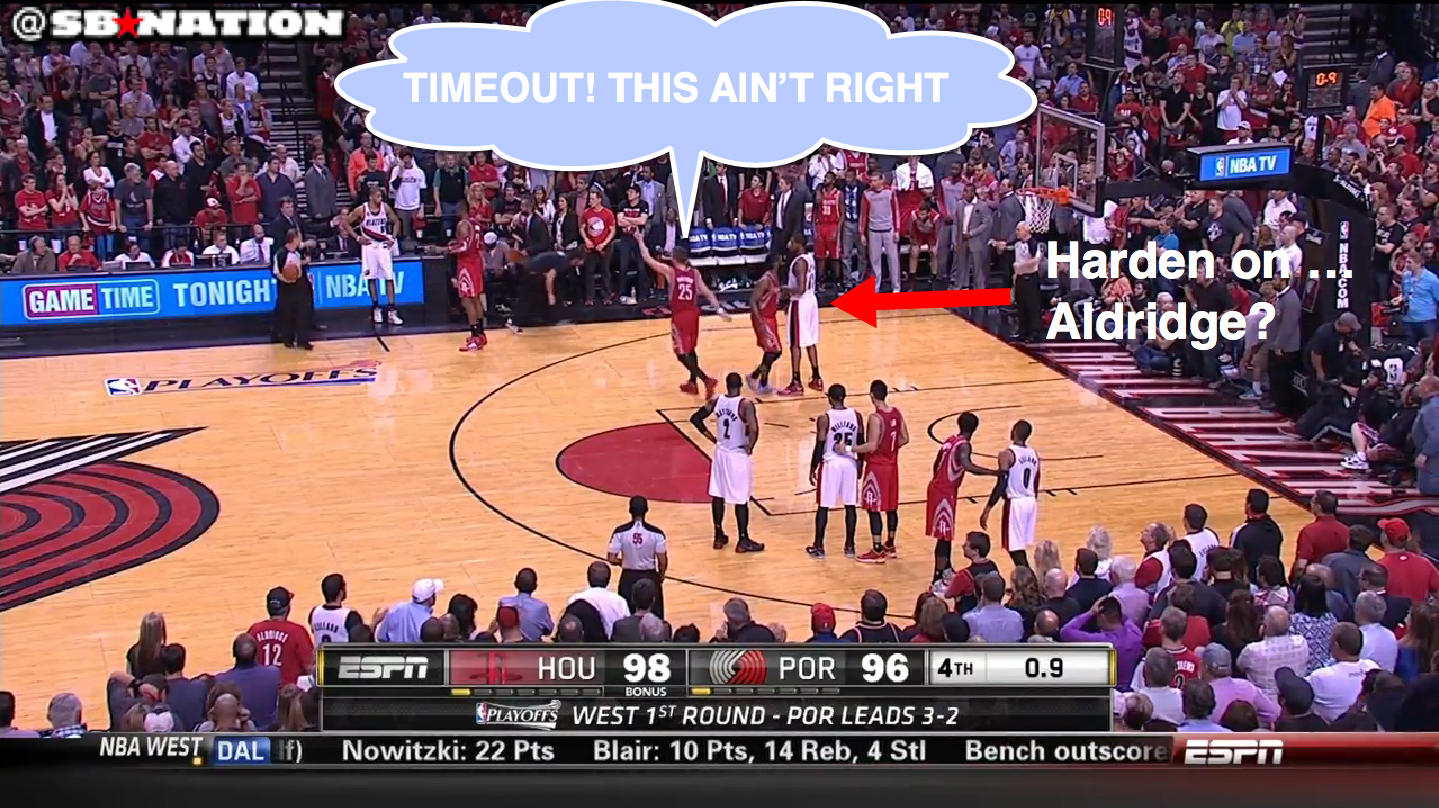
Those are ... less than ideal matchups. Therefore, the Rockets are forced to burn a timeout to get reset.
McHale uses his 20 second timeout to sub in Terrence Jones for Lin. He has also rearranged Houston's matchups by moving Dwight down onto Aldridge in the post and having Jones guard Batum on the inbounds.

Here is the next stage of the Rockets' implosion. As Howard fights to establish position on Aldridge's top side, Beverley and Parsons are in deep conversation about who will cover Lillard. Beverley originally starts on Lillard before he and Parsons switch assignments. This maneuver shouts out that Houston will be switching the any potential screen action that Portland will run.
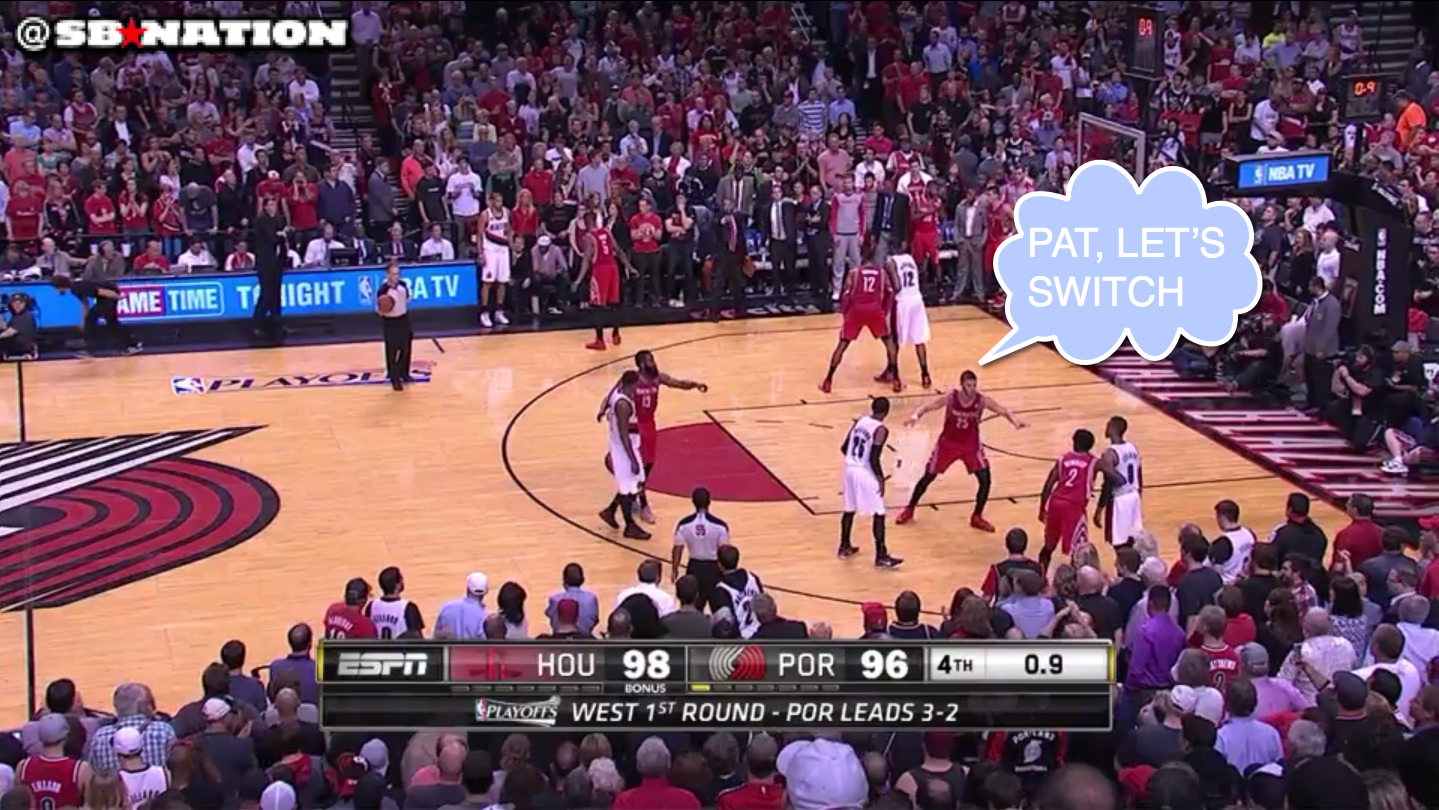
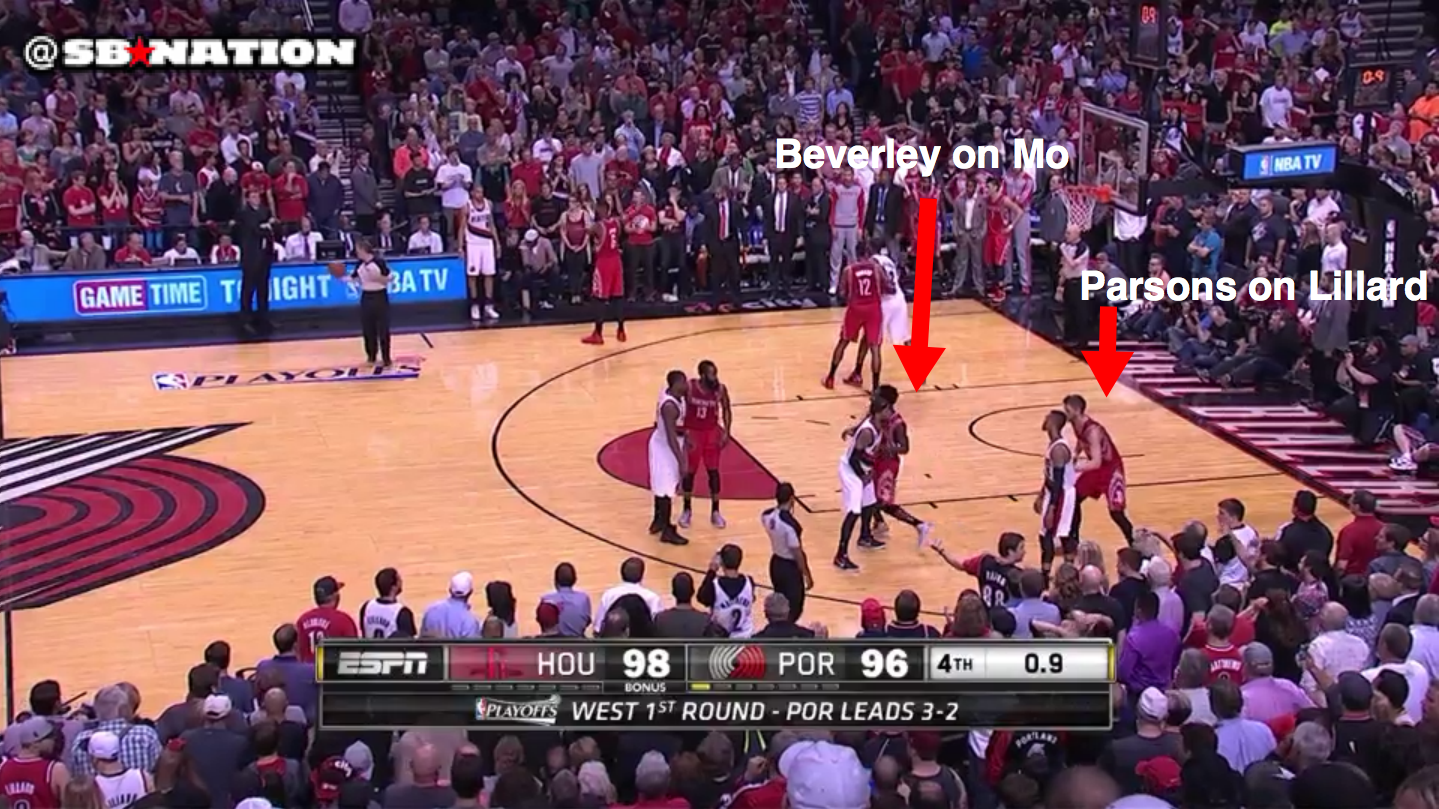
The cast is now set. Jones is on Batum. James Harden is on Matthews at the top of the potential picket fence. Beverley is starting on the rim side of Williams and is also in in an ideal spot to slide under any potential Matthews screen to recover up top if necessary. Finally, Parsons is marking Lillard at the potential "GO" spot of the Blazers' action.
But just before Mike Callahan hands Batum the ball, Lillard does something very interesting. He achieves stillness. We're talking Zen-like, quiet-the-body-and-mind stillness. Deep, cleansing stillness. But when Lillard sees the ball handed off to Batum, he explodes like he has just been shot out of Blazers' t-shirt canon.
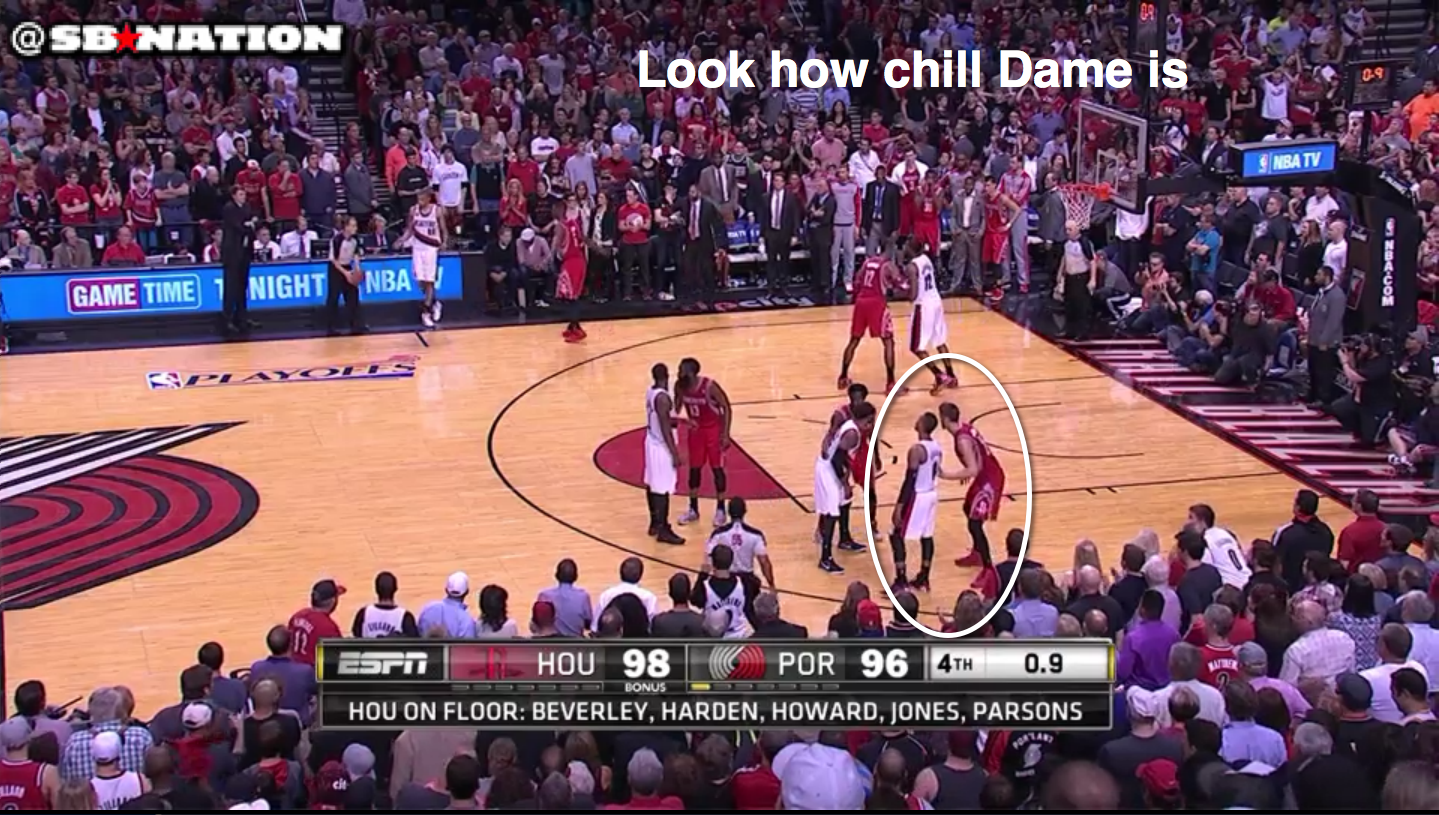

Lillard is wide open after his third step, with Parsons already a full two steps behind. As Lillard reaches his third stride, he frantically starts clapping to alert Batum that he is really open.
Why the clap? Because Batum is locked in on LaMarcus Aldridge in the post. After watching the video a few hundred times, it is apparent that Aldridge was the actual first option on the play. Portland was hoping for a full front from Dwight (which they actually ended up getting) and was looking to go over the top for the tying basket.
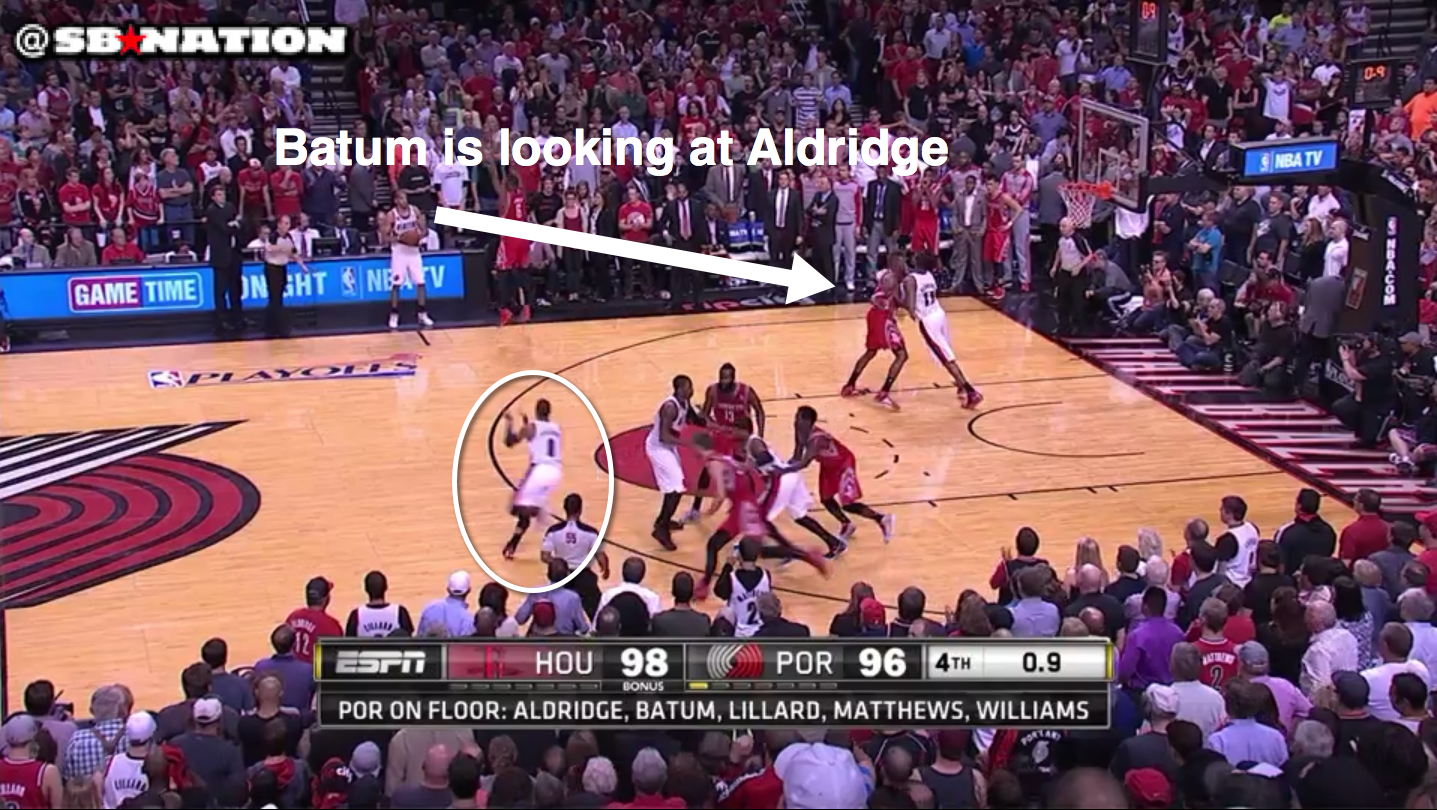
Lillard, the original second option, finally catches Batum's attention and Nic recognizes just how open Lillard is. Batum hits Lillard a tiny bit late with the pass, but still basically in stride. Parsons, who has been playing catch-up all the while, needed two big strides to close out on Lillard. Even then, there is still a big gap between the them.
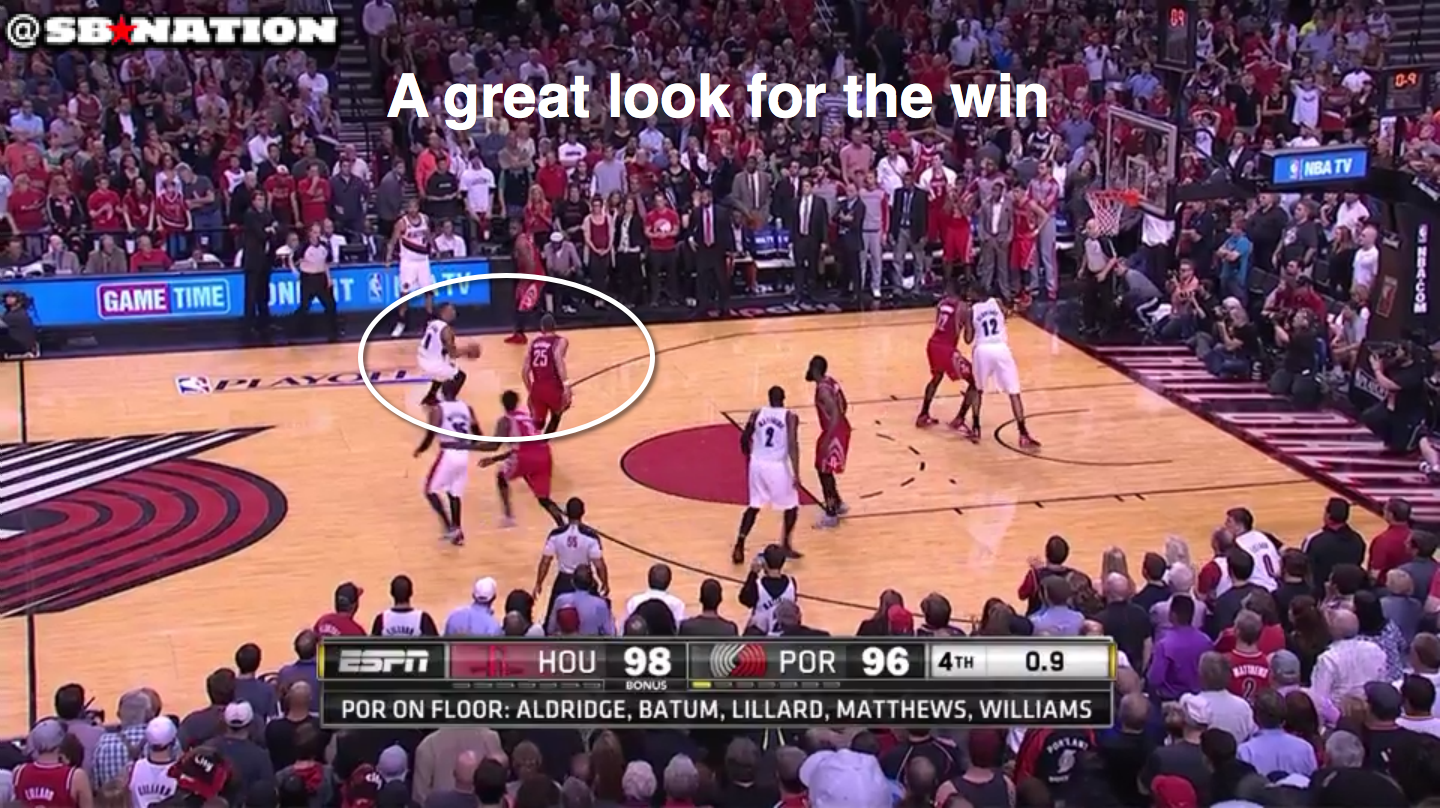
This is the shot every player dreams of making growing up, whether in the driveway or on the playground. Nothing but net for 3. Game. Set. Walk-off.
I don't normally like second-guessing coaching decisions, because as a coach myself, I find it disrespectful most of the time. I'm not in the team's room or in their huddle, so it's often tough to know just what has been communicated between the coach and players.
In this case, though, I'm going to be the good third-party assistant and become a "professional suggester."
The Houston Rockets should have been switching EVERYTHING with their three perimeter players. Hand off the coverage right down the line. You would still be in a position to cover any backdoor lob actions. A skip pass to someone on the other side would be extremely difficult. The last man to switch could push the first cutter, Lillard, higher up the court than he would be comfortable.
Given Beverley and Parsons' first switch before the play even began, it appears that would be the Rockets strategy. Instead, they ended up with Parsons falling way behind Lillard, Beverley locking and trailing on Williams and Harden hugging Matthews like they were waiting for the next Luther Vandross song to come on and end the junior high prom. Confused matchups and an even more confusing strategy led to a lack of communication on D, and that ultimately caused the Rockets to head home.
Houston gave a talented and cold-blooded Lillard an opening. Like A-List actors everywhere, he responded to the directing challenge. Individual brilliance, in this case, won out over ATO design.
If you have an ATO to suggest, please tweet or email me with #ebeATO
firehose likes this
08 May 21:30
A California Carriage House Transformed
by Janet Hall
firehoseffsaucie
 |
Courtney
shared this story
from  Remodelista: Remodelista:
|
| iwtgtt |
After graduating from UC Berkeley with a BA in architecture, Christi Azevedo started her career fabricating limited-edition wood and steel furniture. Over the years, her focus evolved into an architecture practice known for its refined industrial aesthetic. Her hands-on knowledge of fabrication, construction, and materials is on display in her renovation of a dilapidated, 360-square-foot 1908 carriage house in Oakland, California.
Saving as much of the original structure as possible, Azevado used low-budget materials and did most of the work herself with the help of her electrician brother, Craig, and friend Henry DeFauw, an architectural metal fabricator. In the interior, Azevedo retained the original fir flooring and used translucent glass, white paint, and sliding doors to create a sense of space.
To see the Before images of the project, visit Dwell magazine. Photos by Susanne Friedrich and Henry DeFauw, courtesy of Christi Azevedo.

Above: The exterior of the finished project features a copper downspout, new exterior lighting, and a staircase that Azevedo fabricated from galvanized steel and reclaimed wood treads. The exterior is painted Ruskin Bronze by Kelly-Moore.

Above: The dining area has a tiny kitchen tucked in the corner.

Above: The kitchen incorporates steel shelving and accessories from Ikea as well as a custom steel countertop and sink; the under-counter refrigerator is by Avanti.

Above: The translucent glass to the right of the entry conceals the shower

Above: One wall of the bathroom is clad in wood reclaimed from the basement of the main house. The toilet is Toto's Dual Flush Aquia. Henry DeFauw made the toilet paper holder (as well as some of the other hardware). Visit DeFauw Design and Fabrication to see more of his work.

Above; Azevedo used translucent glass to create an architectural (and very visible) shower.

Above: Interior walls are clad in V-groove siding from Home Depot, "a low-grade pine with knots that costs about 70 cents per linear foot," according to Azevedo. "We did some filling and sanding before the final coat to refine the look. The key is to use white oil-based paint."

Above L: An open mudroom is situated just off the small entryway. Above R: An unexpected detail: a pair of toggle switches, one white, one black.

Above: Azevedo's fabrication skills are evident in the steel and reclaimed wood crates she made as under-shelf storage for the project. "They're an interpretation of some bolt bins I saw on a friend's 1940s ferry boat," she says.
For more ideas, have a look at our Small Space Living posts, including a Garage Turned Studio Apartment (and a second standout example on Gardenista). Also don't miss Erin's Expert Advice: 10 Tips for Living in 240 Square Feet.
Browse our Photo Gallery of rooms and spaces for remodeling inspiration.
N.B.: This post is an update; the original story ran on September 13, 2010.
More Stories from Remodelista