The Two Great Ones
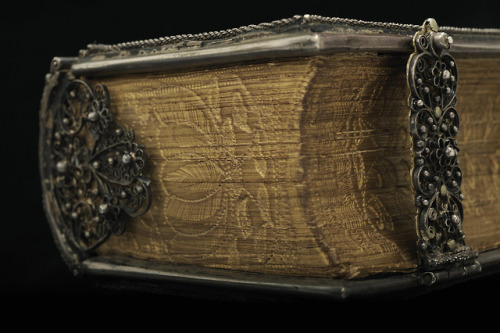


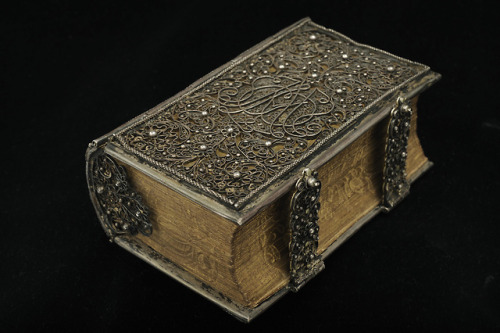
1690s book with filigree silver binding - National Library of Sweden

This binding is an exquisite example of Danish filigree technique
from the 1690s.It belongs to the National Library’s Huseby
Collection and was once owned by Karren Mogensdotter Skoug.
 Her name and the year 1692 are engraved on the inside of the clasps. -(x)

Dudes with Attitude (American Video Entertainment - NES - 1990)
From the moment the initial tapes emerged, people have remarked on the similarity between Clippers owner Donald Sterling's voice and that of the character Master Shake on Aqua Teen Hunger Force. We did some searching through old ATHF episodes, and discovered these similarities are more than uncanny.
Give the above video a watch and tell us that actor Dana Snyder isn't just a pseudonym for ol' Donny.

The MakerBot Digital Store has just announced a licensing deal with Sesame Street. Starting with Mr. Snuffleupagus, this online printed part store offers you a chance to purchase a model of one of your favorite public television memories to run on your desktop 3D printer. It will be interesting to watch this digital marketplace as it begins to launch the licensed designs that have been rumored for some months!
We couldn’t be more excited to announce the childhood classic, Sesame Street, as our first global licensed brand. To celebrate, we’ve added Snuffy to the original, fun, and paintable digital 3D models available on the MakerBot Digital Store. Explore the delightful Sesame Street fun here.
Connecting to Memories
We all remember growing and learning with Sesame Street, but who would have thought you could create one of your favorite characters right at home? Well, today’s the day!
Collect Them All
Mr. Snufflepagus is just the beginning of our Sesame Street offerings. Wait and see who’s next. For now, you can get a jumpstart on this brand-new way of adding to your Sesame Street character collection. You might search high and low for collectibles, but your friends won’t believe where you got this one….


Every Thursday is #3dthursday here at Adafruit! The DIY 3D printing community has passion and dedication for making solid objects from digital models. Recently, we have noticed electronics projects integrated with 3D printed enclosures, brackets, and sculptures, so each Thursday we celebrate and highlight these bold pioneers!
Have you considered building a 3D project around an Arduino or other microcontroller? How about printing a bracket to mount your Raspberry Pi to the back of your HD monitor? And don’t forget the countless LED projects that are possible when you are modeling your projects in 3D!
The Adafruit Learning System has dozens of great tools to get you well on your way to creating incredible works of engineering, interactive art, and design with your 3D printer! We also offer the LulzBot TAZ – Open source 3D Printer and the Printrbot Simple Metal 3D Printer in our store. If you’ve made a cool project that combines 3D printing and electronics, be sure to let us know, and we’ll feature it here!
Human beings are causing mountains in California to rise, according to a new study published yesterday in scientific journal Nature. Geologists monitoring the mountains of the California Coast and Sierra Nevada ranges found that the vertical positions of more than 500 GPS sensors have been steadily increasing by between one and three millimeters every year. The authors of the study blame the rise on the huge amount of water extracted from the area by human hands. More than 160 cubic kilometers of water has been taken from the region for irrigation and other purposes in the last 150 years, a process that has contributed to a net raise in the height of the mountains, and may lead to more frequent earthquakes in the state.
Mountains naturally rise and fall in height with the seasons, as snow and rain compress them in winter, before drier spells allow them to rise again by melting snow and evaporating water. But the geologists behind the Californian study say that the removal of groundwater for human use has reduced the weight on the Earth's crust, and caused the mountains to flex upward at an inflated rate. Colin Amos, lead author of the study, said he and his team had considered other tectonic causes for the year-on-year rise in height, but came to the conclusion that people were involved after modelling the crust in the area. "It looks like the net vertical motion of the mountains upward can be explained just by humans sucking the water out of the ground."
The rise of the mountains may lead to an increase in seismic activity
The study also says the rise of the ranges may cause more earthquakes in the area. Central Californian seismic activity is more common during dry seasons, as mountains flex upward and impact the nearby San Andreas fault, a process described as "unclamping." But commenting on the study in Nature, NASA's Paul Lundgren says that while quakes could be more frequent, they could also be smaller. Lundgren questions the link between the rise in mountain height and San Andreas seismic activity, suggesting that it's unclear whether unclamping will have a long-term impact on the fault, and clarifying that the study "does not imply that a large earthquake is imminent." But Lundgren points to its findings to show the activities of humans can make unexpected changes to our planet. "Whether it's water withdrawal or things like oil extraction," he says, our actions "can potentially have some other unintentional effects."

The Federal Communications Commission is scheduled to vote on a controversial "fast lane" proposal Thursday, and it's inspired a bunch of people to protest by slowing down their own websites.
Last week, a Web hosting company called Neocities throttled its home page, and MaxCDN gave customers the option of doing the same—but this only slowed websites down for people connecting from an FCC IP address. Now, there's an easy way to throttle your website for everyone who visits.
Venture capitalist Brad Feld announced the project Wednesday. There's a Stop The Slow Lane page and a small bit of code on GitHub that inserts the "slow lane" widget on a website.
Read 7 remaining paragraphs | Comments
firehosevia Lori
firehose"Zoe needs to be rescued" fukken unsubscribe
firehose"Doesn't any defense of Gambit start with the fact that he's just cool?"
no, that's the only thing that never even comes up
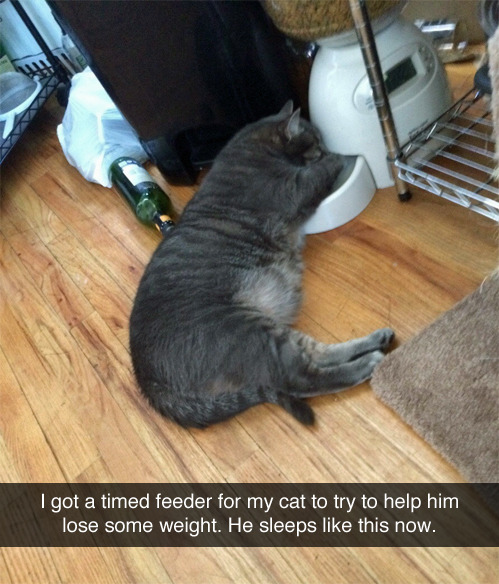
firehosethe legit reason is that most automated feeders can be exploited by persistent cats who can reach inside and spin the feeder mechanism for more food
firehose'This scenario assumes that the former Solicitor General reproduces asexually'
What if Au Bon Pain lost this lawsuit and had to pay the plaintiff $2 undecillion?
—Kevin Underhill
The bakery-cafe chain Au Bon Pain (with a few other organizations) is being sued. This is how much money the person suing them is demanding:

This is how much sellable stuff there is in the world:

This is the estimated economic value of all goods and services produced by humanity since we first evolved:

Even if Au Bon Pain conquers the planet and puts everyone to work for them from now until the stars die, they wouldn't make a dent in the bill.
Maybe people just aren't that valuable. The EPA currently values a human life at $8.7 million, although they go to great lengths to point out that technically this is not actually the value any specific person places on another person's individual life.[1]Note that they don't say whether they assume that amount would be higher or lower. In any case, by their measure, the total value we place on all the world's humans is only about $60 quadrillion.[2]The world's combined oil reserves are only worth a few hundred trillion, which suggests that purely from an accounting standpoint, the "no blood for oil" slogan makes a lot of sense.
But while people may be worthless,[3]I'm rounding down. we're hardly all there is on the planet. Out of all the Earth's atoms, only 1 out of every 10 trillion is part of a human.
The Earth's crust contains a bunch of atoms,[citation needed] some of which are valuable. If you extracted all the elements, purified them,[4]This is just one of many reasons that this idea wouldn't make sense in practice. The reason many elements (like U-235) are valuable is that it's hard to manufacture or purify them, not just because they're rare. and sold them, the market would crash.[5]Both in the sense that the supply would cause a drop in prices, and the sense that the market is like 20 miles above the mantle and you just removed the crust supporting it. But if you somehow sold them at their current market price, they would be worth ...

Oddly, most of this value comes from potassium and calcium, and most of the rest comes from sodium and iron. If you're going to sell the Earth's crust for scrap, those are probably the ones you should sift out.
Sadly, even selling the crust for scrap doesn't get us close to the numbers we need.
We could include the core,[6]It's down there. which is iron and nickel with a dash of precious metals, but it turns out it wouldn't help. The amount demanded from Au Bon Pain is just too large. In fact, an Earth made of solid gold wouldn't be enough. The Sun's weight in platinum wouldn't be, either.
By weight, the single most valuable thing that's been bought and sold on an open market is probably the Treskilling Yellow postage stamp. There's only one known copy of it, and in 2010 it sold for \$2,300,000. That works out to about \$30 billion per kilogram of stamps. If the Earth's weight were entirely postage stamps, it would still not be enough to pay off Au Bon Pain's potential debt.[7]Also, the stamps would probably be less valuable now that there is literally an entire planet of them, but that's the least of Au Bon Pain's problems.
If Au Bon Pain & co decided to be intentionally difficult, and pay their debt entirely in pennies, they would form a sphere that would squeeze inside the orbit of Mercury.[8]The fate of this sphere of pennies is left as an exercise for the reader. The fate of Mercury is that it would fall into the pennies and disintegrate. The bottom line is that paying this settlement would be, in almost any sense of the word, impossible.
Fortunately, Au Bon Pain has a better option.
Kevin, who asked this question, is a lawyer and author of the legal humor blog that reported on the Au Bon Pain case.[9]And which we encountered in Question #90. He told me that the world's most highly-paid lawyer—on an hourly basis—is probably former Solicitor General Ted Olson, who recently disclosed in bankruptcy filings that he charges $1,800 per hour.
Suppose there are 40 billion habitable planets in our galaxy, and every one of them hosts an Earth-sized population of 7 billion Ted Olsons.

If Au Bon Pain hired every Ted Olson in the galaxy to defend them in this case, and had them all work 80-hour weeks, 52 weeks a year, for a thousand generations[10]This scenario assumes that the former Solicitor General reproduces asexually....

... it would still cost them less than if they lost.


Amelia Boynton-Robinson, beaten, gassed, and left for dead by police in Selma, Alabama during the first Selma to Birmingham voting rights march. 3/17/65. (x)
Amelia Boynton-Robinson, later that year, meeting with President Lyndon Johnson at the signing of the Voting Rights Act. 8/6/65. (x)
#it is all of us who must overcome the crippling legacy of bigotry and injustice #and we shall overcome
1965 is Modern history, not “ancient history”.
1965 really wasn’t that long ago….
It’s over so it’s history get over it.
THIS WOMAN IS STILL ALIVE YOU WASTE OF SENTIENCE
SHE WAS AT THE DEMOCRATIC NATIONAL CONVENTION IN 2012
Then again, you seem like the kind of jackass who would walk up to a distinguished woman like Amelia Boynton Robinson and tell her to “get over it”, because you’re apparently incapable of fucking BASIC HUMAN EMPATHY AND RESPECT.
People like YOU are the reason this fight ISN’T OVER, it can’t be relegated to history because PEOPLE LIKE YOU make the continuing fight necessary. People like you would SILENCE HER with “get over it”. SHE IS STILL FIGHTING NOW.
She lived to see the Voting Rights Acts signed into law, and god help us, SHE LIVED TO SEE IT OVERTURNED. She is over 100 years old and STILL FIGHTING FOR HER BASIC HUMAN RIGHTS AND DIGNITY.
Here is a playlist of an interview with her from the National Visionary Leadership Project.
firehosevia Rosalind

I like how the original title for The Fault in Our Stars is all poetic and then the Norwegians just translated it to “fuck destiny” and I think that’s beautiful
Aw man, I thought for sure this had to be bullshit but nope
WAIT WHAT
firehosevia Lori
"shhhh. small noises. small baseline solo."
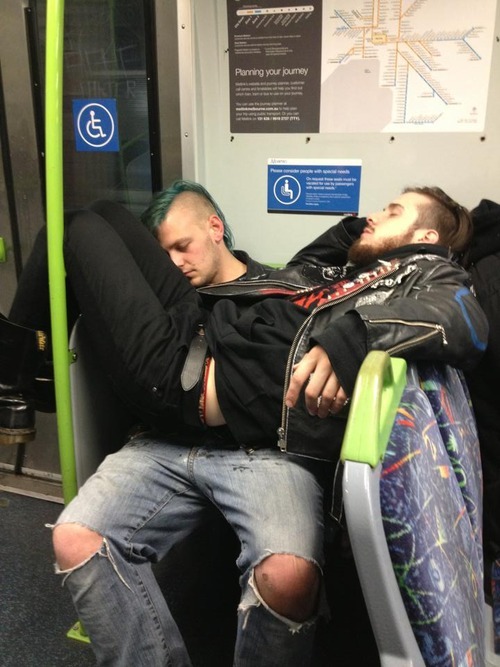
Punk’s not dead. Just exhausted.
Punk needs a blanket. Maybe some chamomile tea.
shhhh. small noises. small baseline solo.
firehosevia Rosalind
firehosevia Rosalind
firehosevia multitasksuicide
And I'm not just saying that so that Ice-T doesn't murder me... I swear!
The post “Talk Sh*t, Get Shot”: Body Count’s New Single is the Best Song Ever Written appeared first on MetalSucks.
More than 20,000 people will gather at Bell Centre for a game that's not even being played at Bell Centre.
Canadiens fans will pile into Bell Centre on Wednesday night to watch Game 7 of their series against the rival Boston Bruins. They each paid $12 to get in, and they'll root on their team with 20,000-plus of their fellow Habs faithful.
There's a catch, though. The game is in Boston.
Reminder: Game is in Boston. RT @GlobeFluto: Bell Centre is sold out tonight. Passion.
— Travis Hughes (@TravisSBN) May 14, 2014
Yes, their fans are paying to watch a game on a giant TV screen.
This concept isn't rare -- teams often have playoff watch parties in their home arenas while they're playing on the road. Typically teams just open up the arena for free, let fans in, and hope they buy concessions. And maybe they'll get 10,000 in the building if they're lucky.
But selling out the arena is one thing, and doing it when admission costs actual money is another thing. Bravo, Montreal. No word on if they'll light the torch.
firehose#teamcake

New species of bat found, Niumbaha superba, and it’s adorable.
Oh wow! I’m glad people are as excited about animals as I am. Here’s some additional photos. Fun fact: this bat is so different from others that a new genus was created!
FUZZY FUZZY CUTE CUTE
MARBLE CAKE BAT MARBLE CAKE BAT
What a darling little baby we now have on the earth. ;u;
IT’S A BEE BAT? OR A SKUNK BAT? IDK BUT IT’S CUTE AND I WANT ONE.
Superba, huh? What makes it “proud”? …Not that it’s not cute as heck…
firehose"Bartenders were required to develop their drink using ingredients available in nearly every country and promote the cocktail through different means to prove its viability.
Some used social media, others served the drink to thousands on guest bartending shifts in different bars, and the American competitor Naomi Levy from Boston's Eastern Standard used the drink as a means of raising $13,000 for charity."
...
"The winner of the Bacardi Legacy Global Cocktail Competition was Tom Walker of The American Bar at The Savoy Hotel in London. His drink contains Bacardi, lime juice, cucumber, mint, absinthe, and soda water, like a Daiquiri-Mojito mashup with a spritz of absinthe."
Maid in Cuba
-----------
60ml Bacardi Superior
6 leaves of mint
3 slices of cucumber
45ml sweet-and-sour mix (15 sugar 2:1 30 fresh lime, infused for half a day)
absinthe spritz
50ml soda
http://alcademics.typepad.com/.a/6a00e553b3da20883401a3fd07fe26970b-580wi
firehose"low lumber stocks mean that distilleries are running low on the barrels they need for aging"

Last year, Maker’s Mark got a 45% jump in sales after the whiskey brand announced that it would water down its bourbon to meet climbing demand, which prompted panicked customers to stock up on the unadulterated stuff. (Then Maker’s didn’t go through with the plan.) Now, the Kentucky-based Buffalo Trace distillery has announced impending bourbon “shortages,” causing a mild uproar (perhaps all bourbon drinkers can muster after being jerked around by Maker’s Mark). Meanwhile, in a case of very poor timing, low lumber stocks mean that distilleries are running low on the barrels they need for aging.
It’s hard to say if there is a true shortage, since whiskey reserves remain a trade secret. But it’s clear that we just can’t stop drinking bourbon. And apparently, we like the good stuff.
To be called bourbon, the spirit must be made in the United States, from a fermented mash of grains including at least 51% corn, and stored in new charred oak containers for at least two years. The US also remains the largest consumer of bourbon, drinking about 73 percent of the stock domestically, according to the Distilled Sprits Council of the US. The growth has been at the top end of the market; sales of pricier bottles such as Woodford Reserve, Knob Creek, and Basil Hayden’s have nearly quadrupled over the last decade.

Fine whiskey takes time (though some innovative distillers are working on changing that), which is part of the problem with a bourbon—distillers can’t ramp up production in short order. So even as consumers are willing to pay nearly a thousand dollars for a bottle of 15-year-aged Pappy Van Winkle (one of Buffalo Trace’s several bourbon labels), there are only so many of those bottles to go around.
And the rest of the world has a hankering for bourbon, too. For the last five consecutive years, global exports of US whiskey—the vast majority of which is bourbon and Tennessee whiskey—have broken records. Last year, they surpassed the billion-dollar mark.

So where is it all going? Last year, Germany bought more US whiskey by volume than any other country, with Australia not far behind. 
And the real emerging markets for US whiskey are, well, the emerging markets. Mexico’s imports of US whiskey have tripled by volume since 2008; Brazil’s have increased fivefold; and Turkey’s have multiplied by 10. No word yet on whether customers there have started to develop a taste for bacon-infused bourbon Manhattans.