Shared posts

23 May 01:07

So This Is Happening: Zenimax Sues Oculus

by Nathan Grayson

By Nathan Grayson on May 21st, 2014 at 10:00 pm.

Given the way things have been going, I suppose this was basically inevitable. In the wake of some very serious John Carmack hardware-related allegations from ZeniMax, the Elder Scrolls, Fallout, and Wolfenstein publisher has dropped a megaton legal bomb. It’s suing virtual reality kingpin (and recent Facebook acquisition) Oculus Rift for “illegally misappropriating ZeniMax trade secrets relating to virtual reality technology, and infringing ZeniMax copyrights and trademarks.” Oculus, meanwhile, continues to claim ZeniMax’s claims are entirely without merit. Claim claim claim clamber clams. Now there’s an idea. Instead of duking it out in a legal cagefight, maybe everyone should just sit down around a nice, fresh plate of clams. Talk things out nice and civil-like while loudly slurping the precious flesh meats of a lowly sea creature.

But no, this is probably gonna be terrible.

Here’s ZeniMax’s announcement, which is about as cut-and-dry as they come on these sorts of matters:

“ZeniMax Media Inc. and its subsidiary, id Software LLC, filed suit today against Oculus VR, Inc. and its founder, Palmer Luckey, for illegally misappropriating ZeniMax trade secrets relating to virtual reality technology, and infringing ZeniMax copyrights and trademarks. ZeniMax is also asserting claims for breach of contract, unjust enrichment, and unfair competition against the defendants. The suit was filed in federal court in the U.S. District Court for the Northern District of Texas.”

“The suit arises from the defendants’ unlawful exploitation of intellectual property, including trade secrets, copyrighted computer code, and technical know-how relating to virtual reality technology that was developed by ZeniMax after years of research and investment. ZeniMax provided this valuable intellectual property to defendants under a binding Non-Disclosure Agreement that specifies such intellectual property is owned exclusively by ZeniMax and cannot be used, disclosed, or transferred to third parties without ZeniMax’s approval. ZeniMax’s intellectual property has provided the fundamental technology driving the Oculus Rift since its inception. Nevertheless, the defendants refused all requests from ZeniMax for reasonable compensation and continue to use ZeniMax’s intellectual property without authorization.”

“All efforts by ZeniMax to resolve this matter amicably have been unsuccessful. Oculus has recently issued a public statement remarkably claiming that ‘ZeniMax has never contributed IP or technology to Oculus.’ Meanwhile, Luckey has held himself out to the public as the visionary developer of virtual reality technology, when in fact the key technology Luckey used to establish Oculus was developed by ZeniMax.”

Yikes. That last paragraph, especially – those are some fighting words followed by a dismissive gob of tobacco-tarred saliva bullet-spat into a bucket. “Ding!” it sounds, both beginning the fight and mixing my metaphors.

In response, Oculus issued a statement of complete denial. ”The lawsuit filed by ZeniMax has no merit whatsoever. As we have previously said, ZeniMax did not contribute to any Oculus technology. Oculus will defend these claims vigorously.”

So that’s it, then. To court everyone goes. Or maybe they’ll settle it out of court at the last second, but something’s got to give. So far, neither side is letting the other have an inch, let alone a mile, so I don’t expect this to go down without things getting messy.

And while Oculus claims ZeniMax is blathering on about nothing, I highly doubt it’d willfully play David vs Goliath (or really, Goliath vs Significantly Bigger Goliath) against Facebook without some sort of ace up its sleeve. But when two companies that – regardless of policies and reputation – make great stuff come to blows, it’s tough to say anybody wins. Here’s hoping this resolves quickly.

22 May 17:05

His Substance Abuse Problem Was Different

by Mallory Ortberg
Courtney shared this story from The ToastThe Toast:
Heh.

alcoholHis substance abuse problem was different because he knew he was going to die someday.

Her substance abuse problem was different because it’s lonely, living in New York City.

Her substance abuse problem was different because she was still totally beautiful but not quite as beautiful as she was five years ago. Then she was beautiful like a hummingbird, alive and vibrant and hovering several feet off the ground. Now she was beautiful in a brittle way, like a hummingbird covered in fondant.

His substance abuse problem was different because he had only written one best-selling novel instead of several.

His substance abuse problem was different because he was so young and good-looking and his hair fell in front of his eyes when he talked.

His substance abuse problem was different because he had a job he had to go to every day even though he didn’t want to have one.

Her substance abuse problem was different because she was unhappy on purpose.

Her substance abuse problem was different because she spent a lot of time thinking about being and existence and nothingness, even though she didn’t have to.

His substance abuse problem was different because of how self-aware he was. “I’m making a bad decision,” he said, and then made a bad decision, but no one could say anything about it because he’d already explained that he was making a bad decision.

Her substance abuse problem was different because nobody really understood her, even when they tried to.

His substance abuse problem was different because nothing helped, even though he was the life of the party.

His substance abuse problem was different because he was having a lot of sex with strangers, but in a sad and interesting way, not in a fun and exciting way.

Her substance abuse problem was different because she was too smart to be happy.

Her substance abuse problem was different because she struggled with being the voice of a generation.

His substance abuse problem was different because he couldn’t be content with the small, secure life that you have.

Her substance abuse problem was different because she felt like an imposter, because even though she impressed other people she could never impress herself.

His substance abuse problem was different because everything was different after the war.

Her substance abuse problem was different because she was so busy taking care of everyone else that she forgot how to take care of herself.

Her substance abuse problem was different because society is so empty, and rich people make terrible friends.

His substance abuse problem was different because he was funny on the outside but dying on the inside.

His substance abuse problem was different because he was so successful and made so much money, and that’s terrible.

His substance abuse problem was different because he was divorced and his wife never understood anything.

Read more His Substance Abuse Problem Was Different at The Toast.

22 May 17:05

Photo

Courtney shared this story from Super Opinionated.


22 May 16:59

bat face

by djempirical
22 May 16:48

What managers do at a company that’s trying to replace them with software

by Max Nisen
If you call a meeting, make it worthwhile.

The enterprise software company Asana manages to serve multi-billion-dollar startups such as Airbnb, Uber, Dropbox and Pinterest with only 65 employees. That’s because streamlining workflow is what the company, whose motto is “Teamwork without email,” is designed to do.

The company, founded by the Facebook co-founder Dustin Moskowitz and the former Google and Facebook engineering manager Justin Rosenstein, was built using its own efficiency software from the start, and the result is a management culture that’s defined by its own technology.

“People often ask, ‘how do you have only 65?’” Rosenstein told Quartz. “I think a lot of it is technology, but a lot of it is a management philosophy of taking the best people and really teaching them to fish rather than doing the fishing for them—and constantly giving them more responsibility.”

Asana’s origin was in software that Moskowitz built at Facebook—a “rudimentary prototype” of the task-based system that Asana is now. Rosenstein said the early version of Moskowitz’s software allowed Facebook to double the size of its engineering team in a year without hiring any new product managers.

Asana has plenty of competitors, from big ones such as Jive and Microsoft’s Yammer to new entrants such as Slack and Convo. The difference is that Asana is centered around units of work and accomplishing them, not social tools or chat. 

Despite his history at Facebook, and the fact that his co-founder was there from the very start, Rosenstein doesn’t see social tools or chat as the way forward in the workplace. “If what you needed in your work life was Facebook for work, we would have stayed at Facebook,” Rosenstein says. “We had plenty-good Facebook at Facebook.”

Instead, Asana’s system tracks tasks, making it clear to all who’s responsible for achieving them, and where they are in their process. So what do managers do every day at a company where many of their usual coordination and communication functions are automated? We spoke to Rosenstein about how technology and management interact at his company, and how Asana has redefined the role of managers. Here’s his advice:

Free your managers by empowering employees

In many workplaces, Rosenstein says, employees feel like cogs in a machine, and frequently must turn to their managers for answers or next steps. Managers end up spending their days answering questions and keeping people on task.

“I was watching super-talented engineers, super-talented people, spend half of their day just on this work about work, on coordination, and I hated to watch it,” Rosenstein says.

The solution, he argues, is more clarity and autonomy for employees. If you ask any engineer at Asana why they’re working on a piece of code, they should be able to explain not just what it does, but its importance, next steps, end effect on the customer, and why it supports the company’s mission. In the task-based system, information is attached to each unit of work.

Asana makes all of the steps to a goal public to everyone at the company, along with the progress made and deadlines. That cuts down on the need for status meetings, because managers know instantly where they need to take action or solve problems.

“You need to know all of the things left to accomplishing a goal,” Rosenstein says, “because even at Google and Facebook, which are really well-organized companies, we would get to launch day and realize that there were like five things we had forgotten to do.”

Both Asana the product and the company are governed by one main idea: taking all that information out of people’s heads, email, and meetings and making it public, so that managers are free to solve problems and mentor, instead of being well-compensated taskmasters.

Change the metrics for success

Creating and maintaining that environment is a management feat in itself. New hires need to get used to the idea of transparency in their work and their progress completing tasks, and managers still have a role in assigning, prioritizing, and giving clarity on particular tasks.

Another source of conflict comes when people aren’t clear on who’s responsible for what. To that end, every unit of work or step at the company has just one person who’s accountable. Not zero, which makes it unlikely to get it done, Rosenstein says. And not two, which risks splitting tasks incoherently.

The focus is on making sure that those discrete tasks actually get done, people are accountable, and that managers don’t have to search for who’s working on what. That intense focus on tasks means that progress on those tasks is what managers track, instead of hours or any other metric of productivity.

“That’s the really critical data source: What are people working on? What do they need help on?” Rosenstein says. “People look at things like how many lines of code someone wrote, and that’s just BS. Those sort of metrics give you really skewed understanding of the people’s value. The data that doesn’t lie is what work the person is accomplishing each week.”

When you do call a meeting, make it count

Rosenstein dislikes the sorts of meetings where managers dictate all the decisions, as well as the ones where 10 people go around the circle and update each other on what they’re working on. But he’s not completely anti-meeting. If you’re going to have a meeting, he argues, it’s worth using the time to nurture and empower employees to make decisions themselves—which means less of the same meeting down the line.

In service of the overall philosophy of “teaching people to fish,” the focus is on creating learning experiences at meetings. “The tempting thing as a manager is to be like, ‘I would choose option B over A,’” he explains. “But that sets them up to always be dependent on me, and really disenfranchises them.”

Instead Rosenstein says, he’ll ask staffers how they’re thinking about their current problem and choices, and their framework for making a decision. He’ll guide them, but as much as he can, have them figure it out on their own.

“The next time they have a similar decision, they can do it themselves,” Rosenstein says. “What we get from that is that the people on our teams are constantly getting better and better, so we keep trusting them with more and more responsibilities.”

Meetings at most companies don’t go this way, Rosenstein says. “(It’s) an insane situation,” he says. “If you get 10 people in a room for an hour, people think of that as an hour; it’s really 10 hours. Typically the reason the meeting is necessary is to get clarity they didn’t have during the week. But during the week they were going ten degrees in the wrong direction.”

Meetings instead are reserved for the sort of big meaty questions that don’t work in a messaging environment and are even worse handled by email (which can amount to long digital essays that detail every possible contingency).

“Basically, I see two extremes that are unhealthy,” Rosenstein says. “You have the companies that are like, ‘All meetings, all the time,’ [and] never get any work done. The other companies: ‘All meetings are bad, meetings suck, no meetings, zero meetings.’ That’s equally ridiculous.”

Spend a “ridiculous” amount of time recruiting

One of Rosenstein’s most important jobs, he says, is recruiting the kind of people who can survive, thrive, and be productive in the company’s  environment.

“The downside is that I spend a ridiculous amount of time recruiting,” Rosenstein says. “The upside of that is that it’s just a joy to work with people who are the best in the world.”

That means a nuanced recruiting process that looks for more than just exceptional engineers. “We’re not just looking for raw IQ, we’re not just looking for culture fit and values-alignment, and we’re not just looking for someone we think will work well in this environment,” Rosenstein says. “We recruit them as whole human beings.”

The interview starts with one question. “Tell me why you do what you do.” Based on that answer alone, Rosenstein will either let candidates know that Asana isn’t the right place, or explain why there could be a good fit. Then the conversation continues.

“We try to do a lot of non-standard things with those interviews,” Rosenstein says, “everything from asking deep philosophical questions about your purpose in life, to actually having them do the work.”

Turn management into a role, instead of a promotion

Management at Asana is seen as service role, rather than the next step in the pyramid on the org chart. The usual model, where exceptional work leads inevitably to the management track is a mistake, Rosenstein argues. “The effect of that is that individual work is looked down on,” he says. “That is so caustic.”

It also can fail to take advantage of people’s talents, he says. “You end up losing your best individual contributors and your people in management often suck because they’re not great managers; they’re great individual contributors.” Becoming a manager at Asana isn’t a promotion but a role-change, not necessarily offered to the best or most productive employees, but t0 those who show that they would be good managers.


22 May 16:11

Wearable Anti-Tech @YahooTech #WearableWednesday

by Becky Stern

webURMEFLASH5

Rob Walker writes about why “anti-tech” is all the rage right now, on Yahoo Tech:

For a while now, the tech world has been obsessed with “wearables” — smartwatches, body-monitoring wrist bands, Google Glass, and other devices that you can wear on your person to make technology more readily available. “Wearable tech,” it’s often called.

But some of the most interesting gadgetized accessories these days have an unusual twist: Their real function is to thwart or disabletechnology.

Call it the rise of wearable anti-tech.

These experiments, which range from the practical to the theatrical, all have one thing in common: They respond to the annoyances, incursions, and even threats of technology with clever technology jujitsu.

They represent the latest that technology has to offer to get rid of the latest that technology has to offer.

Sometimes it takes the form of a weapon in a more quotidian battle over technological control — as in the ridiculously appealing TV-B-Gone hoodie, which embeds a universal remote in a sweatshirt and uses conductive thread to turn a zipper into an off switch for irritating television sets.

That one is from Becky Stern, who among other things is director of wearable electronics at the endlessly impressive DIY-tech site Adafruit.

“As we lose agency over our devices (NSA spying, operating systems phoning home even in airplane mode, etc.), we’re seeing folks take DIY actions to reclaim ownership over their devices and privacy, sometimes as artistic and political statements too,” Stern told me.

“When you can’t trust your phone, but it becomes a necessary evil in your life, it makes a lot of sense that you’d want to have a way to take total control over it. This troubled relationship is very fertile ground for artists and hackers right now.”

22 May 16:11

Tzompantli, Tenochtitlan, Mexico


Tzompantli, Tenochtitlan, Mexico

22 May 16:03

The Great Fredini – The World’s Largest 3D Printed Installation to be featured in Coney Island #3DxArt #3DThursday #3DPrinting

by Matt

Pasted Image 5 21 14 11 42 PM

Over a year in the making, designer Fred Kahl has completed 3D designing/scanning/printing his scale model of Coney Island in its heyday. The World’s Largest 3D Printed Installation to be featured in Coney Island: Thompson & Dundy’s Luna Park: 3D Printed by the Great Fredini:

Coney Island USA is pleased to announce the exhibition of the world’s largest art installation ever created with desktop 3D printer technology at the Coney Island Museum. Thompson & Dundy’s Luna Park: 3D Printed by the Great Fredini is a year-long installation by artist Fred Kahl, which will open in the Coney Island Museum on Sunday, May 25. An artist’s reception will be held on Sunday, July 6 from 2-6pm. This living museum exhibit will expand over the course of the year to recreate the ornate art and architecture of Coney island’s heyday 100 years ago.

The project is the latest brainchild of Coney Island sideshow veteran, Brooklyn-based artist and impresario Fred Kahl, a.k.a. the Great Fredini. Kahl’s goal is to fully 3D model and fabricate a 1:13 scale 3D-printed replica of Coney Island’s famed Luna Park, as it stood a hundred years ago, and populate it with portraits of Coney’s most interesting characters from his Coney Island Scan-A-Rama 3D Portrait studio. The project garnered worldwide attention last summer, when Kahl raised over $16,000 on Kickstarter to build a “bot farm” in support of the endeavor. A year later, he has 3D scanned hundreds, if not thousands, of Coney’s denizens and visitors who will be featured in the installation. The show will include hundreds of 3D prints comprising over 10,000 hours of print time and the installation will fill an entire gallery of the museum’s newly reopened space.

“Luna Park has a special place in history, a witness to the society being transformed by technology. These are the themes that are relevant to us today as our world undergoes the third industrial revolution,” said Kahl. “This piece is also about a deep love of Coney Island as the cultural melting pot and showcase for presenting cutting-edge technology as entertainment.” …

Read More.

Pasted Image 5 21 14 11 47 PM

Pasted Image 5 21 14 11 47 PM

Pasted Image 5 21 14 11 47 PM


649-1
Every Thursday is #3dthursday here at Adafruit! The DIY 3D printing community has passion and dedication for making solid objects from digital models. Recently, we have noticed electronics projects integrated with 3D printed enclosures, brackets, and sculptures, so each Thursday we celebrate and highlight these bold pioneers!

Have you considered building a 3D project around an Arduino or other microcontroller? How about printing a bracket to mount your Raspberry Pi to the back of your HD monitor? And don’t forget the countless LED projects that are possible when you are modeling your projects in 3D!

The Adafruit Learning System has dozens of great tools to get you well on your way to creating incredible works of engineering, interactive art, and design with your 3D printer! We also offer the Printrbot Simple Metal 3D Printer in our store. If you’ve made a cool project that combines 3D printing and electronics, be sure to let us know, and we’ll feature it here!

22 May 16:03

PangramTweets

by Ben Zimmer
popular shared this story from Language Log.

The Twitter API, beyond its great utility for corpus linguistics (see "On the front lines of Twitter linguistics," "The he's and she's of Twitter"), has made possible a lot of fun automated text-mining projects. One fertile area is algorithmic found poetry: there have been Twitter bots designed to find accidental haikus, and even more impressively, a bot named @Pentametron that finds rhyming tweets in iambic pentameter and fashions sonnets out of them.

And then there is found wordplay, which is its own kind of found poetry. I'm a big fan of @Anagramatron, which discovers paired tweets that form serendipitous anagrams of each other. (Example: "Last time I do anything" ⇔ "That's it. I'm dying alone.") Now, courtesy of Jesse Sheidlower, comes @PangramTweets, in which each tweet contains every letter of the alphabet at least once.

Jesse explains the project on his site:

PangramTweetsis a bot (a computer program that runs on its own) that searches Twitter for, and then retweets, pangrams—texts that contain every letter of the alphabet. A famous pangram, sometimes used as a typing test, is “The quick brown fox jumps over the lazy dog.” [...]

You may find the results interesting, or dull. I make no judgment on this. The bot is entirely automated; I do not curate the results.

I strip out user names and URLs from the results, but hashtags are included. I also do some very basic filtering to try to ensure that the results are in English, and not in another language or complete gibberish (random letters), though earlier versions of the bot did retweet nonsense or foreign-language pangrams.

The bot originally did not filter out known pangrams of the "quick brown fox" variety, but by popular demand Jesse put a filter in place for that as well. The results are not as rich as Anagramatron, but that's to be expected given the constraints: Jesse sayshe gets "one real pangram in every few million tweets scanned." Here's a sampling of what has turned up so far.

I've just (with the help of google) realized I wrote about the wrong experiment in my 12 mark psychology question oops

— s (@bricktop___) May 13, 2014

It's official: Arthur Sulzberger names Dean Baquet executive editor of The New York Times, replacing Jill Abramson.

— Vindu Goel (@vindugoel) May 14, 2014

Looking for a new job is exhausting. Every one I want requires a bazillion years of experience I don't have. FML.

— Ryan Stephens (@Integrity1stziB) May 16, 2014

Thanks JMM for boosting my boxing prediction confidence again. The Mayweather card did a number on a lot of boxing fans. #MarquezAlvarado

— E.J.O. (@ElioOrtiz11) May 18, 2014

SHUT THE FUCK UP ABOUT THE “FRIENDZONE”. MAYBE YOU SHOULD JUST VALUE A WOMAN’S FRIENDSHIP AND QUIT EXPECTING THEM TO FUCK YOU. JESUS FUCK.

— ・。。・゜☆゜・。。・ (@chrstnmchd) May 19, 2014

Juan Manuel Marquez boxes Alvarado on weekday to line up fifth fight alongside Pacquiao @SportsMomentz http://t.co/e5CyDwDXFd

— Rinaldo Jonathan (@testeronline12) May 19, 2014

Maybe Joe needs to take some advice from Iceland and arrest the rich people who are stealing from the rest of us tax paying citizens. #qanda

— Toby Owens (@TehMegaWiz) May 19, 2014


It will be interesting to see if the bot turns up a naturally occurring "pangrammatic window" that beats the current record-holder of 42 letters, from Piers Anthony's Cube Route:

"We are all from Xanth," Cube said quickly. "Just visiting Phaze…"

Sean Irvine announced the discovery of this pangrammatic window in Word Ways in 2012. It beat out Eric Chaikin's 47-letter find, which he discovered by Googling for "Joaquin Phoenix":

"JoBlo's movie review of The Yards: Mark Wahlberg, Joaquin Phoenix, Charlize Theron…"

Of course, determining if a pangram is "naturally occurring" may be difficult, since it's always possible to game the system! But with half a billion tweeters tweeting, maybe someday one of them will authentically produce a winner like "Mr. Jock, TV quiz PhD, bags few lynx."

Update: Jesse is attempting to filter out non-English tweets, but Indonesian tweets keep seeping through. Since I've done research on colloquial varieties of Indonesian, I find these tweets fascinating. I was initially surprised that the Indonesian Twittersphere would be generating pangrams, considering that the letters Q, V, X, and Z appear only in loanwords. But Indonesian participants on Twitter are using quite a lot of Anglicisms, along with a plethora of txtspk-style abbreviations of Indonesian words. An example that just popped up:

@PutriAZSYA EXCITED BGT GRGR 1D MW K INDO. LBH EXCITED LG KLO JOIN LITTLEQUIZ @1D_CrazyLovers DAN BCA JG FFNY.PASTI LO MKIN EXCITED.CEK FAV6

— winda (@windaameliasar1) May 20, 2014

The loanwords here are EXCITED, JOIN, and LITTLEQUIZ, and 1D refers to the band One Direction. Here's a key to the abbreviation-heavy Indonesian items:

BGT = banget 'very'
GRGR = gara-gara 'just because'
MW = mau 'will'
K = ke '(come) to'
INDO = Indonesia
LBH = lebih 'more'
LG = lagi '(even) more'
KLO = kalau 'if'
DAN = dan 'and'
BCA = baca 'read'
JG = juga 'also'
PASTI = pasti 'definitely'
LO = (e)lo 'you'
MKIN = makin 'more and more'
CEK = cek 'check'

So that would work out to: "@PutriAZSYA Very excited just because One Direction is coming to Indonesia. You'll be even more excited if you join LittleQuiz @1D_CrazyLovers, and also read FFNY. You'll definitely get more and more excited. Check Fav6."

22 May 15:46

Oh, man. I love this photo.


Oh, man. I love this photo.

22 May 15:43

Stolen Sellwood art found, thieves caught

22 May 15:43

Long after announced 'resignation,' ex-Cover Oregon director Bruce Goldberg draws $14,425 monthly salary

22 May 15:35

Huh. Weird.

I just spoke to She-Hulk and she told me that screenwriting was created as a male power fantasy.

So ironic!

22 May 15:32

38 Studios board member wanted to keep possibly 'under capitalized' MMO secret

by Dave Tach

38 Studios' lead board director Thomas Zaccagnino advised others involved with Rhode Island's proposed $75 million loan guarantee to the studio to keep part of its risky financial standing from those approving the guarantee, WPRI reports

On July 1, 2010, Zaccagnino responded to an email from CEO Jen MacLean, who was concerned that the state might not provide the full $75 million. According to WPRI, she also wrote that she wasn't comfortable telling the state that the funds would be insufficient to cover the full cost of 38 Studios' in-development massively multiplayer online role-playing game Project Copernicus

As the Rhode Island Economic Development Corporation (now known as the Rhode Island Commerce Corporation) was considering backing the loan guarantee to the studio, Zaccagnino responded to MacLean's email, copying CFO Rick Wester and Michael Corso, a broker involved with the deal. 

"I really do not think we should highlight the fact that we might be under capitalized … wont [sic] go over well with the staff or board," Zaccagnino wrote.

The state approved the loan guarantee later that month, but former Red Sox pitcher Curt Schilling's development studio declared bankruptcy in June 2012. Later that year, the state filed suit arguing that those involved in approving the loan were misleading about the associated risks.

Zaccagnino is one of several individuals named in Rhode Island's lawsuit. 

In January 2014, Governor Lincoln Chafee's administration submitted legislation designed to encourage settlements. Since then, The Rhode Island Senate the state's House of Representatives passed similar legislation. 

Earlier this month, Rhode Island made a $2.4 million payment on interest — the first paid with funds not previously earmarked for the investment. A subsequent report by SJ Advisors concluded that the state's bond rating could be reduced to junk status if it chose not to repay the loan. 

You can follow along with the history of 38 Studios' decline and continuing developments in Polygon's 38 Studios StoryStream.

22 May 15:14

These signs should be mandatory at all Little League fields

by Bill Hanstock

Rule 6: Take a chill pill.

Parents get wild at Little League games. As long as parents have been living vicariously through their children or installing latches on the doors of their homes, they've been known to get a little rowdy. Heck, when I was in Little League, my grandmother was kicked out of the dugout for giving an umpire an untoward amount of Oklahoma sass.

So every once in a while, someone needs to remind parents to chillax, or at the very least, dial it down a skosh. Which is where Holyoke city councilor James Leahy comes in.

@cbsboston pic.twitter.com/tXzFbwRtoz

— James M. Leahy (@leahy413) May 21, 2014

Well done, sir. Let us make this happen everywhere. Chill out, parents. You're embarrassing your children.

(h/t to Boston.com)

22 May 15:14

L.A. restaurant congratulates Lakers on their playoff run

by Bill Hanstock

Who can even keep track of all the basketball teams in Los Angeles, anyway?

Well, Los Angeles has been ousted from the NBA Playoffs. Still, they gave it their best shot. So why not congratulate them on their great season, local businesses?

LMFAO they congratulated the wrong LA team. The Clippers will NEVER prosper. pic.twitter.com/yZ5xYEFkGY

— Jahan (@H00PINATI) May 21, 2014

Uh ...

Hm.

It's actually the, uh ... the OTHER Los Angeles team. But hey, I'm sure no one will doubt you're "wholly focused on food."

(h/t to The Score)

22 May 15:06

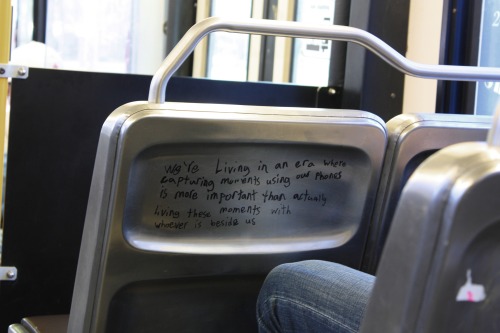
We’re living in an era where capturing moments using our phones...


We’re living in an era where capturing moments using our phones is more important than actually living these moments with whoever is beside us.

never would have seen this if it wasn’t for my phone, here, let me show this to the person next to me

22 May 12:24

High Elf, High on Acid, Attacks Woman's BMW With a Sword

by Jay Hathaway
firehose

via Toaster Strudel

followup:

'In an interview with Vocativ, Bass explained, "I wasn't in my right mind. I was still rocking my new pair of elf ears."

He mistook the car for a shapeshifting demon.

"I hopped on her hood and tried to pierce her tires with my master sword. I was trying to prove a point. Don't mess with a dark elf," he said.

Bass is also involved in Live Action Roleplaying (shocking!) and writes fantasy novels under the name Konrad McKane. Last time he dropped acid, he turned into a dragon.'

High Elf, High on Acid, Attacks Woman's BMW With a Sword

Portland, Ore. police responded to a 911 call at around 7 a.m. Tuesday morning from a woman who believed her car was under attack by a pirate. But instead of a routine pirate attack—oh, Portland—they discovered an armored man who claimed he was a High Elf.

Read more...


22 May 05:15

A Lion, A Tiger and A Bear Are the Best of Friends at Noah’s Ark Animal Sanctuary

by Lori Dorn

Noah’s Ark Animal Rescue in Locust Grove, Georgia is a seemingly magical place. The sanctuary is not only home to a great number of different animals who were abused, abandoned and/or in need of rehabilitation, it is a safe and nurturing environment for an unlikely friendship between a lion, a tiger and a bear to thrive after very, very rough beginnings.

The BLT (bear, lion and tiger) came to Noah’s Ark in 2001. Baloo, a North American Black Bear, Leo an African Lion and Shere Hkhan a Bengal Tiger, were discovered in an Atlanta home’s basement by police officers during a drug raid. At only a few months old, all three cubs were frightened, malnourished and infected with internal and external parasites when they were brought to Noah’s Ark by the Georgia Department of Natural Resources…They eat, sleep and play together and even seek out grooming from one another, head rubbing and licking one another. It seems that their terrifying early months in life bonded the three together and they are truly inseparable.

Bear, Lion and Tiger

Bear Lion Tiger

Tiger and Lion Cub

BLT Cubs

Tiger Snuggling Bear

via Twisted Sifter, My Modern Met

22 May 01:50

Working in Silicon Valley & trying to show clients that I'm tech savvy

image

22 May 01:09

Bitcoin trolled by 25Yr old STONED-Virus

by René
firehose

via Tadeu

„Earlier today, a virus signature from the virus ‘DOS/STONED’ was uploaded into the Bitcoin blockchain […] MSE recognizes the signature for the virus and continuously reports it as a threat, and every time it deletes the file, the bitcoin client will simply re-download the missing blockchain. It appears to be a joke or prank, simply because this particular virus does nothing more than periodically show ‘YOUR COMPUTER HAS BEEN STONED‘ on one out of every eight computer boot-ups, and is over 25 years old.“ (via Fefe)

Vorher auf NC: Hidden Data in Bitcoin Blockchain

22 May 00:34

Wield, a new fantasy RPG, up on Kickstarter now

by Polar_Bear
firehose

Rules-light (50-page core) resource-management RPG where you create and play as magical sentient weapons; adventurers are your gear, not the other way around. 4x, nearly 5x funded; woman co-author. $5 PDF, $15 softcover.

Wield, a new fantasy RPG, up on Kickstarter now

Wield is a new fantasy rpg that’s up on Kickstarter. They’ve made it over their goal with still 10 days left. Source From the campaign: WIELD: Chronicles of the Vatcha is a new “Little Game” from the creators of Wicked Fantasy, Gillian Fraser and John Wick. We plan on it being around 50 pages, 6″ […]
22 May 00:16

Date Rapist Tossing His Mortarboard Into Air 3 Rows In Front Of You

AMHERST, MA—Moments after triumphantly pushing his tassel to the left side of his cap and erupting into applause with his classmates, a jubilant date rapist three rows in front of you reportedly tossed his mortarboard into the air in glee Wednesday,...


21 May 23:52

Senate, House committees push to keep A-10 flying

by Sean Gallagher
firehose

no guys, chill, just send one to me and I'll take real good care of it

A US Air Force A/OA-10 Thunderbolt II surrounded by a cloud of gun smoke. The Air Force wants to send the A-10 to boot hill to keep funding for the wounded F-35 intact.
US Air Force

The Warthog may live to fly another day—or another year, for that matter. The A-10 Thunderbolt II, the venerable Cold War era attack plane built by the now-defunct Fairchild Aerospace Corporation, has fans in Congress pushing for its continued funding despite the threat of a presidential veto of the entire Department of Defense budget.

As part of its budget plans for 2015, the Air Force had planned to retire its entire fleet of A-10 attack planes. But the Senate Armed Services Committee appears poised to throw a monkey wrench into that strategy, which was aimed at freeing money to boost spending on the F-35 Joint Strike Fighter program.

On May 20, Senator Carl Levin, a Michigan Democrat, told reporters that he and a group of other Armed Services committee members have found a way to move hundreds of millions of dollars from other parts of the Air Force’s budget to keep A-10s flying. Levin said that the budgetary moves stayed within the total budget presented by the Department of Defense and did not pull from the Pentagon’s overseas contingency operations funding.

Read 4 remaining paragraphs | Comments

21 May 23:45

Sailor convicted of hacking websites from aboard aircraft carrier

by Sean Gallagher
The USS Harry S. Truman apparently had adequate Internet bandwidth for a sailor to hack websites in his spare time.
US Navy

A 27-year-old now-former sailor pleaded guilty in a federal court in Tulsa, Oklahoma on May 20 to charges of conspiracy after leading a band of hackers in the US and Canada from onboard an aircraft carrier. Nicholas Paul Knight, who was the system administrator for the USS Harry S. Truman’s nuclear reactors department, was caught trying to hack into a Navy database while at sea.

Knight and a co-defendant—Daniel Kreuger of Salem, Illinois—were part of “Team Digi7al,” a collective of hackers who attacked at least 24 websites in 2012 in search of personally identifiable information. Knight himself hacked the Navy’s Smart Web Move website, a system for sailors to manage household moves during transfers between stations; that hack included about 220,000 service members’ Social Security numbers, dates of birth, addresses, and other personal data.

Other sites attacked by the group included ones operated by the Department of Homeland Security, the Library of Congress, Stanford University, Los Alamos National Laboratory, the Toronto Police Service, and the University of Nebraska-Lincoln.

Read 2 remaining paragraphs | Comments

21 May 23:44

Some Russian tech entrepreneurs would love it if their government blocked Facebook and Twitter

by Nastya Chernikova, Hopes and Fears
firehose

rofl

want to make Levan Nazarov my avatar on every online service, that is a headshot for the ages

The Kremlin loves Twitter, but not so much it can't turn it off.

Quartz editors’ note: Last week a Russian official publicly threatened to block Twitter in Russia. Prime minister Dmitry Medvedev slapped him down, but it led to much speculation about the government’s true intentions. Hopes & Fears, a digital magazine about business in Russia, asked Russian entrepreneurs their views and published this article, which we’ve reprinted with permission, and with some explanatory notes in italics.

Today [May 16] Izvestia published an interview with the deputy head of Roskomnadzor [the Russian state telecoms regulator], Maxim Ksenzov, [saying that] the agency does not rule out blocking Facebook and Twitter if these companies don’t comply with the laws in force. Later, Vadim Ampelonsky, a Roskomnadzor spokesman, confirmed that the agency is indeed contemplating such a development. He stressed that if any tweet containing illegal information is blocked, it “will inevitably make the entire microblogging service unavailable in Russia.” Hopes & Fears asked entrepreneurs whose work is directly related to social media what risks this decision could entail.

German Klimenko, Founder, LiveInternet [a Russian version of Craigslist]

If we’re talking about Twitter, it has no role in our business turnover. Officials and bohemians use it, they’ll suffer, but it is not a real business. We know that social-media promotion is more a PR stunt than something really effective. If Roskomnadzor needs to block these services, no one will suffer any losses from a business perspective.

In fact, we should recognize that the more harshly the government treats foreign companies, the better things will be for their Russian counterparts. The quality of the user base on VKontakte [a Russian social network] would dramatically improve. Right now it’s still generally accepted that only teenagers and kids use it.

As for traffic, if we look at the overall statistics, Facebook has about 15% of all visits on RuNet [the Russian-language internet], and Twitter has 5%. So they’ll go to VKontakte, LiveJournal, or somewhere else. If we look at how other countries behave, we see that regulation there is often more stringent. In Israel loads of sites are shut down and nobody makes a fuss—the government just takes the decision.

We also often forget that monopolies generate huge demand from investors because they’re a more predictable business.

The only ones who suffer will be those who work on both sides [of the border]. For instance, games that are available in both Russia and abroad, they’ll have to make a choice. Companies that are based here will only benefit financially from the restrictions. Do you think that if the government bans Google, Yandex will be worse off? Business is unanimously in favor of this, but for various reasons nobody will say it out loud.

Denis Kryuchkov, Founder, Thematic Media [Owner of habrahabr.ru, a large IT community site]

As far as I know, there are no contacts between officialdom and Twitter right now; perhaps this statement was directed at the microblog’s leadership. If they have to talk to Facebook via [Ekaterina] Skorobogatova [Facebook's representative in Russia], then with [Twitter] there’s no way they can deal with the problem of undesirable content [because Twitter has no office in Russia]. I think that blocking it would be an extreme measure. This week Ksenzov had a meeting with industry representatives where the authorities indicated that they’re open to dialogue. For example, I asked what I should do about [user] comments on Habrahabr. They said they’re willing to make some specific changes to the law for industry sites.

If the Russian market matters to Facebook and Twitter, they’ll work within the law and cooperate with Roskomnadzor. It’s worth remembering what happened in Turkey—social media were banned for a bit, but after an outburst of indignation they were brought back.

Alexander Vinokourov, Owner of Dozhd, Slon, and Bolshoi Gorod [Among Russia's few remaining independent media websites, hence the only interviewee who seems truly alarmed by the move]

If Facebook and Twitter are shut off, there’ll be a global change in business, and a new era will begin. The question will then be whether business is possible at all or whether we’ll be living in a country more like the Soviet Union or Iran. The media will be hostage to government interests. Some will readjust, as long as private business isn’t banned. Then the question of where traffic comes from and how much of it will be driven by social media will be nobody’s concern any longer.

And such a shutdown is entirely possible—the events of the last few months have convinced me that nothing is impossible in our country.

Yuri Sinodov, Founder Roem.ru [A business news and community site]

Ksenzov’s statement is a sign of the state’s desire to have a way of pressuring Western companies that could carry out policies undesirable to Russia or influence our infrastructure. Remember the case of MasterCard and Visa—they were forced to keep significant sums of money in accounts in Russia and they’ll be required to work incessantly under the threat of losing that money in the form of fines.

I think the same will happen with Facebook and Twitter: They want to force these companies to bring their cash flows into Russia in order to make them comply with the requirements of the Russian authorities, under the threat of losing the money. True, this would be for media rather than infrastructural reasons.

As for my own projects, a block on Facebook and Twitter would probably be good for them: Lots of my competitor sites get traffic from there.

Denis Terekhov, Partner, Social Networks ad agency

I sincerely hope that it won’t come to a shutdown. But if such a situation does come to pass, we’ll have to turn our focus to communicating using Russian networks. This will of course affect the agency’s business, but probably not critically. Our client portfolio, including our online clients, is a diverse one.

Levan Nazarov, Partner, Mili.ru [Microlending site that uses social-media connections to establish trustworthiness]

Not more than 6% of our users have registered with us via Facebook. From a practical point of view, our mathematical models will work even better if those 6% come in via VKontakte or Odnoklassniki [another Russian social network].

Vitaly Bykov, Director of ad agency RedKeds

We run groups mainly on Facebook, VKontakte and Odnoklassniki. If the first of these is absent in Russia, we’ll simply transfer all our accounts and our audience outreach to Russian social networks. We don’t see any particular problem for this business. It could well reduce our revenue for a brief period. But it will also mean less work, so we can go on vacation.

Translated by Gideon Lichfield. Images of interviewees by Hopes & Fears, via their Facebook profiles

21 May 23:24

Johann Dryander, Two men drinking, overconsuming and vomiting,...


Johann Dryander, Two men drinking, overconsuming and vomiting, 1542

21 May 20:05

Book Traces, A Project Collecting 19th and Early 20th Century Library Books With Customizations From Original Owners

by Rollin Bishop

Book Traces
Longfellow’s Poems and Ballads

Book Traces is a crowd-sourced project collecting 19th and early 20th century library books with customizations like marginalia and inserts from original owners. The project, led by Andrew Stauffer at the University of Virginia, aims to preserve these bits of history given that wide-scale digitization of texts often leads libraries to consider one copy of a book as good as another, meaning that any unique additions will likely be lost going forward.

Thousands of old library books bear fascinating traces of the past. Readers wrote in their books, and left notes, pictures, letters, flowers, locks of hair, and other things between their pages. We need your help identifying them because many are in danger of being discarded as libraries go digital. Books printed between 1820 and 1923 are at particular risk. Help us prove the value of maintaining rich print collections in our libraries.

Book Traces
Alice’s Adventures in Wonderland

Book Traces
The Age of Wordsworth

photos via Book Traces

via Clive Thompson

21 May 19:58

The mixed emotions surrounding one's hobby being absorbed into popular culture...

by MRTIM
firehose

ddddddddddddddddddddddddddddddddddddddddddddeal with it assholes


21 May 19:57

Police looking for tattoo artists in connection with Aaron Hernandez

by Louis Bien

Investigators are now on the lookout for tattoo artists who may be able to help link Aaron Hernandez to a double murder that took place in Boston on July 12, 2012.

Boston police are looking for the tattoo artist or artists who may have inked the right forearm of Aaron Hernandez around the time he allegedly killed two men at a stoplight in Boston, according to USA Today. Investigators would not say what the tattoos of interest depict, only that they were given to Hernandez between Feb., 2012 and June, 2013.

Nor did investigators reveal how the tattoo artist might be able to link Hernandez to the double murder. Police are apparently casting a wide net for their search, with Hernandez known to have traveled to Hermosa Beach, Calif.; Bristol, Conn.; Palm Beach and Miami, Fla.; Boston and Rhode Island during that time span.

Jake Wark, press secretary for the Suffolk County District Attorney's office in Massachusetts, said that police are purposefully being vague about details of the investigation.

"We don't want to influence the statements of anyone who might have this information. So we're not being specific in which tattoo we're looking at. What we hope to learn really we want to get unvarnished, unrehearsed observations from any tattoo artists. It could provide information of an evidenciary value."

Hernandez was indicted last week in the murders of Daniel Abreu, 28, and Safiro Furtado, 29, which took place on July 12, 2012. Police began looking at Hernandez as a suspect in the case after he was arrested for the murder of Odin Lloyd during the summer of 2013.

Hernandez was allegedly at the same nightclub as Abreu and Furtado on the night they were murdered. Surveillance tape showed the former New England Patriots tight end leaving the club around 1:30 a.m. Afterwards, district attorney Daniel L. Conley alleges that Hernandez pulled his SUV next to the BMW that Abreu and Furtado were sitting in while both vehicles were at a stoplight, then open fired into the car with a .38-caliber Smith and Wesson revolver, killing both men and injuring a third.