Shared posts

10 Aug 14:01

Aromatic Gain in a Supramolecular Polymer

by Victorio Saez Talens, Pablo Englebienne, Thuat T. Trinh, Willem E. M. Noteborn, Ilja K. Voets, Roxanne E. Kieltyka

Abstract

The synergy of aromatic gain and hydrogen bonding in a supramolecular polymer is explored. Partially aromatic bis(squaramide) bolaamphiphiles were designed to self-assemble through a combination of hydrophobic, hydrogen-bonding, and aromatic effects into stiff, high-aspect-ratio fibers. UV and IR spectroscopy show electron delocalization and geometric changes within the squaramide ring indicative of strong hydrogen bonding and aromatic gain of the monomer units. The aromatic contribution to the interaction energy was further supported computationally by nucleus-independent chemical shift (NICS) and harmonic oscillator model of aromaticity (HOMA) indices, demonstrating greater aromatic character upon polymerization: at least 30 % in a pentamer. The aromatic gain–hydrogen bonding synergy results in a significant increase in thermodynamic stability and a striking difference in aggregate morphology of the bis(squaramide) bolamphiphile compared to isosteres that cannot engage in this effect.

Thumbnail image of graphical abstract

Getting in tune: The synergy of aromatic gain and hydrogen bonding is observed in an aqueous supramolecular polymer consisting of squaramide-based bolaamphiphiles. The aromatic gain effect accounts for more than 30 % of the total interaction energy among squaramide pentamers. The interplay between polymer self-assembly and reciprocal hydrogen-bonding–aromaticity interactions is examined.

24 Jul 08:46

Dendritic nanofibers of gold formed by the electron transfer at the interface between water and a highly hydrophobic ionic liquid

Chem. Commun., 2015, 51,13638-13641
DOI: 10.1039/C5CC05476A, Communication
Open Access Open Access
Naoya Nishi, Tatsuya Kakinami, Tetsuo Sakka
Novel nanostructures, dendritic nanofibers of gold, have been found to be formed via an electron-transfer reaction at the ionic liquid-water interface, instead of the more conventional oil-water interface.
The content of this RSS Feed (c) The Royal Society of Chemistry
24 Jul 08:45

A simple synthesis of nitrogen-doped carbon micro- and nanotubes

Chem. Commun., 2015, 51,13546-13549
DOI: 10.1039/C5CC04621A, Communication
Hoon T. Chung, Piotr Zelenay
A new and simple method for the synthesis of nitrogen-doped carbon micro- and nanotubes with diameters in the 20-1000 nm range has been developed.
The content of this RSS Feed (c) The Royal Society of Chemistry
14 May 12:36

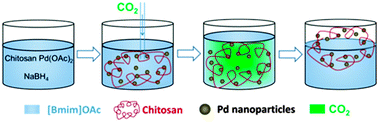
CO2 as a regulator for the controllable preparation of highly dispersed chitosan-supported Pd catalysts in ionic liquids

Chem. Commun., 2015, 51,10811-10814
DOI: 10.1039/C5CC03032C, Communication
Zhimin Xue, Xiaofu Sun, Zhonghao Li, Tiancheng Mu
A controllable synthetic route has been developed for the preparation of chitosan supported Pd catalysts in 1-butyl-3-methylimidazolium acetate by using compressed CO2 as the anti-solvent and regulator.
The content of this RSS Feed (c) The Royal Society of Chemistry
14 May 09:41

Recent Advances in Polyoxometalate-Catalyzed Reactions

by Sa-Sa Wang and Guo-Yu Yang

TOC Graphic

Chemical Reviews
DOI: 10.1021/cr500390v
05 May 03:13

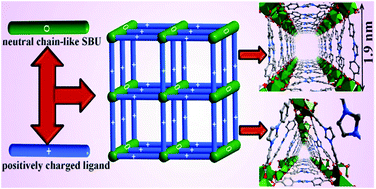
Periodic tiling of triangular and square nanotubes in a cationic metal-organic framework for selective anion exchange

Chem. Commun., 2015, 51,9515-9518
DOI: 10.1039/C5CC02639C, Communication
Bai-Qiao Song, Xin-Long Wang, Yu-Teng Zhang, Xue-Song Wu, Hong-Sheng Liu, Kui-Zhan Shao, Zhong-Min Su
A unique cationic metal-organic framework formed by connecting the neutral chain-like secondary building units with positively charged ligands shows charge- and size-dependent ion-exchange of anion dyes.
The content of this RSS Feed (c) The Royal Society of Chemistry
01 Apr 12:38

Complexation of Polyoxometalates with Cyclodextrins

by Yilei Wu, Rufei Shi, Yi-Lin Wu, James M. Holcroft, Zhichang Liu, Marco Frasconi, Michael R. Wasielewski, Hui Li and J. Fraser Stoddart

TOC Graphic

Journal of the American Chemical Society
DOI: 10.1021/ja511713c
01 Apr 10:56

Highly Ordered Mesoporous Few-Layer Graphene Frameworks Enabled by Fe3O4 Nanocrystal Superlattices

by Yucong Jiao, Dandan Han, Limin Liu, Li Ji, Guannan Guo, Jianhua Hu, Dong Yang, Angang Dong

Abstract

While great progress has been achieved in the synthesis of ordered mesoporous carbons in the past decade, it still remains a challenge to prepare highly graphitic frameworks with ordered mesoporosity and high surface area. Reported herein is a simple synthetic methodology, based on the conversion of self-assembled superlattices of Fe3O4 nanocrystals, to fabricate highly ordered mesoporous graphene frameworks (MGFs) with ultrathin pore walls consisting of three to six stacking graphene layers. The MGFs possess face-centered-cubic symmetry with interconnected mesoporosity, tunable pore width, and high surface area. Because of their unique architectures and superior structural durability, the MGFs exhibit excellent cycling stability and rate performance when used as anode materials for lithium-ion batteries, thus retaining a specific capacity of 520 mAh g−1 at a current density of 300 mA g−1 after 400 cycles.

Thumbnail image of graphical abstract

Framed: The title frameworks were fabricated from self-assembled Fe3O4 nanocrystal superlattices. Because of their unique architectures and superior structure durability, the mesoporous graphene frameworks exhibit excellent electrochemical performance when used as anode materials for lithium-ion batteries.

24 Mar 12:01

In situ encapsulation of Pd inside the MCM-41 channel

Chem. Commun., 2015, 51,7482-7485
DOI: 10.1039/C5CC00300H, Communication
Xi-Jie Lin, Ai-Zhi Zhong, Yong-Bin Sun, Xing Zhang, Wei-Guo Song, Rong-Wen Lu, An-Min Cao, Li-Jun Wan
Pd nanoparticles were successfully introduced into the channels of mesoporous silica MCM-41 with their dispersion well-tuned.
The content of this RSS Feed (c) The Royal Society of Chemistry
22 Mar 14:47

Selective Growth of a C70 Crystal in a Mixed Solvent System: From Cube to Tube

by Jungah Kim, Chibeom Park and Hee Cheul Choi

TOC Graphic

Chemistry of Materials
DOI: 10.1021/cm5044478
19 Mar 02:14

Hydroxyl-rich C-dots synthesized by a one-pot method and their application in the preparation of noble metal nanoparticles

Chem. Commun., 2015, 51,7164-7167
DOI: 10.1039/C5CC01771H, Communication
Qiujun Lu, Jianhui Deng, Yuxin Hou, Haiyan Wang, Haitao Li, Youyu Zhang, Shouzhuo Yao
Hydro-rich C-dots were used as both the reducing and stabilizing agent in the preparation of noble metal nanoparticles (AuNPs, AgNPs and Au@AgNPs) for the detection of glucose.
The content of this RSS Feed (c) The Royal Society of Chemistry
07 Mar 02:43

Pd/C-catalyzed reactions of HMF: decarbonylation, hydrogenation, and hydrogenolysis

Green Chem., 2015, 17,307-313
DOI: 10.1039/C4GC01520G, Paper
Joyee Mitra, Xiaoyuan Zhou, Thomas Rauchfuss
The diverse reactivity of 5-hydroxymethylfural (HMF) in Pd/C-catalyzed reactions is described with emphasis on the role of additives that affect selectivity.
The content of this RSS Feed (c) The Royal Society of Chemistry
04 Mar 11:42

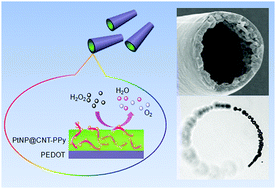
An efficient polymeric micromotor doped with Pt nanoparticle@carbon nanotubes for complex bio-media

Chem. Commun., 2015, 51,6325-6328
DOI: 10.1039/C5CC00546A, Communication
Yana Li, Jie Wu, Yuzhe Xie, Huangxian Ju
A highly efficient polymeric tubular micromotor doped with Pt nanoparticle@carbon nanotubes is fabricated by template-assisted electrochemical growth.
The content of this RSS Feed (c) The Royal Society of Chemistry
26 Feb 03:21

Octahedral Pd@Pt1.8Ni Core–Shell Nanocrystals with Ultrathin PtNi Alloy Shells as Active Catalysts for Oxygen Reduction Reaction

by Xu Zhao, Sheng Chen, Zhicheng Fang, Jia Ding, Wei Sang, Youcheng Wang, Jin Zhao, Zhenmeng Peng and Jie Zeng

TOC Graphic

Journal of the American Chemical Society
DOI: 10.1021/ja511596c
26 Feb 03:04

One Step Facile Synthesis of Amine-Functionalized COF-1 with Enhanced Hydrostability

by Yi Du, David Calabro, Bradley Wooler, Pavel Kortunov, Quanchang Li, Stephen Cundy and Kanmi Mao

TOC Graphic

Chemistry of Materials
DOI: 10.1021/cm5032317
06 Feb 03:01

Versatile Surfactant/Swelling-Agent Template for Synthesis of Large-Pore Ordered Mesoporous Silicas and Related Hollow Nanoparticles

by Liang Huang and Michal Kruk

TOC Graphic

Chemistry of Materials
DOI: 10.1021/cm5028749
03 Feb 01:44

Charge-Transfer Emission of Mixed Organic Cocrystal Microtubes over the Whole Composition Range

by Yan-Qiu Sun, Yi-Long Lei, Xu-Hui Sun, Shuit-Tong Lee and Liang-Sheng Liao

TOC Graphic

Chemistry of Materials
DOI: 10.1021/cm5027249
19 Jan 10:49

A Highly Efficient Palladium(II)/Polyoxometalate Catalyst System for Aerobic Oxidation of Alcohols

Catal. Sci. Technol., 2014, Accepted Manuscript
DOI: 10.1039/C4CY01632G, Communication
Laura M. Dornan, Mark J. Muldoon
This is an Accepted Manuscript, which has been through the RSC Publishing peer review process and has been accepted for publication. Accepted manuscripts are published online shortly after acceptance. This version of the article will be replaced by the fully edited, formatted and proof read Advance Article as soon as this is available.
The content of this RSS Feed (c) The Royal Society of Chemistry
29 Sep 11:26

Synchronized synthesis of Pd@C-RGO carbocatalyst for improved anode and cathode performance for direct ethylene glycol fuel cell

Chem. Commun., 2014, 50,14623-14626
DOI: 10.1039/C4CC06879C, Communication
Ramanujam Kannan, Ae Rhan Kim, Kee Suk Nahm, Hong-Ki Lee, Dong Jin Yoo
The simultaneous formation of a carbocatalyst composed of 5 nm sized flower-shaped Pd nanoparticles assembled on carbon-reduced graphene oxide (Pd@C-RGO) is reported via the solid state process between 1 and 2 minutes followed by microwave irradiation and exhibits improved electrocatalytic performance for the oxidation of ethylene glycol.
The content of this RSS Feed (c) The Royal Society of Chemistry