If you look at the basic colors from a variety of cultures & languages from around the world, there are differences in the number of colors represented in each language. Some languages only have words for black, white, and red while others have words for more than 10 basic colors. Surprisingly, there’s a pattern behind the development of these color words across many of these languages: the words for colors were often invented in the same order.
A representative of the Paris Olympic bid committee made waves earlier this month when he told the Associated Press they wanted to talk to the International Olympic Committee about adding esports to the 2024 Games. This was met with the usual “video games aren’t sports” grumbles, but the esports market continues to…
In a series of tweets this morning, President Trump announced that “the United States Government will not accept or allow ... Transgender individuals to serve in any capacity in the US military.” My colleague Emma Green gives context:
Former Secretary of Defense Ashton Carter had announced last June that transgender individuals would be able to serve openly in the military. He issued guidance for medical care for these soldiers—including those who transitioned during their service—as well as training military leaders. Since then, it has been the military’s policy not to discharge or deny reenlistment to service members based solely on their gender identity. The full policy was set to be implemented by July 1, 2017. But at the end of June, Secretary of Defense Jim Mattis announced a six-month delay to review the plan, assessing whether it would hurt the “readiness or lethality” of American troops.
Back in March, Jenny Hall, a CIA officer, wrote about the support she received from her colleagues when she came out as trans, and how coming out improved her ability to serve her country:
No one cares that I’m trans. Defecting from Brooks Brothers to Ann Taylor had no impact on my ability to update the president on events overseas. In fact, without the fear of losing my clearance or exhaustion from pretending to be male, I became a better intelligence officer.
Migrating from man to woman, I learned the social codes of both camps, and was forced to confront my own prejudices and assumptions. Indeed, self-awareness, humility, and the courage to speak unpopular truths are core principles of intelligence tradecraft. I have been to war and changed genders; I don’t fear the next mission.
If you’re a veteran or active-duty service member, or a trans American who’s served or is serving in the military, we’d like to hear your story. Please email our reader inbox, hello@theatlantic.com, to share your experience, and let us know if you would like to remain anonymous.
I'm really going to stop watching football this year.
Scientists looked at the brains of 111 former NFL players. All but one had chronic traumatic encephalopathy.
Friends, family members, and supporters sign surfboards as they pay tribute to former NFL star Junior Seau during a public memorial at Qualcomm Stadium on May 11th, 2012, in San Diego, California.
In 2009, a team of researchers looked up every confirmed case of chronic traumatic encephalopathy (CTE) they could find in the scientific literature. They discovered 48. Today, a new study adds 177 more cases, all in former football players, to science's understanding of the brain disease that can strike those who suffer repeated hits to the head over many years, and can end in dementia and suicide.
"In just eight years, we were able to amass 177 cases of CTE," says Dan Daneshvar, a doctor and scientist who worked on the new study while he was at Boston University's CTE Center; he's now a resident at Stanford University. "The fact that so many of them had evidence of CTE indicates that CTE is maybe related to prior participation in football and is certainly not a rare disease in individuals with exposure to repetitive brain trauma."
Chronic traumatic encephalopathy has garnered a lotof attention in the past several years, as autopsies have revealed it affected NFL stars such as Frank Gifford, whose family said in a statement that he suffered from "cognitive and behavioral symptoms" before dying of natural causes, and Junior Seau, who committed suicide in 2012.
In 2015, a United States district judge approved a settlement between the NFL and a group of former players who have long-term brain diseases, which the Associated Press reports could reach $1 billion or more. Yet a lot of questions remain about CTE, including which symptoms are caused by the condition and which may be the result of other, non-football-related mental disorders. Daneshvar and his colleagues' study offers some answers.
The research team studied 202 brains, belonging to male former football players, that the men or their families had donated to the VA-BU-CLF Brain Bank after their deaths. Among those, 177, or 87 percent, had diagnosable CTE. Fourteen of the donated brains came from men who had played football in high school; three of them had CTE. Fifty-three of the brains came from former college players; 48 of those had CTE. And 111 former NFL players had donated to the Brain Bank. All but one had CTE.
"CTE is certainly not a rare disease in individuals with exposure to repetitive brain trauma."
These numbers don't reflect the rates of CTE among football players of different levels. Because families are probably more likely to donate to the Brain Bank when they're worried about CTE, the real rates of CTE among football players in general are much lower. But the data is an indication CTE can develop among folks who play football at those levels.
Among the men whose brains showed signs of the severest CTE, nearly all had problems with their memory and problem-solving. Many had memory problems so severe they were diagnosed with dementia while they were alive, and dementia-related causes were their most common reason for death. The majority in this category also exhibited mood disorders, such as depression.
The men who had less-severe CTE tended not to have as bad of cognitive problems as their counterparts with worse CTE. But their families told researchers they tended to have behavioral and mood problems, including a lack of impulse control and feelings of hopelessness. The most common cause of death among the donors with mild CTE was suicide.
During the study, the scientists who worked on diagnosing CTE in the brain samples and the scientists who worked on gathering medical histories from family members didn't consult one another, so they wouldn't be influenced by the other team's diagnosis for any one donor. All of the men who had CTE features in their brains turned out to have CTE-like symptoms in life too.
Studies like this start scientists on the path toward figuring out what puts people at risk for CTE, Daneshvar says. Does it matter how old you are when you start playing high-impact sports, for example? Are there certain genetics that make CTE more likely? Daneshvar also hopes his work will help doctors figure out how to diagnose CTE while people are still alive. For now, families can only get a definite diagnosis after death and an autopsy. "Diagnosing in life is really the first step toward developing potential treatments," he says.
There's a lot more to learn, but there's also a lot of material left to learn from. Daneshvar's team is working on a study comparing football players of various levels, he says, and the VA-BU-CLF Brain Bank now has nearly 500 brains, donated by victims and their loved ones, searching for answers.
“I can't remember a president who has had more authoritarian tendencies than Trump.”
Vermont Sen. Bernie Sanders may have lost his bid for the White House in 2016, but he’s sure as hell not ready to fade into obscurity anytime soon. Instead, he’s emerged as a gadfly, loudly and publicly sounding the alarm on what he sees as the country’s troubling descent into authoritarianism under President Donald Trump.
“I can't remember a president who has had more authoritarian tendencies than Trump,” Sanders told me in an interview on Wednesday. “What is going on is not only this rise of authoritarianism but also, simultaneously, you are seeing this country move very rapidly toward oligarchy.”
As Sanders prepared to give a big speech on Thursday at the Carnegie Endowment for International Peace, he got on the phone with me to talk about Trump’s admiration for authoritarian leaders, his attacks on the media, the Russia investigation, and more.
Sanders told me he believes Trump has a basic disrespect for the fundamental pillars of democracy — the press, the judicial system — that mimics the authoritarian regimes the Trump administration has cozied up to around the globe. And that combination, he says, is dangerous.
What follows is a partial transcript of our conversation, lightly edited for clarity and length.
Bernie Sanders
There has never been a president, or even a leading public official, who has lied as often or as dangerously as Trump has.
And when the president of the United States lies a whole lot and makes outrageous statements, it's not only bad unto itself, but it also opens the door for other people to be lying and for truth to be disrespected. And that is a very dangerous thing for the fabric of American society.
When he talks about 3 to 5 million people voting illegally in the last election — no one believes that, it is an outrageous lie —- but what that does is tell Republican governors that they should go forward to suppress the vote, to make it harder for people to vote, under the guise of voter fraud.
Every politician has disagreements with the media and how they cover this or that story, and I am certainly one of those. But there has never been a president, or political leader, who has basically said, “Everything you see on mainstream television or mainstream media — the New York Times, the Washington Post, Vox, whatever it may be — is a lie, don’t believe it.”
If you take that to its logical conclusion, and some people have, then where do you get the truth? Where do you learn about what’s going on that you can’t see with your own eyes? Who’s going to help you? It kind of leads you to the conclusion that there is only one person in America who can tell us the truth, and that is the president of the United States.
Sarah Wildman
Do you think he’s a demagogue?
Bernie Sanders
Well, I think that ... let me continue and then you can ask me a question, fair enough?
Sarah Wildman
Okay.
Bernie Sanders
So you have this unprecedented attack on the media. What this guy is doing is basically telling the American people, “You cannot trust anything in mainstream media.”
Then, on top of that, he is attacking the judiciary system and Department of Justice. A judge rules against him — that is not unusual; judges often rule against presidents and against legislation — but you don't go around undermining the judiciary and calling people “so-called judges” because they ruled against you.
Then on top of that, you have his support for authoritarian leaders.
The American people, I think, whether you are a Republican or Democrat, have a hard time understanding his affection for a guy like [Russian President] Vladimir Putin, who has worked overtime to undermine not only democracy in his own country but also democracy in the United States.
Do you want a good relationship with Russia? Of course you do. But why would you have what appears to be a personal affection for an authoritarian leader? It is not just Putin. It is also [President Rodrigo] Duterte of the Philippines; it is the royal family of Saudi Arabia.
Again: You may want to make alliances, you may not; those are debates you have to have. But for a country like the United States, which has been seen, historically, as one of the great promoters of democracy, why have this affinity for so many authoritarian countries?
I have spoken to conservatives who share these exact same concerns.
Sarah Wildman
Do you see this as a global phenomenon? Why do you think we may be seeing public support around the world for authoritarian characters or politicians? And, go back to my original question, do you think he is a demagogue — is that what you are moving toward saying?
Bernie Sanders
Let me take the last question first. Both good questions.
You can contrast this with a very conservative Republican president named George W. Bush. I opposed Bush on virtually every piece legislation, every initiative, he put forward. Virtually all of them. But if you remember, Bush’s response to 9/11 was to visit a mosque — a very profound statement for a conservative Republican — essentially what he was saying is that we have to stand together, don't judge people by religion or by the color of their skin, and that America is a country which belongs to all of us.
Contrast that with Trump’s effort to start a program in which is he is documenting every crime an undocumented person commits, [his] verbal attacks against Latinos and against Muslims, and his effort, it seems to me, to try to make political points by dividing us up by scapegoating minorities.
That is not what a leader of any democratic country should be doing. That is part of the tradition and history of demagoguery. It divides people up.
That leads to your other question: Is this happening around the world? The answer is yes, it is.
And why is it happening? For a lot of the same reasons it is happening in the United States. The radical changes to the global economy over the last 40 to 50 years, which have benefited some people, no question about it, but have left behind tens and tens of millions of people who are today working longer hours for lower wages, who are worried to death about whether their kids can afford to go to college and whether their kids will ever have a standard of living as high as they themselves have.
A whole lot of people have been left behind in the global economy, in the United States — in rural areas, in inner cities all over this country. A lot of people have been left behind, and they are angry, they are furious, and they think people do not understand their pain. And then you have demagogues trying to explain that the problem is some Mexican farm worker who makes eight bucks an hour or someone who is a Muslim.
Tens and tens of millions of Americans today are struggling to keep heads above water economically.
What rational leadership is about is putting those problems on the table and saying, “All right, here are problems: We’ve got 28 million Americans with no health insurance. How do we deal with that issue?” rather than demagoguing about that issue and blaming minorities for the problems the country faces.
This is certainly an international phenomenon — you see it with the National Front in France, and you see [a] similar type phenomenon with Putin in Russia.
Sarah Wildman
In Berlin this May, you gave a speech where you said,“What has become absolutely clear since the election is that Donald Trump represents something we haven’t seen before in the United States. A trend toward authoritarianism, a normalization of corruption and the rise of oligarchy.” Can you unpack the last part of that sentence?
Bernie Sanders
You got my quote right.
What is going on is not only this rise of authoritarianism but also, simultaneously, you are seeing this country move very rapidly toward oligarchy.
The media doesn't talk about it very often. I do. Because it's frightening, and I don't think the media is comfortable with it — but the truth is in America today, you have the top one-tenth of 1 percent owning as much wealth as the bottom 90 percent, and you’ve got 20 people in America owning as much wealth as [the] bottom half of America, and you are seeing 52 percent of all new income generated today going to the top 1 percent.
So just an incredible inequality, in terms of wealth and income, that we have not seen since the Great Depression, since 1928.
On top of that, [we have] a political system in which the Koch brothers and other billionaires are able to spend unlimited sums through Citizens United to buy elections for the candidates who represent their interests.
You add that together with a media which is also increasingly owned by fewer and fewer people around the world. I think it is fair to say we are moving toward oligarchy, where we have an economy and a political system controlled by few incredibly wealthy people.
And [as to] the corruption aspect of this: There is an incredible blurring of business interests for the Trump family with public policy. Is Trump making foreign policy decisions on behalf of the American people and what is best for the world? Or is he making those decisions on behalf of Trump enterprises? That’s a whole other area.
Sarah Wildman
There seems little doubt that Russians attempted in some way to influence our election. How has this played out in terms of how you see the Trump administration moving toward authoritarianism?
Bernie Sanders
Well, that’s a question that obviously is being investigated right now. You are right there is nobody who denies that Russia played a significant role in trying to influence the election on behalf of Trump. So the question being investigated now is was there collusion? And you have [special counsel Robert] Mueller and his team working on that, and you have the House and Senate Intelligence Committees working on that. We will see where that will go.
I don’t have the answer, and I don't want to speak before I have facts in front of us. Trump fired [FBI Director James] Comey. Did he fire Comey because he thought Comey was a bad FBI director and he needed a change in the FBI? If that is the case, that is what a president can do.
Or did he fire Comey because Comey was launching a significant investigation about possible collusion of the Trump campaign with Russia? If that’s the case, then that's just another argument about the movement of this country toward authoritarianism, because that is obstructing justice. And that’s what’s being looked at.
Sarah Wildman
You said a few times that this is a first in American history — but there are aspects of these issues that have repeated themselves throughout history. Do you think this a repeat of something we saw in the 1930s, for example, or otherwise?
Bernie Sanders
Yes and no. Yes — look,we had Joe McCarthy. But I don't know if you have had a president whose actions —- in terms of dishonesty, clear dishonesty, in terms of the attacks on the media, trying to undermine people’s faith in what they see, hear, and read, and support for authoritarian regimes — I don't know if you have had a president who has put all of these characteristics together at one time.
I can't remember a president who has had more authoritarian tendencies than Trump.
Sarah Wildman
What role do you think the media needs to play? What happens when you undermine the Fourth Estate?
Bernie Sanders
Trump says, [essentially] “Hey all of these, ABC, CBS, VOX, everybody else, anybody in the mainstream media, they are all liars, they hate me, they are trying to undermine me, so don't believe a word of it.”
What does that tell the average person in this country? Where will they get the truth?
That is a very profound development. After all, where do you get truth? How do you get truth? How do you know what is going on in Washington, DC? Is it just Trump's tweets? I think when a president says, “This is a [news] story, I disagree with it, this is why I disagree with it” — there’s nothing wrong with that. I do that every day. But to say, “Everything you are seeing in the media is a lie” — wow, that is pretty dangerous stuff.
Sarah Wildman
You mentioned the National Front earlier — there was great anxiety that she had a chance to succeed, but actually, in the end, Marine Le Pen, and the far right in France, was profoundly unsuccessful. What was different there that we didn't experience here?
Bernie Sanders
Let’s not forget that if you had a popular vote that was announced at 11 pm on election night — [Hillary] Clinton won the popular vote by 2.9 million votes. That’s a difference. Emmanuel Macron did not go through a complicated Electoral College which allowed someone who received a minority of the votes to become president; that’s one of the differences. That’s a good discussion. Maybe we can have it another time.
But why? Take a cut of all economic activity? Sounds pointless.
Amazon’s New Customer is a really great analysis by Ben Thompson of Amazon’s strategy and why Amazon bought Whole Foods: they purchased a new customer for Amazon infrastructure, not a retailer. Early on in the piece, Thompson lays this one on us:
Amazon’s goal is to take a cut of all economic activity.
No qualifiers. All economic activity. In the world. Sort of a Dutch East India Company for the internet age. Thompson explains how they’re going to do it and why fresh food is such a strategic hole for them.
As you might expect, given a goal as audacious as “taking a cut of all economic activity”, Amazon has several different strategies. The key to the enterprise is AWS: if it is better to build an Internet-enabled business on the public cloud, and if all businesses will soon be Internet-enabled businesses, it follows that AWS is well-placed to take a cut of all business activity.
On the consumer side the key is Prime. While Amazon has long pursued a dominant strategy in retail — superior cost and superior selection — it is difficult to build sustainable differentiation on these factors alone. After all, another retailer is only a click away.
This, though, is the brilliance of Prime: thanks to its reliability and convenience (two days shipping, sometimes faster!), plus human fallibility when it comes to considering sunk costs (you’ve already paid $99!), why even bother looking anywhere else? With Prime Amazon has created a powerful moat around consumer goods that does not depend on simply having the lowest price, because Prime customers don’t even bother to check.
This, though, is why groceries is a strategic hole: not only is it the largest retail category, it is the most persistent opportunity for other retailers to gain access to Prime members and remind them there are alternatives. That is why Amazon has been so determined in the space: AmazonFresh launched a decade ago, and unlike other Amazon experiments, has continued to receive funding along with other rumored initiatives like convenience store and grocery pick-ups. Amazon simply hasn’t been able to figure out the right tactics.
When I heard about the Whole Foods deal, the first thing I thought about was Amazon Go. The company has been trying to experiment with different retail environments, but without the proper scale, it doesn’t make a lot of sense. Whole Foods gives them a chance to develop their fresh food delivery infrastructure at scale…so that they can offer it to other customers just like they do with AWS.
There was a time when I legitimately understood both political parties and their ideals. But what is the argument against public healthcare? I sincerely don't understand.
A chance trip to Long Island’s Adventureland amusement park just might have saved Cassidy McCarthy’s life. After Cassidy—whose family calls her Cassie—then 4, complained about pain and nausea following a ride on the Ladybug rollercoaster, her dad, Daniel, a registered nurse, felt her stomach and discovered a small bump. A CT scan ordered up at a local hospital’s emergency room revealed a kidney tumor.
It was another seemingly chance decision by Daniel McCarthy to sign on as a volunteer firefighter more than a decade ago that saved the family’s finances in the wake of Cassidy’s diagnosis with cancer. As it turned out, that activity allowed him to ask The Heather Pendergast Fund, a foundation set up in 2009 to help out the families of Long Island’s volunteer firefighters and EMS workers with their children’s medical expenses, to pay many of Cassidy’s medical bills.
McCarthy says the charitable foundation was a financial lifeline. Cassidy quickly racked up more than several thousand dollars in out-of-pocket medical expenses—for the surgeon, the anesthesiologist, radiologists, chemotherapy, you name it—since the family’s insurance policy had a $6,000 deductible. A few months later, Pendergast came through again when McCarthy lost his job at a local nursing home and rehabilitative center and the family suddenly had to find money for COBRA payments, which, at $2,100 a month, were more than the monthly mortgage payment on their West Babylon, Long Island, home.
“I don’t know how people who don’t have resources do this. I don’t. Many people work three, four jobs, and can’t afford the time to volunteer in an organization like the fire department that would be able to help them. There are many people living out there that need help that can’t find it,” McCarthy says.
The current debate over the future of the Affordable Care Act is obscuring a more pedestrian reality. Just because a person is insured, it doesn’t mean he or she can actually afford their doctor, hospital, pharmaceutical, and other medical bills. The point of insurance is to protect patients’ finances from the costs of everything from hospitalizations to prescription drugs, but out-of-pocket spending for people even with employer-provided health insurance has increased by more than 50 percent since 2010, according to human resources consultant Aon Hewitt. The Kaiser Family Foundation reports that in 2016, half of all insurance policy-holders faced a deductible, the amount people need to pay on their own before their insurance kicks in, of at least $1,000. For people who buy their insurance via one of the Affordable Care Act’s exchanges, that figure will be higher still: Almost 90 percent have deductibles of $1,300 for an individual or $2,600 for a family.
Even a gold-plated insurance plan with a low deductible and generous reimbursements often has its holes. Many people have separate—and often hard-to-understand—in-network and out-of-network deductibles, or lack out-of-network coverage altogether. Expensive pharmaceuticals are increasingly likely to require a significantly higher co-pay or not be covered at all. While many plans cap out-of-pocket spending, that cap can often be quite high—in 2017, it’s $14,300 for a family plan purchased on the ACA exchanges, for example. Depending on the plan, medical care received from a provider not participating in a particular insurer’s network might not count toward any deductible or cap at all.
At the same time, the most recent Report on the Economic Well-Being of U.S. Households, an annual survey conducted by the Federal Reserve Board, found that 44 percent of adult Americans claim they could not come up with $400 in an emergency without turning to credit cards, family and friends, or selling off possessions. When this reality combines with healthcare bills, the consequences can be financially devastating. A 2015 poll by the Robert Wood Johnson Foundation and the Harvard T.H. Chan School of Public Health discovered that 26 percent of those who took part in the survey claimed medical bills caused severe damage to their household’s bottom line. A poll conducted earlier this year by Amino, a healthcare-transparency company, with Ipsos Public Affairs, found that 55 percent of those they surveyed claimed they had at least once received a medical bill they could not afford. No surprise, then, that the Consumer Financial Protection Bureau reported earlier this year that medical debt was the most common reason for someone to be contacted by a debt collector.
This spending is most pressing for households with the highest medical bills, the 5 percent of Americans who make up 50 percent of the country’s healthcare costs. Medicare, Medicaid, and private insurers will spend $40,375 on average per patient for someone in this group. Their out-of-pocket spending will be much less: on average, $2,582.90. This isn’t, in the scale of things, a lot of money—but given Americans’ straightened personal finances, it’s more than many can easily access.
This isn’t, it’s important to point out, a static group. A chronic illness can land someone in this category but, given the increasing prevalence of high-deductible plans, so can something as simple as a broken bone or an emergency appendectomy. Although some people will be in this group year after year, many will cycle in and out, and nearly everyone will be in it for some brief period. The fact is that nearly any illness or injury can lead to unexpected bills, and few are able to absorb those shocks without difficulty. Yet, despite the commonness of such problems, there is little in the way of a system for helping people out through these times.
Some of these people will declare bankruptcy. How many is the subject of controversy. A famous study—co-authored by Elizabeth Warren—found that suffering from a medical misfortune was the most common reason for ultimately leading someone to petition the courts for relief from their financial obligations, but another study pointed to unnecessary spending prior to the medical crisis.
As it turns out, determining what counts as a medical expense is difficult. It’s not simply doctor bills. In addition to the not-covered deductibles, there is transportation to and from medical appointments, parking fees at many hospitals, and often childcare expenses while parents are in treatment or at appointments. Time for cooking will be limited, so take-out bills can pile up, too.
And families that experience an illness are often hit by a double whammy—they lose income at the same time their financial needs grow, often cutting back on work hours or leaving work altogether, either voluntarily or not. McCarthy, for one, recently filed a lawsuit against his former employer, Daleview Care Center in Farmingdale, Long Island, claiming he was let go because of the amount of work he missed as result of his daughter’s illness, a violation of several laws including the Family Medical and Leave Act. In legal filings, Daleview denied McCarthy’s allegations, but the company did not return requests for comment.
“The families get to the point where it’s, ‘What do I do? Do I pay the doctor bill because I’m getting collection notices? But I gotta pay my mortgage, I gotta pay my electric bill, I’ve gotta pay the rent.’ That’s where we come in,” Tom Pendergast of the Heather Pendergast Fund told me. “They can pay their mortgage, their rent, their electric bills and not have to worry about the medical part of it.”
For many, the idea of charity to help those in need out—which is, after all, what saved the McCarthy family from financial disaster—holds much in the way of appeal, speaking to both a sense of generosity and a can-do spirit. It somehow seems, well, American, to think individual donations can compensate for a broken, expensive system that views illness as a moneymaking opportunity. So there is crowdfunding, small foundations like the Pendergast Fund, hospital-charity programs for the needy, and disease-specific resources. These efforts are patchy, and often inadequate, but they’re what’s available. Their strengths and their failings reveal a lot about the broader American healthcare system—something that is all too easy to ignore till it is your life or the life of a loved one at stake.
***
CancerCare was founded in 1944 as a bereavement-support organization, but quickly began helping people with the disease manage their financial issues as well. “The first hospital bill we paid, in 1944, was to Memorial Sloan Kettering for $13 and change,” said Patricia Goldsmith, the organization’s chief executive officer. Today, finances are why between 60 and 70 percent of those who contact the organization reach out, and the dilemmas are the same as those people who turn to The Heather Pendergast Fund face. “For the most part, people call us because they are in some kind of financial crisis,” says William Goeren, CancerCare’s director of clinical programs. “The prices have increased ... so that really puts the burden on the patient, who is weighing, ‘Do I pay for my mortgage or should I pay for my diagnostic test?’ These are the calls we are getting.”
CancerCare attempts to head off these sorts of financial issues, while still offering emotional support to people in need. They offer a bereavement camp—located in Pennsylvania’s Poconos—and counseling groups for cancer sufferers and their children alike. They also distribute more than $4 million in transportation, home-care, and childcare assistance.
But the heart of CancerCare’s aid is distributed through their disease-specific prescription co-pay funds, which award anywhere between $4,000 and $15,000 per patient to income-eligible patients. (“Income eligible” varies based on the fund, but is generally anywhere between 250 and 500 percent of the federal poverty line.) Last year, the organization distributed slightly more than $14.2 million in total.
Such funds are not without controversy. The cost of treating cancer, a disease that will be newly diagnosed in just under 1.7 million Americans in 2017, is skyrocketing. According to research published in theJournal of Oncology Practice, the average cost of a year of a cancer treatment drug in 2000 was less than $10,000 in total. By 2005, that had more than tripled to between $30,000 to $50,000 annually. In 2012, 12 out of the 13 drugs newly approved for cancer cost more than $100,000. Another study, this one published inJAMA Oncology, found the price of one month of an oral-cancer medication increased from $1,869 in 2000 to $11,325 in 2014. As insurance companies, desperate to clamp down on their own expenses, cut reimbursements for the more expensive drugs, and employers, hoping to cut their own costs, push employees into high-deductible health-insurance plans, more of this cost ends up being picked up by the patients.
A paper published by the journal Health Affairsin 2013 found cancer patients are more than twice as likely as their peers without the disease to declare bankruptcy. The consequences of this expense goes beyond the patient’s checkbook: Last year researchers writing for the Journal of Clinical Oncology found that cancer patients who declared bankruptcy were significantly more likely to die than those who did not need to ask the courts to discharge their debts. The reasons for the increased mortality are unclear: It’s possible people with shaky finances are less likely to receive adequate treatment, but it’s also possible stress is a contributor.
Many believe the 2003 passage of Medicare Part D, which established coverage for pharmaceutical costs, is partially responsible for the price surge. The same legislation allowed for non-profit patient-advocacy groups to establish co-pay funds that could be funded by the pharmaceutical industry. (The CancerCare Co-Payment Foundation was established in 2007, for example.) These co-pay funds are meant by the organizations offering them to help people, but critics maintain the pharmaceutical-company contributions to organizations like CancerCare and others like it should be viewed less as charity and more as cover for the ever-increasing cost of their medications, since these donations allow pharmaceutical companies to stick insurance companies and government programs like Medicare with an ever-greater bill, while helping the consumers cover their share of the tab. “Co-pay programs are meant to mitigate criticism of high drug prices, deflect legislation on drug pricing, get around payer restrictions and get patients on expensive drugs they will stay on for a long time,” says Adriane Fugh-Berman, an associate professor at Georgetown University Medical Center and an expert on physician-industry relationships.
The amount of money is also not enough. The phrase “drop in a bucket” barely does it justice. When CancerCare opened a $1.6 million fund for the co-payment of multiple myeloma medications this past April, it was exhausted within two days, Goldsmith told me. “I guarantee you tomorrow if for some reason we got $500 million tomorrow to support co-pay assistance, we could distribute that money likely within two months,” she said. But it is, she points out, better than not distributing the money at all. “I can tell you that that amount of money often makes the difference between people being able to get their treatment and not get their treatment.”
This is hardly unique to CancerCare. Alan Balch, the chief executive officer of the Patient Advocate Foundation, which provides both case-management services and administers co-pay funds for a range of diseases and distributed more than $50 million in assistance in the fiscal year that ended in June of 2016, tells me that while some co-pay funds remain open for a considerable period of time, others open and close quickly. “There’s only so much money that is available at any one time and there’s so much demand for it,” he says.
The evidence is clear when you visit the websites of the funds. The Patient Advocate Foundation’s chronic pain fund? Its aid is limited to $1,500 and you need to apply when it’s taking applications. “Effective 01/18/2017, we are unable to process applications that are pending or accept new or renewal applications at this time. Should additional funding for Chronic Pain Fund applicants become available in the future, it will be necessary to re-apply if assistance is still needed.” The Patient Advocate Foundation’s multiple-sclerosis and renal-cell-carcinoma funds have been closed to new applicants since 2016. It helps to have a more popular disease: Everyone I interviewed told me it was a lot easier to find funds to assist sufferers of, say, breast cancer, than it was an unusual malignant tumor. “The rarer the cancer, the less likely there will be funding for that cancer,” said William Goeren of CancerCare.
For patients, this can seem like an elaborate, never-ending maze—and there is no central clearinghouse for the information. The Leukemia & Lymphoma Society’s Co-Pay Assistance Program will cover blood transfusions, chemotherapy, and radiation therapy, among other things, but not diagnostic procedures like surgery or lab work. United Way offerings vary by locality. Still others, like the Pendergast Fund, are targeted to small populations and can fly under the raadar. The hospital where Cassidy McCarthy received her treatments, for example, did not inform the family about the Heather Pendergast Fund, but the organization’s work is well known in Long Island’s firefighting community. “The chief of the fire department came to me and goes, ‘Well, there’s this Pendergast Fund so any bills you have, just give them to me,’” McCarthy recalled.
And even when medical supplicants find programs, they are not guaranteed aid even if they meet all the eligibility requirements. Amanda Collins, 36, is a Bartlesville, Oklahoma, resident who found herself financially scrambling after first her husband and then herself suffered a succession of medical crises. When the family finally obtained health insurance through Sooner Care—that’s Medicaid in Oklahoma—they were also given a list of local charities that could help out those in need. She says she learned to call any organization, whether they were offering aid with medical expenses or electric bills, mighty quick. “Then you call these services, not just for medical help, but any help. They tell you, ‘Oh, you have to hit us on this date,’ or ‘We get funding every month, but our funding is gone by the fifth of the month.’”
But for many who do receive monetary aid in the face of a medically induced financial crisis, it helps them, but it doesn’t make their money woes go away. The American Kidney Fund, yet another patient-advocacy fund, put me in touch with Lori Noyes, a 55-year-old nurse living in Upland, California, with her two cocker spaniels, Kirby and Tucker. Noyes’ financial life all but collapsed when a donated kidney she received in childhood failed in early 2014. Her out-of-pocket cost for prescription co-pays was running about $200 a month. Every medical appointment resulted in more bills. “Each little doctor would take a swipe at you,” she told me. Credit-card bills mounted.
Noyes, too, found herself struggling to navigate the charities that could potentially help. When she suffered vision loss following her kidney transplant and could no longer drive, it wasn’t anyone at a medical office who informed her of the Service Center for Independent Life, a Claremont, California based organization that helps people with disabilities with everything from transportation to employment assistance. A sympathetic Uber driver told her about the program. Finally, a financial counselor at the DaVita kidney-care location where she received dialysis suggested she reach out to the American Kidney Fund, which offered Noyes help paying her health-insurance bill and Medicare Part D premium. (All end-stage renal-failure patients are eligible for Medicare.) “It gave me wiggle room,” she says.
But that still left Noyes with a lot of bills. Even with the help of the American Kidney Fund, Noyes claimed about $22,000 in medical expenses on her taxes in 2014 and $19,000 in 2015, which included everything from dressing supplies and over-the-counter medications to travel expenses to and from the transplant center where she ultimately received a donated kidney. There are few—if any—charitable organizations willing or able to hand out this amount of assistance.
As for hospital-based charity, it can vary widely. Most studies find for-profit hospitals provide less charity care than nonprofit medical centers. But getting aid from a non-profit hospital isn’t exactly a gimme. A paper published by the Brookings Institution in 2015 pointed out that the non-profit hospitals with the most funds that could be devoted to charity care—that is, covering or forgiving medical bills of those who cannot pay full—are not located in the geographic areas where the need is greatest. The higher the wealth in a particular region, the more money a hospital is likely to have for indigent or needy patients. But those patients who need financial assistance are likely to live in lower-income areas where there is less in the way of resources. The paper uses two hospitals in Connecticut’s Fairfield County to make the point. The facility located in the high-income New York City suburb of Greenwich offers assistance to people with higher incomes than one located in Norwalk, a less wealthy town located a mere 15 miles away. But despite the lower ceiling, a much higher percentage of the Norwalk hospital’s bad-debt cases turned out to meet the eligibility guidelines for charity care.
Moreover, in the wake of the Affordable Care Act, a number of nonprofit hospitals actually lowered the eligibility ceiling for charity assistance, thinking that such a change would encourage more people to sign up for health insurance. (For example, BJC Healthcare, headquartered in St. Louis, now only offers aid to people with household incomes of 300 percent of the federal poverty line, compared to 400 percent previously.) But because of the increasingly high deductibles, even people who didn’t meet the threshold for aid under the older, more generous standards are now experiencing financial grief as a result of medical bills. In an effort to cut down on uncollectable bills, a number of hospitals are now teaming up with financial services firms like Commerce Bank to offer time-limited interest free loans to patients something that, while helpful to some, most certainly is not charity.
When I catch up with Savannah Dray—she calls me from her car, on the way back to her Tallahassee apartment from a chemotherapy session—she begins rattling off her debt. “I have all kinds of medical bills. I have pathology bills. I have radiology bills. I have oral surgeon bills because the disease eroded parts of my teeth and broke them off. Now I have a regular dental as well as an oral surgeon bill. I have bills from my CT scans, which I guess would fall under radiology. I have surgery bills.” Dray, 22, was diagnosed earlier this year with stage-three colon cancer. How much does she owe overall? She can’t tell me. The bills are coming in by the day, and have been pretty much since the January day she doubled over with pain, and went to a nearby emergency room. But it’s definitely more than $10,000. She met her own $6,250 deductible, and then switched over to her husband’s plan when she left work as an assistant manager for a chain store. She now needs to meet that $6,250 deductible too.
A financial counselor at her oncologist’s office told Dray about CancerCare, as well as programs available from the American Cancer Society and Stupid Cancer, an advocacy and aid group for young adults fighting malignancies. But Dray says she was initially so overwhelmed by her illness and all the bills, she didn’t have the energy to reach out. For Dray, crowdfunding was a more familiar process, so she went with that. Only after she raised $4,712 toward a $30,000 goal on a page she set up at GoFundMe did she send an application in to CancerCare for financial assistance.
Little wonder, then, that an increasing number of patients turn to crowdfunding even before they investigate more established charitable giving programs. While turning to friends and family and holding fundraisers for medical bills has almost certainly been with us as long as people have paid for assistance when ill, turning to the Internet to plead for help with medical expenses is less than ten years old. Yet it has become all but ubiquitous, seemingly the first thing many people think to do when confronted by a medical crisis or tragedy. Last year’s Orlando nightclub shootings inspired numerous crowdsharing efforts for everything from survivors medical bills to help for families paying funeral expenses. The same thing happened this year, when two men were killed and another injured by a man shouting anti-Muslim sentiments at a woman wearing a hijab in Portland, Oregon.*
Recommending patients experiencing trouble with their bills give crowdfunding a try has turned into all but a personal-finance trope. “Do you need money for unexpected medical and long-term-care expenses, funeral costs, or a local charitable endeavor? Maybe it’s time to turn to one of the growing number of personal ‘crowdfunding’ sites and ask the public for small donations,” chirpedKiplinger’s last fall. Newspaper articles about successful campaigns are a staple of what remains of the local press and heartwarming articles about the practice abound.
The truth is more than a bit darker. A few years ago, Ethan Austin, the co-founder of Give Forward (which recently merged with YouCaring, another crowdfunding site), one of the first sites to realize that crowdfunding could be as useful for people facing medical bills as those seeking to fund an independent film or fund a business venture, spoke to a group of students at New York University’s Stern School of Business about his site. He was blunt about one of the reasons he believed this segment of the online fundraising world had taken off so dramatically. “Our health-care system is shit and it’s trending shittier,” he told the group. Last year, Nerdwallet broke down the numbers and discovered that just under 50 percent of the money raised by GoFundMe campaigns is somehow related to healthcare. There’s likely a measure of nowhere-else-to-turn desperation involved: A study published earlier this year by Lauren Berliner and Nora Kenworthy, both on faculty at the University of Washington, found that residents of states that didn’t take advantage of the Affordable Care Act to offer more residents access to Medicaid were over-represented on crowdfunding sites.
Yet for all the attention paid to crowdfunding, the limited evidence we have shows that for most people, the hype is better than the actual results. A 2015 analysis by Nerdwallet found only 11 percent of healthcare fundraisers on Fundrazr, GiveForward, GoFundMe, Plumfund, and Red Basket met the organizer’s financial target. Berliner and Kenworthy, who studied a random selection of 200 campaigns on GoFundMe, they found a very similar result. Nine in 10 were never funded in full.
According to Berliner and Kenworthy, most campaigns don’t go viral. Instead, they stay among the ill person’s existing social networks. “There seems to be some allure about what campaigns can do that exceeds what we are seeing they can do,” says Berliner. “It’s probably unlikely that you have some billionaires in your mix who are just looking to swoop in,” adds Kenworthy.
In the healthcare community, some experts are increasingly down on the concept. “We don’t recommend it routinely,” says Anne Bailey, a vice president for patient support at DaVita, the chain of dialysis centers where Noyes received treatment. In her view, crowdfunding works best for a one-time emergency, not a medical issue that will potentially go on for years. “That’s just not an acceptable solution for a long-term chronic medical issue.” For the 5 percent of people with the largest medical bills, crowdfunding is unlikely to come through, or least to come through in a way that solves the financial problem in the long term.
Nonetheless, it’s also true that every little bit helps. If Dray’s campaign hasn’t met her hoped-for expectations, it’s far from useless. She’s already been able to use some of the money to pay for oral surgery, not to mention to make a co-payment for a cardiologist. If not for the GoFundMe and an account on Instagram where she sells her art, she tells me, she’s not sure she could handle her medical bills, keep a roof over her head, and food in the kitchen.
***
I spoke with numerous people for this piece who told me that at some point, after all the fundraising, and asking for aid for organizations, and cleaning out of retirement and savings accounts, they simply put all their remaining bills on a credit card, and hoped for the best. They simply couldn’t take the constant barrage of mail from numerous separate medical providers and facilities.
For many, the financial turmoil caused by their illness already adds to the emotional and physical turmoil they are already experiencing. “Many people call us, and I am speaking anecdotally and they are angry. They say I’ve been working my whole life, I’ve paid my taxes, I’ve been diligent, but now I’m being slammed, I have to ask for charity ... There’s shame and anger in that,” says Richard Dickens, CancerCare’s director of client advocacy.
But there is more than simple embarrassment arguing against this system. It’s the equivalent of taping a few bandages over a gaping wound and hoping for the best. The cost of medical care is so high, and the personal finances of many Americans so tight, it’s all but impossible for any organization—or all of them—to keep up, and that’s whether or not the charitable contributions they accept are part of the problem or the solution. And this is now. Should Republicans succeed in their effort to repeal the Affordable Care Act, an estimated 23 million people would lose health-insurance coverage over the next decade. That would almost certainly put even more pressure on the charitable resources available to help those in need pay for medical care.
Yet illness exists in the here and now. People need the money, so we open our wallets and we give what we can, feeling a little good about doing our part. And it does help some: As CancerCare’s Patricia Goldsmith puts it, “I can tell you that that amount of money often makes the difference between people being able to get their treatment, and not get their treatment.”
As for Cassidy McCarthy, she received what the family hopes was her last dose of chemotherapy on May 22. Both she and a brother will be attending a summer camp for children with cancer and their siblings that’s offered free of charge. Daniel McCarthy has a new job, and no longer needs assistance with his insurance premium. When a recent $45 blood-work lab bill recently arrived, the family didn’t forward it to Pendergast. They paid it themselves. “Some other people might need the money,” McCarthy said. If the family is lucky, they’re heading toward the best approach to avoiding big medical bills in the future: good health.
*This article originally stated the location of the attack as Portland, Maine. We regret the error.
The founders of our portfolio company Blockstack are ambitious.
What they have built and are announcing today is effectively a new Internet, powered by the blockchain.
This is what the Blockstack team is after:
A new internet needs to have security and safety as a core of its DNA. Applications and services cannot be owned and controlled by remote third-parties. We can build a digital world of truly peer-to-peer internet utilities not maintained by corporations, but collectively, by the people. We can build a digital world that encodes property rights, where we can own our data, and where the people are powerful.
One of the new tools Google has announced for its advertisers today promises to tie your offline credit card data together with all your online viewing to tell advertisers exactly what's working as they try to target you and your wallet. Consumerist reports: That return, for decades, was hard to measure in all but the most vaguely correlative of ways. Did people buy your product after seeing your TV ad? After seeing your billboard? On a whim after seeing neither? Who knows! But in the age of highly targeted, algorithmic advertising, the landscape is completely different. The apps on your phone know what you looked at and when, and can tie that in to what you see on other devices you're also logged into their services on (like your work computer). Meanwhile, you're leaving tracks out in the physical world -- not only the location history of your phone, but also the trail of payments you leave behind you if you pay with a credit card, debit card, or app (as millions of us do). Google also introduced some offline measurements to its online tool suite back in 2014, when it started using phone location data to try to match store visit location data to digital ad views. But a store doesn't make any money when you simply walk into it; you need to buy something. So Google's tracking that very granularly now, too. "In the coming months, we'll be rolling out store sales measurement at the device and campaign levels. This will allow you to measure in-store revenue in addition to the store visits delivered by your Search and Shopping ads," Google explains to advertisers. That's very literally a collection of spending data matched to the people who spent it, matched in turn to people who saw ads.
From a purplish blue color named "Sane Green" to a "Gray Pubic" sky blue, an artificial intelligence experiment by research scientist Janelle Shane saw a series of colors invented and named by a neural network. Through inputting 7,700 Sherwin-Williams......
Continue Reading...
The Stranger Things cast is a talented young crew. Millie Bobby Brown can flawlessly rap her way through Nicki Minaj’s “Monster” and her counterpart Finn Wolfhard, who plays Mike Wheeler on the show, revealed he can shred on the guitar. The minor showboating went down at a Mac DeMarco show at the Tabernacle in Atlanta, Georgia the other night. Wolfhard previously revealed himself as a DeMarco fan last year when he uploaded an acoustic cover of “Salad Days” from the artist’s 2014 album of the same name.
DeMarco certainly returned the favor, inviting the burgeoning actor/musician onto the stage to play a solo while perched atop his shoulders. And, as any good cast mate would, Stranger Things’ actress Natalie Dyer was right there to capture the moment in real time.
If the whole Netflix show thing doesn’t work out for Aziz Ansari, he could become a professional reader of bad online restaurant reviews, because he is a master at this particular art form. Last night, Aziz and Jimmy Fallon revived one of the Tonight Show’s best comedy bits, “Dramatic readings of Yelp Reviews.” Watch the clip above to see Aziz and Jimmy toss around lines from reviews of an Italian deli, a bar and grill, a dentist office with a weird selection of movies, and an auto-repair shop. Toward the end of the segment, Aziz quips, “Next time we should actually get these people in here so we can find out what really happens.” • The Tonight Show [YouTube] • All Video Interludes [E]
Who can sincerely believe that President Trump fired FBI Director James Comey for any reason other than to thwart an investigation of serious crimes? Which crimes—and how serious—we can only guess.
The suggestion that Comey was fired to punish him for overzealously mishandling the Clinton email investigation appears laughable: Just this morning, Trump’s social media director Dan Scavino gleefully proposed to release video of Hillary Clinton’s concession call in order to hurt and humiliate her—and top Trump aide Kellyanne Conway laughed along with him.
No, this appears to be an attack on the integrity—not just of law enforcement—but of our defense against a foreign cyberattack on the processes of American democracy. The FBI was investigating the Trump campaign’s collusion with Russian espionage. Trump’s firing of Comey is an apparent attempt to shut that investigation down.
Whether that exactly counts as a confession of wrongdoing is a question that still deserves some withholding of judgment. Trump is impulsive and arrogant. His narcissistic ego needs to believe he won a great electoral victory by his own exertions, not that he was tipped into office by a lucky foreign espionage operation. He could well resent the search for truth, even without being particularly guilty of anything heinously bad. But we all now must take seriously the heightened possibility of guilt, either personal or on the part of people near him—and of guilt of some of the very worst imaginable crimes in the political lexicon.
Now comes the hour of testing. Will the American system resist? Or will it be suborned?
The question has to be asked searchingly of the Republican members of Congress: Will you allow a president of your party to attack the integrity of the FBI? You impeached Bill Clinton for lying about sex. Will you now condone and protect a Republican administration lying about espionage?
Where are you? Who are you?
The question has to be asked of every Trump law-enforcement appointee: In 1974, Elliot Richardson resigned rather than fire the investigator of presidential wrongdoing. Why are you still on your job? Where are your resignations?
The question has to be asked of every national-security official: It’s a lot more probable today than it was yesterday that the chain of command is compromised and beholden in some way to a hostile foreign power. If you know more of the truth than the rest of us, why are you keeping it secret? Your oath is to the Constitution, not the person of this compromised president.
The question has to be asked of all the rest of us: Perhaps the worst fears for the integrity of the U.S. government and U.S. institutions are being fulfilled. If this firing stands—and if Trump dares to announce a pliable replacement—the rule of law begins to shake and break. The law will answer to the president, not the president to the law.
Utah Senator Mike Lee introduced a bill Monday aimed at nullifying the Federal Communications Commission's net neutrality rules. "Few areas of our economy have been as dynamic and innovative as the internet," said the statement. "But now this engine of growth is threatened by the Federal Communications Commission's 2015 Open Internet Order, which would put federal bureaucrats in charge of engineering the Internet's infrastructure."
The bill is primarily aimed at stripping the internet of its status as a public utility, returning its status to that of an "information service", and preventing the FCC from changing the classification back in the future. The Senate Republicans might not have to be so worried: the FCC's new chairman has already outlined similar plans to curtail recent net neutrality decisions.
Like Senator Lee, FCC boss Ajit Pai wants to do away with how net neutrality rules are enforced. His plans to dismantle net neutrality would turn the internet back to an information service classification, which would reduce regulation. It would also remove the "internet conduct standard" which let the FCC investigate zero-rating schemes that exclude certain services from monthly data allowances.
Senator Lee added that his "Restoring Internet Freedom Act" (which he's introduced once before) would put a stop "to the FCC and the Obama administration's unauthorized power grab over the Internet." According to The Hill, the senator's bill is unlikely to receive support from Democrats.
"Uncertainty is, in a nutshell, justification for action, not complacency."
It’s time for the opinion page to take climate change as seriously as the paper’s reporters do.
Earlier this month, the New York Times hired conservative Bret Stephens, longtime writer for the Wall Street Journal, as a columnist for its opinion page.
It really shouldn’t have.
For one thing, though the paper defends the hire in the name of opinion diversity, Stephens is a very familiar sort of establishment conservative — a cosmopolitan, well-educated, reflexively pro-Israel war hawk (who once wrote a column on “the disease of the Arab mind”) who thinks anti-racists are the real racists but moderates on select issues to demonstrate his independence.
It is difficult to imagine a perspective more over-represented in DC political circles, at least relative to its representation in the actual conservative movement. In terms of intellectual contribution, his main credential seems to be that he has opposed Donald Trump.
It takes a particular sort of insularity to hire a pro-war, anti-Trump white guy as a contribution to diversity on the NYT editorial page.
Worse, Stephens is the kind of conservative writer who has feasted on easy shots at liberals for so long that he has let himself get lazy. Read his interview with Vox’s Jeff Stein, who actually pushed him a little. He says things like this:
I think Black Lives Matter has some really thuggish elements in it. Look — at the risk of being incredibly politically incorrect, but I guess that’s my job — I think that all lives matter. Not least black lives.
This is perfect: The delivery of a faux-profound bit of conservative conventional wisdom in tones that suggest a) no one has ever thought of it before and b) willingness to say it demonstrates a kind of tough-minded courage.
That kind of bubble blindness comes up frequently when we turn to the main reason NYT shouldn’t have hired Stephens: climate change.
The Truth Is More Important Now Than Ever, Except If You're Reading Our Op-Ed Page pic.twitter.com/1bWM9IPM1k
Stephens has long been a standard conservative hack on climate change
Predictably, the debate about Stephens has focused on whether he is a “climate denier.” That label, which has taken on such weighty culture-war implications, is mostly symbolic and mostly a distraction. Despite what people like Stephens like to say, climate change is not a religious doctrine. Attitudes toward it need not be binary, belief or apostasy. Different people might draw different conclusions from the available information.
But just saying that doesn’t get us very far. What matters is not whether Stephens deserves a particular label, but whether he is honest, and makes good arguments, about what is an extremely important subject.
And when he discusses climate change, Stephens uses incorrect facts and terrible arguments. At a time when we desperately need a conversation about climate change more sophisticated than “is it a problem?” he makes the debate dumber.
Since the outcry that met his hiring, Stephens has tried to soften his take on climate. He told Huffington Post that he is a “climate agnostic.”
“Is the earth warming?” he asked. “That’s what the weight of scientific evidence indicates. Is it at least partially, and probably largely, a result of man-made carbon emissions? Again, that seems to be the case. Am I ‘anti-science’? Hell, no.”
As Joe Romm of Climate Progress has demonstrated, this is utterly disingenuous. Stephens called climate change a “mass hysteria phenomenon” for which “much of the science has … been discredited.” He said that people who accept climate change science are motivated in part by the “totalitarian impulse” and they worship “a religion without God.” He said “global warming is dead, nailed into its coffin one devastating disclosure, defection and re-evaluation at a time.” In a column calling climate change one of liberalism’s “imaginary enemies,” he said this:
Here’s a climate prediction for the year 2115: Liberals will still be organizing campaigns against yet another mooted social or environmental crisis. Temperatures will be about the same.
As Romm notes, the idea that temperature will be the same in 100 years is utterly ludicrous, the scientific equivalent of claiming the earth is flat.
It doesn’t sound like the words of a “climate agnostic.” It sounds like the words of a climate dope.
Before he was hired at NYT, Stephens was a source of standard-issue right-wing hackery on climate change. If he has really changed his mind on whether climate change is a “mass hysteria phenomenon,” he ought to say why.
Getting hired has not stopped Stephens from making lazy arguments
Editorial page editor James Bennet says charges of denialism against Stephens — holding him responsible for words he has written — are “terribly unfair.” So let’s give Stephens the benefit of the doubt and look only at arguments he’s madein interviews and his columnsince being hired. They are the kinds of arguments one finds convincing only insofar as one has never encountered a serious interlocutor.
1) People have kids.
In his interview with Stein, Stephens notes that he knows a climate activist who has had kids. If the activist really believed climate change is a potentially catastrophic problem, “presumably he wouldn’t be having children.” QED, I guess?
It’s going to blow Stephens’s mind when he finds out people have had kids during wars, famine, diseases, and droughts — catastrophic things they were right in the middle of. Did they not believe their eyes?
I too have children. I too believe that the worst-cast scenarios on climate change are genuinely catastrophic and that we are doing far too little to forestall them. Like many people know, I have grappled with what it means for my kids, sometimes painfully. I bet the activist Stephens knows has grappled with it. Stephens should have a conversation with him, it might wring a little bit of the glib out.
2) We don’t know the future for certain.
Stephens concedes that global temperatures are rising, but says to Stein:
However, does that mean the trend will continue forever? We don’t know. Does this mean we will reach the upper bounds of what climate scientists fear? We aren’t sure. There are uncertainties in all of this.
If I say, “Hey, there are uncertainties about forecasting the future,” that ought to be — in any other context — a statement of common sense. But now if you say there are uncertainties, you are akin to what’s called “a denier.”
Stephens devoted his debut column in the NYT entirely to the same banality, refuting those who claim “complete certainty” about climate change.
Who claims this? Stephens does not cite anyone. The world contains zero (0) climate scientists who have ever claimed that long-term models of climate change are certain. It’s not even a coherent notion. All models do is take an enormous set of inputs, run calculations on them, and spit out a range of possible outcomes, with probabilities attached. What would it even mean for them to be “certain”?
All any science ever provides are probabilities. Climate science is an enormous territory and within it there are wider and narrower error bars, a range of different conclusions in which scientists have varying degrees of confidence. (See climate scientist Ken Celdeira on this.)
What introduces the most uncertainty into climate modeling is not the physical measurements and models the conservative movement spends so much time attacking. It is the human element — the difficulty of projecting social, demographic, economic, and technological changes. After all, how much damage climate change will ultimately do depends closely on how such changes play out. What will, say, natural gas cost in 2050? Obviously we don’t know.
The climate challenge just is a challenge of making consequential decisions in the face of deep uncertainty. Climate change is, in the words of EDF’s Gernot Wagner and Harvard’s Martin Weitzman, “almost uniquely global, uniquely long-term, uniquely irreversible and uniquely uncertain.” There’s a whole branch of scholarship and research on it, endless literature. I have written posts devoted to uncertainty in climate change here, here, here, here, here, and here.
When he reveals in his column that “much else that passes as accepted fact is really a matter of probabilities,” Stephens just knows that dropping such a truth bomb is going to get him in trouble. “By now I can almost hear the heads exploding,” he says.
3) Other people have been wrong about other things.
In his first column for the Times, Stephens points out that the managers of Hillary Clinton’s campaign were very confident in her victory. Then they turned out to be wrong. This shows that sometimes people are confident about things and turn out to be wrong.
To make this already devastating critique of climate science even stronger, Stephens specifies that scientists have often been wrong in the past, and that science has often been used for political purposes.
This is a very common argument on the right, but again, it is banal. Of course it is true. Policy should not be made based on faddish or poorly supported science. But for that point to mean anything in this case, Stephens has to make the case that climate science is that kind of science. He has not. Nor, after decades of effort, have any of his conservative compatriots.
And climate science isn’t. It is incredibly robust. It does not depend on any one or even any dozen studies. There is what’s called “consilience” — multiple varieties and lines of evidence coming from multiple disciplines, all telling a mutually reinforcing story.
What’s more, no science of virtually any kind has ever been subjected to the intense scrutiny that climate science (and scientists) have undergone. The global scientific community’s collective climate research has undergone multiple overlapping layers of review and assessment, not to mention the constant need to defend against bad-faith attacks from political hacks.
Climate science is not in the same epistemological universe as the knowledge and assumptions behind a single political campaign. It is far, far stronger than that, far stronger the vast majority of theories about health and economics upon when we routinely make personal and policy decisions. Taking it seriously does not require “overweening scientism,” just a willingness to hear what science is saying, even when it is uncomfortable for one’s political priors.
Of course we are never certain about anything. Of course scientists have been wrong before. And of course climate science — especially when it tries to project damages at smaller temporal and geographic scales, like the next several decades — is filled with probabilities and uncertainties.
But when it comes to the bigger picture, we are very, very confident — 90 to 95 percent confident, which is more confident than science gets about almost anything — that human beings are causing most or all of the rapid recent rise in temperature and that the impacts are going to cause great ecological and social disruption. Climate change is not a “mass hysteria phenomenon.”
4) Nobody talks about how much to spend on climate change.
My favorite exchange in the Vox interview:
Bret Stephens
The best argument made on behalf of climate mitigation strategies is even if there’s a small chance your house catches fire, you take out insurance. That’s perfectly sensible. And you can make a perfectly sensible argument that even if we’re not 100 percent sure we’re facing a catastrophic climate future, we should take out a host of insurance policies to mitigate carbon emissions.
But then the intelligent question is: “How much are you paying for insurance?”
Jeff Stein
Are you saying we’re currently paying too much?
Bret Stephens
I’m saying that’s a question we ought to be raising.
Kudos (genuinely) to Stephens for being familiar with the insurance analogy (which traces back to Weitzman’s work on “fat-tailed uncertainties”). When I interviewed libertarian Jerry Taylor about what changed his mind on climate change, the risk-hedging argument played a big role.
But the question of how much we ought to spend as a hedge against uncertainty with enormous downside risks … has been raised. Quite a lot. Again, there’s a whole thriving area of scholarship devoted to it. There are all sorts of smart people who have thought it through from all sorts of angles and run all sorts of models.
Many studies have found that a transition to sustainable energy will be a net economic positive. If Stephens wants studies that wildly exaggerate the costs of the transition, there are a number of think tanks in the conservative world that specialize in that product.
5) One time somebody said something stupid or rude about climate change.
Though Stephens cites no one in his critique of people who accept climate science, there are certainly plenty of people out there — climate activists sometimes among them — who say dumb things about climate change. If you want to find someone who overstates the certainty of climate science, or is rude to climate skeptics, or violates some other bit of decorum, you usually can.
You can make the story about how some activists are too strident, or uncivil. You can make yourself the victim.
After 20 months of being harangued by bullying Trump supporters, I'm reminded that the nasty left is no different. Perhaps worse. https://t.co/uQ2L5lox6e
But what is the point? How does it advance the conversation?
Why not engage with the best, most thoughtful voices in the climate world? Why not do some research before you write so you don’t get yelled at at all?
6) Just asking questions. Why so rude?
Stephens is playing a bit part in a very, very old strategy. It goes like this:
Q: “We’re just asking questions.”
A: [questions answered]
Q: “We’re just asking questions.”
A: “Yeah, we answered those. Here’s a link.”
Q: “We’re just asking questions.”
A: “We answered the questions. A bunch of times. Please acknowledge our answers.”
Q: “We’re just asking questions.”
A: “Okay, we went back over our answers, double-checked and peer-reviewed them, compiled them in a series of reports with easy-to-read summaries, all of which we have broken down into digestible bits via various blog posts and visual aids.”
Q: “We’re just asking questions.”
A: “It’s beginning to seem like you don’t really care about this issue and are just jerking us around.”
Q: “Hey, we’re just asking questions! Galileo asked questions, didn’t he? Why are you being so intolerant and rude?”
Everyone who has written about climate change on the internet has gone through this ringer dozens of times. Yet relatively few people in US politics or media follow climate closely, or know much about it, so when they do tune in to these controversies, all they see is, heck, some fellas askin’ questions. That a crime?
It is a tiresome game. It’s difficult to see how NYT readers will benefit from it.
The NYT is a referee and it has made a call: bullshitting on climate is not disqualifying
In all these examples, a similar theme emerges: Stephens just doesn’t seem to have thought much about climate change. He’s enacting the rote conservative ritual of groping around for some reason, any reason, to a) justify inaction and b) blame liberals, in the process saying false things and making terrible arguments.
Editorial page editor James Bennet said this to public editor Liz Spayd:
The crux of the question is whether [Stephens’] work belongs inside our boundaries for intelligent debate, and I have no doubt that it does. I have no doubt he crosses our bar for intellectual honesty and fairness.
Let’s ponder this a moment. The question is not whether Stephens has said false and misleading things about climate change in the past. If you believe the work of NYT reporters, then yes, he has. His latest column indicates that his rethinking on the subject remains inch-deep.
The question is whether it matters — whether dismissing climate change as a “mass hysteria phenomenon” is, or ought to be, disqualifying, below any reasonable “bar for intellectual honesty and fairness.”
The line separating what’s inside and outside the bounds of reasonable debate is not fixed. We draw it together, through our decisions and actions. We push and pull on it all the time.
When a trusted institution deems a particular perspective within the bounds of reasonable debate, it carries a certain imprimatur, a signal to elites and readers alike. The same is true when those institutions exclude certain perspectives. Institutions are, whether they like to acknowledge it or not, referees in this game. They make calls about what’s in and out of bounds.
Bennet does not endorse (or even address) anything Stephens says on climate, only waves his hands, as he did to Washington Post’s Erik Wemple, that Stephens is “capturing and contributing to a vitally important debate.”
Through hiring and defending Stephens, he is signaling that bullshitting about climate change is not disqualifying from a position at the NYT. It is within acceptable mainstream bullshitting limits. Even if you dismiss climate change as a totalitarian delusion for years, as long as you’re willing to publicly acknowledge the most rudimentary science, the rest is fair game.
Make no mistake: This isn’t new. Bullshitting about climate change has never carried much censure in US media. The Washington Post ran some George Will bullshit on climate just a couple weeks ago.
This has long been the norm. Bennet just reaffirmed it.
Still, he shouldn’t have.
About canceling subscriptions
A bunch of people (at least on Twitter) have been canceling or threatening to cancel their NYT subscriptions over this.
I understand that decision and respect anybody who makes it. The only way climate bullshitting will ever carry any censure is when people kick up a fuss about it.
For my part, though, I’m not going to follow suit.
For one thing, my colleague Brad Plumer is headed to the NYT to help with their climate coverage and he alone is worth the price of a subscription.
Beyond that, the dedicated climate desk that NYT has built is already doing fantastic work, which builds on a long history of great climate change reporting at the paper.
And beyond that, for reasons I wrote about in my piece on tribal epistemology, a strong, independent media matters more now than ever. For all their sins, America’s big newspapers have done some great things these past 100 days.
It would be a shame to punish the news side for the missteps of the opinion page.
To be honest, now that informed opinion has become such a robust part of the NYT and WaPo (see the Monkey Cage, the Upshot, Wonkblog, and many others), it’s unclear why the papers still reserve a section where, to “widen the range of perspectives,” they include the uninformed kind — or why anyone would want to read it.
In any case, climate change is a big deal. Getting it right, advancing the conversation past basics the rest of the world left behind decades ago, is important, more so than most other things newspapers cover. The NYT news desk is taking it seriously. The opinion page should too.
Flickr represents one of the very best of things in the history of the internet. It was the first popular way to share photos in a social way instead of photos lingering in private accounts online and in the real world in shoeboxes under beds. It brought millions together and helped kick off first the digital SLR revolution, then it was eclipsed by the mobile photography revolution. Flickr—despite being a big corporate entity—embraced open licensing and took on the ambitious goal of being a mirror and gallery for oodles of museums around the globe.
Those values that drove Flickr during its influential peak can be seen in its Explore page, which still knocks your socks off. Matt calls it “an entire year’s worth of epic shots from National Geographic, generated each day, automatically by algorithms.”
Lots of wondrous shots from places I’ve never heard of. Lots of “how’d they even get that shot?!” photos of animals… Instagram has an explore tab but it’s popular music and tv stars and their dogs or it’s brand advertising-driven shots cooked up to sell something. There’s something so completely boring about Instagram’s explore page that makes me ignore it and go back to my friend feeds, whereas Flickr is the opposite: my friend feed is largely silent, but the best of the best page is truly awe-inspiring and at least one photo each day is going to take my breath away.
It is bizarre to think now that Flickr was only active for about a year before it was acquired by Yahoo. For those of us who were on the site then, that year felt like everything.
Jason’s first post that mentions Flickr is from March 2004. He wonders whether Flickr could be used as a universal login (much like Facebook, Twitter, and Google accounts are today). Annotation quickly followed. Then calendar view. RSS feed splicing. Organizr. A public API. The interestingness algorithm. Prints. It was step-by-step, bit-by-bit, but every new feature was a milestone. It excited people, and got them thinking and working on what was next.
Jason even has a remarkable post from August 2004 where he imagines an entire web-based operating system linking different services together:
To put this another way, a distributed data storage system would take the place of a local storage system. And not just data storage, but data processing/filtering/formatting. Taking the weblog example to the extreme, you could use TypePad to write a weblog entry; Flickr to store your photos; store some mp3s (for an mp3 blog) on your ISP-hosted shell account; your events calendar on Upcoming; use iCal to update your personal calendar (which is then stored on your .Mac account); use GMail for email; use TypeKey or Flickr’s authentication system to handle identity; outsource your storage/backups to Google or Akamai; you let Feedburner “listen” for new content from all those sources, transform/aggregate/filter it all, and publish it to your Web space; and you manage all this on the Web at each individual Web site or with a Watson-ish desktop client.
Think of it like Unix…small pieces loosely joined.
That last part didn’t come true; the pieces didn’t join so much as fuse together into something new. The companies listed either took over the world, faded into relative obscurity, or stopped existing (at least for a little while). And then there’s Flickr — which didn’t do any of those things, but changed how we use the web forever.
I usually say that platforms stop being vital, even if they continue to have lots of users, when the platforms stop getting better. It’s a tricky thing: sometimes a ham-handed “improvement” can actually ruin a lot of what made a platform special. Flickr was extraordinarily vital, for years. It still has so much to offer. Sometimes there’s something reassuring about a tool that’s still much the same.
I'm not sure this is a problem. If we move away from a basic algorithmic human way of explaining things we're getting closer to intelligence. It's not like we can explain our own intelligence for how we do even basic every day things recall somebodies name or hit a tennis ball.
Last year an experimental vehicle, developed by researchers at the chip maker Nvidia was unlike anything demonstrated by Google, Tesla, or General Motors. The car didn't follow a single instruction provided by an engineer or programmer. Instead, it relied entirely on an algorithm that had taught itself to drive by watching a human do it. Getting a car to drive this way was an impressive feat. But it's also a bit unsettling, since it isn't completely clear how the car makes its decisions, argues an article on MIT Technology Review. From the article: The mysterious mind of this vehicle points to a looming issue with artificial intelligence. The car's underlying AI technology, known as deep learning, has proved very powerful at solving problems in recent years, and it has been widely deployed for tasks like image captioning, voice recognition, and language translation. There is now hope that the same techniques will be able to diagnose deadly diseases, make million-dollar trading decisions, and do countless other things to transform whole industries. But this won't happen -- or shouldn't happen -- unless we find ways of making techniques like deep learning more understandable to their creators and accountable to their users. Otherwise it will be hard to predict when failures might occur -- and it's inevitable they will. That's one reason Nvidia's car is still experimental.
Hundreds of thousands of New York residents mulling the idea of going to college at a public university could soon enroll for free, as the state’s lawmakers passed a budget over the weekend that included a program that would allow students from middle- and low-income families to attend college for free.
New York Governor Andrew Cuomo confirmed Monday that lawmakers approved the Excelsior Scholarship program that would initially provide tuition-free college at the state’s public colleges and universities to families making up to $100,000 a year.
The program received official approval Sunday evening when the New York Senate passed the 2018 Budget [PDF], a day after the state’s Assembly backed the plan.
Under the program, which was proposed by Gov. Cuomo in 2017, an estimated 940,000 middle-class families and individuals would qualify to attend college tuition-free at all CUNY and SUNY two- and four-year colleges in the State.
The program was created to close the “last mile” of tuition costs for students by covering the price remaining after the state’s Tuition Assistance Program and federal grant funding are deducted.
The Excelsior Scholarship program will be phased in over three years, with New Yorkers making up to $100,000 annual eligible starting this fall. In 2018, the threshold increases to $110,000 annually, and $125,000 annually in 2019.
To be eligible for the program, students must be enrolled full-time and average 30 credits each year, including summer semesters, and maintain a passing grade point average.
Additionally, the program requires students to live and work in New York for the same number of years after graduating that they received the scholarship. For example, if a student participated in the program for four years, they must live and work in the state for four years. Students must still foot the bill for room and board.
In all, the plan is estimated to cost about $163 million each year once fully implemented. According to the Governor’s office, tuition at SUNY and CUNY four-year schools cost roughly $6,400 and $4,300 at community colleges.
In addition to approving the Excelsior Scholarship program, the legislature also agreed to provide $8 million for open educational resources, such as e-books.
While New York is the first state to begin offering free tuition at four-year public colleges and Universities, two states offer similar plans for two-year schools.
In 2014, Tennessee became the first state to offer a program that provides all Tennessee high school graduates the opportunity to receive two years of free tuition to community colleges or technical schools in the state.
The following year Oregon implemented a similar program. Dubbed the Oregon Promise, the plan provides tuition waivers to recent high school graduates who earned at least a 2.5 grade point average and are Oregon residents for at least 12 months, and apply to community college no more than six months after graduation.
Never has the anxiety of influence been captured so openly, and so vividly, as in the standoff between Chuck Berry and Keith Richards when they rehearsed Berry’s song “Carol” in St. Louis thirty years ago. To watch Berry bully, instruct, and, finally, cajole Richards into getting things right is as unforgettable for the viewer as it was humbling for the veteran of the Rolling Stones. Not that Richards was unaccustomed to the dynamic. Years before, Richards had dared to strum Berry’s guitar—the big Gibson ES-355—when Berry was out of the room. Berry returned and shouted, “No one touches my guitar!,” and belted Richards in the mouth. Now Richards was getting the hard-ass treatment, even as he was trying to put together an all-star concert to celebrate Berry’s sixtieth birthday.
“I remember looking at her and thinking, ‘She’s totally lying.’ At the same time, I remember something in my mind saying, ‘And that doesn’t matter.’” For Daniel Shaw, believing the words of the guru he had spent years devoted to wasn’t blind faith exactly. It was something he chose. “I remember actually consciously making that choice.”
There are facts, and there are beliefs, and there are things you want so badly to believe that they become as facts to you.
Back in 1980, Shaw had arrived at a Siddha Yoga meditation center in upstate New York during what he says was a “very vulnerable point in my life.” He’d had trouble with relationships, and at work, and none of the therapies he’d tried really seemed to help. But with Siddha Yoga, “my experiences were so good and meditation felt so beneficial [that] I really walked into it more and more deeply. At one point, I felt that I had found my life’s calling.” So, in 1985, he saved up money and flew to India to join the staff of Gurumayi Chidvilasananda, the spiritual leader of the organization, which had tens of thousands of followers. Shaw rose through the ranks, and spent a lot of time traveling for the organization, sometimes with Gurumayi, sometimes checking up on centers around the U.S.
But in 1994, Siddha Yoga became the subject of an exposé in The New Yorker. The article by Lis Harris detailed allegations of sexual abuse against Gurumayi’s predecessor, as well as accusations that Gurumayi forcibly ousted her own brother, Nityananda, from the organization. Shaw says he was already hearing “whispers” of sexual abuse when he joined in the 80s, but “I chose to decide that they couldn’t be true.” One day shortly after he flew to India, Shaw and the other staff members had gathered for a meeting, and Gurumayi had explained that her brother and popular co-leader was leaving the organization voluntarily. That was when Shaw realized he was being lied to. And when he decided it didn’t matter—“because she’s still the guru, and she’s still only doing everything for the best reasons. So it doesn’t matter that she’s lying.’” (For her part, Gurumayi has denied banishing her brother, and Siddha Yoga is still going strong. Gurumayi, though unnamed, is presumed to be the featured guru in Elizabeth Gilbert’s 2006 bestseller Eat, Pray, Love.)
But that was then. Shaw eventually found his way out of Siddha Yoga and became a psychotherapist. These days, he dedicates part of his practice to working with former cult members and family members of people in cults.
The theory of cognitive dissonance—the extreme discomfort of simultaneously holding two thoughts that are in conflict—was developed by the social psychologist Leon Festinger in the 1950s. In a famous study, Festinger and his colleagues embedded themselves with a doomsday prophet named Dorothy Martin and her cult of followers who believed that spacemen called the Guardians were coming to collect them in flying saucers, to save them from a coming flood. Needless to say, no spacemen (and no flood) ever came, but Martin just kept revising her predictions. Sure, the spacemen didn’t show up today, but they were sure to come tomorrow, and so on. The researchers watched with fascination as the believers kept on believing, despite all the evidence that they were wrong.
“A man with a conviction is a hard man to change,” Festinger, Henry Riecken, and Stanley Schacter wrote in When Prophecy Fails, their 1957 book about this study. “Tell him you disagree and he turns away. Show him facts or figures and he questions your sources. Appeal to logic and he fails to see your point … Suppose that he is presented with evidence, unequivocal and undeniable evidence, that his belief is wrong: what will happen? The individual will frequently emerge, not only unshaken, but even more convinced of the truth of his beliefs than ever before.”
This doubling down in the face of conflicting evidence is a way of reducing the discomfort of dissonance, and is part of a set of behaviors known in the psychology literature as “motivated reasoning.” Motivated reasoning is how people convince themselves or remain convinced of what they want to believe—they seek out agreeable information and learn it more easily; and they avoid, ignore, devalue, forget, or argue against information that contradicts their beliefs.
It starts at the borders of attention—what people even allow to breach their bubbles. In a 1967 study, researchers had undergrads listen to some pre-recorded speeches, with a catch—the speeches were pretty staticky. But, the participants could press a button that reduced the static for a few seconds if they wanted to get a clearer listen. Sometimes the speeches were about smoking—either linking it to cancer, or disputing that link—and sometimes it was a speech attacking Christianity. Students who smoked were very eager to tune in to the speech that suggested cigarettes might not cause cancer, whereas nonsmokers were more likely to slam on the button for the antismoking speech. Similarly, the more-frequent churchgoers were happy to let the anti-Christian speech dissolve into static while the less religious would give the button a few presses.
Outside of a lab, this kind of selective exposure is even easier. You can just switch off the radio, change channels, only like the Facebook pages that give you the kind of news you prefer. You can construct a pillow fort of the information that’s comfortable.
Most people aren’t totally ensconced in a cushiony cave, though. They build windows in the fort, they peek out from time to time, they go for long strolls out in the world. And so, they will occasionally encounter information that suggests something they believe is wrong. A lot of these instances are no big deal, and people change their minds if the evidence shows they should—you thought it was supposed to be nice out today, you step out the door and it’s raining, you grab an umbrella. Simple as that. But if the thing you might be wrong about is a belief that’s deeply tied to your identity or worldview—the guru you’ve dedicated your life to is accused of some terrible things, the cigarettes you’re addicted to can kill you—well, then people become logical Simone Bileses, doing all the mental gymnastics it takes to remain convinced that they’re right.
People see evidence that disagrees with them as weaker, because ultimately, they’re asking themselves fundamentally different questions when evaluating that evidence, depending on whether they want to believe what it suggests or not, according to psychologist Tom Gilovich. “For desired conclusions,” he writes, “it is as if we ask ourselves ‘Can I believe this?’, but for unpalatable conclusions we ask, ‘Must I believe this?’” People come to some information seeking permission to believe, and to other information looking for escape routes.
In 1877, the philosopher William Kingdon Clifford wrote an essay titled “The Ethics of Belief,” in which he argued: “It is wrong always, everywhere, and for anyone to believe anything on insufficient evidence.”
Lee McIntyre takes a similarly moralistic tone in his 2015 book Respecting Truth: Willful Ignorance in the Internet Age: “The real enemy of truth is not ignorance, doubt, or even disbelief,” he writes. “It is false knowledge.”
Whether it’s unethical or not is kind of beside the point, because people are going to be wrong and they’re going to believe things on insufficient evidence. And their understandings of the things they believe are often going to be incomplete—even if they’re correct. How many people who (rightly) believe climate change is real could actually explain how it works? And as the philosopher and psychologist William James noted in an address rebutting Clifford’s essay, religious faith is one domain that, by definition, requires a person to believe without proof.
Still, all manner of falsehoods—conspiracy theories, hoaxes, propaganda, and plain old mistakes—do pose a threat to truth when they spread like fungus through communities and take root in people’s minds. But the inherent contradiction of false knowledge is that only those on the outside can tell that it’s false. It’s hard for facts to fight it because to the person who holds it, it feels like truth.
At first glance, it’s hard to see why evolution would have let humans stay resistant to facts. “You don’t want to be a denialist and say, ‘Oh, that’s not a tiger, why should I believe that’s a tiger?’ because you could get eaten,” says McIntyre, a research fellow at the Center for Philosophy and History of Science at Boston University.
But from an evolutionary perspective, there are more important things than truth. Take the same scenario McIntyre mentioned and flip it on its head—you hear a growl in the bushes that sounds remarkably tiger-like. The safest thing to do is probably high-tail it out of there, even if it turns out it was just your buddy messing with you. Survival is more important than truth.
And of course, truth gets more complicated when it’s a matter of more than just “Am I about to be eaten or not?” As Pascal Boyer, an anthropologist and psychologist at Washington University in St. Louis points out in his forthcoming book The Most Natural Thing: How Evolution Explains Human Societies: “The natural environment of human beings, like the sea for dolphins or the ice for polar bears, is information provided by others, without which they could not forage, hunt, choose mates, or build tools. Without communication, no survival for humans.”
In this environment, people with good information are valued. But expertise comes at a cost—it requires time and work. If you can get people to believe you’re a good source without actually being one, you get the benefits without having to put in the work. Liars prosper, in other words, if people believe them. So some researchers have suggested motivated reasoning may have developed as a “shield against manipulation.” A tendency to stick with what they already believe could help protect people from being taken in by every huckster with a convincing tale who comes along.
“This kind of arms-race between deception and detection is common in nature,” Boyer writes.
Spreading a tall tale also gives people something even more important than false expertise—it lets them know who’s on their side. If you accuse someone of being a witch, or explain why you think the contrails left by airplanes are actually spraying harmful chemicals, the people who take you at your word are clearly people you can trust, and who trust you. The people who dismiss your claims, or even those who just ask how you know, are not people you can count on to automatically side with you no matter what.
“You spread stories because you know that they’re likely to be a kind of litmus test, and the way people react will show whether they’re prepared to side with you or not,” Boyer says. “Having social support, from an evolutionary standpoint, is far more important than knowing the truth about some facts that do not directly impinge on your life.” The meditation and sense of belonging that Daniel Shaw got from Siddha Yoga, for example, was at one time more important to his life than the alleged misdeeds of the gurus who led the group.
Though false beliefs are held by individuals, they are in many ways a social phenomenon. Dorothy Martin’s followers held onto their belief that the spacemen were coming, and Shaw held onto his reverence for his guru, because those beliefs were tethered to a group they belonged to, a group that was deeply important to their lives and their sense of self.
Shaw describes the motivated reasoning that happens in these groups: “You’re in a position of defending your choices no matter what information is presented,” he says, “because if you don’t, it means that you lose your membership in this group that’s become so important to you.” Though cults are an intense example, Shaw says people act the same way with regard to their families or other groups that are important to them.
And in modern America, one of the groups that people have most intensely hitched their identities to is their political party. Americans are more politically polarized than they’ve been in decades, possibly ever. There isn’t public-opinion data going back to the Federalists and the Democratic Republicans, of course. But political scientists Keith Poole and Howard Rosenthal look at the polarization in Congress. And the most recent data shows that 2015 had the highest rates of polarization since 1879, the earliest year for which there’s data. And that was even before well, you know.
Now, “party is a stronger part of our identity,” says Brendan Nyhan, a professor of government at Dartmouth College. “So it’s easy to see how we can slide into a sort of cognitive tribalism.”
Though as the graph above shows, partisanship has been on the rise in the United States for decades, Donald Trump’s election, and even his brief time as president, have made partisanship and its relationship to facts seem like one of the most urgent questions of the era. In the past couple of years, fake news stories perfectly crafted to appeal to one party or the other have proliferated on social media, convincing people that the Pope had endorsed Trump or that Rage Against the Machine was reuniting for an anti-Trump album. While some studies suggest that conservatives are more susceptible to fake news—one fake news creator told NPR that stories he’d written targeting liberals never gained as much traction—after the election, the tables seem to have turned. As my colleague Robinson Meyer reported, in recent months there’s been an uptick in progressive fake news, stories that claim Trump is about to be arrested or that his administration is preparing for a coup.
Though both Hillary Clinton and Donald Trump were disliked by members of their own parties—with a “Never Trump” movement blooming within the Republican Party—ultimately most people voted along party lines. Eighty-nine percent of Democrats voted for Clinton and 88 percent of Republicans voted for Trump, according to CNN’s exit polls.
Carol Tavris, a social psychologist and co-author of Mistakes Were Made, But Not by Me, says that for Never Trump Republicans, it must have been “uncomfortable to them to feel they could not be wholeheartedly behind their candidate. You could hear the dissonance humming within them. We had a year of watching with interest as Republicans struggled to resolve this. Some resolved it by: ‘Never Trump but never Hillary, either.’ Others resolved it by saying, ‘I’m going to hold my nose and vote for him because he’s going to do the things that Republicans do in office.’”
In one particularly potent example of party trumping fact, when shown photos of Trump’s inauguration and Barack Obama’s side by side, in which Obama clearly had a bigger crowd, some Trump supporters identified the bigger crowd as Trump’s. When researchers explicitly told subjects which photo was Trump’s and which was Obama’s, a smaller portion of Trump supporters falsely said Trump’s photo had more people in it.
While this may appear to be a remarkable feat of self-deception, Dan Kahan thinks it’s likely something else. It’s not that they really believed there were more people at Trump’s inauguration, but saying so was a way of showing support for Trump. “People knew what was being done here,” says Kahan, a professor of law and psychology at Yale University. “They knew that someone was just trying to show up Trump or trying to denigrate their identity.” The question behind the question was, “Whose team are you on?”
In these charged situations, people often don’t engage with information as information but as a marker of identity. Information becomes tribal.
In a New York Times article called “The Real Story About Fake News Is Partisanship,” Amanda Taub writes that sharing fake news stories on social media that denigrate the candidate you oppose “is a way to show public support for one’s partisan team—roughly the equivalent of painting your face with team colors on game day.”
This sort of information tribalism isn’t a consequence of people lacking intelligence or of an inability to comprehend evidence. Kahan has previously written that whether people “believe” in evolution or not has nothing to do with whether they understand the theory of it—saying you don’t believe in evolution is just another way of saying you’re religious. Similarly, a recent Pew study found that a high level of science knowledge didn’t make Republicans any more likely to say they believed in climate change, though it did for Democrats.
What’s more, being intelligent and informed can often make the problem worse. The higher someone’s IQ, the better they are at coming up with arguments to support a position—but only a position they already agree with, as one study showed. High levels of knowledge make someone more likely to engage in motivated reasoning—perhaps because they have more to draw on when crafting a counterargument.
People also learn selectively—they’re better at learning facts that confirm their worldview than facts that challenge it. And media coverage makes that worse. While more news coverage of a topic seems to generally increase people’s knowledge of it, one paper, “Partisan Perceptual Bias and the Information Environment,” showed that when the coverage has implications for a person’s political party, then selective learning kicks into high gear.
“You can have very high levels of news coverage of a particular fact or an event and you see little or no learning among people who are motivated to disagree with that piece of information,” says Jennifer Jerit, a professor of political science at Stony Brook University and a co-author of the partisan-perception study. “Our results suggest that extraordinary levels of media coverage may be required for partisans to incorporate information that runs contrary to their political views,” the study reads. For example, Democrats are overwhelmingly supportive of bills to ban the chemical BPA from household products, even though the FDA and many scientific studies have found it is safe at the low levels currently used. This reflects a “chemophobia” often seen among liberals, according to Politico.
Fact-checking erroneous statements made by politicians or cranks may also be ineffective. Nyhan’s work has shown that correcting people’s misperceptions often doesn’t work, and worse, sometimes it creates a backfire effect, making people endorse their misperceptions even more strongly.
Sometimes during experimental studies in the lab, Jerit says, researchers have been able to fight against motivated reasoning by priming people to focus on accuracy in whatever task is at hand, but it’s unclear how to translate that to the real world, where people wear information like team jerseys. Especially because a lot of false political beliefs have to do with issues that don’t really affect people’s day-to-day lives.
“Most people have no reason to have a position on climate change aside from expression of their identity,” Kahan says. “Their personal behavior isn’t going to affect the risk that they face. They don't matter enough as a voter to determine the outcome on policies or anything like this. These are just badges of membership in these groups, and that’s how most people process the information.”
John Garrison
In 2016, Oxford Dictionaries chose “post-truth” as its word of the year, defined as “relating to or denoting circumstances in which objective facts are less influential in shaping public opinion than appeals to emotion and personal belief.”
It was a year when the winning presidential candidate lied almost constantly on the campaign trail, when fake news abounded, and when people cocooned themselves thoroughly in social-media spheres that only told them what they wanted to hear. After careening through a partisan hall of mirrors, the “facts” that came through were so twisted and warped that Democrats and Republicans alike were accused of living in a “filter bubble,” or an “echo chamber,” or even an “alternate reality.”
Farhad Manjoo’s book, True Enough: Learning to Live in a Post-Fact Society, sounds like it could have come out yesterday—with its argument about how the media is fragmenting, how belief beats out fact, and how objective reality itself gets questioned—but it was actually published in 2008.
“Around the time [the book] came out, I was a little bit unsure how speculative and how real the idea was,” says Manjoo, who is now a technology columnist for The New York Times. “One of my arguments was, in politics, you don’t pay a penalty for lying.” At the time, a lot of lies were going around about presidential candidate Barack Obama—that he was a Muslim, that he wasn’t born in the United States—lies that did not ultimately sink him.
“Here was a person who was super rational, and believed in science, and was the target of these factless claims, but won anyway,” Manjoo says. “It really seemed like that election was a vindication of fact and truth, which in retrospect, I think it was just not.”
There was plenty of post-truth to go around during the Obama administration, whether it was the birther rumors (famously perpetuated by the current president) that just wouldn’t die, or the debate over the nonexistent “death panels” in the Affordable Care Act.
“I started to get a sense that my idea was probably realer than I thought,” Manjoo says. “And then you had the 2016 election, which confirmed every worst fear of mine.”
But the problem, Nyhan says, with “post-truth, post-fact language is it suggests a kind of golden age that never existed in which political debate was based on facts and truth.”
People have always been tribal and have always believed things that aren’t true. Is the present moment really so different, or do the stakes just feel higher?
Partisanship has surely ramped up—but Americans have been partisan before, to the point of civil war. Today’s media environment is certainly unique, though it’s following some classic patterns. This is hardly the first time there have been partisan publications, or many competing outlets, or even information silos. People often despair at the loss of the mid-20th-century model, when just a few newspapers and TV channels fed people most of their unbiased news vegetables. But in the 19th century, papers were known for competing for eyeballs with sensational headlines, and in the time of the Founding Fathers, Federalist and Republican papers were constantly sniping at each other. In times when communication wasn’t as easy as it is now, news was more local—you could say people were in geographical information silos. The mid-20th-century “mainstream media” was an anomaly.
The situation now is in some ways a return to the bad old days of bias and silos and competition, “but it’s like a supercharged return,” Manjoo says. “It’s not just that I’m reading news that confirms my beliefs, but I’m sharing it and friending other people, and that affects their media. I think it’s less important what a news story says than what your friend says about the news story.” These silos are also no longer geographical, but ideological and thus less diverse. A recent study in the Proceedings of the National Academy of Sciences that analyzed 376 million Facebook users’ interactions with 900 news outlets reports that “selective exposure drives news consumption.”
Not everyone, however, agrees that the silos exist. Kahan says he’s not convinced: “I think that people have a preference for the sources that support their position. That doesn’t mean that they're never encountering what the other side is saying.” They’re just dismissing it when they do.
The sheer scale of the internet allows you to find evidence (if sometimes dubious evidence) for any claim you want to believe, and counterevidence against any claim you don’t want to have to believe. And because humans didn’t evolve to operate in such a large sea of people and information, Boyer says people can be fooled into thinking some ideas are more widespread than they really are.
“When I was doing fieldwork in small villages in Africa, I've seen examples of people who have a strange belief,” he says. “[For example], they think that if they recite an incantation they can make a small object disappear. Now, most people around them just laugh and tell them that’s stupid. And that’s it. And the belief kind of disappears.”
But as a community gets larger, the likelier it is that a person can find someone else who shares their strange belief. And if the “community” is everyone in the world with an internet connection who speaks your language, well.
“If you encounter 10 people who seem to have roughly the same idea, then it fools your system into thinking that it must be a probable idea because lots of people agree with it,” Boyer says. “One thing you assume, unconsciously, is that these 10 people came to the same belief independently. You don’t think that nine of these are just repeating something that the 10th one said.”
Part of the problem is that society has advanced to the point that believing what’s true often means accepting things you don’t have any firsthand experience of and that you may not completely understand. Sometimes it means disbelieving your own senses—Earth doesn’t feel like it’s moving, after all, and you can’t see climate change out your window.
In areas where you lack expertise, you have to rely on trust. Even Clifford acknowledges this—it’s acceptable, he says, to believe what someone else tells you “when there is reasonable ground for supposing that he knows the matter of which he speaks.”
The problem is that who and what people trust to give them reliable information is also tribal. Deferring to experts might seem like a good start, but Kahan has found that people see experts who agree with them as more legitimate than experts who don’t.
In the United States, people are less generally trusting of each other than they used to be. Since 1972, the General Social Survey has asked respondents: “Generally speaking, would you say that most people can be trusted or that you can’t be too careful in dealing with people?” As of 2014, the most recent data, the number of people saying most others can be trusted was at a historic low.
Percent of Americans Who Say Most People Can Be Trusted
On the other hand, there’s “particularized trust”—specifically, the trust you have for people in your groups. “Particularized trust destroys generalized trust,” Manjoo wrote in his book. “The more that people trust those who are like themselves—the more they trust people in their own town, say—the more they distrust strangers.”
This fuels tribalism. “Particularized trusters are likely to join groups composed of people like themselves—and to shy away from activities that involve people they don’t see as part of their moral community,” writes Eric Uslaner, a professor of government and politics at the University of Maryland, College Park.
So people high on the particularized-trust scale would be more likely to believe information that comes from others in their groups, and if those groups are ideological, the people sharing that information probably already agree with them. And so it spirals.
This is also a big part of why people don’t trust the media. Not that news articles are never biased, but a hypothetical perfectly evenhanded piece of journalism, that fairly and neutrally represented all sides would still likely be seen as biased by people on each side. Because, Manjoo writes, everyone thinks their side has the best evidence, and therefore if the article were truly objective, it would have emphasized their side more.
This is the attitude Trump has taken toward the media, calling any unfavorable coverage of him—even if it’s true—“unfair” and “fake news.” On the other hand, outlets that are biased in his favor, like Fox and Friends and the pro-Trump conservative blog The Gateway Pundit, Trump bills as “very honorable” and he invites them to the White House. (This is a reversal of fortune for Fox, which got a similar “fake news” style brush-off in 2009, when Obama’s communications director said the administration wouldn’t “legitimize them as a news organization.”) Trump’s is an extreme, id-fueled version of particularized trust, to be sure, but it’s akin to a mind-set many are prone to. Objectivity is a valiant battle, but sometimes, a losing one.
“Alternative facts” is a phrase that will live in infamy. Trump counselor Kellyanne Conway famously used it to describe White House Press Secretary Sean Spicer’s lie that Trump’s inauguration had drawn the “largest audience to ever witness an inauguration—period.”
Spicer has also said to reporters, “I think sometimes we can disagree with the facts.”
These are some of the more explicit statements from an administration that shows in ways subtle and not-at-all subtle that it often does not, as McIntyre would put it, “respect the truth.” This sort of flippant disregard for objective reality is deeply troubling, but the extreme nature of it also exposes more clearly something that’s always been true about politics: that sometimes when we argue about the facts, we’re not arguing about the facts at all.
The experiment where Trump supporters were asked about the inauguration photos is one example. In a paper on political misperceptions, Nyhan suggests another: a survey asking people whether they agree with the statement “The murder rate in the United States is the highest it’s been in 45 years,” something Trump often said on the campaign trail, as well as something that’s not true. “Because the claim is false,” Nyhan writes, “the most accurate response is to disagree. But what does it mean if a person agrees with the statement?”
It becomes unclear whether the person really believes that the false statement is true, or whether they’re using it as a shortcut to express something else—their support for Trump regardless of the validity of his claims, or just the fact that they feel unsafe and they’re worried about crime. Though for the media outlets that are fact-checking these things, it’s a matter of truth and falsehood, for the ordinary person evaluating, adopting, rejecting, or spreading false beliefs, that may not be what it’s really about.
These are more often disputes over values, Kahan says, about what kind of society people want and which group or politician aligns with that. “Even if a fact is corrected, why is that going to make a difference?” he asks. “That’s not why they were supporting the person in the first place.”
So what would get someone to change their mind about a false belief that is deeply tied to their identity?
“Probably nothing,” Tavris says. “I mean that seriously.”
But of course there are areas where facts can make a difference. There are people who are just mistaken or who are motivated to believe something false without treasuring the false belief like a crown jewel.
“Personally my own theory is that there’s a slide that happens,” McIntyre says. “This is why we need to teach critical thinking, and this is why we need to push back against false beliefs, because there are some people who are still redeemable, who haven’t made that full slide into denialism yet. I think once they’ve hit denial, they’re too far gone and there’s not a lot you can do to save them.”
There are small things that could help. One recent study suggests that people can be “inoculated” against misinformation. For example, in the study, a message about the overwhelming scientific consensus on climate change included a warning that “some politically motivated groups use misleading tactics to try to convince the public that there is a lot of disagreement among scientists.” Exposing people to the fact that this misinformation is out there should make them more resistant to it if they encounter it later. And in the study at least, it worked.
While there’s no erasing humans’ tribal tendencies, muddying the waters of partisanship could make people more open to changing their minds. “We know people are less biased if they see that policies are supported by a mix of people from each party,” Jerit says. “It doesn’t seem like that’s very likely to happen in this contemporary period, but even to the extent that they see within party disagreement, I think that is meaningful. Anything that's breaking this pattern where you see these two parties acting as homogeneous blocks, there’s evidence that motivated reasoning decreases in these contexts.”
It’s also possible to at least imagine a media environment that’s less hospitable to fake news and selective exposure than our current one, which relies so heavily on people’s social-media networks.
I asked Manjoo what a less fake-newsy media environment might look like.
“I think we need to get to an information environment where sharing is slowed down,” Manjoo says. “A really good example of this is Snapchat. Everything disappears after a day—you can’t have some lingering thing that gets bigger and bigger.”
Facebook is apparently interested in copying some of Snapchat’s features—including the disappearing messages. “I think that would reduce virality, and then you could imagine that would perhaps cut down on sharing false information,” Manjoo says. But, he caveats: “Things must be particularly bad if you’re looking at Snapchat for reasons of hope.”
So much of how people view the world has nothing to do with facts. That doesn’t mean truth is doomed, or even that people can’t change their minds. But what all this does seem to suggest is that, no matter how strong the evidence is, there’s little chance of it changing someone’s mind if they really don’t want to believe what it says. They have to change their own.
As previously noted, Daniel Shaw ultimately left Siddha Yoga. But it took a long time. “Before that [New Yorker] article came out,” he says, “I started to learn about what was going to be in that article, and the minute I heard it is the minute I left that group, because immediately it all clicked together. But it had taken at least five years of this growing unease and doubt, which I didn’t want to know about or face.”
It seems like if people are going to be open-minded, it’s more likely to happen in group interactions. As Manjoo noted in his book, when the U.S. government was trying to get people to eat organ meat during World War II (you know, to save the good stuff for our boys), researchers found that when housewives had a group discussion about it, rather than just listening to a nutritionist blather on about what a good idea it was, they were five times more likely to actually cook up some organs. And groups are usually better at coming up with the correct answers to reasoning tasks than individuals are.
Of course, the wisdom of groups is probably diminished if everyone in a group already agrees with each other.
“One real advantage of group reasoning is that you get critical feedback,” McIntyre says. “If you’re in a silo, you don’t get critical feedback, you just get applause.”
But if the changes are going to happen at all, it’ll have to be “on a person-to-person level,” Shaw says.
He tells me about a patient of his, whose family is involved in “an extremely fundamentalist Christian group. [The patient] has come to see a lot of problems with the ideology and maintains a relationship with his family in which he tries to discuss in a loving and compassionate way some of these issues,” Shaw says. “He is patient and persistent, and he chips away, and he may succeed eventually.”
“But are they going to listen to a [news] feature about why they’re wrong? I don’t think so.”
When someone does change their mind, it will probably be more like the slow creep of Shaw’s disillusionment with his guru. He left “the way most people do: Sort of like death by a thousand cuts.”
Where to find Detroit-style pizza and on-trend poke bowls
Today Eater returns to Madison, Wisconsin, to focus on 12 newish restaurants that have been garnering some serious buzz. Once again, Isthmus food and beer writer Kyle Nabilcy is on hand to offer up his picks for the hottest openings of the past 12 months.
Among them: a bustling nightlife hub that doubles as a Detroit-style pizza purveyor (Lucille), a new ramen destination owned by an acclaimed local Japanese chef (Shinji Muramoto's Morris Ramen), a third-wave coffee shop that's just as good for lunch (Porter), and the city's first-ever poke restaurant (Miko Poké). This being Madison, there's also a great new beer place (BarleyPop Tap and Shop).
Without further ado, and presented in geographical order from west to east, the Eater Heatmap to Madison:
"If another terrorist attack occurs in the United States, which unfortunately is very likely, we have to be vigilant about what comes next. For these are the moments when rights are lost and regimes are changed. So we have to be prepared for that.
We can’t trade our actual freedom for a false feeling of security."
“To abandon facts is to abandon freedom.” —Timothy Snyder
A week after Donald Trump’s election, Timothy Snyder, a professor of European history at Yale, posted a long note on Facebook. “Americans are no wiser than the Europeans who saw democracy yield to fascism, Nazism, or communism,” he began. “Our one advantage is that we might learn from their experience.”
The note consisted of “twenty lessons from the twentieth century,” adapted to what Snyder called “the circumstances of today.” Among other things, he admonished Americans to defend democratic institutions, to not repeat the same words and phrases we hear in the media, to think clearly and critically, and to “take responsibility for the face of the world.”
The post went viral. It’s now the basis of Snyder’s new book, On Tyranny. The book is a brisk read packed with lucid prose. If it’s not quite alarmist, it’s certainly bracing. This is a call to action, a reminder that the future isn’t fixed. Being a citizen, Snyder argues, means engaging — with the world, with other people, with the truth.
“You submit to tyranny,” he writes, “when you renounce the difference between what you want to hear and what is actually the case.”
If there’s a recurring theme in On Tyranny, it’s that accepting untruth is a precondition of tyranny. “Post-truth is pre-fascism,” he warns, and “to abandon facts is to abandon freedom.”
In this interview, I talk to Snyder about the book, the fragility of America’s liberal democratic system, and what we might learn from Europe’s descent into fascism.
This conversation has been edited for length and clarity.
Sean Illing
This is a brief book, but you cover a lot of ground. The tone is measured but also urgent. You write as though the American political order is truly imperiled.
Timothy Snyder
Absolutely. I believe it is. I wrote the book in a few days in December, so it was all done a month before the inauguration. It sounded true at the time, and it sounds even more true now. These are thoughts I had relatively long ago. As a historian, I understand that democratic republics fall all the time. You work on European history and you know that most times it actually doesn't work out.
You also know that the Europeans who saw their regimes change were not necessarily less wise than we are. I'd be tempted to say they're wiser, in fact. I think we have a lot of good attributes in our society, in our political system, but also we've been lucky a lot of the time. It's important to be humble and to realize that past success is no guarantee of future returns.
So what happens next is going to depend on us.
Sean Illing
The American founders were very attuned to the dangers of tyranny, and they designed a system that would guard against it. Why is that system short-circuiting now?
Timothy Snyder
I'm just going to repeat the point that you make. This is something that Americans often get wrong. We think that because we're America, everything will work itself out. This is exactly what the founders refused to believe. They thought human nature is such that you have to constrain it by institutions. They preferred rule of law and checks and balances. They were the opposite of American exceptionalists.
They thought they knew something from history because of the Greeks and Romans. In the book, I just argue that they were right and that we can also learn from more recent and relevant examples because two more centuries have passed. I think our institutions are basically okay, but there are a couple of things that have gone wrong before the election.
Sean Illing
What went wrong before the election?
Timothy Snyder
An obvious problem is the role of money in politics, the confusion between the right to free speech and the right to give as much money as you want to anyone you want. Those are obviously two different things. The founders knew, because they read Aristotle, that inequality itself is always going to be a threat to democracy. If you have too much inequality, Aristotle warned, the people will grow tired of oligarchs. And someone like Trump will come along and say, well, the world's run by billionaires but at least I'll be your billionaire, which is false and demagogic and generally horrible.
But it makes a certain kind of sense when you've already reached a point of extremity.
Sean Illing
Tell me about the distinction you make between “a politics of inevitability” and “a politics of eternity.” I find this interesting from a political theory perspective. What you’re describing is two equally misguided orientations to politics, both of which are grounded in a false story we tell ourselves about history. The price we pay for this is blindness to the present, and to our role in shaping the future.
Timothy Snyder
It all starts with me trying to assert that history matters, that we have to start from history itself and not from the comforting or delusive myths we might have about the past. A politics of inevitability is an idea that’s been pretty widespread in the US since 1989. It’s the view that the past is messy and violent and chaotic but that we’re inching inexorably toward a freer, safer, more progressive world. The future will be better, in other words, because that’s how history works. There will be more globalization, more life, more prosperity, more democracy. But this is just not true.
No big narrative or grand stories like that are true, and they actually blind you to the very real danger of returning to the kinds of things you're saying can't happen, which is where the politics of eternity emerges.
A politics of eternity is an equally antihistorical posture. It’s a self-absorbed concern with the past, free of any real concern with facts. In the book, I call this a longing for past moments that never really happened during epochs that were, in fact, disastrous. An eternity politician seduces the populace with a vision of the past in which the nation was once great, only to be sullied by some external enemy. This focus on the past and on victimhood means people think less about possible futures, less about possible solutions to real problems.
But again, these are just stories. The truth is that history is much more open and we have much more agency and responsibility than we think.
Sean Illing
This reminds me of a recent discussion I had with Fareed Zakaria. People mistakenly assume that history moves in only one direction, that liberal democracy is the logical endpoint of Western civilization. But that’s clearly not the case. History, like everything else, is in flux, and the range of outcomes is infinite.
Timothy Snyder
That is exactly why I wrote the book. I was afraid the dominant narrative reaction would be something like: “Oh, well, it's a bump in the road. It's a detour. The institutions will handle it. It'll all be fine in the end, right?” That's what we were talking about earlier. That's the politics of inevitability. That's just not true.
It's just not true that things have any kind of direction. That's a big intellectual mistake that we made in 1989. We put ourselves to sleep and now we're having a rough awakening, and the rough awakening has to lead us to realize that no, we're actually in charge, and things can go in all kinds of directions.
Sean Illing
A recurring theme of your book is that many democracies have failed in circumstances that resemble our own. Tell me what you mean by “circumstances that resemble our own.”
Timothy Snyder
Well, for one, people overlook the fact that regime change in a democracy usually happens after an election — that’s when we have to be on guard. There are dramatic cases like the Bolshevik Revolution where a very, very young republic was overturned by a true revolution, but usually what happens is the scenario begins with an election, a big election. This is how Hitler came to power, for instance. His party won more votes than anyone else. Once inside, he decided the system needed to be changed. Something similar happened with the communists in Czechoslovakia, who won an election in 1946 and then wanted to carry out a coup d’état.
But to answer your basic question: The general circumstances are when an unusual figure is elected by way of normal mechanisms at a time when for other reasons the system is under stress. That’s the basic setup, and that’s what I was referring to.
Sean Illing
You said a minute ago that you still believe in the basic viability of our institutions. But I wonder if that’s true for the majority of Americans. This last election showed, among other things, that a lot of people have lost faith in public institutions. They elected a man in large part because he wasn’t a product of these institutions. It seems they were willing to flirt with disaster to register their disgust with the system.
So we’re already in a very dangerous place. A liberal democracy can’t survive if people don’t believe in it.
Timothy Snyder
We're not just flirting. We're in a long-term relationship with disaster. The question is whether we get out of it in time. There are two steps here. The first is dealing with these flawed institutions; there’s too much stress in the system. There's gerrymandering, for example, which is an affront to the one-vote-for-one-person principle. These are problems that have to be addressed.
But we’re in a stage now where we have to first rescue the flawed system and then work to improve it. In order to do that, one does have to have some idea of an America that would be better, right? It's an aspiration of America that would be improved. It's not enough to say, “Let's go back to 2016.” We have to have some idea of this as an experience from which one learns and then applies those lessons.
So I do believe our institutions in their logic are basically sound, but I agree with you that they will have to be corrected. The doubt that Americans have for institutions has to be mobilized toward a sense that they can improve as opposed to a cynicism about institutions and rules in general.
If we reach that point where people say, nothing ever works, it's all nonsense, then we really are done.
Sean Illing
Are we there already? My sense is that November 8 was a Rubicon-crossing moment for the country. But you’re a historian, and this is a book about historical lessons, so tell me there’s a non-terrifying precedent for this.
Talk me off the ledge!
Timothy Snyder
My whole gambit in this book is that I'm not a US historian. I'm a historian of Europe, and the experience I'm bringing to bear is what happened to many European democracies and what people I admire have to say about how they resisted and what they learned when beating back authoritarianism. These are the sources of my book, and I believe the lessons learned in the 20th century apply equally to the 21st century.
History doesn't give you perfect analogues, perfect parallels. It doesn't repeat, and it doesn't even rhyme, but it does present patterns.
Sean Illing
Well, let’s talk about one of those patterns, namely the discrediting of truth in totalitarian regimes.
Timothy Snyder
This whole idea we're dealing with now about the alternative facts and post-factuality is pretty familiar to the 1920s. It’s a vision that's very similar to the central premise of the fascist vision. It's important because if you don't have the facts, you don't have the rule of law. If you don't have the rule of law, you can't have democracy.
And people who want to get rid of democracy and the rule of law understand this because they actively propose an alternative vision. The everyday is boring, they say. Forget about the facts. Experts are boring. Let's instead attach ourselves to a much more attractive and basically fictional world.
So I'm not saying that Trump is just like the fascists of 1920s, but I am saying this isn’t new.
Timothy Snyder.
Sean Illing
In the book, you say that abandoning facts means abandoning freedom.
Timothy Snyder
That's absolutely the case. The thing that makes you an individual, the thing that makes you stand out, is your ability to figure out what's going on for yourself. If you abandon that, then you open yourself up to some grand dream, and you cease to be free in any meaningful sense.
Sean Illing
Abandoning facts also means abandoning truth, and a civilization can’t get along without shared truths.
Timothy Snyder
Sociologists say that a belief in truth is what makes trust in authority possible. Without trust, without respect for journalists or doctors or politicians, a society can’t hang together. Nobody trusts anyone, which leaves society open to resentment and propaganda, and of course to demagogues.
If a community or country can't hold together horizontally by way of an idea of factuality, then someone comes along vertically with a huge myth, and that person wins.
Sean Illing
When you address this in the book, your intended audience is individual citizens. “Most of the power of authoritarianism is freely given,” you write. “Individuals offer themselves without being asked.” Political theorists have understood for a long time that the foundation of political power is consent, which can always be withdrawn. But this is not well understood by most citizens.
Timothy Snyder
I think Americans do understand this well enough for normal times. In normal times, consent means political consent, as expressed in voting. What Americans might not understand is that in abnormal times, when the political system as they understand it is shaken and transformed, they can express consent to these changes without being aware that they are doing so. In normal political times, this sort of social adjustment would also be normal. But in times like these, our impulse to adjust takes on radical political significance.
Sean Illing
Are you optimistic about the potential for collective action in this environment?
Timothy Snyder
Collective action is hard, but there are real opportunities. If we manage to get our heads away from the screens, if we manage to meet people and talk to people with whom we disagree, then there can be new forms of action which may turn out to be effective. It doesn't have to be that all Americans at exactly the same time do the same thing.
If 10,000 little groups do 5,000 little things, that will make a tremendous difference.
Sean Illing
What’s the most important — and relevant — lesson in the book? What do you urge people to do with these historical truths?
Timothy Snyder
The book has 20 lessons in there, and they're of a different character. Some people are going to find some of them more relevant than others. What I want to emphasize is the instruction of the people who survived and learned about totalitarianism. There is wisdom in their examples, in what they did in those dramatic moments. For example, people who lived through fascism understand that when governments talk about terrorism and extremism, you have to be on guard, because these are always the words you hear before your rights are taken away from you.
If another terrorist attack occurs in the United States, which unfortunately is very likely, we have to be vigilant about what comes next. For these are the moments when rights are lost and regimes are changed. So we have to be prepared for that.
We can’t trade our actual freedom for a false feeling of security.
As expected, Republicans in Congress have begun the process of rolling back the FCC's broadband privacy rules which prevent excessive surveillance. Arizona Republican Jeff Flake introduced a resolution to scrub the rules, using Congress' powers to invalidate recently-approved federal regulations. Reuters reports that the move has broad support, with 34 other names throwing their weight behind the resolution.
The rules require broadband providers to secure their customers' consent before they can sell their private data to marketing agencies. That information includes your precise geolocation, financial and health data, information about your children and your social security number. In addition, the rules forbade ISPs from storing your web browsing, app usage and contents of your text messages automatically.
Ajit Pai, current head of the FCC, has already moved to undermine the rules by halting their rollout late last month. Pai, who opposed move during his predecessor's tenure, claims that they favor one set of companies over another. He believes that limits on ISPs data-gathering are unfair given that social networks are exempt from the regulation.
The American Civil Liberties Union issued a statement saying that "Congress is essentially allowing companies like Comcast, AT&T and Verizon to sell consumers' private information to the highest bidder." The organization added that "consumers have a right to control how these companies use their sensitive data."
How did we lose the universe? When, last month, NASA announced the discovery of seven new Earth-like exoplanets orbiting TRAPPIST-1, a dwarf star only 40 light years from us, it felt strange: not the beginning of something, but the end. The immediate reaction from thousands of people was not “what’s out there?” but “when can we leave?”
This planet is done for, to be ruled from a marble-plated toilet for its short remainder as a life-bearing world. The oceans are acidifying and filling with plastic, the air is clamming up into a soup of deadly microparticles; we’re slowly narrowing down the list of extant animal species until, finally, the only thing we’ll have left to kill and eat is each other. Get me off this rock.
Outer space was once the domain of myth and metaphors; the sun’s stern circuit around the sky told the stories of living and dying gods, the stars were immortalized heroes. These myths changed, as they always do: In the science-fiction mythology our galaxy would be a great adventure; we’d go out in search of green-skinned alien babes or make war against angry humanoids with weird foreheads. That’s gone now. Human beings look up at the night sky, through all its senseless intricacies, and don’t see anything else looking back. Instead, the entire infinite universe has become nothing more than a life raft.
In promoting its new planets, NASA hasn’t exactly tried to hide this fact. To accompany the announcement, the agency released a mocked-up tourist poster for the star system: Kids and grown-ups stare as gobsmacked silhouettes through the window of their landing shuttle: new worlds dangling vast in a new sky with their buzzing haloes of rocket-trails; beneath them pristine waves, strange hills, sharp crystal fountains, and the slogan “Planet Hop from TRAPPIST-1e, voted best “hab zone” vacation within 12 parsecs of Earth.” It’s a gorgeous image, all brooding purples and pinks and blues, block colors, jaunty fonts. It’s retro; it’s ironic. There’s an art deco vibe, a nod to the pulpy fictions of the 1920s, to Buck Rogers and George Barbiers, to when the whole world was still gleefully racing towards its future without knowing that what lay in wait for it there was the Final Solution and the atomic bomb. Now, we’ve exhausted ourselves of futures, reduced ourselves to scrabbling around in the graveyards of history, suffocating and alone; if we want anything really new to ever happen again, we have to get away from this Earth.
NASA is not alone here. Elon Musk has made clear his belief that humanity will leave itself vulnerable to extinction unless we remove a few eggs from a basket that’s slowly falling apart. His plan is to build a colony on Mars, to send out a few hundred volunteers to live for the rest of their lives in some geodesic hut surrounded by an infinite emptiness, with no way to get home and nothing to do there but hope that they die before the rest of the species does. Just in case. Something similar is proposed by a whole cast of farsighted luminaries: Stephen Hawking, for instance, believes that we have at most another millennium to escape our world before we choke to death; the joyously paranoid right-wing talk show host Alex Jones thinks our great destiny is to escape this globalist hell and set out across the galaxy. This general idea was also the plot of Christopher Nolan’s 2014 propaganda epic Interstellar, in which humanity is about to be killed off by an unexplained crop blight unless the entire species manages to decamp to its new home in a distant galaxy, a tiny rocky slab that—it’s implied—will soon become a verdant new Eden.
What’s not explained is how we’re expected to avoid bringing the crop blight with us, or why agriculture would be more viable on a desert world than one that still has some harried remnants of life. Listen to these narratives for long enough and you start to think that the problem is our Earth itself, that there’s something evil buried deep below the soil, that it’s one giant haunted house to be fled. As if whatever ghosts swarm around this place were here before we created them. All these visions of humanity’s destiny in the stars, whether they’re brought on by curiosity or desperation, imagine that we could turn lifeless planets into gardens. But all that’s happened in living memory is the precise opposite. Wastelands are already growing on this earth, steadily drying out farmlands into scrub or burning forests into lifeless ashy mud. What will happen to an earth that’s wasteland already? Fleeing into outer space isn’t a solution to any of our problems; it’s not even running away from them. Exploring the galaxy just means giving the problem more room in which to expand.
Capitalism, as David Harvey once remarked, never solves its contradictions, it only moves them around. If it becomes impossible to make profits in Europe, you set up plantations in the New World, where you can work people to death for free. If you’re worried about socialist uprisings in your own country, you can move the production process to south-east Asia, where client states can brutalize their populations without the people that matter ever having to care about it. For centuries the capitalist mode of production has chased itself in tightening circles around a planet that’s starting to wear away under the strain, thinning out the biosphere, removing the conditions necessary for biological life out from under its own frantic legs. It’s run out of room; there are fewer and fewer places in which to lodge the permanent crisis. The only direction left is up and out. And so the idea starts to take hold that human destiny is to conquer the stars, that the darkness beyond our planet isn’t the home of gods or aliens, but infinite lifeless space. An empire waiting to be founded. And if we don’t create it soon, the empire we have now will kill us all.
The unspoken promise is that things will be different on the seven new exoplanets: With all that room, you’ll have the freedom to build something entirely new, live the way you really want to live. It’s the promise of NASA’s poster: You’ll want to see this, it’s not like anything you’ll have seen before.
But things won’t be different on those distant planets. They’ll be exactly the same, just worse, always worse. The logic of this model of space colonization assumes a society that expands constantly, pushing itself into every empty space it can find, because if it stops for even a moment, it’ll die. It’s a society that needs to spread itself infinitely, not for any articulable reason, but simply because that’s what it needs to do. And it’s a society that is always under threat of breaking under the weight of its own contradictions and always at war with the livability of life. In other words, the exact conditions we’re all living and dying under now. It’s capitalism; it could only ever be capitalism, turning itself into all the monsters it could once only imagine. Purified from any residual traces of the soil from which it rose, liberated from its parasitic dependence on Earth and its human labor by a glut of new planets, space capitalism could transform itself into something truly monstrous: a black and segmented carapace, vast beyond thought; nested jaws gnashing through the galaxies in a lifeless, merciless greed.
If you’re worried that reactionary leaders, climate change, and nuclear weapons have the power to destroy everything on this planet, the solution isn’t to conjure up a future in which they could destroy everything on all the other planets too. Our problems have to be solved, not fed, before we risk spreading the blight to rot away the entire sky. As things stand, going to TRAPPIST-1e will not save you from your fear of Donald Trump or anything else. That tourist poster needs updating; already, there should be a big gleaming gold skyscraper jutting out between the untouched hills, because he’s going with you, clinging to the hull of your spaceship as it crosses those 40 light years of black nothing, his hair finally freed from gravity and fanning into a predator’s frill.
“We’re going to colonize these new worlds,” he says. “It’ll be very nice there, believe me, believe me.”


/cdn0.vox-cdn.com/uploads/chorus_asset/file/8440769/fig_nearterm_all_UPDATE_2017_panela_1.png) (Climate Lab Book)
(Climate Lab Book)
/cdn0.vox-cdn.com/uploads/chorus_asset/file/8440775/GettyImages_618811516.jpg) (Photo by Justin Sullivan/Getty Images)
(Photo by Justin Sullivan/Getty Images)



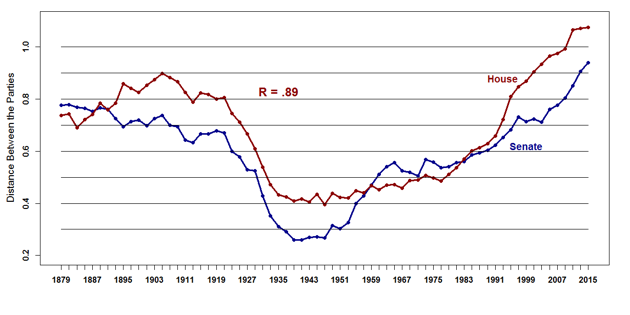


/cdn0.vox-cdn.com/uploads/chorus_asset/file/8112371/On_Tyranny.jpg)
/cdn0.vox-cdn.com/uploads/chorus_asset/file/8112375/Snyder_author_photo___credit_Ine_Gundersveen.jpg)