Shared posts

27 Aug 19:49

A decade of Yelp review trends

by Nathan Yau

Yelp trends

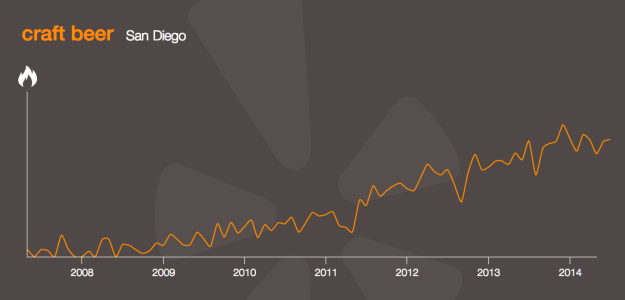
Yelp released an amusing tool that lets you see how the use of word in reviews has changed over the site's decade of existence.

From food trends to popular slang to short-lived beauty fads (Brazilian blowout anyone?), Yelp Trends searches through words used in Yelp reviews to show you what's hot and reveals the trend-setting cities that kicked it all off. Our massive wealth of data and the high quality reviews contributed by the Yelp community are what allow us to surface consumer trends and behavior based on ten years of experiences shared by locals around the world.

Just type in keywords, select your city, business category, and click the search button to see the changes. For the less used words, the data looks mostly like noise, but there are also some clear trends like in craft beer and chicken and waffles.

28 Jul 18:34

johndarnielle: saladinahmed: So apparently, this is a thing:...


johndarnielle:

saladinahmed:

So apparently, this is a thing: Greenscreen-clad workers who secretly flip models’ hair during shampoo commercials. (via @makingofs on twitter)

if they would leave the mummy in the commercial I would be 200% more likely to purchase the product

22 Jul 17:10

daveshumka: I made this thing! The Phil Collins Album Cover...


daveshumka:

I made this thing!

The Phil Collins Album Cover Guide.

22 Jul 17:05

kwmurphy: 7 Mistakes You’re Making with Olive Oil Shampooing...


kwmurphy:

7 Mistakes You’re Making with Olive Oil

  1. Shampooing your dog with it.

  2. Pouring it on Lord Denethor and lighting him on fire.

  3. Trying to use it as currency.

  4. Carrying it in a gallon freezer bag and telling people it’s your nephew Walt.

  5. Freezing it in the shape of olives.

  6. Dressing like Popeye and trying to have sex with it.

  7. Using it as a metaphor to describe Johnny Fontaine’s hair to Tom Hagen.

29 Jun 18:28

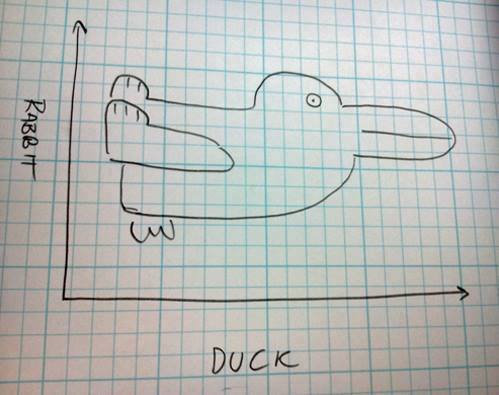
Duck vs. rabbit plot

by Nathan Yau

rabbit or duck

Not sure where this is from, but feel that tingle in the back of your head? That's the feeling of your mind blowing up.

26 Jun 04:57

Buzzfeed tracks your quiz answers—and the results may surprise you

25 Jun 18:16

MATLAB code in an unexpected place

by Steve Eddins

MATLAB on The Americans

The TV show "The Americans" is a show about Soviet Union secret agents pretending to be a normal American couple in 1981-82 or so. In the 2nd season's final episode, which I watched last night, a military officer shows an FBI agent a computer screen that's supposed to be showing some code from a top-secret computer program called Echo. (Don't worry; this is not a significant spoiler.) When the code flashed by I thought it looked odd, more modern than I would have expected for an early 80s program. So I paused the show and took a closer look. I was very amused to see that the top half of the screen contains MATLAB code of a type that did not exist until about 20 years after the show's time period.

The MATLAB code was clearly generated using GUIDE, the MATLAB GUI Design Environment. (Click on the thumbnail above for an enlarged view in which the code is readable.)

When I showed this to my MathWorker friend Jason, he did a little investigating and discovered the code's origin. It's from an 11-year-old File Exchange contribution called MATLAB Simulations for Radar Systems Design by Bassem Mahafza.

So congratulations, Bassem! Your old MATLAB code is now famous (sort of).

18 Jun 14:42

99percentinvisible: A razzle dazzle jacket that hides you from...

by jessethorn


99percentinvisible:

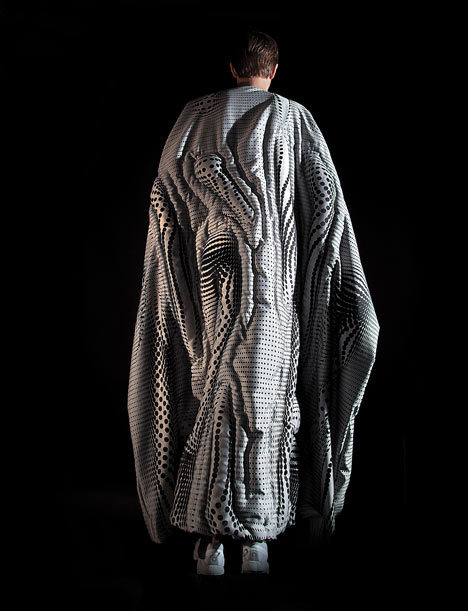
A razzle dazzle jacket that hides you from Google

The coat is lined with metallic fibers that protect you from data snooping. The exterior is designed to obscure the direction and location of your body by creating (to a computer) the illusion of “strange multiple body parts.”

06 Jun 13:58

In Search of America’s Best Burrito

30 May 12:45

The Dream Kickoff «

28 May 15:26

Back Bay parking meters just for cars, bicyclists are learning

by adamg

Angela Wang reports DPW workers wielding bolt cutters are roaming the Back Bay this morning, cutting bicycles away from meters and taking them away to that place where bad bicycles go.

24 May 22:23

Buzzfeed, Porn, Kansas…That Can’t Be Good

by David

This post is by David K. Park and courtesy of Alex Palen Ellis…

Thought you might find this funny:

Buzzfeed set out to study porn consumption versus the red/blue political spectrum. And they failed miserably. An article form opennews.org outlines six major fallacies Buzzfeed committed, the best of which resulted in the Kansas effect:

“Pornhub’s writeup omitted any explicit description of their methodology—this is never a good sign—but it seems to have involved mapping the IP addresses from which users visited the site to physical addresses and reverse geocoding those to get states…. a large percentage of IP addresses could not be resolved to an address any more specific than “USA.” When that address was geocoded, it returned a point in the centroid of the continental United States, which placed it in the state of—you guessed it—Kansas!”

As a result, Kansas was 2.95 std dev above the mean. Those pervs!

from: https://source.opennews.org/en-US/learning/distrust-your-data/

The post Buzzfeed, Porn, Kansas…That Can’t Be Good appeared first on Statistical Modeling, Causal Inference, and Social Science.

18 May 03:16

Google buys the maker of Word Lens, the augmented reality translation app

by Ron Amadeo

Google has just snapped up one of the most futuristic apps to come along in some time. Quest Visual, the maker of the incredible Word Lens app, posted on its website that it has been acquired by Google.

Word Lens is (was?) an augmented reality translation app. As you can see in the video, just point your phone camera at a supported foreign language, and Word Lens replaces the foreign text with translated text. The plan is to move the team over to Google Translate where Quest Visual will work on integrating its technology into Google's app.

The two companies are a good match for each other. The biggest downside to Word Lens was the limited language compatibility—it only supported translating Russian, Spanish, French, Italian, German, and Portuguese into English. Google can definitely help here. Google Translate is one of the most advanced translation systems in the world, with 345 supported languages and more than 10,000 language pairs.

Read 2 remaining paragraphs | Comments

18 May 01:13

Amsterdam Falafelshop to Open in Boston's Kenmore Square

by noreply@blogger.com (Marc)
Last year we reported that a Washington, DC-based falafel shop that has a location in Somerville was planning on opening a few more shops in the Boston area. Now we have learned where one of them will be.

Eater Boston is reporting that Amsterdam Falafelshop is going to be opening in Kenmore Square, moving into the Beacon Street space where a location of Boca Grande had been until closing last summer. The article says that this shop will have approximately twice the seating of the location on Elm Street in Davis Square, with the eatery looking to open later this year. Expect to see such items as falafel, salads, fries, and chips at the new store.

The Somerville location of Amsterdam Falafelshop first opened its doors in July of 2012.

The address for this upcoming falafel shop in Kenmore Square is: Amsterdam Falafelshop, 642 Beacon Street, Boston, MA, 02215. The website for the group of shops can be found at http://www.falafelshop.com/

[Earlier Article]
Amsterdam Falafelshop to Open Four More Locations in the Boston Area

Tweet
18 May 01:10

What is meant by “Now you have two problems”?

by Stack Exchange
Stack Exchange

This Q&A is part of a weekly series of posts highlighting common questions encountered by technophiles and answered by users at Stack Exchange, a free, community-powered network of 100+ Q&A sites.

IQAndreas asks:

There is a popular quote by Jamie Zawinski:

Read 24 remaining paragraphs | Comments

15 May 17:40

How a mayor’s quest to unmask a foul-mouthed Twitter user blew up in his face

by Nate Anderson
"There's got to be a statute out there somewhere..."
Aurich Lawson / Thinkstock

When news broke that the mayor of Peoria, Illinois, had called upon his town's police force to shut down a fake Twitter account opened in his name; that local police had responded with search warrants against Twitter, Comcast, and Google; that they had at last raided a local home and seized four iPhones, four computers, two Xbox game consoles, an iPad, and a "large gold gift bag with five sandwich bags containing a green leafy substance;" that the homeowner hadn't created the account but was ultimately suspended from his job as a result of that "green leafy substance;" that Peoria's next city council meeting descended into outright acrimony over the heavy-handedness of the entire episode; and that the entire episode turned out to be a colossal waste of time and resources in which no one but the pot owner was ever charged with a crime—well, that's the moment at which a curious reporter files a public records act request to get a glimpse of how such a trainwreck got underway.

So I filed one—and the backstory I found was fascinating.

Could your town's mayor spark a police investigation into your activities that ends with town cops rifling through your mobile phone, your laptop, and the full contents of your Gmail account—all over an alleged misdemeanor based on something you wrote on social media? Not in America, you say? But you'd be wrong. Here, based on e-mail records provided by the city of Peoria to Ars Technica, is what that sort of investigation looks like.

Read 71 remaining paragraphs | Comments

14 May 13:53

Madame Fromage

Madame Fromage

Who are you, and what do you do?

I'm a digital cheese courtesan. I blog about cheese, offer pairing advice, and stage delicious experiences - mostly around Philadelphia, where I live. Recently, I wrote a racy cheese guide.

In my earthly life, I teach and direct a graduate writing program at a university haunted by cheese-loving priests. My desk is turbo-loaded with pairings to assuage their every craving.

What hardware do you use?

I'm partial to Peg and Awl cutting boards and cheese lovin' tea towels from Girls Can Tell. And I'm nothing without my cheese knives, my Rebel T2i, and Manfrotto 190 tripod. I love to say Manfrotto.

I blog on a MacBook Pro and rely on my iPhone for instant cheese updates via Twitter and Instagram. I like knowing which cheeses are in season, what's ripening, and who's stocking what across the U.S.

My refrigerator - a key component in this world - is a fully stocked stainless steel Kenmore. The temperature controlled humidity drawers look like tide pools full of curious sea life at the moment - I just finished writing a story on spring goat cheeses for The Philadelphia Inquirer.

And what software?

The softer, the better, frankly. Lately, I'm into geotrichum rinds, which have wrinkly rinds like pug puppies. Allison Hooper at Vermont Creamery makes some flawless softies, like Bonne Bouche, a cheese so fuzzy and crazy that I dream of turning the rind into velvety wallpaper.

I'm also having a mad love affair with Tunworth, a hopelessly gooey Camembert from southern England, of all places. And don't get me started on soft blues. Have you eaten Chiriboga Blue? It might as well be cheese gelato. I could lounge in bed all day and eat it with a tiny spoon.

What would be your dream setup?

I dream of: a traveling cheese valise. I am always lugging cheese boards around to parties, demos, tastings, classes, etc., and frankly, my setup is a crappy laptop bag and some ice packs. I travel mostly by train, so I fantasize about having a fabulous valise with special compartments for condiments, cheese wedges, and knives. When I arrive at my stop, I want to be able to snap the case open and set up a fabulous cheese board on the fly, complete with cloth napkins, a flask, and an array of snacksies.

I am working on a project with a canning blogger, and we joke about traveling across the country together to host pop-up nibble fests - me with my cheese valise, she with her preserve-laden porta-pantry. One day!

13 May 00:27

Woman allegedly records own arrest, gets accused of wiretapping

by David Kravets

A Massachusetts woman faces charges of allegedly using a hidden mobile phone to audio-record her own suspicion-of-disorderly-conduct arrest.

Karen Dziewit, 24 of Chicopee, was allegedly "loud and belligerent" and disturbing her building's tenants early Sunday when police arrested her, according to local media outlet Mass Live. When police inventoried her purse, they said they found a mobile phone secretly recording the incident, allegedly in violation of state wiretapping regulations. Springfield police told Mass Live that the woman slipped the phone in her purse and activated the recording feature before the arrest.

Under Massachusetts law, people may record police officers in public places, but only if the officers are aware that a recording is taking place, according to case law.

Read 2 remaining paragraphs | Comments

12 May 21:36

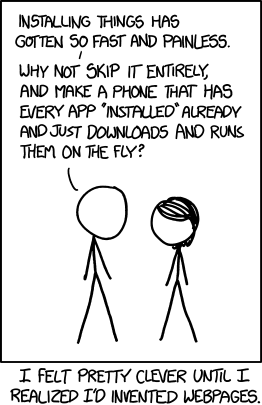
Installing

But still, my scheme for creating and saving user config files and data locally to preserve them across reinstalls might be useful for--wait, that's cookies.
08 May 18:55

Discussion with Steven Pinker on research that is attached to data that are so noisy as to be essentially uninformative

by Andrew

I pointed Steven Pinker to my post, How much time (if any) should we spend criticizing research that’s fraudulent, crappy, or just plain pointless?, and he responded:

Clearly it *is* important to call out publicized research whose conclusions are likely to be false. The only danger is that it’s so easy and fun to criticize, with all the perks of intellectual and moral superiority for so little cost, that there is a moral hazard to go overboard and become a professional slasher and snarker. (That’s a common phenomenon among literary critics, especially in the UK.) There’s also the risk of altering the incentive structure for innovative research, so that researchers stick to the safest kinds of paradigm-twiddling. I think these two considerations were what my late colleague Dan Wegner had in mind when he made the bumbler-pointer contrast — he himself was certainly a discerning critic of social science research. [Just to clarify: Wegner is the person who talked about bumblers and pointers but he was not the person who sent me the email characterizing these as "our only choices in life."---AG.]

The other comment is that I don’t think that evolutionary psychology is a worse offender at noise-mining than social psychology in general. Quite the contrary, the requirement that a psychological mechanism enhance reproductive success in a pre-modern environment at least imposes a modicum of aprioricity on hypotheses, which is entirely lacking in non-evolutionary (and defiantly atheoretical) social psychology. The worry that you can spin scientifically respectable evolutionary hypotheses post hoc for any finding is, in my view, greatly exaggerated. The Griskevicius finding may be wrong, for all the usual reasons, but the hypothesis is well motivated by prior theory and research.

To which I replied:

I think there are 3 things going on:

1. The science. As Lakatos and other philosophers of science have emphasized, any real scientific theory will make all sorts of predictions. The mapping of theory to prediction is a messy and necessary part of science. So a theory can be valid even if it is difficult to test, indeed part of the reason for testing a theory is often not to confirm or dispute the theory’s validity but to refine the theory.

2. Data collection. The studies by Griskevicius etc. have an extremely low ratio of signal to noise. Variability is high, measurements are crude, comparisons are performed between subjects, and this is all with a background of small effects that vary in sign and magnitude. As a result, the studies provide essentially zero information about the theory.

3. Multiple comparisons. The reason that multiple comparisons come in is to explain how it is that researchers such as Bem, Griskevicius, etc., manage to consistently find statistical significance (typically, many statistically significant comparisons in a single study) even though their noise level is so high. Multiple comparisons is the answer, and the point of our garden of forking paths paper is to explain how this problem can arise even for studies that are well motivated by substantive theory.

In short, my claim is not that the theories of Griskevicius etc. are wrong (about that, I have no idea) and my central criticism of them is not data-mining and multiple comparisons. Rather, my problem is that the study design is such that the data provide essentially no information about the science. I’d have no problem with the theory being presented as such; my problem is with the incorrect (in this case) claims that the data add anything to the story.

Regarding incentives structure, I fear that the current lack of incentives to criticize serves to offer an incentive for researchers to do small noisy studies which then they can sometimes publish in places such as Psychological Science. I would love if the incentives were to change so that researchers would put more effort into careful measurement and design!

The post Discussion with Steven Pinker on research that is attached to data that are so noisy as to be essentially uninformative appeared first on Statistical Modeling, Causal Inference, and Social Science.

24 Apr 23:46

Radio in Somerville May Be Closed for Good

by noreply@blogger.com (Marc)
It looks like a music club in Somerville that has been closed since last fall may be shuttered for good.

Eater Boston is reporting (via a Licensing Commission page) that the liquor license for Radio on Somerville Avenue may be transferred to Two Three Zero, which is the event space for Paint Nite, a painting party spot located a bit further east on Somerville Avenue in Union Square. Radio first took over the space where Club Choices had been in October of 2011, with an earlier article on the Vanyaland site saying that an electrical fire closed the place last November due to water damage from the sprinkler system. There had been hope that the music club might reopen, but now that seems to be in doubt.

The address for this now-closed music club in Somerville was: Radio, 379 Somerville Avenue, Somerville, MA, 02143.

Tweet
24 Apr 23:46

2014 Bacon and Beer Festival to Be Held in Boston on June 7

by noreply@blogger.com (Marc)
A popular event that features two very popular food and drink items is returning to Boston once again.

On Saturday, June 7, the 2014 Boston Bacon and Beer Festival will take place at an undisclosed location that will soon be announced. This is year 5 of the event, and as always, it will be raising money for hunger relief organizations Community Servings and Lovin' Spoonfuls. The event page mentions that more than 60 restaurants and brewers will be participating this year.

Tickets to the 2014 Boston Bacon and Beer Festival will cost $47, with ticket sales coming soon (we will post an update as soon as they go on sale).

For more information on this event, please go to the following link:

http://www.wheretoeat.in/2014-boston-bacon-and-beer-festival/

Tweet
20 Apr 18:27

April 20, 2014


Comrades! Marxist shirts are in stock!

19 Apr 14:57

Wikipedia Usage Estimates Prevalence of Influenza-Like Illness in the United States in Near Real-Time

by David J. McIver et al.

by David J. McIver, John S. Brownstein

Circulating levels of both seasonal and pandemic influenza require constant surveillance to ensure the health and safety of the population. While up-to-date information is critical, traditional surveillance systems can have data availability lags of up to two weeks. We introduce a novel method of estimating, in near-real time, the level of influenza-like illness (ILI) in the United States (US) by monitoring the rate of particular Wikipedia article views on a daily basis. We calculated the number of times certain influenza- or health-related Wikipedia articles were accessed each day between December 2007 and August 2013 and compared these data to official ILI activity levels provided by the Centers for Disease Control and Prevention (CDC). We developed a Poisson model that accurately estimates the level of ILI activity in the American population, up to two weeks ahead of the CDC, with an absolute average difference between the two estimates of just 0.27% over 294 weeks of data. Wikipedia-derived ILI models performed well through both abnormally high media coverage events (such as during the 2009 H1N1 pandemic) as well as unusually severe influenza seasons (such as the 2012–2013 influenza season). Wikipedia usage accurately estimated the week of peak ILI activity 17% more often than Google Flu Trends data and was often more accurate in its measure of ILI intensity. With further study, this method could potentially be implemented for continuous monitoring of ILI activity in the US and to provide support for traditional influenza surveillance tools.
19 Apr 14:57

Where nobody lives

by Nathan Yau

Where nobody lives

We've seen the map of where everyone lives. Now here's the reverse of that by Nik Freeman: where nobody lives in the United States.

A Block is the smallest area unit used by the U.S. Census Bureau for tabulating statistics. As of the 2010 census, the United States consists of 11,078,300 Census Blocks. Of them, 4,871,270 blocks totaling 4.61 million square kilometers were reported to have no population living inside them. Despite having a population of more than 310 million people, 47 percent of the USA remains unoccupied.

See also Stephen Von Worley's map from a couple years ago, which shows blocks in the US with only one person per square mile.

11 Apr 15:24

"Putting on (H)airs" The Appendix has a great story about...

by derekguypto


"Putting on (H)airs"

The Appendix has a great story about Abraham Lincoln’s famous beard (or “whiskers,” as writers of that time would say). He grew it a few weeks before his inauguration, supposedly on the advice of Grace Bedell, an eleven year old girl who wrote him a letter during his campaign. An excerpt from the article:

Rather, Lincoln’s whiskers were meant to signify urbanity and refinement. Adopting a fashionable style of grooming—the wreath of whiskers that had been a fixture of men’s fashion for decades—Lincoln offered a visual counterpoint to persistent barbs about his rough manners, rural upbringing, and rustic sense of humor. Holzer, then, was at least partly right about the meaning of Lincoln’s whiskers. He was, in fact, shedding the campaign image of the frontier railsplitter. But instead of adopting the look of a firm patriarch (or even a stern sexton), he was cultivating the appearance of a man of the world: a person of humble origins but hard-earned cultural capital.

He had good reason to do so. Since assuming the national stage, Lincoln had been dogged by doubts about his social graces. An article from the Columbus, Ohio Crisis, for instance, lampooned his ignorance of classical languages, while informing polite readers that Lincoln had only recently “abstained from facetiously designating hotel napkins as towels.” And one contemporary, recalling an encounter between the former Secretary of the Navy George Bancroft and Lincoln noted a “most striking” contrast between the two: “the one courtly and precise in his every word and gesture, with the air of a trans-Atlantic statesman; the other bluff and awkward, his every utterance an apology for his ignorance of metropolitan manners and customs.” Eager to dispel these aspersions—especially in light of unfavorable comparisons between himself and the stately Jefferson Davis—Lincoln grew fashionable whiskers, not a patriarchal beard.

What does this story tell us about Old Abe Lincoln? Besides the obvious—that the “most famous beard in American history” was not a beard at all—it reveals something about the nature of power in Civil War-era America. Taking command of a sinking ship of state and confronted with dire questions about his fitness for office, Abraham Lincoln chose a set of symbols that emphasized urbanity over more obvious emblems of authority. Calling on an old set of ideas about gentility and power, the president-elect claimed, in effect, that the right to rule hinged as much on politeness as on patriarchal strength or the imprimatur of the people. It’s a strange story, to be sure. But it reminds us of the extraordinary currency of symbols like these: that faced with national dissolution and civil war, Lincoln sought the urbane sophistication required for his job in, of all places, his hair.

You can read the full story at The Appendix.

(Story found via IQ Fashion)

11 Apr 01:19

At Feds’ request, GoGo in-flight Wi-Fi service added more spying capabilities

by Joe Silver
Go Go gadget: Inflight Wi-Fi intercept!

A prominent privacy activist has discovered a previously little-known filing with the Federal Communications Commission showing that GoGo, an in-flight Wi-Fi provider, has voluntarily done more to share user data with law enforcement than what is required. While GoGo and its competitors must follow the same wiretap provisions outlined in the Communications Assistance for Law Enforcement Act (CALEA), Chris Soghoian of the American Civil Liberties Union recently found that GoGo takes its information volunteering further.

Soghoian tweeted a link to a July 2012 letter submitted from a GoGo attorney to the FCC, which states:

The Commission’s ATG [air-to-ground] rules do not require licensees to implement capabilities to support law enforcement beyond those outlined in CALEA. Nevertheless, GoGo worked with federal agencies to reach agreement regarding a set of additional capabilities to accommodate law enforcement interests. GoGo then implemented those functionalities into its system design.

GoGo's willingness to go beyond the legal requirements of the CALEA is bolstered by its terms of service, which indicate that activating in-flight Wi-Fi authorizes GoGo to “disclose your Personal Information… if we believe in good faith that such disclosure is necessary” to “comply with relevant laws or to respond to subpoenas or warrants served on us” or to “protect or defend the rights, property, or safety of GoGo, you, other users, or third parties.”

Read 4 remaining paragraphs | Comments

08 Apr 22:36

US agency that created “Cuban Twitter” faces political firestorm

by Joe Silver
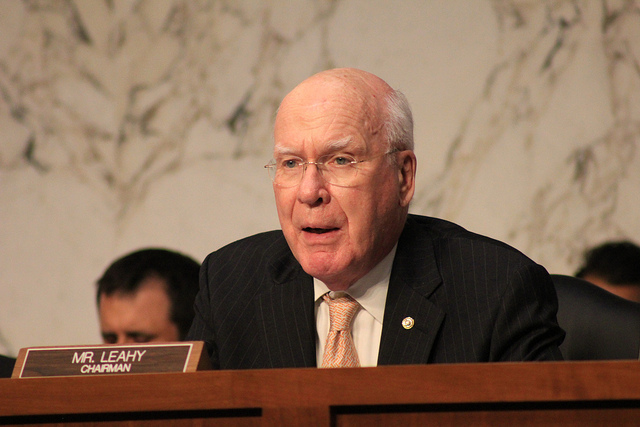
Senator Patrick Leahy, chairman of the foreign operations subcommittee.

The head of the US government agency that oversaw the creation of a Twitter-like communications network in Cuba aimed at fueling political dissent against the communist government is expected to testify before Congress on Tuesday. One senator who will be hearing testimony next week has called the whole idea “dumb, dumb, dumb,” according to The Associated Press.

The program, codenamed ZunZuneo, was covertly established by US government agents. Run by the US Agency for International Development (USAID), the subversion program was targeted at building a user base of young Cubans in hopes that they would use the service to voice opposition to the governing communist party.

By using a list of phone numbers provided by a worker at Cuba’s state-owned telecommunications company Cubacel, USAID workers began to send out mass text messages over the platform. Once the network reached a critical mass of users, the plan was for operators to introduce political content aimed at inspiring Cubans to organize “smart mobs." Ultimately, the project sought to trigger a “Cuban Spring” or to “renegotiate the balance of power between the state and society," the AP reported.

Read 4 remaining paragraphs | Comments

29 Mar 19:34

After seven years, exactly one person gets off the gov’t no-fly list

by Joe Silver

A hearing in federal court Tuesday has apparently marked the conclusion of a drawn-out, costly, and, to use the judge’s own term, “Kafkaesque” legal battle over the government no-fly list. Malaysian college professor Rahinah Ibrahim sued the government back in 2006, after Dr. Ibrahim’s name mistakenly ended up on a federal government no-fly list.

Last month, US District Judge William Alsup ruled that Ibrahim must be removed from the government's various watchlists. At Tuesday's hearing, a Department of Justice lawyer said that the government did not intend to appeal the ruling. The ruling in Ibrahim v. DHS calls into question the government's administration of its controversial no-fly list as well as other terrorist watch lists, but it leaves no clear roadmap for other people wrongly placed on such lists.

Ibrahim's pro bono attorney, Elizabeth Pipkin, has asked for the government to pay more than $3.5 million to cover her legal fees and costs. Alsup didn't rule on that motion, but said that the issue was "not easy," while indicating that Pipkin is unlikely to be entitled to such a large payout.

Read 12 remaining paragraphs | Comments

25 Mar 22:13

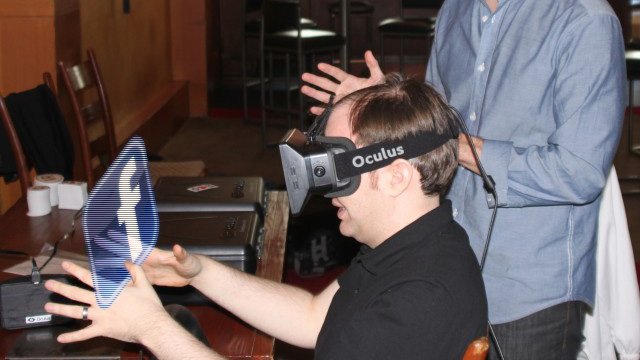
Facebook purchases VR headset maker Oculus for $2 billion [Updated]

by Kyle Orland
Aurich Lawson

Giant social networking company Facebook has just announced it has "reached a definitive agreement" to acquire virtual reality headset maker Oculus for $400 million in cash and 23.1 million shares valued at $1.6 billion. Oculus can earn another $300 million if it reaches unspecified performance milestones, and the deal is expected to close in the second quarter of 2014.

In announcing the deal, Facebook founder and CEO Mark Zuckerberg indicated that the move is about much more than gaming, and goes well beyond the kneejerk FarmVille VR jokes that propagated at warp speed immediately in the announcement's wake. "While the applications for virtual reality technology beyond gaming are in their nascent stages, several industries are already experimenting with the technology," Facebook said in a blog post. "Facebook plans to extend Oculus' existing advantage in gaming to new verticals, including communications, media and entertainment, education, and other areas," he wrote.

"Mobile is the platform of today, and now we're also getting ready for the platforms of tomorrow," Zuckerberg said in a statement. "Oculus has the chance to create the most social platform ever and change the way we work, play, and communicate."

Read 13 remaining paragraphs | Comments