Shared posts

17 Feb 12:55

'The Hallmark of What Is Truly Priceless'

by Patrick Kurp

“. . . what literature is really about: our very survival as human beings.” 

A bit melodramatic, no? Grandiose? Perhaps expressed by a writer worried about sales or a reader boosting his self-esteem? Could be. But there’s something to it. Maybe it amounts to more than virtue-signaling after all, and it’s one of the reasons we go on reading in a post-literate age.


The late Belgian-born Simon Leys, Pierre Ryckmans, was not a frivolous man. He was serious but seldom solemn, and understood how to prudently lend an ironic edge to his words. Above he is speaking in one of his 1996 Boyer Lectures, later published as The View from the Bridge. He asks, “Are books essentially useless?” and answers, “I suggest that we indeed subscribe to such a conclusion. But so long as we remain aware that uselessness is also the hallmark of what is truly priceless.” A paradox worthy of Chesterton, one of his admirations. (“He wrote with a reckless generosity of genius.”) Leys goes on to quote the wife of an Australian Outback farmer – and Nabokov:  “Let us not kid ourselves; let us remember that literature is of no use whatever, except in the very special case of somebody’s wishing to become, of all things, a Professor of Literature.”


Books are not the curriculum of a vocational school. A popular sentiment boosted by many of late has been the therapeutic worth of literature. Reading makes us better people, a statement revealing a childish naïveté about both books and human beings. Serious readers read for non-utilitarian reasons. Books are consolation. Leys cites a Chinese scholar who read Shakespeare and Du Fu while in one of Mao’s camps, and Primo Levi who consoled himself and another prisoner in Auschwitz with lines from Dante. Levi described this experience in If This is a Man. I would add the unexpected fondness inmates of Soviet prisons and labor camps had for Proust, as recounted by Aleksander Wat, Józef Czapski and Varlam Shalamov.


No, books are not food, water or warm clothing. In fact, for many in camps and elsewhere they might serve as kindling. In the title essay of Leys’ The Hall of Uselessness: Collected Essays (New York Review Books, 2013), he writes: “After all, this sort of ‘uselessness’ is the very ground on which rest all the essential values of our common humanity.”

17 Jan 14:52

2024: Too Many Things Going Wrong

by Gail Tverberg

It will be an interesting year.

We know that the age of peak performance for humans varies, depending upon the activity. Peak performance for an athlete tends to come between ages 20 and 30, while peak performance for a person writing academic papers seems to come between ages 40 and 50 years. By the time people are 80 years old, they have a strong suspicion that health and other aspects of performance will deteriorate in the next 20 years.

Economies, in physics terms, are similar to human beings. Both are dissipative structures. They require energy of the appropriate kinds to keep their systems growing and operating normally. For humans, the main source of this energy is food. For an economy, it is a mixture of energy that the economy is specifically adapted to. Today’s economy requires a certain mixture of energy directly from the sun, plus energy from fossil fuels, burned biomass, and nuclear energy. Electricity is a carrier of energy from different sources. It needs to be available at the right time of day and the right time of year to allow today’s economy to continue.

Most people don’t realize that economies grow and eventually collapse. For example, we know that the Roman Empire started its growth in 625 BCE and reached its peak extent in 211 CE. It declined somewhat between 211 CE and 456 CE, when it finally collapsed after several invasions. The growth and collapse of economies is very much expected because of their nature as dissipative structures.

In 2024, the world economy is acting more and more like an 80-year-old man than like a young vigorous economy. Perhaps the economy can continue for quite a few more years, but it increasingly looks like it is in danger of falling apart, or of succumbing as a result of what might be regarded as minor problems.

Trying to predict precisely what will happen in the year 2024 is difficult, but in this post, I will examine some of the things that are going wrong in this increasingly creaky old economy.

[1] Too many parts of the world economy are changing from growth to shrinkage.

The blue circles can illustrate many different things:

  • The total goods and services produced by the economy;
  • The quantity of energy required to produce the total goods and service produced by the economy;
  • The total population that is supported by these goods and services (which will generally be rising or falling, too);
  • Goods and services per person (which tend to rise during periods of growth and fall in a shrinking economy);
  • And, strangely enough, the ability of the economy to maintain complexity. Without enough energy, structures such as governments tend to fail.

As the economy moves away from growth, toward shrinkage, major changes can be expected.

[2] In a growing economy, repaying debt with interest is very easy. In a shrinking economy, repaying debt with interest becomes close to impossible.

If an economy is growing, there will likely be an increasing number of jobs available over time, and they will pay relatively more. If a person loses his/her job, it is not very difficult to get a position that will pay as much or more. Paying back a loan on a house or an automobile tends to be easy.

A corresponding situation occurs for businesses. If the business can count on an increasing number of customers, overhead becomes easier and easier to cover with a growing consumer base.

The reverse is obviously true in a shrinking economy. Jobs may be available if a person loses his/her current job, but the jobs don’t pay very well. Businesses may face periods with suddenly lower demand, as in 2020. There is a sudden need to reduce overhead, such as payments for office space, if the space is no longer being utilized by employees.

Clearly, if interest rates rise, it becomes increasingly difficult for borrowers of all kinds to repay debt with interest. Raising interest rates is thus a way to intentionally slow the economy. If the economy is growing too quickly (like a 20-year-old sprinter), then such a change makes sense. But if the economy is behaving like an 80-year-old, hobbling along on a walking stick, it becomes likely the economy will figuratively fall and become severely injured. This is the danger of raising interest rates when the world economy is having difficulty growing at an adequate rate.

[3] The physics of the system dictates that as the system shifts in the direction of shrinkage, the wealth of the system is increasingly distributed toward the rich and very powerful, and away from those of modest means.

Physicist Francois Roddier writes about this issue in his book, The Thermodynamics of Evolution. He likens energy (and the goods and services produced using this energy) as being like energy applied to water. When energy levels are low, the less wealthy members of the economy tend to be squeezed out, just as (low energy) frozen water turns to ice. The reduced amount of energy available (and goods and services produced using this energy) increasingly bubbles up to the small number of economic participants at the top of the economic hierarchy. This issue tends to make the already rich even richer.

In some sense, the self-organizing economy seems to preserve as much of the economy as it can, when energy supplies are inadequate. The wealthy seem to be important for keeping the whole system operating, so the physics tends to favor them.

Inflation, in general, is a problem, especially for people with limited income. Higher interest rates also take a big “bite” out of spendable income. This problem is greatest for low income people. The benefit of higher interest rates, and of capital gains, tends to go to high income people. 

High food prices especially affect the poor because, even in good times, food tends to be a high share of their income. For example, in a poor country, if food costs amount to 50% of a person’s income when food prices are moderate, a 20% increase in food prices will lead to food prices costing 60% of income. Such a situation quickly becomes intolerable because there is not enough income left for other essential goods. 

Figure 2. Chart by the Federal Reserve of St. Louis showing the Share of the Total Net Worth Held by the Top 1% of US Citizens (99th to 100th percentile).

The figure above shows that between 1990 and 2022, the share of total wealth held by the top 1% of US citizens rose from 23% to 32%. This means that other citizens were increasingly squeezed out of the benefits of the growing economy.

[4] With their newfound power (arising from the growing concentration of wealth), the wealthy are tempted to exert increasing control over the economic system.

The fact that the world economy was likely to reach annual limits of fossil fuel extraction about now has been known for a very long time. I have referred to a 1957 speech by US Navy Admiral Hyman Rickover pointing out this bottleneck many times. Wealthy individuals have known about this bottleneck for a very long time. They have been asking themselves, “How can we increasingly benefit from this change?”

Clearly, reducing the population growth rate has been one of the goals of some of these wealthy individuals. With fewer people to share the resources available, everyone will benefit.

But the wealthy can also see that hiding the energy bottleneck would be of huge benefit in keeping the current system operating as usual. These individuals, through the World Economic Forum and other organizations, have pushed for zero global warming emissions. They have tried to reframe the problem of inadequate inexpensive-to-produce fossil fuels as a problem of too large a quantity of fossil fuels for the system to handle. In their view, we can decide to transition away from fossil fuels without significantly adverse impacts.

By hiding the energy bottleneck, companies selling vehicles can claim they will be useful for many years. Educational systems can claim that we are well on our way to finding substitutes for fossil fuels, and that there will be good jobs available in the new systems. With the bottleneck problem hidden, politicians do not have to present citizens with a very concerning and intractable issue. Since a happily-ever-after narrative is desired by all, it is easy for the wealthy (and politicians who want to be reelected) to influence the major news outlets to present only this view to readers. 

[5] Major cracks in the economy are likely to start showing soon. The energy bottleneck is already pulling the economy down, even if major news media are reluctant to discuss the problem.

The problem displays itself in several different ways:

(a) The economy has moved toward two widely differing views regarding today’s energy situation.

The narrative presented in the press is that we have an excessive amount of fossil fuels. In this view, any shortage of fossil fuels (or any other resource) would be quickly accompanied by rising prices. These rising prices would allow an increasing quantity of these materials to be extracted, quickly solving the problem. But the real story, for anyone who examines the details, is quite different. Affordability becomes very important, holding prices down. History shows that nearly every civilization has collapsed. Populations tend to grow but the resources supporting the economies don’t grow quickly enough. Rising prices don’t fix the problem!

People who work with fossil fuels know how essential they are for our current civilization. The story about intermittent wind and solar substituting for fossil fuels sounds very far-fetched if a person thinks about the need for heat in the winter and the difficulties associated with long-term storage of electricity. The two widely differing narratives surrounding our energy future sound like they could have come from the dystopian novel Nineteen Eighty-Four by George Orwell.

(b) Repaying debt with interest gets to be an increasing problem.

Strange as it may seem, added debt can temporarily act as a placeholder for additional energy. Debt is a promise for goods and services that will be made with future energy. This placeholder can allow capital goods, such as factories, to be made which allow more goods and services to be made in the future. This placeholder can also be used as the basis for money to pay workers, so that they can afford to purchase more goods.

At some point, the debt becomes too much for the system to sustain. We are seeing some of this in China, where there have been debt defaults in the real estate market. In the US, the commercial real estate market is experiencing high vacancy rates. There is increasing concern that, in many places, commercial real estate can only be sold at a huge loss. In this situation, the holders of debt are likely to sustain massive losses.

(c) Political parties start differing widely on whether to increase government debt. 

The more conservative parties do not want to keep adding more debt, but the more liberal parties insist that there is no other way out: If there isn’t enough energy of the right kind, the added debt can perhaps be used to fund projects in the renewable energy sector that will create the illusion of progress toward an adequate supply of energy of the right kind at the right price. The added debt can also be used to continue the many social programs promised to citizens and to provide support for activities such as the war in Ukraine.

So far, adding debt has worked for the US because the US dollar is the world’s reserve currency and because the US has tended to keep its target interest rates high, encouraging other countries to invest in US securities. If other countries try to add substantially more debt, their currencies will tend to fall, leading to inflation. 

The US may soon also run into an inflation problem because of added debt. This happens because it is possible to “print money,” but it is not possible to print goods and services made with inexpensive energy products. For example, the temptation is to bail out failing banks and pension plans with added debt. To the extent that this debt gets back into the money supply, but there aren’t added goods to match, the result is likely to be inflation in the prices of the goods and services that are available.

(d) Broken supply lines are another sign of an economy reaching limits.

When there aren’t quite enough goods and services to go around, some would-be buyers of goods have to be left out. 

In the last three years, all of us have experienced at least some problems with empty shelves in stores and the unavailability of needed parts for repairs. Many kinds of drugs are in short supply around the world. Heavy industry has been encountering problems, as well. In 2022, Upstream Online wrote, “Drill pipe shortages causing headaches for US producers [of oil and natural gas].” 

If we are reaching the limit of inexpensive fossil fuel available for extraction, an increasing number of these problems can be expected. These supply line problems tend to raise costs in a different way than “regular” inflation. Often, a more expensive product must be substituted, or a higher cost workaround is needed. For example, a person may need to use a rental vehicle while his current vehicle is being repaired because of unavailable replacement parts. 

(e) Conflicts arise when there are not enough goods and services to go around.

Part of the conflict comes from wage and wealth disparity. For example, an increasing number of people are finding reasonably-priced housing impossible to find. The combination of high interest rates and high housing prices tends to make home-buying a luxury, available only to the rich. An increasing share of young people are also finding automobiles too expensive to afford. One way “not-enough-goods-and-services-to-go-around” manifests itself is by many people not being able to afford the products in question. 

There is often a belief that a more equitable distribution of income would solve the problem. But, if the economy cannot build more cars or homes because of energy shortages, this doesn’t fix the problem. Providing more money to the poor would instead cause inflation in the price of the goods that are available.

Another way this conflict manifests itself is in conflicts among countries. Countries selling fossil fuels, such as Russia, would like higher fossil fuel prices, so that the standards of living of their own people can be higher. However, if fossil-fuel-importing countries, such as those in Europe, are forced to pay higher prices for the fossil fuel they use, it becomes difficult for companies in these countries to manufacture goods profitably. Also, the higher fossil fuel prices make the cost of growing food higher. Customers often cannot afford higher food prices.

In the case of the fight between Israel and Gaza, at least part of the conflict relates to the natural gas field that Israel is developing, but which arguably belongs to Gaza. If Israel can develop this resource, it may be able to keep its own economy expanding for a while longer. The people of Gaza will remain very poor.

(f) Manufacturing around the world seems to be reducing in quantity. It definitely is not rising to keep up with population growth.

The big shortfall today is in goods, rather than in services. This is what a person would expect if an energy problem is giving rise to the problems we are currently experiencing.

The organization S&P Global Market Intelligence puts out an index called the Purchasing Managers Index, for 15 countries, including a global average. The manufacturing portion of this index is in contraction on a worldwide basis, as of the latest data available. The extent of this manufacturing contraction is especially significant for the US, the European countries included, for Japan, and for Australia. The countries that are not in contraction are India, Russia, and China. 

If manufacturing is in contraction, we would expect more broken supply lines in the months and years ahead.

[6] How will all this turn out, in 2024 and long term?

I don’t think we know. Things are likely to get worse economically, but we don’t know how much worse. We know that an elderly person can easily succumb to some illness. In the same way, we know that if the economy has enough weak points, a major collapse might occur, even without a huge decline in energy availability.

At the same time, the economy seems to have a lot of resilience. Leaders of the US, and perhaps of other countries, as well, seem likely to take the route of adding increasing amounts of debt, to bail themselves out of whatever problems arise. If banks get into trouble, some new funding facility will be developed. If Social Security or private pensions need more funding, it will likely be provided by more government debt. This leads me to suspect that in the US, at least, there is likely to be a higher risk of hyperinflation (lots of money but very little to buy) rather than deflation (very little money, but also very little to buy).

The Universe came into being, apparently out of nothing. The Universe has grown and continues to grow. Eric Chaisson, in his 2001 book, Cosmic Evolution: The Rise of Complexity in Nature, shows that the trend in the Universe has been toward ever greater complexity. 

Figure 3. Image similar to ones shown in Eric Chaisson’s 2001 book, Cosmic Evolution: The Rise of Complexity in Nature.

Together, it appears that the Universe, itself, acts like a dissipative structure. Self-organization leads the Universe to grow and become more complex, as long as it has adequate energy. The question becomes, “Where is the expanding energy supply for the Universe as a whole coming from? Can the expanding energy supply continue indefinitely, or until whatever force started it, chooses to stop it?”

It seems to me that there is something from outside pushing the whole Universe along. Economists talk about “an invisible hand.” People from a religious background might say that there is a God who created the Universe, and is continuing to create it every day, through involvement in the things that take place on Earth, including the strange happenings in 2020. 

If I am correct that there is an outside force influencing the economy today, perhaps Earth’s problems are temporary. One possibility is that eventually a new type of energy solution will be found. There is also the possibility that, at some point, whatever force started the Universe may cause the operation of the Universe to cease. A replacement (which we can think of as heaven) might be provided instead. 

The popular narrative tends to see ourselves as having a great deal of power to manage problems with our current economy, but I don’t think that we have very much power to influence the system we find ourselves embedded in. The economic system behaves on its own, based on market forces, just a child grows up, matures, and eventually dies. The system within which we live is very much guided by what we call self-organization, which is outside our power to control.

15 Dec 14:43

'If You Want Less Trouble, Plow the Sky'

by Patrick Kurp

I had a suburban kid’s notion of life on a farm -- hearty yeomen and Jeffersonian gentleman-farmers tilling the soil and bringing in the sheaves. Working for rural newspapers in the Midwest and upstate New York educated me to the realities of mortgages, tractor accidents, unpredictable weather and even more unpredictable markets.

In the mid-nineties, under the influence of Verlyn Klinkenborg’s first book, Making Hay (1986), I decided to write a feature about the cutting of hay and spent several late-summer days with a farmer and his family in Saratoga County, N.Y. They worked a small dairy farm in the foothills of the Adirondacks – the farmer, his wife, their kids, one hand. This was the opposite of corporate agriculture. From a rise at the northern end of their acreage I could see the Green Mountains of Vermont to the east and the Catskills to the south. The work was hot and dirty but the smells were intoxicating, even the cow manure. This naïve and ignorant suburban kid learned two new words: tedding and silage.


My most vivid sensory memory: standing sweaty and tired in the barn in the late afternoon, sunlight shining through narrow gaps in the walls, the hot air dense with dust from the hay. Deborah Warren is a poet who raises heifers on a farm in Vermont. She published “Hay Field on Methodist Hill” in Southwest Review in 2003 and collected it in Zero Meridian: Poems (2004):


“From the time we cleared it, all it’s been is trouble,

stubborn and recalcitrant and proud—

every winter, fractious and uncowed,

throwing up new rocks and glacier-rubble:

It’s clear it never wanted to be plowed.


“And once we got the stones out, it was trees

behaving as if they had the right of way:

Every March the maples have a field day

—don't expect them to give you a year of peace—

shoving, off-side, elbowing out the hay.


“When the saplings get above themselves, it’s over.

Let them grow a foot or so too high

and—teen-age trees? You might as well go try

and sow the sea with rocks and hope for clover,

or, if you want less trouble, plow the sky.”


Nice wordplay: “uncowed,” “field day.”

28 Sep 12:40

When Shelter Becomes a Speculative Asset, Society Unravels

by Charles Hugh Smith
Does anyone really believe that the renunciation of massive, sustained stimulus of speculation in housing would leave housing valuations unchanged because valuations are solely the result of "shortages"?

Let's begin by stipulating that speculation (i.e. gambling) is part of human nature. The role of regulations and policy is to limit the damage that gambling inevitably inflicts when "sure things" cliff-dive into losses.

In other words, where the speculative frenzy and money flows matters. When the South Sea Bubble expanded circa 1713-1720, this flood tide of speculative capital did not distort the cost of shelter and bread in England; it was limited to a purely financial marketplace of shares in the company. When the bubble imploded in 1720, the losses fell mostly on wealthy investors like Isaac Newton.

The same can be said of the speculative mania of the dot-com era: the bubble and collapse were limited to the tech sector and those participating in the sector and the speculative frenzy. The cost of rent and bread did not double due to the speculative bubble's inflation or bursting.

In contrast, when speculation floods into shelter / housing, it fatally distorts the cost of housing non-speculators must pay. I say fatally because shelter, along with food, energy and water (the FEW resources), are essential to life. These are not discretionary things we can decide not to have. When the price of essentials soars due to speculation that only rewards the speculators at the expense of non-speculators, the fuse of social disorder is lit.

Anyone who believes policies that encourage the wealthy to hoard housing to the point that the bottom 80% (or the bottom 95% in some areas) cannot afford to buy a home are just peachy is overdosing Delusionol. The social consequences are severe and uncontainable once the worm turns.

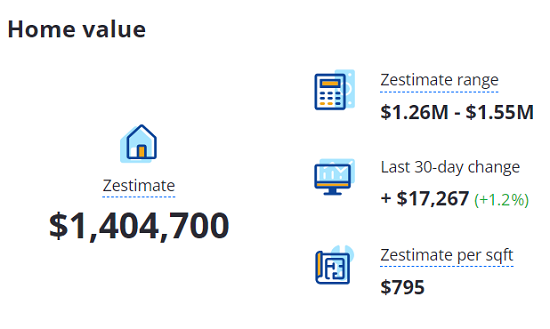
Exhibit #1 in Shelter Becoming a Speculative Asset is a modest house in the San Francisco Bay Area that sold for $135,000 in mid-1996. By modest I mean small, old, and on a small lot in a neighborhood of other small lots and homes. (A screenshot of the Zillow history is below.)

Today the home's value is estimated to be about ten times higher: $1.35 million. Let's do some basic math to understand just how distorted this market has become.

The median household income in 1996 was about $39,000. For a house costing $135,000, this represents 3.5 ratio of income to housing, well within the traditional ratio of 4 to 1 (4 X income = cost of the home).

Median household income has almost doubled to $75,000, roughly in line with inflation according to the Bureau of Labor Statistics. According to the BLS, the house that cost $135,000 in July 1996 would now cost $264,000 when adjusted for inflation, and the $39,000 median income would be $76,000.

Let's say the house appreciated above the rate of inflation to $300,000 today. That's still within the 4 to 1 ratio of income to house cost (4 X $75,000 = $300,000.) So even though the house rose 2.2X in cost, it would still be affordable to a median household.

At a value of $1.35 million, a household would need to make $337,500 annually--an income that is in the top 5% of households--to buy the house today. In other words, an income that is 4.5 times the median household income is the minimum needed to buy this modest house.

The house is now worth 4.5 times what it would have been worth if it had appreciated well above inflation.


The conventional argument holds that this four-fold increase in housing costs is due solely to a shortage of housing. Let's consider some data before concluding this is the only dynamic in play.

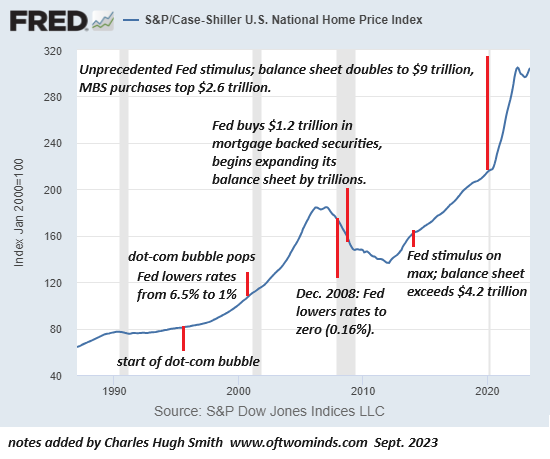
Chart #1: Case Shiller housing index: this chart shows two massive housing bubbles in the past 20 years.


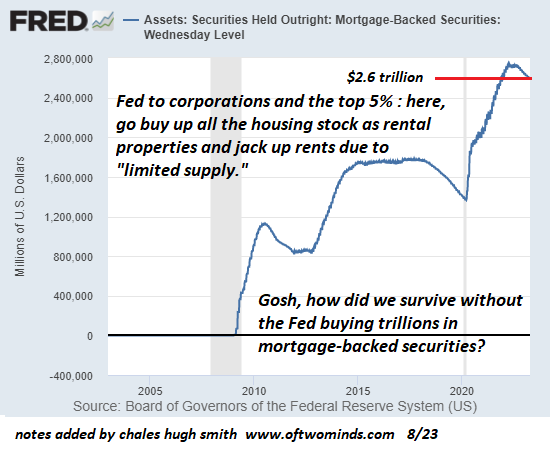
Chart #2: Federal Reserve's purchases of mortgage backed securities (MBS) to goose the housing market. The "housing shortage" argument claims the unprecedented Fed purchases of trillions of dollars of MBS is not correlated to the housing bubble, but this claim makes no sense: dropping mortgage rates to unprecedented lows while soaking up trillions of dollars in securitized mortgages was like injecting speculative crack cocaine into the housing market. Gosh, how did we survive without the Fed buying $2.5 trillion in mortgages?


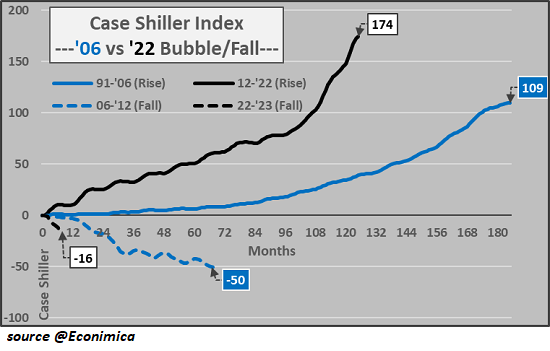
Chart #3: the current housing bubble compared to the 2000-2006 housing bubble: today's bubble is even more extreme than housing bubble #1.


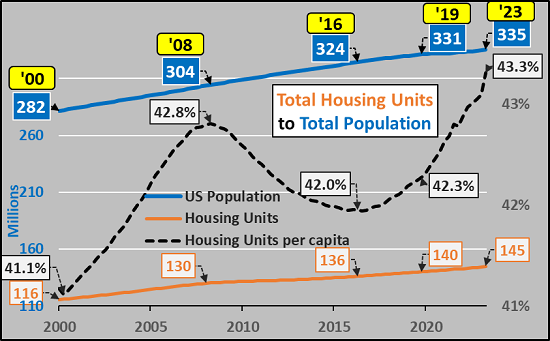
Chart #4: housing per capita (per person) has reached a new high: if there's such a severe shortage of housing, how can the housing per capita be at an all-time high? Population rose 4 million in the past 4 years while 5 million housing units were added--plus a pig-in-a-python of housing in the pipeline.


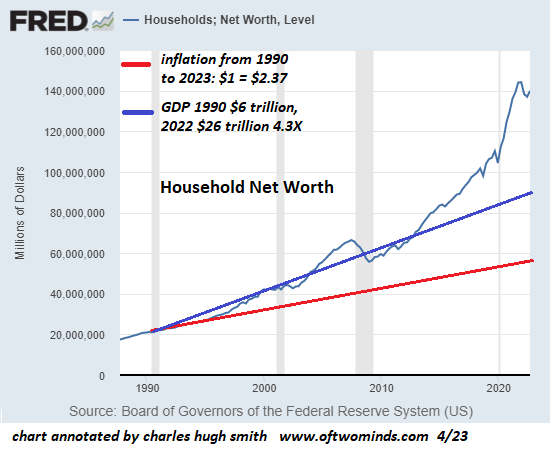
Chart #5: household net worth is $50 trillion above trend, the direct result of massive monetary and fiscal stimulus. Tens of trillions of dollars were borrowed into existence and pumped into so-called risk assets--assets such as housing that the wealthy buy for speculative appreciation.


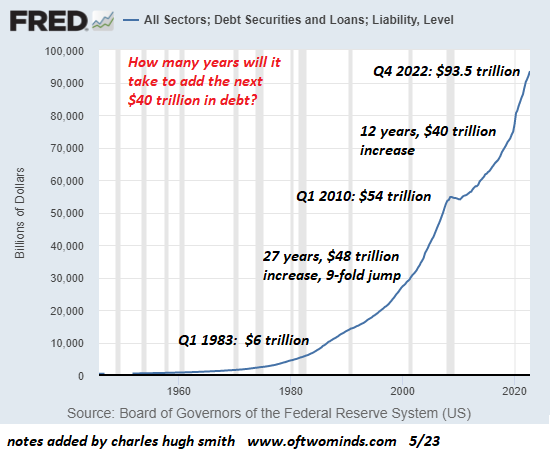
Chart #6: total debt--private and public--soared from $20 trillion in 1996 to $95 trillion now. Is it merely coincidental that this is $55 trillion above the trendline of inflation, which would have placed total debt at $40 trillion today?


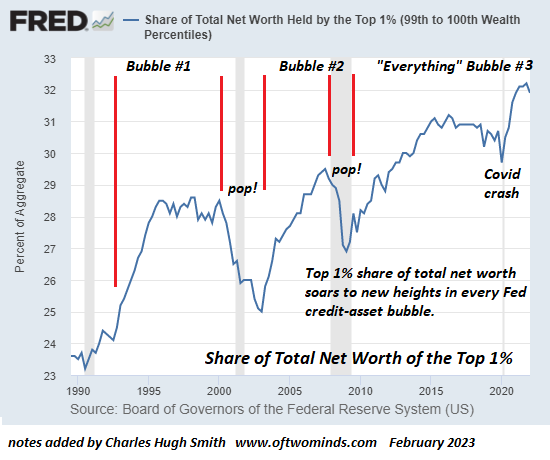
Chart #7: net worth of the top 1% households, which soared from 23% of all net worth to 32%: this 9% gain in the percentage of all household net worth represents a gain of $14 trillion above and beyond the $28.7 trillion in gains registered by the 23% they owned in 1990.

1990 total net worth: $21 trillion, 23% = $4.8 trillion; 2023 total net worth: $146 trillion, 23% = $33.5 trillion; $33.5 trillion - $4.8 trillion = $28.7 trillion.


This unprecedented bubble in housing valuations is due not to shortages but to decades of massive financial stimulus that incentivized speculative capital to flood into housing as a low-risk way to skim stupendous gains for creating zero gains in productivity. If you doubt this, then run this scenario and tell us what happens:

The Fed dumps its entire portfolio of mortgage backed securities and stipulates it will never buy any again. It also renounces all the other stimulus gimmicks that incentivized expansions of debt and speculation.

Does anyone really believe that the renunciation of massive, sustained stimulus of speculation in housing would leave housing valuations unchanged because valuations are solely the result of "shortages"? If so, there's a little shack under the Brooklyn Bridge I'll let you have for a couple of million. I'm sure the Airbnb rent will mint you millions.


My new book is now available at a 10% discount ($8.95 ebook, $18 print): Self-Reliance in the 21st Century.

Read the first chapter for free (PDF)

Read excerpts of all three chapters

Podcast with Richard Bonugli: Self Reliance in the 21st Century (43 min)


My recent books:

The Asian Heroine Who Seduced Me (Novel) print $10.95, Kindle $6.95 Read an excerpt for free (PDF)

When You Can't Go On: Burnout, Reckoning and Renewal $18 print, $8.95 Kindle ebook; audiobook Read the first section for free (PDF)

Global Crisis, National Renewal: A (Revolutionary) Grand Strategy for the United States (Kindle $9.95, print $24, audiobook) Read Chapter One for free (PDF).

A Hacker's Teleology: Sharing the Wealth of Our Shrinking Planet (Kindle $8.95, print $20, audiobook $17.46) Read the first section for free (PDF).

Will You Be Richer or Poorer?: Profit, Power, and AI in a Traumatized World
(Kindle $5, print $10, audiobook) Read the first section for free (PDF).

The Adventures of the Consulting Philosopher: The Disappearance of Drake (Novel) $4.95 Kindle, $10.95 print); read the first chapters for free (PDF)

Money and Work Unchained $6.95 Kindle, $15 print)
Read the first section for free


Become a $1/month patron of my work via patreon.com.

Subscribe to my Substack for free


NOTE: Contributions/subscriptions are acknowledged in the order received. Your name and email remain confidential and will not be given to any other individual, company or agency.

Thank you, Hamburger Today ($50), for your magnificently generous Substack subscription to this site -- I am greatly honored by your support and readership.


Thank you, Ronald G. ($50), for your superbly generous Substack subscription to this site -- I am greatly honored by your support and readership.


Thank you, Alberto T. ($50), for your splendidly generous Substack subscription to this site -- I am greatly honored by your support and readership.


Thank you, Bryan A. ($50), for your marvelously generous Substack subscription to this site -- I am greatly honored by your support and readership.

Go to my main site at www.oftwominds.com/blog.html for the full posts and archives.
24 Oct 14:50

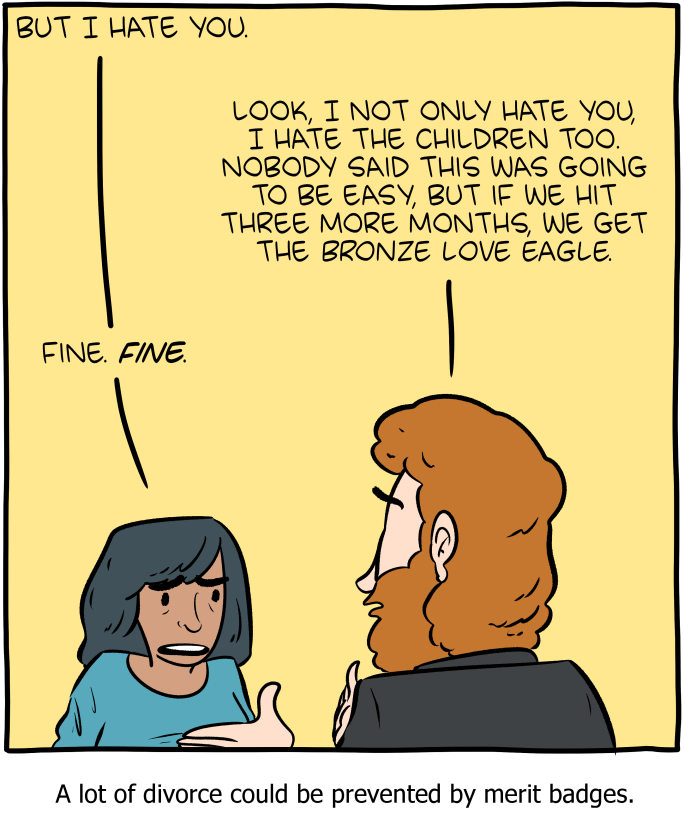
Saturday Morning Breakfast Cereal - Marriage

by tech@thehiveworks.com


Click here to go see the bonus panel!

Hovertext:
If you made it the least bit social you could complete end divorce and also happiness.


Today's News:
15 Feb 17:44

`It Pains a Man When ’t Is Kept Close'

by Patrick Kurp
I wish I had known Sir John Suckling’s poem, sometimes called “Love’s Offence”, when I was young and too easily infatuated. It might have served as prophylaxis for the more delicate sentiments:


“If when Don Cupids dart

Doth wound a heart,

    we hide our grief

    and shun relief;

The smart increaseth on that score;

For wounds unsearcht but ranckle more.”


On this day after St. Valentine’s Day, obligatory card and candy consumed, it’s good to take a refresher course in the booby traps of love. It’s not all nectar and ambrosia. Suckling suggests we suck it up – a wounded heart, that is – and put a lid on it. No Swain, no gain, as the boys say down at the gym. The Cavalier poet goes on:


“Then if we whine, look pale,

And tell our tale,

    men are in pain

    for us again;

So, neither speaking doth become

The Lovers state, nor being dumb.


Suckling discourages both “sharing,” as moderns would call it, and also shutting up. So what’s a lover to do?


“When this I do descry,

Then thus think I,

    love is the fart

    of every heart:

It pains a man when ’t is kept close,

And others doth offend, when ’t is let loose.”

In his Dictionary, Dr. Johnson cited that final stanza in his entry for fart, which he defined rather delicately as “wind from behind.” J. Geils articulated Suckling’s insight for contemporary sensibilities.

27 Jul 17:15

8 years ago: What’s $12 million?

by Fred Clark

July 27, 2005, on this blog: What’s $12 million?

Dick Cheney is also incapable of explaining why the estate tax should be repealed. But he’s for it. Such a repeal would reap at least $12.6 million for him personally, but that, we’re supposed to believe, has nothing to do with his position.

$12 million is enough of a bribe to tempt even the purest of saints. And Dick Cheney ain’t no saint. Yet we’re supposed to blithely accept that this $12 million windfall has utterly no effect on his decision-making.

I rounded down there, did you catch that? I rounded $12.6 million down to $12 million. That decimal point I knocked off there represents $600,000, or roughly what the average American family will earn over the next 10 years. If your bank account were to suddenly swell by this amount — $600,000 — you would have a very difficult time convincing a judge that it was meaningless, a trivial sum that had no influence on your actions and that you had done nothing questionable to acquire. But Dick Cheney will never have to stand before a judge to account for that $0.6 million, or for the $12 million before the decimal point.

22 Jul 15:37

Subject: What Ben Bernanke Is Really Saying - by: autoearthadmin

David Ellis

Quantitative Easing and low interest rate policy help the financial system and too-big-to-fail banks but not the economy.

Ever wonder what Bernanke is saying? Well, it boils down to this: at the same time that Jimmy Carter says the US doesn't have a functioning democracy, Ben Bernanke says the US doesn't have a functioning economy.

Unfortunately, people understand what Carter says, though they may not agree with him, but they do not understand what Bernanke says, and that has nothing to do with agreeing with him or not. Moe likely it has something to do with the illusionary oracle qualities once attributed to his predecessor Alan Greenspan, whenever no-one had a clue what he was saying. In reality, Ben Bernanke will turn out to be the biggest scourge on American society since the same Alan Greenspan, but that's not how he's seen; instead, just like Greenspan, he's idolized. What's wrong with this picture is that Bernanke's words and actions are interpreted in the press exclusively by people who live in the part of society that stands to profit from them, let's call it "the financial world". That they are but a very small part of society easily gets lost in translation.

Greenspan was and still is mostly regarded as a miracle worker of super-human intelligence, even though he ran the US straight into the recession/depression/crisis we've now been witnessing since about the day when Bernanke took over the Fed, February 1 2006. Greenspan set the American economy firmly on the road to ruin through his support of the Glass-Steagall repeal and various tax-cuts, as well as his insistence that the newly blossoming derivatives trade needed little or no regulation. Certainly in hindsight, it should be obvious that Alan Greenspan served the interests of Wall Street, not Main Street.

All Ben Bernanke has done since succeeding the Oracle is continue where the former left off. Not that you would know it from the picture the media paint of him. Or the president, for that matter. Just about everyone agrees that he saved the US from something like a Great Recession II. In reality, what Bernanke has done over the past 6.5 years is being a prominent player in aiding and abetting Wall Street banks in hiding their losses through the violation of accounting standards, declaring them Too-Big-To-Fail, and then handing them trillions of dollars in public funds, most recently through QE programs, thus enabling them, the very same banks that would no longer exist without public funds, to once again play the casinos and come up with near record profits and bonuses.

This is the great little scheme that is presented to you through the media as "saving the US economy". It has done no such thing. It has been, and still is, enormously harmful to the economy. But as long as you continue to believe that what's good for Wall Street is also good for Main Street, the trick will continue to be played on you; Ben Bernanke is giving free money (well, actually, credit) away to those whose interests he represents, the banks, and taking it from those he doesn't, you. What Bernanke has saved is bankers' bonuses, not the economy. And if there is a direct correlation between the two, it's not the one you're being tempted to think it is. Which is how you should interpret Bernanke's insistence before Congress on July 17 that "We're very focused on Main Street": it may be true, but not in the way he wants you to believe it is.


Here's how Bernanke said the US doesn't have a functioning economy: by choosing to continue QE, he would reveal how weak the US financial system is. He already has, obviously, first by starting up QE in the first place, and again by his recent backpedaling on the conditions for tapering. The worst wet dream of the big banks is that they wouldn't get their black jack chips for free anymore, and they manage to convince everyone that the real economy would go down if they can no longer play. Regardless of the details: if it needs free money, the financial system can't stand on its own two legs.

By choosing to halt QE, on the other hand, Bernanke would reveal how weak the financial system is just as much. The slight rise in available credit that has allowed Americans to add yet more debt towards home and automobile purchases, giving the economy a fleetingly rosy glow in the process, would be over in a heartbeat. The banks would sit on their QE free excess reserve giveaways parked at the Fed even more than they already do. And then use it as security for more leveraged high-risk wagers. That's where the money is, not in consumer loans. Don't worry, says Ben, we'll keep interest rates low for the foreseeable future. Hossanah, sings the entire choir. But interest rates for whom? Only the big banks, that's for whom. Rates on the street, not so much: he has no control over those.

Here's an example of Bernanke's effect on Main Street: debt has been rising, not falling, since debt plunged the markets into that deep dark pit. A graph I picked up here at Zero Hedge:
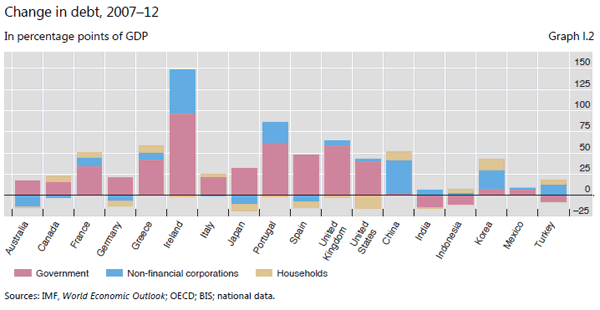


The US may not look like the worst horse in the slaughterhouse, but in absolute numbers it probably is. Debt has risen by some 40% of GDP, and that does not yet include financial corporations and the Fed.


Is the new and additional debt at least put to good use for American society? The answer is a resounding "no". Just take a look at the diminishing productivity of debt in the US. Which, as is evident from these two graphs, will soon turn into negative territory, if it isn't already there.
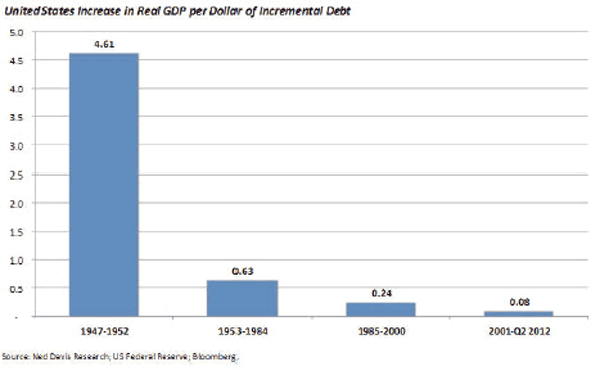
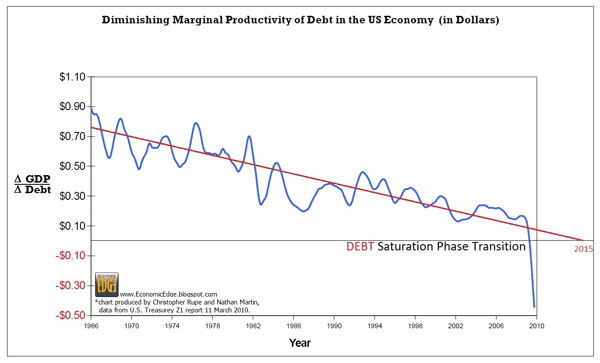


The huge amounts of debt the Fed (and government) policies are adding will result in hardly any GDP growth. What does seem to be there in growth or recovery, moreover, comes from individuals taking on additional debt for home and automobile purchases. Bernanke, even if he would be trying to help Main Street, would be pushing on a string regardless. And I have no qualms about suggesting that he knows all this, which leads to one possible conclusion only: he is not trying. If he were, he'd adopt totally different policies. QE is not helping Main Street; it's killing it. Not today perhaps, but we should broaden our view beyond today, and consider what happens tomorrow.


Here's another example of how Bernanke is killing Main Street, courtesy of Chris Turner at Zero Hedge:


Savers And The 'Real' $10.8 Trillion Cost Of ZIRP


The good news behind the bottom 85% of close-to-retiree status Baby Boomers that participate in the “markets” via sub $50,000 retirement money is that at some point, the voters might actually get smart and get mad at how much money has been siphoned from them.  Consult the chart below to see a historical relationship between total savings and amount of interest income earned on the savings.


Note that prior to 2001, as savings increased (blue line), interest income received increased (red line) proportionally.  However, after 2001, the interest earned stopped increasing.  The green line shows the effective interest paid on interest bearing accounts.

Scaling into the shaded area representing 1986 to present, the following chart depicts the actual Fed Funds rate determined by FOMC.


As savings increased when Fed Funds rate remained around 5%, interest income continued to rise.  However, post 2001, the interest income received stopped growing at the same rate.  With the exception of 2005 to 2008 when rates went back to “normal” in the 5% range – the interest income earned has remained stable at just under 1 trillion (Ben Bernanke is so smart).

Let’s apply some thought experiments and make a couple calculations – what would happen if the FOMC were removed and the Fed Funds rate “floated?”  Using average historical rates from the 1920’s for the 10 year note– the mean rate would sit around 5.82%.  With a floating Fed Funds rate, banks would be competing for money and providing responsible savers with some interest income.  Voila, a calculation is borne:


By calculating the estimated interest income from historical ratios (orange shaded area), we can see that as of July 2013, approximate interest income would be just over 3 trillion (1/5th of GDP) on savings of 6.8 trillion (using the left scale).  Whereas the actual interest income reported by NIPA remained at 1.1 Trillion, the difference in interest received and lost interest equals roughly 2 Trillion.  Remember, this is interest income to SAVERS forever lost since 2001.  By aggregating the entire shaded orange area, SAVERS have missed out on a whopping 10.8 Trillion in earned interest usage. 

The final chart above makes a loud and clear statement toward the beneficiaries of the low interest rate environment.


"Very focused on Main Street" indeed. It's where (through QE) newly found and fangled bank profits come from. As per the very first - Change in Debt - graph, household debt has gone down (though that's largely due to falling real estate prices, in other words, a double edged coin), but so have savings. And not a little bit either. Americans lost $10.8 trillion. And counting.


So how does the Oracle 2.0 explain it all? From Bloomberg, July 10:


Bernanke Supports Continuing Stimulus Amid Debate Over QE


"Highly accommodative monetary policy for the foreseeable future is what's needed in the U.S. economy," Bernanke said yesterday in response to a question after a speech in Cambridge, Massachusetts.


The numbers don't add up to that. If it's what's needed for the economy, that economy is in very bad shape, and has been for a long time despite the same highly accommodative monetary policy. If the economy is the goal, it makes no sense to keep going or even double down. What Bernanke's saying he's aiming for is not what's needed for the economy, but for the financial system.


........ the minutes showed many Fed officials wanted to see more signs employment is improving before backing a trim to bond purchases known as quantitative easing.


The fear of course is that the very moment they ease bond purchases, stock markets plummet and, with a short lag, unemployment will start rising again. Any positive effect of QE on employment is not backed up by numbers, other than people believing the illusion that it makes the economy better. But that's a fleeting illusion which depends on both their belief and continuing QE. Take either of the two away and you're holding an empty bag.


Bernanke said the central bank is trying to communicate its plans for two different policy tools. With bond purchases, the Fed is "trying to achieve a substantial improvement in the outlook for the labor market in the context of price stability. We’ve made progress on that but we still have further to go," he said.

The Fed wields another policy tool with its benchmark interest rate, which it reduced to close to zero in December 2008. Officials have said they won’t consider raising the main interest rate until the unemployment rate falls to 6.5 percent, as long as long-term inflation expectations don’t exceed 2.5 percent.


We're approaching nonsense territory here. We've already seen that years of low interest rates and bond purchases have not raised the velocity of money in the US economy. For the US economy and labor market, QE has been a total and unmitigated disaster, and a hugely expensive one to boot. For the financial system, though, it's been an unbelievable behemoth of a windfall.

Sure, unemployment has fallen a little, because most people still believe that a higher stock market is positive for the economy. But if it rises only if and when promises are issued for more and continuing free giveaways for the banking sector, that can then remain in accounts with the Fed and not get into the real economy, then a higher stock market is perhaps a symptom of an increasingly sick economy, not a healing one. It's like banks announcing great profits, that directly reflect nothing but those same giveaways. A profit would seem to indicate something has been sold for more than was paid for it, because of added value. That is obviously not the case here. Without free credit, there would be no "profits" in the banking sector.


"It may well be sometime after we hit 6.5 percent before rates reach any significant level," Bernanke said. "So again, the overall message is accommodation."


Well, no. If and when only, at best, one in every 7 dollars in QE has any influence on the real economy at all (the estimate is 86% is in banks' reserve accounts with the Fed), then QE is a failed policy. From the perspective of the economy, at least. For the banking sector, it's an entirely different story. People keep on thinking that what is good for the banking sector is good for the economy as a whole, but the recent graphs prove that this is not true. That should be end of story for QE, but Bernanke's oracle talk apparently still is too convincing; the general optimism bias trumps reality. Bernanke claims he's accommodating the economy, but he's not, he accommodates Wall Street.


The 59-year-old Fed chief said the FOMC may opt to hold interest rates near zero even after unemployment reaches 6.5 percent due to the possibility of low inflation.


And, apparently, he'll keep on accomodating Wall Street, even if enough waitressing, greeting and flipping jobs that don't pay enough to feed yourself let alone your family, but still count towards official jobs numbers, can be created to lower the unemployment rate to 6.5%. Why? Deflation. Or as he euphemistically calls it: low inflation. Bernanke paves the way for endless QE (breaking his own former promises, but he's leaving anyway). Why endless QE? Because without it, the US banking sector AND economy would collapse in a heartbeat. That's what it means when markets rise as fast as they do just because Bearded Ben announced what he did. It means there are no other prospects for profits. Or that the banks don't have to go looking for other prospects as long as the free stuff keeps flowing in.


Now, whatever powers one may think they do have, it should be clear that Bernanke and the Fed have no control over : 1) Treasury yields and 2) Velocity of money. As for the first, Ambrose Evans-Pritchard has some numbers:


Can the world cope with a trigger-happy Fed?


After weeks of utter confusion, the result of Fed taper talk is clear enough. Long-term borrowing rates are much higher across the world regardless whether the underlying economies are in any fit condition to absorb this shock. The rise in 10-year sovereign yields by basis points has been: Japan (25), Germany (35), France (62), UK (63), Norway (63), Australia (66), Korea (66), Spain (70), US (70), Italy (74), Poland (120), Mexico (122), Turkey (131), Brazil (135), and Indonesia (170).

As you can see, the emerging market bloc has suffered the worst hit, especially those countries caught when the tide went out with big current account deficits – the CADs as they are called in the trade. Basically, the whole world has just suffered a credit shock, even as the global economy weakens and the IMF downgrades its forecasts. What a mess.

A rate rise of 70 basis points or more is nothing short of catastrophic for Italy, Spain, Portugal, all in the grip of nominal GDP contraction, and all at risk of surging debt ratios as the denominator effect does its worst. The ECB must take action immediately to offset this "passive" tightening.


Can the US deal with higher yields on 10-year Treasuries? Well, better than Spain and Italy, obviously, but when yields are higher than real GDP (nominal+inflation, perhaps some 2.5% combined today), debt continues to rise. Yields are there already. Add a little deflation and what will the Fed do? QE on steroids probably, a.k.a. more debt. As Ambrose put it:


What struck me about Bernanke's testimony was his comment that the Fed would have to monitor the risk of "outright deflation" closely. "If needed, the Committee would be prepared to employ all of its tools, including an increase the pace of purchases for a time", he said.


The US will be the least worst horse in the glue factory, but only by the grace of Europe, Japan and China doing even worse. That will not save it from a combination of rising yields and falling inflation and GDP growth, however. And that is a lethal combination.


No risk of deflation, you think? Ben Bernanke does:


Bernanke Says Fed Bond Purchases Not on 'Preset Course'


Some sources of declining inflation "are likely to be transitory" and expectations for future price increases "have generally remained stable," he said in his prepared remarks. At the same time, "very low inflation poses risks to economic performance - for example, by raising the real cost of capital investment - and increases the risk of outright deflation." [..]

[..] Bernanke said in his testimony the Fed could keep buying bonds for longer if "financial conditions - which have tightened recently - were judged to be insufficiently accommodative to allow us to attain our mandated objectives." Responding to a question, he said the policy makers have succeeded in reducing market volatility that has greeted the Fed’s discussion of tapering. "Markets are beginning to understand our message, and the volatility has obviously moderated," he said.


Well, no. Volatility fell because of the promise of more free money. And that's all she wrote.


Policy makers have tried to assure investors that the Fed will hold down the benchmark interest rate after ending bond buying.


Well, no again. Chances are very real that when the Fed ends its bond buying, yields will rise so fast the Fed will lose control of the benchmark rate.


As for No. 2 above, the Velocity of Money, here's once again my favorite graph so far this year. It's so important in understanding the American economy today, one can't repeat it often enough:
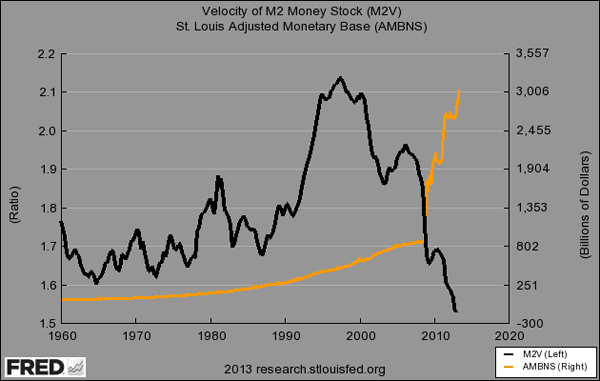


Money isn't going anywhere in America. The banks sit pretty on their QE excess reserves, and the little that consumers do spend is what they can borrow. The velocity of money is a crucial element in any true understanding of what inflation really is, and this graph screams deflation. To which Bernanke (or his successor) will react with QE on steroids, but as we can see, that won't help Main Street one bit. It’ll help Wall Street, though .....


Everyone in America who doesn't work on Wall Street should be very worried when stock markets go up as soon as Ben Bernanke suggests more free credit is available for the world's biggest banks, because everyone who doesn't work on Wall Street will end up paying for it. Instead, everybody's celebrating it. Still, all it is, is a clear and simple sign that the markets are not well. At all.

Americans should demand that Bernanke discuss how he intends to speed up the velocity of money. This should be his no. 1 priority, because without it there will be no recovery, but he doesn't even mention it.

Wall Street banks post huge profits again, and pay huge bonuses. Does that mean they're healthy? No, it doesn't. It only means that they can use excess reserves provided by Bernanke's QE to increase high-risk wagers. Take away QE and then you'll see how healthy they are. And it goes, of course, one step further: Banks can (and will if there's a profit in it) take the advantages provided by the QE excess reserves and use them to bet against exactly what Bernanke purports to aspire to for the real economy. And he'll play innocent, like he never could have seen that coming.

I'm not saying that Bernanke wouldn't like to help out Main Street as well, I'm just saying that it's not his priority, and that he'll gladly help out Wall Street at the cost of Main Street. And will gladly lie about it too.

Ben Bernanke has spent 6 years and change dragging America deeper into the debt swamp, and just about everyone thinks he's brilliant. He must be quite the magician indeed. But as Chris Turner says above: The good news [..] is that at some point, the voters might actually get smart and get mad at how much money has been siphoned from them.


Photo top: Marjory Collins "Service station in Mechanicsville, Md." July 1942


Last but not least: a wonderful podcast interview featuring Nicole Foss at From Alpha to Omega:



 

Read More...
21 Jul 20:47

4 years ago: On offendedness

by Fred Clark

July 21, 2009, on this blog: On offendedness

Taking offense and getting angry aren’t exactly the same thing. Anger has to do with the intolerable difference between what is and what ought to be, which is to say, with injustice. Offendedness has to do with my own discomfort with the difference between how I feel and how I’d prefer to feel. Offendedness makes it all about me.

20 Jul 00:17

Held Hostage by Progress

by John Michael Greer
David Ellis

The obsession with the harnessing of nuclear fusion to supply electricity has cost billions and success appears unattainable.

The continual recycling of repeatedly failed predictions in the peak oil community, the theme of last week’s post here, is anything but unique these days. Open a copy of today’s newspaper (or the online equivalent), and it’s a safe bet that you’ll find at least one op-ed piece calling enthusiastically for the adoption of some political, military, or economic policy that’s failed every single time it’s been tried. It’s hard, in fact, to think of any broadly accepted policy in any dimension of public life today that can’t be accurately described in those terms.

Arnold Toynbee, whose sprawling study of historical cycles is among the constellations by which this blog navigates, pointed out quite some time ago that this process of self-inflicted failure is one of the standard ways that civilizations write their own obituaries. In his formulation, societies thrive so long as the creative minority that leads them can keep on coming up with new responses to the challenges the world throws their way—a process that normally requires the regular replacement of the society’s leadership from below, so that new leaders with new ideas can rise to the top.

When that process of replacement breaks down, and the few people who still rise into the ruling class from lower down the pyramid are selected for their willingness to go along with the status quo rather than for their commitment to new ideas that work, what was once a creative minority degenerates into a dominant minority, which rules by coercion because it can no longer inspire by example. You can tell that this has happened to your society when every crisis gets met with the same stereotyped set of responses, even when those responses clearly don’t work. That happens because dominant minorities identify themselves with certain policies, and with the social roles and narratives that go with those policies, and it takes much more than mere failure to shake those obsessions loose.

The resulting one-track thinking can go very far indeed.  The ideology of the Roman Empire, for example, copied the theological vision of Roman Pagan religion and projected it onto the world of politics. Roman Pagans saw the universe as a place of chaotic powers that had to be subjected to the benevolent rule of a cosmic paterfamilias by way of Jove’s thunderbolts. Roman social thought understood history in the same way, as a process by which an original state of chaos was bashed into obedience by Rome’s legions and subjected to the benevolent rule of the emperor.  For much of Rome’s imperial history, that model even made a certain amount of sense, as substantial parts of the Mediterranean world that had been repeatedly ravaged by wars beforehand experienced an age of relative peace and prosperity under Roman rule.

The problem was simply that this way of dealing with problems had little relevance to the pressures that gutted the Roman Empire in its final years, and trying to apply it anyway very quickly turned into a massive source of problems in its own right. The endless expansion of the Roman military required by increasingly drastic attempts to hammer the world into obedience imposed crippling tax burdens across Roman society, driving whole economic sectors into bankruptcy, and the government responded to this by passing laws requiring every man to practice the same profession as his father, whether he could afford to do so or not. Across the dying empire, whenever one extension of centralized imperial authority turned into a costly flop, some even more drastic act of centralization was the only thinkable option, until finally the whole system fell to pieces.

Modern industrial civilization, especially but not only in its American expression, is well on its way to this same destination by a slightly different road. Across the board, in politics, in economics, in energy policy, in any other field you care to name, the enthusiastic pursuit of repeatedly failed policies has become one of the leitmotifs of contemporary life.  I’d like to focus on one of those briefly, partly because it’s a classic example of the kind, partly because it shows with rare clarity the thinking that underlies the whole phenomenon. The example I have in mind is the ongoing quest for fusion power.

Scientists in the US and something like a dozen other countries have been busy at that quest since the 1950s. In the process, they’ve discovered something well worth knowing about fusion power:  if it can be done at all, on any scale smaller than a star—and the jury’s still out on that one—it can’t be done at a price that any nation on Earth can possibly afford.  The dream of limitless cheap fusion power that filled the pages of gosh-wow newspaper articles and science fiction stories in the 1950s and 1960s is thus as dead as a sack full of doornails. Has this stopped the continuing flow of billions of dollars of grant money into round after futile round of gargantuan fusion-power projects? Surely you jest.

Thus fusion researchers are stuck in the same self-defeating loop as those peak oil mavens who repeat the same failed prediction for the umpteenth time in a row, in the serene conviction that this time it’ll come true.  They’re approaching the situation in a way that prevents them from learning from their mistakes, no matter how many times the baseball bat of failure whacks them upside the head. In the case of the fusion scientists, what drives that loop is evident enough:  the civil religion of progress and, in particular, the historical mythology at the core of that religion.

Fusion researchers by and large see themselves as figures standing at the cutting edge of one important branch of techological progress. Given their training, their history, and the cultural pressures that surround them and define their work, it’s all but impossible for them to do anything else. That’s what has them boxed into a dead end with no easy exits, because the way progress is conceptualized in contemporary culture is fatally out of step with the facts on the ground.

Progress, as the word literally means, is continued forward motion in one direction. To believers in the civil religion of progress, that’s the shape of history:  whatever it is that matters—moral improvement, technological prowess, economic expansion, or what have you—marches invincibly onward over time, and any setbacks in the present will inevitably be overcome in the future, just as equivalent setbacks in the past were overcome by later generations.  To join the marching legions of progress, according to the myth, is to enlist on the side of history’s winners and to help the inevitable victory come about just that little bit sooner, just as to oppose progress is to fight valiantly in a misguided cause and lose.

That’s the myth that guides contemporary industrial society, just as the myth of Jupiter clobbering the Titans and imposing the rule of law on a fractious cosmos was the myth that guided Roman society. In the broadest sense, whether any given change is “progressive” or “regressive” has to be settled by good old-fashioned politics, since changes don’t arrive with these labels branded on their backsides. Once a group of people have committed themselves to the claim that a change they’re trying to bring about is progressive, though, they’re trapped; no matter what happens, the only action the myth allows them to consider is that of slogging gamely onwards under the conviction that the obstacles will inevitably give way if they just keep at it. Thus the fusion research community is stuck perpetually pushing on a door marked PULL and wondering why it won’t open.

Of course fusion researchers also have deeply pragmatic reasons for their refusal to learn the lessons of repeated failure. Careers, reputations, and million-dollar grants depend on keeping up the pretense that further investment in fusion research has any chance of producing something more than a collection of vastly overpriced laboratory curiosities, and the field of physics is so specialized these days that shutting down fusion research programs would leave most fusion researchers with few marketable job skills relevant to anything this side of flipping burgers. Thus the charade goes on, funded by granting agencies just as committed to that particular corner of the myth of progress as the researchers whose salaries they pay, and continuing to swallow vast amounts of money, resources, and intellectual talent that might accomplish quite a bit if they could be applied to some less futile task.

The fusion research community, in effect, is being held hostage by the myth of progress. I’ve come to think that a great deal of contemporary science is caught in the same bind.  By and large, the research programs that get funding and prestige are those that carry forward existing agendas, and the law of diminishing returns—which applies to scientific research as it does to all other human activities—means that the longer an existing agenda has been pursued, the fewer useful discoveries are likely to be made by pursuing it further.  Yet the myth of progress has no place for the law of diminishing returns; in terms of the myth, every step along the forward march of progress must lead to another step, and that to another still.  This is why, to glance briefly at another example, efforts to craft a unified field theory out of Einsteinian relativity and quantum physics still get ample funding today, despite a century of total failure, while scores of research projects that might actually yield results go unfunded.

It does no good to science, in other words, to be imprisoned within the myth of endless linear progress. I’ve wondered more than once what modern science would look like if some philosophical equivalent of a SWAT team were to kick down the doors of the temple of Progress and liberate the hostages held inside. My best guess is that, freed from the myth, science would look like a tree, rather than a road leading into infinite distance:  rooted in mathematics and logic, supported by the strong trunk of the scientific method, extending branches, twigs and leaves in all directions, some of which would thrive while others would inevitably fail. Its leaves would spread out to catch as many of the rays of the light of truth as the finite nature of the tree allowed, but if one branch—the one called “fusion research,” let’s say—strayed into a lightless zone, the tree of science would direct its resources elsewhere and let that branch turn into a dry stick.

Eventually, the whole tree would reach its maximum growth, and after a lifespan of some centuries or millennia more, it would weaken, fail, and die, leaving its remains as a nurse log to nurture a new generation of intellectual saplings. That’s the way that Greek logic unfolded over time, and modern science started out its existence as one of the saplings nurtured on classical logic’s vast fallen trunk. More generally, that’s history’s way with human intellectual, cultural, and artistic systems of all kinds, and only the blinders imposed by the myth of progress make it impossible for most people in today’s industrial world to see science in the same terms.

That same logic is not restricted to science, either.  If some force of philosophers packing high-caliber syllogisms and fallacy-piercing ammunition ever does go charging through the door of the temple of Progress, quite a few people may be startled by the identity of some of the hostages who are led out blinking into light and freedom. It’s not just the sciences that are tied up and blindfolded there; nearly all the Western world’s religions share the same fate.

It’s important here to recognize that the myth of progress provides two potential roles for those who buy into its preconceptions. As noted earlier in this post, they can join the winning side and enlist in the marching legions of progress, or they can join the losing side, struggle against progress, and heroically fail. Both those roles are necessary for the enactment of the myth, and the raw power of popular culture can be measured in the ease with which nearly every religious tradition in the Western world, including those whose traditions are radically opposed to either one, have been pushed into one role or the other. The major division is of course that between liberal and conservative denominations; the former have by and large been reduced to the role of cheerleaders for progress, while the latter have by and large been assigned the corresponding role as cannon fodder for the side that’s destined to lose. 

The interplay between the two sides of the religious spectrum has been made rather more complex by the spectacularly self-defeating behavior of most North American denominations following the Second World War. In those years, a series of wildly popular books—John A.T. Robinson’s Honest to God, Pierre Berton’s The Comfortable Pew, and others of the same kind—argued in effect that, in order to be properly progressive, Christian churches ought to surrender their historic beliefs, practices, and commitments, and accept whatever diminished role they might be permitted by the mainstream of liberal secular society.  Some of these books, such as Robinson’s, were written by churchmen; others, such as Berton’s, were not, but all of them were eagerly received by liberal churches across the English-speaking world.

The case of The Comfortable Pew is particularly intriguing, as the Anglican Church of Canada hired a well-known Canadian atheist to write a book about what was wrong with their church and what they should do about it, and then gamely took his advice.  Other denominations were not quite so forthright in expressing a death wish, but the results were broadly similar.  Across the board, liberal churches reworked seminary programs to imitate secular liberal arts degrees, abandoned instruction in religious practice, took up the most radical forms of scriptural criticism, and redefined their clergy as amateur social service providers and progressive activists with a sideline in rites of passage. Since most people who go to churches or synagogues are there to practice their religion, not to provide their clergy with an admiring audience for political monologues and lessons in fashionable agnosticism, this shift was promptly followed a steep plunge in the number of people who attended services in all the liberal denominations. Here again, the logic of progress made it all but impossible for church leaders to learn the lesson taught by failure, and most liberal denominations have remained in a death spiral ever since.

Meanwhile, conservative denominations were busy demonstrating that the opposite of one bad idea is usually another bad idea. Panicked by the global expansion of Communism—you rarely heard that latter word in American public discourse in the 1950s and 1960s without the adjective “godless” tacked on its front end—and the sweeping social changes triggered by postwar prosperity, the leaders of the conservative denominations moved as eagerly as their liberal counterparts to embrace the role that the myth of progress offered them. Along with William F. Buckley and the other architects of postwar American pseudoconservatism, they redefined themselves in opposition to the progressive agenda of their time, and never seemed to notice that they were so busy standing against this, that, and the other that most of them forgot to stand for anything at all.

The social pressure to conform to stereotypes and resist progress in every sense drove the weirdest dimension of late 20th century American Christian pseudoconservatism, the holy war against Darwinian evolution. Nowhere in the Bible does it say that the luminous poetry of the first chapter of Genesis must be treated as a geology textbook, nor is a literal reading of Genesis mandated by any of the historic creeds of the Christian churches. Nonetheless “Thou shalt not evolve” got turned into an ersatz Eleventh Commandment, and devout Christians exercised their ingenuity to the utmost to find ways to ignore the immense and steadily expanding body of evidence from geology, molecular biology, paleontology, and genetics that backed Darwin’s great synthesis. That and such sideshows as the effort to insist on the historical reality of the Noah’s ark story, despite conclusive geological evidence disproving it, crippled the efforts of conservative Christians to reach outside their existing audience.

The conservative denominations never quite managed to discard their historic beliefs, practices and commitments with the same enthusiasm shown by their liberal counterparts, preferring to maintain them in mummified form while political activism took center stage; still, the result was much the same.  Today, the spokespersons for conservative religious denominations in America speak and act as though reinstating the mores and politics that America had in the late 1940s has become the be-all and end-all of their religion. In response, a growing number of former parishioners of conservative denominations have withdrawn into the rapidly growing Home Church movement, in which families meet in living rooms with their neighbors to pray and study the Bible together. If that trend accelerates, as it appears to be doing, today’s conservative megachurches may soon turn into cavernous spaces visited once a week by a handful of retirees, just like the once-bustling liberal churches across the road.

The hijacking of religious institutions by the competing civil religion of progress has thus turned out to be a disaster on both sides of the political divide.  The distortions imposed on religion, once it was taken hostage by the myth of progress, thus correspond closely to the distortions imposed on science during its own imprisonment by the same myth. As the civil religion of progress begins to lose its grip on the collective imagination of our time, in turn, both science and religion thus will have to undergo a difficult process of reappraisal, in which many of the mistaken commitments of recent decades will need to be renegotiated or simply abandoned. Harrowing as that process may be, it may just have an unexpected benefit—a negotiated truce in the pointless struggle between science and religion, or even a creative rapprochement between these two distinct and complementary ways of relating to the universe. I’ll discuss these possibilities in next week’s post.
16 Jul 20:51

`Give Me No High-Flown Fangled Things'

by Patrick Kurp
A friend in Dallas is reading Edward Seidensticker’s Low City, High City: Tokyo from Edo to the Earthquake (1983). I haven’t yet read the book and know Seidensticker only as the translator of Kawabata, Mishima and Tanizaki, but my friend sent me a passage by the Japanese writer Nagai Kafū (1879-1959) he thought I might enjoy. It’s from Kafū’s Hiyori-geta (Good-weather Footgear, also translated as Fairweather Clogs), a collection of essays about his walks around Tokyo, published in 1914:


“I love weeds.  I have the same fondness for them as for the violets and dandelions of spring, the bell flowers and maiden flowers of autumn. I love the weeds that flourish in vacant lots, the weeds that grow on roofs, the weeds beside the road and beside the ditch. A vacant lot is a garden of weeds. The plumes of the mosquito-net grass, as delicate as glossed silk; the plumes of foxtail, soft as fur; the warm rose-pink of knotgrass blossoms; the fresh blue-white of the plantain; chickweed in flower, finer and whiter than sand: having come upon them does one not linger over them and find them difficult to give up?”


As Seidensticker notes, “Kafū could be lyrical on the subject of vacant lots.” One is tempted at first to see something distinctly Japanese in the appeal of scorned plants, except similar sentiments can be found in Western writers as various as John Clare, Thoreau, Chesterton and Richard Mabey. Weeds possess the qualities we admire in paintings and poems – eloquent humility, enduring toughness, an absence of pretention and overreaching for significance, a mingling of plainness and complexity too often mistaken for simplicity. Weeds are elemental, nature distilled. Give me a mullein over a hothouse orchid any day. In “The Flitting,”Clare defines an aesthetic by way of nature: “Give me no high-flown fangled things, / No haughty pomp in marching chime,” and says of weeds:


“Een here my simple feelings nurse
   A love for every simple weed,
 And een this little shepherd's purse
   Grieves me to cut it up; indeed
 I feel at times a love and joy
   For every weed and every thing.”


Shepherd’s purse is Capsella bursa-pastoris, a member of the mustard family. In Weeds: In Defense of Nature’s Most Unloved Plants (HarperCollins, 2010), Mabey writes:


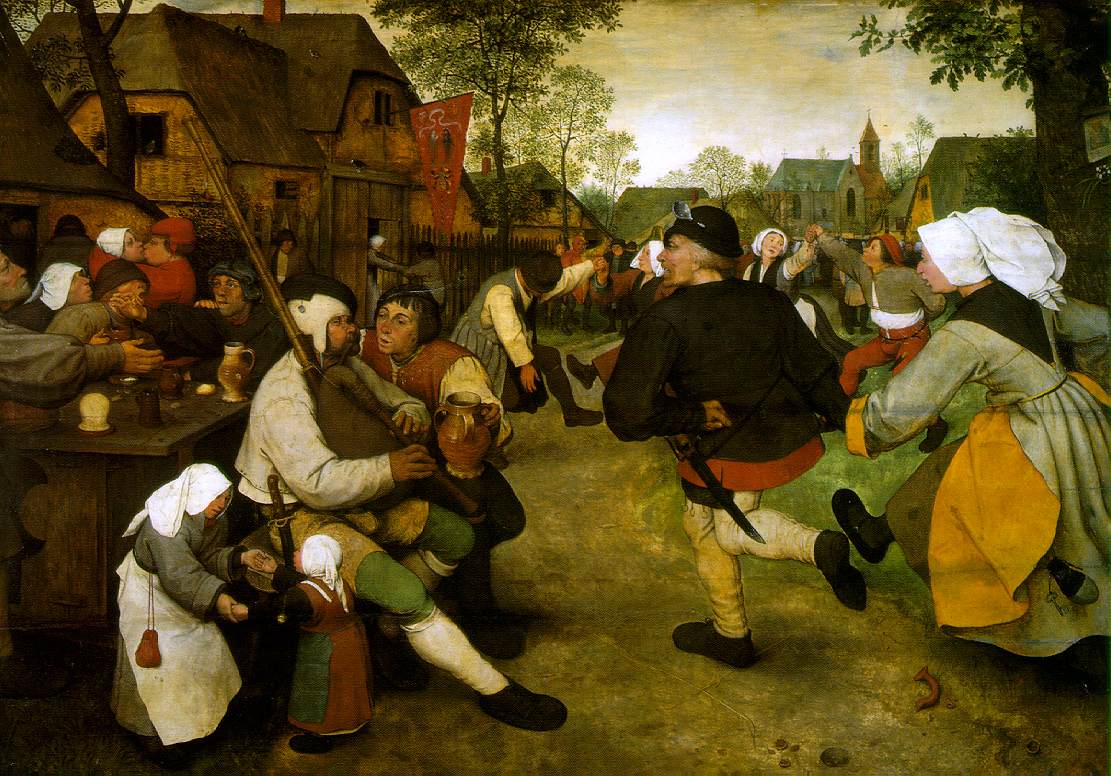
“The common garden weed shepherd’s purse is named for its seed heads, which resemble the little pouches or skrips worn by medieval peasants (there’s a typical skrip in Brueghel’s painting The Peasant Dance). Open up a purse and the seeds spill out like tiny golden coins. They’re cover with a thin layer of gum, which becomes stickier still when it’s moistened -- as for instance by contact with the soil – so that it can cling to the feet of birds.”


Getting back to Japan, the Festival of Seven Herbs or Seven Grasses Day (Nanakusa no sekku) is observed on Jan. 7 by eating seven-herb rice porridge, including nazuna, or shepherd’s purse.
15 Jul 00:23

Roots on the Ground

by Charles Hugh Smith
Part 2 of a guest essay on food security.

Here is Part 2 of a guest essay by longtime contributor Eric A on resilience and food security: become a producer, not a consumer. 


Part Two: Roots on the Ground

How do you grow food? Well that depends entirely on where you are and what land and living situation you can develop, but let’s look at a few examples.

With only 2% of the US population in agriculture, let’s dispense with the idea that you’re a farmer or have the land to do so. But that would not help you anyway: during a crisis running one of the new thousand acre farms with their inputs of imported oil, machine parts, cash and clearing from the digital banking and commodity systems will be impossible. A huge portion of the food grown in North America is on a large scale hundreds or thousands of miles from their market, while at the same time the massive scale of the distant infrastructure means nothing will run without an uninterrupted supply of oil, seeds, fertilizers, machines, and money.

During Russia’s 1998 currency crisis, an abundant wheat crop planted at great expense the year before was unable to be harvested due to an interruption of money that led to a limited supply of diesel fuel. Without fuel, the combines sat idle while the crop rotted and was overcome by winter. Without harvest, there was no seed to plant next year’s crop, nor was there money to buy next year’s diesel to till and plant in spring, leading to years of economic hardship as the nation slowly adjusted and rebuilt.


With wheat fields like this, neither could you find a million scythes to send men to harvest, a billion bags for the threshing, local elevators for the storing, or trains for the delivering. Sure, the farmer might eat, but if the money system stops even for a month, he is just as likely to default on his mortgage and be out on the street as you are.

In any case, statistically you are not a farmer, nor are you near one. So let’s take the best case: you live on little-to-no land in the Northeast or Midwest. How do you get food security? First plant a tree.


Each apple can produce from 40–200 kilograms (88–440 lb) per year, but as they take 5 years to bear you’ll need to start early. Other fruits are similar. Chestnuts and walnuts can produce 100 lbs per tree. Working up the walls and fences, you’ll get about 10 lbs of grapes per vine.

In the garden you’ll find tomatoes at 50 lbs/plant or 40 tons per acre, squash at 10 lbs per plant or 12 tons per acre, 10 tons/acre for cabbage, and 16 tons/acre for potatoes.

Grains are 2,500 lbs/acre for wheat, 3,200 for oats, and 6,000 lbs/acre for corn, 3,500 lbs/acre for dry beans.

Fancy eggs? Each chicken needs about 9 square feet and produces 300 eggs per year.
What does this add up to? Let’s say you have a ¼ acre yard to work with or 11,000 square feet. Assume for the moment that placement of trees, chickens, vertical growing of fences and espalier trees allows all of it to be used. That’s 6,000 pounds of squash, 8,000 pounds of potatoes, 20,000 pounds of tomatoes, 1,500 pounds of corn, or 6,000 pounds of chicken and 360,000 eggs.

Of course these numbers are idealized, but I want to give you some idea of how productive an intensive acre can be. 6,000 lbs of food on 1/10th acre - Urban Farm (8:39 video)

More importantly, I wanted to give some idea of how you could afford to buy and store a year’s food. With trees costing $30 and grain seeds at $25 an acre or $100 for fancy purchased garden seeds, you can see that a very small outlay leads to an enormous gain in stored food. Further, with seed saving, perennials, and tree stock, this food gain can be parlayed into decades of production at what becomes virtually no input cost at all. That’s food security.

But none of that would have worked in 1816. Let’s look at the next step: a year or more of stored food.


This may seem daunting, but look at the benefits: Have to tighten your belt with rising prices and taxes? You can lower your monthly outlay by dipping into your reserves. Someone laid off? Need to scare up $400 for the dentist or to fix the car? You can eat from the cupboard until you can get on your feet. Food interruption? Not for you. A food, oil, money, or weather event will have no effect. So long as it doesn’t hit your house directly, even a war cannot affect you, while rising prices of a war or catastrophe gives you a cushion to sell as well as help your family and neighbors.

How much space does it take?

Let’s start with some basic assumptions: 1 pound per person/meal x 3 meals/day = 1000 lbs per year, or 4,000 lbs, 2 tons of food for a family of four.

Hold on, you say, I can’t stack 2 tons of food in the closet, the floor would cave in!

You won’t have to. Prepared food at the plate is mostly water. Calculating 2:1 for beans, rice, bread, etc, you’d need 2,000 lbs for a family of four for a year. For scale, a large dog food bag is 50 lbs, or 1 cubic foot. 2,000 lbs = 8’x8’x1’ -- you can put it in the corner of a basement.


Or if you live in an apartment, 500 lbs in each of two closets and the rest under the beds.


3 months of food for one.

How much would it cost? Prices vary wildly based on what you choose to store, but let’s just look at flour, 50 lbs for $14; beans, 25 lbs for $27; popcorn 50 lbs for $34, and 50 lbs of cornmeal for $20. That’s about 50 cents a pound--way cheaper than those TV dinners you’re buying at the store. Considering you will need oil, spices, sugar, cocoa, coffee or whatever, let’s call it $1/lb. But that’s still $2,000!

Maybe. First, remember you’re not supposed to be buying food at all. Buying uses scarce money, ties you to the consumer/money system, and doesn’t perpetually renew itself. Again: MAKE food, don’t buy it.

But supposing you have to buy it, or are storing things you can’t grow, like coffee, sugar, and rice, the cost of a storage meal for 4 is $2. Cost per day is $6. Even in Depressions, during wars, in the poorest and most desperate parts of your own city, people find and spend such small sums every day. Starbucks costs $4 a drink. Smoking $6/pack. Cable $2/day. Somehow, somewhere, you can find some part of this expense and stabilize your situation. I know because I’ve lived on the streets, in my car, under bridges, and I’ve done it. So can you.

This is well and good, you say, but I don’t have a ¼ acre, or at least one I’m allowed to use. I live in a condo, an apartment, with my mother, or under the stern eye of the housing association board. So do millions of others. Russia before collapse was a good example: millions lived in looming apartment flats in expansive cities not unlike our own, and like us, there was neither ownership nor space to garden. Nevertheless, it was estimated that the 10% of land allocated to kitchen gardens produced 90% of Russian domestic food. How did they do it?

First, they planted the areas around the apartments as a sort of community garden. This was as simple as having no one meddling to stop them. Second, there was a long tradition of Dacha gardens where they arranged access to a small plot of land in the country, riding the bus or train there in the morning and home at night with bags of produce. Britain has a similar tradition with their “Allotment” of space in the community garden.

In the modern U.S., suburbanization and collapsed urbanization has created nothing but small, unused plots of land everywhere on the landscape, conveniently with easy access, good soil, great drainage, dry storage, and fresh running water built-in.


About 800 sq. feet


About 10 acres including the houses. These front yards are about 1/10th acre.

No access? There was a landless gardener who traded garden produce for access to his neighbor’s yards. He now runs a business selling the surplus.

It’s not very different in urban settings but can be harder to arrange. Nationwide there are ever-more urban gardening initiatives on the enormous quantity of vacant lots. The Greening of Detroit


GM Orion aids recycle of old Cadillac plant for urban gardening in Detroit


Chicago’s Peterson Garden Project – Built for Victory

But you say none of these are possible and you have nothing but a balcony.


Sky High Gardens
Fine for all you rich people who have 16 square feet somewhere, but what if you live in a van down by the river?

Easy. Don’t ask; don’t get permission, just take your concord vines and nasturtium seeds, ragusa roses and wild apples down to the train tracks, to the back of the city park and plant them where you bury your food buckets. No one will recognize them. No one will care. You’re unemployed anyway so you’ve got plenty of time. Guerrilla_gardening

Will this work in downtown Hooverville in the 20-year Depression? Yes. If you’re evicted? Yes. Will it work in a war? Yes.

That’s what I mean by creating food security by planning for the world NOT to end. Because it won’t. That’s what I mean by doing something. Not buying something, staking your life on money and the good will of the next guy, not being a consumer, but PRODUCING something. In an unstable world you can put your life back in your own hands if only you apply yourself and try.

These directions suit my zone in the northeast, but with different methods the same is possible anywhere. Permaculture specializes in converting rocky hills and desert climates to food forests:


Houston Permaculture

Or the hot plains of the south, made shelter like high tunnels are ideal, easily replicated with a hacienda plan or dead branches for a patio ramada filled with prickly pear and barrel cactus:


blissbloggin.blogspot.com

The bitter cold of Maine and Canada is productive as anywhere with short-season Siberian apples and hoop houses. Master gardener Elliot Coleman has developed a way to garden through Maine winters with no added heat. Four-Season Harvest: Organic Vegetables from Your Home Garden All Year Long

Seen Machu Picchu? I guarantee where you live is easier to garden than this:


The temptation to assume that the world will either go on normally or end abruptly is strong, perhaps because both assumptions require no work. However, time is all about change. Changes you may want and prepare for, but also changes you may not like or have prepared for. By looking to history with a dispassionate eye we can discover the most likely changes, like unemployment, or what were the most helpful things in dramatic but uncommon experiences, like war and depression.

Food security is just one aspect of owning and stabilizing your life, but a useful one. Although not as universal in use as money, yet food stores can be safer, a better comfort, and more stable source of value in financial turmoil like we see today. If you learn to make your own food you have a skill, a source of income, a way to prepare at no cost, and a way to both trade and connect with your neighbors--which may be the ultimate wealth in uncertain times.

So the markets just crashed another 20% in many parts of the world:


What have you been doing lately?

copyright 2013 by Eric A.

If you missed Part 1: The Sky Is (not) Falling: a “Little More Chicken” Tale (July 9, 2013)


Things are falling apart--that is obvious. But why are they falling apart? The reasons are complex and global. Our economy and society have structural problems that cannot be solved by adding debt to debt. We are becoming poorer, not just from financial over-reach, but from fundamental forces that are not easy to identify or understand. We will cover the five core reasons why things are falling apart:

go to print edition1. Debt and financialization
2. Crony capitalism and the elimination of accountability
3. Diminishing returns
4. Centralization
5. Technological, financial and demographic changes in our economy

Complex systems weakened by diminishing returns collapse under their own weight and are replaced by systems that are simpler, faster and affordable. If we cling to the old ways, our system will disintegrate. If we want sustainable prosperity rather than collapse, we must embrace a new model that is Decentralized, Adaptive, Transparent and Accountable (DATA).

We are not powerless. Not accepting responsibility and being powerless are two sides of the same coin: once we accept responsibility, we become powerful.

Kindle edition: $9.95       print edition: $24 on Amazon.com
To receive a 20% discount on the print edition: $19.20 (retail $24), follow the link, open a Createspace account and enter discount code SJRGPLAB. (This is the only way I can offer a discount.)


Thank you, Jay H. (silver coin), for yet another superbly generous contribution to this site -- I am greatly honored by your steadfast support and readership. Thank you, Robert B. ($15), for yet another most excellently generous contribution to this site -- I am greatly honored by your steadfast support and readership.

Go to my main site at www.oftwominds.com/blog.html for the full posts and archives.
14 Jul 01:16

Asking the Hard Questions

by John Michael Greer
There are nights, now and then, when I sit up late with a glass of bourbon and look back over the long strange trip that’s unfolded over the last thirty years or so.  When a substantial majority of Americans straight across the political landscape convinced themselves in the early 1980s that mouthing feel-good slogans and clinging to extravagant lifestyles over the short term made more sense than facing up to the hard choices that might have given our grandchildren a livable future, that choice kickstarted a flight into fantasy that continues to this day.

Over the seven years that I’ve been writing and posting essays here on The Archdruid Report, in turn, a tolerably good sample of the resulting fantasies have been dumped on my electronic doorstep by readers who were incensed by my lack of interest in playing along. There’s a certain amusement value in reviewing that sample, but a retrospective glance that way has another advantage: the common threads that unite the fantasies in question form a pattern of central importance to the theme that this sequence of posts is trying to explore.

Back in 2006, when I made my first posts suggesting that the future waiting for us on the far side of Hubbert’s peak was a long, ragged descent punctuated by crises, there were three common ways of dismissing that prediction. The first insisted that once the price of petroleum got near $100 a barrel, the sheer cost of fueling the industrial economy would trigger the economic crisis to end all economic crises and bring civilization crashing down at once. The second insisted that once that same price threshold was met, any number of exciting new renewable energy technologies would finally become profitable, resulting in a green-energy boom and a shiny future.  The third insisted that once that price threshold was met, the law of supply and demand would flood the market with petroleum, force prices back down, and allow the march of economic growth to continue merrily on its way.

A case could be made that those were reasonable hypotheses at the time. Still, the price of oil went soaring past $100 a barrel over the next few years, and none of those predictions panned out. We did have a whopping economic crisis in 2008, but emergency actions on the part of central banks kept the global economy from unraveling; a variety of renewable energy technologies got launched onto the market, but it took massive government subsidies to make any of them profitable, and all of them together provide only a very small fraction of our total energy use; and, of course, as prices rose, a certain amount previously uneconomical oil did find its way to market, but production remains locked into a plateau and the price remains stubbornly high.

That is to say, the perfect storms weren’t, the game-changing events didn’t, and a great many prophets ended up taking a total loss on their predictive investments.  It’s the aftermath, though, that matters. By and large, the people who were making these claims didn’t stop, look around, and say, “Hmm, clearly I got something wrong.  Is there another way of thinking about the implications of peak oil that makes more sense of the data?” Instead, they found other arguments to back the same claims, or simply kept repeating them at higher volume. For a while there, you could go visit certain peak oil bloggers every January and read the same predictions of imminent economic doom that appeared there the year before, and then go to another set of peak oil bloggers and read equally recycled predictions that this would be the breakthrough year for some green energy source or other, and in neither case was there any sign that any of them had learned a thing from all the times those same predictions had failed before.

Nor were they alone—far from it.  When I think about the number of arguments that have been posted here over the last seven years, in an effort to defend the claim that the Long Descent can’t possibly happen, it’s enough to make my head spin, even without benefit of bourbon. I’ve fielded patronizing lectures from believers in UFOs, New Age channelers, and the fake-Mayan 2012 prophecy, airily insisting that once the space brothers land, the New Age dawns, or what have you, we’ll all discover that ecological limits and the laws of thermodynamics are illusions created by lower states of consciousness. Likewise, I’ve received any number of feverish pronouncements that asteroids, solar flares, methane burps from the sea floor or, really, just about anything you can imagine short of titanic space walruses with photon flippers, are going to wipe out humanity in the next few years or decades and make the whole issue moot.

It’s been a wild ride, really.  I’ve been labeled dogmatic and intolerant for pointing out to proponents of zero point energy, abiotic oil, and similar exercises in wishful thinking that insisting that a completely unproven theory will inevitably save us may not be the most sensible strategy in a time of crisis. I’ve been dismissed as closed-minded by believers in artificial intelligence, fusion power, and an assortment of other technological will-o’-the-wisps for asking why promises of imminent sucess that have been repeated word for word every few years since the 1950s still ought to be considered credible today  I’ve been accused of being a stooge for the powers of evil for questioning claims that Bush—er, make that Clinton—uh, well, let’s try Dubya—um, okay, then, Obama, is going to suspend the constitution, impose a totalitarian police state and start herding us all into camps, and let’s not even talk about the number of people who’ve gotten irate with me when I failed to be impressed by their insistence that the Rapture will happen before we run out of oil.

Not one of these claims is new, any more than the claims of imminent economic collapse, green-energy breakthroughs, or oceans of petroleum just waiting to be drilled. Most of them have been recycled over and over again, some for over a century—the New Age, for example, was originally slated to arrive in 1879, and in fact the most popular alternative spirituality magazine in 1890s Britain was titled The New Age—and the few that have only been through a few seasons’ worth of reruns follow familiar patterns and thus fail in equally familiar ways. If the point of making predictions in the first place has anything to do with anticipating the future we’re actually likely to get, these claims have flopped resoundingly, and yet they remain wildly popular.

Now of course there are good reasons why they should be popular. All the claims about the future I’ve listed are, in practical terms, incentives to inaction and evasions of responsibility.  If rising oil prices are guaranteed to bring on a rush of new green energy options, then we don’t have to change our lifestyles, because pretty soon we’ll be able to power them on sun or wind or what have you; if rising oil prices are guaranteed to bring on a rush of new petroleum sources, well, then we don’t need to change our lifestyles, either, and we can make an extra donation to the Sierra Club or something to assuage any lingering ecological guilt we might have. The same goes for any of the other new technologies that are supposedly going to provide us with, ahem, limitless energy sometime very soon—and you’ll notice that in every case, supplying us with all that energy is someone else’s job.

On the other hand, if the global economy is sure to go down in flames in the next few years, or runaway climate change is going to kill us all, or some future president is finally going to man up, impose a police state and march us off to death camps, it’s not our fault, and there’s nothing we can do that matters anyway, so we might as well just keep on living our comfortable lifestyles while they’re still here, right? It may be impolite to say this, but it needs to be said: any belief about the future that encourages people to sit on their backsides and do nothing but consume scarce resources, when there’s a huge amount that could be done to make the future a better place and a grave shortage of people doing it, is a luxury this age of the world can’t afford.

Still, I’d like to cycle back to the way that failed predictions are recycled, because it leads straight to the heart of an unrecognized dimension of the predicament of our time. Since the future can’t be known in advance, attempts to predict it have to rely on secondhand evidence.  One proven way to collect useful evidence concerning the validity of a prediction is to ask what happened in the past when somebody else made that same prediction.  Another way is to look for situations in the past that are comparable to the one the prediction discusses, in order to see what happened then. A prediction that fails either one of these tests usually needs to be put out to pasture; one that fails both—that has been made repeatedly in the past and failed every time, and that doesn’t account for the way that comparable situations have turned out—ought to be sent to the glue factory instead.

It’s in this light that the arguments used to defend repeatedly failed predictions can be understood. I’ve discussed these arguments at some length in recent posts:  the endlessly repeated claim that it’s different this time, the refusal to think about the implications of well-documented sources of negative feedback, the insistence that a prediction must be true if no one’s proved that it’s impossible, and so on. All of them are rhetorical gimmicks meant to stonewall the kind of assessment I’ve just outlined. Put another way, they’re attempts to shield repeatedly failed predictions from the normal and healthy consequences of failure.

Think about that for a bit.  From the time that our distant ancestors ventured out onto the East African savannas and started to push the boundaries of their nervous systems in ways for which millions of years of treetop living did little to prepare them, their survival and success have been a function of their ability to come up with mental models of the world that more or less correspond to reality where it counts. If there were ever australopithecines that couldn’t do the sort of basic reality testing that allows food to be distinguished from inedible objects, and predators from harmless animals, they didn’t leave any descendants. Since then, as hominids and then humans developed more and more elaborate mental models of the world, the hard-won ability to test those models against the plain facts of experience with more and more precision has been central to our achievement.

In the modern West, we’ve inherited two of the great intellectual revolutions our species has managed—the creation of logic and formal mathematics in ancient Greece, and the creation of experimental science in early modern Europe—and both of those revolutions are all about reality testing. Logic is a system for making sure that mental models make sense on their own terms, and don’t stray into fallacy or contradiction; experimental science is a system for checking some mental models, those that deal with the quantifiable behavior of matter and energy, against the facts on the ground. Neither system is foolproof, but then neither is anything else human, and if both of them survive the decline and fall of our present civilization, there’s every reason to hope that future civilizations will come up with ways to fill in some of their blind spots, and add those to the slowly accumulating body of effective technique that provides one of the very few long-term dynamics to history.

It remains true, though, that all the many methods of reality testing we’ve evolved down through the millennia, from the most basic integration of sense inputs hardwired into the human brain right on up to the subtleties of propositional logic and the experimental method, share one central flaw. None of them will work if their messages are ignored—and that’s what’s going on right now, as a vast majority of people across the modern industrial world scramble to find reasons to cling to a range of popular but failed predictions about the future, and do their level best to ignore the evidence that a rather more unpopular set of predictions about the future is coming true around them. 

Look around, dear reader, and you’ll see a civilization in decline, struggling ineffectually with the ecological overshoot, the social disintegration, the institutional paralysis, and the accelerating decay of infrastructure that are part and parcel of the normal process by which civilizations die. This is what the decline and fall of a civilization looks like in its early-to-middle stages—and it’s also what I’ve been talking about, very often in so many words, since not long after this blog got under way seven years ago.  Back then, as I’ve already mentioned, it was reasonable to propose that something else might happen, that we’d get the fast crash or the green-energy breakthrough or all the new petroleum that the law of supply and demand was supposed to provide us, but none of those things happened. (Of course, neither did the mass landing of UFOs or any of the other more colorful fantasies, but then that was never really in question.)  It’s time to recognize that the repetition of emotionally appealing but failed predictions is not a helpful response to the crisis of our time, and in fact has done a great deal to back us into the corner we’re now in. What was Ronald Reagan’s airy twaddle about “morning in America,” after all, but another emotionally appealing failed prophecy of the kind I’ve just been discussing?

Thus I’d like to suggest that from now on, any claim about the future needs to be confronted up front by the two hard questions proposed above.  What happened at other times when people made the same prediction, or one that’s closely akin to it? What happened in other situations that are comparable to the one the prediction attempts to address?  Any prediction that claims to be about a future we might actually encounter should be able to face these two questions without resorting to the kind of rhetorical evasions noted above. Any prediction that has to hide behind those evasions, in turn, needs to be recognized as being irrelevant to any future we might actually encounter. My own predictions, by the way, stand or fall by the same rule, and I encourage my readers to ask those questions of each prediction I make, and answer them through their own research.

Yes, I’m aware that those two questions pack an explosive punch that makes dynamite look weak. It’s embarrassingly common in contemporary life for theories to be embraced because of their emotional appeal, and then defended with every rhetorical trick in the book against any inconvenient contact with unsympathetic facts. As suggested in last week’s post, that’s a common feature of civilizations toward the end of their rationalist period, when abstract reason gets pushed to the point of absurdity and then well beyond it.  Fantasies about the shape of the future aren’t uncommon at such times, but I don’t know of another civilization in all of recorded history that has put as much energy as ours into creating and defending abstract theories about the shape of the future. With any luck, the civilizations that come after ours will learn from our mistakes, and direct their last and most overblown abstractions in directions that will do less harm.

In the meantime, those of us who are interested in talking about the kinds of future we might actually encounter might find it useful to give up the standard modern habit of choosing a vision of the future because it’s emotionally appealing, demanding that the world fulfill whatever dream we happen to have, and filling our minds with defensive gimmicks to keep from hearing when the world says “no.” That requires a willingness to ask the questions I mentioned above, and to accept the answers, even when they aren’t what we’d like them to be.  More generally, it requires a willingness to approach the universe of our experience from a standpoint that’s as stunningly unfashionable these days as it is necessary—a standpoint of humility.

What would it mean if, instead of trying to impose an emotionally appealing narrative on the future, and shouting down any data that conflicts with it, we were to approach the universe of our experience with enough humility to listen to the narratives the universe itself offers us?  That’s basically what I’ve been trying to suggest here all along, after all. That’s the point to my repeated references to history, because history is our species’ accumulated body of knowledge of the way human affairs unfold over time, and approaching that body of knowledge with humility and a willingness to listen to the stories it tells is a proven way to catch hints about the shape of the future as it unfolds.

That’s also the point to my equally frequent references to ecology, because history is simply one subset of the behavior of living things over time—the subset that deals with human organisms—and also because ecological factors have played a huge and all too often unrecognized role in the rise and fall of human societies. Whether humans are smarter than yeast is less important than the fact, and of course it is a fact, that humans, yeast, and all other living things are subject to the same ecological laws and thus inevitably experience similar processes over time. Attentive listening to the stories that history tells, and the even richer body of stories that nature tells, is the one reliable way we’ve got to figure out what those processes are before they clobber us over the head.

That act of humility, finally, may be the best ticket out of the confusion that the collective imagination of our time has created around itself, the proliferation of abstractions divorced from reality that makes it so hard to see the future looming up ahead of us.  By turning our attention to what actually happens in the world around us, and asking the hard but necessary questions about our preferred notions concerning that world and its future, we might just be able to extract ourselves far enough from that confusion to begin to grapple with the challenges of our time. In the process, we’ll have to confront once again the issues with which this series of posts started out—the religious dimension of peak oil and the end of the industrial age. We’ll proceed with that discussion next week.
06 Jul 21:55

2013 Auto Miles: 1,025; 2013 Bicycle Miles: 850

by Charles Hugh Smith
David Ellis

It should be safer to ride a bike for practical purposes as well as for fitness.

We rode almost as many miles on our bikes as we logged in our car in 2013.

I don't usually track my mileage very closely, but I recently discovered that we drove our only vehicle (a late-90s Honda Civic) 1,025 the first six months of 2013 and we rode about 850 miles on our bicycles. We put exactly 27.28 gallons of gasoline in the car in those six months, and we still have a quarter tank left, so it seems we're getting over 35 miles per gallon.

As a data-driven person, I naturally have an odometer/speedometer on my primary bicycle, an old Mongoose mountain bike. In June I rode 115 miles, which is a little less than normal as I was under the weather for three days.


So I reckon I rode about 700 miles in the first six months and my wife probably logged about 150 miles on her Specialized. Most of our bike trips are errands that most people would get in their auto to do, but I also log a fair number of 8-mile pleasure rides just to clear my head (I ride more for pleasure than my wife does.)

I know we spent more on bicycle repairs than on auto repairs ($0), as I replaced worn-out gears, chain, brake pads, etc.

We spend much of the year in Berkeley CA, which is small and bicycle-friendly. Jumping on our bikes is easier than getting in a car on multiple levels: parking is easier (and free), and there's no traffic jams.

(Our time in Hawaii is less bike-friendly due to steep hills and rural distances.)

All miles are about the same in a car; not so on a bike. If you're in a car and you start climbing a hill, you just press the accelerator down. On a bike, you must bear down to climb the hill. One of my standard rides is 3 miles each way, but the last mile is a semi-grueling climb from near sea-level to above 800 feet. You have to be in reasonably good shape to do that mile, and the ride down offers another challenge--not going so fast you lose control. (Just for context: I am 59 years old and very much not interested in falling off my bike....)

But since most people live in relatively flat areas, most bike rides do not require extreme fitness or effort. It's a far more relaxing way to get somewhere than in a car.

It's not really a sacrifice to ride a bike, except in extreme weather. Yes, you have to be alert, as you're on a 30-pound machine and everyone around you is ensconced in a 3,000+ pound machine. On a bike, you can't really afford to space out; things are happening around you all the time--vehicles, pedestrians, other cyclists--and you're constantly responding and tracking potential problems. It's very good practice for focusing on the present. (Always wear your helmet, of course.)

It's a lot more fun going somewhere on a bike (as long as the "bike lane" isn't suicidal--see below), not to mention the simple joys of not having to find a parking space. You can't haul your Costco load home on a bike, but you can haul quite a bit in saddle bags, a bike trailer or just a backpack.

Not everyone can ride year round, but correspondent R.C. reports that the bike club in his Chicago suburb has grown by 40% in the past three years.

Studies have found (duh!) that more people are willing to ride bikes if there are safe routes. A few other nations are way ahead of the U.S. in this regard; here, "bike lanes" are imaginary zones marked by white lines on the pavement; my brother-in-law and I took a long ride a few years ago and found one stretch of the "bike lane" was the shoulder on an interstate freeway. The "bike lane" was littered with delaminated truck tire detritus and other highway junk. Whoever planned that "bike lane" has a wicked sense of humor.

"Bike lanes" often separate lanes of fast-moving traffic from freeway on-ramps (check out the lower University Avenue bike lane in Honolulu for an example). Bike safety in 99.9% of urban America is an unfunny joke: the only truly safe bikeway is one separated from auto traffic by a barrier, or on throughways where cars and trucks are banned.

Correspondent R.C. suggested that perhaps one reason transportation fuel consumption is going down is that more people are riding bicycles ( Our Energy Slaves Are in Recession July 2, 2013). I would like to think so, but I don't personally know a single other adult who rides a bike daily for practical reasons (as opposed to pure fitness) or does errands on a bike rather than a car.

Yes, there are plenty of limiting factors, but one that could be remedied with a modest amount of money and political influence is to make biking safe enough that mothers would be drawn to take their children out, and people who are not bike freaks would not find it frightening to take to the streets on a bike.


Three video programs for your viewing pleasure:

Gordon Long and I discuss Window of Opportunity: Blown!

Longtime contributor and fellow writer Zeus Yiamouyiannis discusses his new bookTransforming Economy: From Corrupted Capitalism to Connected Communities with Max Keiser

Kerry Lutz of Financial Survival Network and I discuss the future of work and education--though Kerry titled the show more provocatively.... 


Things are falling apart--that is obvious. But why are they falling apart? The reasons are complex and global. Our economy and society have structural problems that cannot be solved by adding debt to debt. We are becoming poorer, not just from financial over-reach, but from fundamental forces that are not easy to identify or understand. We will cover the five core reasons why things are falling apart:

go to print edition1. Debt and financialization
2. Crony capitalism and the elimination of accountability
3. Diminishing returns
4. Centralization
5. Technological, financial and demographic changes in our economy

Complex systems weakened by diminishing returns collapse under their own weight and are replaced by systems that are simpler, faster and affordable. If we cling to the old ways, our system will disintegrate. If we want sustainable prosperity rather than collapse, we must embrace a new model that is Decentralized, Adaptive, Transparent and Accountable (DATA).

We are not powerless. Not accepting responsibility and being powerless are two sides of the same coin: once we accept responsibility, we become powerful.

Kindle edition: $9.95       print edition: $24 on Amazon.com
To receive a 20% discount on the print edition: $19.20 (retail $24), follow the link, open a Createspace account and enter discount code SJRGPLAB. (This is the only way I can offer a discount.)


Thank you, Gene M. ($10/month), for your stupendously generous re-subscription to this site -- I am greatly honored by your steadfast support and readership. Thank you, William S. ($50), for another outrageously generous contribution to this site -- I am greatly honored by your steadfast support and readership.

Go to my main site at www.oftwominds.com/blog.html for the full posts and archives.