Shared posts

29 Jun 13:08

A Hermetic Musing on Fate, Necessity, and Providence

by polyphanes

This post was originally a short tweet thread I shared last September, but I don’t think I ever shared it outside Twitter, and I think I phrased some things in it that even I hadn’t realized were as big as I do now.  I’ve reformatted it and embiggened it slightly for a proper blog post, but the gist is the same.

So, a few definitions first, largely based on SH 12—14:

  1. Providence is the will of God.
  2. Necessity is what comes up with what needs to happen in order for Providence to be fulfilled.
  3. Fate is what arranges things in order for that which Necessity declares to come about.

In software engineering terms, Providence is the requirement that specifies what is to be done, Necessity is the design that specifies how it’s to be done, and Fate is the code that does what the requirement says in the manner the design says. The execution of the code—the carrying-out of Fate—is the actual activity that happens in the cosmos, right down to our own lives.

And what are the agents of Fate, you might ask?  What are the entities that facilitate and serve Fate to bring it about?  It’s the planets and stars themselves, which are not just indicators of Fate but the things that provide all things that exist down here with the energy (in the philosophical sense of activity or being-at-work-ness) to do what they need to do to be born, to grow, to die, and decay—and, in the process, fulfill whatever purpose it was meant to achieve.

That the planets are the agents of Fate is why astrology is the first (and most important) Hermetic art, because the study of the planets and stars allows us to learn about Fate, and thus about Necessity and Providence, and thus God and our relation to it. Our external and bodily lives are commanded by Fate, and Fate is not up to us to change in the Hermetic worldview, no more than we can make Mercury not go retrograde when we find it inconvenient. Fate is going to happen one way or another; we must learn to live with it.  (This is where a good understanding of Stoicism comes into play when studying Hermeticism.)

But, the thing is, your soul—that which you really are—is not your body; rather, our souls come from a place beyond the cosmos, and thus a place beyond Fate.  As such, our souls are not compelled by Fate the way our bodies and external lives are.  Our bodies are creations of the cosmos, and the cosmos is ruled by Fate, and so our bodies are naturally controlled by Fate as well as a production of it (and, by extension, the seven planets).  The soul, which only wears the body like how the body wears a shirt, is only impelled, not compelled, by Fate, in the same way that while the quality of a shirt can make a body comfortable or uncomfortable, the body is not fundamentally bound to the same fate as the shirt.  That saying that we’re spiritual entities having a physical experience, or that we should only be in the world and not of the world?  That notion is critically Hermetic, and we need to take that to heart.  We can’t be in control of everything (or even anything) external on the level of the body, but internally on the level of the soul, we can overcome it all.

It is in rising above the powers of Fate that we conquer it, by learning what it does and how it plays out that we learn the exceptions in the code and the behavior unspecified by the design and the loopholes in the requirements. Only once we rise above Fate can we make it our plaything., but in order to do so, we need to understand how Fate actually plays out on the low level once we see what Fate is trying to accomplish at a high level.  This is why alchemy is the second Hermetic art: alchemy is the study and science of learning how the activities and energies of the cosmos play out specifically at the level of material creation and manifestation, in the world we live in. Astrology looks above to see “why”, alchemy looks below to see “how”. And, well, as the Emerald Tablet (and so many others who love to quote it) says, “as above, so below”.

Learning Fate’s activity/energeia by alchemy and Fate’s power/dynamis by astrology, that’s where the third Hermetic art comes in: theurgy. Theurgy doesn’t change Fate to fight against Necessity or change Providence. Rather, it works by Fate to do what is best—what is Necessary—in accordance with highest Providence.  In working by Fate, we rise up to Fate’s own level and surpass it, able to at last be consciously and intentionally free of Fate.  Theurgy relies on knowing that which is above, that which is below, and the relationship between the two to not just go up or down, but to go beyond both entirely.  (After all, when you’re talking about a sphere, any direction away from the center is technically “up”.)

To borrow a bit of Christianity for a moment: angels are said to have no free will, but consider instead that they have will, just that their will is to fulfill God’s will. In this, the will of an angel is the will of God to be expressed through that angel.  The same goes for us, too. Theurgy is what allows us to make our will God’s will, which also makes God’s will our will. And if God is for you, sharing the one and same will, who can be against you?

When your own will is Providence, what need would you have to fight with Fate, when Fate itself could not fight with you?

14 Jun 00:07

Climate Change Reversal at Whole Village

by Albert Bates
"During the burn people were taken around the farm to see the 40,000+ trees we have planted, our carbon farming ways with cover crops, minimum tillage, compost, and our movable fencing for grazing."


“Whenever I plant something using biochar, not only is there the pleasant expectation of whatever it is — tomatoes, beans or peas — but I know that I am chipping away at that 415 ppm in the atmosphere and the CO2 which was in the plants that made my biochar will never go back into the atmosphere again.” 
— Milton Wallace

I am grateful Milton Wallace could help me with this weekly post, because I have been traveling to and from speaking events and have found it difficult to keep up. The following is an account Milton wrote about one such event, at his ecovillage in Ontario.

Many people visit our ecovillage, including members’ relatives, people who want to help out on our Work Bee days, school groups, those interested in becoming members, workshop participants and more. One of the things we like to share with our many visitors, especially as we all are becoming more concerned, is the projects we have underway to help reverse climate change. What’s going on at our biochar site often draws the most attention.

Biochar is carbon that has been removed permanently from the atmosphere. Leading us forward on this project is 85-year-old Barbara Wallace, the oldest member of Whole Village. Because of her enthusiasm and single minded support, she is often referred to as “Biochar Barb.” She has had us making biochar for almost 5 years.

We make our biochar in a Kon Tiki pyrolysis kiln, so called because as the Kon Tiki raft crossed the ocean in the last century and revised our idea of human capabilities for finding something new, it is hoped the Kon Tiki kiln will help us create a new beginning. Our kiln was made by our neighbor John Rowe, who was kind enough to gift it to us.

Biochar can be made from anything that was once alive. We fill our kiln with dry wood waste from our many acres of woodland, and set it on fire. The kiln is constructed so that the fire’s flames shield the wood below and keep out oxygen. The kiln heats up to 500 to 700 degrees centigrade, driving out the wood oils and leaving pure carbon. The design of the kiln prevents any smoke or other emissions from escaping to the atmosphere.

So what can you do with biochar? Well it turns out you can do a whole lot! A recent tabulation found 55 uses for biochar. Biochar in asphalt road paving raises the temperature at which softening occurs and reduces rutting. In cement, biochar reduces weight, increases strength, provides indoor pollution control, humidity control, and much more. In toothpaste, it removes stains without abrasive or bleaching agents. In bedding, it adsorbs perspiration and odors. And so it goes — an amazing material which can be made into all kinds of things with amazing properties.

At Whole Village, we use it for agriculture. We grow vegetables, grains, berries, fruit and other trees, and add biochar to all as we plant. Biochar has a very porous structure. It is full of tunnels and pores where the wood gases and moisture used to be. The result is a condo like structure in which the microbes, bacteria and mycelia reside while they are helping our plants grow. Once all the critters have moved in, they can cut down fertilizer requirements significantly every year from then on. Another nice feature comes into play when rain is scarce. Biochar can hold almost 6 times its own weight in water which is made available right at the root zone.

We also use it in the barn. Spread on the floor, it cuts down on animal odors, and after it is shoveled out onto the compost pile that continues. Then we load it in our manure spreader and spread it all over our hay fields, helping to grow more and better hay. As a feed supplement, Biochar reduces diarrhea, improves feed intake, and has other benefits.

The latest reading at the Mauna Loa Observatory in Hawaii is 415 ppm of Carbon Dioxide in our atmosphere. We need to reduce that to about 260–280 ppm to avoid a lot of very serious consequences. Whenever I plant something using biochar, not only is there the pleasant expectation of whatever it is — tomatoes, beans or peas — but I know that I am chipping away at that 415 ppm in the atmosphere and the CO2 which was in the plants that made my biochar will never go back into the atmosphere again.

There are many different kinds of kilns in use all over the world. The Kon Tiki is a good size for a farm like ours. There are also small kilns that are good for house plants or a small garden. At the large end are more industrial sized plants. They can be located near a good source of materials for making biochar. They can also manufacture some of the many products enhanced by biochar. Money is not necessarily needed to make biochar. It is made in pits in the earth in many parts of the world.

Albert Bates is a friend of Biochar Barb’s and mine who is right up there in the list of major players in the biochar world. His latest book titled Burn: Using Fire to Cool the Earth, co-authored by Kathleen Draper, has the CO2 measuring instruments at Mauna Loa changing direction from up to down. Albert was at Whole Village earlier this month, and led an all day workshop attended by about 100 people from Canada and the U.S.

 
He showed us a new way to use our Kon Tiki kiln which looks much easier. We’re anxious to try it ourselves for our next burn. He also texted his expert friends on the other side of the world to get a question answered which will dramatically change our procedure. The burn took several hours which gave us time to hear some of what Albert had to say about biochar. When the burn was done and quenched, I was pleased to see several of our guests step up and crush the biochar with our quite heavy roller-crusher.

During the burn people were taken around the farm to see some of our other climate change reversal projects. These include the 40,000+ trees we have planted, our carbon farming ways with cover crops, minimum tillage, and compost as well as our fencing setup to allow us to maneuver our cattle around so as to maximize carbon sequestration.

After a busy afternoon, we had a “knock your socks off” dinner made by our Whole Village super cooks using food supplied by Rowan Lalonde (another biochar believer) from Harmony Whole Foods.

In the evening, we heard Albert speak about biochar and his new book. Albert’s talk was riveting. He has spoken to the U.S. Supreme Court, the UN in New York, and to many hundreds of others around the world during his biochar-laced permaculture courses. The idea that emerges is that a lot of money can be made by developing biochar-based products and methods, and that if this course is zealously pursued by enough people we can reverse climate change.

Let’s Do It !
 

You encourage me to do more and then tell you about it. Help me get my blog posted every week. All Patreon donations and Blogger subscriptions are needed and welcomed. Those are how we make this happen. PowerUp! donors on Patreon get an autographed book off each first press run. Please help if you can.

26 Mar 23:50

Wild perennial pesto

by Dee

ChickweedBy Dee Reid

The only crop that was ready to be harvested this week in my early spring garden was one I had nothing to do with.  When I went out to the garden to check on my sugar-snap peas (they finally germinated!), imagine my delight when I also discovered a whole bed of chickweed and dead nettle. These delicious and nutritious wild, edible, perennial and ubiquitous greens had taken over a bed of soil that I had not yet planted.

What could be better? They grew on their own, with no help from yours truly. I didn’t have to buy seeds, nurture the transplants, weed, feed or fret about this crop. It just took care of itself, and in so doing, it is taking great care of me, too.

So I thanked Mother Nature and grabbed up several fistfuls to eat and cook with. I learned about this “manna” from heaven a couple of years ago when I went for a walk with the amazing  herbalist and wild foods enthusiast Kim Calhoun, and later took a class with her at Central Carolina Community College. She showed me some of the weeds growing in our backyards that can easily be used in salads, soups and pesto.

She also told me that wild greens are packed with nutrients — or “goodiments” as she likes to say. Then she shared her recipe for Wild Greens Pesto, which also features garlic, one of the most nutritious cultivated foods we know.

I made my first batch of the season this week and it’s even more delicious than my last batch. It tastes great on sandwiches, pasta, vegetables, seafood, meats, etc. You can keep it in the refrigerator for weeks at a time (if you can manage not to gobble it all at once) and it keeps well in the freezer in individual ice cubes for easy future use.

Planty Kim’s Wild Greens Pesto

Ingredients:

3 medium garlic cloves

½ cup walnuts (or pecans, almonds, cashews, pine nuts)

3 cups firmly packed greens (any combo of seasonal wild & cultivated herbs—see list below)

¼-½ cup extra virgin olive oil

1 tablespoon lemon juice

1 tablespoon UME plum vinegar (or sea salt to taste)

1 tablespoon nutritional yeast (a dairy-free option instead of parmesan cheese)

Preparation:

1. Blend garlic and nuts in food processor until coarsely chopped.

2. Add remainder of ingredients to food processor and blend till desired smoothness. Yields approximately one cup.

3. Eat on crackers, mixed into pasta, smeared on a frittata or fried egg sandwich, spread on rolls or pizza, get creative!

4. Any leftovers will keep in the fridge for a week or more. I like to triple the recipe and freeze some Wild Green Pesto in half pint (8oz.) glass mason jars.

Wild Greens of the NC Piedmont in early Spring (to name a few): chickweed, purple dead nettle, creasy greens/cress, dandelion leaves, plantain leaves, tender yellow dock leaves, wild lettuce leaves, cleavers, wild garlic, self heal, violets,henbit…don’t forget flowers too—dandelion (remove bitter green base), henbit…

Cultivated Greens: parsley, cilantro, nettle, lemon balm, thyme, rosemary, nettle, oregano…

Before you pick something to eat, you should be sure you know what it is. Check online for color photos of these greens, or ask a friend who knows. Also be sure it’s growing in an area that is not polluted by chemical pesticides, herbicides or road runoff. Always wash the greens before consuming them, in case any of our four-legged friends “fertilized” them when we weren’t looking.


14 Nov 15:28

Who knew that Seoul was a leader in the sharing economy?

By Richard Heinberg, posted Nov 12, 2013:


Seoul Skyline.

Did you know that Seoul, South Korea is one of the world’s key sites for post-growth economic re-development? No? Neither did I, until I saw for myself.
 
I was pleased to be invited to give the keynote address at a conference titled “Reshaping the Way We Live,” put on by the Seoul Youth Hub, held November 7-8. I had no idea what to expect, and was rather surprised when the event turned out to be one of the most enjoyable and eye-opening in recent memory.
 
First, some background on South Korea. The nation has an export-based industrial economy that has expanded rapidly in recent decades; however, its rate of growth has begun to slow and the youth unemployment rate is now north of 22 percent. Korean politics has also taken a worrisome turn: many citizens dispute the legitimacy of the most recent presidential election, which brought to power Park Geun-hye, the daughter of former dictator Park Chung-hee.
 
Meanwhile Korea’s energy situation could hardly be bleaker: the nation imports essentially all its oil, natural gas, and coal (Korea was once self-sufficient in coal, but production has declined dramatically). It gets some electricity from hydropower, but there is little room for expansion. The country’s 23 nuclear power plants are subject to increasing controversy since the 2011 Fukushima catastrophe in nearby Japan, as many Koreans fear they are now eating radioactive fish.
 
The Seoul Youth Hub evidently sees crisis as opportunity. Why else would they ask the author of The End of Growth to address a conference of 18-to-40 year-olds? I came to their attention through a protracted Internet search, but it helped that three of my books have been translated into Korean. Evidently the organizers weren’t shy about conveying a sobering message.
 
Lunch with the Youth Hub conference organizers.
 
Though I hadn’t visited their country previously, I knew that Koreans have a reputation for being friendly and generous. If my experience is any gauge, the reputation is well deserved. The organizers put me up at a traditional Hanok Korean guesthouse (no chairs or television, just mats on the floor of a beautifully constructed, floor-heated, meticulously scrubbed little pavilion). Nearly all food provided during my stay was also traditional, and included a Buddhist temple meal with multiple courses of artistically crafted vegetarian morsels. Suffice it to say that I felt well taken care of and had a splendid time.
 
Now to the conference itself. Except for the opening keynote and a final wrap-up, the sessions were workshops led by eight collaborative groups (including ones from Hong Kong and Japan), each of which is a youth-led organization engaged in social innovation. You can find a list of participating groups at the conference website. The subjects explored ranged from cheese-making to innovations in democratic decision-making; in effect, it amounted to a multi-track laboratory for young people to explore adaptive responses to economic contraction.
 
Surprisingly, the event was free to the participants. The City of Seoul footed the bill, thanks to Mayor Park Won-soon (more about him in a moment).
 
The Seoul Youth Hub is a project of the Seoul Metropolitan Government, and its mandate is to help young people “design a future society” by providing a place where they can share and resolve their problems, experiment with a sharing economy, and “discuss specific policies regarding various agendas such as work-labor, housing, life safety net, business creation, youth politics,” and more. The Hub is also intended as a model and a networking center for similar projects throughout Asia. I highly recommend watching this short video.
 
The venue for the conference was the Youth Hub’s headquarters, which features movable walls, furniture made of recycled building materials, open and shared office spaces, informal dormitory nooks, a café, and learning co-laboratories. Altogether, there was far more going on here than I could take in during the two days of the conference, much less describe in a couple of paragraphs.
 
On the evening of the first day of the conference I met Mayor Park at his offices in City Hall, a twisty new steel-and-glass structure whose ground floor is devoted to citizen-led social innovation projects.
 
Copies of The End of Growth were on the Mayor’s meeting room table. Using an interpreter, we got right to it: he had clearly read the book and asked intelligent questions about it. What would I recommend that he and the City of Seoul do to prepare for the end of economic growth? It was a stunning question, given the circumstances, and he appeared eager to consider whatever suggestions I might offer. I started rattling off a laundry list of ideas—supporting farmers’ markets, community gardens, and other staples of a local food system; discouraging cars while encouraging bicycling and public transport; raising energy building standards to the Passive House level; staging more cultural events to increase the happiness quotient among citizens. When I finished, he recited examples of how he and the City have already begun doing nearly every one of these things. He was saying, in effect, “Check, check, check. Come on, what else have you got? Please tell me, and I’ll see if we can do it!” I suggested he find a way for the City to help bring Transition to Seoul (there are currently two official Transition Initiatives in Japan, none in Korea). He promised to do just that.
 
Mayor Park Won-soon
 
Whoa, I thought. Who is this guy? I looked up his Wikipedia listing later that night. Before becoming Mayor in 2011, Park Won-soon had a 30-year career as a human rights and social justice activist and spent four months in prison for some of these activities. In recent years he developed a chain of nonprofit “Beautiful Stores,” which collect donations of used items, repair them if needed, and sell them to raise money for the social enterprise movement. There are now over a hundred of these stores throughout Korea.
 
Inside a Beautiful Store
 
Hard to believe this man is the elected leader of the largest city proper in the world, with a population of over 10 million.
 
The organizers of the Youth Hub conference think the world of Mayor Park, and I can understand why. I’ve seen a lot of hopeful post-growth initiatives in a lot of places—usually citizen-led and modest in scale; never have I seen such visionary, intelligent leadership at the municipal government level within so large a city.
 
This is a country with a hard future ahead. Challenges with energy, the economy, and the environment are lining up (not to mention ever-present tensions with North Korea). Yet if efforts led by Mayor Park and the Seoul Youth Hub manage to flourish, things may go much better than they otherwise would. Perhaps other cities can begin to find inspiration here.
 
 
For a helpful overview of the food sovereignty movement in South Korea, see this article from Foreign Policy in Focus.
 
Richard Heinberg in front of a Youth Hub garden of Korean cabbage (key ingredient of Kim-Chee)
 
23 Sep 20:53

Free market

by Nancy Oates

Developers and property owners who rant about their “right” to make the maximum profit regardless of how it affects the quality of life for the rest of the community should spend a couple hours at the end of a Saturday afternoon at the Orange County Solid Waste Convenience Center on Eubanks Road. There they could note the individuals and families waiting to see what gets dropped off in the “free shed.”

Saturday mornings are popular times for yard sales, and later in the day, some sellers decide they don’t want to make room in their closets again for their unsold merchandise. So they take it to the free shed on Eubanks Road for anyone who wants it. Those who drop off items receive no tax write-off, only the knowledge that their useable items will be snapped up and begin a new life in another home.

In my observation, the number of people who spend their Saturday afternoons “shopping” at the free shed instead of at Southpoint is increasing. Yet they seem to remain invisible to developers and property owners concerned only about making their own well-off selves richer.

I spent the past week barking behind Ron Strom as he presented his rezoning request to various boards and commissions. Strom claims that the rents at the Timber Hollow Apartments he purchased last year are 32 percent below market rate, so he plans to bump up the rent on one-bedroom units from about $700 a month to about $925. And he plans to build more than half again as many new luxury rentals and tricking up the amenities, adding a resort-style pool, party plaza and coffee shop to appeal to well-to-do tenants. To speed the approval process, he stamped his plans “affordable,” even though the plan won’t yield a single affordable unit.

Every market rate apartment complex has a predictable vacancy rate. Stom’s plan allows him to claim that his vacant units are the affordable ones and that if he can’t rent them out within 30 days to tenants who qualify for affordable units, he can rent them at market rate. No tenant on a budget can pay the buyout for breaking a current lease in order to move into Timber Hollow with less than 30 days’ notice. So, goodbye affordable units.

The Rules of Strom deem graduate students (who receive annual stipends of $15,900 for a PhD student and $11,900 for a master’s student) make too much to qualify for affordable units because he includes as income their scholarship funds paid directly to the school and personal loans students take out to make ends meet.

Strom claims he can’t make the numbers work to provide actual affordable rentals, yet at every public meeting he brings a posse of six to eight men, professionals who charge about $300 an hour – the middle-aged white men in the group, anyway. He likes to portray himself as community minded, but recall that when 3Cups didn’t garner him enough return on his investment, he pulled out, and the independent coffee shop was sold to a franchise.

If Strom wanted to make a positive contribution to the community, he could preserve the existing affordable housing, and maybe open a free coffee bar next to the free shed on Eubanks Road.
– Nancy Oates

19 Sep 23:45

A Dam, Dying Fish, and a Montana Farmer’s Lifelong Quest to Right a Wrong

By Sandra Postel, posted Sep 12, 2013:

 Roger Muggli, a third-generation Montana farmer, stands at the fish-friendly water diversion structure he worked for decades to get installed

Roger Muggli, a third-generation Montana farmer, stands at the fish-friendly water diversion structure he worked for decades to get installed. Photo by Sandra Postel
 
In the pantheon of river conservationists, few may leave a legacy larger than that of Roger Muggli, a third-generation farmer in eastern Montana.
 
Thanks to his decades of efforts to help fish safely pass 12 Mile Dam, an irrigation diversion structure built in 1885 on the Tongue River, a major tributary to the Yellowstone, Muggli has inspired actions throughout the lower Yellowstone watershed aimed at saving the unique assemblage of fish that call that basin home, including the highly endangered pallid sturgeon.
 
Muggli’s mission to establish fish-friendly river practices began at the ripe age of ten when he knew in his gut that something was seriously wrong.
Not only would the saugers, suckers, channel catfish, sturgeon and other species get blocked by the dam from reaching their spawning grounds upstream, but fish floating down the Tongue toward the Yellowstone were getting swept into the irrigation canals and discharged along with the water onto his family’s farmland.
 
“I couldn’t stand to watch them die in the field,” Muggli said.
 
He would scoop stranded fish into buckets, hop on his bike and release them into the Yellowstone River, which flowed near the Muggli farm.  One smallmouth bass, which he’d watched flop around and suck mud after the farm water receded, swam back to him after its release into the Yellowstone.  The fish tapped the boy’s leg, they made eye contact, and Muggli’s dedication to fish rescue was set.
 
He tried placing a screen against the headgate of the irrigation canal to keep the fish out of the canal and in the river, but the screen got so plastered with debris that the irrigation water couldn’t get through.
 
The week he got his driver’s license he took a bucket of fish from his field down to local officials, convinced that they, like him, would be mortified at the death of so many innocent creatures.  Instead they shooed him out of the office.
 
Undeterred, and fortified by his mother’s reminder that he would outlive the older folks shouting him down, he waited for his opportunity.
 
xx
12 Mile Dam on the Tongue River, one of several diversion dams in the lower Yellowstone River Basin that block fish from migrating upstream. Photo by Sandra Postel
 
In 1986, when he was in his late thirties, Muggli got elected to the board of the Tongue and Yellowstone (T&Y) Irrigation District.  Both his father and grandfather had served before him, so the Muggli name was well known around Miles City, Montana, where he’s lived his whole life.
 
Muggli inherited both an unmatched work ethic and deep pride in farming. He’s never been away from his farm for more than two weeks.  His father would wonder aloud how they could have such a good life while working only half days – by which he meant 12 hours out of each day’s 24.
 
In addition to farming 1,700 acres, Muggli owns and operates the biggest feed-making plant in Montana. In the off-season, he and his team turn alfalfa and grains into some 30,000 tons of pellets that feed livestock throughout the state.  Last December, Muggli lost an index finger operating machinery in the plant.
 
From his position on the T&Y Board, Muggli went about building a coalition of partners to solve the fish problem that had plagued him his whole life.
 
By the late 1990s, the first fruits of his crusade materialized.  Having garnered help from public agencies and private conservation groups, Muggli oversaw the installation of a new canal headgate system that includes an inlet with a baffled wall that lets water through but keeps fish out.  A passageway guides fish carried into the inlet right back to the river on the other side of the dam.
 
As a result, many thousands of fish previously siphoned into the irrigation canal to meet their death were now heading downstream to their mother river, the Yellowstone, which in turn is a major tributary to the Missouri, the nation’s longest river.
 
“You’ve got to fight it to the end or it’s not going to get fixed,” Muggli said.
 
But at that point Muggli’s mission was only half complete.  There was still the problem that 12 Mile Dam – so named because it is located 12 miles upstream from Miles City, where the Tongue empties into the Yellowstone – was blocking fish from reaching their spawning habitats in the Tongue. Unlike salmon, many species of warm water fish cannot jump, so even a relatively short diversion dam like 12 Mile blocked their upstream migration.
 
In 2007, Muggli’s full dream for a fish-friendly diversion dam was realized.  With assistance from state and federal agencies, as well as The Nature Conservancy, a private conservation organization, a $400,000 bypass channel was built to enable fish heading upstream to circumvent 12 Mile Dam.
 
xx
A louvered wall prevents fish from entering the irrigation canal, which heads off upper-right. The inlet current carries fish back to the river (which is left of the photo) to continue their journey downstream. Photo by Sandra Postel
 
State fisheries assessments have found that the Muggli Bypass is proving successful in helping a wide variety of native fish move past the dam and head upstream.
“It’s just so gratifying to have it done,” Muggli said.
 
Soon after the upgrade at 12 Mile, two other diversion structures upstream on the Tongue began to be dismantled – the S-H and Mobley diversion dams.  Combined with the Muggli passage, their removal opens up some 190 miles (306 kilometers) of river habitat and spawning grounds.
 
According to The Nature Conservancy, 31 species of warm water fish that had disappeared from the Tongue are now able to migrate freely up and down this critical Yellowstone tributary.
 
The success on the Tongue is also inspiring efforts on the Yellowstone River itself.
 
The Yellowstone, which rises in the Absaroka Range of northwest Wyoming and flows some 690 miles before joining the Missouri, is crucial to the survival of the endangered pallid sturgeon, which has plied the waters of the greater Missouri-Yellowstone basin for millions of years.
 
Though the Yellowstone is sometimes called the last major free-flowing river in the country because it has no large storage dams, it does have diversion structures, like those on the Tongue, that block sturgeon and other fish from passing up and down the river.
 
One of those barricades is the Intake Diversion Dam, about 70 miles upstream of the Yellowstone’s confluence with the Missouri.  In collaboration with irrigators, conservation organizations and other public agencies, the U.S. Bureau of Reclamation and the Army Corps of Engineers are installing fish screens and a bypass channel similar to those at 12 Mile Dam.
 
These will reduce fish kills due to entrainment in the irrigation canals, and enable pallid sturgeon and other migrating fish to move 237 miles up the Yellowstone from the Missouri, greatly expanding their spawning habitat.   Plans for fish passage have also been drawn up for Cartersville Diversion Dam further upstream, which would open up even more river to sturgeon and other warm water fishes of the greater Yellowstone-Missouri basin.
 
Big efforts like these in the greater Yellowstone watershed require a great deal of collaboration and commitment among all the parties involved.
But the spark for change – to show that productive irrigated farming can be done in ways that are not harmful to fish – may have begun with a 10-year old’s sense that something just wasn’t right about so many fish dying in his family’s fields and his decision to do something about it.
 
“It’s a complex world and we have to be responsible players in it,” Muggli said.  “I want to leave this place better than I found it.”
And as for those naysayers that Muggli’s mother advised him about:  I outlived them all, Muggli said. “They’re all pushing up daisies.”
 
Originally published at National Geographic Newswatch
10 Sep 23:47

The best course I ever did, and 11 Top Tips for creative teaching

by Rob Hopkins

Over the next few days we will be sharing the winning three stories in our Transition Training competition of courses people did that changed their lives.  I thought it might be a good idea to start with my story of the course that impacted me the most in my life so far. 

In June 2001, I got off the bus in a small village in Lancashire, with a rather heavy bag and in somewhat inclement weather, to walk up the hill to Middlewood, a permaculture project set atop a hill in beautiful woodland.  The walk was considerably longer than I had anticipated, the road, seemingly to nowhere, seemed to stretch on for miles.  Eventually I made it there in a somewhat sweaty blather, and found my bunk in the Study Centre, a beautiful building clad in timber from the site, graced, at its heart, by the first masonry stove I had ever seen (see right). 

The masonry stove in the Middlewood Study Centre ('teacher' Rod Everett can be seen emerging from behind it).

The reason for my trek was to do a course called Teaching Permaculture Creatively, led by Rod Everett.  I had recently got a copy of the book of the same name, by Robin Clanfield and Skye, and had been deeply impressed by its approach.  I was just about to start teaching the Practical Sustainability course at Kinsale Further Education College and was seeking an immersion in different approaches to teaching. 

Middlewood was a stunningly beautiful place.  The community there lived mostly in yurts adapted for year-round living, and many worked the land and managed the woods.  There were reed beds, gardens, innovative buildings, off-the-grid renewables and so on.  There was also a beautiful river, woods to get lost in, and the Study Centre had a fantastic library of permaculture books.  And, of course, there were the other course participants, permaculture teachers drawn from across the country.

The Middlewood Study Centre, with the yurt we studied in to the right.

The course itself took place in a large yurt, in the round.  One of the early exercises that really stuck with me was when we got into pairs, and were asked to discuss and list things we are good at.  Once each person had done this, we were then asked to reflect on how it was that we became good at those things.  Did we do a course?  Did we teach ourselves from books?  Did we seek out people who could teach us?  There are many ways in which we seek out what we need to learn, and, as Rod argued, the role of the teacher is to enable people to learn through the whole spectrum of ways in which we learn, not just the sitting-down-and-listening-to-a-teacher way. 

We were also introduced to the Learning Pyramid, and how much information people retain depending on the way in which information is presented, and how the best way for people to retain something is for them to teach it to someone else.  Putting this chart up alongside how most learning takes place in schools and universities is pretty sobering.  

What most impressed me was how much of the course, how much of the learning, happened without your being aware that it was happening.  That realisation came later though.  By the afternoon of the second day I was feeling really pissed off.  It felt like all we had done up to that point was chat, go for a walk around the site looking at things, chatted, eaten and wandered around a bit more.  When were we actually going to start learning stuff?  When would the teaching start?  When I mentioned this, Rod got us into pairs to reflect on what we could remember in terms of what we had done that afternoon. 

Sure enough, it turned out we had learnt an astonishing amount of stuff.  The 15 minutes we had spent chatting next to the reed bed actually, it turned out, had furnished me with an understanding of how the whole system had worked, to the point where I could draw a fairly accurate diagram of it. It also left me with a real grasp of soil fertility, the use of different plants in capturing nutrients, and how to use those plants.  And I had thought we were just having a chat.

The 10 minutes sheltering from the rain in the woodshed had left me with a thorough understanding of how reciprocal frame roofs work, and of seasoning timber for optimal efficiency in wood stoves.  Popping in to visit one of the families and chatting to them in front of their woodstove had taught lots about yurt construction, wood heating and adapting yurts to year-round living in the north of England. 

The reciprocal frame roof in the shed.

Enjoying the view from the sloped field and seeing the newly-planted orchard there provided a lot of insight into designing for slopes, working with gradients and so on.  The stroll back across the site, and the conversations on the walk had yielded a real appreciation of how the site’s designers had applied the permaculture principle of zoning.  Even the salad when we got home, and the explanation of what was in it (the leaves and flowers of 24 different plants) was an education. 

But none of it had been formally taught.  No flipcharts, powerpoint slides, no teacher at the front of the classroom, no instructional videos or (heaven forbid) exams.  In part we had taught ourselves, in part Rod had very skilfully introduced us to ideas, engaged us in conversation, without our realising we were formally being taught anything.  That was a revelation. 

The course continued in that vein, and included some great exercises and approaches that I went on to use in my teaching.  Here are 11 of my favourites:

  1. Start the course with a wishlist:  start on the first day by inviting people to suggest what it is they need from the course, what they would want to have covered in order to leave feeling completely satisfied with it by the end.  Stick the list on the wall, and then during the course once something he been covered, check that everyone feels it has been covered to everyone’s satisfaction and then cross it off.  Ideally at the end of course everything will have been ticked. 
  2. Start each day with a revision: we started every day with a reflection over what we had done the previous day.  This was a powerful exercise, arriving in the morning unable to remember much of what had happened the previous day, but bringing it all back to mind was very helpful.  This can be done in different ways.  It could just be getting people into pairs, a 5 minute each way ‘Think and Listen’ (one person talks, the other just listens, and after 5 minutes they swap over), it could be a guided visualisation, an imaginary walkthrough of the day (“first we did this, then we did that”), or an imaginary walkthrough but backwards, starting at the end of the day and running through to the morning.  To bring everyone’s mindfulness back to where we are and what we’ve already done is a great way to start the day, especially if followed by the opportunity to ask questions relating to the previous day’s content. 
  3. Collectively document the course:  one of the things I loved was that every day, two people volunteered to keep a record of the day’s activities, a master set of notes if you like.  This took the pressure off everyone to take their own notes.  At the end of every day, two people huddled together around a table pulling their notes together and producing beautifully presented notes with drawings, notes and mindmaps to capture the day’s learnings.  By the end of the course the entire thing had been captured in this way, and then 3 weeks after the course, when it might have been starting to slip from your memory, the printed copy of the manual of your course popped through the letterbox.  Beautiful. 
  4. Role plays: one day we did a role play, where everyone had a card, setting out their character and their point of view on an issue.  As I remember, our scenario was that we were holding a planning appeal for a local alternative school, with us each representing different person at the appeal.  We all set to the debates with great gusto in our characters, Rod afterwards commenting on how many of the issues raised and dynamics from the actual appeal had also come up in our pretend one.  I have often used this approach since, it can be a very powerful way of exploring complex issues. 
  5. Certificates and ‘affirmation shields’:  at the end of the course, we were given our certificates, but rather than just being signed by the teacher, they were signed by all the participants.  Before they were presented, everyone was given a sheet of paper and asked to write their name on it and to do a drawing of themselves.  Then we went around and on everyone else’s sheet we wrote something we had really enjoyed about spending time with that person.  When that was done, the ceremony of awarding certificates went thus: the teacher presented the first person with their certificate and their affirmation shield, that person then presented the next person, and so on and so on. 
  6. We are all teachers: on a couple of days of the course we each had to prepare a 20 minute session, sharing one of the exercises that we used as permaculture teachers that we felt represented this creative approach.  The rest of the group then were invited to give feedback, which was really useful.  This gave an introduction to a range of approaches which people had already tried out in the courses they had been teaching. 
  7. ‘Get into pairs’: I loved the way that even simple tasks could be turned into fun activities, energy boosts for when eyelids start drooping, or learning opportunities.  Each time we needed to get into pairs, a different way of doing that was used.  For example, one time we were each secretly given the name of an animal, told to mingle around in the middle of the room, close our eyes, and then find our partner by making that animal’s noise.  Another way, at the start of a session about trees and woodlands, was that on the floor in the middle of the room was a circle of leaves.  Everyone was invited to choose a leaf that appealed to them.  They were then told that someone else in the room has the same leaf, and by seeing what everyone else has, to find that person.  Once in pairs, they were asked to identify the leaf, and if they couldn’t the rest of the group was asked to.  One time we were stood next to a long, thin log lying on the ground.  We were told we all had to jump up onto it, otherwise the crocodiles would get us.  Up we hopped, and were then told that, without putting our feet on the ground (and thereby feeding the crocodiles) we were to arrange ourselves in the order of our birthdays, January this end, December that end.  Much manoeuvring and clambering ensued, and then that line of people was divided into twos to form pairs. 
  8. Improvise – do the unexpected: one of my favourites of the sessions where we taught each other was when Ken (I think it was Ken), started by asking for everyone’s coats and jumpers.  In the middle of the room he used them to build a 3D model of a landscape, with valley, slopes and different features.  He then used this to lead a session about slope and aspect, how to use land in different ways depending on its gradient, where to plant forests, as well as a talk about keylining and how to move water around in such a landscape.  I loved the spontaneity of it, and that added frisson of “what’s he going to do with my coat?”, rather similar to when a magician asks for your watch. 
  9. Good food: Never underestimate how important good food is on a course.  I have been on crap courses with great food which have generated very little in the way of complaints, and likewise on great courses where the room is cold and the food is poor, and believe me, things can unravel pretty quickly under those circumstances!  The food at Middlewood was great, especially the bread. 
  10. Keep it changing: different people learn in different ways.  Some learn from listening to someone speaking, others really don’t.  Many people have an attention span of about 15-20 minutes, anything beyond that you start losing people.  So get up, move around.  One of the things I took back to my teaching was that spirit of “right let’s go outside and do the next bit under a tree”.  When I was teaching in Kinsale, we’d often do a short session in class, then go outside, do something practical, play a game, go back in the classroom, break into pairs to reflect on what we had learned, and so on. 
  11. “If you’re tired, have a snooze”:  At the beginning of the course, Rod pointed out that there was a mattress in the yurt, and that if any of us felt sleepy and wanted a snooze, to just go and sleep.  His logic was that if you are battling to keep your eyes open you aren’t learning anything, that this course is also a break from busy lives, and on balance, over the course, you will learn much more if you rest when you need to than if you flog on regardless.  In the early days of the course in Kinsale, I had a mattress in the corner, until the number of students became too big and there wasn’t room for it any more. 

That’s 11, although I’m sure there were many more.  If ever a course shifted my sense of how to do something, that was it.  Twelve years later I feel I’m still digesting the learnings from it.  

Robin Clayfield and Skye's Manual of Teaching Permaculture Creatively is available from Ecologic Books here.  

Themes: 
Education
Themes: 
Inner Transition
Themes: 
Effective groups
11 Aug 00:59

Japan Finally Admits The Truth: “Right Now, We Have An Emergency At Fukushima”

by Croatan Earth First!
Reblogged from Earth First! Newswire: Cross Posted from RedFlag Tepco is struggling to contain the highly radioactive water that is seeping into the ocean near Fukushima. The head of Japan’s NRA, Shinji Kinjo exclaimed, “right now, we have an emergency,” as he … Continue reading →
21 Jul 12:54

Stress Fractures: Are You at Risk for One?

by CatheDotCom

Stress Fractures: Are You at Risk for One?Exercise and sports injuries are common. After all, you’re putting your body under considerable stress when you work out. That’s what causes it to change – but overdo it and you could end up with an injury that makes it hard to work out for weeks or months. One of the most common of sports-related injuries are stress fractures.

Stress fractures most commonly involve the bones in the lower extremities including the feet, heels and lower legs, although they can also involve the pelvis and spine. Unlike a common fracture that occurs from trauma or a spontaneous break in a bone weakened by osteoporosis, stress fractures involve normal bones that have been overstressed, usually due to repetitive trauma. When bones are placed under repeated stress, they undergo remodeling, but if you keep stressing the bone without giving it enough time to rest, the repair and remodeling process can’t “keep up.” This causes tiny fractures to develop in the bone.

Are You at Risk for a Stress Fracture?

Females have a higher risk for stress fractures than males, especially women who over-train and eat a diet that’s low in calories, causing their estrogen levels drop. Estrogen is important for maintaining bone density and when bone density drops the risk of developing a stress fracture is increased. Other risk factors include smoking and excessive use of alcohol. Interestingly, low vitamin D levels have been linked with a greater risk for stress-related fractures.

One of the biggest risk factors for stress fractures is overtraining or a sudden increase in exercise volume, frequency or intensity. Runners who increase their mileage too quickly may pay for it with a painful fracture. That’s why it’s important to increase running distance by no more than 10% per week. It’s not just running that puts you at greater risk for stress fracture, any kind of excessive high-impact exercise does too.

 How Do You Know if You Have One?

Pain is the most common symptom of a stress fracture, but the discomfort of a stress fracture can be hard to distinguish from other overuse injuries like tendinitis. Swelling is another common symptom with both stress fracture and tendinitis. Typically the pain of a stress fracture is “point tenderness.” meaning the discomfort is aggravated when you press in one discrete spot. The pain of tendinitis is usually more diffuse and difficult to localize.

Sometimes doctors use the “tuning fork” test when they suspect a stress fracture. If you place a vibrating tuning fork over a sore area, it aggravates the pain if it’s a stress fracture, although this test isn’t 100% diagnostic.

Even when there’s a stress fracture, it won’t always show up on x-ray the first time. Sometimes it won’t be visible on x-ray until weeks later. That’s why some doctors order an MRI study when the x-ray is normal but they still suspect a fracture.

Can You Still Exercise with a Stress Fracture?

Stress fractures need time to heal but that doesn’t necessarily mean you can’t stay active. It’s important to avoid activity that aggravates the pain as well as high-impact activity, since most stress fractures involve the bones in the legs. With your doctor’s okay, it may be acceptable to cross-train or do low-impact exercise. Swimming and under-water running are good ways to maintain cardiovascular fitness until the fracture heals. Cycling is another low-impact activity that can help you stay in shape if you have a stress fracture. Talk to your doctor first.

Healing can take anywhere from several weeks to several months to be complete. Continuing to do high-impact exercise with a stress fracture delays the healing process and can lead to complications. Some doctors recommend wearing compression walking boots, a stirrup leg brace or crutches. Fractures involving certain parts of the foot take longer to heal and may benefit from a cast.

Stress fractures in certain areas have a higher risk for complications. These include fractures of the patella, tibia, medial malleolus, parts of the femur as well as tarsal, talus, fifth metatarsal or navicular fractures. Fractures in these areas have a higher risk of becoming full fractures and developing complications that delay healing.

How to Prevent Stress Fractures

The best way to prevent a painful, inconvenient stress fracture is to gradually increase the frequency or intensity of your exercise program and avoid doing the same activities over and over. Cross-train and use a variety of exercise DVDs to limit repetitive movements. Do regular strength-training to strengthen the muscles in your lower extremities and core exercises to strengthen the bones in your spine and pelvis.

Make sure you’re eating a nutritionally-sound diet and are consuming enough calories for your activity level. Give your bones the building blocks they need by eating a diet rich in calcium and foods that contain vitamin D like fatty fish and vitamin D fortified milk. Be sure you’re exposing your skin to sunlight several times a week to boost your vitamin D level. If you experience pain or point tenderness, see your doctor right away. Don’t exercise through the pain.

The Bottom Line?

Stress fractures are painful and inconvenient. Make sure you’re doing what you can to prevent them by not overtraining or increasing the volume, duration, frequency or intensity of your workouts too quickly. Don’t overdo the cardio and make sure you’re strength training.


References:

American Family Physician. January 1, 2011. Vol. 83, No. 1.

American Academy of Orthopedic Surgeons. “Stress Fractures of the Feet and Ankles”


30 Jun 20:22

Men, women, collapse and conflict

by Staff Reports
tribal couple

Photo: quinn.anya/Flickr.

As I reflect on my travels and interactions during the past year, one theme persists in my conversations with folks about collapse.

Whereas the most burning questions used to relate to timelines and the speed of collapse, what I now hear more about these days is a nearly bottomless pit of longing so many people have to be held in some kind of community where one need not face the unraveling alone.

When people ask me about options for intentional or unintentional communities, I have little to offer other than websites of various ecovillages and the more abundant options of informal community structures centered around food, alternative healing, Occupy movement projects, spirituality, or other action-based endeavors. Little is yet available for those seeking residence in a community of collapse-aware individuals who are preparing to navigate the future together while at the same time attempting to maintain a cordial relationship with the world outside the community.

Forming alternative communities requires financial commitments; knowledge of vital skills; acquisition of land, housing, equipment; and strong ties among members. Assuming that all of these bulwarks of community are in place, what seems the most problematic overall is communication and a solid sense of connection, particularly in the arenas of gender issues and conflict.

Rarely are these pragmatic or logistical issues which can be resolved with the intellect. Rather, they encompass myriad emotional dynamics that reverberate much more from the soul than our sensibilities. For those who argue that there is no such thing as soul, I would remind them that ours is one of few cultures on earth which would make such an assertion. The ancients were steeped in knowledge of the soul, not because, as some assume, they were archaic and stupid (as compared with modern humans, the assumption goes, who are so much further advanced) but because they lived closer to nature. Disconnection from nature has caused us to lose touch with the soul, which is, in fact, the connecting principle of life, and it is precisely in the domain of soul where connection is enriched, deepened, and solidified.

Conflict

In this culture, few people understand that conflict is an essential aspect of any human relationship. Without it, relationships become sterile and vacuous. When people, whether in a one-to-one relationship or in a community, consistently agree on everything, conflict will invariably erupt because something in us craves the color, texture, taste, and timbre of disagreement. Divergent perspectives in human relationships potentially provide the ingredients for a feast of conviviality enhanced by new experiences of the deeper layers of oneself and the other. Conflict offers the juice that lubricates the arid landscape of tranquil concurrence and facilitates unforeseen ventures into virgin territories of the heart and soul.

Human relationships need conflict in order to thrive. But for us, unlike our indigenous brothers and sisters, conflict is usually synonymous in our minds with warfare, hostility, betrayal, domination, and the intent to harm the other. Our one-dimensional experiences of conflict have usually been those that result in separation and rejection.

Furthermore, in the polite society of Anglophile industrial civilization, one learns to behave in a manner that accedes to the assumed or verbalized wishes of one’s peers. Disagreement is in poor taste. Go along to get along.

This kind of inculcation assumes that things are always as they seem and blatantly excludes the possibility of the human shadow. Overall, indigenous cultures understand that the persona we present is always attended by an “inner other” that we prefer to conceal. Carl Jung named this unconscious aspect of the psyche the “shadow.” Thus, in traditional societies, one usually finds specific rituals or practices that honor the shadow and as a result, provide structured opportunities for its members to disagree, and even to do so mightily, but without doing harm to anyone.

An indigenous person steeped in his or her tradition, when entering a room of individuals who are conversing in cozy concurrence, might find such apparently seamless consensus puzzling. She might become very curious about what is not being said, or she may intentionally stir the pot in order to evoke controversy. Non-indigenous members of the polite gathering might experience this as rude, crass, or provocative, and indeed, such behavior is deviant in the context of the mores of industrial civilization.

Jung believed, and certainly most indigenous traditions would agree, that when the shadow is ignored or repressed, it does not vanish, but invariably persists and usually returns with a vengeance so that the untidiness of dealing with it directly is paled by comparison when experiencing its inexorable eruption. In other words, address the shadow now because it will not be ignored and in one way or other, will insist on being seen.

The shadow consists of thoughts, feelings, and impulses that we disown and dis-identify with. For example, we consciously want a particular dialog to go well and end harmoniously, but another part of us, out of our awareness, really wants to be right or may even want to sabotage the conversation. Or, we may be only vaguely aware that we distrust someone, and when engaged in dialog, because we want to trust them and deepen our connection with them, we ignore our distrust then end up speaking or acting in a hostile or passive-aggressive manner. Had we paid more attention to our compulsion to be right in the first instance and our distrust in the second, we may have behaved differently.

Ancient traditions such as Greek mythology viewed humans a complex creatures who were comprised of many characteristics which they called “spirits.” Some of these traits we may be familiar with and others to a lesser degree or not at all. From the perspective of mythology and Jungian psychology, it is as if a cast of characters inhabits the psyche and influences our thoughts, feelings, moods, and behavior. (No, I am not referring to multiple personalities.)

Predictably, we feel and often express these traits when we are in conflict, although they may not be fully conscious, and because we are not familiar with the community living within us, we find it exceedingly difficult to abide amicably with the external community. Therefore, it behooves anyone longing for external community to become very familiar with the one inside. This is not to say that we must develop complete familiarity with our internal community before entering an external one, but it does mean that interactions with an external community will activate most of the members of our internal community. The real question is: How will we deal with that? Have we developed the necessary skills, or do we need assistance in doing so?

No one can be 100% aware of his shadow 100% of the time, but with practice, we can deepen our awareness and prevent words or actions “out of left field” that harm, alienate, or undermine our relationships. Moreover, a deepening awareness of our own shadow serves to protect us from the shadow of others and speech or behavior by them that could harm us.

So how do we engage in conflict with each other, opening ourselves to the shadow in ourselves and the other? How do we navigate what may feel like mine fields of shadow material both internally and externally?

First we must recognize that we and all human beings possess a shadow as part of the infrastructure of the psyche. Acknowledging and working consciously with the shadow is scary, risky, and threatening to the ego, but the rewards are momentous, and the consequences of not doing that work is costly on every level.

One way people can develop a relationship with the shadow that may prove useful is to journal about what they may already know or suspect about it. In addition, we might depict it artistically—paint, draw, sculpt, or write a poem. We can also ask for dreams about the shadow which often works well for getting clues sooner rather than later. And of course, after we have some sense of it in terms of an image or a dream, we can sit quietly with eyes closed and dialog with it silently and directly as if we were having a conversation with another human being.

Developing familiarity with the shadow is particularly useful in our relationships with people in the external world. When we engage in dialog that, as they say, “pushes our buttons,” we can be fairly certain that some aspect of the shadow has been triggered. Once again, as is so often the case in human relationships, it is crucial to be tuned in to our bodies so that we have an expanded range of communication “equipment” that operates not merely from the intellect, but from intuition and physical sensation as well.

In my experience, men often navigate conflict better than women. At worst, men deal with conflict through war, but at their best, they hold the tension of opposing forces in their bodies and do not act from the shadow but with consciousness and clarity in an attempt to resolve the issues at hand. On the other hand, women have been enculturated with the notion that disagreement in any form is not nice and that they must accede to and above all, please the other. In many cases, they have disowned their shadow for so long that accessing it is exceedingly difficult. In some situations, they are comfortable with ranting about their conflicts or complaining about them indirectly, but stepping into the fire of the actual conflict and working with it directly is too intimidating because it involves the willingness to risk not being nice—or perhaps incurring what they perceive as the wrath of males.

The good news is that when skillfully contained within the parameters of clearly-defined ground rules, often facilitated by people trained in conflict resolution and shadow work, groups and individuals can engage in conflict in ways that bring not only the resolution of problems, but even more intimacy with each other so that the feast of conviviality of which I spoke earlier, becomes not merely an idyllic notion, but a palpable event in the body.

Men and women

For better or worse, the last four decades have been profoundly shaped by feminist consciousness. I am a feminist, and I have no problem with saying so. While I am not satisfied with the gains women have made in terms of equality since the 1970s, I am aware that the lives of most women have been greatly improved by the magnitude of them. I am also pleased with changing attitudes toward Lesbian, Gay, Bisexual, and Transgender people, particularly in the new millennium. Yet these strides in human equality could vanish overnight in the likely event of a national or natural disaster or a terrorist event, and they will most certainly be drastically altered as industrial civilization disintegrates.

James Howard Kunstler has written and spoken profusely his opinion regarding the role of women post-collapse. From his perspective, as the larger systems fail and as law enforcement protection rapidly deteriorates as a result of economic meltdown, myriad eruptions of violence will occur and will escalate in many communities. While Kunstler believes it will be directed toward both men and women, he asserts that women will bear the brunt of it. Readers familiar with his novels World Made By Hand and The Witch of Hebron, are aware of his portrayal of women in those works which essentially depict three female roles: subservient spouse or partner; physically repugnant, overbearing cult leader; and earth-mother hooker. Kunstler argues that in a chaotic, collapsing world, the status of women will devolve to a pre-feminist movement level as if that twentieth-century social phenomenon never occurred.

While I disagree with Kunstler regarding the extent to which feminist influences in the culture will be rolled back in collapse, I do believe that violence against both genders will proliferate. In the first place, one has only to observe the gun hysteria that has engulfed this culture to find this assertion plausible. Furthermore, in times of social chaos and myriad layers of collapse, violence usually becomes epidemic and most certainly will in any culture as unprepared for collapse as this one unequivocally is. Scapegoating, racism, sexism, and homophobia are likely to rage as society disintegrates.

In two of Hollywood’s recent post-apocalyptic portrayals, The Road and The Book of Eli, the treatment of women becomes profoundly barbaric. In these depictions of life post-collapse, a woman cannot survive unless she does whatever is necessary to be protected by boorish, brutal men.

Few collapse-aware women are actually talking about this. In my book Navigating The Coming Chaos, I have included an entire section on violence against women in collapse, but the conversation about this issue needs to be expanded, as well as deepened in terms of exploring the ramifications not only of the inevitability of escalating violence against women, but the emotions this reality evokes and what pro-active measures we will take as individuals and communities. Moreover, the unspoken elephant in the room in many communities and gatherings of collapse-aware individuals is a repository of wounding carried by both genders in relation to the other.

The overt assumption is that men and women will join forces to sustain and protect one another, but not far beneath the surface are myriad lingering resentments, injuries, and other shadow material that will invariably erupt in a chaotic milieu—and that in current time already subtly contaminate cross-gender relationships and discourse.

If indeed our geographic regions become more volatile and warlike, how will both genders navigate this, and to what extent will the wounds we carry which we attribute to the other gender influence our relationships with it? Escalating violence changes people, as any war veteran can attest. Is the only alternative that women become more aggressively feminist and men become more patriarchal? How will we prevent demonizing the other gender when we both desperately need to ally with each other? How will each gender take responsibility for the shadow masculine and shadow feminine, characterized by the destructive aspects of each, that we all seek to have “evolved beyond”?

Moreover, what happens with LGTB members of a community in a time of scapegoating and perceived threats to “masculinity” or “femininity”? What is the role of these individual in venues where “gender wars” have erupted? Do heterosexual women exclude some lesbians because they are “too masculine” or do some heterosexual men tell gay men to “man up or get out”?

One model to which I consistently return is that found in the West African Dagaaba people of Burkina Faso in which LGBT people are perceived as “gatekeepers” between the tangible, human world and the eternal. For this reason, in the Dagaaba tribe, LGBT men and women hold special roles in ceremony and in negotiations between groups of heterosexuals who are experiencing conflict with the other gender. Because the Dagaaba community recognizes the value of the energies of both masculine and feminine that LGBT individuals possess, they are enlisted as liaisons between heterosexual women and men in conflict. Similarly, in the traditions of many First Nation tribes on this continent, a “two-spirits” person was valued as the bearer of “special medicine” which included esteemed roles in ceremony and in negotiations between genders.

Near-term extinction

As the discussion of near-term extinction (NTE) churns in conversations among the collapse-aware, no one can declare with certainty when it will occur or that all life forms on this planet will be eliminated by it. Small pockets of survival here and there may be possible. Obviously, any survivors would need to ask themselves if anything is left to them that merits their perseverance. If they decide to persevere, then clearly, they will need to determine what kind of human community they wish to form. We do not know to what extent they might be informed by the unhealed gender relations of their forbears, nor can we predict the roles of women and men in those incipient communities. What we do know is that in terms of relationships with the other gender, they will know a great deal about what doesn’t work.

I am often asked if in the light of NTE, any of this really matters. For me, this is like asking, “Since we are all going to die eventually, should I get out of bed tomorrow morning?” On the one hand, the possibility of NTE does and should alter our perspective of what matters most in the demise of industrial civilization. For some, nothing really matters except bringing down empire. For others, their lives are about much more than NTE, yet they now want to prepare for collapse in the light of it.

For me, the likelihood of NTE does not cause me to simply give up and begin concocting my very special suicide potion because it matters to me how I live the rest of my days on the planet. Profoundly important to me is the legacy I leave, even if there are no survivors to assimilate it. What matters is that I have left it. Moreover, far more important to me is how I have touched other lives of the human and more-than-human community and how those lives have touched mine.

Are you a more whole and conscious human being because you knew me? Am I more alive, compassionate, and wizened because I knew you? Are other species fed, protected, and in less pain because they encountered me? Certainly my heart is more open, tender, and loving because I encountered them. Where do I make meaning for others in the last days of NTE? Where do I find and make meaning for myself as my species ceases to exist?

For me, it’s about how I touch your life and how you touch mine. It’s about how we slog through our conflict and discover one thing about each other that we didn’t know and that would have been tragic never to have seen. That, as the poet Rebecca del Rio says, is the only “Constant”:

We live for constants,
Rain in winter, the cat
Curled like a furry comma
On the edge of the bed.

Sometimes, many times
These don’t come, instead
There is drought, the father dies,
The mother grows old.

The constant is this:
The mind insists, persists in the insane
Circle of creation from chaos.
Make order of mystery.

“Listen to me,” it shouts.
So we listen.
Constant chatter, constant need
Growing like a curse.

The constant is this:
Life is chaos, disintegration, blooming
Anew into order and collapsing
Again to blossom into something more perfect,
Then chaos, disintegration and on.

We watch helplessly, entranced
Like the magician’s audience,
The hypnotist’s mark.

Nothing to do but join hands,
Bow heads, say blessings
To the capricious, wild
original god.

Reposted from original article at Speaking Truth to Power.

– Carolyn Baker, Transition Voice

21 May 01:09

The Virtue of Acceptance

by Ileana Grams-Moog
I have two collections of aphorisms by Ashley Brilliant, an English Jewish guy now living in the US--I think--whose wit I really enjoy. The title of one is "I Feel Much Better, Now That I've Given Up Hope". I glanced at the title last week and realized that it summarizes a recent shift in my own outlook. For several years, I've felt increasingly unhappy about a relationship with someone I like a lot, had to work with closely in a mentoring relationship for several years, and still need to interact with. Over time, I noticed that he didn't do a lot of stuff his job called for, because he didn't enjoy it. He did a lot of blaming of other people, and a lot of complaining about how he wasn't getting the support he wanted, but he didn't take suggestions well, and he spent no time upgrading his skills to deal better with his weak areas. I wanted to support him as much as I could, so I put time, energy, and thought into working with him, but felt increasingly that it wasn't helping. I couldn't get him to shift, and I felt used and resentful about all I was giving. He felt criticized and responded hurtfully. I withdrew--very atypical for me. However, a situation arose in which it was essential that we resolve our differences and get along. A friend suggested mediation, and we both agreed. I'm happy to say that it worked well, and we are meeting again now. During the mediation, an important shift happened for me. I gave up hope that he would improve. He's got lots and lots of good qualities, but I found myself finally realizing that some of the ones he's missing will probably stay missing. I understood that he'll probably always be demanding, closed, unable to say thank you easily, etc. I had really, really hoped that he would change, not only for my sake, but because he'd be a lot better at his job. But now I see that it may never happen. That means that we'll never have the kind of relationship I hoped for when I started helping him--close and warm--because he just isn't that kind of person. I feel sad about that--that's the giving up hope part. But on the good side, since I'm no longer hoping, I can finally accept him as he is, and tailor my response to reality, rather than to my hopes. This is bound to be more productive and less stressful for both of us. That's why acceptance is a virtue. And that's why, in some circumstances, giving up hope can be good for us.
16 Sep 21:10

A Brief History of Smith Level Road

by Mark Chilton
Long before the Town of Carrboro and even before UNC, there was a road that connected Hillsborough to the town at the limits of navigation on the Cape Fear River – the nearest inland port – then called Cross Creek but now called Fayetteville. That road ran high up in the watershed of New Hope, Bolin and Morgan Creeks, just a mile west of the New Hope Chapel for which Chapel Hill is named. That road is Old NC 86/Old Fayetteville Road/Ray Road/Smith Level Road.

Though the old Fayetteville road is not named on John Daniel’s 1792 survey of the proeprties donated to start UNC, the road is nevertheless plainly shown:

Daniel Map 1792 Smith Level

The part of the road where it crossed Morgan Creek is now gone, but there used to be a bridge there. The last remains of that bridge are still there, a single steel rail still spanning the creek. The bridge was nearly directly at the McCauley Mill on Morgan Creek. The University Lake Dam stands on the same site that the McCauley Mill dam did.

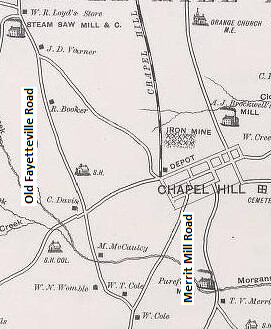
When George W. Tate produced the first detailed map of Orange County in 1891 he showed largely the same road configuration:

Smith level

However the McCauley bridge site was abandoned in the 1920’s (probably about the same time the mill was abandoned) in favor of another old bridge location a little further down stream (where the present bridge is). South Greensboro Street was not extended down the hill to that location until the 1950’s sometime, but Old Pittsboro Road in Carrboro wended its way down to meet Merritt Mill Road and cross Morgan Creek. The present bridge location had been long in use and is also shown on the 1792 Daniel plat. Before the University was built an alignment more or less equivalent to Cameron Avenue/Merritt Mill Road/Smith Level Road lead from the old Fayetteville road up to the New Hope Chapel (which formerly stood where the Carolina Inn is today).

Probably since the 19th century, this road has been called Smith Level Road after the Smith family farm which was along it. The Smith house is that stately home on the west side of Smith Level Road, about 2/3 of the way to Chatham County from Carrboro. It was once the home of Sidney Smith a white slave owner whose African American descendants include Pauli Murray. The road is called Smith Level because of the flat topography particularly on the southern half of the road.

In fact the unusually flat topography is the very reason the old Fayetteville road ran that way. Considering the inherent advantages of the route and the fact that Hillsborough was the site of a Native American village from pre-Columbian times, it is conceivable that the route from Hillsborough down Old NC 86/Old Fayetteville Road/Ray Road/Smith Level Road may well have been a Native American trade route from long ago.