17 Jan 11:43
Chem. Sci., 2017, 8,2337-2343
DOI: 10.1039/C6SC04893E, Edge Article

Open Access
Anindya K. Swarnakar, Christian Hering-Junghans, Michael J. Ferguson, Robert McDonald, Eric Rivard
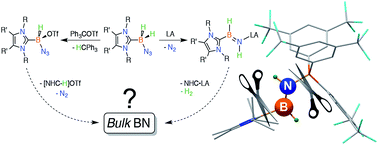
Isolable complexes of HBNH and [B(H)N3]+ have been prepared and their attempted conversion into bulk boron nitride was investigated. These studies yielded important insights into the reactivity of HBNH, an inorganic acetylene analogue.
The content of this RSS Feed (c) The Royal Society of Chemistry

04 Jan 12:41
Chem. Commun., 2017, 53,1301-1304
DOI: 10.1039/C6CC06605D, Communication
Zhi-Pei Zhang, Nan Dong, Xin Li
An efficient 1,6-allylation addition of para-quinone methides with allylboronic acid pinacol ester was developed with 0.5-5 mol% bismuth(III) triflate.
The content of this RSS Feed (c) The Royal Society of Chemistry

04 Jan 12:41
Chem. Commun., 2017, 53,513-516
DOI: 10.1039/C6CC08166E, Communication
Ranajit Mondol, Daan A. Snoeken, Mu-Chieh Chang, Edwin Otten
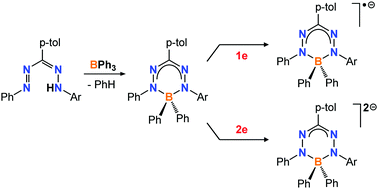
Boron complexes are isolated with formazanate ligands in mono-, di- and trianionic form, showing their distinctive ability to function as electron-reservoir.
The content of this RSS Feed (c) The Royal Society of Chemistry

13 Dec 15:23
by Lars Wesemann, Jakob-Jonathan Maudrich, Christian Patrik Sindlinger, Frederik S. W. Aicher, Klaus Eichele, Hartmut Schubert
Abstract
Alkyltin trihydride [(Me3Si)2CHSnH3] was synthesized and the reductive elimination of hydrogen from this species was investigated. A methyl-substituted N-heterocyclic carbene reacts with the organotrihydride in dependence on stoichiometry and solvent to give a series of products of the reductive elimination and dehydrogenative tin–tin bond formation. Besides characterization of the carbene adduct of the alkyltin(II) hydride, a Sn4 chain was also isolated, encompassing two stannyl–stannylene sites, which are stabilized each as NHC-adducts. Complete dehydrogenation resulted to give either a carbene-stabilized distannyne or a metalloid Sn9-cluster salt. Reductive elimination of hydrogen was also achieved with an excess of diethylmethylamine to give the alkyltin(II) hydride as a Lewis base free tetramer [(RSnH)4]. The method of cluster formation at low temperatures by hydrogen elimination was also transferred to the mesityl-substituted tin trihydride MesSnH3. In this case [(MesSn)10], showing a [5]prismane structure, was isolated in good yield and characterized. NMR spectroscopic features of the propellane-type cluster [Trip6Sn6] are reported.

A can of gas: Reductive elimination of hydrogen from the alkyltin trihydride [(Me3Si)2CH-SnH3] in reactions with the N-heterocyclic carbene MeNHC in various stoichiometries or diethylmethylamine leads to a number of products.
13 Dec 10:00
by Youngchan Kim, Ramesh B. Dateer and Sukbok Chang

Organic Letters
DOI: 10.1021/acs.orglett.6b03485

11 Dec 19:11
by Simon J. Bonyhady, Nicole Holzmann, Gernot Frenking, Andreas Stasch, Cameron Jones
Abstract
The first example of a well-defined binary, low-oxidation-state aluminum hydride species that is stable at ambient temperature, namely the dianion in [{(DepNacnac)Mg}2(μ-H)]2[H3Al-AlH3] (DepNacnac=[(DepNCMe)2CH]−, Dep=2,6-diethylphenyl), has been prepared via a magnesium(I) reduction of the alanate complex, (DepNacnac)Mg(μ-H)3AlH(NEt3). An X-ray crystallographic analysis has shown the compound to be a contact ion complex, which computational studies have revealed to be the source of the stability of the aluminum(II) dianion.

You can call me HAl: The first example of a well-defined binary, low-oxidation-state aluminum hydride species that is stable at ambient temperature, is prepared (see picture). Computational studies reveal the stability of the aluminum(II) hydride dianion to be derived from its complexation with two bulky dimagnesium hydride cations.
07 Dec 16:38
by Lisa-Maria Elmer, Gerald Kehr, Constantin G. Daniliuc, Melanie Siedow, Hellmut Eckert, Matthias Tesch, Armido Studer, Kamille Williams, Timothy H. Warren, Gerhard Erker
Abstract
The dimesitylphosphinocyclopentene/HB(C6F5)2-derived vicinal trans-1,2-P/B frustrated Lewis pair (FLP) 4 shows no direct phosphane–borane interaction. Toward some reagents it behaves similar to an intermolecular FLP; it cleaves dihydrogen, deprotonates terminal alkynes, and adds to organic carbonyl compounds including CO2. It shows typical intramolecular FLP reaction modes (cooperative 1,1-additions) to mesityl azide, to carbon monoxide, and to NO. The latter reaction yields a persistent P/B FLPNO nitroxide radical, which undergoes H-atom abstraction reactions. The FLP 4 serves as a template for the CO reduction by [HB(C6F5)2] to generate a FLP-η2-formylborane. The formylborane moiety is removed from the FLP template by reaction with pyridine to yield a genuine pyridine stabilized formylborane that undergoes characteristic borane carbaldehyde reactions (Wittig olefination, imine formation). Most new products were characterized by X-ray diffraction.

Poised to attack: The trans-1,2-attachment of the B(C6F5)2 and PMes2 functional groups at a cyclopentane framework leads to a non-interacting frustrated P/B Lewis pair (see Scheme). The diverse reactivity of this system was studied in detail.
06 Dec 08:40
Chem. Commun., 2017, 53,192-195
DOI: 10.1039/C6CC09171G, Communication
Open Access
Subrata Kundu, Chandrajeet Mohapatra, Prinson P. Samuel, Johannes Kretsch, M. G. Walawalkar, Regine Herbst-Irmer, Dietmar Stalke, Sriman De, Debasis Koley, Herbert W. Roesky
The synthesis of a 1,4-bisphosphino-2,3-disila butadiene and a 1,3-diphospha-2-silaallyl anion has been reported.
The content of this RSS Feed (c) The Royal Society of Chemistry

04 Dec 16:01
by Max M. Hansmann and Guy Bertrand

Journal of the American Chemical Society
DOI: 10.1021/jacs.6b11496

02 Dec 17:15
Org. Chem. Front., 2017, 4,178-190
DOI: 10.1039/C6QO00640J, Research Article
Open Access
Stephanie M. Barbon, Samantha Novoa, Desiree Bender, Hilary Groom, Leonard G. Luyt, Joe B. Gilroy
Emissive BF2 complexes of 3-cyanoformazanates produced using CuAAC chemistry are described. Highlights include ferrocene-substituted derivatives with 'turn-on' fluorescence upon oxidation and a water soluble derivative with application as a cell-imaging agent.
The content of this RSS Feed (c) The Royal Society of Chemistry
02 Dec 15:40
by Silvia Schnitzler, Thomas P. Spaniol and Jun Okuda

Inorganic Chemistry
DOI: 10.1021/acs.inorgchem.6b02509

28 Nov 12:04
Chem. Sci., 2017, 8,846-863
DOI: 10.1039/C6SC04245G, Perspective
Open Access
Lei Ji, Stefanie Griesbeck, Todd B. Marder
We highlight recent developments in the synthesis, optical and electronic properties of 3-coordinate boron compounds and their applications in materials.
The content of this RSS Feed (c) The Royal Society of Chemistry

22 Nov 22:50
by Johannes A. Baus, Felix M. Mück, Heidi Schneider, Reinhold Tacke
Abstract
Reaction of the donor-stabilized silylene [iPrNC(NiPr2)NiPr]2Si (1) with FeBr2, CoBr2, NiBr2⋅MeOCH2CH2OMe, ZnCl2, and ZnBr2 afforded the respective transition-metal silylene complexes 4–8, the formation of which can be described in terms of a Lewis acid/base reaction (4, 5, 7, 8) or a nucleophilic substitution reaction (6). However, the reactivity profile of silylene 1 is not only based on its strong Lewis base character; the different coordination modes of the two guanidinato ligands (4–6 vs. 7 and 8) add an additional reactivity facet. The paramagnetic compounds 4 and 5 and the diamagnetic compounds 6⋅THF, 7, and 8⋅0.5 Et2O were structurally characterized by single-crystal X-ray diffraction. In addition, compound 6⋅THF was studied by 15N and 29Si solid-state NMR spectroscopy, and 7 and 8 were characterized by NMR spectroscopic studies in the solid state (15N, 29Si) and in solution (1H, 13C, 29Si). Compounds 4–8 represent very rare examples of FeII, CoII, NiII, and ZnII silylene complexes. Four-coordinate silicon(II) compounds with an SiN3M skeleton (M=Fe, Co, Ni) and M in the formal oxidation state +2 (4–6) have not yet been reported, and five-coordinate silicon(II) compounds with an SiN4Zn skeleton (7, 8) are also unprecedented.

Transition-metal silylene complexes: The donor-stabilized silylene [iPrNC(NiPr2)NiPr]2Si reacts with FeBr2, CoBr2, NiBr2⋅MeOCH2CH2OMe, ZnCl2, and ZnBr2 to afford compounds 1–5, a series of very rare examples of FeII, CoII, NiII, and ZnII silylene complexes. The reactivity profile of the silylene is not only based on its strong Lewis base character; the different coordination modes of the two guanidinato ligands (bridging vs. nonbridging) add an additional reactivity facet.
18 Nov 10:01
by Daniel Franz, Lorenz Sirtl, Alexander Pöthig, Shigeyoshi Inoue
The catalytic activity of the NHI-substituted aluminum hydrides {LMesNAlH2}2 (1a), {LDipNAlH2}2 (1b), {LMesNAl(H)OTf}2 (2a), and {LDipNAl(H)OTf}2 (2b) in the hydroboration of terminal alkynes (for 1), as well as carbonyl compounds (for 2) with pinacolborane (4,4,5,5-tetramethyl-1,3,2-dioxaborolane) is investigated (LMesN = 1,3-dimesityl-imidazolin-2-imino, Mes = 2,4,6-trimethylphenyl, LDipN = 1,3-bis(2,6-diisopropylphenyl)-imidazolin-2-imino, Tf = triflyl). With the implementation of 1 as a catalyst, the hydroboration of selected terminal arylalkynes requires elevated temperature (80 °C) to proceed. The less sterically congested 1a produces faster conversions than the bulkier 1b. With the use of 2 as a catalyst, the hydroboration of carbonyl compounds occurs at room temperature. An increased steric hindrance of the catalyst (2a vs. 2b) does not mitigate the rate of conversion to a relevant degree.

18 Nov 10:01
by Shigeyoshi Inoue, Eric Rivard
16 Nov 08:50
by Małgorzata Walewska, Judith Baumgartner, Christoph Marschner, Lena Albers, Thomas Müller
Abstract
Silylated germylene–PMe3 adducts exchange their phosphane moiety smoothly for an N-heterocyclic carbene or isocyanide species to form their respective base adducts. Reaction of the silylated germylene–PMe3 adducts with monosubstituted alkynes produce germylene adducts with the alkyne inserted into a Ge−Si bond. A computational study of this process provides evidence for the initial formation of a germirene, which rearranges to a vinylgermylene species. The thermodynamic driving force for this reaction is provided by subsequent adduct formation with PMe3. Reaction of the PMe3 adduct of bis[(trimethylsilyl)silyl]germylene with disubstituted alkynes leads to the formation of stable germirenes, which can be isomerized further to silagermetes.

Insert here: Monosubstituted alkynes can insert into one of the Ge−Si bonds of disilylated germylene–PMe3 adducts (see figure). The driving force for this reaction is PMe3–vinylgermylene adduct formation.
16 Nov 08:37
by Jih-Sheng Huang, Wan-Hua Lee, Chao-Tang Shen, Ya-Fan Lin, Yi-Hung Liu, Shie-Ming Peng and Ching-Wen Chiu

Inorganic Chemistry
DOI: 10.1021/acs.inorgchem.6b02336

16 Nov 08:35
Dalton Trans., 2016, 45,18784-18795
DOI: 10.1039/C6DT03570A, Perspective
Malcolm L. H. Green, Gerard Parkin
Compounds that feature 3-center 4-electron interactions may be classified in terms of the number of electrons that each atom contributes to the interaction: Class I are those in which two atoms provide one electron each and the third atom provides a pair of electrons, while Class II are those in which two atoms each provide a pair of electrons.
The content of this RSS Feed (c) The Royal Society of Chemistry

16 Nov 08:35
Chem. Commun., 2016, Advance Article
DOI: 10.1039/C6CC08449D, Communication
Deepak Dange, Christian P. Sindlinger, Simon Aldridge, Cameron Jones
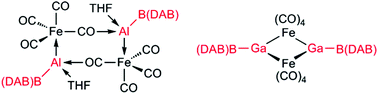
The first examples of boryl substituted aluminylene and gallylene complexes (see picture, DAB = {(C6H3Pri2-2,6)NCH}2) have been prepared by reduction of boryl-group 13 dihalide compounds with K2[Fe(CO)4].
To cite this article before page numbers are assigned, use the DOI form of citation above.
The content of this RSS Feed (c) The Royal Society of Chemistry

16 Nov 08:33
by Thomas A. Hubbard, Alisdair J. Brown, Ian A. W. Bell and Scott L. Cockroft

Journal of the American Chemical Society
DOI: 10.1021/jacs.6b09130

28 Oct 08:26
by Johannes A. Baus, Nadine Laskowski, Reinhold Tacke
Treatment of the donor-stabilized silylene [iPrNC(Ph)NiPr]2Si with Ph–C≡C–Ph resulted in a [2+1] cycloaddition reaction to afford a silicon(IV) compound, the first silacyclopropene with a six-coordinate silicon atom. This compound was structurally characterized by single-crystal X-ray diffraction and multinuclear NMR spectroscopic studies in the solid state and in solution.

The donor-stabilized bis(amidinato)silylene [iPrNC(Ph)NiPr]2Si reacts with Ph–C≡C–Ph in a [2+1] cycloaddition reaction to afford a silicon(IV) compound, the first silacyclopropene with a six-coordinate silicon atom.
26 Oct 12:56
by Ilona Behrends, Susanne Bähr, Constantin Czekelius
Abstract
The activation of perfluoroalkyl iodides by the frustrated Lewis pair tris(pentafluorophenyl)borane and tri-tert-butylphosphine is described. By abstraction of both a fluorine and an iodine atom, an iodophosphonium fluoroborate salt is formed. In the presence of alkenes the corresponding iodoperfluoroalkylation products are generated regioselectively. First mechanistic investigations support a radical mechanism.

Frustrated Lewis pairs mediate the regioselective addition of perfluoroalkyl iodides to non-activated olefins. In the absence of an alkene, an iodophosphonium fluoroborate salt is formed by a fluoride elimination process. For the activation of the C−I bond, dual action of both the phosphine and the borane is required (see scheme).
17 Oct 09:52
by Werner Uhl, Matthias Willeke, Frank Hengesbach, Alexander Hepp and Marcus Layh

Organometallics
DOI: 10.1021/acs.organomet.6b00658

17 Oct 09:51
by Wolfgang W. Schoeller and Guido D. Frey

Inorganic Chemistry
DOI: 10.1021/acs.inorgchem.6b01488

08 Oct 08:13
Dalton Trans., 2017, 46,8751-8755
DOI: 10.1039/C6DT03264H, Paper
Johannes A. Baus, Reinhold Tacke
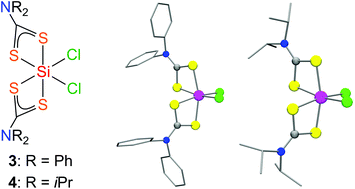
The first six-coordinate bis(dithiocarbamato)silicon(IV) complexes, compounds 3 and 4 with their unprecedented SiCl2S4 skeleton, were synthesised and structurally characterised.
The content of this RSS Feed (c) The Royal Society of Chemistry

08 Oct 08:10
Chem. Commun., 2016, 52,12813-12816
DOI: 10.1039/C6CC07819B, Communication
Eric Fillion, Azadeh Kavoosi, Kevin Nguyen, Christian Ieritano
The hypercoordinated tin reagent iPr-tricarbastannatrane is employed in B(C6F5)3-catalyzed transfer 1,4-hydrostannanylation of electron deficient olefins.
The content of this RSS Feed (c) The Royal Society of Chemistry

04 Oct 17:47
by Qiwen Zhou, Lanqiong Zhang, Wei Meng, Xiangqing Feng, Jing Yang and Haifeng Du

Organic Letters
DOI: 10.1021/acs.orglett.6b02610

04 Oct 17:38
by Alistair J. MacNair, Clément R. P. Millet, Gary S. Nichol, Alan Ironmonger and Stephen P. Thomas

ACS Catalysis
DOI: 10.1021/acscatal.6b02281

04 Oct 15:47
by Kayla Jakobsson, Terry Chu and Georgii I. Nikonov

ACS Catalysis
DOI: 10.1021/acscatal.6b01694

23 Sep 10:47
by Songlei Li, Gen Li, Wei Meng and Haifeng Du

Journal of the American Chemical Society
DOI: 10.1021/jacs.6b07245

   This article is licensed under a Creative Commons Attribution-NonCommercial 3.0 Unported Licence.