Upworthy, the “mission-driven media company” that aggregates photos, videos and articles under new headlines in the hopes of sending them viral, announced Monday that it’s raised $8 million in a Series A round led by Spark Capital. The company plans to use the funds for hiring, expanding its editorial coverage areas and building new tech.
“Our mission here has always been to draw attention to stuff that really matters using irresistible social media,” Upworthy’s cofounders — Eli Pariser, who previously ran MoveOn.org, and Peter Koechley, former managing editor of the Onion — wrote in a blog post. The company, which launched 18 months ago, now has over 20 million monthly visitors and 30 employees.
In addition to Spark Capital, which was an early investor in Tumblr and Twitter, Catamount Ventures (which also backed Seventh Generation and Plum Organics), new VC firm Uprising and the Knight Foundation contributed to the round. Upworthy raised $4 million in seed funding last year.
Upworthy has primarily focused on social and political issues until now, but told TechCrunch it will use the funding in part to expand coverage of topics like parenting and global health. Koechley also suggested that the site, which has no advertising, is looking toward sponsorships: “We think a number of these sections that we might want to delve more deeply into are sections that people might want to underwrite.”
“In case you don’t know, these parties aren’t like real parties. It’s fabricated fun, imposed from the outside. A vision of what squares imagine cool people might do set on a spaceship. Or in Moloko. As we come out of the lift there’s a bloody great long corridor flanked by gorgeous birds in black dresses, paid to be there, motionless, left hand on hip, teeth tacked to lips with scarlet glue. The intention, I suppose, is to contrive some Ian Fleming super-uterus of well fit mannequins to midwife you into the shindig, but me and my mate Matt just felt self-conscious, jigging through Robert Palmer’s oestrogen passage like aspirational Morris dancers. Matt stared at their necks and I made small talk as I hot stepped towards the pre-show drinks. Now, I’m not typically immune to the allure of objectified women, but I am presently beleaguered by a nerdish, whirling dervish, and am eschewing all others. Perhaps the clarity of this elation has awakened me. A friend of mine said: “Being in love is like discovering a concealed ballroom in a house you’ve long inhabited.” I also don’t drink, so these affairs where most people rinse away their Britishness and twitishness with booze are for me a face-first log flume of backslaps, chitchat, eyewash and gak”
Yeah, this is only getting more and more evident and more and more important
The war against computer freedom will just keep escalating, Doctorow contends. The copyright wars, net neutrality, and SOPA (Stop Online Piracy Act) were early samples of what is to come. Victories in those battles were temporary. Conflict in the decades ahead will feature ever higher stakes, more convoluted issues, and far more powerful technology. The debate is about how civilization decides to conduct itself and in whose interests.
“Cory Doctorow is one of the great context-setters of our generation,” says Tim O’Reilly. Co-editor of the acclaimed blog “Boing Boing,” Doctorow writes contemporary science fiction blending contextual insight with journalistic depth. His recent books include For the Win; Makers; and Little Brother.
Long Now and the Electronic Frontier Foundation bring Cory Doctorow to San Francisco for a glimpse into the future of computing and the increasing fight for control over our freedom both online and offline.
Men så en dag i 1970 underviste han en flok marxister på Arkitektskolen.– For dem var samfundet alt, mens individet – jeget – blev udelukket.Det fik ham til at tænke på Treenigheden i kristendommen – Faderen, Sønnen og Helligånden, som han i sin undervisning "oversatte" til "Samfundet, Sproget og jeg-et".
Goddammit jeg har mange kære minder med min egen snake-implementering, Slangemand, fra min gamle Amstrad...
I find myself mesmerized by this gif.
Snake is another one of those games that has meant a lot to many people, but that we just didn’t get around to writing much about. Perhaps there could be a book on Snake, in the vein of 10 PRINT?
John Guillory made the counterintuitive suggestion that the exhausting canon debates of the 1980s culture wars were really “a crisis in the market value of [the literary curriculum’s] cultural capital, occasioned by the emergence of a professional-managerial class which no longer requires the [primarily literary] cultural capital of the old bourgeoisie.”
rimelig bizar vits. hvorfor så jeg ikke den i foråret
Steven Spielberg is doing a sequel to Lincoln called Obama and he got Daniel Day-Lewis to play the lead. I knew Day-Lewis was good, but this is bonkers.
It's extremely interesting reading this post-Snowden, post PGP-weakening by NSA revelations, post FBI-infiltrated Tor-revelations. All premises of this project has shown themselves to be false. Anyone who would be in danger using this has been revealed completely exposed.
The New Yorker has announced a new anonymous document sharing system called Strongbox, that will allow people to anonymously and securely submit documents to reporters from the New Yorker. Other publications have tried to set up something like this -- often inspired by Wikileaks -- but for the most part, they've been full of security holes, sometimes big and serious ones. What may be more interesting than the fact that this system is being set up is the story behind it. It's based on DeadDrop, an open source system that was put together by Aaron Swartz and Kevin Poulsen.
Poulsen has the backstory of DeadDrop here, which is well worth reading. Basically, he and Aaron worked on this project on and off for quite some time, and it was only just completed a few weeks before Aaron's death. The full story is worth reading, though here's a snippet:
I wondered about this young tech-startup founder who put his energy into the debate over corporate-friendly copyright term extensions. That, and his co-creation of an anonymity project called Tor2Web, is what I had in mind when I approached him with the secure-submission notion. He agreed to do it with the understanding that the code would be open-source—licensed to allow anyone to use it freely—when we launched the system.
He started coding immediately, while I set out to get the necessary servers and bandwidth at Conde Nast. The security model required that the system be under the company’s physical control, but with its own, segregated infrastructure. Requisitioning was involved. Executives had questions. Lawyers had more questions.
Poulsen also notes that there were questions raised about the code after Aaron's death, but those were eventually sorted out:
By December, 2012, Aaron’s code was stable, and a squishy launch date had been set. Then, on January 11th, he killed himself. In the immediate aftermath, it was hard to think of anything but the loss and pain of his death. A launch, like so many things, was secondary. His suicide also raised new questions: Who owned the code now? (Answer: he willed all his intellectual property to Sean Palmer, who gives the project his blessing.) Would his closest friends and his family approve of the launch proceeding? (His friend and executor, Alec Resnick, reports that they do.) The New Yorker, which has a long history of strong investigative work, emerged as the right first home for the system.
Of course, Poulsen leaves out his own history here as well. As (perhaps?) many of you know, Poulsen was a somewhat infamous hacker back in the day who eventually (after avoiding law enforcement for quite some time) went to prison for some of his hacks. Since then, he's become one of my favorite journalists, writing for SecurityFocus and then Wired (and writing a wonderful book, Kingpin about some more recent hackers). While Poulsen and Swartz met long before Swartz was indicted -- and Swartz and Poulsen were indicted for very different types of activities -- having the two of them work together on a project like this is really quite fascinating.
The unfortunate part of all of this, of course, is that DeadDrop is basically Aaron's "final project." Given how much he accomplished prior to that in his short life, it's just one more thing to add to a very long list of incredible accomplishments, but yet another reminder of how much potential was wiped away by his suicide.
Polyamory and Respect, by Luke Palmer. One of the best things I
read about the matter.
“Where does the idea that love is a finite resource come from?”
Major arcs for Goldbach’s theorem, by H. A. Helfgott.
“The ternary Goldbach conjecture, or three-primes problem, asserts
that every odd integer N greater than 5 is the sum of three
primes. The present paper proves this conjecture.”
ocaml-bitstring adds Erlang-style bitstrings and matching over
bitstrings as a syntax extension and library for OCaml.
Terra is a new low-level system programming language that is
designed to interoperate seamlessly with the Lua programming language.
CoVim is a Vim Plugin that adds real-time collaboration to your
favorite text editor.
Bunny is a wireless. meshing, darknet that uses 802.11 to hide its
communications.
The axTLS embedded SSL project is a highly configurable
client/server TLSv1 SSL library designed for platforms with small
memory requirements. It comes with a small HTTP/HTTPS server and
additional test tools. BSD licensed!
Reforth is small, familiar, still a Forth. Contains some interesting ideas.
Five hundred thirty million years ago, the number and diversity of life forms on Earth mushroomed. This so-called Cambrian explosion kept Charles Darwin, the father of evolution, awake at night, as he worried that his theory of natural selection couldn’t ...
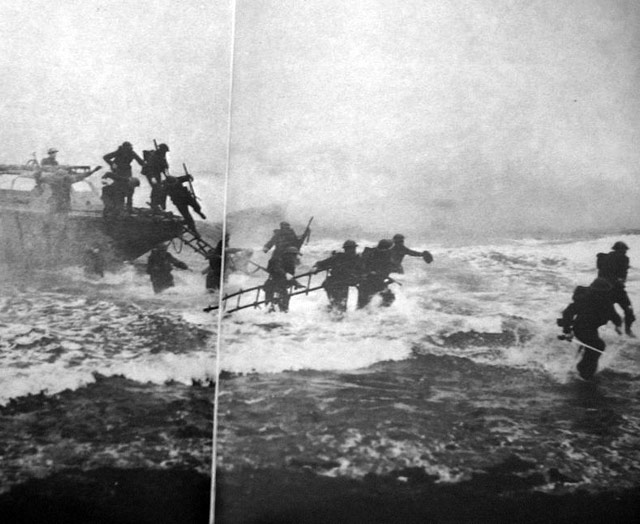
Every few months on the web, a new candidate emerges for the Bad-Ass Hall of Fame, a collection of amazing people who lived large, walked their own path, and left their mark on history with flair. Today's candidate is Mad Jack Churchill, a British Commando leader during World War II who died in 1996. Churchill fought in the war armed with a bow & arrows, a broadsword, and occasionally even bagpipes. Here's a photo of him (far right) during a training exercise in Scotland, sword in hand as he storms the beach:
What a sight he must have been, leading charges branishing a sword and sucking on his pipes. Churchill even killed a German soldier in France with an arrow, recording the only known kill by bow in the war for the British. From a profile in WWII History magazine:
During the BEF's fighting retreat, Churchill remained aggressive, unwilling to give up a yard of ground while extracting the maximum cost from the enemy. He was especially fond of raids and counterattacks, leading small groups of picked soldiers against the advancing Germans. He presented a strange, almost medieval figure at the head of his men, carrying not only his war bow and arrows, but his sword as well.
As befitted his love of things Scottish, Churchill carried the basket-hilted claymore (technically a claybeg, the true claymore being an enormous two-handed sword). Later on, asked by a general who awarded him a decoration why he carried a sword in action, Churchill is said to have answered: "In my opinion, sir, any officer who goes into action without his sword is improperly dressed."
The war-diary of 4th Infantry Brigade, to which Churchill's battalion belonged, commented on this extraordinary figure. "One of the most reassuring sights of the embarkation [from Dunkirk] was the sight of Captain Churchill passing down the beach with his bows and arrows. His high example and his great work ... were a great help to the 4th Infantry Brigade."
And this bit sounds totally made up:
Churchill himself was far in front of his troopers. Sword in hand, accompanied only by a corporal named Ruffell, he advanced into the town itself. Undiscovered by the enemy, he and Ruffell heard German soldiers digging in all around them in the gloom. The glow of a cigarette in the darkness told them the location of a German sentry post. What followed, even Churchill later admitted, was "a bit Errol Flynn-ish."
The first German sentry post, manned by two men, was taken in silence. Churchill, his sword blade gleaming in the night, appeared like a demon from the darkness, ordered "haende hoch!" and got results. He gave one German prisoner to Ruffell, then slipped his revolver lanyard around the second sentry's neck and led him off to make the rounds of the other guards. Each post, lulled into a sense of security by the voice of their captive comrade, surrendered to this fearsome apparition with the ferocious mustache and the naked sword.
Altogether, Churchill and Corporal Ruffell collected 42 prisoners, complete with their personal weapons and a mortar they were manning in the village. Churchill and his claymore took the surrender of ten men in a bunch around the mortar. He and his NCO then marched the whole lot back into the British lines.
As Churchill himself described the event, it all sounded rather routine: "I always bring my prisoners back with their weapons; it weighs them down. I just took their rifle bolts out and put them in a sack, which one of the prisoners carried. [They] also carried the mortar and all the bombs they could carry and also pulled a farm cart with five wounded in it....I maintain that, as long as you tell a German loudly and clearly what to do, if you are senior to him he will cry 'jawohl' and get on with it enthusiastically and efficiently whatever the ... situation. That's why they make such marvelous soldiers..."
Crazy! After the war, he took up boat refurbishing, river surfing, and freaking out train passengers:
In his last job he would sometimes stand up on a train journey from London to his home, open the window and hurl out his briefcase, then calmly resume his seat. Fellow passengers looked on aghast, unaware that he had flung the briefcase into his own back garden.
Simply put, Phonebloks is the opposite of what it appears. Phonebloks makes an appeal to our love of order and simplicity, while actually being significantly more complex. Phonebloks tells us smartphones can cost less, while making each component within them cost more. Phonebloks says that we can upgrade our smartphones without being wasteful, while making it significantly more likely that we’ll have to throw away our phones because they’re broken. And so on.
*That’s quite an interesting argument. The part about imagining today as a design-fiction from the year 2000 is especially good. If you could create a fake Microsoft video from 2000 that described 2013, I’d say you were a maestro of design-fiction; you’d have the level of analytical detachment necessary to do a really good job.
*Of course, Microsoft themselves wouldn’t have done that in a video; the point of a Microsoft promotional video is to expand the Microsoft empire. It would be very interesting indeed to see a Microsoft design-fiction video that forecast the destruction of Microsoft. It would be a sign of corporate design-fiction escaping the black hole of advertising and really tackling the intellectual debate. It’s very common for a political party to say, “things may go badly for us,” but corporations never do. Of course the board of directors says that among themselves, but they would never pay to reveal that prospect to the public.
*So as it is, there’s something odd about holding Microsoft accountable for a lack of forecasting accuracy, because advertising doesn’t tell the truth; that’s not its purpose.
“People often think of Microsoft as wedded to the vision of the PC on the desk, but it’s clear from those vision videos that the Microsoft of 2000 was already a very “post-PC” organisation, with a view of the future that was focused on cloud services and mobility. Sure, there have been missteps on the way.
“We should also remember what Microsoft Research’s Bill Buxton calls the “Long Nose” of technology — the 10 years and more that it takes to leave the research lab and get into the hands of the consumer. It’s an effect I have personal experience of, working in a research lab in the early 90s and experimenting with early versions of cable modems, of ADSL networks, and of pocket sized screens and small radios. At the bleeding edge then, they’re in most homes today — costing a fraction of the thousands of dollars my experimental networks cost to build.
“And so, we should look at the technologies we have today, where iPhones with biosensors unlock information in the cloud, where a Windows 8.1 PC shares apps with the rest of the machines you own, and where the same code runs on the desktop, on the phone, and in the cloud. Watch the videos again, and you’ll see much of the technology landscape we live in. it may not all be here yet, and it certainly won’t look it does in the video, but that Forum 2000 vision (like Apple’s Knowledge Navigator before it) is part of the foundations of today’s IT world….”
Wow, we need stronger governments and weaker corps, when shit like this becomes the norm
A few years ago, we noted that Eli Lilly was facing some hard times, in large part because it had focused its entire business model around getting patents, and many of those patents were expiring, and very few new ones were in the pipeline. Even so, it was still rather surprising earlier this year to see Eli Lilly claim that Canada owed it $100 million for undermining the company's "expected future profits" by rejecting an Eli Lilly patent. The Canadian court reasonably felt that it shouldn't give Eli Lilly a patent on something that wasn't determined to be useful. Normally, if a country doesn't give you a patent, you move on. However, Eli Lilly used a questionable part of NAFTA, the so-called investor-state dispute resolution mechanism, to argue that Canada was "expropriating its property," and thus demanded compensation -- starting at $100 million, which it then raised to $500 million.
A few weeks ago, Eli Lilly's CEO wrote an op-ed piece, claiming that by not granting his company a monopoly, Canada was "suffocating life-saving innovation." That's wrong. And it's obnoxious. For years we've covered how the pharmaceutical industry has actually used patents to hold back life-saving innovations by locking them up, blocking advances, jacking up the price to absolutely insane rates, and by using a variety of other questionable practices (including patenting historical folk medicines). But, more importantly, every country gets to determine what is and what is not patentable. For Eli Lilly to use trade policies to effectively try to negate Canada's patent validity standards is a blatant attack on Canadian sovereignty.
Keep this in mind as we discuss the Trans Pacific Partnership (TPP) agreement and the upcoming EU-US trade agreement TTIP/TAFTA, because companies are asking for similar dispute resolution mechanisms, and this could become a big, big deal. Remember how New Zealand recently has put in a law that should mostly ban software patents? Imagine if Microsoft and others suddenly started trying to sue that country for "lost profits" because it won't give them patents on their software.
Excellent - been looking for easy XMPP for a while
Nearly six years ago, I set up a personal Jabber server using ejabberd. This setup survived the server migration to Ubuntu 8.04 and 10.04. This past weekend, I attempted to migrate that to a server running 12.04 and all I could get out of it was an erlang crash dump.
A quick scan for successors turned up prosody. Configuration was as simple as adding a VirtualHost and setting allow_registration to true.
Let's take a very sophisticated item: one web page. A web page relies on perhaps a hundred thousand other inventions, all needed for its birth and continued existence. There is no web page anywhere without the inventions of HTML code, without computer programming, without LEDs or cathode ray tubes, without solid state computer chips, without telephone lines, without long-distance signal repeaters, without electrical generators, without high-speed turbines, without stainless steel, iron smelters, and control of fire. None of these concrete inventions would exist without the elemental inventions of writing, of an alphabet, of hypertext links, of indexes, catalogs, archives, libraries and the scientific method itself. To recapitulate a web page you have to recreate all these other functions. You might as well remake modern society.
Proper assumption about IoT: Everything will be stored by somebody you didn't want to. Corollary for inventing IoT: Your assumptions about your own tech need to assume you're secretly under complete control by devious assholes
XBox One Kinect Controller (Guardian) — the new Kinect controller can detect gaze, heartbeat, and the buttons on your shirt.
Surveillance and the Internet of Things (Bruce Schneier) — Lots has been written about the “Internet of Things” and how it will change society for the better. It’s true that it will make a lot of wonderful things possible, but the “Internet of Things” will also allow for an even greater amount of surveillance than there is today. The Internet of Things gives the governments and corporations that follow our every move something they don’t yet have: eyes and ears.
Daniel Dennett’s Intuition Pumps (extract) — How to compose a successful critical commentary: 1. Attempt to re-express your target’s position so clearly, vividly and fairly that your target says: “Thanks, I wish I’d thought of putting it that way.” 2. List any points of agreement (especially if they are not matters of general or widespread agreement). 3. Mention anything you have learned from your target.4. Only then are you permitted to say so much as a word of rebuttal or criticism.
New Data Science Toolkit Out (Pete Warden) — with population data to let you compensate for population in your heatmaps. No more “gosh, EVERYTHING is more prevalent where there are lots of people!” meaningless charts.
God idé, Morten - også oplagte reklamemuligheder...
Taking the eyes off the road is the most common cause for traffic accidents. So why don’t we change the in-car display to an on-road display? And while we’re at it, place a depth camera (a Kinect, basically) next to the projector and just don’t show anything if we’re in a dangerous situation? And while we’re still at it, let’s place a projector on the back of the car telling your drivers where you’re going and let them turn off their navigation and just follow you.
I used to think that those on the inside -- those actually running the shadowy agencies of the world -- were immune to conspiracy theories. After all, their hidden actions were usually the ignition point for conspiracy theories. Every tiny revelation gets exaggerated exponentially until someone from a Zionist cabal has used Barak Obama's fake birth certificate to obtain a pilot's license and fly a weather-controlling airliner onto the front lawn of the Pentagon in order to trigger a pre-wired explosion that takes down a chunk of the building from the inside.
But those on the inside see all the connections and know the players inside and out. Nothing's surprising and nothing's a conspiracy because there's absolutely no mystery. But maybe it's that lack of mystery that prompts some insiders to conjure up conspiracies linking their enemies du jour to something much bigger than their individual actions. Too much information is just as much of a curse as too little.
To operate effectively, agents must have a clearly-defined enemy. But the real world is often uncooperative and fails to provide irredeemable villains. Incidents like the recent high profile leaks of Manning and Snowden further cloud the issue. Sure, there's the alleged "exceptionally grave damage" to national security, but much of what's exposed hasn't made the citizens being "defended" by the exposed entities any happier, or feel any less safe. So, when the enemies fail to hold the masses in thrall, what's a former NSA agent to do? The usual narrative isn't working and there's no clear consensus that Snowden, Manning or their mutual associate, Julian Assange are villains. Faced with the untidiness of the current reality, former NSA officer John Schindler has built his own "reality," and it's as insane as it is ugly.
From nearly the outset I’ve stated that Snowden is very likely an agent of Russian intelligence; this was met with howls of indignation which have died down in recent weeks as it’s become apparent that Ed’s staying in Russia for some time, along with whatever classified materials he had on his person.
While the second part of Schindler's statement is most likely true (Ed and documents in Russia indefinitely), his opening assertion is supposed to make us believe that a) something repeated often enough is true and b) the "howls of indignation" directed at that assertion have "died down." The two latter assertions are decidedly less accurate.
"No Hero" Snowden "a grandiose narcissist who deserves to be in prison" - Jeff Toobin nails it lawyer-style w details
A early editorial of his, posted at Politico roughly three weeks after the first leak, compares Snowden to Phillip Agee, a self-proclaimed whistleblower who was later discovered to be a Soviet spy.
Is Ed Snowden a Phil Agee for the 21st century, with superior technology and more media coverage? We may know the answer soon, but every day he stays under the care of hostile intelligence services renders his resemblance to Agee stronger.
If Snowden is under the care of "hostile intelligence services," it's the US government's own fault. Charging him with espionage leaves Snowden very few options if he wishes to avoid being imprisoned. The documents he obtained clearly point out that pretty much all of Europe has been compromised, with various national intelligence agencies working directly in tandem with the NSA. This leaves a very short list of countries that Snowden would be willing to go to and an even shorter list of countries that would be willing to host him.
So, in Schindler's mind, Snowden is well on his way (if he isn't already) to being a tool of Russian intelligence. That requires a logical leap others haven't been ready to take, even if they disagree with Snowden's actions. They may believe the Russians have gained access to Snowden's stash of NSA files, but few are ready to state publicly that he's part of the Russian intelligence machinery. Schindler points out that Snowden's contact with the Russians preceded his arrival as if that were some sort of proof of his assertions, rather than an indication that Snowden was looking for options that wouldn't immediately turn him over to the US government.
From this leap, Schindler travels to another claim that he backs up with nothing more than "I've been saying this for a long time."
I’ve been stating for a while now that Wikileaks is functionally an extension of Russian intelligence; it’s become a minor meme as a few journalists have decided that such a scandalous viewpoint is worth considering.
Again, repetition does not make things true, and even Schindler hedges this a bit by adding the word "functionally." If Wikileaks' actions sometimes correspond with the aims of Russian intelligence (learn US secrets, perhaps?), then it's "functionally" the same as working for the Russians, according to Schindler.
Of course, for anyone versed in the ways of Russian intelligence, the notion that Wikileaks is a Moscow front that’s involved in anti-US espionage is about as controversial as, say, the notion that the sun will rise in the east tomorrow. Running false flags, creating fake activist groups, using Western journalists and activists for deception purposes – this sort of thing is in the DNA of Russian intelligence going back to the 19th century and is second nature to them. They call espionage tradecraft konspiratsiya (conspiracy) for a reason.
Now, we have a full-blown conspiracy theory. Being involved in "anti-US espionage" (his terminology for the leaks that made Wikileaks famous) is now an "proof" that Wikileaks is a Russian front. Yes, Russian intelligence has performed all the acts listed, but his assertion is based on what? The fact that Snowden leaked documents, Wikileaks aided him during his trip to Russia and Snowden seeking asylum there? This is adding 1+1+1 and getting 5, because 5 is the number you had in your head the whole time.
Schindler seems to desperately want Snowden to be a tool of the Russian intelligence agencies and feels he has collected enough dots to say that Snowden is definitely in Russia and another entity he doesn't care for (Wikileaks) helped him out. Therefore, Wikileaks is a "fake activist group" created by the Russian government. But he willingly leaps across several logical gaps without presenting any supporting evidence other than "I've said this several times before." In other words, "Source: Me."
He then goes on for a few hundred more words, offering up explanations that actually undercut his argument. He details the efforts of a spy who sold thousands of sensitive Canadian intelligence documents to Russia, and adds this speculation to his collection of "evidence."
Simply put, one must wonder, after nearly five years of Delisle selling the Russians all the Five Eyes TOP SECRET/ SCI data he could get his hands on, how much there really was about NSA, GCHQ, et al, that Moscow didn’t already know. Perhaps Snowden is, if not exactly a patsy, a none-too-clever fellow – Putin today called Ed “a strange guy” – whose main purpose is causing pain and suffering to Washington, DC. Which, let it be said, he has done rather well, thanks to the propaganda offensive waged by Greenwald, Poitras, and their helpers in several countries, with Ed’s purloined information, and who have masked their radical activism under the (thin) guise of post-modern journalism.
Why would Russia seek Snowden if it already had tons of classified info from other nations' intelligence agencies? What possible purpose could he serve going forward? He no longer works for the NSA and the documents he took have already been distributed out to several news agencies. If Snowden serves any purpose to the Russian government, it's to be pointed at as an evidence of the US government's hypocrisy. Every time it demands the return of its "criminal," Putin will be happy to point out that if the situation was reversed, the US wouldn't be placing a Russian dissident with hard drives full of sensitive documents back in the hands of a government seeking to punish him.
The extraneous slams against Greenwald and others doesn't do his argument any favors. If anything, it shows the desperation of this theory. Schindler needs this theory to be true because it justifies all the accusations and barely-veiled contempt he has for Snowden, Wikileaks and Greenwald. If Snowden is now a Russian spy, then these attacks are "deserved."
It is possible that Snowden’s appearance on the radar of Russian intelligence – presumably late in 2012, almost certainly through Wikileaks – actually represents a cover mechanism of sorts for Moscow. Tasked now with an enormous damage assessment and trying to uncover if Snowden had any helpers inside NSA, it seems unlikely that IC counterintelligence experts will have the resources or manpower anytime soon to find the Russian moles who may be deeply embedded inside NSA and related U.S. intelligence agencies.
The theory goes deeper. Now Snowden's not just an active threat, he's also cover for those already on the inside. The more words Schindler expends, the more his post begins to resemble a cinematic thriller whose team of writers couldn't decide on an ending. Instead of picking one (barely) plausible wrap-up, they've opted to use all of them. Schindler wraps it this up with a call for the government to do the right thing and buy into his narrative.
[I]t would be a step in the right direction for the U.S. and Allied governments to start treating Wikileaks like the front for hostile intelligence that it actually is. Right now, President Obama is contemplating bombing Syria and possibly starting a new war in the Middle East. Surely he can find the strength to call Wikileaks what it actually is, a far easier thing to achieve.
Well, good luck with that. I'm sure the administration has enough issues with credibility without publicly condemning a "known" Russian intelligence front like Wikileaks. Even if it were true, without demonstrable proof, the president would look like a raving paranoiac who should possibly be removed from office for the safety of the nation.
Schindler, on the other hand, has no such office or impetus to maintain credibility, which makes it much easier (and safer) to construct a megaconspiracy that caters to his perception of these entities' motivations. If this were even remotely true, don't you think one out of the thousands of pieces written about Snowden would have attempted to paint Wikileaks as a flack for Russian intelligence?
Apple fans are pathethic. Now they're queing to *preorder*
If you don’t like the idea of lining up to get your hands on Apple’s shiny new iPhone 5c on September 20, you can pre-order it starting Friday, September 13, at 12:01 AM Pacific. So plan to brew a fresh pot of coffee tonight if you want to be among the first to see the phone show up on your doorstep on September 20. East coasters: Set your alarms.
Although Apple itself has not yet specified a pre-order time for the phone, Sprint’s landing page shows that the phone will be available for pre-order beginning September 13 at 2 AM Central. And Verizon’s(vz) site shows that online pre-orders begin September 13 at 3:01 AM EST.
Of course, you can also order the phone directly from Apple itself. For the first time, Apple is selling its new iPhones on all four major U.S. carriers at launch. Prices are the same across the board at either $99 for 16GB or $199 for 32GB with a two-year contract. T-Mobile’s phone is not subsidized, so it’ll cost you $549 for the 16GB version and $649 for the 32GB.
The iPhone 5c is made of plastic, and comes in five different colors. It replaces the iPhone 5 as Apple’s midrange phone, falling between the $199 iPhone 5s and the free iPhone 4s.
What the hell Kottke, this link is ages old, what happened to you, man?
This is possibly the best three-minute demonstration of anything I've ever seen. Derek Sivers takes a shaky video of a lone dancing guy at a music festival and turns it into a lesson about leadership.
A leader needs the guts to stand alone and look ridiculous. But what he's doing is so simple, it's almost instructional. This is key. You must be easy to follow!
Now comes the first follower with a crucial role: he publicly shows everyone how to follow. Notice the leader embraces him as an equal, so it's not about the leader anymore -- it's about them, plural. Notice he's calling to his friends to join in. It takes guts to be a first follower! You stand out and brave ridicule, yourself. Being a first follower is an under-appreciated form of leadership. The first follower transforms a lone nut into a leader. If the leader is the flint, the first follower is the spark that makes the fire.
The rarest of these specialists, he says, is an authentic genius -- a person capable of having seemingly good ideas not in general circulation. "A genius working alone," he says, "is invariably ignored as a lunatic."
The second sort of specialist is a lot easier to find: a highly intelligent citizen in good standing in his or her community, who understands and admires the fresh ideas of the genius, and who testifies that the genius is far from mad. "A person like this working alone," says Slazinger, "can only yearn loud for changes, but fail to say what their shapes should be."
On Twitter, Jeff Veen shortened the three personas to "the inventor, the investor, and the evangelist".
Jeg indeholder en nærmest uudtømmelig kilde af hverdag. Tidligt op, lave havregrød, skifte lortebleer, trøste grædende børn, give tøj på til hidsigt kæmpende børn, tørre havregrød af gulvet, aflevere, tage afsked, gå på arbejde osv. osv. I hvad der føles som en uendelighed. Jeg bilder mig ind at jeg er bedre end de fleste til at tage det. Til at finde en indre fred med at det ikke er mig det handler om og min selvudvikling og mine behov, men at det derimod bare er sådan livet er lige nu. Og at det er godt og vigtigt at jeg gør mig umage, selvom det ikke er intellektuelt udfordrende på den måde som vi ellers bilder os ind at vi gerne vil udfordres og leve.
Men jeg er altså god til det. Kan yde mit bedste og nyde det undervejs. Jeg er en mur. En hær til at opfostre børn.
Jeg har hele tiden mig selv med. Tænker. Lytter til musik. Læser i pauserne. Bevæger mig, mens jeg slider med ophavet. Modnes som menneske. Sådan føles det. Og det føles godt.
Indimellem mærker jeg dog også at huden er tynd visse steder. Måske er det prisen for at befinde sig så tæt inde ved navet i livets hjul. Jeg kan blive helt sort. Uventet. Det sker især når jeg ser og hører på andre mennesker som er i samme situation, men som slet ikke ser dybden i det og slet ikke tager udfordringen op. Jeg ser dem alle steder. På legepladsen med børn der kalder forgæves fordi mor/far er fordybet med at scrolle på deres smartphone. I hjem hvor barnet er en anledning til at shoppe sødt børnetøj og mange andre steder.
Jeg ser det overalt. En moderne - måske evig - måde at leve, hvor det ikke er til at se at mennesket inde bagved er i bevægelse. I dag blev jeg ramt mens jeg afleverede i vuggestuen. Det var så simpelt. To forældre mødes i gangen med deres børn. Den ene siger til den anden: Hvad ønsker din mand sig i fødselsdagsgave og den anden svarer: Et Weber stegetermometer. Det er helt klart unfair at tage det lille replikskifte så tungt som jeg gjorde, men lige der er jeg tynd. At ønske sig et Weber stegetermometer er ultimativt det samme som at sige, at man ingenting ønsker og ingenting kræver af livet.
Stram i ansigtet skyndte jeg mig hjem. Trådte ind ad døren med træt og sulten yngstemand, men prioriterede at finde Instant Karma frem før jeg varmede en flaske. Det er ligesom når trykket falder i flyveren: Sæt først din egen maske på og hjælp derefter dit barn.
You must understand that without the French toast I am no good to the cast and crew. And I will not eat the French toast if it is not prepared the right way. If I do not eat the French toast, my blood sugar will drop to precariously low levels, and I will be groggy and unable to make the necessary split-second decisions a director has to make in order for a film to be successful. Therefore, it is essential that you understand something about the French toast: it is not only my breakfast, it is the film.
I wanted one of those fossil watches so bad, I remember
With the expected introduction of its Galaxy Gear smartwatch on Wednesday, Samsung will be one of the biggest names yet to jump into this market. Save for Microsoft, that is. I know because I bought a Microsoft smartwatch nearly a decade ago. Talk about irony: Microsoft was ahead of its time in the smartwatch game!
Before Samsung’s product is official, now might be a good time to travel back to 2004 to see the beginnings of the modern smartwatch, because in some ways, Microsoft had the right idea, as evidenced by modern takes on the concept.
Microsoft SPOT, the first real connected smartwatch for the masses
I remember my excitement when Microsoft announced SPOT, or Smart Personal Object Technology. The idea was to provide useful bits of information to devices over FM waves for a $39 to $59 yearly subscription fee depending on options. Coffee-makers, weather stations and alarm clocks were shown off with small SPOT screens but the poster child was a series of watches with the technology built-in.
Fossil, Suunto, and Tissot all offered these smartwatches and I bought a Fossil Abacus model for around $150.
I paid the full $59 subscription fee, which included Outlook email synchronization as well. Interestingly, the watch recharged without any wires connected to it. Instead, just like today’s wireless charging pads, an inductive charger was built into a stand for the watch. Plug in the stand and place the watch on it to charge. Sound familiar?
A limited feature set that still provided value
So what could you do with a SPOT watch and its monochrome screen? You had your choice of various watch faces; you could change them as often as you liked. Thanks to the FM radio inside, you could get up to 12 different channels of information from MSN Direct: Think Sports, News, Weather, Stock Tickers and such.
Friends on MSN Messenger could shoot a message to your smartwatch but of course, you couldn’t reply: There was no way to broadcast any information from the watch.
Here’s a trip down memory lane with a video review of the Suunto model from 2004 courtesy of Smart Watch News, giving a nice overview of the features, functions and user interface:
I recall some hacker-like — and I mean that in a good way — development efforts to extend the functionality of the SPOT watch so that messages could be forwarded from other services outside of Microsoft, for example. The small but passionate community was almost a precursor to the Android developer movement today, at least in spirit.
Since FM radio was the key connection, there was no Wi-Fi, nor any Bluetooth. So to that end, Microsoft’s SPOT watches were less of a second screen for a smartphone (or a PDA back then) and more of a standalone device. That’s interesting to me because after 10 years it seems like the market is still sorting out which of those it expects a smartwatch to be.
Death to SPOT
Ultimately, the literally suffered from bad timing. Microsoft relied upon one-way FM radio for data just at the time cellular broadband was getting off the ground. Once that happened, few wanted a watch that could only receive very limited data through 12 MSN Direct channels.
In 2008, Microsoft killed its support for the platform and at some point, I lost track of my SPOT watch. It’s probably buried in a the back of my gadget closet; still able to keep the time, but otherwise useless since the MSN Direct service is no more.
But you can see much of what Microsoft got right when you examine some of the more popular current watches.
Smartwatches live on
Take the Pebble, for example. It uses a low-power, monochrome display which helps save battery life. And the watch functionality has been extended though officially supported channels: Pebble has an SDK for developers to use in the creation of smartwatch apps.
Of course, with nearly 10 years of time comes hardware advances. Pebble, like many other currently available smartwatches, connects to a smartphone via Bluetooth connection. This lifeline wasn’t available for SPOT watches and provides a two-way communication method, a way to send data from watch to the wider world and access nearly limitless information sources thanks to the internet. Add in other radios such as GPS and Wi-Fi as well accelerometers and other sensors and you have a more sophisticated timepiece.
I’ll likely take Samsung’s Galaxy Gear for a spin as well. And to this day, I still run with a Motorola MotoACTV smartwatch, which doubles as smartphone notification screen and a standalone exercise tracker and wireless MP3 player.
Look closely though, and all of these have some roots in Microsoft’s original vision.
So, what’s the future of the smartwatch?
It’s possible that Microsoft returns to this market, especially after acquiring Nokia’s devices and services division on Monday for $7.17 billion, but it’s far more likely that both Apple and Google will do so first. I think these two companies have the best chance of truly disrupting the wearables space because they’re both in a position to change the definition of a smartwatch.
Apple’s forte is in mobile apps thanks to its strong developer base and tool set. It also has a wide reach for providing those apps. If anyone is going to crack the “useful apps on the wrist” market, my money is on Apple. But I’m personally not sure I want apps on my watch. I have enough devices that run apps: a smartphone, tablet, and laptop. Apple also redefined the smartphone market through the iOS breakthroughs in mobile user interfaces; something that’s key for truly mainstream smartwatch.
Google Now is certainly useful on a smartphone or tablet, but the value increases by a magnitude on a wearable such as Google Glass or a potential smartwatch, perhaps built on WIMM’s efforts. Combine the context of where you are with when you’re there and it’s a superb concept that could work great on a smartwatch, one that I’ll make for on my wrist if Google chooses to build it.
Either way, no matter who becomes a leader in this space — Samsung, Google, Apple or an upstart like Pebble — they can all trace back to SPOT, a Microsoft idea that just like the Tablet PC from 2001, was in the right place at the wrong time.
Bezos at the Post (Washington Post) — “All businesses need to be young forever. If your customer base ages with you, you’re Woolworth’s,” added Bezos.[...] “The number one rule has to be: Don’t be boring.” (via Julie Starr)
Summingbird (Github) — Twitter open-sourced library that lets you write streaming MapReduce programs that look like native Scala or Java collection transformations and execute them on a number of well-known distributed MapReduce platforms like Storm and Scalding.
aws-cli (Github) — commandline for Amazon Web Services. (via AWS Blog)
Man, these guys have been slugging it out for years; bizdev still works I guess
Web browser maker Maxthon has announced a partnership with Rolltech, the value-added services arm of MediaTek, the third largest global supplier of chipsets used in Android smartphones. The deal means that in 2014 Maxthon’s mobile browser will be preloaded onto upwards of 100 million smartphones and tablets made by manufacturers such as LGE, ZTE, TCL/Alcatel, Gionee, Phillips, Techain, Konka, Lenovo Mobile, CKT and LavaMobile.
“It’s a very broad and diverse list of OEMs, so when you look at where these devices will end up, that is what is most exciting to us,” says Karl Mattson, vice president of Maxthon’s International Division. “We’re talking about Russia, China, most of Latin America, as well as some very interesting markets in Indonesia and Thailand.”
Based in Taiwan, MediaTek has rapidly grabbed market share away from other smartphone app processor makers such as Qualcomm and Samsung by providing manufacturers with the chips, instructions and software that they need to quickly and cheaply bring devices to market. Rolltech, MediaTek’s software licensing arm, helps OEMs customize and preload software and services onto mobile devices, allowing them to add value to smartphones and tablets without further eroding into their already slim margins.
Preloading its browser onto devices sold in emerging markets is a crucial part of Maxthon’s growth strategy and the deal with MediaTek will significantly enlarge the Beijing-based company’s user base, which is currently 120 million people per month in more than 150 countries. Maxthon hopes to gain scale against competitors such as UCWeb, Opera and Firefox by grabbing a strong foothold in markets that currently have low Internet penetration, meaning that most users haven’t yet developed brand loyalty to specific mobile browsers.
“The significance of our MediaTek relationship is twofold. One is that it obviously represents many new potential customers. But it is also very significant for us strategically in that it gives us heavy, heavy distribution in the markets we know we want to grow in. In the longer term, we know these markets will be where the next billion [Internet users] come from,” says Mattson.
Maxthon designs its Chromium-based browser so it can be easily localized to suit the Web usage habits of its various target markets. For example, MMORPG games are especially popular in Thailand, while Brazilians use a wider variety of social media networks than people in other countries. Maxthon’s cloud-based browser means that users with accounts can access their content across different platforms, adding further incentive for them to stick with Maxthon when moving between their smartphones, tablets and PCs.
“One thing that we just launched is a really robust smartphone experience in the browser that allows us to aggregate content, services and video in a very specific market-by-market way that will allow users to do things like off-line reading and viewing, and keep that customized experience with them even when using other devices,” says Mattson.
World building is not storytelling. World building is getting the band together, not actually making music. Stories are music.
In this video from the Media Systems gathering at UC Santa Cruz, Alex McDowell — one of the most influential designers in the world today — talks about how computational media are transforming storytelling. We are moving from the linear, auteur-oriented storytelling model of the printing press and industrialized film production to a collaborative, non-linear approach he terms world building.
He uses the film Upside Down to demonstrate the process of world building. Beginning from an image, a moment, and creating a world and its interior logic. The terrain, society, politics, culture, history, and geography are all realized. Creating connections to our world, like using rich and poor areas of Montreal as starting points for the up world and down world. Developing new techniques, like those needed for the eyelines of characters situated in spaces where the world is over itself. All of this — from technology development to cultural analysis — as part of a coherent, collaborative process driven by the goals of the artwork.
He frames his famous work on Minority Report as starting with an urban planning investigation — what kind of vertical city would grow up inside a radius where most kinds of violent crime were prevented by precogs? What sort of polarization takes place as the upper levels take all the natural light from those below? What kind of transportation could negotiate a city running both vertically and horizontally? And then how does this become part of the film-making process? From rapid prototyping of props to directing within the pre-vis framework, he shows how Minority Report offered a window into the future world-building approaches that he (with his new lab at USC) and others are pioneering.
In the context of Media Systems, McDowell’s world building is an example of how computational media practices have the potential to simultaneously do the work of transforming existing media forms and that of developing new forms. It shows clearly how this work is technical, creative, interpretive, and collaborative — simultaneously and interpenetratively — requiring teams of interdisciplinary practitioners able to move away from specialized, siloed approaches now common in much large-scale media making.
As with Ian Horswill’s talk posted last week, PDF slides are available on the main Media Systems page for this talk. Feel free to discuss here in the comments or on Twitter with hashtag #MediaSystems. Also, watch for Nick Montfort’s thoughtful talk, with energetic audience feedback, here next week!
Arduino fanatics rejoice: Autodesk and Circuits.io have jointly released a new electronics design tool with some unique features: 123D Circuits. Anyone familiar with Autodesk knows they have a bit of a habit of taking over the world, but you can relax knowing this is a (pretty much) free product that’s filed under their Free 3D tools—though we’re not quite sure what is “3D” about a circuits layout program.
123D is web-based software, and using it requires account creation on the circuits.io website. Anything you design sits on the cloud: you can collaborate with others and even embed your circuit (with functioning simulation) straight into a webpage. Unfortunately, your work is public and therefore accessible by anyone unless you fork over $12 or $25 monthly: the former only gives you 5 private circuits. Dollar signs pop up again when you hit “finish circuit;” they offer to sell you PCBs in multiples of three.
Some features of the free account, however, may tempt the Arduino veteran away from a go-to program like Fritzing. Plopping in a virtual Arduino lets you edit its code on the fly in another window, which you can then simulate. If you’re new to circuit design or want some guidance for using 123D Circuits, they have provided an extensive list of applicable Instructables. Check out their promotional video below.